EP4424634A1 - Hydrogen production method and hydrogen production device - Google Patents
Hydrogen production method and hydrogen production device Download PDFInfo
- Publication number
- EP4424634A1 EP4424634A1 EP22887206.5A EP22887206A EP4424634A1 EP 4424634 A1 EP4424634 A1 EP 4424634A1 EP 22887206 A EP22887206 A EP 22887206A EP 4424634 A1 EP4424634 A1 EP 4424634A1
- Authority
- EP
- European Patent Office
- Prior art keywords
- hydrogen
- gas
- solid carbon
- hydrogen production
- reaction
- Prior art date
- Legal status (The legal status is an assumption and is not a legal conclusion. Google has not performed a legal analysis and makes no representation as to the accuracy of the status listed.)
- Pending
Links
Images








Classifications
-
- C—CHEMISTRY; METALLURGY
- C01—INORGANIC CHEMISTRY
- C01B—NON-METALLIC ELEMENTS; COMPOUNDS THEREOF; METALLOIDS OR COMPOUNDS THEREOF NOT COVERED BY SUBCLASS C01C
- C01B3/00—Hydrogen; Gaseous mixtures containing hydrogen; Separation of hydrogen from mixtures containing it; Purification of hydrogen; Reversible storage of hydrogen
- C01B3/02—Production of hydrogen; Production of gaseous mixtures containing hydrogen
- C01B3/32—Production of hydrogen; Production of gaseous mixtures containing hydrogen by reaction of gaseous or liquid organic compounds with gasifying agents, e.g. water, carbon dioxide or air
- C01B3/34—Production of hydrogen; Production of gaseous mixtures containing hydrogen by reaction of gaseous or liquid organic compounds with gasifying agents, e.g. water, carbon dioxide or air by reaction of hydrocarbons with gasifying agents
- C01B3/38—Production of hydrogen; Production of gaseous mixtures containing hydrogen by reaction of gaseous or liquid organic compounds with gasifying agents, e.g. water, carbon dioxide or air by reaction of hydrocarbons with gasifying agents using catalysts
- C01B3/40—Production of hydrogen; Production of gaseous mixtures containing hydrogen by reaction of gaseous or liquid organic compounds with gasifying agents, e.g. water, carbon dioxide or air by reaction of hydrocarbons with gasifying agents using catalysts characterised by the catalyst
-
- B—PERFORMING OPERATIONS; TRANSPORTING
- B01—PHYSICAL OR CHEMICAL PROCESSES OR APPARATUS IN GENERAL
- B01D—SEPARATION
- B01D53/00—Separation of gases or vapours; Recovering vapours of volatile solvents from gases; Chemical or biological purification of waste gases, e.g. engine exhaust gases, smoke, fumes, flue gases, aerosols
- B01D53/22—Separation of gases or vapours; Recovering vapours of volatile solvents from gases; Chemical or biological purification of waste gases, e.g. engine exhaust gases, smoke, fumes, flue gases, aerosols by diffusion
- B01D53/228—Separation of gases or vapours; Recovering vapours of volatile solvents from gases; Chemical or biological purification of waste gases, e.g. engine exhaust gases, smoke, fumes, flue gases, aerosols by diffusion characterised by specific membranes
-
- B—PERFORMING OPERATIONS; TRANSPORTING
- B01—PHYSICAL OR CHEMICAL PROCESSES OR APPARATUS IN GENERAL
- B01D—SEPARATION
- B01D71/00—Semi-permeable membranes for separation processes or apparatus characterised by the material; Manufacturing processes specially adapted therefor
- B01D71/02—Inorganic material
- B01D71/022—Metals
- B01D71/0223—Group 8, 9 or 10 metals
- B01D71/02231—Palladium
-
- B—PERFORMING OPERATIONS; TRANSPORTING
- B01—PHYSICAL OR CHEMICAL PROCESSES OR APPARATUS IN GENERAL
- B01J—CHEMICAL OR PHYSICAL PROCESSES, e.g. CATALYSIS OR COLLOID CHEMISTRY; THEIR RELEVANT APPARATUS
- B01J23/00—Catalysts comprising metals or metal oxides or hydroxides, not provided for in group B01J21/00
- B01J23/70—Catalysts comprising metals or metal oxides or hydroxides, not provided for in group B01J21/00 of the iron group metals or copper
- B01J23/76—Catalysts comprising metals or metal oxides or hydroxides, not provided for in group B01J21/00 of the iron group metals or copper combined with metals, oxides or hydroxides provided for in groups B01J23/02 - B01J23/36
- B01J23/83—Catalysts comprising metals or metal oxides or hydroxides, not provided for in group B01J21/00 of the iron group metals or copper combined with metals, oxides or hydroxides provided for in groups B01J23/02 - B01J23/36 with rare earths or actinides
-
- C—CHEMISTRY; METALLURGY
- C01—INORGANIC CHEMISTRY
- C01B—NON-METALLIC ELEMENTS; COMPOUNDS THEREOF; METALLOIDS OR COMPOUNDS THEREOF NOT COVERED BY SUBCLASS C01C
- C01B3/00—Hydrogen; Gaseous mixtures containing hydrogen; Separation of hydrogen from mixtures containing it; Purification of hydrogen; Reversible storage of hydrogen
- C01B3/02—Production of hydrogen; Production of gaseous mixtures containing hydrogen
- C01B3/22—Production of hydrogen; Production of gaseous mixtures containing hydrogen by decomposition of gaseous or liquid organic compounds
- C01B3/24—Production of hydrogen; Production of gaseous mixtures containing hydrogen by decomposition of gaseous or liquid organic compounds of hydrocarbons
- C01B3/26—Production of hydrogen; Production of gaseous mixtures containing hydrogen by decomposition of gaseous or liquid organic compounds of hydrocarbons using catalysts
-
- C—CHEMISTRY; METALLURGY
- C01—INORGANIC CHEMISTRY
- C01B—NON-METALLIC ELEMENTS; COMPOUNDS THEREOF; METALLOIDS OR COMPOUNDS THEREOF NOT COVERED BY SUBCLASS C01C
- C01B3/00—Hydrogen; Gaseous mixtures containing hydrogen; Separation of hydrogen from mixtures containing it; Purification of hydrogen; Reversible storage of hydrogen
- C01B3/02—Production of hydrogen; Production of gaseous mixtures containing hydrogen
- C01B3/32—Production of hydrogen; Production of gaseous mixtures containing hydrogen by reaction of gaseous or liquid organic compounds with gasifying agents, e.g. water, carbon dioxide or air
- C01B3/34—Production of hydrogen; Production of gaseous mixtures containing hydrogen by reaction of gaseous or liquid organic compounds with gasifying agents, e.g. water, carbon dioxide or air by reaction of hydrocarbons with gasifying agents
- C01B3/38—Production of hydrogen; Production of gaseous mixtures containing hydrogen by reaction of gaseous or liquid organic compounds with gasifying agents, e.g. water, carbon dioxide or air by reaction of hydrocarbons with gasifying agents using catalysts
-
- C—CHEMISTRY; METALLURGY
- C01—INORGANIC CHEMISTRY
- C01B—NON-METALLIC ELEMENTS; COMPOUNDS THEREOF; METALLOIDS OR COMPOUNDS THEREOF NOT COVERED BY SUBCLASS C01C
- C01B3/00—Hydrogen; Gaseous mixtures containing hydrogen; Separation of hydrogen from mixtures containing it; Purification of hydrogen; Reversible storage of hydrogen
- C01B3/02—Production of hydrogen; Production of gaseous mixtures containing hydrogen
- C01B3/32—Production of hydrogen; Production of gaseous mixtures containing hydrogen by reaction of gaseous or liquid organic compounds with gasifying agents, e.g. water, carbon dioxide or air
- C01B3/34—Production of hydrogen; Production of gaseous mixtures containing hydrogen by reaction of gaseous or liquid organic compounds with gasifying agents, e.g. water, carbon dioxide or air by reaction of hydrocarbons with gasifying agents
- C01B3/38—Production of hydrogen; Production of gaseous mixtures containing hydrogen by reaction of gaseous or liquid organic compounds with gasifying agents, e.g. water, carbon dioxide or air by reaction of hydrocarbons with gasifying agents using catalysts
- C01B3/384—Production of hydrogen; Production of gaseous mixtures containing hydrogen by reaction of gaseous or liquid organic compounds with gasifying agents, e.g. water, carbon dioxide or air by reaction of hydrocarbons with gasifying agents using catalysts with external heating of the catalyst
-
- C—CHEMISTRY; METALLURGY
- C01—INORGANIC CHEMISTRY
- C01B—NON-METALLIC ELEMENTS; COMPOUNDS THEREOF; METALLOIDS OR COMPOUNDS THEREOF NOT COVERED BY SUBCLASS C01C
- C01B3/00—Hydrogen; Gaseous mixtures containing hydrogen; Separation of hydrogen from mixtures containing it; Purification of hydrogen; Reversible storage of hydrogen
- C01B3/02—Production of hydrogen; Production of gaseous mixtures containing hydrogen
- C01B3/32—Production of hydrogen; Production of gaseous mixtures containing hydrogen by reaction of gaseous or liquid organic compounds with gasifying agents, e.g. water, carbon dioxide or air
- C01B3/34—Production of hydrogen; Production of gaseous mixtures containing hydrogen by reaction of gaseous or liquid organic compounds with gasifying agents, e.g. water, carbon dioxide or air by reaction of hydrocarbons with gasifying agents
- C01B3/48—Production of hydrogen; Production of gaseous mixtures containing hydrogen by reaction of gaseous or liquid organic compounds with gasifying agents, e.g. water, carbon dioxide or air by reaction of hydrocarbons with gasifying agents followed by reaction of water vapour with carbon monoxide
-
- C—CHEMISTRY; METALLURGY
- C01—INORGANIC CHEMISTRY
- C01B—NON-METALLIC ELEMENTS; COMPOUNDS THEREOF; METALLOIDS OR COMPOUNDS THEREOF NOT COVERED BY SUBCLASS C01C
- C01B3/00—Hydrogen; Gaseous mixtures containing hydrogen; Separation of hydrogen from mixtures containing it; Purification of hydrogen; Reversible storage of hydrogen
- C01B3/50—Separation of hydrogen or hydrogen-containing gases from gaseous mixtures, e.g. purification
- C01B3/501—Separation of hydrogen or hydrogen-containing gases from gaseous mixtures, e.g. purification by diffusion
- C01B3/503—Separation of hydrogen or hydrogen-containing gases from gaseous mixtures, e.g. purification by diffusion characterised by membranes
- C01B3/505—Membranes containing palladium
-
- C—CHEMISTRY; METALLURGY
- C01—INORGANIC CHEMISTRY
- C01B—NON-METALLIC ELEMENTS; COMPOUNDS THEREOF; METALLOIDS OR COMPOUNDS THEREOF NOT COVERED BY SUBCLASS C01C
- C01B3/00—Hydrogen; Gaseous mixtures containing hydrogen; Separation of hydrogen from mixtures containing it; Purification of hydrogen; Reversible storage of hydrogen
- C01B3/50—Separation of hydrogen or hydrogen-containing gases from gaseous mixtures, e.g. purification
- C01B3/56—Separation of hydrogen or hydrogen-containing gases from gaseous mixtures, e.g. purification by contacting with solids; Regeneration of used solids
-
- H—ELECTRICITY
- H01—ELECTRIC ELEMENTS
- H01M—PROCESSES OR MEANS, e.g. BATTERIES, FOR THE DIRECT CONVERSION OF CHEMICAL ENERGY INTO ELECTRICAL ENERGY
- H01M8/00—Fuel cells; Manufacture thereof
-
- H—ELECTRICITY
- H01—ELECTRIC ELEMENTS
- H01M—PROCESSES OR MEANS, e.g. BATTERIES, FOR THE DIRECT CONVERSION OF CHEMICAL ENERGY INTO ELECTRICAL ENERGY
- H01M8/00—Fuel cells; Manufacture thereof
- H01M8/04—Auxiliary arrangements, e.g. for control of pressure or for circulation of fluids
- H01M8/04082—Arrangements for control of reactant parameters, e.g. pressure or concentration
- H01M8/04089—Arrangements for control of reactant parameters, e.g. pressure or concentration of gaseous reactants
- H01M8/04097—Arrangements for control of reactant parameters, e.g. pressure or concentration of gaseous reactants with recycling of the reactants
-
- H—ELECTRICITY
- H01—ELECTRIC ELEMENTS
- H01M—PROCESSES OR MEANS, e.g. BATTERIES, FOR THE DIRECT CONVERSION OF CHEMICAL ENERGY INTO ELECTRICAL ENERGY
- H01M8/00—Fuel cells; Manufacture thereof
- H01M8/06—Combination of fuel cells with means for production of reactants or for treatment of residues
- H01M8/0606—Combination of fuel cells with means for production of reactants or for treatment of residues with means for production of gaseous reactants
- H01M8/0612—Combination of fuel cells with means for production of reactants or for treatment of residues with means for production of gaseous reactants from carbon-containing material
-
- H—ELECTRICITY
- H01—ELECTRIC ELEMENTS
- H01M—PROCESSES OR MEANS, e.g. BATTERIES, FOR THE DIRECT CONVERSION OF CHEMICAL ENERGY INTO ELECTRICAL ENERGY
- H01M8/00—Fuel cells; Manufacture thereof
- H01M8/06—Combination of fuel cells with means for production of reactants or for treatment of residues
- H01M8/0606—Combination of fuel cells with means for production of reactants or for treatment of residues with means for production of gaseous reactants
- H01M8/0612—Combination of fuel cells with means for production of reactants or for treatment of residues with means for production of gaseous reactants from carbon-containing material
- H01M8/0618—Reforming processes, e.g. autothermal, partial oxidation or steam reforming
-
- H—ELECTRICITY
- H01—ELECTRIC ELEMENTS
- H01M—PROCESSES OR MEANS, e.g. BATTERIES, FOR THE DIRECT CONVERSION OF CHEMICAL ENERGY INTO ELECTRICAL ENERGY
- H01M8/00—Fuel cells; Manufacture thereof
- H01M8/06—Combination of fuel cells with means for production of reactants or for treatment of residues
- H01M8/0662—Treatment of gaseous reactants or gaseous residues, e.g. cleaning
- H01M8/0687—Reactant purification by the use of membranes or filters
-
- B—PERFORMING OPERATIONS; TRANSPORTING
- B01—PHYSICAL OR CHEMICAL PROCESSES OR APPARATUS IN GENERAL
- B01D—SEPARATION
- B01D2256/00—Main component in the product gas stream after treatment
- B01D2256/16—Hydrogen
-
- C—CHEMISTRY; METALLURGY
- C01—INORGANIC CHEMISTRY
- C01B—NON-METALLIC ELEMENTS; COMPOUNDS THEREOF; METALLOIDS OR COMPOUNDS THEREOF NOT COVERED BY SUBCLASS C01C
- C01B2203/00—Integrated processes for the production of hydrogen or synthesis gas
- C01B2203/02—Processes for making hydrogen or synthesis gas
- C01B2203/0205—Processes for making hydrogen or synthesis gas containing a reforming step
- C01B2203/0227—Processes for making hydrogen or synthesis gas containing a reforming step containing a catalytic reforming step
- C01B2203/0238—Processes for making hydrogen or synthesis gas containing a reforming step containing a catalytic reforming step the reforming step being a carbon dioxide reforming step
-
- C—CHEMISTRY; METALLURGY
- C01—INORGANIC CHEMISTRY
- C01B—NON-METALLIC ELEMENTS; COMPOUNDS THEREOF; METALLOIDS OR COMPOUNDS THEREOF NOT COVERED BY SUBCLASS C01C
- C01B2203/00—Integrated processes for the production of hydrogen or synthesis gas
- C01B2203/04—Integrated processes for the production of hydrogen or synthesis gas containing a purification step for the hydrogen or the synthesis gas
- C01B2203/0405—Purification by membrane separation
-
- C—CHEMISTRY; METALLURGY
- C01—INORGANIC CHEMISTRY
- C01B—NON-METALLIC ELEMENTS; COMPOUNDS THEREOF; METALLOIDS OR COMPOUNDS THEREOF NOT COVERED BY SUBCLASS C01C
- C01B2203/00—Integrated processes for the production of hydrogen or synthesis gas
- C01B2203/04—Integrated processes for the production of hydrogen or synthesis gas containing a purification step for the hydrogen or the synthesis gas
- C01B2203/0465—Composition of the impurity
- C01B2203/049—Composition of the impurity the impurity being carbon
-
- C—CHEMISTRY; METALLURGY
- C01—INORGANIC CHEMISTRY
- C01B—NON-METALLIC ELEMENTS; COMPOUNDS THEREOF; METALLOIDS OR COMPOUNDS THEREOF NOT COVERED BY SUBCLASS C01C
- C01B2203/00—Integrated processes for the production of hydrogen or synthesis gas
- C01B2203/08—Methods of heating or cooling
- C01B2203/0805—Methods of heating the process for making hydrogen or synthesis gas
- C01B2203/0811—Methods of heating the process for making hydrogen or synthesis gas by combustion of fuel
-
- C—CHEMISTRY; METALLURGY
- C01—INORGANIC CHEMISTRY
- C01B—NON-METALLIC ELEMENTS; COMPOUNDS THEREOF; METALLOIDS OR COMPOUNDS THEREOF NOT COVERED BY SUBCLASS C01C
- C01B2203/00—Integrated processes for the production of hydrogen or synthesis gas
- C01B2203/08—Methods of heating or cooling
- C01B2203/0805—Methods of heating the process for making hydrogen or synthesis gas
- C01B2203/0838—Methods of heating the process for making hydrogen or synthesis gas by heat exchange with exothermic reactions, other than by combustion of fuel
-
- C—CHEMISTRY; METALLURGY
- C01—INORGANIC CHEMISTRY
- C01B—NON-METALLIC ELEMENTS; COMPOUNDS THEREOF; METALLOIDS OR COMPOUNDS THEREOF NOT COVERED BY SUBCLASS C01C
- C01B2203/00—Integrated processes for the production of hydrogen or synthesis gas
- C01B2203/10—Catalysts for performing the hydrogen forming reactions
- C01B2203/1041—Composition of the catalyst
- C01B2203/1047—Group VIII metal catalysts
- C01B2203/1052—Nickel or cobalt catalysts
- C01B2203/1058—Nickel catalysts
-
- C—CHEMISTRY; METALLURGY
- C01—INORGANIC CHEMISTRY
- C01B—NON-METALLIC ELEMENTS; COMPOUNDS THEREOF; METALLOIDS OR COMPOUNDS THEREOF NOT COVERED BY SUBCLASS C01C
- C01B2203/00—Integrated processes for the production of hydrogen or synthesis gas
- C01B2203/16—Controlling the process
- C01B2203/1614—Controlling the temperature
- C01B2203/1623—Adjusting the temperature
-
- C—CHEMISTRY; METALLURGY
- C01—INORGANIC CHEMISTRY
- C01B—NON-METALLIC ELEMENTS; COMPOUNDS THEREOF; METALLOIDS OR COMPOUNDS THEREOF NOT COVERED BY SUBCLASS C01C
- C01B2203/00—Integrated processes for the production of hydrogen or synthesis gas
- C01B2203/16—Controlling the process
- C01B2203/169—Controlling the feed
Definitions
- the present invention relates to a hydrogen production method and a hydrogen production system.
- DRM Dry reforming
- the DRM reaction (CH 4 + CO 2 -> 2CO + 2H 2 ) may compete with a solid carbon deposition reaction (CH 4 -> C + 2H 2 , 2CO -> C + CO 2 ) depending on the reaction conditions, and the precipitated carbon may cause problems such as decreasing the catalytic activity of the catalyst (coking).
- NPL 1 describes, as a device capable of performing such methods, a system in which Ni/Al 2 O 3 is used as a dry reforming catalyst and a stainless steel tube is used as a catalyst for capturing solid carbon, and they are connected in order.
- the present inventors have considered applying such a system described in NPL 1 to hydrogen production and conceived a device including a hydrogen separator added to the above system, and have advanced developments of a method that can continuously extract hydrogen using methane and carbon dioxide as starting materials.
- the present inventors have found for the first time that a continuous hydrogen (hydrogen gas) production is possible according to the above method; however, by simply combining the three processes of the dry reforming reaction, the solid carbon capture reaction, and a hydrogen separation, more carbon dioxide may have been emitted outside the reaction system than carbon dioxide contained in the source gas introduced into the reaction system.
- an object of the present invention is to provide a hydrogen production method in which the amount of carbon dioxide emitted outside the system are reduced. Another object of the present invention is to provide a hydrogen production system.
- the present inventors have intensively studied to solve the above problem, and as a result, have found that the above problem can be solved by the following configuration.
- the present invention can provide a hydrogen production method in which carbon dioxide emissions outside the system are reduced. Typically, a hydrogen production method in which the amount of carbon dioxide derived outside the system is less than the amount of carbon dioxide introduced into the system can be provided.
- the present invention can also provide a hydrogen production system.
- a numerical range represented by using "X to Y” means a range that includes the numerical values represented by X and Y as a lower limit value and an upper limit value, respectively.
- the hydrogen production method of the present invention includes a step (dry reforming step) of performing a dry reforming reaction to obtain a synthesis gas containing carbon monoxide and hydrogen from a source gas containing methane and carbon dioxide in the presence of a dry reforming catalyst; a step (carbon capture step) of performing a solid carbon capture reaction to react the synthesis gas in the presence of a catalyst for capturing solid carbon to generate solid carbon from the carbon monoxide in the synthesis gas, thereby obtaining the solid carbon and a processed gas; and a step (hydrogen separation step) of separating the processed gas into an emission gas and hydrogen to obtain hydrogen (hydrogen gas).
- One of the characteristics of the present invention is to regulate a content molar ratio (CO/CO 2 ) of a content of carbon monoxide to a content of carbon dioxide in the synthesis gas, reaction temperature T 1 (°C) of the dry reforming reaction, and reaction temperature T 2 (°C) of the solid carbon capture reaction to satisfy the following condition (1) in order to obtain the desired effects.
- Fig. 1 is a block diagram of an embodiment of a hydrogen production system that can be used to carry out the present production method.
- Hydrogen production system 100 has dry reforming reactor 103 (hereinafter also referred to as a "DRM reactor"), solid carbon collector 106, and hydrogen separator 107, which are connected in order via flow path 115 for circulating gas.
- DRM reactor dry reforming reactor 103
- solid carbon collector 106 solid carbon collector 106
- hydrogen separator 107 hydrogen separator 107
- DRM reactor 103 has dry reforming catalyst 101 (hereinafter also referred to as a "DRM catalyst") and first thermostat 102 for regulating the temperature of the gas circulating in DRM reactor 103 (reaction temperature T 1 ).
- Solid carbon collector 106 also has catalyst for capturing solid carbon 104 and second thermostat 105 for regulating the temperature of the gas circulating in solid carbon collector 106 (reaction temperature T 2 ).
- Source gas 110 containing methane (CH 4 ) and carbon dioxide (CO 2 ) is introduced into hydrogen production system 100 from the upstream side of DRM reactor 103 via flow path 115.
- Source gas 110 circulates in DRM reactor 103 and is converted to synthesis gas 111 by the DRM reaction (DRM reaction: CH 4 + CO 2 -> 2CO + 2H 2 ).
- the resulting synthesis gas 111 contains carbon monoxide (CO) and hydrogen generated by the DRM reaction.
- the resulting synthesis gas 111 may also contain methane that can be carbon dioxide due to combustion, depending on the DRM reaction temperature T 1 (°C).
- dry reforming reactor 103 is not particularly limited as long as source gas 110 (source gas stream) can be contacted with dry reforming catalyst 101 at reaction temperature T 1 .
- dry reforming reactor 103 may include a container in which source gas 110 can be circulated, dry reforming catalyst 101 fixed in the container, and first thermostat 102 that is a heater.
- Dry reforming catalyst 101 may be a composite including a porous carrier containing alumina and an active ingredient carried on the porous carrier.
- the active ingredient may include nickel, cobalt, molybdenum, rhodium, ruthenium, aluminum, zirconium, magnesium, palladium, zinc, potassium, calcium, and an oxide thereof.
- the dry reforming catalyst is preferably "Ni#Y 2 O 3 ", a catalyst described in Chemical. Science., 2019, volume 10, p3701-3705 , from the viewpoint of obtaining a better effect of the present invention.
- Ni#Y 2 O 3 is a catalyst in which fibrous metal nickel having a thickness of tens of nanometers and oxygen-deficient Y 2 O 3 are intertwined to form a rooted structure.
- Ni#Y 2 O 3 can be made, for example, by the following methods.
- Ni-Y alloy metal nickel and metal yttrium are dissolved in an argon atmosphere to synthesize a Ni-Y alloy.
- the powder of this Ni-Y alloy (average particle size of 50 to 60 ⁇ m) is then heated with a gas stream consisting of CO, O 2 , and Ar to synthesize "Ni#Y 2 O 3 ".
- Synthesis gas 111 is then introduced from the upstream side of solid carbon collector 106. Synthesis gas 111 becomes processed gas 112 by a solid carbon capture reaction while circulating in solid carbon collector 106 (solid carbon capture (Boudoard) reaction: 2CO -> C + CO 2 ).
- Fig. 11 is a cross-sectional view of the main part of an embodiment of catalyst for capturing solid carbon 104.
- Catalyst for capturing solid carbon 104 has tubular substrate 11 and coating layer 12 formed on the inner wall surface of substrate 11.
- substrate 11 of catalyst for capturing solid carbon 104 is a tubular substrate
- synthesis gas 111 can be easily circulated in catalyst for capturing solid carbon 104. It is also an advantage that, as the tubular substrate has less inner structure that interferes with the circulation, less clog due to the deposited solid carbon occurs.
- Substrate 11 is not particularly limited as long as it can be coated with a metal-containing component, and may be a stainless steel tube, an aluminum tube, or the like.
- substrate 11 is a tubular substrate having an inner wall surface of a circular cross section, the inner diameter thereof is not particularly limited, and may be, for example, 10 to 300 mm, or 10 to 1000 mm.
- substrate 11 is a tubular substrate
- the length thereof is not particularly limited, and may be, for example, 20 to 5000 mm.
- Substrate 11 may be a linearly extending tubular substrate or a twisted tubular substrate.
- Coating layer 12 contains at least one metal-containing component selected from the group consisting of iron oxide, cobalt oxide, magnesium oxide, molybdenum oxide, nickel oxide, manganese oxide, metal iron, metal cobalt, metal magnesium, metal molybdenum, metal nickel, and metal manganese as a main component.
- Coating layer 12 may contain iron oxide, and in particular, may contain Fe 3 O 4 , Fe 2 O 3 , FeO, or a combination thereof as iron oxide.
- the content of the metal-containing component in coating layer 12 is preferably 40 mass% or more, more preferably 50 mass% or more, further preferably 60 mass% or more, particularly preferably 70 mass% or more, and preferably 100 mass% or less with respect to the total mass of coating layer 12 of 100 mass%.
- Coating layer 12 may contain a carrier containing aluminum oxide (Al 2 O 3 ) and metal iron carried thereon.
- the content of metal iron may be 40 to 50 mass% with respect to the mass of coating layer 12 of 100 mass%.
- Coating layer 12 is formed to cover the entire or a portion of the surface (inner wall surface) of substrate 11.
- the thickness of coating layer 12 is not particularly limited, and may be, for example, 5 to 2000 ⁇ m or 10 to 2000 ⁇ m.
- coating layer 12 may be porous.
- the specific surface area of the porous coating layer may be from 5 to 1000 m 2 /g.
- Coating layer 12 can be formed, for example, by a method including adhering a coating solution containing at least one metal-containing component selected from the group consisting of iron oxide, cobalt oxide, magnesium oxide, molybdenum oxide, nickel oxide, manganese oxide, metal iron, metal cobalt, metal magnesium, metal molybdenum, metal nickel, and metal manganese, or a precursor thereof, and a solvent to a surface (e.g., an inner wall surface) of substrate 11; and removing the solvent from the coating solution adhered to the surface of substrate 11.
- the solvent of the coating solution may be, for example, water, alcohol, acetone, or a combination thereof.
- Solid carbon collector 106 includes catalyst for capturing solid carbon 104 and second thermostat 105 for controlling reaction temperature T 2 .
- solid carbon collector 106 includes a reaction tube, catalyst for capturing solid carbon 104 contained in the reaction tube, and second thermostat 105 that is a heater disposed around the reaction tube.
- a flow path for introducing synthesis gas 111 is connected to the upstream (primary) side of the reaction tube, and a flow path for emitting processed gas 112 is connected to the downstream (secondary) side of the reaction tube.
- Processed gas 112 is introduced into hydrogen separator 107 from the upstream side thereof and separated into hydrogen 113 and emission gas 114.
- Hydrogen separator 107 has the function of separating processed gas 112 into hydrogen 113 and emission gas 114, and may include a hydrogen separation membrane, a pressure swing adsorption mechanism, and the like.
- a palladium alloy-based thin membrane can be used as the hydrogen separation membrane.
- the palladium alloy-based hydrogen separation membrane those in which rare earth elements such as yttrium and gadolinium are added to palladium, those in which silver is added to palladium, and the like can be used.
- Thin membranes containing mainly niobium, vanadium, titanium, tantalum, zirconium, or the like, instead of palladium can also be used.
- Examples of such a hydrogen separation membrane include those described in Japanese Patent Laid-Open No. 2000-159503 , Japanese Patent Laid-Open No. 2005-232533 , and Japanese Patent Laid-Open No. 2006-43677 or the like.
- hydrogen separation membranes that have both excellent hydrogen permeability and hydrogen embrittlement resistance
- those in which at least one metal component selected from the group consisting of chromium, iron, nickel, and cobalt, and further at least one metal component selected from the group consisting of aluminum, scandium, titanium, yttrium, zirconium, niobium, molybdenum, tantalum, lanthanum, cerium, praseodymium, neodymium, promethium, samarium, europium, gadolinium, terbium, dysprosium, holmium, erbium, thulium, ytterbium, and ruthenium are added to vanadium may also be used.
- Such hydrogen separation membranes are described, for example, in Japanese Patent Laid-Open No. 2008-55295 .
- Hydrogen separator 107 including the hydrogen separation membrane typically includes the hydrogen separation membrane, a flow path for supplying processed gas 112 from the upstream (primary) side of the hydrogen separation membrane to the hydrogen separation membrane, a flow path for emitting hydrogen 113 permeated through the hydrogen separation membrane to the downstream (secondary) side, and a flow path for recovering emission gas 114 not permeated through the hydrogen separation membrane after contacting with the hydrogen separation membrane.
- hydrogen separator 107 including a hydrogen separation membrane, those described in Japanese Patent Laid-Open No. 2019-5684 or the like can be used.
- a PSA-type hydrogen separator typically includes an adsorption column filled with adsorbents, a pump, and a flow path connecting them.
- adsorbents those that adsorb carbon dioxide, carbon monoxide, moisture and the like in processed gas 112 can be used.
- activated carbon zeolite, and alumina or the like can be used.
- adsorption, desorption, and washing are repeatedly performed as one cycle for each of the adsorption columns.
- Adsorption is a step of adsorbing carbon dioxide, carbon monoxide and the like in processed gas 112 to the adsorbent to derive hydrogen.
- Desorption is a step of reducing the pressure in the adsorption column to desorb carbon dioxide, carbon monoxide, and the like from the adsorbent and derive them as emission gas 114.
- Washing is a step of washing the adsorption column with hydrogen.
- a flow path for introducing processed gas 112 is connected to the primary side, and a pipeline for deriving hydrogen 113, and a flow path for deriving emission gas 114 are connected to the secondary side, respectively.
- emission gas 114 derived from hydrogen separator 107 contains carbon dioxide, carbon monoxide, unseparated hydrogen, and the like.
- the balance between the amount of CO 2 introduced as part of source gas 110 and the amount of CO 2 derived in emission gas 114 in the hydrogen production using hydrogen production system 100 is described. It should be noted that the amount of CO 2 derived is calculated considering the influence of CO that may be contained in emission gas 114 and may generate CO 2 by combustion.
- DRM reactor 103 is kept at 600°C, i.e., reaction temperature T 1 is 600°C.
- the composition of synthesis gas 111 can be estimated by thermal equilibrium calculation.
- the emission amount will be 105 L/h with respect to 101 L/h of CO 2 flowed into the hydrogen production system.
- CO/CO 2 is 1.24
- the emission amount will be 103 L/h with respect to the inflow amount of 90 L/h
- CO/CO 2 is 1.53
- the emission amount will be 102 L/h with respect to the inflow amount of 81 L/h.
- reaction temperature T 1 is 600°C and reaction temperature T 2 is 451°C, and CO/CO 2 in the synthesis gas is 0.396, the amount of CO 2 will be 116 L/h. In this case, the emission amount is less compared to the inflow amount of 121 L/h.
- thermodynamic response An estimation mechanism for obtaining a thermodynamic response as described above is described below.
- Fig. 2 shows a thermal equilibrium calculation result of the Boudouard reaction (2CO -> CO 2 + C).
- the white (open) circular symbols and the black (closed) circular symbols represent molar fractions of CO 2 and CO (vertical axis: left) in processed gas 112 (derived gas, described as "Outgas” in the figure) relative to reaction temperature T 2 , respectively.
- the white (open) square symbols represent CO/CO 2 (vertical axis: right) in processed gas 112 relative to reaction temperature T 2 (°C).
- the light-off temperature (activity onset temperature) can theoretically be estimated to be 450°C.
- the light-off temperature means the lowest temperature at which the amount of CO contained in processed gas 112 reaches a significant value from zero when reaction temperature T 2 of the solid carbon capture reaction is gradually raised from 350°C while the mixture gas of CO and CO 2 are circulating.
- reaction temperature T 2 is gradually raised, the equilibrium of the Boudouard reaction shifts from right to left, so that the amount of CO contained in processed gas 112 increases accordingly.
- the content of CO in processed gas 112 affects the final amount of CO 2 emitted outside the system. By reducing the amount of CO emission, the final amount of CO 2 emission can be reduced.
- the amount of CO 2 emitted outside the hydrogen production system is also affected by the amount of CH 4 contained in processed gas 112.
- CH 4 is emitted into processed gas 112 because CH 4 is not involved in the solid carbon capture reaction.
- CO 2 is generated.
- the amount of CH 4 in synthesis gas 111 can be reworded as the residual CH 4 not used in the DRM reaction, and the residual CH 4 also needs to be controlled.
- the present inventors have investigated conditions under which the amount of CO 2 derived becomes less than or equal to the amount of CO 2 introduced by regulating reaction temperature T 2 and CO/CO 2 in synthesis gas 111 to a predetermined range. As a result, the present inventors have focused a certain contiguous region formed by the "range", and further investigated the relationship of reaction temperature T 1 , reaction temperature T 2 , and CO/CO 2 in synthesis gas 111.
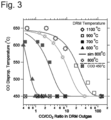
- Fig. 3 is a diagram showing the resulting relationship of reaction temperature T 1 , reaction temperature T 2 , and CO/CO 2 in synthesis gas 111.
- reaction temperature T 1 is 600°C
- the amount of CO 2 derived becomes less, typically less than the amount of CO 2 introduced, in the region inside each plot (in the direction towards origin).
- Table 1 represents the Inflection and Gradient at each reaction temperature T 1 , where the values at 600°C, 700°C, and 900°C were determined by fitting, respectively.
- reaction temperature T 1 (°C).
- the plot of triangle represents Inflection, and the plot of square represents Gradient.
- the respective relationships obtained from the fitting of each plot were determined as follows. It should be noted that reaction temperature T 1 (°C) is preferably 600°C or higher.
- Inflection 1.06 ⁇ 10 ⁇ 4 ⁇ T 1 2 + ⁇ 0.130 ⁇ T 1 + 40.0 3
- Gradient 1.69 ⁇ 10 ⁇ 4 ⁇ T 1 2 + ⁇ 0.205 ⁇ T 1 + 62.2
- the curve represented by "sim 800°C" in Fig. 3 is a sigmoid curve obtained by determining Inflection and Gradient at reaction temperature T 1 of 800°C from the above relationship formulas (2) and (3) (these results are described in Table 1), and obtaining the sigmoid curve at the right hand side of the inequality sign on the right side of the resulting (1). This curve is consistent with the plots obtained by separate calculations, and the above condition settings have been found to be correct.
- reaction temperature T 1 temperature of the dry reforming reaction
- CO/CO 2 in the DRM outgas i.e., synthesis gas 111
- Fig. 5 is a diagram showing reaction temperature T 1 dependency of the relationship between CH 4 /CO 2 in the source gas and CO/CO 2 in synthesis gas 111.
- Fig. 5 represents "CH 4 /CO 2 in DRM InGas", i.e., CH 4 /CO 2 in source gas 110, and the vertical axis represents "CO/CO 2 in DRM OutGas", i.e., CO/CO 2 in synthesis gas 111.
- reaction temperature T 1 As shown in Fig. 5 , once reaction temperature T 1 is determined, CO/CO 2 in the synthesis gas can be controlled to the desired value by simply controlling CH 4 /CO 2 in the source gas, and the value can be easily determined by calculation.
- CO/CO 2 is more than 0 and 124 or less, and the lower limit value thereof is preferably 0.20 or more.
- the lower limit value thereof is preferably 0.20 or more.
- the upper limit value thereof is preferably 0.50 or less.
- CO/CO 2 is less than or equal to the above upper limit value, a better effect of the present invention can be obtained.
- Fig. 6 is a flow diagram of the present hydrogen production method.
- step S10 a dry reforming reaction is performed at reaction temperature T 1 (dry reforming reaction step).
- the dry reforming reaction can be performed by circulating source gas 110 into dry reforming reactor 103 at reaction temperature T 1 .
- Reaction temperature T 1 is not particularly limited, but is preferably equal to or higher than an activity onset temperature of the dry reforming catalyst. In a specific embodiment, reaction temperature T 1 is preferably 600°C or higher and is preferably 1100°C or lower, more preferably 900°C or lower.
- reaction temperature T 1 can be controlled by regulating first thermostat 102 of dry reforming reactor 103.
- Methods for controlling the mixing ratio of methane and carbon dioxide in source gas 110 are not particularly limited, and examples thereof include methods for controlling the mixing ratio of methane and carbon dioxide supplied via a flow path, respectively, by a source gas controller having a gas mixer and a mass flow controller.
- reaction temperature T 1 (°C) and CH 4 /CO 2 in source gas 110 are determined, CO/CO 2 in synthesis gas 111 can be calculated.
- step S11 a solid carbon capture reaction is performed such that the above-mentioned condition (1) is satisfied (solid carbon capture reaction step).
- the solid carbon capture reaction can be performed by circulating synthesis gas 111 in solid carbon collector 106 at reaction temperature T 2 .
- the solid carbon capture reaction can be performed such that the condition (1) is satisfied, by determining the corresponding reaction temperature T 2 (°C) based on CH 4 /CO 2 of source gas 110 supplied to the dry reforming reaction step and the composition (CO/CO 2 ) of synthesis gas 111 calculated at reaction temperature T 1 , and regulating second thermostat 105.
- step S12 processed gas 112 generated by the solid carbon capture reaction is separated into emission gas 114 and hydrogen 113 to obtain hydrogen 113 (hydrogen separation step).
- Hydrogen 113 can be separated by introducing processed gas 112 into hydrogen separator 107 and operating the separator under known conditions.
- step S13 heat is recovered from emission gas 114 (heat recovery step). Since emission gas 114 contains carbon monoxide, hydrogen, and the like, heat can be recovered, for example, by combusting them or the like. The recovered heat is preferably used for the dry reforming reaction and/or solid carbon capture reaction. It should be noted that the hydrogen production method of the present invention may not include this step.
- the amount of CO 2 emitted outside the system can be significantly reduced when producing hydrogen from the source gas containing methane and carbon dioxide by controlling CO/CO 2 in synthesis gas 111 and reaction temperature T 2 to an appropriate range as described above.
- Fig. 7 is a block diagram of a first embodiment of the hydrogen production system of the present invention.
- Hydrogen production system 200 has DRM reactor 103, solid carbon collector 106, hydrogen separator 107, heat recovery module 204, and source gas controller 205, which are connected via flow path 115 through which gas can be circulated.
- source gas controller 205 DRM reactor 103, solid carbon collector 106, and hydrogen separator 107 are connected in order (in series), and heat recovery module 204 is connected at its primary side to flow path 115 for emission gas 114 branched from hydrogen separator 107.
- Flow path 115 connected to the secondary side of heat recovery module 204 is joined between source gas controller 205 and DRM reactor 103.
- each part (component) in hydrogen production system 200 is connected by flow path 115 as described above, but the connection form (connection pathway) of each part in the hydrogen production system of the present invention is not limited to the above.
- hydrogen separator 107 may be arranged between DRM reactor 103 and solid carbon collector 106. Also, a plurality of one or more types of components may be arranged, where flow path 115 may be branched to have a plurality of same components arranged in parallel or a plurality of same components arranged in series.
- hydrogen production system 200 may further include one or more valves, water vapor removers, pressure controllers (pressure reducing valves, compressors), heat exchangers, or the like within the scope of exerting the effects of the present invention.
- DRM reactor 103 solid carbon collector 106, and hydrogen separator 107 included in hydrogen production system 200 are similar to those already described, and descriptions thereof are omitted.
- Heat recovery module 204 has the function of recovering heat from methane, carbon monoxide, hydrogen, and the like, which may be contained in emission gas 114 generated by the separation of hydrogen 113 from processed gas 112 by hydrogen separator 107.
- the heat recovery module may be a burner that combusts emission gas 114, a fuel cell using emission gas 114 as a fuel, and the like.
- the heat recovered by heat recovery module 204 is preferably used for temperature regulation of DRM reactor 103 and/or solid carbon collector 106 (in the figure, the transfer of heat is indicated by the symbol "Q").
- Circulating gas 120 emitted from heat recovery module 204 contains carbon dioxide, which is mixed into source gas 110 and used.
- CO 2 generated during hydrogen production is significantly reduced by hydrogen production system 200, and in an embodiment, CO 2 contained in circulating gas 120 is less than or equal to the amount of CO 2 required in source gas 110, it is even possible to perform circulation operation without emitting CO 2 outside hydrogen production system 200 while supplying CO 2 from outside of the system.
- Source gas controller 205 has the function of mixing methane 121 and carbon dioxide 122 to control the composition of source gas 110.
- Source gas controller 205 may include a gas mixer that mixes methane 121 supplied through a flow path and carbon dioxide 122 in any ratio, a mass flow controller, and the like.
- Hydrogen production system 200 includes regulator 201.
- Regulator 201 is a computer including processor 202 and memory 203. Regulator 201 intends to regulate DRM reactor 103, solid carbon collector 106, and source gas controller 205.
- regulator 201 may also intend to regulate hydrogen separator 107 and heat recovery module 204.
- Regulator 201 has a plurality of sensors for detecting an operating state of hydrogen production system 200. Detection signals from the plurality of sensors are input to regulator 201. Regulator 201 has temperature sensor (TEMP1) 130 that detects reaction temperature T 1 of the DRM reaction in DRM reactor 103, temperature sensor (TEMP2) 131 that detects reaction temperature T 2 of the solid carbon capture reaction in solid carbon collector 106, and flow sensor (FLOW) 132 that detects the mixing ratio of methane 121 and carbon dioxide 122 in source gas controller 205.
- temperature sensor (TEMP1) 130 that detects reaction temperature T 1 of the DRM reaction in DRM reactor 103
- temperature sensor (TEMP2) 131 that detects reaction temperature T 2 of the solid carbon capture reaction in solid carbon collector 106
- FLOW flow sensor
- TEMP1 and TEMP2 may directly detect the temperatures of gas in DRM reactor 103 and solid carbon collector 106 or may estimate each temperature from physical quantities such as the outputs of first thermostat 102 and second thermostat 105 and the operating time.
- Regulator 201 obtains, for example, the detection signal of temperature sensor (TEMP1) 130 for reaction temperature T 1 of the DRM reaction in DRM reactor 103, and controls the output of first thermostat 102 of DRM reactor 103 based on the obtained information.
- TMP1 temperature sensor
- Regulator 201 may have processor 202, which is a hardware device, and processor 202 may be a processor core that executes a program stored in a memory. Examples of such a processor core include a Central Processing Unit (CPU) and a Graphics Processing Unit (GPU).
- processor 202 may be a processor core that executes a program stored in a memory. Examples of such a processor core include a Central Processing Unit (CPU) and a Graphics Processing Unit (GPU).
- CPU Central Processing Unit
- GPU Graphics Processing Unit
- Processor 202 may be a hardware logic circuit that includes a programmed logic unit.
- the digital circuit is a logic circuit array, such as an Application-Specific Integrated Circuit (ASIC), a Field Programmable Gate Array (FPGA), a System on a Chip (SoC), a Programmable Gate Array (PGA), a Complex Programmable Logic Device (CPLD), and the like.
- ASIC Application-Specific Integrated Circuit
- FPGA Field Programmable Gate Array
- SoC System on a Chip
- PGA Programmable Gate Array
- CPLD Complex Programmable Logic Device
- the Regulator 201 has memory 203.
- the memory is a non-transitional and tangible storage medium that non-transitorily stores a program and/or data readable by a processor.
- the storage medium is provided by a semiconductor memory, a magnetic disk, an optical disk, and the like.
- the program may be distributed as a program alone or as a storage medium in which the program is stored.
- Processor 202 may also be a combination of a processor core and a hardware logic circuit.
- Fig. 8 is a flow diagram of hydrogen production with hydrogen production system 200.
- first thermostat 102 and source gas controller 205 are regulated by regulator 201 to perform the DRM reaction at reaction temperature T 1 (°C).
- reaction temperature T 1 (°C) is obtained by temperature sensor (TEMP1) 130.
- FLOW flow sensor
- T 1 reaction temperature
- T 1 temperature sensor
- source gas 110 is prepared by merging with circulating gas 120
- CH 4 /CO 2 in source gas controller 205 may be controlled based on the content of CO 2 in circulating gas 120.
- the content of CO 2 in circulating gas 120 can be calculated from the composition of source gas 110 used in the production and the like, a sensor measuring the composition of circulating gas 120 may be provided in the middle of flow path 115, regulator 201 may obtain the measurement value, and thereby source gas controller 205 may be regulated.
- synthesis gas 111 containing hydrogen and carbon monoxide is obtained from source gas 110 containing methane and carbon dioxide.
- step S21 second thermostat 105 is regulated by regulator 201 to perform a solid carbon capture reaction such that condition (1) is satisfied.
- regulator 201 determines whether the reaction conditions of the solid carbon capture reaction satisfy condition (1) based on CO/CO 2 of synthesis gas 111 calculated from CH 4 /CO 2 of source gas 110, reaction temperature T 1 (°C) obtained by temperature sensor (TEMP1) 130, and reaction temperature T 2 (°C) obtained by temperature sensor (TEMP2) 131, regulates the outputs of source gas controller 205, first thermostat 102, and second thermostat 105 such that the condition (1) is satisfied, and controls CO/CO 2 , reaction temperature T 1 , and reaction temperature T 2 .
- condition (1) based on CO/CO 2 of synthesis gas 111 calculated from CH 4 /CO 2 of source gas 110, reaction temperature T 1 (°C) obtained by temperature sensor (TEMP1) 130, and reaction temperature T 2 (°C) obtained by temperature sensor (TEMP2) 131.
- processed gas 112 may contain methane, carbon monoxide, water vapor, hydrogen, and the like in addition to carbon dioxide.
- step S22 hydrogen 113 separated from processed gas 112 by hydrogen separator 107 is obtained, and emission gas 114 is also obtained.
- step S23 the heat is recovered from emission gas 114 by heat recovery module 204, and circulating gas 120 is generated.
- Heat Q generated at step S23 is supplied to DRM reactor 103 and/or solid carbon collector 106 and used to control each reaction temperature.
- Circulating gas 120 generated at step S23 is merged through the flow path at the middle of source gas controller 205 and DRM reactor 103 and is used as part of source gas 110.
- Fig. 9 is a flow diagram of the regulation process performed by regulator 201 at step S21 described above.
- Regulator 201 regulates the reaction conditions of the DRM reaction and the reaction conditions of the solid carbon capture reaction by performing the above regulation processes. The CO 2 emissions outside the system is significantly reduced by the above regulation processes.
- regulator 201 obtains information about the operating state of hydrogen production system 200. Specifically, the temperature of the gas inside DRM reactor 103 (reaction temperature T 1 ) is obtained by temperature sensor (TEMP1) 130. Each flow rate (mixing ratio) of methane and carbon dioxide in source gas controller 205 is also obtained by flow sensor (FLOW) 132.
- T 1 temperature of the gas inside DRM reactor 103
- FLOW flow sensor
- regulator 201 calculates CO/CO 2 in the synthesis gas from the CH 4 /CO 2 ratio in the source gas in DRM reactor 103 and reaction temperature T 1 (°C).
- the CO/CO 2 is calculated by the thermal equilibrium calculation based on CH 4 /CO 2 in source gas 110 and reaction temperature T 1 .
- Software programs such as "COCO” can be used for this calculation.
- regulator 201 obtains the temperature of the gas in solid carbon collector 106 (reaction temperature T 2 ) by temperature sensor (TEMP2) 131.
- regulator 201 determines whether the relationship of CO/CO 2 in synthesis gas 111 introduced into solid carbon collector 106, reaction temperature T 1 (°C), and reaction temperature T 2 (°C) satisfies condition (1).
- step S33 a determination is made through the following steps.
- Inflection and Gradient are calculated by Formulas (2) and (3) based on the obtained reaction temperature T 1 (°C).
- the sigmoid curve at the right hand side of the inequality sign on the right side of condition (1) is obtained, and whether they are within the range of the above sigmoid curve is determined based on the calculated CO/CO 2 and the obtained reaction temperature T 2 .
- reaction temperature T 1 is regulated using first thermostat 102 based on the detection signal of temperature sensor (TEMP1) 130 (step S34), each flow rate (mixing ratio) of methane and carbon dioxide in source gas 110 is regulated based on the detection signal of flow sensor (FLOW) 132 using source gas controller 205 (step S35), and reaction temperature T 2 is regulated using second thermostat 105 based on the detection signal of temperature sensor (TEMP2) 131 (step S36).
- step S33 the determination is made at step S33 after performing steps S30 to S32 again, and steps S34 to S36 and S30 to S33 are repeated until condition (1) is satisfied.
- step S33 Yes
- the regulation process by regulator 201 ends, then returning to Fig. 8 , subsequent steps (step S22 and step S23) are performed.
- hydrogen production system 200 has regulator 201 that regulates each part such that condition (1) for CO/CO 2 in synthesis gas 111 and reaction temperature T 2 is satisfied, carbon dioxide emitted outside the system when producing hydrogen from the source gas is significantly reduced.
- hydrogen production system 200 has heat recovery module 204, heat from hydrogen contained in emission gas 114 and carbon monoxide can be recovered and the recovered heat can be used in the DRM reaction and/or the solid carbon capture reaction, thus carbon dioxide emitted by heating or the like (or electricity for heating) can also be reduced.
- Hydrogen production system 200 further has a flow path that merges circulating gas 120 with source gas 110.
- the content of carbon dioxide contained in circulating gas 120 is less than the (required) content of carbon dioxide contained in the source gas, thereby hydrogen production can be performed without emitting the carbon dioxide used in the process outside the system, in other words, while carbon dioxide is always supplied from outside of the system.
- Fig. 10 is a block diagram of a modification example of the hydrogen production system of the present invention.
- Hydrogen production system 200 described above has DRM reactor 103 that performs a DRM reaction and solid carbon collector 106 that performs a solid carbon capture reaction, while hydrogen production system 300 of Fig. 10 has reactor 301 that serves as both a DRM reactor and a solid carbon collector, instead the above.
- DRM catalyst 101 and catalyst for capturing solid carbon 104 are disposed, and source gas 110 introduced from the primary side is first brought into contact with DRM catalyst 101 to generate synthesis gas 111. Synthesis gas 111 is then brought into contact with catalyst for capturing solid carbon 104 to generate processed gas 112. The above reactions are performed in turn in reactor 301.
- the temperature in reactor 301 is controlled by third thermostat 302 regulated by regulator 201, and reaction temperature T 1 and reaction temperature T 2 are obtained by temperature sensor (TEMP1) 130 and temperature sensor (TEMP2) 131.
- reactor 301 examples include a reactor having a reaction tube, DRM catalyst 101 and catalyst for capturing solid carbon 104 which are filled into the reaction tube in order, and a heater that controls the temperature of the reaction tube.
- reactor 301 of hydrogen production system 300 has third thermostat 302 that controls the overall temperature
- the hydrogen production system may have first thermostat 102 that independently regulates the temperature of the DRM reaction (reaction temperature T 1 ) and second thermostat 105 that independently regulates the temperature of the solid carbon capture reaction (reaction temperature T 2 ), which may be configured to be regulated by regulator 201.
- hydrogen production system 300 has reactor 301 that serves as both a DRM reactor and a solid carbon collector, and also has a configuration in which the reaction temperature is performed by third thermostat 302, hydrogen production system 300 has an advantage that its structure is simpler and easier to regulate. This trend is more pronounced in particular when reaction temperature T 1 and reaction temperature T 2 are regulated to 600 to 620°C.
- Fig. 12 is a block diagram of the main part of a hydrogen production system that can be used to carry out the hydrogen production method of the present invention.
- Hydrogen production system 100 has dry reforming reactor 103 (hereinafter also referred to as a "DRM reactor"), solid carbon collector 106, and hydrogen separator 107, which are connected in order via flow path 115 for circulating gas.
- DRM reactor dry reforming reactor 103
- solid carbon collector 106 solid carbon collector 106
- hydrogen separator 107 hydrogen separator 107
- Source gas 110 containing methane (CH 4 ) and carbon dioxide (CO 2 ) is introduced into hydrogen production system 100 from the upstream side of DRM reactor 103 via flow path 115.
- Source gas 110 circulates through DRM reactor 103 and is converted to synthesis gas 111 by the DRM reaction (DRM reaction: CH 4 + CO 2 -> 2CO + 2H 2 ).
- the resulting synthesis gas 111 contains carbon monoxide (CO) and hydrogen generated by the DRM reaction.
- the resulting synthesis gas 111 may also contain methane that can be carbon dioxide by combustion, depending on the DRM reaction temperature T 1 (°C).
- DRM reactor 103 is not particularly limited as long as source gas 110 (source gas stream) can be contacted with dry reforming catalyst 101, and DRM reactor 103 may include, for example, a container in which source gas 110 can be circulated, dry reforming catalyst 101 (hereinafter also referred to as a "DRM catalyst") fixed in the container, and first thermostat 102 for regulating the temperature of the gas circulating in DRM reactor 103 (reaction temperature T 1 ), as shown in Fig. 12 .
- DRM catalyst dry reforming catalyst 101
- Dry reforming catalyst 101 may be a composite including a porous carrier containing alumina and an active ingredient carried on the porous carrier.
- the active ingredient may include nickel, cobalt, molybdenum, rhodium, ruthenium, aluminum, zirconium, magnesium, palladium, zinc, potassium, calcium, and an oxide thereof.
- the dry reforming catalyst is preferably "Ni#Y 2 O 3 ", a catalyst described in Chemical. Science., 2019, volume 10, p3701-3705 , from the viewpoint of obtaining a better effect of the present invention.
- Ni#Y 2 O 3 is a catalyst in which fibrous metal nickel having a thickness of tens of nanometers and oxygen-deficient Y 2 O 3 are intertwined to form a rooted structure.
- Ni#Y 2 O 3 can be made, for example, by the following methods.
- Ni-Y alloy metal nickel and metal yttrium are dissolved in an argon atmosphere to synthesize a Ni-Y alloy.
- the powder of this Ni-Y alloy (average particle size of 50 to 60 ⁇ m) is then heated with a gas stream consisting of CO, O 2 , and Ar to synthesize "Ni#Y 2 O 3 ".
- Synthesis gas 111 is then introduced from the upstream side of solid carbon collector 106. Synthesis gas 111 becomes processed gas 112 by a solid carbon capture reaction while circulating in solid carbon collector 106 (solid carbon capture (Boudoard) reaction: 2CO -> C + CO 2 ).
- Solid carbon collector 106 is not particularly limited as long as synthesis gas 111 from DRM reactor 103 can be contacted with catalyst for capturing solid carbon 104, and may include catalyst for capturing solid carbon 104 and second thermostat 105 for controlling reaction temperature T 2 .
- solid carbon collector 106 includes a reaction tube, catalyst for capturing solid carbon 104 contained in the reaction tube, and second thermostat 105 that is a heater disposed around the reaction tube.
- First flow path 115a for introducing synthesis gas 111 from DRM reactor 103 is connected to the upstream (primary) side of the reaction tube, and second flow path 115b for emitting processed gas 112 is connected to the downstream (secondary) side of the reaction tube.
- catalyst for capturing solid carbon 104 can have a configuration having substrate 11 that is a tubular substrate and coating layer 12 formed on the inner wall surface of substrate 11.
- solid carbon When synthesis gas 111 is introduced into solid carbon collector 106, solid carbon is deposited on coating layer 12 of catalyst for capturing solid carbon 104. The deposited solid carbon can be easily peeled off.
- substrate 11 of catalyst for capturing solid carbon 104 is a tubular substrate
- synthesis gas 111 can be easily circulated in catalyst for capturing solid carbon 104.
- the tubular substrate has less inner structure that interferes with the circulation, it is also an advantage that less clog due to the deposited solid carbon occurs.
- Substrate 11 is not particularly limited as long as it can be coated with a metal-containing component, and may be a stainless steel tube, an aluminum tube, or the like.
- substrate 11 is a tubular substrate having an inner wall surface of circular cross section, the inner diameter thereof is not particularly limited and may be, for example, 10 to 300 mm, or 10 to 1000 mm.
- substrate 11 is a tubular substrate
- the length thereof is not particularly limited, and may be, for example, 20 to 5000 mm.
- Substrate 11 may be a linearly extending tubular substrate or a twisted tubular substrate.
- Coating layer 12 contains at least one metal-containing component selected from the group consisting of iron oxide, cobalt oxide, magnesium oxide, molybdenum oxide, nickel oxide, manganese oxide, metal iron, metal cobalt, metal magnesium, metal molybdenum, metal nickel, and metal manganese as a main component.
- Coating layer 12 may contain iron oxide, and in particular may contain Fe 3 O 4 , Fe 2 O 3 , FeO, or a combination thereof as iron oxide.
- the content of the metal-containing component in coating layer 12 is preferably 40 mass% or more, more preferably 50 mass% or more, further preferably 60 mass% or more, particularly preferably 70 mass% or more, and preferably 100 mass% or less with respect to the total mass of coating layer 12 of 100 mass%.
- Coating layer 12 may contain a carrier containing aluminum oxide (Al 2 O 3 ) and metal iron carried thereon.
- the content of metal iron may be 40 to 50 mass% with respect to the mass of coating layer 12 of 100 mass%.
- Coating layer 12 is formed such that the entire or a portion of the surface (inner wall surface) of substrate 11 is covered.
- the thickness of coating layer 12 is not particularly limited, and may be, for example, 5 to 2000 ⁇ m or 10 to 2000 ⁇ m.
- coating layer 12 may be porous.
- the specific surface area of the porous coating layer may be from 5 to 1000 m 2 /g.
- Coating layer 12 can be formed, for example, by a method including adhering a coating solution containing at least one metal-containing component selected from the group consisting of iron oxide, cobalt oxide, magnesium oxide, molybdenum oxide, nickel oxide, manganese oxide, metal iron, metal cobalt, metal magnesium, metal molybdenum, metal nickel, and metal manganese, or a precursor thereof, and a solvent to a surface of substrate 11 (e.g., an inner wall surface); and removing the solvent from the coating solution adhered to the surface of substrate 11.
- the solvent of the coating solution may be, for example, water, alcohol, acetone, or a combination thereof.
- Processed gas 112 from solid carbon collector 106 is introduced into hydrogen separator 107 from the upstream side via second flow path 115b and separated into hydrogen 113 and emission gas 114.
- Emission gas 114 derived from hydrogen separator 107 contains carbon dioxide, carbon monoxide, a trace amount of unseparated hydrogen, and the like.
- Hydrogen separator 107 is not particularly limited as long as it has the function of separating processed gas 112 from solid carbon collector 106 into hydrogen 113 and emission gas 114 while circulating the processed gas, and may have a hydrogen separation membrane, a pressure swing adsorption mechanism, and the like.
- a palladium alloy-based thin membrane can be used as the hydrogen separation membrane.
- the palladium alloy-based hydrogen separation membrane those in which rare earth elements such as yttrium and gadolinium are added to palladium, those in which silver is added to palladium and the like can be used.
- Thin membranes containing mainly niobium, vanadium, titanium, tantalum, zirconium or the like, instead of palladium, can also be used.
- Examples of such a hydrogen separation membrane include those described in Japanese Patent Laid-Open No. 2000-159503 , Japanese Patent Laid-Open No. 2005-232533 , and Japanese Patent Laid-Open No. 2006-43677 or the like.
- hydrogen separation membranes that have both excellent hydrogen permeability and hydrogen embrittlement resistance
- those in which at least one metal component selected from the group consisting of chromium, iron, nickel, and cobalt, and further at least one metal component selected from the group consisting of aluminum, scandium, titanium, yttrium, zirconium, niobium, molybdenum, tantalum, lanthanum, cerium, praseodymium, neodymium, promethium, samarium, europium, gadolinium, terbium, dysprosium, holmium, erbium, thulium, ytterbium, and ruthenium are added to vanadium may also be used.
- Such hydrogen separation membranes are described, for example, in Japanese Patent Laid-Open No. 2008-55295 .
- Hydrogen separator 107 including the hydrogen separation membrane typically includes the hydrogen separation membrane, a flow path for supplying processed gas 112 from the upstream (primary) side of the hydrogen separation membrane to the hydrogen separation membrane, a flow path for emitting hydrogen 113 permeated through the hydrogen separation membrane to the downstream (secondary) side, and a flow path for recovering emission gas 114 not permeated through the hydrogen separation membrane after contacting with the hydrogen separation membrane.
- hydrogen separator 107 including a hydrogen separation membrane, those described in Japanese Patent Laid-Open No. 2019-5684 or the like can be used.
- a PSA-type hydrogen separator typically includes an adsorption column filled with adsorbents, a pump, and a flow path connecting them.
- adsorbents those that adsorb carbon dioxide, carbon monoxide, moisture and the like in processed gas 112 can be used.
- activated carbon zeolite, and alumina or the like can be used.
- adsorption, desorption, and washing are repeatedly performed as one cycle for each one of the adsorption columns.
- Adsorption is a step of adsorbing carbon dioxide, carbon monoxide and the like in processed gas 112 to the adsorbent to derive hydrogen.
- Desorption is a step of reducing the pressure in the adsorption column to desorb carbon dioxide, carbon monoxide, and the like from the adsorbent and derive them as emission gas 114.
- Washing is a step of washing the adsorption column with hydrogen.
- a flow path for introducing processed gas 112 is connected to the primary side, and a pipeline for deriving hydrogen 113 and a flow path for deriving emission gas 114 are connected to the secondary side, respectively.
- step S10 a dry reforming reaction is performed at reaction temperature T 1 (dry reforming reaction step).
- the dry reforming reaction can be performed by circulating source gas 110 into dry reforming reactor 103 at reaction temperature T 1 .
- Reaction temperature T 1 is not particularly limited, but is preferably equal to or higher than an activity onset temperature of the dry reforming catalyst. In a specific embodiment, reaction temperature T 1 is preferably 600°C or higher and is preferably 1100°C or lower, more preferably 900°C or lower.
- reaction temperature T 1 can be controlled by regulating first thermostat 102 of dry reforming reactor 103.
- Methods for controlling the mixing ratio of methane and carbon dioxide in source gas 110 are not particularly limited, and examples thereof include methods for controlling the mixing ratio of methane and carbon dioxide supplied via a flow path, respectively, by a source gas controller having a gas mixer and a mass flow controller.
- reaction temperature T 1 (°C) and CH 4 /CO 2 in source gas 110 are determined, CO/CO 2 in synthesis gas 111 can be calculated.
- a solid carbon capture reaction is performed (solid carbon capture reaction step).
- the solid carbon capture reaction can be performed by circulating synthesis gas 111 in solid carbon collector 106 at reaction temperature T 2 . It is preferable that the solid carbon capture reaction satisfies the following condition (1).
- the solid carbon capture reaction can be performed such that the condition (1) is satisfied by determining the corresponding reaction temperature T 2 (°C) based on CH 4 /CO 2 of source gas 110 supplied to the dry reforming reaction step and the composition (CO/CO 2 ) of synthesis gas 111 calculated at reaction temperature T 1 , and regulating second thermostat 105.
- step S12 processed gas 112 generated by the solid carbon capture reaction is separated into emission gas 114 and hydrogen 113 to obtain hydrogen 113 (hydrogen separation step).
- Hydrogen 113 can be separated by introducing processed gas 112 into hydrogen separator 107 and operating the separator under known conditions.
- step S13 heat is preferably recovered from emission gas 114 (heat recovery step). Since emission gas 114 contains carbon monoxide, hydrogen, and the like, heat can be recovered, for example, by combusting them or the like. The recovered heat is preferably used for the dry reforming reaction and/or solid carbon capture reaction.
- reaction temperature T 1 at step S10 the regulation of reaction temperature T 1 at step S10, condition (1) at step S11, and the heat recovery at step S13 are optional and may not be performed.
- the amount of CO 2 emitted outside the system can be preferably reduced significantly when producing hydrogen from the source gas containing methane and carbon dioxide by controlling CO/CO 2 in synthesis gas 111 and reaction temperature T 2 to an appropriate range.
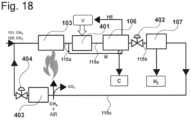
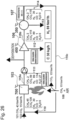
- Fig. 13 shows the basic configuration of a hydrogen production system to carry out the hydrogen production method of the second embodiment.
- the hydrogen production method of the present invention includes:
- emission gas 114 containing carbon dioxide is circulated to DRM reactor 103 via third flow path 115c connecting hydrogen separator 107 and DRM reactor 103, the carbon dioxide contained in emission gas 114 is not emitted outside the hydrogen production system. This enables the amount of carbon dioxide emitted outside the system to be reduced.
- the hydrogen production method and system according to the second embodiment can produce hydrogen equivalent to or greater than the conventional hydrogen production method and system by circulating carbon dioxide internally without emitting outside and thus reducing the amount of carbon dioxide emitted outside the system compared to the conventional hydrogen production method and system.
- Fig. 14 shows a block diagram of a hydrogen production system to carry out the hydrogen production method of the third embodiment.
- methane is combusted to generate heat and carbon dioxide
- the generated heat is introduced into the dry reforming reaction step
- the source gas containing carbon dioxide in an amount equal to the generated carbon dioxide is introduced into the dry reforming reaction step to capture carbon in an amount equal to the total amount of carbon contained in carbon dioxide and methane in the source gas as solid carbon in the solid carbon capture step in the hydrogen production method shown in Fig. 13 .
- the hydrogen production system shown in Fig. 14 further includes methane combustion furnace 108 and heat supply path 108a that supplies heat from methane combustion furnace 108 to dry reforming reactor 103 in the hydrogen production system shown in Fig. 13 .
- Fig. 15 shows a block diagram of a hydrogen production system to carry out the hydrogen production method of the fourth embodiment.
- the hydrogen production method shown in Fig. 15 further includes, in the hydrogen production method shown in Fig. 13 , taking out and combusting a portion of the separated hydrogen 113 in hydrogen separation step 107 and supplying heat generated to dry reforming reaction step 103.
- the hydrogen production system shown in Fig. 15 further includes, in the hydrogen production system shown in Fig. 13 , hydrogen extraction path 116 that takes out a portion of hydrogen 113a from hydrogen separator 107, hydrogen combustion furnace 109 that combusts hydrogen, and heat supply path 109a that supplies heat from hydrogen combustion furnace 109 to dry reforming reactor 103.
- At least a portion of carbon dioxide as a source gas is not required and the hydrogen production by methane reforming becomes possible without emitting carbon dioxide.
- Fig. 15 shows a configuration in which hydrogen combustion furnace 109 and heat supply path 109a are provided in the hydrogen production system of the second embodiment (basic configuration) shown in Fig. 13 , those can be additionally provided in the hydrogen production system shown in Fig. 14 .
- heat from emission gas 114 is recovered and supplied to dry reforming reaction step 103 before introducing emission gas 114 from hydrogen separation step 107 into dry reforming reaction step 103 in the hydrogen production method shown in Fig. 13 .
- heat recovery module 204 that recovers heat from emission gas 114 is connected to the middle of third flow path 115c, and the heat recovered in heat recovery module 204 is supplied to dry reforming reactor 103 in the hydrogen production system shown in Fig. 13 .
- Heat recovery module 204 may be a combustion furnace that introduces oxygen to combust emission gas 114, or a fuel cell.
- the hydrogen production method and system of the present embodiment can reduce the energy introduced from outside the system by utilizing the heat recovered by the heat recovery module for the dry reforming reaction.
- Fig. 16 shows a configuration in which heat recovery module 204 is provided in the hydrogen production system of the second embodiment (basic configuration) shown in Fig. 13
- heat recovery module 204 can be additionally provided in the hydrogen production system shown in Fig. 14 or Fig. 15 .
- Hydrogen production system 200 shown in Fig. 17 includes source gas controller 205 and regulator 201 that regulates the gas flow rate of source gas controller 205, as well as the temperatures of DRM reactor 103 and solid carbon collector 106 in the hydrogen production system shown in Fig. 16 .
- source gas controller 205 DRM reactor 103, solid carbon collector 106, and hydrogen separator 107 are connected in order (in series), and heat recovery module 204 is connected in its primary side to third flow path 115c for emission gas 114 branched from hydrogen separator 107.
- Third flow path 115c connected to the secondary side of heat recovery module 204 is joined between source gas controller 205 and DRM reactor 103.
- Heat recovery module 204 has the function of recovering heat from methane, carbon monoxide, hydrogen, and the like, which may be contained in emission gas 114 generated by the separation of hydrogen 113 from processed gas 112 by hydrogen separator 107.
- the heat recovery module may be a burner that combusts emission gas 114, a fuel cell using emission gas 114 as a fuel, and the like.
- the heat recovered by heat recovery module 204 is preferably used for temperature regulation of DRM reactor 103 and/or solid carbon collector 106 (in the figure, the transfer of heat is indicated by the symbol "Q").
- Circulating gas 120 emitted from heat recovery module 204 contains carbon dioxide, which is mixed into source gas 110 and used.
- CO 2 generated during hydrogen production is significantly reduced by hydrogen production system 200, and in an embodiment, CO 2 contained in circulating gas 120 is less than or equal to the amount of CO 2 required in source gas 110, it is even possible to perform circulation operation without emitting CO 2 outside hydrogen production system 200 while CO 2 is supplied from outside of the system.
- Source gas controller 205 has the function of mixing methane 121 and carbon dioxide 122 to control the composition of source gas 110.
- Source gas controller 205 may include a gas mixer that mixes methane 121 supplied through a flow path and carbon dioxide 122 in any ratio, a mass flow controller, and the like.
- Hydrogen production system 200 includes regulator 201.
- Regulator 201 is a computer including processor 202 and memory 203. Regulator 201 intends to regulate DRM reactor 103, solid carbon collector 106, and source gas controller 205.
- regulator 201 may also intend to regulate hydrogen separator 107 and heat recovery module 204.
- Regulator 201 has a plurality of sensors for detecting an operating state of hydrogen production system 200. Detection signals from the plurality of sensors are input to regulator 201. Regulator 201 has temperature sensor (TEMP1) 130 that detects reaction temperature T 1 of the DRM reaction in DRM reactor 103, temperature sensor (TEMP2) 131 that detects reaction temperature T 2 of the solid carbon capture reaction in solid carbon collector 106, and flow sensor (FLOW) 132 that detects the mixing ratio of methane 121 and carbon dioxide 122 in source gas controller 205.
- temperature sensor (TEMP1) 130 that detects reaction temperature T 1 of the DRM reaction in DRM reactor 103
- temperature sensor (TEMP2) 131 that detects reaction temperature T 2 of the solid carbon capture reaction in solid carbon collector 106
- FLOW flow sensor
- TEMP1 and TEMP2 may directly detect the temperatures of gas in DRM reactor 103 and solid carbon collector 106 or may estimate each temperature from physical quantities such as the outputs of first thermostat 102 and second thermostat 105 and the operating time.
- Regulator 201 obtains, for example, the detection signal of temperature sensor (TEMP1) 130 for reaction temperature T 1 of the DRM reaction in DRM reactor 103, and controls the output of first thermostat 102 of DRM reactor 103 based on the obtained information.
- TMP1 temperature sensor
- Regulator 201 may have processor 202, which is a hardware device, and processor 202 may be a processor core that executes a program stored in a memory. Examples of such a processor core include a Central Processing Unit (CPU) and a Graphics Processing Unit (GPU).
- processor 202 may be a processor core that executes a program stored in a memory. Examples of such a processor core include a Central Processing Unit (CPU) and a Graphics Processing Unit (GPU).
- CPU Central Processing Unit
- GPU Graphics Processing Unit
- Processor 202 may be a hardware logic circuit that includes a programmed logic unit.
- the digital circuit is a logic circuit array, such as an Application-Specific Integrated Circuit (ASIC), a Field Programmable Gate Array (FPGA), a System on a Chip (SoC), a Programmable Gate Array (PGA), a Complex Programmable Logic Device (CPLD), and the like.
- ASIC Application-Specific Integrated Circuit
- FPGA Field Programmable Gate Array
- SoC System on a Chip
- PGA Programmable Gate Array
- CPLD Complex Programmable Logic Device
- the Regulator 201 has memory 203.
- the memory is a non-transitional and tangible storage medium that non-transitorily stores a program and/or data readable by a processor.
- the storage medium is provided by a semiconductor memory, a magnetic disk, an optical disk, and the like.
- the program may be distributed as a program alone or as a storage medium in which the program is stored.
- Processor 202 may also be a combination of a processor core and a hardware logic circuit.
- Hydrogen production system 200 can perform the flow of hydrogen production shown in Fig. 8 .
- first thermostat 102 and source gas controller 205 are regulated by regulator 201 to perform the DRM reaction at reaction temperature T 1 (°C).
- reaction temperature T 1 (°C) is obtained by temperature sensor (TEMP1) 130.
- FLOW flow sensor
- T 1 reaction temperature
- T 1 temperature sensor
- source gas 110 is prepared by merging with circulating gas 120
- CH 4 /CO 2 in source gas controller 205 may be controlled based on the content of CO 2 in circulating gas 120.
- the content of CO 2 in circulating gas 120 can be calculated from the composition of source gas 110 used in the production and the like, a sensor measuring the composition of circulating gas 120 may be provided in the middle of flow path 115, regulator 201 may obtain the measurement value, and thereby source gas controller 205 may be regulated.
- synthesis gas 111 containing hydrogen and carbon monoxide is obtained from source gas 110 containing methane and carbon dioxide.
- step S21 second thermostat 105 is regulated by regulator 201 to perform a solid carbon capture reaction such that condition (1) is satisfied.
- regulator 201 determines whether the reaction conditions of the solid carbon capture reaction satisfy condition (1) based on CO/CO 2 of synthesis gas 111 calculated from CH 4 /CO 2 of source gas 110, reaction temperature T 1 (°C) obtained by temperature sensor (TEMP1) 130, and reaction temperature T 2 (°C) obtained by temperature sensor (TEMP2) 131, regulates the outputs of source gas controller 205, first thermostat 102, and second thermostat 105 such that the condition (1) is satisfied, and controls CO/CO 2 , reaction temperature T 1 , and reaction temperature T 2 .
- condition (1) based on CO/CO 2 of synthesis gas 111 calculated from CH 4 /CO 2 of source gas 110, reaction temperature T 1 (°C) obtained by temperature sensor (TEMP1) 130, and reaction temperature T 2 (°C) obtained by temperature sensor (TEMP2) 131.
- processed gas 112 may contain methane, carbon monoxide, water vapor, hydrogen, and the like in addition to carbon dioxide.
- step S22 hydrogen 113 separated from processed gas 112 by hydrogen separator 107 is obtained, and emission gas 114 is also obtained.
- step S23 the heat is recovered from emission gas 114 by heat recovery module 204, and circulating gas 120 is generated.
- Heat Q generated at step S23 is supplied to DRM reactor 103 and/or solid carbon collector 106 and used to control each reaction temperature.
- Circulating gas 120 generated at step S23 is merged through the flow path at the middle of source gas controller 205 and DRM reactor 103 and is used as part of source gas 110.
- the regulation process flow performed by regulator 201 at step S21 described above may be a flow diagram shown in Fig. 9 .
- Regulator 201 regulates the reaction conditions of the DRM reaction and the reaction conditions of the solid carbon capture reaction by performing the above regulation processes. The CO 2 emissions outside the system is significantly reduced by the above regulation processes.
- regulator 201 obtains information about the operating state of hydrogen production system 200. Specifically, the temperature of the gas inside DRM reactor 103 (reaction temperature T 1 ) is obtained by temperature sensor (TEMP1) 130. Each flow rate (mixing ratio) of methane and carbon dioxide in source gas controller 205 is also obtained by flow sensor (FLOW) 132.
- T 1 temperature of the gas inside DRM reactor 103
- FLOW flow sensor
- regulator 201 calculates CO/CO 2 in the synthesis gas from the CH 4 /CO 2 ratio in the source gas in DRM reactor 103 and reaction temperature T 1 (°C).
- the CO/CO 2 is calculated by the thermal equilibrium calculation based on CH 4 /CO 2 in source gas 110 and reaction temperature T 1 .
- Software programs such as "COCO” can be used for this calculation.
- regulator 201 obtains the temperature of the gas in solid carbon collector 106 (reaction temperature T 2 ) by temperature sensor (TEMP2) 131.
- regulator 201 determines whether the relationship of CO/CO 2 in synthesis gas 111 introduced into solid carbon collector 106, reaction temperature T 1 (°C), and reaction temperature T 2 (°C) satisfies condition (1).
- step S33 a determination is made through the following steps.
- Inflection and Gradient are calculated by Formulas (2) and (3) based on the obtained reaction temperature T 1 (°C).
- the sigmoid curve at the right hand side of the inequality sign on the right side of condition (1) is obtained, and whether they are within the range of the above sigmoid curve is determined based on the calculated CO/CO 2 and the obtained reaction temperature T 2 .
- [Formula 8] (Condition 1) 450 ⁇ T 2 ⁇ 750 ⁇ 300 1 + e Inflection ⁇ CO / CO 2 Gradient
- reaction temperature T 1 is regulated using first thermostat 102 based on the detection signal of temperature sensor (TEMP1) 130 (step S34), each flow rate (mixing ratio) of methane and carbon dioxide in source gas 110 is regulated based on the detection signal of flow sensor (FLOW) 132 using source gas controller 205 (step S35), and reaction temperature T 2 is regulated using second thermostat 105 based on the detection signal of temperature sensor (TEMP2) 131 (step S36).
- step S33 the determination is made at step S33 after performing steps S30 to S32 again, and steps S34 to S36 and S30 to S33 are repeated until condition (1) is satisfied.
- step S33 Yes
- the regulation process by regulator 201 ends, then returning to Fig. 8 , subsequent steps (step S22 and step S23) are performed.
- hydrogen production system 200 has regulator 201 that regulates each part such that condition (1) for CO/CO 2 in synthesis gas 111 and reaction temperature T 2 is satisfied, carbon dioxide emitted outside the system when producing hydrogen from the source gas is significantly reduced.
- hydrogen production system 200 has heat recovery module 204, heat from hydrogen contained in emission gas 114 and carbon monoxide can be recovered and the recovered heat can be used in the DRM reaction and/or the solid carbon capture reaction, thus carbon dioxide emitted by heating or the like (or electricity for heating) can also be reduced.
- Hydrogen production system 200 further has a flow path that merges circulating gas 120 with source gas 110.
- the content of carbon dioxide contained in circulating gas 120 is less than the (required) content of carbon dioxide contained in the source gas, thereby hydrogen production can be performed without emitting the carbon dioxide used in the process outside the system, in other words, while carbon dioxide is always supplied from outside of the system.
- each part (component) in hydrogen production system 200 is connected by flow path 115 as described above, but the connection form (connection pathway) of each part in the hydrogen production system 200 of the present invention is not limited to the above.
- hydrogen separator 107 may be arranged between DRM reactor 103 and solid carbon collector 106. Also, a plurality of one or more types of components may be arranged, where flow path 115 may be branched to have a plurality of same components arranged in parallel or a plurality of same components arranged in series.
- hydrogen production system 200 may further include one or more valves, water vapor removers, pressure controllers (pressure reducing valves, compressors), heat exchangers, or the like within the scope of exerting the effects of the present invention.
- the hydrogen production method or hydrogen production system shown in Fig. 18 further includes compressor 401 in first flow path 115a in the hydrogen production method or hydrogen production system shown in Fig. 13 .
- the hydrogen separation membrane described above When the hydrogen separation membrane described above is used as hydrogen separator 107, a low hydrogen partial pressure results in a low extraction amount of hydrogen.
- a PSA-type hydrogen separator described above When a PSA-type hydrogen separator described above is used as hydrogen separator 107, a low inlet pressure of the adsorbent in hydrogen separator 107 also results in a low extraction amount of hydrogen.
- the hydrogen production method or the hydrogen production system of the present embodiment further includes compressor 401 in first flow path 115a, the amount of hydrogen extracted in hydrogen separator 107 can be increased.
- Compressor 401 is not particularly limited, and may include or consist of a volumetric compressor, a turbo compressor, or a combination of two or more of these. Among these, the volumetric compressor is preferred. With the volumetric compressor, a high compression ratio can be achieved by a small number of steps.
- the hydrogen production method or hydrogen production system shown in Fig. 18 further includes heat exchanger HE that converts heat generated in solid carbon collector 106 into steam and supplies the steam to compressor 401.
- the heat generated in solid carbon collector 106 can be converted to steam V by heat exchanger HE and steam V can be supplied to compressor 401.
- the solid carbon capture reaction is an exothermic reaction, and the heat generated by the reaction can be used to drive compressor 401 to reduce the consumption of driving power.
- pressure control valve 402 is provided at an inlet of hydrogen separator 107 in second flow path 115b, and gas holder 403 and pressure control valve 404 are provided in third flow path 115c.
- first flow path 115a includes compressor 401
- conditions for the separation and extraction of hydrogen in hydrogen separator 107 can be regulated by providing pressure control valve 402 at the inlet of hydrogen separator 107.
- Pressure control valve 404 for depressurizing emission gas 114 and gas holder 403 for holding the gas provided in third flow path 115c can facilitate the merge of emission gas 114 at the inlet of dry reforming reactor 103.
- Pressure control valves 402 and 404 are not particularly limited and may be operated by appropriately using primary and secondary valves.
- Gas holder 403 is not particularly limited.
- the gas holder can be used to reduce pressure fluctuation.
- the hydrogen production method or hydrogen production system shown in Fig. 18 further includes water supply path W that supplies water generated in dry reforming reactor 103 to solid carbon collector 106.
- the water taken out and condensed from dry reforming reactor 103 can be used as cooling water for regulating the temperature of the solid carbon capture reaction and the consumption of cooling water can thus be reduced.
- the hydrogen production method or the hydrogen production system shown in Fig. 18 includes compressor 401 in first flow path 115a, and further includes a steam supply path that supplies steam V generated in solid carbon collector 106 to compressor 401.
- the steam generated by the solid carbon capture reaction can be used to drive compressor 401 provided in first flow path 115a to reduce the consumption of the driving power of compressor 401.
- Fig. 18 shows a configuration including compressor 401, pressure control valve 402, gas holder 403, and pressure control valve 404, heat exchanger HE, water supply path W, and a steam supply path.
- compressor 401 pressure control valve 402, gas holder 403, and pressure control valve 404, heat exchanger HE, water supply path W, and a steam supply path.
- another configuration only including compressor 401 is also possible and the configuration members other than compressor 401 are preferably provided in a system including compressor 401 and not always required to be provided in their entirety.
- Fig. 18 also shows a configuration including compressor 401, pressure control valve 402, gas holder 403, and pressure control valve 404, heat exchanger HE, water supply path W, and a steam supply path based on the basic configuration of the hydrogen production system shown in Fig. 13 , but those members can also be provided in each of the hydrogen production systems shown in Figs. 14 to 16 .
- Fig. 19 shows modification example 1 of the solid carbon collector.
- first flow path 115a at downstream side of compressor 401 may be branched to have a plurality of solid carbon collectors 106 arranged in parallel, and valves 405A, 405B, 405C and valves 406A, 406B, 406C may be provided at the inlet and the outlet of each solid carbon collector 106A, 106B, 106C, respectively.
- Fig. 19 shows three sets of combination of a solid carbon collector and a valve, the number of sets is not limited thereto.
- a valve for the inlet of at least one of the plurality of solid carbon collectors can be closed to discharge the solid carbon while another solid carbon collector can be continuously operated. Carbon capture is thus possible while the hydrogen production system is continuously operated.
- inlet valve 405C is closed and outlet valve 406C is open, thus solid carbon is emitted from solid carbon collector 106C.
- solid carbon collectors 106A and 106B operates continuously to capture solid carbon.
- the hydrogen production system further includes buffer tank 407 in first flow path 115a at downstream side of compressor 401 and upstream side of the branch.
- solid carbon collectors 106A, 106B, and 106C When solid carbon is emitted from at least one of solid carbon collectors 106A, 106B, and 106C, other solid carbon collectors may have pressure fluctuations. Such a pressure fluctuation can be buffered by providing buffer tank 407 in first flow path 115a at downstream side of compressor 401 and upstream side of the branch.
- Buffer tank 407 provided in the previous stage of the plurality of solid carbon collectors is not particularly limited.
- Fig. 20 shows modification example 2 of the solid carbon collector.
- the hydrogen production system may further include compressor 401 in first flow path 115a, where a plurality of the solid carbon collectors 106D, 106E may be arranged in series, and a gas composition controller 408 may be provided between each of the solid carbon collectors.
- the arrangement of the plurality of solid carbon collectors 106D, 106E in series can increase the entire amount of carbon captured in the hydrogen production system.
- the concentration of carbon monoxide decreases and the concentration of carbon dioxide increases in the downstream-side solid carbon collector 106E when carbon is captured in the upstream-side solid carbon collector 106D, thus reactions are less likely to occur in the downstream-side solid carbon collector 106E.
- gas composition controller 408 is provided at the outlet of each solid carbon collector to control the gas composition to be susceptible to reaction in the downstream-side solid carbon collector, the capture rate at the downstream-side solid carbon collector can be improved.
- the reaction (1) in solid carbon collector 106E is less likely to occur than the reaction (1) in solid carbon collector 106D as much as the CO concentration decreases and the CO 2 concentration increases.
- at least a portion of CO 2 contained in the outlet gas of solid carbon collector 106D is recovered at gas composition controller 408. This reduces the CO 2 concentration contained in the outlet gas and relatively increases the CO concentration, which makes the reaction (1) in solid carbon collector 106E more likely to occur, and as a result, the carbon capture rate in solid carbon collector 106E can be improved.
- the CO 2 recovered at the gas composition controller 408 can be reused as a component of source gas 110 to be introduced into DRM reactor 103.
- the gas composition controller 408 may include or consist of, but is not particularly limited to, a gas separation membrane, a gas adsorption and desorption system, or a combination of two or more of these. Among these, a gas separation membrane is preferred. The use of gas separation membrane has the effect of reducing footprint and/or optimizing energy costs.
- Fig. 21 is a graph showing the carbon deposition equilibrium composition of the synthesis gas at each temperature in a solid carbon collector.
- the horizontal axis represents the ratio of moles of oxygen to moles of carbon (O/C) and the vertical axis represents the ratio of moles of hydrogen to moles of carbon (H/C).
- the temperature (400, 500, 600, or 700°C) represents the temperature in the solid carbon collector.
- the region on the lower left side of the curve of each temperature in Fig. 21 is the region where the carbon capture reaction occurs, and the region on the upper right side of the curve is the region where the carbon capture reaction does not occur.
- the gas composition is controlled by using gas composition controller 408 in accordance with the temperature in the downstream-side solid carbon collector 106E to ensure that the reaction occur in the downstream-side solid carbon collector 106E.
- Fig. 22 is a block diagram of a modification example of the hydrogen production system of the present invention.
- Hydrogen production system 200 described above has DRM reactor 103 that performs a DRM reaction and solid carbon collector 106 that performs a solid carbon capture reaction, while hydrogen production system 300 of Fig. 22 has reactor 301 that serves as both a DRM reactor and a solid carbon collector instead the above.
- DRM catalyst 101 and catalyst for capturing solid carbon 104 are disposed, and source gas 110 introduced from the primary side is first brought into contact with DRM catalyst 101 to generate synthesis gas 111. Synthesis gas 111 is then brought into contact with catalyst for capturing solid carbon 104 to generate processed gas 112. The above reactions are performed in turn in reactor 301.
- the temperature in reactor 301 is controlled by third thermostat 302 regulated by regulator 201, and reaction temperature T 1 and reaction temperature T 2 are obtained by temperature sensor (TEMP1) 130 and temperature sensor (TEMP2) 131.
- reactor 301 examples include a reactor having a reaction tube, DRM catalyst 101 and catalyst for capturing solid carbon 104 which are filled into the reaction tube in order, and a heater that controls the temperature of the reaction tube.
- reactor 301 of hydrogen production system 300 has third thermostat 302 that controls the overall temperature
- the hydrogen production system may have first thermostat 102 that independently regulates the temperature of the DRM reaction (reaction temperature T 1 ) and second thermostat 105 that independently regulates the temperature of the solid carbon capture reaction (reaction temperature T 2 ), which may be configured to be regulated by regulator 201.
- hydrogen production system 300 has reactor 301 that serves as both a DRM reactor and a solid carbon collector, and also has a configuration in which the reaction temperature is performed by third thermostat 302, hydrogen production system 300 has an advantage that its structure is simpler and easier to regulate. This trend is more pronounced in particular when reaction temperature T 1 and reaction temperature T 2 are regulated to 600 to 620°C.
- the content molar ratio (CO/CO 2 ) of the content of carbon monoxide to the content of carbon dioxide in the synthesis gas, reaction temperature T 1 (°C) of the dry reforming reaction, and reaction temperature T 2 (°C) of the solid carbon capture reaction are regulated to satisfy the following condition (1).
- DRM reactor 103 has dry reforming catalyst 101 (hereinafter also referred to as a "DRM catalyst") and first thermostat 102 for regulating the temperature of the gas circulating in DRM reactor 103 (reaction temperature T 1 ).
- Solid carbon collector 106 has catalyst for capturing solid carbon 104 and second thermostat 105 for regulating the temperature of the gas circulating in solid carbon collector 106 (reaction temperature T 2 ).
- dry reforming reactor 103 is not particularly limited as long as source gas 110 (source gas stream) can be contacted with dry reforming catalyst 101 at reaction temperature T 1 .
- dry reforming reactor 103 may include a container in which source gas 110 can be circulated, dry reforming catalyst 101 fixed in the container, and first thermostat 102 that is a heater.
- Solid carbon collector 106 includes catalyst for capturing solid carbon 104 and second thermostat 105 for controlling reaction temperature T 2 .
- solid carbon collector 106 includes a reaction tube, catalyst for capturing solid carbon 104 contained in the reaction tube, and second thermostat 105 that is a heater disposed around the reaction tube.
- First flow path 115a for introducing synthesis gas 111 is connected to the upstream (primary) side of the reaction tube, and second flow path 115b for emitting processed gas 112 is connected to the downstream (secondary) side of the reaction tube.
- the balance between the amount of CO 2 introduced as part of source gas 110 and the amount of CO 2 derived in emission gas 114 in the hydrogen production using hydrogen production system 100 is described. It should be noted that the amount of CO 2 derived is calculated considering the influence of CO that can be contained in emission gas 114 and may generate CO 2 by combustion.
- DRM reactor 103 is kept at 600°C, i.e., reaction temperature T 1 is 600°C.
- the composition of synthesis gas 111 can be estimated by thermal equilibrium calculation.
- the emission amount will be 105 L/h with respect to 101 L/h of CO 2 flowed into the hydrogen production system.
- CO/CO 2 is 1.24
- the emission amount will be 103 L/h with respect to the inflow amount of 90 L/h
- CO/CO 2 is 1.53
- the emission amount will be 102 L/h with respect to the inflow amount of 81 L/h.
- reaction temperature T 1 is 600°C and reaction temperature T 2 is 451°C, and CO/CO 2 in the synthesis gas is 0.396, the amount of CO 2 will be 116 L/h. In this case, the emission amount is less compared to the inflow amount of 121 L/h.
- thermodynamic response An estimation mechanism for obtaining a thermodynamic response as described above is described below.
- Fig. 2 shows a thermal equilibrium calculation result of the Boudouard reaction (2CO ⁇ CO 2 + C).
- the white (open) circular symbols and the black (closed) circular symbols represent molar fractions of CO 2 and CO (vertical axis: left) in processed gas 112 (derived gas, described as "Outgas” in the figure) relative to reaction temperature T 2 , respectively.
- the white (open) square symbols represent CO/CO 2 (vertical axis: right) in processed gas 112 relative to reaction temperature T 2 (°C).
- the light-off temperature (activity onset temperature) can theoretically be estimated to be 450°C.
- the light-off temperature means the lowest temperature at which the amount of CO contained in processed gas 112 reaches a significant value from zero when reaction temperature T 2 of the solid carbon capture reaction is gradually raised from 350°C while the mixture gas of CO and CO 2 are circulating.
- reaction temperature T 2 is gradually raised, the equilibrium of the Boudouard reaction shifts from right to left, so that the amount of CO contained in processed gas 112 increases accordingly.
- the content of CO in processed gas 112 affects the final amount of CO 2 emitted outside the system. By reducing the amount of CO emission, the final amount of CO 2 emission can be reduced.
- the amount of CO 2 emitted outside the hydrogen production system is also affected by the amount of CH 4 contained in processed gas 112.
- CH 4 is emitted into processed gas 112 because CH 4 is not involved in the solid carbon capture reaction.
- CO 2 is generated.
- the amount of CH 4 in synthesis gas 111 can be reworded as the residual CH 4 not used in the DRM reaction, and the residual CH 4 also needs to be controlled.
- the present inventors have investigated conditions under which the amount of CO 2 derived becomes less than or equal to the amount of CO 2 introduced by regulating reaction temperature T 2 and CO/CO 2 in synthesis gas 111 to a predetermined range. As a result, the present inventors have focused a certain contiguous region formed by the "range", and further investigated the relationship of reaction temperature T 1 , reaction temperature T 2 , and CO/CO 2 in synthesis gas 111.
- Fig. 3 is a diagram showing the resulting relationship of reaction temperature T 1 , reaction temperature T 2 , and CO/CO 2 in synthesis gas 111.
- reaction temperature T 1 is 600°C
- the amount of CO 2 derived becomes less, typically less than the amount of CO 2 introduced, in the region inside each plot (in the direction towards origin).
- Table 2 represents the Inflection and Gradient at each reaction temperature T 1 , where the values at 600°C, 700°C, and 900°C were determined by fitting, respectively.
- reaction temperature T 1 (°C).
- the plot of the triangle represents Inflection, and the plot of the square represents Gradient.
- reaction temperature T 1 (°C) is preferably 600°C or higher.
- 2 Inflection 1.06 ⁇ 10 ⁇ 4 ⁇ T 1 2 + ⁇ 0.130 ⁇ T 1 + 40.0 3
- Gradient 1.69 ⁇ 10 ⁇ 4 ⁇ T 1 2 + ⁇ 0.205 ⁇ T 1 + 62.2
- the curve represented by "sim 800°C" in Fig. 3 is a sigmoid curve obtained by determining Inflection and Gradient at reaction temperature T 1 of 800°C from the above relationship formulas (2) and (3) (these results are described in Table 2), and obtaining the sigmoid curve at the right hand side of the inequality sign on the right side of the resulting (1). This curve is consistent with the plots obtained by separate calculations, and the above condition settings have been found to be correct.
- reaction temperature T 1 temperature of the dry reforming reaction
- CO/CO 2 in the DRM outgas i.e., synthesis gas 111
- Fig. 5 is a diagram showing reaction temperature T 1 dependency of the relationship between CH 4 /CO 2 in the source gas and CO/CO 2 in synthesis gas 111.
- Fig. 5 represents "CH 4 /CO 2 in DRM InGas", i.e., CH 4 /CO 2 in source gas 110, and the vertical axis represents "CO/CO 2 in DRM OutGas", i.e., CO/CO 2 in synthesis gas 111.
- reaction temperature T 1 As shown in Fig. 5 , once reaction temperature T 1 is determined, CO/CO 2 in the synthesis gas can be controlled to the desired value by simply controlling CH 4 /CO 2 in the source gas, and the value can be easily determined by calculation.
- CO/CO 2 is more than 0 and 124 or less, and the lower limit value thereof is preferably 0.20 or more.
- the lower limit value thereof is preferably 0.20 or more.
- the upper limit value thereof is preferably 0.50 or less.
- CO/CO 2 is less than or equal to the above upper limit value, a better effect of the present invention can be obtained.
- temperature regulations in DRM reactor 103 and solid carbon collector 106 are not indispensable, but temperature regulation provides a better effect of the present invention.
- Ni#Y 2 O 3 a DRM catalyst, was synthesized with reference to Chemical Science, 2019, 10, 3701-3705 (Topologically immobilized catalysis centre for long-term stable carbon dioxide reforming of methane).
- a Fe 3 O 4 powder was then filled and fixed in a similar manner directly below its downstream side.
- a PdAg alloy membrane ( ⁇ 20 mm; thickness 100 ⁇ m) was connected in series to the downstream side of the quartz reaction tube in which the "Ni#Y 2 O 3 " powder and the Fe 3 O 4 powder are sequentially filled.
- Fig. 23 is a photograph of a hydrogen production system used in this demonstration experiment.
- the hydrogen production system of Fig. 23 has a pair of holders 501 for mounting the quartz reaction tube, heater 502, sensor 503 for measuring the temperature in the heater, and PdAg alloy membrane 504 disposed at the downstream side.
- the source gas flowed from FL1 circulates FL2 ( with the quartz reaction tube not mounted in the figure), FL3, FL4, FL5, and FL6 in order.
- the hydrogen flow rate at the secondary side of the PdAg alloy membrane increased along with the rising temperature, and the indicated value of the mass flow meter reached 3.1 ml/min at the temperature of 700°C. This value then gradually decreased and became a steady state of around 2.5 ml/min after 15 hours elapsed.
- Fig. 24 shows the result of the above demonstration test, where the horizontal axis represents the elapsed time, the vertical axis (left side) represents the amount of hydrogen produced (ml/min), and the vertical axis (right side) represents the total amount of hydrogen produced (L).
- the material balance and energy balance were determined by simulating the case where the temperature of DRM reactor 103 was regulated to 700°C, the temperature of solid carbon collector 106 was regulated to 450°C, the temperature of hydrogen separator 107 was regulated to 350°C, 15 Nm 3 /h of methane was combusted in the air in methane combustion furnace 108 outside the hydrogen production system as part of the heat applied to DRM reactor 103, and 15 Nm 3 /h of carbon dioxide was generated.
- the hydrogen extraction rate (%) can be calculated by calculating the ratio of the flow rate of hydrogen 113 from hydrogen separator 107 to the flow rate of hydrogen in processed gas 112 from solid carbon collector 106.
- the hydrogen extraction rate resulted in 75% in Example 1, confirming that hydrogen can be extracted at a high rate.
- the material balance and energy balance were determined by simulating the case where the temperature of DRM reactor 103 was regulated to 700°C, the temperature of solid carbon collector 106 was regulated to 450°C, the temperature of hydrogen separator 107 was regulated to 350°C, 15 Nm 3 /h of methane was combusted in the air in methane combustion furnace 108 outside the hydrogen production system as part of the heat applied to DRM reactor 103, and 15 Nm 3 /h of carbon dioxide was generated.
- the hydrogen extraction rate (%) can be calculated by calculating the ratio of the flow rate of hydrogen 113 from hydrogen separator 107 to the flow rate of hydrogen in processed gas 112 from solid carbon collector 106.
- the hydrogen extraction rate resulted in 66% in Example 1, confirming that hydrogen can be extracted at a high rate.
- the material balance and energy balance were determined by simulating the case where the temperature of DRM reactor 103 was regulated to 700°C, the temperature of solid carbon collector 106 was regulated to 450°C, the temperature of hydrogen separator 107 was regulated to 350°C, and the hydrogen separated and collected in hydrogen separator 107 was combusted as part of the heat applied to DRM reactor 103.
- the material balance and energy balance were determined by simulating the case where the temperature of DRM reactor 103 was regulated to 700°C, the temperature of solid carbon collector 106 was regulated to 550°C, the temperature of hydrogen separator 107 was regulated to 350°C, the heat from emission gas 114 was recovered as part of the heat applied to DRM reactor 103 before introducing emission gas 114 into DRM reactor 103, and 90 Nm 3 /h of carbon dioxide was generated.
- Circulating gas 120 circulated to DRM reactor 103 through third flow path 115c after the heat is recovered
Landscapes
- Chemical & Material Sciences (AREA)
- Chemical Kinetics & Catalysis (AREA)
- Organic Chemistry (AREA)
- Engineering & Computer Science (AREA)
- Inorganic Chemistry (AREA)
- Combustion & Propulsion (AREA)
- General Health & Medical Sciences (AREA)
- Health & Medical Sciences (AREA)
- General Chemical & Material Sciences (AREA)
- Life Sciences & Earth Sciences (AREA)
- Sustainable Development (AREA)
- Manufacturing & Machinery (AREA)
- Sustainable Energy (AREA)
- Electrochemistry (AREA)
- Materials Engineering (AREA)
- Oil, Petroleum & Natural Gas (AREA)
- Analytical Chemistry (AREA)
- Hydrogen, Water And Hydrids (AREA)
Abstract
[Formula 1]

wherein Inflection = (1.06 × 10⁻⁴) × (T1)2+(-0.130) × T,+40.0
Gradient = (1.69 × 10⁻⁴) × (T1)2+(-0.205) × T1+62.2
Description
- The present invention relates to a hydrogen production method and a hydrogen production system.
- Dry reforming (DRM) methods in which methane and carbon dioxide are reacted and converted into a synthesis gas containing carbon monoxide and hydrogen have been known.
- The DRM reaction (CH4 + CO2 -> 2CO + 2H2) may compete with a solid carbon deposition reaction (CH4 -> C + 2H2, 2CO -> C + CO2) depending on the reaction conditions, and the precipitated carbon may cause problems such as decreasing the catalytic activity of the catalyst (coking).
- As one of the solutions for the above problems, methods that can suppress degradation of catalysts and make them act for longer period of time by continuously performing the dry reforming reaction and the solid carbon capture reaction with separate catalysts have been developed.
- NPL 1 describes, as a device capable of performing such methods, a system in which Ni/Al2O3 is used as a dry reforming catalyst and a stainless steel tube is used as a catalyst for capturing solid carbon, and they are connected in order.
- NPL 1: Journal of CO2 Utilization, 2017, vol. 22, p. 91-96
- The present inventors have considered applying such a system described in
NPL 1 to hydrogen production and conceived a device including a hydrogen separator added to the above system, and have advanced developments of a method that can continuously extract hydrogen using methane and carbon dioxide as starting materials. - As a result, the present inventors have found for the first time that a continuous hydrogen (hydrogen gas) production is possible according to the above method; however, by simply combining the three processes of the dry reforming reaction, the solid carbon capture reaction, and a hydrogen separation, more carbon dioxide may have been emitted outside the reaction system than carbon dioxide contained in the source gas introduced into the reaction system.
- Reducing carbon dioxide emissions in the hydrogen production process is considered to be one of the important issues in hydrogen utilization. Accordingly, an object of the present invention is to provide a hydrogen production method in which the amount of carbon dioxide emitted outside the system are reduced. Another object of the present invention is to provide a hydrogen production system.
- The present inventors have intensively studied to solve the above problem, and as a result, have found that the above problem can be solved by the following configuration.
- [1] A hydrogen production method comprising:
- performing a dry reforming reaction to obtain a synthesis gas comprising carbon monoxide and hydrogen from a source gas comprising methane and carbon dioxide in the presence of a dry reforming catalyst;
- performing a solid carbon capture reaction by reacting the synthesis gas in the presence of a catalyst for capturing solid carbon to generate solid carbon from the carbon monoxide in the synthesis gas, thereby obtaining the solid carbon and a processed gas; and
- separating the processed gas into an emission gas and hydrogen to obtain hydrogen,
- wherein a content molar ratio CO/CO2 of a content of the carbon monoxide to a content of the carbon dioxide in the synthesis gas, reaction temperature T1 (°C) of the dry reforming reaction, and reaction temperature T2 (°C) of the solid carbon capture reaction satisfy the following condition (1):
[Formula 1]
- wherein Inflection = (1.06 × 10⁻⁴) × (T1)2+(-0.130) × T1+40.0 Gradient = (1.69 × 10⁻⁴) × (T1)2+(-0.205) × T1+62.2
- [2] The hydrogen production method according to [1], wherein the reaction temperature T2 is a temperature equal to or higher than an activity onset temperature of the catalyst for capturing solid carbon.
- [3] The hydrogen production method according to [1] or [2], wherein the content molar ratio CH4/CO2 of a content of the methane to a content of the carbon dioxide in the source gas is 0.5 or less.
- [4] The hydrogen production method according to any one of [1] to [3], wherein the reaction temperature T1 is a temperature equal to or higher than an activity onset temperature of the dry reforming catalyst.
- [5] The hydrogen production method according to any one of [1] to [4], wherein the reaction temperature T1 is 600°C or higher.
- [6] The hydrogen production method according to any one of [1] to [5], further comprising recovering heat from the emission gas and using the heat for at least one reaction selected from the group consisting of the dry reforming reaction and the solid carbon capture reaction.
- [7] The hydrogen production method according to [6], wherein the recovering is performed by introducing the emission gas into a fuel cell.
- [8] The hydrogen production method according to [6], wherein the recovering is performed by combusting the emission gas.
- [9] The hydrogen production method according to any one of [1] to [8], wherein the separating the processed gas is performed with a hydrogen separation membrane.
- [10] A hydrogen production system comprising:
- a dry reforming reactor that performs a dry reforming reaction to obtain a synthesis gas comprising carbon monoxide and hydrogen from a source gas comprising methane and carbon dioxide in the presence of a dry reforming catalyst;
- a solid carbon collector that performs a solid carbon capture reaction by reacting the synthesis gas in the presence of a catalyst for capturing solid carbon to generate solid carbon from the carbon monoxide in the synthesis gas, thereby obtaining the solid carbon and a processed gas;
- a hydrogen separator that separates the processed gas into an emission gas and hydrogen;
- a first thermostat that controls reaction temperature T1 (°C) of the dry reforming reaction;
- a second thermostat that controls reaction temperature T2 (°C) of the solid carbon capture reaction;
- a source gas controller that controls a composition of the source gas; and
- a regulator,
- wherein the regulator regulates the first thermostat, the second thermostat, and the source gas controller such that a content molar ratio CO/CO2 of a content of the carbon monoxide to a content of the carbon dioxide in the synthesis gas, the reaction temperature T1 (°C), and the reaction temperature T2 (°C) satisfy the following condition (1):
[Formula 2]
Gradient = (1.69 × 10⁻⁴) × (T1)2+(-0.205) × T1+62.2
- [11] The hydrogen production system according to [10], wherein the regulator regulates the source gas controller such that a content molar ratio CH4/CO2 of a content of the methane to a content of the carbon dioxide in the source gas is 0.5 or less.
- [12] The hydrogen production system according to [10] or [11], wherein the regulator regulates the first thermostat and the second thermostat to regulate reaction the temperature T1 to a temperature equal to or higher than an activity onset temperature of the dry reforming catalyst and to regulate reaction the temperature T2 to a temperature equal to or higher than an activity onset temperature of the catalyst for capturing solid carbon.
- [13] The hydrogen production system according to any one of [10] to [12], further comprising a heat recovery module for recovering heat from the emission gas.
- [14] The hydrogen production system according to [13], wherein the heat is used for heating at least one selected from the group consisting of the dry reforming reactor and the solid carbon collector.
- [15] The hydrogen production system according to any one of [10] to [14], wherein the hydrogen separator comprises a hydrogen separation membrane.
- [16] The hydrogen production system according to [13], wherein the heat recovery module comprises a fuel cell.
- [17] A hydrogen production method comprising:
- a dry reforming reaction step of obtaining a synthesis gas comprising carbon monoxide and hydrogen from a source gas comprising methane and carbon dioxide in the presence of a dry reforming catalyst;
- a solid carbon capture step of introducing the synthesis gas from the dry reforming reaction step to generate solid carbon from the carbon monoxide in the synthesis gas in the presence of a catalyst for capturing solid carbon, thereby obtaining a processed gas; and
- a hydrogen separation step of extracting hydrogen from the processed gas from the solid carbon capture step to obtain an emission gas comprising carbon dioxide,
- wherein the emission gas from the hydrogen separation step is introduced into the dry reforming reaction step to circulate carbon dioxide without emitting outside.
- [18] The hydrogen production method according to [17], wherein methane is combusted to generate heat and carbon dioxide, the generated heat is introduced into the dry reforming reaction step, and the source gas comprising carbon dioxide in an amount equal to the generated carbon dioxide is introduced into the dry reforming reaction step to capture carbon in an amount equal to carbon contained in carbon dioxide and methane in the source gas as solid carbon in the solid carbon capture step.
- [19] The hydrogen production method according to [17] or [18], further comprising taking out and combusting a portion of hydrogen separated in the hydrogen separation step and supplying generated heat to the dry reforming reaction step.
- [20] The hydrogen production method according to any one of [17] to [19], wherein heat from the emission gas is recovered and supplied to the dry reforming reaction step before introducing the emission gas from the hydrogen separation step into the dry reforming reaction step.
- [21] A hydrogen production system comprising:
- a dry reforming reactor that obtains a synthesis gas comprising carbon monoxide and hydrogen from a source gas comprising methane and carbon dioxide in the presence of a dry reforming catalyst;
- a solid carbon collector that introduces the synthesis gas from the dry reforming reactor to generate solid carbon from the carbon monoxide in the synthesis gas in the presence of a catalyst for capturing solid carbon, thereby obtaining a processed gas;
- a hydrogen separator that extracts hydrogen from the processed gas from the solid carbon collector to obtain an emission gas comprising carbon dioxide;
- a first flow path that supplies the synthesis gas from the dry reforming reactor to the solid carbon collector;
- a second flow path that supplies the processed gas from the solid carbon collector to the hydrogen separator; and
- a third flow path that supplies the emission gas from the hydrogen separator to the dry reforming reactor,
- wherein carbon dioxide is circulated internally without being emitted outside.
- [22] The hydrogen production system according to [21], further comprising a methane combustion furnace and a heat supply path that supplies heat from the methane combustion furnace to the dry reforming reactor.
- [23] The hydrogen production system according to [21] or [22], further comprising a hydrogen extraction path that takes out a portion of hydrogen from the hydrogen separator, a hydrogen combustion furnace that combusts the taken-out hydrogen, and a heat supply path that supplies heat from the hydrogen combustion furnace to the dry reforming reactor.
- [24] The hydrogen production system according to any one of [21] to [23], wherein a heat recovery module that recovers heat from the emission gas is connected to the middle of the third flow path, and the heat recovered in the heat recovery module is supplied to the dry reforming reactor.
- [25] The hydrogen production system according to any one of [21] to [24], further comprising a compressor in the first flow path.
- [26] The hydrogen production system according to [25], further comprising a heat exchanger that converts heat generated in the solid carbon collector into steam and supplies the steam to the compressor.
- [27] The hydrogen production system according to [25], wherein a pressure control valve is provided at an inlet of the hydrogen separator, and a gas holder and a pressure control valve are provided at an outlet of the hydrogen separator.
- [28] The hydrogen production system according to any one of [21] to [27], further comprising a water supply path that supplies water generated in the dry reforming reactor to the solid carbon collector.
- [29] The hydrogen production system according to [28], further comprising a compressor in the first flow path, and further comprising a steam supply path that supplies steam generated in the solid carbon collector to the compressor.
- [30] The hydrogen production system according to any one of [21] to [29], further comprising a compressor in the first flow path, wherein the first flow path at downstream side of the compressor is branched to have a plurality of the solid carbon collectors arranged in parallel, and valves are provided at an inlet and an outlet of each of the solid carbon collectors.
- [31] The hydrogen production system according to [30], further comprising a buffer tank in the first flow path at downstream side of the compressor and upstream side of the branch.
- [32] The hydrogen production system according to any one of [21] to [31], further comprising a compressor in the first flow path, wherein a plurality of the solid carbon collectors is arranged in series, and a gas composition controller is provided between each of the solid carbon collectors.
- The present invention can provide a hydrogen production method in which carbon dioxide emissions outside the system are reduced. Typically, a hydrogen production method in which the amount of carbon dioxide derived outside the system is less than the amount of carbon dioxide introduced into the system can be provided. The present invention can also provide a hydrogen production system.
-
- [
Fig. 1] Fig. 1 is a block diagram of an embodiment of a hydrogen production system that can be used to carry out the production method of the present invention. - [
Fig. 2] Fig. 2 shows a thermal equilibrium calculation result of the Boudouard reaction (2CO → CO2 + C). - [
Fig. 3] Fig. 3 is a diagram showing the relationship of reaction temperature T1, reaction temperature T2, and CO/CO2 in the synthesis gas. - [
Fig. 4] Fig. 4 is a diagram showing the relationship of Inflection and Gradient and reaction temperature T1. - [
Fig. 5] Fig. 5 is a diagram showing reaction temperature T1 dependency of the relationship between CH4/CO2 in the source gas and CO/CO2 in the synthesis gas. - [
Fig. 6] Fig. 6 is a flow diagram of the hydrogen production method of the present invention. - [
Fig. 7] Fig. 7 is a block diagram of a first embodiment of the hydrogen production system of the present invention. - [
Fig. 8] Fig. 8 is a flow diagram of hydrogen production withhydrogen production system 200. - [
Fig. 9] Fig. 9 is a flow diagram of a regulation process performed byregulator 201. - [
Fig. 10] Fig. 10 is a block diagram of a modification example of the hydrogen production system of the present invention. - [
Fig. 11] Fig. 11 is a cross-sectional view of the main part of one embodiment of a catalyst for capturing solid carbon. - [
Fig. 12] Fig. 12 is a block diagram showing the main part of the hydrogen production method of the present invention. - [
Fig. 13] Fig. 13 is a block diagram showing a basic configuration of a hydrogen production system that can be used to carry out the hydrogen production method of the present invention. - [
Fig. 14] Fig. 14 is a block diagram showing an embodiment (heat supply from a methane combustion furnace to a dry reforming reaction) of a hydrogen production system that can be used to carry out the hydrogen production method of the present invention. - [
Fig. 15] Fig. 15 is a block diagram of another embodiment (heat supply from a hydrogen combustion furnace to a dry reforming reaction) of a hydrogen production system that can be used to carry out the hydrogen production method of the present invention. - [
Fig. 16] Fig. 16 is a block diagram of another embodiment (heat recovery from emission gas and heat supply to a dry reforming reaction) of a hydrogen production system that can be used to carry out the hydrogen production method of the present invention. - [
Fig. 17] Fig. 17 is a block diagram of another embodiment (heat recovery from emission gas and heat regulation) of a hydrogen production system that can be used to carry out the hydrogen production method of the present invention. - [
Fig. 18] Fig. 18 is a block diagram of another embodiment (including a compressor) of a hydrogen production system that can be used to carry out the hydrogen production method of the present invention. - [
Fig. 19] Fig. 19 is a block diagram of another embodiment (in which a plurality of solid carbon collectors is arranged in parallel) of a hydrogen production system that can be used to carry out the hydrogen production method of the present invention. - [
Fig. 20] Fig. 20 is a block diagram of another embodiment (in which a plurality of solid carbon collectors is arranged in series) of a hydrogen production system that can be used to carry out the hydrogen production method of the present invention. - [
Fig. 21] Fig. 21 is a graph showing the gas composition at each temperature in a solid carbon collector. - [
Fig. 22] Fig. 22 is a block diagram of another embodiment (temperature regulations of a DRM reaction and a solid carbon capture reaction) of a hydrogen production system that can be used to carry out the hydrogen production method of the present invention. - [
Fig. 23] Fig. 23 is a photograph of a hydrogen production system used in a demonstration experiment. - [
Fig. 24] Fig. 24 is a result of the demonstration test. - [
Fig. 25] Fig. 25 is a schematic diagram showing a simulation of material balance and energy balance of the hydrogen production method of Example 2. - [
Fig. 26] Fig. 26 is a schematic diagram showing a simulation of material balance and energy balance of the hydrogen production method of Example 3. - [
Fig. 27] Fig. 27 is a schematic diagram showing a simulation of material balance and energy balance of the hydrogen production method of Example 4. - [
Fig. 28] Fig. 28 is a schematic diagram showing a simulation of material balance and energy balance of the hydrogen production method of Example 5. - Hereinafter, the present invention is described in detail.
- While the configurations may be described below based on the representative embodiments of the present invention, the present invention is not limited to such embodiments.
- As used herein, a numerical range represented by using "X to Y" means a range that includes the numerical values represented by X and Y as a lower limit value and an upper limit value, respectively.
- In the following description, portions having the same function and/or structure may be given the same reference numerals, and descriptions thereof may be omitted.
- The hydrogen production method of the present invention (hereinafter also referred to as "the present production method") includes a step (dry reforming step) of performing a dry reforming reaction to obtain a synthesis gas containing carbon monoxide and hydrogen from a source gas containing methane and carbon dioxide in the presence of a dry reforming catalyst; a step (carbon capture step) of performing a solid carbon capture reaction to react the synthesis gas in the presence of a catalyst for capturing solid carbon to generate solid carbon from the carbon monoxide in the synthesis gas, thereby obtaining the solid carbon and a processed gas; and a step (hydrogen separation step) of separating the processed gas into an emission gas and hydrogen to obtain hydrogen (hydrogen gas).
- One of the characteristics of the present invention is to regulate a content molar ratio (CO/CO2) of a content of carbon monoxide to a content of carbon dioxide in the synthesis gas, reaction temperature T1 (°C) of the dry reforming reaction, and reaction temperature T2 (°C) of the solid carbon capture reaction to satisfy the following condition (1) in order to obtain the desired effects.
[Formula 3]
Gradient = (1.69 × 10⁻⁴) × (T1)2+(-0.205) × T1+62.2 - The following describes, first, an embodiment of hydrogen production system that can be used to carry out the present production method, and then the significance of the above condition (1) and the estimation mechanism where the effect of the present invention is obtained by regulating the relationship between CO/CO2 in the synthesis gas and reaction temperatures T1 and T2 as described above.
-
Fig. 1 is a block diagram of an embodiment of a hydrogen production system that can be used to carry out the present production method. -
Hydrogen production system 100 has dry reforming reactor 103 (hereinafter also referred to as a "DRM reactor"),solid carbon collector 106, andhydrogen separator 107, which are connected in order viaflow path 115 for circulating gas. -
DRM reactor 103 has dry reforming catalyst 101 (hereinafter also referred to as a "DRM catalyst") andfirst thermostat 102 for regulating the temperature of the gas circulating in DRM reactor 103 (reaction temperature T1).Solid carbon collector 106 also has catalyst for capturingsolid carbon 104 andsecond thermostat 105 for regulating the temperature of the gas circulating in solid carbon collector 106 (reaction temperature T2). -
Source gas 110 containing methane (CH4) and carbon dioxide (CO2) is introduced intohydrogen production system 100 from the upstream side ofDRM reactor 103 viaflow path 115.Source gas 110 circulates inDRM reactor 103 and is converted tosynthesis gas 111 by the DRM reaction (DRM reaction: CH4 + CO2 -> 2CO + 2H2). The resultingsynthesis gas 111 contains carbon monoxide (CO) and hydrogen generated by the DRM reaction. The resultingsynthesis gas 111 may also contain methane that can be carbon dioxide due to combustion, depending on the DRM reaction temperature T1 (°C). - The structure of dry reforming
reactor 103 is not particularly limited as long as source gas 110 (source gas stream) can be contacted with dry reformingcatalyst 101 at reaction temperature T1. For example, dry reformingreactor 103 may include a container in whichsource gas 110 can be circulated, dry reformingcatalyst 101 fixed in the container, andfirst thermostat 102 that is a heater. - Dry reforming
catalyst 101 may be a composite including a porous carrier containing alumina and an active ingredient carried on the porous carrier. Examples of the active ingredient may include nickel, cobalt, molybdenum, rhodium, ruthenium, aluminum, zirconium, magnesium, palladium, zinc, potassium, calcium, and an oxide thereof. - In addition to the above, the catalysts described in
Japanese Patent Laid-Open No. 2006-055820 Japanese Patent Laid-Open No. 2019-37905 catalyst 101. - The dry reforming catalyst is preferably "Ni#Y2O3", a catalyst described in Chemical. Science., 2019, , from the viewpoint of obtaining a better effect of the present invention.
- "Ni#Y2O3" is a catalyst in which fibrous metal nickel having a thickness of tens of nanometers and oxygen-deficient Y2O3 are intertwined to form a rooted structure.
- "Ni#Y2O3" can be made, for example, by the following methods.
- First, metal nickel and metal yttrium are dissolved in an argon atmosphere to synthesize a Ni-Y alloy. The powder of this Ni-Y alloy (average particle size of 50 to 60 µm) is then heated with a gas stream consisting of CO, O2, and Ar to synthesize "Ni#Y2O3".
-
Synthesis gas 111 is then introduced from the upstream side ofsolid carbon collector 106.Synthesis gas 111 becomes processedgas 112 by a solid carbon capture reaction while circulating in solid carbon collector 106 (solid carbon capture (Boudoard) reaction: 2CO -> C + CO2). -
Fig. 11 is a cross-sectional view of the main part of an embodiment of catalyst for capturingsolid carbon 104. Catalyst for capturingsolid carbon 104 hastubular substrate 11 andcoating layer 12 formed on the inner wall surface ofsubstrate 11. - Since
substrate 11 of catalyst for capturingsolid carbon 104 is a tubular substrate,synthesis gas 111 can be easily circulated in catalyst for capturingsolid carbon 104. It is also an advantage that, as the tubular substrate has less inner structure that interferes with the circulation, less clog due to the deposited solid carbon occurs. -
Substrate 11 is not particularly limited as long as it can be coated with a metal-containing component, and may be a stainless steel tube, an aluminum tube, or the like. Whensubstrate 11 is a tubular substrate having an inner wall surface of a circular cross section, the inner diameter thereof is not particularly limited, and may be, for example, 10 to 300 mm, or 10 to 1000 mm. - When
substrate 11 is a tubular substrate, the length thereof is not particularly limited, and may be, for example, 20 to 5000 mm.Substrate 11 may be a linearly extending tubular substrate or a twisted tubular substrate. -
Coating layer 12 contains at least one metal-containing component selected from the group consisting of iron oxide, cobalt oxide, magnesium oxide, molybdenum oxide, nickel oxide, manganese oxide, metal iron, metal cobalt, metal magnesium, metal molybdenum, metal nickel, and metal manganese as a main component. -
Coating layer 12 may contain iron oxide, and in particular, may contain Fe3O4, Fe2O3, FeO, or a combination thereof as iron oxide. The content of the metal-containing component incoating layer 12 is preferably 40 mass% or more, more preferably 50 mass% or more, further preferably 60 mass% or more, particularly preferably 70 mass% or more, and preferably 100 mass% or less with respect to the total mass ofcoating layer 12 of 100 mass%. -
Coating layer 12 may contain a carrier containing aluminum oxide (Al2O3) and metal iron carried thereon. In this case, the content of metal iron may be 40 to 50 mass% with respect to the mass ofcoating layer 12 of 100 mass%. -
Coating layer 12 is formed to cover the entire or a portion of the surface (inner wall surface) ofsubstrate 11. The thickness ofcoating layer 12 is not particularly limited, and may be, for example, 5 to 2000 µm or 10 to 2000 µm. - From the viewpoint of efficient deposition of solid carbon,
coating layer 12 may be porous. The specific surface area of the porous coating layer may be from 5 to 1000 m2/g. -
Coating layer 12 can be formed, for example, by a method including adhering a coating solution containing at least one metal-containing component selected from the group consisting of iron oxide, cobalt oxide, magnesium oxide, molybdenum oxide, nickel oxide, manganese oxide, metal iron, metal cobalt, metal magnesium, metal molybdenum, metal nickel, and metal manganese, or a precursor thereof, and a solvent to a surface (e.g., an inner wall surface) ofsubstrate 11; and removing the solvent from the coating solution adhered to the surface ofsubstrate 11. The solvent of the coating solution may be, for example, water, alcohol, acetone, or a combination thereof. -
Solid carbon collector 106 includes catalyst for capturingsolid carbon 104 andsecond thermostat 105 for controlling reaction temperature T2. - Specifically,
solid carbon collector 106 includes a reaction tube, catalyst for capturingsolid carbon 104 contained in the reaction tube, andsecond thermostat 105 that is a heater disposed around the reaction tube. A flow path for introducingsynthesis gas 111 is connected to the upstream (primary) side of the reaction tube, and a flow path for emitting processedgas 112 is connected to the downstream (secondary) side of the reaction tube. - It should be noted that when
synthesis gas 111 is introduced intosolid carbon collector 106, solid carbon is deposited oncoating layer 12 of catalyst for capturingsolid carbon 104. The deposited solid carbon can be easily peeled off. -
Processed gas 112 is introduced intohydrogen separator 107 from the upstream side thereof and separated intohydrogen 113 andemission gas 114. -
Hydrogen separator 107 has the function of separating processedgas 112 intohydrogen 113 andemission gas 114, and may include a hydrogen separation membrane, a pressure swing adsorption mechanism, and the like. - For example, a palladium alloy-based thin membrane can be used as the hydrogen separation membrane. As the palladium alloy-based hydrogen separation membrane, those in which rare earth elements such as yttrium and gadolinium are added to palladium, those in which silver is added to palladium, and the like can be used.
- Thin membranes containing mainly niobium, vanadium, titanium, tantalum, zirconium, or the like, instead of palladium can also be used.
- Examples of such a hydrogen separation membrane include those described in
Japanese Patent Laid-Open No. 2000-159503 Japanese Patent Laid-Open No. 2005-232533 Japanese Patent Laid-Open No. 2006-43677 - As hydrogen separation membranes that have both excellent hydrogen permeability and hydrogen embrittlement resistance, those in which at least one metal component selected from the group consisting of chromium, iron, nickel, and cobalt, and further at least one metal component selected from the group consisting of aluminum, scandium, titanium, yttrium, zirconium, niobium, molybdenum, tantalum, lanthanum, cerium, praseodymium, neodymium, promethium, samarium, europium, gadolinium, terbium, dysprosium, holmium, erbium, thulium, ytterbium, and ruthenium are added to vanadium may also be used.
- Such hydrogen separation membranes are described, for example, in
Japanese Patent Laid-Open No. 2008-55295 -
Hydrogen separator 107 including the hydrogen separation membrane typically includes the hydrogen separation membrane, a flow path for supplying processedgas 112 from the upstream (primary) side of the hydrogen separation membrane to the hydrogen separation membrane, a flow path for emittinghydrogen 113 permeated through the hydrogen separation membrane to the downstream (secondary) side, and a flow path for recoveringemission gas 114 not permeated through the hydrogen separation membrane after contacting with the hydrogen separation membrane. - As
such hydrogen separator 107 including a hydrogen separation membrane, those described inJapanese Patent Laid-Open No. 2019-5684 - In addition to the above,
hydrogen separator 107 using the Pressure Swing Adsorption (PSA) method can also be used. A PSA-type hydrogen separator typically includes an adsorption column filled with adsorbents, a pump, and a flow path connecting them. As the adsorbents, those that adsorb carbon dioxide, carbon monoxide, moisture and the like in processedgas 112 can be used. - As the adsorbents, activated carbon, zeolite, and alumina or the like can be used.
- In the PSA-type hydrogen separator, adsorption, desorption, and washing are repeatedly performed as one cycle for each of the adsorption columns.
- Adsorption is a step of adsorbing carbon dioxide, carbon monoxide and the like in processed
gas 112 to the adsorbent to derive hydrogen. - Desorption is a step of reducing the pressure in the adsorption column to desorb carbon dioxide, carbon monoxide, and the like from the adsorbent and derive them as
emission gas 114. - Washing is a step of washing the adsorption column with hydrogen.
- In the PSA-type hydrogen separator, a flow path for introducing processed
gas 112 is connected to the primary side, and a pipeline for derivinghydrogen 113, and a flow path for derivingemission gas 114 are connected to the secondary side, respectively. - It should be noted that
emission gas 114 derived fromhydrogen separator 107 contains carbon dioxide, carbon monoxide, unseparated hydrogen, and the like. - Next, the balance between the amount of CO2 introduced as part of
source gas 110 and the amount of CO2 derived inemission gas 114 in the hydrogen production usinghydrogen production system 100 is described. It should be noted that the amount of CO2 derived is calculated considering the influence of CO that may be contained inemission gas 114 and may generate CO2 by combustion. - First, a case is considered where source gas 110 (135 L/h) mixed with CH4 and CO2 at a
rate 100 mmol/min at one atmosphere is introduced intoDRM reactor 103 and flowed from the upstream to the downstream offlow path 115 ofhydrogen production system 100. Here,DRM reactor 103 is kept at 600°C, i.e., reaction temperature T1 is 600°C. - Assuming a thermodynamic equilibrium is established between
DRM catalyst 101 and the gas stream inDRM reactor 103, the composition ofsynthesis gas 111 can be estimated by thermal equilibrium calculation. - As an example, when the composition of
source gas 110 flowing intohydrogen production system 100 is assumed to have a volume ratio CH4:CO2= 1:9 (14:121 (L/h)), the composition ofsynthesis gas 111 is to be CH4:H2:CO2:CO:H2O = 1:13:96:38:12 (L/h). That is, CO/CO2 is 0.396. - When this synthesis gas is subjected to solid carbon capture at T2 = 600°C, and CO and CH4 contained in the emission gas after hydrogen separation are combusted to obtain CO2, the amount of CO2 contained in the gas released outside the system is 121 (L/h).
- That is, the amount of CO2 flowed into the hydrogen production system and the amount of CO2 emitted are equal in calculation.
- When the reaction temperatures T1 and T2 are set to 600°C similarly to the above, and CO/CO2 in the synthesis gas is 0.953, the emission amount will be 105 L/h with respect to 101 L/h of CO2 flowed into the hydrogen production system. When CO/CO2 is 1.24, the emission amount will be 103 L/h with respect to the inflow amount of 90 L/h, and when CO/CO2 is 1.53, the emission amount will be 102 L/h with respect to the inflow amount of 81 L/h.
- On the other hand, when reaction temperature T1 is 600°C and reaction temperature T2 is 451°C, and CO/CO2 in the synthesis gas is 0.396, the amount of CO2 will be 116 L/h. In this case, the emission amount is less compared to the inflow amount of 121 L/h.
- An estimation mechanism for obtaining a thermodynamic response as described above is described below.
-
Fig. 2 shows a thermal equilibrium calculation result of the Boudouard reaction (2CO -> CO2 + C). InFig. 2 , the white (open) circular symbols and the black (closed) circular symbols represent molar fractions of CO2 and CO (vertical axis: left) in processed gas 112 (derived gas, described as "Outgas" in the figure) relative to reaction temperature T2, respectively. The white (open) square symbols represent CO/CO2 (vertical axis: right) in processedgas 112 relative to reaction temperature T2 (°C). - According to
Fig. 2 , the light-off temperature (activity onset temperature) can theoretically be estimated to be 450°C. - As used herein, the light-off temperature (activity onset temperature) means the lowest temperature at which the amount of CO contained in processed
gas 112 reaches a significant value from zero when reaction temperature T2 of the solid carbon capture reaction is gradually raised from 350°C while the mixture gas of CO and CO2 are circulating. - As can be seen from
Fig. 2 , the equilibrium of the formula: 2CO -> CO2 + C shifts from right to left in accordance with the change of reaction temperature T2 from 350°C to 1200°C, and the molar fraction CO2:CO of CO and CO2 in processedgas 112 changes from about 0.5:0.0 to about 0.0:1.0. - That is, as reaction temperature T2 is gradually raised, the equilibrium of the Boudouard reaction shifts from right to left, so that the amount of CO contained in processed
gas 112 increases accordingly. - The content of CO in processed
gas 112 affects the final amount of CO2 emitted outside the system. By reducing the amount of CO emission, the final amount of CO2 emission can be reduced. - The amount of CO2 emitted outside the hydrogen production system is also affected by the amount of CH4 contained in processed
gas 112. Whensynthesis gas 111 contains CH4, CH4 is emitted into processedgas 112 because CH4 is not involved in the solid carbon capture reaction. When such processed gas is combusted, CO2 is generated. - The amount of CH4 in
synthesis gas 111 can be reworded as the residual CH4 not used in the DRM reaction, and the residual CH4 also needs to be controlled. - The present inventors have investigated conditions under which the amount of CO2 derived becomes less than or equal to the amount of CO2 introduced by regulating reaction temperature T2 and CO/CO2 in
synthesis gas 111 to a predetermined range. As a result, the present inventors have focused a certain contiguous region formed by the "range", and further investigated the relationship of reaction temperature T1, reaction temperature T2, and CO/CO2 insynthesis gas 111. - Specifically, the same calculation as above was performed while changing the reaction temperatures T1 and T2, and the relationship was investigated.
Fig. 3 is a diagram showing the resulting relationship of reaction temperature T1, reaction temperature T2, and CO/CO2 insynthesis gas 111. - In
Fig. 3 , "CO/CO2 Ratio in DRM Outgas" on the horizontal axis means CO/CO2 insynthesis gas 111. The vertical axis "CO Disprop. Temperature (°C)" means reaction temperature T2. Each plot is a point at which the amount of CO2 derived is equal to the amount of CO2 introduced in calculation at "DRM Temperature", i.e., reaction temperature T1. - For example, when reaction temperature T1 is 600°C, the amount of CO2 derived becomes less, typically less than the amount of CO2 introduced, in the region inside each plot (in the direction towards origin).
- From the results of
Fig. 4 , it can be seen that as reaction temperature T1 increases, the region defined by each plot at which "the amount of CO2 derived is equal to the amount of CO2 introduced" becomes larger. - In the present invention, we postulated from
Fig. 3 that a collection of points at which the amount of CO2 derived is equal to the amount of CO2 introduced at each reaction temperature T1 follows a sigmoid curve. Furthermore, we have focused the fact that, as reaction temperature T1 increases, the slope (absolute value) of this sigmoid curve decreases and the inflection point is shifted in the positive direction of the horizontal axis, and have further investigated. - Specifically, a region where "the amount of CO2 derived is equal to the amount of CO2 introduced" at reaction temperature T1 of 900°C, 700°C, and 600°C was calculated using "COCO" software, and a region where the following condition (1):
[Formula 4]
[Table 1] Table 1 Reaction temperature T1 (°C) 600 700 900 800 Inflection 0.405 1.25 9.32 3.84 Gradient 0.190 1.68 14.8 6.36 - Table 1 represents the Inflection and Gradient at each reaction temperature T1, where the values at 600°C, 700°C, and 900°C were determined by fitting, respectively.
- As is clear from the results of Table 1 and
Fig. 3 , Inflection and Gradient have a relationship that increases in response to an increase in reaction temperature T1, andFig. 4 is a diagram representing the relationship. - In
Fig. 4 , the horizontal axis represents reaction temperature T1 (°C). The plot of triangle represents Inflection, and the plot of square represents Gradient. The respective relationships obtained from the fitting of each plot were determined as follows. It should be noted that reaction temperature T1 (°C) is preferably 600°C or higher.
- That is, it has been found that the region where the amount of CO2 derived is significantly less, and typically the derived amount is less than that, at each reaction temperature T1 shown in
Fig. 4 is a region that satisfies the following condition (1).
[Formula 6]
Gradient = (1.69 × 10⁻⁴) × (T1)2+( -0.205) × T1+62.2 - It should be noted that the curve represented by "
sim 800°C" inFig. 3 is a sigmoid curve obtained by determining Inflection and Gradient at reaction temperature T1 of 800°C from the above relationship formulas (2) and (3) (these results are described in Table 1), and obtaining the sigmoid curve at the right hand side of the inequality sign on the right side of the resulting (1). This curve is consistent with the plots obtained by separate calculations, and the above condition settings have been found to be correct. - From the above, it has been found that when the production method satisfies condition (1), the amount of CO2 emitted outside the system is significantly reduced, and typically, the amount of CO2 introduced and the amount of CO2 derived are equal, or the amount of CO2 derived is less.
- It should be noted that it is easy for a person skilled in the art to operate
hydrogen production system 100 under such conditions. This is because once the temperature of the dry reforming reaction (reaction temperature T1) is determined, CO/CO2 in the DRM outgas (i.e., synthesis gas 111) can be readily controlled by controlling CH4/CO2 insource gas 110. -
Fig. 5 is a diagram showing reaction temperature T1 dependency of the relationship between CH4/CO2 in the source gas and CO/CO2 insynthesis gas 111. - The horizontal axis of
Fig. 5 represents "CH4/CO2 in DRM InGas", i.e., CH4/CO2 insource gas 110, and the vertical axis represents "CO/CO2 in DRM OutGas", i.e., CO/CO2 insynthesis gas 111. - As shown in
Fig. 5 , once reaction temperature T1 is determined, CO/CO2 in the synthesis gas can be controlled to the desired value by simply controlling CH4/CO2 in the source gas, and the value can be easily determined by calculation. - For condition (1), CO/CO2 is more than 0 and 124 or less, and the lower limit value thereof is preferably 0.20 or more. When CO/CO2 is more than or equal to the above lower limit value, a better effect of the present invention can be obtained.
- The upper limit value thereof is preferably 0.50 or less. When CO/CO2 is less than or equal to the above upper limit value, a better effect of the present invention can be obtained.
-
Fig. 6 is a flow diagram of the present hydrogen production method. - First, as step S10, a dry reforming reaction is performed at reaction temperature T1 (dry reforming reaction step).
- The dry reforming reaction can be performed by circulating
source gas 110 into dry reformingreactor 103 at reaction temperature T1. - Reaction temperature T1 is not particularly limited, but is preferably equal to or higher than an activity onset temperature of the dry reforming catalyst. In a specific embodiment, reaction temperature T1 is preferably 600°C or higher and is preferably 1100°C or lower, more preferably 900°C or lower.
- It should be noted that reaction temperature T1 can be controlled by regulating
first thermostat 102 of dry reformingreactor 103. - Methods for controlling the mixing ratio of methane and carbon dioxide in
source gas 110 are not particularly limited, and examples thereof include methods for controlling the mixing ratio of methane and carbon dioxide supplied via a flow path, respectively, by a source gas controller having a gas mixer and a mass flow controller. - Once reaction temperature T1 (°C) and CH4/CO2 in
source gas 110 are determined, CO/CO2 insynthesis gas 111 can be calculated. - Next, as step S11, a solid carbon capture reaction is performed such that the above-mentioned condition (1) is satisfied (solid carbon capture reaction step).
- The solid carbon capture reaction can be performed by circulating
synthesis gas 111 insolid carbon collector 106 at reaction temperature T2. - The solid carbon capture reaction can be performed such that the condition (1) is satisfied, by determining the corresponding reaction temperature T2 (°C) based on CH4/CO2 of
source gas 110 supplied to the dry reforming reaction step and the composition (CO/CO2) ofsynthesis gas 111 calculated at reaction temperature T1, and regulatingsecond thermostat 105. - Next, as step S12, processed
gas 112 generated by the solid carbon capture reaction is separated intoemission gas 114 andhydrogen 113 to obtain hydrogen 113 (hydrogen separation step).Hydrogen 113 can be separated by introducing processedgas 112 intohydrogen separator 107 and operating the separator under known conditions. - Next, as step S13, heat is recovered from emission gas 114 (heat recovery step). Since
emission gas 114 contains carbon monoxide, hydrogen, and the like, heat can be recovered, for example, by combusting them or the like. The recovered heat is preferably used for the dry reforming reaction and/or solid carbon capture reaction. It should be noted that the hydrogen production method of the present invention may not include this step. - According to the present production method, the amount of CO2 emitted outside the system can be significantly reduced when producing hydrogen from the source gas containing methane and carbon dioxide by controlling CO/CO2 in
synthesis gas 111 and reaction temperature T2 to an appropriate range as described above. -
Fig. 7 is a block diagram of a first embodiment of the hydrogen production system of the present invention. -
Hydrogen production system 200 hasDRM reactor 103,solid carbon collector 106,hydrogen separator 107,heat recovery module 204, andsource gas controller 205, which are connected viaflow path 115 through which gas can be circulated. - Of these,
source gas controller 205,DRM reactor 103,solid carbon collector 106, andhydrogen separator 107 are connected in order (in series), andheat recovery module 204 is connected at its primary side to flowpath 115 foremission gas 114 branched fromhydrogen separator 107. Flowpath 115 connected to the secondary side ofheat recovery module 204 is joined betweensource gas controller 205 andDRM reactor 103. - It should be noted that each part (component) in
hydrogen production system 200 is connected byflow path 115 as described above, but the connection form (connection pathway) of each part in the hydrogen production system of the present invention is not limited to the above. - For example,
hydrogen separator 107 may be arranged betweenDRM reactor 103 andsolid carbon collector 106. Also, a plurality of one or more types of components may be arranged, whereflow path 115 may be branched to have a plurality of same components arranged in parallel or a plurality of same components arranged in series. - In addition to the above,
hydrogen production system 200 may further include one or more valves, water vapor removers, pressure controllers (pressure reducing valves, compressors), heat exchangers, or the like within the scope of exerting the effects of the present invention. - It should be noted that
DRM reactor 103,solid carbon collector 106, andhydrogen separator 107 included inhydrogen production system 200 are similar to those already described, and descriptions thereof are omitted. -
Heat recovery module 204 has the function of recovering heat from methane, carbon monoxide, hydrogen, and the like, which may be contained inemission gas 114 generated by the separation ofhydrogen 113 from processedgas 112 byhydrogen separator 107. Specifically, the heat recovery module may be a burner that combustsemission gas 114, a fuel cell usingemission gas 114 as a fuel, and the like. - The heat recovered by
heat recovery module 204 is preferably used for temperature regulation ofDRM reactor 103 and/or solid carbon collector 106 (in the figure, the transfer of heat is indicated by the symbol "Q"). - Circulating
gas 120 emitted fromheat recovery module 204 contains carbon dioxide, which is mixed intosource gas 110 and used. - As will be described later, since CO2 generated during hydrogen production is significantly reduced by
hydrogen production system 200, and in an embodiment, CO2 contained in circulatinggas 120 is less than or equal to the amount of CO2 required insource gas 110, it is even possible to perform circulation operation without emitting CO2 outsidehydrogen production system 200 while supplying CO2 from outside of the system. -
Source gas controller 205 has the function of mixingmethane 121 andcarbon dioxide 122 to control the composition ofsource gas 110.Source gas controller 205 may include a gas mixer that mixesmethane 121 supplied through a flow path andcarbon dioxide 122 in any ratio, a mass flow controller, and the like. -
Hydrogen production system 200 includesregulator 201.Regulator 201 is acomputer including processor 202 andmemory 203.Regulator 201 intends to regulateDRM reactor 103,solid carbon collector 106, andsource gas controller 205. - In addition to the above,
regulator 201 may also intend to regulatehydrogen separator 107 andheat recovery module 204. -
Regulator 201 has a plurality of sensors for detecting an operating state ofhydrogen production system 200. Detection signals from the plurality of sensors are input toregulator 201.Regulator 201 has temperature sensor (TEMP1) 130 that detects reaction temperature T1 of the DRM reaction inDRM reactor 103, temperature sensor (TEMP2) 131 that detects reaction temperature T2 of the solid carbon capture reaction insolid carbon collector 106, and flow sensor (FLOW) 132 that detects the mixing ratio ofmethane 121 andcarbon dioxide 122 insource gas controller 205. - It should be noted that TEMP1 and TEMP2 may directly detect the temperatures of gas in
DRM reactor 103 andsolid carbon collector 106 or may estimate each temperature from physical quantities such as the outputs offirst thermostat 102 andsecond thermostat 105 and the operating time. -
Regulator 201 obtains, for example, the detection signal of temperature sensor (TEMP1) 130 for reaction temperature T1 of the DRM reaction inDRM reactor 103, and controls the output offirst thermostat 102 ofDRM reactor 103 based on the obtained information. -
Regulator 201 may haveprocessor 202, which is a hardware device, andprocessor 202 may be a processor core that executes a program stored in a memory. Examples of such a processor core include a Central Processing Unit (CPU) and a Graphics Processing Unit (GPU). -
Processor 202 may be a hardware logic circuit that includes a programmed logic unit. The digital circuit is a logic circuit array, such as an Application-Specific Integrated Circuit (ASIC), a Field Programmable Gate Array (FPGA), a System on a Chip (SoC), a Programmable Gate Array (PGA), a Complex Programmable Logic Device (CPLD), and the like. -
Regulator 201 hasmemory 203. The memory is a non-transitional and tangible storage medium that non-transitorily stores a program and/or data readable by a processor. The storage medium is provided by a semiconductor memory, a magnetic disk, an optical disk, and the like. The program may be distributed as a program alone or as a storage medium in which the program is stored. -
Processor 202 may also be a combination of a processor core and a hardware logic circuit. -
Fig. 8 is a flow diagram of hydrogen production withhydrogen production system 200. - At step S20,
first thermostat 102 andsource gas controller 205 are regulated byregulator 201 to perform the DRM reaction at reaction temperature T1 (°C). - Specifically, the state of CH4/CO2 at the time of the DRM reaction is obtained by flow sensor (FLOW) 132, and reaction temperature T1 (°C) is obtained by temperature sensor (TEMP1) 130. It should be noted that the gas mixing ratio CH4/CO2 is controlled by
source gas controller 205, and reaction temperature T1 is controlled byfirst thermostat 102. - It should be noted that when
source gas 110 is prepared by merging with circulatinggas 120, CH4/CO2 insource gas controller 205 may be controlled based on the content of CO2 in circulatinggas 120. - Although the content of CO2 in circulating
gas 120 can be calculated from the composition ofsource gas 110 used in the production and the like, a sensor measuring the composition of circulatinggas 120 may be provided in the middle offlow path 115,regulator 201 may obtain the measurement value, and thereby sourcegas controller 205 may be regulated. - At this step S20,
synthesis gas 111 containing hydrogen and carbon monoxide is obtained fromsource gas 110 containing methane and carbon dioxide. - Next, at step S21,
second thermostat 105 is regulated byregulator 201 to perform a solid carbon capture reaction such that condition (1) is satisfied. - Specifically,
regulator 201 determines whether the reaction conditions of the solid carbon capture reaction satisfy condition (1) based on CO/CO2 ofsynthesis gas 111 calculated from CH4/CO2 ofsource gas 110, reaction temperature T1 (°C) obtained by temperature sensor (TEMP1) 130, and reaction temperature T2 (°C) obtained by temperature sensor (TEMP2) 131, regulates the outputs ofsource gas controller 205,first thermostat 102, andsecond thermostat 105 such that the condition (1) is satisfied, and controls CO/CO2, reaction temperature T1, and reaction temperature T2. - At this step S21, solid carbon is separated from
synthesis gas 111 containing carbon monoxide and processedgas 112 containing carbon dioxide and the like is obtained. It should be noted that processedgas 112 may contain methane, carbon monoxide, water vapor, hydrogen, and the like in addition to carbon dioxide. - Next, at step S22,
hydrogen 113 separated from processedgas 112 byhydrogen separator 107 is obtained, andemission gas 114 is also obtained. - Next, at step S23, the heat is recovered from
emission gas 114 byheat recovery module 204, and circulatinggas 120 is generated. Heat Q generated at step S23 is supplied toDRM reactor 103 and/orsolid carbon collector 106 and used to control each reaction temperature. - Circulating
gas 120 generated at step S23 is merged through the flow path at the middle ofsource gas controller 205 andDRM reactor 103 and is used as part ofsource gas 110. -
Fig. 9 is a flow diagram of the regulation process performed byregulator 201 at step S21 described above.Regulator 201 regulates the reaction conditions of the DRM reaction and the reaction conditions of the solid carbon capture reaction by performing the above regulation processes. The CO2 emissions outside the system is significantly reduced by the above regulation processes. - At step S30,
regulator 201 obtains information about the operating state ofhydrogen production system 200. Specifically, the temperature of the gas inside DRM reactor 103 (reaction temperature T1) is obtained by temperature sensor (TEMP1) 130. Each flow rate (mixing ratio) of methane and carbon dioxide insource gas controller 205 is also obtained by flow sensor (FLOW) 132. - At step S31,
regulator 201 calculates CO/CO2 in the synthesis gas from the CH4/CO2 ratio in the source gas inDRM reactor 103 and reaction temperature T1 (°C). - The CO/CO2 is calculated by the thermal equilibrium calculation based on CH4/CO2 in
source gas 110 and reaction temperature T1. Software programs such as "COCO" can be used for this calculation. - Next, at step S32,
regulator 201 obtains the temperature of the gas in solid carbon collector 106 (reaction temperature T2) by temperature sensor (TEMP2) 131. - Next, at step S33,
regulator 201 determines whether the relationship of CO/CO2 insynthesis gas 111 introduced intosolid carbon collector 106, reaction temperature T1 (°C), and reaction temperature T2 (°C) satisfies condition (1). - Specifically, at step S33, a determination is made through the following steps.
- First, Inflection and Gradient are calculated by Formulas (2) and (3) based on the obtained reaction temperature T1 (°C). Next, from the calculated Inflection and Gradient, the sigmoid curve at the right hand side of the inequality sign on the right side of condition (1) is obtained, and whether they are within the range of the above sigmoid curve is determined based on the calculated CO/CO2 and the obtained reaction temperature T2.
- When condition (1) is not satisfied as a result of the above determination (step S33: NO), at steps S34 to S36, reaction temperature T1 is regulated using
first thermostat 102 based on the detection signal of temperature sensor (TEMP1) 130 (step S34), each flow rate (mixing ratio) of methane and carbon dioxide insource gas 110 is regulated based on the detection signal of flow sensor (FLOW) 132 using source gas controller 205 (step S35), and reaction temperature T2 is regulated usingsecond thermostat 105 based on the detection signal of temperature sensor (TEMP2) 131 (step S36). - Thereafter, the determination is made at step S33 after performing steps S30 to S32 again, and steps S34 to S36 and S30 to S33 are repeated until condition (1) is satisfied.
- When condition (1) is satisfied as a result of the determination at step S33 (step S33: Yes), the regulation process by
regulator 201 ends, then returning toFig. 8 , subsequent steps (step S22 and step S23) are performed. - Since
hydrogen production system 200 hasregulator 201 that regulates each part such that condition (1) for CO/CO2 insynthesis gas 111 and reaction temperature T2 is satisfied, carbon dioxide emitted outside the system when producing hydrogen from the source gas is significantly reduced. - In addition, since
hydrogen production system 200 hasheat recovery module 204, heat from hydrogen contained inemission gas 114 and carbon monoxide can be recovered and the recovered heat can be used in the DRM reaction and/or the solid carbon capture reaction, thus carbon dioxide emitted by heating or the like (or electricity for heating) can also be reduced. -
Hydrogen production system 200 further has a flow path that merges circulatinggas 120 withsource gas 110. As an embodiment, the content of carbon dioxide contained in circulatinggas 120 is less than the (required) content of carbon dioxide contained in the source gas, thereby hydrogen production can be performed without emitting the carbon dioxide used in the process outside the system, in other words, while carbon dioxide is always supplied from outside of the system. -
Fig. 10 is a block diagram of a modification example of the hydrogen production system of the present invention. -
Hydrogen production system 200 described above hasDRM reactor 103 that performs a DRM reaction andsolid carbon collector 106 that performs a solid carbon capture reaction, whilehydrogen production system 300 ofFig. 10 hasreactor 301 that serves as both a DRM reactor and a solid carbon collector, instead the above. - Inside
reactor 301,DRM catalyst 101 and catalyst for capturingsolid carbon 104 are disposed, andsource gas 110 introduced from the primary side is first brought into contact withDRM catalyst 101 to generatesynthesis gas 111.Synthesis gas 111 is then brought into contact with catalyst for capturingsolid carbon 104 to generate processedgas 112. The above reactions are performed in turn inreactor 301. - The temperature in
reactor 301 is controlled bythird thermostat 302 regulated byregulator 201, and reaction temperature T1 and reaction temperature T2 are obtained by temperature sensor (TEMP1) 130 and temperature sensor (TEMP2) 131. - Examples of the specific forms of
reactor 301 include a reactor having a reaction tube,DRM catalyst 101 and catalyst for capturingsolid carbon 104 which are filled into the reaction tube in order, and a heater that controls the temperature of the reaction tube. - It should be noted that, although
reactor 301 ofhydrogen production system 300 hasthird thermostat 302 that controls the overall temperature, the hydrogen production system may havefirst thermostat 102 that independently regulates the temperature of the DRM reaction (reaction temperature T1) andsecond thermostat 105 that independently regulates the temperature of the solid carbon capture reaction (reaction temperature T2), which may be configured to be regulated byregulator 201. - Since
hydrogen production system 300 hasreactor 301 that serves as both a DRM reactor and a solid carbon collector, and also has a configuration in which the reaction temperature is performed bythird thermostat 302,hydrogen production system 300 has an advantage that its structure is simpler and easier to regulate. This trend is more pronounced in particular when reaction temperature T1 and reaction temperature T2 are regulated to 600 to 620°C. -
Fig. 12 is a block diagram of the main part of a hydrogen production system that can be used to carry out the hydrogen production method of the present invention. -
Hydrogen production system 100 has dry reforming reactor 103 (hereinafter also referred to as a "DRM reactor"),solid carbon collector 106, andhydrogen separator 107, which are connected in order viaflow path 115 for circulating gas. -
Source gas 110 containing methane (CH4) and carbon dioxide (CO2) is introduced intohydrogen production system 100 from the upstream side ofDRM reactor 103 viaflow path 115.Source gas 110 circulates throughDRM reactor 103 and is converted tosynthesis gas 111 by the DRM reaction (DRM reaction: CH4 + CO2 -> 2CO + 2H2). The resultingsynthesis gas 111 contains carbon monoxide (CO) and hydrogen generated by the DRM reaction. The resultingsynthesis gas 111 may also contain methane that can be carbon dioxide by combustion, depending on the DRM reaction temperature T1 (°C). -
DRM reactor 103 is not particularly limited as long as source gas 110 (source gas stream) can be contacted with dry reformingcatalyst 101, andDRM reactor 103 may include, for example, a container in whichsource gas 110 can be circulated, dry reforming catalyst 101 (hereinafter also referred to as a "DRM catalyst") fixed in the container, andfirst thermostat 102 for regulating the temperature of the gas circulating in DRM reactor 103 (reaction temperature T1), as shown inFig. 12 . - Dry reforming
catalyst 101 may be a composite including a porous carrier containing alumina and an active ingredient carried on the porous carrier. Examples of the active ingredient may include nickel, cobalt, molybdenum, rhodium, ruthenium, aluminum, zirconium, magnesium, palladium, zinc, potassium, calcium, and an oxide thereof. - In addition to the above, the catalysts described in
Japanese Patent Laid-Open No. 2006-055820 Japanese Patent Laid-Open No. 2019-37905 catalyst 101. - The dry reforming catalyst is preferably "Ni#Y2O3", a catalyst described in Chemical. Science., 2019, , from the viewpoint of obtaining a better effect of the present invention.
- "Ni#Y2O3" is a catalyst in which fibrous metal nickel having a thickness of tens of nanometers and oxygen-deficient Y2O3 are intertwined to form a rooted structure.
- "Ni#Y2O3" can be made, for example, by the following methods.
- First, metal nickel and metal yttrium are dissolved in an argon atmosphere to synthesize a Ni-Y alloy. The powder of this Ni-Y alloy (average particle size of 50 to 60 µm) is then heated with a gas stream consisting of CO, O2, and Ar to synthesize "Ni#Y2O3".
-
Synthesis gas 111 is then introduced from the upstream side ofsolid carbon collector 106.Synthesis gas 111 becomes processedgas 112 by a solid carbon capture reaction while circulating in solid carbon collector 106 (solid carbon capture (Boudoard) reaction: 2CO -> C + CO2). -
Solid carbon collector 106 is not particularly limited as long assynthesis gas 111 fromDRM reactor 103 can be contacted with catalyst for capturingsolid carbon 104, and may include catalyst for capturingsolid carbon 104 andsecond thermostat 105 for controlling reaction temperature T2. - Specifically,
solid carbon collector 106 includes a reaction tube, catalyst for capturingsolid carbon 104 contained in the reaction tube, andsecond thermostat 105 that is a heater disposed around the reaction tube.First flow path 115a for introducingsynthesis gas 111 fromDRM reactor 103 is connected to the upstream (primary) side of the reaction tube, andsecond flow path 115b for emitting processedgas 112 is connected to the downstream (secondary) side of the reaction tube. - As shown in
Fig. 11 , catalyst for capturingsolid carbon 104 can have aconfiguration having substrate 11 that is a tubular substrate andcoating layer 12 formed on the inner wall surface ofsubstrate 11. - When
synthesis gas 111 is introduced intosolid carbon collector 106, solid carbon is deposited oncoating layer 12 of catalyst for capturingsolid carbon 104. The deposited solid carbon can be easily peeled off. - Since
substrate 11 of catalyst for capturingsolid carbon 104 is a tubular substrate,synthesis gas 111 can be easily circulated in catalyst for capturingsolid carbon 104. As the tubular substrate has less inner structure that interferes with the circulation, it is also an advantage that less clog due to the deposited solid carbon occurs. -
Substrate 11 is not particularly limited as long as it can be coated with a metal-containing component, and may be a stainless steel tube, an aluminum tube, or the like. Whensubstrate 11 is a tubular substrate having an inner wall surface of circular cross section, the inner diameter thereof is not particularly limited and may be, for example, 10 to 300 mm, or 10 to 1000 mm. - When
substrate 11 is a tubular substrate, the length thereof is not particularly limited, and may be, for example, 20 to 5000 mm.Substrate 11 may be a linearly extending tubular substrate or a twisted tubular substrate. -
Coating layer 12 contains at least one metal-containing component selected from the group consisting of iron oxide, cobalt oxide, magnesium oxide, molybdenum oxide, nickel oxide, manganese oxide, metal iron, metal cobalt, metal magnesium, metal molybdenum, metal nickel, and metal manganese as a main component. -
Coating layer 12 may contain iron oxide, and in particular may contain Fe3O4, Fe2O3, FeO, or a combination thereof as iron oxide. The content of the metal-containing component incoating layer 12 is preferably 40 mass% or more, more preferably 50 mass% or more, further preferably 60 mass% or more, particularly preferably 70 mass% or more, and preferably 100 mass% or less with respect to the total mass ofcoating layer 12 of 100 mass%. -
Coating layer 12 may contain a carrier containing aluminum oxide (Al2O3) and metal iron carried thereon. In this case, the content of metal iron may be 40 to 50 mass% with respect to the mass ofcoating layer 12 of 100 mass%. -
Coating layer 12 is formed such that the entire or a portion of the surface (inner wall surface) ofsubstrate 11 is covered. The thickness ofcoating layer 12 is not particularly limited, and may be, for example, 5 to 2000 µm or 10 to 2000 µm. - From the viewpoint of efficient deposition of solid carbon,
coating layer 12 may be porous. The specific surface area of the porous coating layer may be from 5 to 1000 m2/g. -
Coating layer 12 can be formed, for example, by a method including adhering a coating solution containing at least one metal-containing component selected from the group consisting of iron oxide, cobalt oxide, magnesium oxide, molybdenum oxide, nickel oxide, manganese oxide, metal iron, metal cobalt, metal magnesium, metal molybdenum, metal nickel, and metal manganese, or a precursor thereof, and a solvent to a surface of substrate 11 (e.g., an inner wall surface); and removing the solvent from the coating solution adhered to the surface ofsubstrate 11. The solvent of the coating solution may be, for example, water, alcohol, acetone, or a combination thereof. -
Processed gas 112 fromsolid carbon collector 106 is introduced intohydrogen separator 107 from the upstream side viasecond flow path 115b and separated intohydrogen 113 andemission gas 114. -
Emission gas 114 derived fromhydrogen separator 107 contains carbon dioxide, carbon monoxide, a trace amount of unseparated hydrogen, and the like. -
Hydrogen separator 107 is not particularly limited as long as it has the function of separating processedgas 112 fromsolid carbon collector 106 intohydrogen 113 andemission gas 114 while circulating the processed gas, and may have a hydrogen separation membrane, a pressure swing adsorption mechanism, and the like. - For example, a palladium alloy-based thin membrane can be used as the hydrogen separation membrane. As the palladium alloy-based hydrogen separation membrane, those in which rare earth elements such as yttrium and gadolinium are added to palladium, those in which silver is added to palladium and the like can be used.
- Thin membranes containing mainly niobium, vanadium, titanium, tantalum, zirconium or the like, instead of palladium, can also be used.
- Examples of such a hydrogen separation membrane include those described in
Japanese Patent Laid-Open No. 2000-159503 Japanese Patent Laid-Open No. 2005-232533 Japanese Patent Laid-Open No. 2006-43677 - As hydrogen separation membranes that have both excellent hydrogen permeability and hydrogen embrittlement resistance, those in which at least one metal component selected from the group consisting of chromium, iron, nickel, and cobalt, and further at least one metal component selected from the group consisting of aluminum, scandium, titanium, yttrium, zirconium, niobium, molybdenum, tantalum, lanthanum, cerium, praseodymium, neodymium, promethium, samarium, europium, gadolinium, terbium, dysprosium, holmium, erbium, thulium, ytterbium, and ruthenium are added to vanadium may also be used.
- Such hydrogen separation membranes are described, for example, in
Japanese Patent Laid-Open No. 2008-55295 -
Hydrogen separator 107 including the hydrogen separation membrane typically includes the hydrogen separation membrane, a flow path for supplying processedgas 112 from the upstream (primary) side of the hydrogen separation membrane to the hydrogen separation membrane, a flow path for emittinghydrogen 113 permeated through the hydrogen separation membrane to the downstream (secondary) side, and a flow path for recoveringemission gas 114 not permeated through the hydrogen separation membrane after contacting with the hydrogen separation membrane. - As
such hydrogen separator 107 including a hydrogen separation membrane, those described inJapanese Patent Laid-Open No. 2019-5684 - In addition to the above,
hydrogen separator 107 using the Pressure Swing Adsorption (PSA) method can also be used. A PSA-type hydrogen separator typically includes an adsorption column filled with adsorbents, a pump, and a flow path connecting them. As the adsorbents, those that adsorb carbon dioxide, carbon monoxide, moisture and the like in processedgas 112 can be used. - As the adsorbents, activated carbon, zeolite, and alumina or the like can be used.
- In the PSA-type hydrogen separator, adsorption, desorption, and washing are repeatedly performed as one cycle for each one of the adsorption columns.
- Adsorption is a step of adsorbing carbon dioxide, carbon monoxide and the like in processed
gas 112 to the adsorbent to derive hydrogen. - Desorption is a step of reducing the pressure in the adsorption column to desorb carbon dioxide, carbon monoxide, and the like from the adsorbent and derive them as
emission gas 114. - Washing is a step of washing the adsorption column with hydrogen.
- In the PSA-type hydrogen separator, a flow path for introducing processed
gas 112 is connected to the primary side, and a pipeline for derivinghydrogen 113 and a flow path for derivingemission gas 114 are connected to the secondary side, respectively. - In the hydrogen production method shown in
Fig. 12 , a suitable flow shown inFig. 6 can be performed. - First, as step S10, a dry reforming reaction is performed at reaction temperature T1 (dry reforming reaction step).
- The dry reforming reaction can be performed by circulating
source gas 110 into dry reformingreactor 103 at reaction temperature T1. - Reaction temperature T1 is not particularly limited, but is preferably equal to or higher than an activity onset temperature of the dry reforming catalyst. In a specific embodiment, reaction temperature T1 is preferably 600°C or higher and is preferably 1100°C or lower, more preferably 900°C or lower.
- It should be noted that reaction temperature T1 can be controlled by regulating
first thermostat 102 of dry reformingreactor 103. - Methods for controlling the mixing ratio of methane and carbon dioxide in
source gas 110 are not particularly limited, and examples thereof include methods for controlling the mixing ratio of methane and carbon dioxide supplied via a flow path, respectively, by a source gas controller having a gas mixer and a mass flow controller. - Once reaction temperature T1 (°C) and CH4/CO2 in
source gas 110 are determined, CO/CO2 insynthesis gas 111 can be calculated. - Next, as step S11, a solid carbon capture reaction is performed (solid carbon capture reaction step). The solid carbon capture reaction can be performed by circulating
synthesis gas 111 insolid carbon collector 106 at reaction temperature T2. It is preferable that the solid carbon capture reaction satisfies the following condition (1).
[Formula 7]
(Condition 1)
Gradient = (1.69 × 10⁻⁴) × (T1)2+( -0.205) × T1+62.2 - T1: Reaction temperature of dry reforming reaction (°C)
- T2: Reaction temperature of solid carbon capture reaction (°C)
- The solid carbon capture reaction can be performed such that the condition (1) is satisfied by determining the corresponding reaction temperature T2 (°C) based on CH4/CO2 of
source gas 110 supplied to the dry reforming reaction step and the composition (CO/CO2) ofsynthesis gas 111 calculated at reaction temperature T1, and regulatingsecond thermostat 105. - Next, as step S12, processed
gas 112 generated by the solid carbon capture reaction is separated intoemission gas 114 andhydrogen 113 to obtain hydrogen 113 (hydrogen separation step).Hydrogen 113 can be separated by introducing processedgas 112 intohydrogen separator 107 and operating the separator under known conditions. - Next, as step S13, heat is preferably recovered from emission gas 114 (heat recovery step). Since
emission gas 114 contains carbon monoxide, hydrogen, and the like, heat can be recovered, for example, by combusting them or the like. The recovered heat is preferably used for the dry reforming reaction and/or solid carbon capture reaction. - However, the regulation of reaction temperature T1 at step S10, condition (1) at step S11, and the heat recovery at step S13 are optional and may not be performed.
- According to the flow shown in
Fig. 6 , the amount of CO2 emitted outside the system can be preferably reduced significantly when producing hydrogen from the source gas containing methane and carbon dioxide by controlling CO/CO2 insynthesis gas 111 and reaction temperature T2 to an appropriate range. -
Fig. 13 shows the basic configuration of a hydrogen production system to carry out the hydrogen production method of the second embodiment. - The hydrogen production method of the present invention includes:
- dry reforming
reaction step 103 of obtainingsynthesis gas 111 containing carbon monoxide and hydrogen fromsource gas 110 containing methane and carbon dioxide in the presence of a dry reforming catalyst; - solid
carbon capture step 106 of introducingsynthesis gas 111 from dry reformingreaction step 103 to generate solid carbon from the carbon monoxide in the synthesis gas in the presence of a catalyst for capturing solid carbon, thereby obtaining processedgas 112; and -
hydrogen separation step 107 of extractinghydrogen 113 from processedgas 112 from solidcarbon capture step 106 to obtainemission gas 114 containing carbon dioxide, - wherein
emission gas 114 fromhydrogen separation step 107 is introduced into dry reformingreaction step 103 to circulate carbon dioxide without emitting outside. - The hydrogen production system of the second embodiment includes:
- dry reforming
reactor 103 that obtains a synthesis gas containing carbon monoxide and hydrogen fromsource gas 110 containing methane and carbon dioxide in the presence of a dry reforming catalyst; -
solid carbon collector 106 that introducessynthesis gas 111 from dry reformingreactor 103 to generate solid carbon from the carbon monoxide in the synthesis gas in the presence of a catalyst for capturing solid carbon, thereby obtaining processedgas 112; -
hydrogen separator 107 that extractshydrogen 113 from processedgas 112 fromsolid carbon collector 106 to obtainemission gas 114 containing carbon dioxide; -
first flow path 115a that suppliessynthesis gas 111 from dry reformingreactor 103 tosolid carbon collector 106;second flow path 115b that supplies processedgas 112 fromsolid carbon collector 106 tohydrogen separator 107; andthird flow path 115c that suppliesemission gas 114 fromhydrogen separator 107 to dry reformingreactor 103, - wherein carbon dioxide is circulated internally without being emitted outside.
- Since
emission gas 114 containing carbon dioxide is circulated toDRM reactor 103 viathird flow path 115c connectinghydrogen separator 107 andDRM reactor 103, the carbon dioxide contained inemission gas 114 is not emitted outside the hydrogen production system. This enables the amount of carbon dioxide emitted outside the system to be reduced. - The hydrogen production method and system according to the second embodiment can produce hydrogen equivalent to or greater than the conventional hydrogen production method and system by circulating carbon dioxide internally without emitting outside and thus reducing the amount of carbon dioxide emitted outside the system compared to the conventional hydrogen production method and system.
-
Fig. 14 shows a block diagram of a hydrogen production system to carry out the hydrogen production method of the third embodiment. In the hydrogen production method shown inFig. 14 , methane is combusted to generate heat and carbon dioxide, the generated heat is introduced into the dry reforming reaction step, and the source gas containing carbon dioxide in an amount equal to the generated carbon dioxide is introduced into the dry reforming reaction step to capture carbon in an amount equal to the total amount of carbon contained in carbon dioxide and methane in the source gas as solid carbon in the solid carbon capture step in the hydrogen production method shown inFig. 13 . - The hydrogen production system shown in
Fig. 14 further includesmethane combustion furnace 108 andheat supply path 108a that supplies heat frommethane combustion furnace 108 to dry reformingreactor 103 in the hydrogen production system shown inFig. 13 . - Since the carbon dioxide contained in the source gas and the carbon dioxide emitted outside the system due to the combustion of methane are equal in amount in the hydrogen production method and system shown in
Fig. 14 , hydrogen production becomes possible without emitting carbon dioxide due to the combustion of methane. -
Fig. 15 shows a block diagram of a hydrogen production system to carry out the hydrogen production method of the fourth embodiment. The hydrogen production method shown inFig. 15 further includes, in the hydrogen production method shown inFig. 13 , taking out and combusting a portion of the separatedhydrogen 113 inhydrogen separation step 107 and supplying heat generated to dry reformingreaction step 103. - The hydrogen production system shown in
Fig. 15 further includes, in the hydrogen production system shown inFig. 13 ,hydrogen extraction path 116 that takes out a portion ofhydrogen 113a fromhydrogen separator 107,hydrogen combustion furnace 109 that combusts hydrogen, andheat supply path 109a that supplies heat fromhydrogen combustion furnace 109 to dry reformingreactor 103. - In the hydrogen production method and system of the present embodiment, at least a portion of carbon dioxide as a source gas is not required and the hydrogen production by methane reforming becomes possible without emitting carbon dioxide.
- It should be noted that, although
Fig. 15 shows a configuration in whichhydrogen combustion furnace 109 andheat supply path 109a are provided in the hydrogen production system of the second embodiment (basic configuration) shown inFig. 13 , those can be additionally provided in the hydrogen production system shown inFig. 14 . - In the hydrogen production method shown in
Fig. 16 , heat fromemission gas 114 is recovered and supplied to dry reformingreaction step 103 before introducingemission gas 114 fromhydrogen separation step 107 into dry reformingreaction step 103 in the hydrogen production method shown inFig. 13 . - In the hydrogen production system shown in
Fig. 16 ,heat recovery module 204 that recovers heat fromemission gas 114 is connected to the middle ofthird flow path 115c, and the heat recovered inheat recovery module 204 is supplied to dry reformingreactor 103 in the hydrogen production system shown inFig. 13 .Heat recovery module 204 may be a combustion furnace that introduces oxygen to combustemission gas 114, or a fuel cell. - The hydrogen production method and system of the present embodiment can reduce the energy introduced from outside the system by utilizing the heat recovered by the heat recovery module for the dry reforming reaction.
- It should be noted that, although
Fig. 16 shows a configuration in which heatrecovery module 204 is provided in the hydrogen production system of the second embodiment (basic configuration) shown inFig. 13 ,heat recovery module 204 can be additionally provided in the hydrogen production system shown inFig. 14 or Fig. 15 . -
Hydrogen production system 200 shown inFig. 17 includessource gas controller 205 andregulator 201 that regulates the gas flow rate ofsource gas controller 205, as well as the temperatures ofDRM reactor 103 andsolid carbon collector 106 in the hydrogen production system shown inFig. 16 . - Of these,
source gas controller 205,DRM reactor 103,solid carbon collector 106, andhydrogen separator 107 are connected in order (in series), andheat recovery module 204 is connected in its primary side tothird flow path 115c foremission gas 114 branched fromhydrogen separator 107.Third flow path 115c connected to the secondary side ofheat recovery module 204 is joined betweensource gas controller 205 andDRM reactor 103. -
Heat recovery module 204 has the function of recovering heat from methane, carbon monoxide, hydrogen, and the like, which may be contained inemission gas 114 generated by the separation ofhydrogen 113 from processedgas 112 byhydrogen separator 107. Specifically, the heat recovery module may be a burner that combustsemission gas 114, a fuel cell usingemission gas 114 as a fuel, and the like. - The heat recovered by
heat recovery module 204 is preferably used for temperature regulation ofDRM reactor 103 and/or solid carbon collector 106 (in the figure, the transfer of heat is indicated by the symbol "Q"). - Circulating
gas 120 emitted fromheat recovery module 204 contains carbon dioxide, which is mixed intosource gas 110 and used. - As will be described later, since CO2 generated during hydrogen production is significantly reduced by
hydrogen production system 200, and in an embodiment, CO2 contained in circulatinggas 120 is less than or equal to the amount of CO2 required insource gas 110, it is even possible to perform circulation operation without emitting CO2 outsidehydrogen production system 200 while CO2 is supplied from outside of the system. -
Source gas controller 205 has the function of mixingmethane 121 andcarbon dioxide 122 to control the composition ofsource gas 110.Source gas controller 205 may include a gas mixer that mixesmethane 121 supplied through a flow path andcarbon dioxide 122 in any ratio, a mass flow controller, and the like. -
Hydrogen production system 200 includesregulator 201.Regulator 201 is acomputer including processor 202 andmemory 203.Regulator 201 intends to regulateDRM reactor 103,solid carbon collector 106, andsource gas controller 205. - In addition to the above,
regulator 201 may also intend to regulatehydrogen separator 107 andheat recovery module 204. -
Regulator 201 has a plurality of sensors for detecting an operating state ofhydrogen production system 200. Detection signals from the plurality of sensors are input toregulator 201.Regulator 201 has temperature sensor (TEMP1) 130 that detects reaction temperature T1 of the DRM reaction inDRM reactor 103, temperature sensor (TEMP2) 131 that detects reaction temperature T2 of the solid carbon capture reaction insolid carbon collector 106, and flow sensor (FLOW) 132 that detects the mixing ratio ofmethane 121 andcarbon dioxide 122 insource gas controller 205. - It should be noted that TEMP1 and TEMP2 may directly detect the temperatures of gas in
DRM reactor 103 andsolid carbon collector 106 or may estimate each temperature from physical quantities such as the outputs offirst thermostat 102 andsecond thermostat 105 and the operating time. -
Regulator 201 obtains, for example, the detection signal of temperature sensor (TEMP1) 130 for reaction temperature T1 of the DRM reaction inDRM reactor 103, and controls the output offirst thermostat 102 ofDRM reactor 103 based on the obtained information. -
Regulator 201 may haveprocessor 202, which is a hardware device, andprocessor 202 may be a processor core that executes a program stored in a memory. Examples of such a processor core include a Central Processing Unit (CPU) and a Graphics Processing Unit (GPU). -
Processor 202 may be a hardware logic circuit that includes a programmed logic unit. The digital circuit is a logic circuit array, such as an Application-Specific Integrated Circuit (ASIC), a Field Programmable Gate Array (FPGA), a System on a Chip (SoC), a Programmable Gate Array (PGA), a Complex Programmable Logic Device (CPLD), and the like. -
Regulator 201 hasmemory 203. The memory is a non-transitional and tangible storage medium that non-transitorily stores a program and/or data readable by a processor. The storage medium is provided by a semiconductor memory, a magnetic disk, an optical disk, and the like. The program may be distributed as a program alone or as a storage medium in which the program is stored. -
Processor 202 may also be a combination of a processor core and a hardware logic circuit. -
Hydrogen production system 200 can perform the flow of hydrogen production shown inFig. 8 . - At step S20,
first thermostat 102 andsource gas controller 205 are regulated byregulator 201 to perform the DRM reaction at reaction temperature T1 (°C). - Specifically, the state of CH4/CO2 at the time of the DRM reaction is obtained by flow sensor (FLOW) 132, and reaction temperature T1 (°C) is obtained by temperature sensor (TEMP1) 130. It should be noted that the gas mixing ratio CH4/CO2 is controlled by
source gas controller 205, and reaction temperature T1 is controlled byfirst thermostat 102. - It should be noted that when
source gas 110 is prepared by merging with circulatinggas 120, CH4/CO2 insource gas controller 205 may be controlled based on the content of CO2 in circulatinggas 120. - Although the content of CO2 in circulating
gas 120 can be calculated from the composition ofsource gas 110 used in the production and the like, a sensor measuring the composition of circulatinggas 120 may be provided in the middle offlow path 115,regulator 201 may obtain the measurement value, and thereby sourcegas controller 205 may be regulated. - At this step S20,
synthesis gas 111 containing hydrogen and carbon monoxide is obtained fromsource gas 110 containing methane and carbon dioxide. - Next, at step S21,
second thermostat 105 is regulated byregulator 201 to perform a solid carbon capture reaction such that condition (1) is satisfied. - Specifically,
regulator 201 determines whether the reaction conditions of the solid carbon capture reaction satisfy condition (1) based on CO/CO2 ofsynthesis gas 111 calculated from CH4/CO2 ofsource gas 110, reaction temperature T1 (°C) obtained by temperature sensor (TEMP1) 130, and reaction temperature T2 (°C) obtained by temperature sensor (TEMP2) 131, regulates the outputs ofsource gas controller 205,first thermostat 102, andsecond thermostat 105 such that the condition (1) is satisfied, and controls CO/CO2, reaction temperature T1, and reaction temperature T2. - At this step S21, solid carbon is separated from
synthesis gas 111 containing carbon monoxide and processedgas 112 containing carbon dioxide and the like is obtained. It should be noted that processedgas 112 may contain methane, carbon monoxide, water vapor, hydrogen, and the like in addition to carbon dioxide. - Next, at step S22,
hydrogen 113 separated from processedgas 112 byhydrogen separator 107 is obtained, andemission gas 114 is also obtained. - Next, at step S23, the heat is recovered from
emission gas 114 byheat recovery module 204, and circulatinggas 120 is generated. Heat Q generated at step S23 is supplied toDRM reactor 103 and/orsolid carbon collector 106 and used to control each reaction temperature. - Circulating
gas 120 generated at step S23 is merged through the flow path at the middle ofsource gas controller 205 andDRM reactor 103 and is used as part ofsource gas 110. - The regulation process flow performed by
regulator 201 at step S21 described above may be a flow diagram shown inFig. 9 .Regulator 201 regulates the reaction conditions of the DRM reaction and the reaction conditions of the solid carbon capture reaction by performing the above regulation processes. The CO2 emissions outside the system is significantly reduced by the above regulation processes. - At step S30,
regulator 201 obtains information about the operating state ofhydrogen production system 200. Specifically, the temperature of the gas inside DRM reactor 103 (reaction temperature T1) is obtained by temperature sensor (TEMP1) 130. Each flow rate (mixing ratio) of methane and carbon dioxide insource gas controller 205 is also obtained by flow sensor (FLOW) 132. - At step S31,
regulator 201 calculates CO/CO2 in the synthesis gas from the CH4/CO2 ratio in the source gas inDRM reactor 103 and reaction temperature T1 (°C). - The CO/CO2 is calculated by the thermal equilibrium calculation based on CH4/CO2 in
source gas 110 and reaction temperature T1. Software programs such as "COCO" can be used for this calculation. - Next, at step S32,
regulator 201 obtains the temperature of the gas in solid carbon collector 106 (reaction temperature T2) by temperature sensor (TEMP2) 131. - Next, at step S33,
regulator 201 determines whether the relationship of CO/CO2 insynthesis gas 111 introduced intosolid carbon collector 106, reaction temperature T1 (°C), and reaction temperature T2 (°C) satisfies condition (1). - Specifically, at step S33, a determination is made through the following steps.
- First, Inflection and Gradient are calculated by Formulas (2) and (3) based on the obtained reaction temperature T1 (°C). Next, from the calculated Inflection and Gradient, the sigmoid curve at the right hand side of the inequality sign on the right side of condition (1) is obtained, and whether they are within the range of the above sigmoid curve is determined based on the calculated CO/CO2 and the obtained reaction temperature T2.
[Formula 8]
(Condition 1)
- T1: Reaction temperature of dry reforming reaction (°C)
- T2: Reaction temperature of solid carbon capture reaction (°C)
- When condition (1) is not satisfied as a result of the above determination (step S33: NO), at steps S34 to S36, reaction temperature T1 is regulated using
first thermostat 102 based on the detection signal of temperature sensor (TEMP1) 130 (step S34), each flow rate (mixing ratio) of methane and carbon dioxide insource gas 110 is regulated based on the detection signal of flow sensor (FLOW) 132 using source gas controller 205 (step S35), and reaction temperature T2 is regulated usingsecond thermostat 105 based on the detection signal of temperature sensor (TEMP2) 131 (step S36). - Thereafter, the determination is made at step S33 after performing steps S30 to S32 again, and steps S34 to S36 and S30 to S33 are repeated until condition (1) is satisfied.
- When condition (1) is satisfied as a result of the determination at step S33 (step S33: Yes), the regulation process by
regulator 201 ends, then returning toFig. 8 , subsequent steps (step S22 and step S23) are performed. - Since
hydrogen production system 200 hasregulator 201 that regulates each part such that condition (1) for CO/CO2 insynthesis gas 111 and reaction temperature T2 is satisfied, carbon dioxide emitted outside the system when producing hydrogen from the source gas is significantly reduced. - In addition, since
hydrogen production system 200 hasheat recovery module 204, heat from hydrogen contained inemission gas 114 and carbon monoxide can be recovered and the recovered heat can be used in the DRM reaction and/or the solid carbon capture reaction, thus carbon dioxide emitted by heating or the like (or electricity for heating) can also be reduced. -
Hydrogen production system 200 further has a flow path that merges circulatinggas 120 withsource gas 110. As an embodiment, the content of carbon dioxide contained in circulatinggas 120 is less than the (required) content of carbon dioxide contained in the source gas, thereby hydrogen production can be performed without emitting the carbon dioxide used in the process outside the system, in other words, while carbon dioxide is always supplied from outside of the system. - It should be noted that each part (component) in
hydrogen production system 200 is connected byflow path 115 as described above, but the connection form (connection pathway) of each part in thehydrogen production system 200 of the present invention is not limited to the above. - For example,
hydrogen separator 107 may be arranged betweenDRM reactor 103 andsolid carbon collector 106. Also, a plurality of one or more types of components may be arranged, whereflow path 115 may be branched to have a plurality of same components arranged in parallel or a plurality of same components arranged in series. - In addition to the above,
hydrogen production system 200 may further include one or more valves, water vapor removers, pressure controllers (pressure reducing valves, compressors), heat exchangers, or the like within the scope of exerting the effects of the present invention. - The hydrogen production method or hydrogen production system shown in
Fig. 18 further includescompressor 401 infirst flow path 115a in the hydrogen production method or hydrogen production system shown inFig. 13 . - When the hydrogen separation membrane described above is used as
hydrogen separator 107, a low hydrogen partial pressure results in a low extraction amount of hydrogen. When a PSA-type hydrogen separator described above is used ashydrogen separator 107, a low inlet pressure of the adsorbent inhydrogen separator 107 also results in a low extraction amount of hydrogen. For these respects, since the hydrogen production method or the hydrogen production system of the present embodiment further includescompressor 401 infirst flow path 115a, the amount of hydrogen extracted inhydrogen separator 107 can be increased. -
Compressor 401 is not particularly limited, and may include or consist of a volumetric compressor, a turbo compressor, or a combination of two or more of these. Among these, the volumetric compressor is preferred. With the volumetric compressor, a high compression ratio can be achieved by a small number of steps. - It is preferable that the hydrogen production method or hydrogen production system shown in
Fig. 18 further includes heat exchanger HE that converts heat generated insolid carbon collector 106 into steam and supplies the steam tocompressor 401. The heat generated insolid carbon collector 106 can be converted to steam V by heat exchanger HE and steam V can be supplied tocompressor 401. - The solid carbon capture reaction is an exothermic reaction, and the heat generated by the reaction can be used to drive
compressor 401 to reduce the consumption of driving power. - In the hydrogen production method or hydrogen production system shown in
Fig. 18 , it is preferable thatpressure control valve 402 is provided at an inlet ofhydrogen separator 107 insecond flow path 115b, andgas holder 403 andpressure control valve 404 are provided inthird flow path 115c. - When
first flow path 115a includescompressor 401, conditions for the separation and extraction of hydrogen inhydrogen separator 107 can be regulated by providingpressure control valve 402 at the inlet ofhydrogen separator 107. - It may be difficult for
emission gas 114 fromhydrogen separator 107 to merge at the inlet of dry reformingreactor 103 whenemission gas 114 remains pressurized.Pressure control valve 404 for depressurizingemission gas 114 andgas holder 403 for holding the gas provided inthird flow path 115c can facilitate the merge ofemission gas 114 at the inlet of dry reformingreactor 103. -
Pressure control valves -
Gas holder 403 is not particularly limited. The gas holder can be used to reduce pressure fluctuation. - It is preferable that the hydrogen production method or hydrogen production system shown in
Fig. 18 further includes water supply path W that supplies water generated in dry reformingreactor 103 tosolid carbon collector 106. - Since water is generated in the dry reforming reaction, it is necessary to taken out water. The water taken out and condensed from dry reforming
reactor 103 can be used as cooling water for regulating the temperature of the solid carbon capture reaction and the consumption of cooling water can thus be reduced. - It is preferable that the hydrogen production method or the hydrogen production system shown in
Fig. 18 includescompressor 401 infirst flow path 115a, and further includes a steam supply path that supplies steam V generated insolid carbon collector 106 tocompressor 401. - The steam generated by the solid carbon capture reaction can be used to drive
compressor 401 provided infirst flow path 115a to reduce the consumption of the driving power ofcompressor 401. -
Fig. 18 shows aconfiguration including compressor 401,pressure control valve 402,gas holder 403, andpressure control valve 404, heat exchanger HE, water supply path W, and a steam supply path. However, another configuration only includingcompressor 401 is also possible and the configuration members other thancompressor 401 are preferably provided in asystem including compressor 401 and not always required to be provided in their entirety. -
Fig. 18 also shows aconfiguration including compressor 401,pressure control valve 402,gas holder 403, andpressure control valve 404, heat exchanger HE, water supply path W, and a steam supply path based on the basic configuration of the hydrogen production system shown inFig. 13 , but those members can also be provided in each of the hydrogen production systems shown inFigs. 14 to 16 . -
Fig. 19 shows modification example 1 of the solid carbon collector. When the hydrogen production system includescompressor 401 infirst flow path 115a,first flow path 115a at downstream side ofcompressor 401 may be branched to have a plurality ofsolid carbon collectors 106 arranged in parallel, andvalves valves solid carbon collector Fig. 19 shows three sets of combination of a solid carbon collector and a valve, the number of sets is not limited thereto. - With a plurality of solid carbon collectors being arranged in parallel, a valve for the inlet of at least one of the plurality of solid carbon collectors can be closed to discharge the solid carbon while another solid carbon collector can be continuously operated. Carbon capture is thus possible while the hydrogen production system is continuously operated.
- In
Fig. 19 , atsolid carbon collector 106C,inlet valve 405C is closed andoutlet valve 406C is open, thus solid carbon is emitted fromsolid carbon collector 106C. At the same time,solid carbon collectors - In
Fig. 19 , it is preferable that the hydrogen production system further includesbuffer tank 407 infirst flow path 115a at downstream side ofcompressor 401 and upstream side of the branch. - When solid carbon is emitted from at least one of
solid carbon collectors buffer tank 407 infirst flow path 115a at downstream side ofcompressor 401 and upstream side of the branch. -
Buffer tank 407 provided in the previous stage of the plurality of solid carbon collectors is not particularly limited. -
Fig. 20 shows modification example 2 of the solid carbon collector. As shown inFig. 20 , the hydrogen production system may further includecompressor 401 infirst flow path 115a, where a plurality of thesolid carbon collectors gas composition controller 408 may be provided between each of the solid carbon collectors. - The arrangement of the plurality of
solid carbon collectors solid carbon collectors solid carbon collector 106E when carbon is captured in the upstream-sidesolid carbon collector 106D, thus reactions are less likely to occur in the downstream-sidesolid carbon collector 106E. Whengas composition controller 408 is provided at the outlet of each solid carbon collector to control the gas composition to be susceptible to reaction in the downstream-side solid carbon collector, the capture rate at the downstream-side solid carbon collector can be improved. - For example, an inlet gas (CH4:CO2:H2:CO:H2O = 10:30:25:25:5 (molar ratio)) is introduced into
solid carbon collector 106D, 2CO → C + CO2 (reaction (1)) occurs insolid carbon collector 106D. As a result, an outlet gas (CH4:CO2:H2:CO:H2O = 10:35:25:15:5 (molar ratio)) is released fromsolid carbon collector 106D, thus the CO concentration is decreased and the CO2 concentration is increased in the outlet gas relative to the inlet gas. When the outlet gas is introduced intosolid carbon collector 106E as it is, the reaction (1) insolid carbon collector 106E is less likely to occur than the reaction (1) insolid carbon collector 106D as much as the CO concentration decreases and the CO2 concentration increases. Considering this, at least a portion of CO2 contained in the outlet gas ofsolid carbon collector 106D is recovered atgas composition controller 408. This reduces the CO2 concentration contained in the outlet gas and relatively increases the CO concentration, which makes the reaction (1) insolid carbon collector 106E more likely to occur, and as a result, the carbon capture rate insolid carbon collector 106E can be improved. The CO2 recovered at thegas composition controller 408 can be reused as a component ofsource gas 110 to be introduced intoDRM reactor 103. - The
gas composition controller 408 may include or consist of, but is not particularly limited to, a gas separation membrane, a gas adsorption and desorption system, or a combination of two or more of these. Among these, a gas separation membrane is preferred. The use of gas separation membrane has the effect of reducing footprint and/or optimizing energy costs. -
Fig. 21 is a graph showing the carbon deposition equilibrium composition of the synthesis gas at each temperature in a solid carbon collector. InFig. 21 , the horizontal axis represents the ratio of moles of oxygen to moles of carbon (O/C) and the vertical axis represents the ratio of moles of hydrogen to moles of carbon (H/C). InFig. 21 , the temperature (400, 500, 600, or 700°C) represents the temperature in the solid carbon collector. The region on the lower left side of the curve of each temperature inFig. 21 is the region where the carbon capture reaction occurs, and the region on the upper right side of the curve is the region where the carbon capture reaction does not occur. For example, regarding the curve of 400°C inFig. 21 , when the solid carbon is captured, the mole of C decreases and thus both O/C ratio and the H/C ratio increase and shift occurs from the region where the carbon capture reaction occurs to the region where the carbon capture reaction does not occur, as shown by the arrow inFig. 21 . When such a change occurs in the upstream-sidesolid carbon collector 106D, the solid carbon capture reaction less likely occurs in the downstream-sidesolid carbon collector 106E. Considering this, the gas composition is controlled by usinggas composition controller 408 in accordance with the temperature in the downstream-sidesolid carbon collector 106E to ensure that the reaction occur in the downstream-sidesolid carbon collector 106E. -
Fig. 22 is a block diagram of a modification example of the hydrogen production system of the present invention.Hydrogen production system 200 described above hasDRM reactor 103 that performs a DRM reaction andsolid carbon collector 106 that performs a solid carbon capture reaction, whilehydrogen production system 300 ofFig. 22 hasreactor 301 that serves as both a DRM reactor and a solid carbon collector instead the above. - Inside
reactor 301,DRM catalyst 101 and catalyst for capturingsolid carbon 104 are disposed, andsource gas 110 introduced from the primary side is first brought into contact withDRM catalyst 101 to generatesynthesis gas 111.Synthesis gas 111 is then brought into contact with catalyst for capturingsolid carbon 104 to generate processedgas 112. The above reactions are performed in turn inreactor 301. - The temperature in
reactor 301 is controlled bythird thermostat 302 regulated byregulator 201, and reaction temperature T1 and reaction temperature T2 are obtained by temperature sensor (TEMP1) 130 and temperature sensor (TEMP2) 131. - Examples of the specific forms of
reactor 301 include a reactor having a reaction tube,DRM catalyst 101 and catalyst for capturingsolid carbon 104 which are filled into the reaction tube in order, and a heater that controls the temperature of the reaction tube. - It should be noted that, although
reactor 301 ofhydrogen production system 300 hasthird thermostat 302 that controls the overall temperature, the hydrogen production system may havefirst thermostat 102 that independently regulates the temperature of the DRM reaction (reaction temperature T1) andsecond thermostat 105 that independently regulates the temperature of the solid carbon capture reaction (reaction temperature T2), which may be configured to be regulated byregulator 201. - Since
hydrogen production system 300 hasreactor 301 that serves as both a DRM reactor and a solid carbon collector, and also has a configuration in which the reaction temperature is performed bythird thermostat 302,hydrogen production system 300 has an advantage that its structure is simpler and easier to regulate. This trend is more pronounced in particular when reaction temperature T1 and reaction temperature T2 are regulated to 600 to 620°C. - In the hydrogen production method of the present invention shown in
Fig. 12 , it is preferable that the content molar ratio (CO/CO2) of the content of carbon monoxide to the content of carbon dioxide in the synthesis gas, reaction temperature T1 (°C) of the dry reforming reaction, and reaction temperature T2 (°C) of the solid carbon capture reaction are regulated to satisfy the following condition (1).
[Formula 10]
- wherein Inflection = (1.06 × 10⁻⁴) × (T1)2+(-0.130) × T1+40.0
- Gradient = (1.69 × 10⁻⁴) × (T1)2+ (-0.205) × T1+62.2
- The following describes the significance of the above condition (1) and the estimation mechanism where the effect of the present invention is obtained by regulating the relationship between CO/CO2 in the synthesis gas and reaction temperatures T1 and T2 as described above.
- In
Fig. 12 ,DRM reactor 103 has dry reforming catalyst 101 (hereinafter also referred to as a "DRM catalyst") andfirst thermostat 102 for regulating the temperature of the gas circulating in DRM reactor 103 (reaction temperature T1).Solid carbon collector 106 has catalyst for capturingsolid carbon 104 andsecond thermostat 105 for regulating the temperature of the gas circulating in solid carbon collector 106 (reaction temperature T2). - The structure of dry reforming
reactor 103 is not particularly limited as long as source gas 110 (source gas stream) can be contacted with dry reformingcatalyst 101 at reaction temperature T1. For example, dry reformingreactor 103 may include a container in whichsource gas 110 can be circulated, dry reformingcatalyst 101 fixed in the container, andfirst thermostat 102 that is a heater. -
Solid carbon collector 106 includes catalyst for capturingsolid carbon 104 andsecond thermostat 105 for controlling reaction temperature T2. - Specifically,
solid carbon collector 106 includes a reaction tube, catalyst for capturingsolid carbon 104 contained in the reaction tube, andsecond thermostat 105 that is a heater disposed around the reaction tube.First flow path 115a for introducingsynthesis gas 111 is connected to the upstream (primary) side of the reaction tube, andsecond flow path 115b for emitting processedgas 112 is connected to the downstream (secondary) side of the reaction tube. - Next, the balance between the amount of CO2 introduced as part of
source gas 110 and the amount of CO2 derived inemission gas 114 in the hydrogen production usinghydrogen production system 100 is described. It should be noted that the amount of CO2 derived is calculated considering the influence of CO that can be contained inemission gas 114 and may generate CO2 by combustion. - First, a case is considered where source gas 110 (135 L/h) mixed with CH4 and CO2 at a
rate 100 mmol/min at one atmosphere is introduced intoDRM reactor 103 and flowed from the upstream to the downstream offlow path 115 ofhydrogen production system 100. Here,DRM reactor 103 is kept at 600°C, i.e., reaction temperature T1 is 600°C. - Assuming a thermodynamic equilibrium is established between
DRM catalyst 101 and the gas stream inDRM reactor 103, the composition ofsynthesis gas 111 can be estimated by thermal equilibrium calculation. - As an example, when the composition of
source gas 110 flowing intohydrogen production system 100 is assumed to have a volume ratio CH4:CO2= 1:9 (14:121 (L/h)), the composition ofsynthesis gas 111 is estimated to be CH4:H2:CO2:CO:H2O = 1:13:96:38:12 (L/h). That is, CO/CO2 is 0.396. - When this synthesis gas is subjected to solid carbon capture at T2 = 600°C, and CO and CH4 contained in the emission gas after hydrogen separation are combusted to obtain CO2, the amount of CO2 contained in the gas released outside the system is 121 (L/h).
- That is, the amount of CO2 flowed into the hydrogen production system and the amount of CO2 emitted are equal in calculation.
- When the reaction temperatures T1 and T2 are set to 600°C similarly to the above, and CO/CO2 in the synthesis gas is 0.953, the emission amount will be 105 L/h with respect to 101 L/h of CO2 flowed into the hydrogen production system. When CO/CO2 is 1.24, the emission amount will be 103 L/h with respect to the inflow amount of 90 L/h, and when CO/CO2 is 1.53, the emission amount will be 102 L/h with respect to the inflow amount of 81 L/h.
- On the other hand, when reaction temperature T1 is 600°C and reaction temperature T2 is 451°C, and CO/CO2 in the synthesis gas is 0.396, the amount of CO2 will be 116 L/h. In this case, the emission amount is less compared to the inflow amount of 121 L/h.
- An estimation mechanism for obtaining a thermodynamic response as described above is described below.
-
Fig. 2 shows a thermal equilibrium calculation result of the Boudouard reaction (2CO → CO2 + C). InFig. 2 , the white (open) circular symbols and the black (closed) circular symbols represent molar fractions of CO2 and CO (vertical axis: left) in processed gas 112 (derived gas, described as "Outgas" in the figure) relative to reaction temperature T2, respectively. The white (open) square symbols represent CO/CO2 (vertical axis: right) in processedgas 112 relative to reaction temperature T2 (°C). - According to
Fig. 2 , the light-off temperature (activity onset temperature) can theoretically be estimated to be 450°C. - As used herein, the light-off temperature (activity onset temperature) means the lowest temperature at which the amount of CO contained in processed
gas 112 reaches a significant value from zero when reaction temperature T2 of the solid carbon capture reaction is gradually raised from 350°C while the mixture gas of CO and CO2 are circulating. - As can be seen from
Fig. 2 , the equilibrium of the formula: 2CO → CO2+ C shifts from right to left in accordance with the change of reaction temperature T2 from 350°C to 1200°C, and the molar fraction CO2:CO of CO and CO2 in processedgas 112 changes from about 0.5:0.0 to about 0.0:1.0. - That is, as reaction temperature T2 is gradually raised, the equilibrium of the Boudouard reaction shifts from right to left, so that the amount of CO contained in processed
gas 112 increases accordingly. - The content of CO in processed
gas 112 affects the final amount of CO2 emitted outside the system. By reducing the amount of CO emission, the final amount of CO2 emission can be reduced. - The amount of CO2 emitted outside the hydrogen production system is also affected by the amount of CH4 contained in processed
gas 112. Whensynthesis gas 111 contains CH4, CH4 is emitted into processedgas 112 because CH4 is not involved in the solid carbon capture reaction. When such processed gas is combusted, CO2 is generated. - The amount of CH4 in
synthesis gas 111 can be reworded as the residual CH4 not used in the DRM reaction, and the residual CH4 also needs to be controlled. - The present inventors have investigated conditions under which the amount of CO2 derived becomes less than or equal to the amount of CO2 introduced by regulating reaction temperature T2 and CO/CO2 in
synthesis gas 111 to a predetermined range. As a result, the present inventors have focused a certain contiguous region formed by the "range", and further investigated the relationship of reaction temperature T1, reaction temperature T2, and CO/CO2 insynthesis gas 111. - Specifically, the same calculation as above was performed while changing the reaction temperatures T1 and T2, and the relationship was investigated.
Fig. 3 is a diagram showing the resulting relationship of reaction temperature T1, reaction temperature T2, and CO/CO2 insynthesis gas 111. - In
Fig. 3 , "CO/CO2 Ratio in DRM Outgas" on the horizontal axis means CO/CO2 insynthesis gas 111. The vertical axis "CO Disprop. Temperature (°C)" means reaction temperature T2. Each plot is a point at which the amount of CO2 derived is equal to the amount of CO2 introduced in calculation at "DRM Temperature", i.e., reaction temperature T1. - For example, when reaction temperature T1 is 600°C, the amount of CO2 derived becomes less, typically less than the amount of CO2 introduced, in the region inside each plot (in the direction towards origin).
- From the results of
Fig. 4 , it can be seen that as reaction temperature T1 increases, the region where "the amount of CO2 derived is equal to the amount of CO2 introduced" defined by each plot becomes larger. - From
Fig. 3 , we postulated that a collection of points at which the amount of CO2 derived is equal to the amount of CO2 introduced at each reaction temperature T1 follows a sigmoid curve. Furthermore, we have focused the fact that, as reaction temperature T1 increases, the slope (absolute value) of this sigmoid curve decreases and the inflection point is shifted in the positive direction of the horizontal axis, and have further investigated. - Specifically, a region where "the amount of CO2 derived is equal to the amount of CO2 introduced" at reaction temperature T1 of 900°C, 700°C, and 600°C was calculated using "COCO" software, and a region where the following condition (1):
[Formula 11]
[Table 2] Table 2 Reaction temperature T1 (°C) 600 700 900 800 Inflection 0.405 1.25 9.32 3.84 Gradient 0.190 1.68 14.8 6.36 - Table 2 represents the Inflection and Gradient at each reaction temperature T1, where the values at 600°C, 700°C, and 900°C were determined by fitting, respectively.
- As is clear from the results of Table 2 and
Fig. 3 , Inflection and Gradient have a relationship that increases in response to an increase in reaction temperature T1, andFig. 4 is a diagram representing the relationship. - In
Fig. 4 , the horizontal axis represents reaction temperature T1 (°C). The plot of the triangle represents Inflection, and the plot of the square represents Gradient. The respective relationships obtained from the fitting of each plot were determined as follows. It should be noted that reaction temperature T1 (°C) is preferably 600°C or higher.
- That is, it has been found that the region where the amount of CO2 derived is significantly less, and typically the introduced amount is less than that, at each reaction temperature T1 shown in
Fig. 4 is a region that satisfies the following condition (1).
[Formula 13]
- wherein Inflection = (1.06 × 10⁻⁴) × (T1)2+ (-0.130) × T1+40.0
- Gradient = (1.69 × 10⁻⁴) × (T1)2+(-0.205) × T1+62.2
- It should be noted that the curve represented by "
sim 800°C" inFig. 3 is a sigmoid curve obtained by determining Inflection and Gradient at reaction temperature T1 of 800°C from the above relationship formulas (2) and (3) (these results are described in Table 2), and obtaining the sigmoid curve at the right hand side of the inequality sign on the right side of the resulting (1). This curve is consistent with the plots obtained by separate calculations, and the above condition settings have been found to be correct. - From the above, it has been found that when the production method satisfies condition (1), the amount of CO2 emitted outside the system is significantly reduced, and typically, the amount of CO2 introduced and the amount of CO2 derived are equal, or the amount of CO2 derived is less.
- It should be noted that it is easy for a person skilled in the art to operate
hydrogen production system 100 under such conditions. This is because once the temperature of the dry reforming reaction (reaction temperature T1) is determined, CO/CO2 in the DRM outgas (i.e., synthesis gas 111) can be readily controlled by controlling CH4/CO2 insource gas 110. -
Fig. 5 is a diagram showing reaction temperature T1 dependency of the relationship between CH4/CO2 in the source gas and CO/CO2 insynthesis gas 111. - The horizontal axis of
Fig. 5 represents "CH4/CO2 in DRM InGas", i.e., CH4/CO2 insource gas 110, and the vertical axis represents "CO/CO2 in DRM OutGas", i.e., CO/CO2 insynthesis gas 111. - As shown in
Fig. 5 , once reaction temperature T1 is determined, CO/CO2 in the synthesis gas can be controlled to the desired value by simply controlling CH4/CO2 in the source gas, and the value can be easily determined by calculation. - For condition (1), CO/CO2 is more than 0 and 124 or less, and the lower limit value thereof is preferably 0.20 or more. When CO/CO2 is more than or equal to the above lower limit value, a better effect of the present invention can be obtained.
- The upper limit value thereof is preferably 0.50 or less. When CO/CO2 is less than or equal to the above upper limit value, a better effect of the present invention can be obtained.
- In the embodiments of the present invention described in
Figs. 13 to 16 , temperature regulations inDRM reactor 103 andsolid carbon collector 106 are not indispensable, but temperature regulation provides a better effect of the present invention. - Hereinafter, the present invention is described by way of Examples, but the present invention is not limited to these.
- First, "Ni#Y2O3", a DRM catalyst, was synthesized with reference to Chemical Science, 2019, 10, 3701-3705 (Topologically immobilized catalysis centre for long-term stable carbon dioxide reforming of methane).
- Next, 0.1 g of "Ni#Y2O3" powder was filled into a quartz reaction tube with an outer diameter of ϕ3/8 inch (about 9.53 mm). This powder was sandwiched with quartz wool and fixed.
- A Fe3O4 powder was then filled and fixed in a similar manner directly below its downstream side. Next, a PdAg alloy membrane (ϕ20 mm;
thickness 100 µm) was connected in series to the downstream side of the quartz reaction tube in which the "Ni#Y2O3" powder and the Fe3O4 powder are sequentially filled. - Bleed gas at the primary side of this membrane was emitted through GC (gas chromatography). Continuous suction was performed at the secondary side of this membrane with pump through a mass flow meter. A branch was made to a Q-Mass (quadrupole mass spectrometer) from directly above this pump and a signal with a mass (m/z) of 2 was continuously monitored. The signal strength of Q-Mass was calibrated according to the indicated value of the mass flow meter.
-
Fig. 23 is a photograph of a hydrogen production system used in this demonstration experiment. The hydrogen production system ofFig. 23 has a pair ofholders 501 for mounting the quartz reaction tube,heater 502,sensor 503 for measuring the temperature in the heater, andPdAg alloy membrane 504 disposed at the downstream side. The source gas flowed from FL1 circulates FL2 ( with the quartz reaction tube not mounted in the figure), FL3, FL4, FL5, and FL6 in order. - First, 5 ml/min of N2 gas was circulated in the quartz reaction tube while the temperature was raised from room temperature to 400°C. CH4 gas and CO2 gas were added thereto at a
rate 10 ml/min respectively to make the total inflow amount into the quartz reaction tube to 25 ml/min. - After the temperature of each powder in the quartz reaction tube reached around 470°C, hydrogen was detected at the secondary side of the PdAg alloy membrane due to the start of the DRM reaction.
- The hydrogen flow rate at the secondary side of the PdAg alloy membrane increased along with the rising temperature, and the indicated value of the mass flow meter reached 3.1 ml/min at the temperature of 700°C. This value then gradually decreased and became a steady state of around 2.5 ml/min after 15 hours elapsed.
-
Fig. 24 shows the result of the above demonstration test, where the horizontal axis represents the elapsed time, the vertical axis (left side) represents the amount of hydrogen produced (ml/min), and the vertical axis (right side) represents the total amount of hydrogen produced (L). - From the above results, it was confirmed that the hydrogen production method of the present invention can stably produce hydrogen over a long period of time.
- In the configuration of the hydrogen production system shown in
Fig. 25 , the material balance and energy balance were determined by simulating the case where the temperature ofDRM reactor 103 was regulated to 700°C, the temperature ofsolid carbon collector 106 was regulated to 450°C, the temperature ofhydrogen separator 107 was regulated to 350°C, 15 Nm3/h of methane was combusted in the air inmethane combustion furnace 108 outside the hydrogen production system as part of the heat applied toDRM reactor 103, and 15 Nm3/h of carbon dioxide was generated. - Methane: 43 Nm3/h, carbon dioxide: 15 Nm3/h
- Methane: 45 Nm3/h, carbon dioxide: 130 Nm3/h, hydrogen: 20 Nm3/h, carbon monoxide:
- 1 Nm3/h, water: 0 Nm3/h
- Methane: 2 Nm3/h, carbon dioxide: 59 Nm3/h, hydrogen: 82 Nm3/h, carbon monoxide:
- 115 Nm3/h, water: 27 Nm3/h
- Methane: 2 Nm3/h, carbon dioxide: 115 Nm3/h, hydrogen: 82 Nm3/h, carbon monoxide:
- 1 Nm3/h, water: 27 Nm3/h
- Methane: 2 Nm3/h, carbon dioxide: 115 Nm3/h, hydrogen: 20 Nm3/h, carbon monoxide:
- 1 Nm3/h, water: 0 Nm3/h
- In Example 2, the hydrogen extraction rate (%) can be calculated by calculating the ratio of the flow rate of
hydrogen 113 fromhydrogen separator 107 to the flow rate of hydrogen in processedgas 112 fromsolid carbon collector 106. The hydrogen extraction rate resulted in 75% in Example 1, confirming that hydrogen can be extracted at a high rate. - In the configuration of the hydrogen production system shown in
Fig. 26 , the material balance and energy balance were determined by simulating the case where the temperature ofDRM reactor 103 was regulated to 700°C, the temperature ofsolid carbon collector 106 was regulated to 450°C, the temperature ofhydrogen separator 107 was regulated to 350°C, 15 Nm3/h of methane was combusted in the air inmethane combustion furnace 108 outside the hydrogen production system as part of the heat applied toDRM reactor 103, and 15 Nm3/h of carbon dioxide was generated. -
- (1) Source gas introduced into
DRM reactor 103 from outside of hydrogen production system
Methane: 43 Nm3/h, carbon dioxide: 15 Nm3/h - (2)
Source gas 110 introduced intoDRM reactor 103
Methane: 45 Nm3/h, carbon dioxide: 130 Nm3/h, hydrogen: 30 Nm3/h, carbon monoxide:1 Nm3/h, water: 0 Nm3/h - (3)
Synthesis gas 111 emitted fromDRM reactor 103
Methane: 2 Nm3/h, carbon dioxide: 59 Nm3/h, hydrogen: 89 Nm3/h, carbon monoxide: 114 Nm3/h, water: 27 Nm3/h - (4) Carbon fixed in solid carbon collector 106: 30 kg/h
- (5) Processed
gas 112 emitted fromsolid carbon collector 106 and introduced intohydrogen separator 107
Methane: 2 Nm3/h, carbon dioxide: 115 Nm3/h, hydrogen: 89 Nm3/h, carbon monoxide: 1 Nm3/h, water: 27 Nm3/h - (6) Hydrogen separated and collected in hydrogen separator 107: 59 Nm3/h
- (7)
Emission gas 114 emitted fromhydrogen separator 107
Methane: 2 Nm3/h, carbon dioxide: 115 Nm3/h, hydrogen: 30 Nm3/h, carbon monoxide: 1 Nm3/h, water: 0 Nm3/h - In Example 3, the hydrogen extraction rate (%) can be calculated by calculating the ratio of the flow rate of
hydrogen 113 fromhydrogen separator 107 to the flow rate of hydrogen in processedgas 112 fromsolid carbon collector 106. The hydrogen extraction rate resulted in 66% in Example 1, confirming that hydrogen can be extracted at a high rate. - In the configuration of the hydrogen production system shown in
Fig. 27 , the material balance and energy balance were determined by simulating the case where the temperature ofDRM reactor 103 was regulated to 700°C, the temperature ofsolid carbon collector 106 was regulated to 450°C, the temperature ofhydrogen separator 107 was regulated to 350°C, and the hydrogen separated and collected inhydrogen separator 107 was combusted as part of the heat applied toDRM reactor 103. - Methane: 42 Nm3/h, carbon dioxide: 10 Nm3/h
- Methane: 45 Nm3/h, carbon dioxide: 95 Nm3/h, hydrogen: 0 Nm3/h, carbon monoxide:
- 1 Nm3/h, water: 0 Nm3/h
- Methane: 3 Nm3/h, carbon dioxide: 37 Nm3/h, hydrogen: 68 Nm3/h, carbon monoxide:
- 101 Nm3/h, water: 15 Nm3/h
- Methane: 3 Nm3/h, carbon dioxide: 85 Nm3/h, hydrogen: 68 Nm3/h, carbon monoxide:
- 1 Nm3/h, water: 0 Nm3/h
- Methane: 3 Nm3/h, carbon dioxide: 85 Nm3/h, hydrogen: 0 Nm3/h, carbon monoxide:
- 1 Nm3/h, water: 0 Nm3/h
- In the configuration of the hydrogen production system shown in
Fig. 28 , the material balance and energy balance were determined by simulating the case where the temperature ofDRM reactor 103 was regulated to 700°C, the temperature ofsolid carbon collector 106 was regulated to 550°C, the temperature ofhydrogen separator 107 was regulated to 350°C, the heat fromemission gas 114 was recovered as part of the heat applied toDRM reactor 103 before introducingemission gas 114 intoDRM reactor 103, and 90 Nm3/h of carbon dioxide was generated. - Methane: 45 Nm3/h
- Methane: 45 Nm3/h, carbon dioxide: 90 Nm3/h, hydrogen: 0 Nm3/h, carbon monoxide: 0 Nm3/h, water: 0 Nm3/h
- Methane: 3 Nm3/h, carbon dioxide: 34 Nm3/h, hydrogen: 68 Nm3/h, carbon monoxide: 97 Nm3/h, water: 15 Nm3/h
- Methane: 3 Nm3/h, carbon dioxide: 79 Nm3/h, hydrogen: 68 Nm3/h, carbon monoxide: 8 Nm3/h, water: 0 Nm3/h
- Methane: 3 Nm3/h, carbon dioxide: 79 Nm3/h, hydrogen: 25 Nm3/h, carbon monoxide: 8 Nm3/h, water: 0 Nm3/h
- Methane: 0 Nm3/h, carbon dioxide: 90 Nm3/h, hydrogen: 0 Nm3/h, carbon monoxide: 0 Nm3/h, water: 0 Nm3/h
-
- 11: Substrate
- 12: Coating layer
- 100, 200, 300: Hydrogen production system
- 101: Dry reforming catalyst (DRM catalyst)
- 102: First thermostat
- 103: Dry reforming reactor (DRM reactor)
- 104: Catalyst for capturing solid carbon
- 105: Second thermostat
- 106: Solid carbon collector
- 106A, 106B, 106C, 106D, 106E: Solid carbon collector
- 107: Hydrogen separator
- 108: Methane combustion furnace
- 108a, 109a: Heat supply path
- 109: Hydrogen combustion furnace
- 110: Source gas
- 111: Synthesis gas
- 112: Processed gas
- 113: Hydrogen
- 114: Emission gas
- 115: Flow path
- 115a: First flow path
- 115b: Second flow path
- 115c: Third flow path
- 116: Hydrogen extraction path
- 120: Circulating gas
- 121: Methane
- 122: Carbon dioxide
- 201: Regulator
- 202: Processor
- 203: Memory
- 204: Heat recovery module
- 205: Source gas controller
- 301: Reactor
- 302: Third thermostat
- 401: Compressor
- 402, 404: Pressure control valve
- 403: Gas holder
- 405A, 405B, 405C, 406A, 406B, 406C: Valve
- 407: Buffer tank
- 408: Gas composition controller
- HE: Heat exchanger
- W: Water supply path
- V: Steam

Claims (32)
- A hydrogen production method comprising:performing a dry reforming reaction to obtain a synthesis gas comprising carbon monoxide and hydrogen from a source gas comprising methane and carbon dioxide in the presence of a dry reforming catalyst;performing a solid carbon capture reaction by reacting the synthesis gas in the presence of a catalyst for capturing solid carbon to generate solid carbon from the carbon monoxide in the synthesis gas, thereby obtaining the solid carbon and a processed gas; andseparating the processed gas into an emission gas and hydrogen to obtain hydrogen,wherein a content molar ratio CO/CO2 of a content of the carbon monoxide to a content of the carbon dioxide in the synthesis gas, reaction temperature T1 (°C) of the dry reforming reaction, and reaction temperature T2 (°C) of the solid carbon capture reaction satisfy the following condition (1):
[Formula 1] wherein Inflection = (1.06 × 10⁻⁴) × (T1)2+(-0.130) × T,+40.0Gradient = (1.69 × 10⁻⁴) × (T1)2+(-0.205) × T1+62.2
 - The hydrogen production method according to claim 1, wherein the reaction temperature T2 is a temperature equal to or higher than an activity onset temperature of the catalyst for capturing solid carbon.
- The hydrogen production method according to claim 1 or 2, wherein the content molar ratio CH4/CO2 of a content of the methane to a content of the carbon dioxide in the source gas is 0.5 or less.
- The hydrogen production method according to claim 1 or 2, wherein the reaction temperature T1 is a temperature equal to or higher than an activity onset temperature of the dry reforming catalyst.
- The hydrogen production method according to claim 1 or 2, wherein the reaction temperature T1 is 600°C or higher.
- The hydrogen production method according to claim 1 or 2, further comprising recovering heat from the emission gas and using the heat for at least one reaction selected from the group consisting of the dry reforming reaction and the solid carbon capture reaction.
- The hydrogen production method according to claim 6, wherein the recovering is performed by introducing the emission gas into a fuel cell.
- The hydrogen production method according to claim 6, wherein the recovering is performed by combusting the emission gas.
- The hydrogen production method according to claim 1 or 2, wherein the separating the processed gas is performed with a hydrogen separation membrane.
- A hydrogen production system comprising:a dry reforming reactor that performs a dry reforming reaction to obtain a synthesis gas comprising carbon monoxide and hydrogen from a source gas comprising methane and carbon dioxide in the presence of a dry reforming catalyst;a solid carbon collector that performs a solid carbon capture reaction by reacting the synthesis gas in the presence of a catalyst for capturing solid carbon to generate solid carbon from the carbon monoxide in the synthesis gas, thereby obtaining the solid carbon and a processed gas;a hydrogen separator that separates the processed gas into an emission gas and hydrogen;a first thermostat that controls reaction temperature T1 (°C) of the dry reforming reaction;a second thermostat that controls reaction temperature T2 (°C) of the solid carbon capture reaction;a source gas controller that controls a composition of the source gas; anda regulator,wherein the regulator regulates the first thermostat, the second thermostat, and the source gas controller such that a content molar ratio CO/CO2 of a content of the carbon monoxide to a content of the carbon dioxide in the synthesis gas, the reaction temperature T1 (°C), and the reaction temperature T2 (°C) satisfy the following condition (1):
[Formula 2] wherein Inflection = (1.06 × 10⁻⁴) × (T1)2+ (-0.130) × T,+40.0Gradient = (1.69 × 10⁻⁴) × (T1)2+(-0.205) × T1+62.2
 - The hydrogen production system according to claim 10, wherein the regulator regulates the source gas controller such that a content molar ratio CH4/CO2 of a content of the methane to a content of the carbon dioxide in the source gas is 0.5 or less.
- The hydrogen production system according to claim 10 or 11, wherein the regulator regulates the first thermostat and the second thermostat to regulate the reaction temperature T1 to a temperature equal to or higher than an activity onset temperature of the dry reforming catalyst and to regulate the reaction temperature T2 to a temperature equal to or higher than an activity onset temperature of the catalyst for capturing solid carbon.
- The hydrogen production system according to claim 10 or 11, further comprising a heat recovery module for recovering heat from the emission gas.
- The hydrogen production system according to claim 13, wherein the heat is used for heating at least one selected from the group consisting of the dry reforming reactor and the solid carbon collector.
- The hydrogen production system according to claim 10 or 11, wherein the hydrogen separator comprises a hydrogen separation membrane.
- The hydrogen production system according to claim 13, wherein the heat recovery module comprises a fuel cell.
- A hydrogen production method comprising:a dry reforming reaction step of obtaining a synthesis gas comprising carbon monoxide and hydrogen from a source gas comprising methane and carbon dioxide in the presence of a dry reforming catalyst;a solid carbon capture step of introducing the synthesis gas from the dry reforming reaction step to generate solid carbon from the carbon monoxide in the synthesis gas in the presence of a catalyst for capturing solid carbon, thereby obtaining a processed gas; anda hydrogen separation step of extracting hydrogen from the processed gas from the solid carbon capture step to obtain an emission gas comprising carbon dioxide,wherein the emission gas from the hydrogen separation step is introduced into the dry reforming reaction step to circulate carbon dioxide without emitting outside.
- The hydrogen production method according to claim 17, wherein methane is combusted to generate heat and carbon dioxide, the generated heat is introduced into the dry reforming reaction step, and the source gas comprising carbon dioxide in an amount equal to the generated carbon dioxide is introduced into the dry reforming reaction step to capture carbon in an amount equal to carbon contained in carbon dioxide and methane in the source gas as solid carbon in the solid carbon capture step.
- The hydrogen production method according to claim 17, further comprising taking out and combusting a portion of hydrogen separated in the hydrogen separation step and supplying generated heat to the dry reforming reaction step.
- The hydrogen production method according to claim 17, wherein heat from the emission gas is recovered and supplied to the dry reforming reaction step before introducing the emission gas from the hydrogen separation step into the dry reforming reaction step.
- A hydrogen production system comprising:a dry reforming reactor that obtains a synthesis gas comprising carbon monoxide and hydrogen from a source gas comprising methane and carbon dioxide in the presence of a dry reforming catalyst;a solid carbon collector that introduces the synthesis gas from the dry reforming reactor to generate solid carbon from the carbon monoxide in the synthesis gas in the presence of a catalyst for capturing solid carbon, thereby obtaining a processed gas;a hydrogen separator that extracts hydrogen from the processed gas from the solid carbon collector to obtain an emission gas comprising carbon dioxide;a first flow path that supplies the synthesis gas from the dry reforming reactor to the solid carbon collector;a second flow path that supplies the processed gas from the solid carbon collector to the hydrogen separator; anda third flow path that supplies the emission gas from the hydrogen separator to the dry reforming reactor,wherein carbon dioxide is circulated internally without being emitted outside.
- The hydrogen production system according to claim 21, further comprising a methane combustion furnace and a heat supply path that supplies heat from the methane combustion furnace to the dry reforming reactor.
- The hydrogen production system according to claim 21, further comprising a hydrogen extraction path that takes out a portion of hydrogen from the hydrogen separator, a hydrogen combustion furnace that combusts the taken-out hydrogen, and a heat supply path that supplies heat from the hydrogen combustion furnace to the dry reforming reactor.
- The hydrogen production system according to claim 21, wherein a heat recovery module that recovers heat from the emission gas is connected to the middle of the third flow path, and the heat recovered in the heat recovery module is supplied to the dry reforming reactor.
- The hydrogen production system according to claim 21, further comprising a compressor in the first flow path.
- The hydrogen production system according to claim 25, further comprising a heat exchanger that converts heat generated in the solid carbon collector into steam and supplies the steam to the compressor.
- The hydrogen production system according to claim 25, wherein a pressure control valve is provided at an inlet of the hydrogen separator, and a gas holder and a pressure control valve are provided at an outlet of the hydrogen separator.
- The hydrogen production system according to claim 21, further comprising a water supply path that supplies water generated in the dry reforming reactor to the solid carbon collector.
- The hydrogen production system according to claim 28, further comprising a compressor in the first flow path, and further comprising a steam supply path that supplies steam generated in the solid carbon collector to the compressor.
- The hydrogen production system according to claim 21, further comprising a compressor in the first flow path, wherein the first flow path at downstream side of the compressor is branched to have a plurality of the solid carbon collectors arranged in parallel, and valves are provided at an inlet and an outlet of each of the solid carbon collectors.
- The hydrogen production system according to claim 30, further comprising a buffer tank in the first flow path at downstream side of the compressor and upstream side of the branch.
- The hydrogen production system according to claim 21, further comprising a compressor in the first flow path, wherein a plurality of the solid carbon collectors is arranged in series, and a gas composition controller is provided between each of the solid carbon collectors.
Applications Claiming Priority (2)
| Application Number | Priority Date | Filing Date | Title |
|---|---|---|---|
| JP2021176567 | 2021-10-28 | ||
| PCT/JP2022/040546 WO2023074881A1 (en) | 2021-10-28 | 2022-10-28 | Hydrogen production method and hydrogen production device |
Publications (2)
| Publication Number | Publication Date |
|---|---|
| EP4424634A1 true EP4424634A1 (en) | 2024-09-04 |
| EP4424634A4 EP4424634A4 (en) | 2026-04-01 |
Family
ID=86159490
Family Applications (1)
| Application Number | Title | Priority Date | Filing Date |
|---|---|---|---|
| EP22887206.5A Pending EP4424634A4 (en) | 2021-10-28 | 2022-10-28 | HYDROGEN PRODUCTION PROCESS AND HYDROGEN PRODUCTION DEVICE |
Country Status (8)
| Country | Link |
|---|---|
| US (1) | US20250236519A1 (en) |
| EP (1) | EP4424634A4 (en) |
| JP (1) | JPWO2023074881A1 (en) |
| KR (1) | KR20240090573A (en) |
| CN (1) | CN118139811A (en) |
| AU (1) | AU2022378041A1 (en) |
| CA (1) | CA3236282A1 (en) |
| WO (1) | WO2023074881A1 (en) |
Families Citing this family (1)
| Publication number | Priority date | Publication date | Assignee | Title |
|---|---|---|---|---|
| JPWO2023214563A1 (en) * | 2022-05-02 | 2023-11-09 |
Family Cites Families (16)
| Publication number | Priority date | Publication date | Assignee | Title |
|---|---|---|---|---|
| JP2000159503A (en) | 1998-11-20 | 2000-06-13 | Mitsubishi Heavy Ind Ltd | Hydrogen separating film of niobium alloy |
| JP4227907B2 (en) | 2004-02-19 | 2009-02-18 | 三菱重工業株式会社 | Pd alloy hydrogen separation membrane material |
| US7794690B2 (en) * | 2004-04-06 | 2010-09-14 | Socpra Sciences Et Genie S.E.C. | Carbon sequestration and dry reforming process and catalysts to produce same |
| JP2006043677A (en) | 2004-08-06 | 2006-02-16 | Juichi Kashimoto | Hydrogen separator |
| JP4528059B2 (en) | 2004-08-24 | 2010-08-18 | 千代田化工建設株式会社 | Synthesis gas production catalyst, synthesis gas production catalyst preparation method, and synthesis gas production method |
| JP2008055295A (en) | 2006-08-30 | 2008-03-13 | Ihi Corp | Hydrogen separation membrane |
| CA2625755A1 (en) * | 2007-03-15 | 2008-09-15 | Socpra Sciences Et Genie S.E.C. | Non-porous catalysts for co2 sequestration through dry reforming |
| EP2838839B1 (en) * | 2012-04-16 | 2020-08-12 | Seerstone LLC | Method for producing solid carbon by reducing carbon dioxide |
| US9783416B2 (en) * | 2013-03-15 | 2017-10-10 | Seerstone Llc | Methods of producing hydrogen and solid carbon |
| EP2886514A1 (en) * | 2013-12-20 | 2015-06-24 | Basf Se | Method for reforming mixtures of hydrocarbons and carbon dioxide |
| DE102014011213A1 (en) * | 2014-07-29 | 2016-02-04 | Linde Aktiengesellschaft | Process for synthesis gas production |
| JP6405275B2 (en) * | 2015-03-23 | 2018-10-17 | 住友精化株式会社 | Hydrogen production method and hydrogen production system |
| JP2019005684A (en) | 2017-06-22 | 2019-01-17 | 国立大学法人名古屋大学 | Hydrogen separation device and hydrogen separation system |
| JP6933337B2 (en) | 2017-08-22 | 2021-09-08 | 国立研究開発法人物質・材料研究機構 | Low temperature methane reforming catalyst active material |
| US20230348268A1 (en) * | 2020-05-19 | 2023-11-02 | National University Corporation Shizuoka University | Reaction system, method for collecting solid carbon, method for producing gas containing hydrogen, catalyst set, and catalyst for solid carbon collection |
| JP7509594B2 (en) * | 2020-07-21 | 2024-07-02 | 東京瓦斯株式会社 | Solid carbon recovery type energy supply system and solid carbon recovery type energy supply method. |
-
2022
- 2022-10-28 EP EP22887206.5A patent/EP4424634A4/en active Pending
- 2022-10-28 JP JP2023556693A patent/JPWO2023074881A1/ja active Pending
- 2022-10-28 KR KR1020247016642A patent/KR20240090573A/en active Pending
- 2022-10-28 CA CA3236282A patent/CA3236282A1/en active Pending
- 2022-10-28 AU AU2022378041A patent/AU2022378041A1/en active Pending
- 2022-10-28 CN CN202280070320.7A patent/CN118139811A/en active Pending
- 2022-10-28 US US18/703,398 patent/US20250236519A1/en active Pending
- 2022-10-28 WO PCT/JP2022/040546 patent/WO2023074881A1/en not_active Ceased
Also Published As
| Publication number | Publication date |
|---|---|
| US20250236519A1 (en) | 2025-07-24 |
| KR20240090573A (en) | 2024-06-21 |
| AU2022378041A1 (en) | 2024-05-09 |
| JPWO2023074881A1 (en) | 2023-05-04 |
| EP4424634A4 (en) | 2026-04-01 |
| CN118139811A (en) | 2024-06-04 |
| WO2023074881A1 (en) | 2023-05-04 |
| CA3236282A1 (en) | 2023-05-04 |
Similar Documents
| Publication | Publication Date | Title |
|---|---|---|
| Mendes et al. | Enhancing the production of hydrogen via water–gas shift reaction using Pd-based membrane reactors | |
| Jablonski et al. | A comparison of H2S, SO2, and COS poisoning on Ni/YSZ and Ni/K2O-CaAl2O4 during methane steam and dry reforming | |
| US7393382B2 (en) | Temperature-based breakthrough detection and pressure swing adsorption systems and fuel processing systems including the same | |
| US20110277630A1 (en) | Systems and methods for starting up pressure swing adsorption assemblies and hydrogen-producing fuel processing systems including the same | |
| US20090011298A1 (en) | Hydrogen Production Apparatus, Fuel Cell System and Operation Method Thereof | |
| JPH11312527A (en) | Molten carbonate fuel cell power generation-exhaust gas recovery combined system using steelmaking by-product gas | |
| ZA200303049B (en) | Method for partial oxidation of methane using dense, oxygen selective permeation ceramic membrane. | |
| WO2019073867A1 (en) | Methane producing system | |
| JP2008519134A5 (en) | ||
| US20230294984A1 (en) | Methane Reformer for the Production of Hydrogen and a Hydrocarbon Fuel | |
| EP4424634A1 (en) | Hydrogen production method and hydrogen production device | |
| Abdulla et al. | Efficiency of hydrogen recovery from reformate with a polymer electrolyte hydrogen pump | |
| Baker et al. | Study of the activity and deactivation of Ni-YSZ cermet in dry CH4 using temperature-programmed techniques | |
| US7354882B2 (en) | Carbon monoxide removing catalyst and production process for the same as well as carbon monoxide removing apparatus | |
| CN107021455B (en) | System and method for producing hydrogen and fuel cell | |
| Rydén et al. | Two novel approaches for hydrogen production; chemical-looping reforming and steam reforming with carbon dioxide capture by chemical-looping combustion | |
| Ongis et al. | Techno-economic analysis for the design of membrane reactors in a small-scale biogas-to-hydrogen plant | |
| US20050193627A1 (en) | Carbon monoxide clean-up in a PEM fuel cell system | |
| De Falco et al. | Reformer and membrane modules for methane conversion: Experimental assessment and perspectives of an innovative architecture | |
| JP4311961B2 (en) | Fuel cell system | |
| EP2187471A1 (en) | Fuel cell power generating system and fuel cell power generating system operating method | |
| JP5795280B2 (en) | CO reduction system in CO2 gas in hydrogen production system | |
| Ovalle-Encinia et al. | Modeling analysis of water-gas-shift reaction on catalyst-packed ceramic-carbonate dual-phase membrane reactor for hydrogen production | |
| JP2006241319A (en) | Method and apparatus for removing CO2 in mixed gas such as biogas | |
| Salladini et al. | Membrane reforming pilot testing: KT experiences |
Legal Events
| Date | Code | Title | Description |
|---|---|---|---|
| STAA | Information on the status of an ep patent application or granted ep patent |
Free format text: STATUS: THE INTERNATIONAL PUBLICATION HAS BEEN MADE |
|
| PUAI | Public reference made under article 153(3) epc to a published international application that has entered the european phase |
Free format text: ORIGINAL CODE: 0009012 |
|
| STAA | Information on the status of an ep patent application or granted ep patent |
Free format text: STATUS: REQUEST FOR EXAMINATION WAS MADE |
|
| 17P | Request for examination filed |
Effective date: 20240430 |
|
| AK | Designated contracting states |
Kind code of ref document: A1 Designated state(s): AL AT BE BG CH CY CZ DE DK EE ES FI FR GB GR HR HU IE IS IT LI LT LU LV MC ME MK MT NL NO PL PT RO RS SE SI SK SM TR |
|
| DAV | Request for validation of the european patent (deleted) | ||
| DAX | Request for extension of the european patent (deleted) | ||
| RIC1 | Information provided on ipc code assigned before grant |
Ipc: C01B 3/40 20060101AFI20251028BHEP Ipc: C01B 3/56 20060101ALI20251028BHEP Ipc: H01M 8/00 20160101ALI20251028BHEP Ipc: H01M 8/04 20160101ALI20251028BHEP Ipc: H01M 8/0612 20160101ALI20251028BHEP Ipc: B01J 23/83 20060101ALI20251028BHEP |
|
| A4 | Supplementary search report drawn up and despatched |
Effective date: 20260302 |
|
| RIC1 | Information provided on ipc code assigned before grant |
Ipc: C01B 3/40 20060101AFI20260224BHEP Ipc: C01B 3/56 20060101ALI20260224BHEP Ipc: H01M 8/00 20160101ALI20260224BHEP Ipc: H01M 8/04 20160101ALI20260224BHEP Ipc: H01M 8/0612 20160101ALI20260224BHEP Ipc: B01J 23/83 20060101ALI20260224BHEP Ipc: C01B 3/26 20060101ALI20260224BHEP Ipc: C01B 3/38 20060101ALI20260224BHEP Ipc: C01B 3/384 20260101ALI20260224BHEP Ipc: C01B 3/48 20060101ALI20260224BHEP Ipc: H01M 8/04089 20160101ALI20260224BHEP Ipc: H01M 8/0662 20160101ALI20260224BHEP |