EP4424527A1 - Pneumatic tire - Google Patents
Pneumatic tire Download PDFInfo
- Publication number
- EP4424527A1 EP4424527A1 EP24160779.5A EP24160779A EP4424527A1 EP 4424527 A1 EP4424527 A1 EP 4424527A1 EP 24160779 A EP24160779 A EP 24160779A EP 4424527 A1 EP4424527 A1 EP 4424527A1
- Authority
- EP
- European Patent Office
- Prior art keywords
- bead
- reinforcing rubber
- rubber layer
- tire
- elastic modulus
- Prior art date
- Legal status (The legal status is an assumption and is not a legal conclusion. Google has not performed a legal analysis and makes no representation as to the accuracy of the status listed.)
- Granted
Links
Images

Classifications
-
- B—PERFORMING OPERATIONS; TRANSPORTING
- B60—VEHICLES IN GENERAL
- B60C—VEHICLE TYRES; TYRE INFLATION; TYRE CHANGING; CONNECTING VALVES TO INFLATABLE ELASTIC BODIES IN GENERAL; DEVICES OR ARRANGEMENTS RELATED TO TYRES
- B60C15/00—Tyre beads, e.g. ply turn-up or overlap
- B60C15/06—Flipper strips, fillers, or chafing strips and reinforcing layers for the construction of the bead
- B60C15/0628—Flipper strips, fillers, or chafing strips and reinforcing layers for the construction of the bead comprising a bead reinforcing layer
- B60C15/0635—Flipper strips, fillers, or chafing strips and reinforcing layers for the construction of the bead comprising a bead reinforcing layer using chippers between the carcass layer and chafer rubber wrapped around the bead
-
- B—PERFORMING OPERATIONS; TRANSPORTING
- B60—VEHICLES IN GENERAL
- B60C—VEHICLE TYRES; TYRE INFLATION; TYRE CHANGING; CONNECTING VALVES TO INFLATABLE ELASTIC BODIES IN GENERAL; DEVICES OR ARRANGEMENTS RELATED TO TYRES
- B60C15/00—Tyre beads, e.g. ply turn-up or overlap
- B60C15/06—Flipper strips, fillers, or chafing strips and reinforcing layers for the construction of the bead
- B60C15/0628—Flipper strips, fillers, or chafing strips and reinforcing layers for the construction of the bead comprising a bead reinforcing layer
-
- B—PERFORMING OPERATIONS; TRANSPORTING
- B60—VEHICLES IN GENERAL
- B60C—VEHICLE TYRES; TYRE INFLATION; TYRE CHANGING; CONNECTING VALVES TO INFLATABLE ELASTIC BODIES IN GENERAL; DEVICES OR ARRANGEMENTS RELATED TO TYRES
- B60C15/00—Tyre beads, e.g. ply turn-up or overlap
- B60C15/04—Bead cores
-
- B—PERFORMING OPERATIONS; TRANSPORTING
- B60—VEHICLES IN GENERAL
- B60C—VEHICLE TYRES; TYRE INFLATION; TYRE CHANGING; CONNECTING VALVES TO INFLATABLE ELASTIC BODIES IN GENERAL; DEVICES OR ARRANGEMENTS RELATED TO TYRES
- B60C15/00—Tyre beads, e.g. ply turn-up or overlap
- B60C15/06—Flipper strips, fillers, or chafing strips and reinforcing layers for the construction of the bead
-
- B—PERFORMING OPERATIONS; TRANSPORTING
- B60—VEHICLES IN GENERAL
- B60C—VEHICLE TYRES; TYRE INFLATION; TYRE CHANGING; CONNECTING VALVES TO INFLATABLE ELASTIC BODIES IN GENERAL; DEVICES OR ARRANGEMENTS RELATED TO TYRES
- B60C15/00—Tyre beads, e.g. ply turn-up or overlap
- B60C15/06—Flipper strips, fillers, or chafing strips and reinforcing layers for the construction of the bead
- B60C15/0603—Flipper strips, fillers, or chafing strips and reinforcing layers for the construction of the bead characterised by features of the bead filler or apex
-
- B—PERFORMING OPERATIONS; TRANSPORTING
- B60—VEHICLES IN GENERAL
- B60C—VEHICLE TYRES; TYRE INFLATION; TYRE CHANGING; CONNECTING VALVES TO INFLATABLE ELASTIC BODIES IN GENERAL; DEVICES OR ARRANGEMENTS RELATED TO TYRES
- B60C15/00—Tyre beads, e.g. ply turn-up or overlap
- B60C15/04—Bead cores
- B60C2015/042—Bead cores characterised by the material of the core, e.g. alloy
-
- B—PERFORMING OPERATIONS; TRANSPORTING
- B60—VEHICLES IN GENERAL
- B60C—VEHICLE TYRES; TYRE INFLATION; TYRE CHANGING; CONNECTING VALVES TO INFLATABLE ELASTIC BODIES IN GENERAL; DEVICES OR ARRANGEMENTS RELATED TO TYRES
- B60C15/00—Tyre beads, e.g. ply turn-up or overlap
- B60C15/06—Flipper strips, fillers, or chafing strips and reinforcing layers for the construction of the bead
- B60C2015/0617—Flipper strips, fillers, or chafing strips and reinforcing layers for the construction of the bead comprising a cushion rubber other than the chafer or clinch rubber
- B60C2015/0621—Flipper strips, fillers, or chafing strips and reinforcing layers for the construction of the bead comprising a cushion rubber other than the chafer or clinch rubber adjacent to the carcass turnup portion
-
- B—PERFORMING OPERATIONS; TRANSPORTING
- B60—VEHICLES IN GENERAL
- B60C—VEHICLE TYRES; TYRE INFLATION; TYRE CHANGING; CONNECTING VALVES TO INFLATABLE ELASTIC BODIES IN GENERAL; DEVICES OR ARRANGEMENTS RELATED TO TYRES
- B60C15/00—Tyre beads, e.g. ply turn-up or overlap
- B60C15/06—Flipper strips, fillers, or chafing strips and reinforcing layers for the construction of the bead
- B60C2015/0617—Flipper strips, fillers, or chafing strips and reinforcing layers for the construction of the bead comprising a cushion rubber other than the chafer or clinch rubber
- B60C2015/0625—Flipper strips, fillers, or chafing strips and reinforcing layers for the construction of the bead comprising a cushion rubber other than the chafer or clinch rubber provided at the terminal edge portion of a carcass or reinforcing layer
-
- B—PERFORMING OPERATIONS; TRANSPORTING
- B60—VEHICLES IN GENERAL
- B60C—VEHICLE TYRES; TYRE INFLATION; TYRE CHANGING; CONNECTING VALVES TO INFLATABLE ELASTIC BODIES IN GENERAL; DEVICES OR ARRANGEMENTS RELATED TO TYRES
- B60C15/00—Tyre beads, e.g. ply turn-up or overlap
- B60C15/06—Flipper strips, fillers, or chafing strips and reinforcing layers for the construction of the bead
- B60C15/0628—Flipper strips, fillers, or chafing strips and reinforcing layers for the construction of the bead comprising a bead reinforcing layer
- B60C2015/065—Flipper strips, fillers, or chafing strips and reinforcing layers for the construction of the bead comprising a bead reinforcing layer at the axially outer side of the carcass turn-up portion not wrapped around the bead core
-
- B—PERFORMING OPERATIONS; TRANSPORTING
- B60—VEHICLES IN GENERAL
- B60C—VEHICLE TYRES; TYRE INFLATION; TYRE CHANGING; CONNECTING VALVES TO INFLATABLE ELASTIC BODIES IN GENERAL; DEVICES OR ARRANGEMENTS RELATED TO TYRES
- B60C15/00—Tyre beads, e.g. ply turn-up or overlap
- B60C15/06—Flipper strips, fillers, or chafing strips and reinforcing layers for the construction of the bead
- B60C15/0628—Flipper strips, fillers, or chafing strips and reinforcing layers for the construction of the bead comprising a bead reinforcing layer
- B60C2015/0678—Physical properties of the bead reinforcing layer, e.g. modulus of the ply
Definitions
- the present invention relates to a pneumatic tire.
- Patent Document 1 discloses a pneumatic tire of which bead portion is provided with a reinforcing rubber layer adjacent to the outside in the tire axial direction of a turned-up portion of a carcass ply in order to increase the stiffness of the bead portion and improve the durability.
- Patent Document 1 Japanese Patent Application Publication No. 2023-005149
- the present invention was made in view of the circumstances as described above, and a primary objective of the present invention is to provide a pneumatic tire capable of improving steering stability while maintaining ride comfort.
- a pneumatic tire comprises:
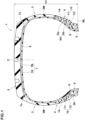
- FIG. 1 is a tire meridian cross section including the tire rotational axis, showing a pneumatic tire 1 as an embodiment of the present invention.
- the present invention is suitably applied to passenger car tires, and the tire 1 of the present embodiment is a pneumatic tire for passenger cars.
- FIG. 1 there is shown the tire 1 under its standard state.
- the "standard state” means a state of the tire when mounted on a standard wheel rim, and inflated to a standard tire pressure, but loaded with no tire load.
- the “standard wheel rim” is a wheel rim specified for the tire in a standard system including standards on which the tire is based, for example, the "Standard rim” in JATMA, "Design Rim” in TRA, “Measuring Rim” in ETRTO,
- the “standard tire pressure” is the air pressure specified for the tire in a standard system including standards on which the tire is based, for example, the “maximum air pressure” in JATMA, "INFLATION PRESSURE” in ETRTO, and the maximum air pressure listed in the table "TIRE LOAD LIMITS AT VARIOUS COLD INFLATION PRESSURES" in TRA.
- the "standard state” means a standard usage state depending on the purpose of use of the tire and in a condition in which the tire is not attached to a vehicle and no tire load is applied.
- the tire 1 of the present embodiment comprises a tread portion 2, a pair of sidewall portions 3, a pair of bead portions 4 and a carcass 6.
- the sidewall portions 3 are respectively connected with the ends in the tire axial direction of the tread portion 2.
- the bead portions 4 are respectively connected with the inner ends in the tire radial direction of the sidewall portions 3.
- the carcass 6 extends between the bead portions 4 through the tread portion 2 and the sidewall portions 3 and has a toroidal shape.
- the bead portions 4 are each provided with a bead core 5 and a bead apex 8, the bead apex 8 extending radially outwardly from the bead core 5 in a tapered manner.
- the bead core 5 is a ring-shaped body formed by winding a high tensile modulus member, for example, a steel wire or filament (not shown) in multiple turns in the radial distortion and axial direction.
- a high tensile modulus member for example, a steel wire or filament (not shown) in multiple turns in the radial distortion and axial direction.
- the cross-sectional shape of the bead core 5 is, for example, a polygon, in the present embodiment, generally a rectangle.
- the bead apex 8 is made of hard rubber, for example, having a generally triangular cross sectional shape.
- the carcass 6 comprises at least one carcass ply 6A.
- the carcass ply 6A extends between the bead portions 4 through the tread portion 2 and the sidewall portions 3 and is turned up around the bead core 5 in each bead portion from the axially inside to the axially outside so as to form a pair of turned-up portions 6b and a main portion 6a therebetween.
- the turned-up portions 6b extend radially outwardly from the bead cores on the axially outsides of the bead apexes 8, respectively.
- the carcass ply 6A is made of carcass cords covered with topping rubber (not shown).
- carcass cords for example, organic fiber cords such as aramid or rayon can be used.
- the carcass cords are arranged at an angle in a range from 70 to 90 degrees with respect to the tire equator C, for example.
- the carcass 6 of the present embodiment is composed of only one carcass ply 6A, it may be composed of a plurality of carcass plies 6A.
- the tread portion 2 is provided with a belt 7 on the radially outside of the carcass 6.
- the belt 7 in this example comprises two belt plies 7A and 7B of parallel belt cords arranged at an angle in a range from 15 to 45 degrees with respect to the tire circumferential direction.
- the belt cords of one belt ply 7A and the belt cords of the other belt ply 7B are inclined in opposite directions with respect to the tire circumferential direction to thereby effectively reinforce the tread portion 2.
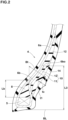
- At least one of the bead portions 4 is provide with a bead reinforcing rubber 10 as shown in FIG. 2 .
- each of the bead portions 4 is provide with the bead reinforcing rubber 10.
- the bead reinforcing rubber 10 is disposed axially outside the turned-up portion 6b.
- the bead reinforcing rubber 10 comprises a plurality of reinforcing rubber layers arranged in the tire axial direction and each extending in a tire radial direction.
- the bead reinforcing rubber 10 comprises a first reinforcing rubber layer 11 and a second reinforcing rubber layer 12, the second reinforcing rubber layer 12 disposed axially inside the first reinforcing rubber layer 11.
- the bead reinforcing rubber 10 in the present embodiment is composed of only the first reinforcing rubber layer 11 and the second reinforcing rubber layer 12, the bead reinforcing rubber 10 may include another rubber layer.
- the complex elastic modulus E*2 of the second reinforcing rubber layer 12 is smaller than the complex elastic modulus E*1 of the first reinforcing rubber layer 11.
- JIS Japanese Industrial Standard
- the bead reinforcing rubber 10 in the present invention can change the state of the turned-up portion 6b from a compressed state to a tensile state when the bead portion 4 is deformed outward in the tire axial direction. This improves the stiffness of the bead portion 4 and improves the steering stability.
- the first reinforcing rubber layer 11 having the complex elastic modulus E*1 can prevent the bead portion 4 from falling outward in the tire axial direction, further improving the steering stability.
- the second reinforcing rubber layer 12 having a relatively small complex elastic modulus E*2 is disposed on the inner side in the tire axial direction, minute vibrations (especially high-frequency components of the vibrations) of the carcass 6, bead apex 8 and bead core 5 cab be easily absorbed, without sacrificing the ride comfort.
- the complex elastic modulus E*2 of the second reinforcing rubber layer 12 is relatively small, embrittlement due to heat generation of the second reinforcing rubber layer 12 is prevented, and damages such as separation between the bead reinforcing rubber 10 and the turned-up portion 6b can be prevented.
- the dimension Lb in the tire radial direction of the bead apex 8 is preferably set in a range from 5% to 10% of the total tire height h1 (for example, the dimension Lb is 20 mm or less) so that, with respect to positions in the tire radial direction, the radially outer end of the bead apex 8 approximates the radially outer end of the rim flange (not shown).
- the bead portion 4 falls outward in the tire axial direction, strain in the bead portion 4 can be prevented from concentrating on the radially outer end portion of the bead apex 8.
- the total tire height h1 means, as shown in Fig. 1 , the radial dimension from the bead base line BL to the radially outermost position on the tread surface which usually occurs at the tire equator C.
- the bead base line BL means a base line extending parallel to the tire axial direction at a radial position corresponding to the rim diameter of the standard wheel rim.
- the complex elastic modulus of the bead apex 8 is not less than 40 MPa, more preferably not less than 50 MPa, but not more than 80 MPa, more preferably not more than 70 MPa.
- the stiffness of the bead portion 4 becomes appropriate for improving the steering stability and ride comfort in a well-balanced manner.
- the bead apex 8 may contain a thermosetting resin in order to improve strength so as to withstand large pressure and external forces that occur during running, and thereby improving the durability.
- Each of the bead portions 4 is provided with a clinch rubber 14 disposed on the axially outer side of the bead reinforcing rubber 10 to form the outer surface of the bead portion 4.
- the complex elastic modulus of the clinch rubber 14 is smaller than that of the bead apex 8, and is set in a range from 15 to 30 MPa for example.
- the radially outer end 6bo of the turned-up portion 6b of the carcass ply 6A is positioned at a distance L3 in the tire radial direction from the above-mentioned bead base line BL which is, for example, in a range from 15% to 25% of the above-mentioned total tire height h1.
- the radially outer end 6bo of the turned-up portion 6b is spaced apart at least 5 mm in the tire radial direction from both of the radially outer end of the first reinforcing rubber layer 11 and the radially outer end of the second reinforcing rubber layer 12.
- the bead reinforcing rubber 10 is disposed radially outside the bead core 5.
- the bead reinforcing rubber 10 is spaced apart at least 5 mm from the outer end 7o in the tire axial direction of the belt 7.
- the bead reinforcing rubber 10 is preferably arranged on the radially inside than a tire maximum width position 3M in the sidewall portion 3.
- the bead reinforcing rubber 10 is arranged so as to contact with an axially outer side of the turned-up portion 6b of the carcass ply 6A and an axially outer side of the main portion 6a of the carcass ply 6A as shown in FIG. 2 .
- the complex elastic modulus E*1 of the first reinforcing rubber layer 11 and the complex elastic modulus E*2 of the second reinforcing rubber layer 12 are both larger than the complex elastic modulus of the clinch rubber 14.
- the complex elastic modulus E*1 of the first reinforcing rubber layer 11 is preferably not less than 40 MPa, more preferably not less than 50 MPa, but preferably not more than 80 MPa, more preferably not more than 70 MPa.
- the complex elastic modulus E*2 of the second reinforcing rubber layer 12 is preferably not less than 10 MPa, more preferably not less than 15, but preferably not more than 35 MPa, more preferably not more than 30 MPa.
- the ratio E*1/E*2 of the complex elastic modulus E*1 to the complex elastic modulus E*2 is preferably larger than 1.5, more preferably not less than 2.5, but preferably smaller than 5.0, more preferably not more than 4.0 from the viewpoint of improving the steering stability and ride comfort in a well-balanced manner.
- FIG. 3 is a cross-sectional view showing only the first reinforcing rubber layer 11 and the second reinforcing rubber layer 12.
- each of the first reinforcing rubber layer 11 and the second reinforcing rubber layer 12 has a tapered radially inner end portion and a tapered radially outer end portion.
- each of the first reinforcing rubber layer 11 and the second reinforcing rubber layer 12 has a portion having a maximum thickness located between the tapered radially inner end portion and tapered radially outer end portion thereof.
- the first reinforcing rubber layer 11 has an axially outer surface 16 and an axially inner surface 17, and in this example, as shown in FIG. 2 , the entire outer surface 16 is in contact with the clinch rubber 14, and the entire inner surface 17 is in contact with the second reinforcing rubber layer 12.
- the radially outer end 11o of the first reinforcing rubber layer 11 is located radially outside the radially outer end 6bo of the turned-up portion 6b.
- the dimension L1 in the tire radial direction of the first reinforcing rubber layer 11 is preferably not less than 80%, but not more than 100% of the above-mentioned distance L3 in the tire radial direction from the bead base line BL to the radially outer end 6bo of the turned-up portion 6b, for reliably improving the steering stability.
- the second reinforcing rubber layer 12 has an axially outer surface 18 and an axially inner surface 19.
- a part of the axially outer surface 18 is in contact with the first reinforcing rubber layer 11, and the remaining part of the axially outer surface 18 is in contact with the clinch rubber 14.
- the length along the above-mentioned part of the axially outer surface 18 contacting with the first reinforcing rubber layer 11 is larger than the length along the above-mentioned part of the axially outer surface 18 contacting with the clinch rubber 14, and is in a range from 60% to 70% of the length along the entire axially outer surface 18.
- a part of the axially inner surface 19 is in contact with the turned-up portion 6b, and the remaining part of the axially inner surface 19 is in contact with the main portion 6a.
- the length along the above-mentioned part of the axially inner surface 19 contacting with the main portion 6a is in a range from 40% to 60% of the length along the entire axially inner surface 19.
- the dimension L2 in the tire radial direction of the second reinforcing rubber layer 12 is larger than the dimension L1 in the tire radial direction of the first reinforcing rubber layer 11.
- the dimension L2 is not less than 130%, but not more than 170% of the dimension L1.
- Such second reinforcing rubber layer 12 helps to improve the ride comfort and steering stability in a well-balanced manner.
- the radially outer end 11o of the first reinforcing rubber layer 11 is spaced apart at least 5 mm in the tire radial direction from the radially outer end 12o of the second reinforcing rubber layer 12 from the view point of suppressing separation between the first reinforcing rubber layer 11 and the second reinforcing rubber layer 12,
- the sum of a maximum thickness tc of the clinch rubber 14 and a thickness t1 of the first reinforcing rubber layer 11 measured at a position on the axially inner surface of the clinch rubber at which the maximum thickness tc of the clinch rubber 14 occurs is not less than 50% of the overall thickness Bt of the bead portion 4 measured at the above-mentioned position.
- the first reinforcing rubber layer 11 and the clinch rubber 14 can effectively prevent the bead portion 4 from falling axially outward, and the durability of the bead portion 4 and the steering stability are further improved.
- pneumatic tires of size 215/70R15 for passenger cars were experimentally manufactured as test tires (working example tire and comparative example tire).
- test tires had the same structure except for the values of the complex elastic moduli E*1 and E*2.
- the value of was larger than the value of E*1 as shown in Table 1.
- test tires mounted on a wheel rim of size 15 ⁇ 6.5J and inflated to 450 kPa were attached to a test vehicle (3500 cc minivan). Then, using the test vehicle, the tires were tested for steering stability and ride comfort as follows.
- the steering stability of the test vehicle when running on a test course was evaluated by a test driver.
- test results are indicated in Table 1 by an index based on the comparative example being 100, wherein the larger the value, the better the steering stability.
- test results are indicated in Table 1 by an index based on the comparative example being 100, wherein the larger the value, the better the ride comfort.
Landscapes
- Engineering & Computer Science (AREA)
- Mechanical Engineering (AREA)
- Tires In General (AREA)
Abstract
Description
- The present invention relates to a pneumatic tire.
- Patent Document 1 below discloses a pneumatic tire of which bead portion is provided with a reinforcing rubber layer adjacent to the outside in the tire axial direction of a turned-up portion of a carcass ply in order to increase the stiffness of the bead portion and improve the durability.
Patent Document 1:Japanese Patent Application Publication No. 2023-005149 - In recent years, as the performance of vehicles has improved, there has been a demand for pneumatic tires further improved in steering stability.
- On the other hand, in the pneumatic tires of which bead portions are provided with reinforcing rubber layers as described above, ride comfort is liable to deteriorate.
- The present invention was made in view of the circumstances as described above, and a primary objective of the present invention is to provide a pneumatic tire capable of improving steering stability while maintaining ride comfort.
- According to the present invention, a pneumatic tire comprises:
- a pair of bead portions,
- a carcass extending between the bead portions,
- a bead core disposed in each of the bead portions, and
- a bead apex disposed in each of the bead portions and extending from the bead core outwardly in a tire radial direction in a tapered manner,
wherein - the carcass comprises a carcass ply extending between the bead portions and turned up around the bead core in each bead portion from the inside to the outside in the tire axial direction to form a pair of turned-up portions and a main portion therebetween, and
in each of the bead portions, the turned-up portion extends in a tire radial direction on the outside in the tire axial direction of the bead apex, wherein - at least one of the bead portions is provided, on the outside in the tire axial direction of the turned-up portion, with a bead reinforcing rubber comprising a first reinforcing rubber layer and a second reinforcing rubber layer on the inside in the tire axial direction of the first reinforcing rubber layer, and
- a complex elastic modulus E*2 of the second reinforcing rubber layer is smaller than a complex elastic modulus E*1 of the first reinforcing rubber layer.
- In the pneumatic tire according to the present invention, therefore, as the above configuration is employed, steering stability can be improved while maintaining ride comfort.
-
-
FIG. 1 is a cross-sectional view of a pneumatic tire as an embodiment of the present invention. -
FIG. 2 is an enlarged cross-sectional view of one of the bead portions shown inFIG. 1 . -
FIG. 3 is an enlarged cross-sectional view showing the first reinforcing rubber layer and the second reinforcing rubber layer shown inFIG. 2 . - An embodiment of the present invention will now be described in detail in conjunction with accompanying drawings.
-
FIG. 1 is a tire meridian cross section including the tire rotational axis, showing a pneumatic tire 1 as an embodiment of the present invention. - The present invention is suitably applied to passenger car tires, and the tire 1 of the present embodiment is a pneumatic tire for passenger cars.
- In
FIG. 1 , there is shown the tire 1 under its standard state. - Incidentally, in order to aid understanding of the present invention, the drawings may include expressions exaggerated or dimensionally differed from the actualities.
- In the case that the tire 1 is a kind of pneumatic tires for which various standards have been established,
the "standard state" means a state of the tire when mounted on a standard wheel rim, and inflated to a standard tire pressure, but loaded with no tire load. - The "standard wheel rim" is a wheel rim specified for the tire in a standard system including standards on which the tire is based, for example, the "Standard rim" in JATMA, "Design Rim" in TRA, "Measuring Rim" in ETRTO,
- The "standard tire pressure" is the air pressure specified for the tire in a standard system including standards on which the tire is based, for example, the "maximum air pressure" in JATMA, "INFLATION PRESSURE" in ETRTO, and the maximum air pressure listed in the table "TIRE LOAD LIMITS AT VARIOUS COLD INFLATION PRESSURES" in TRA.
- In the case that the tire 1 is a tire for which various standards are not yet established, the "standard state" means a standard usage state depending on the purpose of use of the tire and in a condition in which the tire is not attached to a vehicle and no tire load is applied.
- In this application including specification and claims, dimensions and positions of each part or portion of the tire refer to those measured under the standard state unless otherwise noted.
- As shown in
FIG. 1 , the tire 1 of the present embodiment comprises a tread portion 2, a pair ofsidewall portions 3, a pair ofbead portions 4 and acarcass 6. - The
sidewall portions 3 are respectively connected with the ends in the tire axial direction of the tread portion 2. - The
bead portions 4 are respectively connected with the inner ends in the tire radial direction of thesidewall portions 3. Thecarcass 6 extends between thebead portions 4 through the tread portion 2 and thesidewall portions 3 and has a toroidal shape. - The
bead portions 4 are each provided with abead core 5 and abead apex 8, thebead apex 8 extending radially outwardly from thebead core 5 in a tapered manner. - The
bead core 5 is a ring-shaped body formed by winding a high tensile modulus member, for example, a steel wire or filament (not shown) in multiple turns in the radial distortion and axial direction. - The cross-sectional shape of the
bead core 5 is, for example, a polygon, in the present embodiment, generally a rectangle. - The
bead apex 8 is made of hard rubber, for example, having a generally triangular cross sectional shape. - The
carcass 6 comprises at least onecarcass ply 6A. - The
carcass ply 6A extends between thebead portions 4 through the tread portion 2 and thesidewall portions 3 and is turned up around thebead core 5 in each bead portion from the axially inside to the axially outside so as to form a pair of turned-upportions 6b and amain portion 6a therebetween. - The turned-up
portions 6b extend radially outwardly from the bead cores on the axially outsides of thebead apexes 8, respectively. - The
carcass ply 6A is made of carcass cords covered with topping rubber (not shown). - As the carcass cords, for example, organic fiber cords such as aramid or rayon can be used.
- The carcass cords are arranged at an angle in a range from 70 to 90 degrees with respect to the tire equator C, for example. Although the
carcass 6 of the present embodiment is composed of only onecarcass ply 6A, it may be composed of a plurality ofcarcass plies 6A. - In the tire 1 of the present embodiment, the tread portion 2 is provided with a
belt 7 on the radially outside of thecarcass 6. - The
belt 7 in this example comprises twobelt plies - The belt cords of one
belt ply 7A and the belt cords of theother belt ply 7B are inclined in opposite directions with respect to the tire circumferential direction to thereby effectively reinforce the tread portion 2. - In the present invention, at least one of the
bead portions 4 is provide with abead reinforcing rubber 10 as shown inFIG. 2 . In the present embodiment, each of thebead portions 4 is provide with thebead reinforcing rubber 10. - The
bead reinforcing rubber 10 is disposed axially outside the turned-upportion 6b. - The
bead reinforcing rubber 10 comprises a plurality of reinforcing rubber layers arranged in the tire axial direction and each extending in a tire radial direction. - In the present invention, the
bead reinforcing rubber 10 comprises a first reinforcingrubber layer 11 and a second reinforcingrubber layer 12, the second reinforcingrubber layer 12 disposed axially inside the first reinforcingrubber layer 11. Although thebead reinforcing rubber 10 in the present embodiment is composed of only the first reinforcingrubber layer 11 and the second reinforcingrubber layer 12, thebead reinforcing rubber 10 may include another rubber layer. - In the present invention, the complex elastic modulus E*2 of the second reinforcing
rubber layer 12 is smaller than the complex elastic modulus E*1 of the first reinforcingrubber layer 11. - In this application including specification and claims, the complex elastic modulus is measured according to Japanese Industrial Standard (JIS) K6394 under the following conditions using a viscoelastic spectrometer:
- Initial strain: 10%
- Strain amplitude: +/-2%
- Frequency: 10 Hz
- Deformation mode: tension
- Measuring temperature: 30 degrees C.
- As the tire 1 of the present invention is provided with the above configurations, steering stability can be improved while maintaining ride comfort. The reason is considered as follows.
- The
bead reinforcing rubber 10 in the present invention can change the state of the turned-upportion 6b from a compressed state to a tensile state when thebead portion 4 is deformed outward in the tire axial direction. This improves the stiffness of thebead portion 4 and improves the steering stability. - Further, the first reinforcing
rubber layer 11 having the complex elastic modulus E*1 can prevent thebead portion 4 from falling outward in the tire axial direction, further improving the steering stability. - Furthermore, in the present invention, since the second reinforcing
rubber layer 12 having a relatively small complex elastic modulus E*2 is disposed on the inner side in the tire axial direction, minute vibrations (especially high-frequency components of the vibrations) of thecarcass 6,bead apex 8 andbead core 5 cab be easily absorbed, without sacrificing the ride comfort. - Further, in the present invention, since the complex elastic modulus E*2 of the second reinforcing
rubber layer 12 is relatively small, embrittlement due to heat generation of the second reinforcingrubber layer 12 is prevented, and damages such as separation between thebead reinforcing rubber 10 and the turned-upportion 6b can be prevented. - Therefore, according to the present invention, it is also expected to improve the durability of the
bead portion 4. - Hereinafter, a more detailed configuration of the present embodiment will be described.
- The dimension Lb in the tire radial direction of the
bead apex 8 is preferably set in a range from 5% to 10% of the total tire height h1 (for example, the dimension Lb is 20 mm or less) so that, with respect to positions in the tire radial direction, the radially outer end of thebead apex 8 approximates the radially outer end of the rim flange (not shown). As a result, when thebead portion 4 falls outward in the tire axial direction, strain in thebead portion 4 can be prevented from concentrating on the radially outer end portion of thebead apex 8. - Here, the total tire height h1 means, as shown in
Fig. 1 , the radial dimension from the bead base line BL to the radially outermost position on the tread surface which usually occurs at the tire equator C. - The bead base line BL means a base line extending parallel to the tire axial direction at a radial position corresponding to the rim diameter of the standard wheel rim.
- Preferably, the complex elastic modulus of the
bead apex 8 is not less than 40 MPa, more preferably not less than 50 MPa, but not more than 80 MPa, more preferably not more than 70 MPa. Thereby, the stiffness of thebead portion 4 becomes appropriate for improving the steering stability and ride comfort in a well-balanced manner. - For example, the
bead apex 8 may contain a thermosetting resin in order to improve strength so as to withstand large pressure and external forces that occur during running, and thereby improving the durability. - Each of the
bead portions 4 is provided with aclinch rubber 14 disposed on the axially outer side of thebead reinforcing rubber 10 to form the outer surface of thebead portion 4. - The complex elastic modulus of the
clinch rubber 14 is smaller than that of thebead apex 8, and is set in a range from 15 to 30 MPa for example. - As shown in
Fig. 2 , the radially outer end 6bo of the turned-upportion 6b of thecarcass ply 6A is positioned at a distance L3 in the tire radial direction from the above-mentioned bead base line BL which is, for example, in a range from 15% to 25% of the above-mentioned total tire height h1. - It is preferable that the radially outer end 6bo of the turned-up
portion 6b is spaced apart at least 5 mm in the tire radial direction from both of the radially outer end of the first reinforcingrubber layer 11 and the radially outer end of the second reinforcingrubber layer 12. - Thereby, failures at the radially outer ends of the turned-up
portion 6b and the rubber layers 11 and 12 are suppressed and thebead portion 4 is improved in durability. - As shown in
FIG. 1 , thebead reinforcing rubber 10 is disposed radially outside thebead core 5. - The
bead reinforcing rubber 10 is spaced apart at least 5 mm from the outer end 7o in the tire axial direction of thebelt 7. - The
bead reinforcing rubber 10 is preferably arranged on the radially inside than a tiremaximum width position 3M in thesidewall portion 3. - The
bead reinforcing rubber 10 is arranged so as to contact with an axially outer side of the turned-upportion 6b of thecarcass ply 6A and an axially outer side of themain portion 6a of thecarcass ply 6A as shown inFIG. 2 . - It is preferable that the complex elastic modulus E*1 of the first reinforcing
rubber layer 11 and the complex elastic modulus E*2 of the second reinforcingrubber layer 12 are both larger than the complex elastic modulus of theclinch rubber 14. The complex elastic modulus E*1 of the first reinforcingrubber layer 11 is preferably not less than 40 MPa, more preferably not less than 50 MPa, but preferably not more than 80 MPa, more preferably not more than 70 MPa. - The complex elastic modulus E*2 of the second reinforcing
rubber layer 12 is preferably not less than 10 MPa, more preferably not less than 15, but preferably not more than 35 MPa, more preferably not more than 30 MPa. - The ratio E*1/E*2 of the complex elastic modulus E*1 to the complex elastic modulus E*2 is preferably larger than 1.5, more preferably not less than 2.5, but preferably smaller than 5.0, more preferably not more than 4.0 from the viewpoint of improving the steering stability and ride comfort in a well-balanced manner.
-
FIG. 3 is a cross-sectional view showing only the first reinforcingrubber layer 11 and the second reinforcingrubber layer 12. - As shown, each of the first reinforcing
rubber layer 11 and the second reinforcingrubber layer 12 has a tapered radially inner end portion and a tapered radially outer end portion. - Accordingly, each of the first reinforcing
rubber layer 11 and the second reinforcingrubber layer 12 has a portion having a maximum thickness located between the tapered radially inner end portion and tapered radially outer end portion thereof. - The first reinforcing
rubber layer 11 has an axiallyouter surface 16 and an axiallyinner surface 17, and in this example, as shown inFIG. 2 , the entireouter surface 16 is in contact with theclinch rubber 14, and the entireinner surface 17 is in contact with the second reinforcingrubber layer 12. - Preferably, the radially outer end 11o of the first reinforcing
rubber layer 11 is located radially outside the radially outer end 6bo of the turned-upportion 6b. - The dimension L1 in the tire radial direction of the first reinforcing
rubber layer 11 is preferably not less than 80%, but not more than 100% of the above-mentioned distance L3 in the tire radial direction from the bead base line BL to the radially outer end 6bo of the turned-upportion 6b, for reliably improving the steering stability. - The second reinforcing
rubber layer 12 has an axiallyouter surface 18 and an axiallyinner surface 19. - In this example, as shown in
FIG. 2 , a part of the axiallyouter surface 18 is in contact with the first reinforcingrubber layer 11, and the remaining part of the axiallyouter surface 18 is in contact with theclinch rubber 14. In the cross section as shown inFIG. 2 , the length along the above-mentioned part of the axiallyouter surface 18 contacting with the first reinforcingrubber layer 11 is larger than the length along the above-mentioned part of the axiallyouter surface 18 contacting with theclinch rubber 14, and is in a range from 60% to 70% of the length along the entire axiallyouter surface 18. Thereby, ride comfort can be reliably maintained. - In this example, as shown in
FIG. 2 , a part of the axiallyinner surface 19 is in contact with the turned-upportion 6b, and the remaining part of the axiallyinner surface 19 is in contact with themain portion 6a. - In the cross section as shown in
FIG. 2 , the length along the above-mentioned part of the axiallyinner surface 19 contacting with themain portion 6a is in a range from 40% to 60% of the length along the entire axiallyinner surface 19. - Thereby, slight vibrations of the
main portion 6a becomes easily absorbed by the second reinforcingrubber layer 12, and riding comfort can be improved. - Preferably, the dimension L2 in the tire radial direction of the second reinforcing
rubber layer 12 is larger than the dimension L1 in the tire radial direction of the first reinforcingrubber layer 11. - For example, the dimension L2 is not less than 130%, but not more than 170% of the dimension L1.
- Such second reinforcing
rubber layer 12 helps to improve the ride comfort and steering stability in a well-balanced manner. - Preferably, the radially outer end 11o of the first reinforcing
rubber layer 11 is spaced apart at least 5 mm in the tire radial direction from the radially outer end 12o of the second reinforcingrubber layer 12 from the view point of suppressing separation between the first reinforcingrubber layer 11 and the second reinforcingrubber layer 12, - Further, it is preferable that, as shown in
FIG. 2 , the sum of a maximum thickness tc of theclinch rubber 14 and a thickness t1 of the first reinforcingrubber layer 11 measured at a position on the axially inner surface of the clinch rubber at which the maximum thickness tc of theclinch rubber 14 occurs, is not less than 50% of the overall thickness Bt of thebead portion 4 measured at the above-mentioned position. - Thereby, the first reinforcing
rubber layer 11 and theclinch rubber 14 can effectively prevent thebead portion 4 from falling axially outward, and the durability of thebead portion 4 and the steering stability are further improved. - while detailed description has been made of a preferable embodiment of the present invention, the present invention can be embodied in various forms without being limited to the illustrated embodiment.
- Based on the structure shown in
Fig. 1 , pneumatic tires of size 215/70R15 for passenger cars were experimentally manufactured as test tires (working example tire and comparative example tire). - The test tires had the same structure except for the values of the complex elastic moduli E*1 and E*2. In the comparative example tire, the value of was larger than the value of E*1 as shown in Table 1.
- The test tires mounted on a wheel rim of size 15×6.5J and inflated to 450 kPa were attached to a test vehicle (3500 cc minivan). Then, using the test vehicle, the tires were tested for steering stability and ride comfort as follows.
- The steering stability of the test vehicle when running on a test course was evaluated by a test driver.
- The test results are indicated in Table 1 by an index based on the comparative example being 100, wherein the larger the value, the better the steering stability.
- The ride comfort when the test vehicle was running on an uneven tire test course, was evaluated by a test driver.
- The test results are indicated in Table 1 by an index based on the comparative example being 100, wherein the larger the value, the better the ride comfort.
- -- [0046]
Table 1 Tire Comparative example Working example complex elastic modulus E*1 (MPa) of the first reinforcing rubber layer 23.6 62.3 complex elastic modulus E*2 (MPa) of the second reinforcing rubber layer 30.4 22.5 ratio E*1/E*2 0.8 2.8 steering stability 100 120 ride comfort 100 110 - From the test results, it was confirmed that, in the tire according to the present invention, it is possible to improve the steering stability and ride comfort.
-
- 4
- bead portion
- 5
- bead core
- 6
- carcass
- 6A
- carcass ply
- 6a
- main portion
- 6b
- turned-up portion
- 8
- bead apex
- 10
- bead reinforcing rubber
- 11
- first reinforcing rubber layer
- 12
- second reinforcing rubber layer
Claims (10)
- A pneumatic tire comprising:a pair of bead portions each provided with a bead core and a bead apex which extends radially outwardly from the bead core in a tapered manner, anda toroidal carcass comprising a carcass ply extending between the bead portions and turned up around the bead core in each bead portion from the axially inside to the axially outside so as to form a pair of turned-up portions and a main portion therebetween,the turned-up portions extending radially outwardly on the axially outer sides of the bead apexes, respectively, whereinat least one of the bead portions is provided with a bead reinforcing rubber disposed on the axially outer side of the turned-up portion,the bead reinforcing rubber comprises a first reinforcing rubber layer and a second reinforcing rubber layer disposed axially inside the first reinforcing rubber layer, anda complex elastic modulus E*2 of the second reinforcing rubber layer is smaller than a complex elastic modulus E*1 of the first reinforcing rubber layer.
- The pneumatic tire according to claim 1, wherein
a ratio E*1/E*2 of the complex elastic modulus E*1 to the complex elastic modulus is greater than 1.5. - The pneumatic tire according to claim 2, wherein
the ratio E*1/E*2 of the complex elastic modulus E*1 to the complex elastic modulus is smaller than 5.0. - The pneumatic tire according to claim 1, 2 or 3, wherein
the dimension in the tire radial direction of the bead apex is not more than 20 mm. - The pneumatic tire according to any one of claims 1 to 4, wherein
the bead apex comprises a thermosetting resin. - The pneumatic tire according to any one of claims 1 to 5, wherein
the dimension in the tire radial direction of the second reinforcing rubber layer is greater than the dimension in the tire radial direction of the first reinforcing rubber layer. - The tire according to any one of claims 1 to 6, wherein
the first reinforcing rubber layer has an axially inner surface of which entirety is in contact with the second reinforcing rubber layer. - The tire according to any one of claims 1 to 7, wherein
the radially outer end of the first reinforcing rubber layer is spaced apart at least 5 mm in the tire radial direction from the radially outer end of the second reinforcing rubber layer. - The tire according to any one of claims 1 to 8, wherein
the radially outer end of the turned-up portion is spaced apart at least 5 mm in the tire radial direction from the radially outer end of each of the first reinforcing rubber layer and the second reinforcing rubber layer. - The tire according to any one of claims 1 to 9, whereinsaid at least one of the bead portions is provided, on the axially outer side of the bead reinforcing rubber, with a clinch rubber forming an outer surface of the bead portion, andwhen measured at a position in the tire radial direction where the clinch rubber has a maximum thickness tc,the sum of a thickness t1 of the first reinforcing rubber layer and the maximum thickness tc of the clinch rubber is not less than 50% of the overall thickness Bt of the bead portion.
Applications Claiming Priority (1)
| Application Number | Priority Date | Filing Date | Title |
|---|---|---|---|
| JP2023032995A JP2024124971A (en) | 2023-03-03 | 2023-03-03 | Pneumatic tires |
Publications (2)
| Publication Number | Publication Date |
|---|---|
| EP4424527A1 true EP4424527A1 (en) | 2024-09-04 |
| EP4424527B1 EP4424527B1 (en) | 2025-06-18 |
Family
ID=90123338
Family Applications (1)
| Application Number | Title | Priority Date | Filing Date |
|---|---|---|---|
| EP24160779.5A Active EP4424527B1 (en) | 2023-03-03 | 2024-03-01 | Pneumatic tire |
Country Status (4)
| Country | Link |
|---|---|
| US (1) | US20240294040A1 (en) |
| EP (1) | EP4424527B1 (en) |
| JP (1) | JP2024124971A (en) |
| CN (1) | CN118578814A (en) |
Citations (8)
| Publication number | Priority date | Publication date | Assignee | Title |
|---|---|---|---|---|
| JP2002178724A (en) * | 2000-12-18 | 2002-06-26 | Sumitomo Rubber Ind Ltd | Heavy duty tire |
| US20070102091A1 (en) * | 2005-11-08 | 2007-05-10 | Sumitomo Rubber Industries, Ltd. | Heavy duty tire |
| JP2016052840A (en) * | 2014-09-04 | 2016-04-14 | 住友ゴム工業株式会社 | Pneumatic tire |
| EP3196055A1 (en) * | 2014-09-04 | 2017-07-26 | Sumitomo Rubber Industries, Ltd. | Pneumatic tire |
| EP3674109A1 (en) * | 2018-12-26 | 2020-07-01 | Toyo Tire Corporation | Tire and tire manufacturing method |
| WO2021126187A1 (en) * | 2019-12-18 | 2021-06-24 | Compagnie Generale Des Etablissements Michelin | Truck tire with stiff outer bead products |
| JP2023005149A (en) | 2021-06-28 | 2023-01-18 | 住友ゴム工業株式会社 | Pneumatic tire and method for manufacturing the same |
| EP4253094A1 (en) * | 2022-03-31 | 2023-10-04 | Sumitomo Rubber Industries, Ltd. | Pneumatic tire |
-
2023
- 2023-03-03 JP JP2023032995A patent/JP2024124971A/en active Pending
-
2024
- 2024-02-13 US US18/440,200 patent/US20240294040A1/en active Pending
- 2024-02-23 CN CN202410200805.4A patent/CN118578814A/en active Pending
- 2024-03-01 EP EP24160779.5A patent/EP4424527B1/en active Active
Patent Citations (8)
| Publication number | Priority date | Publication date | Assignee | Title |
|---|---|---|---|---|
| JP2002178724A (en) * | 2000-12-18 | 2002-06-26 | Sumitomo Rubber Ind Ltd | Heavy duty tire |
| US20070102091A1 (en) * | 2005-11-08 | 2007-05-10 | Sumitomo Rubber Industries, Ltd. | Heavy duty tire |
| JP2016052840A (en) * | 2014-09-04 | 2016-04-14 | 住友ゴム工業株式会社 | Pneumatic tire |
| EP3196055A1 (en) * | 2014-09-04 | 2017-07-26 | Sumitomo Rubber Industries, Ltd. | Pneumatic tire |
| EP3674109A1 (en) * | 2018-12-26 | 2020-07-01 | Toyo Tire Corporation | Tire and tire manufacturing method |
| WO2021126187A1 (en) * | 2019-12-18 | 2021-06-24 | Compagnie Generale Des Etablissements Michelin | Truck tire with stiff outer bead products |
| JP2023005149A (en) | 2021-06-28 | 2023-01-18 | 住友ゴム工業株式会社 | Pneumatic tire and method for manufacturing the same |
| EP4253094A1 (en) * | 2022-03-31 | 2023-10-04 | Sumitomo Rubber Industries, Ltd. | Pneumatic tire |
Also Published As
| Publication number | Publication date |
|---|---|
| US20240294040A1 (en) | 2024-09-05 |
| CN118578814A (en) | 2024-09-03 |
| EP4424527B1 (en) | 2025-06-18 |
| JP2024124971A (en) | 2024-09-13 |
Similar Documents
| Publication | Publication Date | Title |
|---|---|---|
| US5988247A (en) | Pneumatic tire with crown reinforcing rubber layer and side reinforcing rubber layers | |
| EP0844110B1 (en) | Pneumatic tyre | |
| US9272582B2 (en) | Pneumatic tire | |
| JP2023018528A (en) | tire | |
| EP3878667B1 (en) | Pneumatic tire | |
| JP7587159B2 (en) | tire | |
| JP2023002263A (en) | tire | |
| GB2198996A (en) | Radial tyres | |
| EP3202599A1 (en) | Pneumatic tire | |
| EP3943660B1 (en) | Tire | |
| EP3936660B1 (en) | Tire | |
| US20230241922A1 (en) | Pneumatic tire | |
| EP3636454B1 (en) | Tire | |
| EP4201703B1 (en) | Tire | |
| EP4424527A1 (en) | Pneumatic tire | |
| EP3895916B1 (en) | Pneumatic tire | |
| EP3888943B1 (en) | Pneumatic tire | |
| EP3536522B1 (en) | Run flat tire | |
| US20230339267A1 (en) | Pneumatic tire | |
| JP2022147003A (en) | tire | |
| JP6529127B2 (en) | Pneumatic tire | |
| EP4282668B1 (en) | Pneumatic tire | |
| EP4635752A1 (en) | Tire | |
| JP7852458B2 (en) | pneumatic tires | |
| EP3900954B1 (en) | Pneumatic tyre |
Legal Events
| Date | Code | Title | Description |
|---|---|---|---|
| PUAI | Public reference made under article 153(3) epc to a published international application that has entered the european phase |
Free format text: ORIGINAL CODE: 0009012 |
|
| STAA | Information on the status of an ep patent application or granted ep patent |
Free format text: STATUS: THE APPLICATION HAS BEEN PUBLISHED |
|
| AK | Designated contracting states |
Kind code of ref document: A1 Designated state(s): AL AT BE BG CH CY CZ DE DK EE ES FI FR GB GR HR HU IE IS IT LI LT LU LV MC ME MK MT NL NO PL PT RO RS SE SI SK SM TR |
|
| STAA | Information on the status of an ep patent application or granted ep patent |
Free format text: STATUS: REQUEST FOR EXAMINATION WAS MADE |
|
| 17P | Request for examination filed |
Effective date: 20250124 |
|
| RIC1 | Information provided on ipc code assigned before grant |
Ipc: B60C 15/06 20060101AFI20250224BHEP |
|
| GRAP | Despatch of communication of intention to grant a patent |
Free format text: ORIGINAL CODE: EPIDOSNIGR1 |
|
| STAA | Information on the status of an ep patent application or granted ep patent |
Free format text: STATUS: GRANT OF PATENT IS INTENDED |
|
| P01 | Opt-out of the competence of the unified patent court (upc) registered |
Free format text: CASE NUMBER: APP_12408/2025 Effective date: 20250313 |
|
| INTG | Intention to grant announced |
Effective date: 20250407 |
|
| GRAS | Grant fee paid |
Free format text: ORIGINAL CODE: EPIDOSNIGR3 |
|
| GRAA | (expected) grant |
Free format text: ORIGINAL CODE: 0009210 |
|
| STAA | Information on the status of an ep patent application or granted ep patent |
Free format text: STATUS: THE PATENT HAS BEEN GRANTED |
|
| AK | Designated contracting states |
Kind code of ref document: B1 Designated state(s): AL AT BE BG CH CY CZ DE DK EE ES FI FR GB GR HR HU IE IS IT LI LT LU LV MC ME MK MT NL NO PL PT RO RS SE SI SK SM TR |
|
| REG | Reference to a national code |
Ref country code: GB Ref legal event code: FG4D |
|
| REG | Reference to a national code |
Ref country code: CH Ref legal event code: EP |
|
| REG | Reference to a national code |
Ref country code: DE Ref legal event code: R096 Ref document number: 602024000205 Country of ref document: DE |
|
| REG | Reference to a national code |
Ref country code: CH Ref legal event code: EP |
|
| REG | Reference to a national code |
Ref country code: IE Ref legal event code: FG4D |
|
| PG25 | Lapsed in a contracting state [announced via postgrant information from national office to epo] |
Ref country code: FI Free format text: LAPSE BECAUSE OF FAILURE TO SUBMIT A TRANSLATION OF THE DESCRIPTION OR TO PAY THE FEE WITHIN THE PRESCRIBED TIME-LIMIT Effective date: 20250618 |
|
| REG | Reference to a national code |
Ref country code: LT Ref legal event code: MG9D |
|
| PG25 | Lapsed in a contracting state [announced via postgrant information from national office to epo] |
Ref country code: NO Free format text: LAPSE BECAUSE OF FAILURE TO SUBMIT A TRANSLATION OF THE DESCRIPTION OR TO PAY THE FEE WITHIN THE PRESCRIBED TIME-LIMIT Effective date: 20250918 Ref country code: GR Free format text: LAPSE BECAUSE OF FAILURE TO SUBMIT A TRANSLATION OF THE DESCRIPTION OR TO PAY THE FEE WITHIN THE PRESCRIBED TIME-LIMIT Effective date: 20250919 |
|
| PG25 | Lapsed in a contracting state [announced via postgrant information from national office to epo] |
Ref country code: BG Free format text: LAPSE BECAUSE OF FAILURE TO SUBMIT A TRANSLATION OF THE DESCRIPTION OR TO PAY THE FEE WITHIN THE PRESCRIBED TIME-LIMIT Effective date: 20250618 |
|
| PG25 | Lapsed in a contracting state [announced via postgrant information from national office to epo] |
Ref country code: HR Free format text: LAPSE BECAUSE OF FAILURE TO SUBMIT A TRANSLATION OF THE DESCRIPTION OR TO PAY THE FEE WITHIN THE PRESCRIBED TIME-LIMIT Effective date: 20250618 |
|
| PG25 | Lapsed in a contracting state [announced via postgrant information from national office to epo] |
Ref country code: RS Free format text: LAPSE BECAUSE OF FAILURE TO SUBMIT A TRANSLATION OF THE DESCRIPTION OR TO PAY THE FEE WITHIN THE PRESCRIBED TIME-LIMIT Effective date: 20250918 |
|
| REG | Reference to a national code |
Ref country code: NL Ref legal event code: MP Effective date: 20250618 |
|
| PG25 | Lapsed in a contracting state [announced via postgrant information from national office to epo] |
Ref country code: LV Free format text: LAPSE BECAUSE OF FAILURE TO SUBMIT A TRANSLATION OF THE DESCRIPTION OR TO PAY THE FEE WITHIN THE PRESCRIBED TIME-LIMIT Effective date: 20250618 |
|
| PG25 | Lapsed in a contracting state [announced via postgrant information from national office to epo] |
Ref country code: NL Free format text: LAPSE BECAUSE OF FAILURE TO SUBMIT A TRANSLATION OF THE DESCRIPTION OR TO PAY THE FEE WITHIN THE PRESCRIBED TIME-LIMIT Effective date: 20250618 |
|
| PG25 | Lapsed in a contracting state [announced via postgrant information from national office to epo] |
Ref country code: PT Free format text: LAPSE BECAUSE OF FAILURE TO SUBMIT A TRANSLATION OF THE DESCRIPTION OR TO PAY THE FEE WITHIN THE PRESCRIBED TIME-LIMIT Effective date: 20251020 |
|
| REG | Reference to a national code |
Ref country code: AT Ref legal event code: MK05 Ref document number: 1803895 Country of ref document: AT Kind code of ref document: T Effective date: 20250618 |
|
| PG25 | Lapsed in a contracting state [announced via postgrant information from national office to epo] |
Ref country code: IS Free format text: LAPSE BECAUSE OF FAILURE TO SUBMIT A TRANSLATION OF THE DESCRIPTION OR TO PAY THE FEE WITHIN THE PRESCRIBED TIME-LIMIT Effective date: 20251018 |
|
| PG25 | Lapsed in a contracting state [announced via postgrant information from national office to epo] |
Ref country code: AT Free format text: LAPSE BECAUSE OF FAILURE TO SUBMIT A TRANSLATION OF THE DESCRIPTION OR TO PAY THE FEE WITHIN THE PRESCRIBED TIME-LIMIT Effective date: 20250618 Ref country code: SM Free format text: LAPSE BECAUSE OF FAILURE TO SUBMIT A TRANSLATION OF THE DESCRIPTION OR TO PAY THE FEE WITHIN THE PRESCRIBED TIME-LIMIT Effective date: 20250618 |
|
| PG25 | Lapsed in a contracting state [announced via postgrant information from national office to epo] |
Ref country code: CZ Free format text: LAPSE BECAUSE OF FAILURE TO SUBMIT A TRANSLATION OF THE DESCRIPTION OR TO PAY THE FEE WITHIN THE PRESCRIBED TIME-LIMIT Effective date: 20250618 |
|
| PG25 | Lapsed in a contracting state [announced via postgrant information from national office to epo] |
Ref country code: PL Free format text: LAPSE BECAUSE OF FAILURE TO SUBMIT A TRANSLATION OF THE DESCRIPTION OR TO PAY THE FEE WITHIN THE PRESCRIBED TIME-LIMIT Effective date: 20250618 |
|
| PG25 | Lapsed in a contracting state [announced via postgrant information from national office to epo] |
Ref country code: EE Free format text: LAPSE BECAUSE OF FAILURE TO SUBMIT A TRANSLATION OF THE DESCRIPTION OR TO PAY THE FEE WITHIN THE PRESCRIBED TIME-LIMIT Effective date: 20250618 |
|
| PG25 | Lapsed in a contracting state [announced via postgrant information from national office to epo] |
Ref country code: SK Free format text: LAPSE BECAUSE OF FAILURE TO SUBMIT A TRANSLATION OF THE DESCRIPTION OR TO PAY THE FEE WITHIN THE PRESCRIBED TIME-LIMIT Effective date: 20250618 |
|
| PG25 | Lapsed in a contracting state [announced via postgrant information from national office to epo] |
Ref country code: ES Free format text: LAPSE BECAUSE OF FAILURE TO SUBMIT A TRANSLATION OF THE DESCRIPTION OR TO PAY THE FEE WITHIN THE PRESCRIBED TIME-LIMIT Effective date: 20250618 |
|
| PG25 | Lapsed in a contracting state [announced via postgrant information from national office to epo] |
Ref country code: DK Free format text: LAPSE BECAUSE OF FAILURE TO SUBMIT A TRANSLATION OF THE DESCRIPTION OR TO PAY THE FEE WITHIN THE PRESCRIBED TIME-LIMIT Effective date: 20250618 |
|
| PGFP | Annual fee paid to national office [announced via postgrant information from national office to epo] |
Ref country code: DE Payment date: 20260128 Year of fee payment: 3 |
|
| PG25 | Lapsed in a contracting state [announced via postgrant information from national office to epo] |
Ref country code: IT Free format text: LAPSE BECAUSE OF FAILURE TO SUBMIT A TRANSLATION OF THE DESCRIPTION OR TO PAY THE FEE WITHIN THE PRESCRIBED TIME-LIMIT Effective date: 20250618 |
|
| PGFP | Annual fee paid to national office [announced via postgrant information from national office to epo] |
Ref country code: FR Payment date: 20260209 Year of fee payment: 3 |
|
| PLBE | No opposition filed within time limit |
Free format text: ORIGINAL CODE: 0009261 |
|
| STAA | Information on the status of an ep patent application or granted ep patent |
Free format text: STATUS: NO OPPOSITION FILED WITHIN TIME LIMIT |
|
| REG | Reference to a national code |
Ref country code: CH Ref legal event code: L10 Free format text: ST27 STATUS EVENT CODE: U-0-0-L10-L00 (AS PROVIDED BY THE NATIONAL OFFICE) Effective date: 20260430 |