EP4421204A1 - Eco-friendly steel sheet having high strength and high formability, and method for manufacturing same - Google Patents
Eco-friendly steel sheet having high strength and high formability, and method for manufacturing same Download PDFInfo
- Publication number
- EP4421204A1 EP4421204A1 EP22883985.8A EP22883985A EP4421204A1 EP 4421204 A1 EP4421204 A1 EP 4421204A1 EP 22883985 A EP22883985 A EP 22883985A EP 4421204 A1 EP4421204 A1 EP 4421204A1
- Authority
- EP
- European Patent Office
- Prior art keywords
- steel sheet
- less
- temperature
- eco
- excluding
- Prior art date
- Legal status (The legal status is an assumption and is not a legal conclusion. Google has not performed a legal analysis and makes no representation as to the accuracy of the status listed.)
- Pending
Links
Images




Classifications
-
- C—CHEMISTRY; METALLURGY
- C21—METALLURGY OF IRON
- C21D—MODIFYING THE PHYSICAL STRUCTURE OF FERROUS METALS; GENERAL DEVICES FOR HEAT TREATMENT OF FERROUS OR NON-FERROUS METALS OR ALLOYS; MAKING METAL MALLEABLE, e.g. BY DECARBURISATION OR TEMPERING
- C21D9/00—Heat treatment, e.g. annealing, hardening, quenching or tempering, adapted for particular articles; Furnaces therefor
- C21D9/46—Heat treatment, e.g. annealing, hardening, quenching or tempering, adapted for particular articles; Furnaces therefor for sheet metals
-
- B—PERFORMING OPERATIONS; TRANSPORTING
- B21—MECHANICAL METAL-WORKING WITHOUT ESSENTIALLY REMOVING MATERIAL; PUNCHING METAL
- B21C—MANUFACTURE OF METAL SHEETS, WIRE, RODS, TUBES, PROFILES OR LIKE SEMI-MANUFACTURED PRODUCTS OTHERWISE THAN BY ROLLING; AUXILIARY OPERATIONS USED IN CONNECTION WITH METAL-WORKING WITHOUT ESSENTIALLY REMOVING MATERIAL
- B21C47/00—Winding-up, coiling or winding-off metal wire, metal band or other flexible metal material characterised by features relevant to metal processing only
- B21C47/02—Winding-up or coiling
-
- C—CHEMISTRY; METALLURGY
- C21—METALLURGY OF IRON
- C21D—MODIFYING THE PHYSICAL STRUCTURE OF FERROUS METALS; GENERAL DEVICES FOR HEAT TREATMENT OF FERROUS OR NON-FERROUS METALS OR ALLOYS; MAKING METAL MALLEABLE, e.g. BY DECARBURISATION OR TEMPERING
- C21D1/00—General methods or devices for heat treatment, e.g. annealing, hardening, quenching or tempering
- C21D1/18—Hardening; Quenching with or without subsequent tempering
- C21D1/19—Hardening; Quenching with or without subsequent tempering by interrupted quenching
-
- C—CHEMISTRY; METALLURGY
- C21—METALLURGY OF IRON
- C21D—MODIFYING THE PHYSICAL STRUCTURE OF FERROUS METALS; GENERAL DEVICES FOR HEAT TREATMENT OF FERROUS OR NON-FERROUS METALS OR ALLOYS; MAKING METAL MALLEABLE, e.g. BY DECARBURISATION OR TEMPERING
- C21D1/00—General methods or devices for heat treatment, e.g. annealing, hardening, quenching or tempering
- C21D1/84—Controlled slow cooling
-
- C—CHEMISTRY; METALLURGY
- C21—METALLURGY OF IRON
- C21D—MODIFYING THE PHYSICAL STRUCTURE OF FERROUS METALS; GENERAL DEVICES FOR HEAT TREATMENT OF FERROUS OR NON-FERROUS METALS OR ALLOYS; MAKING METAL MALLEABLE, e.g. BY DECARBURISATION OR TEMPERING
- C21D8/00—Modifying the physical properties of ferrous metals or ferrous alloys by deformation combined with, or followed by, heat treatment
- C21D8/02—Modifying the physical properties of ferrous metals or ferrous alloys by deformation combined with, or followed by, heat treatment during manufacturing of plates or strips
-
- C—CHEMISTRY; METALLURGY
- C21—METALLURGY OF IRON
- C21D—MODIFYING THE PHYSICAL STRUCTURE OF FERROUS METALS; GENERAL DEVICES FOR HEAT TREATMENT OF FERROUS OR NON-FERROUS METALS OR ALLOYS; MAKING METAL MALLEABLE, e.g. BY DECARBURISATION OR TEMPERING
- C21D8/00—Modifying the physical properties of ferrous metals or ferrous alloys by deformation combined with, or followed by, heat treatment
- C21D8/02—Modifying the physical properties of ferrous metals or ferrous alloys by deformation combined with, or followed by, heat treatment during manufacturing of plates or strips
- C21D8/021—Modifying the physical properties of ferrous metals or ferrous alloys by deformation combined with, or followed by, heat treatment during manufacturing of plates or strips involving particular fabrication steps or treatments of ingots or slabs
- C21D8/0215—Rapid solidification; Thin strip casting
-
- C—CHEMISTRY; METALLURGY
- C21—METALLURGY OF IRON
- C21D—MODIFYING THE PHYSICAL STRUCTURE OF FERROUS METALS; GENERAL DEVICES FOR HEAT TREATMENT OF FERROUS OR NON-FERROUS METALS OR ALLOYS; MAKING METAL MALLEABLE, e.g. BY DECARBURISATION OR TEMPERING
- C21D8/00—Modifying the physical properties of ferrous metals or ferrous alloys by deformation combined with, or followed by, heat treatment
- C21D8/02—Modifying the physical properties of ferrous metals or ferrous alloys by deformation combined with, or followed by, heat treatment during manufacturing of plates or strips
- C21D8/0221—Modifying the physical properties of ferrous metals or ferrous alloys by deformation combined with, or followed by, heat treatment during manufacturing of plates or strips characterised by the working steps
- C21D8/0226—Hot rolling
-
- C—CHEMISTRY; METALLURGY
- C21—METALLURGY OF IRON
- C21D—MODIFYING THE PHYSICAL STRUCTURE OF FERROUS METALS; GENERAL DEVICES FOR HEAT TREATMENT OF FERROUS OR NON-FERROUS METALS OR ALLOYS; MAKING METAL MALLEABLE, e.g. BY DECARBURISATION OR TEMPERING
- C21D8/00—Modifying the physical properties of ferrous metals or ferrous alloys by deformation combined with, or followed by, heat treatment
- C21D8/02—Modifying the physical properties of ferrous metals or ferrous alloys by deformation combined with, or followed by, heat treatment during manufacturing of plates or strips
- C21D8/0221—Modifying the physical properties of ferrous metals or ferrous alloys by deformation combined with, or followed by, heat treatment during manufacturing of plates or strips characterised by the working steps
- C21D8/0236—Cold rolling
-
- C—CHEMISTRY; METALLURGY
- C21—METALLURGY OF IRON
- C21D—MODIFYING THE PHYSICAL STRUCTURE OF FERROUS METALS; GENERAL DEVICES FOR HEAT TREATMENT OF FERROUS OR NON-FERROUS METALS OR ALLOYS; MAKING METAL MALLEABLE, e.g. BY DECARBURISATION OR TEMPERING
- C21D8/00—Modifying the physical properties of ferrous metals or ferrous alloys by deformation combined with, or followed by, heat treatment
- C21D8/02—Modifying the physical properties of ferrous metals or ferrous alloys by deformation combined with, or followed by, heat treatment during manufacturing of plates or strips
- C21D8/0221—Modifying the physical properties of ferrous metals or ferrous alloys by deformation combined with, or followed by, heat treatment during manufacturing of plates or strips characterised by the working steps
- C21D8/0242—Flattening; Dressing; Flexing
-
- C—CHEMISTRY; METALLURGY
- C21—METALLURGY OF IRON
- C21D—MODIFYING THE PHYSICAL STRUCTURE OF FERROUS METALS; GENERAL DEVICES FOR HEAT TREATMENT OF FERROUS OR NON-FERROUS METALS OR ALLOYS; MAKING METAL MALLEABLE, e.g. BY DECARBURISATION OR TEMPERING
- C21D8/00—Modifying the physical properties of ferrous metals or ferrous alloys by deformation combined with, or followed by, heat treatment
- C21D8/02—Modifying the physical properties of ferrous metals or ferrous alloys by deformation combined with, or followed by, heat treatment during manufacturing of plates or strips
- C21D8/0247—Modifying the physical properties of ferrous metals or ferrous alloys by deformation combined with, or followed by, heat treatment during manufacturing of plates or strips characterised by the heat treatment
- C21D8/0273—Final recrystallisation annealing
-
- C—CHEMISTRY; METALLURGY
- C22—METALLURGY; FERROUS OR NON-FERROUS ALLOYS; TREATMENT OF ALLOYS OR NON-FERROUS METALS
- C22C—ALLOYS
- C22C38/00—Ferrous alloys, e.g. steel alloys
- C22C38/02—Ferrous alloys, e.g. steel alloys containing silicon
-
- C—CHEMISTRY; METALLURGY
- C22—METALLURGY; FERROUS OR NON-FERROUS ALLOYS; TREATMENT OF ALLOYS OR NON-FERROUS METALS
- C22C—ALLOYS
- C22C38/00—Ferrous alloys, e.g. steel alloys
- C22C38/04—Ferrous alloys, e.g. steel alloys containing manganese
-
- C—CHEMISTRY; METALLURGY
- C22—METALLURGY; FERROUS OR NON-FERROUS ALLOYS; TREATMENT OF ALLOYS OR NON-FERROUS METALS
- C22C—ALLOYS
- C22C38/00—Ferrous alloys, e.g. steel alloys
- C22C38/18—Ferrous alloys, e.g. steel alloys containing chromium
- C22C38/26—Ferrous alloys, e.g. steel alloys containing chromium with niobium or tantalum
-
- C—CHEMISTRY; METALLURGY
- C22—METALLURGY; FERROUS OR NON-FERROUS ALLOYS; TREATMENT OF ALLOYS OR NON-FERROUS METALS
- C22C—ALLOYS
- C22C38/00—Ferrous alloys, e.g. steel alloys
- C22C38/18—Ferrous alloys, e.g. steel alloys containing chromium
- C22C38/28—Ferrous alloys, e.g. steel alloys containing chromium with titanium or zirconium
-
- C—CHEMISTRY; METALLURGY
- C22—METALLURGY; FERROUS OR NON-FERROUS ALLOYS; TREATMENT OF ALLOYS OR NON-FERROUS METALS
- C22C—ALLOYS
- C22C38/00—Ferrous alloys, e.g. steel alloys
- C22C38/18—Ferrous alloys, e.g. steel alloys containing chromium
- C22C38/38—Ferrous alloys, e.g. steel alloys containing chromium with more than 1.5% by weight of manganese
-
- C—CHEMISTRY; METALLURGY
- C21—METALLURGY OF IRON
- C21D—MODIFYING THE PHYSICAL STRUCTURE OF FERROUS METALS; GENERAL DEVICES FOR HEAT TREATMENT OF FERROUS OR NON-FERROUS METALS OR ALLOYS; MAKING METAL MALLEABLE, e.g. BY DECARBURISATION OR TEMPERING
- C21D1/00—General methods or devices for heat treatment, e.g. annealing, hardening, quenching or tempering
- C21D1/18—Hardening; Quenching with or without subsequent tempering
- C21D1/19—Hardening; Quenching with or without subsequent tempering by interrupted quenching
- C21D1/20—Isothermal quenching, e.g. bainitic hardening
-
- C—CHEMISTRY; METALLURGY
- C21—METALLURGY OF IRON
- C21D—MODIFYING THE PHYSICAL STRUCTURE OF FERROUS METALS; GENERAL DEVICES FOR HEAT TREATMENT OF FERROUS OR NON-FERROUS METALS OR ALLOYS; MAKING METAL MALLEABLE, e.g. BY DECARBURISATION OR TEMPERING
- C21D2211/00—Microstructure comprising significant phases
- C21D2211/005—Ferrite
-
- C—CHEMISTRY; METALLURGY
- C21—METALLURGY OF IRON
- C21D—MODIFYING THE PHYSICAL STRUCTURE OF FERROUS METALS; GENERAL DEVICES FOR HEAT TREATMENT OF FERROUS OR NON-FERROUS METALS OR ALLOYS; MAKING METAL MALLEABLE, e.g. BY DECARBURISATION OR TEMPERING
- C21D2211/00—Microstructure comprising significant phases
- C21D2211/008—Martensite
Definitions
- the present disclosure relates to a steel sheet used in automobiles, etc., and to a steel sheet that has high strength and high formability and is eco-friendly manufactured, and a manufacturing method therefor.
- the products may include dual phase steel (DP steel), transformation induced plasticity steel (TRIP steel), complex phase steel (CP steel), and ferrite-bainite steel (FB steel).
- DP steel dual phase steel
- TRIP steel transformation induced plasticity steel
- CP steel complex phase steel
- FB steel ferrite-bainite steel
- the products are manufactured through iron making, steel making, casting, hot rolling, cold rolling, and annealing processes.
- the energy required for cold rolling and annealing uses by-product gas of an iron making process, but when eco-friendly technologies such as DRI are applied, by-product gas is reduced and energy costs increase, and thus, to save energy, technology to lower the heat treatment temperature is required. Furthermore, when the by-product gas is used to create a heat source, this may also generate CO 2 , so that it may be necessary to minimize the amount used.
- An aspect of the present disclosure is to provide a steel sheet that has high strength and high formability and is eco-friendly manufactured by reducing the generation of carbon dioxide (CO 2 ), and a manufacturing method therefor.
- CO 2 carbon dioxide
- the object of the present disclosure is not limited to the above-described matters.
- An additional object of the present disclosure is described throughout the specification, and, a person of ordinary skill in the art to which the present disclosure belongs will have no difficulty in understanding the additional object of the present disclosure from the contents described in the specification of the present disclosure.
- an eco-friendly steel sheet having high strength and high formability comprising: by wt%, C: 0.05 to 0.10%, Si: 0.3% or less (excluding 0%), Mn: 2.0 to 2.5%, Ti: 0.05% or less (excluding 0%), Nb: 0.1% or less (excluding 0%), Cr: 1.5% or less (excluding 0%), P: 0.1% or less, S: 0.01% or less, and a balance of Fe, and inevitable impurity elements, wherein a microstructure comprises, in area fraction, 15 to 35% of a hard phase and 65 to 85% of a soft phase.
- a method for manufacturing an eco-friendly steel sheet having high strength and high formability comprising: manufacturing a hot-rolled steel sheet using a steel slab comprising, by wt%, C: 0.05 to 0.10%, Si: 0.3% or less (excluding 0%), Mn: 2.0 to 2.5%, Ti: 0.05% or less (excluding 0%), Nb: 0.1% or less (excluding 0%), Cr: 1.5% or less (excluding 0%), P: 0.1% or less, S: 0.01% or less, and a balance of Fe, and inevitable impurity elements;
- the present disclosure it may be possible to provide a steel sheet having high strength and formability, especially an excellent balance between strength and ductility (TS*El), processing defects such as cracks or wrinkles may be prevented during press forming, so that the steel sheet may be suitably applied to components such as a structural structure that require processing into a complex shape. Furthermore, the present disclosure may be effective in manufacturing automobile components having excellent collision resistance in which cracks are not frequently formed, when a vehicle inevitably crashes.
- TS*El strength and ductility
- the present disclosure may provide a steel sheet that is eco-friendly manufactured by reducing the generation of carbon dioxide (CO 2 ) by lowering an annealing heat treatment temperature during a manufacturing process, and a manufacturing method therefor.
- CO 2 carbon dioxide
- Representative high-strength steel used as automotive materials includes dual phase steel (DP steel), transformation induced plasticity steel (TRIP steel), complex phase steel (CP steel), and ferrite-bainite steel (FB steel).
- DP steel dual phase steel
- TRIP steel transformation induced plasticity steel
- CP steel complex phase steel
- FB steel ferrite-bainite steel
- DP steel includes a soft phase and a hard phase, and may include partial residual austenite.
- Such DP steel has low yield strength and high tensile strength, resulting in a low yield ratio (YR), and the DP steel has high work hardening rate, high ductility, excellent continuous yield behavior, excellent room temperature aging resistance, excellent bake hardenability, and in some cases, the DP steel has excellent hole expandability.
- the inventors of the present invention have increased a reduction ratio of cold rolling performed at room temperature to finely disperse a structure and adjust a heat treatment temperature, and have increased recrystallization driving force to induce sufficient recrystallization of a soft phase which affects the ductility of steel.
- the inventors have confirmed that an excellent balance of strength and elongation may be secured, and have completed the present invention.
- a steel slab is manufactured, and then this steel slab is manufactured through hot rolling, cold rolling, and annealing processes.
- the cold rolling process is a process mainly performed during the manufacture of a cold rolled steel sheet, which refer to rolling a hot rolled coil at a constant reduction ratio at room temperature.
- the cold rolling is performed in a Tandem Cold Rolling Mill (TCM).
- TCM Tandem Cold Rolling Mill
- the TCM has the advantage of mass production at low manufacturing costs.
- the annealing process by heating and maintaining a steel sheet (cold rolled steel sheet) in a constant temperature section in a heating furnace, hardness may be lowered and workability may be improved through recrystallization and phase deformation.
- a steel sheet that has not undergone the annealing process has a high hardness, particularly a surface hardness, and have insufficient workability, while a steel sheet on which the annealing process has been performed has a recrystallization structure, thereby lowering hardness, yield point, and tensile strength.
- the annealing process requires a large amount of energy because a steel sheet at room temperature is heated and needs to be heated to a high temperature, which may increase energy costs, and may incur costs for purification of gases generated after combustion and be not environmentally friendly due to an inevitable increase in the generation of pollutants such as carbon dioxide (CO 2 ) . Accordingly, the inventors of the present disclosure have studied ways to lower a heating temperature of the annealing process, and have studied ways to minimize the generation of pollutants such as carbon dioxide (CO 2 ) during an energy production process and a post-combustion treatment process.
- the present inventors have developed a technology of securing excellent materials even when a heat treatment temperature is lowered by increasing a cold reduction ratio during cold rolling after hot rolling, and have achieved the present invention.
- the present disclosure provides a steel sheet that is not only eco-friendly by applying the low annealing temperature to save energy and minimize pollutants, but also has an excellent balance of strength and elongation, and a manufacturing method therefor.
- An alloy composition of the steel sheet includes, by wt%, C: 0.05 to 0.10%, Si: 0.3% or less (excluding 0%), Mn: 2.0 to 2.5%, Ti: 0.05% or less (excluding 0%), Nb: 0.1% or less (excluding 0%), Cr: 1.5% or less (excluding 0%), P: 0.1% or less, S: 0.01% or less, and a balance of Fe, and inevitable impurity elements.
- the alloy composition is described in detail as follows. Unless otherwise specified in the present disclosure, the content of each element is based on wt%.
- Carbon (C) is an important element added for solid solution strengthening, and Carbon (C) is combined with precipitated elements to form fine precipitates, thereby contributing to improving the strength of steel.
- the content of Carbon (C) exceeds 0.10%, hardenability increases and strength increases excessively as martensite is formed during cooling when manufacturing steel, which may result in a decrease in elongation. Furthermore, since weldability deteriorates, there may be a risk of welding defects occurring when processing into components.
- the content of Carbon (C) is less than 0.05%, it may be difficult to secure a target level of strength. More advantageously, the content thereof may be 0.06 to 0.08%.
- Silicon (Si) is a ferrite stabilizing element, and is advantageous to secure a target level of ferrite fraction by promoting ferrite transformation. Furthermore, Silicon (Si) is effective in increasing the strength of ferrite due to excellent solid solution strengthening ability, and is a useful element in securing strength without reducing the ductility of steel. When a content of Silicon (Si) exceeds 0.3%, a solid solution strengthening effect becomes excessive to reduce ductility, which may cause surface scale defects, may have a negative impact on plating surface quality, and may impair chemical treatment properties. More advantageously, the content thereof may be 0.1% or less.
- Manganese (Mn) is an element that prevents hot embrittlement caused by the formation of FeS by precipitating sulfur (S) in steel into MnS, and is advantageous for solid solution strengthening the steel.
- a content of Manganese (Mn) is less than 2.0%, Manganese (Mn) may not obtain the above-described effect, and may find it difficult to secure a target level of strength.
- the content of Manganese (Mn) exceeds 2.5%, problems such as weldability and hot rolling are likely to occur, and at the same time, there may be a risk that ductility will decrease as martensite is formed more easily due to an increase in hardenability.
- Mn oxide bands Mn-bands
- Mn-bands Mn oxide bands
- Mn-bands Mn oxide bands
- Mn oxide may be eluted to a surface thereof during annealing, greatly impairing plating properties. More advantageously, the content thereof may be 2.2 to 2.4%.
- Titanium (Ti) is an element that forms fine carbides and contributes to securing yield strength and tensile strength. Furthermore, Titanium (Ti) has the effect of precipitating N in steel into TiN and suppressing the formation of AlN in Al, which is inevitably present in the steel, thereby reducing the possibility of cracks occurring during continuous casting. When a content of Titanium (Ti) exceeds 0.05%, coarse carbides may precipitate, and there may be a risk of a decrease in strength and elongation due to a decrease in the amount of carbon in the steel. Furthermore, there may be a risk of nozzle clogging during continuous casting, and the manufacturing costs may increase. Accordingly, Titanium (Ti) may be, preferably, 0.05% or less, and may be, preferably, more than 0%.
- Niobium (Nb) is an element that segregates at austenite grain boundaries, suppresses coarsening of austenite grains during an annealing heat treatment, and forms fine carbides, contributing to strength improvement. When the content of Niobium (Nb) exceeds 0.1%, coarse carbides may be precipitated, the strength and elongation may be inferior due to the reduction of carbides in steel, and manufacturing costs may increase. Niobium (Nb) may be, preferably, 0.1% or less, and may be, preferably, more than 0%.
- Chromium (Cr) is an element that facilitates the formation of bainite, suppresses the formation of martensite during an annealing heat treatment, and forms fine carbides, contributing to strength improvement.
- a content of Chromium (Cr) exceeds 1.5%, bainite may be excessively formed to reduce elongation, and when carbides are formed at grain boundaries, strength and elongation may deteriorate, and manufacturing costs may increase.
- Chromium (Cr) may be preferably included in an amount of 1.5% or less, and Chromium (Cr) may be, preferably, more than 0%.
- Phosphorus (P) 0.1% or less
- Phosphorus (P) is a substitutional element with the greatest solid solution strengthening effect, and is an element that improves in-plane anisotropy and is advantageous in securing strength without significantly reducing formability.
- the content of Phosphorus (P) may be, preferably, 0.1% or less, and the amount of 0% may be excluded in consideration of a level of unavoidable inclusion.
- Sulfur (S) is an element that is inevitably added as an impurity element in steel, and since Sulfur (S) reduces ductility, it may be desirable to keep the content of Sulfur (S) as low as possible. Specifically, since Sulfur (S) has the problem of increasing the possibility of causing red heat embrittlement, it may be desirable to control the content thereof to 0.01% or less. However, the amount of 0% may be excluded in consideration of a level of unavoidable inclusion.
- Fe may be included, and unintended impurities may inevitably be introduced from raw materials or the surrounding environment during a normal manufacturing process, which may not be excluded. Since these impurities may be known to anyone skilled in the art during the manufacturing process, all of them are not specifically mentioned in this specification.
- a high-strength steel sheet of the present disclosure has a microstructure including a hard phase and a soft phase, and specifically, by maximizing ferrite recrystallization through an optimized annealing process, ultimately, the steel sheet may include a structure in which bainite and martensite phases as hard phases are uniformly distributed in a recrystallized ferrite matrix.
- the hard phase is mainly martensite, and refers to a mixed phase including a small amount of bainite
- the soft phase refers to a ferrite phase.
- the soft phase determines the formability
- the hard phase determines the strength.
- the hard phase may include 15 to 35% of the area fraction.
- the hard phase may include, preferably, 15% or more in area fraction, and to ensure formability, it is desirable that the hard phase does not exceed 35%.
- the soft phase may include, preferably, 65 to 85% in area fraction.
- the ferrite of the soft phase may be divided into recrystallized ferrite and non-recrystallized ferrite.
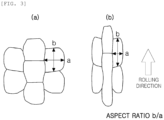
- a difference between the recrystallized ferrite and the non-recrystallized ferrite may be distinguished by an aspect ratio of the grain size to a rolling direction.
- the non-recrystallized ferrite has a large aspect ratio, and when the non-recrystallized ferrite is analyzed in detail, a linear deformation structure in the ferrite grains is observed.
- the recrystallized ferrite in the soft phase may be 60% or more, and the non-recrystallized ferrite is a soft phase, but when the fraction thereof is high, formability is reduced, and thus, the non-recrystallized ferrite may be 5% or less.
- an aspect ratio of the hard phase may be 1.2 or less.
- the aspect ratio refers to a ratio (b/a) of a major axis (b) and a minor axis (a) of a grain size with respect to the rolling direction
- an aspect ratio of the hard phase refers to an aspect ratio of a structure formed by stretching the hard phase in the rolling direction.
- bending properties which are important for resistance to deformation in the thickness direction, are adversely affected.
- hole expandability decreases. Accordingly, since it is decisive to keep the aspect ratio of the hard phase as low as possible, it is desirable that the aspect ratio does not exceed 1.2.
- the steel sheet of the present disclosure has a high tensile strength TS of 780 MPa or more and an elongation of 18% or more, thereby ensuring excellent strength and formability.
- the steel sheet of the present disclosure may be manufactured by first preparing and heating a steel slab, performing hot rolling on the steel slab, and then coiling and cooling the steel slab, followed by cold rolling and continuous annealing.
- each step will be described in detail.
- a steel slab having the above-described alloy composition that is, including, by wt%, C: 0.05 to 0.10%, Si: 0.3% or less (excluding 0%), Mn: 2.0 to 2.5%, Ti: 0.05% or less (excluding 0%), Nb: 0.1% or less (excluding 0%), Cr: 1.5% or less (excluding 0%), P: 0.1% or less, S: 0.01% or less, and a balance of Fe, and inevitable impurity elements, is prepared and then heated.
- This is to smoothly perform a subsequent hot rolling process and secure target physical properties of the steel sheet, and the heating process conditions are not particularly limited, and any method or condition commonly used in the technical field to which the present disclosure pertains may be used.
- the steel slab may be heated in a temperature within a range of 1100 to 1300°C.
- the heated steel slab is hot rolled to manufacture a hot-rolled steel sheet.
- final hot rolling may be performed at an outlet temperature in a temperature within a range of, preferably, Ar3 to 1000°C.
- Ar3 a temperature within a range of, preferably, Ar3 to 1000°C.
- the outlet temperature during the finishing hot rolling is less than Ar3
- hot deformation resistance increases rapidly, the top, tail, and edge of a hot-rolled coil become single-phase regions, which may increase in-plane anisotropy, and deteriorate formability.
- the temperature exceeds 1000°C a rolling load is relatively reduced, which is advantageous for productivity, but there may be a risk of an occurrence of a thick oxidation scale.
- the final hot rolling may be performed at a temperature within a range of, more preferably, 760 to 940°C.
- the hot-rolled steel sheet manufactured by hot rolling may be wound into a coil shape.
- the coiling may be performed in a temperature within a range of 400 to 700°C.
- the coiling temperature is less than 400°C, the formation of excessive martensite or bainite causes excessive strength increase of the hot-rolled steel sheet, and accordingly, during subsequent cold rolling, problems such as shape defects due to load may occur.
- the coiling temperature exceeds 700°C, a surface scale may increase and pickling properties may deteriorate.
- the wound hot-rolled steel sheet may be cooled to room temperature at an average cooling rate of 0.1°C/s or less (excluding 0°C/s).
- the wound hot-rolled steel sheet may be cooled after undergoing processes such as transport and stacking, and the process before cooling is not limited thereto.
- a hot-rolled steel sheet in which carbides that serve as austenite nucleation sites are finely dispersed may be obtained.
- the pickling method is not particularly limited, and it may be sufficient to use a method commonly used in the technical field to which the present disclosure pertains.
- the hot-rolled steel sheet wound as above may be manufactured into a cold-rolled steel sheet by performing cold rolling at a constant reduction ratio at room temperature.
- the cold rolling may be performed at a reduction ratio of 70 to 90%.
- the reduction ratio of the cold rolling is less than 70%, recrystallization driving force is reduced to form ferrite coarsely, and the formation of austenite is also reduced, so that the temperature of a soaking section in an annealing furnace must be increased to ensure a sufficient austenite fraction.
- the cold rolling reduction ratio exceeds 90%, there is a high possibility that cracks will occur at an edge of the steel sheet, and an initial thickness before rolling must be excessively thick and the number of rolling passes increases, which may result in lower productivity.
- the method of performing the cold rolling is not particularly limited in the present disclosure, and any method used in the technical field to which the present disclosure pertains may be applied.
- TCM Tandem Cold rolling mill
- ZRM Sendzimir rolling mill
- the TCM method is a reversible rolling method, which allows for low manufacturing costs and mass production and has the advantage of excellent productivity, but has the disadvantage of being somewhat limited in applying pressing force.
- the ZRM is a reversible batch method, which has the disadvantage of low productivity, but has the advantage of being somewhat easier to apply pressing force.
- the reduction ratio of cold rolling is an important operating factor that improves various physical properties by improving phase transformation of steel, control of the reduction ratio is particularly decisive for ensuring quality.
- an appropriate method may be adopted in consideration of a product material, a size, an operating environment, and the like.
- a continuous annealing treatment may be performed on the manufactured cold-rolled steel sheet.
- the continuous annealing treatment may be performed, for example, in a continuous annealing furnace (CAL).
- An example of a heat treatment step of a continuous annealing process is graphically illustrated in FIG. 1 .
- a heat treatment step may be comprised of a Heating Section (HS), a Soaking Section (SS), a Slow Cooling Section (SCS), a Rapid Cooling Section (RCS), and an Over Aging Section (OAS) in the annealing furnace.
- HS Heating Section
- SS Soaking Section
- SCS Slow Cooling Section
- RCS Rapid Cooling Section
- OF Over Aging Section
- a temperature of each section is obtained by measuring a temperature attached to an end point of each section, the temperature refers to a temperature at an end of each section.
- a Rapid Cooling Section (RCS) temperature is a temperature of a section in which the Rapid Cooling Section ends, and is indicated as 4 in
- the steel sheet In the Heating Section (HS), the steel sheet is heated at a constant temperature increase rate, and as the temperature of the steel sheet increases, recovery of dislocations, precipitation of cementite, recrystallization of ferrite, and dual-phase region reverse transformation occur.
- a line speed varies depending on the thickness and width of the steel sheet, and a change in microstructure for each temperature section may vary, depending on a hot rolling initial structure and a cold rolling reduction ratio.
- the Soaking Section (SS) When entering the Soaking Section (SS), the temperature is maintained constantly for a certain period of time, and in this case, depending on the annealing temperature, dual-phase region austenite or single phase region austenite reverse transformation is observed.
- the Soaking Section (SS) is known to be one of the sections that consumes the most energy in the annealing furnace.
- SCS Slow Cooling Section
- RCS Rapid Cooling Section
- some bainite may be generated during cooling depending on an RCS set temperature and degree of hardenability.
- FIG. 2 is an arbitrary Fe-C phase diagram, and when a temperature T1 is determined for an arbitrary component, a ratio of austenite and ferrite corresponding to the temperature may be determined by a lever rule.
- the temperature of the Soaking Section (SS) is closely related to phase transformation.
- Factors that affect phase transformation and change in a state of a substance may include a temperature, pressure, and a composition, and when the composition is determined, the phase transformation may be adjusted through the temperature and pressure. In particular, as the temperature and pressure increase, the phase transformation may proceed faster during heating in the annealing furnace. However, as the temperature increases, energy costs increases and carbon emissions such as carbon dioxide increase after combustion, making it unfriendly.
- a variable compared to pressure is a cold reduction ratio.
- the cold reduction ratio is increased at the same temperature, phase transformation progresses faster, and in an opposite concept, when the cold rolling reduction ratio is increased, the phase transformation may be created even at low temperatures.
- the cold rolling reduction ratio is performed at 70 to 90%, which is higher than a conventional method.
- a soaking section temperature in a typical annealing process is generally in the range of Ac1+30°C to Ac3-30°C.
- the present disclosure enables ferrite recrystallization and austenite formation even when a heat treatment is performed at a low temperature by increasing the cold rolling reduction ratio, and an annealing process of the present disclosure may be heated and maintained to a temperature within a range of Ac1 to Ac1+50°C.
- the present invention may reduce hardness and improve processability through recrystallization and phase transformation even in the above-described temperature range.
- a target structure By cooling the cold-rolled steel sheet heat-treated in the above-described temperature range, a target structure may be formed, and at this time, cooling may be performed stepwise.
- the stepwise cooling may be performed in the Slow Cooling Section (SCS) and the Rapid Cooling Section (RCS), and for example, the cold-rolled steel sheet may be cooled slowly to a temperature within a range of 650 to 700°C at an average cooling rate of 1 to 10°C/s, followed by rapid cooling at an average cooling rate of 5 to 50°C/s to a temperature within a range of 300 to 580°C.
- SCS Slow Cooling Section
- RCS Rapid Cooling Section
- rapid cooling is performed.
- a rapid cooling end temperature is less than 300°C
- cooling deviations may occur in width and length directions of the steel sheet to deteriorate a sheet shape, and when the temperature exceeds 580°C, the hard phase may not be sufficiently secured and the strength may be lowered.
- the average cooling rate during rapid cooling is less than 5°C/s
- the fraction of the hard phase may increase excessively, and when the temperature exceeds 50°C/s, there may be a risk that the hard phase may become insufficient.
- an over aging treatment is a process of maintaining a rapid cooling end temperature for a certain period of time.
- the over aging treatment does not require any separate treatment and may be regarded as the same treatment as a type of air-cooling treatment.
- a coil may be homogenized in the width and length directions of the coil, thereby improving shape quality.
- the over aging treatment may be performed for 200 to 800 seconds.
- each steel slab was heated at 1200°C for 1 hour, and then was subject to finish hot rolling at a finish rolling temperature of 800 to 920°C to manufacture a hot-rolled steel sheet.
- the hot-rolled steel sheet was cooled at a cooling rate of 0.1°C/s and wound at 650°C. Then, the wound hot-rolled steel sheet was cold-rolled at a reduction ratio of 40% and 80% to produce a cold-rolled steel sheet.
- the manufactured cold-rolled steel sheet was heated to an annealing temperature within a range of 730 to 860°C, and a heat treatment was performed under an annealing temperature condition in Table 2.
- Table 2 shows the temperatures of each step of the annealing heat treatment in the Heating section (HS), the Soaking Section (SS), the Slow Cooling Section (SCS), the Rapid Cooling Section (RCS), and the Over aging Section (OAS) in FIG. 1 . Meanwhile, the slow cooling (SCS section in Table 2) was performed at an average cooling rate of 3°C/s, and the rapid cooling (RCS section in Table 2) was performed at an average cooling rate of 20°C/s.
- Table 1 Steel Type C Si Mn P S Cr Ti Nb Ac1 (°C) 1 0.07 0.18 2.4 0.01 0.0052 0.98 0.015 0.08 719.1 2 0.092 0.27 2.41 0.011 0.004 1.02 0.042 0.04 722.3 Table 2: Stee 1 Type Cold Rolling Reductio n Ratio (%) Temperature at Each Step Of Annealing Process (°C) SS Temperature Range Division HS SS SC S RC S OA S 2 40 73 0 73 0 65 0 45 0 36 0 Ac1 ⁇ SS ⁇ Ac1+50° C Comparativ e
- Example 1 40 75 0 75 0 65 0 45 0 36 0 Ac1 ⁇ SS ⁇ Ac1+50° C Comparativ e
- Example 2 2 40 79 0 79 0 65 0 45 0 36 0 Ac1+50°C ⁇ SS Comparativ e
- Example 3 1 40 80 0 80 0 65 0 45 0 36 0 Ac1+50°C
- a tensile test for each specimen was performed at a strain rate of 0.01/s after collecting a tensile specimen of size JIS No. 5 in a vertical direction of a rolling direction.
- non-crystallized ferrite in the structure phase was observed through the scanning electron microscope (SEM) of 5,000X magnification after nital etching.
- SEM scanning electron microscope
- sub grains observed in normal non-crystallized ferrite from the observed grain shape on the ferrite or particles stretched in the rolling direction were analyzed with non-crystallized ferrite, and a fraction thereof was measured.
- each fraction was measured using the SEM and an image analyzer after nital etching.
- An aspect ratio of the hard phase was measured by measuring a ratio of a width (a) and a length (b) with respect to the rolling direction as illustrated in FIG. 3 , which is a commonly used method.
- F refers to ferrite
- YS refers to a yield strength
- TS tensile strength
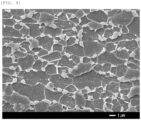
- FIG. 4 is an SEM image of the microstructure of Inventive Example 1, in which ferrite is recrystallized by 60% or more and a hard phase has a round shape with an aspect ratio of 1.2 or less.
- Comparative Examples 1 to 2 since the reduction ratio is low, when the annealing temperature decreases, ferrite recrystallization may be insufficient, and austenite may be formed quickly during heating to ensure strength, but to cause a problem of low elongation.
- Comparative Example 2 was subjected to the same heat treatment as Invention Example 2, but due to the low reduction ration, recrystallization does not occur smoothly, and the fraction of recrystallization ferrite decreases, which may result in poor elongation.
- FIG. 5 is an SEM image of the microstructure of Comparative Example 1, and a plurality of recrystallized ferrite are observed.
- Comparative Examples 3 to 7 did not satisfy target physical properties of the elongation. Specifically, due to the low reduction ration, austenite may be formed coarsely, and thus the elongation decreases, and the annealing temperature increases, which may result in a problem of low energy efficiency.
- FIG. 6 is an SEM image of the microstructure of Comparative Example 4, from which it was confirmed that the fraction of the hard phase increased and the aspect ratio was high, and formability such as the elongation was deteriorated.
- Comparative Examples 8 to 11 had problems of low energy efficiency due to a high annealing temperature, and low elongation due to a high secondary phase fraction.
Landscapes
- Chemical & Material Sciences (AREA)
- Engineering & Computer Science (AREA)
- Mechanical Engineering (AREA)
- Materials Engineering (AREA)
- Metallurgy (AREA)
- Organic Chemistry (AREA)
- Physics & Mathematics (AREA)
- Thermal Sciences (AREA)
- Crystallography & Structural Chemistry (AREA)
- Heat Treatment Of Sheet Steel (AREA)
Abstract
Description
- The present disclosure relates to a steel sheet used in automobiles, etc., and to a steel sheet that has high strength and high formability and is eco-friendly manufactured, and a manufacturing method therefor.
- Improving fuel efficiency and durability is an important issue that automakers should address. To this end, by utilizing thin, high-strength steel, it may be possible to simultaneously improve various issues of the environment, fuel efficiency, impact resistance, and durability. For example, the Insurance Institute for Highway Safety in the United States has gradually strengthened crash safety regulations to protect occupants, and have required harsh collision components such as 25% small overlap since 2013. These solutions include reducing the weight of automobiles, and to reduce the weight thereof, high strength of a steel material is required and high formability is also required.
- Specifically, as regulations on the impact safety of automobiles are expanding, steel with excellent strength is being used for structural members such as a member, a seat rail, and a pillar to improve the impact resistance of a vehicle body. These components have complex shapes depending on stability and design, and are mainly manufactured by forming in press molds, which may require high strength and a high level of formability.
- However, as the strength of steel increases, it has advantageous characteristics in absorbing impact energy. However, in general, when the strength increases, there may be a problem in which elongation decreases and molding processability deteriorates. In addition, when the yield strength is excessively high, there may be a problem in which the inflow of a material from the mold is reduced during molding, resulting in poor formability. Accordingly, the automobile industry is requesting the steel industry to develop steel materials with excellent strength and formability, that is, excellent strength and elongation balance (TS*E1).
- Steel companies have developed various products to meet these demands. For example, the products may include dual phase steel (DP steel), transformation induced plasticity steel (TRIP steel), complex phase steel (CP steel), and ferrite-bainite steel (FB steel)., and the products are manufactured through iron making, steel making, casting, hot rolling, cold rolling, and annealing processes.
- Meanwhile, demands for environmental protection are increasing around the world, and companies are concentrating their capabilities on Environmental, Social, Governance (ESG) factors by reducing carbon dioxide (CO2) emissions. Several steel companies have announced plans to achieve zero carbon dioxide emissions, and a conventional method of coke reduction has the problem of high carbon dioxide emissions, so that there is high interest in eco-friendly technologies such as DRI technology that performs reduction using hydrogen.
- Normally, the energy required for cold rolling and annealing uses by-product gas of an iron making process, but when eco-friendly technologies such as DRI are applied, by-product gas is reduced and energy costs increase, and thus, to save energy, technology to lower the heat treatment temperature is required. Furthermore, when the by-product gas is used to create a heat source, this may also generate CO2, so that it may be necessary to minimize the amount used.
- An aspect of the present disclosure is to provide a steel sheet that has high strength and high formability and is eco-friendly manufactured by reducing the generation of carbon dioxide (CO2), and a manufacturing method therefor.
- The object of the present disclosure is not limited to the above-described matters. An additional object of the present disclosure is described throughout the specification, and, a person of ordinary skill in the art to which the present disclosure belongs will have no difficulty in understanding the additional object of the present disclosure from the contents described in the specification of the present disclosure.
- According to an aspect of the present disclosure, provided is an eco-friendly steel sheet having high strength and high formability, comprising: by wt%, C: 0.05 to 0.10%, Si: 0.3% or less (excluding 0%), Mn: 2.0 to 2.5%, Ti: 0.05% or less (excluding 0%), Nb: 0.1% or less (excluding 0%), Cr: 1.5% or less (excluding 0%), P: 0.1% or less, S: 0.01% or less, and a balance of Fe, and inevitable impurity elements,
wherein a microstructure comprises, in area fraction, 15 to 35% of a hard phase and 65 to 85% of a soft phase. - According to another aspect of the present disclosure, provided is a method for manufacturing an eco-friendly steel sheet having high strength and high formability, the method comprising: manufacturing a hot-rolled steel sheet using a steel slab comprising, by wt%, C: 0.05 to 0.10%, Si: 0.3% or less (excluding 0%), Mn: 2.0 to 2.5%, Ti: 0.05% or less (excluding 0%), Nb: 0.1% or less (excluding 0%), Cr: 1.5% or less (excluding 0%), P: 0.1% or less, S: 0.01% or less, and a balance of Fe, and inevitable impurity elements;
- manufacturing a cold-rolled steel sheet by cold-rolling the hot-rolled steel sheet at a reduction ratio of 70 to 90%;
- heating and maintaining the cold-rolled steel sheet to a temperature within a range of Ac1 to Ac1+50°C; and
- cooling the cold-rolled steel sheet slowly at an average cooling rate of 1 to 10°C/s to a temperature within a range of 650 to 700°C, and then rapidly cooling the cold-rolled steel sheet to a temperature within a range of 300 to 580°C at an average cooling rate of 5 to 50°C/s.
- According to the present disclosure, it may be possible to provide a steel sheet having high strength and formability, especially an excellent balance between strength and ductility (TS*El), processing defects such as cracks or wrinkles may be prevented during press forming, so that the steel sheet may be suitably applied to components such as a structural structure that require processing into a complex shape. Furthermore, the present disclosure may be effective in manufacturing automobile components having excellent collision resistance in which cracks are not frequently formed, when a vehicle inevitably crashes.
- Furthermore, the present disclosure may provide a steel sheet that is eco-friendly manufactured by reducing the generation of carbon dioxide (CO2) by lowering an annealing heat treatment temperature during a manufacturing process, and a manufacturing method therefor.
- Various useful advantages and effects of the present disclosure are not limited to the above and may be relatively easily understood in a process of describing embodiments of the present invention.
-
-
FIG. 1 is a graph illustrating a heat treatment stage of a continuous annealing process. -
FIG. 2 is an arbitrary Fe-C state view illustrating a relationship between a component and an annealing temperature. -
FIG. 3 is a schematic diagram illustrating an example of a method of measuring an aspect ratio of a hard phase. -
FIG. 4 is an image obtained by observing a microstructure of Inventive Example 1 of embodiments. -
FIG. 5 is an image obtained by observing a microstructure of Comparative Example 1 of embodiments. -
FIG. 6 is an image obtained by observing a microstructure of Comparative Example 4 of embodiments. - The terms used in the present specification are intended to describe specific embodiments and are not intended to limit the present disclosure. In addition, singular forms used in the present specification include plural forms unless the relevant definition indicates the opposite meaning.
- The meaning of "include" and "comprise" used in the specification specifies the configuration and does not exclude the existence or addition of other configurations.
- Unless otherwise defined, all terms including technical and scientific terms used herein have the same meaning as commonly understood by one of ordinary skill in the art to which example embodiments of the present disclosure belong. It will be further understood that the terms, such as those defined in commonly used dictionaries, should be interpreted as having meanings consistent with the relevant technical literature and the currently disclosed content.
- Representative high-strength steel used as automotive materials includes dual phase steel (DP steel), transformation induced plasticity steel (TRIP steel), complex phase steel (CP steel), and ferrite-bainite steel (FB steel).
- Among these, DP steel includes a soft phase and a hard phase, and may include partial residual austenite. Such DP steel has low yield strength and high tensile strength, resulting in a low yield ratio (YR), and the DP steel has high work hardening rate, high ductility, excellent continuous yield behavior, excellent room temperature aging resistance, excellent bake hardenability, and in some cases, the DP steel has excellent hole expandability.
- However, in order to secure ultra-high tensile strength of 780 MPa or more, a fraction of a hard phase such as martensite, which is advantageous for strength improvement, needs to be increased, and in this case, there may be a problem in that a yield strength may increase to cause defects such as cracks during press forming. Accordingly, it may be decisive to secure excellent properties in both strength and elongation.
- Accordingly, the inventors of the present invention have increased a reduction ratio of cold rolling performed at room temperature to finely disperse a structure and adjust a heat treatment temperature, and have increased recrystallization driving force to induce sufficient recrystallization of a soft phase which affects the ductility of steel. In addition, by ensuring the miniaturization and uniform distribution of a hard phase, which is advantageous for securing strength, the inventors have confirmed that an excellent balance of strength and elongation may be secured, and have completed the present invention.
- On the other hand, in order to manufacture the DP steel, a steel slab is manufactured, and then this steel slab is manufactured through hot rolling, cold rolling, and annealing processes. The cold rolling process is a process mainly performed during the manufacture of a cold rolled steel sheet, which refer to rolling a hot rolled coil at a constant reduction ratio at room temperature. Typically, the cold rolling is performed in a Tandem Cold Rolling Mill (TCM). The TCM has the advantage of mass production at low manufacturing costs. On the other hand, in the annealing process, by heating and maintaining a steel sheet (cold rolled steel sheet) in a constant temperature section in a heating furnace, hardness may be lowered and workability may be improved through recrystallization and phase deformation. A steel sheet that has not undergone the annealing process has a high hardness, particularly a surface hardness, and have insufficient workability, while a steel sheet on which the annealing process has been performed has a recrystallization structure, thereby lowering hardness, yield point, and tensile strength.
- The annealing process requires a large amount of energy because a steel sheet at room temperature is heated and needs to be heated to a high temperature, which may increase energy costs, and may incur costs for purification of gases generated after combustion and be not environmentally friendly due to an inevitable increase in the generation of pollutants such as carbon dioxide (CO2) . Accordingly, the inventors of the present disclosure have studied ways to lower a heating temperature of the annealing process, and have studied ways to minimize the generation of pollutants such as carbon dioxide (CO2) during an energy production process and a post-combustion treatment process. Accordingly, to save energy in heat treatment processes with a high CO2 generation rate and high energy costs, the present inventors have developed a technology of securing excellent materials even when a heat treatment temperature is lowered by increasing a cold reduction ratio during cold rolling after hot rolling, and have achieved the present invention.
- That is, the present disclosure provides a steel sheet that is not only eco-friendly by applying the low annealing temperature to save energy and minimize pollutants, but also has an excellent balance of strength and elongation, and a manufacturing method therefor.
- First, a steel sheet, which is an embodiment of the present disclosure, will be described in detail. An alloy composition of the steel sheet includes, by wt%, C: 0.05 to 0.10%, Si: 0.3% or less (excluding 0%), Mn: 2.0 to 2.5%, Ti: 0.05% or less (excluding 0%), Nb: 0.1% or less (excluding 0%), Cr: 1.5% or less (excluding 0%), P: 0.1% or less, S: 0.01% or less, and a balance of Fe, and inevitable impurity elements. The alloy composition is described in detail as follows. Unless otherwise specified in the present disclosure, the content of each element is based on wt%.
- Carbon (C) is an important element added for solid solution strengthening, and Carbon (C) is combined with precipitated elements to form fine precipitates, thereby contributing to improving the strength of steel. When the content of Carbon (C) exceeds 0.10%, hardenability increases and strength increases excessively as martensite is formed during cooling when manufacturing steel, which may result in a decrease in elongation. Furthermore, since weldability deteriorates, there may be a risk of welding defects occurring when processing into components. When the content of Carbon (C) is less than 0.05%, it may be difficult to secure a target level of strength. More advantageously, the content thereof may be 0.06 to 0.08%.
- Silicon (Si) is a ferrite stabilizing element, and is advantageous to secure a target level of ferrite fraction by promoting ferrite transformation. Furthermore, Silicon (Si) is effective in increasing the strength of ferrite due to excellent solid solution strengthening ability, and is a useful element in securing strength without reducing the ductility of steel. When a content of Silicon (Si) exceeds 0.3%, a solid solution strengthening effect becomes excessive to reduce ductility, which may cause surface scale defects, may have a negative impact on plating surface quality, and may impair chemical treatment properties. More advantageously, the content thereof may be 0.1% or less.
- Manganese (Mn) is an element that prevents hot embrittlement caused by the formation of FeS by precipitating sulfur (S) in steel into MnS, and is advantageous for solid solution strengthening the steel. When a content of Manganese (Mn) is less than 2.0%, Manganese (Mn) may not obtain the above-described effect, and may find it difficult to secure a target level of strength. On the other hand, when the content of Manganese (Mn) exceeds 2.5%, problems such as weldability and hot rolling are likely to occur, and at the same time, there may be a risk that ductility will decrease as martensite is formed more easily due to an increase in hardenability. Furthermore, there may be a problem in that excessive formation of Mn oxide bands (Mn-bands) in a structure may increase the risk of defects such as processing cracks. Additionally, there may be a problem in that Mn oxide may be eluted to a surface thereof during annealing, greatly impairing plating properties. More advantageously, the content thereof may be 2.2 to 2.4%.
- Titanium (Ti) is an element that forms fine carbides and contributes to securing yield strength and tensile strength. Furthermore, Titanium (Ti) has the effect of precipitating N in steel into TiN and suppressing the formation of AlN in Al, which is inevitably present in the steel, thereby reducing the possibility of cracks occurring during continuous casting. When a content of Titanium (Ti) exceeds 0.05%, coarse carbides may precipitate, and there may be a risk of a decrease in strength and elongation due to a decrease in the amount of carbon in the steel. Furthermore, there may be a risk of nozzle clogging during continuous casting, and the manufacturing costs may increase. Accordingly, Titanium (Ti) may be, preferably, 0.05% or less, and may be, preferably, more than 0%.
- Niobium (Nb) is an element that segregates at austenite grain boundaries, suppresses coarsening of austenite grains during an annealing heat treatment, and forms fine carbides, contributing to strength improvement. When the content of Niobium (Nb) exceeds 0.1%, coarse carbides may be precipitated, the strength and elongation may be inferior due to the reduction of carbides in steel, and manufacturing costs may increase. Niobium (Nb) may be, preferably, 0.1% or less, and may be, preferably, more than 0%.
- Chromium (Cr) is an element that facilitates the formation of bainite, suppresses the formation of martensite during an annealing heat treatment, and forms fine carbides, contributing to strength improvement. When a content of Chromium (Cr) exceeds 1.5%, bainite may be excessively formed to reduce elongation, and when carbides are formed at grain boundaries, strength and elongation may deteriorate, and manufacturing costs may increase. Accordingly, Chromium (Cr) may be preferably included in an amount of 1.5% or less, and Chromium (Cr) may be, preferably, more than 0%.
- Phosphorus (P) is a substitutional element with the greatest solid solution strengthening effect, and is an element that improves in-plane anisotropy and is advantageous in securing strength without significantly reducing formability. However, when Phosphorus (P) is added excessively, the possibility of brittle fracture may occur significantly, increasing the possibility of sheet fracture of a slab during hot rolling, and plating surface characteristics may deteriorate. Accordingly, the content of Phosphorus (P) may be, preferably, 0.1% or less, and the amount of 0% may be excluded in consideration of a level of unavoidable inclusion.
- Sulfur (S) is an element that is inevitably added as an impurity element in steel, and since Sulfur (S) reduces ductility, it may be desirable to keep the content of Sulfur (S) as low as possible. Specifically, since Sulfur (S) has the problem of increasing the possibility of causing red heat embrittlement, it may be desirable to control the content thereof to 0.01% or less. However, the amount of 0% may be excluded in consideration of a level of unavoidable inclusion.
- As a remainder, Fe may be included, and unintended impurities may inevitably be introduced from raw materials or the surrounding environment during a normal manufacturing process, which may not be excluded. Since these impurities may be known to anyone skilled in the art during the manufacturing process, all of them are not specifically mentioned in this specification.
- A high-strength steel sheet of the present disclosure has a microstructure including a hard phase and a soft phase, and specifically, by maximizing ferrite recrystallization through an optimized annealing process, ultimately, the steel sheet may include a structure in which bainite and martensite phases as hard phases are uniformly distributed in a recrystallized ferrite matrix. In the microstructure, the hard phase is mainly martensite, and refers to a mixed phase including a small amount of bainite, and the soft phase refers to a ferrite phase. In a structure comprised of a soft phase and a hard phase, the soft phase determines the formability, and the hard phase determines the strength.
- The hard phase may include 15 to 35% of the area fraction. When the fraction of the hard phase is significantly high, the strength is high but the elongation is low, and when the fraction of the soft phase is high, the elongation is high but the strength is low. To secure the strength of 780 MPa or more provided by the present disclosure, the hard phase may include, preferably, 15% or more in area fraction, and to ensure formability, it is desirable that the hard phase does not exceed 35%.
- To secure appropriate strength and formability at the same time, the soft phase may include, preferably, 65 to 85% in area fraction. The ferrite of the soft phase may be divided into recrystallized ferrite and non-recrystallized ferrite. As illustrated in
Figure 3 , a difference between the recrystallized ferrite and the non-recrystallized ferrite may be distinguished by an aspect ratio of the grain size to a rolling direction. As illustrated inFIG. 3B , the non-recrystallized ferrite has a large aspect ratio, and when the non-recrystallized ferrite is analyzed in detail, a linear deformation structure in the ferrite grains is observed. On the other hand, since the recrystallized ferrite is advantageous in securing formability, the recrystallized ferrite in the soft phase may be 60% or more, and the non-recrystallized ferrite is a soft phase, but when the fraction thereof is high, formability is reduced, and thus, the non-recrystallized ferrite may be 5% or less. - Meanwhile, an aspect ratio of the hard phase may be 1.2 or less. As illustrated in
FIGS. 3 A and 3B , the aspect ratio refers to a ratio (b/a) of a major axis (b) and a minor axis (a) of a grain size with respect to the rolling direction, and an aspect ratio of the hard phase refers to an aspect ratio of a structure formed by stretching the hard phase in the rolling direction. As the aspect ratio of the hard phase increases, bending properties, which are important for resistance to deformation in the thickness direction, are adversely affected. Additionally, as the aspect ratio of the hard phase increases, hole expandability decreases. Accordingly, since it is decisive to keep the aspect ratio of the hard phase as low as possible, it is desirable that the aspect ratio does not exceed 1.2. - The steel sheet of the present disclosure has a high tensile strength TS of 780 MPa or more and an elongation of 18% or more, thereby ensuring excellent strength and formability.
- Next, an embodiment of a method for manufacturing a steel sheet of the present disclosure will be described in detail. The steel sheet of the present disclosure may be manufactured by first preparing and heating a steel slab, performing hot rolling on the steel slab, and then coiling and cooling the steel slab, followed by cold rolling and continuous annealing. Hereinafter, each step will be described in detail.
- A steel slab having the above-described alloy composition, that is, including, by wt%, C: 0.05 to 0.10%, Si: 0.3% or less (excluding 0%), Mn: 2.0 to 2.5%, Ti: 0.05% or less (excluding 0%), Nb: 0.1% or less (excluding 0%), Cr: 1.5% or less (excluding 0%), P: 0.1% or less, S: 0.01% or less, and a balance of Fe, and inevitable impurity elements, is prepared and then heated. This is to smoothly perform a subsequent hot rolling process and secure target physical properties of the steel sheet, and the heating process conditions are not particularly limited, and any method or condition commonly used in the technical field to which the present disclosure pertains may be used. As an example, the steel slab may be heated in a temperature within a range of 1100 to 1300°C.
- The heated steel slab is hot rolled to manufacture a hot-rolled steel sheet. In this case, final hot rolling may be performed at an outlet temperature in a temperature within a range of, preferably, Ar3 to 1000°C. When the outlet temperature during the finishing hot rolling is less than Ar3, hot deformation resistance increases rapidly, the top, tail, and edge of a hot-rolled coil become single-phase regions, which may increase in-plane anisotropy, and deteriorate formability. On the other hand, when the temperature exceeds 1000°C, a rolling load is relatively reduced, which is advantageous for productivity, but there may be a risk of an occurrence of a thick oxidation scale. The final hot rolling may be performed at a temperature within a range of, more preferably, 760 to 940°C.
- The hot-rolled steel sheet manufactured by hot rolling may be wound into a coil shape. The coiling may be performed in a temperature within a range of 400 to 700°C. When the coiling temperature is less than 400°C, the formation of excessive martensite or bainite causes excessive strength increase of the hot-rolled steel sheet, and accordingly, during subsequent cold rolling, problems such as shape defects due to load may occur. On the other hand, when the coiling temperature exceeds 700°C, a surface scale may increase and pickling properties may deteriorate.
- Meanwhile, the wound hot-rolled steel sheet may be cooled to room temperature at an average cooling rate of 0.1°C/s or less (excluding 0°C/s). The wound hot-rolled steel sheet may be cooled after undergoing processes such as transport and stacking, and the process before cooling is not limited thereto. By cooling the wound hot-rolled steel sheet at a constant rate, a hot-rolled steel sheet in which carbides that serve as austenite nucleation sites are finely dispersed may be obtained.
- Then, an additional process of removing surface scale by pickling a surface of the hot-rolled steel sheet before performing subsequent cold rolling may be performed. The pickling method is not particularly limited, and it may be sufficient to use a method commonly used in the technical field to which the present disclosure pertains.
- The hot-rolled steel sheet wound as above may be manufactured into a cold-rolled steel sheet by performing cold rolling at a constant reduction ratio at room temperature.
- During the cold rolling, the cold rolling may be performed at a reduction ratio of 70 to 90%. When the reduction ratio of the cold rolling is less than 70%, recrystallization driving force is reduced to form ferrite coarsely, and the formation of austenite is also reduced, so that the temperature of a soaking section in an annealing furnace must be increased to ensure a sufficient austenite fraction. On the other hand, when the cold rolling reduction ratio exceeds 90%, there is a high possibility that cracks will occur at an edge of the steel sheet, and an initial thickness before rolling must be excessively thick and the number of rolling passes increases, which may result in lower productivity.
- The method of performing the cold rolling is not particularly limited in the present disclosure, and any method used in the technical field to which the present disclosure pertains may be applied. For example, there is a Tandem Cold rolling mill (TCM) method and a Sendzimir rolling mill (ZRM) method. To briefly explain these, the TCM method is a reversible rolling method, which allows for low manufacturing costs and mass production and has the advantage of excellent productivity, but has the disadvantage of being somewhat limited in applying pressing force. The ZRM is a reversible batch method, which has the disadvantage of low productivity, but has the advantage of being somewhat easier to apply pressing force.
- Since the reduction ratio of cold rolling is an important operating factor that improves various physical properties by improving phase transformation of steel, control of the reduction ratio is particularly decisive for ensuring quality. In the present disclosure, an appropriate method may be adopted in consideration of a product material, a size, an operating environment, and the like.
- A continuous annealing treatment may be performed on the manufactured cold-rolled steel sheet. The continuous annealing treatment may be performed, for example, in a continuous annealing furnace (CAL). An example of a heat treatment step of a continuous annealing process is graphically illustrated in
FIG. 1 . As illustrated inFIG. 1 , a heat treatment step may be comprised of a Heating Section (HS), a Soaking Section (SS), a Slow Cooling Section (SCS), a Rapid Cooling Section (RCS), and an Over Aging Section (OAS) in the annealing furnace. Generally, since a temperature of each section is obtained by measuring a temperature attached to an end point of each section, the temperature refers to a temperature at an end of each section. For example, a Rapid Cooling Section (RCS) temperature is a temperature of a section in which the Rapid Cooling Section ends, and is indicated as 4 inFIG. 1 . - In the Heating Section (HS), the steel sheet is heated at a constant temperature increase rate, and as the temperature of the steel sheet increases, recovery of dislocations, precipitation of cementite, recrystallization of ferrite, and dual-phase region reverse transformation occur. A line speed varies depending on the thickness and width of the steel sheet, and a change in microstructure for each temperature section may vary, depending on a hot rolling initial structure and a cold rolling reduction ratio.
- When entering the Soaking Section (SS), the temperature is maintained constantly for a certain period of time, and in this case, depending on the annealing temperature, dual-phase region austenite or single phase region austenite reverse transformation is observed. The Soaking Section (SS) is known to be one of the sections that consumes the most energy in the annealing furnace. In the Slow Cooling Section (SCS), cooling occurs at a low cooling rate, and after the SCS, continuous cooling occurs at a high cooling rate in the Rapid Cooling Section (RCS), and some bainite may be generated during cooling depending on an RCS set temperature and degree of hardenability.
- Meanwhile,
FIG. 2 is an arbitrary Fe-C phase diagram, and when a temperature T1 is determined for an arbitrary component, a ratio of austenite and ferrite corresponding to the temperature may be determined by a lever rule. In other words, the temperature of the Soaking Section (SS) is closely related to phase transformation. Factors that affect phase transformation and change in a state of a substance may include a temperature, pressure, and a composition, and when the composition is determined, the phase transformation may be adjusted through the temperature and pressure. In particular, as the temperature and pressure increase, the phase transformation may proceed faster during heating in the annealing furnace. However, as the temperature increases, energy costs increases and carbon emissions such as carbon dioxide increase after combustion, making it unfriendly. In the steel manufacturing process, a variable compared to pressure is a cold reduction ratio. When the cold reduction ratio is increased at the same temperature, phase transformation progresses faster, and in an opposite concept, when the cold rolling reduction ratio is increased, the phase transformation may be created even at low temperatures. Using this principle, in the present disclosure, the cold rolling reduction ratio is performed at 70 to 90%, which is higher than a conventional method. - A soaking section temperature in a typical annealing process is generally in the range of Ac1+30°C to Ac3-30°C. However, as described above, the present disclosure enables ferrite recrystallization and austenite formation even when a heat treatment is performed at a low temperature by increasing the cold rolling reduction ratio, and an annealing process of the present disclosure may be heated and maintained to a temperature within a range of Ac1 to Ac1+50°C. The present invention may reduce hardness and improve processability through recrystallization and phase transformation even in the above-described temperature range.
- By cooling the cold-rolled steel sheet heat-treated in the above-described temperature range, a target structure may be formed, and at this time, cooling may be performed stepwise. In the present disclosure, the stepwise cooling may be performed in the Slow Cooling Section (SCS) and the Rapid Cooling Section (RCS), and for example, the cold-rolled steel sheet may be cooled slowly to a temperature within a range of 650 to 700°C at an average cooling rate of 1 to 10°C/s, followed by rapid cooling at an average cooling rate of 5 to 50°C/s to a temperature within a range of 300 to 580°C. By performing a slow cooling rate during slow cooling, sheet shape defects caused by a rapid temperature drop during subsequent rapid cooling may be suppressed.
- When an end temperature of the slow cooling is less than 650°C, the diffusion activity of carbon is low due to a significantly low temperature to increase the carbon concentration in the ferrite, but as the carbon concentration in austenite decreases, the fraction of the hard phase becomes excessive, increasing the yield ratio, which increases the tendency for cracks to occur during processing. Furthermore, a temperature difference from the soaking section may significantly increase, causing a problem that a shape of the sheet becomes non-uniform. When an end temperature exceeds 700°C, there is a disadvantage that an excessively high cooling rate is required during subsequent cooling (rapid cooling). Furthermore, when the average cooling rate during the slow cooling exceeds 10°C/s, carbon diffusion may not sufficiently occur, and in consideration of productivity, the cooling may be performed at an average cooling rate of 1°C/s or more.
- After completing the above-described slow cooling, rapid cooling is performed. When a rapid cooling end temperature is less than 300°C, cooling deviations may occur in width and length directions of the steel sheet to deteriorate a sheet shape, and when the temperature exceeds 580°C, the hard phase may not be sufficiently secured and the strength may be lowered. On the other hand, when the average cooling rate during rapid cooling is less than 5°C/s, the fraction of the hard phase may increase excessively, and when the temperature exceeds 50°C/s, there may be a risk that the hard phase may become insufficient.
- Meanwhile, in the annealing process, after cooling is completed, an over aging treatment (OAS) may be performed if necessary. The over aging treatment is a process of maintaining a rapid cooling end temperature for a certain period of time. The over aging treatment does not require any separate treatment and may be regarded as the same treatment as a type of air-cooling treatment. By performing the over aging treatment, a coil may be homogenized in the width and length directions of the coil, thereby improving shape quality. For this purpose, the over aging treatment may be performed for 200 to 800 seconds.
- Hereinafter, embodiments of the present disclosure will be described. Various modifications to the following examples may be made by those skilled in the art without departing from the scope of the present disclosure. The following examples are for understanding of the present disclosure, and the scope of the present disclosure should not be limited to the following examples, but should be determined by the claims described below as well as their equivalents.
- After manufacturing a steel slab having the alloy composition shown in Table 1 below (unit is wt%, the remainder not illustrated in Table 1 is Fe and inevitable impurity elements), each steel slab was heated at 1200°C for 1 hour, and then was subject to finish hot rolling at a finish rolling temperature of 800 to 920°C to manufacture a hot-rolled steel sheet. The hot-rolled steel sheet was cooled at a cooling rate of 0.1°C/s and wound at 650°C. Then, the wound hot-rolled steel sheet was cold-rolled at a reduction ratio of 40% and 80% to produce a cold-rolled steel sheet.
- The manufactured cold-rolled steel sheet was heated to an annealing temperature within a range of 730 to 860°C, and a heat treatment was performed under an annealing temperature condition in Table 2. Table 2 shows the temperatures of each step of the annealing heat treatment in the Heating section (HS), the Soaking Section (SS), the Slow Cooling Section (SCS), the Rapid Cooling Section (RCS), and the Over aging Section (OAS) in
FIG. 1 . Meanwhile, the slow cooling (SCS section in Table 2) was performed at an average cooling rate of 3°C/s, and the rapid cooling (RCS section in Table 2) was performed at an average cooling rate of 20°C/s.Table 1: Steel Type C Si Mn P S Cr Ti Nb Ac1 (°C) 1 0.07 0.18 2.4 0.01 0.0052 0.98 0.015 0.08 719.1 2 0.092 0.27 2.41 0.011 0.004 1.02 0.042 0.04 722.3 Table 2: Stee 1 Type Cold Rolling Reductio n Ratio (%) Temperature at Each Step Of Annealing Process (°C) SS Temperature Range Division HS SS SC S RC S OA S 2 40 73 0 73 0 65 0 45 0 36 0 Ac1≤SS≤Ac1+50° C Comparativ e Example 1 1 40 75 0 75 0 65 0 45 0 36 0 Ac1≤SS≤Ac1+50° C Comparativ e Example 2 2 40 79 0 79 0 65 0 45 0 36 0 Ac1+50°C < SS Comparativ e Example 3 1 40 80 0 80 0 65 0 45 0 36 0 Ac1+50°C < SS Comparativ e Example 4 2 40 82 0 82 0 65 0 45 0 36 0 Ac1+50°C < SS Comparativ e Example 5 1 40 84 0 84 0 65 0 45 0 36 0 Ac1+50°C < SS Comparativ e Example 6 1 40 86 0 86 0 65 0 45 0 36 0 Ac1+50°C < SS Comparativ e Example 7 1 80 73 0 73 0 65 0 45 0 36 0 Ac1≤SS≤Ac1+50° C Inventive Example 1 2 80 75 0 75 0 65 0 45 0 36 0 Ac1≤SS≤Ac1+50° C Inventive Example 2 2 80 77 0 77 0 65 0 45 0 36 0 Ac1≤SS≤Ac1+50° C Inventive Example 3 2 80 79 0 79 0 65 0 45 0 36 0 Ac1+50°C < SS Comparativ e Example 8 1 80 81 0 81 0 65 0 45 0 36 0 Ac1+50°C < SS Comparativ e Example 9 2 80 83 0 83 0 65 0 45 0 36 0 Ac1+50°C < SS Comparativ e Example 10 1 80 85 0 85 0 65 0 45 0 36 0 Ac1+50°C < SS Comparativ e Example 11 - A microstructure of each steel sheet manufactured by the above-described method was observed, mechanical properties and plating properties were evaluated, and results thereof are shown in Table 3 below.
- In this case, a tensile test for each specimen was performed at a strain rate of 0.01/s after collecting a tensile specimen of size JIS No. 5 in a vertical direction of a rolling direction.
- Furthermore, non-crystallized ferrite in the structure phase was observed through the scanning electron microscope (SEM) of 5,000X magnification after nital etching. In this case, sub grains observed in normal non-crystallized ferrite from the observed grain shape on the ferrite or particles stretched in the rolling direction were analyzed with non-crystallized ferrite, and a fraction thereof was measured. For other phases, each fraction was measured using the SEM and an image analyzer after nital etching. An aspect ratio of the hard phase was measured by measuring a ratio of a width (a) and a length (b) with respect to the rolling direction as illustrated in
FIG. 3 , which is a commonly used method. -
Table 3: Ste el Typ e Microstructure Area Fraction (%) Har d Pha se Asp ect Rat io Mechanical property Divisi on Recrystall ized F Non-recrystall ized F Har d Pha se YS (MP a) TS (MP a) Yie ld Rat io elonga tion (%) 2 7 65 28 3.1 611 132 5 0.4 6 9.8 Compar ative Exampl e 1 1 16 49 35 2.8 602 113 5 0.5 3 10.5 Compar ative Exampl e 2 2 26 26 48 2.5 683 104 8 0.6 5 11.3 Compar ative Exampl e 3 1 28 18 54 2.1 736 107 2 0.6 9 14 Compar ative Exampl e 4 2 26 9 65 1.9 779 108 7 0.7 2 7.7 Compar ative Exampl e 5 1 12 3 85 1.2 804 110 9 0.7 2 7.6 Compar ative Exampl e 6 1 5 1 94 1.1 9 809 112 5 0.7 2 8.9 Compar ative Exampl e 7 1 71 5 24 1.1 577 782 0.7 4 22.7 Invent ive Exampl e 1 2 69 1 30 1.0 8 408 830 0.4 9 20.7 Invent ive Exampl e 2 2 65 0 35 1.0 5 543 965 0.5 6 18.1 Invent ive Exampl e 3 2 57 0 43 1.0 5 667 105 5 0.6 3 13.1 Compar ative Exampl e 8 1 45 0 55 1.0 3 720 107 8 0.6 7 12.7 Compar ative Exampl e 9 2 25 0 75 1.0 1 769 108 9 0.7 1 8.3 Compar ative Exampl e 10 1 18 0 82 1.0 1 836 112 8 0.7 4 7.3 Compar ative Exampl e 11 - In Table 3, F refers to ferrite, YS refers to a yield strength, and TS refers to tensile strength.
- As shown in Tables 1 to 3, in Inventive Examples 1 to 3, which satisfy the composition of the steel alloy and the manufacturing conditions, particularly, all of the suggestions of the present disclosure in the continuous annealing process, a microstructure required even at a low annealing temperature is obtained, and an eco-friendly manufacturing process due to good physical properties, high strength, excellent elongation, and low annealing temperature may be provided.
-
FIG. 4 is an SEM image of the microstructure of Inventive Example 1, in which ferrite is recrystallized by 60% or more and a hard phase has a round shape with an aspect ratio of 1.2 or less. - In Comparative Examples 1 to 2, since the reduction ratio is low, when the annealing temperature decreases, ferrite recrystallization may be insufficient, and austenite may be formed quickly during heating to ensure strength, but to cause a problem of low elongation. Specifically, Comparative Example 2 was subjected to the same heat treatment as Invention Example 2, but due to the low reduction ration, recrystallization does not occur smoothly, and the fraction of recrystallization ferrite decreases, which may result in poor elongation.
FIG. 5 is an SEM image of the microstructure of Comparative Example 1, and a plurality of recrystallized ferrite are observed. - Comparative Examples 3 to 7 did not satisfy target physical properties of the elongation. Specifically, due to the low reduction ration, austenite may be formed coarsely, and thus the elongation decreases, and the annealing temperature increases, which may result in a problem of low energy efficiency.
FIG. 6 is an SEM image of the microstructure of Comparative Example 4, from which it was confirmed that the fraction of the hard phase increased and the aspect ratio was high, and formability such as the elongation was deteriorated. - Comparative Examples 8 to 11 had problems of low energy efficiency due to a high annealing temperature, and low elongation due to a high secondary phase fraction.
Claims (8)
- An eco-friendly steel sheet having high strength and high formability, comprising: by wt%, C: 0.05 to 0.10%, Si: 0.3% or less (excluding 0%), Mn: 2.0 to 2.5%, Ti: 0.05% or less (excluding 0%), Nb: 0.1% or less (excluding 0%), Cr: 1.5% or less (excluding 0%), P: 0.1% or less, S: 0.01% or less, and a balance of Fe, and inevitable impurity elements,
wherein a microstructure comprises, in area fraction, 15 to 35% of a hard phase and 65 to 85% of a soft phase. - The eco-friendly steel sheet having high strength and high formability of claim 1, wherein the soft phase comprises, in area fraction, 60% or more of recrystallized ferrite and 5% or less of non-recrystallized ferrite.
- The eco-friendly steel sheet having high strength and high formability of claim 1, wherein the hard phase comprises martensite or a mixed structure of martensite and a trace amount of bainite.
- The eco-friendly steel sheet having high strength and high formability of claim 1, wherein an aspect ratio of the hard phase is 1.2 or less.
- The eco-friendly steel sheet having high strength and high formability of claim 1, wherein the steel sheet has tensile strength TS of 780 MPa or more and an elongation El of 18% or more.
- A method for manufacturing an eco-friendly steel sheet having high strength and high formability, the method comprising:manufacturing a hot-rolled steel sheet using a steel slab comprising, by wt%, C: 0.05 to 0.10%, Si: 0.3% or less (excluding 0%), Mn: 2.0 to 2.5%, Ti: 0.05% or less (excluding 0%), Nb: 0.1% or less (excluding 0%), Cr: 1.5% or less (excluding 0%), P: 0.1% or less, S: 0.01% or less, and a balance of Fe, and inevitable impurity elements;manufacturing a cold-rolled steel sheet by cold-rolling the hot-rolled steel sheet at a reduction ratio of 70 to 90%;heating and maintaining the cold-rolled steel sheet to a temperature within a range of Ac1 to Ac1+50°C; andcooling the cold-rolled steel sheet slowly at an average cooling rate of 1 to 10°C/s to a temperature within a range of 650 to 700°C, and then rapidly cooling the cold-rolled steel sheet to a temperature within a range of 300 to 580°C at an average cooling rate of 5 to 50°C/s.
- The method for manufacturing an eco-friendly steel sheet having high strength and high formability of claim 6, wherein the hot-rolled steel sheet comprises:heating the steel slab to a temperature within a range of 1100 to 1300°C;performing hot rolling the steel slab by performing finish rolling on the heated steel slab at a temperature within a range of Ar3 to 1000°C; andafter the hot rolling, coiling a hot-rolled steel at a temperature within a range of 400 to 700°C and cooling a wound hot-rolled steel at a cooling rate of 0.1°C/s or less.
- The method for manufacturing an eco-friendly steel sheet having high strength and high formability of claim 6, further comprising:
performing an over aging treatment for 200 to 800 seconds after the rapid cooling.
Applications Claiming Priority (2)
| Application Number | Priority Date | Filing Date | Title |
|---|---|---|---|
| KR1020210139497A KR20230055740A (en) | 2021-10-19 | 2021-10-19 | Eco-friendly steel sheet having high strength and high formability, and method for manufacturing the same |
| PCT/KR2022/015870 WO2023068763A1 (en) | 2021-10-19 | 2022-10-18 | Eco-friendly steel sheet having high strength and high formability, and method for manufacturing same |
Publications (2)
| Publication Number | Publication Date |
|---|---|
| EP4421204A1 true EP4421204A1 (en) | 2024-08-28 |
| EP4421204A4 EP4421204A4 (en) | 2025-08-06 |
Family
ID=86059411
Family Applications (1)
| Application Number | Title | Priority Date | Filing Date |
|---|---|---|---|
| EP22883985.8A Pending EP4421204A4 (en) | 2021-10-19 | 2022-10-18 | Environmentally friendly steel sheet with high strength and high formability and method for producing the same |
Country Status (7)
| Country | Link |
|---|---|
| US (1) | US20250236924A1 (en) |
| EP (1) | EP4421204A4 (en) |
| JP (1) | JP2024540919A (en) |
| KR (1) | KR20230055740A (en) |
| CN (1) | CN118159679A (en) |
| MX (1) | MX2024004760A (en) |
| WO (1) | WO2023068763A1 (en) |
Cited By (1)
| Publication number | Priority date | Publication date | Assignee | Title |
|---|---|---|---|---|
| EP4455346A4 (en) * | 2021-12-21 | 2025-05-14 | POSCO Co., Ltd | HIGH STRENGTH AND HIGH FORMABILITY STEEL SHEET HAVING EXCELLENT SPOT WELDABILITY, AND MANUFACTURING METHOD THEREOF |
Family Cites Families (14)
| Publication number | Priority date | Publication date | Assignee | Title |
|---|---|---|---|---|
| JP5483916B2 (en) * | 2009-03-27 | 2014-05-07 | 日新製鋼株式会社 | High-strength galvannealed steel sheet with excellent bendability |
| WO2013018740A1 (en) * | 2011-07-29 | 2013-02-07 | 新日鐵住金株式会社 | High-strength steel sheet having superior impact resistance, method for producing same, high-strength galvanized steel sheet, and method for producing same |
| KR101382854B1 (en) * | 2012-03-20 | 2014-04-08 | 주식회사 포스코 | Ultra high strength cold rolled steel sheets having high yield ratio, excellent weldability and bendability and method for manufacturing the same |
| KR101449134B1 (en) * | 2012-10-15 | 2014-10-08 | 주식회사 포스코 | Ultra high strength cold rolled steel sheet having excellent weldability and bendability and method for manufacturinf the same |
| JP6291289B2 (en) * | 2013-03-06 | 2018-03-14 | 株式会社神戸製鋼所 | High-strength cold-rolled steel sheet excellent in steel sheet shape and shape freezing property and method for producing the same |
| KR101676137B1 (en) * | 2014-12-24 | 2016-11-15 | 주식회사 포스코 | High strength cold rolled, hot dip galvanized steel sheet with excellent bendability and hole expansion property, and method for production thereof |
| KR102157430B1 (en) * | 2016-03-31 | 2020-09-17 | 제이에프이 스틸 가부시키가이샤 | Thin steel sheet and plated steel sheet, and manufacturing method of hot rolled steel sheet, cold rolled full hard steel sheet manufacturing method, thin steel sheet manufacturing method, and plated steel sheet manufacturing method |
| JP6702357B2 (en) * | 2017-06-29 | 2020-06-03 | Jfeスチール株式会社 | Low yield ratio type high strength steel sheet and method for producing the same |
| JP6702356B2 (en) * | 2017-06-29 | 2020-06-03 | Jfeスチール株式会社 | High yield ratio type high strength steel sheet and method for producing the same |
| DE102017123236A1 (en) * | 2017-10-06 | 2019-04-11 | Salzgitter Flachstahl Gmbh | Highest strength multi-phase steel and process for producing a steel strip from this multi-phase steel |
| KR102020411B1 (en) * | 2017-12-22 | 2019-09-10 | 주식회사 포스코 | High-strength steel sheet having excellent workablity and method for manufacturing thereof |
| KR102020412B1 (en) * | 2017-12-22 | 2019-09-10 | 주식회사 포스코 | High-strength steel sheet having excellent crash worthiness and formability, and method for manufacturing thereof |
| KR102255823B1 (en) * | 2019-12-11 | 2021-05-26 | 주식회사 포스코 | High-strength steel having excellent formability and high yield ratio and method for manufacturing same |
| CA3164036C (en) * | 2019-12-18 | 2024-06-18 | Arcelormittal | Cold-rolled and annealed steel sheet and manufacturing method |
-
2021
- 2021-10-19 KR KR1020210139497A patent/KR20230055740A/en active Pending
-
2022
- 2022-10-18 CN CN202280070175.2A patent/CN118159679A/en active Pending
- 2022-10-18 WO PCT/KR2022/015870 patent/WO2023068763A1/en not_active Ceased
- 2022-10-18 JP JP2024523510A patent/JP2024540919A/en active Pending
- 2022-10-18 MX MX2024004760A patent/MX2024004760A/en unknown
- 2022-10-18 US US18/702,142 patent/US20250236924A1/en active Pending
- 2022-10-18 EP EP22883985.8A patent/EP4421204A4/en active Pending
Cited By (1)
| Publication number | Priority date | Publication date | Assignee | Title |
|---|---|---|---|---|
| EP4455346A4 (en) * | 2021-12-21 | 2025-05-14 | POSCO Co., Ltd | HIGH STRENGTH AND HIGH FORMABILITY STEEL SHEET HAVING EXCELLENT SPOT WELDABILITY, AND MANUFACTURING METHOD THEREOF |
Also Published As
| Publication number | Publication date |
|---|---|
| MX2024004760A (en) | 2024-05-27 |
| JP2024540919A (en) | 2024-11-06 |
| US20250236924A1 (en) | 2025-07-24 |
| EP4421204A4 (en) | 2025-08-06 |
| KR20230055740A (en) | 2023-04-26 |
| WO2023068763A1 (en) | 2023-04-27 |
| CN118159679A (en) | 2024-06-07 |
Similar Documents
| Publication | Publication Date | Title |
|---|---|---|
| KR101353787B1 (en) | Ultra high strength colde rolled steel sheet having excellent weldability and bendability and method for manufacturing the same | |
| KR101767780B1 (en) | High strength cold rolled steel sheet having high yield ratio and method for manufacturing the same | |
| KR102020407B1 (en) | High-strength steel sheet having high yield ratio and method for manufacturing thereof | |
| KR102109265B1 (en) | Ultra high strength and high ductility steel sheet having excellent yield ratio and manufacturing method for the same | |
| KR20230087773A (en) | Steel sheet having excellent strength and ductility, and manufacturing method thereof | |
| KR101917452B1 (en) | Cold rolled steel sheet with excellent bendability and hole expansion property, and method for manufacturing the same | |
| EP4421204A1 (en) | Eco-friendly steel sheet having high strength and high formability, and method for manufacturing same | |
| KR20150142791A (en) | High strength cold rolled steel sheet excellent in shape freezability, and manufacturing method thereof | |
| KR102255823B1 (en) | High-strength steel having excellent formability and high yield ratio and method for manufacturing same | |
| EP3231886A2 (en) | Dual-phase steel sheet with excellent formability and manufacturing method therefor | |
| JP7640701B2 (en) | High-strength steel plate with excellent bendability and formability and manufacturing method thereof | |
| EP4375391A1 (en) | High-strength steel sheet having excellent hole expandability and ductility and manufacturing method therefor | |
| EP4640881A1 (en) | Steel sheet and manufacturing method therefor | |
| JP7637161B2 (en) | High-strength steel plate with excellent formability and manufacturing method thereof | |
| KR102390816B1 (en) | High-strength steel sheet having excellent hole expandability and mathod for manufacturing thereof | |
| EP4357476A1 (en) | Ultra high strength steel sheet having high yield ratio and excellent bendability and method of manufacturing same | |
| KR20240098498A (en) | High yield ratio steel sheet having excellent workability, method for manufacturing the same | |
| EP4411013A1 (en) | High-strength and thick steel sheet having excellent hole expandability and ductility, and manufacturing method therefor | |
| KR20250093761A (en) | Cold rolled steel sheet and method of manufacturing the same | |
| KR20250093732A (en) | Cold rolled steel sheet and method of manufacturing the same | |
| KR20250093724A (en) | Cold-rolled steel sheet and manufacturing method thereof |
Legal Events
| Date | Code | Title | Description |
|---|---|---|---|
| STAA | Information on the status of an ep patent application or granted ep patent |
Free format text: STATUS: THE INTERNATIONAL PUBLICATION HAS BEEN MADE |
|
| PUAI | Public reference made under article 153(3) epc to a published international application that has entered the european phase |
Free format text: ORIGINAL CODE: 0009012 |
|
| STAA | Information on the status of an ep patent application or granted ep patent |
Free format text: STATUS: REQUEST FOR EXAMINATION WAS MADE |
|
| 17P | Request for examination filed |
Effective date: 20240514 |
|
| AK | Designated contracting states |
Kind code of ref document: A1 Designated state(s): AL AT BE BG CH CY CZ DE DK EE ES FI FR GB GR HR HU IE IS IT LI LT LU LV MC ME MK MT NL NO PL PT RO RS SE SI SK SM TR |
|
| DAV | Request for validation of the european patent (deleted) | ||
| DAX | Request for extension of the european patent (deleted) | ||
| A4 | Supplementary search report drawn up and despatched |
Effective date: 20250704 |
|
| RIC1 | Information provided on ipc code assigned before grant |
Ipc: C22C 38/38 20060101AFI20250630BHEP Ipc: C22C 38/28 20060101ALI20250630BHEP Ipc: C22C 38/26 20060101ALI20250630BHEP Ipc: C21D 8/02 20060101ALI20250630BHEP Ipc: C21D 9/46 20060101ALI20250630BHEP Ipc: B21C 47/02 20060101ALI20250630BHEP Ipc: C22C 38/04 20060101ALI20250630BHEP |