EP4420633A1 - Hilfsdruckvorrichtung für stressbedingte harninkontinenz - Google Patents
Hilfsdruckvorrichtung für stressbedingte harninkontinenz Download PDFInfo
- Publication number
- EP4420633A1 EP4420633A1 EP23810933.4A EP23810933A EP4420633A1 EP 4420633 A1 EP4420633 A1 EP 4420633A1 EP 23810933 A EP23810933 A EP 23810933A EP 4420633 A1 EP4420633 A1 EP 4420633A1
- Authority
- EP
- European Patent Office
- Prior art keywords
- expansion body
- state
- out portions
- vagina
- roots
- Prior art date
- Legal status (The legal status is an assumption and is not a legal conclusion. Google has not performed a legal analysis and makes no representation as to the accuracy of the status listed.)
- Granted
Links
Images







Classifications
-
- A—HUMAN NECESSITIES
- A61—MEDICAL OR VETERINARY SCIENCE; HYGIENE
- A61F—FILTERS IMPLANTABLE INTO BLOOD VESSELS; PROSTHESES; DEVICES PROVIDING PATENCY TO, OR PREVENTING COLLAPSING OF, TUBULAR STRUCTURES OF THE BODY, e.g. STENTS; ORTHOPAEDIC, NURSING OR CONTRACEPTIVE DEVICES; FOMENTATION; TREATMENT OR PROTECTION OF EYES OR EARS; BANDAGES, DRESSINGS OR ABSORBENT PADS; FIRST-AID KITS
- A61F2/00—Filters implantable into blood vessels; Prostheses, i.e. artificial substitutes or replacements for parts of the body; Appliances for connecting them with the body; Devices providing patency to, or preventing collapsing of, tubular structures of the body, e.g. stents
- A61F2/0004—Closure means for urethra or rectum, i.e. anti-incontinence devices or support slings against pelvic prolapse
- A61F2/0031—Closure means for urethra or rectum, i.e. anti-incontinence devices or support slings against pelvic prolapse for constricting the lumen; Support slings for the urethra
- A61F2/005—Closure means for urethra or rectum, i.e. anti-incontinence devices or support slings against pelvic prolapse for constricting the lumen; Support slings for the urethra with pressure applied to urethra by an element placed in the vagina
-
- A—HUMAN NECESSITIES
- A61—MEDICAL OR VETERINARY SCIENCE; HYGIENE
- A61F—FILTERS IMPLANTABLE INTO BLOOD VESSELS; PROSTHESES; DEVICES PROVIDING PATENCY TO, OR PREVENTING COLLAPSING OF, TUBULAR STRUCTURES OF THE BODY, e.g. STENTS; ORTHOPAEDIC, NURSING OR CONTRACEPTIVE DEVICES; FOMENTATION; TREATMENT OR PROTECTION OF EYES OR EARS; BANDAGES, DRESSINGS OR ABSORBENT PADS; FIRST-AID KITS
- A61F2/00—Filters implantable into blood vessels; Prostheses, i.e. artificial substitutes or replacements for parts of the body; Appliances for connecting them with the body; Devices providing patency to, or preventing collapsing of, tubular structures of the body, e.g. stents
- A61F2/0004—Closure means for urethra or rectum, i.e. anti-incontinence devices or support slings against pelvic prolapse
- A61F2/0009—Closure means for urethra or rectum, i.e. anti-incontinence devices or support slings against pelvic prolapse placed in or outside the body opening close to the surface of the body
- A61F2/0018—Closure means for urethra or rectum, i.e. anti-incontinence devices or support slings against pelvic prolapse placed in or outside the body opening close to the surface of the body magnetic
-
- A—HUMAN NECESSITIES
- A61—MEDICAL OR VETERINARY SCIENCE; HYGIENE
- A61F—FILTERS IMPLANTABLE INTO BLOOD VESSELS; PROSTHESES; DEVICES PROVIDING PATENCY TO, OR PREVENTING COLLAPSING OF, TUBULAR STRUCTURES OF THE BODY, e.g. STENTS; ORTHOPAEDIC, NURSING OR CONTRACEPTIVE DEVICES; FOMENTATION; TREATMENT OR PROTECTION OF EYES OR EARS; BANDAGES, DRESSINGS OR ABSORBENT PADS; FIRST-AID KITS
- A61F2250/00—Special features of prostheses classified in groups A61F2/00 - A61F2/26 or A61F2/82 or A61F9/00 or A61F11/00 or subgroups thereof
- A61F2250/0004—Special features of prostheses classified in groups A61F2/00 - A61F2/26 or A61F2/82 or A61F9/00 or A61F11/00 or subgroups thereof adjustable
- A61F2250/001—Special features of prostheses classified in groups A61F2/00 - A61F2/26 or A61F2/82 or A61F9/00 or A61F11/00 or subgroups thereof adjustable for adjusting a diameter
Definitions
- the present invention relates to the technical field of medical devices, and in particular to an auxiliary pressure device for stress urinary incontinence.
- SUI Stress urinary incontinence
- SUI Stress urinary incontinence
- the relaxation of the pelvic floor supporting tissue that results in a decrease in the pressure in the urethra.
- the intra-abdominal pressure will increase, causing involuntary urine leakage from the external urethra orifice.
- SUI can be unpleasant and embarrassing for women in life, and the pessary, which has been most commonly used for SUI, has become a feasible non-surgical option for treating SUI.
- the present invention provides an auxiliary pressure device for stress urinary incontinence, which can effectively solve the problems discussed above.
- An auxiliary pressure device for stress urinary incontinence comprising:
- expansion body is an integral structure.
- the expansion body comprises at least two lead-out portions evenly distributed along the circumferential direction.
- the respective lead-out portions are connected at roots and free at distal ends thereof.
- the adjustment system is configured to maintain the first state of the expansion body. In the first state, the distal ends are close to or fit with each other, and in the second state, the distal ends are separated from each other.
- the force application part is connected to the connection of the respective lead-out portions.
- the lead-out portion is an elastically curved structure that bends inwards, and in the second state, the distal end of the lead-out portion is separated from the vaginal wall.
- the lead-out portion comprises an elastic connection structure, and a fitting end connected as the distal end to one end of the connection structure.
- connection structure serves as the root.
- the fitting end expands outward relative to the connection structure, and in the second state, the fitting end fits with the vaginal wall.
- the expansion body is a hollow deformable structure.
- the adjustment system is configured to maintain the first state of the expansion body. In the first state, the internal cavity of the expansion body is compressed and deformed, and in the second state, the compressed and deformed internal cavity is at least partially restored.
- the force application part is connected to one end of the expansion body.
- the deformable structure is an elastic structure that has a maximum size in the middle part along the direction of insertion into vagina and gradually shrinks and extends toward both sides, wherein the length in the extension direction is greater than the maximum width of the middle part.
- the side wall of the expansion body is provided with a plurality of through areas, namely, a plurality of grooves distributed along the length direction of the deformable structure.
- a set of unlike-pole permanent magnets are arranged on the inner wall of the expansion body in the opposite directions, and the opposite directions indicate the direction of insertion into the vagina.
- the adjustment system comprises an outer tube body and a push rod.
- One end of the outer tube body is an open end, at which the expansion body is at least partially inserted into the outer tube body, and the other end of the outer tube body is used for the force application part to be led out.
- the push rod is inserted from the end of the outer tube body through which the force application part is led out.
- the expansion body is moved out of the open end under the action of the push rod.
- the open end is provided on the curved outer surface of the outer tube body.
- the inner wall of the outer tube body transitions to the edge of the open end through curved surface contraction.
- the side wall of the outer tube body is a continuous or a hollowed structure.
- the inner wall of the outer tube linearly guides the push rod.
- the push rod is a hollow structure with a hollow portion through which the force application part passes.
- the open end is in a normally open state.
- the outer tube body is an elastic body, and the open end is in a normally closed state and is opened under the action of external extrusion force.
- the expansion body comprises at least two lead-out portions evenly distributed along the circumferential direction.
- the respective lead-out portions are connected at roots and free at distal ends thereof.
- the adjustment system is configured to release the first state of the expansion body to reach the second state.
- the distal ends are close to or fit with each other under the action of external force
- the second state the external force is released and the respective distal ends are separated from each other under the action of the adjustment system.
- the force application part is connected to the connection of the respective lead-out portions.
- the lead-out portions are elastic, and/or the connection of the respective lead-out portions is elastic.
- roots of the respective lead-out portions are arranged to rotate relative to each other.
- the adjustment system is a set of like-pole permanent magnets arranged in one-to-one correspondence with the distal ends and fixedly arranged relative to the distal ends.
- the like-pole permanent magnets are respectively embedded in the distal ends of the respective lead-out portions.
- the adjustment system is an elastic structure connected to the respective lead-out portions and can be deformed under the extrusion of any of the lead-out portions.
- the expansion body is a hollow deformable structure.
- the adjustment system is configured to release the first state of the expansion body to reach the second state.
- the deformable structure causes the internal cavity of the expansion body to be compressed and deformed under the action of external force
- the second state the external force is released and the internal cavity is at least partially restored under the action of the adjustment system.
- the force application part is connected to one end of the expansion body.
- the deformable structure is an elastic structure that has a maximum size in the middle part along the direction of insertion into vagina and gradually shrinks and extends toward both sides, wherein the length in the extension direction is greater than the maximum width of the middle part, the inner wall of the expansion body is provided with a plurality of like-pole permanent magnets evenly distributed around the middle part of the deformable structure, and the external force acts on the outer wall of the middle part.
- the deformable structure is an elastic structure that has a maximum size in the middle part along the direction of insertion into vagina and gradually shrinks and extends toward both sides, wherein the length in the extension direction is greater than the maximum width of the middle part.
- One end of the force application part is connected to the inner wall of the internal cavity at one end in the length direction of the deformable structure, and the other end of the force application part passes through the other end of the internal cavity.
- the adjustment system comprises a positioning block fixed on the force application part.
- the positioning block includes a ready-to-use state in which it is located in the internal cavity, and a positioning state in which it is located outside the internal cavity and maintains press fit with the outer wall of the expansion body.
- the transition from the ready-to-use state to the positioning state is achieved in the process of maintaining the position of the expansion body in the vagina by external force and pulling the force application part by external force.
- the exterior of the positioning block gradually shrinks in the direction of removal from the internal cavity.
- the positioning block is located on the force application part and is provided in a number of at least two side by side at an interval along the direction of removal from the internal cavity.
- the expansion body is a hollow deformable structure.
- the adjustment system is configured to maintain and release the first state of the expansion body. In the first state, the internal cavity of the expansion body is compressed and deformed, and in the second state, the compressed and deformed internal cavity is at least partially restored.
- the force application part is connected to one end of the expansion body.
- the deformable structure is an elastic structure that has a maximum size in the middle part along the direction of insertion into vagina and gradually shrinks and extends toward both sides, wherein the length in the extension direction is greater than the maximum width of the middle part.
- One end of the force application part is connected to the inner wall of the internal cavity at one end in the length direction of the deformable structure, and the other end of the force application part passes through the other end of the internal cavity.
- the adjustment system comprises an outer tube body and a push rod.
- One end of the outer tube body is an open end, at which the expansion body is at least partially inserted into the outer tube body, and the other end of the outer tube body is used for the force application part to be led out.
- the push rod is inserted from the end of the outer tube body through which the force application part is led out.
- the expansion body is moved out of the open end under the action of the push rod.
- the adjustment system further comprises a positioning block fixed on the force application part.
- the positioning block includes a ready-to-use state in which it is located in the internal cavity, and a positioning state in which it is located outside the internal cavity and maintains press fit with the outer wall of the expansion body.
- the transition from the ready-to-use state to the positioning state is achieved in the process of maintaining the position of the outer tube body and/or push rod and the fitting state with the expansion body by external force and pulling the force application part by external force.
- the adjustment system is a pressure system using gas or liquid as a medium, comprising a delivery pipeline and a valve body structure.
- the delivery pipeline connects the internal cavity and external space of the expansion body.
- the valve body structure is mounted on a portion of the delivery pipeline located in the external space and is configured to open and close the internal channel of the delivery pipeline.
- the present invention provides an auxiliary pressure device for stress urinary incontinence comprising an adjustment system.
- the adjustment system aims, on one hand, to improve the convenience of the expansion body entering the vagina through the imparting of the first state, thus improving the comfort during insertion into the vagina, and on the other hand, to improve the positional stability of the expansion body in the vagina to avoid discomfort caused by position changes during use, as well as embarrassment caused by accidental falling off, minimizing the doctor's intervention.
- An auxiliary pressure device for stress urinary incontinence comprises: an expansion body 1 with a structure for insertion into the vagina, including a first state 01 before insertion into the vagina, and a second state 02 after insertion into the vagina; an adjustment system 2 for maintaining and/or releasing the first state 01 of the expansion body 1; and a force application part 3 connected to the expansion body 1, with a traction structure for the user to apply force to move the expansion body 1 out of the vagina.
- the present invention provides an auxiliary pressure device for stress urinary incontinence, comprising an adjustment system 2.
- the adjustment system 2 aims, on one hand, to improve the convenience of the expansion body 1 entering the vagina through the imparting of the first state 01, thus improving the comfort during insertion into the vagina, and on the other hand, to improve the positional stability of the expansion body 1 in the vagina to avoid discomfort caused by position changes during use, as well as embarrassment caused by accidental falling off, minimizing the doctor's intervention.
- the force application part 3 is partially placed outside the human body.
- the soft material can be used to reduce the influence on the human body.
- Flexible threads may be a common choice and are conventionally implementation as cotton threads. Of course, this material is not the only choice for the force application part 3 according to the present invention.
- Other materials that are acceptable to the human body and do not cause discomfort during friction are also within the scope of protection of the present invention.
- the expansion body 1 is an integrated structure.
- the expansion body 1 can have better overall integrity, which on one hand ensures the stability of the structure, and on the other hand makes it easier to control the expansion body into a shape comfortable for the human body and obtains a more beautiful appearance.
- the adjustment system 2 may be implemented in the following specific ways, by which the technical object of the present invention can be more easily and clearly understood by those skilled in the art.
- the adjustment system 2 is configured to maintain the first state 01 of the expansion body 1.
- the adjustment system 2 is separated from the expansion body 1, the expansion body 1 naturally acquires the second state 02.
- the expansion body 1 comprises at least two lead-out portions 11 evenly distributed along the circumferential direction.
- the respective lead-out portions 11 are connected at roots 11a and free at distal ends 11c thereof.
- the adjustment system 2 is configured to maintain the first state 01 of the expansion body 1. In the first state 01, the distal ends 11c are close to or fit with each other; and in the second state 02, the distal ends 11c are separated from each other.
- the force application part 3 is connected to the connection of the respective lead-out portions 11.
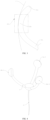
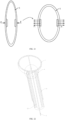
- FIG. 1 A structural form of the above embodiment is shown in FIG. 1 .
- the distal ends 11c of the lead-out portions 11 in the first state 01, when the distal ends 11c of the lead-out portions 11 move close to or fit with each other, it will inevitably reduce the coverage of the distal ends 11c of the respective lead-out portions 11. This reduced state is the main reason for increasing convenience in entering the vagina.
- the second state 02 the distal ends 11c are separated from each other to increase the coverage and thus the fitting force with the vaginal wall 4, whereby the vaginal wall 4 is be deformed due to extrusion, increasing the extrusion force on the urethra and effectively improving the stress urinary incontinence.
- the expansion body 1 is preferably integrally formed.
- the lead-out portions 11 are deformed due to the extrusion of the adjustment system 2. After the expansion body 1 is separated from the adjustment system 2, the respective lead-out portions 11 are elastically reset and returns to the original expanded state.
- the material of the expansion body 1 is certain, it is possible to obtain different extrusion forces against the vaginal wall 4 after the expansion body is inserted into the vagina by reasonably controlling the size of the expansion body 1 in the second state 02.
- the expansion body 1 can thus be available in different models for choice and use by users with different needs.
- the lead-out portion 11 is an elastically curved structure that bends inwards, and in the second state 02, the distal end 11c of the lead-out portion 11 is separated from the vaginal wall 4.
- the lead-out portion 11 includes a root 11a, a fitting position 11b with the vagina, and a distal end 11c.
- the distal end 11c does not directly fit with the vaginal wall 4, but fits with the vaginal wall 4 through the portion between the distal end 11c and the root 11a.
- the expansion body 1 can be made more stable through the fit of the middle part of the overall structure with the vaginal wall 4.
- the curved shape of the lead-out portion 11 imparts a relative extension of the fitting range 03 on both sides of the fitting position 11b, thereby obtaining a larger range of interaction with the vaginal wall 4, which is obviously beneficial to the stable fixation of the expansion body 1.
- the cross section of the curved structure may be circular, elliptical, etc.
- the side facing the vaginal wall 4 is smooth in order to ensure the comfort of the vaginal wall 4 when being compressed, while the shape of the other side can be selected in a wider range as it does not come into direct contact with the human body.
- the lead-out portion 11 may be in the form of a rod and may obtain a greater area of fit with the vaginal wall 4 through appropriate expansion, thus improving comfort and positional stability.
- the above figure shows six uniformly distributed lead-out portions 11. This number is just one of the possible implementations, while other quantities such as 2, 3, 4, etc. are also within the scope of protection of the present invention. Of course, it is necessary to ensure that the selection of number adapts to the possibility of machining and application.
- the lead-out portion 11 can fit with the vaginal wall 4 at different positions.
- the lead-out portion 11 comprises an elastic connection structure and a fitting end connected as the distal end 11c to one end of the connection structure.
- the other end of the connection structure serves as the root 11a.
- the fitting end expands outward relative to the connection structure, and fits with the vaginal wall in the second state 02.
- the curved structure is the structural form of the lead-out portion 11, the middle part of which fits with the vaginal wall 4.
- the curved structure is a part of the lead-out portion 11 and realizes fitting with the vaginal wall 4 through the fitting end connected thereto.
- this embodiment focuses on ensuring the installation stability of the entire auxiliary pressure device through the optimization of the structure of the fitting end.
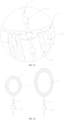
- FIG. 4 shows the provision of three lead-out portions 11 correspondingly comprising three curved structures and three fitting ends.
- FIG. 5 shows the provision of two lead-out portions 11 correspondingly comprising two curved structures and two fitting ends.
- the fitting ends selected in the above figure are all partially spherical.
- the sphere referred to here may be a circular sphere, an ellipsoid, etc.
- the spherical surface of the sphere is the part that fits with the vaginal wall 4. By controlling its volume, the adjustment of the area that fits with the vaginal wall 4 can be effectively achieved.
- the auxiliary pressure device in the present invention can control the stability of the position after insertion into the vagina by controlling the shape and number of the fitting ends.
- the number of the lead-out portions 11 increases, more fitting ends may be used to fit with the inner wall of the vagina, so the size of the fitting ends can be appropriately reduced.
- the number of lead-out portion 11 decreases, the number of fitting positions 11b with the vagina will be reduced, so the size of the fitting ends can be appropriately increased, as shown by the comparison between FIG. 4 and FIG. 5 .
- these situations are only for considerations such as product cost and does not serve as a basis for limiting the scope of protection of the present invention.
- different fitting positions 11b are formed between the fitting ends and the vaginal wall 4 in this embodiment, such as the fitting positions 11b-1 to 11b-3 shown in FIG. 4 , and the fitting positions 11b-4 to 1 1b-5 shown in FIG. 5 .
- there is an unavoidable situation that is, the rotation of the fitting position 11b relative to the vaginal wall 4 .
- contact with the vaginal wall 4 can be achieved through an approximately bow-shaped structure, so that the above problem can be appropriately solved.
- the connection of the roots 11a of the respective lead-out portions 11 may be used as an additional fitting point with the vaginal wall 4, as shown in FIG. 6 , which shows the state of the expansion body 1 rotating to the extreme position on one side in the vagina.
- the connection of the roots 11a of the respective lead-out portions 11 may form a new fitting position 11b-6, thereby limiting further rotation.
- the extrusion force of the fitting position 11b-6 on the vaginal wall 4 is smaller than the extrusion force of the fitting positions 11b-1 to 11b-3 on the vaginal wall 4. Therefore, the fitting position 11b cannot play the role of positioning the auxiliary pressure device, but only achieves the purpose of preventing rotation.
- the force application part 3 When the expansion body 1 rotates, the force application part 3 will inevitably change its position. However, due to the limitation of the space in the vagina, the change in position will not affect the length outside the human body.
- the connection of the roots 11a of the respective lead-out portions 11 is preferably realized by a smoother structure.
- the effect achieved is generally the with that achieved by the case with the three lead-out portions.
- the expansion body 1 has two obviously different rotation directions: a first rotation direction, as shown in FIG 7 , where the expansion body rotates in the distribution direction of the two lead-out portions 11, and a second rotation direction, as shown by the arrows in FIG 5 , where the expansion body rotates relative to both sides of the distribution direction of the two lead-out portions 11.
- the distribution direction here is the plane direction shown in FIG. 7 .
- the degree of rotation can be limited by the fitting position 11b-7 shown in FIG. 7 .
- the technical objective achieved is the same as that of partially spherical fitting ends, and the difference lies in the contact position.
- a larger contact area with the vaginal wall 4 in the circumferential direction can be obtained in an annular manner.
- the bending direction of the annulus is perpendicular to the direction of insertion into the vagina, while the complete structure's bending is in compliance with the direction of insertion into the vagina.
- the cross section of the annulus may be circular or elliptical.
- the side facing the vaginal wall 4 is curved to ensure the comfort of the vaginal wall 4 when being pressed, while the shape of the other side can be selected in a wider range as it does not come into direct contact with the human body.
- the length of the lead-out portions 11 can be appropriately extended, so as to achieve the limit of rotation at a smaller rotation angle.
- the length limit may be selected based on the level of comfort that the human body can perceive.
- the expansion body 1 is a hollow deformable structure.
- the adjustment system 2 is configured to maintain the first state 01 of the expansion body 1. In the first state 01, the internal cavity of the expansion body 1 is compressed and deformed, and in the second state 02, the compressed and deformed internal cavity is at least partially restored.
- the force application part 3 is connected to one end of the expansion body 1.
- the expansion body 1 may be made of elastic and non-absorbent structure, for example, a medical-grade silicone structure, a plastic structure, or a metal structure.
- the material is only intended to apply pressure to the vaginal wall 4, and the pressure may be the deformation recovery force caused by bending or the deformation recovery force caused by compression deformation.
- the elastic restoring force generated by bending is the main reason for its fixation relative to the vaginal wall 4, while in the form of the deformable structure, the elastic restoring force generated by compression deformation is the main reason for its fixation relative to the vaginal wall 4.
- both compression deformation and bending can occur simultaneously, and the combined elastic restoring force of the two can also ensure the stable fixation of the expanding body 1.
- the deformable structure is an elastic structure that has a maximum size in the middle part along the direction of insertion into vagina and gradually shrinks and extends toward both sides, wherein the length in the extension direction is greater than the maximum width of the middle part.
- the shrinkage on both sides of the deformable structure may be symmetrical or asymmetrical, or uniform or non-uniform.
- the ellipsoidal shape is preferred.
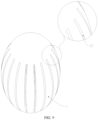
- the long axis direction of the ellipsoid is the direction of insertion into the vagina, namely, the extension direction, as shown in FIG. 9 . Therefore, a larger fitting area with the vaginal wall 4 can be obtained through a flatter sidewall around the short axis.
- the cavity of the deformable structure is intended to accommodate the deformation of the outside when pressed and to reduce the weight of the entire expansion body 1.
- the side wall of the expansion body 1 is provided with a plurality of through areas, namely, a plurality of grooves 12 distributed along the length direction of the deformable structure.
- the expansion body 1 compresses against the vaginal wall 4 due to its own deformation or the compressibility of the material, and the extrusion force is achieved by itself.
- a set of unlike-pole permanent magnets are arranged on the inner wall of the expansion body 1 in the opposite directions, and the opposite directions indicate the direction of insertion into the vagina.
- a set of unlike-pole permanent magnets includes a first permanent magnet 51 and a second permanent magnet 52 that are characterized by attracting each other.
- the attractive force is indicated by the F1 direction in the figure.
- the deformable structure is an ellipsoidal structure, arranging a set of such magnets on both sides of the long axis of the ellipsoid can cause the deformable structure to have the effect of being compressed and extending in the circumferential direction of the short axis. This effect is obviously more favorable for fixation in the vagina.
- unlike-pole permanent magnets can be applied to a wider range of shapes.
- Elliptical shape is one of the comfortable structural forms. It should be noted that other structural forms that can generate a restoring force after elastic deformation and undergo deformation due to the mutual attraction of two magnets through the installation of unlike-pole permanent magnets also fall within the scope of protection of the present invention.
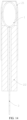
- the adjustment system 2 configured to maintain the first state 01 of the expansion body 1, as shown in FIGS. 10 and 11 , the adjustment system 2 comprises an outer tube body 21 and a push rod 22.
- One end of the outer tube body 21 is an open end, at which the expansion body 1 is at least partially inserted into the outer tube body 21, and the other end of the outer tube body 21 is used for the force application part 3 to be led out.
- the push rod 22 is inserted from the end of the outer tube body 21 through which the force application part is led out.
- the expansion body 1 is moved out of the open end 21a under the action of the push rod 22.
- the expansion body 1 is placed into the vagina through the adjustment system 2. After the position of the end of the outer tube body 21 is determined, push the push rod 22 to push the expansion body 1 out of the open end 21a, so that the expansion body 1 is in a free state to achieve the second state 02, and then remove the adjustment system 2 from the vagina.
- FIG. 11 shows the situation where the expansion body 1 is entirely located inside the outer tube body 21. This situation is more suitable for the form where the lead-out portion 11 is an curved structure that bends inwards.
- the open end 21a is provided on the curved outer surface 21c of the outer tube body 21. Therefore, the outer tube body 21 can enter the human body more gently.
- the curved surface will cause the annular edge 21b of the open end 21a to retract inward relative to the vaginal wall 4 after the outer tube body 21 is inserted into the vagina, thereby forming a distance H as shown in FIG. 12 from the vaginal wall 4.
- the distance H prevents the expansion body 1 from coming into contact with the vaginal wall 4 during the state transition as much as possible during the removal of the expansion body 1 from the outer tube body 21. This can also further improve the comfort of use.
- the inner wall of the outer tube body 21 transitions to the edge of the open end 21a through curved surface contraction. As shown in FIGS. 11 and 12 , this achieves guidance during the removal of the expansion body 1 from the outer tube body 21, allowing the user to insert it into a designated position in the vagina by applying less force.
- the structural form of the outer tube 21 in this embodiment serves as a guiding part and participates in the insertion process of the expansion body 1, that is, it not only maintains the first state 01 of the elastic expansion body, but also serves as a carrier.
- the outer tube body 21 may also be an elastic and non-absorbent structure, for example, a medical-grade silicone structure, a plastic structure, or a metal structure.
- the side wall of the outer tube body 21 may be a continuous or a hollowed structure.
- the outer wall of the outer tube body 21 is preferably smooth.
- the length of the outer tube body 21 needs to ensure that after the outer tube body 21 is inserted into the human body to a set length, there is still enough length for the user to operate the push rod 22 outside the human body.
- the continuous structure or the hollowed structure they both can offer smoothness and have their own advantages. Specifically, when the side wall is in a continuous structure, as shown in FIGS. 10 and 11 , it is more convenient for machining, and is also less difficult in terms of cleaning when the adjustment system 2 is a non-disposable product.
- the hollow pattern can be selected according to actual needs, but the advantage that can be achieved with various hollow patterns is that during the process of entering the vagina, the air in the vagina can better circulate through the hollowed parts, thereby maintaining the pressure in the space and avoiding resistance caused by local high pressure caused by the entry of the adjustment system 2.
- FIG. 13 shows the situation where the expansion body 1 is partially located inside the outer tube body 21.
- This situation is more suitable for the form where the lead-out portion 11 includes a curved structure, and a fitting end that serves as the distal end 11c and is located outside the outer tube body 21.
- the fitting end will inevitably come into contact with the vaginal wall 4 during the process of entering the vagina, thereby causing the vaginal wall 4 to expand appropriately for insertion.
- the respective fitting positions 11b gradually achieve effective support for the vaginal wall 4, and then the adjustment system 2 can be removed. In this way, the size of the adjustment system 2 can be reduced, and the discomfort during insertion can also be alleviated to a certain extent.
- FIG. 14 shows the installation of the expansion body 1 of the deformable structure relative to the adjustment system 2. The specific use is the same as that of the structure shown in FIGS. 11 and 13 and will not be repeated here.
- the inner wall of the outer tube body 21 linearly guides the push rod 22, which is not limited by the shape of the outer wall of the outer tube body 21.
- the linear guidance is the simplest way for the user to execute the pushing action, simply by making the outer wall of the pushing rod 22 fit with the inner wall of the outer tube body 21 and ensuring that the fitting positions 11b can extend in a linear direction.
- the push rod 22 is a hollow structure with a hollow portion through which the force application part 3 passes.
- the present invention provides the following two implementations.
- the open end 21a is in a normally open state
- the outer tube body 21 is an elastic body and the open end 21a is in a normally closed state and is opened under the action of external extrusion force.
- FIGS. 10 to 14 show the open end 21a in a normally open state.
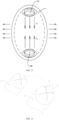
- an open end 21a that is normally closed and opened under set conditions can also be provided, as shown in FIG 16 , which shows a relatively simple open end 21a in a normally closed state.
- the crossing through traces are a conventional approach, as shown in Figure 16 , which involves crossing two through traces.
- more through traces intersecting forms are also within the scope of protection of the present invention.
- the outer tube body 21 is formed of an elastic material.
- the through traces may be obtained by cutting, whereby the normally closed state can be achieved by fitting both sides of the traces.
- the opening process can be achieved simply by deformation of the through traces.
- the direction of the arrow in FIG. 16 is the direction of deformation.
- Embodiment 1 illustrates the case where the adjustment system 2 is configured to maintain the first state 01 of the expansion body 1.
- the adjustment system 2 is separated from the expansion body 1, the expansion body 1 naturally acquires the second state 02.
- the adjustment system 2 is configured to release the first state 01 of the expansion body 1, while the maintenance of the first state 01 is achieved through the application of force by the user's hand, which is the external force hereinafter.
- This embodiment provides an auxiliary pressure device that requires the user's hand to reach into the vagina.
- the arrow direction of force F represents the direction of force applied by the hand towards the lead-out portions 11, thereby bringing the respective distal ends 11c closer and obtaining a state in favor for entering the vagina.
- the expansion body 1 comprises at least two lead-out portions 11 evenly distributed along the circumferential direction.
- the respective lead-out portions 11 are connected at roots 11a and free at distal ends 11c thereof.
- the adjustment system 2 is configured to release the first state 01 of the expansion body 1 to reach the second state 02. In the first state, the distal ends 11c move close to or fit with each other under the action of external force, and in the second state 02, the external force is released and the respective distal ends 11c are separated from each other under the action of the adjustment system 2.
- the force application part 3 is connected to the connection of the respective lead-out portions 11.
- the distal ends 11c of the respective lead-out portions 11 move away from each other due to the adjustment system 2, wherein the lead-out portions 11 are elastic, and/or the connection of the respective lead-out portions 11 is elastic.
- the lead-out portions 11 themselves can undergo elastic deformation, and/or the connection of the respective lead-out portions 11 can undergo elastic deformation under the action of the external force, so that after the user removes the external force, the recovery of the deformation will generate a restoring force.
- the restoring force here is beneficial for the fixation of the entire expanding body 1 relative to the vaginal wall 4.
- the above-mentioned restoring force is not the main factor in fixing the expansion body 1 relative to the vaginal wall 4, but only plays an auxiliary role.
- the roots 11a of the respective lead-out portions 11 are arranged to rotate relative to each other. As shown in FIG. 19 , this can also ensure that the respective lead-out portions 11 reach the second state 02 after relative rotation.
- the rotational arrangement allows the variation in relative position of the respective lead-out portions 11.
- the relative rotational arrangement here may be a rotational connection between two lead-out portions 11 as shown in FIG. 19 , or a rotational connection between all lead-out portions 11 with an additional third-party structure, so that the relative rotation is achieved through rotation relative to the third party.
- This embodiment provides the following implementation of the adjustment system 2.
- the adjustment system 2 is a set of like-pole permanent magnets arranged in one-to-one correspondence with the distal ends 11c and fixedly arranged relative to the distal ends 11c.
- the like-pole permanent magnets may be respectively embedded in the distal ends 11c of the respective lead-out portions 11.
- the third permanent magnet 53 and the fourth permanent magnet 54 are the permanent magnets that need to be embedded.
- the permanent magnets are seamlessly embedded, so that the outer surface of the expansion body 1 can be considered as an integrated structure. This not only ensures the safety of use, but also effectively improves the aesthetics of the product, thereby bringing better user experience.
- the size of the permanent magnet needs to be guaranteed, and in order to ensure sufficient installation position, the embedding position of the permanent magnet can be appropriately increased.
- the fitting end in the above Embodiment 1 can achieve this goal, and of course, it can also increase the fitting area with the vaginal wall 4.
- the adjustment system 2 is an elastic structure connected to the respective lead-out portions 11 and can be deformed under the extrusion of any of the lead-out portions 11.
- the schematic diagram shown in FIG. 20 shows a way for the adjustment system 2 to achieve elasticity, in which the adjustment system is connected to the respective lead-out portions 11 through an elastic protrusion position in one-to-one correspondence with the respective lead-out portions 11.
- the line structure in the figure only represents an elastically deformable structure, and it can be in any form such as a spring structure, a rubber structure, or a compressible airbag.
- the respective lead-out portions 11 fit with the vaginal wall 4, so it is necessary to ensure that there is no difference in the deformation of the elastic structure in the direction towards each of the lead-out portions 11, thereby ensuring the equivalence of use in all directions.
- the elastic structure When the user's hand exerts force on the lead-out portions 11, the elastic structure will deform to allow the respective lead-out portions 11 to move close each other to achieve the first state 01.
- the reset of elastic deformation can act on the expansion body 1 so that the expansion body reaches the second state 02.
- the expansion body 1 is a hollow deformable structure.
- the adjustment system 2 is configured to release the first state 01 of the expansion body 1 to reach the second state 02.
- the deformable structure causes the internal cavity of the expansion body 1 to be compressed and deformed under the action of external force, and in the second state 02, the external force is released and the internal cavity is at least partially restored under the action of the adjustment system 2.
- the force application part 3 is connected to one end of the expansion body 1.
- FIG. 21 shows the deformable structure of the expansion body 1.
- the contraction on both sides of the deformable structure can be symmetric or asymmetric, as well as uniform or non-uniform.
- the ellipsoidal shape is preferred, and the advantages of the ellipsoidal shape are described in the above Embodiment 1, which will not be repeated here.
- the deformable structure is an elastic structure that has a maximum size in the middle part along the direction of insertion into vagina and gradually shrinks and extends toward both sides, wherein the length in the extension direction is greater than the maximum width of the middle part, the inner wall of the expansion body is provided with a plurality of like-pole permanent magnets evenly distributed around the middle part of the deformable structure, and the external force acts on the outer wall of the middle part.
- F in the figure represents the direction of the user's external force
- F1 in the figure represents the mutual repulsive force between the permanent magnets, so that there is sufficient fitting force between the expansion body 1 and the vaginal wall 4.
- the expansion body 1 may have an elastic structure, so that it can also produce an extrusion effect on the vaginal wall 4 by a certain restoring force through elastic reset.
- the above-mentioned restoring force is not the main factor in fixing the expansion body 1 relative to the vaginal wall 4, but only plays an auxiliary role.
- the elastic structure of an ellipsoidal structure is preferred.
- drum shaped or other profiled structures that meet the above conditions are also within the scope of protection of the present invention.
- the long axis direction of the ellipsoid is the direction of insertion into the vagina.
- the set directions of the long and short axes will be naturally adjusted in the vagina, thereby achieving the expected extrusion effect on the vaginal wall 4.
- the deformable structure is an elastic structure that has a maximum size in the middle part along the direction of insertion into vagina and gradually shrinks and extends toward both sides, wherein the length in the extension direction is greater than the maximum width of the middle part.
- One end of the force application part 3 is connected to the inner wall of the internal cavity at one end in the length direction of the deformable structure, and the other end of the force application part 3 passes through the other end of the internal cavity.
- the adjustment system 2 comprises a positioning block 23 fixed on the force application part 3.
- the positioning block 23 includes a ready-to-use state in which it is located in the internal cavity, and a positioning state in which it is located outside the internal cavity and maintains press fit with the outer wall of the expansion body. The transition from the ready-to-use state to the positioning state is achieved in the process of maintaining the position of the expansion body 1 in the vagina by external force and pulling the force application part 3 by external force.
- the above optimization scheme is implemented for the purpose that the adjustment system 2 is configured to release the first state 01 of expansion body 1.
- the force application part 3 is pulled to exert force on the connection between the expansion body 1 and the internal cavity, so that the expansion body 1 undergoes elastic deformation.
- the deformation process occurs in the direction perpendicular to the force exerted by the force application part 3 on the expansion body 1, which is the direction of extrusion on the vaginal wall 4.
- the final degree of deformation can be controlled, thereby achieving control over the extrusion force on the vaginal wall 4.
- the elastic structure of the deformable structure can be utilized.
- the positioning block compresses the elastic structure to deform the penetration position, thereby passing through the penetration position, and the deformation recovers after the positioning block passes, so that the positioning block 23 can be blocked outside the elastic structure.
- the exterior of the positioning block 23 gradually shrinks in the direction of removal from the internal cavity.
- the frustum shape shown in FIG. 23 is an implementation of the present invention.
- the hole on the expansion body 1 for the positioning block 23 to move out can adopt the same shrinking form and direction as the positioning block 23, thereby achieving guidance on one hand, and ensuring stable positioning of the exterior of the positioning block 23 on the other hand.
- the positioning block 23 is located on the force application part 3 and is provided in a number of at least two side by side at an interval along the direction of removal from the internal cavity. Therefore, the adjustment of different extrusion forces on the vaginal wall 4 can be achieved by fitting different positioning blocks 23 to the outer wall of the expansion body 1.
- the adjustment system 2 does not separately maintain or release the first state 01, but simultaneously achieves the above two technical objectives.
- the expansion body 1 is a hollow deformable structure.
- the adjustment system 2 is configured to maintain and release the first state 01 of the expansion body 1. In the first state 01, the internal cavity of the expansion body 1 is compressed and deformed, and in the second state 02, the compressed and deformed internal cavity is at least partially restored.
- the force application part 3 is connected to one end of the expansion body 1.
- the deformable structure is an elastic structure that has a maximum size in the middle part along the direction of insertion into vagina and gradually shrinks and extends toward both sides, wherein the length in the extension direction is greater than the maximum width of the middle part.
- One end of the force application part 3 is connected to the inner wall of the internal cavity at one end of the long axis of the ellipsoid, and the other end of the force application part 3 passes through the internal cavity at the other end of the long axis.
- the adjustment system 2 comprises an outer tube body 21 and a push rod 22.
- the adjustment system 2 further comprises a positioning block 23 fixed on the force application part 3.
- the positioning block 23 includes a ready-to-use state in which it is located in the internal cavity, and a positioning state in which it is located outside the internal cavity and maintains press fit with the outer wall of the expansion body 1. The transition from the ready-to-use state to the positioning state is achieved in the process of maintaining the position of the outer tube body 21 and/or push rod 22 and the fitting state with the expansion body 1 by external force and pulling the force application part 3 by external force.
- the outer tube body 21 and the push rod 22 in this embodiment have the same function as in Embodiment 1 and can also be optimized in the same way.
- the positioning block 23 has the same function as in Embodiment 2 and can also be optimized in the same way.
- the optimization in Embodiment 1 will not be repeated.
- the difference is that the outer tube also needs to maintain the position of the expanding body 1 when it is inserted into the vagina and the expansion body 1 is placed externally relative to the outer tube body 21.
- the adjustment system 2 is a pressure system using gas or liquid as a medium, comprising a delivery pipeline 61 and a valve body structure 62.
- the delivery pipeline 61 connects the internal cavity and external space of the expansion body 1.
- the valve body structure 62 is mounted on a portion of the delivery pipeline 61 located in the external space and is configured to open and close the internal channel of the delivery pipeline 61.
- the injection and extraction of the medium into and from the delivery pipeline 61 can be achieved through an external syringe or the like.
- the injection of the medium is performed after the expansion body 1 in the first state 01 enters the vagina. It is necessary to ensure that the delivery pipeline 61 is partially located outside the vagina, and the extrusion force on the vaginal wall 4 is adjusted by adjusting the injection amount of the medium.
- the valve body configuration 62 may be selected to be unidirectional to ensure entry of the medium, and to ensure the medium pressure at the time of insertion when the auxiliary pressure device is removed from the vagina. Alternatively, the valve body structure 62 may be bidirectional so that the medium can be extracted after use and then the auxiliary pressure device is removed from the vagina.
- the valve body structure 62 may be located close to the expansion body 1. As the expansion body 1 is inserted into the vagina, the vagina is partially expanded by the expansion body 1 to accommodate the location of the valve body structure 62, thereby avoiding discomfort outside the human body.
- the outer surface of the deformable structure in the above embodiments of the present invention may be equipped with appropriate anti-slip structures to increase the friction with the vaginal wall 4, thereby ensuring positional stability.
- a raised surface is preferred, and of course, the amplitude of the raise needs to be effectively controlled to avoid discomfort.
- the outer tube body 21 and the push rod 22, which are also part of the adjustment system 2 can also be used to facilitate the insertion of the expansion body.
- they can be optimized in the same way as in Embodiment 1.
Landscapes
- Health & Medical Sciences (AREA)
- Urology & Nephrology (AREA)
- Cardiology (AREA)
- Oral & Maxillofacial Surgery (AREA)
- Transplantation (AREA)
- Engineering & Computer Science (AREA)
- Biomedical Technology (AREA)
- Heart & Thoracic Surgery (AREA)
- Vascular Medicine (AREA)
- Life Sciences & Earth Sciences (AREA)
- Animal Behavior & Ethology (AREA)
- General Health & Medical Sciences (AREA)
- Public Health (AREA)
- Veterinary Medicine (AREA)
- Orthopedics, Nursing, And Contraception (AREA)
- Prostheses (AREA)
Applications Claiming Priority (2)
| Application Number | Priority Date | Filing Date | Title |
|---|---|---|---|
| CN202210564541.1A CN114848228B (zh) | 2022-05-23 | 2022-05-23 | 一种压力性尿失禁的辅助施压装置 |
| PCT/CN2023/094930 WO2023226860A1 (zh) | 2022-05-23 | 2023-05-18 | 一种压力性尿失禁的辅助施压装置 |
Publications (4)
| Publication Number | Publication Date |
|---|---|
| EP4420633A1 true EP4420633A1 (de) | 2024-08-28 |
| EP4420633A4 EP4420633A4 (de) | 2025-01-29 |
| EP4420633C0 EP4420633C0 (de) | 2025-07-23 |
| EP4420633B1 EP4420633B1 (de) | 2025-07-23 |
Family
ID=82640155
Family Applications (1)
| Application Number | Title | Priority Date | Filing Date |
|---|---|---|---|
| EP23810933.4A Active EP4420633B1 (de) | 2022-05-23 | 2023-05-18 | Hilfsdruckvorrichtung für stressbedingte harninkontinenz |
Country Status (5)
| Country | Link |
|---|---|
| US (1) | US20240325134A1 (de) |
| EP (1) | EP4420633B1 (de) |
| JP (1) | JP7665260B2 (de) |
| CN (1) | CN114848228B (de) |
| WO (1) | WO2023226860A1 (de) |
Families Citing this family (2)
| Publication number | Priority date | Publication date | Assignee | Title |
|---|---|---|---|---|
| CN114848228B (zh) * | 2022-05-23 | 2023-04-11 | 江苏泰科博曼医疗器械有限公司 | 一种压力性尿失禁的辅助施压装置 |
| CN116458958B (zh) * | 2023-03-16 | 2023-11-03 | 常州市第一人民医院 | 基于形变感应的敞口调节型结石吸取装置及控制方法 |
Family Cites Families (16)
| Publication number | Priority date | Publication date | Assignee | Title |
|---|---|---|---|---|
| US6676594B1 (en) * | 2002-09-18 | 2004-01-13 | Kimberly-Clark Worldwide, Inc. | C-shaped vaginal incontinence insert |
| EP1631211B1 (de) | 2003-05-22 | 2017-01-04 | Kimberly-Clark Worldwide, Inc. | Vorrichtung zur verhinderung von harninkontinenz bei frauen |
| ES2361600T3 (es) * | 2004-03-18 | 2011-06-20 | Contipi Ltd. | Aparatos para la prevención de la incontinencia urinaria femenina. |
| IL176883A (en) * | 2005-09-22 | 2013-09-30 | Eliahu Eliachar | Devices for reducing urine leakage in women |
| WO2008079271A1 (en) | 2006-12-21 | 2008-07-03 | Baystate Health, Inc. | Vaginal pessary |
| US9339363B2 (en) * | 2007-10-01 | 2016-05-17 | Kimberly Clark Worldwide, Inc. | Management of urinary incontinence in females |
| US8449446B2 (en) * | 2008-02-06 | 2013-05-28 | Contipi Ltd. | Female urinary incontinence devices |
| US9814630B2 (en) * | 2010-12-23 | 2017-11-14 | Kimberly-Clark Worldwide, Inc. | Vaginal insert device having a support portion with plurality of foldable areas |
| CN104013483B (zh) * | 2014-06-20 | 2016-01-27 | 盛欣柯 | 一种用于减轻女性尿失禁的医疗器械装置 |
| CN204745323U (zh) * | 2015-07-14 | 2015-11-11 | 卢家凤 | 一种可穿戴式现代医疗阴道壁扩张装置 |
| US20170014217A1 (en) * | 2015-07-16 | 2017-01-19 | Karen L. Patrusky | Intravaginal incontinence device |
| CN110049744A (zh) * | 2016-10-30 | 2019-07-23 | 康迪普医疗有限公司 | 用以改善排泄失禁的装置及方法 |
| CN111741734A (zh) * | 2018-01-16 | 2020-10-02 | 埃尔医学股份有限公司 | 用于身体组织的热治疗的装置、系统及方法 |
| CN108403268B (zh) * | 2018-03-22 | 2024-02-20 | 镇江市第三人民医院 | 一种带磁性的可收缩气管支架 |
| WO2021142537A1 (en) | 2020-01-14 | 2021-07-22 | Cntrl+ Inc. | Intravaginal device |
| CN114848228B (zh) * | 2022-05-23 | 2023-04-11 | 江苏泰科博曼医疗器械有限公司 | 一种压力性尿失禁的辅助施压装置 |
-
2022
- 2022-05-23 CN CN202210564541.1A patent/CN114848228B/zh active Active
-
2023
- 2023-05-18 WO PCT/CN2023/094930 patent/WO2023226860A1/zh not_active Ceased
- 2023-05-18 JP JP2024524741A patent/JP7665260B2/ja active Active
- 2023-05-18 EP EP23810933.4A patent/EP4420633B1/de active Active
-
2024
- 2024-06-03 US US18/731,861 patent/US20240325134A1/en active Pending
Also Published As
| Publication number | Publication date |
|---|---|
| US20240325134A1 (en) | 2024-10-03 |
| JP2024539693A (ja) | 2024-10-29 |
| WO2023226860A1 (zh) | 2023-11-30 |
| EP4420633A4 (de) | 2025-01-29 |
| EP4420633C0 (de) | 2025-07-23 |
| CN114848228A (zh) | 2022-08-05 |
| CN114848228B (zh) | 2023-04-11 |
| JP7665260B2 (ja) | 2025-04-21 |
| EP4420633B1 (de) | 2025-07-23 |
Similar Documents
| Publication | Publication Date | Title |
|---|---|---|
| US20240325134A1 (en) | Auxiliary pressure applying device for stress urinary incontinence | |
| AU577823B2 (en) | Elastomeric prosthetic sphincter | |
| US6158435A (en) | Pessary | |
| CA2796946C (en) | Apparatus for the prevention of urinary incontinence in females | |
| US6048306A (en) | Non-invasive dual acting urological press for the prevention of female incontinence | |
| EP3581232B1 (de) | Harnröhrenstent und blasenkontrollvorrichtung mit solch einem harnröhrenstent | |
| US10441401B2 (en) | Incontinence device | |
| CN102458301B (zh) | 解剖扩张装置及一套部件工具包 | |
| AU2017302514A1 (en) | Incontinence device | |
| JP6068618B2 (ja) | 膣内部支持具及び膣内部支持具セット | |
| US20170086956A1 (en) | Foldable Pessary for Treatment of Stress Urinary Incontinence | |
| US20180318086A1 (en) | Inflatable penile prosthesis with reinforced members | |
| RU2380064C2 (ru) | Аппарат для предотвращения недержания мочи у женщин | |
| RU2396924C2 (ru) | Устройства для уменьшения недержания мочи у женщин | |
| US20110190805A1 (en) | Intraurethral Retainer and Keeper For Facilitating Penile Fixation and/or Occlusion | |
| WO1996000542A1 (en) | An assembly and method for prevention of urinary incontinence in humans | |
| HK40005911A (en) | Incontinence device | |
| HK40005911B (en) | Incontinence device | |
| WO2025088218A1 (en) | Urinary flow control device | |
| CA1232408A (en) | Elastomeric prosthetic sphincter | |
| HK1101498B (en) | Apparatus for the prevention of urinary incontinence in females |
Legal Events
| Date | Code | Title | Description |
|---|---|---|---|
| STAA | Information on the status of an ep patent application or granted ep patent |
Free format text: STATUS: THE INTERNATIONAL PUBLICATION HAS BEEN MADE |
|
| PUAI | Public reference made under article 153(3) epc to a published international application that has entered the european phase |
Free format text: ORIGINAL CODE: 0009012 |
|
| STAA | Information on the status of an ep patent application or granted ep patent |
Free format text: STATUS: REQUEST FOR EXAMINATION WAS MADE |
|
| 17P | Request for examination filed |
Effective date: 20240522 |
|
| AK | Designated contracting states |
Kind code of ref document: A1 Designated state(s): AL AT BE BG CH CY CZ DE DK EE ES FI FR GB GR HR HU IE IS IT LI LT LU LV MC ME MK MT NL NO PL PT RO RS SE SI SK SM TR |
|
| A4 | Supplementary search report drawn up and despatched |
Effective date: 20250108 |
|
| RIC1 | Information provided on ipc code assigned before grant |
Ipc: A61F 2/00 20060101AFI20241223BHEP |
|
| GRAP | Despatch of communication of intention to grant a patent |
Free format text: ORIGINAL CODE: EPIDOSNIGR1 |
|
| STAA | Information on the status of an ep patent application or granted ep patent |
Free format text: STATUS: GRANT OF PATENT IS INTENDED |
|
| DAV | Request for validation of the european patent (deleted) | ||
| DAX | Request for extension of the european patent (deleted) | ||
| INTG | Intention to grant announced |
Effective date: 20250512 |
|
| GRAS | Grant fee paid |
Free format text: ORIGINAL CODE: EPIDOSNIGR3 |
|
| GRAA | (expected) grant |
Free format text: ORIGINAL CODE: 0009210 |
|
| STAA | Information on the status of an ep patent application or granted ep patent |
Free format text: STATUS: THE PATENT HAS BEEN GRANTED |
|
| AK | Designated contracting states |
Kind code of ref document: B1 Designated state(s): AL AT BE BG CH CY CZ DE DK EE ES FI FR GB GR HR HU IE IS IT LI LT LU LV MC ME MK MT NL NO PL PT RO RS SE SI SK SM TR |
|
| REG | Reference to a national code |
Ref country code: GB Ref legal event code: FG4D |
|
| REG | Reference to a national code |
Ref country code: CH Ref legal event code: EP |
|
| REG | Reference to a national code |
Ref country code: IE Ref legal event code: FG4D |
|
| REG | Reference to a national code |
Ref country code: DE Ref legal event code: R096 Ref document number: 602023005079 Country of ref document: DE |
|
| U01 | Request for unitary effect filed |
Effective date: 20250724 |
|
| U07 | Unitary effect registered |
Designated state(s): AT BE BG DE DK EE FI FR IT LT LU LV MT NL PT RO SE SI Effective date: 20250731 |
|
| PG25 | Lapsed in a contracting state [announced via postgrant information from national office to epo] |
Ref country code: IS Free format text: LAPSE BECAUSE OF FAILURE TO SUBMIT A TRANSLATION OF THE DESCRIPTION OR TO PAY THE FEE WITHIN THE PRESCRIBED TIME-LIMIT Effective date: 20251123 |
|
| PG25 | Lapsed in a contracting state [announced via postgrant information from national office to epo] |
Ref country code: NO Free format text: LAPSE BECAUSE OF FAILURE TO SUBMIT A TRANSLATION OF THE DESCRIPTION OR TO PAY THE FEE WITHIN THE PRESCRIBED TIME-LIMIT Effective date: 20251023 |
|
| PG25 | Lapsed in a contracting state [announced via postgrant information from national office to epo] |
Ref country code: HR Free format text: LAPSE BECAUSE OF FAILURE TO SUBMIT A TRANSLATION OF THE DESCRIPTION OR TO PAY THE FEE WITHIN THE PRESCRIBED TIME-LIMIT Effective date: 20250723 |
|
| PG25 | Lapsed in a contracting state [announced via postgrant information from national office to epo] |
Ref country code: GR Free format text: LAPSE BECAUSE OF FAILURE TO SUBMIT A TRANSLATION OF THE DESCRIPTION OR TO PAY THE FEE WITHIN THE PRESCRIBED TIME-LIMIT Effective date: 20251024 |
|
| PG25 | Lapsed in a contracting state [announced via postgrant information from national office to epo] |
Ref country code: PL Free format text: LAPSE BECAUSE OF FAILURE TO SUBMIT A TRANSLATION OF THE DESCRIPTION OR TO PAY THE FEE WITHIN THE PRESCRIBED TIME-LIMIT Effective date: 20250723 |
|
| PG25 | Lapsed in a contracting state [announced via postgrant information from national office to epo] |
Ref country code: RS Free format text: LAPSE BECAUSE OF FAILURE TO SUBMIT A TRANSLATION OF THE DESCRIPTION OR TO PAY THE FEE WITHIN THE PRESCRIBED TIME-LIMIT Effective date: 20251023 |
|
| PG25 | Lapsed in a contracting state [announced via postgrant information from national office to epo] |
Ref country code: ES Free format text: LAPSE BECAUSE OF FAILURE TO SUBMIT A TRANSLATION OF THE DESCRIPTION OR TO PAY THE FEE WITHIN THE PRESCRIBED TIME-LIMIT Effective date: 20250723 |
|
| PG25 | Lapsed in a contracting state [announced via postgrant information from national office to epo] |
Ref country code: SM Free format text: LAPSE BECAUSE OF FAILURE TO SUBMIT A TRANSLATION OF THE DESCRIPTION OR TO PAY THE FEE WITHIN THE PRESCRIBED TIME-LIMIT Effective date: 20250723 |