EP4418679A2 - Verbrauchsmesser, kalibrierungssystem und verfahren zur kalibrierung - Google Patents
Verbrauchsmesser, kalibrierungssystem und verfahren zur kalibrierung Download PDFInfo
- Publication number
- EP4418679A2 EP4418679A2 EP24186551.8A EP24186551A EP4418679A2 EP 4418679 A2 EP4418679 A2 EP 4418679A2 EP 24186551 A EP24186551 A EP 24186551A EP 4418679 A2 EP4418679 A2 EP 4418679A2
- Authority
- EP
- European Patent Office
- Prior art keywords
- consumption meter
- external device
- communication
- representation
- calibration
- Prior art date
- Legal status (The legal status is an assumption and is not a legal conclusion. Google has not performed a legal analysis and makes no representation as to the accuracy of the status listed.)
- Granted
Links
Images

Classifications
-
- G—PHYSICS
- G01—MEASURING; TESTING
- G01D—MEASURING NOT SPECIALLY ADAPTED FOR A SPECIFIC VARIABLE; ARRANGEMENTS FOR MEASURING TWO OR MORE VARIABLES NOT COVERED IN A SINGLE OTHER SUBCLASS; TARIFF METERING APPARATUS; MEASURING OR TESTING NOT OTHERWISE PROVIDED FOR
- G01D4/00—Tariff metering apparatus
- G01D4/002—Remote reading of utility meters
-
- G—PHYSICS
- G01—MEASURING; TESTING
- G01D—MEASURING NOT SPECIALLY ADAPTED FOR A SPECIFIC VARIABLE; ARRANGEMENTS FOR MEASURING TWO OR MORE VARIABLES NOT COVERED IN A SINGLE OTHER SUBCLASS; TARIFF METERING APPARATUS; MEASURING OR TESTING NOT OTHERWISE PROVIDED FOR
- G01D18/00—Testing or calibrating apparatus or arrangements provided for in groups G01D1/00 - G01D15/00
-
- G—PHYSICS
- G01—MEASURING; TESTING
- G01F—MEASURING VOLUME, VOLUME FLOW, MASS FLOW OR LIQUID LEVEL; METERING BY VOLUME
- G01F15/00—Details of, or accessories for, apparatus of groups G01F1/00 - G01F13/00 insofar as such details or appliances are not adapted to particular types of such apparatus
- G01F15/06—Indicating or recording devices
- G01F15/061—Indicating or recording devices for remote indication
- G01F15/063—Indicating or recording devices for remote indication using electrical means
-
- G—PHYSICS
- G01—MEASURING; TESTING
- G01F—MEASURING VOLUME, VOLUME FLOW, MASS FLOW OR LIQUID LEVEL; METERING BY VOLUME
- G01F25/00—Testing or calibration of apparatus for measuring volume, volume flow or liquid level or for metering by volume
- G01F25/10—Testing or calibration of apparatus for measuring volume, volume flow or liquid level or for metering by volume of flowmeters
-
- G—PHYSICS
- G01—MEASURING; TESTING
- G01F—MEASURING VOLUME, VOLUME FLOW, MASS FLOW OR LIQUID LEVEL; METERING BY VOLUME
- G01F25/00—Testing or calibration of apparatus for measuring volume, volume flow or liquid level or for metering by volume
- G01F25/20—Testing or calibration of apparatus for measuring volume, volume flow or liquid level or for metering by volume of apparatus for measuring liquid level
-
- H—ELECTRICITY
- H04—ELECTRIC COMMUNICATION TECHNIQUE
- H04Q—SELECTING
- H04Q9/00—Arrangements in telecontrol or telemetry systems for selectively calling a substation from a main station, in which substation desired apparatus is selected for applying a control signal thereto or for obtaining measured values therefrom
-
- H—ELECTRICITY
- H04—ELECTRIC COMMUNICATION TECHNIQUE
- H04Q—SELECTING
- H04Q9/00—Arrangements in telecontrol or telemetry systems for selectively calling a substation from a main station, in which substation desired apparatus is selected for applying a control signal thereto or for obtaining measured values therefrom
- H04Q9/02—Automatically-operated arrangements
-
- H—ELECTRICITY
- H04—ELECTRIC COMMUNICATION TECHNIQUE
- H04Q—SELECTING
- H04Q2209/00—Arrangements in telecontrol or telemetry systems
- H04Q2209/40—Arrangements in telecontrol or telemetry systems using a wireless architecture
-
- H—ELECTRICITY
- H04—ELECTRIC COMMUNICATION TECHNIQUE
- H04Q—SELECTING
- H04Q2209/00—Arrangements in telecontrol or telemetry systems
- H04Q2209/40—Arrangements in telecontrol or telemetry systems using a wireless architecture
- H04Q2209/47—Arrangements in telecontrol or telemetry systems using a wireless architecture using RFID associated with sensors
-
- H—ELECTRICITY
- H04—ELECTRIC COMMUNICATION TECHNIQUE
- H04Q—SELECTING
- H04Q2209/00—Arrangements in telecontrol or telemetry systems
- H04Q2209/60—Arrangements in telecontrol or telemetry systems for transmitting utility meters data, i.e. transmission of data from the reader of the utility meter
-
- H—ELECTRICITY
- H04—ELECTRIC COMMUNICATION TECHNIQUE
- H04Q—SELECTING
- H04Q2209/00—Arrangements in telecontrol or telemetry systems
- H04Q2209/70—Arrangements in the main station, i.e. central controller
- H04Q2209/75—Arrangements in the main station, i.e. central controller by polling or interrogating the sub-stations
Definitions
- the present invention relates to a consumption meter, a calibration system for calibration of a consumption meter, and a method of calibration of a consumption meter, such as a wireless consumption meter, such as an ultrasonic flow meter for measuring an accumulated volume and determining a consumption of a utility such as water, district heating, or gas.
- a consumption meter such as a wireless consumption meter, such as an ultrasonic flow meter for measuring an accumulated volume and determining a consumption of a utility such as water, district heating, or gas.
- the amount of data transmitted from the consumption meter is typically much larger than the amount of data transmitted during normal operation.
- the increased amount of data to be transmitted also severely reduces the expected lifetime of the battery supplying the consumption meter as data transmission is one of the most power-consuming functions of such consumption meters.
- Another critical factor of the calibration is the loss of one or more data packages, which may cause incorrect calibration of the consumption meter.
- the inventors have identified the above-mentioned problems and challenges related to calibration of consumption meters, and subsequently made the below-described invention which may relate to an object of the present invention to provide a consumption meter and a related system and method which save energy compared to the consumption meters, systems and methods known in the art.
- a battery-powered consumption meter comprising a measurement means for measuring a value relating to an accumulated volume of a fluid flowing in a connected fluid pipe system to make up a consumption meter representation of the accumulated volume, and a first communication means, which is a wireless two-way communication means arranged for transmitting the consumption meter representation from the consumption meter to an external device external to the consumption meter, and for receiving a communication therefrom, wherein the consumption meter has at least two modes of operation comprising a normal operation mode, and a calibration mode different from the normal operation mode, wherein in calibration mode the consumption meter is arranged to transmit the consumption meter representation to the external device in response to a request therefor from the external device.
- a wireless consumption meter is provided with a particularly advantageous calibration mode for allowing calibration of the consumption meter using less energy than known in the prior art.
- the consumption meter is battery-powered.
- battery-powered consumption meters such as battery-powered consumption meters for utilities such as water, gas or district heating
- long battery life time is an important parameter as such meters may be remotely arranged with each end-user, such as in a water meter pit at the premises of the end-user, and their batteries not easily replaced. Therefore, with battery-powered consumption meters, energy-saving during calibration is an important step to improve the battery life time.
- the consumption meter comprises a measurement means to make up a consumption meter representation of the accumulated volume of the fluid in question.
- Utilities are billed according to the supplied accumulated volume, and with district heating additionally according to the heat content thereof.
- the consumption meter is arranged to have measured at any time the accumulated supplied volume of the utility, such as by measuring and integrating the flow of the subject utility.
- the consumption meter representation which in the context of the present invention is the current output of the consumption meter, comprises at any time the accumulated volume of the utility.
- the measurement means also referred to as flow metering part of the consumption meter, may be implemented in various ways known by the skilled person, such as by ultrasonic flow metering technologies, preferably comprising two ultrasonic transducers transmitting ultrasonic signals back and forth along the fluid flow, or such as by other electronically detectable flow metering technologies whether mechanical, ultrasonic, electromagnetic inductive, etc.
- the consumption meter comprises a first communication means, which is a wireless two-way communication means, and which is arranged for transmitting the consumption meter representation from the consumption meter to an external device.
- the first communication means is also referred to as first communication interface.
- the communication means is also arranged for receiving communications from the external device.
- the consumption meter is able to transmit consumption meter representations to the external device and to receive communications therefrom.
- the external device is able to receive consumption meter representations from the consumption meter, and to transmit communications thereto, such as commands or requests.
- the external device is a device which is arranged externally to the consumption meter, which makes up an interface to the consumption meter during calibration, which controls the calibration of the consumption meter per se and which controls any reference devices and other hardware involved in the calibration as well.
- the external device may comprise a single device, or may comprises two or more separate devices, such as a calibration box and a control unit, the calibration box making up the interface between the control unit and the consumption meter under calibration.
- the external device and any reference devices and other hardware may be integrated or provided as separate devices.
- the consumption meter has at least two modes of operation: a normal operation mode, and a calibration mode different from the normal operation mode.
- the normal operation mode refers to the mode of the consumption meter being arranged in a utility network at a consumer's premises and operating to measure and communicate the utility supplied to the consumer according to this mode. In particular, no calibration of the consumption meter takes place during normal operation.
- the calibration mode is different therefrom; in calibration mode the consumption meter is arranged to be calibrated, i.e. tested for and mapped in terms of its correct operation in terms of its ability to measure correctly the accumulated volume of a fluid flowing in a flow pipe of the consumption meter. Typically, in calibration mode the consumption meter is arranged to more frequently measure and communicate the accumulated volume than in the normal operation mode.
- the consumption meter in calibration mode is arranged to transmit the consumption meter representation to the external device in response to a request therefor from the external device.
- the consumption meter typically repeatedly transmits its consumption meter representations at predefined intervals once the subject mode has been entered into and until it is left. Also, in the prior art, in calibration mode the intervals are shorter than in the normal operation mode, and thus the communication more energy-consuming.
- the consumption meter transmits its consumption meter representation only when requested by the external device, i.e. only upon request from the external device, and preferably only once or a few times.
- the consumption meter in calibration mode makes a single “tweet” only, and only when asked therefore by the external device.
- the consumption meter is arranged to transmit the consumption meter representation to the external device.
- the term “to transmit” should be understood as an active or a passive transmission from the consumption meter to the external device.
- the representation may be actively transmitted from the consumption meter to the external device such as by radio signal transmission, or it may be passively transmitted, i.e. it may be "picked up” by the external device from the consumption meter, such as from a passive radio frequency identification facility (RFID) of the consumption meter.
- RFID radio frequency identification facility
- the consumption meter under investigation is calibrated in terms of its ability to measure correctly the accumulated volume of the fluid flowing in the flow pipe with the consumption meter.
- “measuring correctly the accumulated volume” calibration basically involves that a volume of liquid measured by the consumption meter under calibration is also measured by a reference device arranged with the flow pipe. With the calibration the accumulated volumes measured with the consumption meter and with the reference device are compared, and any deviation of the accumulated volume measured by the consumption meter over the accumulated volume measured by the reference device registered.
- the consumption meter may be adjusted, i.e. brought into a state of performance where its reading, i.e. its measured accumulated volume, agrees with the measured accumulated volume of the reference device. It should be understood, however, that the adjustment is not part of the calibration.
- the reference device measures an accumulated volume of liquid of 10.00 liters.
- the same accumulated volume of liquid is measured by the consumption meter under calibration, however, the reading of the consumption meter from measuring the volume is 10.20 liters. Accordingly, the accumulated volume measured by the consumption meter deviates by 0.20 liters over the accumulated volume measured by the reference device, i.e. on a relative scale the reading of the consumption meter exceeds the reading of the reference device by 2.0%. This is the result of the calibration.
- the consumption meter under calibration may then be adjusted, i.e. correcting the reading according to the calibration result, i.e. reducing the subject reading from 10.20 liters to the correct value of 10.00 liters, i.e. on a relative scale reducing the reading by 1.96%.
- the reference device and the consumption meter will now have readings of 10.00 liters.
- calibration relates to the accumulated volume measured by the consumption meter.
- the volume of liquid may be arranged to flow through the flow pipe to be measured by both of the consumption meter and the reference device, and be collected in a simple bucket on a balance and weighed, in this case 10.00 liters weighing 10.00 kilograms.
- the volume may as well be weighed beforehand, i.e. before flowing through the flow pipe, and it may be controlled that no liquid is lost during the session.
- Time is not an issue with a calibration session, for example such as the above.
- the flow is small, such as if the volume of 10.00 liters flows through the flow pipe in 50 minutes, i.e. at a flow rate of 0.200 liters per minute, or high, such if the volume of 10.00 flows through the flow tube in 2 minutes, i.e. at a flow rate of 5.00 liters per minute, the accumulated volume is still 10.00 liters, independently of the flow rate.
- the consumption meter representation may comprise a first and a second accumulated volume, or it may comprise an accumulated volume difference between a first and a second measured accumulated volume.
- this accumulated volume difference V2-V1 corresponds to the difference between the above first and second accumulated volumes, V1 and V2.
- the first communication means comprises near field communication (NFC) means, such as an NFC interface.
- NFC near field communication
- the transmission of the consumption meter representation from the consumption meter to the external device may be done by NFC by arranging the external device having a corresponding NFC interface close to the consumption meter.
- NFC is preferably conducted at a frequency between 10 MHz and 100 MHz and over a distance of less than 50 cm, preferably less than 10 cm, and at the commonly used NFC frequency of 13.56 MHz.
- NFC allows for the transmission of the consumption meter representation to be made in a very simple way from the consumption meter to the external device, such as from the consumption meter to a calibration box, when arranging the calibration box in the vicinity of the consumption meter.
- the short range near field communication technology for communication between the consumption meter and the external device, it may be avoided that other consumption meters nearby and other external devices are able to receive the transmitted signals. Thereby is ensured that only the intended consumption meter receives the communications from the external device, and that only the intended external device receives the transmission with the consumption meter representation from the consumption meter.
- identification data may be omitted from some or all communications, as it can easily be achieved that communications are only received from one device at a time by not having other devices within the short range.
- the short range communication by NFC between the consumption meter and the external device is less energy-consuming than longer range communication, such as radio communication.
- NFC may be powered by the external device, such as by a rechargeable battery thereof, thus not consuming any energy from the battery of the battery-powered consumption meter for communication purposes.
- the consumption meter needs not have a radio signal transmitter, such as a VHF or UHF radio signal transmitter. Instead it needs only have an NFC facility, which is far simpler and cheaper than radio signal transmitters.
- Consumption meters with no radio signal transmission facility may be used with utility networks where there is no need for radio communication from the consumption meters.
- Such networks may be networks with different communication schemes, such as networks based on walk-by reading of consumption meters, or it may be networks with an existing communication facility, such as networks, where battery-powered consumption meters such as water meters are connected to other consumption meters such as electricity meters, which are not battery-powered, and which have their own radio signal transmitter, and which may act as communication gateways or repeaters for the battery-powered consumption meters.
- the consumption meter further comprises a second communication means, which is a communication means for communication in normal operation mode for transmitting the consumption meter representation from the consumption meter by long range communication.
- second communication means also referred to as second communication interface
- Such communication means are long range communication means, ranging from tens or hundreds of meters to several kilometers, as compared to the NFC means in the sub-meter range.
- the battery-powered consumption meter may advantageously communicate via the first communication means in the calibration mode and via the second communication means in normal operation mode.
- the first communication means as described above, may be powered by the external device, no energy is consumed for communication purposes from the battery of the battery-powered consumption meter in the calibration mode; only when in the normal operation mode, energy is consumed from the battery of the battery-powered consumption meter for communication purposes, thus providing savings of battery energy as well as a higher level of control of the battery energy management.
- a battery-powered consumption meter which has at least two modes of operation comprising a normal operation mode and a calibration mode different from the normal operation mode, the consumption meter comprising a measurement means for measuring a value relating to an accumulated volume of a fluid flowing in a connected fluid pipe system to make up a consumption meter representation of the accumulated volume, and a first communication means, which is a wireless two-way communication means for communication in calibration mode arranged for transmitting the consumption meter representation from the consumption meter to an external device external to the consumption meter, and for receiving a communication therefrom, wherein the first communication means comprises near field communication means.
- the advantages of the consumption meter according to the second aspect of the invention using NFC when in the calibration mode may be, among others, energy saving and/or elimination of any need for radio signal transmission facilities.
- the consumption meter according to the second aspect of the invention may as well have long range second communication means in addition to the first communication means, the second communication means for communication in the normal operation mode.
- the consumption meter comprises an internal clock
- the consumption meter representation comprises corresponding values of time and accumulated volume obtained by the consumption meter.
- the consumption meter representation comprises, in additional to information relating to the accumulated volume as above, information relating to the corresponding time relating to the accumulated volume.
- the consumption meter representation may comprise a first and a second sets of corresponding time and accumulated volume, or it may comprise a corresponding time interval and accumulated volume difference between the first and the second sets of corresponding time value and accumulated volume.
- the time interval and accumulated volume difference correspond to the difference between the times and accumulated volumes of the first and second sets, respectively.
- the time data from the consumption meter may be used for correlating a consumption meter representation and a reference device representation, which do not relate to the same time interval, in terms of overlap and/or in terms of duration.
- the time-wise overlap between the consumption meter time interval and the reference device time interval should be as high as possible, such as the consumption meter time interval preferably overlapping the reference device time interval by at least 20% thereof, preferably by at least 50% thereof, more preferably by at least 80% thereof, even more preferably by at least 90% thereof.
- the overlap is 80% and 90%, respectively.
- each of the consumption meter time interval and the reference device time interval have an interval duration, and the consumption meter time interval duration preferably deviates from the reference device time interval duration by less than 10%, preferably by less than 5%.
- the accumulated volumes may be compared, i.e.
- the consumption meter comprises registration means for registration of a communication from the external device at the time of the communication from the external device.
- the registration means is understood as an arrangement of the consumption meter, which per se registers that the communication took place, such as a clock registering the time of communication, or it may be means, which performs an action as a consequence of the communication, such as means executing a measurement or a transmission as a consequence of the communication.
- the communication from the external device may be the request for transmission of a consumption meter representation, such as a request for transmission of a consumption meter representation based on the latest measurement of the accumulated volume made by the consumption meter. Such transmission may be done immediately at the time of the communication, or at a later stage, as requested.
- the communication from the external device may be a request for transmission of a consumption meter representation based on a later measurement of the accumulated volume to be made by the consumption meter.
- the communication from the external device may be another communication than a request for transmission of a consumption meter representation.
- the communication from the external device may be a "wake-up signal” or a "tap-on-the-shoulder signal” such as an unmodulated carrier wave to alert the consumption meter and bring it into an activated state, such as in a state of measurement or a state of transmission.
- the registration means comprises means for registration of the accumulated volume at the time of the communication from the external device.
- the registration means further comprises means for registration of the accumulated volume at the time of the communication from the external device.
- the registration of the accumulated volume at the time of the communication from the external device may be a registration of the latest value of the accumulated volume made by the consumption meter or it may be a registration of a later value of the accumulated volume to be made by the consumption meter.
- the accumulated volume at the time of the communication from the external device may comprise an interpolated value of the accumulated volume, such as an interpolated value between the latest value of the accumulated volume at the time of the communication and a later value of the accumulated volume measured by the consumption meter.
- the consumption meter has an internal clock
- the registration means comprises means for registration of the time of the consumption meter at the time of the communication from the external device.
- the time registered by the consumption meter by means of the internal clock at the time of the communication from the external device may then be used as described above for correlating a consumption meter representation and a reference device representation, which do not relate to the same time interval.
- the time registered by the consumption meter by means of the internal clock at the time of the communication from the external device may be used for interpolation purposes.
- the consumption meter comprises interpolation means for making up a consumption meter representation corresponding to the time of the communication from the external device from a set of values of the accumulated volume measured previously and subsequently, respectively, to the time of the communication from the external device.
- the interpolation means, or interpolator, or interpolation processor may for example be implemented by a microprocessor, preferably a processor shared with the measuring means.
- the consumption meter comprises storage means for storage of the consumption meter representation.
- the consumption meter has storage means, also referred to as memory, for storage of consumption meter representations, the so-stored consumption meter representation being arranged with the storage means for transmission to the external device.
- the storage means may comprise one or more consumption meter representations.
- the storage means may comprise one consumption meter representation only, such as the at any time latest consumption meter representation made up from the latest measurement of the accumulated volume by means of a principle of continuously overwriting the previous consumption meter representation.
- the storage may comprise more consumption meter representations, such as the latest two, three, four, five, ten, twenty or more representations made up, or it may comprise a selection of the representations, such the latest representation made up, as well as every fifth or every tenth representation made up.
- the storage means may be a non-volatile storage means, preferably a solid state storage medium such as various types of Flash memory, e.g. an electrically erasable programmable read-only memory (EEPROM) means or a non-volatile random-access memory (NV-RAM) means.
- the storage means may be a volatile storage means, such as a random-access memory (RAM) means, which can only hold data when powered, and therefore needs continuous powering by the consumption meter.
- RAM random-access memory
- a calibration system for a battery-powered consumption meter which comprises the consumption meter, an external device, a reference device and a fluid pipe system, wherein the consumption meter and the reference device are arranged sequentially in any order with the fluid pipe system to allow a flow of fluid through the fluid pipe system, the consumption meter and the reference device, and wherein the consumption meter comprises a measurement means for measuring a value relating to an accumulated volume of the fluid to make up a consumption meter representation of the accumulated volume, and a first communication means, which is a wireless two-way communication means arranged for transmitting the consumption meter representation from the consumption meter to the external device, and for receiving a communication therefrom, and wherein the consumption meter has at least two modes of operation comprising a normal operation mode, and a calibration mode different from the normal operation mode, wherein the reference device is arranged for transmitting a reference device representation relating to an accumulated volume of the fluid made up by the reference device to the external device, and wherein the
- a calibration system for a battery-powered consumption meter which comprises the consumption meter, an external device, a reference device and a fluid pipe system, wherein the consumption meter and the reference device are arranged sequentially in any order with the fluid pipe system to allow a flow of fluid through the fluid pipe system, the consumption meter and the reference device, and wherein the consumption meter comprises a measurement means for measuring a value relating to an accumulated volume of the fluid to make up a consumption meter representation of the accumulated volume, and a first communication means, which is a wireless two-way communication means arranged for transmitting the consumption meter representation from the consumption meter to the external device, and for receiving a communication therefrom, and wherein the consumption meter has at least two modes of operation comprising a normal operation mode, and a calibration mode different from the normal operation mode, wherein the reference device is arranged for transmitting a reference device representation relating to an accumulated volume of the fluid made up by the reference device to the external device, and
- the third and fourth aspects relate to calibration systems for calibration of the consumption meter according to the first and second aspects, respectively.
- the system comprises, in addition to the consumption meter of the first and second aspects, respectively, an external device, a reference device and a fluid pipe system.
- the external device makes up an interface to the consumption meter during calibration, and controls the calibration of the consumption meter per se.
- the external device additionally controls the reference device, which along with the consumption meter under calibration, is arranged with the fluid pipe system, so that the fluid flowing therein passes both of the consumption meter and the reference device.
- the reference device of the calibration system makes up reference device representations comprising measures of accumulated volumes measured by the reference device, or corresponding values of time and accumulated volumes measured by the reference device. Such reference device representations are subsequently compared to consumption meter representations for establishment of a calibration result for the consumption meter as described above.
- the external device is arranged to communicate with the consumption meter and to register the communication at the time thereof.
- the consumption meter comprises registration means for simultaneous registration of the communication from the external device.
- to register is understood as the action of per se registering that the communication took place, such as registering the time of communication, or to perform an action as a consequence of the communication, such as executing a measurement or a transmission in consequence of the communication.
- the consumption meter has registration means for registration of the communication from the external device at the time of the communication, for example a request for transmission of a consumption meter representation or a wake-up signal in terms of an unmodulated carrier wave. This registration is made simultaneous to the registration by the external device of the communication.
- the external device communicates with the consumption meter under calibration by transmitting an unmodulated carrier wave to the consumption meter. This communication is registered with the external device and simultaneously with the consumption meter.
- the external device now requests that the reference device immediately measures the accumulated volume and makes up a corresponding reference device representation at the time of the communication.
- This first reference device representation may be transmitted to external device.
- the consumption meter Once the communication has been registered by the consumption meter, the consumption meter "wakes up", preparing to make up a consumption meter representation corresponding to the time of the communication.
- This consumption meter representation may be made up from the latest measurement of the accumulated volume at the time of the communication, the subsequent measurement of the accumulated volume at the time of communication, or by interpolation therebetween. This first consumption meter representation may be transmitted to the external device.
- the procedure is repeated at the end of the calibration, and each of a second consumption meter representation and a second reference device representation may be transmitted to the external device.
- the differences between the first and second consumption meter representations, and between the first and second reference device representations, respectively, may be calculated by the consumption meter and the reference device, respectively, and subsequently transmitted to the external device.
- the consumption meter has an internal clock for interpolation purposes as described above.
- the external device is arranged to register the time of the communication. Also it may further be arranged to establish the calibration additionally on the basis the time of the communication.
- the external device has an internal clock and registers the time of the communication, as an alternative or supplement to time registration by the consumption meter.
- time registration in case time registration is involved with the calibration, and time values are comprised with the representations, whether from the consumption meter or from the reference device, it is essential that such time registrations are correct or at least calibrated. If not, the calibration may be wrong.
- the accumulated volumes of the reference device and the consumption meter are similar, and the reading of the consumption meter is correct: this is the immediate result of the calibration.
- the internal clock of the consumption meter is not calibrated, and that from a subsequent calibration of the internal clock of the consumption meter it is discovered that the clock of the consumption meter goes too fast by 25%: during every 4 minutes interval, the reading of the internal clock of the consumption meter is 5 minutes.
- the actual reading of the consumption meter exceeds the reading of the reference device by 25%, corresponding to the relative error of the internal clock of the consumption meter.
- each calibration session typically involves only tens or a few hundreds of consumption meters, and at maximum a similar number of external devices, dependent on whether an external device may operate one consumption meter only or a number of consumption meters.
- the calibration system comprises synchronization means, also referred to as a time synchronizer, for synchronizing the time values of the consumption meter and the time values of the reference device, such as synchronizing relative to radio-based shortwave or longwave standard time signals, e.g. the German DCF77 signal, the British MSF signal, the Canadian CHU signal, etc., or relative to other standard time references such as GPS-derived time, a Network Time Protocol-derived time such as from an Internet time server, etc.
- synchronization makes up a continuous calibration of any internal clocks of the consumption meter and the external device.
- a method of calibration of a battery-powered consumption meter wherein the consumption meter has first communication means, which is two-way wireless communication means, the method comprising the steps of: arranging sequentially the consumption meter and a reference device in any order with a fluid pipe system to allow a flow of fluid through the consumption meter and the reference device; providing an external device in wireless two-ways communication with the consumption meter and in communication with the reference device; making, by the external device, the consumption meter, which is arranged to operate in accordance with at least a normal operation mode and a calibration mode different from the normal operation mode, change to the calibration mode to measure a value relating to an accumulated volume of the fluid to make up a consumption meter representation of the accumulated volume; transmitting by the consumption meter to the external device the consumption meter representation; transmitting by the reference device to the external device a reference device representation relating to an accumulated volume of the fluid made up by the reference device; establishing, by the external device, a calibration result for
- a method for calibration of a battery-powered consumption meter wherein the consumption meter has first communication means, which is two-way wireless communication means, the method comprising the steps of: arranging sequentially the consumption meter and a reference device in any order with a fluid pipe system to allow a flow of fluid through the consumption meter and the reference device; providing an external device in wireless two-ways communication with the consumption meter and in communication with the reference device; making, by the external device, the consumption meter, which is arranged to operate in accordance with at least a normal operation mode and a calibration mode different from the normal operation mode, change to the calibration mode to measure a value relating to an accumulated volume of the fluid to make up a consumption meter representation of the accumulated volume; transmitting by the consumption meter to the external device the consumption meter representation; transmitting by the reference device to the external device a reference device representation relating to an accumulated volume of the fluid made up by the reference device; establishing, by the external device, a calibration result for
- the fifth and sixth aspects relate to methods of calibration of the consumption meter according to the first and second aspects, respectively, and for calibration of consumption meter of the calibration system according to the third and fourth aspects, respectively.
- the step of transmitting by the consumption meter to the external device the consumption meter representation is done independently of the step of the consumption meter measuring a value relating to an accumulated volume of the fluid.
- the consumption meter continuously, at predetermined intervals, measures the accumulated volume of the fluid to make up consumption meter representations of the accumulated volume, and, compared to the normal operation mode, in the calibration mode the intervals are shorter.
- the transmission of the consumption meter representation from the consumption meter to the external device may be done independently of the step of measuring.
- the consumption meter uninterruptedly continues measuring accumulated volumes while the consumption meter representation is transmitted to the external device, and the first communication means of the consumption meter is arranged therefore.
- the consumption meter comprises an internal clock, and wherein the consumption meter representation comprises corresponding values of time and accumulated volume obtained by the consumption meter.
- consumption meter representation may be compared with reference meter representations, even though the duration involved with each of the representations are not similar.
- the method according to any of the fifth and sixth aspects of the invention comprises the further steps of: the external device communicates with the consumption meter to initiate or terminate a calibration session and registers the communication at the time thereof; and the consumption meter simultaneously registers the communication from the external device.
- the external device registers the time of the communication, preferably by means of an internal clock of the external device.
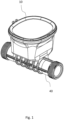
- Fig. 1 shows a wireless consumption meter 10 according to an embodiment of the invention. It is configured to be connectable to a fluid pipe 40 so as to be able to perform its measuring method on the fluid in the fluid pipe 40, by letting the fluid flow through a piece of pipe integrated with the consumption meter 10 and allowing ultrasonic transceivers to gain access to the fluid.
- the wireless consumption meter 10 comprises a battery for powering purposes, and a measurement means, also referred to as flow metering part, for performing the flow measuring.
- the consumption meter further comprises first communication means (11, not shown in fig. 1 ), also referred to as first communication interface, in terms of a storage with an NFC interface (not shown) for consumption meter representations, which may be read by a corresponding NFC interface of an external device (20, not shown in fig. 1 ).
- first communication means 11, not shown in fig. 1
- first communication interface also referred to as first communication interface
- the consumption meter preferably further comprises second communication means, also referred to as second communication interface, in terms of a VHF or UHF radio signal transmitter (not shown), which may be used for transmission of data packages related to normal operation volume measurements, such as if the consumption meter is arranged in a pit at the premises of an end-user.
- second communication means also referred to as second communication interface
- VHF or UHF radio signal transmitter not shown
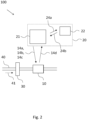
- Fig. 2 illustrates schematically a calibration system 100 according to an embodiment of the invention.
- the fluid pipe 40 facilitates a fluid flow as indicated by arrow 41 through the calibration system 100.
- the consumption meter 10 under calibration is coupled to the fluid pipe 40 and arranged to measure a value representing a fluid passing through the fluid pipe 40 in terms of an accumulated volume of the fluid.
- the fluid may be water, hot water for district heating, or gas.
- a reference device 30 configured to measure a reference value in terms of the accumulated volume of the fluid flowing through the fluid pipe 40.
- the reference device 30 may e.g. be a pre-calibrated consumption meter provided as a separate device or integrated with the external device 20, or it may be another device, such as a simple bucket, which by means of for instance weight measurements or volume indications is able to meter very accurately the accumulated volume of the fluid flow.
- the measured reference value is used for calibration of consumption meter 10.
- the calibration system 100 further comprises a calibration box 21 and a common control unit 22, which together make up an external device 20 according to the invention.
- the calibration box 21 communicates (14a, 14b, 14c, 14d) with the consumption meter, and the common control unit 22 communicates (24a, 24b) with the calibration box 21.
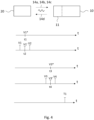
- Fig. 3a shows a prior art communication scheme between a consumption meter and a calibration system, according to which the consumption meter, when in its calibration mode, repeatedly transmits consumption meter representations with its latest measured accumulated volume by means of radio communication, such as by VHF or UHF radio signal transmission.
- radio communication such as by VHF or UHF radio signal transmission.
- the consumption meter repeatedly tweets its consumption meter representations by "tweet-tweet-tweet"-ing.
- the consumption meter repeatedly measures the accumulated volume, here in terms of five consumption meter representations of accumulated volumes V1, V2, V3, V4, and V5 on a time-scale. As shown on a similar time scale, each of the five representations are transmitted from the consumption meter in terms of transmissions T1, T2, T3, T4, and T5, each representing a consumption meter representation. Each transmission Tx is made by radio signal transmission immediately upon the completion of the consumption meter representation Vx. An accumulated volume difference for calibration purposes may be calculated from the difference between Vx-values, such as V4-V1.
- Fig. 3b shows a communication scheme between the consumption meter 10 and the calibration system 100 according to an embodiment of the invention, according to which the consumption meter 10, when in its calibration mode, transmits its consumption meter representations only when requested by the calibration box 21, i.e. only upon request from the calibration box 21.
- the transmission is made up of a single “tweet” when the calibration box 21 with its NFC interface is arranged close, such as within 10-20 cm, to the consumption meter 10 with its NFC interface to "request” the transmission, and the consumption meter representation is transmitted by NFC from the consumption meter 10 to the calibration box 21.
- the consumption meter 10 repeatedly measures the accumulated volume, her in terms of five representations V1, V2, V3, V4, and V5 on a time scale, and stores them in a storage means, also referred to as memory, e.g. flash memory, of the consumption meter.
- a storage means also referred to as memory, e.g. flash memory
- the results of these representations are not immediately transmitted as with the prior art. Instead, upon request from the external device 20, a consumption meter representation involving V1 is transmitted as T1 at some point during the time interval between the measurement of V1, and a subsequent measurement, V2. Likewise, upon request from the external device 20, another consumption meter representation involving V4 is transmitted as T2 at some point during the time interval between the measurement of V4, and a subsequent measurement, V5. An accumulated volume difference for calibration purposes may be calculated from the difference between these Vx-values, V4-V1.
- Fig. 4 shows another communication scheme between the consumption meter 10 and the calibration system 100 according to an embodiment of the present invention.
- the external device 20 communicates at time t1 with the consumption meter 10 by transmitting an unmodulated carrier wave 14a to the NFC interface 11 of the consumption meter 10.
- This communication 14a is a wake-up call to the consumption meter 10.
- the external device 20 also requests a reference device representation with the accumulated volume V1 * from the reference device.
- This reference device representation is made up by the reference device from a measurement of the accumulated volume made immediately at the time of communication 14a.
- the consumption meter 10 Upon receipt of the communication 14a, the consumption meter 10 simultaneously registers the time thereof, t2. Thus, t1 and t2 are identical.
- the consumption meter 10 most likely has not made a measurement of the accumulated volume right at time t2, as the consumption meter does not know when to expect to receive the communication 14a from the external device 20. Instead, the consumption meter 10 makes up a consumption meter representation corresponding to t2, V1', by interpolation between the accumulated volumes V1 and V2 measured previously and subsequently to t2. V1' therefore corresponds to V1*, volume-wise as well as time-wise.
- the interpolation may be carried out by an interpolating processor, also referred to as interpolator or interpolation means, e.g. a microprocessor, preferably shared with the measuring means or flow metering part of the consumption meter.
- the procedure is repeated at the end of the calibration session, the external device communicating 14b with the consumption meter 10 at time t3, and receiving the accumulated volume V3* from the reference device 30.
- time t4 is registered simultaneously to time t3, and a consumption meter representation corresponding to time t4, V3', is made up by interpolation between V3 and V4.
- V3' corresponds to V3*, volume-wise as well as time-wise.
- a consumption meter representation involving the accumulated volume difference V3'-V1' is calculated by the consumption meter 10, and communicated as communication 14d and T1 from the consumption meter 10 to the external device 20 upon request by communication 14c therefrom, and the measured accumulated volume difference V3'-V1' is compared to accumulated volume difference from the reference device 30, V3 *-V1 *.
- embodiment E1 describes an additional possible embodiment of the invention:
- a method for calibration of a battery-powered consumption meter with first communication means comprising the steps of: arranging sequentially the consumption meter and a reference device in any order with a fluid pipe system to allow a flow of fluid through the consumption meter and the reference device; providing an external device in wireless two-ways communication with the consumption meter and in communication with the reference device; making, by the external device, the consumption meter, which is arranged to operate in accordance with at least a normal operation mode and a calibration mode different from the normal operation mode, change to the calibration mode to measure a value relating to an accumulated volume of the fluid to make up a consumption meter representation of the accumulated volume; transmitting by the consumption meter to the external device the consumption meter representation; transmitting by the reference device to the external device a reference device representation relating to an accumulated volume of the fluid made up by the reference device; establishing, by the external device, a calibration result for the consumption meter on the basis of the consumption meter representation and the reference device representation;
- embodiments of the six aspects of the invention may be combined, even though such combination may not by specifically described.
- embodiments of the consumption meter of the first and second aspects may be combined with embodiments of the calibration system of the third and fourth aspects, and with embodiments of the method of calibration of the fifth and sixth aspects.
- embodiments of the calibration system of the third and fourth aspects may be combined with embodiments of the method of calibration of the fifth and sixth aspects.
Landscapes
- Physics & Mathematics (AREA)
- General Physics & Mathematics (AREA)
- Fluid Mechanics (AREA)
- Engineering & Computer Science (AREA)
- Computer Networks & Wireless Communication (AREA)
- Arrangements For Transmission Of Measured Signals (AREA)
- Details Of Flowmeters (AREA)
- Measuring Volume Flow (AREA)
Priority Applications (1)
| Application Number | Priority Date | Filing Date | Title |
|---|---|---|---|
| EP24186551.8A EP4418679B1 (de) | 2019-04-30 | 2019-04-30 | Verbrauchsmesser, kalibrierungssystem und verfahren zur kalibrierung |
Applications Claiming Priority (3)
| Application Number | Priority Date | Filing Date | Title |
|---|---|---|---|
| PCT/DK2019/050132 WO2020221401A1 (en) | 2019-04-30 | 2019-04-30 | A consumption meter, a calibration system and a method of calibration |
| EP19721986.8A EP3963294B1 (de) | 2019-04-30 | 2019-04-30 | Verbrauchszähler, kalibriersystem und kalibrierverfahren |
| EP24186551.8A EP4418679B1 (de) | 2019-04-30 | 2019-04-30 | Verbrauchsmesser, kalibrierungssystem und verfahren zur kalibrierung |
Related Parent Applications (1)
| Application Number | Title | Priority Date | Filing Date |
|---|---|---|---|
| EP19721986.8A Division EP3963294B1 (de) | 2019-04-30 | 2019-04-30 | Verbrauchszähler, kalibriersystem und kalibrierverfahren |
Publications (4)
| Publication Number | Publication Date |
|---|---|
| EP4418679A2 true EP4418679A2 (de) | 2024-08-21 |
| EP4418679A3 EP4418679A3 (de) | 2024-11-27 |
| EP4418679B1 EP4418679B1 (de) | 2026-03-04 |
| EP4418679C0 EP4418679C0 (de) | 2026-03-04 |
Family
ID=66429141
Family Applications (2)
| Application Number | Title | Priority Date | Filing Date |
|---|---|---|---|
| EP24186551.8A Active EP4418679B1 (de) | 2019-04-30 | 2019-04-30 | Verbrauchsmesser, kalibrierungssystem und verfahren zur kalibrierung |
| EP19721986.8A Active EP3963294B1 (de) | 2019-04-30 | 2019-04-30 | Verbrauchszähler, kalibriersystem und kalibrierverfahren |
Family Applications After (1)
| Application Number | Title | Priority Date | Filing Date |
|---|---|---|---|
| EP19721986.8A Active EP3963294B1 (de) | 2019-04-30 | 2019-04-30 | Verbrauchszähler, kalibriersystem und kalibrierverfahren |
Country Status (4)
| Country | Link |
|---|---|
| US (1) | US11846534B2 (de) |
| EP (2) | EP4418679B1 (de) |
| PL (1) | PL3963294T3 (de) |
| WO (1) | WO2020221401A1 (de) |
Families Citing this family (5)
| Publication number | Priority date | Publication date | Assignee | Title |
|---|---|---|---|---|
| EP4019908B1 (de) * | 2020-12-28 | 2024-01-17 | Kamstrup A/S | Flüssigkeitsverbrauchszähler und verfahren zur schalldetektion in einem rohrleitungssystem |
| CN113203452A (zh) * | 2021-04-13 | 2021-08-03 | 湖南省计量检测研究院 | 一种校准装置及方法 |
| DE102022128366A1 (de) * | 2022-10-26 | 2024-05-02 | Endress+Hauser Flowtec Ag | Verfahren zum Justieren und/oder Kalibrieren eines Durchflussmessgerätes und Durchflussmessgerät |
| CN116519099A (zh) * | 2023-05-17 | 2023-08-01 | 上海一诺仪表有限公司 | 针对流量仪表的在线检定方法、设备及介质 |
| USD1085924S1 (en) * | 2024-03-13 | 2025-07-29 | Sunsonic, LLC | Inclined ultrasonic flow meter |
Citations (1)
| Publication number | Priority date | Publication date | Assignee | Title |
|---|---|---|---|---|
| WO2016008485A1 (en) | 2014-07-18 | 2016-01-21 | Apator Miitors Aps | A method and a system for test and calibration of wireless consumption meters |
Family Cites Families (7)
| Publication number | Priority date | Publication date | Assignee | Title |
|---|---|---|---|---|
| JP2002054964A (ja) * | 2000-08-10 | 2002-02-20 | Mitsui Mining & Smelting Co Ltd | 流量測定方法及び流量計 |
| DE102005045995A1 (de) * | 2005-09-27 | 2007-04-05 | Hydrotechnik Gmbh | Durchflusssensor |
| WO2007131169A2 (en) * | 2006-05-04 | 2007-11-15 | Capstone Mobile Technologies, Llc | System and method for remotely monitoring and controlling a water meter |
| FR2977059B1 (fr) * | 2011-06-27 | 2013-07-05 | Suez Environnement | Procede de tele-releve de compteurs de fluide, compteur et serveur associes a ce procede |
| DK3184984T3 (da) * | 2015-12-22 | 2019-07-22 | Kamstrup As | System til kalibrering af tryksensorer i et forsyningsnetværk |
| SG10202009336PA (en) * | 2016-10-13 | 2020-10-29 | South East Water Corp | Vibration sensor for fluid leak detection |
| WO2018128538A1 (en) * | 2017-01-04 | 2018-07-12 | George Kent (Malaysia) Berhad | Fluid meter with supplementary wireless communication module |
-
2019
- 2019-04-30 US US17/606,498 patent/US11846534B2/en active Active
- 2019-04-30 EP EP24186551.8A patent/EP4418679B1/de active Active
- 2019-04-30 PL PL19721986.8T patent/PL3963294T3/pl unknown
- 2019-04-30 WO PCT/DK2019/050132 patent/WO2020221401A1/en not_active Ceased
- 2019-04-30 EP EP19721986.8A patent/EP3963294B1/de active Active
Patent Citations (1)
| Publication number | Priority date | Publication date | Assignee | Title |
|---|---|---|---|---|
| WO2016008485A1 (en) | 2014-07-18 | 2016-01-21 | Apator Miitors Aps | A method and a system for test and calibration of wireless consumption meters |
Also Published As
| Publication number | Publication date |
|---|---|
| EP3963294B1 (de) | 2024-07-31 |
| US20220205826A1 (en) | 2022-06-30 |
| EP3963294C0 (de) | 2024-07-31 |
| WO2020221401A1 (en) | 2020-11-05 |
| US11846534B2 (en) | 2023-12-19 |
| EP4418679A3 (de) | 2024-11-27 |
| PL3963294T3 (pl) | 2024-09-23 |
| EP4418679B1 (de) | 2026-03-04 |
| EP4418679C0 (de) | 2026-03-04 |
| EP3963294A1 (de) | 2022-03-09 |
Similar Documents
| Publication | Publication Date | Title |
|---|---|---|
| EP4418679B1 (de) | Verbrauchsmesser, kalibrierungssystem und verfahren zur kalibrierung | |
| EP3779366B1 (de) | Verfahren und system zum testen und kalibrieren von drahtlosen verbrauchszählern | |
| US8590395B2 (en) | Flow meter with sensor element having a magnetic element coupled to an inductor element | |
| US11181407B2 (en) | Efficient battery-powered meter | |
| US20130275572A1 (en) | Method for setting up temporary readiness of a field device to receive data and measuring system | |
| EP3702734B1 (de) | Funkkommunikationsvorrichtung mit hochpräziser echtzeituhr | |
| CN110737251B (zh) | 带时间传送的电池供电型现场设备 | |
| US20140156093A1 (en) | Auto-discovery of smart meter update interval | |
| CN103069285A (zh) | 双向数字功率计 | |
| EP2963396A1 (de) | Gepulste radarpegelmessung mit effizientem start | |
| US20220170774A1 (en) | Gas meter architecture | |
| CN109964491A (zh) | 用于改善数据收集器与多个自主测量单元之间的传输质量的方法以及通信系统 | |
| CN111837016A (zh) | 燃气切断装置和燃气切断装置用无线装置 | |
| CN103765915A (zh) | 遥读流体流量计的方法、流量计及与此方法相关的服务器 | |
| KR100850638B1 (ko) | 무선 원격 검침이 가능한 계량기 시스템 | |
| CN201212907Y (zh) | 电能表的rtc调校装置 | |
| EP4391601A1 (de) | Sensorvorrichtung mit synchronisierter messfähigkeit | |
| RU2658548C2 (ru) | Автоматизированная система коммерческого учета электроэнергии | |
| CN106097585A (zh) | 一种ic卡控制器计费方法及仪表 | |
| KR20180100983A (ko) | 세대 표시형 원격 검침 시스템 및 그의 제어방법 | |
| KR20010008216A (ko) | 할인 시간대에 따른 전력 사용량 계량 방법 및 이를 위한근거리 무선 검침용 전력계 | |
| JP2017005465A (ja) | 通信装置 |
Legal Events
| Date | Code | Title | Description |
|---|---|---|---|
| PUAI | Public reference made under article 153(3) epc to a published international application that has entered the european phase |
Free format text: ORIGINAL CODE: 0009012 |
|
| STAA | Information on the status of an ep patent application or granted ep patent |
Free format text: STATUS: THE APPLICATION HAS BEEN PUBLISHED |
|
| AC | Divisional application: reference to earlier application |
Ref document number: 3963294 Country of ref document: EP Kind code of ref document: P |
|
| AK | Designated contracting states |
Kind code of ref document: A2 Designated state(s): AL AT BE BG CH CY CZ DE DK EE ES FI FR GB GR HR HU IE IS IT LI LT LU LV MC MK MT NL NO PL PT RO RS SE SI SK SM TR |
|
| REG | Reference to a national code |
Ref country code: DE Ref legal event code: R079 Free format text: PREVIOUS MAIN CLASS: H04Q0009000000 Ipc: G01F0015060000 Ref country code: DE Ref legal event code: R079 Ref document number: 602019082268 Country of ref document: DE Free format text: PREVIOUS MAIN CLASS: H04Q0009000000 Ipc: G01F0015060000 |
|
| PUAL | Search report despatched |
Free format text: ORIGINAL CODE: 0009013 |
|
| AK | Designated contracting states |
Kind code of ref document: A3 Designated state(s): AL AT BE BG CH CY CZ DE DK EE ES FI FR GB GR HR HU IE IS IT LI LT LU LV MC MK MT NL NO PL PT RO RS SE SI SK SM TR |
|
| RIC1 | Information provided on ipc code assigned before grant |
Ipc: G01F 25/10 20220101ALI20241018BHEP Ipc: G01F 15/063 20220101ALI20241018BHEP Ipc: H04Q 9/00 20060101ALI20241018BHEP Ipc: G01F 25/00 20220101ALI20241018BHEP Ipc: G01D 18/00 20060101ALI20241018BHEP Ipc: G01D 4/00 20060101ALI20241018BHEP Ipc: G01F 15/06 20220101AFI20241018BHEP |
|
| STAA | Information on the status of an ep patent application or granted ep patent |
Free format text: STATUS: REQUEST FOR EXAMINATION WAS MADE |
|
| 17P | Request for examination filed |
Effective date: 20250505 |
|
| GRAP | Despatch of communication of intention to grant a patent |
Free format text: ORIGINAL CODE: EPIDOSNIGR1 |
|
| STAA | Information on the status of an ep patent application or granted ep patent |
Free format text: STATUS: GRANT OF PATENT IS INTENDED |
|
| RIC1 | Information provided on ipc code assigned before grant |
Ipc: G01F 15/06 20220101AFI20250916BHEP Ipc: G01D 4/00 20060101ALI20250916BHEP Ipc: G01D 18/00 20060101ALI20250916BHEP Ipc: G01F 25/00 20220101ALI20250916BHEP Ipc: H04Q 9/00 20060101ALI20250916BHEP Ipc: G01F 15/063 20220101ALI20250916BHEP Ipc: G01F 25/10 20220101ALI20250916BHEP |
|
| INTG | Intention to grant announced |
Effective date: 20251010 |
|
| GRAS | Grant fee paid |
Free format text: ORIGINAL CODE: EPIDOSNIGR3 |
|
| GRAA | (expected) grant |
Free format text: ORIGINAL CODE: 0009210 |
|
| STAA | Information on the status of an ep patent application or granted ep patent |
Free format text: STATUS: THE PATENT HAS BEEN GRANTED |
|
| AC | Divisional application: reference to earlier application |
Ref document number: 3963294 Country of ref document: EP Kind code of ref document: P |
|
| AK | Designated contracting states |
Kind code of ref document: B1 Designated state(s): AL AT BE BG CH CY CZ DE DK EE ES FI FR GB GR HR HU IE IS IT LI LT LU LV MC MK MT NL NO PL PT RO RS SE SI SK SM TR |
|
| REG | Reference to a national code |
Ref country code: CH Ref legal event code: F10 Free format text: ST27 STATUS EVENT CODE: U-0-0-F10-F00 (AS PROVIDED BY THE NATIONAL OFFICE) Effective date: 20260304 Ref country code: GB Ref legal event code: FG4D |
|
| REG | Reference to a national code |
Ref country code: DE Ref legal event code: R096 Ref document number: 602019082268 Country of ref document: DE |
|
| REG | Reference to a national code |
Ref country code: IE Ref legal event code: FG4D |
|
| U01 | Request for unitary effect filed |
Effective date: 20260320 |
|
| U07 | Unitary effect registered |
Designated state(s): AT BE BG DE DK EE FI FR IT LT LU LV MT NL PT RO SE SI Effective date: 20260326 |