EP4418357A1 - High-voltage composite positive electrode material and manufacturing method thereof - Google Patents
High-voltage composite positive electrode material and manufacturing method thereof Download PDFInfo
- Publication number
- EP4418357A1 EP4418357A1 EP23175474.8A EP23175474A EP4418357A1 EP 4418357 A1 EP4418357 A1 EP 4418357A1 EP 23175474 A EP23175474 A EP 23175474A EP 4418357 A1 EP4418357 A1 EP 4418357A1
- Authority
- EP
- European Patent Office
- Prior art keywords
- powders
- positive electrode
- lnmo
- lvpf
- electrode material
- Prior art date
- Legal status (The legal status is an assumption and is not a legal conclusion. Google has not performed a legal analysis and makes no representation as to the accuracy of the status listed.)
- Pending
Links
- 239000007774 positive electrode material Substances 0.000 title claims abstract description 118
- 239000002131 composite material Substances 0.000 title claims abstract description 80
- 238000004519 manufacturing process Methods 0.000 title claims abstract description 25
- 239000000843 powder Substances 0.000 claims abstract description 186
- 238000000034 method Methods 0.000 claims abstract description 51
- 239000002245 particle Substances 0.000 claims abstract description 50
- 238000002156 mixing Methods 0.000 claims abstract description 40
- FRMOHNDAXZZWQI-UHFFFAOYSA-N lithium manganese(2+) nickel(2+) oxygen(2-) Chemical compound [O-2].[Mn+2].[Ni+2].[Li+] FRMOHNDAXZZWQI-UHFFFAOYSA-N 0.000 claims abstract description 22
- QRVIVVYHHBRVQU-UHFFFAOYSA-H [Li+].[V+5].[O-]P([O-])(F)=O.[O-]P([O-])(F)=O.[O-]P([O-])(F)=O Chemical compound [Li+].[V+5].[O-]P([O-])(F)=O.[O-]P([O-])(F)=O.[O-]P([O-])(F)=O QRVIVVYHHBRVQU-UHFFFAOYSA-H 0.000 claims abstract description 19
- 239000000126 substance Substances 0.000 claims description 13
- 239000013078 crystal Substances 0.000 claims description 8
- 229910052596 spinel Inorganic materials 0.000 claims description 8
- 239000011029 spinel Substances 0.000 claims description 8
- 229910013503 LiNixMn Inorganic materials 0.000 claims description 6
- 229910001319 LiVPO4F Inorganic materials 0.000 claims description 6
- 230000000052 comparative effect Effects 0.000 description 22
- 238000001878 scanning electron micrograph Methods 0.000 description 12
- 238000007599 discharging Methods 0.000 description 9
- 238000012360 testing method Methods 0.000 description 9
- 239000011248 coating agent Substances 0.000 description 8
- 238000000576 coating method Methods 0.000 description 8
- 238000010586 diagram Methods 0.000 description 8
- 230000014759 maintenance of location Effects 0.000 description 8
- OKTJSMMVPCPJKN-UHFFFAOYSA-N Carbon Chemical compound [C] OKTJSMMVPCPJKN-UHFFFAOYSA-N 0.000 description 7
- 239000003792 electrolyte Substances 0.000 description 7
- 239000000463 material Substances 0.000 description 7
- 229910052799 carbon Inorganic materials 0.000 description 6
- KMTRUDSVKNLOMY-UHFFFAOYSA-N Ethylene carbonate Chemical compound O=C1OCCO1 KMTRUDSVKNLOMY-UHFFFAOYSA-N 0.000 description 4
- 229910001290 LiPF6 Inorganic materials 0.000 description 4
- 230000001351 cycling effect Effects 0.000 description 4
- 230000000694 effects Effects 0.000 description 4
- 239000011247 coating layer Substances 0.000 description 3
- 229910017052 cobalt Inorganic materials 0.000 description 3
- 239000010941 cobalt Substances 0.000 description 3
- GUTLYIVDDKVIGB-UHFFFAOYSA-N cobalt atom Chemical compound [Co] GUTLYIVDDKVIGB-UHFFFAOYSA-N 0.000 description 3
- 230000004048 modification Effects 0.000 description 3
- 238000012986 modification Methods 0.000 description 3
- 229920002981 polyvinylidene fluoride Polymers 0.000 description 3
- SBLRHMKNNHXPHG-UHFFFAOYSA-N 4-fluoro-1,3-dioxolan-2-one Chemical compound FC1COC(=O)O1 SBLRHMKNNHXPHG-UHFFFAOYSA-N 0.000 description 2
- OIFBSDVPJOWBCH-UHFFFAOYSA-N Diethyl carbonate Chemical compound CCOC(=O)OCC OIFBSDVPJOWBCH-UHFFFAOYSA-N 0.000 description 2
- PXHVJJICTQNCMI-UHFFFAOYSA-N Nickel Chemical compound [Ni] PXHVJJICTQNCMI-UHFFFAOYSA-N 0.000 description 2
- 239000012752 auxiliary agent Substances 0.000 description 2
- 230000015572 biosynthetic process Effects 0.000 description 2
- JBTWLSYIZRCDFO-UHFFFAOYSA-N ethyl methyl carbonate Chemical compound CCOC(=O)OC JBTWLSYIZRCDFO-UHFFFAOYSA-N 0.000 description 2
- -1 lithium hexafluorophosphate Chemical compound 0.000 description 2
- 238000007500 overflow downdraw method Methods 0.000 description 2
- 238000002360 preparation method Methods 0.000 description 2
- 238000010008 shearing Methods 0.000 description 2
- 229910002099 LiNi0.5Mn1.5O4 Inorganic materials 0.000 description 1
- 229910021178 PF3O Inorganic materials 0.000 description 1
- LXRZVMYMQHNYJB-UNXOBOICSA-N [(1R,2S,4R)-4-[[5-[4-[(1R)-7-chloro-1,2,3,4-tetrahydroisoquinolin-1-yl]-5-methylthiophene-2-carbonyl]pyrimidin-4-yl]amino]-2-hydroxycyclopentyl]methyl sulfamate Chemical compound CC1=C(C=C(S1)C(=O)C1=C(N[C@H]2C[C@H](O)[C@@H](COS(N)(=O)=O)C2)N=CN=C1)[C@@H]1NCCC2=C1C=C(Cl)C=C2 LXRZVMYMQHNYJB-UNXOBOICSA-N 0.000 description 1
- 239000011230 binding agent Substances 0.000 description 1
- 239000006229 carbon black Substances 0.000 description 1
- 238000007580 dry-mixing Methods 0.000 description 1
- 229910052744 lithium Inorganic materials 0.000 description 1
- GELKBWJHTRAYNV-UHFFFAOYSA-K lithium iron phosphate Chemical compound [Li+].[Fe+2].[O-]P([O-])([O-])=O GELKBWJHTRAYNV-UHFFFAOYSA-K 0.000 description 1
- 239000011812 mixed powder Substances 0.000 description 1
- 229910052759 nickel Inorganic materials 0.000 description 1
- 239000010970 precious metal Substances 0.000 description 1
- 239000002994 raw material Substances 0.000 description 1
- 238000007790 scraping Methods 0.000 description 1
- 239000002904 solvent Substances 0.000 description 1
- 239000000758 substrate Substances 0.000 description 1
Images





Classifications
-
- H—ELECTRICITY
- H01—ELECTRIC ELEMENTS
- H01M—PROCESSES OR MEANS, e.g. BATTERIES, FOR THE DIRECT CONVERSION OF CHEMICAL ENERGY INTO ELECTRICAL ENERGY
- H01M4/00—Electrodes
- H01M4/02—Electrodes composed of, or comprising, active material
- H01M4/36—Selection of substances as active materials, active masses, active liquids
- H01M4/362—Composites
- H01M4/366—Composites as layered products
-
- H—ELECTRICITY
- H01—ELECTRIC ELEMENTS
- H01M—PROCESSES OR MEANS, e.g. BATTERIES, FOR THE DIRECT CONVERSION OF CHEMICAL ENERGY INTO ELECTRICAL ENERGY
- H01M4/00—Electrodes
- H01M4/02—Electrodes composed of, or comprising, active material
- H01M4/36—Selection of substances as active materials, active masses, active liquids
- H01M4/362—Composites
- H01M4/364—Composites as mixtures
-
- C—CHEMISTRY; METALLURGY
- C01—INORGANIC CHEMISTRY
- C01G—COMPOUNDS CONTAINING METALS NOT COVERED BY SUBCLASSES C01D OR C01F
- C01G53/00—Compounds of nickel
- C01G53/40—Complex oxides containing nickel and at least one other metal element
- C01G53/42—Complex oxides containing nickel and at least one other metal element containing alkali metals, e.g. LiNiO2
- C01G53/44—Complex oxides containing nickel and at least one other metal element containing alkali metals, e.g. LiNiO2 containing manganese
- C01G53/54—Complex oxides containing nickel and at least one other metal element containing alkali metals, e.g. LiNiO2 containing manganese of the type (Mn2O4)-, e.g. Li(NixMn2-x)O4 or Li(MyNixMn2-x-y)O4
-
- H—ELECTRICITY
- H01—ELECTRIC ELEMENTS
- H01M—PROCESSES OR MEANS, e.g. BATTERIES, FOR THE DIRECT CONVERSION OF CHEMICAL ENERGY INTO ELECTRICAL ENERGY
- H01M10/00—Secondary cells; Manufacture thereof
- H01M10/05—Accumulators with non-aqueous electrolyte
- H01M10/052—Li-accumulators
- H01M10/0525—Rocking-chair batteries, i.e. batteries with lithium insertion or intercalation in both electrodes; Lithium-ion batteries
-
- H—ELECTRICITY
- H01—ELECTRIC ELEMENTS
- H01M—PROCESSES OR MEANS, e.g. BATTERIES, FOR THE DIRECT CONVERSION OF CHEMICAL ENERGY INTO ELECTRICAL ENERGY
- H01M4/00—Electrodes
- H01M4/02—Electrodes composed of, or comprising, active material
- H01M4/13—Electrodes for accumulators with non-aqueous electrolyte, e.g. for lithium-accumulators; Processes of manufacture thereof
- H01M4/131—Electrodes based on mixed oxides or hydroxides, or on mixtures of oxides or hydroxides, e.g. LiCoOx
-
- H—ELECTRICITY
- H01—ELECTRIC ELEMENTS
- H01M—PROCESSES OR MEANS, e.g. BATTERIES, FOR THE DIRECT CONVERSION OF CHEMICAL ENERGY INTO ELECTRICAL ENERGY
- H01M4/00—Electrodes
- H01M4/02—Electrodes composed of, or comprising, active material
- H01M4/13—Electrodes for accumulators with non-aqueous electrolyte, e.g. for lithium-accumulators; Processes of manufacture thereof
- H01M4/139—Processes of manufacture
- H01M4/1391—Processes of manufacture of electrodes based on mixed oxides or hydroxides, or on mixtures of oxides or hydroxides, e.g. LiCoOx
-
- H—ELECTRICITY
- H01—ELECTRIC ELEMENTS
- H01M—PROCESSES OR MEANS, e.g. BATTERIES, FOR THE DIRECT CONVERSION OF CHEMICAL ENERGY INTO ELECTRICAL ENERGY
- H01M4/00—Electrodes
- H01M4/02—Electrodes composed of, or comprising, active material
- H01M4/36—Selection of substances as active materials, active masses, active liquids
- H01M4/48—Selection of substances as active materials, active masses, active liquids of inorganic oxides or hydroxides
- H01M4/50—Selection of substances as active materials, active masses, active liquids of inorganic oxides or hydroxides of manganese
- H01M4/505—Selection of substances as active materials, active masses, active liquids of inorganic oxides or hydroxides of manganese of mixed oxides or hydroxides containing manganese for inserting or intercalating light metals, e.g. LiMn2O4 or LiMn2OxFy
-
- H—ELECTRICITY
- H01—ELECTRIC ELEMENTS
- H01M—PROCESSES OR MEANS, e.g. BATTERIES, FOR THE DIRECT CONVERSION OF CHEMICAL ENERGY INTO ELECTRICAL ENERGY
- H01M4/00—Electrodes
- H01M4/02—Electrodes composed of, or comprising, active material
- H01M4/36—Selection of substances as active materials, active masses, active liquids
- H01M4/48—Selection of substances as active materials, active masses, active liquids of inorganic oxides or hydroxides
- H01M4/52—Selection of substances as active materials, active masses, active liquids of inorganic oxides or hydroxides of nickel, cobalt or iron
- H01M4/525—Selection of substances as active materials, active masses, active liquids of inorganic oxides or hydroxides of nickel, cobalt or iron of mixed oxides or hydroxides containing iron, cobalt or nickel for inserting or intercalating light metals, e.g. LiNiO2, LiCoO2 or LiCoOxFy
-
- H—ELECTRICITY
- H01—ELECTRIC ELEMENTS
- H01M—PROCESSES OR MEANS, e.g. BATTERIES, FOR THE DIRECT CONVERSION OF CHEMICAL ENERGY INTO ELECTRICAL ENERGY
- H01M4/00—Electrodes
- H01M4/02—Electrodes composed of, or comprising, active material
- H01M4/36—Selection of substances as active materials, active masses, active liquids
- H01M4/58—Selection of substances as active materials, active masses, active liquids of inorganic compounds other than oxides or hydroxides, e.g. sulfides, selenides, tellurides, halogenides or LiCoFy; of polyanionic structures, e.g. phosphates, silicates or borates
- H01M4/5825—Oxygenated metallic salts or polyanionic structures, e.g. borates, phosphates, silicates, olivines
-
- C—CHEMISTRY; METALLURGY
- C01—INORGANIC CHEMISTRY
- C01P—INDEXING SCHEME RELATING TO STRUCTURAL AND PHYSICAL ASPECTS OF SOLID INORGANIC COMPOUNDS
- C01P2002/00—Crystal-structural characteristics
- C01P2002/30—Three-dimensional structures
- C01P2002/32—Three-dimensional structures spinel-type (AB2O4)
-
- C—CHEMISTRY; METALLURGY
- C01—INORGANIC CHEMISTRY
- C01P—INDEXING SCHEME RELATING TO STRUCTURAL AND PHYSICAL ASPECTS OF SOLID INORGANIC COMPOUNDS
- C01P2002/00—Crystal-structural characteristics
- C01P2002/50—Solid solutions
-
- C—CHEMISTRY; METALLURGY
- C01—INORGANIC CHEMISTRY
- C01P—INDEXING SCHEME RELATING TO STRUCTURAL AND PHYSICAL ASPECTS OF SOLID INORGANIC COMPOUNDS
- C01P2002/00—Crystal-structural characteristics
- C01P2002/70—Crystal-structural characteristics defined by measured X-ray, neutron or electron diffraction data
- C01P2002/72—Crystal-structural characteristics defined by measured X-ray, neutron or electron diffraction data by d-values or two theta-values, e.g. as X-ray diagram
-
- C—CHEMISTRY; METALLURGY
- C01—INORGANIC CHEMISTRY
- C01P—INDEXING SCHEME RELATING TO STRUCTURAL AND PHYSICAL ASPECTS OF SOLID INORGANIC COMPOUNDS
- C01P2004/00—Particle morphology
- C01P2004/01—Particle morphology depicted by an image
- C01P2004/03—Particle morphology depicted by an image obtained by SEM
-
- C—CHEMISTRY; METALLURGY
- C01—INORGANIC CHEMISTRY
- C01P—INDEXING SCHEME RELATING TO STRUCTURAL AND PHYSICAL ASPECTS OF SOLID INORGANIC COMPOUNDS
- C01P2004/00—Particle morphology
- C01P2004/60—Particles characterised by their size
- C01P2004/61—Micrometer sized, i.e. from 1-100 micrometer
-
- C—CHEMISTRY; METALLURGY
- C01—INORGANIC CHEMISTRY
- C01P—INDEXING SCHEME RELATING TO STRUCTURAL AND PHYSICAL ASPECTS OF SOLID INORGANIC COMPOUNDS
- C01P2004/00—Particle morphology
- C01P2004/60—Particles characterised by their size
- C01P2004/62—Submicrometer sized, i.e. from 0.1-1 micrometer
-
- C—CHEMISTRY; METALLURGY
- C01—INORGANIC CHEMISTRY
- C01P—INDEXING SCHEME RELATING TO STRUCTURAL AND PHYSICAL ASPECTS OF SOLID INORGANIC COMPOUNDS
- C01P2004/00—Particle morphology
- C01P2004/80—Particles consisting of a mixture of two or more inorganic phases
-
- C—CHEMISTRY; METALLURGY
- C01—INORGANIC CHEMISTRY
- C01P—INDEXING SCHEME RELATING TO STRUCTURAL AND PHYSICAL ASPECTS OF SOLID INORGANIC COMPOUNDS
- C01P2006/00—Physical properties of inorganic compounds
- C01P2006/40—Electric properties
-
- H—ELECTRICITY
- H01—ELECTRIC ELEMENTS
- H01M—PROCESSES OR MEANS, e.g. BATTERIES, FOR THE DIRECT CONVERSION OF CHEMICAL ENERGY INTO ELECTRICAL ENERGY
- H01M4/00—Electrodes
- H01M4/02—Electrodes composed of, or comprising, active material
- H01M2004/021—Physical characteristics, e.g. porosity, surface area
-
- H—ELECTRICITY
- H01—ELECTRIC ELEMENTS
- H01M—PROCESSES OR MEANS, e.g. BATTERIES, FOR THE DIRECT CONVERSION OF CHEMICAL ENERGY INTO ELECTRICAL ENERGY
- H01M4/00—Electrodes
- H01M4/02—Electrodes composed of, or comprising, active material
- H01M2004/026—Electrodes composed of, or comprising, active material characterised by the polarity
- H01M2004/028—Positive electrodes
-
- Y—GENERAL TAGGING OF NEW TECHNOLOGICAL DEVELOPMENTS; GENERAL TAGGING OF CROSS-SECTIONAL TECHNOLOGIES SPANNING OVER SEVERAL SECTIONS OF THE IPC; TECHNICAL SUBJECTS COVERED BY FORMER USPC CROSS-REFERENCE ART COLLECTIONS [XRACs] AND DIGESTS
- Y02—TECHNOLOGIES OR APPLICATIONS FOR MITIGATION OR ADAPTATION AGAINST CLIMATE CHANGE
- Y02E—REDUCTION OF GREENHOUSE GAS [GHG] EMISSIONS, RELATED TO ENERGY GENERATION, TRANSMISSION OR DISTRIBUTION
- Y02E60/00—Enabling technologies; Technologies with a potential or indirect contribution to GHG emissions mitigation
- Y02E60/10—Energy storage using batteries
Definitions
- the present disclosure relates to a positive electrode material of a secondary battery, and more particularly to a high-voltage composite positive electrode material and a manufacturing method thereof, which has the high-voltage lithium nickel manganese oxide positive electrode material with an appropriate amount of lithium vanadium fluorophosphate coated on the surface thereof, so as to effectively improve the electrical properties and the cycle life.
- the raw material of cobalt element used in the ternary oxide positive electrode material is regarded as rare, strategic and precious metals, which is not conducive to mass production.
- the lithium nickel manganese oxide positive electrode material is a high-voltage positive electrode material that does not contain cobalt. Due to the high redox potential of the lithium nickel manganese oxide positive electrode material, the power density of the lithium nickel manganese oxide positive electrode material is ranged between the power density of the ternary oxide positive electrode material and the power density of the lithium iron phosphate positive electrode material.
- the lithium nickel manganese oxide does not contain the cobalt and has less nickel content, the price of the lithium nickel manganese oxide is lower than that of ternary oxides. Therefore, the lithium nickel manganese oxide is often studied and used in the application projects of next-generation electric vehicles and 3C products.
- An object of the present disclosure is to provide a high-voltage composite positive electrode material and a manufacturing method thereof.
- High voltage lithium nickel manganese oxide (LNMO) powders and lithium vanadium fluorophosphate (LVPF) powders are mixed with specific particle sizes and proportions to form the high-voltage composite positive electrode material with the LVPF powders coated on the surfaces of the LNMO powder.
- the electrical properties and the cycle life of the high-voltage LNMO positive electrode material are significantly improved.
- the LVPF has good electrical conductivity, high voltage platform, excellent rate performance and cycle life.
- the LVPF and the high-voltage LNMO positive electrode material are provided in a specific ratio and mixed in a dry mechanofusion method, the LVPF is coated on the surface of high-voltage LNMO positive electrode material. In this way, the conductively of high-voltage LNMO is significantly improved. In addition, the LVPF further provides the protection for the surface of the high-voltage LNMO positive electrode material, so that the impact of the material surface being damaged by the electrolyte is slowed down.
- Another object of the present disclosure is to provide a high-voltage composite positive electrode material and a manufacturing method thereof.
- the LNMO powders and the LVPF powders are provided in an optimized ratio and mixed in a dry mechanofusion method. Since the average particle diameter of the LVPF powders is less than one-tenth of the average particle diameter of the LNMO powders, it allows coating the LVPF powders on the surfaces of the LNMO powders by mixing at 700 rpm to 3500 rpm for 5 minutes to 10 minutes, so as to form a high-voltage composite positive electrode material. On the other hand, when the surface coating is carried out by the dry mechanical fusion method, the temperature in the reaction chamber is maintained between 25° C.
- the aforementioned method for forming the high-voltage composite positive electrode material has a simple and easy-to-control manufacturing process. Furthermore, the high-voltage composite positive electrode material facilitates to maintain the capacity retention rate at a high charge-discharge rate (C-rate), and the good fast charging performance. Compared with the high-voltage LNMO positive electrode material without the LVPF coated thereon, the high-voltage composite positive electrode material with the LVPF coated thereon further improves the capacity retention rate by about 10% at the C-rate of 1C.
- the LVPF with tavorite-type structure is utilized to modify the surface of LNMO positive electrode material with the spinel crystal phase structure, so that the rate performance and the cycle life of the LNMO positive electrode material is improved, and the composite positive electrode material can be widely used in more application projects.
- a high-voltage composite positive electrode material includes lithium nickel manganese oxide (LNMO) powders and lithium vanadium fluorophosphate (LVPF) powders.
- the LNMO powders have a first average particle diameter.
- the LVPF powders have a second average particle diameter.
- a molar ratio of the LVPF powders to the LNMO powders is equal to or less than 0.5, the second average particle diameter is less than one-tenth of the first average particle diameter, the LVPF powders and the LNMO powders are mixed by a mechanically mixing method, and the LVPF powders are coated on surfaces of the LNMO powders to form the high-voltage composite positive electrode material.
- the molar ratio of the LVPF powders to the LNMO powders is equal to or less than 0.2.
- the molar ratio of the LVPF powders to the LNMO powders is equal to or less than 0.1.
- the first average particle diameter is ranged from 10 ⁇ m to 20 ⁇ m.
- the second average particle diameter is ranged from 0.2 ⁇ m to 2 ⁇ m .
- the LNMO powders have a spinel crystal structure and a chemical formula of LiNi x Mn( 2-x )O 4 , where x ⁇ 0.5.
- the LVPF powders have a tavorite-type structure and a chemical formula of LiVPO 4 F.
- the mechanically mixing method is a mechanofusion method.
- the mechanically mixing method includes a working temperature ranged from 25 °C to 45 °C.
- the mechanically mixing method includes a rotational speed ranged from 700 rpm to 3500 rpm, and a mixing time ranged from 5 minutes to 10 minutes.
- a manufacturing method of a high-voltage composite positive electrode material includes steps of: (a) providing lithium nickel manganese oxide (LNMO) powders and lithium vanadium fluorophosphate (LVPF) powders, respectively, wherein a molar ratio of the LVPF powders to the LNMO powders is equal to or less than 0.5, the LNMO powders have a first average particle diameter, the LVPF powders have a second average particle diameter, wherein the second average particle diameter is less than one-tenth of the first average particle diameter; and (b) mixing the LVPF powders and the LNMO powders by a mechanically mixing method, wherein the LVPF powders are coated on surfaces of the LNMO powders to form the high-voltage composite positive electrode material.
- LNMO lithium nickel manganese oxide
- LVPF lithium vanadium fluorophosphate
- the molar ratio of the LVPF powders to the LNMO powders is equal to or less than 0.2.
- the molar ratio of the LVPF powders to the LNMO powders is equal to or less than 0.1.
- the first average particle diameter is ranged from 10 ⁇ m to 20 ⁇ m.
- the second average particle diameter is ranged from 0.2 ⁇ m to 2 ⁇ m .
- the LNMO powders have a spinel crystal structure and a chemical formula of LiNi x Mn( 2-x )O 4 , where x ⁇ 0.5.
- the LVPF powders have a tavorite-type structure and a chemical formula of LiVPO 4 F.
- the mechanically mixing method is a mechanofusion method.
- the mechanically mixing method includes a working temperature ranged from 25 °C to 45 °C.
- the mechanically mixing method includes a rotational speed ranged from 700 rpm to 3500 rpm, and a mixing time ranged from 5 minutes to 10 minutes.
- first and second features are formed in direct contact
- additional features may be formed between the first and second features, such that the first and second features may not be in direct contact
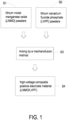
- FIG. 1 is a flow chart illustrating a manufacturing method of a high-voltage composite positive electrode material according to an embodiment of the present disclosure.
- FIG. 2A is an SEM image illustrating the LNMO powders of the present disclosure.
- FIG. 2B is an XRD image illustrating the LNMO powders of the present disclosure.
- FIG. 3A is an SEM image illustrating the LVPF powders of the present disclosure.
- FIG. 3B is an XRD image illustrating the LVPF powders of the present disclosure.
- a manufacturing method of a high-voltage composite positive electrode material is provided and includes the following steps.
- lithium nickel manganese oxide (LNMO) powders and lithium vanadium fluorophosphate (LVPF) powders are provided in the step S1 and the step S2, respectively.
- the LNMO powders are illustrated in FIG. 2A and FIG. 2B .
- the LVPF powders are illustrated in FIG. 3A and FIG. 3B .
- the LVPF powders are obtained by automatic pulverizer crushing or airflow crushing.
- the present disclosure is not limited thereto.
- a molar ratio of the LVPF powders to the LNMO powders is equal to or less than 0.5.
- the LNMO powders have the chemical formula of LiNi x Mn( 2-x )O 4 , where 2>x>0.5.
- the LNMO powders have a first average particle diameter, and the first average particle diameter is ranged from 10 ⁇ m to 20 ⁇ m.
- the LVPF powders have a second average particle diameter, and the second average particle diameter is ranged from 0.2 ⁇ m to 2 ⁇ m.
- the second average particle diameter is less than one-tenth of the first average particle diameter.
- FIG. 4 is a schematic diagram showing the high-voltage composite positive electrode material produced by the mechanofusion method of the present disclosure.
- the LVPF powders and the LNMO powders are mixed by the mechanically dry mixing method.
- the mechanically mixing method is a mechanofusion method.
- the mechanical energy and thermal energy are added simultaneously to mix the LVPF powders and the LNMO powders.
- the chamber C is rotated at a rotational speed R
- the press-head H applies a high impact energy to the particles
- the particles of the LNMO powders can be completely surrounded by the LVPF powders coated thereon, so that the powders P of the high-voltage composite positive electrode material are obtained.
- the centrifugal force is generated by rotating the chamber C at the rotational speed R to fix the two kinds of particles inside the chamber C.
- the powders are briefly compacted by means of an internal press-head H fixed on the central shaft. Furthermore, the mixed powders are scraped through a scraper S at high speed.
- the particles are mixed to obtain the powders P of the high-voltage composite positive electrode material.
- the LVPF powders and the LNMO powders of the present disclosure are mechanically mixed, so that the LVPF powders are evenly coated on the surfaces of the LNMO powders, and a high-voltage composite positive electrode material is formed.
- the rotational speed R for the mechanofusion method is ranged from 700 rpm to 3500 rpm.
- the rotational speed R for the mechanofusion method is set at 700 rpm (the power output is set to 10% of the total output power of the motor), and the mixing time is set to 5 minutes to obtain the high-voltage composite positive electrode material with the LVPF powders uniformly coated on the surfaces of the LNMO powders.
- the rotational speed R for the mechanofusion method is set at 1400 rpm (the power output is set to 20% of the total output power of the motor), and the mixing time is set to 5 minutes to obtain the high-voltage composite positive electrode material with the LVPF powders uniformly coated on the surfaces of the LNMO powders.
- the rotational speed R for the mechanofusion method is set at 2100 rpm (the power output is set to 30% of the total output power of the motor), and the mixing time is set to 5 minutes to obtain the high-voltage composite positive electrode material with the LVPF powders uniformly coated on the surfaces of the LNMO powders.
- the rotational speed R for the mechanofusion method is set at 2800 rpm (the power output is set to 40% of the total output power of the motor), and the mixing time is set to 10 minutes to obtain the high-voltage composite positive electrode material with the LVPF powders uniformly coated on the surfaces of the LNMO powders.
- the rotational speed R for the mechanofusion method is set at 3500 rpm (the power output is set to 50% of the total output power of the motor), and the mixing time is set to 10 minutes to obtain the high-voltage composite positive electrode material with the LVPF powders uniformly coated on the surfaces of the LNMO powders.
- the rotational speed R and the mixing time for the mechanofusion method are adjustable according to the practical requirements.
- the working temperature of the chamber C during mechanical mixing is maintained and ranged from 25°C to 45°C.
- the aforementioned method for forming the high-voltage composite positive electrode material has a simple and easy-to-control manufacturing process.
- the high-voltage composite positive electrode material facilitates to maintain the capacity retention rate at a high charge-discharge rate (C-rate), and the good fast charging performance.
- the comparative example is a lithium nickel manganese oxide positive electrode material (LNMO Blank) without a surface modification of LVPF and formed by the LNMO powders merely.
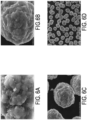
- FIGS. 5A to 5D are SEM images at different magnifications illustrating the high-voltage LNMO positive electrode material of the comparative example.
- the molar ratio of the LVPF powders to the LNMO powders is equal to 0.1.
- the LNMO powders and the LVPF powders are mixed by the mechanically mixing method to obtain the high-voltage composite positive electrode material.
- the mechanically mixing method is the mechanofusion method, which includes the working temperature ranged from 25° C to 45° C, the rotational speed at 700 rpm, and the mixing time of 5 minutes.
- FIGS. 6A to 6D are SEM images at different magnifications illustrating the high-voltage composite positive electrode material of Example 1 of the present disclosure.
- FIGS. 7A to 7D are SEM images at different magnifications illustrating the high-voltage composite positive electrode material of Example 2 of the present disclosure.
- FIGS. 8A to 8D are SEM images at different magnifications illustrating the high-voltage composite positive electrode material of Example 3 of the present disclosure.
- the high-voltage composite positive electrode material, an auxiliary agent (acetylene carbon black, Li400), a binder of polyvinylidene difluoride (PVDF) and a solvent are mixed, then coated on a substrate and dried to form a positive electrode sheet.
- the high-voltage composite positive electrode material, the auxiliary agent and the PVDF are in a ratio of 94:4:2.
- the negative electrode sheet is made of lithium metal.
- the electrolyte disposed between the positive electrode sheet and the negative electrode sheet includes 1.0 M lithium hexafluorophosphate (LiPF 6 ) and ethylene carbonate (EC)/methyl ethyl carbonate (EMC) (3/7). In this way, the preparation of the test samples of Example 1 to Example 3 are completed.
- the electrolyte disposed between the positive electrode sheet and the negative electrode sheet includes 1.150 M lithium hexafluorophosphate (LiPF 6 ), ethylene carbonate (EC)/diethyl carbonate (DEC)/methyl ethyl carbonate (EMC) (3/3/4) and 5 wt.% fluoroethylene carbonate (FEC).
- LiPF 6 lithium hexafluorophosphate
- EMC ethylene carbonate
- EMC ethyl carbonate
- FEC fluoroethylene carbonate
- FIG. 9 is a charging and discharging voltage-capacity curve diagram of the comparative example, Example 1, Example 2 and Example 3 of the present disclosure at the C-rate of 0.1C.
- the testing results of the comparative example, Example 1, Example 2 and Example 3 of the present disclosure at the C-rate of 0.1C are further compared in Table 1 below. As shown in Table 1, Compared with the comparative example, the charging and discharging capabilities of Example 1 to Example 3 are slightly increased, and the Coulomb efficiency (C.E.) is maintained above 90%.
- Example 1 with the LNMO powders: the LVPF powders 1:0.1 (molar ratio) is the best. It can be seen that, by controlling the particle sizes and the relative ratio of the LNMO powders and the LVPF powders in the mechanically mixing method, the LVPF powders are evenly coated on the surfaces of the LNMO powders to form an optimized high-voltage composite positive electrode material, which can significantly improve the electrical properties and the cycle life of the high-voltage lithium nickel manganese oxide (LNMO BLANK) positive electrode material and has good charging and discharging performance.
- LNMO BLANK lithium nickel manganese oxide
- Example 1 presents the significant increase in the capacity at the C-rate of 1C/2C/3C/5C. It can be seen that, by controlling the particle sizes and the relative ratio of the LNMO powders and the LVPF powders in the mechanically mixing method, the LVPF powders are evenly coated on the surfaces of the LNMO powders to form an optimized high-voltage composite positive electrode material, which can significantly improve the electrical properties and the cycle life of the high-voltage lithium nickel manganese oxide (LNMO BLANK) positive electrode material and has good charging and discharging performance.
- LNMO BLANK lithium nickel manganese oxide
- Example 1 Under the condition of higher charging and discharging rate (C-rate), compared with the comparative example, the capacity of Example 1 is significantly improved and presents the good fast charging performance.
- the LVPF has good electrical conductivity, high voltage platform, excellent rate performance and cycle life, when the LVPF and the high-voltage LNMO positive electrode material are provided in a specific ratio and mixed in a dry mechanofusion method, the LVPF is evenly coated on the surface of high-voltage LNMO positive electrode material. In this way, the conductively of high-voltage LNMO is significantly improved.
- the LVPF further provides the protection for the surface of the high-voltage LNMO positive electrode material, so that the impact of the material surface being damaged by the electrolyte is slowed down.
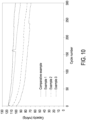
- FIG. 10 is a discharging capacity-cycle number curve diagram of the comparative example, Example 1, Example 2 and Example 3 of the present disclosure at 1C cycling of room temperature.
- FIG. 11 is a charging capacity retention rate-cycle number curve diagram of the comparative example, Example 1, Example 2 and Example 3 of the present disclosure at 1C cycling of room temperature.
- the comparative example, Example 1, Example 2 and Example 3 are tested for multiple cycles of capacities at 1C charge-discharge rate (C-rate) of room temperature.
- C-rate charge-discharge rate
- the capacity of Example 1 of the present disclosure is significantly higher than that of the comparative example, and the retention is increased by about 10% after 300 cycles of testing.
- the rate performance and the cycle life of the LNMO positive electrode material is further improved, and the composite positive electrode material can be widely used in more application projects.
- the LVPF powders used in the high-voltage composite positive electrode material further includes a small amount of carbon, such as 1.65 wt.% carbon content.
- the carbon is added during the process of automatic pulverizer crushing or airflow crushing.
- the surfaces of the LVPF powders are covered with a conductive carbon coating layer.
- the carbon coating layer on the LVPF powder can also provide the protection to slow down the impact of the material surface being damaged by the electrolyte.
- the present disclosure is not limited thereto.
- the present disclosure provides a high-voltage composite positive electrode material and a manufacturing method thereof.
- High voltage lithium nickel manganese oxide (LNMO) powders and lithium vanadium fluorophosphate (LVPF) powders are mixed with specific particle sizes and proportions to form the high-voltage composite positive electrode material with the LVPF powders coated on the surfaces of the LNMO powder.
- LNMO lithium nickel manganese oxide
- LVPF lithium vanadium fluorophosphate
- the electrical properties and the cycle life of the high-voltage LNMO positive electrode material are significantly improved.
- the LVPF has good electrical conductivity, high voltage platform, excellent rate performance and cycle life.
- the LVPF and the high-voltage LNMO positive electrode material are provided in a specific ratio and mixed in a dry mechanofusion method, the LVPF is coated on the surface of high-voltage LNMO positive electrode material. In this way, the conductively of high-voltage LNMO is significantly improved. In addition, the LVPF further provides the protection for the surface of the high-voltage LNMO positive electrode material, so that the impact of the material surface being damaged by the electrolyte is slowed down.
- the LNMO powders and the LVPF powders are provided in an optimized ratio and mixed in a dry mechanofusion method.
- the average particle diameter of the LVPF powders is less than one-tenth of the average particle diameter of the LNMO powders, it allows coating the LVPF powders on the surfaces of the LNMO powders by mixing at 700 rpm to 3500 rpm for 5 minutes to 10 minutes, so as to form a high-voltage composite positive electrode material.
- the surface coating is carried out by the dry mechanical fusion method, the temperature in the reaction chamber is maintained between 25° C. and 45° C, so as to avoid the high temperature in the reaction chamber from affecting the materials and coating substances.
- the aforementioned method for forming the high-voltage composite positive electrode material has a simple and easy-to-control manufacturing process.
- the high-voltage composite positive electrode material facilitates to maintain the capacity retention rate at a high charge-discharge rate (C-rate), and the good fast charging performance.
- C-rate charge-discharge rate
- the high-voltage composite positive electrode material with the LVPF coated thereon further improves the capacity retention rate by about 10% at the C-rate of 1C.
- the LVPF with tavorite-type structure is utilized to modify the surface of LNMO positive electrode material with the spinel crystal phase structure, so that the rate performance and the cycle life of the LNMO positive electrode material is improved, and the composite positive electrode material can be widely used in more application projects.
Landscapes
- Chemical & Material Sciences (AREA)
- Electrochemistry (AREA)
- General Chemical & Material Sciences (AREA)
- Chemical Kinetics & Catalysis (AREA)
- Inorganic Chemistry (AREA)
- Composite Materials (AREA)
- Engineering & Computer Science (AREA)
- Materials Engineering (AREA)
- Organic Chemistry (AREA)
- Manufacturing & Machinery (AREA)
- Crystallography & Structural Chemistry (AREA)
- Battery Electrode And Active Subsutance (AREA)
- Inorganic Compounds Of Heavy Metals (AREA)
Abstract
Description
- The present disclosure relates to a positive electrode material of a secondary battery, and more particularly to a high-voltage composite positive electrode material and a manufacturing method thereof, which has the high-voltage lithium nickel manganese oxide positive electrode material with an appropriate amount of lithium vanadium fluorophosphate coated on the surface thereof, so as to effectively improve the electrical properties and the cycle life.
- In recent years, with the continuous improvement of the cruising range of electric vehicles, the demand for ternary oxide positive electrode material has been continuously improved. However, the raw material of cobalt element used in the ternary oxide positive electrode material is regarded as rare, strategic and precious metals, which is not conducive to mass production. In addition, the lithium nickel manganese oxide positive electrode material is a high-voltage positive electrode material that does not contain cobalt. Due to the high redox potential of the lithium nickel manganese oxide positive electrode material, the power density of the lithium nickel manganese oxide positive electrode material is ranged between the power density of the ternary oxide positive electrode material and the power density of the lithium iron phosphate positive electrode material. Furthermore, since the lithium nickel manganese oxide does not contain the cobalt and has less nickel content, the price of the lithium nickel manganese oxide is lower than that of ternary oxides. Therefore, the lithium nickel manganese oxide is often studied and used in the application projects of next-generation electric vehicles and 3C products.
- However, when the conventional lithium nickel manganese oxide positive electrode material is charged and discharged at a high potential, there are several side effects formed on the surface of the positive electrode material due to the HF generated by LiPF6 and H2O in the electrolyte (LiPF6 + H2O → 2HF + LiF + PF3O). As a result, the capacity, the rate performance, and the cycle life are affected and declined.
- Therefore, there is a need to provide a high-voltage composite positive electrode material and a manufacturing method thereof, which has the high-voltage lithium nickel manganese oxide positive electrode material with a surface modification of lithium vanadium fluorophosphate, so as to effectively improve the electrical properties and the cycle life, and obviate the drawbacks encountered by the prior arts.
- An object of the present disclosure is to provide a high-voltage composite positive electrode material and a manufacturing method thereof. High voltage lithium nickel manganese oxide (LNMO) powders and lithium vanadium fluorophosphate (LVPF) powders are mixed with specific particle sizes and proportions to form the high-voltage composite positive electrode material with the LVPF powders coated on the surfaces of the LNMO powder. In that, the electrical properties and the cycle life of the high-voltage LNMO positive electrode material are significantly improved. Preferably, the LVPF has good electrical conductivity, high voltage platform, excellent rate performance and cycle life. When the LVPF and the high-voltage LNMO positive electrode material are provided in a specific ratio and mixed in a dry mechanofusion method, the LVPF is coated on the surface of high-voltage LNMO positive electrode material. In this way, the conductively of high-voltage LNMO is significantly improved. In addition, the LVPF further provides the protection for the surface of the high-voltage LNMO positive electrode material, so that the impact of the material surface being damaged by the electrolyte is slowed down.
- Another object of the present disclosure is to provide a high-voltage composite positive electrode material and a manufacturing method thereof. The LNMO powders and the LVPF powders are provided in an optimized ratio and mixed in a dry mechanofusion method. Since the average particle diameter of the LVPF powders is less than one-tenth of the average particle diameter of the LNMO powders, it allows coating the LVPF powders on the surfaces of the LNMO powders by mixing at 700 rpm to 3500 rpm for 5 minutes to 10 minutes, so as to form a high-voltage composite positive electrode material. On the other hand, when the surface coating is carried out by the dry mechanical fusion method, the temperature in the reaction chamber is maintained between 25° C. and 45° C, so as to avoid the high temperature in the reaction chamber from affecting the materials and coating substances. The aforementioned method for forming the high-voltage composite positive electrode material has a simple and easy-to-control manufacturing process. Furthermore, the high-voltage composite positive electrode material facilitates to maintain the capacity retention rate at a high charge-discharge rate (C-rate), and the good fast charging performance. Compared with the high-voltage LNMO positive electrode material without the LVPF coated thereon, the high-voltage composite positive electrode material with the LVPF coated thereon further improves the capacity retention rate by about 10% at the C-rate of 1C. In other words, the LVPF with tavorite-type structure is utilized to modify the surface of LNMO positive electrode material with the spinel crystal phase structure, so that the rate performance and the cycle life of the LNMO positive electrode material is improved, and the composite positive electrode material can be widely used in more application projects.
- In accordance with an aspect of the present disclosure, a high-voltage composite positive electrode material is provided and includes lithium nickel manganese oxide (LNMO) powders and lithium vanadium fluorophosphate (LVPF) powders. The LNMO powders have a first average particle diameter. The LVPF powders have a second average particle diameter. A molar ratio of the LVPF powders to the LNMO powders is equal to or less than 0.5, the second average particle diameter is less than one-tenth of the first average particle diameter, the LVPF powders and the LNMO powders are mixed by a mechanically mixing method, and the LVPF powders are coated on surfaces of the LNMO powders to form the high-voltage composite positive electrode material.
- In an embodiment, the molar ratio of the LVPF powders to the LNMO powders is equal to or less than 0.2.
- In an embodiment, the molar ratio of the LVPF powders to the LNMO powders is equal to or less than 0.1.
- In an embodiment, the first average particle diameter is ranged from 10 µm to 20 µm.
- In an embodiment, the second average particle diameter is ranged from 0.2 µm to 2 µm .
- In an embodiment, the LNMO powders have a spinel crystal structure and a chemical formula of LiNixMn(2-x)O4, where x ≧ 0.5.
- In an embodiment, the LVPF powders have a tavorite-type structure and a chemical formula of LiVPO4F.
- In an embodiment, the mechanically mixing method is a mechanofusion method.
- In an embodiment, the mechanically mixing method includes a working temperature ranged from 25 °C to 45 °C.
- In an embodiment, the mechanically mixing method includes a rotational speed ranged from 700 rpm to 3500 rpm, and a mixing time ranged from 5 minutes to 10 minutes.
- In accordance with another aspect of the present disclosure, a manufacturing method of a high-voltage composite positive electrode material is provided and includes steps of: (a) providing lithium nickel manganese oxide (LNMO) powders and lithium vanadium fluorophosphate (LVPF) powders, respectively, wherein a molar ratio of the LVPF powders to the LNMO powders is equal to or less than 0.5, the LNMO powders have a first average particle diameter, the LVPF powders have a second average particle diameter, wherein the second average particle diameter is less than one-tenth of the first average particle diameter; and (b) mixing the LVPF powders and the LNMO powders by a mechanically mixing method, wherein the LVPF powders are coated on surfaces of the LNMO powders to form the high-voltage composite positive electrode material.
- In an embodiment, the molar ratio of the LVPF powders to the LNMO powders is equal to or less than 0.2.
- In an embodiment, the molar ratio of the LVPF powders to the LNMO powders is equal to or less than 0.1.
- In an embodiment, the first average particle diameter is ranged from 10 µm to 20 µm.
- In an embodiment, the second average particle diameter is ranged from 0.2 µm to 2 µm .
- In an embodiment, the LNMO powders have a spinel crystal structure and a chemical formula of LiNixMn(2-x)O4, where x ≧ 0.5.
- In an embodiment, the LVPF powders have a tavorite-type structure and a chemical formula of LiVPO4F.
- In an embodiment, the mechanically mixing method is a mechanofusion method.
- In an embodiment, the mechanically mixing method includes a working temperature ranged from 25 °C to 45 °C.
- In an embodiment, the mechanically mixing method includes a rotational speed ranged from 700 rpm to 3500 rpm, and a mixing time ranged from 5 minutes to 10 minutes.
- The above contents of the present disclosure will become more readily apparent to those ordinarily skilled in the art after reviewing the following detailed description and accompanying drawings, in which:
-
FIG. 1 is a flow chart illustrating a manufacturing method of a high-voltage composite positive electrode material according to an embodiment of the present disclosure; -
FIG. 2A is an SEM image illustrating the LNMO powders of the present disclosure; -
FIG. 2B is an XRD image illustrating the LNMO powders of the present disclosure; -
FIG. 3A is an SEM image illustrating the LVPF powders of the present disclosure; -
FIG. 3B is an XRD image illustrating the LVPF powders of the present disclosure; -
FIG. 4 is a schematic diagram showing the high-voltage composite positive electrode material produced by the mechanofusion method of the present disclosure; -
FIGS. 5A to 5D are SEM images at different magnifications illustrating the high-voltage LNMO positive electrode material of the comparative example; -
FIGS. 6A to 6D are SEM images at different magnifications illustrating the high-voltage composite positive electrode material of Example 1 of the present disclosure; -
FIGS. 7A to 7D are SEM images at different magnifications illustrating the high-voltage composite positive electrode material of Example 2 of the present disclosure; -
FIGS. 8A to 8D are SEM images at different magnifications illustrating the high-voltage composite positive electrode material of Example 3 of the present disclosure; -
FIG. 9 is a charging and discharging voltage-capacity curve diagram of the comparative example, Example 1, Example 2 and Example 3 of the present disclosure at the C-rate of 0.1C; -
FIG. 10 is a discharging capacity-cycle number curve diagram of the comparative example, Example 1, Example 2 and Example 3 of the present disclosure at 1C cycling of room temperature; and -
FIG. 11 is a charging capacity retention rate-cycle number curve diagram of the comparative example, Example 1, Example 2 and Example 3 of the present disclosure at 1C cycling of room temperature. - The present disclosure will now be described more specifically with reference to the following embodiments. It is to be noted that the following descriptions of preferred embodiments of this disclosure are presented herein for purpose of illustration and description only. It is not intended to be exhaustive or to be limited to the precise form disclosed. For example, the formation of a first feature over or on a second feature in the description that follows may include embodiments in which the first and second features are formed in direct contact, and may also include embodiments in which additional features may be formed between the first and second features, such that the first and second features may not be in direct contact. In addition, although the "first," "second," "third," and the like terms in the claims be used to describe the various elements can be appreciated, these elements should not be limited by these terms, and these elements are described in the respective embodiments are used to express the different reference numerals, these terms are only used to distinguish one element from another element. For example, a first element could be termed a second element, and, similarly, a second element could be termed a first element, without departing from the scope of example embodiments. Besides, "and / or" and the like may be used herein for including any or all combinations of one or more of the associated listed items. Alternatively, the word "about" means within an acceptable standard error of ordinary skill in the art-recognized average. In addition to the operation / working examples, or unless otherwise specifically stated otherwise, in all cases, all of the numerical ranges, amounts, values and percentages, such as the number for the herein disclosed materials, time duration, temperature, operating conditions, the ratio of the amount, and the like, should be understood as the word "about" decorator. Accordingly, unless otherwise indicated, the numerical parameters of the present invention and scope of the appended patent proposed is to follow changes in the desired approximations. At least, the number of significant digits for each numerical parameter should at least be reported and explained by conventional rounding technique is applied. Herein, it can be expressed as a range between from one endpoint to the other or both endpoints. Unless otherwise specified, all ranges disclosed herein are inclusive.
-
FIG. 1 is a flow chart illustrating a manufacturing method of a high-voltage composite positive electrode material according to an embodiment of the present disclosure.FIG. 2A is an SEM image illustrating the LNMO powders of the present disclosure.FIG. 2B is an XRD image illustrating the LNMO powders of the present disclosure.FIG. 3A is an SEM image illustrating the LVPF powders of the present disclosure.FIG. 3B is an XRD image illustrating the LVPF powders of the present disclosure. In the embodiment, a manufacturing method of a high-voltage composite positive electrode material is provided and includes the following steps. Firstly, lithium nickel manganese oxide (LNMO) powders and lithium vanadium fluorophosphate (LVPF) powders are provided in the step S1 and the step S2, respectively. In the embodiment, the LNMO powders are illustrated inFIG. 2A and FIG. 2B . The LNMO powders have an average particle diameter equal to 15.13 µm with a specific surface area BET=0.31(m2/g), a spinel crystal structure and a chemical formula of LiNixMn(2-x)O4, where x=0.5. In addition, the LVPF powders are illustrated inFIG. 3A and FIG. 3B . The LVPF powders have an average particle diameter equal to 0.78 µm with a specific surface area BET=5.39(m2/g), a tavorite-type structure and a chemical formula of LiVPO4F. Preferably but not exclusively, the LVPF powders are obtained by automatic pulverizer crushing or airflow crushing. The present disclosure is not limited thereto. In the embodiment, a molar ratio of the LVPF powders to the LNMO powders is equal to or less than 0.5. In other embodiments, the LNMO powders have the chemical formula of LiNixMn(2-x)O4, where 2>x>0.5. Preferably but not exclusively, the LNMO powders have a first average particle diameter, and the first average particle diameter is ranged from 10 µm to 20 µm. In addition, the LVPF powders have a second average particle diameter, and the second average particle diameter is ranged from 0.2 µm to 2 µm. Notably, except that molar ratio of the LVPF powders to the LNMO powders is not greater than 0.5, the second average particle diameter is less than one-tenth of the first average particle diameter. Thereafter, in the step S3, the LVPF powders and the LNMO powders are mixed by a mechanically mixing method. Finally, the LVPF powders are coated on surfaces of the LNMO powders to form the high-voltage composite positive electrode material (LNMO/LVPF), as shown in the step S4. -
FIG. 4 is a schematic diagram showing the high-voltage composite positive electrode material produced by the mechanofusion method of the present disclosure. In the embodiment, the LVPF powders and the LNMO powders are mixed by the mechanically dry mixing method. Preferably but not exclusively, the mechanically mixing method is a mechanofusion method. When the specific ratio of the LVPF powders and the LNMO powders of the present disclosure is filled into a chamber C of the mechanofusion mixer, the mechanical energy and thermal energy are added simultaneously to mix the LVPF powders and the LNMO powders. In the mechanofusion method, the chamber C is rotated at a rotational speed R, the press-head H applies a high impact energy to the particles, the particles of the LNMO powders can be completely surrounded by the LVPF powders coated thereon, so that the powders P of the high-voltage composite positive electrode material are obtained. The centrifugal force is generated by rotating the chamber C at the rotational speed R to fix the two kinds of particles inside the chamber C. The powders are briefly compacted by means of an internal press-head H fixed on the central shaft. Furthermore, the mixed powders are scraped through a scraper S at high speed. By repeating the compacting/scraping (shearing, shearing) operations and the mechanofusion operations to heat-adhere the LVPF powders and the LNMO powders, the particles are mixed to obtain the powders P of the high-voltage composite positive electrode material. In this way, the LVPF powders and the LNMO powders of the present disclosure are mechanically mixed, so that the LVPF powders are evenly coated on the surfaces of the LNMO powders, and a high-voltage composite positive electrode material is formed. - Notably, in the embodiment, the rotational speed R for the mechanofusion method is ranged from 700 rpm to 3500 rpm. Preferably but not exclusively, in an embodiment, the rotational speed R for the mechanofusion method is set at 700 rpm (the power output is set to 10% of the total output power of the motor), and the mixing time is set to 5 minutes to obtain the high-voltage composite positive electrode material with the LVPF powders uniformly coated on the surfaces of the LNMO powders. Preferably but not exclusively, in an embodiment, the rotational speed R for the mechanofusion method is set at 1400 rpm (the power output is set to 20% of the total output power of the motor), and the mixing time is set to 5 minutes to obtain the high-voltage composite positive electrode material with the LVPF powders uniformly coated on the surfaces of the LNMO powders. Preferably but not exclusively, in an embodiment, the rotational speed R for the mechanofusion method is set at 2100 rpm (the power output is set to 30% of the total output power of the motor), and the mixing time is set to 5 minutes to obtain the high-voltage composite positive electrode material with the LVPF powders uniformly coated on the surfaces of the LNMO powders. Preferably but not exclusively, in an embodiment, the rotational speed R for the mechanofusion method is set at 2800 rpm (the power output is set to 40% of the total output power of the motor), and the mixing time is set to 10 minutes to obtain the high-voltage composite positive electrode material with the LVPF powders uniformly coated on the surfaces of the LNMO powders. Preferably but not exclusively, in an embodiment, the rotational speed R for the mechanofusion method is set at 3500 rpm (the power output is set to 50% of the total output power of the motor), and the mixing time is set to 10 minutes to obtain the high-voltage composite positive electrode material with the LVPF powders uniformly coated on the surfaces of the LNMO powders. Certainly, the rotational speed R and the mixing time for the mechanofusion method are adjustable according to the practical requirements.
- On the other hand, when mechanical force is used to coat the LVPF powders on the surfaces of the LNMO powders, high temperature is generated inside the chamber C. In order to avoid the influence of high temperature on the LVPF powders, the LNMO powders and the powders P of high-voltage composite positive electrode material, the working temperature of the chamber C during mechanical mixing is maintained and ranged from 25°C to 45°C. In that, the aforementioned method for forming the high-voltage composite positive electrode material has a simple and easy-to-control manufacturing process. Furthermore, the high-voltage composite positive electrode material facilitates to maintain the capacity retention rate at a high charge-discharge rate (C-rate), and the good fast charging performance.
- The manufacturing process and the effects of the high-voltage composite positive electrode material in the present disclosure are further described in detail below through a comparative examples and demonstration examples.
- The comparative example is a lithium nickel manganese oxide positive electrode material (LNMO Blank) without a surface modification of LVPF and formed by the LNMO powders merely.
FIGS. 5A to 5D are SEM images at different magnifications illustrating the high-voltage LNMO positive electrode material of the comparative example. - 1000 g of the lithium nickel manganese oxide (LiNi0.5Mn1.5O4, LNMO) powders having the average particle diameter equal to 15.13 µm with the specific surface area BET=0.31(m2/g), and 95g of the lithium vanadium fluorophosphate (LiVPO4F, LVPF) powders having the average particle diameter equal to 0.78 µm with the specific surface area BET=5.39(m2/g) are provided, respectively, and mixing together by a mechanofusion method. In that, the molar ratio of the LVPF powders to the LNMO powders is equal to 0.1.
- In the embodiment, the LNMO powders and the LVPF powders are mixed by the mechanically mixing method to obtain the high-voltage composite positive electrode material. The mechanically mixing method is the mechanofusion method, which includes the working temperature ranged from 25° C to 45° C, the rotational speed at 700 rpm, and the mixing time of 5 minutes.
FIGS. 6A to 6D are SEM images at different magnifications illustrating the high-voltage composite positive electrode material of Example 1 of the present disclosure. - The manufacturing process of Example 2 is roughly the same as that of Example 1, but in the high-voltage composite positive electrode material of Example 2, the molar ratio of the LVPF powders to the LNMO powders is equal to 0.25. That is, the LNMO powders: the LVPF powders =1:0.2375 (in weight percentage). Furthermore, the mechanofusion method for preparing the high-voltage composite positive electrode material of Example 2 includes the working temperature ranged from 25° C to 45° C, the rotational speed at 700 rpm, and the mixing time of 5 minutes.
FIGS. 7A to 7D are SEM images at different magnifications illustrating the high-voltage composite positive electrode material of Example 2 of the present disclosure. - The manufacturing process of Example 3 is roughly the same as that of Example 1, but in the high-voltage composite positive electrode material of Example 3, the molar ratio of the LVPF powders to the LNMO powders is equal to 0.5. That is, the LNMO powders: the LVPF powders =1:0.475 (in weight percentage). Furthermore, the mechanofusion method for preparing the high-voltage composite positive electrode material of Example 2 includes the working temperature ranged from 25° C to 45° C, the rotational speed at 700 rpm, and the mixing time of 5 minutes.
FIGS. 8A to 8D are SEM images at different magnifications illustrating the high-voltage composite positive electrode material of Example 3 of the present disclosure. - In order to test the electrical properties of the high-voltage composite positive electrode materials in the aforementioned Example 1 to the Example 3, the high-voltage composite positive electrode material, an auxiliary agent (acetylene carbon black, Li400), a binder of polyvinylidene difluoride (PVDF) and a solvent are mixed, then coated on a substrate and dried to form a positive electrode sheet. Preferably but not exclusively, the high-voltage composite positive electrode material, the auxiliary agent and the PVDF are in a ratio of 94:4:2. The negative electrode sheet is made of lithium metal. The electrolyte disposed between the positive electrode sheet and the negative electrode sheet includes 1.0 M lithium hexafluorophosphate (LiPF6) and ethylene carbonate (EC)/methyl ethyl carbonate (EMC) (3/7). In this way, the preparation of the test samples of Example 1 to Example 3 are completed. In other embodiments, the electrolyte disposed between the positive electrode sheet and the negative electrode sheet includes 1.150 M lithium hexafluorophosphate (LiPF6), ethylene carbonate (EC)/diethyl carbonate (DEC)/methyl ethyl carbonate (EMC) (3/3/4) and 5 wt.% fluoroethylene carbonate (FEC). The present disclosure is not limited thereto.
- In addition, the comparative example of lithium nickel manganese oxide positive electrode material (LNMO Blank) without the surface modification of LVPF is directly used to form a test sample by the preparation process similar to Example 1.
- The test samples of the comparative example, Example 1, Example 2 and Example 3 of the present disclosure are tested at a C-rate of 0.1C, 1C, 2C, 3C and 5C.
FIG. 9 is a charging and discharging voltage-capacity curve diagram of the comparative example, Example 1, Example 2 and Example 3 of the present disclosure at the C-rate of 0.1C. The testing results of the comparative example, Example 1, Example 2 and Example 3 of the present disclosure at the C-rate of 0.1C are further compared in Table 1 below. As shown in Table 1, Compared with the comparative example, the charging and discharging capabilities of Example 1 to Example 3 are slightly increased, and the Coulomb efficiency (C.E.) is maintained above 90%. Preferably, for the capacity improvement effect of the high-voltage composite positive electrode material, Example 1 with the LNMO powders: the LVPF powders = 1:0.1 (molar ratio) is the best. It can be seen that, by controlling the particle sizes and the relative ratio of the LNMO powders and the LVPF powders in the mechanically mixing method, the LVPF powders are evenly coated on the surfaces of the LNMO powders to form an optimized high-voltage composite positive electrode material, which can significantly improve the electrical properties and the cycle life of the high-voltage lithium nickel manganese oxide (LNMO BLANK) positive electrode material and has good charging and discharging performance.Table 1 Test sample 0.1C charging capacity (mAh/g) 0.1C discharging capacity (mAh/g) Coulomb efficiency (C.E.) (%) Comparative example 150/140 146/140 93.3 Example 1 159/144 152/145 90.6 Example 2 154/141 147/141 91.6 Example 3 155/140 147/141 90.3 - In addition, the testing results of the comparative example, Example 1, Example 2 and Example 3 of the present disclosure at the C-rate of 1C/2C/3C/5C are further compared in Table 2 below. Compared with the comparative example, Example 1 presents the significant increase in the capacity at the C-rate of 1C/2C/3C/5C. It can be seen that, by controlling the particle sizes and the relative ratio of the LNMO powders and the LVPF powders in the mechanically mixing method, the LVPF powders are evenly coated on the surfaces of the LNMO powders to form an optimized high-voltage composite positive electrode material, which can significantly improve the electrical properties and the cycle life of the high-voltage lithium nickel manganese oxide (LNMO BLANK) positive electrode material and has good charging and discharging performance. Notably, under the condition of higher charging and discharging rate (C-rate), compared with the comparative example, the capacity of Example 1 is significantly improved and presents the good fast charging performance. Since the LVPF has good electrical conductivity, high voltage platform, excellent rate performance and cycle life, when the LVPF and the high-voltage LNMO positive electrode material are provided in a specific ratio and mixed in a dry mechanofusion method, the LVPF is evenly coated on the surface of high-voltage LNMO positive electrode material. In this way, the conductively of high-voltage LNMO is significantly improved. In addition, the LVPF further provides the protection for the surface of the high-voltage LNMO positive electrode material, so that the impact of the material surface being damaged by the electrolyte is slowed down. In other words, in case of that the molar ratio of the LVPF powders to the LNMO powders is less than or equal to 0.2, the effect of coating the LVPF powders on the LNMO powders is better, and the excessive coating is avoided. In case of that he molar ratio of the LVPF powders to the LNMO powders is less than or equal to 0.1, the formation of the high-voltage composite positive electrode material is further optimized.
Table 2 Test sample Rate performance at 1C/2C/3C/5C (mAh/g) Comparative example 133 / 121 / 110 / 89 Example 1 138/ 127 / 115 /90 Example 2 128/ 110/90/59 Example 3 124 / 105 / 84 / 54 -
FIG. 10 is a discharging capacity-cycle number curve diagram of the comparative example, Example 1, Example 2 and Example 3 of the present disclosure at 1C cycling of room temperature.FIG. 11 is a charging capacity retention rate-cycle number curve diagram of the comparative example, Example 1, Example 2 and Example 3 of the present disclosure at 1C cycling of room temperature. The comparative example, Example 1, Example 2 and Example 3 are tested for multiple cycles of capacities at 1C charge-discharge rate (C-rate) of room temperature. As shown in theFIG. 10 andFIG. 11 , at the charge-discharge rate (C-rate) of 1C, the capacity of Example 1 of the present disclosure is significantly higher than that of the comparative example, and the retention is increased by about 10% after 300 cycles of testing. It can be seen that, by using the LVPF with the tavorite-type structure to modify the surface of the LNMO positive electrode material with the spinel crystal structure, the rate performance and the cycle life of the LNMO positive electrode material is further improved, and the composite positive electrode material can be widely used in more application projects. - Moreover, notably, in the embodiment, the LVPF powders used in the high-voltage composite positive electrode material further includes a small amount of carbon, such as 1.65 wt.% carbon content. Preferably but not exclusively, the carbon is added during the process of automatic pulverizer crushing or airflow crushing. The surfaces of the LVPF powders are covered with a conductive carbon coating layer. In addition to providing good electrical conductivity, when the LVPF powders with the carbon coating layer are coated on the surfaces of the LNMO powders to form the high-voltage composite positive electrode material, the carbon coating layer on the LVPF powder can also provide the protection to slow down the impact of the material surface being damaged by the electrolyte. Certainly, the present disclosure is not limited thereto.
- In summary, the present disclosure provides a high-voltage composite positive electrode material and a manufacturing method thereof. High voltage lithium nickel manganese oxide (LNMO) powders and lithium vanadium fluorophosphate (LVPF) powders are mixed with specific particle sizes and proportions to form the high-voltage composite positive electrode material with the LVPF powders coated on the surfaces of the LNMO powder. In that, the electrical properties and the cycle life of the high-voltage LNMO positive electrode material are significantly improved. Preferably, the LVPF has good electrical conductivity, high voltage platform, excellent rate performance and cycle life. When the LVPF and the high-voltage LNMO positive electrode material are provided in a specific ratio and mixed in a dry mechanofusion method, the LVPF is coated on the surface of high-voltage LNMO positive electrode material. In this way, the conductively of high-voltage LNMO is significantly improved. In addition, the LVPF further provides the protection for the surface of the high-voltage LNMO positive electrode material, so that the impact of the material surface being damaged by the electrolyte is slowed down. The LNMO powders and the LVPF powders are provided in an optimized ratio and mixed in a dry mechanofusion method. Since the average particle diameter of the LVPF powders is less than one-tenth of the average particle diameter of the LNMO powders, it allows coating the LVPF powders on the surfaces of the LNMO powders by mixing at 700 rpm to 3500 rpm for 5 minutes to 10 minutes, so as to form a high-voltage composite positive electrode material. On the other hand, when the surface coating is carried out by the dry mechanical fusion method, the temperature in the reaction chamber is maintained between 25° C. and 45° C, so as to avoid the high temperature in the reaction chamber from affecting the materials and coating substances. The aforementioned method for forming the high-voltage composite positive electrode material has a simple and easy-to-control manufacturing process. Furthermore, the high-voltage composite positive electrode material facilitates to maintain the capacity retention rate at a high charge-discharge rate (C-rate), and the good fast charging performance. Compared with the high-voltage LNMO positive electrode material without the LVPF coated thereon, the high-voltage composite positive electrode material with the LVPF coated thereon further improves the capacity retention rate by about 10% at the C-rate of 1C. In other words, the LVPF with tavorite-type structure is utilized to modify the surface of LNMO positive electrode material with the spinel crystal phase structure, so that the rate performance and the cycle life of the LNMO positive electrode material is improved, and the composite positive electrode material can be widely used in more application projects.
Claims (14)
- A high-voltage composite positive electrode material, characterized by comprising:lithium nickel manganese oxide (LNMO) powders having a first average particle diameter; andlithium vanadium fluorophosphate (LVPF) powders having a second average particle diameter, wherein a molar ratio of the LVPF powders to the LNMO powders is equal to or less than 0.5, the second average particle diameter is less than one-tenth of the first average particle diameter, the LVPF powders and the LNMO powders are mixed by a mechanically mixing method, and the LVPF powders are coated on surfaces of the LNMO powders to form the high-voltage composite positive electrode material.
- The high-voltage composite positive electrode material according to claim 1, wherein the molar ratio of the LVPF powders to the LNMO powders is equal to or less than 0.2.
- The high-voltage composite positive electrode material according to claim 1, wherein the molar ratio of the LVPF powders to the LNMO powders is equal to or less than 0.1.
- The high-voltage composite positive electrode material according to claim 1, wherein the first average particle diameter is ranged from 10 µm to 20 µm, and the second average particle diameter is ranged from 0.2 µm to 2 µm.
- The high-voltage composite positive electrode material according to claim 1, wherein the LNMO powders have a spinel crystal structure and a chemical formula of LiNixMn(2-x)O4, where x ≧ 0.5.
- The high-voltage composite positive electrode material according to claim 1, wherein the LVPF powders have a tavorite-type structure and a chemical formula of LiVPO4F.
- The high-voltage composite positive electrode material according to claim 1, wherein the mechanically mixing method is a mechanofusion method, wherein the mechanically mixing method includes a working temperature ranged from 25 °C to 45 °C, a rotational speed ranged from 700 rpm to 3500 rpm, and a mixing time ranged from 5 minutes to 10 minutes.
- A manufacturing method of a high-voltage composite positive electrode material, characterized by comprising steps of:(a) providing lithium nickel manganese oxide (LNMO) powders and lithium vanadium fluorophosphate (LVPF) powders, respectively, wherein a molar ratio of the LVPF powders to the LNMO powders is equal to or less than 0.5, the LNMO powders have a first average particle diameter, the LVPF powders have a second average particle diameter, wherein the second average particle diameter is less than one-tenth of the first average particle diameter; and(b) mixing the LVPF powders and the LNMO powders by a mechanically mixing method, wherein the LVPF powders are coated on surfaces of the LNMO powders to form the high-voltage composite positive electrode material.
- The manufacturing method of the high-voltage composite positive electrode material according to claim 8, wherein the molar ratio of the LVPF powders to the LNMO powders is equal to or less than 0.2.
- The manufacturing method of the high-voltage composite positive electrode material according to claim 8, wherein the molar ratio of the LVPF powders to the LNMO powders is equal to or less than 0.1.
- The manufacturing method of the high-voltage composite positive electrode material according to claim 8, wherein the first average particle diameter is ranged from 10 µm to 20 µm, and the second average particle diameter is ranged from 0.2 µm to 2 µm .
- The manufacturing method of the high-voltage composite positive electrode material according to claim 8, wherein the LNMO powders have a spinel crystal structure and a chemical formula of LiNixMn(2-x)O4, where x ≧ 0.5.
- The manufacturing method of the high-voltage composite positive electrode material according to claim 8, wherein the LVPF powders have a tavorite-type structure and a chemical formula of LiVPO4F.
- The manufacturing method of the high-voltage composite positive electrode material according to claim 8, wherein the mechanically mixing method is a mechanofusion method, wherein the mechanically mixing method includes a working temperature ranged from 25 °C to 45 °C, a rotational speed ranged from 700 rpm to 3500 rpm, and a mixing time ranged from 5 minutes to 10 minutes.
Applications Claiming Priority (1)
| Application Number | Priority Date | Filing Date | Title |
|---|---|---|---|
| TW112105075A TWI821118B (en) | 2023-02-14 | 2023-02-14 | High-voltage composite positive electrode material and manufacturing method thereof |
Publications (1)
| Publication Number | Publication Date |
|---|---|
| EP4418357A1 true EP4418357A1 (en) | 2024-08-21 |
Family
ID=86603987
Family Applications (1)
| Application Number | Title | Priority Date | Filing Date |
|---|---|---|---|
| EP23175474.8A Pending EP4418357A1 (en) | 2023-02-14 | 2023-05-25 | High-voltage composite positive electrode material and manufacturing method thereof |
Country Status (7)
| Country | Link |
|---|---|
| US (1) | US20240274791A1 (en) |
| EP (1) | EP4418357A1 (en) |
| JP (1) | JP7644170B2 (en) |
| KR (1) | KR20240126785A (en) |
| CN (1) | CN118507663A (en) |
| AU (1) | AU2023203287B2 (en) |
| TW (1) | TWI821118B (en) |
Family Cites Families (10)
| Publication number | Priority date | Publication date | Assignee | Title |
|---|---|---|---|---|
| US8034485B2 (en) * | 2008-05-29 | 2011-10-11 | 3M Innovative Properties Company | Metal oxide negative electrodes for lithium-ion electrochemical cells and batteries |
| US20110129732A1 (en) * | 2009-12-01 | 2011-06-02 | Applied Materials, Inc. | Compressed powder 3d battery electrode manufacturing |
| JP2016510941A (en) * | 2013-03-15 | 2016-04-11 | アプライド マテリアルズ インコーポレイテッドApplied Materials,Incorporated | Multi-layer battery electrode design to enable thicker electrode manufacturing |
| CN105098188B (en) * | 2014-04-28 | 2017-09-01 | 比亚迪股份有限公司 | A kind of positive electrode material additive of lithium ion battery and preparation method thereof, positive electrode material containing the additive and lithium ion battery |
| KR20170127422A (en) * | 2015-03-09 | 2017-11-21 | 다이헤이요 세멘토 가부시키가이샤 | Cathode active material for secondary battery and manufacturing method thereof |
| CN107452950A (en) * | 2017-08-08 | 2017-12-08 | 西安交通大学 | The anode material for lithium-ion batteries and method of a kind of stable circulation |
| CN112514109A (en) * | 2018-04-19 | 2021-03-16 | A123系统有限责任公司 | Method and system for coating cathode material and use of coated cathode material |
| JP7461752B2 (en) | 2020-02-18 | 2024-04-04 | 本田技研工業株式会社 | Positive electrode active material composite for lithium ion secondary battery, positive electrode for lithium ion secondary battery, and lithium ion secondary battery |
| US11955624B2 (en) * | 2020-10-29 | 2024-04-09 | Saft America | Blended cathode materials for secondary batteries |
| US11831001B2 (en) * | 2021-05-13 | 2023-11-28 | Saft America | Pre-lithiation method and pre-lithiated lithium-ion secondary battery |
-
2023
- 2023-02-14 TW TW112105075A patent/TWI821118B/en active
- 2023-05-22 CN CN202310576546.0A patent/CN118507663A/en active Pending
- 2023-05-25 US US18/202,263 patent/US20240274791A1/en active Pending
- 2023-05-25 EP EP23175474.8A patent/EP4418357A1/en active Pending
- 2023-05-25 JP JP2023086548A patent/JP7644170B2/en active Active
- 2023-05-25 AU AU2023203287A patent/AU2023203287B2/en active Active
- 2023-05-25 KR KR1020230067533A patent/KR20240126785A/en not_active Ceased
Non-Patent Citations (4)
| Title |
|---|
| "Mechanochemical plating and surface modifi cation using ultrasonic vibration", 1 January 2010, WOODHEAD PUBLISHING, ISBN: 978-1-84569-944-4, article KO S V ET AL: "Mechanochemical plating and surface modifi cation using ultrasonic vibration", XP093098019 * |
| ABBIREDD ET AL: "A review of modern particle sizing methods", PROCEEDINGS OF THE INSTITUTION OF CIVIL ENGINEERS. GEOTECHNICALENGINEERING, LONDON, GB, vol. 162, no. 4, 1 January 2009 (2009-01-01), pages 193 - 201, XP009150583, ISSN: 1353-2618 * |
| GAN ZHANGGEN ET AL: "Surface modification on enhancing the high-voltage performance of LiNi0.8Co0.1Mn0.1O2 cathode materials by electrochemically active LiVPO4F hybrid", ELECTROCHIMICA ACTA, ELSEVIER, AMSTERDAM, NL, vol. 324, 5 September 2019 (2019-09-05), XP085860645, ISSN: 0013-4686, [retrieved on 20190905], DOI: 10.1016/J.ELECTACTA.2019.134807 * |
| MAKIMURA YOSHINARI ET AL: "Improved Kinetics in Spinel-Related 5 V Positive Electrode Materials by Changing Lithium Insertion Schemes for Lithium-Ion Batteries", ACS APPLIED ENERGY MATERIALS, vol. 5, no. 10, 26 September 2022 (2022-09-26), pages 12239 - 12251, XP093095081, ISSN: 2574-0962, Retrieved from the Internet <URL:https://pubs.acs.org/doi/pdf/10.1021/acsaem.2c01721> DOI: 10.1021/acsaem.2c01721 * |
Also Published As
| Publication number | Publication date |
|---|---|
| KR20240126785A (en) | 2024-08-21 |
| CN118507663A (en) | 2024-08-16 |
| TW202433783A (en) | 2024-08-16 |
| JP2024115493A (en) | 2024-08-26 |
| JP7644170B2 (en) | 2025-03-11 |
| TWI821118B (en) | 2023-11-01 |
| US20240274791A1 (en) | 2024-08-15 |
| AU2023203287A1 (en) | 2024-08-29 |
| AU2023203287B2 (en) | 2024-09-19 |
Similar Documents
| Publication | Publication Date | Title |
|---|---|---|
| US11108043B2 (en) | Method for producing positive electrode active material for nonaqueous electrolyte secondary battery | |
| KR101964726B1 (en) | Spherical or spherical-like lithium ion battery cathode material and preparation method and application thereof | |
| EP2237347B1 (en) | Positive electrode material, its manufacturing method and lithium batteries | |
| JP7703115B2 (en) | Sodium ion positive electrode material and its manufacturing method and use, sodium ion battery, sodium ion battery pack, and device | |
| JP2005310744A (en) | Cathode activator for nonaqueous lithium secondary battery, manufacturing method of the same, and nonaqueous lithium secondary battery using the cathode activator | |
| EP4625514A1 (en) | Lithium ion battery | |
| EP4542678A1 (en) | Positive electrode material, positive electrode sheet comprising same, and battery | |
| JP4868271B2 (en) | Method for producing positive electrode active material for non-aqueous lithium secondary battery, positive electrode using this active material, and non-aqueous lithium secondary battery | |
| JP2018195419A (en) | Positive electrode material for nonaqueous electrolyte secondary battery, nonaqueous electrolyte secondary battery arranged by use thereof, and method for manufacturing positive electrode material for nonaqueous electrolyte secondary battery | |
| CN113937253A (en) | Simple method for improving positive performance of lithium ion battery | |
| CN115043444B (en) | High-nickel ternary cathode material, preparation method thereof and battery | |
| KR101194911B1 (en) | Electrode active material for secondary battery and method for preparing the same | |
| JP5062534B2 (en) | Method for producing positive electrode active material for non-aqueous lithium secondary battery | |
| EP4542704A2 (en) | Positive electrode active material, positive electrode sheet and lithium-ion battery | |
| JP2001155728A (en) | Positive electrode active material for use in non-aqueous lithium secondary battery and method of fabricating it | |
| EP4418357A1 (en) | High-voltage composite positive electrode material and manufacturing method thereof | |
| JP2005346956A (en) | Positive electrode active material for nonaqueous lithium secondary battery, manufacturing method thereof, and nonaqueous lithium secondary battery using the positive electrode active material | |
| JP7702578B2 (en) | Olivine-type composite positive electrode material and its manufacturing method and application, lithium-ion battery | |
| JP5120719B2 (en) | Positive electrode active material for non-aqueous lithium secondary battery, positive electrode using this active material, and non-aqueous lithium secondary battery | |
| JPH08185863A (en) | Positive electrode active material for lithium secondary battery and secondary battery using it | |
| AU2023202834B2 (en) | Cathode material and preparation method thereof | |
| KR101102651B1 (en) | Electrode Active Material for Secondary Battery and Manufacturing Method Thereof | |
| EP4481840A1 (en) | Composite electrode and preparation method thereof | |
| JP2003187795A (en) | Cathode active material for non-aqueous electrolyte secondary batteries | |
| WO2020171089A1 (en) | Method for producing positive electrode active material for lithium ion secondary batteries, positive electrode active material for lithium ion secondary batteries, and lithium ion secondary battery |
Legal Events
| Date | Code | Title | Description |
|---|---|---|---|
| PUAI | Public reference made under article 153(3) epc to a published international application that has entered the european phase |
Free format text: ORIGINAL CODE: 0009012 |
|
| STAA | Information on the status of an ep patent application or granted ep patent |
Free format text: STATUS: THE APPLICATION HAS BEEN PUBLISHED |
|
| AK | Designated contracting states |
Kind code of ref document: A1 Designated state(s): AL AT BE BG CH CY CZ DE DK EE ES FI FR GB GR HR HU IE IS IT LI LT LU LV MC ME MK MT NL NO PL PT RO RS SE SI SK SM TR |
|
| STAA | Information on the status of an ep patent application or granted ep patent |
Free format text: STATUS: REQUEST FOR EXAMINATION WAS MADE |
|
| 17P | Request for examination filed |
Effective date: 20241019 |
|
| RBV | Designated contracting states (corrected) |
Designated state(s): AL AT BE BG CH CY CZ DE DK EE ES FI FR GB GR HR HU IE IS IT LI LT LU LV MC ME MK MT NL NO PL PT RO RS SE SI SK SM TR |
|
| RAV | Requested validation state of the european patent: fee paid |
Extension state: MA Effective date: 20241213 |