EP4418341A2 - Positivelektrodenplatte und sekundärbatterie mit wasserfreiem elektrolyt - Google Patents
Positivelektrodenplatte und sekundärbatterie mit wasserfreiem elektrolyt Download PDFInfo
- Publication number
- EP4418341A2 EP4418341A2 EP23220759.7A EP23220759A EP4418341A2 EP 4418341 A2 EP4418341 A2 EP 4418341A2 EP 23220759 A EP23220759 A EP 23220759A EP 4418341 A2 EP4418341 A2 EP 4418341A2
- Authority
- EP
- European Patent Office
- Prior art keywords
- active material
- positive electrode
- material layer
- electrode plate
- core body
- Prior art date
- Legal status (The legal status is an assumption and is not a legal conclusion. Google has not performed a legal analysis and makes no representation as to the accuracy of the status listed.)
- Pending
Links
Images


Classifications
-
- H—ELECTRICITY
- H01—ELECTRIC ELEMENTS
- H01M—PROCESSES OR MEANS, e.g. BATTERIES, FOR THE DIRECT CONVERSION OF CHEMICAL ENERGY INTO ELECTRICAL ENERGY
- H01M4/00—Electrodes
- H01M4/02—Electrodes composed of, or comprising, active material
- H01M4/13—Electrodes for accumulators with non-aqueous electrolyte, e.g. for lithium-accumulators; Processes of manufacture thereof
-
- B—PERFORMING OPERATIONS; TRANSPORTING
- B82—NANOTECHNOLOGY
- B82Y—SPECIFIC USES OR APPLICATIONS OF NANOSTRUCTURES; MEASUREMENT OR ANALYSIS OF NANOSTRUCTURES; MANUFACTURE OR TREATMENT OF NANOSTRUCTURES
- B82Y30/00—Nanotechnology for materials or surface science, e.g. nanocomposites
-
- H—ELECTRICITY
- H01—ELECTRIC ELEMENTS
- H01M—PROCESSES OR MEANS, e.g. BATTERIES, FOR THE DIRECT CONVERSION OF CHEMICAL ENERGY INTO ELECTRICAL ENERGY
- H01M10/00—Secondary cells; Manufacture thereof
- H01M10/05—Accumulators with non-aqueous electrolyte
- H01M10/052—Li-accumulators
- H01M10/0525—Rocking-chair batteries, i.e. batteries with lithium insertion or intercalation in both electrodes; Lithium-ion batteries
-
- H—ELECTRICITY
- H01—ELECTRIC ELEMENTS
- H01M—PROCESSES OR MEANS, e.g. BATTERIES, FOR THE DIRECT CONVERSION OF CHEMICAL ENERGY INTO ELECTRICAL ENERGY
- H01M4/00—Electrodes
- H01M4/02—Electrodes composed of, or comprising, active material
- H01M4/13—Electrodes for accumulators with non-aqueous electrolyte, e.g. for lithium-accumulators; Processes of manufacture thereof
- H01M4/131—Electrodes based on mixed oxides or hydroxides, or on mixtures of oxides or hydroxides, e.g. LiCoOx
-
- H—ELECTRICITY
- H01—ELECTRIC ELEMENTS
- H01M—PROCESSES OR MEANS, e.g. BATTERIES, FOR THE DIRECT CONVERSION OF CHEMICAL ENERGY INTO ELECTRICAL ENERGY
- H01M4/00—Electrodes
- H01M4/02—Electrodes composed of, or comprising, active material
- H01M4/62—Selection of inactive substances as ingredients for active masses, e.g. binders, fillers
- H01M4/624—Electric conductive fillers
- H01M4/625—Carbon or graphite
-
- H—ELECTRICITY
- H01—ELECTRIC ELEMENTS
- H01M—PROCESSES OR MEANS, e.g. BATTERIES, FOR THE DIRECT CONVERSION OF CHEMICAL ENERGY INTO ELECTRICAL ENERGY
- H01M4/00—Electrodes
- H01M4/02—Electrodes composed of, or comprising, active material
- H01M4/64—Carriers or collectors
- H01M4/66—Selection of materials
- H01M4/661—Metal or alloys, e.g. alloy coatings
-
- H—ELECTRICITY
- H01—ELECTRIC ELEMENTS
- H01M—PROCESSES OR MEANS, e.g. BATTERIES, FOR THE DIRECT CONVERSION OF CHEMICAL ENERGY INTO ELECTRICAL ENERGY
- H01M4/00—Electrodes
- H01M4/02—Electrodes composed of, or comprising, active material
- H01M4/64—Carriers or collectors
- H01M4/66—Selection of materials
- H01M4/661—Metal or alloys, e.g. alloy coatings
- H01M4/662—Alloys
-
- H—ELECTRICITY
- H01—ELECTRIC ELEMENTS
- H01M—PROCESSES OR MEANS, e.g. BATTERIES, FOR THE DIRECT CONVERSION OF CHEMICAL ENERGY INTO ELECTRICAL ENERGY
- H01M4/00—Electrodes
- H01M4/02—Electrodes composed of, or comprising, active material
- H01M4/64—Carriers or collectors
- H01M4/66—Selection of materials
- H01M4/663—Selection of materials containing carbon or carbonaceous materials as conductive part, e.g. graphite, carbon fibres
-
- H—ELECTRICITY
- H01—ELECTRIC ELEMENTS
- H01M—PROCESSES OR MEANS, e.g. BATTERIES, FOR THE DIRECT CONVERSION OF CHEMICAL ENERGY INTO ELECTRICAL ENERGY
- H01M4/00—Electrodes
- H01M4/02—Electrodes composed of, or comprising, active material
- H01M4/64—Carriers or collectors
- H01M4/66—Selection of materials
- H01M4/665—Composites
- H01M4/667—Composites in the form of layers, e.g. coatings
-
- H—ELECTRICITY
- H01—ELECTRIC ELEMENTS
- H01M—PROCESSES OR MEANS, e.g. BATTERIES, FOR THE DIRECT CONVERSION OF CHEMICAL ENERGY INTO ELECTRICAL ENERGY
- H01M4/00—Electrodes
- H01M4/02—Electrodes composed of, or comprising, active material
- H01M2004/021—Physical characteristics, e.g. porosity, surface area
-
- H—ELECTRICITY
- H01—ELECTRIC ELEMENTS
- H01M—PROCESSES OR MEANS, e.g. BATTERIES, FOR THE DIRECT CONVERSION OF CHEMICAL ENERGY INTO ELECTRICAL ENERGY
- H01M4/00—Electrodes
- H01M4/02—Electrodes composed of, or comprising, active material
- H01M2004/026—Electrodes composed of, or comprising, active material characterised by the polarity
- H01M2004/028—Positive electrodes
-
- H—ELECTRICITY
- H01—ELECTRIC ELEMENTS
- H01M—PROCESSES OR MEANS, e.g. BATTERIES, FOR THE DIRECT CONVERSION OF CHEMICAL ENERGY INTO ELECTRICAL ENERGY
- H01M4/00—Electrodes
- H01M4/02—Electrodes composed of, or comprising, active material
- H01M4/36—Selection of substances as active materials, active masses, active liquids
- H01M4/362—Composites
- H01M4/364—Composites as mixtures
-
- Y—GENERAL TAGGING OF NEW TECHNOLOGICAL DEVELOPMENTS; GENERAL TAGGING OF CROSS-SECTIONAL TECHNOLOGIES SPANNING OVER SEVERAL SECTIONS OF THE IPC; TECHNICAL SUBJECTS COVERED BY FORMER USPC CROSS-REFERENCE ART COLLECTIONS [XRACs] AND DIGESTS
- Y02—TECHNOLOGIES OR APPLICATIONS FOR MITIGATION OR ADAPTATION AGAINST CLIMATE CHANGE
- Y02E—REDUCTION OF GREENHOUSE GAS [GHG] EMISSIONS, RELATED TO ENERGY GENERATION, TRANSMISSION OR DISTRIBUTION
- Y02E60/00—Enabling technologies; Technologies with a potential or indirect contribution to GHG emissions mitigation
- Y02E60/10—Energy storage using batteries
Definitions
- the present invention relates to a positive electrode plate and a non-aqueous electrolyte secondary battery (hereinafter also referred to as a battery) including the positive electrode plate.
- Japanese Patent Laying-Open No. 2016-48698 proposes to use a carbon nanotube (hereinafter also referred to as CNT) in order to improve an output characteristic in a positive electrode of a lithium ion secondary battery.
- CNT carbon nanotube
- the output characteristic is improved but electric conductivity may become too high.
- the content of the CNT in the positive electrode plate is reduced to such an extent that the electric conductivity does not become too high, the output characteristic is less likely to be improved.
- the present invention provides the following positive electrode plate and battery.
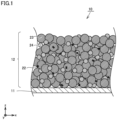
- FIG. 1 is a schematic diagram showing an exemplary configuration of a positive electrode plate in the present embodiment.
- a positive electrode plate 10 includes, for example, a core body 11 and an active material layer 12.
- Core body 11 is an electrically conductive sheet.
- Core body 11 may be, for example, an aluminum alloy foil or the like.
- Core body 11 may have a thickness of, for example, 10 ⁇ m to 30 ⁇ m. The thickness of core body 11 can be measured by a constant-pressure thickness measurement device (thickness gauge).
- Active material layer 12 can be disposed on a surface of core body 11.
- Active material layer 12 may be disposed on one or both of front and rear surfaces of core body 11.
- Active material layer 12 may have a thickness of, for example, 10 ⁇ m to 200 ⁇ m.
- the thickness of active material layer 12 is measured in a cross sectional SEM image of active material layer 12.
- An observation plane can be parallel to the thickness direction of active material layer 12.
- the thickness of active material layer 12 is measured at five or more positions.
- the thickness of active material layer 12 is defined as an arithmetic average of the thicknesses at the five or more positions.
- a particle packing density of active material layer 12 can be, for example, 3.0 to 3.8 g/cm 3 or more.
- Active material layer 12 includes active material particles and a conductive auxiliary agent 22.
- Conductive auxiliary agent 22 present in the vicinity of a surface of active material layer 12 opposite to core body 11 includes a CNT. Since the conductive auxiliary agent including the CNT is disposed in the vicinity of the surface of the active material layer opposite to the core body, the output characteristic can be improved and the electric conductivity can be avoided from being too high.
- the vicinity of the surface of active material layer 12 opposite to core body 11 may be a region that includes the surface of active material layer 12 opposite to core body 11 and that is present to extend from the surface of active material layer 12 opposite to core body 11 to 1/5, 2/5, 1/2, 3/5, or 4/5 of the thickness of active material layer 12 in the thickness direction of active material layer 12.
- the CNT is fibrous carbon having such a structure that graphene that forms a carbon hexagonal network is rounded into a tubular shape.
- the CNT has a high aspect ratio and a property with an excellent electron conductivity.
- Examples of the CNT include: a single-walled CNT composed of one layer of graphene; a multi-walled CNT composed of two or more layers of graphene; and the like.
- the multi-walled CNT is preferable from the viewpoint of thermal and chemical stabilities.
- the CNT preferably includes a surface-modified CNT.
- CNT a commercially available CNT may be purchased and used, or a CNT produced by a conventionally known CNT manufacturing method may be used. Examples of such a method include a chemical vapor deposition (CVD) method, an arc discharging method, a laser evaporation method, and the like.
- CVD chemical vapor deposition
- arc discharging method a laser evaporation method
- the content of the CNT in active material layer 12 may be, for example, less than 0.6 wt% based on 100 wt% of the total solid content of active material layer 12 as a reference.
- the content of the CNT in active material layer 12 is preferably 0.5 wt% or less, is more preferably 0.4 wt% or less, and is, for example, 0.15 wt% or more, based on 100 wt% of the total solid content of active material layer 12 as a reference.
- conductive auxiliary agent 22 can include carbon black such as acetylene black (AB), another carbon material (for example, graphite), or the like. Among them, the AB is preferable.
- the AB is preferably disposed in the vicinity of the surface of active material layer 12 on the core body 11 side from the viewpoint of improving the output characteristic and avoiding the electric conductivity from being too high.
- the vicinity of the surface of active material layer 12 on the core body 11 side can be a region that includes the surface of active material layer 12 on the core body 11 side and that is other than the vicinity of the surface of active material layer 12 opposite to core body 11.
- the content of the AB may be, for example, less than 2.5 wt% based on 100 wt% of the total solid content of active material layer 12 as a reference.
- the content of the AB in active material layer 12 is preferably 2.0 wt% or less, is more preferably 1.5 wt% or less, and is, for example, 0.15 wt% or more, based on 100 wt% of the total solid content of active material layer 12 as a reference.
- active material layer 12 can include: a deep layer 31 disposed on the core body 11 side; and a surficial layer 32 disposed on a side of the deep layer opposite to the core body 11 side.
- Active material layer 12 may have a two-layer structure consisting of the deep layer and the surficial layer.
- Deep layer 31 and surficial layer 32 may have the same thickness or different thicknesses.
- a ratio (deep layer/surficial layer) of the thicknesses of deep layer 31 and surficial layer 32 is preferably 4/5 to 5/4.
- Conductive auxiliary agent 22 in surficial layer 32 includes the CNT.
- Conductive auxiliary agent 22 in deep layer 31 can include a carbon material (for example, AB) other than the CNT.
- Conductive auxiliary agent 22 present in the vicinity of the surface of active material layer 12 on the core body 11 side or in deep layer 31 can include the CNT and the carbon material (for example, AB) other than the CNT, but preferably includes no CNT from the viewpoint of avoiding the electric conductivity from being too high.
- Conductive auxiliary agent 22 present in the vicinity of the surface of active material layer 12 opposite to the core body 11 side or in surficial layer 32 may include the carbon material (for example, AB) other than the CNT or may include no carbon material (for example, AB) other than the CNT.
- Each of the active material particles may be a particle containing a lithium transition metal composite oxide.
- a crystal structure of the lithium transition metal composite oxide is not particularly limited, and may be a lamellar structure, a spinel structure, an olivine structure, or the like.
- the lithium transition metal composite oxide a lithium transition metal composite oxide including at least one of Ni, Co, and Mn as a transition metal element is preferable, and specific examples thereof include a lithium-nickel-based composite oxide, a lithium-cobalt-based composite oxide, a lithium-manganese-based composite oxide, a lithium-nickel-manganese-based composite oxide, a lithium-nickel-cobalt-manganese-based composite oxide, a lithium-nickel-cobalt-aluminum-based composite oxide, a lithium-iron-nickel-manganese-based composite oxide, and the like.
- the active material particle includes nickel
- the active material particle may include, for example, a lamellar metal oxide.
- the lamellar metal oxide is represented by the following formula (1): Li 1-a1 Ni x1 Me 1 1-x1 O 2 (1)
- a1 satisfies the relation "-0.3 ⁇ a1 ⁇ 0.3”.
- x1 satisfies the relation "0.1 ⁇ x1 ⁇ 0.95".
- Me 1 represents at least one selected from a group consisting of Co, Mn, Al, Zr, Ti, V, Cr, Fe, Cu, Zn, Mo, Sn, Ge, Nb, and W.
- the active material particles include a first particle group and a second particle group.
- the first particle group is constituted of large particles 23.
- the second particle group can be constituted of small particles 24.
- Each of large particles 23 may be an aggregated particle (secondary particle) in which a primary particle is aggregated.
- Each of small particles 24 may be a single-particle.
- An average particle size (D50) of the first particle group (large particles) may be, for example, 10 ⁇ m or more and 20 ⁇ m or less, and is preferably 14 ⁇ m or more and 18 ⁇ m or less.
- An average primary particle size may be, for example, 0.1 ⁇ m or more and 3 ⁇ m or less, and is preferably 0.5 ⁇ m or more and 2.5 ⁇ m or less.
- An average particle size (D50) of the second particle group may be, for example, 2 ⁇ m or more and 6 ⁇ m or less, and is preferably 3 ⁇ m or more and 6 ⁇ m or less.
- the average particle size (D50) represents a particle size (hereinafter, also referred to as D50) corresponding to a cumulative particle volume of 50% from the small particle size side with respect to the total particle volume in the volume-based particle size distribution.
- the average particle size (D50) can be measured by a laser diffraction/scattering method.
- An average primary particle size is an average of distances in ten primary particles randomly extracted on the SEM image, each of the distances being a distance between two most distant points on the outline of each of the ten primary particles.
- a BET specific surface area of the active material particles may be, for example, 0.5 m 2 /g to 1.5 m 2 /g.
- the content of the active material particles in active material layer 12 may be, for example, 70 wt% or more, is preferably 80 to 99 wt%, and is more preferably 90 to 99 wt% or less, based on 100 wt% of the total solid content of active material layer 12 as a reference.
- Active material layer 12 can include a binder.
- the binder include polyvinylidene difluoride (PVDF), polytetrafluoroethylene (PTFE), polyimide (PI), polyamide (PA), polyamide-imide (PAI), butadiene rubber (BR), styrene-butadiene rubber (SBR), nitrile-butadiene rubber (NBR), styrene-ethylene-butylene-styrene block copolymer (SEBS), carboxymethyl cellulose (CMC), a combination thereof, and the like.
- the content of the binder in active material layer 12 may be, for example, 0.5 to 10 wt%, and is preferably 1.0 to 5 wt%, based on 100 wt% of the total solid content of active material layer 12 as a reference.
- a method of manufacturing positive electrode plate 10 includes positive electrode slurry preparation (A1), application (B1), drying (C1), and compression (D1).
- a positive electrode slurry including the active material particles and the CNT is prepared.
- the positive electrode slurry is prepared by dispersing the active material particles in a dispersion medium.
- An organic solvent can include, for example, at least one selected from a group consisting of N-methyl-2-pyrrolidone (NMP), tetrahydrofuran (THF), dimethylformamide (DMF), methyl ethyl ketone (MEK) and dimethyl sulfoxide (DMSO). Any amount of the organic solvent is usable.
- the positive electrode slurry can have any solid content concentration (mass fraction of the solid content).
- the slurry can have a solid content concentration of, for example, 40% to 80%. Any stirring device, mixing device, or dispersing device can be used for the mixing.
- the application (B 1) can include applying the positive electrode slurry onto a surface of the substrate so as to form a coating film.
- the positive electrode slurry can be applied to the surface of the substrate by any application device.
- the active material layer includes the deep layer and the surficial layer
- a first coating film for the deep layer and a second coating film for the surficial layer may be formed sequentially or substantially simultaneously.
- a slurry for the deep layer can be applied onto one surface of the core body to form the first coating film, and then a slurry for the surficial layer can be applied thereonto to form a second coating film.
- the term "coating film” may collectively represent both the first coating film and the second coating film.
- the drying (C1) can include heating and drying the coating film by, for example, a hot air dryer or the like so as to form a dried coating film.
- the compression (D 1) can include compressing the dried coating film using any compression device so as to form active material layer 12. The dried applied film is compressed to form active material layer 12, thereby completing positive electrode plate 10.
- Positive electrode plate 10 can be cut into a predetermined planar size in accordance with a specification of a battery. Positive electrode plate 10 may be cut to have a strip-shaped planar shape, for example. Positive electrode plate 10 may be cut to have a quadrangular planar shape, for example.
- the battery can be a lithium ion battery.
- Fig. 4 is a schematic diagram showing an exemplary lithium ion battery in the present embodiment.
- a battery 200 shown in Fig. 4 may be, for example, a lithium ion battery for a main electric power supply, a motive power assisting electric power supply, or the like in an electrically powered vehicle.
- Battery 200 includes an exterior package 90. Exterior package 90 accommodates an electrode assembly 50 and a non-aqueous electrolyte (not shown).
- Electrode assembly 50 is connected to a positive electrode terminal 91 by a positive electrode current collecting member 81.
- Electrode assembly 50 is connected to a negative electrode terminal 92 by a negative electrode current collecting member 82.
- Fig. 5 is a schematic diagram showing an exemplary electrode assembly in the present embodiment.
- Electrode assembly 50 is a wound type. Electrode assembly 50 includes positive electrode plate 10, a separator 70, and a negative electrode plate 60. That is, battery 200 includes positive electrode plate 10. Positive electrode plate 10 includes active material layer 12 and core body 11. Negative electrode plate 60 includes a negative electrode active material layer 62 and a negative electrode substrate 61.
- volume-based particle size distributions of the first and second lithium composite oxide particles were measured using a commercially available laser diffraction/scattering type particle size distribution measurement device, and a particle size corresponding to a cumulative frequency of 50 volume% from a fine particle side having a small particle size was found as each of the average particle size (D50) of the first lithium composite oxide particles and the average particle size (D50) of the second lithium composite oxide particles.
- BET specific surface areas of the first and second lithium composite oxide particles were measured in accordance with a nitrogen adsorption method using a commercially available specific surface area measurement device ("Macsorb Model-1208" (provided by MOUNTECH)).
- a cross section observation sample of the positive electrode sheet was produced by a cross section polisher process.
- a SEM was used to obtain an SEM image of this sample.
- C Graphite (C) serving as a negative electrode active material
- SBR styrene-butadiene rubber
- CMC carboxymethyl cellulose
- the negative electrode active material layer formation slurry was applied onto a copper foil, and was dried to form a negative electrode active material layer.
- the negative electrode active material layer was roll-pressed by a roller to attain a predetermined density and was then cut to a predetermined size, thereby producing a negative electrode plate.
- a porous polyolefin sheet was prepared as a separator.
- a positive electrode plate produced in each of an Example and Comparative Examples and the negative electrode plate produced above were stacked on each other with the separator being interposed therebetween, thereby producing a stacked type electrode assembly.
- An electrode terminal was attached to the stacked type electrode assembly, this was inserted into a battery case composed of an aluminum laminate sheet, and a non-aqueous electrolyte was injected thereinto.
- EC ethylene carbonate
- EMC ethyl methyl carbonate
- each lithium ion secondary battery for evaluation was subjected to constant-current charging with a current density of 0.2 mA/cm 2 under a temperature environment of 25°C until 4.25 V was attained, and was then subjected to constant-voltage charging at a voltage of 4.25 V until a current density of 0.04 mA/cm 2 was attained.
- each lithium ion secondary battery for evaluation was subjected to constant-current discharging with a current density of 0.2 mA/cm 2 until 3.0 V was attained.
- Each lithium ion secondary battery for evaluation was adjusted to each of SOCs of 50% and 80% so as to measure an output resistance (internal resistance ratio).
- lithium composite oxide particles As the first lithium composite oxide particles (small particles), LiNi 0.6 Co 0.2 Mn 0.2 O 2 in the form of single-particles with an average particle size (D50) of 3.9 ⁇ m and a BET specific surface area of 0.60 m 2 /g was prepared.
- the second lithium composite oxide particles As the second lithium composite oxide particles (large particles), LiNi 0.55 Co 0.20 Mn 0.25 O 2 in the form of secondary particles with an average primary particle size of 1.8 ⁇ m, an average particle size (D50) of 16.5 ⁇ m, and a BET specific surface area of 0.20 m 2 /g was prepared.
- the first lithium composite oxide particles and the second lithium composite oxide particles were mixed at a mass ratio of 50:50, thereby preparing active material particles 1.
- Positive electrode active material layer formation slurry A was applied onto each of both surfaces of a core body composed of aluminum foil, and was dried to form a deep-layer dried coating film. Thereafter, positive electrode active material layer formation slurry B was applied onto the deep-layer dried coating film so as to have a weight comparable to that of the deep-layer dried coating film, and was dried to form a surface-layer dried coating film.
- the active material layer having such a two-layer structure was roll-pressed by a roller, and was then cut to a predetermined size, thereby producing a positive electrode plate having the active material layer including the deep layer and the surficial layer. Results of evaluation on the output resistance are shown in Table 1.
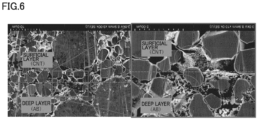
- Fig. 6 shows a cross sectional SEM image of the active material layer.
- the thicknesses of the deep layer and the surficial layer were 70 ⁇ m and 60 ⁇ m, respectively.
- a positive electrode plate of a Comparative Example 1 was produced in the same manner as in Example 1 except that the active material layer was formed using only positive electrode active material layer formation slurry B.
- a positive electrode plate of a Comparative Example 2 was produced in the same manner as in Example 1 except that the active material layer was formed using only positive electrode active material layer formation slurry A. Results are shown in Table 1. [Table 1] Type of Conductive Auxiliary Agent Output Resistance (m ⁇ ) Vicinity of Surface of Active Material Layer Opposite to Core Body Vicinity of Surface of Active Material Layer on Core Body Side SOC50% SOC80% Comparative Example 1 CNT CNT 71 80 Example 1 CNT AB 73 81 Comparative Example 2 AB AB 77 85
- Example 1 Since the CNT was included in the vicinity of the surface of the active material layer opposite to the core body in Example 1 as shown in Table 1, an output characteristic (low output resistance) was obtained to be comparable to that of Comparative Example 1 in which the conductive auxiliary agent of the positive electrode plate was entirely the CNT and to be higher than that of Comparative Example 2 in which the conductive auxiliary agent was entirely the AB. Further, since the positive electrode plate of Example 1 includes the AB as a conductive auxiliary agent in the vicinity of the surface of the active material layer on the core body side, it is presumed that the positive electrode plate exhibits lower electric conductivity than that in Comparative Example 1 in which the conductive auxiliary agent of the positive electrode plate is entirely the CNT. In view of these, it is understood that according to the present invention, there are obtained: a positive electrode plate in which an improved output characteristic is obtained and electric conductivity is suppressed from being too high; and a battery including the positive electrode plate.
Landscapes
- Chemical & Material Sciences (AREA)
- Engineering & Computer Science (AREA)
- Chemical Kinetics & Catalysis (AREA)
- Electrochemistry (AREA)
- General Chemical & Material Sciences (AREA)
- Materials Engineering (AREA)
- Nanotechnology (AREA)
- Manufacturing & Machinery (AREA)
- Composite Materials (AREA)
- Physics & Mathematics (AREA)
- Condensed Matter Physics & Semiconductors (AREA)
- General Physics & Mathematics (AREA)
- Crystallography & Structural Chemistry (AREA)
- Battery Electrode And Active Subsutance (AREA)
- Cell Electrode Carriers And Collectors (AREA)
Applications Claiming Priority (1)
| Application Number | Priority Date | Filing Date | Title |
|---|---|---|---|
| JP2023021652A JP2024115806A (ja) | 2023-02-15 | 2023-02-15 | 正極板および非水電解質二次電池 |
Publications (2)
| Publication Number | Publication Date |
|---|---|
| EP4418341A2 true EP4418341A2 (de) | 2024-08-21 |
| EP4418341A3 EP4418341A3 (de) | 2025-08-06 |
Family
ID=89428862
Family Applications (1)
| Application Number | Title | Priority Date | Filing Date |
|---|---|---|---|
| EP23220759.7A Pending EP4418341A3 (de) | 2023-02-15 | 2023-12-29 | Positivelektrodenplatte und sekundärbatterie mit wasserfreiem elektrolyt |
Country Status (4)
| Country | Link |
|---|---|
| US (1) | US20240274826A1 (de) |
| EP (1) | EP4418341A3 (de) |
| JP (1) | JP2024115806A (de) |
| CN (1) | CN118507646A (de) |
Citations (1)
| Publication number | Priority date | Publication date | Assignee | Title |
|---|---|---|---|---|
| JP2016048698A (ja) | 2016-01-04 | 2016-04-07 | 日立化成株式会社 | リチウムイオン二次電池正極用導電剤並びにこれを用いたリチウムイオン二次電池用正極材料、リチウムイオン二次電池用正極合剤、リチウムイオン二次電池用正極及びリチウムイオン二次電池 |
Family Cites Families (10)
| Publication number | Priority date | Publication date | Assignee | Title |
|---|---|---|---|---|
| EP3200265A4 (de) * | 2014-09-26 | 2018-04-04 | Positec Power Tools (Suzhou) Co., Ltd | Batterie, batteriepack und unterbrechungsfreie stromversorgung |
| KR102101006B1 (ko) * | 2015-12-10 | 2020-04-14 | 주식회사 엘지화학 | 이차전지용 양극 및 이를 포함하는 이차전지 |
| US11362318B2 (en) * | 2016-09-14 | 2022-06-14 | Nec Corporation | Lithium ion secondary battery |
| JP7035540B2 (ja) * | 2018-01-11 | 2022-03-15 | 住友金属鉱山株式会社 | 遷移金属含有複合水酸化物粒子とその製造方法、非水電解質二次電池用正極活物質とその製造方法、および非水電解質二次電池 |
| JP7452420B2 (ja) * | 2018-07-19 | 2024-03-19 | 株式会社Gsユアサ | 蓄電素子 |
| EP3996167A4 (de) * | 2019-07-01 | 2023-08-16 | Daikin Industries, Ltd. | Zusammensetzung für elektrochemische vorrichtung, positives elektrodengemisch, positive elektrodenstruktur und sekundärbatterie |
| EP4130145A4 (de) * | 2020-04-02 | 2024-05-01 | Daikin Industries, Ltd. | Elektrodenmischung, elektrode und sekundärbatterie |
| EP4160717A4 (de) * | 2020-05-29 | 2024-02-28 | SANYO Electric Co., Ltd. | Positivelektrode für sekundärbatterie mit wasserfreiem elektrolyt und sekundärbatterie mit wasserfreiem elektrolyt |
| KR20220092435A (ko) * | 2020-12-24 | 2022-07-01 | 주식회사 엘지에너지솔루션 | 리튬 이차 전지용 양극 및 이를 포함하는 리튬 이차 전지 |
| EP4542705A3 (de) * | 2021-06-24 | 2026-01-07 | LG Energy Solution, Ltd. | Kathode für lithiumsekundärbatterie und lithiumsekundärbatterie damit |
-
2023
- 2023-02-15 JP JP2023021652A patent/JP2024115806A/ja active Pending
- 2023-12-29 EP EP23220759.7A patent/EP4418341A3/de active Pending
-
2024
- 2024-01-16 US US18/413,030 patent/US20240274826A1/en active Pending
- 2024-02-07 CN CN202410171751.3A patent/CN118507646A/zh active Pending
Patent Citations (1)
| Publication number | Priority date | Publication date | Assignee | Title |
|---|---|---|---|---|
| JP2016048698A (ja) | 2016-01-04 | 2016-04-07 | 日立化成株式会社 | リチウムイオン二次電池正極用導電剤並びにこれを用いたリチウムイオン二次電池用正極材料、リチウムイオン二次電池用正極合剤、リチウムイオン二次電池用正極及びリチウムイオン二次電池 |
Also Published As
| Publication number | Publication date |
|---|---|
| EP4418341A3 (de) | 2025-08-06 |
| JP2024115806A (ja) | 2024-08-27 |
| US20240274826A1 (en) | 2024-08-15 |
| CN118507646A (zh) | 2024-08-16 |
Similar Documents
| Publication | Publication Date | Title |
|---|---|---|
| EP2894703B1 (de) | Sekundärbatterie mit wasserfreiem elektrolyt | |
| US20230110690A1 (en) | Method of producing cathode slurry, cathode and all-solid-state battery, and cathode and all-solid-state battery | |
| JP5696904B2 (ja) | リチウムイオン二次電池およびその製造方法 | |
| US20150194674A1 (en) | Electrode Formulations Comprising Graphenes | |
| CN109671906B (zh) | 锂离子二次电池用电极和锂离子二次电池 | |
| US20240105958A1 (en) | Carbon nanotube dispersion liquid for electrode slurry, negative electrode slurry, nonaqueous electrolyte secondary battery, and manufacturing method for carbon nanotube dispersion liquid for electrode slurry | |
| JP5418828B2 (ja) | リチウム二次電池とその製造方法 | |
| JP2021106094A (ja) | 全固体電池用電極 | |
| EP4404300A1 (de) | Positivelektrode und sekundärbatterie mit wasserfreiem elektrolyt | |
| EP4418341A2 (de) | Positivelektrodenplatte und sekundärbatterie mit wasserfreiem elektrolyt | |
| CN113964318A (zh) | 二次电池用多层电极 | |
| US20240047656A1 (en) | Electrode, all-solid-state battery, and method of producing electrode | |
| EP4379847A1 (de) | Negativelektrode und sekundärbatterie damit | |
| EP4517782A1 (de) | Flüssigdispersion aus leitendem material, positivelektrodenschlamm, verfahren zur herstellung | |
| EP4411879A1 (de) | Positivelektrodenplatte und sekundärbatterie mit wasserfreiem elektrolyt | |
| CN116364922B (zh) | 锂离子二次电池 | |
| US20240347721A1 (en) | Selection method and production method of nickel-cobalt-manganese-based active material for positive electrode | |
| EP4597602A1 (de) | Positivelektrode für sekundärbatterien mit wasserfreiem elektrolyt, sekundärbatterie mit wasserfreiem elektrolyt damit und dispersion aus leitfähigem material | |
| JP2025103891A (ja) | 正極板及びリチウムイオン二次電池 | |
| WO2025047327A1 (ja) | 正極および二次電池 | |
| WO2024247965A1 (ja) | 非水電解質二次電池 | |
| WO2025187609A1 (ja) | 非水電解質二次電池用正極の製造方法および非水電解質二次電池 | |
| CN120834140A (zh) | 正极板及具有该正极板的非水电解质二次电池 | |
| CN119111008A (zh) | 二次电池、正极和正极合剂层用组合物 | |
| WO2022024605A1 (ja) | 二次電池用正極 |
Legal Events
| Date | Code | Title | Description |
|---|---|---|---|
| PUAI | Public reference made under article 153(3) epc to a published international application that has entered the european phase |
Free format text: ORIGINAL CODE: 0009012 |
|
| STAA | Information on the status of an ep patent application or granted ep patent |
Free format text: STATUS: REQUEST FOR EXAMINATION WAS MADE |
|
| 17P | Request for examination filed |
Effective date: 20231229 |
|
| AK | Designated contracting states |
Kind code of ref document: A2 Designated state(s): AL AT BE BG CH CY CZ DE DK EE ES FI FR GB GR HR HU IE IS IT LI LT LU LV MC ME MK MT NL NO PL PT RO RS SE SI SK SM TR |
|
| PUAL | Search report despatched |
Free format text: ORIGINAL CODE: 0009013 |
|
| AK | Designated contracting states |
Kind code of ref document: A3 Designated state(s): AL AT BE BG CH CY CZ DE DK EE ES FI FR GB GR HR HU IE IS IT LI LT LU LV MC ME MK MT NL NO PL PT RO RS SE SI SK SM TR |
|
| RIC1 | Information provided on ipc code assigned before grant |
Ipc: H01M 4/131 20100101AFI20250630BHEP Ipc: H01M 4/62 20060101ALI20250630BHEP Ipc: B82Y 30/00 20110101ALI20250630BHEP Ipc: H01M 10/0525 20100101ALI20250630BHEP Ipc: H01M 4/66 20060101ALI20250630BHEP Ipc: H01M 4/36 20060101ALN20250630BHEP Ipc: H01M 4/02 20060101ALN20250630BHEP |