EP4418237A1 - Kontratil-unterdrückung - Google Patents
Kontratil-unterdrückung Download PDFInfo
- Publication number
- EP4418237A1 EP4418237A1 EP24152043.6A EP24152043A EP4418237A1 EP 4418237 A1 EP4418237 A1 EP 4418237A1 EP 24152043 A EP24152043 A EP 24152043A EP 4418237 A1 EP4418237 A1 EP 4418237A1
- Authority
- EP
- European Patent Office
- Prior art keywords
- aircraft
- contrail
- flight
- data
- contrails
- Prior art date
- Legal status (The legal status is an assumption and is not a legal conclusion. Google has not performed a legal analysis and makes no representation as to the accuracy of the status listed.)
- Pending
Links
Images



Classifications
-
- B—PERFORMING OPERATIONS; TRANSPORTING
- B64—AIRCRAFT; AVIATION; COSMONAUTICS
- B64F—GROUND OR AIRCRAFT-CARRIER-DECK INSTALLATIONS SPECIALLY ADAPTED FOR USE IN CONNECTION WITH AIRCRAFT; DESIGNING, MANUFACTURING, ASSEMBLING, CLEANING, MAINTAINING OR REPAIRING AIRCRAFT, NOT OTHERWISE PROVIDED FOR; HANDLING, TRANSPORTING, TESTING OR INSPECTING AIRCRAFT COMPONENTS, NOT OTHERWISE PROVIDED FOR
- B64F5/00—Designing, manufacturing, assembling, cleaning, maintaining or repairing aircraft, not otherwise provided for; Handling, transporting, testing or inspecting aircraft components, not otherwise provided for
-
- F—MECHANICAL ENGINEERING; LIGHTING; HEATING; WEAPONS; BLASTING
- F02—COMBUSTION ENGINES; HOT-GAS OR COMBUSTION-PRODUCT ENGINE PLANTS
- F02C—GAS-TURBINE PLANTS; AIR INTAKES FOR JET-PROPULSION PLANTS; CONTROLLING FUEL SUPPLY IN AIR-BREATHING JET-PROPULSION PLANTS
- F02C9/00—Controlling gas-turbine plants; Controlling fuel supply in air- breathing jet-propulsion plants
- F02C9/26—Control of fuel supply
-
- G—PHYSICS
- G08—SIGNALLING
- G08G—TRAFFIC CONTROL SYSTEMS
- G08G5/00—Traffic control systems for aircraft
- G08G5/70—Arrangements for monitoring traffic-related situations or conditions
- G08G5/76—Arrangements for monitoring traffic-related situations or conditions for monitoring atmospheric conditions
-
- G—PHYSICS
- G08—SIGNALLING
- G08G—TRAFFIC CONTROL SYSTEMS
- G08G5/00—Traffic control systems for aircraft
- G08G5/50—Navigation or guidance aids
-
- B—PERFORMING OPERATIONS; TRANSPORTING
- B64—AIRCRAFT; AVIATION; COSMONAUTICS
- B64C—AEROPLANES; HELICOPTERS
- B64C19/00—Aircraft control not otherwise provided for
-
- B—PERFORMING OPERATIONS; TRANSPORTING
- B64—AIRCRAFT; AVIATION; COSMONAUTICS
- B64D—EQUIPMENT FOR FITTING IN OR TO AIRCRAFT; FLIGHT SUITS; PARACHUTES; ARRANGEMENT OR MOUNTING OF POWER PLANTS OR PROPULSION TRANSMISSIONS IN AIRCRAFT
- B64D47/00—Equipment not otherwise provided for
-
- F—MECHANICAL ENGINEERING; LIGHTING; HEATING; WEAPONS; BLASTING
- F02—COMBUSTION ENGINES; HOT-GAS OR COMBUSTION-PRODUCT ENGINE PLANTS
- F02C—GAS-TURBINE PLANTS; AIR INTAKES FOR JET-PROPULSION PLANTS; CONTROLLING FUEL SUPPLY IN AIR-BREATHING JET-PROPULSION PLANTS
- F02C9/00—Controlling gas-turbine plants; Controlling fuel supply in air- breathing jet-propulsion plants
- F02C9/26—Control of fuel supply
- F02C9/40—Control of fuel supply specially adapted to the use of a special fuel or a plurality of fuels
-
- G—PHYSICS
- G08—SIGNALLING
- G08G—TRAFFIC CONTROL SYSTEMS
- G08G5/00—Traffic control systems for aircraft
- G08G5/20—Arrangements for acquiring, generating, sharing or displaying traffic information
- G08G5/25—Transmission of traffic-related information between aircraft
-
- G—PHYSICS
- G08—SIGNALLING
- G08G—TRAFFIC CONTROL SYSTEMS
- G08G5/00—Traffic control systems for aircraft
- G08G5/30—Flight plan management
- G08G5/32—Flight plan management for flight plan preparation
-
- G—PHYSICS
- G08—SIGNALLING
- G08G—TRAFFIC CONTROL SYSTEMS
- G08G5/00—Traffic control systems for aircraft
- G08G5/30—Flight plan management
- G08G5/34—Flight plan management for flight plan modification
-
- G—PHYSICS
- G08—SIGNALLING
- G08G—TRAFFIC CONTROL SYSTEMS
- G08G5/00—Traffic control systems for aircraft
- G08G5/50—Navigation or guidance aids
- G08G5/53—Navigation or guidance aids for cruising
-
- G—PHYSICS
- G08—SIGNALLING
- G08G—TRAFFIC CONTROL SYSTEMS
- G08G5/00—Traffic control systems for aircraft
- G08G5/50—Navigation or guidance aids
- G08G5/55—Navigation or guidance aids for a single aircraft
-
- B—PERFORMING OPERATIONS; TRANSPORTING
- B64—AIRCRAFT; AVIATION; COSMONAUTICS
- B64D—EQUIPMENT FOR FITTING IN OR TO AIRCRAFT; FLIGHT SUITS; PARACHUTES; ARRANGEMENT OR MOUNTING OF POWER PLANTS OR PROPULSION TRANSMISSIONS IN AIRCRAFT
- B64D37/00—Arrangements in connection with fuel supply for power plant
- B64D37/30—Fuel systems for specific fuels
-
- G—PHYSICS
- G08—SIGNALLING
- G08G—TRAFFIC CONTROL SYSTEMS
- G08G5/00—Traffic control systems for aircraft
- G08G5/20—Arrangements for acquiring, generating, sharing or displaying traffic information
- G08G5/21—Arrangements for acquiring, generating, sharing or displaying traffic information located onboard the aircraft
Definitions
- the present invention relates to an aircraft, a flight planning tool, a method of contrail suppression, a computer-implemented method of calculating a flight route, a method of fuelling an aircraft, and a method of loading an aircraft with a contrail suppression fuel-additive.
- EP3961012 A1 discloses an aircraft flight contrail assessment device comprising a contrail sensor adapted to produce contrails data representative of an atmosphere parameter having an influence on the formation of contrails or an observation parameter varying depending on at least the presence of one or more contrails, and a processing unit adapted to calculate at least a contrails value representative of an amount of contrail, based on said contrails data.
- the invention provides such device as well a corresponding method to evaluate the amount of contrails produced by an aircraft during a flight.
- a first aspect of the invention provides a method of contrail suppression, the method comprising: generating data with a sensing system onboard a first aircraft during a flight of the first aircraft, wherein the data comprises atmospheric information indicative of an atmospheric condition and/or contrail information indicative of a presence or absence of contrails generated by the first aircraft; and operating a second aircraft to perform one or more contrail suppression measures on a basis of the data.
- the data is associated with an air space occupied by the first aircraft during the flight of the first aircraft; and the flight of the second aircraft follows a flight route which includes the air space occupied by the first aircraft.
- the method further comprises transmitting the data from the first aircraft during the flight of the first aircraft.
- the method further comprises receiving the data at the second aircraft during the flight of the second aircraft.
- the one or more contrail suppression measures comprise switching a fuel system of the second aircraft to a fuel less prone to cause contrails.
- the one or more contrail suppression measures comprise a flight route for the second aircraft.
- a second aspect of the invention provides a computer-implemented method of calculating a flight route, the method comprising: receiving data from a first aircraft during a flight of the first aircraft, wherein the data comprises atmospheric information indicative of an atmospheric condition and/or contrail information indicative of a presence or absence of contrails generated by the first aircraft; and calculating a flight route for a second aircraft on a basis of the data.
- the flight route is calculated by a flight planning tool.
- the flight route is calculated on a basis of external meteorological information, and/or on a basis of satellite observation, and/or on a basis of observations from ground based sensors.
- the method further comprises transmitting the flight route to the second aircraft.
- the flight route is transmitted to the second aircraft on the ground before its flight.
- the flight route includes air space occupied by the first aircraft.
- the flight route is calculated to avoid ice super saturated regions detected by the first aircraft and/or calculated to avoid air space in which contrails have been generated by the first aircraft.
- a further aspect of the invention provides a method of operating an aircraft, the method comprising: calculating a flight route by a method according to the second aspect; and operating the aircraft to fly the flight route.
- a further aspect of the invention provides a method of fuelling an aircraft, the method comprising: calculating a flight route by a method according to the second aspect; calculating a risk of contrail generation for the calculated flight route; calculating a fuel load on a basis of the risk of contrail generation for the flight route; loading the second aircraft with a first fuel; and loading the aircraft with an amount of a second fuel which is less prone to causing contrails than the first fuel, wherein the amount of the second fuel is determined on a basis of the calculated fuel load.
- a further aspect of the invention provides a method of loading an aircraft with a contrail suppression fuel-additive, the method comprising: calculating a flight route by a method according to the second aspect; calculating a risk of contrail generation for the calculated flight route; calculating an additive load on a basis of the risk of contrail generation for the flight route; and loading the aircraft with an amount of a contrail suppression fuel-additive, wherein the amount of the contrail suppression fuel-additive is determined on a basis of the additive load.
- the data comprises atmospheric information indicative of an atmospheric condition.
- the data comprises contrail information indicative of a presence or absence of contrails generated by the first aircraft.
- the data comprises atmospheric information indicative of an atmospheric condition and contrail information indicative of a presence or absence of contrails generated by the first aircraft.
- the atmospheric condition comprises a humidity.
- the atmospheric information comprises an indication of an ice super saturated region.
- a further aspect of the invention provides an aircraft comprising: a sensing system, wherein the sensing system is configured to generate data, the data comprising atmospheric information indicative of an atmospheric condition and/or contrail information indicative of a presence or absence of contrails generated by the aircraft; and a transmitter configured to transmit the data during flight of the aircraft.
- the data comprises atmospheric information indicative of an atmospheric condition and contrail information indicative of a presence or absence of contrails generated by the first aircraft; and the sensing system comprises an atmospheric sensor configured to generate the atmospheric information and a contrail sensor configured to generate the contrail information.
- a further aspect of the invention provides a contrail suppression system comprising: a first aircraft according to the receding aspect; and a second aircraft configured to implement one or more contrail suppression measures on a basis of the data.
- system further comprises: a flight planning tool configured to calculate a flight route for the second aircraft on a basis of the data, wherein the second aircraft is configured to follow the flight route.
- a flight planning tool configured to calculate a flight route for the second aircraft on a basis of the data, wherein the second aircraft is configured to follow the flight route.
- the flight planning tool is configured to transmit the flight route to the second aircraft.
- a further aspect of the invention provides a flight planning tool configured to receive data from a first aircraft, wherein the data comprises atmospheric information indicative of an atmospheric condition and/or contrail information indicative of a presence or absence of contrails generated by the first aircraft, and wherein the flight planning tool is configured to calculate a flight route for a second aircraft on a basis of the data.
- the flight route is calculated to avoid ice super saturated regions detected by the first aircraft and/or calculated to avoid air space in which contrails have been generated by the first aircraft.
- the flight planning tool is configured to calculate a risk of contrail generation for the calculated flight route; and the flight planning tool is further configured to calculate a fuel load for the second aircraft on a basis of the risk of contrail generation for the calculated flight route.
- Figure 1 shows a contrail suppression system comprising first and second aircraft 1a,b during flight.
- the aircraft 1a,b may be flying in close formation, or separated by some distance but with the second (following) aircraft 1b following the first (leading) aircraft 1a along a similar flight route.
- the aircraft 1a,b are similar, with equivalent parts designated 'a' for the first aircraft 1a, and 'b' for the second aircraft 1b.
- Each aircraft comprises a pair of wings 2a,b carrying engines 3a,b.
- the engines 3a,b are fed with fuel from a fuel system comprising fuel tanks 12a,b and 13a,b.
- the engines can either be fed with a first fuel from a first fuel tank 12a,b or with second fuel from a second fuel tank 13a,b.
- the engines are being fed with the first fuel from the first fuel tank 12a,b.
- the fuel tanks are only indicated schematically and can be located in any part of the aircraft.
- the first fuel may be a standard fuel, such as JetA1, which is likely to cause condensation trails (referred to herein as “contrails”) in certain atmospheric conditions.
- the second fuel may be Sustainable Aviation Fuel (SAF), or any other fuel which is less prone to causing contrails than the first fuel. SAF is less prone to causing contrails than JetA1 because it produces less soot.
- SAF Sustainable Aviation Fuel
- Each aircraft comprises a transmitter 10a,b configured to transmit data from the aircraft during flight of the aircraft, and a receiver 15a,b configured to receive data at the aircraft during flight of the aircraft.
- a transmitter 10a,b configured to transmit data from the aircraft during flight of the aircraft
- a receiver 15a,b configured to receive data at the aircraft during flight of the aircraft.
- These can be located in any part of the aircraft and are shown in the nose and tail in Figure 1 for ease of illustration.
- the transmitter and receiver are shown as separate devices, but in other embodiments a single device may be used to provide transmit and receive functions.
- Each aircraft comprises an avionics system indicated schematically at 17a,b which controls the fuel tanks 12a,b; 13a,b and also controls the flight route of the aircraft.
- the avionics system 17a,b may be configured to implement one or more contrail suppression measures during a flight of the aircraft. For instance the avionics system 17a,b can switch the fuel system to the second fuel (which is less prone to cause contrails) and operate flight control devices (rudder, ailerons etc) to control the trajectory of the aircraft to follow a flight route less likely to cause contrails.
- Each aircraft also comprises a sensing system comprising a forward-facing atmospheric sensor 11a,b and a rear-facing contrail sensor 14a,b.
- the atmospheric sensor 11a,b can be located onboard the aircraft at any position in which it has an unimpeded forward-facing view.
- the atmospheric sensor 11a,b is configured to generate atmospheric information indicative of an atmospheric condition and feed the atmospheric information to the avionics system 17a,b and the transmitter 15a,b.
- the atmospheric condition may comprise a humidity, or any other indication of an ice super saturated region (ISSR) which will tend to cause contrails to be generated.
- ISSR ice super saturated region
- the contrail sensor 14a,b can be located onboard the aircraft at any position in which it has an unimpeded rear-facing view.
- the contrail sensor 14a,b is configured to generate contrail information indicative of a presence or absence of contrails generated by the aircraft and feed the contrail information to the avionics system 17a,b and the transmitter 15a,b.
- the contrail sensor 14a,b may be a rear-facing camera which takes images of the exhaust plumes of the aircraft and analyses the images to detect the presence or absence of contrails.
- each contrail sensor 14a,b is configured to generate contrail information indicative of a presence or absence of contrails generated by the aircraft carrying the sensor. That is, the contrail sensor 14a is configured to generate contrail information indicative of a presence or absence of contrails 4a generated by the first aircraft 1a; and the contrail sensor 14b is configured to generate contrail information indicative of a presence or absence of contrails generated by the second aircraft 1b.
- the data from the sensing system 11a, 14a is associated with an air space occupied by the first aircraft 1a during the flight of the first aircraft 1a.
- the atmospheric information is indicative of an atmospheric condition in the air space immediately in front of the first aircraft 1a (hence soon to be occupied by the first aircraft 1a) and the contrail information is indicative of a presence or absence of contrails generated by the first aircraft 1a in the air space immediately behind the first aircraft 1a.
- the atmospheric information and contrail information may be recorded onboard the aircraft 1a,b.
- the flight of the second aircraft 1b may follow a flight route which includes the air space occupied by the first aircraft 1a.
- the atmospheric information and contrail information are transmitted from the transmitter 15a of the first aircraft 1a during flight of the first aircraft 1a and received at the receiver 10b of the second aircraft 1b during flight of the second aircraft 1b.
- the contrail information in the transmission 16 is indicative of a presence of contrails 4a being generated by the first aircraft 1a.
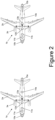
- the detection of the contrails 4a causes the avionics system 17a of the first aircraft 1a to switch its fuel system to the second fuel, by changing from the first fuel tank 12a to the second fuel tank 13a as shown in Figure 2 .
- the consequent switch to SAF fuel causes the contrails 4a to stop as shown in Figure 2 .
- the second aircraft 1b also implements one or more contrail suppression measures on a basis of the data received from the first aircraft in the transmission 16.
- it causes the avionics system 17b of the second aircraft 1b to switch from fuel tank 12b to fuel tank 13b as shown in Figure 2 , so no contrails are generated by the second aircraft 1b when it flies into the air space previously occupied by the first aircraft 1a at the time of Figure 1 .
- the switch from fuel tank 12b to fuel tank 13b may be made immediately, if the aircraft 1a,b are flying in close formation, or at a later time when the second aircraft 1b enters the airspace where the contrails 4a were being generated by the first aircraft.
- the contrail information in the transmission 16 is indicative of an absence of contrails 4a being generated by the first aircraft 1a.
- the first aircraft 1a is about to fly into an ice super saturated region (ISSR) 20 which will tend to cause contrails to be generated, and this is indicated by the atmospheric information in the transmission 16.
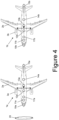
- the detection of the ISSR 20 in the atmospheric information causes the avionics system 17a of the first aircraft 1a to switch from fuel tank 12a to fuel tank 13a as shown in Figure 4 , which prevents contrails from developing as the first aircraft 1a flies into the ISSR 20.
- the second aircraft 1b also implements one or more contrail suppression measures on a basis of the data received from the first aircraft in the transmission 16.
- the avionics system 17b of the second aircraft 1b causes the avionics system 17b of the second aircraft 1b to switch from fuel tank 12b to fuel tank 13b as shown in Figure 4 , so no contrails are generated by the second aircraft 1b when it flies into the ISSR 20.
- the switch from fuel tank 12b to fuel tank 13b may be made immediately, if the aircraft 1a,b are flying in close formation, or at a later time when the second aircraft 1b enters the ISSR 20.
- the avionics system 17a of the first aircraft 1a may switch the fuel system back to fuel tank 12a.
- the second aircraft 1b may also switch its fuel system back to fuel tank 12b on a basis of the atmospheric information from the first aircraft 1a.
- Figures 1-4 show one type of contrail suppression measure (change of fuel type) which can be implemented by the aircraft 1a,b. Another type of contrail suppression measure is to feed a contrail suppression fuel-additive into the fuel line from the first fuel tank 12a,b without switching from JetA1. Another type of contrail suppression measure (change of flight route) is shown in Figures 5 and 6 .
- the aircraft 1a,b are following a flight route 30 which is heading into an ISSR 20.
- the detection of the ISSR 20 causes both aircraft 1a,b to implement a contrail suppression measure, which in this case comprises lowering their cruise altitude to revised flight routes 31, 32 which avoid the ISSR 20, thus avoiding the creation of contrails by either aircraft 1a,b.
- the avionics system 17a of the first aircraft is configured to calculate the revised flight route 31 for the first aircraft 1a on a basis of the atmospheric information; and/or the avionics system 17a of the first aircraft is configured to calculate the revised flight route 32 for the second aircraft 1b on a basis of the atmospheric information.
- a contrail suppression system comprising a sensing system 11a, 14a onboard a first aircraft 1a; and a second aircraft 1b configured to implement one or more contrail suppression measures on a basis of the data.
- a sensing system is provided onboard each aircraft 1a,b but only the sensing system of the first aircraft 1a is used. In an alternative embodiment, only the first aircraft 1a may have such a sensing system.
- the examples above enable contrails to be suppressed in real time by direct aircraft-to-aircraft communication during simultaneous flights of two aircraft.
- the two aircraft may be flying in a coordinated fashion in close formation, or separated by some distance (i.e. not flying in a coordinated fashion or in close formation). Both aircraft are in flight in Figures 1-6 , but in an alternative embodiment the second aircraft 1b may be on the ground when it receives the data from the first aircraft 1a.
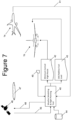
- the alternative example of Figure 7 provides a system for generating a flight route before a flight of the second aircraft 1b, which reduces the generation of contrails during the flight of the second aircraft 1b.
- the system of Figure 7 comprises a computer-implemented ground-based flight planning tool 40 configured to receive atmospheric information and contrail information from the first aircraft 1a via a transmission 41, which may optionally be transmitted via a satellite or other intermediaries.
- the transmission 41 may be received continuously or intermittently during flight of the first aircraft 1a.
- the data in the transmission 41 comprises atmospheric information indicative of an atmospheric condition and/or contrail information indicative of a presence or absence of contrails generated by the first aircraft 1a.
- the flight planning tool 40 is configured to calculate a minimum contrail flight route 42 for the second aircraft 1b on a basis of the data from the first aircraft 1a.
- the minimum contrail flight route 42 comprises a flight route for the second aircraft 1b designed by the flight planning tool 40 with minimal risk of contrail generation, by avoiding ISSRs detected by other aircraft (such as the first aircraft 1a); and/or by avoiding air space in which contrails have recently been generated by other aircraft (such as the first aircraft 1a).
- the flight planning tool 40 is also configured to calculate a risk of contrail generation for the minimum contrail flight route 42; and calculate an SAF/additive load 43 for the second aircraft 1b on a basis of the risk of contrail generation for the minimum contrail flight route 42.
- the SAF/additive load 43 may indicate the volume or mass of SAF fuel which must be loaded into the fuel tank 13b of the second aircraft 1b, to ensure that it contains sufficient SAF fuel to suppress contrail generation to the extent expected as the second aircraft 1b flies the minimum contrail flight route 42. Hence if the minimum contrail flight route 42 has a high risk of contrail generation, then a higher volume of SAF fuel may be required compared to a minimum contrail flight route 42 with a low risk of contrail generation.
- first fuel tank 12b Prior to the second aircraft's next flight, its first fuel tank 12b is loaded with a first fuel (for instance JetA1) and its second fuel tank 13b is loaded with an amount of a second fuel (for instance SAF) less prone to causing contrails than the first fuel.
- the amount of the second fuel loaded into the second fuel tank 13b is determined on a basis of the SAF/additive load 43 calculated by the flight planning tool 40.
- the SAF/additive load 43 may indicate the volume or mass of contrail suppression fuel-additive which must be loaded onto second aircraft 1b, to ensure that it contains sufficient contrail suppression fuel-additive to suppress contrail generation to the extent expected as the second aircraft 1b flies the minimum contrail flight route 42.
- the minimum contrail flight route 42 has a high risk of contrail generation, then a higher volume of contrail suppression fuel-additive may be required compared to a minimum contrail flight route 42 with a low risk of contrail generation.
- the amount of the contrail suppression fuel-additive loaded onto the second aircraft 1b is determined on a basis of the SAF/additive load 43 calculated by the flight planning tool 40.
- the minimum contrail flight route 42 and the SAF/additive load 43 may be calculated by the flight planning tool 40 on a basis of not only the data in the transmission 41 from the first aircraft 1a, but also other data such as: external meteorological information from a geospatial meteorological database 44, and/or satellite observations 45 from a satellite 46 (the satellite observations indicating the presence or absence of ISSRs 47), and/or observations from ground based sensors 49.
- the satellite 46 may be updated by the flight planning tool 40 via a transmission 48 to update new ISSR acquisitions by the satellite 46.
- the minimum contrail flight route 42 and the SAF/additive load 43 are transmitted to the second aircraft 1b on the ground before its flight.
- the minimum contrail flight route 42 may instead be transmitted to the second aircraft 1b during flight of the second aircraft 1b.
- the minimum contrail flight route 42 is stored on the second aircraft 1b, and the second aircraft 1b is then operated to fly the minimum contrail flight route 42.
- inventions 1-7 various methods of contrail suppression are disclosed in Figures 1-7 .
- the methods comprise: generating data with a sensing system 11a, 14a onboard a first aircraft 1a during a flight of the first aircraft, wherein the data comprises atmospheric information indicative of an atmospheric condition and/or contrail information indicative of a presence or absence of contrails generated by the first aircraft; and operating a second aircraft 1b to perform one or more contrail suppression measures on a basis of the data.
- the contrail suppression measure may comprise a flight route (as in Figure 6 ), a switch of fuel composition (as in Figures 2 and 4 ), the use of a contrail suppression additive, or any other measure which has the effect of reducing the generation of contrails by the second aircraft 1b.
- the data is transmitted from the first aircraft 1a during the flight of the first aircraft 1a, although optionally it may be obtained from the first aircraft 1a after the flight of the first aircraft 1a.
- Methods of calculating a flight route comprise: receiving data from a first aircraft 1a during a flight of the first aircraft, wherein the data comprises atmospheric information indicative of an atmospheric condition and/or contrail information indicative of a presence or absence of contrails generated by the first aircraft 1a; and calculating a flight route for a second aircraft 1b on a basis of the data.
- the flight route may be calculated before flight of the second aircraft 1b by a ground-based flight planning tool 40 as shown in Figure 7 , or it may be calculated in real time during flight of the second aircraft 1b by a computer-implemented flight planning tool onboard the second aircraft 1b.
- a computer-implemented flight planning tool configured to receive data from a first aircraft 1a.
- the data comprises atmospheric information indicative of an atmospheric condition and/or contrail information indicative of a presence or absence of contrails generated by the first aircraft 1a.
- the flight planning tool 40 is configured to calculate a flight route for a second aircraft 1b on a basis of the data.
- the flight planning tool may be a ground-based tool 40 as in Figure 7 , or a tool hosted onboard the second aircraft 1b.
- an aircraft 1a comprising a sensing system 11a, 14a.
- the sensing system is configured to generate data, the data comprising atmospheric information indicative of an atmospheric condition and/or contrail information indicative of a presence or absence of contrails generated by the aircraft 1a.
- a transmitter 15a is configured to transmit the data during flight of the aircraft 1a, either via a direct aircraft-to-aircraft transmission 16 as in Figure 1 , or via a transmission 41 to a ground-based flight planning tool 40 as in Figure 7 .
- the provision of a transmitter 15a enables the data to be used not only to trigger the implementation of one or more contrail suppression measures for the first aircraft 1a, but also to trigger the implementation of one or more contrail suppression measures for a second aircraft 1b.
Landscapes
- Engineering & Computer Science (AREA)
- Aviation & Aerospace Engineering (AREA)
- Physics & Mathematics (AREA)
- General Physics & Mathematics (AREA)
- Chemical & Material Sciences (AREA)
- Combustion & Propulsion (AREA)
- Mechanical Engineering (AREA)
- General Engineering & Computer Science (AREA)
- Manufacturing & Machinery (AREA)
- Transportation (AREA)
- Traffic Control Systems (AREA)
- Radar, Positioning & Navigation (AREA)
- Remote Sensing (AREA)
Applications Claiming Priority (1)
| Application Number | Priority Date | Filing Date | Title |
|---|---|---|---|
| GB2301420.2A GB2626923A (en) | 2023-02-01 | 2023-02-01 | Contrail suppression |
Publications (1)
| Publication Number | Publication Date |
|---|---|
| EP4418237A1 true EP4418237A1 (de) | 2024-08-21 |
Family
ID=85476455
Family Applications (1)
| Application Number | Title | Priority Date | Filing Date |
|---|---|---|---|
| EP24152043.6A Pending EP4418237A1 (de) | 2023-02-01 | 2024-01-16 | Kontratil-unterdrückung |
Country Status (4)
| Country | Link |
|---|---|
| US (1) | US12505750B2 (de) |
| EP (1) | EP4418237A1 (de) |
| CN (1) | CN118426480A (de) |
| GB (1) | GB2626923A (de) |
Families Citing this family (2)
| Publication number | Priority date | Publication date | Assignee | Title |
|---|---|---|---|---|
| US12555484B2 (en) * | 2023-08-29 | 2026-02-17 | Honeywell International Inc. | Systems and methods for diminishing vehicle contrails |
| US20250201135A1 (en) * | 2023-12-13 | 2025-06-19 | Honeywell International Inc. | Monitoring for conditions likely to cause persistent contrails |
Citations (4)
| Publication number | Priority date | Publication date | Assignee | Title |
|---|---|---|---|---|
| EP2860375A1 (de) * | 2013-10-08 | 2015-04-15 | Rolls-Royce plc | Kraftstoffsystem für Flugzeugtriebwerke |
| US9824593B1 (en) * | 2015-09-21 | 2017-11-21 | Rockwell Collins, Inc. | System and method for holistic flight and route management |
| EP3961012A1 (de) | 2020-09-01 | 2022-03-02 | Airbus Operations, S.L.U. | Vorrichtung und verfahren zur beurteilung von flugzeugflugkondensstreifen |
| US20220223052A1 (en) * | 2019-05-23 | 2022-07-14 | Smartsky Networks LLC | Augmented Reality in Aircraft Cockpit Through Bi-Directional Connectivity |
Family Cites Families (6)
| Publication number | Priority date | Publication date | Assignee | Title |
|---|---|---|---|---|
| GB201405894D0 (en) | 2014-04-02 | 2014-05-14 | Rolls Royce Plc | Aircraft vapour trail control system |
| GB201420989D0 (en) | 2014-11-26 | 2015-01-07 | Rolls Royce Plc | Aircraft engine fuel system |
| CN111610793A (zh) * | 2019-02-26 | 2020-09-01 | 北京京东尚科信息技术有限公司 | 一种人工降雨方法和装置 |
| EP3875742A1 (de) * | 2020-03-04 | 2021-09-08 | Rolls-Royce plc | Gestufte verbrennung |
| GB2599918B (en) | 2020-10-13 | 2023-03-29 | Durant Adam | Methods for optimising the atmospheric radiative forcing of aircraft flight operations on climate by forecasting and validating aircraft contrail formation |
| GB202205358D0 (en) * | 2022-04-12 | 2022-05-25 | Rolls Royce Plc | Loading parameters |
-
2023
- 2023-02-01 GB GB2301420.2A patent/GB2626923A/en active Pending
-
2024
- 2024-01-16 EP EP24152043.6A patent/EP4418237A1/de active Pending
- 2024-01-30 CN CN202410134586.4A patent/CN118426480A/zh active Pending
- 2024-01-31 US US18/428,815 patent/US12505750B2/en active Active
Patent Citations (4)
| Publication number | Priority date | Publication date | Assignee | Title |
|---|---|---|---|---|
| EP2860375A1 (de) * | 2013-10-08 | 2015-04-15 | Rolls-Royce plc | Kraftstoffsystem für Flugzeugtriebwerke |
| US9824593B1 (en) * | 2015-09-21 | 2017-11-21 | Rockwell Collins, Inc. | System and method for holistic flight and route management |
| US20220223052A1 (en) * | 2019-05-23 | 2022-07-14 | Smartsky Networks LLC | Augmented Reality in Aircraft Cockpit Through Bi-Directional Connectivity |
| EP3961012A1 (de) | 2020-09-01 | 2022-03-02 | Airbus Operations, S.L.U. | Vorrichtung und verfahren zur beurteilung von flugzeugflugkondensstreifen |
Non-Patent Citations (1)
| Title |
|---|
| SHERRY LANCE ET AL: "Design of an Aircraft Induced Cloud (AIC) Abatement Program (AAP) for Global Warming Mitigation", 2021 INTEGRATED COMMUNICATIONS NAVIGATION AND SURVEILLANCE CONFERENCE (ICNS), IEEE, 19 April 2021 (2021-04-19), pages 1 - 10, XP033920846, DOI: 10.1109/ICNS52807.2021.9441627 * |
Also Published As
| Publication number | Publication date |
|---|---|
| CN118426480A (zh) | 2024-08-02 |
| US12505750B2 (en) | 2025-12-23 |
| GB202301420D0 (en) | 2023-03-15 |
| GB2626923A (en) | 2024-08-14 |
| US20240257653A1 (en) | 2024-08-01 |
Similar Documents
| Publication | Publication Date | Title |
|---|---|---|
| EP4418237A1 (de) | Kontratil-unterdrückung | |
| CA2998342C (en) | System and method for optimization of aircraft fuel economy in real-time | |
| US8788188B1 (en) | Dynamic weather selection | |
| US20220051577A1 (en) | Flight path deconfliction among unmanned aerial vehicles | |
| US8774989B1 (en) | Aircraft energy state display | |
| US10024665B2 (en) | Environmental waypoint insertion | |
| US20080228333A1 (en) | Method and device to assist in the guidance of an airplane | |
| US8532848B2 (en) | Systems and methods for alerting potential tailstrike during landing | |
| US11436930B2 (en) | Recording data associated with an unmanned aerial vehicle | |
| US20070260366A1 (en) | Method and device for determining the air turbulence likely to be encountered by an aircraft | |
| US11676498B2 (en) | Enhanced vehicle efficiency through smart automation for on-board weather update | |
| US20110071710A1 (en) | Method and device for detecting an erroneous speed generated by an air data inertial reference system | |
| US20080035784A1 (en) | Aircraft wake vortex predictor and visualizer | |
| US20220383762A1 (en) | Increasing awareness of an environmental condition for an unmanned aerial vehicle | |
| US8935016B2 (en) | Method and device for automatically managing the spacing of at least one following aircraft behind at least one target aircraft | |
| US20210300555A1 (en) | Coordinating an aerial search among unmanned aerial vehicles | |
| WO2021046021A1 (en) | Determining whether to service an unmanned aerial vehicle | |
| GB2529271A (en) | Meteorological hazard identification apparatus, moving craft and methods | |
| Stone | A comparison of Mode‐S Enhanced Surveillance observations with other in situ aircraft observations | |
| CN111066074A (zh) | 航空气象管制系统 | |
| EP4014219A1 (de) | Zugriff auf informationen über ein unbemanntes luftfahrzeug | |
| US20220351631A1 (en) | Unmanned aerial vehicle response to object detection | |
| EP4330787A1 (de) | Mehrfachzielmissionsplanung und -ausführung für ein unbemanntes luftfahrzeug | |
| US20050273221A1 (en) | Flight control indicator determining the maximum slope for the flight control of an aircraft by terrain following | |
| WO2021141657A1 (en) | Radio occultation aircraft navigation aid system |
Legal Events
| Date | Code | Title | Description |
|---|---|---|---|
| PUAI | Public reference made under article 153(3) epc to a published international application that has entered the european phase |
Free format text: ORIGINAL CODE: 0009012 |
|
| STAA | Information on the status of an ep patent application or granted ep patent |
Free format text: STATUS: THE APPLICATION HAS BEEN PUBLISHED |
|
| AK | Designated contracting states |
Kind code of ref document: A1 Designated state(s): AL AT BE BG CH CY CZ DE DK EE ES FI FR GB GR HR HU IE IS IT LI LT LU LV MC ME MK MT NL NO PL PT RO RS SE SI SK SM TR |
|
| STAA | Information on the status of an ep patent application or granted ep patent |
Free format text: STATUS: REQUEST FOR EXAMINATION WAS MADE |
|
| 17P | Request for examination filed |
Effective date: 20250205 |