EP4415104A2 - Chemical formulations for electrochemical device - Google Patents
Chemical formulations for electrochemical device Download PDFInfo
- Publication number
- EP4415104A2 EP4415104A2 EP24185174.0A EP24185174A EP4415104A2 EP 4415104 A2 EP4415104 A2 EP 4415104A2 EP 24185174 A EP24185174 A EP 24185174A EP 4415104 A2 EP4415104 A2 EP 4415104A2
- Authority
- EP
- European Patent Office
- Prior art keywords
- carbonate
- ether
- bis
- methyl
- ethyl
- Prior art date
- Legal status (The legal status is an assumption and is not a legal conclusion. Google has not performed a legal analysis and makes no representation as to the accuracy of the status listed.)
- Pending
Links
Images




Classifications
-
- H—ELECTRICITY
- H01—ELECTRIC ELEMENTS
- H01M—PROCESSES OR MEANS, e.g. BATTERIES, FOR THE DIRECT CONVERSION OF CHEMICAL ENERGY INTO ELECTRICAL ENERGY
- H01M10/00—Secondary cells; Manufacture thereof
- H01M10/05—Accumulators with non-aqueous electrolyte
- H01M10/052—Li-accumulators
- H01M10/0525—Rocking-chair batteries, i.e. batteries with lithium insertion or intercalation in both electrodes; Lithium-ion batteries
-
- H—ELECTRICITY
- H01—ELECTRIC ELEMENTS
- H01G—CAPACITORS; CAPACITORS, RECTIFIERS, DETECTORS, SWITCHING DEVICES, LIGHT-SENSITIVE OR TEMPERATURE-SENSITIVE DEVICES OF THE ELECTROLYTIC TYPE
- H01G11/00—Hybrid capacitors, i.e. capacitors having different positive and negative electrodes; Electric double-layer [EDL] capacitors; Processes for the manufacture thereof or of parts thereof
- H01G11/22—Electrodes
- H01G11/30—Electrodes characterised by their material
- H01G11/32—Carbon-based
-
- H—ELECTRICITY
- H01—ELECTRIC ELEMENTS
- H01G—CAPACITORS; CAPACITORS, RECTIFIERS, DETECTORS, SWITCHING DEVICES, LIGHT-SENSITIVE OR TEMPERATURE-SENSITIVE DEVICES OF THE ELECTROLYTIC TYPE
- H01G11/00—Hybrid capacitors, i.e. capacitors having different positive and negative electrodes; Electric double-layer [EDL] capacitors; Processes for the manufacture thereof or of parts thereof
- H01G11/22—Electrodes
- H01G11/30—Electrodes characterised by their material
- H01G11/50—Electrodes characterised by their material specially adapted for lithium-ion capacitors, e.g. for lithium-doping or for intercalation
-
- H—ELECTRICITY
- H01—ELECTRIC ELEMENTS
- H01G—CAPACITORS; CAPACITORS, RECTIFIERS, DETECTORS, SWITCHING DEVICES, LIGHT-SENSITIVE OR TEMPERATURE-SENSITIVE DEVICES OF THE ELECTROLYTIC TYPE
- H01G11/00—Hybrid capacitors, i.e. capacitors having different positive and negative electrodes; Electric double-layer [EDL] capacitors; Processes for the manufacture thereof or of parts thereof
- H01G11/54—Electrolytes
- H01G11/58—Liquid electrolytes
- H01G11/60—Liquid electrolytes characterised by the solvent
-
- H—ELECTRICITY
- H01—ELECTRIC ELEMENTS
- H01G—CAPACITORS; CAPACITORS, RECTIFIERS, DETECTORS, SWITCHING DEVICES, LIGHT-SENSITIVE OR TEMPERATURE-SENSITIVE DEVICES OF THE ELECTROLYTIC TYPE
- H01G11/00—Hybrid capacitors, i.e. capacitors having different positive and negative electrodes; Electric double-layer [EDL] capacitors; Processes for the manufacture thereof or of parts thereof
- H01G11/54—Electrolytes
- H01G11/58—Liquid electrolytes
- H01G11/62—Liquid electrolytes characterised by the solute, e.g. salts, anions or cations therein
-
- H—ELECTRICITY
- H01—ELECTRIC ELEMENTS
- H01G—CAPACITORS; CAPACITORS, RECTIFIERS, DETECTORS, SWITCHING DEVICES, LIGHT-SENSITIVE OR TEMPERATURE-SENSITIVE DEVICES OF THE ELECTROLYTIC TYPE
- H01G11/00—Hybrid capacitors, i.e. capacitors having different positive and negative electrodes; Electric double-layer [EDL] capacitors; Processes for the manufacture thereof or of parts thereof
- H01G11/54—Electrolytes
- H01G11/58—Liquid electrolytes
- H01G11/64—Liquid electrolytes characterised by additives
-
- H—ELECTRICITY
- H01—ELECTRIC ELEMENTS
- H01G—CAPACITORS; CAPACITORS, RECTIFIERS, DETECTORS, SWITCHING DEVICES, LIGHT-SENSITIVE OR TEMPERATURE-SENSITIVE DEVICES OF THE ELECTROLYTIC TYPE
- H01G11/00—Hybrid capacitors, i.e. capacitors having different positive and negative electrodes; Electric double-layer [EDL] capacitors; Processes for the manufacture thereof or of parts thereof
- H01G11/78—Cases; Housings; Encapsulations; Mountings
-
- H—ELECTRICITY
- H01—ELECTRIC ELEMENTS
- H01M—PROCESSES OR MEANS, e.g. BATTERIES, FOR THE DIRECT CONVERSION OF CHEMICAL ENERGY INTO ELECTRICAL ENERGY
- H01M10/00—Secondary cells; Manufacture thereof
- H01M10/05—Accumulators with non-aqueous electrolyte
- H01M10/052—Li-accumulators
-
- H—ELECTRICITY
- H01—ELECTRIC ELEMENTS
- H01M—PROCESSES OR MEANS, e.g. BATTERIES, FOR THE DIRECT CONVERSION OF CHEMICAL ENERGY INTO ELECTRICAL ENERGY
- H01M10/00—Secondary cells; Manufacture thereof
- H01M10/05—Accumulators with non-aqueous electrolyte
- H01M10/056—Accumulators with non-aqueous electrolyte characterised by the materials used as electrolytes, e.g. mixed inorganic/organic electrolytes
- H01M10/0564—Accumulators with non-aqueous electrolyte characterised by the materials used as electrolytes, e.g. mixed inorganic/organic electrolytes the electrolyte being constituted of organic materials only
- H01M10/0566—Liquid materials
- H01M10/0567—Liquid materials characterised by the additives
-
- H—ELECTRICITY
- H01—ELECTRIC ELEMENTS
- H01M—PROCESSES OR MEANS, e.g. BATTERIES, FOR THE DIRECT CONVERSION OF CHEMICAL ENERGY INTO ELECTRICAL ENERGY
- H01M10/00—Secondary cells; Manufacture thereof
- H01M10/05—Accumulators with non-aqueous electrolyte
- H01M10/056—Accumulators with non-aqueous electrolyte characterised by the materials used as electrolytes, e.g. mixed inorganic/organic electrolytes
- H01M10/0564—Accumulators with non-aqueous electrolyte characterised by the materials used as electrolytes, e.g. mixed inorganic/organic electrolytes the electrolyte being constituted of organic materials only
- H01M10/0566—Liquid materials
- H01M10/0569—Liquid materials characterised by the solvents
-
- H—ELECTRICITY
- H01—ELECTRIC ELEMENTS
- H01G—CAPACITORS; CAPACITORS, RECTIFIERS, DETECTORS, SWITCHING DEVICES, LIGHT-SENSITIVE OR TEMPERATURE-SENSITIVE DEVICES OF THE ELECTROLYTIC TYPE
- H01G11/00—Hybrid capacitors, i.e. capacitors having different positive and negative electrodes; Electric double-layer [EDL] capacitors; Processes for the manufacture thereof or of parts thereof
- H01G11/22—Electrodes
- H01G11/30—Electrodes characterised by their material
- H01G11/32—Carbon-based
- H01G11/38—Carbon pastes or blends; Binders or additives therein
-
- H—ELECTRICITY
- H01—ELECTRIC ELEMENTS
- H01M—PROCESSES OR MEANS, e.g. BATTERIES, FOR THE DIRECT CONVERSION OF CHEMICAL ENERGY INTO ELECTRICAL ENERGY
- H01M2300/00—Electrolytes
- H01M2300/0017—Non-aqueous electrolytes
- H01M2300/0025—Organic electrolyte
- H01M2300/0028—Organic electrolyte characterised by the solvent
-
- Y—GENERAL TAGGING OF NEW TECHNOLOGICAL DEVELOPMENTS; GENERAL TAGGING OF CROSS-SECTIONAL TECHNOLOGIES SPANNING OVER SEVERAL SECTIONS OF THE IPC; TECHNICAL SUBJECTS COVERED BY FORMER USPC CROSS-REFERENCE ART COLLECTIONS [XRACs] AND DIGESTS
- Y02—TECHNOLOGIES OR APPLICATIONS FOR MITIGATION OR ADAPTATION AGAINST CLIMATE CHANGE
- Y02E—REDUCTION OF GREENHOUSE GAS [GHG] EMISSIONS, RELATED TO ENERGY GENERATION, TRANSMISSION OR DISTRIBUTION
- Y02E60/00—Enabling technologies; Technologies with a potential or indirect contribution to GHG emissions mitigation
- Y02E60/10—Energy storage using batteries
-
- Y—GENERAL TAGGING OF NEW TECHNOLOGICAL DEVELOPMENTS; GENERAL TAGGING OF CROSS-SECTIONAL TECHNOLOGIES SPANNING OVER SEVERAL SECTIONS OF THE IPC; TECHNICAL SUBJECTS COVERED BY FORMER USPC CROSS-REFERENCE ART COLLECTIONS [XRACs] AND DIGESTS
- Y02—TECHNOLOGIES OR APPLICATIONS FOR MITIGATION OR ADAPTATION AGAINST CLIMATE CHANGE
- Y02P—CLIMATE CHANGE MITIGATION TECHNOLOGIES IN THE PRODUCTION OR PROCESSING OF GOODS
- Y02P70/00—Climate change mitigation technologies in the production process for final industrial or consumer products
- Y02P70/50—Manufacturing or production processes characterised by the final manufactured product
Definitions
- Embodiments of the invention relate to compositions and chemical formulations of electrolytes for use in electrochemical energy devices, such as batteries and electrochemical capacitors. Devices using the compositions and methods of use of the compositions are also provided.
- Electrochemical energy storage devices such as batteries and double layer capacitors, utilize an ionic conducting electrolyte solution to carry charge between positive and negative electrodes.
- these electrolytes are a liquid at a standard room temperature of 20 °C and standard pressure (approximately 1.01325 bar).
- the electrolyte solutions use a mixture of some amount of solvent and salt and additional components, or additives, for improved electrochemical stability of the device.
- Common component additives include vinyl carbonate, fluoroethylene carbonate, lithium bis(oxalato)borate among others. Such additives help in surface modification of electrodes, safety aspects or in other useful ways. Solubility of salts is generally a function of the primary solvent, rather than additives.
- Embodiments of the present disclosure relate to chemical formulations, electrolyte compositions, electrochemical devices using thereof, and methods of use thereof. Some disclosed embodiments relate to novel formulations for electrolytes comprising a liquefied gas solvent.
- One embodiment relates to a rechargeable electrochemical device that includes: an ionically conducting electrolyte comprising a liquefied gas solvent and one or more additives; a housing enclosing the ionically conducting electrolyte and structured to provide a pressurized condition to the liquefied gas solvent; and at least two conducting electrodes in contact with the ionically conducting electrolyte.
- the liquefied gas solvent is capable of being placed under a compressive pressure equal to, or greater than, the liquefied gas solvent's vapor pressure at a temperature when the compressive pressure is applied, thereby keeping the liquefied gas solvent in a liquid phase.
- the liquefied gas solvent has a vapor pressure above an atmospheric pressure of 100 kPa at a room temperature of 293.15 K.
- the liquefied gas solvent comprises one or more materials selected from the group consisting of fluoromethane, difluoromethane, sulfuryl fluoride, sulfuryl chloride, carbon dioxide, 1,1-difluoroethane, chloromethane, and a combination thereof.
- the liquefied gas solvent comprises fluoromethane and carbon dioxide.
- the liquefied gas solvent comprises fluoromethane and sulfuryl fluoride.
- the liquefied gas solvent comprises fluoromethane and difluoromethane.
- the liquefied gas solvent comprises fluoromethane, difluoromethane, and carbon dioxide.
- the liquefied gas solvent comprises fluoromethane, sulfuryl fluoride, and carbon dioxide.
- the ratio of sulfuryl fluoride to fluoromethane is lower than 1:9. In some embodiments, the ratio of sulfuryl fluoride to carbon dioxide is about 1: 1.
- the one or more additives are selected from the group consisting of non cyclic carbonate, cyclic carbonate, non cyclic ether, cyclic ether, nitrile, and a combination thereof. In some embodiments, the one or more additives comprises acetonitrile. In some embodiments, the one or more additives comprises tetrahydrofuran. In some embodiments, the one or more additives comprises methyl ether.
- the rechargeable electrochemical device further comprises one or more lithium salts.
- the molar ratio of the one or more additives and one or more lithium salt is in the range of about 0.01 to about 10.
- the rechargeable lithium ion battery may include an ionically conducting electrolyte.
- the ionically conducting electrolyte may comprise a liquefied gas solvent.
- the ionically conducting electrolyte may further comprise one or more additives, selected from the group consisting of non cyclic carbonate, cyclic carbonate, non cyclic ether, cyclic ether, nitrile, and combinations thereof.
- the rechargeable lithium ion battery may also include a housing that encloses two conducting electrodes and the ionically conducting electrolyte.
- the liquefied gas solvent has a vapor pressure above an atmospheric pressure of 100 kPa at a room temperature of 293.15 K.
- the liquefied gas solvent may be capable of being placed under a compressive pressure equal to, or greater than, the liquefied gas solvent's vapor pressure at a temperature when the compressive pressure is applied, thereby keeping the liquefied gas solvent in a liquid phase.
- One embodiment is an electrochemical device comprising an ionically conducting electrolyte and having one or more additives.
- the ionically conducting electrolyte may comprise one or more salts.
- the one or more additives may be liquid, solid, or gas at standard room temperature of +20 °C and standard pressure (approximately 1.01325 bar).
- the one or more salts may be liquid, solid, or gas at standard room temperature of +20 °C and standard pressure (approximately 1.01325 bar).
- the ionically conducing electrolyte of the preceding paragraph may also comprise a solution of one or more solvents.
- the one or more solvents may be selected from the group consisting of liquefied gas solvents, liquid solvents, or solid solvents.
- solid solvent as referring to a solvent, which is solid at room temperature, can form a liquid solution, when mixed with other liquid or liquids.
- the solution of one or more solvents may be a solution of one or more liquefied gas solvents.
- Each liquefied gas solvent solution is in a liquid only phase, or in a combined gas and liquid phase at standard room temperature of +20 °C and standard pressure (approximately 1.01325 bar) while inside a mechanically rigid container housing the electrolyte. Because of the nature of the high vapor pressure electrolyte, some liquid component of the electrolyte may turn to a vapor component if the volume within the electrolyte housing allows. One or more liquid components may mix with one or more vapor components in equal or unequal ratio in both liquid and vapor states. This ratio of mixing may occur at any temperature or pressure.
- any single component of liquefied gas solvents may have a vapor pressure above an atmospheric pressure at room temperature
- the mixture of any number of liquefied gas solvents, any number of additives, any number of solvents, and any number of salts may also lower the vapor pressure of the full solution to below an atmospheric pressure at room temperature.
- the solution of one or more liquefied gas solvents may have a vapor pressure above or below an atmospheric pressure at room temperature.
- the ionically conducing electrolyte may further comprise one or more additives (or additive components).
- the one or more additive components may be liquid, solid, or gas at standard room temperature of +20 °C and standard pressure (approximately 1.01325 bar).
- the additive comprises tetrahydrofuran in equal molar ratio to the salt in a liquefied gas solvent solution such as fluoromethane with a LiTFSI salt.
- electrochemical device may further comprise a housing, enclosing the ionically conducting electrolyte and structured to provide a pressurized condition to the one or more salts and the solution of one or more solvents, such as liquefied gas solvents, and a pair of electrodes in contact with the ionically conducting electrolyte.
- a housing enclosing the ionically conducting electrolyte and structured to provide a pressurized condition to the one or more salts and the solution of one or more solvents, such as liquefied gas solvents, and a pair of electrodes in contact with the ionically conducting electrolyte.
- the ionically conducting electrolyte may comprise lithium bis(trifluoromethanesulfonyl)imide salt.
- Such ionically conducting electrolyte may comprise a solution of one or more liquefied gas solvents, comprising fluoromethane, difluoromethane, carbon dioxide, sulfuryl fluoride, or a combination thereof.
- the ionically conducting electrolyte may comprise one or more additives selected from the group consisting of tetrahydrofuran, acetonitrile, methyl ether, dimethoxyethane, and combinations thereof.
- the electrochemical device is an electrochemical energy storage device as described in PCT/US2014/066015 and PCT/US2017/029821 , which are incorporated by reference in their entireties.
- the electrochemical device is a rechargeable battery, ultracapacitor, or supercapacitor.
- the rechargeable battery may be a lithium ion battery or a lithium metal battery.
- the ionically conducting electrolyte can be composed of solvents and salts, wherein the solvents further comprise of only materials which are gaseous under standard conditions.
- the materials included fluoromethane, difluoromethane and carbon dioxide.
- additional additives are used that provide a beneficial use as it relates to improved salt solubility in solution.
- Embodiments relate to material additives which increase the solubility of an electrolyte salt component. Without such additives, the solubility of the salt may be limited.
- additives may be treated as an additional component to the overall solvent solution.
- Salt solubility is primarily a function of the binding energy between positively and negatively charged ions, binding energy between positively charged ions and the solvent, and binding energy between negatively charged ions and the solvent. These binding energies are a function of temperature and particular ions and solvents in solution. When binding energy between positively and negatively charged ions is low compared to binding energy between ions and solvent molecules, the salt has higher solubility within the solvent. This is due to the solvents ability to effectively separate the positively and negatively charged ions and overcome their respective coulombic attraction, which allows ions to solubilize in solution without coming into contact with oppositely charged ions in solution. When binding energy between positively and negatively charged ions is high compared to binding energy between ions and solvent molecules, the salt has lower solubility within the solvent. This is due to the solvents inability to effectively separate the positively and negatively charged ions to overcome their respective coulombic attraction, which results in positive and negative ions coming into contact and separating out of solution, lowering overall solubility.
- Figure 8 demonstrates a situation where the binding energy between salt ions is larger than that between ions and solvent.
- solvent molecule 1 is generally attracted to positive ion 3 and so several solvent molecules 1 will form a solvation shell around positive ion 3.
- Binding energy of the negative ion and the solvent in this example is considered to be low and therefore neglected here.
- four solvent molecules surround the ion in the immediate solvation shell.
- the binding energy between positive ion 3 and all the solvent molecules in the solvent shell is comparatively low to the binding energy between positive ion 3 and negative ion 4.
- the binding between these molecules are represented by a solid line for binding between positive ion 3 and solvent 1 and a dashed line for binding between positive ion 3 and negative ion 4.
- the summation of all binding energy with solvent on a single positive ion represented by solid lines is comparably lower than the binding energy between positive ion 2 and negative ion 4, represented by the dashed line. This allows the ions to stay in contact and lowers the solubility of the salt in solution.
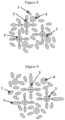
- Figure 9 demonstrates a situation where the binding energy between salt ions is smaller than that between ions and solvent.
- solvent molecule 1 is generally attracted to positive ion 3 and so several solvent molecules 1 will form a solvation shell around positive ion 3. Binding energy of the negative ion and the solvent in this example is considered to be low and therefore neglected here.
- the solvent solution is composed of an additional additive 5 in equal molar quantity as the salt. This additive has higher binding energy with the positive ion 3 than does the other solvent molecule 1.
- the binding between solvent 1 and positive ion 3 is represented by a solid line whereas binding between additive 5 and positive ion 1 is represented by long dash line 2.
- the solvation shell is composed of four solvent molecules total around a single positive ion 3, however, now the solvent shell is composed of two different types of molecules.
- the binding energy between positive ion 3 and all the solvent molecules in the solvent shell is comparatively high to the binding energy between positive ion 3 and negative ion 4.
- the summation of all binding energy with solvent on a single positive ion represented by solid lines and long dashed lines is comparably higher than the binding energy between positive ion 2 and negative ion 4, represented by the dashed line. This allows for increased separation between ions and higher solubility of the salt into solution.
- Temperature has an influence on binding energy of various materials and so solubility may increase or decrease with temperature. Further, although average binding energies of the ions comprising a salt may be higher or lower than binding energies between ions and solvent molecules, random statistical fluctuations due to kinetic movement of molecules or alignment of molecules will generally show some minor solubility of components in solutions that are generally considered insoluble and generally show some minor salt precipitation in solutions that are generally considered soluble.
- ion aggregates are formed. This is when two or more ions of same or differing charge come into contact and form a stable particle in solution. For example, two positively charged ions and a single negatively charged aggregate may for a single larger positively charged ion. Further, a single ion may have double or triple charge, such as often seen with magnesium or aluminum ions. While they are composed of larger aggregates, these ions are often still soluble in solution and may contribute to electrolytic conductivity of the electrolyte solution.
- LiTFSI salt with moderate solubility
- an electrolyte comprised of LiTFSI salt in fluoromethane and carbon dioxide solvent solution, which is a liquefied gas electrolyte. Since the binding energy of the solvent to the ions is comparably low to the binding energy of the Li cation and the TFSI anion, the LiTFSI salt has limited solubility in the solvent.
- the present disclosure provides materials which may improve the solubility of such salts in liquefied gas electrolytes to improve performance of the device such as increasing conductivity or electrolyte to allow for higher power devices.
- One example discloses the use of tetrahydrofuran as an additive in equal molar ratio to the salt in a liquefied gas solvent solution such as fluoromethane with LiTFSI salt.
- the use of tetrahydrofuran increases the binding energy between the solvent solution and the salt ions as compared to a solution of only fluoromethane solution. This increased binding energy increases separation of the negatively charged TFSI anions and positively charged Li cations, thus improving solubility of the salt into the solvent solution.
- additive concentration may be higher or lower than the concentration of the salt.
- a combination of additives or salts may be used in any respective molar ratios.
- One advantage to limiting the additive concentration to less than or equal to the molar ratio of the salt is improved electrochemical stability of the additive. It has been shown in the literature that electrolyte solutions with high concentration of salts show increased electrochemical stability. This is because most or all solvent molecules are strong bound to a salt ion. This binding to a salt ion decreases the chemical reactivity of the solvent with the electrodes which causes decomposition. Generally, a free solvent molecule which is not bound to a salt ion will show decreased electrochemical stability.
- an additive such as tetrahydrofuran is used in equal molar concentration with LiTFSI in fluoromethane. Since fluoromethane is a solvent with excellent electrochemical stability, the tetrahydrofuran is the most likely component to first undergo decomposition at an electrode surface. However, since the tetrahydrofuran is in equal molar concentration with the salt, nearly all tetrahydrofuran molecules are bound to the salt component at all times.
- the tetrahydrofuran in fluoromethane based electrolyte behaves as if it is in a highly concentrated electrolyte since all tetrahydrofuran molecules are coordinated with or bound to a salt ion, thus lowering decomposition reactions with electrodes and improving electrochemical stability.
- a mixture of one solvent and one additive with a salt will form a soluble and miscible solution.
- another solvent or additive causes the solution to separate and become non-miscible.
- An example of this would be the mixture of 0.3M LiTFSI and 0.3 tetrahydrofuran in liquefied gas fluoromethane which shows good miscibility and solubility for all components.
- a mixture of 0.3M LiTFSI and 0.3 tetrahydrofuran in a solution of two parts by volume fluoromethane and one part by volume sulfuryl fluoride, also a liquefied gas solvent shows a distinct separation of components from solution.
- additives that may be used in liquefied gas electrolytes to improve salt solubility.
- the additives are used in combination with fluoromethane as a primary solvent and lithium based salts.
- other liquefied gas solvents such as difluoromethane, trifluoromethane, fluoroethane, tetrafluoroethane, pentafluoroethane, 1,1-difluoroethane, 1,2-difluoroethane, 1,1,1-trifluoroethane, 1,1,2-trifluoroethane, 1,1,1,2-tetrafluoroethane, 1,1,2,2-tetrafluoroethane, pentafluoroethane, chloromethane, chloroethane, thionyl fluoride, thionyl chloride fluoride, phosphoryl fluoride, phosphoryl chloride fluoride, sulfuryl fluoride, sulfuryl fluoride, sulfuryl
- the liquefied gas solvents can be difluoromethane. In some embodiments, the liquefied gas solvents can be chloromethane. In some embodiments, the liquefied gas solvents can be 1,1-difluoroethane. In some embodiments, the liquefied gas solvents can be sulfuryl fluoride. In some embodiments, the liquefied gas solvents can be thionyl chloride or thionyl fluoride. In some embodiments, the liquefied gas solvents can be selected from the group consisting of fluoromethane, difluoromethane, sulfuryl fluoride, chloromethane, carbon dioxide, 1,1-difluoroethane and any combination thereof.
- the liquefied gas electrolyte includes a single liquefied gas solvent or a combination of liquefied gas solvents and one or more additive and one or more salt.
- additives may be gaseous, liquid or solid at standard room temperature of +20 °C and standard pressure (approximately 1.01325 bar). Further, any of the gaseous additives may also be used as primary solvent.
- the amount of the primary solvent or mixture of primary solvents is greater than about 10%, about 20%, about 30%, about 40%, about 50%, about 60%, about 70%, about 80%, about 90%, about 95%, about 98%, or about 99% by weight based on the total weight of the liquefied gas electrolyte.
- the amount of the primary solvent is less than about 99%, about 98%, about 95%, about 90%, about 80%, about 70%, about 60%, about 50%, about 40%, about 30%, or about 20% by weight based on the total weight of the liquefied gas electrolyte.
- the amount of the additive is less than about 80%, about 70%, about 60%, about 50%, about 40%, about 30%, about 20%, about 10%, about 5%, about 2%, or about 1% by weight based on the total weight of the liquefied gas electrolyte.
- the liquefied gas solvents comprises two solvents. In some embodiments, the liquefied gas solvents comprise three solvents. In some embodiments, the liquefied gas solvents comprise four or more solvents. In some embodiments, the liquefied gas solvents comprise fluoromethane, sulfuryl fluoride, and carbon dioxide. In some embodiments, the liquefied gas solvents comprise fluoromethane and carbon dioxide. In some embodiments, the liquefied gas solvents comprise sulfuryl fluoride and carbon dioxide. In some embodiments, the liquefied gas electrolyte comprises of fluoromethane, difluoromethane, and carbon dioxide.
- the liquefied gas solvents comprise halogenated hydrocarbon and sulfuryl halide. In some embodiments, the liquefied gas solvents comprise halogenated hydrocarbon, sulfuryl halide, and carbon dioxide. In some embodiments, the molar ratio of the additive to the salt is greater than about 0.01, about 0.05, about 0.1, about 0.2, about 0.30, about 0.5, about 0.7, about 0.9, about 0.95, about 0.98, about 1.0, about 1.05, about 1.1, about 1.5, about 2, about 3, about 5, about 10, or about 100.
- having a lower molar concertation additive as compared to salt such of about 0.9, about 0.95, or about 0.98 may be favorable in order to guarantee that the majority of additive material in the electrolyte generally is binding or coordinated to an ion in the electrolyte, thus increasing electrochemical stability of the cell.
- the molar ratio of the additive to the salt is less than 0.8, 0.85, 0.9, 0.95, 0.98, 0.99, 1.0, 1.1, 1.2, 1.3, 1.4, or 1.5.
- the molar ratio of the additive to the salt is less than about 0.8, about 0.85, about 0.9, about 0.95, about 0.98, about 0.99, about 1.0, about 1.1, about 1.2, about 1.3, about 1.4, or about 1.5. In some embodiments, the molar ratio of the additive to the salt is in the range of about 0.5 to about 1. 0, about 0.8 to about 0.98, about 0.9 to about 1.0, or about 0.9 to about 0.98. In some embodiments, having a higher molar concertation additive as compared to salt such of about 1.1, about 1.2, or about 2.0 may be favorable in order to guarantee maximum solubility of salt for improved performance.
- multiple additives are used, each of which may have molar ratio to the salt is greater than about 0.01, about 0.05, about 0.1, about 0.2, about 0.30, about 0.5, about 0.7, about 0.9, about 0.95, about 0.98, about 1.0, about 1.05, about 1.1, about 1.5, about 2, about 3, about 5, about 10, or about 100.
- the salt concentration in the electrolyte solution is greater than about 0.1, about 0.3, about 0.5, about 0.8, about 1.0, about 1.3, about 1.5, about 1.8, about 2.0, about 3.0, about 4.0, about 5.0, or about 8.0 moles per liter of solution.
- the liquefied gas electrolyte can include one or more additives. In some embodiments, the liquefied gas electrolyte can include one additive. In some embodiments, the liquefied gas electrolyte can include two or more additives. In some embodiments, the additive can be a noncyclic carbonate, a cyclic carbonate, a non-cyclic ether, a cyclic ether, or a nitrile compound, or any combination thereof. In some embodiments, the additive is tetrahydrofuran.
- the additive may be of a non-cyclic carbonate compound selected from the group consisting of dimethyl carbonate, ethyl methyl carbonate, propyl methyl carbonate, butyl methyl carbonate, diethyl carbonate, propyl ethyl carbonate, butyl ethyl carbonate, dipropyl carbonate, propyl butyl carbonate, dibutyl carbonate, fluoromethyl methyl carbonate, difluoromethyl methyl carbonate, trifluoromethyl methyl carbonate, bis(fluoromethyl) carbonate, bis(difluoromethyl) carbonate, bis(trifluoromethyl) carbonate, fluoromethyl ethyl carbonate, difluoromethyl ethyl carbonate, trifluoromethyl ethyl carbonate, fluoroethyl ethyl carbonate, difluoroethyl carbonate, trifluoromethyl ethyl carbonate, fluoroethyl ethy
- the additive may be of a cyclic carbonate compound selected from the group consisting of vinyl carbonate, ethylene carbonate, propylene carbonate, 1,2-butylene carbonate, trans-butylene carbonate, fluoroethylene carbonate, difluoroethylene carbonate, trifluoroethylene carbonate, tetrafluoroethylene carbonate, chloroethylene carbonate, dichloroethylene carbonate, trichloroethylene carbonate, tetrachloroethylene carbonate, fluoromethyl ethylene carbonate, difluoromethyl ethylene carbonate, trifluoromethyl ethylene carbonate, bis(fluoromethyl) ethylene carbonate, bis(difluoromethyl) ethylene carbonate, bis(trifluoromethyl) ethylene carbonate, and any combination thereof.
- a cyclic carbonate compound selected from the group consisting of vinyl carbonate, ethylene carbonate, propylene carbonate, 1,2-butylene carbonate, trans-butylene carbonate, fluoroethylene carbonate, difluoroethylene carbonate,
- the additive may be of a non-cyclic ether compound selected from the group consisting of methyl propyl ether, methyl butyl ether, diethyl ether, ethyl propyl ether, ethyl butyl ether, dipropyl ether, propyl butyl ether, dibutyl ether, ethyl vinyl ether, divinyl ether, glyme, diglyme, triglyme, tetraglyme, 1,1,2,2-tetrafluoro-3-(1,1,2,2-tetrafluoroethoxy)-propane, trifluoro(trifluoromethoxy)methane, perfluoroethyl ether, fluoromethyl methyl ether, difluoromethyl methyl ether, trifluoromethyl methyl ether, bis(fluoromethyl) ether, bis(difluoromethyl) ether, fluoroethyl methyl ether, difluor
- the additive may be of a cyclic ether compound selected from the group consisting of propylene oxide, tetrahydrofuran, tetrahydropyran, furan, 12-crown-4, 12-crown-5, 18-crown-6, 2-methyltetrahydrofuran, 1,3-dioxolane, 1,4-dioxolane, 2-methyloxolane, (1,2-propylene oxide), ethylene oxide, octafluorotetrahydrofuran, and any combination thereof.
- a cyclic ether compound selected from the group consisting of propylene oxide, tetrahydrofuran, tetrahydropyran, furan, 12-crown-4, 12-crown-5, 18-crown-6, 2-methyltetrahydrofuran, 1,3-dioxolane, 1,4-dioxolane, 2-methyloxolane, (1,2-propylene oxide), ethylene oxide, octafluorotetrahydr
- the additive may be of a nitrile compound selected from the group consisting of acetonitrile, propionitrile, butanenitrile, pentanenitrile, hexanenitrile, hexanedinitrile, pentanedinitrile, butanedinitrile, propanedinitrile, ethanedinitrile, isovaleronitrile, benzonitrile, phenylacetonitrile, cyanogen chloride, hydrogen cyanide, ethanedinitrile, and any combination thereof.
- a nitrile compound selected from the group consisting of acetonitrile, propionitrile, butanenitrile, pentanenitrile, hexanenitrile, hexanedinitrile, pentanedinitrile, butanedinitrile, propanedinitrile, ethanedinitrile, isovaleronitrile, benzonitrile, phenylacetonitrile, cyanogen chloride, hydrogen cyanide,
- the electrodes are composed of any combination of two electrodes of intercalation type such as graphite, carbon, activated carbon, lithium titanate, titanium disulfide, molybdenum disulfide, lithium iron phosphate, lithium cobalt phosphate, lithium nickel phosphate, lithium cobalt oxide, lithium nickel manganese oxide, lithium nickel manganese cobalt oxide, lithium nickel cobalt aluminum oxide or chemical reaction electrode such as with chemicals of sulfur, oxygen, carbon dioxide, nitrogen, sulfur dioxide, thionyl fluoride, thionyl chloride fluoride, sulfuryl fluoride, sulfuryl chloride fluoride or of a metallic electrode with lithium metal or sodium metal or metal alloy including lithium, sodium, tin, aluminum, or any combination thereof.
- these components may be combined with various binder polymer components including polyvinylene glycol, polyethylene glycol, sodium carbon oxide, sodium, tin, aluminum, or any combination thereof.
- the one or more liquefied gas solvent solution or electrolyte may be combined with one or more salts including one or more of lithium bis(trifluoromethanesulfonyl)imide (LiTFSI), lithium hexafluorophosphate, lithium perchlorate, lithium hexafluoroarsenate, lithium tetrachloroaluminate, lithium tetragaliumaluminate, lithium bis(oxalato)borate, lithium hexafluorostannate, lithium difluoro(oxalato)borate, lithium bis(fluorosulfonyl)imide, lithium aluminum fluoride, lithium chloroaluminate, lithium tetrafluoroborate, lithium tetrachloroaluminate, lithium difluorophosphate, lithium tetrafluoro(oxalato)phosphate, lithium difluorobis(oxalato)phosphate, lithium borate, lithium oxolate, Li
- Further useful salts include those with positively charged cations such as tetramethylammonium, tetraethylammonium, tetrapropylammonium, tetrabutylammonium, triethylmethylammonium ammonium, N,N-diethyl-N-methyl-N(2methoxyethyl)ammonium, N,N-Diethyl-N-methyl-N-propylammonium, N,N-dimethyl-N-ethyl-N-(3-methoxypropyl)ammonium, N,N-Dimethyl-N-ethyl-N-benzylAmmonium, N,N-Dimethyl-N-ethyl-N-phenylethylammonium, N-Ethyl-N,N-dimethyl-N-(2-methoxyethyl)ammonium, N-Tributyl-N-methylammonium, N-Trimethyl-N-
- liquefied gas solvents which have a vapor pressure substantially higher than standard pressure at room temperature, may have a minimal solubility of salts which limit device performance.
- the addition of certain chemical additives substantially increases solubility of salts in the liquefied gas electrolytes which increase performance of electrochemical devices. The increase in solubility is observed with a minimal equal molar ratio of additive to salt ratio.
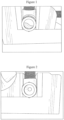
- Figure 1 shows the solubility of the salt lithium bis(trifluoromethanesulfonyl)imide in fluoromethane at a concentration of 0.3 moles salt per liter (0.3 M) at room temperature. The majority of salt remains non-dissolved. However, it is known a small amount of salt does dissolve at concentrations less than 0.3 M to form a conductive solution since functional battery devices have been constructed and show high performance. In order to improve solubility of salts, an additional additive may be added to solution to improve salt disassociation.
- Figure 2 shows a solution of 0.3M LiTFSI + 0.3M tetrahydrofuran, a cyclic ether, in fluoromethane.
- This solution shows excellent solubility of LiTFSI salt, even with only equal molar tetrahydrofuran to salt at room temperature.
- This solution has the advantage of utilizing fluoromethane solvent benefits as a solvent including low temperature performance of devices, low viscosity for high ion mobility, with the benefits of tetrahydrofuran which is good for disassociation of lithium salts and high reduction resistance at low potentials.
- Example 2 Similar to Example 1, several additional additives in place of tetrahydrofuran have been used to improve solubility of LiTFSI in fluoromethane; select additives that are tested include acetonitrile, ethylene carbonate, dimethyl carbonate, dimethoxyethane, fluoroethylene carbonate, among several others. Salt concentrations in these experiments vary from 0.1 M to 1M with high solubility of LiTFSI and the additive in equal molar concentration in fluoromethane. These solutions generally showed high solubility and good miscibility without phase separation from temperatures as low as -78 °C up to around + 40 °C where two phase separation may occur in some instances.
- Sulfuryl fluoride is a relatively non reactive gas and is used in the fumigant industry. It has limited solubility in most organic solvents but is miscible with fluoromethane, as examined with a high pressure window cell similar to Figure 1 and Figure 2 .
- a mixture of 0.3M LiTFSI and 0.3 M tetrahydrofuran was added to a mixed solvent solution of 2 parts by volume fluoromethane and 1 part volume sulfuryl fluoride. This solution shows a distinct liquid line separating two phases, presumably a mixed LiTFSI-tetrahydrofuran-fluoromethane solution in one phase and a fluoromethane-sulfuryl fluoride solution in the second phase.
- dimethoxyethane was used in a solution comprising 0.3M LiTFSI and 0.3 M dimethoxyethane and added to a mixed solvent solution of 2 parts by volume fluoromethane and 1 part sulfuryl fluoride. This solution mixed well. This solution may be useful in primary battery devices using sulfuryl fluoride as a catholyte.
- a cell composed of an NMC622 cathode (LiNi0.6Mn0.2Co0.2O2) and Li metal anode was constructed with electrolyte composed of 1 M LiTFSI and 1 M methyl ether in 9 parts fluoromethane and 1 part carbon dioxide.
- the cell was charged and discharged to various potentials from 4.2 to 4.5 V vs. Li.
- Discharge capacity per gram active cathode was as expected from 150 ⁇ 180 mAh/g.
- An electrochemical cell composed of a lithium metal anode and a cathode comprised of a mixture of sulfur and carbon was formed and tested with an electrolyte comprised of 1 M LiTFSI and 0.9 M acetronitrile in 19 parts by volume fluoromethane and 1 part by volume carbon dioxide.
- This cell has approximately 5 mAh/cm2 capacity and was discharged at approximately a 50 uA rate at room temperature with discharge performance shown in Figure 5 . Performance was fair but required a low discharge rate to extract high capacity.
- a lithium metal anode could substantially increase the energy density of battery devices, however, require a significant improvement in efficiency to make a useful device.
- Cells composed of a lithium metal electrode and a stainless steel counter electrode were built and used to test lithium metal plating and stripping efficiency of lithium metal. Electrolyte solutions of 0.3M LiTFSI and 0.3M tetrahydrofuran in 19 parts by volume fluoromethane and 1 part by volume carbon dioxide were used. These cells were used to plate 0.5 mAh/cm2 lithium metal onto the stainless steel working electrode at a current of 0.5 mA/cm2 at room temperature over several hundred cycles. A high voltage cutoff of 1V is used for a stripping limit, upon when the current is reversed, and plating resumed.
- a cell comprised of a lithium metal anode and a graphite cathode was used to test the ability of the liquefied gas electrolyte to form a stable solid electrolyte interphase on the graphite electrode.
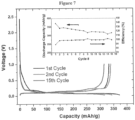
- An electrolyte solution of 0.3M LiTFSI and 0.3M tetrahydrofuran in 19 parts by volume fluoromethane and 1 part by volume carbon dioxide were used. The cell cycled fairly well over tens of cycles, however, capacity did drop over cycling, as shown in Figure 7 .
- solubility lithium salts were examined in sulfuryl fluoride, a mixture of fluoromethane and sulfuryl fluoride, and mixtures of fluoromethane, sulfuryl fluoride with a THF additive.
- the solubility was visually examined via high pressure sight glass window.
- Figure 11 shows the solubility of the salt lithium bis(trifluoromethanesulfonyl)imide in sulfuryl fluoride at a concentration of 0.1 moles salt per liter (0.1 M) at room temperature.
- An electrochemical cell composed of a lithium metal anode and a cathode comprised of carbon was formed and tested with an electrolyte comprised of 0.5 M LiTFSI and fluoromethane to sulfuryl fluoride (1:9 vol). This cell was discharged at approximately a 1 mA/g rate at room temperature with discharge performance shown in Figure 13 .
- the solubility lithium salts was examined in a mixture of fluoromethane and sulfuryl fluoride, a mixture of fluoromethane, carbon dioxide, and sulfuryl fluoride. THF was added as an additive.
- Figure 14 shows the solubility of the salt lithium bis(trifluoromethanesulfonyl)imide in the various solvents at a concentration of 0.5 moles salt per liter (0.5 M) at room temperature.
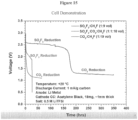
- An electrochemical cell composed of a lithium metal anode and a cathode comprised of carbon was formed and tested with an electrolyte comprised of 0.5 M LiTFSI and a mixture of fluoromethane to sulfuryl fluoride (1:9 vol), a mixture of sulfuryl fluoride, CO2, and fluoromethane (1:1:18 vol), and a mixture of CO2 and fluoromethane (1:19 vol).
- This cell was discharged at approximately a 1 mA/g rate at room temperature with discharge performance shown in Figure 15 .
Landscapes
- Engineering & Computer Science (AREA)
- Chemical & Material Sciences (AREA)
- Power Engineering (AREA)
- Chemical Kinetics & Catalysis (AREA)
- Electrochemistry (AREA)
- Microelectronics & Electronic Packaging (AREA)
- Materials Engineering (AREA)
- Manufacturing & Machinery (AREA)
- General Chemical & Material Sciences (AREA)
- Inorganic Chemistry (AREA)
- General Physics & Mathematics (AREA)
- Condensed Matter Physics & Semiconductors (AREA)
- Physics & Mathematics (AREA)
- Secondary Cells (AREA)
- Electric Double-Layer Capacitors Or The Like (AREA)
- Battery Electrode And Active Subsutance (AREA)
- Primary Cells (AREA)
Abstract
Description
- The present application claims the benefit of priority to
U.S. Provisional Application No. 62/673,752, filed May 18, 2018 U.S. Provisional Application No. 62/749,046, filed October 22, 2018 - This invention was made with U.S. government support under grant 1721646 awarded by the U.S. National Science Foundation (NSF) and under contract NNX17CP67P awarded by the National Aeronautics and Space Administration (NASA). The U.S. government has certain rights in the invention.
- Embodiments of the invention relate to compositions and chemical formulations of electrolytes for use in electrochemical energy devices, such as batteries and electrochemical capacitors. Devices using the compositions and methods of use of the compositions are also provided.
- Electrochemical energy storage devices, such as batteries and double layer capacitors, utilize an ionic conducting electrolyte solution to carry charge between positive and negative electrodes. Typically, these electrolytes are a liquid at a standard room temperature of 20 °C and standard pressure (approximately 1.01325 bar). The electrolyte solutions use a mixture of some amount of solvent and salt and additional components, or additives, for improved electrochemical stability of the device. Common component additives include vinyl carbonate, fluoroethylene carbonate, lithium bis(oxalato)borate among others. Such additives help in surface modification of electrodes, safety aspects or in other useful ways. Solubility of salts is generally a function of the primary solvent, rather than additives.
- Embodiments of the present disclosure relate to chemical formulations, electrolyte compositions, electrochemical devices using thereof, and methods of use thereof. Some disclosed embodiments relate to novel formulations for electrolytes comprising a liquefied gas solvent.
- One embodiment relates to a rechargeable electrochemical device that includes: an ionically conducting electrolyte comprising a liquefied gas solvent and one or more additives; a housing enclosing the ionically conducting electrolyte and structured to provide a pressurized condition to the liquefied gas solvent; and at least two conducting electrodes in contact with the ionically conducting electrolyte.
- In some embodiments, the liquefied gas solvent is capable of being placed under a compressive pressure equal to, or greater than, the liquefied gas solvent's vapor pressure at a temperature when the compressive pressure is applied, thereby keeping the liquefied gas solvent in a liquid phase. In some embodiments, the liquefied gas solvent has a vapor pressure above an atmospheric pressure of 100 kPa at a room temperature of 293.15 K.
- In some embodiments, the liquefied gas solvent comprises one or more materials selected from the group consisting of fluoromethane, difluoromethane, sulfuryl fluoride, sulfuryl chloride, carbon dioxide, 1,1-difluoroethane, chloromethane, and a combination thereof. In some embodiments, the liquefied gas solvent comprises fluoromethane and carbon dioxide. In some embodiments, the liquefied gas solvent comprises fluoromethane and sulfuryl fluoride. In some embodiments, the liquefied gas solvent comprises fluoromethane and difluoromethane. In some embodiments, the liquefied gas solvent comprises fluoromethane, difluoromethane, and carbon dioxide. In some embodiments, the liquefied gas solvent comprises fluoromethane, sulfuryl fluoride, and carbon dioxide. In some embodiments, the ratio of sulfuryl fluoride to fluoromethane is lower than 1:9. In some embodiments, the ratio of sulfuryl fluoride to carbon dioxide is about 1: 1.
- In some embodiments, the one or more additives are selected from the group consisting of non cyclic carbonate, cyclic carbonate, non cyclic ether, cyclic ether, nitrile, and a combination thereof. In some embodiments, the one or more additives comprises acetonitrile. In some embodiments, the one or more additives comprises tetrahydrofuran. In some embodiments, the one or more additives comprises methyl ether.
- In some embodiments, the rechargeable electrochemical device further comprises one or more lithium salts. In some embodiments, the molar ratio of the one or more additives and one or more lithium salt is in the range of about 0.01 to about 10.
- Another embodiment relates to a rechargeable lithium ion battery. The rechargeable lithium ion battery may include an ionically conducting electrolyte. The ionically conducting electrolyte may comprise a liquefied gas solvent. In some embodiments, the ionically conducting electrolyte may further comprise one or more additives, selected from the group consisting of non cyclic carbonate, cyclic carbonate, non cyclic ether, cyclic ether, nitrile, and combinations thereof. In some embodiments, the rechargeable lithium ion battery may also include a housing that encloses two conducting electrodes and the ionically conducting electrolyte. In some embodiments, the liquefied gas solvent has a vapor pressure above an atmospheric pressure of 100 kPa at a room temperature of 293.15 K. In some such embodiments, the liquefied gas solvent may be capable of being placed under a compressive pressure equal to, or greater than, the liquefied gas solvent's vapor pressure at a temperature when the compressive pressure is applied, thereby keeping the liquefied gas solvent in a liquid phase.
- Alternative or additional embodiments described herein provide an electrolyte composition comprising one or more of the features of the foregoing description or of any description elsewhere herein.
- Alternative or additional embodiments described herein provide a device comprising one or more of the features of the foregoing description or of any description elsewhere herein.
- Alternative or additional embodiments described herein provide a method of using the electrolyte composition or device comprising one or more of the features of the foregoing description or of any description elsewhere herein.
-
-
Figure 1 shows a high pressure window cell containing a mixture of 0.3 M LiTFSI (lithium bis(trifluoromethanesulfonyl)imide) salt in fluoromethane liquefied gas solvent.Figure 1 illustrates that majority of salt is non-dissolved inside this solution of liquefied gas electrolyte. -
Figure 2 shows high pressure window cell containing a mixture of 0.3 M LiTFSI salt and 0.3 M tetrahydrofuran in fluoromethane liquefied gas solvent.Figure 2 illustrates that majority of salt is well dissolved inside this solution of liquefied gas electrolyte. -
Figure 3 illustrates conductivities as a function of temperature for an electrolyte solution of LiTFSI and tetrahydrofuran in equal molar concentration of 0.1, 0.2 and 0.4 M in fluoromethane liquefied gas electrolyte. -
Figure 4 illustrates charge-discharge profile of an NMC622 cathode at various charge voltages using an electrolyte composed of 1 M LiTFSI and 1 M methyl ether in 9 parts fluoromethane and 1 part carbon dioxide. -
Figure 5 illustrates cell discharge performance of a carbon and sulfur cathode with lithium metal anode using 1 M LiTFSI and 0.9 M acetronitrile in 19 parts by volume fluoromethane and 1 part by volume carbon dioxide. -
Figure 6 compares Coulombic efficiency of a cell using conventional electrolyte (upper panel) with a cell using an electrolyte composed of 0.3M LiTFSI and 0.3M tetrahydrofuran in 19 parts by volume fluoromethane and 1 part by volume carbon dioxide (bottom panel). Each of the cells were composed of lithium metal counter electrode and stainless steel working electrode. -
Figure 7 illustrates charge and discharge characteristics of a cell using a lithium metal anode and graphite cathode using an electrolyte composed of 0.3M LiTFSI and 0.3M tetrahydrofuran in 19 parts by volume fluoromethane and 1 part by volume carbon dioxide. -
Figures 8 illustrates solvation in exemplary solvent without an additive. -
Figure 9 illustrates solvation in an exemplary solvent with equal molar concentration additive to salt. -
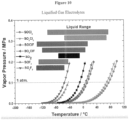
Figure 10 compares vapor pressures of various sulfuryl halide or thionyl halide liquefied gas electrolytes. -
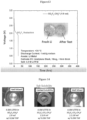
Figure 11 shows a high pressure window cell containing a mixture of 0.1 M LiTFSI salt in liquefied gas solvents. Majority of salt was well dissolved inside this solution of liquefied gas electrolyte. -
Figure 12 illustrates electrolyte conductivities of two types of liquefied gas electrolyte and liquid SOCl2 based electrolyte. -
Figure 13 illustrates cell discharge performance of a carbon cathode with lithium metal anode using 0.5 M LiTFSI and fluoromethane and SO2F2. -
Figure 14 shows a high pressure window cell containing a mixture of 0.5 M LiTFSI salt in several liquefied gas solvents. Majority of salt was well dissolved inside this solution of liquefied gas electrolyte. -
Figure 15 illustrates cell discharge performance of a carbon cathode with lithium metal anode using 0.5 M LiTFSI and fluoromethane, SO2F2 and CO2 -
Figure 16 illustrates computational observations of electron affinity of SO2F2, SO2Cl2, and SO2Cl2. -
Figure 17 illustrates additional catholyte work using liquefied gas co-solvent with thionyl halide such as SOF2 and SOCl2. - One embodiment is an electrochemical device comprising an ionically conducting electrolyte and having one or more additives. The ionically conducting electrolyte may comprise one or more salts. The one or more additives may be liquid, solid, or gas at standard room temperature of +20 °C and standard pressure (approximately 1.01325 bar). The one or more salts may be liquid, solid, or gas at standard room temperature of +20 °C and standard pressure (approximately 1.01325 bar).
- The ionically conducing electrolyte of the preceding paragraph may also comprise a solution of one or more solvents. The one or more solvents may be selected from the group consisting of liquefied gas solvents, liquid solvents, or solid solvents. One of skill in the art will understand the term "solid solvent" as referring to a solvent, which is solid at room temperature, can form a liquid solution, when mixed with other liquid or liquids. In some embodiments, the solution of one or more solvents may be a solution of one or more liquefied gas solvents. Each liquefied gas solvent solution is in a liquid only phase, or in a combined gas and liquid phase at standard room temperature of +20 °C and standard pressure (approximately 1.01325 bar) while inside a mechanically rigid container housing the electrolyte. Because of the nature of the high vapor pressure electrolyte, some liquid component of the electrolyte may turn to a vapor component if the volume within the electrolyte housing allows. One or more liquid components may mix with one or more vapor components in equal or unequal ratio in both liquid and vapor states. This ratio of mixing may occur at any temperature or pressure. While any single component of liquefied gas solvents may have a vapor pressure above an atmospheric pressure at room temperature, the mixture of any number of liquefied gas solvents, any number of additives, any number of solvents, and any number of salts may also lower the vapor pressure of the full solution to below an atmospheric pressure at room temperature. The solution of one or more liquefied gas solvents may have a vapor pressure above or below an atmospheric pressure at room temperature.
- The ionically conducing electrolyte may further comprise one or more additives (or additive components). The one or more additive components may be liquid, solid, or gas at standard room temperature of +20 °C and standard pressure (approximately 1.01325 bar). In one embodiment, the additive comprises tetrahydrofuran in equal molar ratio to the salt in a liquefied gas solvent solution such as fluoromethane with a LiTFSI salt.
- Some such embodiments of electrochemical device may further comprise a housing, enclosing the ionically conducting electrolyte and structured to provide a pressurized condition to the one or more salts and the solution of one or more solvents, such as liquefied gas solvents, and a pair of electrodes in contact with the ionically conducting electrolyte.
- In some embodiments, the ionically conducting electrolyte may comprise lithium bis(trifluoromethanesulfonyl)imide salt. Such ionically conducting electrolyte may comprise a solution of one or more liquefied gas solvents, comprising fluoromethane, difluoromethane, carbon dioxide, sulfuryl fluoride, or a combination thereof. In some such embodiments, the ionically conducting electrolyte may comprise one or more additives selected from the group consisting of tetrahydrofuran, acetonitrile, methyl ether, dimethoxyethane, and combinations thereof. In some embodiments, the electrochemical device is an electrochemical energy storage device as described in
PCT/US2014/066015 andPCT/US2017/029821 , which are incorporated by reference in their entireties. In some embodiments the electrochemical device is a rechargeable battery, ultracapacitor, or supercapacitor. The rechargeable battery may be a lithium ion battery or a lithium metal battery. - One of skill in the art will understand that the terms "one or more salts," "one or more solvents" (including "liquefied gas solvents" and "liquid solvents"), and "one or more additives," as used herein in connection with "the ionically conducting electrolytes," refer to one or a plurality of electrolyte components.
- In some embodiments, the ionically conducting electrolyte can be composed of solvents and salts, wherein the solvents further comprise of only materials which are gaseous under standard conditions. In some embodiments, the materials included fluoromethane, difluoromethane and carbon dioxide. In some embodiments, additional additives are used that provide a beneficial use as it relates to improved salt solubility in solution. Embodiments relate to material additives which increase the solubility of an electrolyte salt component. Without such additives, the solubility of the salt may be limited. Here, additives may be treated as an additional component to the overall solvent solution.
- Salt solubility is primarily a function of the binding energy between positively and negatively charged ions, binding energy between positively charged ions and the solvent, and binding energy between negatively charged ions and the solvent. These binding energies are a function of temperature and particular ions and solvents in solution. When binding energy between positively and negatively charged ions is low compared to binding energy between ions and solvent molecules, the salt has higher solubility within the solvent. This is due to the solvents ability to effectively separate the positively and negatively charged ions and overcome their respective coulombic attraction, which allows ions to solubilize in solution without coming into contact with oppositely charged ions in solution. When binding energy between positively and negatively charged ions is high compared to binding energy between ions and solvent molecules, the salt has lower solubility within the solvent. This is due to the solvents inability to effectively separate the positively and negatively charged ions to overcome their respective coulombic attraction, which results in positive and negative ions coming into contact and separating out of solution, lowering overall solubility.
-
Figure 8 demonstrates a situation where the binding energy between salt ions is larger than that between ions and solvent. In this example,solvent molecule 1 is generally attracted topositive ion 3 and so severalsolvent molecules 1 will form a solvation shell aroundpositive ion 3. Binding energy of the negative ion and the solvent in this example is considered to be low and therefore neglected here. In this example, four solvent molecules surround the ion in the immediate solvation shell. However, the binding energy betweenpositive ion 3 and all the solvent molecules in the solvent shell is comparatively low to the binding energy betweenpositive ion 3 andnegative ion 4. The binding between these molecules are represented by a solid line for binding betweenpositive ion 3 and solvent 1 and a dashed line for binding betweenpositive ion 3 andnegative ion 4. In this example the summation of all binding energy with solvent on a single positive ion represented by solid lines is comparably lower than the binding energy betweenpositive ion 2 andnegative ion 4, represented by the dashed line. This allows the ions to stay in contact and lowers the solubility of the salt in solution. -
Figure 9 demonstrates a situation where the binding energy between salt ions is smaller than that between ions and solvent. In this example,solvent molecule 1 is generally attracted topositive ion 3 and so severalsolvent molecules 1 will form a solvation shell aroundpositive ion 3. Binding energy of the negative ion and the solvent in this example is considered to be low and therefore neglected here. In this example, the solvent solution is composed of anadditional additive 5 in equal molar quantity as the salt. This additive has higher binding energy with thepositive ion 3 than does the othersolvent molecule 1. The binding between solvent 1 andpositive ion 3 is represented by a solid line whereas binding betweenadditive 5 andpositive ion 1 is represented bylong dash line 2. In this example, threesolvent molecules 1 and one additivesolvent molecule 5 will surround the positive ion. Again, the solvation shell is composed of four solvent molecules total around a singlepositive ion 3, however, now the solvent shell is composed of two different types of molecules. Now, the binding energy betweenpositive ion 3 and all the solvent molecules in the solvent shell is comparatively high to the binding energy betweenpositive ion 3 andnegative ion 4. In this example the summation of all binding energy with solvent on a single positive ion represented by solid lines and long dashed lines is comparably higher than the binding energy betweenpositive ion 2 andnegative ion 4, represented by the dashed line. This allows for increased separation between ions and higher solubility of the salt into solution. - Temperature has an influence on binding energy of various materials and so solubility may increase or decrease with temperature. Further, although average binding energies of the ions comprising a salt may be higher or lower than binding energies between ions and solvent molecules, random statistical fluctuations due to kinetic movement of molecules or alignment of molecules will generally show some minor solubility of components in solutions that are generally considered insoluble and generally show some minor salt precipitation in solutions that are generally considered soluble.
- Frequently, ion aggregates are formed. This is when two or more ions of same or differing charge come into contact and form a stable particle in solution. For example, two positively charged ions and a single negatively charged aggregate may for a single larger positively charged ion. Further, a single ion may have double or triple charge, such as often seen with magnesium or aluminum ions. While they are composed of larger aggregates, these ions are often still soluble in solution and may contribute to electrolytic conductivity of the electrolyte solution.
- One example of a salt with moderate solubility would be an electrolyte comprised of LiTFSI salt in fluoromethane and carbon dioxide solvent solution, which is a liquefied gas electrolyte. Since the binding energy of the solvent to the ions is comparably low to the binding energy of the Li cation and the TFSI anion, the LiTFSI salt has limited solubility in the solvent.
- The present disclosure provides materials which may improve the solubility of such salts in liquefied gas electrolytes to improve performance of the device such as increasing conductivity or electrolyte to allow for higher power devices. One example discloses the use of tetrahydrofuran as an additive in equal molar ratio to the salt in a liquefied gas solvent solution such as fluoromethane with LiTFSI salt. The use of tetrahydrofuran increases the binding energy between the solvent solution and the salt ions as compared to a solution of only fluoromethane solution. This increased binding energy increases separation of the negatively charged TFSI anions and positively charged Li cations, thus improving solubility of the salt into the solvent solution.
- The above example uses equal molar concentration of additive and salt, though this is not a requirement. Additive concentration may be higher or lower than the concentration of the salt. Further, a combination of additives or salts may be used in any respective molar ratios. One advantage to limiting the additive concentration to less than or equal to the molar ratio of the salt is improved electrochemical stability of the additive. It has been shown in the literature that electrolyte solutions with high concentration of salts show increased electrochemical stability. This is because most or all solvent molecules are strong bound to a salt ion. This binding to a salt ion decreases the chemical reactivity of the solvent with the electrodes which causes decomposition. Generally, a free solvent molecule which is not bound to a salt ion will show decreased electrochemical stability. In one aspect of the present invention, an additive such as tetrahydrofuran is used in equal molar concentration with LiTFSI in fluoromethane. Since fluoromethane is a solvent with excellent electrochemical stability, the tetrahydrofuran is the most likely component to first undergo decomposition at an electrode surface. However, since the tetrahydrofuran is in equal molar concentration with the salt, nearly all tetrahydrofuran molecules are bound to the salt component at all times. Much like the mentioned electrolyte solutions with high concentration of salt, the tetrahydrofuran in fluoromethane based electrolyte behaves as if it is in a highly concentrated electrolyte since all tetrahydrofuran molecules are coordinated with or bound to a salt ion, thus lowering decomposition reactions with electrodes and improving electrochemical stability.
- Sometimes a mixture of one solvent and one additive with a salt will form a soluble and miscible solution. However, sometimes the addition of another solvent or additive causes the solution to separate and become non-miscible. An example of this would be the mixture of 0.3M LiTFSI and 0.3 tetrahydrofuran in liquefied gas fluoromethane which shows good miscibility and solubility for all components. However, a mixture of 0.3M LiTFSI and 0.3 tetrahydrofuran in a solution of two parts by volume fluoromethane and one part by volume sulfuryl fluoride, also a liquefied gas solvent, shows a distinct separation of components from solution. There is a small separation volume which is likely a highly concentrated salt in a mixture of tetrahydrofuran and fluoromethane with a second separated volume comprised of fluoromethane and sulfuryl fluoride. However, using dimethoxyethane in place of tetrahydrofuran shows a highly soluble and miscible solution of all components. Thus, certain additives may improve solubility of components in certain solutions.
- Disclosed here are additives that may be used in liquefied gas electrolytes to improve salt solubility. In some embodiments, the additives are used in combination with fluoromethane as a primary solvent and lithium based salts. In some embodiments, other liquefied gas solvents such as difluoromethane, trifluoromethane, fluoroethane, tetrafluoroethane, pentafluoroethane, 1,1-difluoroethane, 1,2-difluoroethane, 1,1,1-trifluoroethane, 1,1,2-trifluoroethane, 1,1,1,2-tetrafluoroethane, 1,1,2,2-tetrafluoroethane, pentafluoroethane, chloromethane, chloroethane, thionyl fluoride, thionyl chloride fluoride, phosphoryl fluoride, phosphoryl chloride fluoride, sulfuryl fluoride, sulfuryl chloride fluoride, 1-fluoropropane, 2-fluoropropane, 1,1-difluoropropane, 1,2-difluoropropane, 2,2-fluoropropane, 1,1,1-trifluoropropane, 1,1,2-trifluoropropane, 1,2,2-trifluoropropane, fluoroethylene, cis-1,2-fluoroethylene, 1,1-fluoroethylene, 1-fluoropropylene, 2-propylene, chlorine, chloromethane, bromine, iodine, ammonia, nitrous oxide, molecular oxygen, molecular nitrogen, carbon monoxide, carbon dioxide, sulfur dioxide, carbon disulfide, hydrogen fluoride, hydrogen chloride or any combination thereof may also be used as liquefied gas solvent in combination with these additives. In some embodiments, the liquefied gas solvents can be difluoromethane. In some embodiments, the liquefied gas solvents can be chloromethane. In some embodiments, the liquefied gas solvents can be 1,1-difluoroethane. In some embodiments, the liquefied gas solvents can be sulfuryl fluoride. In some embodiments, the liquefied gas solvents can be thionyl chloride or thionyl fluoride. In some embodiments, the liquefied gas solvents can be selected from the group consisting of fluoromethane, difluoromethane, sulfuryl fluoride, chloromethane, carbon dioxide, 1,1-difluoroethane and any combination thereof. In some embodiments, the liquefied gas electrolyte includes a single liquefied gas solvent or a combination of liquefied gas solvents and one or more additive and one or more salt. These additives may be gaseous, liquid or solid at standard room temperature of +20 °C and standard pressure (approximately 1.01325 bar). Further, any of the gaseous additives may also be used as primary solvent. In some embodiments, the amount of the primary solvent or mixture of primary solvents is greater than about 10%, about 20%, about 30%, about 40%, about 50%, about 60%, about 70%, about 80%, about 90%, about 95%, about 98%, or about 99% by weight based on the total weight of the liquefied gas electrolyte. In some embodiments, the amount of the primary solvent is less than about 99%, about 98%, about 95%, about 90%, about 80%, about 70%, about 60%, about 50%, about 40%, about 30%, or about 20% by weight based on the total weight of the liquefied gas electrolyte. In some embodiments, the amount of the additive is less than about 80%, about 70%, about 60%, about 50%, about 40%, about 30%, about 20%, about 10%, about 5%, about 2%, or about 1% by weight based on the total weight of the liquefied gas electrolyte.
- In some embodiments, the liquefied gas solvents comprises two solvents. In some embodiments, the liquefied gas solvents comprise three solvents. In some embodiments, the liquefied gas solvents comprise four or more solvents. In some embodiments, the liquefied gas solvents comprise fluoromethane, sulfuryl fluoride, and carbon dioxide. In some embodiments, the liquefied gas solvents comprise fluoromethane and carbon dioxide. In some embodiments, the liquefied gas solvents comprise sulfuryl fluoride and carbon dioxide. In some embodiments, the liquefied gas electrolyte comprises of fluoromethane, difluoromethane, and carbon dioxide. In some embodiments, the liquefied gas solvents comprise halogenated hydrocarbon and sulfuryl halide. In some embodiments, the liquefied gas solvents comprise halogenated hydrocarbon, sulfuryl halide, and carbon dioxide. In some embodiments, the molar ratio of the additive to the salt is greater than about 0.01, about 0.05, about 0.1, about 0.2, about 0.30, about 0.5, about 0.7, about 0.9, about 0.95, about 0.98, about 1.0, about 1.05, about 1.1, about 1.5, about 2, about 3, about 5, about 10, or about 100. In some embodiments, having a lower molar concertation additive as compared to salt such of about 0.9, about 0.95, or about 0.98 may be favorable in order to guarantee that the majority of additive material in the electrolyte generally is binding or coordinated to an ion in the electrolyte, thus increasing electrochemical stability of the cell. In some embodiments, the molar ratio of the additive to the salt is less than 0.8, 0.85, 0.9, 0.95, 0.98, 0.99, 1.0, 1.1, 1.2, 1.3, 1.4, or 1.5. In some embodiments, the molar ratio of the additive to the salt is less than about 0.8, about 0.85, about 0.9, about 0.95, about 0.98, about 0.99, about 1.0, about 1.1, about 1.2, about 1.3, about 1.4, or about 1.5. In some embodiments, the molar ratio of the additive to the salt is in the range of about 0.5 to about 1. 0, about 0.8 to about 0.98, about 0.9 to about 1.0, or about 0.9 to about 0.98. In some embodiments, having a higher molar concertation additive as compared to salt such of about 1.1, about 1.2, or about 2.0 may be favorable in order to guarantee maximum solubility of salt for improved performance. In some embodiments, multiple additives are used, each of which may have molar ratio to the salt is greater than about 0.01, about 0.05, about 0.1, about 0.2, about 0.30, about 0.5, about 0.7, about 0.9, about 0.95, about 0.98, about 1.0, about 1.05, about 1.1, about 1.5, about 2, about 3, about 5, about 10, or about 100. In some embodiments, the salt concentration in the electrolyte solution is greater than about 0.1, about 0.3, about 0.5, about 0.8, about 1.0, about 1.3, about 1.5, about 1.8, about 2.0, about 3.0, about 4.0, about 5.0, or about 8.0 moles per liter of solution.
- In some embodiments, the liquefied gas electrolyte can include one or more additives. In some embodiments, the liquefied gas electrolyte can include one additive. In some embodiments, the liquefied gas electrolyte can include two or more additives. In some embodiments, the additive can be a noncyclic carbonate, a cyclic carbonate, a non-cyclic ether, a cyclic ether, or a nitrile compound, or any combination thereof. In some embodiments, the additive is tetrahydrofuran.
- In one embodiment, the additive may be of a non-cyclic carbonate compound selected from the group consisting of dimethyl carbonate, ethyl methyl carbonate, propyl methyl carbonate, butyl methyl carbonate, diethyl carbonate, propyl ethyl carbonate, butyl ethyl carbonate, dipropyl carbonate, propyl butyl carbonate, dibutyl carbonate, fluoromethyl methyl carbonate, difluoromethyl methyl carbonate, trifluoromethyl methyl carbonate, bis(fluoromethyl) carbonate, bis(difluoromethyl) carbonate, bis(trifluoromethyl) carbonate, fluoromethyl ethyl carbonate, difluoromethyl ethyl carbonate, trifluoromethyl ethyl carbonate, fluoroethyl ethyl carbonate, difluoroethyl ethyl carbonate, trifluoroethyl ethyl carbonate, tetrafluoroethyl ethyl carbonate, pentafluoroethyl ethyl carbonate, hexafluoroethyl ethyl carbonate, bis(fluoroethyl) carbonate, bis(difluoroethyl) carbonate, bis(trifluoroethyl) carbonate, bis(tetrafluoroethyl) carbonate, bis(pentafluoroethyl) carbonate, bis(hexafluoroethyl) carbonate, and any combination thereof.
- In another embodiment, the additive may be of a cyclic carbonate compound selected from the group consisting of vinyl carbonate, ethylene carbonate, propylene carbonate, 1,2-butylene carbonate, trans-butylene carbonate, fluoroethylene carbonate, difluoroethylene carbonate, trifluoroethylene carbonate, tetrafluoroethylene carbonate, chloroethylene carbonate, dichloroethylene carbonate, trichloroethylene carbonate, tetrachloroethylene carbonate, fluoromethyl ethylene carbonate, difluoromethyl ethylene carbonate, trifluoromethyl ethylene carbonate, bis(fluoromethyl) ethylene carbonate, bis(difluoromethyl) ethylene carbonate, bis(trifluoromethyl) ethylene carbonate, and any combination thereof.
- In another embodiment, the additive may be of a non-cyclic ether compound selected from the group consisting of methyl propyl ether, methyl butyl ether, diethyl ether, ethyl propyl ether, ethyl butyl ether, dipropyl ether, propyl butyl ether, dibutyl ether, ethyl vinyl ether, divinyl ether, glyme, diglyme, triglyme, tetraglyme, 1,1,2,2-tetrafluoro-3-(1,1,2,2-tetrafluoroethoxy)-propane, trifluoro(trifluoromethoxy)methane, perfluoroethyl ether, fluoromethyl methyl ether, difluoromethyl methyl ether, trifluoromethyl methyl ether, bis(fluoromethyl) ether, bis(difluoromethyl) ether, fluoroethyl methyl ether, difluoroethyl methyl ether, trifluoroethyl methyl ether, bis(fluoroethyl) ether, bis(difluoroethyl) ether, bis(trifluoroethyl) ether, 2-fluoroethoxymethoxyethane, 2,2-difluoroethoxymethoxyethane, methoxy-2,2,2-trifluoroethoxyethane, ethoxy-2-fluoroethoxyethane, 2,2-difluoroethoxyethoxyethane, ethoxy-2,2,2-trifluoroethoxyethane, methyl nanofluorobutyl ether, ethyl nanofluorobutyl ether, 2-fluoroethoxymethoxyethane, 2,2-difluoroethoxymethoxyethane, methoxy-2,2,2-trifluoroethoxyethane, ethoxy-2-fluoroethoxyethane, 2,2-difluoroethoxyethoxyethane, ethoxy-2,2,2-trifluoroethoxyethane, bis(trifluoro)methyl ether, methyl ether, methyl ethyl ether, methyl vinyl ether, perfluoromethyl-vinylether, and any combination thereof.
- In another embodiment, the additive may be of a cyclic ether compound selected from the group consisting of propylene oxide, tetrahydrofuran, tetrahydropyran, furan, 12-crown-4, 12-crown-5, 18-crown-6, 2-methyltetrahydrofuran, 1,3-dioxolane, 1,4-dioxolane, 2-methyloxolane, (1,2-propylene oxide), ethylene oxide, octafluorotetrahydrofuran, and any combination thereof.
- In another embodiment, the additive may be of a nitrile compound selected from the group consisting of acetonitrile, propionitrile, butanenitrile, pentanenitrile, hexanenitrile, hexanedinitrile, pentanedinitrile, butanedinitrile, propanedinitrile, ethanedinitrile, isovaleronitrile, benzonitrile, phenylacetonitrile, cyanogen chloride, hydrogen cyanide, ethanedinitrile, and any combination thereof.
- In an exemplary electrochemical device using a liquefied gas electrolyte composed of one or more liquefied gas components with any combination of one or more liquid components, one or more solid components, or one or more salt components, the electrodes are composed of any combination of two electrodes of intercalation type such as graphite, carbon, activated carbon, lithium titanate, titanium disulfide, molybdenum disulfide, lithium iron phosphate, lithium cobalt phosphate, lithium nickel phosphate, lithium cobalt oxide, lithium nickel manganese oxide, lithium nickel manganese cobalt oxide, lithium nickel cobalt aluminum oxide or chemical reaction electrode such as with chemicals of sulfur, oxygen, carbon dioxide, nitrogen, sulfur dioxide, thionyl fluoride, thionyl chloride fluoride, sulfuryl fluoride, sulfuryl chloride fluoride or of a metallic electrode with lithium metal or sodium metal or metal alloy including lithium, sodium, tin, aluminum, or any combination thereof. These components may be combined with various binder polymer components including polyvinylidene fluoride, carboxymethyl cellulose, styrene-butadiene rubber, or polytetrafluoroethylene in order to maintain structural integrity of the electrode.
- Further, the one or more liquefied gas solvent solution or electrolyte may be combined with one or more salts including one or more of lithium bis(trifluoromethanesulfonyl)imide (LiTFSI), lithium hexafluorophosphate, lithium perchlorate, lithium hexafluoroarsenate, lithium tetrachloroaluminate, lithium tetragaliumaluminate, lithium bis(oxalato)borate, lithium hexafluorostannate, lithium difluoro(oxalato)borate, lithium bis(fluorosulfonyl)imide, lithium aluminum fluoride, lithium chloroaluminate, lithium tetrafluoroborate, lithium tetrachloroaluminate, lithium difluorophosphate, lithium tetrafluoro(oxalato)phosphate, lithium difluorobis(oxalato)phosphate, lithium borate, lithium oxolate, lithium thiocyanate, lithium tetrachlorogallate, lithium chloride, lithium bromide, lithium iodide, lithium carbonate, lithium fluoride, lithium oxide, lithium hydroxide, lithium nitride, lithium super oxide, lithium azide, lithium deltate, di-lithium squarate, lithium croconate dihydrate, dilithium rhodizonate, lithium oxalate, di-lithium ketomalonate, lithium diketosuccinate or any corresponding salts with the positive charged lithium cation substituted for sodium or magnesium or any combinations thereof. Further useful salts include those with positively charged cations such as tetramethylammonium, tetraethylammonium, tetrapropylammonium, tetrabutylammonium, triethylmethylammonium ammonium, N,N-diethyl-N-methyl-N(2methoxyethyl)ammonium, N,N-Diethyl-N-methyl-N-propylammonium, N,N-dimethyl-N-ethyl-N-(3-methoxypropyl)ammonium, N,N-Dimethyl-N-ethyl-N-benzylAmmonium, N,N-Dimethyl-N-ethyl-N-phenylethylammonium, N-Ethyl-N,N-dimethyl-N-(2-methoxyethyl)ammonium, N-Tributyl-N-methylammonium, N-Trimethyl-N-hexylammonium, N-Trimethyl-N-butylammonium, N-Trimethyl-N-propylammonium, 1,3-Dimethylimidazolium, 1-(4-Sulfobutyl)-3-methylimidazolium, 1-Allyl-3H-imidazolium, 1-Butyl-3-methylimidazolium, 1-Ethyl-3-methylimidazolium, 1-Hexyl-3-methylimidazolium, 1-Octyl-3-methylimidazolium, 3-Methyl-1-propylimidazolium, H-3-Methylimidazolium, Trihexyl(tetradecyl)phosphonium, N-Butyl-N-methylpiperidinium, N-Propyl-N-methylpiperidinium, 1-Butyl-1-Methylpyrrolidinium, 1-Methyl-1-(2-methoxyethyl)pyrrolidinium, 1-Methyl-1-(3-methoxypropyl)pyrrolidinium, 1-Methyl-1-octylpyrrolidinium, 1-Methyl-1-pentylpyrrolidinium, N-Propyl-or N-methylpyrrolidinium paired with negatively charged anions such as acetate, bis(fluorosulfonyl)imide, bis(oxalate)borate, bis(trifluoromethanesulfonyl)imide, bromide, chloride, dicyanamide, diethyl phosphate, hexafluorophosphate, hydrogen sulfate, iodide, methanesulfonate, methyl-phophonate, tetrachloroaluminate, tetra fluoroborate, and trifluoromethanesulfonate.
- In contrast to conventional electrolyte liquid solvents, liquefied gas solvents, which have a vapor pressure substantially higher than standard pressure at room temperature, may have a minimal solubility of salts which limit device performance. The addition of certain chemical additives substantially increases solubility of salts in the liquefied gas electrolytes which increase performance of electrochemical devices. The increase in solubility is observed with a minimal equal molar ratio of additive to salt ratio.
- The solubility of lithium salts were examined in fluoromethane. The solubility was visually examined via high pressure sight glass window.
Figure 1 shows the solubility of the salt lithium bis(trifluoromethanesulfonyl)imide in fluoromethane at a concentration of 0.3 moles salt per liter (0.3 M) at room temperature. The majority of salt remains non-dissolved. However, it is known a small amount of salt does dissolve at concentrations less than 0.3 M to form a conductive solution since functional battery devices have been constructed and show high performance. In order to improve solubility of salts, an additional additive may be added to solution to improve salt disassociation.Figure 2 shows a solution of 0.3M LiTFSI + 0.3M tetrahydrofuran, a cyclic ether, in fluoromethane. This solution shows excellent solubility of LiTFSI salt, even with only equal molar tetrahydrofuran to salt at room temperature. This solution has the advantage of utilizing fluoromethane solvent benefits as a solvent including low temperature performance of devices, low viscosity for high ion mobility, with the benefits of tetrahydrofuran which is good for disassociation of lithium salts and high reduction resistance at low potentials. - Similar to Example 1, several additional additives in place of tetrahydrofuran have been used to improve solubility of LiTFSI in fluoromethane; select additives that are tested include acetonitrile, ethylene carbonate, dimethyl carbonate, dimethoxyethane, fluoroethylene carbonate, among several others. Salt concentrations in these experiments vary from 0.1 M to 1M with high solubility of LiTFSI and the additive in equal molar concentration in fluoromethane. These solutions generally showed high solubility and good miscibility without phase separation from temperatures as low as -78 °C up to around + 40 °C where two phase separation may occur in some instances.
- Sulfuryl fluoride is a relatively non reactive gas and is used in the fumigant industry. It has limited solubility in most organic solvents but is miscible with fluoromethane, as examined with a high pressure window cell similar to
Figure 1 and Figure 2 . A mixture of 0.3M LiTFSI and 0.3 M tetrahydrofuran was added to a mixed solvent solution of 2 parts by volume fluoromethane and 1 part volume sulfuryl fluoride. This solution shows a distinct liquid line separating two phases, presumably a mixed LiTFSI-tetrahydrofuran-fluoromethane solution in one phase and a fluoromethane-sulfuryl fluoride solution in the second phase. In place of the tetrahydrofuran additive, dimethoxyethane was used in a solution comprising 0.3M LiTFSI and 0.3 M dimethoxyethane and added to a mixed solvent solution of 2 parts by volume fluoromethane and 1 part sulfuryl fluoride. This solution mixed well. This solution may be useful in primary battery devices using sulfuryl fluoride as a catholyte. - Conductivity measurements were conducted for solution having various concentration of LiTFSI and tetrahydrofuran (THF) in fluoromethane (CH3F).
Figure 3 shows the electrolytic conductivity of solutions composed of 0.1, 0.2 and 0.4 M LiTFSI with equal molar concentration tetrahydrofuran in fluoromethane. The conductivity of these solutions increases steadily with increasing concentration, as expected when salt is fully solubilized into solution. The maximum conductivity approaches around 4 mS/cm at a concentration of 0.4M LiTFSI with 0.4M THF in fluoromethane. Further, the high temperature limit remains around +44 °C due to the super critical point of fluoromethane. Upon cooling, salt is naturally solubilized back into solution and conductivity returns back to nominal. Excellent low temperature conductivity remains at temperatures as low as -60 °C demonstrating the excellent performance possible when used in electrochemical devices at low temperatures. - A cell composed of an NMC622 cathode (LiNi0.6Mn0.2Co0.2O2) and Li metal anode was constructed with electrolyte composed of 1 M LiTFSI and 1 M methyl ether in 9 parts fluoromethane and 1 part carbon dioxide. The cell was charged and discharged to various potentials from 4.2 to 4.5 V vs. Li. Discharge capacity per gram active cathode was as expected from 150~180 mAh/g.
- An electrochemical cell composed of a lithium metal anode and a cathode comprised of a mixture of sulfur and carbon was formed and tested with an electrolyte comprised of 1 M LiTFSI and 0.9 M acetronitrile in 19 parts by volume fluoromethane and 1 part by volume carbon dioxide. This cell has approximately 5 mAh/cm2 capacity and was discharged at approximately a 50 uA rate at room temperature with discharge performance shown in
Figure 5 . Performance was fair but required a low discharge rate to extract high capacity. - The use of a lithium metal anode could substantially increase the energy density of battery devices, however, require a significant improvement in efficiency to make a useful device. Cells composed of a lithium metal electrode and a stainless steel counter electrode were built and used to test lithium metal plating and stripping efficiency of lithium metal. Electrolyte solutions of 0.3M LiTFSI and 0.3M tetrahydrofuran in 19 parts by volume fluoromethane and 1 part by volume carbon dioxide were used. These cells were used to plate 0.5 mAh/cm2 lithium metal onto the stainless steel working electrode at a current of 0.5 mA/cm2 at room temperature over several hundred cycles. A high voltage cutoff of 1V is used for a stripping limit, upon when the current is reversed, and plating resumed. As seen in
Figure 6 , the average coulombic efficiency of this cell shows an impressive 99.73% over nearly 600 cycles. A constant over potential of approximately 60 mV is also seen and grows little over cycling. Cryogenic scanning electron microscopy images of comparative cells after one cycle of plating using conventional liquid electrolyte (1M LiPF6 in ethylene carbonate : dimethyl carbonate 1:1 by mass) and the above described liquefied gas electrolyte solution. The SEMs shows a comparatively highly smooth surface and dense volume for the liquefied gas electrolyte system as compared to the conventional liquid electrolyte system. This smooth surface demonstrates little dendritic growth and the highly dense platted volume is a result of the relatively high coulombic efficiency of this cell. - A cell comprised of a lithium metal anode and a graphite cathode was used to test the ability of the liquefied gas electrolyte to form a stable solid electrolyte interphase on the graphite electrode. An electrolyte solution of 0.3M LiTFSI and 0.3M tetrahydrofuran in 19 parts by volume fluoromethane and 1 part by volume carbon dioxide were used. The cell cycled fairly well over tens of cycles, however, capacity did drop over cycling, as shown in
Figure 7 . - The solubility lithium salts were examined in sulfuryl fluoride, a mixture of fluoromethane and sulfuryl fluoride, and mixtures of fluoromethane, sulfuryl fluoride with a THF additive. The solubility was visually examined via high pressure sight glass window.
Figure 11 shows the solubility of the salt lithium bis(trifluoromethanesulfonyl)imide in sulfuryl fluoride at a concentration of 0.1 moles salt per liter (0.1 M) at room temperature. The same concertation of salt dissolved in a mixture of fluoromethane, sulfuryl fluoride (1:9) with 0.1 M THF additive. - An electrochemical cell composed of a lithium metal anode and a cathode comprised of carbon was formed and tested with an electrolyte comprised of 0.5 M LiTFSI and fluoromethane to sulfuryl fluoride (1:9 vol). This cell was discharged at approximately a 1 mA/g rate at room temperature with discharge performance shown in
Figure 13 . - The solubility lithium salts was examined in a mixture of fluoromethane and sulfuryl fluoride, a mixture of fluoromethane, carbon dioxide, and sulfuryl fluoride. THF was added as an additive.
Figure 14 shows the solubility of the salt lithium bis(trifluoromethanesulfonyl)imide in the various solvents at a concentration of 0.5 moles salt per liter (0.5 M) at room temperature. - An electrochemical cell composed of a lithium metal anode and a cathode comprised of carbon was formed and tested with an electrolyte comprised of 0.5 M LiTFSI and a mixture of fluoromethane to sulfuryl fluoride (1:9 vol), a mixture of sulfuryl fluoride, CO2, and fluoromethane (1:1:18 vol), and a mixture of CO2 and fluoromethane (1:19 vol). This cell was discharged at approximately a 1 mA/g rate at room temperature with discharge performance shown in
Figure 15 . - Additional embodiments of the invention are discussed in the following:
-
Embodiment 1. A rechargeable electrochemical device, comprising:- an ionically conducting electrolyte comprising a liquefied gas solvent and one or more additives;
- a housing enclosing the ionically conducting electrolyte and structured to provide a pressurized condition to the liquefied gas solvent; and
- at least two conducting electrodes in contact with the ionically conducting electrolyte;
- wherein:
- the liquefied gas solvent has a vapor pressure above an atmospheric pressure of 100 kPa at a room temperature of 293.15 K; and
- the liquefied gas solvent is capable of being placed under a compressive pressure equal to, or greater than, the liquefied gas solvent's vapor pressure at a temperature when the compressive pressure is applied, thereby keeping the liquefied gas solvent in a liquid phase.
-
Embodiment 2. The rechargeable electrochemical device ofEmbodiment 1, wherein the one or more additives are selected from the group consisting of: non cyclic carbonate, cyclic carbonate, non cyclic ether, cyclic ether, nitrile, and a combination thereof. -
Embodiment 3. The rechargeable electrochemical device ofEmbodiment 1 orEmbodiment 2, wherein the liquefied gas solvent comprises one or more materials selected from the group consisting of: fluoromethane, difluoromethane, sulfuryl fluoride, sulfuryl chloride, carbon dioxide, 1,1-difluoroethane, chloromethane, and a combination thereof. -
Embodiment 4. The rechargeable electrochemical device ofEmbodiment 3, wherein the liquefied gas solvent comprises fluoromethane and carbon dioxide. -
Embodiment 5. The rechargeable electrochemical device ofEmbodiment 3, wherein the liquefied gas solvent comprises fluoromethane and sulfuryl fluoride. - Embodiment 6. The rechargeable electrochemical device of
Embodiment 3, wherein the liquefied gas solvent comprises fluoromethane, sulfuryl fluoride, and carbon dioxide. - Embodiment 7. The rechargeable electrochemical device of any one of
Embodiments 1 to 6, wherein the one or more additives comprises acetonitrile. -
Embodiment 8. The rechargeable electrochemical device of any one ofEmbodiments 1 to 6, wherein the one or more additives comprises tetrahydrofuran. - Embodiment 9. The rechargeable electrochemical device of any one of
Embodiments 1 to 6, wherein the one or more additives comprises methyl ether. -
Embodiment 10. The rechargeable electrochemical device of any one ofEmbodiments 1 to 9, further comprising one or more lithium salts. -
Embodiment 11. The rechargeable electrochemical device ofEmbodiment 11, wherein the molar ratio of the one or more additives and one or more lithium salt is in the range of about 0.01 to about 10. -
Embodiment 12. The rechargeable electrochemical device ofEmbodiment 5 or Embodiment 6, wherein the ratio of sulfuryl fluoride to fluoromethane is lower than 1:9. -
Embodiment 13. The rechargeable electrochemical device of Embodiment 6, wherein the ratio of sulfuryl fluoride to carbon dioxide is about 1:1. -
Embodiment 14. The rechargeable electrochemical device ofEmbodiments 1 to 13, wherein the electrochemical device is a rechargeable battery, ultracapacitor, or supercapacitor. - Embodiment 15. The rechargeable electrochemical device of
Embodiment 14, wherein the rechargeable battery is a lithium ion battery or lithium metal battery. - Embodiment 16. The rechargeable electrochemical device of
Embodiments 1 to 15, wherein the electrodes comprise one or more of graphite, carbon, activated carbon, lithium titanate, titanium disulfide, molybdenum disulfide, lithium iron phosphate, lithium cobalt phosphate, lithium nickel phosphate, lithium cobalt oxide, lithium nickel manganese oxide, lithium nickel manganese cobalt oxide, and lithium nickel cobalt aluminum oxide. - Embodiment 17. The rechargeable electrochemical device of
Embodiments 1 to 15, wherein the electrodes are metallic electrodes and comprise one or more of lithium metal, sodium metal or a metal alloy including lithium, sodium, tin, aluminum, or any combination thereof. -
Embodiment 18. The rechargeable electrochemical device of Embodiment 16 or Embodiment 17 wherein the electrodes further comprise various binder polymer components selected from the group consisting of: polyvinylidene fluoride, carboxymethyl cellulose, styrene-butadiene rubber, and polytetrafluoroethylene. - Embodiment 19. A rechargeable lithium battery, comprising:
- an ionically conducting electrolyte comprising a liquefied gas solvent and one or more additives selected from the group consisting of: non cyclic carbonate, cyclic carbonate, non cyclic ether, cyclic ether, nitrile, and combinations thereof;
- a housing enclosing two conducting electrodes and the ionically conducting electrolyte, wherein the liquefied gas solvent has a vapor pressure above an atmospheric pressure of 100 kPa at a room temperature of 293.15 K and the liquefied gas solvent is capable of being placed under a compressive pressure equal to, or greater than, the liquefied gas solvent's vapor pressure at a temperature when the compressive pressure is applied, thereby keeping the liquefied gas solvent in a liquid phase.
- 20. The rechargeable lithium battery of Embodiment 19, wherein the liquefied gas solvent comprises one or more materials selected from the group consisting of: fluoromethane, difluoromethane, sulfuryl fluoride, sulfuryl chloride, carbon dioxide, 1,1-difluoroethane, chloromethane, and a combination thereof.
Claims (15)
- An ionically conducting electrolyte comprising: one or more liquefied gas solvents comprising at least one or more of trifluoromethane, fluoroethane, tetrafluoroethane, pentafluoroethane, 1,1-difluoroethane, 1,2-difluoroethane, 1,1,1,2-tetrafluoroethane, 1,1,1-trifluoroethane, 1,1,2-trifluoroethane, 1,1,2,2-tetrafluoroethane, chloromethane, chloroethane, thionyl fluoride, thionyl chloride fluoride, phosphoryl fluoride, phosphoryl chloride fluoride, sulfuryl chloride fluoride, 1-fluoropropane, 2-fluoropropane, 1,1-difluoropropane, 1,2-difluoropropane, 2,2-fluoropropane, 1,1,1-trifluoropropane, 1,1,2-trifluoropropane, 1,2,2-trifluoropropane, fluoroethylene, cis-1,2-fluoroethylene, 1,1-fluoroethylene, 1-fluoropropylene, 2-propylene, chlorine, bromine, iodine, ammonia, nitrous oxide, molecular oxygen, molecular nitrogen, carbon monoxide, sulfur dioxide, carbon disulfide, hydrogen fluoride, hydrogen chloride, or isomers therein, and further comprising carbon dioxide, one or more lithium salts, and one or more additives.
- The ionically conducting electrolyte of claim 1, wherein the one or more additives comprise a non-cyclic carbonate compound.
- The ionically conducting electrolyte of claim 2, wherein the non-cyclic carbonate compound is selected from the group consisting of dimethyl carbonate, ethyl methyl carbonate, propyl methyl carbonate, butyl methyl carbonate, diethyl carbonate, propyl ethyl carbonate, butyl ethyl carbonate, dipropyl carbonate, propyl butyl carbonate, dibutyl carbonate, fluoromethyl methyl carbonate, difluoromethyl methyl carbonate, trifluoromethyl methyl carbonate, bis(fluoromethyl) carbonate, bis(difluoromethyl) carbonate, bis(trifluoromethyl) carbonate, fluoromethyl ethyl carbonate, difluoromethyl ethyl carbonate, trifluoromethyl ethyl carbonate, fluoroethyl ethyl carbonate, difluoroethyl ethyl carbonate, trifluoroethyl ethyl carbonate, tetrafluoroethyl ethyl carbonate, pentafluoroethyl ethyl carbonate, hexafluoroethyl ethyl carbonate, bis(fluoroethyl) carbonate, bis(difluoroethyl) carbonate, bis(trifluoroethyl) carbonate, bis(tetrafluoroethyl) carbonate, bis(pentafluoroethyl) carbonate, bis(hexafluoroethyl) carbonate, and any combination thereof.
- The ionically conducting electrolyte of claim 1, wherein the one or more additives comprises a non-cyclic ether compound.
- The ionically conducting electrolyte of claim 4, wherein the non-cyclic ether compound is selected from the group consisting of: methyl propyl ether, methyl butyl ether, diethyl ether, ethyl propyl ether, ethyl butyl ether, dipropyl ether, propyl butyl ether, dibutyl ether, ethyl vinyl ether, divinyl ether, glyme, diglyme, triglyme, tetraglyme, 1,1,2,2-tetrafluoro-3-(1,1,2,2-tetrafluoroethoxy)-propane, trifluoro(trifluoromethoxy)methane, perfluoroethyl ether, fluoromethyl methyl ether, difluoromethyl methyl ether, trifluoromethyl methyl ether, bis(fluoromethyl) ether, bis(difluoromethyl) ether, fluoroethyl methyl ether, difluoroethyl methyl ether, trifluoroethyl methyl ether, bis(fluoroethyl) ether, bis(difluoroethyl) ether, bis(trifluoroethyl) ether, 2-fluoroethoxymethoxyethane, 2,2-difluoroethoxymethoxyethane, methoxy-2,2,2-trifluoroethoxyethane, ethoxy-2-fluoroethoxyethane, 2,2-difluoroethoxyethoxyethane, ethoxy-2,2,2-trifluoroethoxyethane, methyl nonafluorobutyl ether, ethyl nonafluorobutyl ether, 2-fluoroethoxymethoxyethane, 2,2-difluoroethoxymethoxyethane, methoxy-2,2,2-trifluoroethoxyethane, ethoxy-2-fluoroethoxyethane, 2,2-difluoroethoxyethoxyethane, ethoxy-2,2,2-trifluoroethoxyethane, bis(trifluoro)methyl ether, dimethyl ether, methyl ethyl ether, methyl vinyl ether, perfluoromethyl-vinylether, and any combination thereof.
- The ionically conducting electrolyte of claim 1, wherein the one or more additives comprises a cyclic ether compound.
- The ionically conducting electrolyte of claim 6, wherein the cyclic ether compound is selected from the group consisting of: propylene oxide, tetrahydrofuran, tetrahydropyran, furan, 12-crown-4, 12-crown-5, 18-crown-6, 2-methyltetrahydrofuran, 1,3-dioxolane, 1,4-dioxolane, 2-methyloxolane, (1,2-propylene oxide), ethylene oxide, octafluorotetrahydrofuran, and any combination thereof.
- The ionically conducting electrolyte of claim 1, wherein the one or more additives comprises a nitrile compound.
- The ionically conducting electrolyte of claim 8, wherein the nitrile compound is selected from the group consisting of: acetonitrile, propionitrile, butanenitrile, pentanenitrile, hexanenitrile, hexanedinitrile, pentanedinitrile, butanedinitrile, propanedinitrile, ethanedinitrile, isovaleronitrile, benzonitrile, phenylacetonitrile, cyanogen chloride, hydrogen cyanide, ethanedinitrile, and any combination thereof.
- The ionically conducting electrolyte of claim 1, wherein the one or more additives comprises a cyclic carbonate compound.
- The ionically conducting electrolyte of claim 1, wherein the cyclic carbonate compound is selected from the group consisting of: vinyl carbonate, ethylene carbonate, propylene carbonate, 1,2-butylene carbonate, trans-butylene carbonate, fluoroethylene carbonate, difluoroethylene carbonate, trifluoroethylene carbonate, tetrafluoroethylene carbonate, chloroethylene carbonate, dichloroethylene carbonate, trichloroethylene carbonate, tetrachloroethylene carbonate, fluoromethyl ethylene carbonate, difluoromethyl ethylene carbonate, trifluoromethyl ethylene carbonate, bis(fluoromethyl) ethylene carbonate, bis(difluoromethyl) ethylene carbonate, bis(trifluoromethyl) ethylene carbonate, and any combination thereof.
- The ionically conducting electrolyte of claim 1, wherein the one or more additives comprises acetonitrile, tetrahydrofuran, and/or dimethyl ether.
- The ionically conducting electrolyte of claim 1, wherein the one or more salts comprises lithium bis(fluorosulfonyl)imide (LiFSI) and or lithium bis(trifluoromethanesulfonyl) imide (LiTFSI).
- The ionically conducting electrolyte of claim 1, wherein the molar ratio of the one or more additives and one or more lithium salts is in the range of about 0.01 to about 10.
- The ionically conducting electrolyte of claim 1, wherein the one or more additive is in equal molar ratio to the one or more salts.
Applications Claiming Priority (4)
| Application Number | Priority Date | Filing Date | Title |
|---|---|---|---|
| US201862673752P | 2018-05-18 | 2018-05-18 | |
| US201862749046P | 2018-10-22 | 2018-10-22 | |
| PCT/US2019/032414 WO2019222346A1 (en) | 2018-05-18 | 2019-05-15 | Chemical formulations for electrochemical device |
| EP19804061.0A EP3776615B1 (en) | 2018-05-18 | 2019-05-15 | Chemical formulations for electrochemical device |
Related Parent Applications (1)
| Application Number | Title | Priority Date | Filing Date |
|---|---|---|---|
| EP19804061.0A Division EP3776615B1 (en) | 2018-05-18 | 2019-05-15 | Chemical formulations for electrochemical device |
Publications (2)
| Publication Number | Publication Date |
|---|---|
| EP4415104A2 true EP4415104A2 (en) | 2024-08-14 |
| EP4415104A3 EP4415104A3 (en) | 2025-07-30 |
Family
ID=68540752
Family Applications (2)
| Application Number | Title | Priority Date | Filing Date |
|---|---|---|---|
| EP24185174.0A Pending EP4415104A3 (en) | 2018-05-18 | 2019-05-15 | Chemical formulations for electrochemical device |
| EP19804061.0A Active EP3776615B1 (en) | 2018-05-18 | 2019-05-15 | Chemical formulations for electrochemical device |
Family Applications After (1)
| Application Number | Title | Priority Date | Filing Date |
|---|---|---|---|
| EP19804061.0A Active EP3776615B1 (en) | 2018-05-18 | 2019-05-15 | Chemical formulations for electrochemical device |
Country Status (8)
| Country | Link |
|---|---|
| US (2) | US10784532B2 (en) |
| EP (2) | EP4415104A3 (en) |
| JP (1) | JP7146219B2 (en) |
| KR (1) | KR102337976B1 (en) |
| CN (1) | CN112204688B (en) |
| HU (1) | HUE068463T2 (en) |
| PL (1) | PL3776615T3 (en) |
| WO (1) | WO2019222346A1 (en) |
Families Citing this family (11)
| Publication number | Priority date | Publication date | Assignee | Title |
|---|---|---|---|---|
| CN111864254B (en) * | 2019-04-26 | 2021-09-21 | 宁德时代新能源科技股份有限公司 | Electrolyte and lithium ion battery |
| KR102798900B1 (en) * | 2019-09-30 | 2025-04-22 | 사우스 8 테크놀로지스, 인코포레이티드 | Electrolyte for electrochemical capacitor |
| CN110931875B (en) * | 2019-12-24 | 2023-02-07 | 哈尔滨工业大学 | A kind of succinonitrile-based electrolyte coupling organolithium salt and fluoroethylene carbonate, preparation method and application thereof |
| EP4138169B1 (en) * | 2021-03-31 | 2025-09-10 | LG Energy Solution, Ltd. | Lithium secondary battery |
| WO2022256320A1 (en) * | 2021-06-01 | 2022-12-08 | South 8 Technologies, Inc. | Chemically inert additives for electrochemical cells |
| KR102917427B1 (en) * | 2021-06-03 | 2026-01-23 | 주식회사 엘지에너지솔루션 | Electrolyte for lithium-sulfur battery and lithium-sulfur battery comprising the same |
| US20230327206A1 (en) * | 2022-04-07 | 2023-10-12 | South 8 Technologies, Inc. | Reduced Vapor Pressure Liquefied Gas Electrolytes Using High Concentration Salt |
| US12548798B2 (en) | 2022-09-08 | 2026-02-10 | Battelle Memorial Institute | Hydrofluorocarbon (HFC)-based safe electrolyte for secondary batteries |
| EP4677655A1 (en) * | 2023-03-08 | 2026-01-14 | South 8 Technologies, Inc. | Electrolyte chemical formulations for energy storage device |
| EP4721117A2 (en) * | 2023-05-31 | 2026-04-08 | South 8 Technologies, Inc. | Failsafe liquefied gas electrolytes with solidifying agents |
| US12494510B2 (en) * | 2024-04-05 | 2025-12-09 | Feon Energy, Inc. | Fluorinated diethers and the use thereof in electrolytes and batteries |
Family Cites Families (31)
| Publication number | Priority date | Publication date | Assignee | Title |
|---|---|---|---|---|
| US2310080A (en) | 1940-01-08 | 1943-02-02 | Gen Motors Corp | Nonoverfill device |
| US3540929A (en) | 1969-05-05 | 1970-11-17 | Gen Electric | Deep submergence rechargeable sealed secondary cell |
| US4460666A (en) | 1981-11-24 | 1984-07-17 | Dinkler Leonard R | Coated substrate, preparation thereof, and use thereof |
| DE3920129A1 (en) * | 1988-06-21 | 1989-12-28 | Ricoh Kk | ELECTROCHEMICAL DEVICE |
| US5213908A (en) | 1991-09-26 | 1993-05-25 | The United States Of America As Represented By The Administrator Of The National Aeronautics And Space Administration | Alkali metal carbon dioxide electrochemical system for energy storage and/or conversion of carbon dioxide to oxygen |
| US5770033A (en) | 1993-07-13 | 1998-06-23 | Lynntech, Inc. | Methods and apparatus for using gas and liquid phase cathodic depolarizers |
| JP3581474B2 (en) | 1995-03-17 | 2004-10-27 | キヤノン株式会社 | Secondary battery using lithium |
| US5753389A (en) * | 1995-03-17 | 1998-05-19 | Wilson Greatbatch Ltd. | Organic carbonate additives for nonaqueous electrolyte in alkali metal electrochemical cells |
| US20010049051A1 (en) | 1996-11-12 | 2001-12-06 | William E. M. Jones | Use of catalysts in standby valve-regulated lead acid cells |
| JP4038826B2 (en) | 1996-07-19 | 2008-01-30 | 宇部興産株式会社 | Non-aqueous electrolyte secondary battery and manufacturing method |
| EP1244168A1 (en) | 2001-03-20 | 2002-09-25 | Francois Sugnaux | Mesoporous network electrode for electrochemical cell |
| US7513978B2 (en) | 2003-06-18 | 2009-04-07 | Phillip J. Petillo | Method and apparatus for generating hydrogen |
| KR100515356B1 (en) | 2003-06-19 | 2005-09-15 | 삼성에스디아이 주식회사 | Secondary battery and method for fabricating safety valve thereof |
| WO2004113443A1 (en) * | 2003-06-19 | 2004-12-29 | Daiso Co., Ltd. | Crosslinked polymer electrolyte and use thereof |
| WO2006077380A2 (en) | 2005-01-18 | 2006-07-27 | Oxis Energy Limited | Improvements relating to electrolyte compositions for batteries using sulphur or sulphur compounds |
| JP4967890B2 (en) | 2007-05-01 | 2012-07-04 | トヨタ自動車株式会社 | Air battery system |
| DE102008005841A1 (en) | 2008-01-24 | 2009-07-30 | Forschungszentrum Jülich GmbH | High-temperature polymer electrolyte fuel cell system (HT-PEFC) and a method for operating the same |
| KR101041829B1 (en) | 2008-04-16 | 2011-06-17 | 주식회사 엘지화학 | A lithium secondary battery comprising a negative electrode material composition comprising a polyacrylonitrile-acrylic acid copolymer and a binder, a method of manufacturing the same, and a negative electrode material composition thereof |
| JP5449522B2 (en) * | 2010-06-25 | 2014-03-19 | 株式会社東芝 | Air battery |
| DE102010049649A1 (en) | 2010-10-28 | 2012-05-03 | Carl Freudenberg Kg | Magnetically sealed valve device for a battery housing |
| CN104221203B (en) | 2012-03-19 | 2017-04-12 | 国立大学法人横浜国立大学 | Alkali metal-sulfur secondary cell |
| JP2015004152A (en) | 2013-06-24 | 2015-01-08 | 東レ・モノフィラメント株式会社 | Monofilament and spectacles frame using the same |
| JP2015041526A (en) | 2013-08-22 | 2015-03-02 | 株式会社豊田自動織機 | Method for welding lid body and case body of power storage device |
| US10608284B2 (en) * | 2013-11-15 | 2020-03-31 | The Regents Of The University Of California | Electrochemical devices comprising compressed gas solvent electrolytes |
| TWI517482B (en) | 2015-02-16 | 2016-01-11 | 有量科技股份有限公司 | Lithium battery exhaust structure |
| US9958146B2 (en) | 2015-07-17 | 2018-05-01 | Cooper Technologies Company | Low profile ceiling mounted luminaire |
| KR102050836B1 (en) * | 2015-12-08 | 2019-12-03 | 주식회사 엘지화학 | Electrolye for lithium secondary battery and lithium secondary battery comprising the same |
| WO2017160588A1 (en) * | 2016-03-18 | 2017-09-21 | Colorado State University Research Foundation | Multi-functional electrolyte for thermal management of lithium-ion batteries |
| CA3019132A1 (en) * | 2016-04-01 | 2017-10-05 | NOHMs Technologies, Inc. | Modified ionic liquids containing phosphorus |
| HUE067794T2 (en) * | 2016-05-27 | 2024-11-28 | Univ California | Electrochemical energy storage device |
| US11258101B2 (en) * | 2017-06-26 | 2022-02-22 | Global Graphene Group, Inc. | Non-flammable electrolyte containing liquefied gas and lithium secondary batteries containing same |
-
2019
- 2019-05-15 EP EP24185174.0A patent/EP4415104A3/en active Pending
- 2019-05-15 WO PCT/US2019/032414 patent/WO2019222346A1/en not_active Ceased
- 2019-05-15 HU HUE19804061A patent/HUE068463T2/en unknown
- 2019-05-15 JP JP2021514304A patent/JP7146219B2/en active Active
- 2019-05-15 PL PL19804061.0T patent/PL3776615T3/en unknown
- 2019-05-15 EP EP19804061.0A patent/EP3776615B1/en active Active
- 2019-05-15 CN CN201980032523.5A patent/CN112204688B/en active Active
- 2019-05-15 KR KR1020207033155A patent/KR102337976B1/en active Active
- 2019-10-28 US US16/666,131 patent/US10784532B2/en not_active Ceased
-
2022
- 2022-09-21 US US17/950,044 patent/USRE50031E1/en active Active
Also Published As
| Publication number | Publication date |
|---|---|
| EP3776615A1 (en) | 2021-02-17 |
| CN112204688B (en) | 2021-08-06 |
| EP3776615B1 (en) | 2024-07-03 |
| HUE068463T2 (en) | 2024-12-28 |
| JP7146219B2 (en) | 2022-10-04 |
| JP2021524146A (en) | 2021-09-09 |
| US10784532B2 (en) | 2020-09-22 |
| CN112204688A (en) | 2021-01-08 |
| KR20200144132A (en) | 2020-12-28 |
| USRE50031E1 (en) | 2024-07-02 |
| US20200067130A1 (en) | 2020-02-27 |
| EP4415104A3 (en) | 2025-07-30 |
| KR102337976B1 (en) | 2021-12-09 |
| EP3776615A4 (en) | 2022-01-26 |
| PL3776615T3 (en) | 2024-10-28 |
| WO2019222346A1 (en) | 2019-11-21 |
Similar Documents
| Publication | Publication Date | Title |
|---|---|---|
| USRE50031E1 (en) | Chemical formulations for electrochemical device | |
| US11088396B2 (en) | Electrolyte formulations for electrochemical device | |
| US20210313611A1 (en) | Method of Electrochemical Energy Storage Device Construction | |
| JP2018530141A (en) | Aqueous and hybrid electrolytes with wide electrochemical stability window | |
| KR20240021821A (en) | Chemically inert additives for electrochemical cells | |
| US20230327206A1 (en) | Reduced Vapor Pressure Liquefied Gas Electrolytes Using High Concentration Salt | |
| US20250015357A1 (en) | Electrolyte chemical formulations for energy storage devices | |
| US20250372719A1 (en) | Chemical additives for liquefied gas electrolytes | |
| US12620595B2 (en) | Increased capacity battery cell using reservoir replenishing additives | |
| US20260051512A1 (en) | Increased Capacity Battery Cell Using Reservoir Replenishing Additives |
Legal Events
| Date | Code | Title | Description |
|---|---|---|---|
| PUAI | Public reference made under article 153(3) epc to a published international application that has entered the european phase |
Free format text: ORIGINAL CODE: 0009012 |
|
| STAA | Information on the status of an ep patent application or granted ep patent |
Free format text: STATUS: THE APPLICATION HAS BEEN PUBLISHED |
|
| AC | Divisional application: reference to earlier application |
Ref document number: 3776615 Country of ref document: EP Kind code of ref document: P |
|
| AK | Designated contracting states |
Kind code of ref document: A2 Designated state(s): AL AT BE BG CH CY CZ DE DK EE ES FI FR GB GR HR HU IE IS IT LI LT LU LV MC MK MT NL NO PL PT RO RS SE SI SK SM TR |
|
| REG | Reference to a national code |
Ref country code: DE Ref legal event code: R079 Free format text: PREVIOUS MAIN CLASS: H01M0010056900 Ipc: H01G0011600000 |
|
| PUAL | Search report despatched |
Free format text: ORIGINAL CODE: 0009013 |
|
| AK | Designated contracting states |
Kind code of ref document: A3 Designated state(s): AL AT BE BG CH CY CZ DE DK EE ES FI FR GB GR HR HU IE IS IT LI LT LU LV MC MK MT NL NO PL PT RO RS SE SI SK SM TR |
|
| RIC1 | Information provided on ipc code assigned before grant |
Ipc: H01G 11/60 20130101AFI20250623BHEP Ipc: H01G 11/64 20130101ALI20250623BHEP Ipc: H01G 11/50 20130101ALI20250623BHEP Ipc: H01G 11/54 20130101ALI20250623BHEP Ipc: H01M 10/052 20100101ALI20250623BHEP Ipc: H01M 10/0569 20100101ALI20250623BHEP Ipc: H01G 11/38 20130101ALN20250623BHEP Ipc: H01G 11/32 20130101ALN20250623BHEP Ipc: H01G 11/62 20130101ALN20250623BHEP |
|
| STAA | Information on the status of an ep patent application or granted ep patent |
Free format text: STATUS: REQUEST FOR EXAMINATION WAS MADE |
|
| 17P | Request for examination filed |
Effective date: 20260123 |