EP4414320A1 - Self-lubricating coating, fabrication method, and electrical contact - Google Patents
Self-lubricating coating, fabrication method, and electrical contact Download PDFInfo
- Publication number
- EP4414320A1 EP4414320A1 EP24155347.8A EP24155347A EP4414320A1 EP 4414320 A1 EP4414320 A1 EP 4414320A1 EP 24155347 A EP24155347 A EP 24155347A EP 4414320 A1 EP4414320 A1 EP 4414320A1
- Authority
- EP
- European Patent Office
- Prior art keywords
- coating
- nanoparticles
- self
- coating according
- silver
- Prior art date
- Legal status (The legal status is an assumption and is not a legal conclusion. Google has not performed a legal analysis and makes no representation as to the accuracy of the status listed.)
- Pending
Links
Images
Classifications
-
- C—CHEMISTRY; METALLURGY
- C09—DYES; PAINTS; POLISHES; NATURAL RESINS; ADHESIVES; COMPOSITIONS NOT OTHERWISE PROVIDED FOR; APPLICATIONS OF MATERIALS NOT OTHERWISE PROVIDED FOR
- C09D—COATING COMPOSITIONS, e.g. PAINTS, VARNISHES OR LACQUERS; FILLING PASTES; CHEMICAL PAINT OR INK REMOVERS; INKS; CORRECTING FLUIDS; WOODSTAINS; PASTES OR SOLIDS FOR COLOURING OR PRINTING; USE OF MATERIALS THEREFOR
- C09D7/00—Features of coating compositions, not provided for in group C09D5/00; Processes for incorporating ingredients in coating compositions
- C09D7/40—Additives
- C09D7/60—Additives non-macromolecular
- C09D7/61—Additives non-macromolecular inorganic
-
- C—CHEMISTRY; METALLURGY
- C09—DYES; PAINTS; POLISHES; NATURAL RESINS; ADHESIVES; COMPOSITIONS NOT OTHERWISE PROVIDED FOR; APPLICATIONS OF MATERIALS NOT OTHERWISE PROVIDED FOR
- C09D—COATING COMPOSITIONS, e.g. PAINTS, VARNISHES OR LACQUERS; FILLING PASTES; CHEMICAL PAINT OR INK REMOVERS; INKS; CORRECTING FLUIDS; WOODSTAINS; PASTES OR SOLIDS FOR COLOURING OR PRINTING; USE OF MATERIALS THEREFOR
- C09D7/00—Features of coating compositions, not provided for in group C09D5/00; Processes for incorporating ingredients in coating compositions
- C09D7/40—Additives
- C09D7/66—Additives characterised by particle size
-
- C—CHEMISTRY; METALLURGY
- C25—ELECTROLYTIC OR ELECTROPHORETIC PROCESSES; APPARATUS THEREFOR
- C25D—PROCESSES FOR THE ELECTROLYTIC OR ELECTROPHORETIC PRODUCTION OF COATINGS; ELECTROFORMING; APPARATUS THEREFOR
- C25D3/00—Electroplating: Baths therefor
- C25D3/02—Electroplating: Baths therefor from solutions
- C25D3/46—Electroplating: Baths therefor from solutions of silver
-
- C—CHEMISTRY; METALLURGY
- C09—DYES; PAINTS; POLISHES; NATURAL RESINS; ADHESIVES; COMPOSITIONS NOT OTHERWISE PROVIDED FOR; APPLICATIONS OF MATERIALS NOT OTHERWISE PROVIDED FOR
- C09D—COATING COMPOSITIONS, e.g. PAINTS, VARNISHES OR LACQUERS; FILLING PASTES; CHEMICAL PAINT OR INK REMOVERS; INKS; CORRECTING FLUIDS; WOODSTAINS; PASTES OR SOLIDS FOR COLOURING OR PRINTING; USE OF MATERIALS THEREFOR
- C09D1/00—Coating compositions, e.g. paints, varnishes or lacquers, based on inorganic substances
-
- C—CHEMISTRY; METALLURGY
- C09—DYES; PAINTS; POLISHES; NATURAL RESINS; ADHESIVES; COMPOSITIONS NOT OTHERWISE PROVIDED FOR; APPLICATIONS OF MATERIALS NOT OTHERWISE PROVIDED FOR
- C09D—COATING COMPOSITIONS, e.g. PAINTS, VARNISHES OR LACQUERS; FILLING PASTES; CHEMICAL PAINT OR INK REMOVERS; INKS; CORRECTING FLUIDS; WOODSTAINS; PASTES OR SOLIDS FOR COLOURING OR PRINTING; USE OF MATERIALS THEREFOR
- C09D5/00—Coating compositions, e.g. paints, varnishes or lacquers, characterised by their physical nature or the effects produced; Filling pastes
-
- C—CHEMISTRY; METALLURGY
- C09—DYES; PAINTS; POLISHES; NATURAL RESINS; ADHESIVES; COMPOSITIONS NOT OTHERWISE PROVIDED FOR; APPLICATIONS OF MATERIALS NOT OTHERWISE PROVIDED FOR
- C09D—COATING COMPOSITIONS, e.g. PAINTS, VARNISHES OR LACQUERS; FILLING PASTES; CHEMICAL PAINT OR INK REMOVERS; INKS; CORRECTING FLUIDS; WOODSTAINS; PASTES OR SOLIDS FOR COLOURING OR PRINTING; USE OF MATERIALS THEREFOR
- C09D5/00—Coating compositions, e.g. paints, varnishes or lacquers, characterised by their physical nature or the effects produced; Filling pastes
- C09D5/24—Electrically-conducting paints
-
- C—CHEMISTRY; METALLURGY
- C09—DYES; PAINTS; POLISHES; NATURAL RESINS; ADHESIVES; COMPOSITIONS NOT OTHERWISE PROVIDED FOR; APPLICATIONS OF MATERIALS NOT OTHERWISE PROVIDED FOR
- C09D—COATING COMPOSITIONS, e.g. PAINTS, VARNISHES OR LACQUERS; FILLING PASTES; CHEMICAL PAINT OR INK REMOVERS; INKS; CORRECTING FLUIDS; WOODSTAINS; PASTES OR SOLIDS FOR COLOURING OR PRINTING; USE OF MATERIALS THEREFOR
- C09D7/00—Features of coating compositions, not provided for in group C09D5/00; Processes for incorporating ingredients in coating compositions
- C09D7/40—Additives
- C09D7/60—Additives non-macromolecular
- C09D7/61—Additives non-macromolecular inorganic
- C09D7/62—Additives non-macromolecular inorganic modified by treatment with other compounds
-
- C—CHEMISTRY; METALLURGY
- C09—DYES; PAINTS; POLISHES; NATURAL RESINS; ADHESIVES; COMPOSITIONS NOT OTHERWISE PROVIDED FOR; APPLICATIONS OF MATERIALS NOT OTHERWISE PROVIDED FOR
- C09D—COATING COMPOSITIONS, e.g. PAINTS, VARNISHES OR LACQUERS; FILLING PASTES; CHEMICAL PAINT OR INK REMOVERS; INKS; CORRECTING FLUIDS; WOODSTAINS; PASTES OR SOLIDS FOR COLOURING OR PRINTING; USE OF MATERIALS THEREFOR
- C09D7/00—Features of coating compositions, not provided for in group C09D5/00; Processes for incorporating ingredients in coating compositions
- C09D7/40—Additives
- C09D7/66—Additives characterised by particle size
- C09D7/67—Particle size smaller than 100 nm
-
- C—CHEMISTRY; METALLURGY
- C09—DYES; PAINTS; POLISHES; NATURAL RESINS; ADHESIVES; COMPOSITIONS NOT OTHERWISE PROVIDED FOR; APPLICATIONS OF MATERIALS NOT OTHERWISE PROVIDED FOR
- C09D—COATING COMPOSITIONS, e.g. PAINTS, VARNISHES OR LACQUERS; FILLING PASTES; CHEMICAL PAINT OR INK REMOVERS; INKS; CORRECTING FLUIDS; WOODSTAINS; PASTES OR SOLIDS FOR COLOURING OR PRINTING; USE OF MATERIALS THEREFOR
- C09D7/00—Features of coating compositions, not provided for in group C09D5/00; Processes for incorporating ingredients in coating compositions
- C09D7/40—Additives
- C09D7/66—Additives characterised by particle size
- C09D7/68—Particle size between 100-1000 nm
-
- C—CHEMISTRY; METALLURGY
- C09—DYES; PAINTS; POLISHES; NATURAL RESINS; ADHESIVES; COMPOSITIONS NOT OTHERWISE PROVIDED FOR; APPLICATIONS OF MATERIALS NOT OTHERWISE PROVIDED FOR
- C09D—COATING COMPOSITIONS, e.g. PAINTS, VARNISHES OR LACQUERS; FILLING PASTES; CHEMICAL PAINT OR INK REMOVERS; INKS; CORRECTING FLUIDS; WOODSTAINS; PASTES OR SOLIDS FOR COLOURING OR PRINTING; USE OF MATERIALS THEREFOR
- C09D7/00—Features of coating compositions, not provided for in group C09D5/00; Processes for incorporating ingredients in coating compositions
- C09D7/40—Additives
- C09D7/66—Additives characterised by particle size
- C09D7/69—Particle size larger than 1000 nm
-
- C—CHEMISTRY; METALLURGY
- C09—DYES; PAINTS; POLISHES; NATURAL RESINS; ADHESIVES; COMPOSITIONS NOT OTHERWISE PROVIDED FOR; APPLICATIONS OF MATERIALS NOT OTHERWISE PROVIDED FOR
- C09D—COATING COMPOSITIONS, e.g. PAINTS, VARNISHES OR LACQUERS; FILLING PASTES; CHEMICAL PAINT OR INK REMOVERS; INKS; CORRECTING FLUIDS; WOODSTAINS; PASTES OR SOLIDS FOR COLOURING OR PRINTING; USE OF MATERIALS THEREFOR
- C09D7/00—Features of coating compositions, not provided for in group C09D5/00; Processes for incorporating ingredients in coating compositions
- C09D7/40—Additives
- C09D7/70—Additives characterised by shape, e.g. fibres, flakes or microspheres
-
- C—CHEMISTRY; METALLURGY
- C10—PETROLEUM, GAS OR COKE INDUSTRIES; TECHNICAL GASES CONTAINING CARBON MONOXIDE; FUELS; LUBRICANTS; PEAT
- C10M—LUBRICATING COMPOSITIONS; USE OF CHEMICAL SUBSTANCES EITHER ALONE OR AS LUBRICATING INGREDIENTS IN A LUBRICATING COMPOSITION
- C10M103/00—Lubricating compositions characterised by the base-material being an inorganic material
- C10M103/02—Carbon; Graphite
-
- C—CHEMISTRY; METALLURGY
- C10—PETROLEUM, GAS OR COKE INDUSTRIES; TECHNICAL GASES CONTAINING CARBON MONOXIDE; FUELS; LUBRICANTS; PEAT
- C10M—LUBRICATING COMPOSITIONS; USE OF CHEMICAL SUBSTANCES EITHER ALONE OR AS LUBRICATING INGREDIENTS IN A LUBRICATING COMPOSITION
- C10M103/00—Lubricating compositions characterised by the base-material being an inorganic material
- C10M103/04—Metals; Alloys
-
- C—CHEMISTRY; METALLURGY
- C10—PETROLEUM, GAS OR COKE INDUSTRIES; TECHNICAL GASES CONTAINING CARBON MONOXIDE; FUELS; LUBRICANTS; PEAT
- C10M—LUBRICATING COMPOSITIONS; USE OF CHEMICAL SUBSTANCES EITHER ALONE OR AS LUBRICATING INGREDIENTS IN A LUBRICATING COMPOSITION
- C10M103/00—Lubricating compositions characterised by the base-material being an inorganic material
- C10M103/06—Metal compounds
-
- C—CHEMISTRY; METALLURGY
- C10—PETROLEUM, GAS OR COKE INDUSTRIES; TECHNICAL GASES CONTAINING CARBON MONOXIDE; FUELS; LUBRICANTS; PEAT
- C10M—LUBRICATING COMPOSITIONS; USE OF CHEMICAL SUBSTANCES EITHER ALONE OR AS LUBRICATING INGREDIENTS IN A LUBRICATING COMPOSITION
- C10M125/00—Lubricating compositions characterised by the additive being an inorganic material
- C10M125/22—Compounds containing sulfur, selenium or tellurium
-
- C—CHEMISTRY; METALLURGY
- C23—COATING METALLIC MATERIAL; COATING MATERIAL WITH METALLIC MATERIAL; CHEMICAL SURFACE TREATMENT; DIFFUSION TREATMENT OF METALLIC MATERIAL; COATING BY VACUUM EVAPORATION, BY SPUTTERING, BY ION IMPLANTATION OR BY CHEMICAL VAPOUR DEPOSITION, IN GENERAL; INHIBITING CORROSION OF METALLIC MATERIAL OR INCRUSTATION IN GENERAL
- C23C—COATING METALLIC MATERIAL; COATING MATERIAL WITH METALLIC MATERIAL; SURFACE TREATMENT OF METALLIC MATERIAL BY DIFFUSION INTO THE SURFACE, BY CHEMICAL CONVERSION OR SUBSTITUTION; COATING BY VACUUM EVAPORATION, BY SPUTTERING, BY ION IMPLANTATION OR BY CHEMICAL VAPOUR DEPOSITION, IN GENERAL
- C23C14/00—Coating by vacuum evaporation, by sputtering or by ion implantation of the coating forming material
- C23C14/06—Coating by vacuum evaporation, by sputtering or by ion implantation of the coating forming material characterised by the coating material
- C23C14/0623—Sulfides, selenides or tellurides
-
- C—CHEMISTRY; METALLURGY
- C23—COATING METALLIC MATERIAL; COATING MATERIAL WITH METALLIC MATERIAL; CHEMICAL SURFACE TREATMENT; DIFFUSION TREATMENT OF METALLIC MATERIAL; COATING BY VACUUM EVAPORATION, BY SPUTTERING, BY ION IMPLANTATION OR BY CHEMICAL VAPOUR DEPOSITION, IN GENERAL; INHIBITING CORROSION OF METALLIC MATERIAL OR INCRUSTATION IN GENERAL
- C23C—COATING METALLIC MATERIAL; COATING MATERIAL WITH METALLIC MATERIAL; SURFACE TREATMENT OF METALLIC MATERIAL BY DIFFUSION INTO THE SURFACE, BY CHEMICAL CONVERSION OR SUBSTITUTION; COATING BY VACUUM EVAPORATION, BY SPUTTERING, BY ION IMPLANTATION OR BY CHEMICAL VAPOUR DEPOSITION, IN GENERAL
- C23C14/00—Coating by vacuum evaporation, by sputtering or by ion implantation of the coating forming material
- C23C14/06—Coating by vacuum evaporation, by sputtering or by ion implantation of the coating forming material characterised by the coating material
- C23C14/14—Metallic material, boron or silicon
-
- C—CHEMISTRY; METALLURGY
- C23—COATING METALLIC MATERIAL; COATING MATERIAL WITH METALLIC MATERIAL; CHEMICAL SURFACE TREATMENT; DIFFUSION TREATMENT OF METALLIC MATERIAL; COATING BY VACUUM EVAPORATION, BY SPUTTERING, BY ION IMPLANTATION OR BY CHEMICAL VAPOUR DEPOSITION, IN GENERAL; INHIBITING CORROSION OF METALLIC MATERIAL OR INCRUSTATION IN GENERAL
- C23C—COATING METALLIC MATERIAL; COATING MATERIAL WITH METALLIC MATERIAL; SURFACE TREATMENT OF METALLIC MATERIAL BY DIFFUSION INTO THE SURFACE, BY CHEMICAL CONVERSION OR SUBSTITUTION; COATING BY VACUUM EVAPORATION, BY SPUTTERING, BY ION IMPLANTATION OR BY CHEMICAL VAPOUR DEPOSITION, IN GENERAL
- C23C16/00—Chemical coating by decomposition of gaseous compounds, without leaving reaction products of surface material in the coating, i.e. chemical vapour deposition [CVD] processes
- C23C16/06—Chemical coating by decomposition of gaseous compounds, without leaving reaction products of surface material in the coating, i.e. chemical vapour deposition [CVD] processes characterised by the deposition of metallic material
-
- C—CHEMISTRY; METALLURGY
- C23—COATING METALLIC MATERIAL; COATING MATERIAL WITH METALLIC MATERIAL; CHEMICAL SURFACE TREATMENT; DIFFUSION TREATMENT OF METALLIC MATERIAL; COATING BY VACUUM EVAPORATION, BY SPUTTERING, BY ION IMPLANTATION OR BY CHEMICAL VAPOUR DEPOSITION, IN GENERAL; INHIBITING CORROSION OF METALLIC MATERIAL OR INCRUSTATION IN GENERAL
- C23C—COATING METALLIC MATERIAL; COATING MATERIAL WITH METALLIC MATERIAL; SURFACE TREATMENT OF METALLIC MATERIAL BY DIFFUSION INTO THE SURFACE, BY CHEMICAL CONVERSION OR SUBSTITUTION; COATING BY VACUUM EVAPORATION, BY SPUTTERING, BY ION IMPLANTATION OR BY CHEMICAL VAPOUR DEPOSITION, IN GENERAL
- C23C16/00—Chemical coating by decomposition of gaseous compounds, without leaving reaction products of surface material in the coating, i.e. chemical vapour deposition [CVD] processes
- C23C16/22—Chemical coating by decomposition of gaseous compounds, without leaving reaction products of surface material in the coating, i.e. chemical vapour deposition [CVD] processes characterised by the deposition of inorganic material, other than metallic material
- C23C16/30—Deposition of compounds, mixtures or solid solutions, e.g. borides, carbides, nitrides
- C23C16/305—Sulfides, selenides, or tellurides
-
- C—CHEMISTRY; METALLURGY
- C25—ELECTROLYTIC OR ELECTROPHORETIC PROCESSES; APPARATUS THEREFOR
- C25D—PROCESSES FOR THE ELECTROLYTIC OR ELECTROPHORETIC PRODUCTION OF COATINGS; ELECTROFORMING; APPARATUS THEREFOR
- C25D15/00—Electrolytic or electrophoretic production of coatings containing embedded materials, e.g. particles, whiskers, wires
-
- C—CHEMISTRY; METALLURGY
- C25—ELECTROLYTIC OR ELECTROPHORETIC PROCESSES; APPARATUS THEREFOR
- C25D—PROCESSES FOR THE ELECTROLYTIC OR ELECTROPHORETIC PRODUCTION OF COATINGS; ELECTROFORMING; APPARATUS THEREFOR
- C25D15/00—Electrolytic or electrophoretic production of coatings containing embedded materials, e.g. particles, whiskers, wires
- C25D15/02—Combined electrolytic and electrophoretic processes with charged materials
-
- C—CHEMISTRY; METALLURGY
- C25—ELECTROLYTIC OR ELECTROPHORETIC PROCESSES; APPARATUS THEREFOR
- C25D—PROCESSES FOR THE ELECTROLYTIC OR ELECTROPHORETIC PRODUCTION OF COATINGS; ELECTROFORMING; APPARATUS THEREFOR
- C25D5/00—Electroplating characterised by the process; Pretreatment or after-treatment of workpieces
- C25D5/60—Electroplating characterised by the structure or texture of the layers
- C25D5/615—Microstructure of the layers, e.g. mixed structure
-
- C—CHEMISTRY; METALLURGY
- C25—ELECTROLYTIC OR ELECTROPHORETIC PROCESSES; APPARATUS THEREFOR
- C25D—PROCESSES FOR THE ELECTROLYTIC OR ELECTROPHORETIC PRODUCTION OF COATINGS; ELECTROFORMING; APPARATUS THEREFOR
- C25D7/00—Electroplating characterised by the article coated
- C25D7/006—Nanoparticles
-
- C—CHEMISTRY; METALLURGY
- C25—ELECTROLYTIC OR ELECTROPHORETIC PROCESSES; APPARATUS THEREFOR
- C25D—PROCESSES FOR THE ELECTROLYTIC OR ELECTROPHORETIC PRODUCTION OF COATINGS; ELECTROFORMING; APPARATUS THEREFOR
- C25D9/00—Electrolytic coating other than with metals
- C25D9/04—Electrolytic coating other than with metals with inorganic materials
-
- H—ELECTRICITY
- H01—ELECTRIC ELEMENTS
- H01B—CABLES; CONDUCTORS; INSULATORS; SELECTION OF MATERIALS FOR THEIR CONDUCTIVE, INSULATING OR DIELECTRIC PROPERTIES
- H01B1/00—Conductors or conductive bodies characterised by the conductive materials; Selection of materials as conductors
- H01B1/02—Conductors or conductive bodies characterised by the conductive materials; Selection of materials as conductors mainly consisting of metals or alloys
-
- H—ELECTRICITY
- H01—ELECTRIC ELEMENTS
- H01H—ELECTRIC SWITCHES; RELAYS; SELECTORS; EMERGENCY PROTECTIVE DEVICES
- H01H1/00—Contacts
- H01H1/02—Contacts characterised by the material thereof
- H01H1/021—Composite material
- H01H1/023—Composite material having a noble metal as the basic material
-
- H—ELECTRICITY
- H01—ELECTRIC ELEMENTS
- H01H—ELECTRIC SWITCHES; RELAYS; SELECTORS; EMERGENCY PROTECTIVE DEVICES
- H01H1/00—Contacts
- H01H1/02—Contacts characterised by the material thereof
- H01H1/021—Composite material
- H01H1/027—Composite material containing carbon particles or fibres
-
- H—ELECTRICITY
- H01—ELECTRIC ELEMENTS
- H01R—ELECTRICALLY-CONDUCTIVE CONNECTIONS; STRUCTURAL ASSOCIATIONS OF A PLURALITY OF MUTUALLY-INSULATED ELECTRICAL CONNECTING ELEMENTS; COUPLING DEVICES; CURRENT COLLECTORS
- H01R13/00—Details of coupling devices of the kinds covered by groups H01R12/70 or H01R24/00 - H01R33/00
- H01R13/02—Contact members
- H01R13/03—Contact members characterised by the material, e.g. plating, or coating materials
-
- B—PERFORMING OPERATIONS; TRANSPORTING
- B82—NANOTECHNOLOGY
- B82Y—SPECIFIC USES OR APPLICATIONS OF NANOSTRUCTURES; MEASUREMENT OR ANALYSIS OF NANOSTRUCTURES; MANUFACTURE OR TREATMENT OF NANOSTRUCTURES
- B82Y30/00—Nanotechnology for materials or surface science, e.g. nanocomposites
-
- C—CHEMISTRY; METALLURGY
- C08—ORGANIC MACROMOLECULAR COMPOUNDS; THEIR PREPARATION OR CHEMICAL WORKING-UP; COMPOSITIONS BASED THEREON
- C08K—Use of inorganic or non-macromolecular organic substances as compounding ingredients
- C08K3/00—Use of inorganic substances as compounding ingredients
- C08K3/30—Sulfur-, selenium- or tellurium-containing compounds
- C08K2003/3009—Sulfides
-
- C—CHEMISTRY; METALLURGY
- C08—ORGANIC MACROMOLECULAR COMPOUNDS; THEIR PREPARATION OR CHEMICAL WORKING-UP; COMPOSITIONS BASED THEREON
- C08K—Use of inorganic or non-macromolecular organic substances as compounding ingredients
- C08K2201/00—Specific properties of additives
- C08K2201/011—Nanostructured additives
-
- C—CHEMISTRY; METALLURGY
- C08—ORGANIC MACROMOLECULAR COMPOUNDS; THEIR PREPARATION OR CHEMICAL WORKING-UP; COMPOSITIONS BASED THEREON
- C08K—Use of inorganic or non-macromolecular organic substances as compounding ingredients
- C08K3/00—Use of inorganic substances as compounding ingredients
- C08K3/02—Elements
- C08K3/04—Carbon
-
- C—CHEMISTRY; METALLURGY
- C08—ORGANIC MACROMOLECULAR COMPOUNDS; THEIR PREPARATION OR CHEMICAL WORKING-UP; COMPOSITIONS BASED THEREON
- C08K—Use of inorganic or non-macromolecular organic substances as compounding ingredients
- C08K3/00—Use of inorganic substances as compounding ingredients
- C08K3/02—Elements
- C08K3/04—Carbon
- C08K3/041—Carbon nanotubes
-
- C—CHEMISTRY; METALLURGY
- C08—ORGANIC MACROMOLECULAR COMPOUNDS; THEIR PREPARATION OR CHEMICAL WORKING-UP; COMPOSITIONS BASED THEREON
- C08K—Use of inorganic or non-macromolecular organic substances as compounding ingredients
- C08K3/00—Use of inorganic substances as compounding ingredients
- C08K3/02—Elements
- C08K3/04—Carbon
- C08K3/042—Graphene or derivatives, e.g. graphene oxides
-
- C—CHEMISTRY; METALLURGY
- C10—PETROLEUM, GAS OR COKE INDUSTRIES; TECHNICAL GASES CONTAINING CARBON MONOXIDE; FUELS; LUBRICANTS; PEAT
- C10M—LUBRICATING COMPOSITIONS; USE OF CHEMICAL SUBSTANCES EITHER ALONE OR AS LUBRICATING INGREDIENTS IN A LUBRICATING COMPOSITION
- C10M125/00—Lubricating compositions characterised by the additive being an inorganic material
-
- C—CHEMISTRY; METALLURGY
- C10—PETROLEUM, GAS OR COKE INDUSTRIES; TECHNICAL GASES CONTAINING CARBON MONOXIDE; FUELS; LUBRICANTS; PEAT
- C10M—LUBRICATING COMPOSITIONS; USE OF CHEMICAL SUBSTANCES EITHER ALONE OR AS LUBRICATING INGREDIENTS IN A LUBRICATING COMPOSITION
- C10M2201/00—Inorganic compounds or elements as ingredients in lubricant compositions
- C10M2201/04—Elements
- C10M2201/041—Carbon; Graphite; Carbon black
-
- C—CHEMISTRY; METALLURGY
- C10—PETROLEUM, GAS OR COKE INDUSTRIES; TECHNICAL GASES CONTAINING CARBON MONOXIDE; FUELS; LUBRICANTS; PEAT
- C10M—LUBRICATING COMPOSITIONS; USE OF CHEMICAL SUBSTANCES EITHER ALONE OR AS LUBRICATING INGREDIENTS IN A LUBRICATING COMPOSITION
- C10M2201/00—Inorganic compounds or elements as ingredients in lubricant compositions
- C10M2201/04—Elements
- C10M2201/041—Carbon; Graphite; Carbon black
- C10M2201/042—Carbon; Graphite; Carbon black halogenated, i.e. graphite fluoride
- C10M2201/0423—Carbon; Graphite; Carbon black halogenated, i.e. graphite fluoride used as base material
-
- C—CHEMISTRY; METALLURGY
- C10—PETROLEUM, GAS OR COKE INDUSTRIES; TECHNICAL GASES CONTAINING CARBON MONOXIDE; FUELS; LUBRICANTS; PEAT
- C10M—LUBRICATING COMPOSITIONS; USE OF CHEMICAL SUBSTANCES EITHER ALONE OR AS LUBRICATING INGREDIENTS IN A LUBRICATING COMPOSITION
- C10M2201/00—Inorganic compounds or elements as ingredients in lubricant compositions
- C10M2201/04—Elements
- C10M2201/05—Metals; Alloys
-
- C—CHEMISTRY; METALLURGY
- C10—PETROLEUM, GAS OR COKE INDUSTRIES; TECHNICAL GASES CONTAINING CARBON MONOXIDE; FUELS; LUBRICANTS; PEAT
- C10M—LUBRICATING COMPOSITIONS; USE OF CHEMICAL SUBSTANCES EITHER ALONE OR AS LUBRICATING INGREDIENTS IN A LUBRICATING COMPOSITION
- C10M2201/00—Inorganic compounds or elements as ingredients in lubricant compositions
- C10M2201/04—Elements
- C10M2201/05—Metals; Alloys
- C10M2201/053—Metals; Alloys used as base material
-
- C—CHEMISTRY; METALLURGY
- C10—PETROLEUM, GAS OR COKE INDUSTRIES; TECHNICAL GASES CONTAINING CARBON MONOXIDE; FUELS; LUBRICANTS; PEAT
- C10M—LUBRICATING COMPOSITIONS; USE OF CHEMICAL SUBSTANCES EITHER ALONE OR AS LUBRICATING INGREDIENTS IN A LUBRICATING COMPOSITION
- C10M2201/00—Inorganic compounds or elements as ingredients in lubricant compositions
- C10M2201/06—Metal compounds
- C10M2201/065—Sulfides; Selenides; Tellurides
-
- C—CHEMISTRY; METALLURGY
- C10—PETROLEUM, GAS OR COKE INDUSTRIES; TECHNICAL GASES CONTAINING CARBON MONOXIDE; FUELS; LUBRICANTS; PEAT
- C10M—LUBRICATING COMPOSITIONS; USE OF CHEMICAL SUBSTANCES EITHER ALONE OR AS LUBRICATING INGREDIENTS IN A LUBRICATING COMPOSITION
- C10M2201/00—Inorganic compounds or elements as ingredients in lubricant compositions
- C10M2201/06—Metal compounds
- C10M2201/065—Sulfides; Selenides; Tellurides
- C10M2201/0653—Sulfides; Selenides; Tellurides used as base material
-
- C—CHEMISTRY; METALLURGY
- C10—PETROLEUM, GAS OR COKE INDUSTRIES; TECHNICAL GASES CONTAINING CARBON MONOXIDE; FUELS; LUBRICANTS; PEAT
- C10N—INDEXING SCHEME ASSOCIATED WITH SUBCLASS C10M RELATING TO LUBRICATING COMPOSITIONS
- C10N2010/00—Metal present as such or in compounds
- C10N2010/06—Groups 3 or 13
-
- C—CHEMISTRY; METALLURGY
- C10—PETROLEUM, GAS OR COKE INDUSTRIES; TECHNICAL GASES CONTAINING CARBON MONOXIDE; FUELS; LUBRICANTS; PEAT
- C10N—INDEXING SCHEME ASSOCIATED WITH SUBCLASS C10M RELATING TO LUBRICATING COMPOSITIONS
- C10N2020/00—Specified physical or chemical properties or characteristics, i.e. function, of component of lubricating compositions
- C10N2020/01—Physico-chemical properties
- C10N2020/055—Particles related characteristics
- C10N2020/06—Particles of special shape or size
-
- C—CHEMISTRY; METALLURGY
- C10—PETROLEUM, GAS OR COKE INDUSTRIES; TECHNICAL GASES CONTAINING CARBON MONOXIDE; FUELS; LUBRICANTS; PEAT
- C10N—INDEXING SCHEME ASSOCIATED WITH SUBCLASS C10M RELATING TO LUBRICATING COMPOSITIONS
- C10N2020/00—Specified physical or chemical properties or characteristics, i.e. function, of component of lubricating compositions
- C10N2020/01—Physico-chemical properties
- C10N2020/055—Particles related characteristics
- C10N2020/061—Coated particles
-
- C—CHEMISTRY; METALLURGY
- C10—PETROLEUM, GAS OR COKE INDUSTRIES; TECHNICAL GASES CONTAINING CARBON MONOXIDE; FUELS; LUBRICANTS; PEAT
- C10N—INDEXING SCHEME ASSOCIATED WITH SUBCLASS C10M RELATING TO LUBRICATING COMPOSITIONS
- C10N2050/00—Form in which the lubricant is applied to the material being lubricated
- C10N2050/015—Dispersions of solid lubricants
- C10N2050/02—Dispersions of solid lubricants dissolved or suspended in a carrier which subsequently evaporates to leave a lubricant coating
-
- C—CHEMISTRY; METALLURGY
- C10—PETROLEUM, GAS OR COKE INDUSTRIES; TECHNICAL GASES CONTAINING CARBON MONOXIDE; FUELS; LUBRICANTS; PEAT
- C10N—INDEXING SCHEME ASSOCIATED WITH SUBCLASS C10M RELATING TO LUBRICATING COMPOSITIONS
- C10N2050/00—Form in which the lubricant is applied to the material being lubricated
- C10N2050/023—Multi-layer lubricant coatings
Definitions
- the invention relates to a self-lubricating coating, a method for the fabrication of the coating; and an electrical contact comprising such a coating.
- Electrical connectors with numerous configurations are known. Electrical connectors are intended to establish an electrical connection when in the plugged state. Electrical connectors are generally used for either signal transmission or power transmission. For this purpose, electrical connectors typically comprise electrically conductive contact elements that come into contact with one another when the connector is plugged together. The contact elements of one connector element are often configured as contact pins and those of the counterpart as a socket in one part or in two parts with a contact spring inserted. When the connector and the socket are plugged together, the contact springs exert resilient spring forces upon the contact pins to ensure a reliable electrically conductive connection.
- Electrical connectors are used, for example, in motor vehicles to transmit energy and to interconnect electrical and electronic systems.
- connectors are subjected to strong temperature fluctuations, vibrations, moisture, as well as corrosive media.
- An increase in the operating temperatures results in an increase in the contact resistance, in particular with the widely used tin-plated copper-based contact elements.
- a silver coating has been proposed, in particular for high-current contact elements, which leads to desired electrical properties such as low electrical resistance and contact resistance.
- a pure silver coating has good electrical properties, but disadvantageous tribological properties. This can lead to contact problems if the elements of the connector are plugged together frequently or if vibrational loads arise. Therefore, a silver sulfide film, the so-called “blue silver", was proposed as an additional coating on top of the silver coating. This initially leads to a reduction in the insertion force and to a stable low contact resistance.
- graphite particles can be added to the silver coating to achieve improved wear behavior and permanently low contact resistance.
- the present invention in one embodiment provides a self-lubricating coating comprising a dispersion made of nanoparticles containing sulfur that are incorporated into a silver matrix, where the nanoparticles containing sulfur are selected form Ag 2 S and/or Au 2 S.
- the nanoparticles containing sulfur are dispersed in the silver matrix and are therefore homogeneously distributed in the coating formed therefrom.
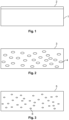
- Figure 1 shows a silver coating 1 with an Ag 2 S coating 2 disposed thereon, as is known from prior art.
- Figure 2 shows an example of a silver coating 3 with graphite particles 4 dispersed therein.
- Figure 3 shows a silver coating 5 with nanoparticles 6 dispersed therein in accordance with the present invention.
- These nanoparticles 6 comprise, for example, nanoparticles containing sulfur or fluorinated carbon nanoparticles, e.g. fluorinated graphene, carbon nanotube (CNT), or carbon nanoparticles of the formula (CF) x .
- the nanoparticles containing sulfur are preferably contained as a dispersion at a quantity of 0.01 to 10% by volume, more preferably at a quantity of 0.1 to 8% by volume, even more preferably at a quantity of 0.5 to 6% by volume based on 100% by volume of the coating.
- the nanoparticles containing sulfur impart self-lubricating properties upon the coating.
- the nanoparticles containing sulfur preferably have an average particle size D50 of 20 to 150 nm, more preferably an average particle size D50 of 40 to 120 nm, even more preferably an average particle size D50 of 50 to 90 nm.
- the average particle size D50 can be determined using a method such as is described in DIN ISO 9276-2:2018-09.
- the present invention provides a self-lubricating coating in a further embodiment comprising a silver-based dispersion coating composed of fluorinated graphene, carbon nanotube (CNT), or carbon nanoparticles of the formula (CF) x incorporated into a silver matrix, where fluorinated graphene, CNT, or carbon nanoparticles of the formula (CF) x with a fluorine to carbon ratio of 1 to 1.25 can be used.
- the fluorinated graphene, CNT, or carbon nanoparticles are dispersed in the silver matrix and therefore homogeneously distributed in the coating formed therefrom.
- Fluorinated carbon nanoparticles of the formula (CF) x having a fluorine to carbon ratio of at least 1 to 1.25 exhibit excellent thermal stability, are corrosion-free in strongly alkaline and acidic environments, and exhibit excellent self-lubricating properties. Fluorinated carbon nanoparticles of the formula (CF) x , on the other hand having a fluorine to carbon ratio of less than 1 exhibit significantly poorer thermal stability and are therefore unsuitable as a lubricant.
- the fluorinated nanoparticles are preferably contained in the dispersion at a quantity of 0.01 to 10% by volume, more preferably at a quantity of 0.1 to 8% by volume, even more preferably at a quantity of 0.1 to 5% by volume, based on 100% by volume of the coating.
- the fluorinated carbon nanoparticles impart self-lubricating properties upon the coating.
- the fluorinated carbon nanoparticles preferably have a bimodal particle size distribution and where the bimodal distribution is 5 nm to 10 nm and 50 nm to 10 ⁇ m or 20 nm to 50 nm and 100 nm to 15 ⁇ m.
- the fluorinated carbon nanoparticles of the formula (CF) x preferably have a fluorine to carbon ratio of ⁇ 1.0, more preferably from 1 to 1.25.
- the coating preferably comprises carbon nanoparticles of the formula (CF) x incorporated into a silver matrix.
- the coating can additionally comprise at least one intermediate layer which is preferably composed of nickel, pure silver, or copper and where the former preferably has a thickness of 0.5 to 4 micrometers, more preferably a thickness of 1.0 to 3 micrometers, and the silver layer containing the dispersion that is disposed thereabove has a layer thickness of 0.5 to 25 ⁇ m, more preferably a thickness of 0.5 to 4 ⁇ m or 5 to 25 ⁇ m.
- the present invention finally provides a method for the fabrication of the coating according to the invention, comprising coating a substrate with the coating according to the invention.
- the present invention comprises a method for surface treatment of an electrically conductive contact element for an electrical connector, where the electrically conductive contact element has a metallic contact surface.
- the coating according to the invention is applied to at least a partial region of the contact surface of the electrically conductive contact element.
- the coating is preferably produced by electrolytic deposition, or is produced by physical deposition using PVD, CVD or plasma deposition.
- the AgS 2 or AuS 2 nanoparticles are preferably masked such that a positive zeta potential is established in the pH range of the coating bath. This is necessary to avoid an agglomeration of the particles among each other or an undesirable chemical reaction and, as a result of the electrical forces of attraction, co-deposition of the nanoparticles at the cathode takes place in the silver matrix.
- Process analysis methods such as photon correlation spectroscopy (PCS) as well as laser Doppler anemometry (LDA) are necessary for controlled deposition.
- the coatings according to the invention allow for electrical contacts with a high number of plugging connections to be plugged at the same time and connector cycles of up to 50,000, applications with high vibration loads, and application temperatures of up to 200° C.
- the lugging connections can be any type of plugging connections already known in prior art.
Landscapes
- Chemical & Material Sciences (AREA)
- Engineering & Computer Science (AREA)
- Organic Chemistry (AREA)
- Materials Engineering (AREA)
- Chemical Kinetics & Catalysis (AREA)
- Metallurgy (AREA)
- Wood Science & Technology (AREA)
- Life Sciences & Earth Sciences (AREA)
- Mechanical Engineering (AREA)
- General Chemical & Material Sciences (AREA)
- Electrochemistry (AREA)
- Inorganic Chemistry (AREA)
- Oil, Petroleum & Natural Gas (AREA)
- Nanotechnology (AREA)
- Composite Materials (AREA)
- Crystallography & Structural Chemistry (AREA)
- Paints Or Removers (AREA)
- Other Surface Treatments For Metallic Materials (AREA)
- Physical Vapour Deposition (AREA)
- Chemical Vapour Deposition (AREA)
- Contacts (AREA)
Abstract
The present invention relates to a self-lubricating coating comprising a dispersion made of nanoparticles containing sulfur that are incorporated into a silver matrix, wherein the nanoparticles containing sulfur have the composition Ag2S and/or Au2S. The present invention furthermore relates to a self-lubricating coating comprising a dispersion made of fluorinated graphene, and/or carbon nanotube (CNT), and/or carbon nanoparticles of the formula (CF)x incorporated into a silver matrix, wherein the fluorinated graphene, CNT, or carbon nanoparticles of the formula (CF)x have a fluorine to carbon ratio of 1 to 1.25. The present invention furthermore relates to a method for the fabrication of the coating, and an electrical contact which comprises such a coating.
Description
- The invention relates to a self-lubricating coating, a method for the fabrication of the coating; and an electrical contact comprising such a coating.
- Electrical connectors with numerous configurations are known. Electrical connectors are intended to establish an electrical connection when in the plugged state. Electrical connectors are generally used for either signal transmission or power transmission. For this purpose, electrical connectors typically comprise electrically conductive contact elements that come into contact with one another when the connector is plugged together. The contact elements of one connector element are often configured as contact pins and those of the counterpart as a socket in one part or in two parts with a contact spring inserted. When the connector and the socket are plugged together, the contact springs exert resilient spring forces upon the contact pins to ensure a reliable electrically conductive connection.
- Electrical connectors are used, for example, in motor vehicles to transmit energy and to interconnect electrical and electronic systems. In motor vehicles, connectors are subjected to strong temperature fluctuations, vibrations, moisture, as well as corrosive media. An increase in the operating temperatures results in an increase in the contact resistance, in particular with the widely used tin-plated copper-based contact elements.
- A silver coating has been proposed, in particular for high-current contact elements, which leads to desired electrical properties such as low electrical resistance and contact resistance. A pure silver coating has good electrical properties, but disadvantageous tribological properties. This can lead to contact problems if the elements of the connector are plugged together frequently or if vibrational loads arise. Therefore, a silver sulfide film, the so-called "blue silver", was proposed as an additional coating on top of the silver coating. This initially leads to a reduction in the insertion force and to a stable low contact resistance. Alternatively, graphite particles can be added to the silver coating to achieve improved wear behavior and permanently low contact resistance.
- However, known dispersions with graphite particles are difficult to use for producing a coating or to handle during subsequent processing, which complicates and limits the coating processes and makes them more expensive.
- Furthermore, it was proposed to add particles made of hexagonal boron nitride (hBN), silicon carbide (SiC), or tungsten (IV) sulfide (WS2) to the silver coating in order to obtain improved wear behavior and low contact resistance. However, these additives do not sufficiently demonstrate the desired improvements in the electrical properties of an electrical contact coated in this manner.
- There is therefore a need for a self-lubricating composition for a coating for electrical contacts, preferably for high-current contacts, as well as for an inexpensive, simplified, and reliable method for their fabrication with which the contact surface of an electrical connector is treated such that a further reduction in the plugging force and a low contact resistance is obtained.
- This object is solved by the subject matter of the independent claims. Advantageous further developments of the present invention are the object of the dependent claims.
- For a better understanding of the present invention, it shall be explained in more detail with reference to the embodiments shown in the following figures. Same parts are provided with the same reference characters and the same component names. Furthermore, some features or combinations of features from the different embodiments shown and described can in themselves represent solutions that are independent, inventive, or according to the invention, where
- Fig. 1
- shows an example of a silver coating with an Ag2S coating disposed thereon;
- Fig. 2
- shows an example of a silver coating with graphite particles dispersed therein;
- Fig. 3
- shows an example of a silver coating of nanoparticles dispersed therein in accordance with the present invention.
- According to the invention, the present invention in one embodiment provides a self-lubricating coating comprising a dispersion made of nanoparticles containing sulfur that are incorporated into a silver matrix, where the nanoparticles containing sulfur are selected form Ag2S and/or Au2S. The nanoparticles containing sulfur are dispersed in the silver matrix and are therefore homogeneously distributed in the coating formed therefrom.
-
Figure 1 shows asilver coating 1 with an Ag2S coating 2 disposed thereon, as is known from prior art.Figure 2 shows an example of asilver coating 3 withgraphite particles 4 dispersed therein. For comparison,Figure 3 shows asilver coating 5 withnanoparticles 6 dispersed therein in accordance with the present invention. Thesenanoparticles 6 comprise, for example, nanoparticles containing sulfur or fluorinated carbon nanoparticles, e.g. fluorinated graphene, carbon nanotube (CNT), or carbon nanoparticles of the formula (CF)x. - The nanoparticles containing sulfur are preferably contained as a dispersion at a quantity of 0.01 to 10% by volume, more preferably at a quantity of 0.1 to 8% by volume, even more preferably at a quantity of 0.5 to 6% by volume based on 100% by volume of the coating. The nanoparticles containing sulfur impart self-lubricating properties upon the coating.
- The nanoparticles containing sulfur preferably have an average particle size D50 of 20 to 150 nm, more preferably an average particle size D50 of 40 to 120 nm, even more preferably an average particle size D50 of 50 to 90 nm. The average particle size D50 can be determined using a method such as is described in DIN ISO 9276-2:2018-09.
- According to the invention, the present invention provides a self-lubricating coating in a further embodiment comprising a silver-based dispersion coating composed of fluorinated graphene, carbon nanotube (CNT), or carbon nanoparticles of the formula (CF)x incorporated into a silver matrix, where fluorinated graphene, CNT, or carbon nanoparticles of the formula (CF)x with a fluorine to carbon ratio of 1 to 1.25 can be used. The fluorinated graphene, CNT, or carbon nanoparticles are dispersed in the silver matrix and therefore homogeneously distributed in the coating formed therefrom. Fluorinated carbon nanoparticles of the formula (CF)x having a fluorine to carbon ratio of at least 1 to 1.25 exhibit excellent thermal stability, are corrosion-free in strongly alkaline and acidic environments, and exhibit excellent self-lubricating properties. Fluorinated carbon nanoparticles of the formula (CF)x, on the other hand having a fluorine to carbon ratio of less than 1 exhibit significantly poorer thermal stability and are therefore unsuitable as a lubricant.
- The fluorinated nanoparticles are preferably contained in the dispersion at a quantity of 0.01 to 10% by volume, more preferably at a quantity of 0.1 to 8% by volume, even more preferably at a quantity of 0.1 to 5% by volume, based on 100% by volume of the coating. The fluorinated carbon nanoparticles impart self-lubricating properties upon the coating.
- The fluorinated carbon nanoparticles preferably have a bimodal particle size distribution and where the bimodal distribution is 5 nm to 10 nm and 50 nm to 10 µm or 20 nm to 50 nm and 100 nm to 15 µm.
- The fluorinated carbon nanoparticles of the formula (CF)x preferably have a fluorine to carbon ratio of ≥1.0, more preferably from 1 to 1.25.
- The coating preferably comprises carbon nanoparticles of the formula (CF)x incorporated into a silver matrix.
- The particle concentration of the carbon nanoparticles of the formula (CF)x is preferably 0.01 to 5% by weight of the coating.
- In the above embodiments, the silver particles are preferably contained at a quantity of 90 to 99.9% by volume, based on 100% by volume of the coating.
- The coatings according to the invention advantageously show improved wear behavior while maintaining the low contact resistance of pure silver.
- Furthermore, the self-lubricating coating can comprise a dispersing agent. Suitable dispersing agents are of polar origin, where preferred dispersing agents are organic solvents containing nitrogen such as N-methylpyrrolidone.
- The present invention also provides a coating comprising a layer comprising silver and nanoparticles, where the nanoparticles are nanoparticles containing sulfur selected from Ag2S and Au2S, or are fluorinated carbon nanoparticles of the formula (CF)x, and have a fluorine to carbon ratio from 1 to 1.25.
- The coating preferably comprises nanoparticles containing sulfur selected from Ag2S and Au2S, or carbon nanoparticles of the formula (CF)x having a fluorine to carbon ratio of 1 to 1.25.
- The coating can additionally comprise at least one intermediate layer which is preferably composed of nickel, pure silver, or copper and where the former preferably has a thickness of 0.5 to 4 micrometers, more preferably a thickness of 1.0 to 3 micrometers, and the silver layer containing the dispersion that is disposed thereabove has a layer thickness of 0.5 to 25 µm, more preferably a thickness of 0.5 to 4 µm or 5 to 25 µm.
- In addition, the coating can comprise a multilayer system which comprises further layers in addition to a layer comprising silver and a layer fabricated with the coating according to the invention. According to a further advantageous embodiment, the intermediate layers comprise tin, and/or nickel or NiP (nickel phosphorus), and/or silver, and/or copper, and/or alloys of tin, nickel, silver, copper. These materials are rust and heat resistant, which guarantees the longevity of the connector. An intermediate layer preferably comprises nickel and an intermediate layer thereabove comprises silver. The intermediate layers each preferably have a thickness of 0.5 to 4 micrometers, more preferably a thickness of 1.0 to 3 micrometers.
- Advantageously, the coatings fabricated with the coatings according to the invention exhibit improved wear behavior while maintaining the low contact resistance of pure silver.
- The present invention furthermore provides an electrical contact comprising the coating according to the invention.
- The present invention finally provides a method for the fabrication of the coating according to the invention, comprising coating a substrate with the coating according to the invention. In particular, the present invention comprises a method for surface treatment of an electrically conductive contact element for an electrical connector, where the electrically conductive contact element has a metallic contact surface. In addition, the coating according to the invention is applied to at least a partial region of the contact surface of the electrically conductive contact element.
- The coating is preferably produced by electrolytic deposition, or is produced by physical deposition using PVD, CVD or plasma deposition.
- The AgS2 or AuS2 nanoparticles are preferably masked such that a positive zeta potential is established in the pH range of the coating bath. This is necessary to avoid an agglomeration of the particles among each other or an undesirable chemical reaction and, as a result of the electrical forces of attraction, co-deposition of the nanoparticles at the cathode takes place in the silver matrix. Process analysis methods such as photon correlation spectroscopy (PCS) as well as laser Doppler anemometry (LDA) are necessary for controlled deposition.
- The coatings of the present invention exhibit superior wear resistance and low contact resistance while simplifying the coating method and the processing. The coatings according to the invention also have excellent electrical properties that are particularly suitable for high-current contacts.
- The coatings according to the invention allow for electrical contacts with a high number of plugging connections to be plugged at the same time and connector cycles of up to 50,000, applications with high vibration loads, and application temperatures of up to 200° C. The lugging connections can be any type of plugging connections already known in prior art.
-
Reference character Description 1 silver coating 2 Ag2S coating 3 silver coating with dispersed particles 4 graphite particles 5 silver coating with dispersed nanoparticles 6 nanoparticles
Claims (19)
- Self-lubricating coating comprising a dispersion made of nanoparticles containing sulfur that are incorporated in a silver matrix, wherein said nanoparticles containing sulfur have the composition Ag2S and/or Au2S.
- Self-lubricating coating according to claim 1, wherein said nanoparticles containing sulfur are contained in said dispersion at a quantity of 0.01 to 10% by volume, based on 100% by volume of the dispersion coating.
- Self-lubricating coating according to claim 1 or 2, wherein said nanoparticles containing sulfur have an average particle size D50 of 5 to 300 nm.
- Self-lubricating coating according to one of the claims 1 to 3, wherein said nanoparticles containing sulfur have an average particle size D50 of 50 to 90 nm.
- Self-lubricating coating, comprising a dispersion made with fluorinated graphene, and/or carbon nanotube (CNT), and/or carbon nanoparticles of the formula (CF)x incorporated into a silver matrix, wherein said fluorinated graphene, CNT, or carbon nanoparticles of the formula (CF)x have a fluorine to carbon ratio of 1 to 1.25.
- Self-lubricating coating according to claim 5, wherein said fluorinated carbon nanoparticles have a bimodal particle size distribution, and wherein the average particle size D50 is from 2 to 50 nm and from 0.4 to 10 µm.
- Self-lubricating coating according to claim 5 or 6, wherein fluorinated carbon nanoparticles of the formula (CF)x have a fluorine to carbon ratio of 1 to 1.25.
- Self-lubricating coating according to one of the claims 5 to 7, wherein said dispersion comprises fluorinated carbon nanoparticles of the formula (CF)x.
- Self-lubricating coating according to one of the claims 1 to 8, wherein the silver content in the matrix is present at a quantity of 90 to 99.99% by volume, based on 100% by volume of said dispersion coating.
- Self-lubricating coating according to one of the claims 1 to 9, wherein said coating further comprises a dispersing agent.
- Self-lubricating coating according to claim 10, wherein said dispersing agent is selected from the group of polar dispersing agents.
- Coating comprising a dispersion layer comprising silver and nanoparticles, wherein said nanoparticles are nanoparticles containing sulfur selected from Ag2S and/or Au2S, or are fluorinated graphene, and/or carbon nanotube (CNT), and/or carbon nanoparticles of the formula (CF)x that have a fluorine to carbon ratio of 1 to 1.25.
- Coating according to claim 11, wherein said dispersion comprises fluorinated carbon nanoparticles of the formula (CF)x.
- Coating according to claim 1 or 5 or 12, wherein said coating furthermore comprises an additional layer comprising nickel, nickel phosphorus, copper, or pure silver, where this layer preferably has a thickness of 1 to 4 micrometers.
- Coating according to claim 1 or 5 or 12, wherein said coating comprises two intermediate layers between a layer comprising silver and said layer produced with said coating of claim 1 or 5 or 12, wherein said first intermediate layer preferably comprises nickel, and wherein said first intermediate layer preferably has a thickness of 0.5 to 4 micrometers, wherein the second intermediate layer preferably comprises silver, and wherein said second intermediate layer preferably has a thickness of 0.5 to 4 micrometers.
- Electrical contact comprising said coating according to one of the claims 1 to 15.
- Method for the fabrication of a coating according to one of the claims 1 to 15, comprising coating a substrate with said coating according to one of the claims 1 to 10.
- Method according to claim 17, wherein said coating is fabricated by electrolytic deposition.
- Method according to claim 17, wherein said coating is fabricated by physical deposition using PVD (physical vapor deposition), CVD (chemical vapor deposition) or plasma deposition.
Applications Claiming Priority (1)
| Application Number | Priority Date | Filing Date | Title |
|---|---|---|---|
| DE102023103001.9A DE102023103001A1 (en) | 2023-02-08 | 2023-02-08 | Self-lubricating coating, process for its manufacture and electrical contact |
Publications (1)
| Publication Number | Publication Date |
|---|---|
| EP4414320A1 true EP4414320A1 (en) | 2024-08-14 |
Family
ID=89833906
Family Applications (1)
| Application Number | Title | Priority Date | Filing Date |
|---|---|---|---|
| EP24155347.8A Pending EP4414320A1 (en) | 2023-02-08 | 2024-02-01 | Self-lubricating coating, fabrication method, and electrical contact |
Country Status (6)
| Country | Link |
|---|---|
| US (1) | US20240263335A1 (en) |
| EP (1) | EP4414320A1 (en) |
| JP (1) | JP7801030B2 (en) |
| KR (1) | KR20240124217A (en) |
| CN (1) | CN118460032A (en) |
| DE (1) | DE102023103001A1 (en) |
Families Citing this family (2)
| Publication number | Priority date | Publication date | Assignee | Title |
|---|---|---|---|---|
| DE102021130188A1 (en) * | 2021-11-18 | 2023-05-25 | Te Connectivity Germany Gmbh | METHOD OF SURFACE TREATMENT OF AN ELECTRICAL CONTACT ELEMENT AND CONTACT ELEMENT |
| CN120261036B (en) * | 2025-04-07 | 2026-06-23 | 扬州戎星电气有限公司 | High-wear-resistance type robot spiral cable and preparation method thereof |
Citations (7)
| Publication number | Priority date | Publication date | Assignee | Title |
|---|---|---|---|---|
| US3787294A (en) * | 1971-12-07 | 1974-01-22 | S Kurosaki | Process for producing a solid lubricant self-supplying-type co-deposited metal film |
| WO2009156386A1 (en) * | 2008-06-27 | 2009-12-30 | Siemens Aktiengesellschaft | Component with a layer into which cnt (carbon nanotubes) are incorporated and a method for the manufacture of said component |
| CN107312949A (en) * | 2017-06-26 | 2017-11-03 | 中南大学 | Empty day contact material of Nanocomposite lubrication ultra-low abrasion and preparation method thereof |
| CN110194931A (en) * | 2019-04-16 | 2019-09-03 | 中国科学院兰州化学物理研究所 | A kind of method of the fabricated in situ vulcanization composite lubricated coating of Nano silver grain reinforced TFE base |
| WO2020007408A2 (en) * | 2018-07-05 | 2020-01-09 | Rosenberger Hochfrequenztechnik Gmbh & Co. Kg | Silver electrolyte for depositing dispersion silver layers and contact surfaces with dispersion silver layers |
| DE102019130506A1 (en) * | 2019-11-12 | 2021-05-12 | Te Connectivity Germany Gmbh | Electromechanical component with integrated lubrication and method for producing such an electromechanical component |
| EP4328934A1 (en) * | 2022-08-26 | 2024-02-28 | TE Connectivity Solutions GmbH | Coating on a surface to transmit electrical current |
Family Cites Families (14)
| Publication number | Priority date | Publication date | Assignee | Title |
|---|---|---|---|---|
| GB956568A (en) * | 1959-07-30 | 1964-04-29 | Gen Electric | Solid lubricant |
| ES2019428B3 (en) * | 1987-04-29 | 1991-06-16 | Siemens Ag | WELDING REPELLENT COATING FOR TOOLS. |
| JPH0428898A (en) * | 1990-05-25 | 1992-01-31 | Yokoyama Hyomen Kogyo Kk | Article having anodically-oxidized film and its production |
| JPH11106775A (en) * | 1997-10-03 | 1999-04-20 | Taiho Kogyo Co Ltd | Solid lubricating coating composition and sliding bearing material using the same |
| JP3771210B2 (en) | 2002-10-23 | 2006-04-26 | 荏原ユージライト株式会社 | Electric composite plating bath and electric composite plating method |
| JP4032116B2 (en) | 2002-11-01 | 2008-01-16 | 国立大学法人信州大学 | Electronic component and manufacturing method thereof |
| WO2006129888A1 (en) | 2005-06-03 | 2006-12-07 | Nippon Oil Corporation | Hydraulic fluid composition for buffer |
| KR100748228B1 (en) | 2006-02-28 | 2007-08-09 | 한국과학기술원 | Method of manufacturing metal / carbon nanotube composites using electroplating |
| JP2008056950A (en) | 2006-08-29 | 2008-03-13 | Shinshu Univ | Silver composite material and method for producing the same |
| DE102010040469B3 (en) | 2010-09-09 | 2012-01-12 | Federal-Mogul Wiesbaden Gmbh | Laminated material for sliding elements, process for its production and use |
| US8879975B2 (en) | 2012-11-29 | 2014-11-04 | Xerox Corporation | Fuser member |
| EP3605751B1 (en) | 2013-08-16 | 2021-10-06 | Schleifring GmbH | Slip ring assembly and components thereof |
| WO2017007011A1 (en) * | 2015-07-09 | 2017-01-12 | 古河電気工業株式会社 | Metal fine particle-containing composition |
| DE102018005352A1 (en) * | 2018-07-05 | 2020-01-09 | Dr.-Ing. Max Schlötter GmbH & Co KG | Silver electrolyte for the deposition of dispersion silver layers and contact surfaces with dispersion silver layers |
-
2023
- 2023-02-08 DE DE102023103001.9A patent/DE102023103001A1/en active Pending
-
2024
- 2024-02-01 EP EP24155347.8A patent/EP4414320A1/en active Pending
- 2024-02-05 JP JP2024015379A patent/JP7801030B2/en active Active
- 2024-02-06 KR KR1020240018147A patent/KR20240124217A/en active Pending
- 2024-02-06 CN CN202410168466.6A patent/CN118460032A/en active Pending
- 2024-02-06 US US18/433,508 patent/US20240263335A1/en active Pending
Patent Citations (7)
| Publication number | Priority date | Publication date | Assignee | Title |
|---|---|---|---|---|
| US3787294A (en) * | 1971-12-07 | 1974-01-22 | S Kurosaki | Process for producing a solid lubricant self-supplying-type co-deposited metal film |
| WO2009156386A1 (en) * | 2008-06-27 | 2009-12-30 | Siemens Aktiengesellschaft | Component with a layer into which cnt (carbon nanotubes) are incorporated and a method for the manufacture of said component |
| CN107312949A (en) * | 2017-06-26 | 2017-11-03 | 中南大学 | Empty day contact material of Nanocomposite lubrication ultra-low abrasion and preparation method thereof |
| WO2020007408A2 (en) * | 2018-07-05 | 2020-01-09 | Rosenberger Hochfrequenztechnik Gmbh & Co. Kg | Silver electrolyte for depositing dispersion silver layers and contact surfaces with dispersion silver layers |
| CN110194931A (en) * | 2019-04-16 | 2019-09-03 | 中国科学院兰州化学物理研究所 | A kind of method of the fabricated in situ vulcanization composite lubricated coating of Nano silver grain reinforced TFE base |
| DE102019130506A1 (en) * | 2019-11-12 | 2021-05-12 | Te Connectivity Germany Gmbh | Electromechanical component with integrated lubrication and method for producing such an electromechanical component |
| EP4328934A1 (en) * | 2022-08-26 | 2024-02-28 | TE Connectivity Solutions GmbH | Coating on a surface to transmit electrical current |
Also Published As
| Publication number | Publication date |
|---|---|
| JP7801030B2 (en) | 2026-01-16 |
| DE102023103001A1 (en) | 2024-08-08 |
| JP2024112782A (en) | 2024-08-21 |
| CN118460032A (en) | 2024-08-09 |
| US20240263335A1 (en) | 2024-08-08 |
| KR20240124217A (en) | 2024-08-16 |
Similar Documents
| Publication | Publication Date | Title |
|---|---|---|
| US20240263335A1 (en) | Self-Lubricating Coating, Fabrication Method, and Electrical Contact | |
| CN112368423B (en) | Silver electrolyte for depositing a dispersion silver layer and contacting a surface having a dispersion silver layer | |
| EP2879145A1 (en) | Electrical contact materials and method for preparing the same | |
| US20090050856A1 (en) | Voltage switchable dielectric material incorporating modified high aspect ratio particles | |
| CN112368422B (en) | Silver electrolyte for depositing a dispersion silver layer and contacting a surface having a dispersion silver layer | |
| JP4348288B2 (en) | Connector contact material | |
| Christensen et al. | Improved thermal conductivity of fluids and composites using boron nitride (BN) nanoparticles through hydrogen bonding | |
| JP4586141B2 (en) | Conductive paste | |
| TWI500758B (en) | Self-lubricating coating and method for producing a self-lubricating coating | |
| TW200410453A (en) | Contact terminal with doped coating | |
| JP6503159B2 (en) | Metal material for electronic parts, connector terminal using the same, connector and electronic parts | |
| JP4083084B2 (en) | Connector contact materials and multipolar terminals | |
| US12355172B2 (en) | Contact member, connector, composition, and method for producing contact member | |
| JPS59150098A (en) | Plating method of metal dispersed with particles | |
| JP6219553B2 (en) | Plating material excellent in heat resistance and method for producing the same | |
| KR101738505B1 (en) | Silver-carbon composite powder and manufacturing method the same | |
| JP2015229791A (en) | Metal materials for electronic parts, connector terminals, connectors and electronic parts using the same | |
| WO2018074256A1 (en) | Conductive bar material | |
| JP7836036B2 (en) | Highly conductive tin-graphene composite plating for automotive terminals and electronic components | |
| US20250347021A1 (en) | Compositions and methods using hexagonal boron nitride | |
| Pike et al. | Multi-walled carbon nanotube composites (Au/sup+/MWCNT) for electrical interconnection and reduction of microelectronic corrosion | |
| JP6490510B2 (en) | Manufacturing method of plating material with excellent heat resistance | |
| CN121507459A (en) | Conductive terminals and electrical connectors | |
| JP2022088909A5 (en) | ||
| CN120272101A (en) | High-concentration water-dispersible heat-conducting coating based on two-dimensional boron nitride and preparation method and application thereof |
Legal Events
| Date | Code | Title | Description |
|---|---|---|---|
| PUAI | Public reference made under article 153(3) epc to a published international application that has entered the european phase |
Free format text: ORIGINAL CODE: 0009012 |
|
| STAA | Information on the status of an ep patent application or granted ep patent |
Free format text: STATUS: THE APPLICATION HAS BEEN PUBLISHED |
|
| AK | Designated contracting states |
Kind code of ref document: A1 Designated state(s): AL AT BE BG CH CY CZ DE DK EE ES FI FR GB GR HR HU IE IS IT LI LT LU LV MC ME MK MT NL NO PL PT RO RS SE SI SK SM TR |
|
| STAA | Information on the status of an ep patent application or granted ep patent |
Free format text: STATUS: REQUEST FOR EXAMINATION WAS MADE |
|
| 17P | Request for examination filed |
Effective date: 20250213 |