EP4413873A1 - Liquid for atomization and production method for same - Google Patents
Liquid for atomization and production method for same Download PDFInfo
- Publication number
- EP4413873A1 EP4413873A1 EP22878617.4A EP22878617A EP4413873A1 EP 4413873 A1 EP4413873 A1 EP 4413873A1 EP 22878617 A EP22878617 A EP 22878617A EP 4413873 A1 EP4413873 A1 EP 4413873A1
- Authority
- EP
- European Patent Office
- Prior art keywords
- liquid
- atomization
- organic acid
- ion
- metal
- Prior art date
- Legal status (The legal status is an assumption and is not a legal conclusion. Google has not performed a legal analysis and makes no representation as to the accuracy of the status listed.)
- Withdrawn
Links
Images


Classifications
-
- A—HUMAN NECESSITIES
- A24—TOBACCO; CIGARS; CIGARETTES; SIMULATED SMOKING DEVICES; SMOKERS' REQUISITES
- A24F—SMOKERS' REQUISITES; MATCH BOXES; SIMULATED SMOKING DEVICES
- A24F40/00—Electrically operated smoking devices; Component parts thereof; Manufacture thereof; Maintenance or testing thereof; Charging means specially adapted therefor
- A24F40/30—Devices using two or more structurally separated inhalable precursors, e.g. using two liquid precursors in two cartridges
-
- A—HUMAN NECESSITIES
- A24—TOBACCO; CIGARS; CIGARETTES; SIMULATED SMOKING DEVICES; SMOKERS' REQUISITES
- A24B—MANUFACTURE OR PREPARATION OF TOBACCO FOR SMOKING OR CHEWING; TOBACCO; SNUFF
- A24B15/00—Chemical features or treatment of tobacco; Tobacco substitutes, e.g. in liquid form
- A24B15/10—Chemical features of tobacco products or tobacco substitutes
- A24B15/16—Chemical features of tobacco products or tobacco substitutes of tobacco substitutes
- A24B15/167—Chemical features of tobacco products or tobacco substitutes of tobacco substitutes in liquid or vaporisable form, e.g. liquid compositions for electronic cigarettes
-
- A—HUMAN NECESSITIES
- A24—TOBACCO; CIGARS; CIGARETTES; SIMULATED SMOKING DEVICES; SMOKERS' REQUISITES
- A24B—MANUFACTURE OR PREPARATION OF TOBACCO FOR SMOKING OR CHEWING; TOBACCO; SNUFF
- A24B15/00—Chemical features or treatment of tobacco; Tobacco substitutes, e.g. in liquid form
- A24B15/18—Treatment of tobacco products or tobacco substitutes
- A24B15/28—Treatment of tobacco products or tobacco substitutes by chemical substances
- A24B15/30—Treatment of tobacco products or tobacco substitutes by chemical substances by organic substances
- A24B15/308—Treatment of tobacco products or tobacco substitutes by chemical substances by organic substances vitamins
-
- A—HUMAN NECESSITIES
- A24—TOBACCO; CIGARS; CIGARETTES; SIMULATED SMOKING DEVICES; SMOKERS' REQUISITES
- A24F—SMOKERS' REQUISITES; MATCH BOXES; SIMULATED SMOKING DEVICES
- A24F40/00—Electrically operated smoking devices; Component parts thereof; Manufacture thereof; Maintenance or testing thereof; Charging means specially adapted therefor
- A24F40/10—Devices using liquid inhalable precursors
-
- A—HUMAN NECESSITIES
- A24—TOBACCO; CIGARS; CIGARETTES; SIMULATED SMOKING DEVICES; SMOKERS' REQUISITES
- A24F—SMOKERS' REQUISITES; MATCH BOXES; SIMULATED SMOKING DEVICES
- A24F40/00—Electrically operated smoking devices; Component parts thereof; Manufacture thereof; Maintenance or testing thereof; Charging means specially adapted therefor
- A24F40/40—Constructional details, e.g. connection of cartridges and battery parts
- A24F40/42—Cartridges or containers for inhalable precursors
-
- A—HUMAN NECESSITIES
- A61—MEDICAL OR VETERINARY SCIENCE; HYGIENE
- A61M—DEVICES FOR INTRODUCING MEDIA INTO, OR ONTO, THE BODY; DEVICES FOR TRANSDUCING BODY MEDIA OR FOR TAKING MEDIA FROM THE BODY; DEVICES FOR PRODUCING OR ENDING SLEEP OR STUPOR
- A61M15/00—Inhalators
- A61M15/06—Inhaling appliances shaped like cigars, cigarettes or pipes
Definitions
- the present invention relates to a liquid for atomization and a method for producing the same.
- Non-combustible flavored smoking articles which generate a vapor or aerosol from an aerosol source material using electric power supplied by a battery, and pass the vapor or aerosol through a tobacco-containing raw material to add tobacco components to the vapor or aerosol (see, for example, Patent Literature 1).
- Patent Literature 2 discloses a liquid formulation comprising an aqueous solution of nicotine, an organic and/or inorganic salt, an organic liquid having a viscosity higher than water, and a particular amount of an organic alcohol, wherein the pH of the formulation is greater than 7 and the formulation does not include a propellant.
- a liquid for atomization is stored and transported in liquid form. There is, therefore, a fear of a hygiene problem that may occur over time due to bacteria or the like.
- a conceivable countermeasure is to add an acid to a liquid for atomization.
- the inventors found that mere addition of an acid, because of its corrosive action, may impair the stability of an article, or may corrode other part(s) upon leakage of the liquid.
- the present invention is directed to the provision of a liquid for atomization which improves the safety of a smoking article.
- the inventors found that a liquid containing an organic acid ion and a metal ion can solve the above problem.
- a liquid for atomization comprising an organic acid ion A, a metal ion M, and a medium, the liquid being to be stored in an atomizing device without contact with a metal.
- a liquid for atomization comprising an organic acid ion A, a metal ion M, and a medium, and containing no nicotine.
- liquid for atomization according to any one of embodiments 1 to 3, wherein the organic acid ion A and the metal ion M are derived from an organic acid metal salt AM.
- the liquid for atomization comprising a combination of the organic acid ion A and the metal ion M which satisfies the following relationship: number of moles of organic acid ion A/number of moles of metal ion M ⁇ valence of A/valence of M .
- the liquid for atomization according to any one of embodiments 1 to 5, having a pH of 4 to 8.5 when diluted 10-fold with water.
- a non-combustible flavor inhalation article comprising: a reservoir holding the liquid according to any one of embodiments 1 to 6; and an atomizing device for atomizing the liquid supplied from the reservoir.
- the present invention makes it possible to provide a liquid for atomization which reduces discomfort during smoking while ensuring the safety of a smoking article.
- X to Y includes the end values X and Y.
- the liquid for atomization refers to a liquid which, when heated or vibrated, generates an aerosol.
- the liquid for atomization comprises an organic acid ion A, a metal ion M, and a medium.
- the inventors have found that while a liquid for atomization comprising an organic acid improves its hygiene reliability, it impairs the stability of an article due to the corrosiveness of the liquid, and have also found that the co-presence of an organic acid ion A and a metal ion M in a liquid can achieve both the hygiene reliability of the liquid and the stability of an article.
- the metal of the metal ion M is preferably selected from Group 1 or Group 2 of the periodic table, and is preferably K, Na, Ca, or Mg from the viewpoint of availability, etc.
- the organic acid ion A is preferably derived from an aromatic organic acid such as benzoic acid, or a hydroxy fatty acid such as lactic acid, tartaric acid, citric acid, or levulinic acid.
- an aromatic organic acid such as benzoic acid
- a hydroxy fatty acid such as lactic acid, tartaric acid, citric acid, or levulinic acid.
- the use of a salt of the organic acid ion A makes it possible to prepare a liquid for atomization in which the minimum required amounts of the organic acid ion A and the metal ion M are dissolved in the medium.
- the above-described acid also has the advantage that the acid itself is unlikely to cause smoke taste inhibition.
- the liquid for atomization may contain a plurality of types of organic acid ions and a plurality of types of metal ions. It is preferred that at least one pair be derived from an organic acid metal salt AM.
- organic acid metal salt AM include sodium benzoate, potassium benzoate, calcium benzoate trihydrate, sodium lactate, trisodium citrate, or calcium lactate pentahydrate.
- PhCOO - (benzoate ion) exists as the organic acid ion A and Na + as the metal ion M in the liquid for atomization
- these ions are preferably derived from sodium benzoate (PhCOONa).
- the liquid for atomization preferably comprises at least one combination of the organic acid ion A and the metal ion M which satisfies the following inequality (1). number of moles of organic acid ion A/number of moles of metal ion M ⁇ valence of A/valence of M
- the left side and the right side are as follows, satisfying inequality (1).
- the liquid for atomization may contain an organic acid metal salt and an organic acid which produce a buffering effect. Also in this case, inequality (1) is preferably satisfied.
- the left side and the right side are as follows, satisfying inequality (1).
- the amounts of the organic acid ion A and the metal ion M are preferably selected so that the pH of the liquid for atomization falls within a particular range.
- the pH of the liquid for atomization is defined as the pH determined when the liquid is diluted 10-fold with water, and its value is preferably 4 to 8.5, more preferably 4 to 7.
- the liquid for atomization contains a liquid medium.
- the medium is preferably water or an aqueous organic solvent such as a polyhydric alcohol.
- a medium which is used as an aerosol source material in the art is more preferred.
- the medium comprises an aerosol source material, such as a polyhydric alcohol, as a main component, and water preferably in an amount of 1 to 20% by weight, more preferably 3 to 10% by weight based on the amount of the aerosol source material.
- the liquid for atomization may or may not contain nicotine.
- the liquid for atomization does not contain nicotine, it is possible to reduce a change in smoke taste, e.g. due to oxidation of a component contained in the liquid, thereby improving the quality stability.
- the liquid for atomization contains nicotine, its amount is about 0.5 to 10% by weight based on the amount of the medium.
- the liquid for atomization contains nicotine, the liquid achieves the effect of reducing smoke taste inhibition, as described above.
- the organic acid ion A and the metal ion M have functions such as prevention of oxidation and prevention of deterioration. Therefore, when the liquid for atomization does not contain nicotine, the liquid can achieve the effect of reducing deterioration of the quality of other component(s), such as a flavoring agent, which may be contained in the liquid.
- the liquid for atomization does not contain nicotine
- the liquid is preferably used together with a tobacco raw material. Even when the organic acid and nicotine are stored and atomized separately, it is possible to reduce the smoke taste inhibition of an article as described above.
- the liquid for atomization may contain other known components such as a flavoring agent.
- the liquid for atomization is stored in an atomizing device.
- the liquid for atomization is stored without contact with a metal. This can reduce problems that may occur e.g. upon leakage of the liquid for atomization, thereby further improving the safety of an article.
- the liquid for atomization may be in contact with a metal when the liquid is stored in the atomizing device.
- the liquid for atomization according to this embodiment has low corrosiveness, and therefore can achieve high safety even when it is stored in contact with a metal.
- the liquid for atomization can be produced by any method, it is preferably produced by a method which includes (1) a step of adding an organic acid metal salt to a medium, or (2) a step of adding an organic acid metal salt and an organic acid, which produce a buffering effect, to a medium.
- organic acid metal salts as described above can be used as the organic acid metal salt.
- organic acid metal salts may be used singly or in a combination of two or more.
- the organic acid metal salt is preferably used in such an amount as to achieve the above-described pH.
- An example of the organic acid metal salt and the organic acid which produce a buffering effect is a combination of an acid and its salt whose organic ion species are the same. Specific examples include a combination of benzoic acid and a benzoate salt and a combination of lactic acid and a lactate salt.
- the total amount of the acid and the salt is preferably adjusted so that the above-described pH can be achieved.
- the weight ratio between the acid and the salt is preferably 1: (10-50). When the ratio is within this range, the large content of the salt can favorably increase the amount of the solute in the liquid for atomization and reduce the moisture activity of the liquid for atomization, and therefore can further reduce the occurrence of hygiene problems.
- FIG. 1 shows an embodiment of a non-combustible flavor inhalation article.
- the non-combustible flavor inhalation article 30 includes a power supply unit 30D, a cartridge 30E, and a flavor source capsule 30F which is a material holder holding a flavor material.
- the non-combustible flavor inhalation article 30 has a shape extending from a non-inhalation end u (upstream) to an inhalation end d (downstream).
- the cartridge 30E is attachable/detachable to/from the power supply unit 30D.
- the flavor source capsule 30F is attachable/detachable to/from the cartridge 30E.
- the non-combustible flavor inhalation article of this embodiment is configured to generate an atomized liquid (aerosol) upstream of the material holder (flavor source capsule 30F), introduce the aerosol into the material holder, and cause the aerosol to carry flavor components to generate a flavor.
- the liquid for atomization contains nicotine, it is possible not to provide a material holder to the non-combustible flavor inhalation article.
- the material holder is the flavor source capsule 30F.
- the flavor source capsule 30F includes a container 310 for storing the flavor source 300, a mesh body 320, a non-woven fabric 330, and a cap 340.
- the aerosol that has been atomized by the below-described atomizing section 220 is introduced through the mesh body 320 into the container 310, where the aerosol comes into contact with the flavor source 300, whereby a flavor is imparted to the aerosol.
- the aerosol then passes through the non-woven fabric 330 and is inhaled by the user. In this manner, the non-combustible flavor inhalation article 30 can impart a flavor to the aerosol without heating the flavor source 300.
- the flavor source 300 may be heated. In that case, the heating temperature is about 40 to 120°C. Substantially no aerosol is generated from the flavor source 300.
- the length of the flavor source capsule 30F is preferably 40 mm or less, more preferably 25 mm or less. Further, in the flow direction of the aerosol, the length is preferably 1 mm or more, more preferably 5 mm or more. In a direction perpendicular to the flow direction of the aerosol, the maximum length of the container 310 of the flavor source capsule 30F (container 310) is preferably 20 mm or less, more preferably 10 mm or less. Further, in a direction perpendicular to the flow direction of the aerosol, the maximum length of the flavor source capsule 30F (container 310) is preferably 1 mm or more, more preferably 3 mm or more.
- the flavor source 300 is composed of pieces of tobacco raw material which impart a flavor to the aerosol.
- the lower limit of the size of each raw material piece is preferably 0.2 to 1.2 mm, more preferably 0.2 to 0.7 mm.
- Shredded tobacco or a shaped product obtained by shaping a tobacco raw material into granules, for example, can be used as the raw material pieces.
- the flavor source 300 may contain a plant(s) other than tobacco (e.g., mint or herb), a natural flagrance such as menthol, a synthetic flagrance, fruit juice, a taste agent, a plant powder, etc.
- a natural flagrance such as menthol
- a synthetic flagrance such as fruit juice
- a taste agent such as menthol
- the taste agent include materials which have sweetness, sourness, saltiness, umami, bitterness, astringency, richness, spiciness, harshness, etc.
- materials which have sweetness include a sugar, a sugar alcohol, and a sweetener.
- the sugar is, for example, a monosaccharide, a disaccharide, an oligosaccharide, or a polysaccharide.
- the sweetener is, for example, a natural sweetener or a synthetic sweetener.
- the amount of the flavor source 300 charged into the container 310 is preferably 300 mg or more, more preferably 350 mg or more from the viewpoint of increasing the amount of nicotine volatilized during smoking.
- the liquid for atomization need not contain nicotine.
- the flavor source 300 does not contain pieces of tobacco raw material or when the non-combustible flavor inhalation article 30 does not include a material holder, the liquid for atomization preferably contains nicotine.
- FIG. 3 shows an example of the power supply unit 30D.
- the power supply unit 30D includes a battery 110.
- the battery 110 may be a disposable battery or a rechargeable battery.
- the initial value of the output voltage of the battery 110 is preferably in the range of 1.2 V to 4.2 V.
- the battery capacity of the battery 110 is preferably in the range of 100 mAh to 1000 mAh.
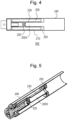
- FIGS. 4 and 5 show an example of the cartridge 30E.
- FIG. 4 is a cross-sectional view of the example of the cartridge 30E
- FIG. 5 is a diagram showing its internal structure.
- the cartridge 30E includes a reservoir 210, an atomizing section 220, a flow path forming body 230, an outer frame 240, and an end cap 250.
- the cartridge 30E has a first flow path 200X as an aerosol flow path, which is disposed downstream of the atomizing section 220.
- the reservoir 210 stores the liquid for atomization 200.
- the reservoir 210 is located around the flow path forming body 230 in a cross-section perpendicular to the aerosol flow direction (direction from the non-inhalation end toward the inhalation end (upstream to downstream)).
- the reservoir 210 is located in the space between the flow path forming body 230 and the outer frame 240.
- the reservoir 210 is formed of, for example, a non-metallic porous body such as a resin web or cotton.
- the reservoir 210 may be formed of a tank for storing the liquid for atomization 200. In that case, the tank is made of, for example, a polymer.
- the atomizing section 220 atomizes, without involving combustion, the liquid for atomization 200 using electric power supplied from the battery 110.
- the atomizing section 220 is composed of a heating wire (coil) wound at a predetermined pitch.
- the atomizing section 220 is preferably composed of a heating wire having a resistance value in the range of 1.0 to 3.0 ⁇ .
- the predetermined pitch is preferably at least a value at which adjacent heating wires do not contact each other, and a smaller possible value is preferred.
- the predetermined pitch is preferably 0.40 mm or less.
- the predetermined pitch is preferably constant in order to stabilize the atomization of the liquid for atomization 200.
- the predetermined pitch refers to the distance between the centers of adjacent heating wires.
- the atomizing section 220 may be comprised of a ceramic heater.
- the liquid for atomization 200 held in the reservoir 210, is stored in a state in which it is supplied to the atomizing section through capillarity or the like.
- the atomizing section is composed of a heating wire
- the liquid for atomization is in contact with a metal when it is stored in the non-combustible flavor inhalation article (atomizing device).
- the liquid for atomization according to this embodiment has low corrosiveness, it can achieve high stability of the device even when it is stored in such a state.
- the liquid for atomization may or may not be in contact with a metal when it is stored in the non-combustible flavor inhalation article (atomizing device). Since the liquid for atomization has low corrosiveness to a metal component(s) of the ceramic heater, it can achieve high stability of the device.
- the flow path forming body 230 has a cylindrical shape that forms the first flow path 200X extending along the flow direction of the aerosol.
- the outer frame 240 has a cylindrical shape that houses the flow path forming body 230.
- the outer frame 240 extends downstream from the end cap 250, while it houses a portion of the flavor source capsule 30F.
- the end cap 250 is a cap that closes the space between the flow path forming body 230 and the outer frame 240 from the downstream side. The end cap 250 prevents the liquid for atomization 200, stored in the reservoir 210, from leaking to the flavor source capsule 30F.
- the liquid for atomization according to this embodiment is also suitable for a flavor inhaler of a type which atomizes the liquid by a method other than the method as illustrated in the figures.
- Such methods include, for example, a method which involves applying ultrasonic vibrations to the liquid to atomize it, a method which uses an element that deforms when energized, and a method which uses bubbles generated in the liquid.
- the method which uses an element is, for example, a surface acoustic wave (SAW) method or a piezo method.
- the surface acoustic wave (SAW) method is a method which involves applying a voltage at a high frequency to a piezoelectric substrate, having a pair of comb-shaped electrodes, to generate surface acoustic waves (SAW), and atomizing a liquid by means of the surface acoustic waves, as disclosed in International Publication No. WO 2021/039340 , the contents of which are incorporated herein by reference.
- the piezo method is a method which atomizes a liquid by vibrating it using a piezoelectric element (piezo element) which deforms when energized.
- the method which uses bubbles is, for example, a thermal method.
- the thermal method is a method which involves boiling a liquid instantaneously in a nozzle equipped with an internal heater to generate bubbles, and ejecting and atomizing the liquid by means of the bubbles.
- the thermal method and the piezo method are also known as a drop-on-demand method in the field of inkjet printing.
- Propylene glycol, glycerin, and water were provided as a medium, and benzoic acid (BA) was provided as an organic acid.
- BA benzoic acid
- 5% by weight of water was added to a mixture of propylene glycol and glycerin, which had been mixed at a weight ratio of 1:1, and the organic acid was added in the amounts shown in Table 1 to the medium to prepare liquids 1 and 2 for atomization.
- a non-combustible flavored smoking article as shown in FIG. 1 was provided, and each liquid for atomization was filled into the liquid holder of the article.
- a smoking test was conducted by well-trained panelists to evaluate smoke taste inhibition.
- Propylene glycol, glycerin, and water were provided as a medium, sodium benzoate (BA-Na) was provided as an organic acid salt, and benzoic acid (BA) was provided as an organic acid.
- BA-Na sodium benzoate
- BA benzoic acid
- 5% by weight of water was added to a mixture of propylene glycol and glycerin, which had been mixed at a weight ratio of 1:1, and the organic acid salt and the organic acid were added in the amounts shown in Table 1 to the medium to prepare liquids 3 to 5 for atomization.
- Example 1 1 1:1 5 - - - - - - C 2 1:1 5 2.5 - 0.23 - 0.23 3.0 A
- Example 1 3 1:1 5 - 3.0 - 0.22 0.22 8.3 B 4 1:1 5 0.1 2.9 0.01 0.21 0.22 5.6 B 5 1:1 5 0.2 6.0 0.02 0.46 0.48 5.6 B
- the liquids 3 to 5 for atomization were provided, and each liquid was filled into the liquid holder of the non-combustible flavored smoking article used in Example 1.
- the article was stored at 40°C for 3 months. After storage, the liquid for atomization was taken out from the article, and the amounts of metal ions were measured by ion chromatography.
- the amounts of metal ions were measured in the same manner as in Example 2 except that the liquids 1 and 2 for atomization were used instead of the liquids 3 to 5 for atomization. The results are shown in FIG. 6 . In the figure, the measured amounts of metal ions in the liquid 2 for atomization are indicated as 1. The amounts of metal ions were small in all of the liquids for atomization obtained in the Examples; in particular, no Al was detected.
Landscapes
- Health & Medical Sciences (AREA)
- Chemical & Material Sciences (AREA)
- Chemical Kinetics & Catalysis (AREA)
- General Chemical & Material Sciences (AREA)
- General Health & Medical Sciences (AREA)
- Engineering & Computer Science (AREA)
- Toxicology (AREA)
- Pulmonology (AREA)
- Bioinformatics & Cheminformatics (AREA)
- Anesthesiology (AREA)
- Biomedical Technology (AREA)
- Heart & Thoracic Surgery (AREA)
- Hematology (AREA)
- Life Sciences & Earth Sciences (AREA)
- Animal Behavior & Ethology (AREA)
- Public Health (AREA)
- Veterinary Medicine (AREA)
- Manufacture Of Tobacco Products (AREA)
- Medicinal Preparation (AREA)
Abstract
Description
- The present invention relates to a liquid for atomization and a method for producing the same.
- Non-combustible flavored smoking articles are known which generate a vapor or aerosol from an aerosol source material using electric power supplied by a battery, and pass the vapor or aerosol through a tobacco-containing raw material to add tobacco components to the vapor or aerosol (see, for example, Patent Literature 1). In order to achieve efficient delivery of nicotine,
Patent Literature 2 discloses a liquid formulation comprising an aqueous solution of nicotine, an organic and/or inorganic salt, an organic liquid having a viscosity higher than water, and a particular amount of an organic alcohol, wherein the pH of the formulation is greater than 7 and the formulation does not include a propellant. -
- PTL 1: International Publication No.
WO 2016/075749 - PTL 2: Japanese Unexamined Patent Application Publication (Translation of
PCT Application) No. 2018-536014 - A liquid for atomization is stored and transported in liquid form. There is, therefore, a fear of a hygiene problem that may occur over time due to bacteria or the like. A conceivable countermeasure is to add an acid to a liquid for atomization. However, the inventors found that mere addition of an acid, because of its corrosive action, may impair the stability of an article, or may corrode other part(s) upon leakage of the liquid. In view of such a situation, the present invention is directed to the provision of a liquid for atomization which improves the safety of a smoking article.
- The inventors found that a liquid containing an organic acid ion and a metal ion can solve the above problem.
- A liquid for atomization, comprising an organic acid ion A, a metal ion M, and a medium, the liquid being to be stored in an atomizing device without contact with a metal.
- A liquid for atomization, comprising an organic acid ion A, a metal ion M, and a medium, and containing no nicotine.
- The liquid for atomization according to
embodiment Group 1 orGroup 2 of the periodic table. - The liquid for atomization according to any one of
embodiments 1 to 3, wherein the organic acid ion A and the metal ion M are derived from an organic acid metal salt AM. - The liquid for atomization according to any one of
embodiments 1 to 4, comprising a combination of the organic acid ion A and the metal ion M which satisfies the following relationship:
- The liquid for atomization according to any one of
embodiments 1 to 5, having a pH of 4 to 8.5 when diluted 10-fold with water. - A non-combustible flavor inhalation article comprising: a reservoir holding the liquid according to any one of
embodiments 1 to 6; and an atomizing device for atomizing the liquid supplied from the reservoir. - The non-combustible flavor inhalation article according to embodiment 7, further comprising a material holder holding a flavor source, wherein the atomized liquid is introduced into the material holder.
- A method for producing the liquid for atomization according to any one of
embodiments 1 to 6, the method comprising adding to the medium an organic acid metal salt, or an organic acid metal salt and an organic acid which produce a buffering effect. - The present invention makes it possible to provide a liquid for atomization which reduces discomfort during smoking while ensuring the safety of a smoking article.
-
- [
FIG. 1] FIG. 1 is a diagram showing an embodiment of a non-combustible flavor inhalation article. - [
FIG. 2] FIG. 2 is a diagram showing an embodiment of a flavor source capsule. - [
FIG. 3] FIG. 3 is a diagram showing an embodiment of a power supply unit. - [
FIG. 4] FIG. 4 is a cross-sectional view of an embodiment of a cartridge. - [
FIG. 5] FIG. 5 is a diagram showing the internal structure of the cartridge. - [
FIG. 6] FIG. 6 is a diagram showing the amounts of ions in a liquid for atomization. - The present invention will now be descried in detail. In the present invention, "X to Y" includes the end values X and Y.
- The liquid for atomization refers to a liquid which, when heated or vibrated, generates an aerosol. The liquid for atomization comprises an organic acid ion A, a metal ion M, and a medium. The inventors have found that while a liquid for atomization comprising an organic acid improves its hygiene reliability, it impairs the stability of an article due to the corrosiveness of the liquid, and have also found that the co-presence of an organic acid ion A and a metal ion M in a liquid can achieve both the hygiene reliability of the liquid and the stability of an article.
- The metal of the metal ion M is preferably selected from
Group 1 orGroup 2 of the periodic table, and is preferably K, Na, Ca, or Mg from the viewpoint of availability, etc. The organic acid ion A is preferably derived from an aromatic organic acid such as benzoic acid, or a hydroxy fatty acid such as lactic acid, tartaric acid, citric acid, or levulinic acid. In particular, when nicotine is added to the liquid or when nicotine is contained in the below-described flavor source, the presence of the organic acid ion A can reduce smoke taste inhibition (a feeling of loss of flavor) caused by nicotine. This effect is pronounced when the organic acid ion A is derived from the above-described acid. Further, the use of a salt of the organic acid ion A makes it possible to prepare a liquid for atomization in which the minimum required amounts of the organic acid ion A and the metal ion M are dissolved in the medium. The above-described acid also has the advantage that the acid itself is unlikely to cause smoke taste inhibition. - The liquid for atomization may contain a plurality of types of organic acid ions and a plurality of types of metal ions. It is preferred that at least one pair be derived from an organic acid metal salt AM. Examples of the organic acid metal salt AM include sodium benzoate, potassium benzoate, calcium benzoate trihydrate, sodium lactate, trisodium citrate, or calcium lactate pentahydrate. For example, when PhCOO- (benzoate ion) exists as the organic acid ion A and Na+ as the metal ion M in the liquid for atomization, these ions are preferably derived from sodium benzoate (PhCOONa).
- In particular, the liquid for atomization preferably comprises at least one combination of the organic acid ion A and the metal ion M which satisfies the following inequality (1).

- For example, when the liquid for atomization contains 2 moles of sodium benzoate, the left side and the right side are as follows, satisfying inequality (1).


- When the liquid for atomization contains 2 moles of calcium tartrate, the left side and the right side are as follows, satisfying inequality (1).


- The liquid for atomization may contain an organic acid metal salt and an organic acid which produce a buffering effect. Also in this case, inequality (1) is preferably satisfied. For example, when the liquid for atomization contains 1 mole of sodium benzoate and 10 mols of benzoic acid as a combination which produces a buffering effect, the left side and the right side are as follows, satisfying inequality (1).


- The amounts of the organic acid ion A and the metal ion M are preferably selected so that the pH of the liquid for atomization falls within a particular range. In the present invention, the pH of the liquid for atomization is defined as the pH determined when the liquid is diluted 10-fold with water, and its value is preferably 4 to 8.5, more preferably 4 to 7.
- The liquid for atomization contains a liquid medium. The medium is preferably water or an aqueous organic solvent such as a polyhydric alcohol. Among them, a medium which is used as an aerosol source material in the art is more preferred. Thus, in one embodiment, the medium comprises an aerosol source material, such as a polyhydric alcohol, as a main component, and water preferably in an amount of 1 to 20% by weight, more preferably 3 to 10% by weight based on the amount of the aerosol source material.
- The liquid for atomization may or may not contain nicotine. When the liquid for atomization does not contain nicotine, it is possible to reduce a change in smoke taste, e.g. due to oxidation of a component contained in the liquid, thereby improving the quality stability. When the liquid for atomization contains nicotine, its amount is about 0.5 to 10% by weight based on the amount of the medium. When the liquid for atomization contains nicotine, the liquid achieves the effect of reducing smoke taste inhibition, as described above.
- The organic acid ion A and the metal ion M have functions such as prevention of oxidation and prevention of deterioration. Therefore, when the liquid for atomization does not contain nicotine, the liquid can achieve the effect of reducing deterioration of the quality of other component(s), such as a flavoring agent, which may be contained in the liquid. When the liquid for atomization does not contain nicotine, the liquid is preferably used together with a tobacco raw material. Even when the organic acid and nicotine are stored and atomized separately, it is possible to reduce the smoke taste inhibition of an article as described above.
- The liquid for atomization may contain other known components such as a flavoring agent.
- The liquid for atomization is stored in an atomizing device. In one embodiment, the liquid for atomization is stored without contact with a metal. This can reduce problems that may occur e.g. upon leakage of the liquid for atomization, thereby further improving the safety of an article. In another embodiment, the liquid for atomization may be in contact with a metal when the liquid is stored in the atomizing device. The liquid for atomization according to this embodiment has low corrosiveness, and therefore can achieve high safety even when it is stored in contact with a metal.
- While the liquid for atomization can be produced by any method, it is preferably produced by a method which includes (1) a step of adding an organic acid metal salt to a medium, or (2) a step of adding an organic acid metal salt and an organic acid, which produce a buffering effect, to a medium.
- The same organic acid metal salts as described above can be used as the organic acid metal salt. Such organic acid metal salts may be used singly or in a combination of two or more. The organic acid metal salt is preferably used in such an amount as to achieve the above-described pH.
- An example of the organic acid metal salt and the organic acid which produce a buffering effect is a combination of an acid and its salt whose organic ion species are the same. Specific examples include a combination of benzoic acid and a benzoate salt and a combination of lactic acid and a lactate salt. The total amount of the acid and the salt is preferably adjusted so that the above-described pH can be achieved. The weight ratio between the acid and the salt is preferably 1: (10-50). When the ratio is within this range, the large content of the salt can favorably increase the amount of the solute in the liquid for atomization and reduce the moisture activity of the liquid for atomization, and therefore can further reduce the occurrence of hygiene problems.
-
FIG. 1 shows an embodiment of a non-combustible flavor inhalation article. The non-combustibleflavor inhalation article 30 includes apower supply unit 30D, acartridge 30E, and aflavor source capsule 30F which is a material holder holding a flavor material. The non-combustibleflavor inhalation article 30 has a shape extending from a non-inhalation end u (upstream) to an inhalation end d (downstream). Thecartridge 30E is attachable/detachable to/from thepower supply unit 30D. Theflavor source capsule 30F is attachable/detachable to/from thecartridge 30E. The non-combustible flavor inhalation article of this embodiment is configured to generate an atomized liquid (aerosol) upstream of the material holder (flavor source capsule 30F), introduce the aerosol into the material holder, and cause the aerosol to carry flavor components to generate a flavor. In the case where the liquid for atomization contains nicotine, it is possible not to provide a material holder to the non-combustible flavor inhalation article. - In one embodiment, the material holder is the
flavor source capsule 30F. As shown inFIG. 2 , theflavor source capsule 30F includes acontainer 310 for storing theflavor source 300, amesh body 320, anon-woven fabric 330, and acap 340. The aerosol that has been atomized by the below-describedatomizing section 220 is introduced through themesh body 320 into thecontainer 310, where the aerosol comes into contact with theflavor source 300, whereby a flavor is imparted to the aerosol. The aerosol then passes through thenon-woven fabric 330 and is inhaled by the user. In this manner, the non-combustibleflavor inhalation article 30 can impart a flavor to the aerosol without heating theflavor source 300. However, theflavor source 300 may be heated. In that case, the heating temperature is about 40 to 120°C. Substantially no aerosol is generated from theflavor source 300. - In the flow direction of the aerosol, the length of the
flavor source capsule 30F (container 310) is preferably 40 mm or less, more preferably 25 mm or less. Further, in the flow direction of the aerosol, the length is preferably 1 mm or more, more preferably 5 mm or more. In a direction perpendicular to the flow direction of the aerosol, the maximum length of thecontainer 310 of theflavor source capsule 30F (container 310) is preferably 20 mm or less, more preferably 10 mm or less. Further, in a direction perpendicular to the flow direction of the aerosol, the maximum length of theflavor source capsule 30F (container 310) is preferably 1 mm or more, more preferably 3 mm or more. - In one embodiment, the
flavor source 300 is composed of pieces of tobacco raw material which impart a flavor to the aerosol. The lower limit of the size of each raw material piece is preferably 0.2 to 1.2 mm, more preferably 0.2 to 0.7 mm. The smaller the size of the raw material pieces, constituting theflavor source 300, the larger the specific surface area of the raw material pieces; therefore, inhaling flavor components are more easily released. Shredded tobacco or a shaped product obtained by shaping a tobacco raw material into granules, for example, can be used as the raw material pieces. Theflavor source 300 may contain a plant(s) other than tobacco (e.g., mint or herb), a natural flagrance such as menthol, a synthetic flagrance, fruit juice, a taste agent, a plant powder, etc. Examples of the taste agent include materials which have sweetness, sourness, saltiness, umami, bitterness, astringency, richness, spiciness, harshness, etc. Examples of materials which have sweetness include a sugar, a sugar alcohol, and a sweetener. The sugar is, for example, a monosaccharide, a disaccharide, an oligosaccharide, or a polysaccharide. The sweetener is, for example, a natural sweetener or a synthetic sweetener. - The amount of the
flavor source 300 charged into thecontainer 310 is preferably 300 mg or more, more preferably 350 mg or more from the viewpoint of increasing the amount of nicotine volatilized during smoking. - When the
flavor source 300 contains pieces of tobacco raw material, the liquid for atomization need not contain nicotine. On the other hand, when theflavor source 300 does not contain pieces of tobacco raw material or when the non-combustibleflavor inhalation article 30 does not include a material holder, the liquid for atomization preferably contains nicotine. -
FIG. 3 shows an example of thepower supply unit 30D. Thepower supply unit 30D includes abattery 110. Thebattery 110 may be a disposable battery or a rechargeable battery. The initial value of the output voltage of thebattery 110 is preferably in the range of 1.2 V to 4.2 V. The battery capacity of thebattery 110 is preferably in the range of 100 mAh to 1000 mAh. -
FIGS. 4 and 5 show an example of thecartridge 30E.FIG. 4 is a cross-sectional view of the example of thecartridge 30E, andFIG. 5 is a diagram showing its internal structure. Thecartridge 30E includes areservoir 210, anatomizing section 220, a flowpath forming body 230, anouter frame 240, and anend cap 250. Thecartridge 30E has afirst flow path 200X as an aerosol flow path, which is disposed downstream of theatomizing section 220. - The
reservoir 210 stores the liquid foratomization 200. Thereservoir 210 is located around the flowpath forming body 230 in a cross-section perpendicular to the aerosol flow direction (direction from the non-inhalation end toward the inhalation end (upstream to downstream)). Thereservoir 210 is located in the space between the flowpath forming body 230 and theouter frame 240. Thereservoir 210 is formed of, for example, a non-metallic porous body such as a resin web or cotton. Alternatively, thereservoir 210 may be formed of a tank for storing the liquid foratomization 200. In that case, the tank is made of, for example, a polymer. - The
atomizing section 220 atomizes, without involving combustion, the liquid foratomization 200 using electric power supplied from thebattery 110. Theatomizing section 220 is composed of a heating wire (coil) wound at a predetermined pitch. Theatomizing section 220 is preferably composed of a heating wire having a resistance value in the range of 1.0 to 3.0 Ω. The predetermined pitch is preferably at least a value at which adjacent heating wires do not contact each other, and a smaller possible value is preferred. For example, the predetermined pitch is preferably 0.40 mm or less. The predetermined pitch is preferably constant in order to stabilize the atomization of the liquid foratomization 200. The predetermined pitch refers to the distance between the centers of adjacent heating wires. Alternatively, theatomizing section 220 may be comprised of a ceramic heater. - The liquid for
atomization 200, held in thereservoir 210, is stored in a state in which it is supplied to the atomizing section through capillarity or the like. When the atomizing section is composed of a heating wire, the liquid for atomization is in contact with a metal when it is stored in the non-combustible flavor inhalation article (atomizing device). However, since the liquid for atomization according to this embodiment has low corrosiveness, it can achieve high stability of the device even when it is stored in such a state. In the case where the atomizing section is comprised of a ceramic heater, the liquid for atomization may or may not be in contact with a metal when it is stored in the non-combustible flavor inhalation article (atomizing device). Since the liquid for atomization has low corrosiveness to a metal component(s) of the ceramic heater, it can achieve high stability of the device. - The flow
path forming body 230 has a cylindrical shape that forms thefirst flow path 200X extending along the flow direction of the aerosol. Theouter frame 240 has a cylindrical shape that houses the flowpath forming body 230. Theouter frame 240 extends downstream from theend cap 250, while it houses a portion of theflavor source capsule 30F. Theend cap 250 is a cap that closes the space between the flowpath forming body 230 and theouter frame 240 from the downstream side. Theend cap 250 prevents the liquid foratomization 200, stored in thereservoir 210, from leaking to theflavor source capsule 30F. - The liquid for atomization according to this embodiment is also suitable for a flavor inhaler of a type which atomizes the liquid by a method other than the method as illustrated in the figures. Such methods include, for example, a method which involves applying ultrasonic vibrations to the liquid to atomize it, a method which uses an element that deforms when energized, and a method which uses bubbles generated in the liquid.
- The method which uses an element is, for example, a surface acoustic wave (SAW) method or a piezo method. The surface acoustic wave (SAW) method is a method which involves applying a voltage at a high frequency to a piezoelectric substrate, having a pair of comb-shaped electrodes, to generate surface acoustic waves (SAW), and atomizing a liquid by means of the surface acoustic waves, as disclosed in International Publication No.
WO 2021/039340 , the contents of which are incorporated herein by reference. - The piezo method is a method which atomizes a liquid by vibrating it using a piezoelectric element (piezo element) which deforms when energized.
- The method which uses bubbles is, for example, a thermal method. The thermal method is a method which involves boiling a liquid instantaneously in a nozzle equipped with an internal heater to generate bubbles, and ejecting and atomizing the liquid by means of the bubbles. The thermal method and the piezo method are also known as a drop-on-demand method in the field of inkjet printing.
- Propylene glycol, glycerin, and water were provided as a medium, and benzoic acid (BA) was provided as an organic acid. 5% by weight of water was added to a mixture of propylene glycol and glycerin, which had been mixed at a weight ratio of 1:1, and the organic acid was added in the amounts shown in Table 1 to the medium to prepare
liquids FIG. 1 was provided, and each liquid for atomization was filled into the liquid holder of the article. For the non-combustible flavored smoking article, a smoking test was conducted by well-trained panelists to evaluate smoke taste inhibition. - Propylene glycol, glycerin, and water were provided as a medium, sodium benzoate (BA-Na) was provided as an organic acid salt, and benzoic acid (BA) was provided as an organic acid. 5% by weight of water was added to a mixture of propylene glycol and glycerin, which had been mixed at a weight ratio of 1:1, and the organic acid salt and the organic acid were added in the amounts shown in Table 1 to the medium to prepare liquids 3 to 5 for atomization. Next, for the non-combustible flavored smoking article, a smoking test was conducted by well-trained panelists in the same manner as in Comparative Example 1 to evaluate the effect of reducing smoke taste inhibition (A: very high reduction effect, B: high reduction effect, C: no reduction effect). The results are shown in Table 1. Table 1 also shows the pH of each liquid as measured when the liquid was diluted 10-fold with water.
[Table 1] Liquid No. medium wt % mol/L pH Smoke taste inhibition PG:G Water wt % BA BA-Na BA BA-Na Total Comp. Example 1 1 1:1 5 - - - - - - C 2 1:1 5 2.5 - 0.23 - 0.23 3.0 A Example 1 3 1:1 5 - 3.0 - 0.22 0.22 8.3 B 4 1:1 5 0.1 2.9 0.01 0.21 0.22 5.6 B 5 1:1 5 0.2 6.0 0.02 0.46 0.48 5.6 B - The liquids 3 to 5 for atomization were provided, and each liquid was filled into the liquid holder of the non-combustible flavored smoking article used in Example 1. The article was stored at 40°C for 3 months. After storage, the liquid for atomization was taken out from the article, and the amounts of metal ions were measured by ion chromatography.
- The amounts of metal ions were measured in the same manner as in Example 2 except that the
liquids FIG. 6 . In the figure, the measured amounts of metal ions in theliquid 2 for atomization are indicated as 1. The amounts of metal ions were small in all of the liquids for atomization obtained in the Examples; in particular, no Al was detected. - The results clearly indicate that the liquids for atomization according to this embodiment are less corrosive to other materials and have higher safety. The results also indicate that the liquids for atomization according to this embodiment reduce flavor inhibition during smoking.
-
- 30
- non-combustible flavor inhalation article
- 30D
- power supply unit
- 30E
- cartridge
- 30F
- flavor source capsule
- u
- non-inhalation end
- d
- inhalation end
- 110
- battery
- 200
- liquid for atomization
- 210
- reservoir
- 220
- atomizing section
- 230
- flow path forming body
- 240
- outer frame
- 250
- end cap
- 200X
- first flow path
- 300
- flavor source
- 310
- container
- 320
- mesh body
- 330
- non-woven fabric
- 340
- cap
Claims (9)
- A liquid for atomization, comprising an organic acid ion A, a metal ion M, and a medium, the liquid being to be stored in an atomizing device without contact with a metal.
- A liquid for atomization, comprising an organic acid ion A, a metal ion M, and a medium, and containing no nicotine.
- The liquid for atomization according to claim 1 or 2, wherein the metal of the metal ion M is selected from Group 1 or Group 2 of the periodic table.
- The liquid for atomization according to any one of claims 1 to 3, wherein the organic acid ion A and the metal ion M are derived from an organic acid metal salt AM.
- The liquid for atomization according to any one of claims 1 to 4, comprising a combination of the organic acid ion A and the metal ion M which satisfies the following relationship:

- The liquid for atomization according to any one of claims 1 to 5, having a pH of 4 to 8.5 when diluted 10-fold with water.
- A non-combustible flavor inhalation article comprising: a reservoir holding the liquid according to any one of claims 1 to 6; and an atomizing device for atomizing the liquid supplied from the reservoir.
- The non-combustible flavor inhalation article according to claim 7, further comprising a material holder holding a flavor source, wherein the atomized liquid is introduced into the material holder.
- A method for producing the liquid for atomization according to any one of claims 1 to 6, the method comprising adding to the medium an organic acid metal salt, or an organic acid metal salt and an organic acid which produce a buffering effect.
Applications Claiming Priority (2)
| Application Number | Priority Date | Filing Date | Title |
|---|---|---|---|
| JP2021166177 | 2021-10-08 | ||
| PCT/JP2022/037597 WO2023058750A1 (en) | 2021-10-08 | 2022-10-07 | Liquid for atomization and production method for same |
Publications (2)
| Publication Number | Publication Date |
|---|---|
| EP4413873A1 true EP4413873A1 (en) | 2024-08-14 |
| EP4413873A4 EP4413873A4 (en) | 2025-09-24 |
Family
ID=85804360
Family Applications (1)
| Application Number | Title | Priority Date | Filing Date |
|---|---|---|---|
| EP22878617.4A Withdrawn EP4413873A4 (en) | 2021-10-08 | 2022-10-07 | Atomizing liquid and manufacturing process therefor |
Country Status (5)
| Country | Link |
|---|---|
| US (1) | US20240245094A1 (en) |
| EP (1) | EP4413873A4 (en) |
| JP (1) | JP7759395B2 (en) |
| CN (1) | CN118076246A (en) |
| WO (1) | WO2023058750A1 (en) |
Families Citing this family (1)
| Publication number | Priority date | Publication date | Assignee | Title |
|---|---|---|---|---|
| CN119033146A (en) * | 2024-10-14 | 2024-11-29 | 东莞市吉纯生物技术有限公司 | Salty essence for atomized liquid and preparation method and application thereof |
Family Cites Families (9)
| Publication number | Priority date | Publication date | Assignee | Title |
|---|---|---|---|---|
| JP5005125B2 (en) * | 2000-10-18 | 2012-08-22 | ホーユー株式会社 | Two-component dispenser |
| CN107072310B (en) | 2014-11-10 | 2020-08-04 | 日本烟草产业株式会社 | Cartridges and non-combustible aroma extractors |
| US20180220697A1 (en) * | 2017-02-03 | 2018-08-09 | Altria Client Services Llc | Methods and systems for improving stability of pre-vapor formulations of e-vaping devices |
| CN108294357B (en) * | 2018-03-21 | 2021-04-23 | 福建中烟工业有限责任公司 | An electronic cigarette with improved sensory quality, its manufacturing method and application |
| CN110150760A (en) * | 2019-05-31 | 2019-08-23 | 钟术光 | A kind of aerosol generation system |
| JP2022177327A (en) | 2019-08-30 | 2022-12-01 | 日本たばこ産業株式会社 | liquid for atomization |
| US12550928B2 (en) | 2019-12-09 | 2026-02-17 | Nicoventures Trading Limited | Liquid oral composition |
| JP7474320B2 (en) * | 2020-04-03 | 2024-04-24 | 日本たばこ産業株式会社 | Non-combustion heated tobacco product cartridges and non-combustion heated tobacco products |
| AU2021347760B2 (en) * | 2020-09-24 | 2024-07-25 | Nicoventures Trading Limited | Formulation |
-
2022
- 2022-10-07 CN CN202280067757.5A patent/CN118076246A/en active Pending
- 2022-10-07 JP JP2023552962A patent/JP7759395B2/en active Active
- 2022-10-07 EP EP22878617.4A patent/EP4413873A4/en not_active Withdrawn
- 2022-10-07 WO PCT/JP2022/037597 patent/WO2023058750A1/en not_active Ceased
-
2024
- 2024-04-05 US US18/627,482 patent/US20240245094A1/en active Pending
Also Published As
| Publication number | Publication date |
|---|---|
| CN118076246A (en) | 2024-05-24 |
| JP7759395B2 (en) | 2025-10-23 |
| JPWO2023058750A1 (en) | 2023-04-13 |
| WO2023058750A1 (en) | 2023-04-13 |
| US20240245094A1 (en) | 2024-07-25 |
| EP4413873A4 (en) | 2025-09-24 |
Similar Documents
| Publication | Publication Date | Title |
|---|---|---|
| KR102414661B1 (en) | Cigarettes | |
| EP2170280B1 (en) | An inhalable composition comprising nicotine | |
| EP3200631B1 (en) | Electronic nicotine delivery system | |
| KR102771014B1 (en) | Aerosolisable formulation | |
| EP4353091B1 (en) | Aerosolisable formulation | |
| ES3014168T3 (en) | Nicotine and binder containing sheet | |
| US20240245094A1 (en) | Liquid for atomization and production method for same | |
| UA127723C2 (en) | COMPOSITION CAPABLE OF FORMING AEROSOL | |
| CN113163840A (en) | Aerosol formulation | |
| KR102522674B1 (en) | Apparatus for generating the aerosol | |
| CN117750890A (en) | Apparatus and method for manufacturing an article for use as or in an aerosol supply system | |
| KR102436026B1 (en) | Hydrogen generating device | |
| JP7724843B2 (en) | Aerosolizable Formulations | |
| CN120456831A (en) | Consumables for aerosolizable preparations | |
| TW202412648A (en) | Aerosolisable formulation | |
| RU2788010C2 (en) | Aerosolising composition | |
| RU2800011C2 (en) | Aerosol-capable composition | |
| RU2797183C2 (en) | Aerosolising composition, method for formation thereof and electronic aerosol-providing system | |
| US20250176623A1 (en) | Provision of High Nicotine Aerosol | |
| RU2806059C2 (en) | Aerosol creating composition | |
| WO2024105615A1 (en) | Aerosolisable formulation | |
| WO2025253091A1 (en) | Aerosol provision system, and atomizing assembly and heating assembly thereof | |
| CN117156991A (en) | Non-combustion heated flavor inhaler | |
| CN117119914A (en) | Non-combustible heated scented inhalation articles and non-combustible heated scented inhalation products | |
| UA121210C2 (en) | Flavoured nicotine powder inhaler |
Legal Events
| Date | Code | Title | Description |
|---|---|---|---|
| STAA | Information on the status of an ep patent application or granted ep patent |
Free format text: STATUS: THE INTERNATIONAL PUBLICATION HAS BEEN MADE |
|
| PUAI | Public reference made under article 153(3) epc to a published international application that has entered the european phase |
Free format text: ORIGINAL CODE: 0009012 |
|
| STAA | Information on the status of an ep patent application or granted ep patent |
Free format text: STATUS: REQUEST FOR EXAMINATION WAS MADE |
|
| 17P | Request for examination filed |
Effective date: 20240424 |
|
| AK | Designated contracting states |
Kind code of ref document: A1 Designated state(s): AL AT BE BG CH CY CZ DE DK EE ES FI FR GB GR HR HU IE IS IT LI LT LU LV MC ME MK MT NL NO PL PT RO RS SE SI SK SM TR |
|
| DAV | Request for validation of the european patent (deleted) | ||
| DAX | Request for extension of the european patent (deleted) | ||
| A4 | Supplementary search report drawn up and despatched |
Effective date: 20250825 |
|
| RIC1 | Information provided on ipc code assigned before grant |
Ipc: A24B 15/167 20200101AFI20250819BHEP Ipc: A24F 40/30 20200101ALI20250819BHEP Ipc: A24F 40/10 20200101ALI20250819BHEP Ipc: A24F 40/42 20200101ALI20250819BHEP Ipc: A61M 15/06 20060101ALI20250819BHEP |
|
| STAA | Information on the status of an ep patent application or granted ep patent |
Free format text: STATUS: THE APPLICATION HAS BEEN WITHDRAWN |
|
| 18W | Application withdrawn |
Effective date: 20260508 |