EP4410267A1 - Dental gel having remineralizing ability, dental patch, and method for preparing dental gel - Google Patents
Dental gel having remineralizing ability, dental patch, and method for preparing dental gel Download PDFInfo
- Publication number
- EP4410267A1 EP4410267A1 EP22874863.8A EP22874863A EP4410267A1 EP 4410267 A1 EP4410267 A1 EP 4410267A1 EP 22874863 A EP22874863 A EP 22874863A EP 4410267 A1 EP4410267 A1 EP 4410267A1
- Authority
- EP
- European Patent Office
- Prior art keywords
- bioactive glass
- tooth
- raw material
- gel
- remineralization
- Prior art date
- Legal status (The legal status is an assumption and is not a legal conclusion. Google has not performed a legal analysis and makes no representation as to the accuracy of the status listed.)
- Pending
Links
- 238000000034 method Methods 0.000 title claims description 23
- 230000000395 remineralizing effect Effects 0.000 title 1
- 239000005313 bioactive glass Substances 0.000 claims abstract description 107
- 230000002087 whitening effect Effects 0.000 claims abstract description 75
- 239000002994 raw material Substances 0.000 claims abstract description 42
- 239000004480 active ingredient Substances 0.000 claims abstract description 34
- 239000002270 dispersing agent Substances 0.000 claims abstract description 24
- 239000007787 solid Substances 0.000 claims abstract description 24
- 239000002904 solvent Substances 0.000 claims abstract description 24
- 239000002562 thickening agent Substances 0.000 claims abstract description 24
- 235000003599 food sweetener Nutrition 0.000 claims abstract description 19
- 239000003765 sweetening agent Substances 0.000 claims abstract description 19
- QORWJWZARLRLPR-UHFFFAOYSA-H tricalcium bis(phosphate) Chemical compound [Ca+2].[Ca+2].[Ca+2].[O-]P([O-])([O-])=O.[O-]P([O-])([O-])=O QORWJWZARLRLPR-UHFFFAOYSA-H 0.000 claims abstract description 15
- 239000001506 calcium phosphate Substances 0.000 claims abstract description 14
- 229910000389 calcium phosphate Inorganic materials 0.000 claims abstract description 14
- 235000011010 calcium phosphates Nutrition 0.000 claims abstract description 12
- 238000002360 preparation method Methods 0.000 claims abstract description 8
- 239000000499 gel Substances 0.000 claims description 103
- DLYUQMMRRRQYAE-UHFFFAOYSA-N tetraphosphorus decaoxide Chemical compound O1P(O2)(=O)OP3(=O)OP1(=O)OP2(=O)O3 DLYUQMMRRRQYAE-UHFFFAOYSA-N 0.000 claims description 60
- 239000000463 material Substances 0.000 claims description 35
- VYPSYNLAJGMNEJ-UHFFFAOYSA-N Silicium dioxide Chemical compound O=[Si]=O VYPSYNLAJGMNEJ-UHFFFAOYSA-N 0.000 claims description 26
- 239000000377 silicon dioxide Substances 0.000 claims description 25
- 239000004615 ingredient Substances 0.000 claims description 22
- 238000003756 stirring Methods 0.000 claims description 22
- 239000000203 mixture Substances 0.000 claims description 21
- MHAJPDPJQMAIIY-UHFFFAOYSA-N Hydrogen peroxide Chemical compound OO MHAJPDPJQMAIIY-UHFFFAOYSA-N 0.000 claims description 20
- ODINCKMPIJJUCX-UHFFFAOYSA-N Calcium oxide Chemical compound [Ca]=O ODINCKMPIJJUCX-UHFFFAOYSA-N 0.000 claims description 16
- QPLDLSVMHZLSFG-UHFFFAOYSA-N Copper oxide Chemical compound [Cu]=O QPLDLSVMHZLSFG-UHFFFAOYSA-N 0.000 claims description 16
- XLOMVQKBTHCTTD-UHFFFAOYSA-N Zinc monoxide Chemical compound [Zn]=O XLOMVQKBTHCTTD-UHFFFAOYSA-N 0.000 claims description 16
- WUKWITHWXAAZEY-UHFFFAOYSA-L calcium difluoride Chemical compound [F-].[F-].[Ca+2] WUKWITHWXAAZEY-UHFFFAOYSA-L 0.000 claims description 16
- 229910001634 calcium fluoride Inorganic materials 0.000 claims description 16
- 239000003795 chemical substances by application Substances 0.000 claims description 16
- PUZPDOWCWNUUKD-UHFFFAOYSA-M sodium fluoride Chemical compound [F-].[Na+] PUZPDOWCWNUUKD-UHFFFAOYSA-M 0.000 claims description 16
- PEDCQBHIVMGVHV-UHFFFAOYSA-N Glycerine Chemical compound OCC(O)CO PEDCQBHIVMGVHV-UHFFFAOYSA-N 0.000 claims description 15
- 229910052681 coesite Inorganic materials 0.000 claims description 13
- 229910052906 cristobalite Inorganic materials 0.000 claims description 13
- VSIIXMUUUJUKCM-UHFFFAOYSA-D pentacalcium;fluoride;triphosphate Chemical compound [F-].[Ca+2].[Ca+2].[Ca+2].[Ca+2].[Ca+2].[O-]P([O-])([O-])=O.[O-]P([O-])([O-])=O.[O-]P([O-])([O-])=O VSIIXMUUUJUKCM-UHFFFAOYSA-D 0.000 claims description 13
- 229910052682 stishovite Inorganic materials 0.000 claims description 13
- 229910052905 tridymite Inorganic materials 0.000 claims description 13
- 229910015868 MSiO Inorganic materials 0.000 claims description 12
- 229910001512 metal fluoride Inorganic materials 0.000 claims description 12
- 238000010791 quenching Methods 0.000 claims description 12
- 229940091249 fluoride supplement Drugs 0.000 claims description 11
- 239000003381 stabilizer Substances 0.000 claims description 11
- CPLXHLVBOLITMK-UHFFFAOYSA-N Magnesium oxide Chemical compound [Mg]=O CPLXHLVBOLITMK-UHFFFAOYSA-N 0.000 claims description 10
- WCUXLLCKKVVCTQ-UHFFFAOYSA-M Potassium chloride Chemical compound [Cl-].[K+] WCUXLLCKKVVCTQ-UHFFFAOYSA-M 0.000 claims description 10
- UIIMBOGNXHQVGW-UHFFFAOYSA-M Sodium bicarbonate Chemical compound [Na+].OC([O-])=O UIIMBOGNXHQVGW-UHFFFAOYSA-M 0.000 claims description 10
- 239000003242 anti bacterial agent Substances 0.000 claims description 10
- 230000000675 anti-caries Effects 0.000 claims description 10
- KRHYYFGTRYWZRS-UHFFFAOYSA-M Fluoride anion Chemical compound [F-] KRHYYFGTRYWZRS-UHFFFAOYSA-M 0.000 claims description 9
- MUBZPKHOEPUJKR-UHFFFAOYSA-N Oxalic acid Chemical compound OC(=O)C(O)=O MUBZPKHOEPUJKR-UHFFFAOYSA-N 0.000 claims description 9
- HEMHJVSKTPXQMS-UHFFFAOYSA-M Sodium hydroxide Chemical compound [OH-].[Na+] HEMHJVSKTPXQMS-UHFFFAOYSA-M 0.000 claims description 9
- 229910052586 apatite Inorganic materials 0.000 claims description 9
- 239000002985 plastic film Substances 0.000 claims description 9
- 229940090898 Desensitizer Drugs 0.000 claims description 8
- TWRXJAOTZQYOKJ-UHFFFAOYSA-L Magnesium chloride Chemical compound [Mg+2].[Cl-].[Cl-] TWRXJAOTZQYOKJ-UHFFFAOYSA-L 0.000 claims description 8
- KWYUFKZDYYNOTN-UHFFFAOYSA-M Potassium hydroxide Chemical compound [OH-].[K+] KWYUFKZDYYNOTN-UHFFFAOYSA-M 0.000 claims description 8
- 235000013024 sodium fluoride Nutrition 0.000 claims description 8
- 239000011775 sodium fluoride Substances 0.000 claims description 8
- 229910001637 strontium fluoride Inorganic materials 0.000 claims description 8
- FVRNDBHWWSPNOM-UHFFFAOYSA-L strontium fluoride Chemical compound [F-].[F-].[Sr+2] FVRNDBHWWSPNOM-UHFFFAOYSA-L 0.000 claims description 8
- BYMUNNMMXKDFEZ-UHFFFAOYSA-K trifluorolanthanum Chemical compound F[La](F)F BYMUNNMMXKDFEZ-UHFFFAOYSA-K 0.000 claims description 8
- WBZFUFAFFUEMEI-UHFFFAOYSA-M Acesulfame k Chemical group [K+].CC1=CC(=O)[N-]S(=O)(=O)O1 WBZFUFAFFUEMEI-UHFFFAOYSA-M 0.000 claims description 7
- 229960004998 acesulfame potassium Drugs 0.000 claims description 7
- 235000010358 acesulfame potassium Nutrition 0.000 claims description 7
- 239000000619 acesulfame-K Substances 0.000 claims description 7
- 238000004945 emulsification Methods 0.000 claims description 7
- 229910052731 fluorine Inorganic materials 0.000 claims description 7
- 229940068918 polyethylene glycol 400 Drugs 0.000 claims description 7
- 239000011698 potassium fluoride Substances 0.000 claims description 7
- NOTVAPJNGZMVSD-UHFFFAOYSA-N potassium monoxide Inorganic materials [K]O[K] NOTVAPJNGZMVSD-UHFFFAOYSA-N 0.000 claims description 7
- CHWRSCGUEQEHOH-UHFFFAOYSA-N potassium oxide Chemical compound [O-2].[K+].[K+] CHWRSCGUEQEHOH-UHFFFAOYSA-N 0.000 claims description 7
- QHGNHLZPVBIIPX-UHFFFAOYSA-N tin(II) oxide Inorganic materials [Sn]=O QHGNHLZPVBIIPX-UHFFFAOYSA-N 0.000 claims description 7
- XLYOFNOQVPJJNP-UHFFFAOYSA-N water Substances O XLYOFNOQVPJJNP-UHFFFAOYSA-N 0.000 claims description 7
- 238000005303 weighing Methods 0.000 claims description 7
- YCKRFDGAMUMZLT-UHFFFAOYSA-N Fluorine atom Chemical compound [F] YCKRFDGAMUMZLT-UHFFFAOYSA-N 0.000 claims description 6
- 229910000272 alkali metal oxide Inorganic materials 0.000 claims description 6
- YCIMNLLNPGFGHC-UHFFFAOYSA-N catechol Chemical compound OC1=CC=CC=C1O YCIMNLLNPGFGHC-UHFFFAOYSA-N 0.000 claims description 6
- 239000011737 fluorine Substances 0.000 claims description 6
- 229920000642 polymer Polymers 0.000 claims description 6
- NROKBHXJSPEDAR-UHFFFAOYSA-M potassium fluoride Chemical compound [F-].[K+] NROKBHXJSPEDAR-UHFFFAOYSA-M 0.000 claims description 6
- FGIUAXJPYTZDNR-UHFFFAOYSA-N potassium nitrate Chemical compound [K+].[O-][N+]([O-])=O FGIUAXJPYTZDNR-UHFFFAOYSA-N 0.000 claims description 6
- 229910052709 silver Inorganic materials 0.000 claims description 6
- 239000004332 silver Substances 0.000 claims description 6
- -1 silver ions Chemical class 0.000 claims description 6
- JPVYNHNXODAKFH-UHFFFAOYSA-N Cu2+ Chemical compound [Cu+2] JPVYNHNXODAKFH-UHFFFAOYSA-N 0.000 claims description 5
- LFQSCWFLJHTTHZ-UHFFFAOYSA-N Ethanol Chemical compound CCO LFQSCWFLJHTTHZ-UHFFFAOYSA-N 0.000 claims description 5
- 229910002319 LaF3 Inorganic materials 0.000 claims description 5
- FUJCRWPEOMXPAD-UHFFFAOYSA-N Li2O Inorganic materials [Li+].[Li+].[O-2] FUJCRWPEOMXPAD-UHFFFAOYSA-N 0.000 claims description 5
- 150000001875 compounds Chemical class 0.000 claims description 5
- 229910001431 copper ion Inorganic materials 0.000 claims description 5
- XUCJHNOBJLKZNU-UHFFFAOYSA-M dilithium;hydroxide Chemical compound [Li+].[Li+].[OH-] XUCJHNOBJLKZNU-UHFFFAOYSA-M 0.000 claims description 5
- 229910000030 sodium bicarbonate Inorganic materials 0.000 claims description 5
- 229910001631 strontium chloride Inorganic materials 0.000 claims description 5
- AHBGXTDRMVNFER-UHFFFAOYSA-L strontium dichloride Chemical compound [Cl-].[Cl-].[Sr+2] AHBGXTDRMVNFER-UHFFFAOYSA-L 0.000 claims description 5
- IATRAKWUXMZMIY-UHFFFAOYSA-N strontium oxide Inorganic materials [O-2].[Sr+2] IATRAKWUXMZMIY-UHFFFAOYSA-N 0.000 claims description 5
- UXVMQQNJUSDDNG-UHFFFAOYSA-L Calcium chloride Chemical compound [Cl-].[Cl-].[Ca+2] UXVMQQNJUSDDNG-UHFFFAOYSA-L 0.000 claims description 4
- 229910002249 LaCl3 Inorganic materials 0.000 claims description 4
- KKCBUQHMOMHUOY-UHFFFAOYSA-N Na2O Inorganic materials [O-2].[Na+].[Na+] KKCBUQHMOMHUOY-UHFFFAOYSA-N 0.000 claims description 4
- NBIIXXVUZAFLBC-UHFFFAOYSA-N Phosphoric acid Chemical compound OP(O)(O)=O NBIIXXVUZAFLBC-UHFFFAOYSA-N 0.000 claims description 4
- 229910000287 alkaline earth metal oxide Inorganic materials 0.000 claims description 4
- 239000001110 calcium chloride Substances 0.000 claims description 4
- 229910001628 calcium chloride Inorganic materials 0.000 claims description 4
- 229940078916 carbamide peroxide Drugs 0.000 claims description 4
- UYMKPFRHYYNDTL-UHFFFAOYSA-N ethenamine Chemical compound NC=C UYMKPFRHYYNDTL-UHFFFAOYSA-N 0.000 claims description 4
- 229910052587 fluorapatite Inorganic materials 0.000 claims description 4
- 229940077441 fluorapatite Drugs 0.000 claims description 4
- ICAKDTKJOYSXGC-UHFFFAOYSA-K lanthanum(iii) chloride Chemical compound Cl[La](Cl)Cl ICAKDTKJOYSXGC-UHFFFAOYSA-K 0.000 claims description 4
- 229910001629 magnesium chloride Inorganic materials 0.000 claims description 4
- 229910044991 metal oxide Inorganic materials 0.000 claims description 4
- 150000004706 metal oxides Chemical class 0.000 claims description 4
- 229910001427 strontium ion Inorganic materials 0.000 claims description 4
- AQLJVWUFPCUVLO-UHFFFAOYSA-N urea hydrogen peroxide Chemical compound OO.NC(N)=O AQLJVWUFPCUVLO-UHFFFAOYSA-N 0.000 claims description 4
- WECGLUPZRHILCT-GSNKCQISSA-N 1-linoleoyl-sn-glycerol Chemical compound CCCCC\C=C/C\C=C/CCCCCCCC(=O)OC[C@@H](O)CO WECGLUPZRHILCT-GSNKCQISSA-N 0.000 claims description 3
- IXPNQXFRVYWDDI-UHFFFAOYSA-N 1-methyl-2,4-dioxo-1,3-diazinane-5-carboximidamide Chemical compound CN1CC(C(N)=N)C(=O)NC1=O IXPNQXFRVYWDDI-UHFFFAOYSA-N 0.000 claims description 3
- RZRNAYUHWVFMIP-KTKRTIGZSA-N 1-oleoylglycerol Chemical compound CCCCCCCC\C=C/CCCCCCCC(=O)OCC(O)CO RZRNAYUHWVFMIP-KTKRTIGZSA-N 0.000 claims description 3
- XGRSAFKZAGGXJV-UHFFFAOYSA-N 3-azaniumyl-3-cyclohexylpropanoate Chemical compound OC(=O)CC(N)C1CCCCC1 XGRSAFKZAGGXJV-UHFFFAOYSA-N 0.000 claims description 3
- NIXOWILDQLNWCW-UHFFFAOYSA-N Acrylic acid Chemical compound OC(=O)C=C NIXOWILDQLNWCW-UHFFFAOYSA-N 0.000 claims description 3
- 108010010803 Gelatin Proteins 0.000 claims description 3
- 229920002125 Sokalan® Polymers 0.000 claims description 3
- PHYFQTYBJUILEZ-UHFFFAOYSA-N Trioleoylglycerol Natural products CCCCCCCCC=CCCCCCCCC(=O)OCC(OC(=O)CCCCCCCC=CCCCCCCCC)COC(=O)CCCCCCCC=CCCCCCCCC PHYFQTYBJUILEZ-UHFFFAOYSA-N 0.000 claims description 3
- 150000003863 ammonium salts Chemical class 0.000 claims description 3
- XAAHAAMILDNBPS-UHFFFAOYSA-L calcium hydrogenphosphate dihydrate Chemical compound O.O.[Ca+2].OP([O-])([O-])=O XAAHAAMILDNBPS-UHFFFAOYSA-L 0.000 claims description 3
- QXDMQSPYEZFLGF-UHFFFAOYSA-L calcium oxalate Chemical compound [Ca+2].[O-]C(=O)C([O-])=O QXDMQSPYEZFLGF-UHFFFAOYSA-L 0.000 claims description 3
- 229960001631 carbomer Drugs 0.000 claims description 3
- 239000005018 casein Substances 0.000 claims description 3
- BECPQYXYKAMYBN-UHFFFAOYSA-N casein, tech. Chemical compound NCCCCC(C(O)=O)N=C(O)C(CC(O)=O)N=C(O)C(CCC(O)=N)N=C(O)C(CC(C)C)N=C(O)C(CCC(O)=O)N=C(O)C(CC(O)=O)N=C(O)C(CCC(O)=O)N=C(O)C(C(C)O)N=C(O)C(CCC(O)=N)N=C(O)C(CCC(O)=N)N=C(O)C(CCC(O)=N)N=C(O)C(CCC(O)=O)N=C(O)C(CCC(O)=O)N=C(O)C(COP(O)(O)=O)N=C(O)C(CCC(O)=N)N=C(O)C(N)CC1=CC=CC=C1 BECPQYXYKAMYBN-UHFFFAOYSA-N 0.000 claims description 3
- 235000021240 caseins Nutrition 0.000 claims description 3
- 239000001913 cellulose Substances 0.000 claims description 3
- 229920002678 cellulose Polymers 0.000 claims description 3
- 239000004744 fabric Substances 0.000 claims description 3
- 239000011888 foil Substances 0.000 claims description 3
- 239000008273 gelatin Substances 0.000 claims description 3
- 229920000159 gelatin Polymers 0.000 claims description 3
- 229940014259 gelatin Drugs 0.000 claims description 3
- 235000019322 gelatine Nutrition 0.000 claims description 3
- 235000011852 gelatine desserts Nutrition 0.000 claims description 3
- 229910000392 octacalcium phosphate Inorganic materials 0.000 claims description 3
- 235000006408 oxalic acid Nutrition 0.000 claims description 3
- 229920001495 poly(sodium acrylate) polymer Polymers 0.000 claims description 3
- 235000003270 potassium fluoride Nutrition 0.000 claims description 3
- 239000004323 potassium nitrate Substances 0.000 claims description 3
- 235000010333 potassium nitrate Nutrition 0.000 claims description 3
- 239000000661 sodium alginate Substances 0.000 claims description 3
- 235000010413 sodium alginate Nutrition 0.000 claims description 3
- 229940005550 sodium alginate Drugs 0.000 claims description 3
- 229960004711 sodium monofluorophosphate Drugs 0.000 claims description 3
- NNMHYFLPFNGQFZ-UHFFFAOYSA-M sodium polyacrylate Chemical compound [Na+].[O-]C(=O)C=C NNMHYFLPFNGQFZ-UHFFFAOYSA-M 0.000 claims description 3
- YIGWVOWKHUSYER-UHFFFAOYSA-F tetracalcium;hydrogen phosphate;diphosphate Chemical compound [Ca+2].[Ca+2].[Ca+2].[Ca+2].OP([O-])([O-])=O.[O-]P([O-])([O-])=O.[O-]P([O-])([O-])=O YIGWVOWKHUSYER-UHFFFAOYSA-F 0.000 claims description 3
- NOOLISFMXDJSKH-UTLUCORTSA-N (+)-Neomenthol Chemical compound CC(C)[C@@H]1CC[C@@H](C)C[C@@H]1O NOOLISFMXDJSKH-UTLUCORTSA-N 0.000 claims description 2
- NOOLISFMXDJSKH-UHFFFAOYSA-N DL-menthol Natural products CC(C)C1CCC(C)CC1O NOOLISFMXDJSKH-UHFFFAOYSA-N 0.000 claims description 2
- 239000005708 Sodium hypochlorite Substances 0.000 claims description 2
- PTFCDOFLOPIGGS-UHFFFAOYSA-N Zinc dication Chemical compound [Zn+2] PTFCDOFLOPIGGS-UHFFFAOYSA-N 0.000 claims description 2
- 229910052589 chlorapatite Inorganic materials 0.000 claims description 2
- 229910001429 cobalt ion Inorganic materials 0.000 claims description 2
- XLJKHNWPARRRJB-UHFFFAOYSA-N cobalt(2+) Chemical compound [Co+2] XLJKHNWPARRRJB-UHFFFAOYSA-N 0.000 claims description 2
- 239000002131 composite material Substances 0.000 claims description 2
- PROQIPRRNZUXQM-ZXXIGWHRSA-N estriol Chemical compound OC1=CC=C2[C@H]3CC[C@](C)([C@H]([C@H](O)C4)O)[C@@H]4[C@@H]3CCC2=C1 PROQIPRRNZUXQM-ZXXIGWHRSA-N 0.000 claims description 2
- 235000019000 fluorine Nutrition 0.000 claims description 2
- 229910052588 hydroxylapatite Inorganic materials 0.000 claims description 2
- 229940041616 menthol Drugs 0.000 claims description 2
- XYJRXVWERLGGKC-UHFFFAOYSA-D pentacalcium;hydroxide;triphosphate Chemical compound [OH-].[Ca+2].[Ca+2].[Ca+2].[Ca+2].[Ca+2].[O-]P([O-])([O-])=O.[O-]P([O-])([O-])=O.[O-]P([O-])([O-])=O XYJRXVWERLGGKC-UHFFFAOYSA-D 0.000 claims description 2
- 150000008442 polyphenolic compounds Chemical class 0.000 claims description 2
- 235000013824 polyphenols Nutrition 0.000 claims description 2
- SUKJFIGYRHOWBL-UHFFFAOYSA-N sodium hypochlorite Chemical compound [Na+].Cl[O-] SUKJFIGYRHOWBL-UHFFFAOYSA-N 0.000 claims description 2
- PWYYWQHXAPXYMF-UHFFFAOYSA-N strontium(2+) Chemical compound [Sr+2] PWYYWQHXAPXYMF-UHFFFAOYSA-N 0.000 claims description 2
- 230000000171 quenching effect Effects 0.000 claims 2
- 241001122767 Theaceae Species 0.000 claims 1
- 229910052746 lanthanum Inorganic materials 0.000 claims 1
- FZLIPJUXYLNCLC-UHFFFAOYSA-N lanthanum atom Chemical compound [La] FZLIPJUXYLNCLC-UHFFFAOYSA-N 0.000 claims 1
- 208000002925 dental caries Diseases 0.000 abstract description 11
- 230000002265 prevention Effects 0.000 abstract description 6
- 208000025157 Oral disease Diseases 0.000 abstract description 5
- 208000030194 mouth disease Diseases 0.000 abstract description 5
- 238000000586 desensitisation Methods 0.000 abstract description 4
- 230000003115 biocidal effect Effects 0.000 abstract description 3
- 230000007794 irritation Effects 0.000 abstract description 3
- 210000004872 soft tissue Anatomy 0.000 abstract description 3
- 230000000052 comparative effect Effects 0.000 description 23
- 230000000975 bioactive effect Effects 0.000 description 16
- 239000011574 phosphorus Substances 0.000 description 15
- 229910052698 phosphorus Inorganic materials 0.000 description 15
- 239000000047 product Substances 0.000 description 12
- 239000000126 substance Substances 0.000 description 12
- 210000003298 dental enamel Anatomy 0.000 description 11
- 239000011521 glass Substances 0.000 description 11
- 238000010586 diagram Methods 0.000 description 10
- 238000000338 in vitro Methods 0.000 description 10
- 244000269722 Thea sinensis Species 0.000 description 9
- 235000006468 Thea sinensis Nutrition 0.000 description 8
- 235000020279 black tea Nutrition 0.000 description 8
- 230000000694 effects Effects 0.000 description 8
- 229920006255 plastic film Polymers 0.000 description 7
- 238000010186 staining Methods 0.000 description 7
- OAICVXFJPJFONN-UHFFFAOYSA-N Phosphorus Chemical compound [P] OAICVXFJPJFONN-UHFFFAOYSA-N 0.000 description 6
- 238000002844 melting Methods 0.000 description 6
- 230000008018 melting Effects 0.000 description 6
- 239000000243 solution Substances 0.000 description 6
- 238000002441 X-ray diffraction Methods 0.000 description 5
- 239000011575 calcium Substances 0.000 description 5
- 238000005516 engineering process Methods 0.000 description 5
- 230000036541 health Effects 0.000 description 5
- 238000004806 packaging method and process Methods 0.000 description 5
- OKTJSMMVPCPJKN-UHFFFAOYSA-N Carbon Chemical compound [C] OKTJSMMVPCPJKN-UHFFFAOYSA-N 0.000 description 4
- 229910019142 PO4 Inorganic materials 0.000 description 4
- 239000000853 adhesive Substances 0.000 description 4
- 230000001070 adhesive effect Effects 0.000 description 4
- 230000003385 bacteriostatic effect Effects 0.000 description 4
- 230000033558 biomineral tissue development Effects 0.000 description 4
- 230000015572 biosynthetic process Effects 0.000 description 4
- 201000002170 dentin sensitivity Diseases 0.000 description 4
- 238000009826 distribution Methods 0.000 description 4
- 239000002241 glass-ceramic Substances 0.000 description 4
- 238000010874 in vitro model Methods 0.000 description 4
- 239000011159 matrix material Substances 0.000 description 4
- 238000003825 pressing Methods 0.000 description 4
- 238000001878 scanning electron micrograph Methods 0.000 description 4
- 238000002560 therapeutic procedure Methods 0.000 description 4
- 239000011248 coating agent Substances 0.000 description 3
- 238000000576 coating method Methods 0.000 description 3
- 238000005520 cutting process Methods 0.000 description 3
- 238000010030 laminating Methods 0.000 description 3
- 238000000465 moulding Methods 0.000 description 3
- 210000000214 mouth Anatomy 0.000 description 3
- 208000028169 periodontal disease Diseases 0.000 description 3
- 230000008439 repair process Effects 0.000 description 3
- 238000007789 sealing Methods 0.000 description 3
- 239000011265 semifinished product Substances 0.000 description 3
- UZJGVXSQDRSSHU-UHFFFAOYSA-N 6-(1,3-dioxoisoindol-2-yl)hexaneperoxoic acid Chemical compound C1=CC=C2C(=O)N(CCCCCC(=O)OO)C(=O)C2=C1 UZJGVXSQDRSSHU-UHFFFAOYSA-N 0.000 description 2
- 239000000120 Artificial Saliva Substances 0.000 description 2
- BQCADISMDOOEFD-UHFFFAOYSA-N Silver Chemical compound [Ag] BQCADISMDOOEFD-UHFFFAOYSA-N 0.000 description 2
- 206010044032 Tooth discolouration Diseases 0.000 description 2
- 239000002253 acid Substances 0.000 description 2
- 238000004061 bleaching Methods 0.000 description 2
- 239000007853 buffer solution Substances 0.000 description 2
- 229910052791 calcium Inorganic materials 0.000 description 2
- 230000035622 drinking Effects 0.000 description 2
- 230000007937 eating Effects 0.000 description 2
- QWPPOHNGKGFGJK-UHFFFAOYSA-N hypochlorous acid Chemical compound ClO QWPPOHNGKGFGJK-UHFFFAOYSA-N 0.000 description 2
- 230000004048 modification Effects 0.000 description 2
- 238000012986 modification Methods 0.000 description 2
- 235000011007 phosphoric acid Nutrition 0.000 description 2
- 239000000049 pigment Substances 0.000 description 2
- 235000011118 potassium hydroxide Nutrition 0.000 description 2
- 230000000391 smoking effect Effects 0.000 description 2
- 238000002791 soaking Methods 0.000 description 2
- 235000011121 sodium hydroxide Nutrition 0.000 description 2
- 239000004634 thermosetting polymer Substances 0.000 description 2
- 210000001519 tissue Anatomy 0.000 description 2
- 230000036347 tooth sensitivity Effects 0.000 description 2
- 230000036344 tooth staining Effects 0.000 description 2
- 239000000606 toothpaste Substances 0.000 description 2
- 229940034610 toothpaste Drugs 0.000 description 2
- 239000004322 Butylated hydroxytoluene Substances 0.000 description 1
- NLZUEZXRPGMBCV-UHFFFAOYSA-N Butylhydroxytoluene Chemical compound CC1=CC(C(C)(C)C)=C(O)C(C(C)(C)C)=C1 NLZUEZXRPGMBCV-UHFFFAOYSA-N 0.000 description 1
- 229910014497 Ca10(PO4)6(OH)2 Inorganic materials 0.000 description 1
- OYPRJOBELJOOCE-UHFFFAOYSA-N Calcium Chemical compound [Ca] OYPRJOBELJOOCE-UHFFFAOYSA-N 0.000 description 1
- 241000588724 Escherichia coli Species 0.000 description 1
- 235000009161 Espostoa lanata Nutrition 0.000 description 1
- 240000001624 Espostoa lanata Species 0.000 description 1
- 229920002153 Hydroxypropyl cellulose Polymers 0.000 description 1
- 201000004328 Pulpitis Diseases 0.000 description 1
- 206010037464 Pulpitis dental Diseases 0.000 description 1
- 241000191967 Staphylococcus aureus Species 0.000 description 1
- 208000014151 Stomatognathic disease Diseases 0.000 description 1
- 230000002378 acidificating effect Effects 0.000 description 1
- 230000001154 acute effect Effects 0.000 description 1
- 229910000147 aluminium phosphate Inorganic materials 0.000 description 1
- 230000003796 beauty Effects 0.000 description 1
- 239000012620 biological material Substances 0.000 description 1
- 230000003592 biomimetic effect Effects 0.000 description 1
- 235000010354 butylated hydroxytoluene Nutrition 0.000 description 1
- 229940095259 butylated hydroxytoluene Drugs 0.000 description 1
- 230000015556 catabolic process Effects 0.000 description 1
- 238000004140 cleaning Methods 0.000 description 1
- 238000010276 construction Methods 0.000 description 1
- 239000002537 cosmetic Substances 0.000 description 1
- 239000013078 crystal Substances 0.000 description 1
- 238000006731 degradation reaction Methods 0.000 description 1
- 230000018109 developmental process Effects 0.000 description 1
- 235000019700 dicalcium phosphate Nutrition 0.000 description 1
- 201000010099 disease Diseases 0.000 description 1
- 208000037265 diseases, disorders, signs and symptoms Diseases 0.000 description 1
- 229940079593 drug Drugs 0.000 description 1
- 239000003814 drug Substances 0.000 description 1
- 238000001035 drying Methods 0.000 description 1
- 239000003995 emulsifying agent Substances 0.000 description 1
- 201000010840 enamel caries Diseases 0.000 description 1
- 239000001863 hydroxypropyl cellulose Substances 0.000 description 1
- 235000010977 hydroxypropyl cellulose Nutrition 0.000 description 1
- 238000007654 immersion Methods 0.000 description 1
- 230000006872 improvement Effects 0.000 description 1
- 230000002401 inhibitory effect Effects 0.000 description 1
- 230000007774 longterm Effects 0.000 description 1
- 229910052749 magnesium Inorganic materials 0.000 description 1
- 230000007246 mechanism Effects 0.000 description 1
- 239000012528 membrane Substances 0.000 description 1
- 238000001000 micrograph Methods 0.000 description 1
- 229920005615 natural polymer Polymers 0.000 description 1
- 231100000344 non-irritating Toxicity 0.000 description 1
- 239000007800 oxidant agent Substances 0.000 description 1
- 230000001590 oxidative effect Effects 0.000 description 1
- 239000002245 particle Substances 0.000 description 1
- 239000011941 photocatalyst Substances 0.000 description 1
- 229920000036 polyvinylpyrrolidone Polymers 0.000 description 1
- 239000001267 polyvinylpyrrolidone Substances 0.000 description 1
- 235000013855 polyvinylpyrrolidone Nutrition 0.000 description 1
- 239000002244 precipitate Substances 0.000 description 1
- 238000006479 redox reaction Methods 0.000 description 1
- 235000017557 sodium bicarbonate Nutrition 0.000 description 1
- 229910052712 strontium Inorganic materials 0.000 description 1
- 235000013616 tea Nutrition 0.000 description 1
- 229910052727 yttrium Inorganic materials 0.000 description 1
Images




Classifications
-
- A—HUMAN NECESSITIES
- A61—MEDICAL OR VETERINARY SCIENCE; HYGIENE
- A61Q—SPECIFIC USE OF COSMETICS OR SIMILAR TOILETRY PREPARATIONS
- A61Q11/00—Preparations for care of the teeth, of the oral cavity or of dentures; Dentifrices, e.g. toothpastes; Mouth rinses
-
- A—HUMAN NECESSITIES
- A61—MEDICAL OR VETERINARY SCIENCE; HYGIENE
- A61K—PREPARATIONS FOR MEDICAL, DENTAL OR TOILETRY PURPOSES
- A61K8/00—Cosmetics or similar toiletry preparations
- A61K8/02—Cosmetics or similar toiletry preparations characterised by special physical form
- A61K8/0208—Tissues; Wipes; Patches
-
- A—HUMAN NECESSITIES
- A61—MEDICAL OR VETERINARY SCIENCE; HYGIENE
- A61K—PREPARATIONS FOR MEDICAL, DENTAL OR TOILETRY PURPOSES
- A61K8/00—Cosmetics or similar toiletry preparations
- A61K8/02—Cosmetics or similar toiletry preparations characterised by special physical form
- A61K8/0216—Solid or semisolid forms
-
- A—HUMAN NECESSITIES
- A61—MEDICAL OR VETERINARY SCIENCE; HYGIENE
- A61K—PREPARATIONS FOR MEDICAL, DENTAL OR TOILETRY PURPOSES
- A61K8/00—Cosmetics or similar toiletry preparations
- A61K8/02—Cosmetics or similar toiletry preparations characterised by special physical form
- A61K8/0216—Solid or semisolid forms
- A61K8/0233—Distinct layers, e.g. core/shell sticks
- A61K8/0237—Striped compositions
-
- A—HUMAN NECESSITIES
- A61—MEDICAL OR VETERINARY SCIENCE; HYGIENE
- A61K—PREPARATIONS FOR MEDICAL, DENTAL OR TOILETRY PURPOSES
- A61K8/00—Cosmetics or similar toiletry preparations
- A61K8/02—Cosmetics or similar toiletry preparations characterised by special physical form
- A61K8/04—Dispersions; Emulsions
- A61K8/042—Gels
-
- A—HUMAN NECESSITIES
- A61—MEDICAL OR VETERINARY SCIENCE; HYGIENE
- A61K—PREPARATIONS FOR MEDICAL, DENTAL OR TOILETRY PURPOSES
- A61K8/00—Cosmetics or similar toiletry preparations
- A61K8/18—Cosmetics or similar toiletry preparations characterised by the composition
- A61K8/19—Cosmetics or similar toiletry preparations characterised by the composition containing inorganic ingredients
-
- A—HUMAN NECESSITIES
- A61—MEDICAL OR VETERINARY SCIENCE; HYGIENE
- A61K—PREPARATIONS FOR MEDICAL, DENTAL OR TOILETRY PURPOSES
- A61K8/00—Cosmetics or similar toiletry preparations
- A61K8/18—Cosmetics or similar toiletry preparations characterised by the composition
- A61K8/19—Cosmetics or similar toiletry preparations characterised by the composition containing inorganic ingredients
- A61K8/20—Halogens; Compounds thereof
-
- A—HUMAN NECESSITIES
- A61—MEDICAL OR VETERINARY SCIENCE; HYGIENE
- A61K—PREPARATIONS FOR MEDICAL, DENTAL OR TOILETRY PURPOSES
- A61K8/00—Cosmetics or similar toiletry preparations
- A61K8/18—Cosmetics or similar toiletry preparations characterised by the composition
- A61K8/19—Cosmetics or similar toiletry preparations characterised by the composition containing inorganic ingredients
- A61K8/20—Halogens; Compounds thereof
- A61K8/21—Fluorides; Derivatives thereof
-
- A—HUMAN NECESSITIES
- A61—MEDICAL OR VETERINARY SCIENCE; HYGIENE
- A61K—PREPARATIONS FOR MEDICAL, DENTAL OR TOILETRY PURPOSES
- A61K8/00—Cosmetics or similar toiletry preparations
- A61K8/18—Cosmetics or similar toiletry preparations characterised by the composition
- A61K8/19—Cosmetics or similar toiletry preparations characterised by the composition containing inorganic ingredients
- A61K8/22—Peroxides; Oxygen; Ozone
-
- A—HUMAN NECESSITIES
- A61—MEDICAL OR VETERINARY SCIENCE; HYGIENE
- A61K—PREPARATIONS FOR MEDICAL, DENTAL OR TOILETRY PURPOSES
- A61K8/00—Cosmetics or similar toiletry preparations
- A61K8/18—Cosmetics or similar toiletry preparations characterised by the composition
- A61K8/19—Cosmetics or similar toiletry preparations characterised by the composition containing inorganic ingredients
- A61K8/24—Phosphorous; Compounds thereof
-
- A—HUMAN NECESSITIES
- A61—MEDICAL OR VETERINARY SCIENCE; HYGIENE
- A61K—PREPARATIONS FOR MEDICAL, DENTAL OR TOILETRY PURPOSES
- A61K8/00—Cosmetics or similar toiletry preparations
- A61K8/18—Cosmetics or similar toiletry preparations characterised by the composition
- A61K8/19—Cosmetics or similar toiletry preparations characterised by the composition containing inorganic ingredients
- A61K8/25—Silicon; Compounds thereof
-
- A—HUMAN NECESSITIES
- A61—MEDICAL OR VETERINARY SCIENCE; HYGIENE
- A61K—PREPARATIONS FOR MEDICAL, DENTAL OR TOILETRY PURPOSES
- A61K8/00—Cosmetics or similar toiletry preparations
- A61K8/18—Cosmetics or similar toiletry preparations characterised by the composition
- A61K8/30—Cosmetics or similar toiletry preparations characterised by the composition containing organic compounds
- A61K8/33—Cosmetics or similar toiletry preparations characterised by the composition containing organic compounds containing oxygen
- A61K8/34—Alcohols
-
- A—HUMAN NECESSITIES
- A61—MEDICAL OR VETERINARY SCIENCE; HYGIENE
- A61K—PREPARATIONS FOR MEDICAL, DENTAL OR TOILETRY PURPOSES
- A61K8/00—Cosmetics or similar toiletry preparations
- A61K8/18—Cosmetics or similar toiletry preparations characterised by the composition
- A61K8/30—Cosmetics or similar toiletry preparations characterised by the composition containing organic compounds
- A61K8/33—Cosmetics or similar toiletry preparations characterised by the composition containing organic compounds containing oxygen
- A61K8/34—Alcohols
- A61K8/345—Alcohols containing more than one hydroxy group
-
- A—HUMAN NECESSITIES
- A61—MEDICAL OR VETERINARY SCIENCE; HYGIENE
- A61K—PREPARATIONS FOR MEDICAL, DENTAL OR TOILETRY PURPOSES
- A61K8/00—Cosmetics or similar toiletry preparations
- A61K8/18—Cosmetics or similar toiletry preparations characterised by the composition
- A61K8/30—Cosmetics or similar toiletry preparations characterised by the composition containing organic compounds
- A61K8/33—Cosmetics or similar toiletry preparations characterised by the composition containing organic compounds containing oxygen
- A61K8/37—Esters of carboxylic acids
- A61K8/375—Esters of carboxylic acids the alcohol moiety containing more than one hydroxy group
-
- A—HUMAN NECESSITIES
- A61—MEDICAL OR VETERINARY SCIENCE; HYGIENE
- A61K—PREPARATIONS FOR MEDICAL, DENTAL OR TOILETRY PURPOSES
- A61K8/00—Cosmetics or similar toiletry preparations
- A61K8/18—Cosmetics or similar toiletry preparations characterised by the composition
- A61K8/30—Cosmetics or similar toiletry preparations characterised by the composition containing organic compounds
- A61K8/33—Cosmetics or similar toiletry preparations characterised by the composition containing organic compounds containing oxygen
- A61K8/38—Percompounds, e.g. peracids
-
- A—HUMAN NECESSITIES
- A61—MEDICAL OR VETERINARY SCIENCE; HYGIENE
- A61K—PREPARATIONS FOR MEDICAL, DENTAL OR TOILETRY PURPOSES
- A61K8/00—Cosmetics or similar toiletry preparations
- A61K8/18—Cosmetics or similar toiletry preparations characterised by the composition
- A61K8/30—Cosmetics or similar toiletry preparations characterised by the composition containing organic compounds
- A61K8/49—Cosmetics or similar toiletry preparations characterised by the composition containing organic compounds containing heterocyclic compounds
-
- A—HUMAN NECESSITIES
- A61—MEDICAL OR VETERINARY SCIENCE; HYGIENE
- A61K—PREPARATIONS FOR MEDICAL, DENTAL OR TOILETRY PURPOSES
- A61K8/00—Cosmetics or similar toiletry preparations
- A61K8/18—Cosmetics or similar toiletry preparations characterised by the composition
- A61K8/72—Cosmetics or similar toiletry preparations characterised by the composition containing organic macromolecular compounds
- A61K8/81—Cosmetics or similar toiletry preparations characterised by the composition containing organic macromolecular compounds obtained by reactions involving only carbon-to-carbon unsaturated bonds
- A61K8/8141—Compositions of homopolymers or copolymers of compounds having one or more unsaturated aliphatic radicals, each having only one carbon-to-carbon double bond, and at least one being terminated by only one carboxyl radical, or of salts, anhydrides, esters, amides, imides or nitriles thereof; Compositions of derivatives of such polymers
- A61K8/8152—Homopolymers or copolymers of esters, e.g. (meth)acrylic acid esters; Compositions of derivatives of such polymers
-
- A—HUMAN NECESSITIES
- A61—MEDICAL OR VETERINARY SCIENCE; HYGIENE
- A61K—PREPARATIONS FOR MEDICAL, DENTAL OR TOILETRY PURPOSES
- A61K8/00—Cosmetics or similar toiletry preparations
- A61K8/18—Cosmetics or similar toiletry preparations characterised by the composition
- A61K8/72—Cosmetics or similar toiletry preparations characterised by the composition containing organic macromolecular compounds
- A61K8/84—Cosmetics or similar toiletry preparations characterised by the composition containing organic macromolecular compounds obtained by reactions otherwise than those involving only carbon-carbon unsaturated bonds
- A61K8/86—Polyethers
-
- A—HUMAN NECESSITIES
- A61—MEDICAL OR VETERINARY SCIENCE; HYGIENE
- A61P—SPECIFIC THERAPEUTIC ACTIVITY OF CHEMICAL COMPOUNDS OR MEDICINAL PREPARATIONS
- A61P1/00—Drugs for disorders of the alimentary tract or the digestive system
- A61P1/02—Stomatological preparations, e.g. drugs for caries, aphtae, periodontitis
-
- C—CHEMISTRY; METALLURGY
- C03—GLASS; MINERAL OR SLAG WOOL
- C03C—CHEMICAL COMPOSITION OF GLASSES, GLAZES OR VITREOUS ENAMELS; SURFACE TREATMENT OF GLASS; SURFACE TREATMENT OF FIBRES OR FILAMENTS MADE FROM GLASS, MINERALS OR SLAGS; JOINING GLASS TO GLASS OR OTHER MATERIALS
- C03C10/00—Devitrified glass ceramics, i.e. glass ceramics having a crystalline phase dispersed in a glassy phase and constituting at least 50% by weight of the total composition
-
- C—CHEMISTRY; METALLURGY
- C03—GLASS; MINERAL OR SLAG WOOL
- C03C—CHEMICAL COMPOSITION OF GLASSES, GLAZES OR VITREOUS ENAMELS; SURFACE TREATMENT OF GLASS; SURFACE TREATMENT OF FIBRES OR FILAMENTS MADE FROM GLASS, MINERALS OR SLAGS; JOINING GLASS TO GLASS OR OTHER MATERIALS
- C03C4/00—Compositions for glass with special properties
- C03C4/0007—Compositions for glass with special properties for biologically-compatible glass
-
- C—CHEMISTRY; METALLURGY
- C03—GLASS; MINERAL OR SLAG WOOL
- C03C—CHEMICAL COMPOSITION OF GLASSES, GLAZES OR VITREOUS ENAMELS; SURFACE TREATMENT OF GLASS; SURFACE TREATMENT OF FIBRES OR FILAMENTS MADE FROM GLASS, MINERALS OR SLAGS; JOINING GLASS TO GLASS OR OTHER MATERIALS
- C03C4/00—Compositions for glass with special properties
- C03C4/0007—Compositions for glass with special properties for biologically-compatible glass
- C03C4/0021—Compositions for glass with special properties for biologically-compatible glass for dental use
-
- A—HUMAN NECESSITIES
- A61—MEDICAL OR VETERINARY SCIENCE; HYGIENE
- A61K—PREPARATIONS FOR MEDICAL, DENTAL OR TOILETRY PURPOSES
- A61K2800/00—Properties of cosmetic compositions or active ingredients thereof or formulation aids used therein and process related aspects
- A61K2800/40—Chemical, physico-chemical or functional or structural properties of particular ingredients
- A61K2800/48—Thickener, Thickening system
-
- A—HUMAN NECESSITIES
- A61—MEDICAL OR VETERINARY SCIENCE; HYGIENE
- A61K—PREPARATIONS FOR MEDICAL, DENTAL OR TOILETRY PURPOSES
- A61K2800/00—Properties of cosmetic compositions or active ingredients thereof or formulation aids used therein and process related aspects
- A61K2800/80—Process related aspects concerning the preparation of the cosmetic composition or the storage or application thereof
- A61K2800/805—Corresponding aspects not provided for by any of codes A61K2800/81 - A61K2800/95
Definitions
- the present application belongs to the technical field of oral health and biomimetic biomaterial engineering technology (biomineralization), and particularly relates to a tooth gel and tooth strip with remineralization capability and a preparation method of the tooth gel.
- Oral health is an important component of general health.
- dental caries, periodontal disease and dentin hypersensitivity are still the most common oral diseases in the world, which seriously affects people's quality of life.
- the degree of these oral diseases develops progressively over time, and the remineralization of dental tissue is expected to block the development of these diseases and repair damaged teeth.
- Tooth whitening is one of the most popular dental cosmetic ways at present, which is mainly achieved by chemical bleaching and cover-whitening.
- Chemical bleaching mainly includes cold-light whitening, denture whitening, tooth strip whitening, gargle whitening, whitening by sealing drug in teeth and so on.
- denture whitening and tooth strip whitening are the most widely used family whitening manners at present. Tooth strip whitening is more convenient and more common, and its price is cheaper than that of denture whitening.
- the construction of whitening tooth strip typically includes: a plastic film layer, a gel layer, and a peel-off backing layer.
- the gel layer contains a substance with tooth whitening efficacy which is closely connected with the plastic film layer.
- the peel-off backing layer is torn off, a surface with the gel layer is adhered to the surface of teeth, and the tooth strip is adjusted by gently pressing it with a finger to be completely adhered to the surface of the teeth. After use, the tooth strip is taken out from the teeth and discarded.
- Whitening tooth strip is favored by consumers because of its advantages of convenience for carrying, ease of use, low price, etc.
- a soluble oral whitening bio-membrane tooth strip includes the following components based on parts by mass: 50-75 parts of film forming agent, 1-5 parts of phthalimido-peroxycaproic acid, 1-3 parts of butylated hydroxytoluene, 1-3 parts of phosphoric acid and 5-15 parts of emulsifier; the tooth strip adopts phthalimido-peroxycaproic acid as oxidant, which has excellent whitening effect; the film carrier of the tooth strip is made of polyvinylpyrrolidone and hydroxypropyl cellulose, which can be dissolved in the oral cavity and is convenient to use and environment-friendly.
- Chinese patent application CN201710548647.1 discloses a whitening tooth strip containing silver-loaded activated carbon, including a three-layer structure, where a first layer is a soft plastic film, a second layer is a whitening bacteriostatic gel layer and a third layer is a peel-off backing layer; when in use, the soft plastic film together with the whitening bacteriostatic gel layer are torn off from the peel-off backing layer and then adhered to the tooth surface; the whitening bacteriostatic gel is composed of silver-loaded activated carbon and stain remover; and the product is safe, stable and non-irritating, has a whitening effect equivalent to that of a commercially available 6% HP whitening tooth strip, and is effective in inhibiting Escherichia coli and Staphylococcus aureus with a bacteriostatic rate of 90% or more.
- Hydrogen peroxide has been used in tooth whitening for 40 years, and its effect and safety are higher than other tooth whitening ingredients. At present, hydrogen peroxide is still the commonly used or auxiliary active ingredient in household tooth whitening products and professional tooth whitening manners.
- the traditional whitening tooth paste has the following problems: (1) hydrogen peroxide will oxidize the adhesive in the product formula, resulting in the collapse of the gel skeleton structure and poor stability of the product over time; (2) a gel layer of the whitening tooth paste has poor water resistance, resulting in a short time for hydrogen peroxide to act on teeth, and therefore the whitening effect is not obvious, which cannot meet the user's requirements; (3) hydrogen peroxide will bring many side effects to teeth and oral cavity, such as damage to mechanical hardness of enamel surface, irritation to soft tissue, tooth sensitivity, acute pulpitis and other problems.
- a whitening agent such as carbamide peroxide, hydrogen peroxide or hypochlorous acid, which generates free radicals to perform a redox reaction with pigment molecules on the surface and in deep layer of teeth.
- a whitening agent such as carbamide peroxide, hydrogen peroxide or hypochlorous acid
- the use of whitening agent will lead to different degrees of tooth sensitivity, and is prone to secondary staining, which will damage people's health after long-term use.
- Remineralization therapy is one of the common methods for the treatment of dental caries, which means using artificial methods to re-mineralize the demineralized enamel or cementum, restoring its hardness and terminating or eliminating early caries.
- Remineralization therapy is mainly directed to susceptible persons for preventing early enamel caries (chalky spot or brown spot) and caries of smooth tooth surfaces.
- the remineralization solution used in the remineralization therapy mainly contains calcium, phosphorus and fluorine in different proportions. The addition of fluorine may significantly promote the remineralization of enamel.
- the pH of the remineralization solution is generally adjusted to 7. The acidic environment may weaken the mineralization effect of the mineralization solution.
- the application method of remineralization therapy includes the following steps: (1) preparing into a gargle for gargling daily; and (2) local application: cleaning and drying the tooth surface, and placing a cotton ball soaked with mineralization solution on the affected part for a few minutes each time, and repeating for 3-4 times.
- remineralization mechanism may make up for the shortcomings of traditional whitening tooth strip and cold-light whitening technology.
- the remineralization solution used in remineralization treatment has certain remineralization ability, but it is inconvenient to use, and its remineralization efficacy needs to be improved. Therefore, it is of great significance to develop tooth gel and tooth strip with remineralization ability so as to prevent or repair demineralized tooth tissue conveniently and effectively, and, for the whitening tooth strip, to improve the safety and reliability of tooth strip whitening technology.
- the present application provides a tooth strip and a tooth gel with remineralization capability and a preparation method of the tooth gel.
- the tooth gel and tooth strip are functional tooth gel and tooth strip that contain bioactive ingredients (including bioactive glass and calcium phosphate), respectively.
- the present application firstly provides a tooth gel with remineralization capability, including the following raw material components by mass:
- raw material components also include, by mass, 0.1-1% of stabilizer.
- the present application further provides a tooth gel with remineralization capability, including the following raw material components by mass:
- raw material components also include, by mass, 0.1-1.0% of sweetener.
- the calcium phosphate is amorphous calcium phosphate (ACP), casein phosphopeptide-calcium phosphate complex (ACP-CPP), calcium hydrogen phosphate dihydrate (Brushite), octacalcium phosphate (OCP), ⁇ -tricalcium phosphate ( ⁇ -TCP), an apatite-like phase ((Ca/Sr/Mg) 10 (PO 4 ) 6 /((OH/F/Cl) 2 /CO 3 )), or any combination thereof in any proportion; where the apatite-like phase is one or more of hydroxyapatite (Ca 10 (PO 4 ) 6 (OH) 2 ), fluorapatite (Ca 10 (PO 4 ) 6 F 2 ), chlorapatite (Ca 10 (PO 4 ) 6 Cl 2 ) and composite apatite (X 10 (PO 4 ) 6 Y 2 , where X is selected from at least one of Ca, Sr and Mg, and Y is
- the bioactive glass is amorphous bioactive glass or bioactive glass-ceramic containing a crystalline phase in its bioactive glass matrix.
- the raw material components of the bioactive glass include: SiO 2 , P 2 O 5 , and one or more selected from Li 2 O, CaO, SrO, MgO, SnO, K 2 O, CaF 2 , SrF 2 , SrCl 2 , NaF, LaF 3 , KF, CaCl 2 , LaCl 3 , KCl, MgCl 2 , CuO and ZnO, and a content of P 2 O 5 in the components of the bioactive glass is more than 2.0mol%;
- the raw material components of the bioactive glass include at least one of functional metal oxides SnO, CuO and ZnO, a content of each functional metal oxide in the components of the bioactive glass is less than 5.0mol%; and a content of P2O5 in the components of the bioactive glass is more than 3.5mol%; when the metal fluoride is included, a total content of the metal fluoride in the components of the bioactive glass is less than 6.0mol%; the contents of the raw material components of the bioactive glass meet the following: 1.5 ⁇ NC ⁇ 2.4.
- the raw material for preparing the active ingredients also includes one or more of desensitizer, whitening agent, antibacterial agent, and anti-caries ingredient.
- the desensitizer is potassium nitrate, oxalic acid, calcium oxalate, tea polyphenol, catechol, glyceryl linoleate, glyceryl oleate, or any combination thereof in any proportion;
- the whitening agent is carbamide peroxide, hydrogen peroxide, sodium hypochlorite, or any combination thereof in any proportion;
- the antibacterial agent is selected from one of a compound or complex capable of releasing silver ions, copper ions, strontium ions, cobalt ions and zinc ions, or from any combination thereof in any proportion;
- the anti-caries component is selected from one of fluorine-containing bioactive glass that is capable of releasing fluoride ions and soluble fluoride, or from any combination thereof in any proportion.
- the soluble fluoride may be selected from at least one of sodium fluoride, potassium fluoride, fluorine-containing ammonium salt, sodium monofluorophosphate, lanthanum fluoride, etc.
- the thickening agent is selected from one of sodium polyacrylate, cellulose, N-vinyl amide polymer, carbomer, sodium alginate, gelatin and the like, or from any combination thereof in any proportion;
- the solvent is selected from one of glycerol, absolute ethanol and water, or from any combination thereof in any proportion;
- the solid dispersant is selected from polyethylene glycol 400;
- the sweetener is selected from acesulfame potassium;
- the essence is selected from essence such as menthol;
- the pH regulator is selected from one of NaOH, KOH, NaHCO3 or H3PO4.
- the tooth gel of the present application may be used as a separate commodity for oral tooth desensitization, whitening, antibiosis, caries prevention and the like, and may also be used for oral tooth desensitization, whitening, caries prevention and the like in combination with a tooth strip, a denture, etc.
- the present application also provides a tooth strip with remineralization capability, including a three-layer structure: an anti-sticking liner, a dental gel layer, and a peel-off backing layer, where the anti-sticking liner is adhered to one side of the dental gel layer, and the other side of the dental gel layer is adhered to the peel-off backing layer.
- the dental gel layer is the tooth gel with remineralization capability with a thickness of 100-300 um.
- the anti-sticking liner is selected from one of a polymer, a fabric or a film, one side of the anti-sticking liner is attached with a dental gel layer, and the other side of the anti-sticking liner is provided with an anti-sticking treatment to prevent lips from being adhered.
- the peel-off backing layer is selected from one of a PET sheet, a foil, a plastic sheet or a paper.
- the present application further provides a method for preparing the above-mentioned tooth gel with remineralization capability, including the following steps:
- the uniformly stirring in step 3) means setting a rotation speed of a stirrer to be 25-35 rpm and stirring for 10 minutes.
- step 4 when a temperature of the material obtained in the step 3) is reduced to 40-45 °C, a whitening agent is added to prepare a whitening tooth gel or tooth strip.
- the uniformly stirring in the step 4) means setting a rotation speed of the stirrer to be 15-25 rpm, and stirring until a resulting mixture is uniform.
- a tooth strip with remineralization capability was prepared by a three-layer structure: an anti-sticking liner, a dental gel layer, and a peel-off backing layer, where the anti-sticking liner was tightly adhered to one side of the dental gel layer, the dental gel layer had a thickness of 100um, active ingredients were dispersed in the dental gel layer, and the other side of the dental gel layer was tightly adhered to the peel-off backing layer.
- the anti-sticking liner was a transparent soft film adhesive attachment layer and was selected from natural polymers.
- the peel-off backing layer was a transparent film and was a sheet selected from PET material.
- the dental gel layer was a water-insoluble film layer and was prepared from the following components in percentage by mass:
- the active ingredient was prepared from a bioactive ingredient, a desensitizer, a whitening agent, an antibacterial agent and an anti-caries ingredient, with a mass ratio of 6:1:1:1:1.
- the bioactive ingredient was a bioactive glass.
- the bioactive glass was a bioactive glass-ceramic containing a small amount of crystalline phase in its matrix, and is prepared from SiO 2 , P 2 O 5 , CaF 2 , CaO and Na 2 O by a high-temperature melting cold-quenching (melt-quench) method, where P 2 O 5 had a content of 5.5mol%; a fluoride CaF 2 was included in a content of 6.0mol%; in addition, the contents of the components of the bioactive glass satisfied: NC is 2.0.
- the desensitizer was an equal-mass mixture of potassium nitrate and glyceryl oleate.
- the whitening agent was an equal-mass mixture of carbamide peroxide, hydrogen peroxide and hypochlorous acid.
- the antibacterial agent was a mixture of compounds that can release silver ions and copper ions respectively, in a mass ratio of 1:2.
- the anti-caries ingredient was a mixture of sodium fluoride, potassium fluoride, fluoride-containing ammonium salt, sodium monofluorophosphate and lanthanum fluoride in any proportion.
- the thickening agent was selected from sodium polyacrylate.
- the solvent was selected from a mixture of glycerol and absolute ethanol in equal volume.
- the solid dispersant was selected from polyethylene glycol 400.
- the sweetener was selected from acesulfame potassium.
- the pH regulator was selected from NaOH.
- a method for preparing the above mentioned tooth strip with remineralization capability included the following steps:
- the use method of the tooth strip included tearing the tooth strip off from the peel-off backing layer, sticking one side of the dental gel layer on a buccal side of a dental crown, placing a long edge of the dental gel layer to be flush with a gingival margin, and gently pressing the tooth strip to make it fully adhered to the teeth for 30-60 minutes, tearing off the tooth strip, and gargling properly to clean the teeth as required.
- the formula of the dental gel layer in this Example can be separately used or packaged as a tooth gel product. It was a gel-like gel, which was used in combination with a thermoset resin denture sheet, that was to say, the thermoset resin denture sheet was placed in hot water of 70-80°C for 10-30 seconds to be softened and then taken out, and the softened denture sheet was sleeved on the teeth and pressed and shaped by a finger and removed; a proper amount of the tooth gel was introduced into the removed shaped denture sheet; and then the denture was put on and kept for 15-30 minutes and removed, and mouth was rinsed properly to clean the teeth as required. During use of the gel, it was not allowed for eating, drinking and smoking.
- the dental gel layer formula in other Examples can also be prepared according to the composition and contents of the formula to obtain a separate tooth gel product, which can be packaged as a commodity, or used in combination with an orthodontic denture, or used separately for minimally invasive tooth whitening, prevention of dental caries and prevention of periodontal disease.
- a tooth strip with remineralization capability which was prepared by a three-layer structure: an anti-sticking liner, a dental gel layer, and a peel-off backing layer, where the anti-sticking liner was tightly adhered to one side of the dental gel layer, the dental gel layer had a thickness of 300um, active ingredients were dispersed in the dental gel layer, and the other side of the dental gel layer was tightly adhered to the peel-off backing layer.
- the anti-sticking liner was an opaque soft film adhesive attachment layer and was selected from fabric.
- the peel-off backing layer was a transparent film and was selected from a foil of PET material.
- the dental gel layer was a water-insoluble film layer and was prepared from the following components in percentage by mass:
- the active ingredient was prepared from a bioactive ingredient, a whitening agent, an antibacterial agent and an anti-caries ingredient, with a mass ratio of 6:1:1:2;
- the bioactive ingredient was a bioactive glass.
- the bioactive glass was an amorphous bioactive glass, and prepared from SiO 2 , P 2 O 5 , Li 2 O, SrO, MgO, SnO, SrF 2 , SrCl 2 and KCl by a high-temperature melting cold-quenching (melt-quench) method, where P 2 O 5 had a content of 4.0mol%; a fluoride SrF 2 was included in a content of 9.0mol%; in addition, the contents of the components of the bioactive glass satisfied: NC is 2.4.
- the whitening agent was hydrogen peroxide.
- the antibacterial agent was a mixture of compounds that can release silver ions, copper ions and strontium ion respectively, in a mass ratio of 1:2:1.
- the anti-caries ingredient was sodium fluoride.
- the thickening agent was selected from cellulose.
- the solvent was selected from a mixture of glycerol and water in a volume ratio of 1:2.
- the solid dispersant was selected from polyethylene glycol 400.
- the sweetener was selected from acesulfame potassium.
- the pH regulator was selected from KOH.
- a method for preparing the above mentioned tooth strip with remineralization capability included the following steps:
- the use method of the tooth strip included tearing the tooth strip off from the peel-off backing layer, sticking one side of the dental gel layer on a buccal side of a dental crown, placing a long edge of the dental gel layer to be flush with a gingival margin, and gently pressing the tooth strip to make it fully adhered to the teeth for 30-60 minutes, tearing off the tooth strip, and gargling properly to clean the teeth as required.
- a tooth strip with remineralization capability was prepared by a three-layer structure: an anti-sticking liner, a dental gel layer, and a peel-off backing layer, where the anti-sticking liner was tightly adhered to one side of the dental gel layer, the dental gel layer had a thickness of 200um, active ingredients were dispersed in the dental gel layer, and the other side of the dental gel layer was tightly adhered to the peel-off backing layer.
- the anti-sticking liner was a transparent soft film adhesive attachment layer and was selected from a film.
- the peel-off backing layer was an opaque film and was selected from paper of PET material.
- the dental gel layer was a water-insoluble film layer and prepared from the following components in percentage by mass:
- the active ingredient was prepared from a bioactive ingredient, an antibacterial agent and an anti-caries ingredient, with a mass ratio of 6:1:1.
- the bioactive ingredient was a bioactive glass.
- the bioactive glass was a bioactive glass-ceramic containing a small amount of crystalline phase in its matrix, and was prepared from SiO 2 , P 2 O 5 , CaO, K 2 O, CuO and CaCh by a high-temperature melting cold-quenching (melt-quench) method, where P 2 O 5 had a content of 2.5mol%, and CuO had a content of 2.0mol%; in addition, the contents of the components of the bioactive glass satisfied: NC is 3.2.
- the antibacterial agent was a mixture of compounds that can release copper ions and strontium ions respectively in a mass ratio of 1:2.
- the anti-caries ingredient was lanthanum fluoride.
- the thickening agent was a mixture of N-vinyl amide polymer and sodium alginate in a mass ratio of 1:1.
- the solvent was selected from glycerol.
- the solid dispersant was selected from polyethylene glycol 400.
- the sweetener was selected from acesulfame potassium.
- the pH regulator was selected from NaHCO 3 .
- a method for preparing the above mentioned tooth strip with remineralization capability included the following steps:
- the use method of the tooth strip included tearing the tooth strip off from the peel-off backing layer, sticking one side of the dental gel layer on a buccal side of a dental crown, placing a long edge of the dental gel layer to be flush with a gingival margin, and gently pressing the tooth strip to make it fully adhered to the teeth for 30-60 minutes, tearing off the tooth strip, and gargling properly to clean the teeth as required.
- a tooth gel with remineralization capability was provided.
- the tooth gel was prepared from the following components in percentage by mass:
- the active ingredient was prepared from a bioactive ingredient and a desensitizer, with a mass ratio of 6:1.
- the bioactive glass was a casein phosphopeptide-calcium-phosphorus complex.
- the desensitizer was an equal-mass mixture of oxalic acid, calcium oxalate, catechol, and glyceryl linoleate.
- the thickening agent was selected from N-vinyl amides polymer.
- the solvent was an equal-volume mixture of absolute ethanol and water.
- the solid dispersant was selected from polyethylene glycol 400.
- the sweetener was selected from acesulfame potassium.
- the pH regulator was selected from NaHCO 3 .
- a method for preparing the above mentioned tooth gel with remineralization capability included the following steps:
- the use method of the tooth gel included taking a proper amount of the tooth gel and evenly smearing it on the tooth surface to form a thin layer of tooth gel with a thickness of about 0.5 mm; taking a proper amount of matched anti-sticking liner film to cover an outer side of the tooth gel so as to prevent the tooth gel from being adhered to lips, keeping for 15-30 minutes; wiping or tearing off the thin layer of tooth gel, and gargling properly to clean the teeth as required.
- a whitening tooth gel with remineralization capability was provided.
- the tooth gel was prepared from the following components in percentage by mass:
- the active ingredient was a bioactive ingredient.
- the bioactive ingredient was a mixture of amorphous calcium phosphate and a bioactive glass, with a mass ratio of 1:1.
- the bioactive glass was a bioactive glass-ceramic containing a small amount of crystalline phase in its matrix, and was prepared from SiO 2 , P 2 O 5 , CaO, CaF 2 , K 2 O, ZnO and CaCh by a high-temperature melting cold-quenching (melt-quench) method, where P 2 O 5 had a content of 2.5mol%; a fluoride CaF 2 was included in a content of 3.0mol%; ZnO had a content of 4mol%; in addition, the contents of the components of the bioactive glass satisfied: NC is 1.5.
- the thickening agent was a mixture of carbomer and gelatin in a mass ratio of 2: 1.
- the solvent was an equal-volume mixture of absolute ethanol and water.
- the solid dispersant was selected from polyethylene glycol 400.
- the sweetener was selected from acesulfame potassium.
- the pH regulator was selected from NaHCO 3 .
- a method for preparing the above mentioned whitening tooth gel with remineralization capability included the following steps:
- the bioactive glass in the tooth strip formula of Comparative Example 2 was the bioactive glass involved in patent CN201910763871.1 (that is, it was composed of SiO 2 , CaO, K 2 O, P 2 O 5 , CaF 2 and Na 2 O at a weight ratio of 42:21:14:3:12:15), in which a content of PzOs was low (1.29mol%) and a content of CaF 2 was high (9.38mol%).
- a content of P 2 O 5 in the bioactive glass involved in Example 1 was greater than 2mol%, and was greater than the content involved in Comparative Example 1; while a content of CaF 2 was 6.0mol%.
- the other relevant conditions of Example 1 are the same with those of Comparative Example 1.
- Example 1 contains CaF 2 with a content of 6.0mol%, which leads to generation of acid-resistant fluorapatite rather than calcium fluoride crystals after glass degradation, thereby providing better remineralization capacity of material.
- FIG. 1 shows X-ray diffraction patterns of products of two series of bioactive glass with different phosphorus contents, the product being obtained after soaking the bioactive glass in a buffer solution for one week, in which FIG. 1(a) belongs to low-phosphorus bioactive glass (glass number is A-H, and a phosphorus content of the glass is about 1mol%), FIG. 1(b) belongs to high-phosphorus bioactive glass (glass number is A2-H2, and its phosphorus content is about 5mol%), and the main difference between two pieces of glass with the same letter number lies in phosphorus content.
- FIG. 1(a) belongs to low-phosphorus bioactive glass (glass number is A-H, and a phosphorus content of the glass is about 1mol%)
- FIG. 1(b) belongs to high-phosphorus bioactive glass (glass number is A2-H2, and its phosphorus content is about 5mol%)
- the main difference between two pieces of glass with the same letter number lies in phosphorus content.
- the inventors found that X-ray diffraction peaks matched with apatite can be seen in the XRD patterns of both the low-phosphorus bioactive glass (A) and the high-phosphorus bioactive glass (A2).
- the intensity of the X-ray diffraction peak of apatite generated in the glass A2 is much larger than that in the glass A, revealing that the high-phosphorus bioactive glass can produce apatite faster and more than the low-phosphorus bioactive glass.
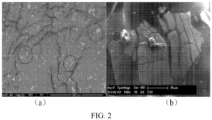
- FIG. 2 shows scanning electron micrographs of the distribution of bioactive glass in the tooth strip with remineralization capability obtained in Example 1 and Example 2 of the present application, in which, FIG. (a) shows the distribution of bioactive glass in the tooth strip obtained in Example 1; and FIG. (b) shows the distribution of bioactive glass in the tooth strip obtained in Example 2.
- the bioactive glass was uniformly dispersed in the tooth strip obtained in Example 1 of the present application.
- the bioactive ingredient was uniformly dispersed in the tooth strip obtained in Example 2 of the present application.
- the small white particles in the figures are all bioactive ingredients (as indicated by circles).
- FIG. 3 is a diagram showing the whitening efficacy of a tooth strip with remineralization capability on an in-vitro model of teeth staining caused by different substances, the tooth strip being obtained in Example 1 of the present application and used for 3, 7, and 14 days
- the substance in Fig. a is coffee, from left to right: untreated - after 14 days of coffee staining - after 3 days of using the tooth strip - after 7 days of using the tooth strip - after 14 days of using the tooth strip;
- the substance in Fig. b is black tea, from left to right: untreated - after 14 days of black tea staining - after 3 days of using the tooth strip - after 7 days of using the tooth strip - after 14 days of using the tooth strip).
- the color of the in-vitro teeth becomes darker after 14 days of staining with coffee and black tea respectively.
- 7 days and 14 days with the tooth strip with remineralization capability obtained in Example 1 the color of the in-vitro teeth in both groups gradually becomes lighter. It can be seen that the tooth strip with remineralization capability obtained in Example 1 has a better whitening effect.
- FIG. 4 is a diagram showing the whitening efficacy of a tooth strip with remineralization capability on an in-vitro model of teeth staining caused by different substances, the tooth strip being obtained in Example 2 of the present application and used for 3 days, 7 days and 14 days
- the substance in Fig. a is coffee, from left to right: untreated - after 14 days of coffee staining - after 3 days of using the tooth strip - after 7 days of using the tooth strip - after 14 days of using the tooth strip; the substance in Fig. b is black tea, from left to right: untreated - after 14 days of black tea staining - after 3 days of using the tooth strip - after 7 days of using the tooth strip - after 14 day of using the tooth strip) .
- the color of the in-vitro teeth becomes darker after 14 days of staining with coffee and black tea.
- 7 days and 14 days with the tooth strip with remineralization capability obtained in Example 2 the color of the in-vitro teeth in both groups gradually becomes lighter. It can be seen that the tooth strip with remineralization capability obtained in Example 1 has a better whitening effect.
- FIG. 5 is a schematic diagram of the degree of tooth whitening after use of the tooth strip obtained in Example 1, Example 2 and Comparative Example 2 of the present application (from left to right, Comparative Example 2, Example 1 and Example 2, respectively).
- the tooth strips obtained in Examples 1 and 2 have a better whitening efficacy than that of Comparative Example 2 after 3 and 7 days of use.
- the tooth strips obtained in Examples 1 and 2 have the same good whitening efficacy as that of Comparative Example 2 after 14 days of use.
- FIG. 6 is a graph showing the formation of a remineralization layer on the enamel surface of the in-vitro teeth after 7 days treatment with the tooth strips obtained in Example 1 and Comparative Example 1 of the present application respectively, in which (a) is the result of Comparative Example 1, and (b) is the result of Example 1.
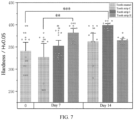
- FIG. 7 is a graph comparing the effects of the tooth strips of Examples and Comparative Examples of the present application on coffee-stained enamel hardness (Comparative Example 1 is the tooth strip C in the figure, Example 1 is the tooth strip I in the figure, and Example 2 is the tooth strip II in the figure).
- a hardness of the tooth enamel is significantly increased after treatment with the tooth strip of Example 1 for 7 days and after treatment with the tooth strip of Example 2 for 14 days as compared to the tooth strip of Comparative Example 1.
- FIG. 8 is a scanning electron micrograph of the tooth strips obtained in Example 3 and Comparative Example 1 of the present application, the tooth strips being immersed in artificial saliva for 7 days, in which (a) is a scanning electron micrograph of the tooth strip obtained in Comparative Example 1 after being immersed in artificial saliva for 7 days, and (b) is a scanning electronic micrograph of the tooth strip obtained in Example 3; as shown in FIG. 8 , the tooth strip of Example 3 is able to produce more apatite precipitates than Comparative Example 1 after 7 days of immersion.
- FIG. 9 is a structural diagram of the tooth strip with remineralization capability obtained in Example 1 of the present application.
- the structure of the tooth strip with remineralization capability obtained in Example 1 of the present application includes a three-layer structure: 1) a peel-off backing layer, 2) a dental gel layer, and 3) an anti-sticking liner.
Landscapes
- Health & Medical Sciences (AREA)
- Life Sciences & Earth Sciences (AREA)
- Veterinary Medicine (AREA)
- Public Health (AREA)
- General Health & Medical Sciences (AREA)
- Animal Behavior & Ethology (AREA)
- Birds (AREA)
- Epidemiology (AREA)
- Chemical & Material Sciences (AREA)
- Inorganic Chemistry (AREA)
- Engineering & Computer Science (AREA)
- Emergency Medicine (AREA)
- Oral & Maxillofacial Surgery (AREA)
- General Chemical & Material Sciences (AREA)
- Organic Chemistry (AREA)
- Chemical Kinetics & Catalysis (AREA)
- Dispersion Chemistry (AREA)
- Geochemistry & Mineralogy (AREA)
- Materials Engineering (AREA)
- Molecular Biology (AREA)
- Crystallography & Structural Chemistry (AREA)
- Ceramic Engineering (AREA)
- Bioinformatics & Cheminformatics (AREA)
- Medicinal Chemistry (AREA)
- Nuclear Medicine, Radiotherapy & Molecular Imaging (AREA)
- Pharmacology & Pharmacy (AREA)
- Biomedical Technology (AREA)
- Cosmetics (AREA)
Abstract
Description
- The present application claims priority to
Chinese Patent Application No. 202111143027.2, entitled with "TOOTH GEL AND TOOTH STRIP WITH REMINERALIZATION CAPABILITY AND PREPARATION METHOD OF TOOTH GEL", filed with China National Intellectual Property Administration on September 28, 2021 - The present application belongs to the technical field of oral health and biomimetic biomaterial engineering technology (biomineralization), and particularly relates to a tooth gel and tooth strip with remineralization capability and a preparation method of the tooth gel.
- Oral health is an important component of general health. However, at present, dental caries, periodontal disease and dentin hypersensitivity are still the most common oral diseases in the world, which seriously affects people's quality of life. The degree of these oral diseases develops progressively over time, and the remineralization of dental tissue is expected to block the development of these diseases and repair damaged teeth.
- In addition, with the improvement of people's living standards, people's awareness of oral aesthetics is becoming stronger and stronger, and more and more attention is paid to dental cosmetology. Tooth whitening is one of the most popular dental cosmetic ways at present, which is mainly achieved by chemical bleaching and cover-whitening. Chemical bleaching mainly includes cold-light whitening, denture whitening, tooth strip whitening, gargle whitening, whitening by sealing drug in teeth and so on.
- Among them, denture whitening and tooth strip whitening are the most widely used family whitening manners at present. Tooth strip whitening is more convenient and more common, and its price is cheaper than that of denture whitening.
- The construction of whitening tooth strip typically includes: a plastic film layer, a gel layer, and a peel-off backing layer. The gel layer contains a substance with tooth whitening efficacy which is closely connected with the plastic film layer. When in use, the peel-off backing layer is torn off, a surface with the gel layer is adhered to the surface of teeth, and the tooth strip is adjusted by gently pressing it with a finger to be completely adhered to the surface of the teeth. After use, the tooth strip is taken out from the teeth and discarded. Whitening tooth strip is favored by consumers because of its advantages of convenience for carrying, ease of use, low price, etc. For example, according to Chinese patent application
CN202011233081.1 CN201710548647.1 - Hydrogen peroxide has been used in tooth whitening for 40 years, and its effect and safety are higher than other tooth whitening ingredients. At present, hydrogen peroxide is still the commonly used or auxiliary active ingredient in household tooth whitening products and professional tooth whitening manners. The traditional whitening tooth paste has the following problems: (1) hydrogen peroxide will oxidize the adhesive in the product formula, resulting in the collapse of the gel skeleton structure and poor stability of the product over time; (2) a gel layer of the whitening tooth paste has poor water resistance, resulting in a short time for hydrogen peroxide to act on teeth, and therefore the whitening effect is not obvious, which cannot meet the user's requirements; (3) hydrogen peroxide will bring many side effects to teeth and oral cavity, such as damage to mechanical hardness of enamel surface, irritation to soft tissue, tooth sensitivity, acute pulpitis and other problems.
- In addition, some exogenous or endogenous factors often cause teeth to show colored spots or plaque appearance, which seriously affects the beauty of teeth. Cold-light whitening technology can remove pigments by a whitening agent, such as carbamide peroxide, hydrogen peroxide or hypochlorous acid, which generates free radicals to perform a redox reaction with pigment molecules on the surface and in deep layer of teeth. However, the use of whitening agent will lead to different degrees of tooth sensitivity, and is prone to secondary staining, which will damage people's health after long-term use.
- Remineralization therapy is one of the common methods for the treatment of dental caries, which means using artificial methods to re-mineralize the demineralized enamel or cementum, restoring its hardness and terminating or eliminating early caries. Remineralization therapy is mainly directed to susceptible persons for preventing early enamel caries (chalky spot or brown spot) and caries of smooth tooth surfaces. The remineralization solution used in the remineralization therapy mainly contains calcium, phosphorus and fluorine in different proportions. The addition of fluorine may significantly promote the remineralization of enamel. The pH of the remineralization solution is generally adjusted to 7. The acidic environment may weaken the mineralization effect of the mineralization solution. The application method of remineralization therapy includes the following steps: (1) preparing into a gargle for gargling daily; and (2) local application: cleaning and drying the tooth surface, and placing a cotton ball soaked with mineralization solution on the affected part for a few minutes each time, and repeating for 3-4 times.
- The advantages of remineralization mechanism may make up for the shortcomings of traditional whitening tooth strip and cold-light whitening technology. At the same time, the remineralization solution used in remineralization treatment has certain remineralization ability, but it is inconvenient to use, and its remineralization efficacy needs to be improved. Therefore, it is of great significance to develop tooth gel and tooth strip with remineralization ability so as to prevent or repair demineralized tooth tissue conveniently and effectively, and, for the whitening tooth strip, to improve the safety and reliability of tooth strip whitening technology.
- In order to realize minimally-invasive tooth whitening, prevent oral diseases such as caries and periodontal diseases, improve the safety of the tooth whitening technology, enhance the remineralization treatment effect of dental diseases such as shallow caries and dentin hypersensitivity, and facilitate the use of remineralization products, the present application provides a tooth strip and a tooth gel with remineralization capability and a preparation method of the tooth gel. The tooth gel and tooth strip are functional tooth gel and tooth strip that contain bioactive ingredients (including bioactive glass and calcium phosphate), respectively.
- The purpose of the present application is achieved by the following technical solutions.
- The present application firstly provides a tooth gel with remineralization capability, including the following raw material components by mass:
- 1-35% of active ingredient,
- 20-60% of thickening agent,
- 20-70% of solvent,
- 5-25% of solid dispersant,
- 0.1-0.8% of essence,
- 0. 1-1.0% of sweetener,
- 0.1-1.0% of pH regulator;
- the raw material for preparing the active ingredient includes calcium phosphate, bioactive glass, or a combination thereof in any proportion.
- Further, the raw material components also include, by mass, 0.1-1% of stabilizer.
- The present application further provides a tooth gel with remineralization capability, including the following raw material components by mass:
- 1-35% of active ingredient,
- 20-60% of thickening agent,
- 20-70% of solvent,
- 5-25% of solid dispersant,
- 0.1-0.8% of essence,
- 0.1-1% of stabilizer,
- 0.1-1.0% of pH regulator;
- the raw material for preparing the active ingredient includes calcium phosphate, bioactive glass, or a combination thereof in any proportion.
- Further, the raw material components also include, by mass, 0.1-1.0% of sweetener.
- Further, the calcium phosphate is amorphous calcium phosphate (ACP), casein phosphopeptide-calcium phosphate complex (ACP-CPP), calcium hydrogen phosphate dihydrate (Brushite), octacalcium phosphate (OCP), β-tricalcium phosphate (β-TCP), an apatite-like phase ((Ca/Sr/Mg)10(PO4)6/((OH/F/Cl)2/CO3)), or any combination thereof in any proportion; where the apatite-like phase is one or more of hydroxyapatite (Ca10(PO4)6(OH)2), fluorapatite (Ca10(PO4)6F2), chlorapatite (Ca10(PO4)6Cl2) and composite apatite (X10(PO4)6Y2, where X is selected from at least one of Ca, Sr and Mg, and Y is selected from at least one of OH, F, Cl and CO3).
- Further, the bioactive glass is amorphous bioactive glass or bioactive glass-ceramic containing a crystalline phase in its bioactive glass matrix. The raw material components of the bioactive glass include: SiO2, P2O5, and one or more selected from Li2O, Na2O, CaO, SrO, MgO, SnO, K2O, CaF2, SrF2, SrCl2, NaF, LaF3, KF, CaCl2, LaCl3, KCl, MgCl2, CuO and ZnO, and a content of P2O5 in the components of the bioactive glass is more than 2.0mol%; when metal fluoride is included, a total content of the metal fluoride in the components of the bioactive glass is less than 9.3mol%; the contents of the raw material components of the bioactive glass enable a network connectivity NC of the bioactive glass to meet the following: 1.5≤NC≤3.2, where a calculation formula of NC is NC=[4× MSiO
2 -2×(MMO+MN2 O)+6×MP2 O5 ]/MSiO2 , and in the formula: MSiO2 is a molar percentage content of SiO2 in a medical bioactive glass; MMO is a molar percentage content of alkaline earth metal oxide in the medical bioactive glass, MN2 O is a molar percentage content of alkali metal oxide in the medical bioactive glass, and MP2 O5 is a molar percentage content of P2O5 in the medical bioactive glass; and the bioactive glass is prepared by a high-temperature melting and cold-quenching method. - Further, the raw material components of the bioactive glass include: SiO2, P2O5, and one or more selected from Li2O, CaO, SrO, MgO, SnO, K2O, CaF2, SrF2, SrCl2, NaF, LaF3, KF, CaCl2, LaCl3, KCl, MgCl2, CuO and ZnO, and a content of P2O5 in the components of the bioactive glass is more than 2.0mol%;
- when metal fluoride is included, a total content of the metal fluoride in the components of the bioactive glass is less than 9.3mol%;
- the contents of the raw material components of the bioactive glass enable a network connectivity NC of the bioactive glass to meet the following: 1.5≤NC≤3.2,
- More preferably, when the raw material components of the bioactive glass include at least one of functional metal oxides SnO, CuO and ZnO, a content of each functional metal oxide in the components of the bioactive glass is less than 5.0mol%; and a content of P2O5 in the components of the bioactive glass is more than 3.5mol%; when the metal fluoride is included, a total content of the metal fluoride in the components of the bioactive glass is less than 6.0mol%; the contents of the raw material components of the bioactive glass meet the following: 1.5≤NC≤2.4.
- Further, the raw material for preparing the active ingredients also includes one or more of desensitizer, whitening agent, antibacterial agent, and anti-caries ingredient.
- Further, the desensitizer is potassium nitrate, oxalic acid, calcium oxalate, tea polyphenol, catechol, glyceryl linoleate, glyceryl oleate, or any combination thereof in any proportion; the whitening agent is carbamide peroxide, hydrogen peroxide, sodium hypochlorite, or any combination thereof in any proportion; the antibacterial agent is selected from one of a compound or complex capable of releasing silver ions, copper ions, strontium ions, cobalt ions and zinc ions, or from any combination thereof in any proportion; the anti-caries component is selected from one of fluorine-containing bioactive glass that is capable of releasing fluoride ions and soluble fluoride, or from any combination thereof in any proportion. The soluble fluoride may be selected from at least one of sodium fluoride, potassium fluoride, fluorine-containing ammonium salt, sodium monofluorophosphate, lanthanum fluoride, etc.
- Further, the thickening agent is selected from one of sodium polyacrylate, cellulose, N-vinyl amide polymer, carbomer, sodium alginate, gelatin and the like, or from any combination thereof in any proportion; the solvent is selected from one of glycerol, absolute ethanol and water, or from any combination thereof in any proportion; the solid dispersant is selected from
polyethylene glycol 400; the sweetener is selected from acesulfame potassium; the essence is selected from essence such as menthol; the pH regulator is selected from one of NaOH, KOH, NaHCO3 or H3PO4. - The tooth gel of the present application may be used as a separate commodity for oral tooth desensitization, whitening, antibiosis, caries prevention and the like, and may also be used for oral tooth desensitization, whitening, caries prevention and the like in combination with a tooth strip, a denture, etc.
- The present application also provides a tooth strip with remineralization capability, including a three-layer structure: an anti-sticking liner, a dental gel layer, and a peel-off backing layer, where the anti-sticking liner is adhered to one side of the dental gel layer, and the other side of the dental gel layer is adhered to the peel-off backing layer. The dental gel layer is the tooth gel with remineralization capability with a thickness of 100-300 um. The anti-sticking liner is selected from one of a polymer, a fabric or a film, one side of the anti-sticking liner is attached with a dental gel layer, and the other side of the anti-sticking liner is provided with an anti-sticking treatment to prevent lips from being adhered. The peel-off backing layer is selected from one of a PET sheet, a foil, a plastic sheet or a paper.
- The present application further provides a method for preparing the above-mentioned tooth gel with remineralization capability, including the following steps:
- 1) accurately weighing each kind of raw materials according to a formula;
- 2) adding a thickening agent, a solid dispersant and an active ingredient into a solvent for homogeneous emulsification to obtain uniformly dispersed and completely mixed and dissolved materials;
- 3) keeping the materials obtained in the step 2) at a temperature of 60°C, adding a stabilizer, an essence and a sweetener, and uniformly stirring;
- 4) slowly adding a pH regulator into the materials obtained in the step 3), and uniformly stirring; and
- 5) allowing the materials obtained in the step 4) to stand for 24 hours, thereby obtaining the tooth gel with remineralization capability.
- In the preparation method of the present application, the uniformly stirring in step 3) means setting a rotation speed of a stirrer to be 25-35 rpm and stirring for 10 minutes.
- In the step 4), when a temperature of the material obtained in the step 3) is reduced to 40-45 °C, a whitening agent is added to prepare a whitening tooth gel or tooth strip.
- The uniformly stirring in the step 4) means setting a rotation speed of the stirrer to be 15-25 rpm, and stirring until a resulting mixture is uniform.
- Compared with the prior art, the present application has the following advantages:
- 1. In the prior art, the glass of the whitening tooth strip containing a bioactive glass has low bioactivity (for example,
Chinese Patent Application No.201910763871.1 FIG. 1 ). In addition, the inventor also found that when the bioactive glass contains fluoride, such as CaF2, SrF2, LaF3 or a mixture thereof, and more importantly, when a content of the fluoride in the bioactive glass is less than 9.3mol%, the formation of acid-resistant fluorapatite rather than CaF2 or SrF2 is promoted, thereby improving the remineralization capacity of the material. - 2. The tooth gel and the tooth strip with remineralization capability described in the present application are convenient to carry and use; have the functions of desensitization, remineralization, antibiosis, caries prevention, whitening and the like; have little or no irritation to oral soft tissues; and have important effects and significance for preventing and treating oral diseases and improving people's health.
- These and/or other aspects and advantages of the present application will become more apparent and more readily appreciated from the following detailed description of embodiments of the present application taken in conjunction with the accompanying drawings, in which:
-
FIG. 1 is X-ray diffraction patterns of the products obtained after soaking a bioactive glass containing different contents of phosphorus in a buffer solution for one week, of which figure (a) belongs to low-phosphorus bioactive glass, and figure (b) belongs to high-phosphorus bioactive glass. -
FIG. 2 is a scanning electron micrograph of the distribution of bioactive glass in a tooth strip with remineralization capability obtained in Example 1 of the present application. -
FIG. 3 is a diagram showing the whitening efficacy of a tooth strip with remineralization capability obtained in Example 1 of the present application on in vitro model of stained-teeth caused by different substances, after 3 days, 7 days and 14 days of use, in which the substance in figure (a) is coffee, and the substance in figure (b) is black tea. -
FIG. 4 is a diagram showing the whitening efficacy of the tooth strip with remineralization capability obtained in Example 2 of the present application on in vitro model of stained-teeth caused by (a) coffee and (b) black tea, after 3 days, 7 days and 14 days of use. -
FIG. 5 is a diagram showing that the tooth strips obtained in Examples and Comparative Examples of the present application have equally good whitening efficacy after use. -
FIG. 6 is a diagram showing the formation of a remineralization layer on the enamel surface of the in vitro teeth after 7 days of treatment with each of the tooth strips obtained in Example 1 and Comparative Example 1 of the present application. -
FIG. 7 is a graph comparing the effects of the tooth strips of Examples and Comparative Example of the present application on coffee-stained enamel hardness. -
FIG. 8 is a diagram showing the repair-remineralization capability of the tooth strips obtained in Example 3 and Comparative Example 1 of the present application. -
FIG. 9 is a structural diagram of the tooth strip with remineralization capability obtained in Example 1 of the present application (in thefigure: 1 . peel-off backing layer; 2. dental gel layer; 3. anti-sticking liner). - The present application is further described in detail through embodiments, however, those embodiments should not be considered as a limitation of the present application.
- A tooth strip with remineralization capability was prepared by a three-layer structure: an anti-sticking liner, a dental gel layer, and a peel-off backing layer, where the anti-sticking liner was tightly adhered to one side of the dental gel layer, the dental gel layer had a thickness of 100um, active ingredients were dispersed in the dental gel layer, and the other side of the dental gel layer was tightly adhered to the peel-off backing layer.
- The anti-sticking liner was a transparent soft film adhesive attachment layer and was selected from natural polymers.
- The peel-off backing layer was a transparent film and was a sheet selected from PET material.
- The dental gel layer was a water-insoluble film layer and was prepared from the following components in percentage by mass:
- 35% of active ingredient;
- 20% of thickening agent;
- 25% of solvent;
- 19% of solid dispersant;
- 0.2% of essence;
- 0.3% of sweetener;
- 0.5% of pH regulator.
- The active ingredient was prepared from a bioactive ingredient, a desensitizer, a whitening agent, an antibacterial agent and an anti-caries ingredient, with a mass ratio of 6:1:1:1:1.
- The bioactive ingredient was a bioactive glass.
- The bioactive glass was a bioactive glass-ceramic containing a small amount of crystalline phase in its matrix, and is prepared from SiO2, P2O5, CaF2, CaO and Na2O by a high-temperature melting cold-quenching (melt-quench) method, where P2O5 had a content of 5.5mol%; a fluoride CaF2 was included in a content of 6.0mol%; in addition, the contents of the components of the bioactive glass satisfied: NC is 2.0.
- The desensitizer was an equal-mass mixture of potassium nitrate and glyceryl oleate.
- The whitening agent was an equal-mass mixture of carbamide peroxide, hydrogen peroxide and hypochlorous acid.
- The antibacterial agent was a mixture of compounds that can release silver ions and copper ions respectively, in a mass ratio of 1:2.
- The anti-caries ingredient was a mixture of sodium fluoride, potassium fluoride, fluoride-containing ammonium salt, sodium monofluorophosphate and lanthanum fluoride in any proportion.
- The thickening agent was selected from sodium polyacrylate.
- The solvent was selected from a mixture of glycerol and absolute ethanol in equal volume.
- The solid dispersant was selected from
polyethylene glycol 400. - The sweetener was selected from acesulfame potassium.
- The pH regulator was selected from NaOH.
- A method for preparing the above mentioned tooth strip with remineralization capability included the following steps:
- 1) accurately weighing each kind of raw materials according to a proportion of components of the dental gel layer;
- 2) adding the weighed thickening agent, solid dispersant and active ingredients into a solvent, performing homogeneous emulsification in a stirrer until these components are uniformly dispersed, completely mixed and dissolved;
- 3) keeping the materials in the step 2) at a temperature of 60°C, adding a stabilizer and an essence, setting a rotation speed of the stirrer to be 30 rpm, and stirring for 10 minutes;
- 4) preparing a whitening tooth strip: adding a whitening agent when the temperature of the materials in the step 3) is reduced to 40-45°C;
- 5) slowly adding a pH regulator into the above-mentioned materials, and simultaneously starting the stirrer and stirring at a rotation speed of 20 rpm until the materials are uniformly mixed;
- 6) stand for 24 hours, then inspecting, coating the qualified mixture uniformly on a plastic film, and laminating;
- 7) machine-cutting and molding the laminated semi-finished product according to the shape of the tooth strip, and packaging.
- The use method of the tooth strip included tearing the tooth strip off from the peel-off backing layer, sticking one side of the dental gel layer on a buccal side of a dental crown, placing a long edge of the dental gel layer to be flush with a gingival margin, and gently pressing the tooth strip to make it fully adhered to the teeth for 30-60 minutes, tearing off the tooth strip, and gargling properly to clean the teeth as required.
- The formula of the dental gel layer in this Example can be separately used or packaged as a tooth gel product. It was a gel-like gel, which was used in combination with a thermoset resin denture sheet, that was to say, the thermoset resin denture sheet was placed in hot water of 70-80°C for 10-30 seconds to be softened and then taken out, and the softened denture sheet was sleeved on the teeth and pressed and shaped by a finger and removed; a proper amount of the tooth gel was introduced into the removed shaped denture sheet; and then the denture was put on and kept for 15-30 minutes and removed, and mouth was rinsed properly to clean the teeth as required. During use of the gel, it was not allowed for eating, drinking and smoking.
- Similarly, the dental gel layer formula in other Examples can also be prepared according to the composition and contents of the formula to obtain a separate tooth gel product, which can be packaged as a commodity, or used in combination with an orthodontic denture, or used separately for minimally invasive tooth whitening, prevention of dental caries and prevention of periodontal disease.
- A tooth strip with remineralization capability, which was prepared by a three-layer structure: an anti-sticking liner, a dental gel layer, and a peel-off backing layer, where the anti-sticking liner was tightly adhered to one side of the dental gel layer, the dental gel layer had a thickness of 300um, active ingredients were dispersed in the dental gel layer, and the other side of the dental gel layer was tightly adhered to the peel-off backing layer.
- The anti-sticking liner was an opaque soft film adhesive attachment layer and was selected from fabric.
- The peel-off backing layer was a transparent film and was selected from a foil of PET material.
- The dental gel layer was a water-insoluble film layer and was prepared from the following components in percentage by mass:
- 20% of active ingredient;
- 41% of thickening agent;
- 20% of solvent;
- 17.8% of solid dispersant;
- 0.1% of essence;
- 1.0% of sweetener;
- 0.1% of pH regulator.
- The active ingredient was prepared from a bioactive ingredient, a whitening agent, an antibacterial agent and an anti-caries ingredient, with a mass ratio of 6:1:1:2;
- The bioactive ingredient was a bioactive glass.
- The bioactive glass was an amorphous bioactive glass, and prepared from SiO2, P2O5, Li2O, SrO, MgO, SnO, SrF2, SrCl2 and KCl by a high-temperature melting cold-quenching (melt-quench) method, where P2O5 had a content of 4.0mol%; a fluoride SrF2 was included in a content of 9.0mol%; in addition, the contents of the components of the bioactive glass satisfied: NC is 2.4.
- The whitening agent was hydrogen peroxide.
- The antibacterial agent was a mixture of compounds that can release silver ions, copper ions and strontium ion respectively, in a mass ratio of 1:2:1.
- The anti-caries ingredient was sodium fluoride.
- The thickening agent was selected from cellulose.
- The solvent was selected from a mixture of glycerol and water in a volume ratio of 1:2.
- The solid dispersant was selected from
polyethylene glycol 400. - The sweetener was selected from acesulfame potassium.
- The pH regulator was selected from KOH.
- A method for preparing the above mentioned tooth strip with remineralization capability included the following steps:
- 1) accurately weighing each kind of raw materials according to a proportion of components of the dental gel layer;
- 2) adding the weighed thickening agent, solid dispersant and active ingredients into a solvent, performing homogeneous emulsification in a stirrer until these components are uniformly dispersed, completely mixed and dissolved;
- 3) keeping the materials in the step 2) at a temperature of 60°C, adding a stabilizer and an essence, setting a rotation speed of the stirrer to be 30 rpm, and stirring for 10 minutes;
- 4) preparing a whitening tooth strip: adding a whitening agent when the temperature of the materials in the step 3) is reduced to 40-45°C;
- 5) slowly adding a pH regulator into the above-mentioned materials, and simultaneously starting the stirrer and stirring at a rotation speed of 20 rpm until the materials are uniformly mixed;
- 6) stand for 24 hours, then inspecting, coating the qualified mixture uniformly on a plastic film, and laminating;
- 7) machine-cutting and molding the laminated semi-finished product according to the shape of the tooth strip, and packaging.
- The use method of the tooth strip included tearing the tooth strip off from the peel-off backing layer, sticking one side of the dental gel layer on a buccal side of a dental crown, placing a long edge of the dental gel layer to be flush with a gingival margin, and gently pressing the tooth strip to make it fully adhered to the teeth for 30-60 minutes, tearing off the tooth strip, and gargling properly to clean the teeth as required.
- A tooth strip with remineralization capability was prepared by a three-layer structure: an anti-sticking liner, a dental gel layer, and a peel-off backing layer, where the anti-sticking liner was tightly adhered to one side of the dental gel layer, the dental gel layer had a thickness of 200um, active ingredients were dispersed in the dental gel layer, and the other side of the dental gel layer was tightly adhered to the peel-off backing layer.
- The anti-sticking liner was a transparent soft film adhesive attachment layer and was selected from a film.
- The peel-off backing layer was an opaque film and was selected from paper of PET material.
- The dental gel layer was a water-insoluble film layer and prepared from the following components in percentage by mass:
- 3.1% of active ingredient;
- 20% of thickening agent;
- 70% of solvent;
- 5% of solid dispersant;
- 0.6% of essence;
- 1.0% of sweetener;
- 0.3% of pH regulator.
- The active ingredient was prepared from a bioactive ingredient, an antibacterial agent and an anti-caries ingredient, with a mass ratio of 6:1:1.
- The bioactive ingredient was a bioactive glass.
- The bioactive glass was a bioactive glass-ceramic containing a small amount of crystalline phase in its matrix, and was prepared from SiO2, P2O5, CaO, K2O, CuO and CaCh by a high-temperature melting cold-quenching (melt-quench) method, where P2O5 had a content of 2.5mol%, and CuO had a content of 2.0mol%; in addition, the contents of the components of the bioactive glass satisfied: NC is 3.2.
- The antibacterial agent was a mixture of compounds that can release copper ions and strontium ions respectively in a mass ratio of 1:2.
- The anti-caries ingredient was lanthanum fluoride.
- The thickening agent was a mixture of N-vinyl amide polymer and sodium alginate in a mass ratio of 1:1.
- The solvent was selected from glycerol.
- The solid dispersant was selected from
polyethylene glycol 400. - The sweetener was selected from acesulfame potassium.
- The pH regulator was selected from NaHCO3.
- A method for preparing the above mentioned tooth strip with remineralization capability included the following steps:
- 1) accurately weighing each kind of raw materials according to a proportion of components of the tooth strip;
- 2) adding the weighed thickening agent, solid dispersant and active ingredient into a solvent, and performing homogeneous emulsification in a stirrer until these components are uniformly dispersed, completely mixed and dissolved;
- 3) keeping the materials in the step 2) at a temperature of 60°C, adding a stabilizer and an essence, setting a rotation speed of the stirrer to be 30 rpm, and stirring for 10 minutes;
- 4) slowly adding a pH regulator into the above-mentioned materials, and simultaneously starting the stirrer and stirring at a rotation speed of 20 rpm until the materials are uniformly mixed;
- 5) stand for 24 hours, then inspecting, coating the qualified mixture uniformly on a plastic film, and laminating;
- 6) machine-cutting and molding the laminated semi-finished product according to the shape of the tooth strip, and packaging.
- The use method of the tooth strip included tearing the tooth strip off from the peel-off backing layer, sticking one side of the dental gel layer on a buccal side of a dental crown, placing a long edge of the dental gel layer to be flush with a gingival margin, and gently pressing the tooth strip to make it fully adhered to the teeth for 30-60 minutes, tearing off the tooth strip, and gargling properly to clean the teeth as required.
- A tooth gel with remineralization capability was provided.
- The tooth gel was prepared from the following components in percentage by mass:
- 15% of active ingredient;
- 30% of thickening agent;
- 32.7% of solvent;
- 20% of solid dispersant;
- 0.8% of essence;
- 0.5% of sweetener;
- 1.0% of pH regulator.
- The active ingredient was prepared from a bioactive ingredient and a desensitizer, with a mass ratio of 6:1.
- The bioactive glass was a casein phosphopeptide-calcium-phosphorus complex.
- The desensitizer was an equal-mass mixture of oxalic acid, calcium oxalate, catechol, and glyceryl linoleate.
- The thickening agent was selected from N-vinyl amides polymer.
- The solvent was an equal-volume mixture of absolute ethanol and water.
- The solid dispersant was selected from
polyethylene glycol 400. - The sweetener was selected from acesulfame potassium.
- The pH regulator was selected from NaHCO3.
- A method for preparing the above mentioned tooth gel with remineralization capability included the following steps:
- 1) accurately weighing each kind of raw materials according to a proportion of components of the tooth gel;
- 2) adding the weighed thickening agent, solid dispersant and active ingredient into a solvent, and performing homogeneous emulsification in a stirrer until these components are uniformly dispersed, completely mixed and dissolved;
- 3) keeping the materials in the step 2) at a temperature of 60°C, adding a stabilizer and an essence, setting a rotation speed of the stirrer to be 30 rpm, and stirring for 10 minutes;
- 4) slowly adding a pH regulator into the above-mentioned materials, and simultaneously starting the stirrer and stirring at a rotation speed of 20 rpm until the materials are uniformly mixed;
- 5) sealing and packaging after the resulting product is inspected to be qualified.
- The use method of the tooth gel included taking a proper amount of the tooth gel and evenly smearing it on the tooth surface to form a thin layer of tooth gel with a thickness of about 0.5 mm; taking a proper amount of matched anti-sticking liner film to cover an outer side of the tooth gel so as to prevent the tooth gel from being adhered to lips, keeping for 15-30 minutes; wiping or tearing off the thin layer of tooth gel, and gargling properly to clean the teeth as required. During use of the gel, it was not allowed for eating, drinking and smoking.
- A whitening tooth gel with remineralization capability was provided.
- The tooth gel was prepared from the following components in percentage by mass:
- 1% of active ingredient;,
- 60% of thickening agent;
- 26.7% of solvent;
- 10% of solid dispersant;
- 0.8% of essence;
- 0.5% of sweetener;
- 1.0% of pH regulator.
- The active ingredient was a bioactive ingredient.
- The bioactive ingredient was a mixture of amorphous calcium phosphate and a bioactive glass, with a mass ratio of 1:1.
- The bioactive glass was a bioactive glass-ceramic containing a small amount of crystalline phase in its matrix, and was prepared from SiO2, P2O5, CaO, CaF2, K2O, ZnO and CaCh by a high-temperature melting cold-quenching (melt-quench) method, where P2O5 had a content of 2.5mol%; a fluoride CaF2 was included in a content of 3.0mol%; ZnO had a content of 4mol%; in addition, the contents of the components of the bioactive glass satisfied: NC is 1.5.
- The thickening agent was a mixture of carbomer and gelatin in a mass ratio of 2: 1.
- The solvent was an equal-volume mixture of absolute ethanol and water.
- The solid dispersant was selected from
polyethylene glycol 400. - The sweetener was selected from acesulfame potassium.
- The pH regulator was selected from NaHCO3.
- A method for preparing the above mentioned whitening tooth gel with remineralization capability included the following steps:
- 1) accurately weighing each kind of raw materials according to a proportion of components of the tooth gel;
- 2) adding the weighed thickening agent, solid dispersant and active ingredient into a solvent, and performing homogeneous emulsification in a stirrer until these components are uniformly dispersed, completely mixed and dissolved;
- 3) keeping the materials in the step 2) at a temperature of 60°C, adding a stabilizer and an essence, setting a rotation speed of the stirrer to be 30 rpm, and stirring for 10 minutes;
- 4) preparing a whitening tooth gel: adding a whitening agent when the temperature of the materials in the step 3) is reduced to 45°C;
- 5) slowly adding a pH regulator into the above-mentioned materials, and simultaneously starting the stirrer and stirring at a rotation speed of 20 rpm until the materials are uniformly mixed;
- 6) sealing and packaging after the resulting product is inspected to be qualified.
- The difference between this Comparative Example from Example 1 was that in this example, no bioactive glass was contained, and other components and preparation process were the same as those in Example 1.
- Compared with Example 1, the bioactive glass in the tooth strip formula of Comparative Example 2 was the bioactive glass involved in patent
CN201910763871.1 - Studies have shown that increasing a content of P2O5 in the bioactive glass can increase the rate and yield of apatite formation from the bioactive glass, thereby improving the remineralization capacity of the material (as shown in
FIG. 1 ). In addition, the bioactive glass involved in Example 1 contains CaF2 with a content of 6.0mol%, which leads to generation of acid-resistant fluorapatite rather than calcium fluoride crystals after glass degradation, thereby providing better remineralization capacity of material. -
FIG. 1 shows X-ray diffraction patterns of products of two series of bioactive glass with different phosphorus contents, the product being obtained after soaking the bioactive glass in a buffer solution for one week, in whichFIG. 1(a) belongs to low-phosphorus bioactive glass (glass number is A-H, and a phosphorus content of the glass is about 1mol%),FIG. 1(b) belongs to high-phosphorus bioactive glass (glass number is A2-H2, and its phosphorus content is about 5mol%), and the main difference between two pieces of glass with the same letter number lies in phosphorus content. - Taking the glass A in
FIG. 1(a) and the glass A2 inFIG. 1(b) as examples, the inventors found that X-ray diffraction peaks matched with apatite can be seen in the XRD patterns of both the low-phosphorus bioactive glass (A) and the high-phosphorus bioactive glass (A2). However, the intensity of the X-ray diffraction peak of apatite generated in the glass A2 is much larger than that in the glass A, revealing that the high-phosphorus bioactive glass can produce apatite faster and more than the low-phosphorus bioactive glass. -
FIG. 2 shows scanning electron micrographs of the distribution of bioactive glass in the tooth strip with remineralization capability obtained in Example 1 and Example 2 of the present application, in which, FIG. (a) shows the distribution of bioactive glass in the tooth strip obtained in Example 1; and FIG. (b) shows the distribution of bioactive glass in the tooth strip obtained in Example 2. - As shown in
FIG. 2(a) , the bioactive glass was uniformly dispersed in the tooth strip obtained in Example 1 of the present application. As shown inFIG. 2(b) , the bioactive ingredient was uniformly dispersed in the tooth strip obtained in Example 2 of the present application. The small white particles in the figures are all bioactive ingredients (as indicated by circles). -
FIG. 3 is a diagram showing the whitening efficacy of a tooth strip with remineralization capability on an in-vitro model of teeth staining caused by different substances, the tooth strip being obtained in Example 1 of the present application and used for 3, 7, and 14 days (The substance in Fig. a is coffee, from left to right: untreated - after 14 days of coffee staining - after 3 days of using the tooth strip - after 7 days of using the tooth strip - after 14 days of using the tooth strip; the substance in Fig. b is black tea, from left to right: untreated - after 14 days of black tea staining - after 3 days of using the tooth strip - after 7 days of using the tooth strip - after 14 days of using the tooth strip). - As shown in
FIG. 3 , the color of the in-vitro teeth becomes darker after 14 days of staining with coffee and black tea respectively. After stained in-vitro teeth treatment of 3 days, 7 days and 14 days with the tooth strip with remineralization capability obtained in Example 1, the color of the in-vitro teeth in both groups gradually becomes lighter. It can be seen that the tooth strip with remineralization capability obtained in Example 1 has a better whitening effect. -
FIG. 4 is a diagram showing the whitening efficacy of a tooth strip with remineralization capability on an in-vitro model of teeth staining caused by different substances, the tooth strip being obtained in Example 2 of the present application and used for 3 days, 7 days and 14 days (The substance in Fig. a is coffee, from left to right: untreated - after 14 days of coffee staining - after 3 days of using the tooth strip - after 7 days of using the tooth strip - after 14 days of using the tooth strip; the substance in Fig. b is black tea, from left to right: untreated - after 14 days of black tea staining - after 3 days of using the tooth strip - after 7 days of using the tooth strip - after 14 day of using the tooth strip) . - As shown in
FIG. 4 , the color of the in-vitro teeth becomes darker after 14 days of staining with coffee and black tea. After stained in-vitro teeth treatment of 3 days, 7 days and 14 days with the tooth strip with remineralization capability obtained in Example 2, the color of the in-vitro teeth in both groups gradually becomes lighter. It can be seen that the tooth strip with remineralization capability obtained in Example 1 has a better whitening effect. -
FIG. 5 is a schematic diagram of the degree of tooth whitening after use of the tooth strip obtained in Example 1, Example 2 and Comparative Example 2 of the present application (from left to right, Comparative Example 2, Example 1 and Example 2, respectively). - The tooth strips obtained in Examples 1 and 2 have a better whitening efficacy than that of Comparative Example 2 after 3 and 7 days of use. The tooth strips obtained in Examples 1 and 2 have the same good whitening efficacy as that of Comparative Example 2 after 14 days of use.
-
FIG. 6 is a graph showing the formation of a remineralization layer on the enamel surface of the in-vitro teeth after 7 days treatment with the tooth strips obtained in Example 1 and Comparative Example 1 of the present application respectively, in which (a) is the result of Comparative Example 1, and (b) is the result of Example 1. - As shown in
FIG. 6 , no obvious remineralization layer is formed on the enamel surface of the in-vitro teeth treated with the tooth strip of Comparative Example 1; and an obvious apatite remineralization layer is formed on the enamel surface of the in-vitro teeth treated with the tooth strip of Example, which has obvious repair effect on the demineralized enamel. -
FIG. 7 is a graph comparing the effects of the tooth strips of Examples and Comparative Examples of the present application on coffee-stained enamel hardness (Comparative Example 1 is the tooth strip C in the figure, Example 1 is the tooth strip I in the figure, and Example 2 is the tooth strip II in the figure). - As shown in
FIG. 7 , a hardness of the tooth enamel is significantly increased after treatment with the tooth strip of Example 1 for 7 days and after treatment with the tooth strip of Example 2 for 14 days as compared to the tooth strip of Comparative Example 1. -
FIG. 8 is a scanning electron micrograph of the tooth strips obtained in Example 3 and Comparative Example 1 of the present application, the tooth strips being immersed in artificial saliva for 7 days, in which (a) is a scanning electron micrograph of the tooth strip obtained in Comparative Example 1 after being immersed in artificial saliva for 7 days, and (b) is a scanning electronic micrograph of the tooth strip obtained in Example 3; as shown inFIG. 8 , the tooth strip of Example 3 is able to produce more apatite precipitates than Comparative Example 1 after 7 days of immersion. -
FIG. 9 is a structural diagram of the tooth strip with remineralization capability obtained in Example 1 of the present application. The structure of the tooth strip with remineralization capability obtained in Example 1 of the present application includes a three-layer structure: 1) a peel-off backing layer, 2) a dental gel layer, and 3) an anti-sticking liner. - The above description is only preferred embodiment of the present application, and it should be noted that, for those of ordinary skill in the art, a number of modification and changes can be made without departing from the inventive concept of the present application, and these modification and changes fall within the scope of protection of this application.
the bioactive glass is prepared by a high-temperature melting cold-quenching method.
Claims (14)
- A tooth gel with remineralization capability, comprising the following raw material components by mass:1-35% of active ingredient;20-60% of thickening agent;20-70% of solvent;5-25% of solid dispersant;0.1-0.8% of essence;0.1-1.0% of sweetener;0.1-1.0% of pH regulator,the raw material for preparing the active ingredient comprises calcium phosphate, bioactive glass, or a combination thereof in any proportion.
- The tooth gel with remineralization capability according to claim 1, wherein the raw material components further comprise, by mass, 0.1-1% of stabilizer.
- A tooth gel with remineralization capability, comprising the following raw material components by mass:1-35% of active ingredient;20-60% of thickening agent;20-70% of solvent;5-25% of solid dispersant;0.1-0.8% of essence;0.1-1% of stabilizer;0.1-1.0% of pH regulator,the raw material for preparing the active ingredient comprises calcium phosphate, bioactive glass, or a combination thereof in any proportion.
- The tooth gel with remineralization capability according to claim 3, wherein the raw material components further comprise, by mass, 0.1-1.0% of sweetener.
- The tooth gel with remineralization capability according to any one of claims 1-4, wherein the calcium phosphate is amorphous calcium phosphate, casein phosphopeptide-calcium phosphate complex, brushite, octacalcium phosphate, β-tricalcium phosphate, an apatite-like phase, or any combination thereof in any proportion; wherein the apatite-like phase is one or more of hydroxyapatite, fluorapatite, chlorapatite and composite apatite.
- The tooth gel with remineralization capability according to claim 1 or 3, wherein the raw material components of the bioactive glass comprise: SiO2, P2O5, and one or more selected from Li2O, Na2O, CaO, SrO, MgO, SnO, K2O, CaF2, SrF2, SrCl2, NaF, LaF3, KF, CaCl2, LaCl3, KCl, MgCl2, CuO and ZnO, and a content of P2O5 in the raw material components of the bioactive glass is more than 2.0mol%;when a metal fluoride is contained, a total content of the metal fluoride in the raw material components of the bioactive glass is less than 9.3mol%;the contents of the raw material components of the bioactive glass enable a network connectivity, NC of the bioactive glass to satisfy: 1.5≤NC≤3.2, wherein NC is calculated by a formula: NC=[4× MSiO
2 -2×(MMO+MN2 O)+6×MP2 O5 ]/MSiO2 , and in the formula: MSiO2 is a molar percentage content of SiO2 in medical bioactive glass; MMO is a molar percentage content of alkaline earth metal oxide in the medical bioactive glass, MN2 O is a molar percentage content of alkali metal oxide in the medical bioactive glass, and MP2 O5 is a molar percentage content of alkali metal oxide in the medical bioactive glass; andthe bioactive glass is prepared by a high-temperature melting-cold quenching method. - The tooth gel with remineralization capability according to claim 1 or 3, wherein the raw material components of the bioactive glass comprise: SiO2, P2O5, and one or more selected from Li2O, CaO, SrO, MgO, SnO, K2O, CaF2, SrF2, SrCl2, NaF, LaF3, KF, CaCl2, LaCl3, KCl, MgCl2, CuO and ZnO, and a content of P2O5 in the raw material components of the bioactive glass is more than 2.0mol%;when a metal fluoride is contained, a total content of the metal fluoride in the raw material components of the bioactive glass is less than 9.3mol%;the contents of the raw material components of the bioactive glass enable a network connectivity, NC of the bioactive glass to satisfy: 1.5≤NC≤3.2, wherein NC is calculated by a formula: NC=[4× MSiO
2 -2×(MMO+ MN2 O)+6× MP2 O5 ]/MSiO2 , and in the formula: MSiO2 is a molar percentage content of SiO2 in medical bioactive glass; MMO is a molar percentage content of alkaline earth metal oxide in the medical bioactive glass, MN2 O is a molar percentage content of alkali metal oxide in the medical bioactive glass, and MP2 O5 is a molar percentage content of alkali metal oxide in the medical bioactive glass; andthe bioactive glass is prepared by a high-temperature melting-cold quenching method. - The tooth gel with remineralization capability according to claim 6 or 7, wherein when the raw material components of the bioactive glass comprise at least one of functional metal oxides SnO, CuO and ZnO, a content of each functional metal oxide in the raw material components of the bioactive glass is less than 5.0mol%; and a content of P2O5 in the raw material components of the bioactive glass is more than 3.5mol%;when the metal fluoride is contained, a total content of the metal fluoride in the raw material components of the bioactive glass is less than 6.0mol%;the contents of the raw material components of the bioactive glass satisfy: 1.5≤NC≤2.4.
- The tooth gel with remineralization capability according to claim 1 or 3, wherein the raw material for preparing the active ingredient further comprises one or more of desensitizer, whitening agent, antibacterial agent, and anti-caries ingredient.
- The tooth gel with remineralization capability according to claim 9, wherein the desensitizer is one of potassium nitrate, oxalic acid, calcium oxalate, tea polyphenol, catechol, glyceryl linoleate and glyceryl oleate, or any combination thereof in any proportion;the whitening agent is one of carbamide peroxide, hydrogen peroxide and sodium hypochlorite, or any combination thereof in any proportion;the antibacterial agent is one of compound or complexes that release silver ions, copper ions, strontium ion, cobalt ions and zinc ions, or any combination thereof in any proportion;the anti-caries ingredient is one of fluorine-containing bioactive glass capable of releasing fluoride ions and soluble fluoride such as sodium fluoride, potassium fluoride, fluorine-containing ammonium salt, sodium monofluorophosphate, lanthanum, or any combination thereof in any proportion.
- The tooth gel with remineralization capability according to claim 1 or 3, wherein the thickening agent is selected from one of sodium polyacrylate, cellulose, N-vinyl amide polymer, carbomer, sodium alginate, and gelatin, or from any combination thereof in any proportion;the solvent is selected from one of glycerol, absolute ethanol and water, or from any combination thereof in any proportion;the solid dispersant is selected from polyethylene glycol 400;the sweetener is selected from acesulfame potassium;the essence is selected from essence such as menthol;the pH regulator is selected from one of NaOH, KOH, NaHCO3 or H3PO4.
- A tooth strip with remineralization capability, comprising a three-layer structure: an anti-sticking liner, a dental gel layer, and a peel-off backing layer, wherein the anti-sticking liner is adhered to one side of the dental gel layer, and the other side of the dental gel layer is adhered to the peel-off backing layer; and the dental gel layer is the tooth gel with remineralization capability according to any one of claims 1-11, and has a thickness of 100-300 um;the anti-sticking liner is selected from one of a polymer, a fabric or a film, one side of the anti-sticking liner is attached with a dental gel layer, and the other side of the anti-sticking liner is subjected to an anti-sticking treatment to prevent lips from being adhered;the peel-off backing layer is selected from one of a PET sheet, a foil, a plastic sheet or a paper.
- A method for preparing the tooth gel with remineralization capability according to claim 2 or 4, comprising the following steps:1) accurately weighing each kind of raw materials based on a formula;2) adding a thickening agent, a solid dispersant and active ingredient into a solvent, and performing homogeneous emulsification to obtain uniformly dispersed and completely mixed and dissolved materials;3) keeping the material obtained in the step 2) at a temperature of 60°C, adding a stabilizer, an essence and a sweetener, and uniformly stirring;4) slowly adding a pH regulator into the materials obtained in the step 3), and uniformly stirring; and5) allowing the materials obtained in the step 4) to stand for 24 hours to obtain the tooth gel with remineralization capability.
- The preparation method of the tooth gel with remineralization ability according to claim 13, wherein the uniformly stirring in step 3) comprises setting a rotation speed of a stirrer to 25-35 rpm and stirring for 10 minutes;in step 4), when a temperature of the materials obtained in the step 3) is reduced to 40-45 °C, adding a whitening agent to prepare a whitening tooth gel or a tooth strip;the uniformly stirring in step 4) comprises setting a rotation speed of a stirrer to be 15-25 rpm, and stirring to obtain a uniform mixture.
Applications Claiming Priority (2)
| Application Number | Priority Date | Filing Date | Title |
|---|---|---|---|
| CN202111143027.2A CN113749955B (en) | 2021-09-28 | 2021-09-28 | A kind of tooth gel with remineralization ability, tooth paste and preparation method of tooth gel |
| PCT/CN2022/121473 WO2023051478A1 (en) | 2021-09-28 | 2022-09-26 | Dental gel having remineralizing ability, dental patch, and method for preparing dental gel |
Publications (2)
| Publication Number | Publication Date |
|---|---|
| EP4410267A1 true EP4410267A1 (en) | 2024-08-07 |
| EP4410267A4 EP4410267A4 (en) | 2025-01-22 |
Family
ID=78798003
Family Applications (1)
| Application Number | Title | Priority Date | Filing Date |
|---|---|---|---|
| EP22874863.8A Pending EP4410267A4 (en) | 2021-09-28 | 2022-09-26 | DENTAL GEL HAVING REMINERALIZATION CAPACITY, DENTAL DRESSING AND METHOD FOR PREPARING DENTAL GEL |
Country Status (4)
| Country | Link |
|---|---|
| US (1) | US20240238173A1 (en) |
| EP (1) | EP4410267A4 (en) |
| CN (1) | CN113749955B (en) |
| WO (1) | WO2023051478A1 (en) |
Families Citing this family (9)
| Publication number | Priority date | Publication date | Assignee | Title |
|---|---|---|---|---|
| CN113749955B (en) * | 2021-09-28 | 2022-09-09 | 中南大学 | A kind of tooth gel with remineralization ability, tooth paste and preparation method of tooth gel |
| WO2023201001A1 (en) * | 2022-04-15 | 2023-10-19 | Zest Ip Holdings, Llc | Remineralization composition and application method thereof |
| CN115778838B (en) * | 2022-12-23 | 2024-09-17 | 重庆登康口腔护理用品股份有限公司 | Oral care composition, application thereof and oral care product containing composition |
| CN117205099A (en) * | 2023-08-31 | 2023-12-12 | 北京易岭生物科技有限公司 | A kind of preparation method of remineralization tooth paste |
| CN117462428A (en) * | 2023-11-07 | 2024-01-30 | 中南大学 | Compositions of arginine with fluorine-containing bioactive glasses and anti-caries oral care products |
| CN117771271B (en) * | 2024-02-26 | 2024-05-03 | 沈阳市口腔医院 | Quick-acting visual tooth desensitizer and preparation method thereof |
| CN117783377B (en) * | 2024-02-27 | 2024-08-30 | 南昌怀特科技有限公司 | Component analysis method and system for tooth paste production |
| CN118059036A (en) * | 2024-03-05 | 2024-05-24 | 爱迪特(秦皇岛)科技股份有限公司 | Caries-preventing anhydrous gel, preparation method and application thereof, and tubular caries-preventing anhydrous gel |
| CN120815011B (en) * | 2025-09-19 | 2025-12-23 | 杭州岛屿星晴生物技术有限公司 | Preparation method of gel composition with three-dimensional network structure, product thereof and application of gel composition in oral care product |
Family Cites Families (19)
| Publication number | Priority date | Publication date | Assignee | Title |
|---|---|---|---|---|
| DE69731184T2 (en) * | 1996-01-29 | 2005-10-13 | University Of Maryland, Baltimore | BIOACTIVE GLASS COMPOSITIONS FOR USE FOR THE TREATMENT OF DENTAL STRUCTURES |
| BRPI0300644B8 (en) * | 2003-02-20 | 2022-04-26 | Fundacao Univ Federal De Sao Carlos | Process of preparing particulate, bioactive and resorbable biosilicates, compositions for preparing said biosilicates and bioactive and resorbable particulate biosilicates. |
| US20060292090A1 (en) * | 2005-06-22 | 2006-12-28 | Deepak Sharma | Oral care compositions, devices, and methods of using the same |
| US8137658B2 (en) * | 2005-06-28 | 2012-03-20 | Isp Investments Inc. | Tooth whitening compositions |
| US20090317339A1 (en) * | 2008-06-23 | 2009-12-24 | Deepak Sharma | Teeth Bleaching Compositions and Devices |
| MX2010014243A (en) * | 2008-06-27 | 2011-03-25 | Novamin Tech Inc Star | COMPOSITION AND METHOD TO INCREASE FLUORIDE CAPTURE USING BIOACTIVE GLASS. |
| US20100086497A1 (en) * | 2008-10-08 | 2010-04-08 | Biofilm Limited | Tooth remineralisation |
| GB201010758D0 (en) * | 2010-06-25 | 2010-08-11 | Queen Mary & Westfield College | Bioactive glass composition |
| PT105617A (en) * | 2011-04-05 | 2012-10-08 | Univ Aveiro | COMPOSITION OF BIOACTIVE GLASS, ITS USE AND RESPECTIVE METHOD OF OBTAINING |
| GB201305774D0 (en) * | 2013-03-28 | 2013-05-15 | Queen Mary & Westfield College | Chlorine-containing silicate glasses and glass ceramics |
| CN104586636A (en) * | 2015-02-03 | 2015-05-06 | 徐阳波 | Tooth-cleaning composition for whitening teeth and repairing wounds |
| CN109771319A (en) * | 2017-11-10 | 2019-05-21 | 重庆登康口腔护理用品股份有限公司 | A kind of bioactivity glass (ceramics) material and casein phosphopeptide composition and its application in oral care implement |
| CN108524290A (en) * | 2018-06-28 | 2018-09-14 | 吉林省登泰克牙科材料有限公司 | Pre- composite for preventing dental caries of dentistry and preparation method thereof |
| CN108852855A (en) * | 2018-07-31 | 2018-11-23 | 成都爱睿康乐医疗器械有限公司 | Biomimetic mineralization repairs desensitizer |
| CN109481374A (en) * | 2018-10-26 | 2019-03-19 | 苏州绿叶日用品有限公司 | Application of the bioactivity glass enwrapped granule in oral care product |
| CN110302065A (en) * | 2019-08-19 | 2019-10-08 | 四川涑爽医疗用品有限公司 | A kind of whitening strips and its preparation process containing photocatalyst |
| CN110623862A (en) * | 2019-10-16 | 2019-12-31 | 北京幸福益生再生医学科技有限公司 | Oral care anhydrous composition for repairing enamel and whitening teeth and preparation method thereof |
| CN110859767B (en) * | 2019-11-21 | 2021-07-16 | 李向军 | Bioactive glass composition, and preparation method and application thereof |
| CN113749955B (en) * | 2021-09-28 | 2022-09-09 | 中南大学 | A kind of tooth gel with remineralization ability, tooth paste and preparation method of tooth gel |
-
2021
- 2021-09-28 CN CN202111143027.2A patent/CN113749955B/en active Active
-
2022
- 2022-09-26 WO PCT/CN2022/121473 patent/WO2023051478A1/en not_active Ceased
- 2022-09-26 EP EP22874863.8A patent/EP4410267A4/en active Pending
-
2024
- 2024-03-27 US US18/619,073 patent/US20240238173A1/en active Pending
Also Published As
| Publication number | Publication date |
|---|---|
| CN113749955A (en) | 2021-12-07 |
| WO2023051478A1 (en) | 2023-04-06 |
| EP4410267A4 (en) | 2025-01-22 |
| US20240238173A1 (en) | 2024-07-18 |
| CN113749955B (en) | 2022-09-09 |
Similar Documents
| Publication | Publication Date | Title |
|---|---|---|
| US20240238173A1 (en) | Tooth gel and tooth strip with remineralization capability and preparation method of tooth gel | |
| CA2402021C (en) | Patches for teeth whitening | |
| AU708145B2 (en) | Method for preparing a preparation for bleaching teeth or for treating skin complaints and mucous membrane disorders | |
| EP2306961A1 (en) | Composition and method for enhancing flouride uptake using bioactive glass | |
| MXPA06006704A (en) | Compositions and methods for preventing or reducing plaque and/or gingivitis using a bioactive glass containing dentifrice. | |
| WO2019034325A1 (en) | Oral care composition | |
| EP3668604B1 (en) | Oral care composition | |
| US20080050408A1 (en) | Dental Whitening Compositions | |
| CN101292943B (en) | Nanometer zinc oxide toothpaste | |
| EP3648731B1 (en) | Oral care composition | |
| CN111163744A (en) | Fluorine coating agent having improved dentinal tubule penetration and coating retention and method for preparing the same | |
| EP3547989B1 (en) | Oral care composition | |
| EP3554459B1 (en) | Oral care composition | |
| CN120549781A (en) | Oral care desensitizing cream and preparation method thereof | |
| EP3500232B1 (en) | Oral care composition | |
| EP3614993A1 (en) | Oral care composition based on zinc oxide and calcium dihydrogen phosphate | |
| WO2011161240A2 (en) | Tooth whitening composition and method | |
| EP3668478B1 (en) | Oral care composition | |
| WO2021047900A1 (en) | Oral care composition | |
| CN110917210A (en) | A kind of tooth mineralization and bleaching bifunctional paste, preparation method and application | |
| US20060115437A1 (en) | Dental whitening compositions | |
| WO2020099068A1 (en) | Oral care composition | |
| EP3614994B1 (en) | Oral care composition | |
| Fulaih | Topical Fluoride in Caries Prevention | |
| WO2021048041A1 (en) | Oral care composition |
Legal Events
| Date | Code | Title | Description |
|---|---|---|---|
| STAA | Information on the status of an ep patent application or granted ep patent |
Free format text: STATUS: THE INTERNATIONAL PUBLICATION HAS BEEN MADE |
|
| PUAI | Public reference made under article 153(3) epc to a published international application that has entered the european phase |
Free format text: ORIGINAL CODE: 0009012 |
|
| STAA | Information on the status of an ep patent application or granted ep patent |
Free format text: STATUS: REQUEST FOR EXAMINATION WAS MADE |
|
| 17P | Request for examination filed |
Effective date: 20240426 |
|
| AK | Designated contracting states |
Kind code of ref document: A1 Designated state(s): AL AT BE BG CH CY CZ DE DK EE ES FI FR GB GR HR HU IE IS IT LI LT LU LV MC MK MT NL NO PL PT RO RS SE SI SK SM TR |
|
| DAV | Request for validation of the european patent (deleted) | ||
| DAX | Request for extension of the european patent (deleted) | ||
| A4 | Supplementary search report drawn up and despatched |
Effective date: 20250102 |
|
| RIC1 | Information provided on ipc code assigned before grant |
Ipc: C03C 10/00 20060101ALI20241219BHEP Ipc: C03C 4/00 20060101ALI20241219BHEP Ipc: A61K 8/86 20060101ALI20241219BHEP Ipc: A61K 8/81 20060101ALI20241219BHEP Ipc: A61K 8/49 20060101ALI20241219BHEP Ipc: A61K 8/34 20060101ALI20241219BHEP Ipc: A61K 8/22 20060101ALI20241219BHEP Ipc: A61K 8/04 20060101ALI20241219BHEP Ipc: A61P 1/02 20060101ALI20241219BHEP Ipc: A61Q 11/00 20060101ALI20241219BHEP Ipc: A61K 8/02 20060101ALI20241219BHEP Ipc: A61K 8/20 20060101ALI20241219BHEP Ipc: A61K 8/19 20060101ALI20241219BHEP Ipc: A61K 8/25 20060101ALI20241219BHEP Ipc: A61K 8/21 20060101ALI20241219BHEP Ipc: A61K 8/24 20060101AFI20241219BHEP |