EP4408150A2 - Hochtemperatur-supraleitende materialien - Google Patents
Hochtemperatur-supraleitende materialien Download PDFInfo
- Publication number
- EP4408150A2 EP4408150A2 EP24182024.0A EP24182024A EP4408150A2 EP 4408150 A2 EP4408150 A2 EP 4408150A2 EP 24182024 A EP24182024 A EP 24182024A EP 4408150 A2 EP4408150 A2 EP 4408150A2
- Authority
- EP
- European Patent Office
- Prior art keywords
- atoms
- cuprate
- concentration
- region
- metallic
- Prior art date
- Legal status (The legal status is an assumption and is not a legal conclusion. Google has not performed a legal analysis and makes no representation as to the accuracy of the status listed.)
- Pending
Links
Images










Classifications
-
- C—CHEMISTRY; METALLURGY
- C04—CEMENTS; CONCRETE; ARTIFICIAL STONE; CERAMICS; REFRACTORIES
- C04B—LIME, MAGNESIA; SLAG; CEMENTS; COMPOSITIONS THEREOF, e.g. MORTARS, CONCRETE OR LIKE BUILDING MATERIALS; ARTIFICIAL STONE; CERAMICS; REFRACTORIES; TREATMENT OF NATURAL STONE
- C04B35/00—Shaped ceramic products characterised by their composition; Ceramics compositions; Processing powders of inorganic compounds preparatory to the manufacturing of ceramic products
- C04B35/01—Shaped ceramic products characterised by their composition; Ceramics compositions; Processing powders of inorganic compounds preparatory to the manufacturing of ceramic products based on oxide ceramics
- C04B35/45—Shaped ceramic products characterised by their composition; Ceramics compositions; Processing powders of inorganic compounds preparatory to the manufacturing of ceramic products based on oxide ceramics based on copper oxide or solid solutions thereof with other oxides
-
- C—CHEMISTRY; METALLURGY
- C04—CEMENTS; CONCRETE; ARTIFICIAL STONE; CERAMICS; REFRACTORIES
- C04B—LIME, MAGNESIA; SLAG; CEMENTS; COMPOSITIONS THEREOF, e.g. MORTARS, CONCRETE OR LIKE BUILDING MATERIALS; ARTIFICIAL STONE; CERAMICS; REFRACTORIES; TREATMENT OF NATURAL STONE
- C04B35/00—Shaped ceramic products characterised by their composition; Ceramics compositions; Processing powders of inorganic compounds preparatory to the manufacturing of ceramic products
- C04B35/01—Shaped ceramic products characterised by their composition; Ceramics compositions; Processing powders of inorganic compounds preparatory to the manufacturing of ceramic products based on oxide ceramics
- C04B35/45—Shaped ceramic products characterised by their composition; Ceramics compositions; Processing powders of inorganic compounds preparatory to the manufacturing of ceramic products based on oxide ceramics based on copper oxide or solid solutions thereof with other oxides
- C04B35/4504—Shaped ceramic products characterised by their composition; Ceramics compositions; Processing powders of inorganic compounds preparatory to the manufacturing of ceramic products based on oxide ceramics based on copper oxide or solid solutions thereof with other oxides containing rare earth oxides
-
- C—CHEMISTRY; METALLURGY
- C04—CEMENTS; CONCRETE; ARTIFICIAL STONE; CERAMICS; REFRACTORIES
- C04B—LIME, MAGNESIA; SLAG; CEMENTS; COMPOSITIONS THEREOF, e.g. MORTARS, CONCRETE OR LIKE BUILDING MATERIALS; ARTIFICIAL STONE; CERAMICS; REFRACTORIES; TREATMENT OF NATURAL STONE
- C04B35/00—Shaped ceramic products characterised by their composition; Ceramics compositions; Processing powders of inorganic compounds preparatory to the manufacturing of ceramic products
- C04B35/01—Shaped ceramic products characterised by their composition; Ceramics compositions; Processing powders of inorganic compounds preparatory to the manufacturing of ceramic products based on oxide ceramics
- C04B35/45—Shaped ceramic products characterised by their composition; Ceramics compositions; Processing powders of inorganic compounds preparatory to the manufacturing of ceramic products based on oxide ceramics based on copper oxide or solid solutions thereof with other oxides
- C04B35/4504—Shaped ceramic products characterised by their composition; Ceramics compositions; Processing powders of inorganic compounds preparatory to the manufacturing of ceramic products based on oxide ceramics based on copper oxide or solid solutions thereof with other oxides containing rare earth oxides
- C04B35/4508—Type 1-2-3
-
- C—CHEMISTRY; METALLURGY
- C04—CEMENTS; CONCRETE; ARTIFICIAL STONE; CERAMICS; REFRACTORIES
- C04B—LIME, MAGNESIA; SLAG; CEMENTS; COMPOSITIONS THEREOF, e.g. MORTARS, CONCRETE OR LIKE BUILDING MATERIALS; ARTIFICIAL STONE; CERAMICS; REFRACTORIES; TREATMENT OF NATURAL STONE
- C04B35/00—Shaped ceramic products characterised by their composition; Ceramics compositions; Processing powders of inorganic compounds preparatory to the manufacturing of ceramic products
- C04B35/622—Forming processes; Processing powders of inorganic compounds preparatory to the manufacturing of ceramic products
- C04B35/626—Preparing or treating the powders individually or as batches ; preparing or treating macroscopic reinforcing agents for ceramic products, e.g. fibres; mechanical aspects section B
- C04B35/62605—Treating the starting powders individually or as mixtures
- C04B35/62645—Thermal treatment of powders or mixtures thereof other than sintering
-
- H—ELECTRICITY
- H10—SEMICONDUCTOR DEVICES; ELECTRIC SOLID-STATE DEVICES NOT OTHERWISE PROVIDED FOR
- H10N—ELECTRIC SOLID-STATE DEVICES NOT OTHERWISE PROVIDED FOR
- H10N60/00—Superconducting devices
- H10N60/01—Manufacture or treatment
- H10N60/0268—Manufacture or treatment of devices comprising copper oxide
- H10N60/0296—Processes for depositing or forming copper oxide superconductor layers
-
- H—ELECTRICITY
- H10—SEMICONDUCTOR DEVICES; ELECTRIC SOLID-STATE DEVICES NOT OTHERWISE PROVIDED FOR
- H10N—ELECTRIC SOLID-STATE DEVICES NOT OTHERWISE PROVIDED FOR
- H10N60/00—Superconducting devices
- H10N60/80—Constructional details
- H10N60/85—Superconducting active materials
- H10N60/855—Ceramic superconductors
- H10N60/857—Ceramic superconductors comprising copper oxide
-
- H—ELECTRICITY
- H10—SEMICONDUCTOR DEVICES; ELECTRIC SOLID-STATE DEVICES NOT OTHERWISE PROVIDED FOR
- H10N—ELECTRIC SOLID-STATE DEVICES NOT OTHERWISE PROVIDED FOR
- H10N60/00—Superconducting devices
- H10N60/99—Alleged superconductivity
-
- C—CHEMISTRY; METALLURGY
- C04—CEMENTS; CONCRETE; ARTIFICIAL STONE; CERAMICS; REFRACTORIES
- C04B—LIME, MAGNESIA; SLAG; CEMENTS; COMPOSITIONS THEREOF, e.g. MORTARS, CONCRETE OR LIKE BUILDING MATERIALS; ARTIFICIAL STONE; CERAMICS; REFRACTORIES; TREATMENT OF NATURAL STONE
- C04B2235/00—Aspects relating to ceramic starting mixtures or sintered ceramic products
- C04B2235/02—Composition of constituents of the starting material or of secondary phases of the final product
- C04B2235/30—Constituents and secondary phases not being of a fibrous nature
- C04B2235/32—Metal oxides, mixed metal oxides, or oxide-forming salts thereof, e.g. carbonates, nitrates, (oxy)hydroxides, chlorides
- C04B2235/3205—Alkaline earth oxides or oxide forming salts thereof, e.g. beryllium oxide
- C04B2235/3206—Magnesium oxides or oxide-forming salts thereof
-
- C—CHEMISTRY; METALLURGY
- C04—CEMENTS; CONCRETE; ARTIFICIAL STONE; CERAMICS; REFRACTORIES
- C04B—LIME, MAGNESIA; SLAG; CEMENTS; COMPOSITIONS THEREOF, e.g. MORTARS, CONCRETE OR LIKE BUILDING MATERIALS; ARTIFICIAL STONE; CERAMICS; REFRACTORIES; TREATMENT OF NATURAL STONE
- C04B2235/00—Aspects relating to ceramic starting mixtures or sintered ceramic products
- C04B2235/02—Composition of constituents of the starting material or of secondary phases of the final product
- C04B2235/30—Constituents and secondary phases not being of a fibrous nature
- C04B2235/32—Metal oxides, mixed metal oxides, or oxide-forming salts thereof, e.g. carbonates, nitrates, (oxy)hydroxides, chlorides
- C04B2235/3205—Alkaline earth oxides or oxide forming salts thereof, e.g. beryllium oxide
- C04B2235/3208—Calcium oxide or oxide-forming salts thereof, e.g. lime
-
- C—CHEMISTRY; METALLURGY
- C04—CEMENTS; CONCRETE; ARTIFICIAL STONE; CERAMICS; REFRACTORIES
- C04B—LIME, MAGNESIA; SLAG; CEMENTS; COMPOSITIONS THEREOF, e.g. MORTARS, CONCRETE OR LIKE BUILDING MATERIALS; ARTIFICIAL STONE; CERAMICS; REFRACTORIES; TREATMENT OF NATURAL STONE
- C04B2235/00—Aspects relating to ceramic starting mixtures or sintered ceramic products
- C04B2235/02—Composition of constituents of the starting material or of secondary phases of the final product
- C04B2235/30—Constituents and secondary phases not being of a fibrous nature
- C04B2235/32—Metal oxides, mixed metal oxides, or oxide-forming salts thereof, e.g. carbonates, nitrates, (oxy)hydroxides, chlorides
- C04B2235/3205—Alkaline earth oxides or oxide forming salts thereof, e.g. beryllium oxide
- C04B2235/3213—Strontium oxides or oxide-forming salts thereof
-
- C—CHEMISTRY; METALLURGY
- C04—CEMENTS; CONCRETE; ARTIFICIAL STONE; CERAMICS; REFRACTORIES
- C04B—LIME, MAGNESIA; SLAG; CEMENTS; COMPOSITIONS THEREOF, e.g. MORTARS, CONCRETE OR LIKE BUILDING MATERIALS; ARTIFICIAL STONE; CERAMICS; REFRACTORIES; TREATMENT OF NATURAL STONE
- C04B2235/00—Aspects relating to ceramic starting mixtures or sintered ceramic products
- C04B2235/02—Composition of constituents of the starting material or of secondary phases of the final product
- C04B2235/30—Constituents and secondary phases not being of a fibrous nature
- C04B2235/32—Metal oxides, mixed metal oxides, or oxide-forming salts thereof, e.g. carbonates, nitrates, (oxy)hydroxides, chlorides
- C04B2235/3205—Alkaline earth oxides or oxide forming salts thereof, e.g. beryllium oxide
- C04B2235/3215—Barium oxides or oxide-forming salts thereof
-
- C—CHEMISTRY; METALLURGY
- C04—CEMENTS; CONCRETE; ARTIFICIAL STONE; CERAMICS; REFRACTORIES
- C04B—LIME, MAGNESIA; SLAG; CEMENTS; COMPOSITIONS THEREOF, e.g. MORTARS, CONCRETE OR LIKE BUILDING MATERIALS; ARTIFICIAL STONE; CERAMICS; REFRACTORIES; TREATMENT OF NATURAL STONE
- C04B2235/00—Aspects relating to ceramic starting mixtures or sintered ceramic products
- C04B2235/02—Composition of constituents of the starting material or of secondary phases of the final product
- C04B2235/30—Constituents and secondary phases not being of a fibrous nature
- C04B2235/32—Metal oxides, mixed metal oxides, or oxide-forming salts thereof, e.g. carbonates, nitrates, (oxy)hydroxides, chlorides
- C04B2235/3217—Aluminum oxide or oxide forming salts thereof, e.g. bauxite, alpha-alumina
- C04B2235/3222—Aluminates other than alumino-silicates, e.g. spinel (MgAl2O4)
-
- C—CHEMISTRY; METALLURGY
- C04—CEMENTS; CONCRETE; ARTIFICIAL STONE; CERAMICS; REFRACTORIES
- C04B—LIME, MAGNESIA; SLAG; CEMENTS; COMPOSITIONS THEREOF, e.g. MORTARS, CONCRETE OR LIKE BUILDING MATERIALS; ARTIFICIAL STONE; CERAMICS; REFRACTORIES; TREATMENT OF NATURAL STONE
- C04B2235/00—Aspects relating to ceramic starting mixtures or sintered ceramic products
- C04B2235/02—Composition of constituents of the starting material or of secondary phases of the final product
- C04B2235/30—Constituents and secondary phases not being of a fibrous nature
- C04B2235/32—Metal oxides, mixed metal oxides, or oxide-forming salts thereof, e.g. carbonates, nitrates, (oxy)hydroxides, chlorides
- C04B2235/3224—Rare earth oxide or oxide forming salts thereof, e.g. scandium oxide
-
- C—CHEMISTRY; METALLURGY
- C04—CEMENTS; CONCRETE; ARTIFICIAL STONE; CERAMICS; REFRACTORIES
- C04B—LIME, MAGNESIA; SLAG; CEMENTS; COMPOSITIONS THEREOF, e.g. MORTARS, CONCRETE OR LIKE BUILDING MATERIALS; ARTIFICIAL STONE; CERAMICS; REFRACTORIES; TREATMENT OF NATURAL STONE
- C04B2235/00—Aspects relating to ceramic starting mixtures or sintered ceramic products
- C04B2235/02—Composition of constituents of the starting material or of secondary phases of the final product
- C04B2235/30—Constituents and secondary phases not being of a fibrous nature
- C04B2235/32—Metal oxides, mixed metal oxides, or oxide-forming salts thereof, e.g. carbonates, nitrates, (oxy)hydroxides, chlorides
- C04B2235/3224—Rare earth oxide or oxide forming salts thereof, e.g. scandium oxide
- C04B2235/3225—Yttrium oxide or oxide-forming salts thereof
-
- C—CHEMISTRY; METALLURGY
- C04—CEMENTS; CONCRETE; ARTIFICIAL STONE; CERAMICS; REFRACTORIES
- C04B—LIME, MAGNESIA; SLAG; CEMENTS; COMPOSITIONS THEREOF, e.g. MORTARS, CONCRETE OR LIKE BUILDING MATERIALS; ARTIFICIAL STONE; CERAMICS; REFRACTORIES; TREATMENT OF NATURAL STONE
- C04B2235/00—Aspects relating to ceramic starting mixtures or sintered ceramic products
- C04B2235/02—Composition of constituents of the starting material or of secondary phases of the final product
- C04B2235/30—Constituents and secondary phases not being of a fibrous nature
- C04B2235/32—Metal oxides, mixed metal oxides, or oxide-forming salts thereof, e.g. carbonates, nitrates, (oxy)hydroxides, chlorides
- C04B2235/3231—Refractory metal oxides, their mixed metal oxides, or oxide-forming salts thereof
- C04B2235/3232—Titanium oxides or titanates, e.g. rutile or anatase
-
- C—CHEMISTRY; METALLURGY
- C04—CEMENTS; CONCRETE; ARTIFICIAL STONE; CERAMICS; REFRACTORIES
- C04B—LIME, MAGNESIA; SLAG; CEMENTS; COMPOSITIONS THEREOF, e.g. MORTARS, CONCRETE OR LIKE BUILDING MATERIALS; ARTIFICIAL STONE; CERAMICS; REFRACTORIES; TREATMENT OF NATURAL STONE
- C04B2235/00—Aspects relating to ceramic starting mixtures or sintered ceramic products
- C04B2235/02—Composition of constituents of the starting material or of secondary phases of the final product
- C04B2235/30—Constituents and secondary phases not being of a fibrous nature
- C04B2235/32—Metal oxides, mixed metal oxides, or oxide-forming salts thereof, e.g. carbonates, nitrates, (oxy)hydroxides, chlorides
- C04B2235/3231—Refractory metal oxides, their mixed metal oxides, or oxide-forming salts thereof
- C04B2235/3241—Chromium oxides, chromates, or oxide-forming salts thereof
-
- C—CHEMISTRY; METALLURGY
- C04—CEMENTS; CONCRETE; ARTIFICIAL STONE; CERAMICS; REFRACTORIES
- C04B—LIME, MAGNESIA; SLAG; CEMENTS; COMPOSITIONS THEREOF, e.g. MORTARS, CONCRETE OR LIKE BUILDING MATERIALS; ARTIFICIAL STONE; CERAMICS; REFRACTORIES; TREATMENT OF NATURAL STONE
- C04B2235/00—Aspects relating to ceramic starting mixtures or sintered ceramic products
- C04B2235/02—Composition of constituents of the starting material or of secondary phases of the final product
- C04B2235/30—Constituents and secondary phases not being of a fibrous nature
- C04B2235/32—Metal oxides, mixed metal oxides, or oxide-forming salts thereof, e.g. carbonates, nitrates, (oxy)hydroxides, chlorides
- C04B2235/3231—Refractory metal oxides, their mixed metal oxides, or oxide-forming salts thereof
- C04B2235/3244—Zirconium oxides, zirconates, hafnium oxides, hafnates, or oxide-forming salts thereof
-
- C—CHEMISTRY; METALLURGY
- C04—CEMENTS; CONCRETE; ARTIFICIAL STONE; CERAMICS; REFRACTORIES
- C04B—LIME, MAGNESIA; SLAG; CEMENTS; COMPOSITIONS THEREOF, e.g. MORTARS, CONCRETE OR LIKE BUILDING MATERIALS; ARTIFICIAL STONE; CERAMICS; REFRACTORIES; TREATMENT OF NATURAL STONE
- C04B2235/00—Aspects relating to ceramic starting mixtures or sintered ceramic products
- C04B2235/02—Composition of constituents of the starting material or of secondary phases of the final product
- C04B2235/30—Constituents and secondary phases not being of a fibrous nature
- C04B2235/32—Metal oxides, mixed metal oxides, or oxide-forming salts thereof, e.g. carbonates, nitrates, (oxy)hydroxides, chlorides
- C04B2235/3262—Manganese oxides, manganates, rhenium oxides or oxide-forming salts thereof, e.g. MnO
-
- C—CHEMISTRY; METALLURGY
- C04—CEMENTS; CONCRETE; ARTIFICIAL STONE; CERAMICS; REFRACTORIES
- C04B—LIME, MAGNESIA; SLAG; CEMENTS; COMPOSITIONS THEREOF, e.g. MORTARS, CONCRETE OR LIKE BUILDING MATERIALS; ARTIFICIAL STONE; CERAMICS; REFRACTORIES; TREATMENT OF NATURAL STONE
- C04B2235/00—Aspects relating to ceramic starting mixtures or sintered ceramic products
- C04B2235/02—Composition of constituents of the starting material or of secondary phases of the final product
- C04B2235/30—Constituents and secondary phases not being of a fibrous nature
- C04B2235/32—Metal oxides, mixed metal oxides, or oxide-forming salts thereof, e.g. carbonates, nitrates, (oxy)hydroxides, chlorides
- C04B2235/327—Iron group oxides, their mixed metal oxides, or oxide-forming salts thereof
-
- C—CHEMISTRY; METALLURGY
- C04—CEMENTS; CONCRETE; ARTIFICIAL STONE; CERAMICS; REFRACTORIES
- C04B—LIME, MAGNESIA; SLAG; CEMENTS; COMPOSITIONS THEREOF, e.g. MORTARS, CONCRETE OR LIKE BUILDING MATERIALS; ARTIFICIAL STONE; CERAMICS; REFRACTORIES; TREATMENT OF NATURAL STONE
- C04B2235/00—Aspects relating to ceramic starting mixtures or sintered ceramic products
- C04B2235/02—Composition of constituents of the starting material or of secondary phases of the final product
- C04B2235/30—Constituents and secondary phases not being of a fibrous nature
- C04B2235/32—Metal oxides, mixed metal oxides, or oxide-forming salts thereof, e.g. carbonates, nitrates, (oxy)hydroxides, chlorides
- C04B2235/327—Iron group oxides, their mixed metal oxides, or oxide-forming salts thereof
- C04B2235/3275—Cobalt oxides, cobaltates or cobaltites or oxide forming salts thereof, e.g. bismuth cobaltate, zinc cobaltite
-
- C—CHEMISTRY; METALLURGY
- C04—CEMENTS; CONCRETE; ARTIFICIAL STONE; CERAMICS; REFRACTORIES
- C04B—LIME, MAGNESIA; SLAG; CEMENTS; COMPOSITIONS THEREOF, e.g. MORTARS, CONCRETE OR LIKE BUILDING MATERIALS; ARTIFICIAL STONE; CERAMICS; REFRACTORIES; TREATMENT OF NATURAL STONE
- C04B2235/00—Aspects relating to ceramic starting mixtures or sintered ceramic products
- C04B2235/02—Composition of constituents of the starting material or of secondary phases of the final product
- C04B2235/30—Constituents and secondary phases not being of a fibrous nature
- C04B2235/32—Metal oxides, mixed metal oxides, or oxide-forming salts thereof, e.g. carbonates, nitrates, (oxy)hydroxides, chlorides
- C04B2235/327—Iron group oxides, their mixed metal oxides, or oxide-forming salts thereof
- C04B2235/3279—Nickel oxides, nickalates, or oxide-forming salts thereof
-
- C—CHEMISTRY; METALLURGY
- C04—CEMENTS; CONCRETE; ARTIFICIAL STONE; CERAMICS; REFRACTORIES
- C04B—LIME, MAGNESIA; SLAG; CEMENTS; COMPOSITIONS THEREOF, e.g. MORTARS, CONCRETE OR LIKE BUILDING MATERIALS; ARTIFICIAL STONE; CERAMICS; REFRACTORIES; TREATMENT OF NATURAL STONE
- C04B2235/00—Aspects relating to ceramic starting mixtures or sintered ceramic products
- C04B2235/02—Composition of constituents of the starting material or of secondary phases of the final product
- C04B2235/30—Constituents and secondary phases not being of a fibrous nature
- C04B2235/32—Metal oxides, mixed metal oxides, or oxide-forming salts thereof, e.g. carbonates, nitrates, (oxy)hydroxides, chlorides
- C04B2235/3281—Copper oxides, cuprates or oxide-forming salts thereof, e.g. CuO or Cu2O
-
- C—CHEMISTRY; METALLURGY
- C04—CEMENTS; CONCRETE; ARTIFICIAL STONE; CERAMICS; REFRACTORIES
- C04B—LIME, MAGNESIA; SLAG; CEMENTS; COMPOSITIONS THEREOF, e.g. MORTARS, CONCRETE OR LIKE BUILDING MATERIALS; ARTIFICIAL STONE; CERAMICS; REFRACTORIES; TREATMENT OF NATURAL STONE
- C04B2235/00—Aspects relating to ceramic starting mixtures or sintered ceramic products
- C04B2235/02—Composition of constituents of the starting material or of secondary phases of the final product
- C04B2235/30—Constituents and secondary phases not being of a fibrous nature
- C04B2235/32—Metal oxides, mixed metal oxides, or oxide-forming salts thereof, e.g. carbonates, nitrates, (oxy)hydroxides, chlorides
- C04B2235/3281—Copper oxides, cuprates or oxide-forming salts thereof, e.g. CuO or Cu2O
- C04B2235/3282—Cuprates
-
- C—CHEMISTRY; METALLURGY
- C04—CEMENTS; CONCRETE; ARTIFICIAL STONE; CERAMICS; REFRACTORIES
- C04B—LIME, MAGNESIA; SLAG; CEMENTS; COMPOSITIONS THEREOF, e.g. MORTARS, CONCRETE OR LIKE BUILDING MATERIALS; ARTIFICIAL STONE; CERAMICS; REFRACTORIES; TREATMENT OF NATURAL STONE
- C04B2235/00—Aspects relating to ceramic starting mixtures or sintered ceramic products
- C04B2235/02—Composition of constituents of the starting material or of secondary phases of the final product
- C04B2235/30—Constituents and secondary phases not being of a fibrous nature
- C04B2235/32—Metal oxides, mixed metal oxides, or oxide-forming salts thereof, e.g. carbonates, nitrates, (oxy)hydroxides, chlorides
- C04B2235/3284—Zinc oxides, zincates, cadmium oxides, cadmiates, mercury oxides, mercurates or oxide forming salts thereof
-
- C—CHEMISTRY; METALLURGY
- C04—CEMENTS; CONCRETE; ARTIFICIAL STONE; CERAMICS; REFRACTORIES
- C04B—LIME, MAGNESIA; SLAG; CEMENTS; COMPOSITIONS THEREOF, e.g. MORTARS, CONCRETE OR LIKE BUILDING MATERIALS; ARTIFICIAL STONE; CERAMICS; REFRACTORIES; TREATMENT OF NATURAL STONE
- C04B2235/00—Aspects relating to ceramic starting mixtures or sintered ceramic products
- C04B2235/02—Composition of constituents of the starting material or of secondary phases of the final product
- C04B2235/30—Constituents and secondary phases not being of a fibrous nature
- C04B2235/32—Metal oxides, mixed metal oxides, or oxide-forming salts thereof, e.g. carbonates, nitrates, (oxy)hydroxides, chlorides
- C04B2235/3287—Germanium oxides, germanates or oxide forming salts thereof, e.g. copper germanate
-
- C—CHEMISTRY; METALLURGY
- C04—CEMENTS; CONCRETE; ARTIFICIAL STONE; CERAMICS; REFRACTORIES
- C04B—LIME, MAGNESIA; SLAG; CEMENTS; COMPOSITIONS THEREOF, e.g. MORTARS, CONCRETE OR LIKE BUILDING MATERIALS; ARTIFICIAL STONE; CERAMICS; REFRACTORIES; TREATMENT OF NATURAL STONE
- C04B2235/00—Aspects relating to ceramic starting mixtures or sintered ceramic products
- C04B2235/02—Composition of constituents of the starting material or of secondary phases of the final product
- C04B2235/30—Constituents and secondary phases not being of a fibrous nature
- C04B2235/32—Metal oxides, mixed metal oxides, or oxide-forming salts thereof, e.g. carbonates, nitrates, (oxy)hydroxides, chlorides
- C04B2235/3289—Noble metal oxides
-
- C—CHEMISTRY; METALLURGY
- C04—CEMENTS; CONCRETE; ARTIFICIAL STONE; CERAMICS; REFRACTORIES
- C04B—LIME, MAGNESIA; SLAG; CEMENTS; COMPOSITIONS THEREOF, e.g. MORTARS, CONCRETE OR LIKE BUILDING MATERIALS; ARTIFICIAL STONE; CERAMICS; REFRACTORIES; TREATMENT OF NATURAL STONE
- C04B2235/00—Aspects relating to ceramic starting mixtures or sintered ceramic products
- C04B2235/02—Composition of constituents of the starting material or of secondary phases of the final product
- C04B2235/30—Constituents and secondary phases not being of a fibrous nature
- C04B2235/32—Metal oxides, mixed metal oxides, or oxide-forming salts thereof, e.g. carbonates, nitrates, (oxy)hydroxides, chlorides
- C04B2235/3293—Tin oxides, stannates or oxide forming salts thereof, e.g. indium tin oxide [ITO]
-
- C—CHEMISTRY; METALLURGY
- C04—CEMENTS; CONCRETE; ARTIFICIAL STONE; CERAMICS; REFRACTORIES
- C04B—LIME, MAGNESIA; SLAG; CEMENTS; COMPOSITIONS THEREOF, e.g. MORTARS, CONCRETE OR LIKE BUILDING MATERIALS; ARTIFICIAL STONE; CERAMICS; REFRACTORIES; TREATMENT OF NATURAL STONE
- C04B2235/00—Aspects relating to ceramic starting mixtures or sintered ceramic products
- C04B2235/02—Composition of constituents of the starting material or of secondary phases of the final product
- C04B2235/30—Constituents and secondary phases not being of a fibrous nature
- C04B2235/32—Metal oxides, mixed metal oxides, or oxide-forming salts thereof, e.g. carbonates, nitrates, (oxy)hydroxides, chlorides
- C04B2235/3296—Lead oxides, plumbates or oxide forming salts thereof, e.g. silver plumbate
-
- C—CHEMISTRY; METALLURGY
- C04—CEMENTS; CONCRETE; ARTIFICIAL STONE; CERAMICS; REFRACTORIES
- C04B—LIME, MAGNESIA; SLAG; CEMENTS; COMPOSITIONS THEREOF, e.g. MORTARS, CONCRETE OR LIKE BUILDING MATERIALS; ARTIFICIAL STONE; CERAMICS; REFRACTORIES; TREATMENT OF NATURAL STONE
- C04B2235/00—Aspects relating to ceramic starting mixtures or sintered ceramic products
- C04B2235/02—Composition of constituents of the starting material or of secondary phases of the final product
- C04B2235/30—Constituents and secondary phases not being of a fibrous nature
- C04B2235/34—Non-metal oxides, non-metal mixed oxides, or salts thereof that form the non-metal oxides upon heating, e.g. carbonates, nitrates, (oxy)hydroxides, chlorides
- C04B2235/3418—Silicon oxide, silicic acids or oxide forming salts thereof, e.g. silica sol, fused silica, silica fume, cristobalite, quartz or flint
-
- C—CHEMISTRY; METALLURGY
- C04—CEMENTS; CONCRETE; ARTIFICIAL STONE; CERAMICS; REFRACTORIES
- C04B—LIME, MAGNESIA; SLAG; CEMENTS; COMPOSITIONS THEREOF, e.g. MORTARS, CONCRETE OR LIKE BUILDING MATERIALS; ARTIFICIAL STONE; CERAMICS; REFRACTORIES; TREATMENT OF NATURAL STONE
- C04B2235/00—Aspects relating to ceramic starting mixtures or sintered ceramic products
- C04B2235/02—Composition of constituents of the starting material or of secondary phases of the final product
- C04B2235/30—Constituents and secondary phases not being of a fibrous nature
- C04B2235/42—Non metallic elements added as constituents or additives, e.g. sulfur, phosphor, selenium or tellurium
- C04B2235/422—Carbon
-
- Y—GENERAL TAGGING OF NEW TECHNOLOGICAL DEVELOPMENTS; GENERAL TAGGING OF CROSS-SECTIONAL TECHNOLOGIES SPANNING OVER SEVERAL SECTIONS OF THE IPC; TECHNICAL SUBJECTS COVERED BY FORMER USPC CROSS-REFERENCE ART COLLECTIONS [XRACs] AND DIGESTS
- Y02—TECHNOLOGIES OR APPLICATIONS FOR MITIGATION OR ADAPTATION AGAINST CLIMATE CHANGE
- Y02E—REDUCTION OF GREENHOUSE GAS [GHG] EMISSIONS, RELATED TO ENERGY GENERATION, TRANSMISSION OR DISTRIBUTION
- Y02E40/00—Technologies for an efficient electrical power generation, transmission or distribution
- Y02E40/60—Superconducting electric elements or equipment; Power systems integrating superconducting elements or equipment
Definitions
- the present invention relates to superconducting materials and methods of fabricating the same.
- cuprate superconductors were discovered experimentally by materials scientists in 1986. Since then, there have been over 200,000 refereed papers on cuprate superconductivity, yet the mechanism that leads to superconductivity is unknown. It has been 24 years since the last discovery of the highest temperature superconductor at ambient pressure with a superconducting transition temperature, Tc, of 139 Kelvin. In addition, the critical current density, Jc, is 100 times smaller than the theoretical limit. The lack of progress in increasing Tc and Jc is due to a lack of understanding of the basic physics of these materials.
- the current invention shows how significantly higher Tc and Jc can be achieved in the cuprate materials class and in other materials with metallic and insulating regions. Such materials are of immense practical value in electrical machinery and power transmission.
- one or more embodiments of the present invention disclose a superconducting composition of matter comprising a first region and a second region.
- the first and second regions comprise unit cells of a solid (e.g., crystalline or amorphous lattice, periodic or aperiodic lattice), the first region comprises an electrical insulator or semiconductor, the second region comprises a metallic electrical conductor.
- the second region extends or percolates through the solid (e.g., crystalline or amorphous) lattice and a subset of the second region comprises surface metal unit cells that are adjacent to at least one unit cell from the first region.
- the ratio of the number of the surface metal unit cells to the total number of unit cells in the second region being at least 20 percent.
- Examples of materials for the first region include an antiferromagnetic insulator, a non-magnetic insulator, and a semiconductor.
- the first region is comprised of metal-monoxides, MgO, CaO, SrO, BaO, MnO, FeO, CoO, NiO, CdO, EuO, PrO, or UO
- the second region is comprised of TiO, VO, NbO, NdO, or SmO.
- the first region is comprised of Al 2 O 3
- the second region is formed by replacing the Al atoms in the first region with Ti, V, or Cr atoms.
- the first region is comprised of V 2 O 3 with up to 20% of the V atoms replaced by Cr atoms
- the second region is comprised of (V x Ti 1-x ) 2 O 3 where x is greater than or equal to zero or less than or equal to one.
- the second region is formed by replacing one type of atom in said first region by another type of atom of a different chemical valence.
- the second region is formed by adding a type of atom to a subset of the unit cells of said first region,the type of atom of such chemical valence that the type of atom acts as an electrical donor or acceptor when added to said unit cells.
- the second region is formed by adding interstitial atoms in said first region.
- the first region is formed by replacing one type of atom in said second region by another type of atom of a different chemical valence.
- the first region is formed by adding a type of atom to a subset of the unit cells of said second region,the type of atom of such chemical valence that the type of atom acts as an electrical donor or acceptor when added to said unit cells.
- said first region is formed by adding interstitial atoms in said second region.
- the second region is comprised of approximately linear subregions.
- the approximately linear subregions of the second region can surround regions of the first kind (first region).
- some of the surrounded regions of the first kind (first region) have atomic substitutions, grain boundaries, or interstitial atoms.
- the present disclosure further describes a superconductor from the hole-doped cuprate class comprising two distinct atoms (first and second atoms) having such chemical valence that the first atom when added to the cuprate acts as an electrical acceptor, the second atom acts as an electrical donor, and 20% or at least 20% of said second atoms reside inside the unit cell between two of the first atoms that are a distance of two unit cells from each other.
- the superconductor has the composition of one or any combination of the previous examples having the first and second regions (the second region including the distinct atoms).
- the present disclosure further describes a superconducting composition of matter comprised of YBa 2 Cu 3 O 6+x where at least 5% of the Y atoms are replaced by +2 oxidation state atoms, Mg, Ca, Sr, Zn, Cd, Cu, Ni, or Co, at least 2% of the Y atoms are replaced by +4 oxidation state atoms, Ti, Zr, Hf, C, Si, Ge, Sn, or Pb.
- the superconducting composition of matter has the composition of one or any combination of the previous examples having the first and second regions.
- the present disclosure further describes a superconductor from the electron-doped cuprate class comprising two distinct atoms (first and second atoms) having such chemical valence that the first atom when added to the cuprate acts as an electrical donor, the second atom acts as an electrical acceptor, and 20% of said second atoms reside inside the unit cell between two of the first atoms that are a distance of two unit cells from each other.
- the superconductor has the composition of one or any combination of the previous examples having the first and second regions (the second region including the distinct atoms).
- the present disclosure describes a new composition of matter useful as high temperature superconductors.
- the compositions are fabricated from a wide range of materials including, but not limited to, cuprate superconductors.
- Tc superconducting transition temperature
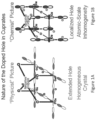
- Figure 1A illustrates the nature of doped holes using the "physicist's” picture
- Figure 1B illustrates the nature of doped holes using the "chemist's” picture.
- the "chemist's" ab initio doped hole picture leads to eight electronic structure concepts that explain a vast array of normal and superconducting state phenomenology using simple counting. These eight structural concepts are described below.
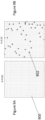
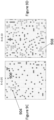
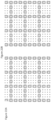
- Figures 9A-9D , 10A-10D , and 11A-11D show the evolution of the plaquettes as a function of doping.
- the black dots 900 are undoped AF Cu sites
- the blue outlined squares 902 are isolated plaquettes (no neighboring plaquette)
- the shaded (yellow) plaquette clusters 904 are larger than 4 plaquettes in size (larger than the superconducting coherence length), and thereby contribute to the superconducting pairing
- the darker shaded (magenta) clusters 906 are metallic clusters that are smaller than the coherence length.
- the blue and green crosses 908 are the fluctuating dumbbells.
- Squares 910 are overlapping plaquettes.
- the present disclosure uses exactly the same doped electronic structure described above to explain the superconducting Tc and its evolution with doping.
- the Oxygen atom phonon modes at and adjacent to the interface between the insulating and metallic regions lead to superconductivity.
- the magnitude of the electron-phonon coupling is estimated and the following results are obtained:
- Tc Concept 1 Figures 12A-12B show there are two planar O atom phonon modes (one at the metal- AF insulator interface and the other adjacent to the interface on the insulating side) that have longer-range electron coupling due to poor electron screening from the metallic region.
- the "effective" single band model for the metallic band [17] is used.
- the planar O atoms are eliminated.
- the model has a single effective Cu d x 2- y 2 orbital per Cu in the CuO 2 plane with an effective hopping to neighboring metallic Cu atoms.
- the parameters of the band structure are the Cu d x 2- y 2 orbital energy and the hopping terms (Table II, Appendix F in the provisional application 62/458,740 ).
- Tc Concept 3 Figure 13 shows the potential energy of each O atom in Figure 12A is strongly anharmonic due to the difference of the electron screening in the metallic and insulating regions. In fact, the phonon mode shown in Figure 12A is anharmonic even without a nearby metal-insulator boundary.
- the "floppiness" of the bond-bending of a linear chain here, the planar Cu-O-Cu chain
- the "floppiness" of the bond-bending of a linear chain has been emphasized by Phillips [19] and seen by neutron scattering (the F atom [20] in ScF 3 and the Ag atom [21] in Ag 2 O).
- reflection symmetry would force the electron-phonon coupling for this mode to be zero.
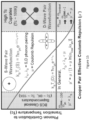
- Tc Concept 5 Cooper pairing from phonons is maximally phase coherent for an isotropic S-wave pair wavefunction because the sign of the pairing matrix element in Figure 14B is always negative. However, a D-wave pair wavefunction is observed for cuprates.
- the pair Coulomb repulsion, ⁇ could suppress the S-wave state and lead to a D-wave state because ⁇ cancels out of Tc when performing the angular integral around the D-wave pair wavefunction.
- the electrons in a pair can couple via a phonon while avoiding each other (due to retardation of phonons).
- the "effective" repulsion, ⁇ * known as the Morel-Anderson pseudopotential [16,28-32] is too small to raise the D-wave Tc higher than the S-wave Tc. Unless there is a mechanism for drastically increasing ⁇ *, any phonon model for cuprate superconductivity is bound to fail to obtain the correct superconducting pair wavefunction.
- Tc Concept 6 Figure 15 illustrates how the fluctuating dumbbells suppress the S-wave pairing wavefunction and lead to a D-wave pairing wavefunction.
- the expression for the Morel-Anderson Coulomb pseudopotential [16,28-32] ⁇ * (also shown in Figure 15 ) depends on the ratio of the Coulomb and phonon energy scales as ⁇ Coul / ⁇ phonon . Since this ratio is large, ⁇ * is small, leading to an S-wave pair wavefunction rather than the experimentally observed D-wave pair wavefunction [33].
- the fluctuating dumbbell frequency, ⁇ Dumbell is of the same order as ⁇ phonon because of the dynamic Jahn-Teller distortion of the planar O atoms in Figure 5 .
- the O atom distortion disrupts the metallic screening of the Coulomb repulsion, and thereby increases ⁇ * as shown in Figure 15 .
- ( ⁇ Dumbell substitutes for ⁇ Coul in the expression for ⁇ *.
- ⁇ * ⁇ ⁇ a D-wave pair wavefunction is formed. 7.
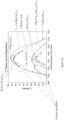
- Tc Concept 7 Interface O atom-phonon pairing explains the experimental Tc domes.
- Figure 16 shows the calculated Tc-domes versus experiment as a function of doping for different cuprates using the phonon modes from Figure 12 and the electron-phonon couplings estimated in Tc Concept 2. All three computed D-wave Tc domes were obtained from the strong-coupling Eliashberg equations for Tc [16,34,35]. Other phonon modes also contribute to Tc. These phonons primarily reduce the magnitude of Tc due to their contribution to electron pair "lifetime effects" (strictly speaking, the "wavefunction renormalization effects”). The effect of all the phonon modes on Tc is included in the computations described herein.
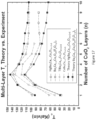
- Tc Concept 8 The experimental variation of Tc with the number of CuO 2 layers per unit cell is due to interlayer coupling of the interface O atom-phonons and the nonuniform hole doping between layers.
- Tc Concept 9 The D-wave Tc values computed in Figures 16 and 17 are weakly dependent on the orbital energy change, ⁇ , and strongly dependent on the hopping energy change, ⁇ t.
- Tc Concept 10 Overlapping plaquettes ("crowding" the dopants) freeze the dumbbells, decrease the Coulomb pseudopotential, ⁇ *, and thereby raise the S-wave Tc. If the same metallic "footprint" can be maintained, then there is no change in the phonon pairing. Only ⁇ * is reduced (see Figure 15 ).
- FIGs 18A-18C shows how two plaquettes with fluctuating dumbbells can be crowded by adding an additional dopant (Sr in the figure) while retaining exactly the same metallic footprint.
- Sr additional dopant
- dope "dominoes" adjacent pairs of plaquettes as in Figure 18A and 18B ).
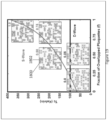
- Tc Concept 11 Figure 19 shows crowding dopants while maintaining the optimal doping metallic footprint leads to room temperature S-wave Tc.
- Figure 20 the ground state electronic wavefunction of H 2 at the equilibrium bond separation of 0.74 Angstrom is well approximated by a restricted Hartree-Fock form (a spin up and spin down electron pair occupying the same bonding orbital).
- this region is represented by t » U.
- dissociation (t « U) the ground state electronic wavefunction is highly correlated.
- the optimal superconducting Tc of cuprates is at "intermediate” correlation. Molecules do not generally "settle" at intermediate correlation. Since the dopants in cuprates are frozen in at high temperatures, the material avoids intermediate correlation by phase separating on an atomic-scale into a metallic (weak correlation) and insulating AF (strong correlation) regions.
- thermopower measurement is one of the fastest ways to determine if a cuprate sample is near optimal doping for Tc because the room-temperature thermopower is very close to zero near optimal doping. This peculiar, but useful, observation can be understood because 2D percolation of the metallic region occurs at x ⁇ 0.15 doping. Since the AF region thermopower is large ( ⁇ +100 ⁇ V/K) and the metallic thermopower is ⁇ 10 ⁇ V ZK at high overdoping, 2D metallic percolation "shorts out" the AF thermopower and drives the thermopower close to zero near optimal Tc.
- the potential energy curve in the intermediate correlation regime is hard to study for molecules.
- the equilibrium bond distance is 0.74 Angstroms.
- the intermediate correlation regime is at ⁇ 2.0 Angstrom bond separation.
- the blue potential energy curve in Figure 20 can only be observed indirectly [45-47] because it is not at a local minimum.
- the ultraviolet spectrum of the vibrational modes (there are 14 discrete levels below the continuum) can be fitted to a simple Morse potential to estimate the potential energy as a function of the H - H separation distance.
- the 10th bond-stretching phonon mode probes the potential energy of the two of H atoms up to ⁇ 2.0 Angstroms.
- Tc can be raised to room-temperature by freezing dumbbells while maintaining the random metallic footprint found at optimal doping.
- wires a wire is defined as a continuous 1D metallic pathway through the crystal
- Tc remains large while Jc increases to at least ⁇ 10 -1 Jc,max.
- the material should be inhomogeneous
- the material should have a metallic region and an insulating region.
- the insulating region does not have to be magnetic.
- the antiferromagnetic insulating region helps maintain the sharp metal-insulator boundary seen in cuprates.
- An ordinary insulator or a semiconductor with a small number of mobile carriers is sufficient to obtain a longer ranged electron-phonon coupling at the interface because there is less electron screening in the semiconducting (or insulating) region compared to the metallic region.
- atomic-scale metal-insulator inhomogeneity in a 3D material leads to a high-Tc 3D S-wave pairing wavefunction.
- a 3D material is more stable against defects and grain boundaries.
- the ratio of the number of metallic unit cells on the interface (adjacent to at least one insulating unit cell) to the total number of metallic unit cells must be larger than 20%.
- interface and surface are used interchangeably below.
- the number of metallic unit cells on the interface (or surface) must be a large fraction of the total number of metallic unit cells in order for the enhanced electron-phonon pairing at the interface to have an appreciable effect on Tc. From the calculations in Figure 16 , 50% of optimal Tc is obtained when the ratio is ⁇ 50%, and 25% of optimal Tc occurs when the ratio is ⁇ 35%. Below a surface metal unit cells to total metal unit cells ratio of 20%, Tc falls off exponentially, and therefore Tc is too low to be useful.
- Metallic clusters that are smaller than approximately the coherence length do not contribute to Tc due to thermal fluctuations.
- the surface metal unit cells to total metal unit cells ratio described above should only include surface metal unit cells in extended metallic clusters.
- Tc In cuprates, high Tc can be obtained at very low doping if all the dopants leading to isolated plaquettes and small plaquette clusters are arranged such that a single contiguous metallic cluster is formed. While the Tc may be high, Jc will be low if the size of the metallic region is a small fraction of the total volume of the crystal.
- Inhomogeneous materials formed at eutectic points have a surface metal unit cells to total metal unit cells ratio of ⁇ 10 -3 or less if the sizes of the metallic and insulating regions are on the order of microns. Standard materials fabrication methods do not lead to sufficient surface atomic sites for high Tc. Inhomogeneity on the atomic-scale is necessary.
- FIGS 21-21F illustrate perpendicularly crossed wires in 2D.
- the added dopant (solid (red) square 2100) that overlaps two plaquettes (larger blue squares 2102 with darker outline) does not have a red square boundary (1802 and 1000d) drawn for reasons of clarity only.
- the same pattern or a different pattern can be used in adjacent layers normal to the 2D wires.
- Crossing wires in 3D also leads to high Tc and Jc.
- Crossed metallic wires with varying aspect ratios and widths provide many opportunities for optimizing Tc and Jc for specific applications. For example, wires that are four metallic atoms wide (equal to two adjacent plaquettes in cuprates), would have ⁇ 1/2 the surface to total metal ratio of metallic wires two atoms wide (or one plaquette in cuprates), leading to an ⁇ 50% reduction in Tc compared to wires that are two metallic atoms wide.
- Jc increases by a factor of two.
- the narrowest wire is one plaquette width (see Figure 2 ). Other materials will have a different minimum width scale for wires.
- dopants are added to an insulating parent compound that leads to metallic regions.
- a metallic parent compound can also be doped to create insulating regions. In cuprates, the parent compound is insulating and doping creates metallic regions.
- This material does not lead to room-temperature T c .
- the crowding method described below is simple.
- the ionic charges of the La and Sr atoms in La 2-x Sr x CuO 4 are +3 and +2 (or -1 relative to La +3 ), respectively.
- the most direct way to crowd dopants is to add atoms with a +1 charge relative to La +3 (a +4 oxidation state) because they favor residing in-between the Sr +2 atoms due to charge attraction.
- this approach is counter-productive because a +4 atom adds an electron, and thereby lowers the net doping and T c .
- the added electron fills a hole in the out-of-plane fluctuating dumbbells rather than doping the planar CuO 2 metallic band. The net result is our desired crowding.
- Example crowding dopants include C +4 , Si +4 , Ge +4 , Sn +4 , Ti +4 , Zr +4 , Hf 44 , and Pt +4 . These dopants are smaller than La +3 , and hence will "fit" in-between the two Sr atoms.
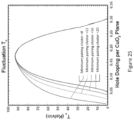
- FIG 23 shows T c for YBCO as a function of crowding.
- T c reaches -390K.
- Oxygen is added to the chains instead of atomic substitution as in LSCO, the LSCO crowding method above does not apply to YBCO.
- O atoms may be removed from the chains (lowering x) and substituting Ca atoms for Y in order to bring the material back to optimal doping. This substitution has already been shown to work experimentally. Hence, Ca becomes the equivalent of Sr in LSCO.
- the crowding method for LSCO can be used for (YCa)CuO.
- the room-temperature Seebeck coefficient (thermopower) of new material samples can be tested because it is a direct measure of the size of the metallic regions (yellow overlay in Figure 23 ), and it can be done cheaply in a few minutes.
- the goal is to add +4 dopants beyond optimal doping without changing the Seebeck coefficient. This approach will lead the materials scientists up the red dotted curve in Figure 23 , and thereby into the solid red region where T c is large.
- Figure 24 is a flowchart illustrating a method of fabricating a superconducting composition/state of matter 1000 (referring also to Figures 10C , 18B , and 19 ).
- Block 2400 represents combining a first region 1002a or material and a second region 1002b or material to form a composition of matter 1000.
- the first region 1002a or material and the second region 1002b or material each comprise unit cells 1004a, 1004b, respectively, of a solid 1000c (e.g., crystalline or amorphous lattice).
- the second region 1002b extends through the solid (e.g., crystalline or amorphous lattice) and a subset of the second region 1002b are surface metal unit cells 1004b that are adjacent to at least one unit cell 1004a from the first region 1002a.
- the ratio of the number of the surface metal unit cells 1004b to the total number of unit cells 1004b, 906, 902 in the second region 1002b is at least 20 percent (e.g., in a range of 20%-100%).
- the first region 1002a or material comprises an electrical insulator or semiconductor.
- insulator include an antiferromagnetic insulator or a non-magnetic insulator.
- the second region or material comprises a metallic electrical conductor.
- composition of matter 1000 examples include the first region or material 1002a comprising at least one compound selected from the metal-monoxides, MgO, CaO, SrO, BaO, MnO, FeO, CoO, NiO, CdO, EuO, PrO, and UO, combined with the second region or material 1002b comprising at least one compound selected from TiO, VO, NbO, NdO, and SmO.
- composition of matter 1000 include the first region 1002a or material comprising at least one compound selected from V 2 O 3 with up to 20% of the V atoms replaced by Cr atoms, combined with the second region 1002b comprised of (V x Ti 1-x ) 2 O 3 where x is greater than or equal to zero or less than or equal to one.
- composition 1000 include the first region 1002a comprised of Al 2 O 3 , and the second region 1002b is formed by replacing the Al atoms in the first region with Ti, V, or Cr atoms.
- the second region 1002b is formed by replacing one type of atom in the first region 1002a by another type of atom of a different chemical valence.
- the second region 1002b is formed by adding a type of atom to a subset of the unit cells 1004a of the first region 1002a, the type of atom of such chemical valence that (when the type of atom is added to the unit cells 1004a) the type of atom acts as an electrical donor or acceptor.
- the second region 1002b is formed by adding interstitial atoms in said first region 1002a.
- the first region 1002a is formed by replacing one type of atom in the second region 1002b by another type of atom of a different chemical valence.
- the first region 1002a is formed by adding a type of atom to a subset of the unit cells 1004b of the second region 1002b, the type of atom of such chemical valence that (when the type of atoms is added to the unit cells) the type of atom acts as an electrical donor or acceptor.
- the first region 1002a is formed by adding interstitial atoms in the second region 1002b.
- the combining comprises combining two distinct atoms (first 1800 and second atoms 1802).
- the first atom 1800 e.g., Sr
- the first atom 1800 has a chemical valence such that when the first atom 1800 is added to the material (e.g., cuprate), the first atom 1800 acts as an electrical acceptor.
- the second atom 1802 (e.g., Ti) has a chemical valence such that, when the second atom is added to the material (e.g., cuprate), the second atom 1802 acts as an electrical donor, and 20% or at least 20% (e.g., 20%-100%) of said second atoms 1802 reside inside the unit cell 1804 between two of said first atoms 1800 that are a distance of two unit cells 1804, 1000d from each other.
- the second region 1002 includes the two distinct atoms (first 1800 and second atoms 1802) and the superconductor is from the hole-doped cuprate class.
- the combining comprises forming YBa 2 Cu 3 O 6+x where at least 5% of the Y atoms are replaced by +2 oxidation state atoms, Mg, Ca, Sr, Zn, Cd, Cu, Ni, or Co, at least 2% of the Y atoms are replaced by +4 oxidation state atoms, Ti, Zr, Hf, C, Si, Ge, Sn, or Pb.
- the combining comprises combining two distinct atoms (first and second atoms) having such chemical valence that (when added to the cuprate) the first atom acts as an electrical donor, the second atom acts as an electrical acceptor, and 20% or at least 20% (e.g., 20%-100%) of said second atoms reside inside the unit cell between two of the first atoms that are a distance of two unit cells from each other.
- the second region includes the two distinct atoms (first and second atoms) and the superconductor is from the electron-doped cuprate class.
- the second region 1002a is comprised of approximately linear subregions 1010, as illustrated in Figure 18B .
- the approximately linear subregions 1010 of the second region 1002b can surround regions of a first kind or first region 1002a. Some of the surrounded regions of the first kind/region 1002a may have atomic substitutions, grain boundaries, or interstitial atoms.
- the components are provided in powder form and ground together in a pestle and mortar.
- Block 2402 represents the step of doping the composition formed in Block 2400.
- Examples of doping include first n-type doping the composition then p-type doping the composition.
- Exemplary ranges of n-type doping include a doping concentration in a range from 5% up to 80% (e.g., 5% up to 20%) n-type dopants per unit cell.
- Exemplary ranges of p-type doping include a doping concentration in a range from 5% up to 80% (e.g., 5% up to 20%) p-type dopants per unit cell.
- the n-type doping and p-type doping are such that the dopant concentration x is in a range of 0.13-0.19.
- dopants include, but are not limited to, Mg, Ca, Sr, Zn, Cd, Cu, Ni, Co, Ti, Zr, Hf, C, Si, Ge, Sn, Pb.
- the dopants are provided in powder form and mixed together (e.g., ground together in a pestle and mortar) with the components of Block 2400.
- Block 2404 represents the optional step of annealing the doped composite formed in Block 2402.
- Block 2406 represents the optional step of measuring the insulator/semiconductor and metal content in the composition.
- the step comprises measuring a thermopower of the composite, wherein the thermopower quantifies the amount of metal and insulator/semiconductor in the composition.
- the measurement enables identification of the fraction of overlapped plaquettes as a function of the structure, doping, and composition of the first region and the second regions, so that compositions mapping onto the red curve 2302 in Figure 23 can be fabricated. Desired compositions are those measured with a ratio of the number of the surface metal unit cells to the total number of unit cells in the second region is at least 20 percent (e.g., in a range of 20-100%).
- Block 2408 represents repeating steps 2400-2404 with modified compositions if the measurement in Block 2406 indicates that the fraction of overlapped plaquettes, f, does not lie on the S-wave curve in Figure 23 so as to obtain the desired Tc.
- Block 2410 illustrates the end result, a superconducting composition of matter having a Tc in a range of 100-400 K, wherein a ratio of the number of the surface metal unit cells to the total number of unit cells in the second region is at least 20 percent (e.g., in a range of 20-100%).
- a ratio of the number of the surface metal unit cells to the total number of unit cells in the second region is at least 20 percent (e.g., in a range of 20-100%).
- both the metallic content of the superconductor and the surface area of the metallic regions overlapping with the insulator/semiconductor regions are maximized.
- Superconducting compositions of matter according to embodiments of the present invention may also be designed by computationally solving equations G43-G45 in the computational methods section for any combination of material(s) using the appropriate parameters for those materials.
- the variable n in the table is the number of metallic electrons per metallic Cu.
- the optimal doping Fermi level is used for all dopings in order to keep the number of parameters to a minimum.
- the 2D k states in adjacent layers, l and l ⁇ 1, are coupled by a momentum dependent matrix element equal to ⁇ k, l ⁇ 1
- each plaquette covers 4 Cu sites.
- N min is the number of metallic Cu sites inside the smallest plaquette cluster that is larger than the coherence length, and thereby contributes to T c .
- the edge, convex, and concave couplings are chosen to be equal for the next layer couplings. All units are eV.
- the Eliashberg equations are non-linear equations for the superconducting gap function, ⁇ (k , ⁇ , T ), and the wave function renormalization, Z (k, ⁇ , T ) , as a function of momentum k, frequency ⁇ , and temperature T.
- T dependence of ⁇ and Z is assumed, and they are written as ⁇ (k, ⁇ ) and Z (k, ⁇ ), respectively.
- Both ⁇ (k, ⁇ ) and Z ( k, ⁇ ) are a complex numbers. In this Appendix only, we will absorb Boltzmann's constant, k B , into T. Thus T has units of energy.
- Both ⁇ and Z are frequency dependent because of the non-instantaneous nature of the superconducting electron-electron pairing. If the pairing via phonons was instantaneous in time, then there would be no frequency dependence to ⁇ and Z .
- the temperature dependence and the retardation of the phonon induced pairing are both absorbed into the imaginary frequency dependence, i ⁇ n .
- both ⁇ (k, ⁇ ) and Z (k, ⁇ ) can be obtained by analytic continuation of their (k, i ⁇ n ) counterparts. In practice, the analytic continuation is fraught with numerical difficulties. 60-63 However, the symmetry of the gap can be extracted from either the real or imaginary frequency representations of ⁇ .
- T c ⁇ (k, ⁇ ) is zero.
- a Cooper pair here is comprised of ( ⁇ l ⁇ , ⁇ l ⁇ ), where ⁇ l is the complex conjugate of ⁇ l .
- Both ⁇ 2 F ( l, l', ⁇ ) and ⁇ ( l , l', ⁇ n ) are real positive numbers.
- Z ( l, i ⁇ n ) is a real positive number.
- ⁇ V is independent of the number of metallic sites, N M .
- the l and l' metallic states each scale as 1 / N M , leading to ⁇ l H ep ⁇ l ′ > ⁇ 1 / N M .
- N M scaling of the sum ⁇ ⁇ ⁇ l H ep ⁇ l ′ > 2 is ⁇ N M 1 / N M 2 ⁇ 1 / N M .
- ⁇ 2 F ( l , l', ⁇ ) and ⁇ ( l , l', ⁇ n ) are dimensionless and independent of N M because the density of states per spin, N (0), is proportional to N M .
- ⁇ 2 F and ⁇ are independent of N M even when the phonon modes ⁇ are delocalized. In this case, ⁇ V ⁇ 1 / N M .
- the electron-phonon matrix element ⁇ l H ep ⁇ l ′ > is now summed over the crystal, and thereby picks up a factor of N m .
- the sum over phonon modes ⁇ in ⁇ ⁇ ⁇ l H ep ⁇ l ′ > 2 does not add another factor of N M .
- the Green's function between two distinct k states, k and k' is zero G k , k ′ , i ⁇ n ⁇ 0 , if k ⁇ k ′ .
- ⁇ bare (k) is the bare electron energy.
- ⁇ 0 adds a shift to the bare electron energy, ⁇ bare (k), and a lifetime broadening to the electronic state.
- ⁇ 1 leads to wavefunction renormalization of the bare electron state.
- the Eliashberg equations above are completely general for a single band crossing the Fermi level.
- Equations G11, G12, G13 need to be modified when more than one band crosses the Fermi level. Phonons can scatter electron pairs from one band to another in addition to scattering within a single band.
- the modification to the single Fermi surface Eliashberg equations above require changing the k and k' labels to bk and b'k' where b and b' refer to the band index. k and k' remain vectors in 2D so long as we assume the coupling of CuO 2 layers in different unit cells is weak.
- the number of bands is equal to the number of CuO 2 layers per unit cell, L .
- ⁇ 2 F 1 is due to the phonons that lead to the low-temperature linear term in the resistivity
- ⁇ 2 F 2 is due to the phonons that lead to the low-temperature T 2 resistivity term.
- 65 ⁇ 2 F surf is the component due to the planar O atom at the surface between the metal and insulating regions. It is the O atom phonon shown in Figure 12a .
- ⁇ 2 F ⁇ is the contribution from the planar O atom adjacent to the metal-insulator surface on the insulating AF side. It is shown in Figure 12b . Since the energy of these two O phonons modes is ⁇ 60 meV, 18 their contribution to the resistivity is very small.
- FIG. 27 A surface O atom phonon mode.
- - ⁇ t is the change in the hopping energy.
- the position of the left Cu atom is at R and the right Cu atom is at R+a.
- ⁇ L , ⁇ R , and ⁇ t are functions of R as seen in Figure 12a .
- H surf R ⁇ L c L ⁇ c L + ⁇ R c R ⁇ c R ⁇ ⁇ t c L ⁇ c R + c R ⁇ c L , where c L ⁇ and c L create and destroy an electron at the L Cu site.
- c R ⁇ and c R are defined similarly. Since there is no electron spin coupling to the O atom phonon mode, the electron spin index is dropped in equation G15.
- Equation G20 for J surf y is identical to the expression for J surf x in equation G19 with x replaced by y .
- FIG. 28 The Perpendicular O atom phonon mode.
- the O atom is in the insulating AF region.
- the chain Cu-O-Cu-O-Cu is on the metal-insulator surface.
- the change in Cu orbital energy for the central Cu atom located at position R is ⁇ . - ⁇ t ( - ) is the change in the hopping between the Cu site at R - a and R.
- - ⁇ t (+) is the change in the hopping between the Cu site at R + a and R.
- ⁇ , ⁇ t ( - ), and ⁇ t (+) are functions of position R as seen in Figure 12b .
- the displaced O atom is on the y-axis while the Cu-O-Cu-O-Cu chain is along the x-axis.
- this figure is a y-axis O phonon mode.
- H ⁇ R ⁇ c R ⁇ c R ⁇ ⁇ t ⁇ c R ⁇ a ⁇ c R + c R ⁇ c R ⁇ a ⁇ ⁇ t + c R + a ⁇ c R + c R ⁇ c R + a , where ck and c R create and destroy an electron at the R Cu site.
- c R ⁇ a ⁇ and c R ⁇ a are defined similarly. Since there is no electron spin coupling to the O atom phonon mode, the electron spin index is dropped in equation G23.
- ⁇ F (R ⁇ ) > y is the average of F (R ⁇ ) over the y-axis O atoms.
- the expression in equation G27 for J ⁇ y is identical to the expression for J ⁇ x in equation G26 with x replaced by y.
- the low-temperature resistivity of La 2-x Sr x CuO 4 is the sum of two terms. 65 One term is linear in T and the other is proportional to T 2 . At high temperatures, both terms become linear in T. Previously, we showed 13 that the doping evolution of these two terms can be explained by phonon scattering and simple counting of the number of metallic sites and the number of overlapped plaquettes, as a function of doping. The contribution of these phonons on T c must be included in our Eliashberg calculation.
- ⁇ k is called the mass-enhancement factor. 16
- the slope of the high-temperature scattering rate can be obtained from the resistivity. Hence, the mass-enhancement can be computed from experiment.
- the Bose-Einstein distribution cuts the integral in the scattering rate off at ⁇ ⁇ T. If ⁇ 2 F ⁇ ⁇ n , then 1 ⁇ k ⁇ ⁇ 0 T d ⁇ ⁇ 2 F k , ⁇ ⁇ T ⁇ T n + 1 .
- ⁇ ⁇ k ⁇ ⁇ k ′ ⁇ ⁇ k ′ ⁇ ⁇ F N 0 ⁇ k ′ ⁇ k ′ ⁇ ⁇ k ′ ⁇ ⁇ F N 0 .
- the constants C 1 and C 2 can be determined as follows.
- the Eliashberg equations G11, G12, and G13 for a single CuO 2 layer per unit cell are generalized to multi-layer cuprates by changing k and k' to bk and b'k', respectively, in the single layer Eliashberg equations.
- Bloch k state for each layer, l , given by ⁇ ( l k).
- the coefficients, A bl (k), are real since the inter-layer hopping matrix elements are real.
- N 4 M ( l ) is the number of metallic Cu sites in layer l that are in non-overlapping plaquettes
- L is the total number of CuO 2 layers per unit cell
- N xy is the total number of Cu sites (metallic plus insulating AF) in a single CuO 2 layer.
- LN xy is the total number of Cu sites in the crystal
- n 4 M is the total fraction of metallic Cu sites over all the CuO 2 layers.
- ⁇ ⁇ bk ⁇ ⁇ b ′ k ′ ⁇ ⁇ b ′ k ′ ⁇ ⁇ F N 0 ⁇ b ′ k ′ ⁇ b ′ k ′ ⁇ ⁇ b ′ k ′ ⁇ ⁇ F N 0 .
- ⁇ 2 F 1 The phonon modes in ⁇ 2 F 1 are 2D.
- the two planar interface O atom phonon modes in Figure 12 require averaging products of pairs of parameters ( ⁇ L , ⁇ R , and ⁇ t for ⁇ surf , and ⁇ and ⁇ t ( ⁇ ) for ⁇ ⁇ ) over the lattice as seen in equations G19, G20, G26, G27, G62, G63, G66, and G67. These parameters vary depending on the environment of the Cu atoms, as shown in Figure 12 .
- Hybrid DFT finds a localized out-of-the-CuO 2 hole is formed around a negatively charged dopant.
- the doped hole resides in a four-Cu-site plaquette.
- the out-of-plane hole destroys the antiferromagnetism inside the plaquette and creates a tiny piece of metal there. Hence, the crystal is inhomogeneous on the atomic-scale with metallic and insulating regions.
- the physicist's DFT methods find a delocalized hole residing in the CuO 2 planes as a consequence of doping.
- the chemist's result is to be trusted over the physicist's result because it corrects the spurious self-Coulomb repulsion of the electrons found in the physicist's density functionals.
- an isotropic S-wave pairing wavefunction is favored over a D-wave pairing wavefunction.
- the present disclosure shows that the fluctuating dumbbells drastically raise the Cooper pair Coulomb repulsion, leading to the observed D- wave pairing wavefunction.
- the S-wave pairing wavefunction becomes favored over the D-wave pairing wavefunction.
- the present disclosure shows that the S-wave Tc is in the range of ⁇ 280 - 390 K when the D-wave Tc ⁇ 100 K.
Landscapes
- Engineering & Computer Science (AREA)
- Chemical & Material Sciences (AREA)
- Ceramic Engineering (AREA)
- Manufacturing & Machinery (AREA)
- Materials Engineering (AREA)
- Structural Engineering (AREA)
- Organic Chemistry (AREA)
- Physics & Mathematics (AREA)
- Thermal Sciences (AREA)
- Inorganic Chemistry (AREA)
- Superconductor Devices And Manufacturing Methods Thereof (AREA)
- Crystals, And After-Treatments Of Crystals (AREA)
Applications Claiming Priority (3)
| Application Number | Priority Date | Filing Date | Title |
|---|---|---|---|
| US201762458740P | 2017-02-14 | 2017-02-14 | |
| EP18754979.5A EP3583632A4 (de) | 2017-02-14 | 2018-02-14 | Hochtemperatursupraleitende materialien |
| PCT/US2018/018190 WO2018152210A1 (en) | 2017-02-14 | 2018-02-14 | High temperature superconducting materials |
Related Parent Applications (1)
| Application Number | Title | Priority Date | Filing Date |
|---|---|---|---|
| EP18754979.5A Division EP3583632A4 (de) | 2017-02-14 | 2018-02-14 | Hochtemperatursupraleitende materialien |
Publications (2)
| Publication Number | Publication Date |
|---|---|
| EP4408150A2 true EP4408150A2 (de) | 2024-07-31 |
| EP4408150A3 EP4408150A3 (de) | 2024-11-06 |
Family
ID=63104852
Family Applications (2)
| Application Number | Title | Priority Date | Filing Date |
|---|---|---|---|
| EP24182024.0A Pending EP4408150A3 (de) | 2017-02-14 | 2018-02-14 | Hochtemperatur-supraleitende materialien |
| EP18754979.5A Ceased EP3583632A4 (de) | 2017-02-14 | 2018-02-14 | Hochtemperatursupraleitende materialien |
Family Applications After (1)
| Application Number | Title | Priority Date | Filing Date |
|---|---|---|---|
| EP18754979.5A Ceased EP3583632A4 (de) | 2017-02-14 | 2018-02-14 | Hochtemperatursupraleitende materialien |
Country Status (4)
| Country | Link |
|---|---|
| US (4) | US11611031B2 (de) |
| EP (2) | EP4408150A3 (de) |
| CN (1) | CN110431677B (de) |
| WO (1) | WO2018152210A1 (de) |
Families Citing this family (2)
| Publication number | Priority date | Publication date | Assignee | Title |
|---|---|---|---|---|
| WO2018152210A1 (en) * | 2017-02-14 | 2018-08-23 | California Institute Of Technology | High temperature superconducting materials |
| CN113808685B (zh) * | 2021-08-27 | 2024-01-16 | 西北工业大学深圳研究院 | 一种非中心对称超导拓扑电子材料的分析方法及系统 |
Family Cites Families (16)
| Publication number | Priority date | Publication date | Assignee | Title |
|---|---|---|---|---|
| DE3854358T2 (de) * | 1987-01-30 | 1996-04-18 | Hitachi, Ltd., Tokio/Tokyo | Supraleitendes Oxid. |
| WO1988010499A1 (fr) * | 1987-06-16 | 1988-12-29 | Kawasaki Steel Corporation | Procede de formation de films minces d'oxyde supraconducteur |
| IL92598A0 (en) * | 1988-12-22 | 1990-08-31 | Gen Electric | High temperature superconductor materials and method for preparation |
| US5157466A (en) * | 1991-03-19 | 1992-10-20 | Conductus, Inc. | Grain boundary junctions in high temperature superconductor films |
| JP3575004B2 (ja) * | 2001-01-09 | 2004-10-06 | 独立行政法人 科学技術振興機構 | マグネシウムとホウ素とからなる金属間化合物超伝導体及びその金属間化合物を含有する合金超伝導体並びにこれらの製造方法 |
| US6811726B1 (en) * | 2002-05-16 | 2004-11-02 | Moises G. Sanchez | One dimensional ceramic conductive oxides |
| US20050159298A1 (en) * | 2004-01-16 | 2005-07-21 | American Superconductor Corporation | Oxide films with nanodot flux pinning centers |
| US7547661B2 (en) * | 2004-08-25 | 2009-06-16 | Los Alamos National Security, Llc | Enhanced pinning in mixed rare earth-123 films |
| AU2005333196B2 (en) * | 2004-10-01 | 2009-10-01 | American Superconductor Corp. | Thick superconductor films with improved performance |
| GB0822901D0 (en) * | 2008-12-16 | 2009-01-21 | Magnifye Ltd | Superconducting systems |
| CN101694789B (zh) * | 2009-10-16 | 2011-04-20 | 北京工业大学 | 一种Ti掺杂的YBCO薄膜的制备方法 |
| CN102568694A (zh) * | 2010-12-23 | 2012-07-11 | 吴仕驹 | 高温超导体及其制备方法 |
| US8470743B2 (en) * | 2010-12-31 | 2013-06-25 | Carlton Anthony Taft | Composite superconductor |
| WO2014069481A1 (ja) * | 2012-11-02 | 2014-05-08 | 古河電気工業株式会社 | 酸化物超電導薄膜 |
| JP6259931B2 (ja) * | 2014-11-25 | 2018-01-10 | 株式会社日立製作所 | 半導体装置および電力変換装置 |
| WO2018152210A1 (en) * | 2017-02-14 | 2018-08-23 | California Institute Of Technology | High temperature superconducting materials |
-
2018
- 2018-02-14 WO PCT/US2018/018190 patent/WO2018152210A1/en not_active Ceased
- 2018-02-14 US US15/896,697 patent/US11611031B2/en active Active
- 2018-02-14 CN CN201880011349.1A patent/CN110431677B/zh active Active
- 2018-02-14 EP EP24182024.0A patent/EP4408150A3/de active Pending
- 2018-02-14 EP EP18754979.5A patent/EP3583632A4/de not_active Ceased
-
2023
- 2023-02-01 US US18/162,817 patent/US12022748B2/en active Active
-
2024
- 2024-04-26 US US18/647,210 patent/US12433174B2/en active Active
-
2025
- 2025-08-14 US US19/300,518 patent/US20260096354A1/en active Pending
Non-Patent Citations (63)
| Title |
|---|
| "Solid State Physics, Advances in Research and Applications", vol. 37, 1982, ACADEMIC PRESS, pages: 1 - 92 |
| ABDEL-JAWAD, M. ET AL.: "Anisotropic scattering and anomalous normal-state transport in a hightemperature superconductor", NATURE PHYSICS, vol. 2, 2006, pages 821 - 825 |
| ALLEN, P. B.DYNES, R. C.: "Transition temperature of strong-coupled superconductors reanalyzed", PHYS. REV. B, vol. 12, 1975, pages 905 - 922, Retrieved from the Internet <URL:http://link.aps.org/doi/10.1103/PhysRevB.12.905> |
| BANGURA, A. F. ET AL.: "Fermi surface and electronic homogeneity of the overdoped cuprate superconductor t12ba2cuo6+δ as revealed by quantum oscillations", PHYS. REV. B, vol. 82, 2010, pages 140501 |
| BEACH, K. S. D.GOODING, R. J.MARSIGLIO, F.: "Reliable pad'e analytical continuation method based on a high-accuracy symbolic computation algorithm", PHYS. REV. B, vol. 61, 2000, pages 5147 - 5157, Retrieved from the Internet <URL:http://link.aps.org/doi/10.1103/PhysRevB.61.5147> |
| BECKE, A. D.: "Density-functional thermochemistry. iii. the role of exact exchange", J. CHEM.PHYS., vol. 98, 1993, pages 5648 - 5652, XP055442717, DOI: 10.1063/1.464913 |
| BOGOLIUBOV, N. N.TOLAMACHEV, V. V.SHIRKOV, D. V.: "A New Method in the Theory of Superconductivity", 1959, CONSULTANTS BUREAU, INC. |
| COOPER, R. A. ET AL.: "Anomalous criticality in the electrical resistivity of la2-xsrxcuo4", SCIENCE, vol. 323, 2009, pages 603 - 607 |
| CRESPI, V. H.COHEN, M. L.: "Anharmonic phonons and high-temperature superconductivity", PHYS. REV. B, vol. 48, 1993, pages 398 - 406, Retrieved from the Internet <URL:http://link.aps.org/doi/10.1103/PhysRevB.48.398.> |
| CRESPI, V. H.COHEN, M. L.: "Anharmonic phonons and the anomalous isotope effect in la2-x srx cuo4", PHYS. REV. B, vol. 44, 1991, pages 4712 - 4715, Retrieved from the Internet <URL:http://link.aps.org/doi/10.1103/PhysRevB.44.4712> |
| CRESPI, V. H.COHEN, M. L.PENN, D. R.: "Anharmonic phonons and the isotope effect in superconductivity", PHYS. REV. B, vol. 43, 1991, pages 12921 - 12924, Retrieved from the Internet <URL:http://link.aps.org/doi/10.1103/PhysRevB.43.12921> |
| CROWLEY, J. M.TAHIR-KHELI, J.GODDARD, W. A.: "Resolution of the band gap prediction problem for materials design", J. PHYS. CHEM. LETT., vol. 7, 2016, pages 1198 - 1203, Retrieved from the Internet <URL:http://dx.doi.org/10.1021/acs.jpclett.5602870> |
| ELLIOTT, R. J.KRUMHANSL, J. A.LEATH, P. L.: "The theory and properties of randomly disordered crystals and related physical systems", REV. MOD. PHYS., vol. 46, 1974, pages 465 - 543, Retrieved from the Internet <URL:http://link.aps.org/doi/10.1103/RevModPhys.46.465> |
| GINDER, J. M. ET AL.: "Photoexcitations in la2cuo4: 2-ev energy gap and long-lived defect states", PHYS. REV. B, vol. 37, 1988, pages 7506 - 7509 |
| HASHIMOTO, M. ET AL.: "Doping evolution of the electronic structure in the single-layer cuprate bi2sr2-xlaxCuo6+δ: Comparison with other single-layer cuprates", PHYS. REV. B, vol. 77, 2008, pages 094516, Retrieved from the Internet <URL:http://link.aps.org/doi/10.1103/PhysRevB.77.094516.> |
| HERZBERG, G.: "Molecular Spectra and Molecular Structure 1. Spectra of Diatomic Molecules", 1950, D. VAN NOSTRAND COMPANY, INC. |
| HERZBERG, G.: "Molecular Spectra and Molecular Structure II. Infrared and Raman Spectra of Polyatomic Molecules", 1945, D. VAN NOSTRAND COMPANY, INC. |
| HUI, J. C. K.ALLEN, P. B.: "Effect of lattice anharmonicity on superconductivity", JOURNAL OF PHYSICS F: METAL PHYSICS, vol. 4, 1974, pages L42, XP020044817, Retrieved from the Internet <URL:http://stacks.iop.org/0305-4608/4/i=3/a=003> DOI: 10.1088/0305-4608/4/3/003 |
| HUSSEY, N. E. ET AL.: "Dichotomy in the t-linear resistivity in hole-doped cuprates", PHILOSOPHICAL TRANSACTIONS OF THE ROYAL SOCIETY A-MATHEMATICAL PHYSICAL AND ENGINEERING SCIENCES, vol. 369, pages 1626 |
| HYBERTSEN, M. S.STECHEL, E. B.FOULKES, W. M. C.SCHLUTER, M.: "Model for low-energy electronic states probed by x-ray absorption in high-tc cuprates", PHYSICAL REVIEW B, vol. 45, 1992, pages 10032 - 10050 |
| KARPPINEN, M. ET AL.: "Layer-specific hole concentrations in bi2sr2y I -xcax)cu2o8+6 as probed by xanes spectroscopy and coulometric redox analysis", PHYS. REV. B, vol. 67, 2003, pages 134522, Retrieved from the Internet <URL:http://link.aps.org/doi/10.1103/PhysRevB.67.134522> |
| KELLER, H.: "Superconductivity in Complex Systems. Springer Series Structure and Bonding", vol. 114, 2005, SPRINGER BERLIN HEIDELBERG, article "Unconventional isotope effects in cuprate superconductors", pages: 143 - 169 |
| KELLER, H.BUSSMANN-HOLDER, A.MLLER, K. A.: "Jahnteller physics and high-tc superconductivity", MATERIALS TODAY, vol. 11, 2008, pages 38 - 46, Retrieved from the Internet <URL:www.sciencedirect.com/science/article/pii/S1369702108701780> |
| KURTIN, S.MCGILL, T. C.MEAD, C. A.: "Fundamental transition in the electronic nature of solids", PHYS. REV. LETT., vol. 22, 1969, pages 1433 - 1436 |
| LAN, T. ET AL.: "Anharmonic lattice dynamics of Ag20 studied by inelastic neutron scattering and first-principles molecular dynamics simulations", PHYS. REV. B, vol. 89, 2014, pages 054306, Retrieved from the Internet <URL:http://link.aps.org/doi/10.1103/PhysRevB.89.054306> |
| LEAVENS, C.RITCHIE, D.: "Extension of the n-point pad'e approximants solution of the eliashberg equations to t - tc", SOLID STATE COMMUNICATIONS, vol. 53, 1985, pages 137 - 142, XP025707708, Retrieved from the Internet <URL:www.sciencedirect.com/science/article/pii/0038109885901127> DOI: 10.1016/0038-1098(85)90112-7 |
| LEE, C.YANG, W.PARR, R. G.: "Development of the colle-salvetti correlation-energy formula into a functional of the electron density", PHYS. REV. B, vol. 37, 1988, pages 785 - 789, XP055442724, Retrieved from the Internet <URL:http://link.aps.org/doi/10.1103/PhysRevB.37.785> DOI: 10.1103/PhysRevB.37.785 |
| LI, C. W. ET AL.: "Structural relationship between negative thermal expansion and quartic anharmonicity of cubic scf3", PHYS. REV. LETT., vol. 107, 2011, pages 195504, Retrieved from the Internet <URL:http://link.aps.org/doi/10.1103/PhysRevLett.107.195504.> |
| LIANG, R.BONN, D. A.HARDY, W. N.: "Evaluation of cuo2 plane hole doping in yba2cu3 6+x single crystals", PHYS. REV. B, vol. 73, 2006, pages 180505, Retrieved from the Internet <URL:http://link.aps.org/doi/10.1103/PhysRevB.73.180505> |
| MANN, A.: "Still in suspense", NATURE, vol. 475, 2011, pages 280 - 282 |
| MATTHEISS, L. F.: "Electronic band properties and superconductivity in la2-yxycuo4", PHYSICAL REVIEW LETTERS, vol. 58, 1987, pages 1028 - 1030 |
| MOREL, P.ANDERSON, P. W.: "Calculation of the superconducting state parameters with retarded electron-phonon interaction", PHYS. REV., vol. 125, 1962, pages 1263 - 1271, Retrieved from the Internet <URL:http://link.aps.org/doi/10.1103/PhysRev.125.1263> |
| MUKUDA, H.SHIMIZU, S.IYO, A.KITAOKA, Y.: "High-tc superconductivity and antiferromagnetism in multilayered copper oxides-a new paradigm of superconducting mechanism", JOURNAL OF THE PHYSICAL SOCIETY OF JAPAN, vol. 81, 2012, pages 011008 |
| NAQIB, S. H.COOPER, J. R.TALLON, J. L.PANAGOPOULOS, C.: "Temperature dependence of electrical resistivity of high-t-c cuprates - from pseudogap to overdoped regions", PHYSICA C-SUPERCONDUCTIVITY AND ITS APPLICATIONS, vol. 387, pages 365 - 372, XP004417645, DOI: 10.1016/S0921-4534(02)02330-4 |
| ONO, S.ANDO, Y.: "Evolution of the resistivity anisotropy in bi2sr2-xlaxcuo6+8 single crystals for a wide range of hole doping", PHYS. REV. B, vol. 67, 2003, pages 104512, Retrieved from the Internet <URL:http://link.aps.org/doi/10.1103/PhysRevB.67.104512> |
| OSTLIN, A.CHIONCEL, L.VITOS, L.: "One-particle spectral function and analytic continuation for many-body implementation in the exact muffin-tin orbitals method", PHYS. REV. B, vol. 86, 2012, pages 235107, Retrieved from the Internet <URL:http://link.aps.org/doi/10.1103/PhysRevB.86.235107> |
| PERDEW, J. PBURKE, K.ERNZERHOF, M.: "Generalized gradient approximation made simple", PHYS. REV. LETT., vol. 77, 1996, pages 3865 - 3868, Retrieved from the Internet <URL:http://link.aps.org/doi/10.1103/PhysRevLett.77.3865.> |
| PERDEW, J. PZUNGER, A.: "Self-interaction correction to density-functional approximations for many-electron systems", PHYSICAL REVIEW B, vol. 23, 1981, pages 5048 - 5079 |
| PEREIRO, J. ET AL.: "Insights from the study of high-temperature interface superconductivity", PHILOSOPHICAL TRANSACTIONS OF THE ROYAL SOCIETY OF LONDON A:, vol. 370, 2012, pages 4890 - 4903, Retrieved from the Internet <URL:http://rsta.royalsocietypublishing.org/content/370/1977/4890> |
| PERRY, J. K.TAHIR-KHELI, J.GODDARD, W. A.: "Ab initio evidence for the formation of impurity d3z2-r2 holes in doped la2-xsrxcuo4", PHYSICAL REVIEW B, vol. 65, 2002, pages 144501 |
| PERRY, J. K.TAHIR-KHELI, J.GODDARD, W. A.: "Antiferromagnetic band structure of la2cuo4: Becke-3-lee-yang-parr calculations", PHYSICAL REVIEW B, vol. 63, 2001, pages 144510 |
| PHILLIPS, J. C.: "Self-organized networks and lattice effects in high-temperature superconductors", PHYSICAL REVIEW B, vol. 75, 2007 |
| PICKETT, W. E.: "Electronic-structure of the high-temperature oxide superconductors", REVIEWS OF MODERN PHYSICS, vol. 61, 1989, pages 433 - 512 |
| PINTSCHOVIUS, L.: "Electron-phonon coupling effects explored by inelastic neutron scattering", PHYSICA STATUS SOLIDI B-BASIC RESEARCH, vol. 242, 2005, pages 30 - 50 |
| PROUST, C.VIGNOLLE, B.LEVALLOIS, J.ADACHI, S.HUSSEY, N. E: "Fermi liquid behavior of the in-plane resistivity in the pseudogap state of yba2cu4o8", PROCEEDINGS OF THE NATIONAL ACADEMY OF SCIENCES, vol. 113, 2016, pages 13654 - 13659, Retrieved from the Internet <URL:http://www.pnas.org/content/113/48/13654> |
| ROURKE, P. M. C. ET AL.: "A detailed de haasvan alphen effect study of the overdoped cuprate t12ba2cuo6+δ", NEW JOURNAL OF PHYSICS, vol. 12, 2010, pages 105009, XP020198776, DOI: 10.1088/1367-2630/12/10/105009 |
| SAUNDERS, V. ET AL.: "CRYSTAL98 User's Manual", 1998, UNIVERSITY OF TORINO |
| SCALAPINO, D. J.: "Superconductivity", vol. 1, 1969, MARCEL DEKKER, INC., article "Superconductivity in low-carrier density systems: Degenerate semiconductors", pages: 449 - 560 |
| SCALAPINO, D. J.SCHRIEFFER, J. R.WILKINS, J. W.: "Strong-coupling superconductivity", PHYS. REV., vol. 148, 1966, pages 263 - 279, Retrieved from the Internet <URL:http://link.aps.org/doi/10.1103/PhysRev.148.263> |
| SCHILLING, A.CANTONI, M.GUO, J. D.OTT, H. R.: "Superconductivity above 130 k in the Hg-Ba-Ca-Cu-o system", NATURE, vol. 363, 1993, pages 56 - 58, XP055534348, DOI: 10.1038/363056a0 |
| SCHREIFFER, J. R.: "Theory of Superconductivity", 1964, ACADEMIC PRESS INC. |
| SCHRIEFFER, J. R.SCALAPINO, D. JWILKINS, J. W.: "Effective tunneling density of states in superconductors", PHYS. REV. LETT., vol. 10, 1963, pages 336 - 339, Retrieved from the Internet <URL:http://link.aps.org/doi/10.1103/PhysRevLett.10.336> |
| TAHIR-KHELI, J.: "Resistance of high-temperature cuprate superconductors", NEW JOURNAL OF PHYSICS, vol. 15, 2013, pages 073020 |
| TAHIR-KHELI, J.: "Understanding superconductivity in cuprates", CALTECH YOUTUBE CHANNEL, 2015, Retrieved from the Internet <URL:https://www.youtube.com/watch?v=Dq2uIzSU9k> |
| TAHIR-KHELI, J.GODDARD, W. A.: "Origin of the pseudogap in high-temperature cuprate superconductors", JOURNAL OF PHYSICAL CHEMISTRY LETTERS, vol. 2, 2011, pages 2326 - 2330, XP008148057, DOI: 10.1021/jz200916t |
| TAHIR-KHELI, J.GODDARD, W. A.: "Universal properties of cuprate superconductors: Tc phase diagram, room-temperature thermopower, neutron spin resonance, and stm incommensurability explained in terms of chiral plaquette pairing", JOURNAL OF PHYSICAL CHEMISTRY LETTERS, vol. 1, 2010, pages 1290 - 1295 |
| TAKAGI, H. ET AL.: "Superconductor-to-nonsuperconductor transition in (lal-xsrx)2cuo4 as investigated by transport and magnetic measurements", PHYS. REV. B, vol. 40, 1989, pages 2254 - 2261, Retrieved from the Internet <URL:http://link.aps.org/doi/10.1103/PhysRevB.40.2254> |
| TSUEI, C. C.KIRTLEY, J. R.: "Pairing symmetry in cuprate superconductors", REV. MOD. PHYS., vol. 72, 2000, pages 969 - 1016, XP093077591, Retrieved from the Internet <URL:http://link.aps.org/doi/10.1103/RevModPhys.72.969.> DOI: 10.1103/RevModPhys.72.969 |
| VIDBERG, H. J.SERENE, J. W.: "Solving the eliashberg equations by means of n-point pad'e approximants", JOURNAL OF LOW TEMPERATURE PHYSICS, vol. 29, 1977, pages 179 - 192, Retrieved from the Internet <URL:http://dx.doi.org/10.1007/BF00655090> |
| WILSON, E. B.DECIUS, J. C.CROSS, P. C.: "Molecular Vibrations. The Theory of Infrared and Raman Vibrational Spectra", 1980, DOVER PUBLICATIONS, INC. |
| YOSHIDA, T. ET AL.: "Low-energy electronic structure of the high-tc cuprates la2-xsrxcuo4 studied by angle-resolved photoemission spectroscopy", JOURNAL OF PHYSICS: CONDENSED MATTER, vol. 19, 2007, pages 125209, XP020116689, Retrieved from the Internet <URL:http://stacks.iop.org/0953-8984/19/i=12/a=125209.> DOI: 10.1088/0953-8984/19/12/125209 |
| YU, J. J.FREEMAN, A. J.XU, J. H.: "Electronically driven instabilities and superconductivity in the layered La - Ba CuO perovskites", PHYSICAL REVIEW LETTERS, vol. 58, 1987, pages 1035 - 1037 |
| ZHANG, F. C.RICE, T. M.: "Effective hamiltonian for the superconducting cu oxides", PHYS. REV. B, vol. 37, 1988, pages 3759 - 3761, Retrieved from the Internet <URL:http://link.aps.org/doi/10.1103/PhysRevB.37.3759> |
Also Published As
| Publication number | Publication date |
|---|---|
| EP3583632A1 (de) | 2019-12-25 |
| CN110431677A (zh) | 2019-11-08 |
| US20260096354A1 (en) | 2026-04-02 |
| EP4408150A3 (de) | 2024-11-06 |
| US20180233650A1 (en) | 2018-08-16 |
| US12022748B2 (en) | 2024-06-25 |
| US11611031B2 (en) | 2023-03-21 |
| US20230397508A1 (en) | 2023-12-07 |
| US20240415031A1 (en) | 2024-12-12 |
| WO2018152210A1 (en) | 2018-08-23 |
| EP3583632A4 (de) | 2021-04-21 |
| CN110431677B (zh) | 2024-04-02 |
| US12433174B2 (en) | 2025-09-30 |
Similar Documents
| Publication | Publication Date | Title |
|---|---|---|
| US20260096354A1 (en) | High temperature superconducting materials | |
| Berri | Half-metallic and thermoelectric properties of Sr2EuReO6 | |
| Bhowal et al. | Polar metals: principles and prospects | |
| Tomczak | Thermoelectricity in correlated narrow-gap semiconductors | |
| Lee et al. | Electronic structure and thermoelectric properties of Sb-based semiconducting half-Heusler compounds | |
| Yaseen et al. | Electronic, optical and magnetic properties of PrXO3 (X= V, Cr): first-principle calculations | |
| Kim et al. | Holographic quantum criticality and strange metal transport | |
| Xing et al. | Anisotropic Ginzburg–Landau scaling of H c 2 and transport properties of 112-type Ca0. 8La0. 2Fe0. 98Co0. 02As2 single crystal | |
| Cheng et al. | Superconductivity in a layered cobalt oxychalcogenide Na2CoSe2O with a triangular lattice | |
| Sundar et al. | Study of the second magnetization peak and the pinning behaviour in Ba (Fe0. 935Co0. 065) 2As2 pnictide superconductor | |
| Ovchinnikov et al. | Specific features of the electronic structure and optical spectra of nanoparticles with strong electron correlations | |
| Kozuka et al. | LaCo1–x Ni x O3 with Improved Electrical Conductivity | |
| Lee et al. | Optical excitations of transition-metal oxides under the orbital multiplicity effects | |
| Nurhuda et al. | Thermoelectric properties of Mexican-hat band structures | |
| Schultz et al. | Optical and acoustic plasmons in the layered material Sr2RuO4 | |
| Assadi et al. | Dopant incorporation site in sodium cobaltate's host lattice: a critical factor for thermoelectric performance | |
| Allam et al. | DFT calculations of electronic and transport properties of substituted Mn4Si7 | |
| Roy et al. | Hole-polarons and bipolarons in the Holstein t− J model: Relevance of inter-site hole-phonon interaction | |
| Tahir-Kheli | Latent Room-Temperature T $ _c $ in Cuprate Superconductors | |
| Hwang | Analysis of optical data using extended Drude model and generalized Allen’s formulas | |
| Pascut et al. | First-principles study of the electronic structure and the Fermi surface in rare-earth filled skutterudites R Pt 4 Ge 12 | |
| Taguchi et al. | Depth-dependence of electron screening, charge carriers and correlation: Theory and experiments | |
| Meshcheriakova et al. | Structural, electronic, and magnetic properties of perpendicularly magnetised Mn2RhSn thin films | |
| Tahir-Kheli | Resistance of high-temperature cuprate superconductors | |
| Li et al. | Symmetry-constrained quantum coupling in non-Fermi-liquid transport |
Legal Events
| Date | Code | Title | Description |
|---|---|---|---|
| PUAI | Public reference made under article 153(3) epc to a published international application that has entered the european phase |
Free format text: ORIGINAL CODE: 0009012 |
|
| STAA | Information on the status of an ep patent application or granted ep patent |
Free format text: STATUS: REQUEST FOR EXAMINATION WAS MADE |
|
| 17P | Request for examination filed |
Effective date: 20240613 |
|
| AC | Divisional application: reference to earlier application |
Ref document number: 3583632 Country of ref document: EP Kind code of ref document: P |
|
| AK | Designated contracting states |
Kind code of ref document: A2 Designated state(s): AL AT BE BG CH CY CZ DE DK EE ES FI FR GB GR HR HU IE IS IT LI LT LU LV MC MK MT NL NO PL PT RO RS SE SI SK SM TR |
|
| PUAL | Search report despatched |
Free format text: ORIGINAL CODE: 0009013 |
|
| AK | Designated contracting states |
Kind code of ref document: A3 Designated state(s): AL AT BE BG CH CY CZ DE DK EE ES FI FR GB GR HR HU IE IS IT LI LT LU LV MC MK MT NL NO PL PT RO RS SE SI SK SM TR |
|
| RIC1 | Information provided on ipc code assigned before grant |
Ipc: C04B 35/626 20060101ALI20240927BHEP Ipc: C04B 35/45 20060101ALI20240927BHEP Ipc: H10N 60/00 20230101ALI20240927BHEP Ipc: H10N 60/85 20230101AFI20240927BHEP |
|
| RIC1 | Information provided on ipc code assigned before grant |
Ipc: C04B 35/626 20060101ALI20241018BHEP Ipc: C04B 35/45 20060101ALI20241018BHEP Ipc: H10N 60/00 20230101ALI20241018BHEP Ipc: H10N 60/85 20230101AFI20241018BHEP |
|
| STAA | Information on the status of an ep patent application or granted ep patent |
Free format text: STATUS: EXAMINATION IS IN PROGRESS |