EP4408096A1 - Direktzugriffsverfahren, direktzugriffsvorrichtung und speichermedium - Google Patents
Direktzugriffsverfahren, direktzugriffsvorrichtung und speichermedium Download PDFInfo
- Publication number
- EP4408096A1 EP4408096A1 EP21957982.8A EP21957982A EP4408096A1 EP 4408096 A1 EP4408096 A1 EP 4408096A1 EP 21957982 A EP21957982 A EP 21957982A EP 4408096 A1 EP4408096 A1 EP 4408096A1
- Authority
- EP
- European Patent Office
- Prior art keywords
- random access
- terminal
- semi
- access method
- identification information
- Prior art date
- Legal status (The legal status is an assumption and is not a legal conclusion. Google has not performed a legal analysis and makes no representation as to the accuracy of the status listed.)
- Pending
Links
Images

Classifications
-
- H—ELECTRICITY
- H04—ELECTRIC COMMUNICATION TECHNIQUE
- H04W—WIRELESS COMMUNICATION NETWORKS
- H04W72/00—Local resource management
- H04W72/04—Wireless resource allocation
-
- H—ELECTRICITY
- H04—ELECTRIC COMMUNICATION TECHNIQUE
- H04W—WIRELESS COMMUNICATION NETWORKS
- H04W74/00—Wireless channel access
- H04W74/08—Non-scheduled access, e.g. ALOHA
- H04W74/0833—Random access procedures, e.g. with 4-step access
-
- H—ELECTRICITY
- H04—ELECTRIC COMMUNICATION TECHNIQUE
- H04W—WIRELESS COMMUNICATION NETWORKS
- H04W56/00—Synchronisation arrangements
- H04W56/004—Synchronisation arrangements compensating for timing error of reception due to propagation delay
- H04W56/0045—Synchronisation arrangements compensating for timing error of reception due to propagation delay compensating for timing error by altering transmission time
-
- H—ELECTRICITY
- H04—ELECTRIC COMMUNICATION TECHNIQUE
- H04W—WIRELESS COMMUNICATION NETWORKS
- H04W74/00—Wireless channel access
-
- H—ELECTRICITY
- H04—ELECTRIC COMMUNICATION TECHNIQUE
- H04W—WIRELESS COMMUNICATION NETWORKS
- H04W74/00—Wireless channel access
- H04W74/002—Transmission of channel access control information
- H04W74/004—Transmission of channel access control information in the uplink, i.e. towards network
-
- H—ELECTRICITY
- H04—ELECTRIC COMMUNICATION TECHNIQUE
- H04W—WIRELESS COMMUNICATION NETWORKS
- H04W74/00—Wireless channel access
- H04W74/002—Transmission of channel access control information
- H04W74/006—Transmission of channel access control information in the downlink, i.e. towards the terminal
-
- H—ELECTRICITY
- H04—ELECTRIC COMMUNICATION TECHNIQUE
- H04W—WIRELESS COMMUNICATION NETWORKS
- H04W74/00—Wireless channel access
- H04W74/08—Non-scheduled access, e.g. ALOHA
-
- H—ELECTRICITY
- H04—ELECTRIC COMMUNICATION TECHNIQUE
- H04W—WIRELESS COMMUNICATION NETWORKS
- H04W76/00—Connection management
- H04W76/20—Manipulation of established connections
- H04W76/27—Transitions between radio resource control [RRC] states
Definitions
- the present invention relates to the technical field of wireless communication, and more particularly to a random access method, a random access apparatus, and a storage medium.
- a terminal may need to perform a random access process in a contention-based random access manner, for example, perform a random access process in a 2-step random access manner or perform a random access process in a 4-step random access manner.
- a random access contention resolution needs to be performed based on an identification of the terminal. When the random access contention resolution is successful, it is determined that the terminal enters a connected state.
- the contention-based random access is complex, and has a large random access latency, resulting in a large power consumption for the terminal.
- the present invention provides a random access method, a random access apparatus, and a storage medium.
- a random access method applied to a terminal includes: determining a semi-static transmission resource, and sending an uplink message for a random access based on the semi-static transmission resource.
- the uplink message includes a radio resource control (RRC) resume request and/or an RRC setup request.
- RRC radio resource control
- the method before sending the uplink message for the random access based on the semi-static transmission resource, the method further includes determining that a time advance of an uplink data transmission for the random access is valid.
- the semi-static transmission resource is a semi-static transmission resource configured for a small data transmission (SDT) in an inactive state.
- SDT small data transmission
- the uplink message includes no first identification information of the terminal, and the first identification information of the terminal is identification information of the terminal in an RRC inactive state.
- the first identification information of the terminal is determined based on a position of the semi-static transmission resource that carries the uplink message.
- the method further includes receiving downlink control information (DCI), and sending an acknowledgement message in response to determining that RRC resume information or RRC setup information is included in a downlink data transmission scheduled by the DCI.
- DCI downlink control information
- the RRC resume message or the RRC setup information includes no contention resolution information.
- the method further includes acquiring second identification information of the terminal based on received indication information or a communication protocol.
- the second identification information of the terminal is configured for data scheduling and data transmission.
- a random access method applied to a network device, includes receiving an uplink message for a random access sent by a terminal based on a semi-static transmission resource.
- the uplink message includes a radio resource control (RRC) resume request and/or an RRC setup request.
- RRC radio resource control
- the semi-static transmission resource is a semi-static transmission resource configured for a small data transmission in an inactive state.
- the uplink message includes no first identification information of the terminal, and the first identification information of the terminal is identification information of the terminal in an RRC inactive state.
- the first identification information of the terminal is determined based on a position of a semi-static resource that carries the uplink message.
- the method further includes sending downlink control information (DCI) in response to receiving the uplink message.
- DCI downlink control information
- a downlink data transmission scheduled by the DCI includes RRC resume information or RRC setup information that is indicated to the terminal.
- the RRC resume message or the RRC setup information includes no contention resolution information.
- the method further includes sending an indication message.
- the indication message includes second identification information of the terminal, and the second identification information of the terminal is configured for data scheduling and data transmission.
- a random access apparatus which is applied to a terminal.
- the apparatus includes a processing module configured to determine a semi-static transmission resource, and a sending module configured to send an uplink message for a random access based on the semi-static transmission resource.
- the uplink message includes a radio resource control (RRC) resume request and/or an RRC setup request.
- RRC radio resource control
- the method before sending the uplink message for the random access based on the semi-static transmission resource, the method further includes determining that a time advance of an uplink data transmission for the random access is valid.
- the semi-static transmission resource is a semi-static transmission resource configured for a small data transmission in an inactive state.
- the uplink message includes no first identification information of the terminal, and the first identification information of the terminal is identification information of the terminal in an RRC inactive state.
- the first identification information of the terminal is determined based on a position of the semi-static transmission resource that carries the uplink message.
- the apparatus further includes a receiving module configured to receive downlink control information (DCI).
- DCI downlink control information
- An acknowledgement message is sent in response to determining that RRC resume information or RRC setup information is included in a downlink data transmission scheduled by the DCI.
- the RRC resume message or the RRC setup information includes no contention resolution information.
- the processing module is further configured to acquire second identification information of the terminal based on received indication information or a communication protocol.
- the second identification information of the terminal is configured for data scheduling and data transmission.
- a random access apparatus which is applied to a network device.
- the apparatus includes a receiving module configured to receive an uplink message for a random access sent by a terminal based on a semi-static transmission resource.
- the uplink message includes a radio resource control (RRC) resume request and/or an RRC setup request.
- RRC radio resource control
- the semi-static transmission resource is a semi-static transmission resource configured for a small data transmission in an inactive state.
- the uplink message includes no first identification information of the terminal, and the first identification information of the terminal is identification information of the terminal in an RRC inactive state.
- the first identification information of the terminal is determined based on a position of a semi-static resource that carries the uplink message.
- the apparatus further includes a sending module configured to send downlink control information (DCI) in response to receiving the uplink message.
- DCI downlink control information
- a downlink data transmission scheduled by the DCI includes RRC resume information or RRC setup information that is indicated to the terminal.
- the RRC resume message or the RRC setup information includes no contention resolution information.
- the sending module is further configured to send an indication message.
- the indication message includes second identification information of the terminal, and the second identification information of the terminal is configured for data scheduling and data transmission.
- a random access device includes a processor, and a memory for storing instructions executable by the processor.
- the processor is configured to perform the random access method described in the first aspect or any one of implementations of the first aspect, or the random access method described in the second aspect or any one of implementations of the second aspect.
- a storage medium has stored therein instructions that, when executed by a processor of a mobile terminal, enable the mobile terminal to perform the random access method described in the first aspect or any one of implementations of the first aspect, or enable the mobile terminal to perform the random access method described in the second aspect or any one of implementations of the second aspect.
- the technical solution provided in the embodiment of the present invention may include the following beneficial effects.
- the terminal sends the uplink message for the random access based on the semi-static transmission resource, which may reduce an amount of the steps of the random access and reduce energy consumption of the terminal.
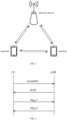
- FIG. 1 is a schematic diagram showing an architecture of a communication system of a network device and a terminal according to an illustrative embodiment.
- a communication method provided in the present invention may be applied to the architecture of the communication system shown in FIG. 1 .
- a network device may send a signaling based on the architecture shown in FIG. 1 .
- a wireless communication system may further include other network devices, such as a core network device, a wireless relay device, and a wireless backhaul device, which are not shown in FIG. 1 .
- the number of network devices and terminals included in the wireless communication system is not limited in the embodiments of the present invention.
- the wireless communication system is a network that provides a wireless communication function.
- the wireless communication system may adopt different communication technologies, such as code division multiple access (CDMA), wideband code division multiple access (WCDMA), time division multiple access (TDMA), frequency division multiple access (FDMA), orthogonal frequency-division multiple access (OFDMA), single carrier frequency division multiple access (SC-FDMA), carrier sense multiple access with collision avoidance.
- CDMA code division multiple access
- WCDMA wideband code division multiple access
- TDMA time division multiple access
- FDMA frequency division multiple access
- OFDMA orthogonal frequency-division multiple access
- SC-FDMA single carrier frequency division multiple access
- the networks may be classified into a 2nd generation (2G) network, a 3G network, a 4G network or a future evolution network, such as a 5G network, the 5G network may also be referred to as a new radio (NR).
- 2G 2nd generation
- 3G 3G
- 4G 4G
- 5G network may also
- the network device involved in the present invention may also be referred to as a wireless access network device.
- the wireless access network device may be a base station, an evolved node B, a home base station, an access point (AP) in a wireless fidelity (WIFI) system, a wireless relay node, a wireless backhaul node, a transmission point (TP), a transmission and reception point (TRP), etc., and it may also be a gNB in an NR system, or it may also be a component or part of device that constitutes a base station.
- the network device may also be an in-vehicle device. It is to be understood that in the embodiments of the present invention, a specific technology and a specific device form adopted by the network device are not limited.
- the terminal involved in the present invention may also be referred to as a terminal device, a user equipment (UE), a mobile station (MS), a mobile terminal (MT), etc. It is a device that provides voice and/or data connectivity to a user.
- the terminal may be a handheld device with a wireless connection function, an in-vehicle device, etc.
- some examples of terminals are a mobile phone, a pocket personal computer (PPC), a palmtop computer, a personal digital assistant (PDA), a notebook computer, a tablet computer, a wearable device, or an in-vehicle device.
- the terminal device may also be an in-vehicle device. It is to be understood that a specific technology and a specific device form adopted by the terminal are not limited in the embodiments of the present invention.
- NR new radio
- SDT small data transmission
- the terminal may complete a data transmission without entering a connected state, so as to avoid wasting time-frequency resources, shorten data transmission delay, and reduce energy consumption of the terminal at the same time.
- the SDT is performed in two manners: a random access-based SDT (RA-based SDT) and a semi-statically configured SDT (also called a configured grant-SDT, CG-SDT).
- RA-based SDT random access-based SDT
- CG-SDT semi-statically configured SDT
- the base station when a radio resource control (RRC) connected state is switched to an RRC inactive state, the base station sends a RRC release message carrying information required for the SDT, such as semi-static time-frequency domain resource allocation information and validity determination of a time advance (TA).
- RRC radio resource control
- TA time advance
- the terminal in an inactive state has uplink data to be transmitted, it determines the TA validity, the coverage condition and the size of date. In a case where the TA is valid, the coverage condition is satisfied, and the size of the date reaches the threshold, the terminal uses the semi-static resource configured by the base station to perform the SDT.
- the RA-based SDT may be performed in two manners, namely an SDT based on a 2-step random access channel (RACH) and an SDT based on a 4-step RACH.
- RACH 2-step random access channel
- a small data packet will be transmitted in a physical uplink shared channel (PUSCH) resource of a random access request message (msgA).
- PUSCH physical uplink shared channel
- msgA random access request message
- msgA random access request message
- msgA random access request message
- msgA random access request message
- the SDT based on the 4-step RACH a small data packet will be carried in msg3.
- the determination of the size of data is still needed. Only when the size of the data is less than a threshold, may the small data be transmitted in the random access process.
- the small data packet is transmitted after the terminal enters the connected state by performing the RACH process.
- the terminal needs to compare a current synchronization signal reference signal receiving power (SS-RSRP) with a reference signal receiving power (RSRP) threshold before performing the transmission of the small data packet. Only when the current SS-RSRP is greater than the RSRP threshold, the transmission of the small data packet is performed.
- SS-RSRP current synchronization signal reference signal receiving power
- RSRP reference signal receiving power
- a UE-special search space USS
- a UE-special search space USS
- a subsequent transmission of the terminal it is further proposed to configure a cell-radio network temporary identifier (C-RNTI) for each terminal in an inactive state.
- C-RNTI cell-radio network temporary identifier
- the C-RNTI correspondingly configured for one terminal in the inactive state may be the same as a C-RNTI of the terminal in an RRC connected state (RRC_CONNECTED), or may be configured by a network device via an explicit signaling.
- FIG. 2 is a flow chart showing a random access method according to an illustrative embodiment.
- a terminal sends a random access request to a network device via a physical random access channel (PRACH) resource.
- PRACH physical random access channel
- the network device transmits a random access response (RAR) message to allocate a temporary cell-radio network temporary identifier (TC-RNTI) to the terminal and provide an uplink (UL) resource required by message 3 (Msg.3).
- RAR random access response
- TC-RNTI temporary cell-radio network temporary identifier
- Msg.3 uplink resource required by message 3
- the terminal performs blind decoding on a physical downlink control channel (PDCCH) scheduling the RAR with a random access radio network temporary identifier (RA-RNTI).
- PDCCH physical downlink control channel
- RA-RNTI random access radio network temporary identifier
- the terminal sends Msg.3 to the network device.
- Msg.3 includes a high layer signaling such as an RRC resume request, which carries an identifier, like i-RNTI or short i-RNTI, and a random access contention resolution is started.
- the terminal performs blind decoding on downlink control information (DCI) scheduling Msg.4 with the TC-RNTI acquired in the second step.
- DCI downlink control information
- the terminal changes the TC-RNTI into the C-RNTI, which is used for data transmission in the connected state.
- MAC CE UE contention resolution identity MAC control element
- the contention-based random access such as 4-step RACH procedure
- the contention-based random access has complex steps and a large random access latency, and is not conducive to energy saving for the terminal.
- the present invention proposes a random access method, which initiates a random access by configuring a semi-static transmission resource for the SDT of the terminal.
- Msg.3 of an uplink message may be directly sent, thus shortening the random access process, and realizing the effect of reducing energy consumption for the terminal.
- FIG. 3 is a flow chart showing a random access method according to an illustrative embodiment. As shown in FIG. 3 , the random access method is applied to a terminal and includes steps as follows.
- step S 11 a semi-static transmission resource is determined.
- step S12 an uplink message for a random access is sent based on the semi-static transmission resource.
- the semi-static transmission resource is a semi-static transmission resource configured for a small data transmission (SDT) in an inactive state.
- SDT small data transmission
- the terminal determines the semi-static transmission resource configured for the small data transmission (SDT) in the inactive state.
- SDT small data transmission
- the terminal needs to enter an RRC connected state
- the uplink message for the random access is sent based on the semi-static transmission resource configured for the data transmission.
- the terminal needs to enter the RRC connected state
- the terminal sends a request to a network device to allow the terminal to access a network and establish a network connection.
- the terminal may use the semi-static transmission resource configured for the SDT in the inactive state to send Msg.3 for the random access to implement the random access.
- Msg.3 for the random access may be initiated based on the semi-static transmission resource.
- the semi-static transmission resource configured for the SDT in the inactive state may be determined by the terminal based on a configuration of a network device, determined based on pre-stored configuration information, or determined based on a communication protocol.
- Msg.3 for the random access may be sent based on the semi-static transmission resource to implement the random access, which shortens the process of the random access and achieves the effect of reducing energy consumption of the terminal.
- the uplink message includes a radio resource control (RRC) resume request and/or an RRC setup request.
- RRC radio resource control
- the terminal may be a terminal configured with the CG-SDT in the inactive state.
- the TA corresponding to an uplink data transmission for the random access needs to be determined.
- an RRC resume request and/or an RRC setup request are/is sent to the network device (e.g., a base station) via the semi-static transmission resource configured for the small data transmission of the terminal to initiate the random access.
- the semi-static transmission resource configured for the small data transmission of the terminal is a semi-static transmission resource configured for a small data transmission of the terminal in an RRC inactive state.
- the uplink message includes no first identification information of the terminal.
- the first identification information of the terminal is identification information of the terminal in an RRC inactive state.
- the first identification information is i-RNTI.
- a position of the semi-static transmission resource (configured by the network device) for the small data transmission of the terminal has a mapping relationship with identification information of the terminal. That is, in the case where the terminal sends the uplink message for the random access based on the semi-static transmission resource, the first identification information of the terminal may be considered as to be implicitly indicated to the network device due to the mapping relationship between the position of the semi-static transmission resource and the identification information of the terminal, that is, the i-RNTI of the terminal is implicitly indicated to the network device based on the position of the semi-static transmission resource, where the i-RNTI is configured for the terminal to perform the random access.
- the terminal after sending the RRC resume request and/or the RRC setup request, the terminal will receive downlink control information (DCI) issued by the network device via a common search space (CSS) or a USS, and determine that the random access is completed. For execution steps, reference may be made to FIG. 4 .
- DCI downlink control information
- CSS common search space
- USS USS
- FIG. 4 is a flow chart showing a random access method according to an illustrative embodiment. As shown in FIG. 4 , the random access method is applied to the terminal and includes steps as follows.
- step S21 downlink control information (DCI) is received.
- DCI downlink control information
- step S22 an acknowledgement message is sent in response to determining that RRC resume information or RRC setup information is included in a downlink data transmission scheduled by the DCI.
- the terminal performs Msg.4 scheduling for the random access based on the DCI received via the CSS/USS, and determines RRC information contained in Msg.4.
- the acknowledgement message i.e., an acknowledge character, ACK
- the ACK is not sent (or NACK is sent), and the random access process is not completed.
- the DCI is sent by the base station according to a received uplink message for the random access sent by the terminal.
- the uplink message is sent by the terminal using the semi-static transmission resource configured for the small data transmission (SDT) in the inactive state.
- SDT small data transmission
- the RRC resume message or the RRC setup information may include no contention resolution information.
- the position of the semi-static transmission resource (configured by the network device) for the small data transmission of the terminal has the mapping relationship with the identification information of the terminal.
- the terminal initiates the random access based on the physical resource corresponding to the terminal, (i.e., the terminal and the resource are in one-to-one correspondence), and thus there is no need to perform the contention resolution.
- the second identification information of the terminal in a case where the terminal is in the inactive state and second identification information of the terminal is not acquired, the second identification information of the terminal may be acquired based on received indication information or a communication protocol.
- the second identification information of the terminal is configured for data scheduling and data transmission.
- the second identification information of the terminal may be C-RNTI.
- the terminal acquires the second identification information based on the received indication information or the communication protocol.
- a DCI dynamic signaling received by the terminal carries the second identification information of the terminal.
- the MAC CE received by the terminal carries the second identification information of the terminal.
- a RRC signaling received by the terminal carries the second identification information of the terminal.
- Yet another manner is to use, according to the provision of the communication protocol, the same second identification information (i.e., C-RNTI) of the terminal before the RRC connection is released.
- embodiments of the present invention further provide a random access method.
- FIG. 5 is a flow chart showing a random access method according to an illustrative embodiment. As shown in FIG. 5 , the random access method is applied to a network device and includes step(s) as follows.
- step S31 an uplink message for a random access sent by a terminal based on a semi-static transmission resource is received.
- the semi-static transmission resource is a semi-static transmission resource configured for a small data transmission (SDT) in an inactive state.
- SDT small data transmission
- the terminal determines the semi-static transmission resource configured for the data transmission.
- the uplink message for the random access is sent based on the semi-static transmission resource configured for the data transmission.
- the terminal sends a request to a network device to allow the terminal to access a network and establish a network connection.
- Msg.3 for the random access may be initiated based on the semi-static transmission resource.
- the semi-static transmission resource configured for the small data transmission (SDT) in the inactive state may be determined by the terminal based on a configuration of a network device, determined based on pre-stored configuration information, or determined based on a communication protocol.
- the method includes an optional step.
- step S32 a configuration message is sent.
- the configuration message is configured to indicate a semi-static transmission resource configured for a small data transmission (SDT) of a terminal in an inactive state.
- SDT small data transmission
- This step S32 may not be executed, may be executed before step S31, or may be executed after step S31.
- the uplink message for the random access is sent based on the semi-static transmission resource configured for the data transmission.
- the terminal sends a request to a network device to allow the terminal to access a network and establish a network connection.
- the terminal may use the semi-static transmission resource configured for the SDT in the inactive state to send Msg.3 for the random access to implement the random access.
- Msg.3 for the random access may be initiated based on the semi-static transmission resource.
- the semi-static transmission resource configured for the SDT in the inactive state may be determined by the terminal based on a configuration of a network device, determined based on pre-stored configuration information, or determined based on a communication protocol.
- Msg.3 for the random access may be received based on the semi-static transmission resource to implement the random access, which shortens a process of the random access of the terminal and achieves the effect of reducing energy consumption of the terminal.
- the uplink message includes a radio resource control (RRC) resume request and/or an RRC setup request.
- RRC radio resource control
- the terminal may be a terminal configured with the CG-SDT in the inactive state.
- the semi-static transmission resource configured for the small data transmission of the terminal is a semi-static transmission resource configured for a small data transmission of the terminal in an RRC inactive state.
- the uplink message includes no first identification information of the terminal.
- the first identification information of the terminal is identification information of the terminal in an RRC inactive state.
- the first identification information is i-RNTI.
- a position of the semi-static transmission resource (configured by the network device) for the small data transmission of the terminal has a mapping relationship with identification information of the terminal. That is, in the case where the terminal sends the uplink message for the random access based on the semi-static transmission resource, the first identification information of the terminal may be considered as to be implicitly indicated to the network device due to the mapping relationship between the position of the semi-static transmission resource and the identification information of the terminal, that is, the i-RNTI of the terminal is implicitly indicated to the network device based on the position of the semi-static transmission resource, where the i-RNTI is configured for the terminal to perform the random access.
- the network device after receiving the uplink message including the RRC resume request and/or the RRC setup request, the network device will issue the DCI via a CSS or a USS to determine that the random access of the terminal is completed. For execution steps, reference may be made to FIG. 6 .
- FIG. 6 is a flow chart showing a random access method according to an illustrative embodiment. As shown in FIG. 6 , the random access method is applied to a network device and includes steps as follows.
- step S41 downlink control information (DCI) is sent in response to receiving an uplink message.
- DCI downlink control information
- the uplink message may be an uplink message for the random access sent by the terminal using a semi-static transmission resource configured for a small data transmission (SDT) in an inactive state.
- SDT small data transmission
- the downlink data transmission scheduled by the DCI includes RRC resume information or RRC setup information that is indicated to the terminal.
- the network device sends the DCI based on the CSS/USS, and the DCI is used for Msg.4 scheduling for the random access of the terminal.
- the DCI is used for Msg.4 scheduling for the random access of the terminal.
- the RRC resume message or the RRC setup information may include no contention resolution information.
- the position of the semi-static transmission resource configured for the small data transmission has the mapping relationship with the identification information of the terminal.
- the network device may determine, based on the mapping relationship between the position of the semi-static transmission resource configured for the small data transmission and the identification information of the terminal, the terminal that initiates the random access request, and the second identification information may be uniquely allocated to the terminal.
- indication information may be sent.
- the indication message includes the second identification information of the terminal, and the second identification information of the terminal is configured for data scheduling and data transmission.
- the second identification information of the terminal may be the C-RNTI.
- the network device sends an indication message to configure the second identification information for the terminal.
- One manner may be sending the DCI to the terminal, and dynamically scheduling, by the DCI, the second identification information of the terminal carried in the signaling.
- one manner is that the MAC CE sent to the terminal carries the second identification information of the terminal.
- a terminal For a CG-SDT, a terminal is configured with a semi-static uplink transmission resource. In this case, if the terminal intends to enter an RRC _CONNECTED state, it may directly send Msg.3 via the semi-static uplink transmission resource configured by a base station, so as to shorten a random access process. Specifically, there are the following designs.
- the terminal When the terminal intends to perform the random access, it first needs to determine whether the TA is valid. When the TA is valid, an RRCResumeRequest is sent to the base station via the semi-static resource configured for the SDT to initiate the random access.
- Msg.4 includes RRC resume. Accordingly, after receiving the RRC resume, the terminal feeds back an ACK, and the random access process is completed.
- the method executed is as follows.
- the terminal In response to the terminal performing the random access and the TA being valid, the terminal sends the RRCResumeRequest to the base station via the semi-static resource configured for the SDT to initiate the random access.
- the terminal receives the DCI issued by the base station via the CSS/USS, and performs Msg.4 scheduling.
- the Msg.4 includes RRC resume.
- the terminal performs HARQ feedback according to the RRC resume (that is, feeds back the ACK if the RRC resume is received).
- the random access is completed.
- the method is as follows.
- the DCI is issued via the CSS/USS to perform Msg.4 scheduling.
- Msg.4 includes RRC resume.
- a receiving terminal may perform HARQ feedback according to the RRC resume (that is, feeds back the ACK if the RRC resume is received).
- an RRCResumeRequest message does not need to include information such as i-RNTI.
- Msg.4 does not need to include information such as content resolution identity MAC CE.
- the base station will allocate one C-RNTI to the terminal via Msg.4.
- the C-RNTI may be carried by the DCI, or may be carried by the RRCResume or the MAC CE.
- a transmitted signaling may be:
- embodiments of the present invention further provide a random access apparatus.
- the random access apparatus includes corresponding hardware structures and/or software modules for executing various functions.
- the embodiments of the present invention may be implemented in the form of hardware or a combination of hardware and computer software. Whether a certain function is executed by hardware or computer software driving hardware depends on the specific application and design constraints of the technical solution. Those skilled in the art may use different methods to implement the described functions for each specific application, but such implementation should not be considered as extending beyond the scope of the technical solutions of the embodiments of the present invention.
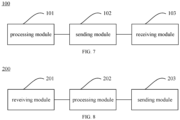
- FIG. 7 is a block diagram showing a random access apparatus according to an illustrative embodiment.
- the random access apparatus 100 is applied to a terminal, and includes a processing module 101 and a sending module 102.
- the processing module 101 is configured to determine a semi-static transmission resource.
- the sending module 102 is configured to send an uplink message for a random access based on the semi-static transmission resource.
- the uplink message includes a radio resource control (RRC) resume request and/or an RRC setup request.
- RRC radio resource control
- the method before sending the uplink message for the random access based on the semi-static transmission resource, the method further includes determining that a time advance of an uplink data transmission for the random access is valid.
- the semi-static transmission resource is a semi-static transmission resource configured for a small data transmission in an inactive state.
- the uplink message includes no first identification information of the terminal, and the first identification information of the terminal is identification information of the terminal in an RRC inactive state.
- the first identification information of the terminal is determined based on a position of the semi-static transmission resource that carries the uplink message.
- the apparatus further includes a receiving module 103.
- the receiving module 103 is configured to receive downlink control information (DCI).
- DCI downlink control information
- An acknowledgement message is sent in response to determining that RRC resume information or RRC setup information is included in a downlink data transmission scheduled by the DCI.
- the RRC resume message or the RRC setup information includes no contention resolution information.
- the processing module 101 is further configured to acquire second identification information of the terminal based on received indication information or a communication protocol.
- the second identification information of the terminal is configured for data scheduling and data transmission.
- FIG. 8 is a block diagram showing a random access apparatus according to an illustrative embodiment.
- the random access apparatus 200 is applied to a network device, and includes a receiving module 201.
- the receiving module 201 is configured to receive an uplink message for a random access sent by a terminal based on a semi-static transmission resource.
- the uplink message includes a radio resource control (RRC) resume request and/or an RRC setup request.
- RRC radio resource control
- the random access apparatus further includes a processing module 202 configured to determine a semi-static transmission resource configured for a small data transmission in an inactive state.
- the uplink message includes no first identification information of the terminal, and the first identification information of the terminal is identification information of the terminal in an RRC inactive state.
- the first identification information of the terminal is determined based on a position of the semi-static resource that carries the uplink message.
- the apparatus further includes a sending module 203 configured to send downlink control information (DCI) in response to receiving the uplink message.
- DCI downlink control information
- a downlink data transmission scheduled by the DCI includes RRC resume information or RRC setup information that is indicated to the terminal.
- the RRC resume message or the RRC setup information includes no contention resolution information.
- the sending module 203 is further configured to send an indication message.
- the indication message includes second identification information of the terminal, and the second identification information of the terminal is configured for data scheduling and data transmission.
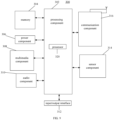
- FIG. 9 is a block diagram showing a device 300 for a random access according to an illustrative embodiment.
- the device 300 may be a mobile phone, a computer, a digital broadcast terminal, a messaging device, a game console, a tablet device, a medical device, a fitness device, a personal digital assistant, or the like.
- the device 300 may include one or more of the following components: a processing component 302, a memory 304, a power component 306, a multimedia component 308, an audio component 310, an input/output (I/O) interface 312, a sensor component 314, and a communication component 316.
- the processing component 302 typically controls overall operations of the device 300, such as the operations associated with display, phone calls, data communications, camera operations, and recording operations.
- the processing component 302 may include one or more processors 320 to execute instructions to perform all or some of the steps in the above-described methods.
- the processing component 302 may include one or more modules which facilitate the interaction between the processing component 302 and other components.
- the processing component 302 may include a multimedia module to facilitate the interaction between the multimedia component 308 and the processing component 302.
- the memory 304 is configured to store various types of data to support the operation of the device 300. Examples of such data include instructions for any applications or methods operated on the device 300, contact data, phonebook data, messages, pictures, videos, etc.
- the memory 304 may be implemented using any type of volatile or non-volatile memory devices, or a combination thereof, such as a static random access memory (SRAM), an electrically erasable programmable read-only memory (EEPROM), an erasable programmable read-only memory (EPROM), a programmable read-only memory (PROM), a read-only memory (ROM), a magnetic memory, a flash memory, a magnetic disk or an optical disk.
- SRAM static random access memory
- EEPROM electrically erasable programmable read-only memory
- EPROM erasable programmable read-only memory
- PROM programmable read-only memory
- ROM read-only memory
- the power component 306 provides power to various components of the device 300.
- the power component 306 may include a power management system, one or more power sources, and any other components associated with the generation, management, and distribution of power in the device 300.
- the multimedia component 308 includes a screen providing an output interface between the device 300 and the user.
- the screen may include a liquid crystal display (LCD) and a touch panel (TP). If the screen includes the touch panel, the screen may be implemented as a touch screen to receive input signals from the user.
- the touch panel includes one or more touch sensors to sense touches, swipes, and gestures on the touch panel. The touch sensors may not only sense a boundary of a touch or swipe action, but also sense a duration and a pressure associated with the touch or swipe action.
- the multimedia component 308 includes a front camera and/or a rear camera.
- the front camera and/or the rear camera may receive an external multimedia datum while the device 300 is in an operation mode, such as a photographing mode or a video mode.
- an operation mode such as a photographing mode or a video mode.
- Each of the front camera and the rear camera may be a fixed optical lens system or have focus and optical zoom capability.
- the audio component 310 is configured to output and/or input audio signals.
- the audio component 310 includes a microphone (MIC) configured to receive an external audio signal when the device 300 is in an operation mode, such as a call mode, a recording mode, and a voice recognition mode.
- the received audio signal may be further stored in the memory 304 or transmitted via the communication component 316.
- the audio component 310 further includes a speaker to output audio signals.
- the I/O interface 312 provides an interface between the processing component 302 and peripheral interface modules, such as keyboards, click wheels, buttons, and the like.
- the buttons may include, but are not limited to, a home button, a volume button, a starting button, and a locking button.
- the sensor component 314 includes one or more sensors to provide status assessments of various aspects of the device 300. For instance, the sensor component 314 may detect an open/closed status of the device 300, relative positioning of components, e.g., the display and the keypad, of the device 300, a change in position of the device 300 or a component of the device 300, a presence or absence of user contact with the device 300, an orientation or an acceleration/deceleration of the device 300, and a change in temperature of the device 300.
- the sensor component 314 may include a proximity sensor configured to detect the presence of nearby objects without any physical contact.
- the sensor component 314 may further include a light sensor, such as a CMOS or CCD image sensor, for use in imaging applications.
- the sensor component 314 may further include an accelerometer sensor, a gyroscope sensor, a magnetic sensor, a pressure sensor, or a temperature sensor.
- the communication component 316 is configured to facilitate communication, wired or wireless, between the device 300 and other devices.
- the device 300 may access a wireless network based on a communication standard, such as Wi-Fi, 2G, or 3G, or a combination thereof.
- the communication component 316 receives a broadcast signal or broadcast associated information from an external broadcast management system via a broadcast channel.
- the communication component 316 further includes a near field communication (NFC) module to facilitate short-range communications.
- NFC near field communication
- the NFC module may be implemented based on a radio frequency identifier (RFID) technology, an infrared data association (IrDA) technology, an ultra-wideband (UWB) technology, a Bluetooth (BT) technology, and other technologies.
- RFID radio frequency identifier
- IrDA infrared data association
- UWB ultra-wideband
- BT Bluetooth
- the device 300 may be implemented with one or more of an application specific integrated circuits (ASIC), a digital signal processor (DSP), a digital signal processing device (DSPD), a programmable logic device (PLD), a field programmable gate array (FPGA), a controller, a micro-controller, a microprocessor, or other electronic elements, for performing the above-mentioned method.
- ASIC application specific integrated circuits
- DSP digital signal processor
- DSPD digital signal processing device
- PLD programmable logic device
- FPGA field programmable gate array
- controller a micro-controller, a microprocessor, or other electronic elements, for performing the above-mentioned method.
- non-transitory computer readable storage medium including instructions, such as included in the memory 304, executable by the processor 320 in the device 300, for completing the above-mentioned method.
- the non-transitory computer-readable storage medium may be a ROM, a random access memory (RAM), a CD-ROM, a magnetic tape, a floppy disc, an optical data storage device, and the like.
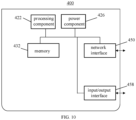
- FIG. 10 is a block diagram showing a device 400 for a random access according to an illustrative embodiment.
- the device 400 may be provided as a server.
- the device 400 includes a processing component 422, which further includes one or more processors, and memory resources represented by a memory 432 for storing instructions executable by the processing component 422, such as an application program.
- the application program stored in the memory 432 may include one or more modules each corresponding to a set of instructions.
- the processing component 422 is configured to execute instructions to perform the above-mentioned method.
- the device 400 may further include a power component 426 configured to perform power management of the device 400, a wired or wireless network interface 450 configured to connect the device 400 to a network, and an input/output (I/O) interface 458.
- the device 400 may operate based on an operating system stored in the memory 432, such as Windows ServerTM, Mac OS XTM, UnixTM, LinuxTM, FreeBSDTM, or the like.
- a plurality in the present invention refers to two or more, and other quantifiers are similar thereto.
- a character “/” generally indicates that contextual objects are in an “or” relationship.
- “A/an” and “the” in singular forms are intended to include plural forms, unless clearly indicated in the context otherwise.
- first, and second are used to describe various information, but these information should not be limited by these terms. These terms are only used for distinguishing information of the same type from each other and do not denote a particular order or degree of importance. As a matter of fact, the terms such as “first,” and “second” may be used interchangeably.
- first information may also be referred to as second information
- second information may also be referred to as the first information, without departing from the scope of embodiments of the present invention.
Landscapes
- Engineering & Computer Science (AREA)
- Computer Networks & Wireless Communication (AREA)
- Signal Processing (AREA)
- Mobile Radio Communication Systems (AREA)
Applications Claiming Priority (1)
| Application Number | Priority Date | Filing Date | Title |
|---|---|---|---|
| PCT/CN2021/120748 WO2023044863A1 (zh) | 2021-09-26 | 2021-09-26 | 一种随机接入方法、随机接入装置及存储介质 |
Publications (2)
| Publication Number | Publication Date |
|---|---|
| EP4408096A1 true EP4408096A1 (de) | 2024-07-31 |
| EP4408096A4 EP4408096A4 (de) | 2024-11-20 |
Family
ID=85719894
Family Applications (1)
| Application Number | Title | Priority Date | Filing Date |
|---|---|---|---|
| EP21957982.8A Pending EP4408096A4 (de) | 2021-09-26 | 2021-09-26 | Direktzugriffsverfahren, direktzugriffsvorrichtung und speichermedium |
Country Status (4)
| Country | Link |
|---|---|
| US (1) | US20250016838A1 (de) |
| EP (1) | EP4408096A4 (de) |
| CN (2) | CN116195327B (de) |
| WO (1) | WO2023044863A1 (de) |
Family Cites Families (16)
| Publication number | Priority date | Publication date | Assignee | Title |
|---|---|---|---|---|
| JP5171765B2 (ja) * | 2008-09-30 | 2013-03-27 | 創新音▲速▼股▲ふん▼有限公司 | スケジューリングリクエストプロシージャとランダムアクセスプロシージャーの間の相互作用を改善する方法及び装置 |
| JP5124028B2 (ja) * | 2010-01-08 | 2013-01-23 | 創新音▲速▼股▲ふん▼有限公司 | ワイヤレスコミュニケーションシステムの半持続性の伝送リソースの処理方法と装置 |
| WO2015137632A1 (en) * | 2014-03-11 | 2015-09-17 | Lg Electronics Inc. | Method for allocating temporary identifier to terminal in random access procedure in wireless communication system and apparatus tehrefor |
| KR102092560B1 (ko) * | 2016-11-04 | 2020-03-25 | 주식회사 케이티 | 무선 통신에서 멀티 빔 기반 랜덤 액세스 절차를 수행하는 방법 및 장치 |
| WO2018201483A1 (zh) * | 2017-05-05 | 2018-11-08 | 华为技术有限公司 | 数据传输的方法、终端设备和接入网设备 |
| CN111713166B (zh) * | 2018-02-14 | 2022-06-10 | 华为技术有限公司 | 随机接入方法及装置 |
| CN110913499B (zh) * | 2018-09-18 | 2022-07-15 | 维沃移动通信有限公司 | 一种随机接入方法、终端及计算机可读存储介质 |
| US12402118B2 (en) * | 2018-09-27 | 2025-08-26 | Telefonaktiebolaget Lm Ericsson (Publ) | Support for transmission in preconfigured UL resources |
| EP4447601B1 (de) * | 2019-01-04 | 2026-01-28 | Nokia Technologies Oy | Kommunikation zwischen einem endgerät und einem drahtlosnetzwerkknoten |
| WO2021012188A1 (zh) * | 2019-07-23 | 2021-01-28 | Oppo广东移动通信有限公司 | 通信处理方法及相关设备 |
| US11758497B2 (en) * | 2019-12-23 | 2023-09-12 | Qualcomm Incorporated | Timing advance simplification for stationary and low mobility user equipments |
| EP4144176A4 (de) * | 2020-05-13 | 2024-05-01 | FG Innovation Company Limited | Datenübertragungsverwaltung in inaktivem zustand der funkressourcensteuerung (rrc) |
| WO2022193269A1 (en) * | 2021-03-19 | 2022-09-22 | Qualcomm Incorporated | New small data transmission indication |
| US20240155374A1 (en) * | 2021-05-14 | 2024-05-09 | Qualcomm Incorporated | Small data transmissions with beam switching for idle/inactive state user equipment in non-terrestrial network |
| WO2023010529A1 (en) * | 2021-08-06 | 2023-02-09 | Qualcomm Incorporated | Small data transfer communications |
| WO2024000215A1 (en) * | 2022-06-29 | 2024-01-04 | Qualcomm Incorporated | Semi-persistent scheduling resource activation for mobile terminated small data transmission |
-
2021
- 2021-09-26 WO PCT/CN2021/120748 patent/WO2023044863A1/zh not_active Ceased
- 2021-09-26 CN CN202180002893.1A patent/CN116195327B/zh active Active
- 2021-09-26 EP EP21957982.8A patent/EP4408096A4/de active Pending
- 2021-09-26 CN CN202511307907.7A patent/CN121126570A/zh active Pending
- 2021-09-26 US US18/694,625 patent/US20250016838A1/en active Pending
Also Published As
| Publication number | Publication date |
|---|---|
| CN116195327B (zh) | 2025-10-10 |
| US20250016838A1 (en) | 2025-01-09 |
| WO2023044863A1 (zh) | 2023-03-30 |
| EP4408096A4 (de) | 2024-11-20 |
| CN121126570A (zh) | 2025-12-12 |
| CN116195327A (zh) | 2023-05-30 |
Similar Documents
| Publication | Publication Date | Title |
|---|---|---|
| EP3952551B1 (de) | Direktzugriffsverfahren und -vorrichtung sowie computerlesbares speichermedium | |
| CN111492716B (zh) | 用于随机接入的通信方法、装置及计算机可读存储介质 | |
| US11909534B2 (en) | HARQ feedback method and apparatus | |
| US20240187281A1 (en) | Indication method, indication apparatus, and storage medium | |
| US11399383B2 (en) | Method and device for requesting uplink transmission resource | |
| US20240406944A1 (en) | Bwp switching method and apparatus, and storage medium | |
| CN110574484B (zh) | 随机接入方法、装置及存储介质 | |
| EP4002943B1 (de) | Datenübertragungsverfahren, gerät und speichermedium | |
| US12452005B2 (en) | Blind retransmission method and apparatus, and blind retransmission indication method and apparatus | |
| CN112449764B (zh) | 随机接入方法、装置、系统及存储介质 | |
| CN111727654A (zh) | 数据传输方法、数据传输装置及存储介质 | |
| EP4387297A1 (de) | Verfahren und vorrichtung zur durchführung kleiner datenübertragung, verfahren und vorrichtung zur bestimmung eines direktzugriffsnachrichtenübertragungsmodus, vorrichtung und speichermedium | |
| EP4672845A1 (de) | Zeitvorlaufmessverfahren und -vorrichtung und speichermedium | |
| CN107223363A (zh) | 一种分配调度请求sr资源的方法和装置 | |
| WO2023070672A1 (zh) | 随机接入方法、装置及存储介质 | |
| US20230413272A1 (en) | Uplink control information transmission method and apparatus, and storage medium | |
| US12445942B2 (en) | Random access method and apparatus, and storage medium | |
| EP3923660B1 (de) | Verfahren und vorrichtungen zur verarbeitung eines direktzugriffs | |
| CN109156015B (zh) | 随机接入的处理方法及装置 | |
| CN114175839B (zh) | 随机接入方法、装置、通信装置和计算机可读存储介质 | |
| EP4408096A1 (de) | Direktzugriffsverfahren, direktzugriffsvorrichtung und speichermedium | |
| EP4510661A1 (de) | Verfahren und vorrichtung zur drahtlosen übertragung sowie kommunikationsvorrichtung und speichermedium | |
| EP4340483A1 (de) | Datenübertragungsverfahren und -vorrichtung sowie kommunikationsvorrichtung | |
| WO2022016469A1 (zh) | 随机接入参数处理方法和装置、存储介质 | |
| WO2023206036A1 (zh) | 一种随机接入的方法、装置、设备及存储介质 |
Legal Events
| Date | Code | Title | Description |
|---|---|---|---|
| STAA | Information on the status of an ep patent application or granted ep patent |
Free format text: STATUS: THE INTERNATIONAL PUBLICATION HAS BEEN MADE |
|
| PUAI | Public reference made under article 153(3) epc to a published international application that has entered the european phase |
Free format text: ORIGINAL CODE: 0009012 |
|
| STAA | Information on the status of an ep patent application or granted ep patent |
Free format text: STATUS: REQUEST FOR EXAMINATION WAS MADE |
|
| 17P | Request for examination filed |
Effective date: 20240418 |
|
| AK | Designated contracting states |
Kind code of ref document: A1 Designated state(s): AL AT BE BG CH CY CZ DE DK EE ES FI FR GB GR HR HU IE IS IT LI LT LU LV MC MK MT NL NO PL PT RO RS SE SI SK SM TR |
|
| A4 | Supplementary search report drawn up and despatched |
Effective date: 20241023 |
|
| RIC1 | Information provided on ipc code assigned before grant |
Ipc: H04W 74/0833 20240101ALI20241017BHEP Ipc: H04W 74/08 20240101ALI20241017BHEP Ipc: H04W 74/00 20090101ALI20241017BHEP Ipc: H04W 72/04 20230101AFI20241017BHEP |
|
| DAV | Request for validation of the european patent (deleted) | ||
| DAX | Request for extension of the european patent (deleted) |