EP4408088A1 - Kommunikationserfassungsverfahren und -vorrichtung sowie kommunikationsvorrichtung - Google Patents
Kommunikationserfassungsverfahren und -vorrichtung sowie kommunikationsvorrichtung Download PDFInfo
- Publication number
- EP4408088A1 EP4408088A1 EP22871887.0A EP22871887A EP4408088A1 EP 4408088 A1 EP4408088 A1 EP 4408088A1 EP 22871887 A EP22871887 A EP 22871887A EP 4408088 A1 EP4408088 A1 EP 4408088A1
- Authority
- EP
- European Patent Office
- Prior art keywords
- positioning
- sensing
- communication device
- requirement
- measurement
- Prior art date
- Legal status (The legal status is an assumption and is not a legal conclusion. Google has not performed a legal analysis and makes no representation as to the accuracy of the status listed.)
- Pending
Links
Images




Classifications
-
- H—ELECTRICITY
- H04—ELECTRIC COMMUNICATION TECHNIQUE
- H04W—WIRELESS COMMUNICATION NETWORKS
- H04W64/00—Locating users or terminals or network equipment for network management purposes, e.g. mobility management
-
- H—ELECTRICITY
- H04—ELECTRIC COMMUNICATION TECHNIQUE
- H04W—WIRELESS COMMUNICATION NETWORKS
- H04W24/00—Supervisory, monitoring or testing arrangements
- H04W24/10—Scheduling measurement reports ; Arrangements for measurement reports
-
- H—ELECTRICITY
- H04—ELECTRIC COMMUNICATION TECHNIQUE
- H04L—TRANSMISSION OF DIGITAL INFORMATION, e.g. TELEGRAPHIC COMMUNICATION
- H04L5/00—Arrangements affording multiple use of the transmission path
- H04L5/003—Arrangements for allocating sub-channels of the transmission path
- H04L5/0048—Allocation of pilot signals, i.e. of signals known to the receiver
- H04L5/0051—Allocation of pilot signals, i.e. of signals known to the receiver of dedicated pilots, i.e. pilots destined for a single user or terminal
-
- H—ELECTRICITY
- H04—ELECTRIC COMMUNICATION TECHNIQUE
- H04W—WIRELESS COMMUNICATION NETWORKS
- H04W4/00—Services specially adapted for wireless communication networks; Facilities therefor
- H04W4/02—Services making use of location information
-
- H—ELECTRICITY
- H04—ELECTRIC COMMUNICATION TECHNIQUE
- H04W—WIRELESS COMMUNICATION NETWORKS
- H04W64/00—Locating users or terminals or network equipment for network management purposes, e.g. mobility management
- H04W64/006—Locating users or terminals or network equipment for network management purposes, e.g. mobility management with additional information processing, e.g. for direction or speed determination
Definitions
- This application relates to the field of communication technologies, and in particular, to a sensing positioning method and apparatus, and a communication device.
- sensing capabilities it means that one or more devices with the sensing capabilities can sense an orientation, a distance, a speed, and other information of a target object through sending and receiving of wireless signals, or detect, track, identify, and image a target object, an event, or an environment, or the like.
- 6G 6 th Generation
- Embodiments of this application provide a sensing positioning method and apparatus, and a communication device, to solve a problem of how to perform sensing based on positioning information.
- a sensing positioning method including.
- a sensing positioning method including.
- a sensing positioning apparatus including.
- a sensing positioning apparatus including.
- a communication device includes a processor, a memory, and a program or instructions stored in the memory and runnable on the processor, the program or the instructions, when executed by the processor, implementing the steps of the method according to the first aspect or the second aspect.
- a communication device including a processor and a communication interface.
- the communication interface is configured to receive a sensing requirement, and send, in a case that the sensing requirement is a sensing requirement associated with a positioning service, the sensing requirement to a second communication device, and send a positioning requirement to a third communication device.
- the communication interface is configured to obtain a positioning requirement, where the positioning requirement is sent by a first communication device in a case that a sensing requirement received by the first communication device is a sensing requirement associated with a positioning service.
- the processor is configured to obtain first information according to the positioning requirement, where the first information includes at least one of signal configuration information and a measurement quantity, the signal configuration information is signal configuration information used for sensing measurement and/or positioning measurement, and the measurement quantity is a measurement quantity used for sensing measurement and/or positioning measurement.
- the communication interface is configured to send the first information to at least one of a second communication device and a fourth communication device, where the second communication device includes a terminal and/or a base station associated with the sensing requirement, and the fourth communication device includes a terminal and/or a base station associated with the positioning requirement.
- a readable storage medium storing a program or instructions, the program or the instructions, when executed by a processor, implementing the steps of the method according to the first aspect or the steps of the method according to the second aspect.
- a chip includes a processor and a communication interface, the communication interface is coupled to the processor, and the processor is configured to run a program or instructions, to implement the method according to the first aspect, or implement the method according to the second aspect.
- a computer program/program product is provided, where the computer program/program product is stored in a non-transitory storage medium, and the computer program/program product is executed by at least one processor to implement the steps of the method according to the first aspect or the second aspect.
- a communication device configured to perform the method according to the first aspect or the second aspect.
- the sensing requirement is received.
- the sensing requirement is a sensing requirement associated with the positioning service
- the sensing requirement is sent to the second communication device, and the positioning requirement is sent to the third communication device, thereby triggering a process combining sensing and positioning, and achieving the purpose of performing sensing based on positioning information.
- first and second are used to distinguish similar objects, but are not used to describe a specific sequence or order. It should be understood that the terms used in this way are interchangeable in a proper case, so that embodiments of this application can be implemented in other orders than the orders illustrated or described herein.
- the objects distinguished by “first” and “second” are usually of one type, and the quantity of objects is not limited. For example, there may be one or more first objects.
- “and/or” in the description and claims represents at least one of connected objects, and the character “I” generally indicates an "or” relationship between associated objects.
- LTE Long Term Evolution
- LTE-A Long Term Evolution-Advanced
- CDMA Code Division Multiple Access
- TDMA Time Division Multiple Access
- FDMA Frequency Division Multiple Access
- OFDMA Orthogonal Frequency Division Multiple Access
- SC-FDMA Single Carrier Frequency Division Multiple Access
- system and “network” may be used interchangeably in embodiments of this application.
- the technology described can be applied to the systems and radio technologies described above, and can also be applied to other systems and radio technologies.
- the following description describes a new radio (New Radio, NR) system for illustrative purposes, and NR terminology is used in most of the description below. These technologies are also applicable to applications other than NR system applications, for example, the 6 th generation (6 th Generation, 6G) communication system.
- NR New Radio
- sensing capabilities it means that one or more devices with the sensing capabilities can sense an orientation, a distance, a speed, and other information of a target object through sending and receiving of wireless signals, or detect, track, identify, and image a target object, an event, or an environment, or the like.
- a sensing resolution is to be significantly improved compared to centimeter wave, allowing the 6G network to provide more sophisticated sensing services.
- a sensing signal measurement party is user equipment (User Equipment, UE, also referred to as a terminal)
- UE location information needs to be obtained.
- an environment map is reconstructed.
- a base station senses and reconstructs a surrounding environment based on a spontaneous self-collection mode, and then uses the reconstruction information to assist UE positioning.
- the UE can determine, if the UE location information is obtained, a sensing signal configuration or a measurement quantity according to a location of a transceiver device and a location of a to-be-sensed target or a sensing area, or assist in calculating a sensing result, thereby obtaining higher sensing accuracy and providing better sensing services.
- a sensing signal configuration or a measurement quantity according to a location of a transceiver device and a location of a to-be-sensed target or a sensing area
- an embodiment of this application provides a sensing positioning method, including: Step 101: A first communication device receives a sensing requirement.
- the first communication device may be specifically a sensing network function or a sensing network element.
- the sensing requirement may be initiated by a third-party application or a core network (or a network management system or a base station) or a terminal.
- the third-party application sends the sensing requirement to an application server (including an in-network server, such as an IP multimedia subsystem (IP Multimedia Subsystem, IMS), or an off-network server).
- the application server sends the sensing requirement to the sensing network function/sensing network element.
- the application server sends the sensing requirement to an access and mobility management function (Access and Mobility Management Function, AMF), and the AMF selects at least one sensing network function/sensing network element and sends the requirement to the sensing network function/sensing network element.
- AMF Access and Mobility Management Function
- the core network AMF selects at least one sensing network function/sensing network element and sends the sensing requirement to the sensing network function/sensing network element; or the AMF receives the sensing requirement sent by the network management system, and selects at least one sensing network function/sensing network element and forwards the requirement to the sensing network function/sensing network element; or the AMF receives the sensing requirement sent by the base station, and selects at least one sensing network function/sensing network element and forwards the requirement to the sensing network function/sensing network element;
- the UE sends the sensing requirement to the core network AMF through non-access stratum (Non-Access Stratum, NAS) signaling.
- the AMF selects at least one sensing network function/sensing network element and sends the sensing requirement to the sensing network function/sensing network element.
- the foregoing sensing requirement includes at least one of the following:
- the sensing performance indicator includes at least one of sensing accuracy/sensing error, a sensing resolution, a sensing range, a sensing delay, a detection probability, and a false alarm probability.
- Step 102 The first communication device sends, in a case that the sensing requirement is a sensing requirement associated with a positioning service, the sensing requirement to a second communication device, and sends a positioning requirement to a third communication device.
- the first communication device After receiving the sensing requirement, the first communication device determines whether positioning service assistance is needed based on the sensing requirement. If the sensing requirement requires positioning service assistance, it is determined that the sensing requirement is a sensing requirement associated with the positioning service, a process combining sensing and positioning is triggered, the sensing requirement is sent to the second communication device, and the positioning requirement is sent to the third communication device.
- the second communication device may be a first base station and/or a first terminal associated with the sensing requirement
- the third communication device may be a location management function (Location Management Function, LMF).
- LMF Location Management Function
- sending the positioning requirement to the third communication device includes: sending the positioning requirement to the AMF, where the AMF selects at least one LMF, and sends the positioning requirement to the LMF.
- the sensing requirement is received.
- the sensing requirement is a sensing requirement associated with the positioning service
- the sensing requirement is sent to the second communication device, and the positioning requirement is sent to the third communication device, thereby triggering a process combining sensing and positioning, and achieving the purpose of performing sensing based on positioning information.
- the method further includes: determining a first base station and a first terminal that are associated with the sensing requirement, where the second communication device includes at least one of the first base station and the first terminal.
- the positioning requirement includes first indication information
- the first indication information is information indicating the second communication device.
- the first indication information indicates identification information of the first base station and/or the first terminal.
- the third communication device determines a second base station and/or a second terminal associated with the positioning requirement, and sends the positioning requirement to the second base station and/or the second terminal.
- the method for determining the second base station and/or the second terminal may be determined according to the second communication device.
- the method further includes:
- the signal configuration information is determined by at least one of the first communication device and the third communication device.
- the configuration information for the sensing signal and the configuration information for the positioning signal may be determined by the first communication device, or the configuration information for the sensing signal and the configuration information for the positioning signal may be determined by the third communication device, or the configuration information for the sensing signal may be determined by the first communication device and the configuration information for the positioning signal may be determined by the second communication device, or the configuration information for the positioning signal may be determined by the first communication device and the configuration information for the sensing signal may be determined by the third communication device.
- the sensing signal and the positioning signal may use the same reference signal or different reference signals.
- the sensing signal and the positioning signal use different reference signals.
- the reference signals may be uplink signals or downlink signals, or one is an uplink signal and the other is a downlink signal.
- the sensing network function/sensing network element determines the configuration information for the sensing signal according to the sensing requirement.
- the LMF determines the configuration information for the positioning signal according to the positioning requirement.
- the sensing signal and the positioning signal use the same reference signal, which may be an uplink signal or a downlink signal.
- a set of signal configuration information is determined, and the signal configuration information includes the configuration information for the sensing signal and the configuration information for the positioning signal, where the configuration information for the sensing signal and the configuration information for the positioning signal may be determined by one of the first communication device and the third communication device, and the determined signal configuration information is notified to the other party.
- the configuration information for the sensing signal and the configuration information for the positioning signal may alternatively be jointly determined by the first communication device and the third communication device.
- one of the parties such as the LMF, can first determine the configuration information for the positioning signal and send the configuration information for the positioning signal to the sensing network function/sensing network element, and then the sensing network function/sensing network element supplements the configuration information for the sensing signal.
- the configuration information for the sensing signal may alternatively be determined according to the sensing requirement and prior information (such as terminal location information).
- the signal configuration information includes the configuration information for the sensing signal and the configuration information for the positioning signal
- the signal configuration information further includes first identification information, where the first identification information indicates that the signal configuration information is used for positioning measurement and sensing measurement.
- the sensing signal and the positioning signal use the same reference signal
- the fourth communication device is the same as the second communication device, that is, the same base station or terminal performs the sensing measurement and positioning measurement.
- the first communication device and the third communication device needs to send the signal configuration information to the second communication device or the fourth communication device.
- the configuration information for the sensing signal and the positioning signal adopts the same configuration
- the first identification information indicates that the signal configuration information is used for both positioning and sensing measurement.
- the AMF knows that the measurement result needs to be sent to the first communication device and the third communication device.
- the AMF knows to forward the signal configuration information or the measurement quantity to a sensing associated base station/UE and a positioning associated base station/UE respectively.
- the method further includes:
- the measurement quantity is determined by at least one of the first communication device and the third communication device.
- the first communication device may determine the sensing measurement and/or common measurement quantity
- the second communication device may determine the positioning measurement quantity and the common measurement quantity.
- the first communication device may determine the sensing measurement quantity and/or the common measurement quantity by itself, and obtain the positioning measurement quantity and/or the common measurement quantity determined by the second communication device.
- the measurement quantity includes at least one of the following:
- configuration information for a signal and the measurement quantity may alternatively be determined by the second communication device and/or the fourth communication device according to the sensing requirement and/or the positioning requirement.
- the method according to this embodiment of this application further includes: obtaining a measurement result corresponding to the measurement quantity, where the measurement result is obtained according to signal configuration information and the measurement quantity, the signal configuration information includes at least one of configuration information for a sensing signal and configuration information for a positioning signal, and the signal configuration information is determined according to at least one of the sensing requirement and the positioning requirement.
- the second communication device performs the sensing measurement process according to the configuration information for the sensing signal, the sensing measurement quantity, and the common measurement quantity.
- the specific method for performing the sensing measurement process includes at least one of the following methods: spontaneous sending or receiving by a base station, sending and receiving between base stations, sending by a base station and receiving by UE, sending by UE and receiving by a base station, spontaneous sending or receiving by UE, and sending and receiving between UEs.
- the fourth communication device performs the sensing measurement process according to the configuration information for the positioning signal, the positioning measurement quantity, and the common measurement quantity.
- the specific process of performing positioning measurement includes at least one of the following methods: sending by a base station and receiving by UE, sending by UE and receiving by a base station, spontaneous sending or receiving by UE, and sending and receiving between UEs.
- the fourth communication device sends the measurement result to the LMF.
- the LMF calculates UE location information according to the measurement result sent by the fourth communication device, and sends the UE location information to the sensing network function/sensing network element through the AMF.
- the method further includes: determining a sensing result according to a measurement result corresponding to a first target measurement quantity and a positioning result sent by the third communication device, where the first target measurement quantity includes at least one of the sensing measurement quantity and the common measurement quantity, the positioning result is sent by the third communication device according to the positioning requirement, and the positioning result includes terminal location information.
- the positioning result sent by the third communication device may be directly fed back by the third communication device according to the positioning requirement.
- the third communication device can directly feed back the known positioning result according to the positioning requirement, that is, the positioning result includes the known positioning result.
- the positioning result is obtained by measuring the measurement quantity by the third communication device.
- the third communication device measures the measurement quantity to obtain the positioning result. Based on this, according to the method in embodiments of this application, before the determining a sensing result according to a measurement result corresponding to a first target measurement quantity and a positioning result sent by the third communication device, the method further includes:
- the first communication device sends the target measurement result corresponding to the second target measurement quantity to the LMF.
- the LMF obtains the UE location information according to the target measurement result and sends the UE location information to the third communication device.
- the terminal location information includes first indication information, and the first indication information indicates a correspondence between the positioning result and the first target measurement quantity.
- the first indication information may include time information or index information consistent with the first target measurement quantity.
- the positioning requirement may further include a type of the positioning requirement.
- the type of the positioning requirement includes at least one of the following:
- the positioning requirement further includes second indication information, and the second indication information indicates time corresponding to the positioning result requested by the positioning requirement.
- the time may be at least one of starting time, ending time, duration, a period, and a period number.
- the time may be a time point or a time window.
- the time may be aperiodic time or periodic time.
- the time is absolute time, such as expressed through universal time coordinated (Universal Time Coordinated, UTC); or relative time, such as relative to specific public time.
- the time coincides with time in a positioning request.
- the sensing requirement may further include a type of the sensing requirement, and the type of the sensing requirement includes at least one of the following:
- the sensing requirement further includes second indication information, and the second indication information indicates time corresponding to the sensing result requested by the sensing requirement.
- the time may be at least one of starting time, ending time, duration, a period, and a period number.
- the time may be a time point or a time window.
- the time may be aperiodic time or periodic time.
- the time is absolute time, such as expressed through UTC; or relative time, such as relative to specific public time.
- the time coincides with time in a positioning request.
- the sensing requirement may further include an indication of a positioning method.
- the positioning method is a positioning method based on time or an angle, or a specific positioning method (such as a downlink time difference of arrival (Downlink Time Difference Of Arrival, DL-TDOA), a downlink angle-of-departure (Downlink Angle-of-Departure, DL-AOD), and multiplecell-round trip time (Multiplecell-Round Trip Time, multi-RTT)).
- the third communication device determines, according to the positioning method, a sensing result that needs to be fed back.
- the sensing requirement may further include a type of sensing feedback, such as immediate feedback, periodic feedback, and event-triggered feedback. Further, the sensing requirement includes the foregoing fed-back configuration information.
- the sensing result in this embodiment of this application may be a measurement value corresponding to the measurement quantity, or may be a result obtained by calculating the measurement value corresponding to the measurement quantity.
- the sensing result in this embodiment of this application may include at least one of the following: feature information of a target object, information related to a target event, and information related to a target environment.
- the feature information of the target object is understood as: information that can reflect attributes or a status of the target object, which may be at least one of the following: a location of the target object, a speed of the target object, an acceleration of the target object, a material of the target object, a shape of the target object, a type of the target object, a radar cross section (Radar Cross Section, RCS) of the target object, polarization scattering characteristics, and the like.
- attributes or a status of the target object which may be at least one of the following: a location of the target object, a speed of the target object, an acceleration of the target object, a material of the target object, a shape of the target object, a type of the target object, a radar cross section (Radar Cross Section, RCS) of the target object, polarization scattering characteristics, and the like.
- the information related to the target event may be understood as: information related to the target event, that is, information that can be detected/sensed when the target event occurs, which may be: fall detection, intrusion detection, quantity statistics, indoor positioning, gesture recognition, lip reading recognition, gait recognition, expression recognition, breathing monitoring, heart rate monitoring, and the like.
- the information related to the target environment may be at least one of the following: humidity, brightness, temperature and humidity, atmospheric pressure, air quality, weather conditions, topography, building/vegetation distribution, population statistics, crowd density, vehicle density, and the like
- the interaction between the sensing network function/sensing network element and the base station and/or UE may be performed through the AMF, or through a newly defined interface, such as an Nx interface and an Ny interface.
- Step 301 A third-party application (Application Function, AF) initiates an environment reconstruction sensing requirement.
- AF Application Function
- the environment reconstruction sensing requirement includes at least:
- Step 302 An AMF selects a sensing network function.
- sensing network function includes at least one of the following:
- a core network network function or network element (such as a sensing network function/sensing network element) or an application server or another node completes a supervision process.
- Step 303 The AMF sends the environment reconstruction sensing requirement to the sensing network element.
- Step 304 If the environment reconstruction sensing requirement requires positioning service assistance, select a base station and UE associated with the environment reconstruction sensing requirement.
- a method for selecting a base station and UE associated with the environment reconstruction sensing requirement may be:
- Step 305 Send the environment reconstruction sensing requirement to the associated base station and/or UE.
- Step 306 Send a positioning requirement to the AMF.
- Step 307 The AMF selects at least one LMF.
- Step 308 The AMF sends the positioning requirement to the LMF.
- the positioning requirement is obtained according to the environment reconstruction sensing requirement, including at least one of the following:
- the positioning requirement may include the base station and/or the UE associated with the environment reconstruction sensing requirement, to assist the LMF in selecting the base station and/or the UE associated with the environment reconstruction sensing requirement.
- Step 309 The LMF determines a base station and/or UE associated with the positioning requirement, and sends the positioning requirement to the associated base station and/or UE.
- a method for selecting the base station and/or the UE associated with the positioning requirement may be to select the corresponding base station and UE according to the base station and/or the UE associated with the sensing requirement.
- Step 310 Determine configuration information for an environment reconstruction sensing signal according to the environment reconstruction sensing requirement, and determine configuration information for a positioning signal according to the positioning requirement.
- the configuration information for the environment reconstruction sensing signal is determined according to the environment reconstruction sensing requirement and positioning information obtained last time a positioning process is triggered.
- the sensing signal and the positioning signal use different reference signals, which may be uplink signals or downlink signals, or one is an uplink signal and the other is a downlink signal.
- the sensing network function/sensing network element determines a sensing signal configuration according to the environment reconstruction sensing requirement.
- the LMF determines a positioning signal configuration according to the positioning requirement.
- the sensing signal and the positioning signal use the same reference signals, which may be uplink signals or downlink signals, or one is an uplink signal and the other is a downlink signal.
- the configuration information for the sensing signal and the configuration information for the positioning signal are determined by one of the sensing network function/sensing network element and the LMF, and the corresponding signal configuration information is notified to the other party through the AMF.
- the configuration information for the sensing signal and the configuration information for the positioning signal are jointly determined by both parties.
- the method may be that for a specific signal configuration, the party with higher requirements for the signal configuration determines the signal configuration.
- the environment reconstruction sensing requirement requires a larger signal bandwidth compared with positioning. Therefore, the signal bandwidth is determined by the sensing network function/sensing network element according to the environment reconstruction requirement.
- the specific method may be that one of the parties, such as the LMF, first determines the configuration of the positioning signal and then sends the configuration to the sensing network function/sensing network element.
- the sensing network function/sensing network element supplements the configuration of the sensing signal, and then sends the configuration directly to the associated base station and/or UE.
- the configuration information for the sensing signal or the positioning signal includes at least one of the following:
- a time interval between an environment reconstruction sensing reference signal and a positioning reference signal may be less than a specific range, for example, less than X time units.
- the time unit may be a transmission time interval (Transmission Time Interval, TTI), a slot, a sub-slot, a symbol, or the like.
- TTI Transmission Time Interval
- the time interval is associated with environment reconstruction delay requirements, positioning delay requirements, and a UE movement speed.
- Step 311 The sensing network function/sensing network element and the LMF respectively send the configuration information for the environment reconstruction sensing signal and the configuration information for the positioning signal to the associated base station and/or UE.
- the base station and/or UE for the positioning requirement are the same as the base station and/or UE for the sensing requirement, and the base stations/UEs that perform a measurement process (a sensing measurement process and a positioning measurement process) are the same, only one of the sensing network function/sensing network element and the LMF is required to send the configuration to the UE/base station.
- the signal configuration information includes identification information to identify whether the signal is used for positioning and sensing at the same time (which, for example, is indicated by a 1-bit information field, where when the information field is "0", it means that the signal is not used for positioning and sensing at the same time; and when the information field is "1", it means that the signal is used for both positioning and sensing).
- Step 312 Determine a measurement quantity according to the environment reconstruction sensing requirement and the positioning requirement.
- the measurement quantity includes at least:
- the environment reconstruction measurement quantity may be: a reflection path delay, a delay difference between reflection paths, a distance of a reflection point relative to the UE/base station, an angle of arrival and an angle of departure of a signal relative to the reflection point, an angle of arrival and an angle of departure of a base station side reflection path, an angle of arrival and an angle of departure of a UE side reflection path, reflection path signal strength, a reflection path reflection order identifier (such as first-order reflection or multi-order reflection), UE local coordinate system related information (such as a UE orientation or a UE antenna panel orientation, a local coordinate origin, and a local coordinates x/y/z axis direction), reflection point coordinates in a reference coordinate system based on the base station, reflection point coordinates in a reference coordinate system based on the UE, or reflection point coordinates in a global coordinate system (where the global coordinate system may be a common reference coordinate system for a plurality of base stations or UEs).
- the positioning measurement quantity may be: a direct path delay, a reflection path delay, a delay difference between reflection paths, a first reach path (which may be a direct path or a reflection path) delay, an angle of arrival and an angle of departure of a signal relative to a reflection point, an angle of arrival and an angle of departure of a base station side multipath signal, an angle of arrival and an angle of departure of a UE side multipath signal, direct path signal strength, reflection path signal strength, first reach path signal strength, a reflection path reflection order identifier (such as first-order reflection or multi-order reflection), or time or a time difference between different base station signals reaching the UE.
- the common measurement quantity may be: a reflection path delay, a delay difference between reflection paths, a distance of a reflection point relative to the UE/base station, an angle of arrival and angle of departure of a signal relative to the reflection point, an angle of arrival and angle of departure of a base station side reflection path, an angle of arrival and angle of departure of a UE side reflection path, signal strength of the reflection path, or a reflection path reflection order identifier (such as first-order reflection or multi-order reflection).
- the measurement quantity may include only the sensing measurement quantity and the common measurement quantity, without the positioning measurement quantity.
- Step 313 The sensing network function/sensing network element sends the environment reconstruction measurement quantity and/or the common measurement quantity to the associated base station and/or UE, and the LMF sends the positioning measurement quantity (if any) and/or the common measurement quantity to the associated base station and/or UE.
- a manner in which the environment reconstruction measurement quantity and/or the common measurement quantity is sent to the associated base station by the sensing network function/sensing network element may be:
- a manner in which the environment reconstruction measurement quantity and/or the common measurement quantity is sent to the associated UE by the sensing network function/sensing network element may be:
- all the measurement quantities are sent by one of the parties to the associated base station and/or UE.
- a manner in which the associated base station and/or UE performs the environment reconstruction measurement process according to an environment reconstruction sensing signal configuration, the sensing measurement quantity, and the common measurement quantity includes at least one of the following: spontaneous sending or receiving by a base station, sending and receiving between base stations, sending by a base station and receiving by UE, sending by UE and receiving by a base station, spontaneous sending or receiving by UE, and sending and receiving between UEs.
- a manner in which the associated base station and/or UE performs the positioning process according to the positioning signal configuration, the positioning measurement quantity, and the common measurement quantity includes at least one of the following: sending by a base station and receiving by UE, sending by UE and receiving by a base station, spontaneous sending or receiving by UE, and sending and receiving between UEs.
- the base station and/or UE associated with the positioning requirement is the same as the base station and/or UE associated with the sensing requirement, and the base stations/UEs that perform the measurement process (the sensing measurement process and the positioning measurement process) are the same, only the environment reconstruction measurement process needs to be performed, and the environment reconstruction measurement manner includes a positioning measurement manner (that is, the UE participates in the measurement), for example, including at least one of sending by a base station and receiving by UE, sending by UE and receiving by a base station, spontaneous sending or receiving by UE, and sending and receiving between UEs.
- a positioning measurement manner that is, the UE participates in the measurement
- Step 314 The sensing associated base station and/or UE sends a measurement result corresponding to the environment reconstruction measurement quantity and/or the common measurement quantity to the sensing network function/sensing network element.
- Step 315 The positioning associated base station or UE sends the positioning measurement quantity and/or the common measurement quantity to the LMF, and the LMF calculates UE location information and sends the UE location information to the sensing network function/sensing network element through the AMF.
- the sensing network function/sensing network element sends the common measurement quantity to the LMF through the AMF, and the LMF calculates the UE location information and sends the UE location information to the sensing network function/sensing network element through the AMF (corresponding to the case with only the environment reconstruction measurement quantity and the common measurement quantity, without the positioning measurement quantity).
- the UE location information includes information indicating the correspondence with the environment reconstruction measurement quantity and/or the common measurement quantity, such as time information, which may be absolute time, a frame number, a TTI sequence number, a slot number, a sub-slot number, a symbol sequence number, and the like (where the environment reconstruction measurement quantity and/or the common measurement quantity includes the same time information), or index information consistent with the environment reconstruction measurement quantity and/or the common measurement quantity.
- time information which may be absolute time, a frame number, a TTI sequence number, a slot number, a sub-slot number, a symbol sequence number, and the like (where the environment reconstruction measurement quantity and/or the common measurement quantity includes the same time information), or index information consistent with the environment reconstruction measurement quantity and/or the common measurement quantity.
- the environment reconstruction measurement quantity measured by the UE at a location 1 is reflection point coordinates, and an index number of the coordinates is X.
- Information about the UE at the location 1 is obtained through the positioning process, and a location information index is also X.
- Step 316 The sensing network function/sensing network element calculates a sensing result according to the measurement result and the UE location information.
- the measurement result in this step is specifically a measurement result corresponding to the environment reconstruction measurement quantity and/or the common measurement quantity.
- the sensing requirement is received.
- the sensing requirement is a sensing requirement associated with the positioning service
- the sensing requirement is sent to the second communication device, and the positioning requirement is sent to the third communication device, thereby triggering a process combining sensing and positioning, and achieving the purpose of performing sensing based on positioning information.
- an embodiment of this application further provides a sensing positioning method, including: Step 401: A third communication device obtains a positioning requirement, where the positioning requirement is sent by a first communication device in a case that a sensing requirement received by the first communication device is a sensing requirement associated with a positioning service.
- the third communication device may be a location management function (Location Management Function, LMF).
- LMF Location Management Function
- Step 402 The third communication device obtains first information according to the positioning requirement, where the first information includes at least one of signal configuration information and a measurement quantity, the signal configuration information is signal configuration information used for sensing measurement and/or positioning measurement, and the measurement quantity is a measurement quantity used for sensing measurement and/or positioning measurement.
- Step 403 The third communication device sends the first information to at least one of a second communication device and a fourth communication device, where the second communication device includes a terminal and/or a base station associated with the sensing requirement, and the fourth communication device includes a terminal and/or a base station associated with the positioning requirement.
- the third communication device obtains a positioning requirement, where the positioning requirement is sent by a first communication device in a case that a sensing requirement received by the first communication device is a sensing requirement associated with a positioning service; obtains first information according to the positioning requirement, where the first information includes at least one of signal configuration information and a measurement quantity, the signal configuration information is signal configuration information used for sensing measurement and/or positioning measurement, and the measurement quantity is a measurement quantity used for sensing measurement and/or positioning measurement; and sends the first information to at least one of a second communication device and a fourth communication device, where the second communication device includes a terminal and/or a base station associated with the sensing requirement, and the fourth communication device includes a terminal and/or a base station associated with the positioning requirement.
- the purpose of performing sensing based on positioning information is achieved.
- the method further includes: determining a fourth communication device associated with the positioning requirement.
- the signal configuration information includes at least one of configuration information for a sensing signal and configuration information for a positioning signal.
- the signal configuration information includes the configuration information for the sensing signal and the configuration information for the positioning signal
- the signal configuration information further includes first identification information, where the first identification information indicates that the signal configuration information is used for positioning measurement and sensing measurement.
- the signal configuration information is determined by at least one of the first communication device and the third communication device.
- the measurement quantity includes at least one of a sensing measurement quantity, a positioning measurement quantity, and a common measurement quantity, and the common measurement quantity is used for positioning measurement and sensing measurement.
- the measurement quantity is determined by at least one of the first communication device and the third communication device.
- the method according to this embodiment of this application further includes:
- the positioning result includes terminal location information
- the determining a positioning result according to the positioning requirement includes:
- the terminal location information includes first indication information, the first indication information indicates a correspondence between the terminal location information and a second target measurement quantity, and the second target measurement quantity includes at least one of a sensing measurement quantity and a common measurement quantity.
- the positioning result includes a known positioning result.
- a type of the positioning requirement includes at least one of the following:
- the determining a positioning result according to the positioning requirement includes: determining the positioning result corresponding to the positioning requirement according to the known positioning result in a case that the type of the positioning requirement is the first positioning requirement type.
- the sensing positioning method performed by the third communication device is a sensing positioning method corresponding to the sensing positioning method performed by the foregoing first communication device.
- the specific implementation process has been described in the method embodiment of the foregoing first communication device. Details are not described herein again.
- the execution body may be a sensing positioning apparatus, or a control module in the sensing positioning apparatus for performing the sensing positioning method.
- the sensing positioning apparatus provided in embodiments of this application is described by taking the sensing positioning method performed by the sensing positioning apparatus as an example.
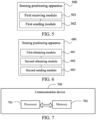
- an embodiment of this application further provides a sensing positioning apparatus 500, including:
- the apparatus further includes: a first determining module, configured to determine, before the first sending module sends the sensing requirement to the second communication device, a first base station and a first terminal that are associated with the sensing requirement, where the second communication device includes at least one of the first base station and the first terminal.
- a first determining module configured to determine, before the first sending module sends the sensing requirement to the second communication device, a first base station and a first terminal that are associated with the sensing requirement, where the second communication device includes at least one of the first base station and the first terminal.
- the positioning requirement includes first indication information, and the first indication information is information indicating the second communication device.
- the apparatus according to this embodiment of this application further includes:
- the signal configuration information is determined by at least one of the first communication device and the third communication device.
- the signal configuration information includes the configuration information for the sensing signal and the configuration information for the positioning signal
- the signal configuration information further includes first identification information, where the first identification information indicates that the signal configuration information is used for positioning measurement and sensing measurement.
- the apparatus according to this embodiment of this application further includes:
- the measurement quantity is determined by at least one of the first communication device and the third communication device.
- the apparatus further includes: a fifth obtaining module, configured to obtain a measurement result corresponding to the measurement quantity, where the measurement result is obtained according to signal configuration information and the measurement quantity, the signal configuration information includes at least one of configuration information for a sensing signal and configuration information for a positioning signal, and the signal configuration information is determined according to at least one of the sensing requirement and the positioning requirement.
- a fifth obtaining module configured to obtain a measurement result corresponding to the measurement quantity, where the measurement result is obtained according to signal configuration information and the measurement quantity, the signal configuration information includes at least one of configuration information for a sensing signal and configuration information for a positioning signal, and the signal configuration information is determined according to at least one of the sensing requirement and the positioning requirement.
- the apparatus according to this embodiment of this application further includes:
- a second determining module configured to determine, after the fifth obtaining module obtains the measurement result corresponding to the measurement quantity, a sensing result according to a measurement result corresponding to a first target measurement quantity and a positioning result sent by the third communication device, where the first target measurement quantity includes at least one of the sensing measurement quantity and the common measurement quantity, the positioning result is sent by the third communication device according to the positioning requirement, and the positioning result includes terminal location information.
- the apparatus according to this embodiment of this application further includes:
- the terminal location information includes first indication information, and the first indication information indicates a correspondence between the positioning result and the first target measurement quantity.
- the positioning result includes a known positioning result.
- a type of the positioning requirement includes at least one of the following:
- the positioning requirement further includes second indication information, and the second indication information indicates time corresponding to the positioning result requested by the positioning requirement.
- the sensing requirement is received.
- the sensing requirement is a sensing requirement associated with the positioning service
- the sensing requirement is sent to the second communication device, and the positioning requirement is sent to the third communication device, thereby triggering a process combining sensing and positioning, and achieving the purpose of performing sensing based on positioning information.
- an embodiment of this application further provides a sensing positioning apparatus 600, including:
- the apparatus further includes: a third determining module, configured to determine a fourth communication device associated with the positioning requirement after the first obtaining module obtains the positioning requirement.
- the signal configuration information includes at least one of configuration information for a sensing signal and configuration information for a positioning signal.
- the signal configuration information in a case that the signal configuration information includes the configuration information for the sensing signal and the configuration information for the positioning signal, the signal configuration information further includes first identification information, where the first identification information indicates that the signal configuration information is used for positioning measurement and sensing measurement.
- the signal configuration information is determined by at least one of the first communication device and the third communication device.
- the measurement quantity includes at least one of a sensing measurement quantity, a positioning measurement quantity, and a common measurement quantity
- the common measurement quantity is used for positioning measurement and sensing measurement.
- the measurement quantity is determined by at least one of the first communication device and the third communication device.
- the apparatus according to this embodiment of this application further includes:
- the fourth determining module includes:
- the terminal location information includes first indication information
- the first indication information indicates a correspondence between the terminal location information and a second target measurement quantity
- the second target measurement quantity includes at least one of a sensing measurement quantity and a common measurement quantity.
- a type of the positioning requirement includes at least one of the following:
- the fourth determining module is configured to determine the positioning result corresponding to the positioning requirement according to the known positioning result in a case that the type of the positioning requirement is the first positioning requirement type.
- an embodiment of this application further provides a communication device 700, including a processor 701, a memory 702, and a program or instructions stored in the memory 702 and executable on the processor 701, where the program or the instructions, when executed by the processor 701, implement the processes of the embodiments of the foregoing sensing positioning method, and can achieve the same technical effects. To avoid repetition, details are not described herein again.
- An embodiment of this application further provides a communication device.
- the communication device may be specifically the first communication device or the third communication device above.
- the communication device includes a processor and a communication interface.
- the communication interface is configured to receive a sensing requirement; and send, in a case that the sensing requirement is a sensing requirement associated with a positioning service, the sensing requirement to a second communication device, and send a positioning requirement to a third communication device.
- the communication interface is configured to obtain a positioning requirement, where the positioning requirement is sent by a first communication device in a case that a sensing requirement received by the first communication device is a sensing requirement associated with a positioning service.
- the processor is configured to obtain first information according to the positioning requirement, where the first information includes at least one of signal configuration information and a measurement quantity, the signal configuration information is signal configuration information used for sensing measurement and/or positioning measurement, and the measurement quantity is a measurement quantity used for sensing measurement and/or positioning measurement.
- the communication interface is configured to send the first information to at least one of a second communication device and a fourth communication device, where the second communication device includes a terminal and/or a base station associated with the sensing requirement, and the fourth communication device includes a terminal and/or a base station associated with the positioning requirement.
- the communication device embodiment corresponds to the foregoing communication device method embodiment.
- Each implementation process and implementation of the foregoing method embodiment can be applied to this communication device embodiment, and can achieve the same technical effects.
- the communication device 800 includes: an antenna 801, a radio frequency apparatus 802, and a baseband apparatus 803.
- the antenna 801 is connected to the radio frequency apparatus 802.
- the radio frequency apparatus 802 receives information by using the antenna 801, and sends the received information to the baseband apparatus 803 for processing.
- the baseband apparatus 803 processes information to be sent, and sends the information to the radio frequency apparatus 802.
- the radio frequency apparatus 802 processes the received information and sends the information by using the antenna 801.
- the frequency band processing apparatus may be located in the baseband apparatus 803, and the method performed by the communication device in the foregoing embodiment may be implemented in the baseband apparatus 803, where the baseband apparatus 803 includes a processor 804 and a memory 905.
- the baseband apparatus 803 may include, for example, at least one baseband plate.
- a plurality of chips are disposed on the baseband plate. As shown in FIG. 8 , one of the plurality of chips is, for example, the processor 804, and is connected to the memory 805, to invoke a program in the memory 905 to perform operations of the first communication device in the foregoing method embodiment.
- the baseband apparatus 803 may further include a network interface 806, configured to exchange information with the radio frequency apparatus 802.
- the interface is, for example, a common public radio interface (Common Public Radio Interface, CPRI).
- the communication device (first communication device) in this embodiment of this application further includes: instructions or a program stored in the memory 805 and runnable on the processor 804.
- the processor 804 invokes the instructions or the program in the memory 805 to perform the method executed by each module shown in FIG. 5 , and achieve the same technical effects. To avoid repetition, details are not repeated herein.
- An embodiment of this application further provides a communication device.
- the communication device may be specifically the foregoing third communication device.
- the communication device 900 includes an antenna 901, a radio frequency apparatus 902, and a baseband apparatus 903.
- the baseband apparatus 903 processes to be sent information.
- the frequency band processing apparatus may be located in the baseband apparatus 903, and the method performed by the communication device in the foregoing embodiment may be implemented in the baseband apparatus 903, where the baseband apparatus 903 includes a processor 904 and a memory 905.
- the baseband apparatus 903 may include, for example, at least one baseband plate.
- a plurality of chips are disposed on the baseband plate.
- one of the plurality of chips is, for example, the processor 904, and is connected to the memory 905, to invoke a program in the memory 905 to perform operations of the third communication device in the foregoing method embodiment.
- the baseband apparatus 903 may further include a network interface 906, configured to exchange information with the radio frequency apparatus 902.
- the interface is, for example, a CPRI.
- the communication device (third communication device) in this embodiment of this application further includes: instructions or a program stored in the memory 905 and runnable on the processor 904.
- the processor 904 invokes the instructions or the program in the memory 905 to perform the method executed by each module shown in FIG. 6 , and achieve the same technical effects. To avoid repetition, details are not repeated herein.
- An embodiment of this application further provides a readable storage medium.
- the readable storage medium stores a program or instructions, where the program or the instructions, when executed by a processor, implement the processes of embodiments of the foregoing sensing positioning method, and achieve the same technical effects. To avoid repetition, details are not described herein again.
- the processor is the processor in the terminal described in the foregoing embodiment.
- the readable storage medium includes a computer-readable storage medium, and is, for example, a read-only memory (Read-Only Memory, ROM), a random access memory (Random Access Memory, RAM), a magnetic disk, or an optical disc.
- An embodiment of this application further provides a chip, where the chip includes a processor and a communication interface, the communication interface is coupled to the processor, and the processor is configured to run a program or instructions, to implement the processes of embodiments of the foregoing sensing positioning method, and achieve the same technical effects. To avoid repetition, details are not described herein again.
- the chip described in this embodiment of this application may also be referred to as a system-level chip, a system chip, a chip system, a system on chip, or the like.
- An embodiment of this application further provides a computer program/program product, stored in a non-transient storage medium, where the computer program/program product is executed by at least one processor to implement the processes of the embodiments of the foregoing sensing positioning method, and can achieve the same technical effects. To avoid repetition, details are not described herein again.
- the methods in the foregoing embodiments may be implemented via software and a necessary general hardware platform, and certainly, may also be implemented by hardware, but in many cases, the former manner is a better implementation.
- the technical solutions of this application essentially or the part contributing to the prior art may be implemented in a form of a computer software product.
- the computer software product is stored in a storage medium (for example, a ROM/RAM, a magnetic disk, or an optical disc) and includes several instructions for instructing a terminal (which may be a mobile phone, a computer, a server, a communication device, or the like) to perform the method described in embodiments of this application.
Landscapes
- Engineering & Computer Science (AREA)
- Signal Processing (AREA)
- Computer Networks & Wireless Communication (AREA)
- Mobile Radio Communication Systems (AREA)
Applications Claiming Priority (2)
| Application Number | Priority Date | Filing Date | Title |
|---|---|---|---|
| CN202111108724.4A CN115915388B (zh) | 2021-09-22 | 2021-09-22 | 通信感知方法、装置及通信设备 |
| PCT/CN2022/119277 WO2023045841A1 (zh) | 2021-09-22 | 2022-09-16 | 通信感知方法、装置及通信设备 |
Publications (2)
| Publication Number | Publication Date |
|---|---|
| EP4408088A1 true EP4408088A1 (de) | 2024-07-31 |
| EP4408088A4 EP4408088A4 (de) | 2025-01-22 |
Family
ID=85720056
Family Applications (1)
| Application Number | Title | Priority Date | Filing Date |
|---|---|---|---|
| EP22871887.0A Pending EP4408088A4 (de) | 2021-09-22 | 2022-09-16 | Kommunikationserfassungsverfahren und -vorrichtung sowie kommunikationsvorrichtung |
Country Status (4)
| Country | Link |
|---|---|
| US (1) | US20240236923A1 (de) |
| EP (1) | EP4408088A4 (de) |
| CN (1) | CN115915388B (de) |
| WO (1) | WO2023045841A1 (de) |
Families Citing this family (5)
| Publication number | Priority date | Publication date | Assignee | Title |
|---|---|---|---|---|
| US20240155417A1 (en) * | 2022-11-03 | 2024-05-09 | Interdigital Patent Holdings, Inc. | Integrated sensing coordination with a sensing operation management function |
| CN120238891A (zh) * | 2023-12-29 | 2025-07-01 | 华为技术有限公司 | 一种通信方法及相关装置 |
| CN120857285A (zh) * | 2024-04-28 | 2025-10-28 | 华为技术有限公司 | 一种感知测量方法、装置、芯片及系统 |
| CN121284479A (zh) * | 2024-07-04 | 2026-01-06 | 华为技术有限公司 | 一种通信方法及装置 |
| CN121310162A (zh) * | 2024-07-09 | 2026-01-09 | 华为技术有限公司 | 一种通信方法和装置 |
Family Cites Families (8)
| Publication number | Priority date | Publication date | Assignee | Title |
|---|---|---|---|---|
| US7383316B2 (en) * | 2002-11-15 | 2008-06-03 | Microsoft Corporation | System and method for providing dynamic location information |
| CN102006547B (zh) * | 2009-08-28 | 2016-01-20 | 北京三星通信技术研究有限公司 | 定位方法、广播邻基站位置信息方法及定位能力协商方法 |
| CN102065065A (zh) * | 2009-11-17 | 2011-05-18 | 财团法人工业技术研究院 | 基于感测组件辅助定位技术的向量式数据传输系统与方法 |
| US20140080519A1 (en) * | 2012-09-18 | 2014-03-20 | Moazzam Rehan Ahmed | Method and system for providing location-aware services |
| CN110928284B (zh) * | 2018-09-19 | 2024-03-29 | 阿波罗智能技术(北京)有限公司 | 辅助控制车辆的自动驾驶的方法、设备、介质和系统 |
| US12041572B2 (en) * | 2018-10-11 | 2024-07-16 | Huawei Technologies Co., Ltd. | Method and device for user equipment positioning |
| CN112491750B (zh) * | 2019-09-12 | 2024-09-24 | 华为技术有限公司 | 用于感知测量的方法和装置 |
| CN111879305B (zh) * | 2020-06-16 | 2022-03-18 | 华中科技大学 | 一种面向高危生产环境的多模态感知定位模型与系统 |
-
2021
- 2021-09-22 CN CN202111108724.4A patent/CN115915388B/zh active Active
-
2022
- 2022-09-16 EP EP22871887.0A patent/EP4408088A4/de active Pending
- 2022-09-16 WO PCT/CN2022/119277 patent/WO2023045841A1/zh not_active Ceased
-
2024
- 2024-03-22 US US18/613,326 patent/US20240236923A1/en active Pending
Also Published As
| Publication number | Publication date |
|---|---|
| EP4408088A4 (de) | 2025-01-22 |
| WO2023045841A1 (zh) | 2023-03-30 |
| CN115915388B (zh) | 2025-10-31 |
| US20240236923A1 (en) | 2024-07-11 |
| CN115915388A (zh) | 2023-04-04 |
Similar Documents
| Publication | Publication Date | Title |
|---|---|---|
| US20240154708A1 (en) | Sensing method, apparatus, and network device | |
| US20240236924A1 (en) | Sensing-based positioning method and apparatus, and communication device | |
| US20240196255A1 (en) | Method and apparatus for measuring sensing signal, network device, and terminal | |
| EP4408088A1 (de) | Kommunikationserfassungsverfahren und -vorrichtung sowie kommunikationsvorrichtung | |
| US20240155388A1 (en) | Sensing method and apparatus, and network device | |
| US20240155394A1 (en) | Sensing method and apparatus, terminal, and network device | |
| US12513648B2 (en) | Positioning method on sidelink, terminal, and network side device | |
| US12058640B2 (en) | Methods and devices for dual-direction positioning of a device | |
| US20200213967A1 (en) | Methods of positioning in a system comprising measuring nodes with multiple receiving points | |
| US11782121B2 (en) | Method and device for positioning utilizing beam information | |
| US20240168123A1 (en) | Reporting of integrity-related information for positioning | |
| WO2023001179A1 (zh) | 通信感知方法、装置及设备 | |
| CN111278023A (zh) | 一种通信方法及设备 | |
| CN118118888B (zh) | 一种无人机的身份识别方法、装置及身份获取方法 | |
| JP2026505977A (ja) | 無線通信システムにおいて無線信号の送受信方法および装置 | |
| WO2026050088A1 (en) | Radio link management enhancements for integrated sensing and communication | |
| TW202606348A (zh) | 用於定位的錨使用者設備選擇 |
Legal Events
| Date | Code | Title | Description |
|---|---|---|---|
| STAA | Information on the status of an ep patent application or granted ep patent |
Free format text: STATUS: THE INTERNATIONAL PUBLICATION HAS BEEN MADE |
|
| PUAI | Public reference made under article 153(3) epc to a published international application that has entered the european phase |
Free format text: ORIGINAL CODE: 0009012 |
|
| STAA | Information on the status of an ep patent application or granted ep patent |
Free format text: STATUS: REQUEST FOR EXAMINATION WAS MADE |
|
| 17P | Request for examination filed |
Effective date: 20240417 |
|
| AK | Designated contracting states |
Kind code of ref document: A1 Designated state(s): AL AT BE BG CH CY CZ DE DK EE ES FI FR GB GR HR HU IE IS IT LI LT LU LV MC MK MT NL NO PL PT RO RS SE SI SK SM TR |
|
| DAV | Request for validation of the european patent (deleted) | ||
| DAX | Request for extension of the european patent (deleted) | ||
| A4 | Supplementary search report drawn up and despatched |
Effective date: 20241223 |
|
| RIC1 | Information provided on ipc code assigned before grant |
Ipc: H04W 64/00 20090101AFI20241217BHEP |