EP4408044A1 - Verfahren zur erweiterung einer oder mehrerer statischer ressourcen in zusammenhang mit einer eingebetteten universellen chipkarte - Google Patents
Verfahren zur erweiterung einer oder mehrerer statischer ressourcen in zusammenhang mit einer eingebetteten universellen chipkarte Download PDFInfo
- Publication number
- EP4408044A1 EP4408044A1 EP24153779.4A EP24153779A EP4408044A1 EP 4408044 A1 EP4408044 A1 EP 4408044A1 EP 24153779 A EP24153779 A EP 24153779A EP 4408044 A1 EP4408044 A1 EP 4408044A1
- Authority
- EP
- European Patent Office
- Prior art keywords
- port
- euicc
- application
- usim
- modem
- Prior art date
- Legal status (The legal status is an assumption and is not a legal conclusion. Google has not performed a legal analysis and makes no representation as to the accuracy of the status listed.)
- Pending
Links
Images






Classifications
-
- H—ELECTRICITY
- H04—ELECTRIC COMMUNICATION TECHNIQUE
- H04W—WIRELESS COMMUNICATION NETWORKS
- H04W8/00—Network data management
- H04W8/18—Processing of user or subscriber data, e.g. subscribed services, user preferences or user profiles; Transfer of user or subscriber data
- H04W8/183—Processing at user equipment or user record carrier
-
- H—ELECTRICITY
- H04—ELECTRIC COMMUNICATION TECHNIQUE
- H04W—WIRELESS COMMUNICATION NETWORKS
- H04W8/00—Network data management
- H04W8/18—Processing of user or subscriber data, e.g. subscribed services, user preferences or user profiles; Transfer of user or subscriber data
- H04W8/186—Processing of subscriber group data
-
- H—ELECTRICITY
- H04—ELECTRIC COMMUNICATION TECHNIQUE
- H04L—TRANSMISSION OF DIGITAL INFORMATION, e.g. TELEGRAPHIC COMMUNICATION
- H04L67/00—Network arrangements or protocols for supporting network services or applications
- H04L67/2866—Architectures; Arrangements
- H04L67/30—Profiles
-
- G—PHYSICS
- G06—COMPUTING OR CALCULATING; COUNTING
- G06F—ELECTRIC DIGITAL DATA PROCESSING
- G06F9/00—Arrangements for program control, e.g. control units
- G06F9/06—Arrangements for program control, e.g. control units using stored programs, i.e. using an internal store of processing equipment to receive or retain programs
- G06F9/46—Multiprogramming arrangements
- G06F9/50—Allocation of resources, e.g. of the central processing unit [CPU]
- G06F9/5005—Allocation of resources, e.g. of the central processing unit [CPU] to service a request
- G06F9/5027—Allocation of resources, e.g. of the central processing unit [CPU] to service a request the resource being a machine, e.g. CPUs, Servers, Terminals
-
- H—ELECTRICITY
- H04—ELECTRIC COMMUNICATION TECHNIQUE
- H04L—TRANSMISSION OF DIGITAL INFORMATION, e.g. TELEGRAPHIC COMMUNICATION
- H04L41/00—Arrangements for maintenance, administration or management of data switching networks, e.g. of packet switching networks
- H04L41/08—Configuration management of networks or network elements
- H04L41/0896—Bandwidth or capacity management, i.e. automatically increasing or decreasing capacities
- H04L41/0897—Bandwidth or capacity management, i.e. automatically increasing or decreasing capacities by horizontal or vertical scaling of resources, or by migrating entities, e.g. virtual resources or entities
-
- H—ELECTRICITY
- H04—ELECTRIC COMMUNICATION TECHNIQUE
- H04L—TRANSMISSION OF DIGITAL INFORMATION, e.g. TELEGRAPHIC COMMUNICATION
- H04L63/00—Network architectures or network communication protocols for network security
- H04L63/10—Network architectures or network communication protocols for network security for controlling access to devices or network resources
- H04L63/102—Entity profiles
-
- H—ELECTRICITY
- H04—ELECTRIC COMMUNICATION TECHNIQUE
- H04W—WIRELESS COMMUNICATION NETWORKS
- H04W12/00—Security arrangements; Authentication; Protecting privacy or anonymity
- H04W12/40—Security arrangements using identity modules
-
- H—ELECTRICITY
- H04—ELECTRIC COMMUNICATION TECHNIQUE
- H04W—WIRELESS COMMUNICATION NETWORKS
- H04W24/00—Supervisory, monitoring or testing arrangements
- H04W24/02—Arrangements for optimising operational condition
-
- H—ELECTRICITY
- H04—ELECTRIC COMMUNICATION TECHNIQUE
- H04W—WIRELESS COMMUNICATION NETWORKS
- H04W4/00—Services specially adapted for wireless communication networks; Facilities therefor
- H04W4/60—Subscription-based services using application servers or record carriers, e.g. SIM application toolkits
-
- H—ELECTRICITY
- H04—ELECTRIC COMMUNICATION TECHNIQUE
- H04W—WIRELESS COMMUNICATION NETWORKS
- H04W8/00—Network data management
- H04W8/18—Processing of user or subscriber data, e.g. subscribed services, user preferences or user profiles; Transfer of user or subscriber data
- H04W8/20—Transfer of user or subscriber data
- H04W8/205—Transfer to or from user equipment or user record carrier
-
- H—ELECTRICITY
- H04—ELECTRIC COMMUNICATION TECHNIQUE
- H04W—WIRELESS COMMUNICATION NETWORKS
- H04W88/00—Devices specially adapted for wireless communication networks, e.g. terminals, base stations or access point devices
- H04W88/02—Terminal devices
- H04W88/06—Terminal devices adapted for operation in multiple networks or having at least two operational modes, e.g. multi-mode terminals
Definitions
- the present disclosure relates generally to wireless communication systems, and more particularly to a method and a system for extending one or more static resources in a multiple enabled profile (MEP) capable embedded universal integrated circuit card (eUICC).
- MEP multiple enabled profile
- eUICC embedded universal integrated circuit card
- An embedded universal integrated circuit card may refer to a secure and programmable subscriber identification module (SIM) card that may be built into an electronic device (e.g., smartphone, internet of things (IoT) device, and the like).
- SIM subscriber identification module
- the eUICC may be configured to store multiple SIM profiles from different mobile network operators (MNOs) and may include functionality to support multiple enabled profiles (MEP).
- MNOs mobile network operators
- MEP enabled profiles
- a profile may refer to a profile as described in Trusted Connectivity Alliance (TCA) eUICC Interoperable Format Technical Specification Release 3.3.1.
- TCA Trusted Connectivity Alliance
- eUICC with MEP capability may manage and/or support multiple SIM profiles simultaneously.
- a single eUICC may store SIM profiles from various MNOs (e.g., a first MNO A, a second MNO B, a third MNO C, and the like), thereby allowing an electronic device to connect to and/or use the services of these different mobile network operators without physically changing the SIM card.
- MNOs e.g., a first MNO A, a second MNO B, a third MNO C, and the like
- This flexibility may enable seamless switching between mobile networks and to access various services based on, for example, but limited to, an active SIM profile, a user requirement, and/or one or more network conditions.
- an eUICC with multiple profiles (e.g., first profile Profile-1 and second profile Profile-2), each of which may be associated with a dedicated port (e.g., first port Port-1 and second port Port-2) and/or an eSIM port as described in Global System for Mobile Communications Association (GSMA) "Remote SIM Provisioning Technical Specification", SGP.22 Release 3.0, and dedicated static resources (e.g., logical channel) for communication, as illustrated in FIG. 1 .
- GSMA Global System for Mobile Communications Association
- the eUICC may communicate with a modem through a physical interface, enabling the modem to access and/or utilize the subscriber information stored on the eUICC.
- the physical interface may act as a bridge between the modem and the eUICC.
- Virtual interface-1 and virtual interface-2 may be communication channels that may allow data to be exchanged between the modem and the eUICC.
- the modem may send commands and/or may receive responses from the eUICC, thereby enabling the two components to work together seamlessly.
- the modem which may consist of baseband-1 and baseband-2, may be responsible for wireless communication.
- the modem may perform transmission and/or reception of data over cellular networks.
- the baseband-1 and baseband-2 may work together to process the signals and/or manage the connection to the network.
- the baseband-1 and baseband-2 may be core components that may enable the electronic device to communicate with cellular towers and/or other electronic devices over the air.
- a growing trend of personalizing applications on SIM cards may have led to an increased demand for resources (e.g., logical channels) supported by the SIM card.
- resources e.g., logical channels
- the number of logical channels may need to increase to provide users with a better experience.
- the logical channel capacity may be set during manufacturing, and may not be changed subsequently.
- the logical channels may not be configurable at runtime. This limitation may pose a challenge as the number of logical channels in the device is limited, and related systems may be unable to dynamically utilize the resources available with each port, as described with reference FIGS. 2 , 3A , and 3B .
- the electronic device may run out of logical channels, which may lead to delays, chain delays, and/or denial of service for an end user.
- increasing the static resource allocation during the manufacturing of eUICC may not address the issue, as increasing the static resource allocation may lead to wasted (unused) resources. Therefore, there is a need to dynamically utilize all available resources and ports associated with the eUICC to address this challenge.
- LSI logical secure element interface
- ETSI European Telecommunications Standards Institute
- ES10c ES10c function
- the manage LSI command may be utilized to manage LSIs and logical secure elements (LSEs) and may provide a mechanism for multiplexing of application protocol data units (APDUs) of different LSIs, each targeting a separate LSE.
- APDU application protocol data units
- the manage LSI command may enable multiple independent LSEs to reside on a single UICC. That is, the manage LSI command may provide functionality for selecting an LSE for subsequent APDUs, resetting an LSE, setting up the LSI configuration after power up or a reset of the physical interface, and assigning the UICC-contactless frontend (CLF) interface to an LSE and retrieving the LSI of the LSE that has the UICC-CLF interface assigned.
- the resource for each supported port may be allocated by the eUICC, regardless of whether any profile is enabled or not. Therefore, in such an example, the resources allocated to the closed/port (e.g., port-3) without an enabled profile may be wasted, as illustrated in FIG.
- a function may be used to enable a profile on the eUICC. This function may enable a target profile and may implicitly disable the currently enabled profile on the target port, if any. This function may be performed in an atomic way, thus ensuring that in the event of an error during the command execution, the command may stop and leave the involved profiles in their original states prior to command execution.
- the eUICC may include a default logical channel, hereinafter referred to as a base channel, along with additional logical channels that may always be closed.
- the modem may use these logical channels by opening a channel, utilizing the channel, and closing the channel once completed.
- the eUICC may support a limited number of logical channels, typically five (5). In some scenarios, the modem may have already opened all the logical channels for different applications.
- Examples of different applications may include, but not be limited to, a master file (MF) application, a universal subscriber identity module (USIM) application, an internet protocol (IP) multimedia services identity module (ISIM) application, a public key cryptography standards (PKCS) application, a code division multiple access (CDMA) subscriber identity module (CSIM) application, an integrated secure device routing (ISDR) application, and the like.
- the modem may access an application (whether the application is present on the card or on a global application (e.g., ISDR)) to perform an operation that may result in the modem being out of logical channels. As a result, the modem may encounter a denial of service and/or may provide a poor user experience, as described with reference to FIG. 2 .
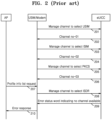
- FIG. 2 is a sequence diagram illustrating a scenario associated with related wireless systems in the context of allocating one or more static resources (e.g., logical channels).
- static resources e.g., logical channels
- the USIM/modem may send a manage channel command to select the USIM application and may request the eUICC to open a logical channel for accessing the USIM application.
- the manage channel command may be in accordance with the manage channel command as described in ETSI TS 102 221.
- the eUICC may respond by allocating channel number 01 to the USIM/modem.
- the USIM/modem may establish communication with the USIM application through the allocated logical channel (e.g., channel number 01).
- the USIM/modem may send another manage channel command to select the ISIM application and may request the eUICC to open a logical channel for accessing the ISIM application.
- the eUICC may respond by allocating channel number 02 to the USIM/modem.
- the USIM/modem may establish communication with the ISIM application through the allocated logical channel (e.g., channel number 02).
- the USIM/modem may send a manage channel command to select the PKCS application and may request the eUICC to open a logical channel for accessing the PKCS application.
- the eUICC may respond by allocating channel number 03 to the USIM/modem.
- the USIM/modem may establish communication with the PKCS application through the allocated logical channel (e.g., channel number 03).
- the USIM/modem may receive a profile info list request from an application platform (AP).
- the USIM/modem may send a manage channel command to select the ISDR application and may request the eUICC to open a logical channel for accessing the ISDR application.
- the eUICC may respond by sending an error status word indicating that no channel may be available to allocate. For example, the eUICC may be unable to allocate a channel due to the static allocation of logical channels to each port. That is, port-1 may be unable to use resources (e.g., logical channels) associated with port-3, even if port-3 has unused logical channels.
- the USIM/modem may send an error response to the AP, which may result in a denial of service.
- the modem may have already enabled all logical channels for different applications (e.g., MF, USIM, ISIM, PKCS, and CSIM) and the modem may need to close any of the logical channels and then reopen the logical channel to select the desired application. Once the operation is completed, the modem may again need to close and reopen the logical channel to return to the previous context.
- the closing and reopening of the logical channels may need additional APDU exchanges that may delay the gathering of information that may need to be provided to the user (e.g., a getprofileInfo command as described in SGP.22) such that a local profile assistant (LPA) (e.g., as described in SGP.22) may boot up with a proper user interface.
- LPA local profile assistant
- These added APDU exchanges may increase the total time needed to provide the user with the services requested through the APDU.
- the added delay may be more pronounced in a T 0 transmission protocol when compared to a T 1 transmission protocol.
- the increased APDU exchange between the modem and the card may significantly delay the user experience, as described with reference to FIGS. 3A and 3B .
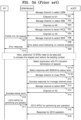
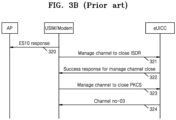
- FIGS. 3A and 3B are sequence diagrams illustrating another scenario associated with related wireless systems in the context of allocating one or more static resources (logical channels).
- the USIM/modem may send a manage channel command to select the USIM application and may request the eUICC to open a logical channel for accessing the USIM application.
- the eUICC may respond by allocating channel number 01 to the USIM/modem.
- the USIM/modem may establish communication with the USIM application through the allocated logical channel (e.g., channel number 01).
- the USIM/modem may send a manage channel command to select the ISIM application and may request the eUICC to open a logical channel for accessing the ISIM application.
- the eUICC may respond by allocating channel number 02 to the USIM/modem.
- the USIM/modem may establish communication with the ISIM application through the allocated logical channel (e.g., channel number 02).
- the USIM/modem may send a manage channel command to select the PKCS application and may request the eUICC to open a logical channel for accessing the PKCS application.
- the eUICC may respond by allocating channel number 03 to the USIM/modem.
- the USIM/modem may establish communication with the PKCS application through the allocated logical channel (e.g., channel number 03).
- the USIM/modem may receive a profile info list request from an application platform (AP).
- AP application platform
- the USIM/modem may send a manage channel command to select the ISDR application and may request the eUICC to open a logical channel for accessing the ISDR application.
- the eUICC may respond by sending an error status word indicating that no channel may be available to allocate.
- the USIM/modem may send an error response to the AP.
- the eUICC may receive a select application command with the P2 indication for the termination of a session from the USIM/modem, the eUICC may respond by sending a select response with a status word of 9000 or 91xx back to the USIM/modem.
- the status word 9000 may indicate that the select response was successfully executed without any errors.
- the status word 91xx may indicate that the select response was partially successful, and additional information may be available in the response data.
- the USIM/modem may send a manage channel command to select the PKCS application and may request the eUICC to close a logical channel for accessing the PKCS application.
- the eUICC may respond by sending a success response for manage channel close to the USIM/modem.
- the USIM/modem may establish a new communication for the ISDR application through the allocated logical channel (e.g., channel number 03).
- the USIM/modem may send a success status word to the AP.
- the AP may receive a success status word from the USIM/modem, and may send an enhanced service 10 (ES10) APDU to the eUICC to perform a specific operation.
- the ES10 APDU may be and/or may include a command that may trigger a particular operation and/or service within the eUICC, such as, but not limited to, provisioning, updating, or managing subscription profiles.
- the eUICC may process the command and may perform the specified operation.
- the eUICC may send a response for the ES10 operation back to the AP via the USIM/modem.
- the response may include the result of the operation requested by the AP, may provide information about the success and/or failure of the operation, and may provide relevant data associated with the result of the operation.
- the USIM/modem sends a manage channel command to select the ISDR application and may request the eUICC to close a logical channel for accessing the ISDR application.
- the eUICC may respond by sending a success response for the manage channel close to the USIM/modem.
- the USIM/modem may establish the previous communication for the PKCS application through the allocated logical channel (e.g., channel number 03).
- the eUICC may provide support for a limited number of logical channels (e.g., five (5) channels).
- a limited number of logical channels e.g., five (5) channels.
- the ports that do not have any enabled profile may also have logical channels associated with the unused ports.
- these logical channels may not be accessed by the USIM/modem.
- the memory allocated for these inaccessible logical channels may not be utilized efficiently, and thereby, inefficient memory usage.
- a method for extending one or more static resources in a multiple enabled profile (MEP) capable embedded universal integrated circuit card includes receiving, by a first network device associated with a user equipment (UE) and from a second network device associated with the LTE, a request to allocate at least one first static resource, from among the one or more static resources, at a first port of the eUICC, the at least one first static resource being configured to access at least one application, wherein the eUICC includes a plurality of ports, and each port includes a predefined number of static resources associated with the one or more static resources and a unique profile, determining, based on receiving the request, whether the at least one first static resource is available for allocation at the first port, determining, based on determining that the at least one first static resource is unavailable at the first port, whether the eUICC supports a port extension feature, and whether at least one second port of the plurality of ports is available for access, and managing the one or more static resources by performing at least
- a system for extending one or more static resources in a multiple enabled profile (MEP) capable embedded universal integrated circuit card includes, a memory storing instructions, a communicator, and a processor, operably coupled to the memory and the communicator, wherein the instructions are configured, when executed by the processor, to cause the system to, receive, by a first network device associated with a user equipment (UE) and from a second network device associated with the UE, a request to allocate at least one first static resource, from among the one or more static resources, at a first port of the eUICC, the at least one first static resource being configured to access at least one application, wherein the eUICC includes a plurality of ports, and each port includes a predefined number of static resources associated with the one or more static resources and a unique profile, determine, based on the request, whether the at least one first static resource is available for allocation at the first port, determine, based on a determination that the at least one first static resource is unavailable
- MEP multiple enabled profile
- eUICC
- each of such phrases as “A or B,” “at least one of A and B,” “at least one of A or B,” “A, B, or C,” “at least one of A, B, and C,” and “at least one of A, B, or C,” may include any one of, or all possible combinations of the items enumerated together in a corresponding one of the phrases.
- the examples used herein are intended merely to facilitate an understanding of ways in which the embodiments herein may be practiced and to further enable those skilled in the art to practice the embodiments herein. Accordingly, the examples should not be construed as limiting the scope of the embodiments herein.
- circuits may, for example, be embodied in one or more semiconductor chips, or on substrate supports such as printed circuit boards and the like.
- circuits constituting a block may be implemented by dedicated hardware, or by a processor (e.g., one or more programmed microprocessors and associated circuitry), or by a combination of dedicated hardware to perform some functions of the block and a processor to perform other functions of the block.
- a processor e.g., one or more programmed microprocessors and associated circuitry
- Each block of the embodiments may be physically separated into two or more interacting and discrete blocks without departing from the scope of the present disclosure.
- the blocks of the embodiments may be physically combined into more complex blocks without departing from the scope of the present disclosure.
- the articles “a” and “an” are intended to include one or more items, and may be used interchangeably with “one or more.” Where only one item is intended, the term “one” or similar language is used.
- a processor may refer to either a single processor or multiple processors. When a processor is described as carrying out an operation and the processor is referred to perform an additional operation, the multiple operations may be executed by either a single processor or any one or a combination of multiple processors.
- FIGS. 4 to 8 where similar reference characters denote corresponding features consistently throughout the figures, there are shown preferred embodiments.
- FIG. 4 illustrates a block diagram of a user equipment (UE) 400 for extending one or more static resources in a multiple enabled profile (MEP) capable embedded universal integrated circuit card (eUICC), according to an embodiment.
- UE 400 may include, but not be limited to, a smartphone, a tablet computer, a personal digital assistance (PDA), an Internet of Things (IoT) device, a wearable device, and the like.
- PDA personal digital assistance
- IoT Internet of Things
- the UE 400 may include a system 401.
- the system 401 includes a memory 410, a processor 420, and a communicator 430.
- the system 401 may be implemented on one or multiple electronic devices/network devices.
- the UE 400 may be and/or may include, for example, but be not limited to, one or more network devices such as an application platform (AP) device, universal subscriber identity module (USIM)/modem, an eUICC (e.g., MEP capable eUICC), an embedded subscriber identity module (eSIM), and an integrated subscriber identity module (ISIM).
- AP application platform
- USIM universal subscriber identity module
- eUICC e.g., MEP capable eUICC
- eSIM embedded subscriber identity module
- ISIM integrated subscriber identity module
- the operational capabilities of the eUICC may be substituted with an eSIM, an ISIM, and/or forthcoming subscriber identity module (SIM) technology.
- the memory 410 may store instructions to be executed by the processor 420 for extending the one or more static resources in the MEP capable eUICC, as described in the present disclosure.
- the memory 410 may include non-volatile storage elements. Examples of such non-volatile storage elements may include, but not be limited to, magnetic hard discs, optical discs, floppy discs, flash memories, forms of electrically programmable memories (EPROM) and/or electrically erasable and programmable (EEPROM) memories.
- the memory 410 may be and/or may include a non-transitory storage medium. The term "non-transitory" may indicate that the storage medium is not embodied in a carrier wave and/or a propagated signal.
- non-transitory should not be interpreted to indicate that the memory 410 is non-movable.
- the memory 410 may be configured to store larger amounts of information than the non-transitory storage medium.
- a non-transitory storage medium may store data that may, over time, change (e.g., in random access memory (RAM) or cache).
- the memory 410 may be and/or may include an internal storage unit, an external storage unit of the UE 400, a cloud storage, and/or any other type of external storage.
- the processor 420 may communicate with the memory 410 and the communicator 430.
- the processor 420 may be configured to execute instructions stored in the memory 410 and to perform various processes for extending the one or more static resources in the MEP capable eUICC, as described in the present disclosure.
- the processor 420 may include one processor or a plurality of processors, that may be and/or may include, but not be limited to, a general-purpose processor (e.g., a central processing unit (CPU), an application processor, and the like), a graphics-only processing unit (e.g., a graphics processing unit (GPU), a visual processing unit (VPU), and the like), and/or an artificial intelligence (AI) dedicated processor (e.g., a neural processing unit (NPU) and the like).
- a general-purpose processor e.g., a central processing unit (CPU), an application processor, and the like
- a graphics-only processing unit e.g., a graphics processing unit (GPU), a visual processing
- the processor 420 may include a resource management module 421 that may execute multiple operations to extend the one or more static resources in the MEP capable eUICC, as described herein.
- the resource management module 421 may be associated with the eUICC.
- the resource management module 421 may be implemented by processing circuitry such as logic gates, integrated circuits, microprocessors, microcontrollers, memory circuits, passive electronic components, active electronic components, optical components, hardwired circuits, or the like, and may optionally be driven by firmware.
- the circuits may, for example, be embodied in one or more semiconductor chips, and/or on substrate supports such as printed circuit boards and the like.
- the resource management module 421 may be configured to receive, at a network device (e.g., eUICC) associated with the UE 400, a request from another network device (e.g., USIM/modem, AP device, and the like) associated with the UE 400 to allocate at least one static resource, from among the one or more static resources, at a first port of the eUICC for accessing at least one application, as described with reference to FIGS. 6A , 6B , and 7A to 7D .
- the eUICC may include a plurality of ports, and each port of the plurality of ports may include a predefined number of static resources associated with the one or more static resources and a unique profile, as shown in FIG. 1 .
- An example of the at least one application may include, but not be limited to, a master file (MF) application, a USIM application, an IP multimedia services identity module (ISIM) application, a public key cryptographic standards (PKCS) application, a code division multiple access (CDMA) subscriber identity module (CSIM) application, and an issuer security domain root (ISDR) application.
- MF master file
- USIM USIM
- ISIM IP multimedia services identity module
- PKCS public key cryptographic standards
- CDMA code division multiple access
- CCM subscriber identity module
- ISDR issuer security domain root
- the resource management module 421 may be configured to determine, upon receiving the request, whether the at least one static resource is available at the first port for allocation, as described with reference to FIGS. 5A , 6A , 6B , and 7A to 7D .
- the resource management module 421 may be configured to determine, in response to determining that the at least one static resource is not available at the first port, whether a port extension feature is supported by the eUICC, and whether at least one second port of the plurality of ports is available for access, as described with reference to FIGS. 5A , 6A , 6B , and 7A to 7D .
- the resource management module 421 may be configured to merge the one or more static resources of the at least one second port with the one or more static resources of the first port in response to determining that the port extension feature is supported by the eUICC and the at least one second port is available for access, as described with reference FIGS. 5A , 5B , 6A , 6B , and 7A to 7D .
- the resource management module 421 may enable the unique profile associated with the first port into the at least one second port using an enable profile function (e.g., SGP.22 enableProfile function) for accessing the at least one application associated with the received request.
- an enable profile function e.g., SGP.22 enableProfile function
- the resource management module 421 may enable the unique profile associated with the first port into the at least one second port using a proprietary command for accessing the at least one application associated with the received request.
- the proprietary command may include one or more application protocol data unit (APDU) commands (e.g., select/manage command).
- APDU application protocol data unit
- the resource management module 421 may determine whether a task associated with the received request is completed, to access the at least one application.
- the resource management module 421 may determine retrieving information associated with the first port, wherein the retrieving information may indicate a number of static resources allocated to the first port in response to determining that the task is completed.
- the resource management module 421 may release the one or more merged static resources at the first port in response to determining that the task is completed.
- the resource management module 421 may reallocate the one or more released static resources among the first port and the at least one second port based on an initial static resource configuration.
- the resource management module 421 may perform one or more operations associated with at least one of a logical secure element (LSE) (e.g., port-1/first port) and a logical secure element interface (LSI), as described in conjunction with FIG. 7D .
- LSE logical secure element
- LSI logical secure element interface
- the LSE may be configured to provide secure storage and process capabilities for sensitive data and the LSI may be configured to provide an interface through which one or more applications and one or more services may interact with the LSE.
- the one or more operations may include, but not be limited to, an extension operation of the LSI and a reduction operation of the LSI.
- the resource management module 421 may be configured to initiate at least one action associated with the one or more static resources for accessing the received request in response to determining that the port extension feature is not supported by the eUICC and that the at least one second port is not available for access, as described with reference to FIGS. 5A , 6A , 6B , and 7A to 7D .
- the at least one action may include, but not be limited to, sending a rejection message to the AP device associated with the UE in response to the received request along with an appropriate error code, and terminating at least one allocated static resource associated with the first port and reallocating the at least one terminated static resource associated with the first port for accessing the at least one application associated with the received request.
- the communicator 430 may be configured for communicating internally between internal hardware components and with external devices (e.g., server) via one or more networks (e.g., radio technology).
- the communicator 430 may include an electronic circuit specific to a telecommunication standard that enables wired and/or wireless communication.
- FIG. 4 shows various hardware components of the UE 400, it is to be understood that the present disclosure is not limited thereon.
- the UE 400 may include less or more components.
- the labels and/or names of the components may be used only for illustrative purposes and may not limit the scope of the present disclosure.
- One or more components may be combined to perform the same or substantially similar functions to extend the one or more static resources in the MEP capable eUICC 400C.
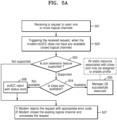
- FIG. 5A is a flow diagram illustrating a method 500 for extending the one or more static resources in the MEP capable eUICC, according to an embodiment.
- the method 500 may include receiving a request, from one of the AP device, the USIM/modem, to open one or more logical channels at the first port of the eUICC (e.g., MEP capable eUICC) for accessing the at least one application.
- the method 500 may include triggering the received request when the modem/eUICC does not have available closed logical channels (e.g., at least one static resource).
- the method 500 may include determining, in response to determining that the at least one static resource is not available at the first port, whether a port extension feature is supported by the eUICC.
- the method 500 may include determining, in response to determining that the port extension feature is supported by the eUICC (Supported at operation 503), whether the at least one second port of the plurality of ports is available for access.
- the method 500 may include performing, in response to determining that the port extension feature is not supported by the eUICC (Not supported at operation 503), one or more operations.
- the one or more operations may include at least one of the modem rejecting the request with an appropriate error code, and the modem closing the existing logical channel and processing the request. However, these one or more operations may result in a denial of service and/or a longer wait time, which may lead to a degraded user experience.
- the method 500 may include managing, in response to determining that the port extension feature is supported by the eUICC and the at least one second port is available for access (Available at operation 504), the one or more static resources (e.g., manage LSI/extend port/merge port) of the at least one second port with the one or more static resources of the first port.
- the method 500 may include sending, in response to determining that the at least one second port is not available for access (Not available at operation 504), a eUICC rejection with an appropriate status word (e.g., 6985) and then the method 500 may proceed to perform operation 507.
- the status word included with the eUICC rejection may be a standard response code word that may be used in global platform specifications for secure elements.
- the standard response code may indicate that conditions of use not satisfied, which may indicate that the command was rejected based on security-related constraints and/or conditions not being met.
- FIG. 5B illustrates a schematic overview of logical channel allocation in the eUICC, according to an embodiment.
- the logical channels (e.g., first logical channel 0, second logical channel 1, third logical channel 2, and fourth logical channel 3) associated with second port Port-2, which may have been previously inaccessible and/or may not be utilizing the memory, may be made accessible and may become part of the first port Port-1 after the successful execution of the enable profile request for the same profile. That is, the first to fourth logical channels 0 to 3 mapped to second port Port-2 may be sequentially mapped to first port Port-1 and may be associated with the first port Port-1 as fifth logical channel 4, sixth logical channel 5, seventh logical channel 6, and eighth logical channel 7. As a result, memory utilization may be improved, when compared to the related wireless systems, as the previously unused first to fourth logical channels 0 to 3 of second port Port-2 may be associated with an enabled profile and may be accessed by the modem.
- the logical channels e.g., first logical channel 0, second logical channel 1, third logical channel 2, and fourth logical channel 3
- the logical channels e.g., first
- the modem may receive a request to open a new logical channel when no more logical channels are available to be opened.
- the modem may query the status of available ports to check if any closed ports are available and/or may issue an enable profile command with the closed port indication.
- the modem may issue an enable profile APDU by setting a refresh flag as off.
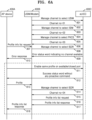
- FIGS. 6A , and 6B are sequence diagrams illustrating one or more scenarios for extending one or more static resources in the MEP capable eUICC, according to an embodiment.
- the USIM/modem 400B may send a manage channel command to select the USIM application and may request the eUICC 400C to open a logical channel associated with the first port for accessing the USIM application.
- the eUICC 400C may respond by allocating channel number 01 to the USIM/modem 400B.
- the USIM/modem 400B may establish communication with the USIM application through the allocated logical channel (e.g., channel number 01).
- the USIM/modem 400B may send a manage channel command to select the ISIM application and may request the eUICC 400C to open a logical channel associated with the first port for accessing the ISIM application.
- the eUICC 400C may respond by allocating channel number 02 to the USIM/modem 400B.
- the USIM/modem 400B may establish communication with the ISIM application through the allocated logical channel (e.g., channel number 02).
- the USIM/modem 400B may send a manage channel command to select the PKCS application and may request the eUICC 400C to open a logical channel associated with the first port for accessing the PKCS application.
- the eUICC may respond by allocating channel number 03 to the USIM/modem 400B.
- the USIM/modem 400B may establish communication with the PKCS application through the allocated logical channel (e.g., channel number 03).
- the USIM/modem 400B may receive a profile info list request from the AP device 400A.
- the USIM/modem 400B may send a manage channel command to select the ISDR application and may request the eUICC 400C to open a logical channel associated with the first port for accessing the ISDR application.
- the eUICC 400C may respond by sending an error status word indicating that no channel is available to allocate.
- the USIM/modem 400B may send an error response to the AP device 400A.
- the AP device 400A may send a manage channel command to enable the same profile, which may be associated with the first port, on the second port of the plurality of ports (e.g., using SGP.22 enableProfile function).
- the enabling of the same profile may be based on the result of determinations, which may include determining whether the port extension feature is supported by the eUICC 400C, and/or whether the second port of the plurality of ports is available for access/allocation.
- the AP device 400A may receive a success status word without any proactive command from the eUICC 400C.
- the AP device 400A may receive a positive response from the eUICC 400C without the eUICC 400C initiating any proactive actions and/or commands, and thus, the USIM/modem 400B may access additional logical channels (e.g., twice).
- the AP device 400A may send, upon receipt of the success status word, profile information to the USIM/modem 400B.
- the USIM/modem 400B may send a manage channel command to select the ISDR application and may request the eUICC 400C to open a logical channel associated with the second port for accessing the ISDR application.
- the eUICC 400C may respond by allocating channel number 04 to the USIM/modem 400B.
- the USIM/modem 400B may establish communication with the ISDR application through the allocated logical channel (e.g., channel number 04).
- the USIM/modem 400B may send a profile info list request to the eUICC 400C.
- the eUICC 400C may send a profile info list response to the AP device 400A via the USIM/modem 400B. That is, when the AP device 400A initiates the transmission of the profile info list request (operation 607), the USIM/modem 400B may send the manage channel command (operation 608) and subsequently may receive an error response (operation 610). If the port extension feature is activated and/or enabled, the transmission of the profile info list request (operation 607) to the eUICC 400C may occur, and the profile info list response (operation 617) may be received from the eUICC 400C.
- the USIM/modem 400B may have the capability to access an increased (e.g., double) number of logical channels, which may lead to a reduction in APDU exchange and may provide technical advantages that may be needed by the USIM/modem 400B to select additional applications, when compared to related wireless systems.
- Aspects of the present disclosure may be applied during a card session, for example, until a cold/warm and/or managed LSI reset has been issued. Aspects of the present disclosure may provide for an improved user experience by potentially avoiding and/or reducing denial of service scenarios for the user.
- the eUICC 400C may allocate a dedicated logical channel for ISDR. Regardless of the scenario, the eUICC 400C may be configured not to assign the dedicated logical channel number to any application. Consequently, the ISDR may be directly selected using the select command with CLA (instruction class) indicating the dedicated logical channel.
- CLA instruction class
- the USIM/modem 400B may send a manage channel command to select the USIM application and may request the eUICC 400C to open a logical channel associated with the first port for accessing the USIM application.
- the eUICC 400C may respond by allocating channel number 01 to the USIM/modem 400B.
- the USIM/modem 400B may establish communication with the USIM application through the allocated logical channel (e.g., channel number 01).
- the USIM/modem 400B may send a manage channel command to select the ISIM application and may request the eUICC 400C to open a logical channel associated with the first port for accessing the ISIM application.
- the eUICC 400C may respond by allocating channel number 02 to the USIM/modem 400B.
- the USIM/modem 400B may establish communication with the ISIM application through the allocated logical channel (e.g., channel number 02).
- the USIM/modem 400B may send a manage channel command to select the PKCS application and may request the eUICC 400C to open a logical channel associated with the first port for accessing the PKCS application.
- the eUICC may respond by allocating channel number 03 to the USIM/modem 400B.
- the USIM/modem 400B may establish communication with the PKCS application through the allocated logical channel (e.g., channel number 03).
- the USIM/modem 400B may receive a profile info list request from the AP device 400A.
- the USIM/modem 400B may send a manage channel command to enable the same profile, which may be associated with the first port, on the second port of the plurality of ports (e.g., using SGP.22 enableProfile function).
- the enabling of the same profile may be based on the result of determinations, which may include determining whether the port extension feature is supported by the eUICC 400C, and/or whether the second port of the plurality of ports is available for access/allocation.
- the USIM/modem 400B may receive a success status word without any proactive command from the eUICC 400C.
- the USIM/modem 400B may receive a positive response from the eUICC 400C without the eUICC 400C initiating any proactive actions and/or commands, and thus, the USIM/modem 400B may access an increased number of logical channels (e.g., double).
- the USIM/modem 400B may send a manage channel command to select the ISDR application and may request the eUICC 400C to open a logical channel associated with the second port for accessing the ISDR application.
- the eUICC 400C may respond by allocating channel number 04 to the USIM/modem 400B.
- the USIM/modem 400B may establish communication with the ISDR application through the allocated logical channel (e.g., channel number 04).
- the USIM/modem 400B may send a profile info list request to the eUICC 400C.
- the eUICC 400C may send a profile info list response to the AP device 400A via the USIM/modem 400B.
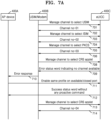
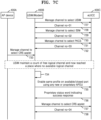
- FIGS. 7A to 7D are sequence diagrams illustrating one or more scenarios for extending one or more static resources in the MEP capable eUICC, according to an embodiment.
- the USIM/modem 400B may send a manage channel command to select the USIM application and may request the eUICC 400C to open a logical channel associated with the first port for accessing the USIM application.
- the eUICC 400C may respond by allocating channel number 01 to the USIM/modem 400B.
- the USIM/modem 400B may establish communication with the USIM application through the allocated logical channel (e.g., channel number 01).
- the USIM/modem 400B may send a manage channel command to select the ISIM application and may request the eUICC 400C to open a logical channel associated with the first port for accessing the ISIM application.
- the eUICC 400C may respond by allocating channel number 02 to the USIM/modem 400B.
- the USIM/modem 400B may establish communication with the ISIM application through the allocated logical channel (e.g., channel number 02).
- the USIM/modem 400B may send a manage channel command to select the PKCS application and may request the eUICC 400C to open a logical channel associated with the first port for accessing the PKCS application.
- the eUICC may respond by allocating channel number 03 to the USIM/modem 400B.
- the USIM/modem 400B may establish communication with the PKCS application through the allocated logical channel (e.g., channel number 03).
- the USIM/modem 400B may send a manage channel command to select a contact registry service (CRS) applet and may request the eUICC 400C to open a logical channel associated with the first port for accessing the CRS applet to manage radio resources in the wireless communication network.
- the manage channel command may be used to establish communication with the eUICC 400C and request the opening of a logical channel associated with the first port for accessing the CRS applet.
- the eUICC 400C may respond by sending an error status word indicating that no channel is available to allocate.
- the USIM/modem 400B may send an error response to the AP device 400A.
- the AP device 400A may send a manage channel command to enable the same profile, which may be associated with the first port, on the second port of the plurality of ports (e.g., using SGP.22 enableProfile function).
- the enabling of the same profile may be based on the result of determinations, which may include determining whether the port extension feature is supported by the eUICC 400C, and/or whether the second port of the plurality of ports is available for access/allocation.
- the AP device 400A may receive a success status word without any proactive command from the eUICC 400C.
- the AP device 400A may receive a positive response from the eUICC 400C without the eUICC 400C initiating any proactive actions and/or commands, and thus, the USIM/modem 400B may access an increased number of the logical channels (e.g., double).
- the USIM/modem 400B may send a manage channel command to select the CRS applet and may request the eUICC 400C to open a logical channel associated with the second port for accessing the CRS applet.
- the eUICC 400C may respond by allocating channel number 04 to the USIM/modem 400B.
- the USIM/modem 400B may establish communication with the CRS applet application through the allocated logical channel (e.g., channel number 04).
- the manage channel command may be and/or may include a control signal that may instruct the eUICC 400C to allocate resources for the logical channel and to establish a communication link between the USIM/modem 400B and the CRS applet.
- the logical channel may provide a pathway for data exchange and control signaling between the USIM/modem 400B and the CRS applet.
- the USIM/modem 400B may interact with the CRS applet to perform tasks related to radio resource management, such as, but not limited to, handover management, interference mitigation, and load balancing.
- the interaction between the USIM/modem 400B and the CRS applet may provide for the USIM/modem 400B to access and/or utilize the functionalities of the CRS applet for optimizing the allocation of radio resources in the wireless network.
- the USIM/modem 400B may send a manage channel command to select the USIM application and may request the eUICC 400C to open a logical channel associated with the first port for accessing the USIM application.
- the eUICC 400C may respond by allocating channel number 01 to the USIM/modem 400B.
- the USIM/modem 400B may establish communication with the USIM application through the allocated logical channel (e.g., channel number 01).
- the USIM/modem 400B may send a manage channel command to select the ISIM application and may request the eUICC 400C to open a logical channel associated with the first port for accessing the ISIM application.
- the eUICC 400C may respond by allocating channel number 02 to the USIM/modem 400B.
- the USIM/modem 400B may establish communication with the ISIM application through the allocated logical channel (e.g., channel number 02).
- the USIM/modem 400B may send a manage channel command to select the PKCS application and may request the eUICC 400C to open a logical channel associated with the first port for accessing the PKCS application.
- the eUICC may respond by allocating channel number 03 to the USIM/modem 400B.
- the USIM/modem 400B may establish communication with the PKCS application through the allocated logical channel (e.g., channel number 03).
- the USIM/modem 400B may receive a manage channel command to a CRS applet from the AP device 400A.
- the USIM/modem 400B may maintain a count of free logical channels and detect whether there is no available logical channel.
- the USIM/modem 400B may send a manage channel command to enable the same profile, which may be associated with the first port, on the second port of the plurality of ports (e.g., using SGP.22 enableProfile function).
- the USIM/modem 400B may receive a success status word without any proactive command from the eUICC 400C. That is, the USIM/modem 400B may receive a positive response from the eUICC 400C without the eUICC 400C initiating any proactive actions and/or commands, and thus, the USIM/modem 400B may access an increased number of the logical channels (e.g., double).
- the USIM/modem 400B may send a manage channel command to select the CRS applet and may request the eUICC 400C to open a logical channel associated with the second port for accessing the CRS applet.
- the eUICC 400C may respond by allocating channel number 04 to the USIM/modem 400B.
- the USIM/modem 400B may establish communication with the CRS applet application through the allocated logical channel (e.g., channel number 04).
- the USIM/modem 400B may send a manage channel command to select the USIM application and may request the eUICC 400C to open a logical channel associated with the first port for accessing the USIM application.
- the eUICC 400C may respond by allocating channel number 01 to the USIM/modem 400B.
- the USIM/modem 400B may establish communication with the USIM application through the allocated logical channel (e.g., channel number 01).
- the USIM/modem 400B may send a manage channel command to select the ISIM application and may request the eUICC 400C to open a logical channel associated with the first port for accessing the ISIM application.
- the eUICC 400C may respond by allocating channel number 02 to the USIM/modem 400B.
- the USIM/modem 400B may establish communication with the ISIM application through the allocated logical channel (e.g., channel number 02).
- the USIM/modem 400B may send a manage channel command to select the PKCS application and may request the eUICC 400C to open a logical channel associated with the first port for accessing the PKCS application.
- the eUICC may respond by allocating channel number 03 to the USIM/modem 400B.
- the USIM/modem 400B may establish communication with the PKCS application through the allocated logical channel (e.g., channel number 03).
- the USIM/modem 400B may receive a manage channel command to a CRS applet from the AP device 400A.
- the USIM/modem 400B maintains a count of free logical channels and detects that there is no available logical channel.
- the USIM/modem 400B may send a manage channel command to enable the same profile, which may be associated with the first port, on the second port of the plurality of ports (e.g., using SGP.22 enableProfile function), using any new and/or proprietary APDU.
- the enabling of the same profile may be based on the result of determinations, which may include determining whether the port extension feature is supported by the eUICC 400C, and/or whether the second port of the plurality of ports is available for access/allocation.
- the USIM/modem 400B may receive a proprietary status word indicating success response from the eUICC 400C. That is, the USIM/modem 400B may receive a positive response from the eUICC 400C, and thus, the USIM/modem 400B may access an increased number of the logical channels (e.g., double).
- the USIM/modem 400B may send a manage channel command to select the CRS applet and may request the eUICC 400C to open a logical channel associated with the second port for accessing the CRS applet.
- the eUICC 400C may respond by allocating channel number 04 to the USIM/modem 400B.
- the USIM/modem 400B may establish communication with the CRS applet application through the allocated logical channel (e.g., channel number 04).
- the USIM/modem 400B may send a manage channel command to the eUICC 400C to manage LSI (e.g., configure LSI) indicating support of extend/reduce LSI.
- the eUICC 400C may respond by sending a manage LSI (e.g., configure LSI) response indicating support of extend/reduce LSI.
- the USIM/modem 400B may send a manage channel command to select the USIM application and may request the eUICC 400C to open a logical channel associated with the first port for accessing the USIM application.
- the eUICC 400C may respond by allocating channel number 01 to the USIM/modem 400B.
- the USIM/modem 400B may establish communication with the USIM application through the allocated logical channel (e.g., channel number 01).
- the USIM/modem 400B may send a manage channel command to select the ISIM application and may request the eUICC 400C to open a logical channel associated with the first port for accessing the ISIM application.
- the eUICC 400C may respond by allocating channel number 02 to the USIM/modem 400B.
- the USIM/modem 400B may establish communication with the ISIM application through the allocated logical channel (e.g., channel number 02).
- the USIM/modem 400B may send a manage channel command to select the PKCS application and may request the eUICC 400C to open a logical channel associated with the first port for accessing the PKCS application.
- the eUICC may respond by allocating channel number 03 to the USIM/modem 400B.
- the USIM/modem 400B may establish communication with the PKCS application through the allocated logical channel (e.g., channel number 03).
- the USIM/modem 400B may receive a profile info list request from the AP device 400A.
- the USIM/modem 400B may send a manage channel command to select the ISDR application and may request the eUICC 400C to open a logical channel associated with the first port for accessing the ISDR application.
- the eUICC 400C may respond by sending an error status word indicating that no channel is available to allocate.
- the USIM/modem 400B may send an error response to the AP device 400A.
- the USIM/modem 400B may send a manage channel command to the eUICC 400C to manage LSI (e.g., extend LSI) in response to detecting that no channel available to allocate.
- the eUICC 400C may respond by sending a message (e.g., 9000) to the USIM/modem 400B. The message may serve as a confirmation and/or acknowledgment of the command being received and being processed successfully.
- the USIM/modem 400B may send a manage channel command to the eUICC 400C to manage/determine the retrieving information and/or LSI (e.g., retrieve LSI).
- the eUICC 400C may respond by sending information associated with a total number of managed LSI available to be used, to merge the one or more static resources of the at least one second port with the one or more static resources of the first port.
- the USIM/modem 400B may send a manage channel command to select the ISDR application and may request the eUICC 400C to open a logical channel associated with the second port for accessing the ISDR application.
- the eUICC 400C may respond by allocating channel number 04 to the USIM/modem 400B.
- the USIM/modem 400B may establish communication with the ISDR application through the allocated logical channel (e.g., channel number 04).
- the USIM/modem 400B may send a profile info list request to the eUICC 400C.
- the eUICC 400C may send a profile info list response to the AP device 400A via the USIM/modem 400B.
- the update on the extend/reduce LSI may include the management of the LSI to indicate the extension and/or reduction of the current LSI.
- the LSI may be extended by adding to the current LSI all associated resources such as logical channels and memory that may not be linked with any LSE.
- the LSI may be reduced by disassociating the extended LSI resource from the current LSI and making available the original LSI for extending and/or enabling a new LSE.
- the terminal may retrieve the associated resources using the manage LSI (e.g., retrieve resource) command.
- the APDU may only be used if the configuration is agreed upon using LSI management (e.g., configure LSI) and/or unless pre-agreed.
- the configuration linked to the first port may correspond with the port configuration shown in Table 1.
- the LSI options configuration may correspond with the options configuration shown in Table 2.
- the response may include the information shown in Table 3.
- Table 1 Port Configuration b8 b7 b6 b5 b4 b3 b2 b1 Meaning 0 0 0 0 0 0 0 0 0
- Select LSI - Lc and Le not present see note 2) 0 0 0 0 0 0 1
- Reset LSE - Lc not present Le present and set to '00' 0 0 0 0 0 0 1 0
- Assign SWP - Lc not present Le present and set to ⁇ 00' 0 0 0 0 0 0 1 1
- Table 2 LSI Options b8 b7 b6 b5 b4 b3 b2 b1 Meaning - - - - - - - ⁇ 1: LSI indication via NAD byte supported/used 0: LSI indication via NAD byte not supported / not used - - - - - - ⁇ - 1: Terminal support extend/reduce LSI 0: Terminal does not support extend/reduce LSI ⁇ ⁇ ⁇ ⁇ ⁇ ⁇ ⁇ - RFU may be set to 0 Table 3 : LSI Response Byte Description Value Length 1 Tag for the number of logical channels assigned to LSI '80' 1 2 Length of next field 1 1 3 Number of logical channels associated with LSI 1
- the USIM/modem 400B may query the status of available port to check if any closed ports are available and/or may issue an enable profile command with the closed port indication. For example, the USIM/modem 400B may perform at least one of following actions.
- the LPA and/or USIM/modem 400B may send a manage LSI (e.g., reduce LSI) command to the eUICC 400C.
- the eUICC 400C may release the additional associated port. If, during the above configuration, a user attempts to enable another profile on the target port, the first manage LSI (e.g., reduce LSI) command may be executed on the target port followed by a request to enable the profile.
- a manage LSI e.g., reduce LSI
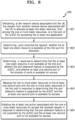
- FIG. 8 is a flow diagram illustrating a method 800 for extending the one or more static resources in the MEP capable eUICC 400C, according to another embodiment.
- the method 800 may include receiving, at the network device associated with the UE 400, the request from another network device associated with the UE 400 to allocate at least one static resource, from among the one or more static resources, at the first port of the eUICC 400C for accessing the at least one application.
- the method 800 may include determining, upon receiving the request, whether the at least one static resource is available at the first port for allocation.
- the method 800 may include determining, in response to determining that the at least one static resource is not available at the first port, whether the port extension feature is supported by the eUICC 400C, and whether at least one second port of the plurality of ports is available for access.
- the method 800 may include merging the one or more static resources of the at least one second port with the one or more static resources of the first port in response to determining that the port extension feature is supported by the eUICC 400C and the at least one second port is available for access.
- the method 800 may include initiating the at least one action associated with the one or more static resources for accessing the received request in response to determining that the port extension feature is not supported by the eUICC 400C and the at least one second port is not available for access.
- the operations of method 800 may include and/or may be similar in many respects to the operations described above with reference to FIGS.
- aspects of the present disclosure may provide several advantages over related wireless systems, such as, but not limited to the following.
- the USIM/modem 400B may enable the same profile on any available port using the EnableProfile function from SGP.22. As described above, the number of available logical channels with the USIM/modem 400B for operation within the profile may be increased. This may result in a reduction in the total APDU exchange between the eUICC 400C and USIM/modem 400B, which may provide an enhanced user experience.
- the USIM/modem 400B may enable the same profile on any available port using a proprietary command (e.g., APDU). As described above, the number of available logical channels with the USIM/modem 400B for operation within the profile may be increased, which may result in a reduced APDU exchange between the eUICC 400C and USIM/modem 400B, which may provide an improved user experience.
- a proprietary command e.g., APDU
- the USIM/modem 400B may enable the same profile on any available port using the EnableProfile function from SGP.22, and ports without any enabled profile may also have logical channels associated with them. These logical channels may, in some scenarios, not be accessed by the USIM/modem 400B, which may result in wasted (unused) memory allocation. However, as described above, these logical channels may be associated with an enabled profile, allowing the logical channels to be accessed, and thereby, potentially improving memory utilization.
- the USIM/modem 400B may extend the LSE using the manage LSI (e.g., extend/reduce LSI) function from ETSI TS 102 221.
- LSI e.g., extend/reduce LSI
- Resources linked with LSE that do not have any LSI associated may, in some scenarios, not be accessible by the USIM/modem 400B, potentially resulting in wasted memory allocation. However, as described above, these resources may be associated with a selected LSI, making the resources accessible, and thereby, potentially improving memory utilization.
- the embodiments disclosed herein may be implemented using at least one hardware device performing network management functions to control the elements.
Landscapes
- Engineering & Computer Science (AREA)
- Computer Networks & Wireless Communication (AREA)
- Signal Processing (AREA)
- Databases & Information Systems (AREA)
- Computer Security & Cryptography (AREA)
- Theoretical Computer Science (AREA)
- Software Systems (AREA)
- General Engineering & Computer Science (AREA)
- Physics & Mathematics (AREA)
- General Physics & Mathematics (AREA)
- Computing Systems (AREA)
- Computer Hardware Design (AREA)
- Mobile Radio Communication Systems (AREA)
Applications Claiming Priority (1)
| Application Number | Priority Date | Filing Date | Title |
|---|---|---|---|
| IN202341005213 | 2023-01-25 |
Publications (1)
| Publication Number | Publication Date |
|---|---|
| EP4408044A1 true EP4408044A1 (de) | 2024-07-31 |
Family
ID=89716034
Family Applications (1)
| Application Number | Title | Priority Date | Filing Date |
|---|---|---|---|
| EP24153779.4A Pending EP4408044A1 (de) | 2023-01-25 | 2024-01-24 | Verfahren zur erweiterung einer oder mehrerer statischer ressourcen in zusammenhang mit einer eingebetteten universellen chipkarte |
Country Status (4)
| Country | Link |
|---|---|
| US (1) | US12652522B2 (de) |
| EP (1) | EP4408044A1 (de) |
| KR (1) | KR20240117496A (de) |
| CN (1) | CN118400416A (de) |
Cited By (1)
| Publication number | Priority date | Publication date | Assignee | Title |
|---|---|---|---|---|
| EP4750102A1 (de) * | 2024-11-26 | 2026-05-27 | Giesecke+Devrient Mobile Security Germany GmbH | Vorrichtung zur verwendung in der drahtlosen kommunikation |
Families Citing this family (3)
| Publication number | Priority date | Publication date | Assignee | Title |
|---|---|---|---|---|
| WO2026059000A1 (en) * | 2024-09-10 | 2026-03-19 | Samsung Electronics Co., Ltd. | Method for dynamically selecting a port of euicc supporting multiple enabled profiles and system thereof |
| US12363530B1 (en) * | 2025-03-24 | 2025-07-15 | Relay, Inc. | Portable communication device profile management using token |
| CN121125649B (zh) * | 2025-11-17 | 2026-01-27 | 天津市天河计算机技术有限公司 | 混合资源网络端口管理方法及端口管理系统 |
Citations (3)
| Publication number | Priority date | Publication date | Assignee | Title |
|---|---|---|---|---|
| WO2022031148A1 (en) * | 2020-08-07 | 2022-02-10 | Samsung Electronics Co., Ltd. | Method and apparatus for installing and managing multiple esim profiles |
| WO2022080971A1 (en) * | 2020-10-16 | 2022-04-21 | Samsung Electronics Co., Ltd. | Method and device for initialization between user equipment and universal integrated circuit card in wireless communication system |
| US20220329372A1 (en) * | 2021-04-13 | 2022-10-13 | Apple Inc. | LOGICAL CHANNEL MANAGEMENT FOR MULTIPLE eSIM PROFILES |
Family Cites Families (5)
| Publication number | Priority date | Publication date | Assignee | Title |
|---|---|---|---|---|
| US9439062B2 (en) * | 2014-05-30 | 2016-09-06 | Apple Inc. | Electronic subscriber identity module application identifier handling |
| KR20220018892A (ko) | 2020-08-07 | 2022-02-15 | 삼성전자주식회사 | 복수 개의 eSIM 프로파일을 설치, 관리하는 방법 및 장치 |
| KR20220068895A (ko) | 2020-11-19 | 2022-05-26 | 삼성전자주식회사 | 복수 프로파일 활성화를 지원하는 탈착식 eUICC를 고려한 프로파일 핸들링 방법 및 장치 |
| US12160926B2 (en) * | 2021-02-18 | 2024-12-03 | Samsung Electronics Co., Ltd. | Method and apparatus for transmitting and processing profile management message for multiple enabled profiles between terminal and universal integrated circuit card |
| EP4282171A4 (de) | 2021-05-10 | 2024-07-10 | Samsung Electronics Co., Ltd. | Verfahren und vorrichtung zum erhalten und handhaben von proaktiven befehlen zwischen endgerät und karte mit unterstützung logischer schnittstellen |
-
2024
- 2024-01-24 KR KR1020240011185A patent/KR20240117496A/ko active Pending
- 2024-01-24 EP EP24153779.4A patent/EP4408044A1/de active Pending
- 2024-01-25 CN CN202410111064.2A patent/CN118400416A/zh active Pending
- 2024-01-25 US US18/422,977 patent/US12652522B2/en active Active
Patent Citations (3)
| Publication number | Priority date | Publication date | Assignee | Title |
|---|---|---|---|---|
| WO2022031148A1 (en) * | 2020-08-07 | 2022-02-10 | Samsung Electronics Co., Ltd. | Method and apparatus for installing and managing multiple esim profiles |
| WO2022080971A1 (en) * | 2020-10-16 | 2022-04-21 | Samsung Electronics Co., Ltd. | Method and device for initialization between user equipment and universal integrated circuit card in wireless communication system |
| US20220329372A1 (en) * | 2021-04-13 | 2022-10-13 | Apple Inc. | LOGICAL CHANNEL MANAGEMENT FOR MULTIPLE eSIM PROFILES |
Non-Patent Citations (2)
| Title |
|---|
| "Smart Cards; UICC-Terminal interface; Physical and logical characteristics (Release 17)", no. V17.4.0, 24 January 2023 (2023-01-24), pages 1 - 200, XP014461724, Retrieved from the Internet <URL:ftp://docbox.etsi.org/SET/SET-WG-T/70-Draft/TEC102221vh40/SET-T102221vh40v1740.docx> [retrieved on 20230124] * |
| SAMSUNG R&D INSTITUTE UK: "Effective Use Of Resource For MEP", vol. WG SET REQ SET-REQ, 11 October 2023 (2023-10-11), pages 1 - 8, XP014471562, Retrieved from the Internet <URL:ftp://docbox.etsi.org/SET/SET-WG-R/05-CONTRIBUTIONS/2023/SETREQ(23)000050_Effective_Use_Of_Resource_For_MEP.pptx> [retrieved on 20231011] * |
Cited By (1)
| Publication number | Priority date | Publication date | Assignee | Title |
|---|---|---|---|---|
| EP4750102A1 (de) * | 2024-11-26 | 2026-05-27 | Giesecke+Devrient Mobile Security Germany GmbH | Vorrichtung zur verwendung in der drahtlosen kommunikation |
Also Published As
| Publication number | Publication date |
|---|---|
| US20240251231A1 (en) | 2024-07-25 |
| US12652522B2 (en) | 2026-06-09 |
| KR20240117496A (ko) | 2024-08-01 |
| CN118400416A (zh) | 2024-07-26 |
Similar Documents
| Publication | Publication Date | Title |
|---|---|---|
| US20240251231A1 (en) | Method for extending one or more static resources associated with embedded universal integrated circuit card | |
| US12401976B2 (en) | IMEI binding and dynamic IMEI provisioning for wireless devices | |
| US10833715B2 (en) | Embedded subscriber identity module including communication profiles | |
| EP3381209B1 (de) | Verfahren und vorrichtung zur verwaltung von profilen | |
| JP6622394B2 (ja) | 複数のアクティブな加入者識別モジュールプロファイルの管理 | |
| US10387219B2 (en) | Enabling multiple secure elements in a card computing device | |
| CN110781129B (zh) | 一种fpga异构加速卡集群中的资源调度方法、设备及介质 | |
| EP1875757B1 (de) | Verfahren zur verwaltung einer peripherieeinheit durch eine sim-karte in drahtlosen kommunikationsendgeräten und peripherieeinheit zur implementierung des verfahrens | |
| US20160088464A1 (en) | Managing Selection and Triggering of Applications on a Card Computing Device | |
| CN110809255B (zh) | 一种卡信息激活方法、装置及存储介质 | |
| EP3286934B1 (de) | System und verfahren zur verwaltung logischer kanäle für zugriff auf mehrere virtuellen profile in einem sicheren element | |
| EP3709687B1 (de) | Elektronische vorrichtung und verfahren zur verwaltung einer ic-karte mit mehreren sim-profilen | |
| US20220086796A1 (en) | System and Method of Access Point Name (APN) Dynamic Mapping | |
| CN1146208C (zh) | 用于读智能卡的通信终端 | |
| KR102319834B1 (ko) | 몇 개의 소프트웨어 컨테이너들을 포함하는 변조 방지 디바이스에서 권한들을 관리하는 방법 | |
| CN108260119B (zh) | 移动终端、嵌入式sim卡及其访问方法、装置 | |
| EP2391175B1 (de) | Verfahren und System zum Verhindern, dass Anwendungen eine Datenanschlusserstellung starten | |
| US11838985B2 (en) | Policy-based management of embedded subscriber identity module (eSIM) profiles | |
| JP7625811B2 (ja) | ドライバプログラム、及びトランザクション仲介方法 | |
| RU2833625C1 (ru) | Устройство хранения данных для мобильного устройства и способ маршрутизации трафика | |
| EP4683360A1 (de) | Mobile vorrichtung und verfahren für drahtlosen datenaustausch | |
| CN1586085B (zh) | 启动无线通信终端应用程序的方法及实现该方法的终端 | |
| EP4161173A1 (de) | Verfahren und vorrichtung zur verarbeitung von endgeräteregistrierungen | |
| CN121666776A (zh) | 非接触式小应用信息的全局化 | |
| CN118796103A (zh) | 一种数据存储方法及装置、网络设备、计算机存储介质及程序产品 |
Legal Events
| Date | Code | Title | Description |
|---|---|---|---|
| PUAI | Public reference made under article 153(3) epc to a published international application that has entered the european phase |
Free format text: ORIGINAL CODE: 0009012 |
|
| STAA | Information on the status of an ep patent application or granted ep patent |
Free format text: STATUS: THE APPLICATION HAS BEEN PUBLISHED |
|
| AK | Designated contracting states |
Kind code of ref document: A1 Designated state(s): AL AT BE BG CH CY CZ DE DK EE ES FI FR GB GR HR HU IE IS IT LI LT LU LV MC ME MK MT NL NO PL PT RO RS SE SI SK SM TR |
|
| RIN1 | Information on inventor provided before grant (corrected) |
Inventor name: KANG, SUJUNG Inventor name: MA, KEONYONG Inventor name: YOON, KANGJIN Inventor name: RATHORE, PANKAJ Inventor name: DANDRA, PRASAD BASAVARAJ Inventor name: MISHRA, BIBHUTI RANJAN |
|
| STAA | Information on the status of an ep patent application or granted ep patent |
Free format text: STATUS: REQUEST FOR EXAMINATION WAS MADE |
|
| P01 | Opt-out of the competence of the unified patent court (upc) registered |
Free format text: CASE NUMBER: APP_66259/2024 Effective date: 20241213 |
|
| 17P | Request for examination filed |
Effective date: 20250103 |