EP4407477A2 - Verfahren und system für öffentliche einzweckschlüssel für öffentliche konten - Google Patents
Verfahren und system für öffentliche einzweckschlüssel für öffentliche konten Download PDFInfo
- Publication number
- EP4407477A2 EP4407477A2 EP24167401.9A EP24167401A EP4407477A2 EP 4407477 A2 EP4407477 A2 EP 4407477A2 EP 24167401 A EP24167401 A EP 24167401A EP 4407477 A2 EP4407477 A2 EP 4407477A2
- Authority
- EP
- European Patent Office
- Prior art keywords
- computing device
- public
- transaction
- account
- purpose string
- Prior art date
- Legal status (The legal status is an assumption and is not a legal conclusion. Google has not performed a legal analysis and makes no representation as to the accuracy of the status listed.)
- Granted
Links
Images



Classifications
-
- G—PHYSICS
- G06—COMPUTING OR CALCULATING; COUNTING
- G06Q—INFORMATION AND COMMUNICATION TECHNOLOGY [ICT] SPECIALLY ADAPTED FOR ADMINISTRATIVE, COMMERCIAL, FINANCIAL, MANAGERIAL OR SUPERVISORY PURPOSES; SYSTEMS OR METHODS SPECIALLY ADAPTED FOR ADMINISTRATIVE, COMMERCIAL, FINANCIAL, MANAGERIAL OR SUPERVISORY PURPOSES, NOT OTHERWISE PROVIDED FOR
- G06Q20/00—Payment architectures, schemes or protocols
- G06Q20/38—Payment protocols; Details thereof
- G06Q20/40—Authorisation, e.g. identification of payer or payee, verification of customer or shop credentials; Review and approval of payers, e.g. check credit lines or negative lists
- G06Q20/401—Transaction verification
- G06Q20/4014—Identity check for transactions
-
- H—ELECTRICITY
- H04—ELECTRIC COMMUNICATION TECHNIQUE
- H04L—TRANSMISSION OF DIGITAL INFORMATION, e.g. TELEGRAPHIC COMMUNICATION
- H04L9/00—Cryptographic mechanisms or cryptographic arrangements for secret or secure communications; Network security protocols
- H04L9/32—Cryptographic mechanisms or cryptographic arrangements for secret or secure communications; Network security protocols including means for verifying the identity or authority of a user of the system or for message authentication, e.g. authorization, entity authentication, data integrity or data verification, non-repudiation, key authentication or verification of credentials
- H04L9/3236—Cryptographic mechanisms or cryptographic arrangements for secret or secure communications; Network security protocols including means for verifying the identity or authority of a user of the system or for message authentication, e.g. authorization, entity authentication, data integrity or data verification, non-repudiation, key authentication or verification of credentials using cryptographic hash functions
- H04L9/3239—Cryptographic mechanisms or cryptographic arrangements for secret or secure communications; Network security protocols including means for verifying the identity or authority of a user of the system or for message authentication, e.g. authorization, entity authentication, data integrity or data verification, non-repudiation, key authentication or verification of credentials using cryptographic hash functions involving non-keyed hash functions, e.g. modification detection codes [MDCs], MD5, SHA or RIPEMD
-
- G—PHYSICS
- G06—COMPUTING OR CALCULATING; COUNTING
- G06Q—INFORMATION AND COMMUNICATION TECHNOLOGY [ICT] SPECIALLY ADAPTED FOR ADMINISTRATIVE, COMMERCIAL, FINANCIAL, MANAGERIAL OR SUPERVISORY PURPOSES; SYSTEMS OR METHODS SPECIALLY ADAPTED FOR ADMINISTRATIVE, COMMERCIAL, FINANCIAL, MANAGERIAL OR SUPERVISORY PURPOSES, NOT OTHERWISE PROVIDED FOR
- G06Q20/00—Payment architectures, schemes or protocols
- G06Q20/04—Payment circuits
- G06Q20/06—Private payment circuits, e.g. involving electronic currency used among participants of a common payment scheme
- G06Q20/065—Private payment circuits, e.g. involving electronic currency used among participants of a common payment scheme using e-cash
-
- G—PHYSICS
- G06—COMPUTING OR CALCULATING; COUNTING
- G06Q—INFORMATION AND COMMUNICATION TECHNOLOGY [ICT] SPECIALLY ADAPTED FOR ADMINISTRATIVE, COMMERCIAL, FINANCIAL, MANAGERIAL OR SUPERVISORY PURPOSES; SYSTEMS OR METHODS SPECIALLY ADAPTED FOR ADMINISTRATIVE, COMMERCIAL, FINANCIAL, MANAGERIAL OR SUPERVISORY PURPOSES, NOT OTHERWISE PROVIDED FOR
- G06Q20/00—Payment architectures, schemes or protocols
- G06Q20/08—Payment architectures
- G06Q20/10—Payment architectures specially adapted for electronic funds transfer [EFT] systems; specially adapted for home banking systems
-
- G—PHYSICS
- G06—COMPUTING OR CALCULATING; COUNTING
- G06Q—INFORMATION AND COMMUNICATION TECHNOLOGY [ICT] SPECIALLY ADAPTED FOR ADMINISTRATIVE, COMMERCIAL, FINANCIAL, MANAGERIAL OR SUPERVISORY PURPOSES; SYSTEMS OR METHODS SPECIALLY ADAPTED FOR ADMINISTRATIVE, COMMERCIAL, FINANCIAL, MANAGERIAL OR SUPERVISORY PURPOSES, NOT OTHERWISE PROVIDED FOR
- G06Q20/00—Payment architectures, schemes or protocols
- G06Q20/22—Payment schemes or models
- G06Q20/223—Payment schemes or models based on the use of peer-to-peer networks
-
- G—PHYSICS
- G06—COMPUTING OR CALCULATING; COUNTING
- G06Q—INFORMATION AND COMMUNICATION TECHNOLOGY [ICT] SPECIALLY ADAPTED FOR ADMINISTRATIVE, COMMERCIAL, FINANCIAL, MANAGERIAL OR SUPERVISORY PURPOSES; SYSTEMS OR METHODS SPECIALLY ADAPTED FOR ADMINISTRATIVE, COMMERCIAL, FINANCIAL, MANAGERIAL OR SUPERVISORY PURPOSES, NOT OTHERWISE PROVIDED FOR
- G06Q20/00—Payment architectures, schemes or protocols
- G06Q20/38—Payment protocols; Details thereof
- G06Q20/382—Payment protocols; Details thereof insuring higher security of transaction
- G06Q20/3821—Electronic credentials
-
- G—PHYSICS
- G06—COMPUTING OR CALCULATING; COUNTING
- G06Q—INFORMATION AND COMMUNICATION TECHNOLOGY [ICT] SPECIALLY ADAPTED FOR ADMINISTRATIVE, COMMERCIAL, FINANCIAL, MANAGERIAL OR SUPERVISORY PURPOSES; SYSTEMS OR METHODS SPECIALLY ADAPTED FOR ADMINISTRATIVE, COMMERCIAL, FINANCIAL, MANAGERIAL OR SUPERVISORY PURPOSES, NOT OTHERWISE PROVIDED FOR
- G06Q20/00—Payment architectures, schemes or protocols
- G06Q20/38—Payment protocols; Details thereof
- G06Q20/382—Payment protocols; Details thereof insuring higher security of transaction
- G06Q20/3825—Use of electronic signatures
-
- G—PHYSICS
- G06—COMPUTING OR CALCULATING; COUNTING
- G06Q—INFORMATION AND COMMUNICATION TECHNOLOGY [ICT] SPECIALLY ADAPTED FOR ADMINISTRATIVE, COMMERCIAL, FINANCIAL, MANAGERIAL OR SUPERVISORY PURPOSES; SYSTEMS OR METHODS SPECIALLY ADAPTED FOR ADMINISTRATIVE, COMMERCIAL, FINANCIAL, MANAGERIAL OR SUPERVISORY PURPOSES, NOT OTHERWISE PROVIDED FOR
- G06Q20/00—Payment architectures, schemes or protocols
- G06Q20/38—Payment protocols; Details thereof
- G06Q20/382—Payment protocols; Details thereof insuring higher security of transaction
- G06Q20/3827—Use of message hashing
-
- G—PHYSICS
- G06—COMPUTING OR CALCULATING; COUNTING
- G06Q—INFORMATION AND COMMUNICATION TECHNOLOGY [ICT] SPECIALLY ADAPTED FOR ADMINISTRATIVE, COMMERCIAL, FINANCIAL, MANAGERIAL OR SUPERVISORY PURPOSES; SYSTEMS OR METHODS SPECIALLY ADAPTED FOR ADMINISTRATIVE, COMMERCIAL, FINANCIAL, MANAGERIAL OR SUPERVISORY PURPOSES, NOT OTHERWISE PROVIDED FOR
- G06Q20/00—Payment architectures, schemes or protocols
- G06Q20/38—Payment protocols; Details thereof
- G06Q20/382—Payment protocols; Details thereof insuring higher security of transaction
- G06Q20/3829—Payment protocols; Details thereof insuring higher security of transaction involving key management
-
- G—PHYSICS
- G06—COMPUTING OR CALCULATING; COUNTING
- G06Q—INFORMATION AND COMMUNICATION TECHNOLOGY [ICT] SPECIALLY ADAPTED FOR ADMINISTRATIVE, COMMERCIAL, FINANCIAL, MANAGERIAL OR SUPERVISORY PURPOSES; SYSTEMS OR METHODS SPECIALLY ADAPTED FOR ADMINISTRATIVE, COMMERCIAL, FINANCIAL, MANAGERIAL OR SUPERVISORY PURPOSES, NOT OTHERWISE PROVIDED FOR
- G06Q20/00—Payment architectures, schemes or protocols
- G06Q20/38—Payment protocols; Details thereof
- G06Q20/40—Authorisation, e.g. identification of payer or payee, verification of customer or shop credentials; Review and approval of payers, e.g. check credit lines or negative lists
- G06Q20/401—Transaction verification
- G06Q20/4014—Identity check for transactions
- G06Q20/40145—Biometric identity checks
-
- G—PHYSICS
- G06—COMPUTING OR CALCULATING; COUNTING
- G06Q—INFORMATION AND COMMUNICATION TECHNOLOGY [ICT] SPECIALLY ADAPTED FOR ADMINISTRATIVE, COMMERCIAL, FINANCIAL, MANAGERIAL OR SUPERVISORY PURPOSES; SYSTEMS OR METHODS SPECIALLY ADAPTED FOR ADMINISTRATIVE, COMMERCIAL, FINANCIAL, MANAGERIAL OR SUPERVISORY PURPOSES, NOT OTHERWISE PROVIDED FOR
- G06Q20/00—Payment architectures, schemes or protocols
- G06Q20/38—Payment protocols; Details thereof
- G06Q20/40—Authorisation, e.g. identification of payer or payee, verification of customer or shop credentials; Review and approval of payers, e.g. check credit lines or negative lists
- G06Q20/405—Establishing or using transaction specific rules
-
- H—ELECTRICITY
- H04—ELECTRIC COMMUNICATION TECHNIQUE
- H04L—TRANSMISSION OF DIGITAL INFORMATION, e.g. TELEGRAPHIC COMMUNICATION
- H04L63/00—Network architectures or network communication protocols for network security
- H04L63/08—Network architectures or network communication protocols for network security for authentication of entities
- H04L63/0861—Network architectures or network communication protocols for network security for authentication of entities using biometrical features, e.g. fingerprint, retina-scan
-
- H—ELECTRICITY
- H04—ELECTRIC COMMUNICATION TECHNIQUE
- H04L—TRANSMISSION OF DIGITAL INFORMATION, e.g. TELEGRAPHIC COMMUNICATION
- H04L63/00—Network architectures or network communication protocols for network security
- H04L63/12—Applying verification of the received information
- H04L63/123—Applying verification of the received information received data contents, e.g. message integrity
-
- H—ELECTRICITY
- H04—ELECTRIC COMMUNICATION TECHNIQUE
- H04L—TRANSMISSION OF DIGITAL INFORMATION, e.g. TELEGRAPHIC COMMUNICATION
- H04L9/00—Cryptographic mechanisms or cryptographic arrangements for secret or secure communications; Network security protocols
- H04L9/006—Cryptographic mechanisms or cryptographic arrangements for secret or secure communications; Network security protocols involving public key infrastructure [PKI] trust models
-
- H—ELECTRICITY
- H04—ELECTRIC COMMUNICATION TECHNIQUE
- H04L—TRANSMISSION OF DIGITAL INFORMATION, e.g. TELEGRAPHIC COMMUNICATION
- H04L9/00—Cryptographic mechanisms or cryptographic arrangements for secret or secure communications; Network security protocols
- H04L9/08—Key distribution or management, e.g. generation, sharing or updating, of cryptographic keys or passwords
- H04L9/0861—Generation of secret information including derivation or calculation of cryptographic keys or passwords
-
- H—ELECTRICITY
- H04—ELECTRIC COMMUNICATION TECHNIQUE
- H04L—TRANSMISSION OF DIGITAL INFORMATION, e.g. TELEGRAPHIC COMMUNICATION
- H04L9/00—Cryptographic mechanisms or cryptographic arrangements for secret or secure communications; Network security protocols
- H04L9/08—Key distribution or management, e.g. generation, sharing or updating, of cryptographic keys or passwords
- H04L9/0861—Generation of secret information including derivation or calculation of cryptographic keys or passwords
- H04L9/0866—Generation of secret information including derivation or calculation of cryptographic keys or passwords involving user or device identifiers, e.g. serial number, physical or biometrical information, DNA, hand-signature or measurable physical characteristics
-
- H—ELECTRICITY
- H04—ELECTRIC COMMUNICATION TECHNIQUE
- H04L—TRANSMISSION OF DIGITAL INFORMATION, e.g. TELEGRAPHIC COMMUNICATION
- H04L9/00—Cryptographic mechanisms or cryptographic arrangements for secret or secure communications; Network security protocols
- H04L9/32—Cryptographic mechanisms or cryptographic arrangements for secret or secure communications; Network security protocols including means for verifying the identity or authority of a user of the system or for message authentication, e.g. authorization, entity authentication, data integrity or data verification, non-repudiation, key authentication or verification of credentials
- H04L9/321—Cryptographic mechanisms or cryptographic arrangements for secret or secure communications; Network security protocols including means for verifying the identity or authority of a user of the system or for message authentication, e.g. authorization, entity authentication, data integrity or data verification, non-repudiation, key authentication or verification of credentials involving a third party or a trusted authority
-
- H—ELECTRICITY
- H04—ELECTRIC COMMUNICATION TECHNIQUE
- H04L—TRANSMISSION OF DIGITAL INFORMATION, e.g. TELEGRAPHIC COMMUNICATION
- H04L9/00—Cryptographic mechanisms or cryptographic arrangements for secret or secure communications; Network security protocols
- H04L9/32—Cryptographic mechanisms or cryptographic arrangements for secret or secure communications; Network security protocols including means for verifying the identity or authority of a user of the system or for message authentication, e.g. authorization, entity authentication, data integrity or data verification, non-repudiation, key authentication or verification of credentials
- H04L9/3226—Cryptographic mechanisms or cryptographic arrangements for secret or secure communications; Network security protocols including means for verifying the identity or authority of a user of the system or for message authentication, e.g. authorization, entity authentication, data integrity or data verification, non-repudiation, key authentication or verification of credentials using a predetermined code, e.g. password, passphrase or PIN
- H04L9/3231—Biological data, e.g. fingerprint, voice or retina
-
- H—ELECTRICITY
- H04—ELECTRIC COMMUNICATION TECHNIQUE
- H04L—TRANSMISSION OF DIGITAL INFORMATION, e.g. TELEGRAPHIC COMMUNICATION
- H04L9/00—Cryptographic mechanisms or cryptographic arrangements for secret or secure communications; Network security protocols
- H04L9/32—Cryptographic mechanisms or cryptographic arrangements for secret or secure communications; Network security protocols including means for verifying the identity or authority of a user of the system or for message authentication, e.g. authorization, entity authentication, data integrity or data verification, non-repudiation, key authentication or verification of credentials
- H04L9/3247—Cryptographic mechanisms or cryptographic arrangements for secret or secure communications; Network security protocols including means for verifying the identity or authority of a user of the system or for message authentication, e.g. authorization, entity authentication, data integrity or data verification, non-repudiation, key authentication or verification of credentials involving digital signatures
-
- H—ELECTRICITY
- H04—ELECTRIC COMMUNICATION TECHNIQUE
- H04L—TRANSMISSION OF DIGITAL INFORMATION, e.g. TELEGRAPHIC COMMUNICATION
- H04L9/00—Cryptographic mechanisms or cryptographic arrangements for secret or secure communications; Network security protocols
- H04L9/32—Cryptographic mechanisms or cryptographic arrangements for secret or secure communications; Network security protocols including means for verifying the identity or authority of a user of the system or for message authentication, e.g. authorization, entity authentication, data integrity or data verification, non-repudiation, key authentication or verification of credentials
- H04L9/3263—Cryptographic mechanisms or cryptographic arrangements for secret or secure communications; Network security protocols including means for verifying the identity or authority of a user of the system or for message authentication, e.g. authorization, entity authentication, data integrity or data verification, non-repudiation, key authentication or verification of credentials involving certificates, e.g. public key certificate [PKC] or attribute certificate [AC]; Public key infrastructure [PKI] arrangements
-
- H—ELECTRICITY
- H04—ELECTRIC COMMUNICATION TECHNIQUE
- H04L—TRANSMISSION OF DIGITAL INFORMATION, e.g. TELEGRAPHIC COMMUNICATION
- H04L9/00—Cryptographic mechanisms or cryptographic arrangements for secret or secure communications; Network security protocols
- H04L9/50—Cryptographic mechanisms or cryptographic arrangements for secret or secure communications; Network security protocols using hash chains, e.g. blockchains or hash trees
-
- G—PHYSICS
- G06—COMPUTING OR CALCULATING; COUNTING
- G06Q—INFORMATION AND COMMUNICATION TECHNOLOGY [ICT] SPECIALLY ADAPTED FOR ADMINISTRATIVE, COMMERCIAL, FINANCIAL, MANAGERIAL OR SUPERVISORY PURPOSES; SYSTEMS OR METHODS SPECIALLY ADAPTED FOR ADMINISTRATIVE, COMMERCIAL, FINANCIAL, MANAGERIAL OR SUPERVISORY PURPOSES, NOT OTHERWISE PROVIDED FOR
- G06Q2220/00—Business processing using cryptography
-
- H—ELECTRICITY
- H04—ELECTRIC COMMUNICATION TECHNIQUE
- H04L—TRANSMISSION OF DIGITAL INFORMATION, e.g. TELEGRAPHIC COMMUNICATION
- H04L2209/00—Additional information or applications relating to cryptographic mechanisms or cryptographic arrangements for secret or secure communication H04L9/00
- H04L2209/56—Financial cryptography, e.g. electronic payment or e-cash
Definitions
- the present disclosure relates to public ledgers including blockchain, and in particular relates to transaction security for public ledgers.
- a ledger is a record of transactions between accounts.
- a public ledger makes the ledger public in the sense that all transactions are available to the public.
- a public ledger system is pseudonymous if the account numbers are traceable, but do not identify individuals by name. Pseudonymous, as used herein, means that the while transactions associated with an account number can be traced, the account numbers themselves cannot necessarily be associated with a particular person.
- a public ledger cryptocurrency is a digital currency that uses cryptography to mark transactions.
- an account number may be a public key, and a transaction may contain a digital signature.
- the public ledger can be used by a cryptocurrency recipient to confirm that the account holder has enough funds in an account before entering into a transaction. This may help to avoid a double spending by a cryptocurrency sender.
- each account holder normally has a private key, which is used to sign transactions.
- the private key is often stored in a module called a digital wallet on a computing device.
- a thief may invade the device storing the digital wallet and extract an account holder's private signing key. The thief can then transfer funds of the account holder into other accounts.
- Every recipient should first inspect the public ledger to see if the said sender possesses sufficient funds. This inspection of the public ledger gives an honest recipient a limited opportunity to counter some forms of theft and fraud. In particular, the checking of the public ledger may allow an honest recipient to trace where funds have travelled. An honest recipient may be able to detect that the cryptocurrency in question has followed a suspicious path. For example, if the funds originate from an account whose funds have been reported stolen, and honest recipient can refuse to receive the funds and may report an attempted transaction to authorities.
- the present disclosure provides a method at a computing device in a public ledger cryptography system, the method comprising: creating a purpose string, the purpose string defining transaction parameters for an account within the public ledger cryptography system; using the purpose string to create a private key and associated public key for an account within the public ledger cryptography system; and providing the purpose string for use in verification of a transaction from the account within the public ledger cryptography system.
- the present disclosure further provides a computing device in a public ledger cryptography system, the computing device comprising: a processor; and a communications subsystem, wherein the computing device is configured to: create a purpose string, the purpose string defining transaction parameters for an account within the public ledger cryptography system; use the purpose string to create a private key and associated public key for an account within the public ledger cryptography system; and provide the purpose string for use in verification of a transaction from the account within the public ledger cryptography system.
- the present disclosure further provides a computer readable medium for storing instruction code which, when executed by a processor of a computing device in a public ledger cryptography system, cause the computing device to: create a purpose string, the purpose string defining transaction parameters for an account within the public ledger cryptography system; use the purpose string to create a private key and associated public key for an account within the public ledger cryptography system; and provide the purpose string for use in verification of a transaction from the account within the public ledger cryptography system.
- Terminology Term Brief Description Ledger A list of transactions/money transfers between accounts Public ledger A ledger which is publicly viewable Pseudonym or account address A unique traceable number attached to an account: usually also a public key Public key A value used to verify a digital signature of a message, for each public key, there is an associated private key Digital signature A value that is a publicly verifiable value, given a message and a public key Private key A value used to generate a digital signature of message - for each private key, there is an associated public key Proof of generation Proof that an entity generated a public key - more precisely that public key was generated in combination with a particular message, called the purpose string in this disclosure. The entity may publicly identify the particular message used for the public key generation. Purpose string A message that can be used to create a mutually associated pair of keys, a private key and a public key, such that each public key can have at most 1 purpose string
- a public ledger is a ledger which is publicly viewable.
- a public ledger cryptocurrency is Bitcoin, which uses blockchain technology to authenticate the public ledger. This process is known as mining, and mostly decentralizes the authority of the public ledger.
- a public ledger cryptography system is described.
- the public ledger may, for example, be used for cryptocurrency.
- the cryptocurrency used with the embodiments herein may be, for example, Bitcoin.
- the present disclosure is not limited to Bitcoin and any suitable cryptocurrency may be used.
- Cryptocurrency may be used in a variety of computing environments.
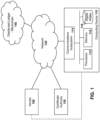
- One example computing environment is shown with regard to Figure 1 .
- a computing device 110 belongs to a user with funds on a public ledger.
- computing device 110 may include a processor 112 and a communications subsystem 114, where the processor and communications subsystem cooperate to perform the methods described herein.
- Computing device 110 may further include a memory 116, which may be used to store the data or programmable logic.
- the programmable logic may be executed by processor 112.
- programmable logic may be provided to computing device 110 through communications subsystem 114.
- the computing device 110 includes a digital wallet 118, which may store the private key for funds within the public ledger.
- the public key for the user of computing device 110 associated with the private key stored in digital wallet 118 may allow for the funds to be used with the public ledger.
- the private key is stored in the digital wallet 118, which provides for security to store such private key.
- Digital wallet 118 may be any data structure or logical structure used to store the private key and associated data.
- digital wallet 118 is implemented in software and hardware, or may be implemented in specifically designed hardware, that stores information that allows an individual to make electronic commerce transactions.
- the digital wallet may be provided utilizing dedicated hardware devices, such as a hardware security module.
- the digital wallet 118 may include memory that is dedicated to the digital wallet, and may be internal or external to computing device 110.
- Computing device 110 may communicate, for example, through a network 120.
- computing device 110 may communicate with a certificate authority 130 which may be used to generate and authenticate certificates for the computing device, including certificates for the public ledger in some cases.
- network 120 may be used for computing device 110 to communicate with a public ledger or block chain 140, which may be stored on a plurality of computers and be distributed in some cases.
- network 120 may be used to communicate with a receiving entity such as a vendor 150.
- Vendor 150 may include a computing device configured to perform the embodiments herein, including communication with computing device 110 and the public ledger / blockchain 140, as well as verification as described below.
- the vendor 150 may be providing goods or services in exchange for the cryptocurrency associated with digital wallet 118.
- computing device 110 may be proximate to a vendor 150 and in this case communication directly between the computing device 110 and vendor 150 is possible.
- Suspicious transactions can be detected, for example, from suspicious activities. For example, large value transactions, sudden transactions, purchases towards suspicious vendors, or purchases made in unusual locations might serve as indicators of fraudulent transactions.
- the credit card industry already uses such measures to block suspicious credit card transactions, or to request further information before allowing suspicious transactions to move forward.
- a recommended response to suspected theft of a private key from a digital wallet is to first create a new account with a new public key, and next transfer remaining funds (if any) to the new account. However, at this point, it may already be too late, the attacker may have already transferred out the funds to another account.
- Bitcoin itself does not provide any means to issue a theft report. There is no current mechanism within the public ledger to flag stolen Bitcoins. Nonetheless, it is possible to do so outside of the public ledger mechanism, such as on social media, by contacting government authorities, among other options. Once such reporting has been performed, a path of the stolen funds through the ledger can be traced.
- an honest vendor can examine suspicious transactions or use theft reports to detect fraudulent transactions. An honest vendor can therefore refuse to enter into new transactions that would that they believe may involve stolen funds or be otherwise fraudulent. The honest vendor can even review or trace through past transactions to measure what percentage of funds in an account are suspicious or fraudulent.
- a thief's efforts to circumvent the fraud detection system is called laundering.
- laundering As a first step of laundering, a thief may transfer a large amount of the victim's funds to his or her own account. The thief would then try to spend this amount before the victim issues a theft report (which flags the funds in the thief's account as stolen).
- a fraud detection system may therefore be designed to suspect funds spent too soon after a large transfer.
- a thief might also try to make many small transfers in a short amount of time to multiple accounts. This type of activity may again be flagged as suspicious.
- authorities may attempt to physically apprehend the people spending the funds, for example, by offering to make a personal transaction with the thief.
- Proof of generation allows for the binding of a message to a public key.
- the public key can then be verified against the message to ensure the public key is associated with the message. This is, for example, described in US Patent Number 9,240,884, January 19, 2016, to Brown .
- proof of generation is used to generate a public key with an attached message.
- proof of generation when the public key is generated, a message is bound to the public key. The binding of this message to the public key can be verified by anybody.
- the binding is unique, in that it is impossible to have two different messages bound to a public key. Even a malicious entity generating the private key and public key cannot create two different messages bound to the same public key.
- a public key with a proof of generation message can be used just like any public key and has no limitations other than being bound to a single proof of generation message.
- a proof of generation public key can be used for digital signatures and for key exchange, or for any other kind of public key cryptography.
- proof of generation allows for each public key to be bound to one message. However, this does not mean a one to one binding.
- One message can be bound to many different public keys.
- Proof of generation can be either authenticated or unauthenticated, as explained below.
- the bound message is in some way authenticated.
- the bound message can contain a digital signature of a certification authority, or some other trusted party.
- the proof of generation is authenticated due to the participation of the certification authority.
- a public key can be reconstructed from implicit certificates. Further, anybody can create an implicit certificate, from which a public key can be reconstructed. However, the only way someone can know the private key for a reconstructed public key is if they participated with the certification authority in the creation of the public/private key pair. Therefore, for implicit certificates to provide full security, including proof of generation, the owner of the reconstructed public key must somehow prove possession of the corresponding private key. This proof of possession is typically demonstrated by signing a message or decrypting a ciphertext. In the context of proof of generation, the proof of generation is not completed until the proof of possession is provided. Up until proof of possession, the security is deemed implicit.
- FIG. 2 shows a method for generating public and private keys utilizing a message m in an Elliptic Curve Digital Signature Algorithm (ECDSA).
- EDSA Elliptic Curve Digital Signature Algorithm
- the process of Figure 2 starts at block 210 and proceeds to block 212 in which a message is chosen.
- the message could be anything.
- the message may be a purpose string indicating the purpose of the cryptocurrency account.
- a message digest e is calculated using a hash function on message m.
- the function hash is a cryptographic hash function that gives an integer result.
- s is an integer in the interval [0, n-1], and is preferably random.
- the value k is an integer chosen at random in the interval [0, n-1].
- the value n is the size of the field for the cryptography.
- the value r is an integer value corresponding to an elliptic curve point R, where R is referred to as the signature ephemeral public key and k is referred to as the ephemeral private key.
- a public key Q and a private key d are tied to a message m.
- Such public and private keys can then be used for a public ledger cryptography system.
- a computing device may verify that the public key is generated based on the message m.
- the process starts at block 310 and proceeds to block 312 in which the verifying computing device receives the public key Q and the message m.
- R) then r' can be computed as r' Hash (A
- the verifier could then compare r' and r at block 316, and if the two match, this indicates that the public key was generated using the message m.
- FIG. 4 a more general method which does not necessarily use elliptic curve cryptography is provided.
- the process of Figure 4 starts at block 410 and proceeds to block 412 in which an integer value k is selected.
- the value k is an integer in the range [0, n-1].
- Such public and private keys can then be used for a public ledger cryptography system.
- a verifier can verify that the public key is bound to the message m utilizing the process of Figure 5 .
- the process of Figure 5 starts at block 510 and proceeds to block 512 in which the verifier receives a hashed exponential triple ( m,R,Q ) .
- a purpose string that is used as part of the message to generate the public key.
- a purpose string identifies the purpose of the account within the public ledger.
- An honest recipient of funds can ask an alleged account holder for the purpose string in some cases.
- the purpose string may be volunteered by the alleged account holder.
- the purpose string may be made available through a public database, or through the ledger itself.
- the purpose string is used as a prevention against fraud and is set at the time the account is created, prior to any fraud occurring.
- proof of generation is used to provide a purpose for the account.
- the purpose may then be verified during a transaction on the public ledger.
- the public key is normal and can be used to generate digital signatures of arbitrarily many messages, as used in cryptocurrency.
- the message to which a public key is bound is re-designated to be a purpose string.
- the purpose string can include arbitrary data. Specific content of the purpose string is discussed below.
- a process is provided on how to use a purpose string in the context of cryptocurrency.
- Alice uses her public key with another honest party Bob
- the other party Bob can request to see the purpose string.
- Alice can then provide the purpose string and Bob can inspect the purpose string.
- Bob honors the purpose string, ensuring the transaction conforms to the details contained in the purpose string.
- the alleged party Alice fails to supply the purpose string, or the alleged Alice or the transaction nature in some ways fails to comply with the purpose string, Bob can refuse to enter the transaction. In so refusing the transaction, Alice cannot obtain any goods or services from Bob.
- One key property of the purpose string is that there can be at most one purpose string per public key. This property is a consequence of the proof generation method as described above. It is infeasible to generate the same public key with two different purpose strings.
- an honest public key owner can create to their public key with an honest purpose string.
- Honest recipients can request the purpose string, on demand, and only accept transactions with a public key if the transactions comply with the content found in the purpose string.
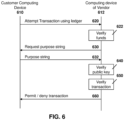
- a customer computing device 610 having a digital wallet associated with a public ledger cryptocurrency can attempt to purchase goods or services from a vendor 612.
- the customer computing device 610 may attempt the transaction using a public ledger, as shown with message 620 between the customer and vendor 612.
- Message 620 may be sent, for example, over a network, or may be based on a short-range communication between the customer computing device 610 and a computing device for the vendor 612.
- the vendor 612 may then verify that the customer associated with computing device 610 has sufficient funds, as shown at block 622.
- the verification at block 622 may query the ledger to ensure that sufficient funds are associated with customer 610.
- the computing device of vendor 612 may then request the purpose string for the account, as shown with message 630.
- Message 630 in the embodiment of Figure 4 is sent to the customer computing device 610.
- the computing device of vendor 612 may request the purpose string from the ledger. In other embodiments, the computing device of vendor 612 may request the purpose string from other databases that may contain such purpose string.
- a purpose string may be provided to the computing device of vendor 612 in message 632.
- Message 632 in the embodiment of Figure 6 , originates from customer computing device 610. However, if the request for the purpose string message 630 went to a different computing device, then message 632 may come from that different computing device.
- the computing device of vendor 612 may then verify that the public key associated with the customer, as shown at block 640.
- the verification may be done in accordance with Figure 3 or Figure 5 above, for example. This ensures that the public key is associated with the purpose string that was provided in message 632.
- the computing device of vendor 612 may attempt to verify the transaction at block 650. Verifying the transaction means that the transaction falls within the boundaries of the purpose string.
- the vendor may then permit or deny the transaction, as shown with message 660.
- the permitting or denying may be done automatically at a computing device in some embodiments. In the other embodiments, the permitting or denying may be based on user input to a computing device based on information presented at the computing device.
- a message 660 may be sent immediately after block 640, denying the transaction.
- the transaction may be verified against the purpose string. There are various options for such verification.
- the purpose string may contain information that limits what type of transactions are allowed for the account.
- the account holder can limit the maximum amount or value of a single transfer, for example.
- the holder can also limit the total number of transfers in a given time period, such as per day.
- the computing device of vendor 612 may refer to the public ledger to see how many transactions have occurred from such account and see whether the current transaction would exceed the transaction limit within the purpose string.
- the computing device of vendor 612 may verify that the amount of the transfer proposed is below the value in the purpose string.
- the purpose string may have a specific format which would facilitate the parsing of the purpose string by a computing device associated with the vendor 612, thereby enabling the computing device to perform the verification at block 640.
- natural language processing may be utilized to find limitations within the purpose string.
- the purpose string may provide a way to add transaction limitations to public ledger cryptocurrency.
- the purpose string may also be used to limit the type of items which the funds can be used to purchase.
- the funds may be limited to only being used for purchasing groceries.
- Such limitation can make it less efficient for a thief to launder stolen funds, because the stolen funds would have to be exchanged for something that is more difficult to resell, is bulkier, and has a short shelf life, thereby losing value quickly.
- the types of goods or services for which transactions are limited may have standardized text to allow for the parsing of the such purpose string in some cases. In other cases, natural language processing could be utilized.
- the purpose string may only permit a transaction when the account holder is physically present and not on-online.
- the purpose string may limit transactions during a certain time window. For example, transactions may be limited to between 7 am and 9 pm Eastern Standard Time. Therefore, if an attempt is made to purchase something from a vendor outside of the specified time window then the transaction may be denied.
- the purpose string may contain geographic boundaries for where the transaction can occur. Therefore, the funds may only be used within the such geographic area, such as a city, province, state or country.
- a positioning system associated with the computing device of the vendor 612 may determine whether the device is in a public space or private space and therefore allow or deny the transaction.
- the purpose string may be limited to only one of the above purposes.
- the purpose string can contain multiple limitations. Therefore, the purpose string may indicate that a transaction limit of $1000 per transaction can occur only between 7am and 9pm Eastern Standard Time. The number or types of purposes is not limited for a purpose string.
- the purpose string may contain an identifier for a customer.
- the purpose string includes data that can be used to identify the true account holder.
- the data may be in a form that allows the honest recipient to verify the identification.
- the purpose string may provide the name of the true account holder, in text form.
- an honest vendor may have some means to verify the name of the person attempting to perform the transaction.
- the vendor may know the account holder, for example through a pre-existing relationship.
- the honest recipient or vendor may request to see other authenticated forms of identification, such as a driver's license or passport.
- the honest recipient may check the name on the official document to find whether it matches the name in the purpose string.
- the strength of identification depends on the strength of the official document or existing relationship.
- the purpose sting may be data that provides biometric data such as an image of the true account holder.
- the honest recipient may compare the image in the purpose string to an image of the alleged account holder. For example, this may be used when transactions are done in person, or using a webcam, among other options.
- biometric data such as a fingerprint, voice pattern, among other options.
- the purpose string may contain an image of an account holders driver's license. This might include an image of the true account holder, the handwritten signature of the holder, among other information. This information can then be matched against the actual driver's license, as well as a direct image of the alleged account holder and the alleged account holder's signature.
- the purpose string is authenticated by a certification authority.
- the underlying proof of generation method could be an implicit certificate, or the purpose could contain a message similar to a traditional public key certificate.
- the certification authority verifies the identity of the true account holder at the time of the account creation.
- the certification authority verifies the identity of the true account holder at the time of the account creation.
- the purely digital information that is usually used for authentication might have been compromised.
- An honest recipient may verify an entity to different degrees.
- the vetting of the alleged account holder may be proportional to the risk level of the transaction.
- one or more purpose strings may be embedded in the message that is used to generate a public key. The use of such purpose string may then allow a recipient to screen a transaction prior to allowing the transaction to proceed.
- the modules and user equipments and devices performing the methods described above may be any electronic device or network node.
- Such computing device or network node may include any type of computing device, including but not limited to, mobile devices such as smartphones or cellular telephones. Examples can further include fixed or mobile user equipments, such as internet of things (IoT) devices, endpoints, home automation devices, medical equipment in hospital or home environments, inventory tracking devices, environmental monitoring devices, energy management devices, infrastructure management devices, vehicles or devices for vehicles, fixed electronic devices, among others.
- IoT internet of things
- Vehicles includes motor vehicles (e.g., automobiles, cars, trucks, buses, motorcycles, etc.), aircraft (e.g., airplanes, unmanned aerial vehicles, unmanned aircraft systems, drones, helicopters, etc.), spacecraft (e.g., spaceplanes, space shuttles, space capsules, space stations, satellites, etc.), watercraft (e.g., ships, boats, hovercraft, submarines, etc.), railed vehicles (e.g., trains and trams, etc.), and other types of vehicles including any combinations of any of the foregoing, whether currently existing or after arising.
- motor vehicles e.g., automobiles, cars, trucks, buses, motorcycles, etc.
- aircraft e.g., airplanes, unmanned aerial vehicles, unmanned aircraft systems, drones, helicopters, etc.
- spacecraft e.g., spaceplanes, space shuttles, space capsules, space stations, satellites, etc.
- watercraft e.g., ships, boats, hovercraft, submarines, etc
- the computing device may be associated with an owner of a public ledger account or associated with a transaction recipient.
- One simplified diagram of a computing device is shown with regard to Figure 7 .
- device 710 includes a processor 720 and a communications subsystem 730, where the processor 720 and communications subsystem 730 cooperate to perform the methods of the embodiments described above.
- Communications subsystem 720 may, in some embodiments, comprise multiple subsystems, for example for different radio technologies.
- Processor 720 is configured to execute programmable logic, which may be stored, along with data, on device 710, and shown in the example of Figure 7 as memory 740.
- Memory 740 can be any tangible, non-transitory computer readable storage medium.
- the computer readable storage medium may be a tangible or in transitory/non-transitory medium such as optical (e.g., CD, DVD, etc.), magnetic (e.g., tape), flash drive, hard drive, or other memory known in the art.
- device 710 may access data or programmable logic from an external storage medium, for example through communications subsystem 730.
- Communications subsystem 730 allows device 710 to communicate with other devices or network elements and may vary based on the type of communication being performed. Further, communications subsystem 730 may comprise a plurality of communications technologies, including any wired or wireless communications technology.
- Communications between the various elements of device 710 may be through an internal bus 760 in one embodiment. However, other forms of communication are possible.
- Such operations may not be immediate or from the server directly. They may be synchronously or asynchronously delivered, from a server or other computing system infrastructure supporting the devices/methods/systems described herein. The foregoing steps may include, in whole or in part, synchronous/asynchronous communications to/from the device/infrastructure. Moreover, communication from the electronic device may be to one or more endpoints on a network. These endpoints may be serviced by a server, a distributed computing system, a stream processor, etc. Content Delivery Networks (CDNs) may also provide may provide communication to an electronic device.
- CDNs Content Delivery Networks
- the server may also provision or indicate a data for content delivery network (CDN) to await download by the electronic device at a later time, such as a subsequent activity of electronic device.
- CDN content delivery network
- data may be sent directly from the server, or other infrastructure, such as a distributed infrastructure, or a CDN, as part of or separate from the system.
- storage mediums can include any or some combination of the following: a semiconductor memory device such as a dynamic or static random access memory (a DRAM or SRAM), an erasable and programmable read-only memory (EPROM), an electrically erasable and programmable read-only memory (EEPROM) and flash memory; a magnetic disk such as a fixed, floppy and removable disk; another magnetic medium including tape; an optical medium such as a compact disk (CD) or a digital video disk (DVD); or another type of storage device.
- a semiconductor memory device such as a dynamic or static random access memory (a DRAM or SRAM), an erasable and programmable read-only memory (EPROM), an electrically erasable and programmable read-only memory (EEPROM) and flash memory
- a magnetic disk such as a fixed, floppy and removable disk
- another magnetic medium including tape an optical medium such as a compact disk (CD) or a digital video disk (DVD); or another type of storage device.
- CD compact disk
- DVD
- Such computer-readable or machine-readable storage medium or media is (are) considered to be part of an article (or article of manufacture).
- An article or article of manufacture can refer to any manufactured single component or multiple components.
- the storage medium or media can be located either in the machine running the machine-readable instructions, or located at a remote site from which machine-readable instructions can be downloaded over a network for execution.
Landscapes
- Engineering & Computer Science (AREA)
- Business, Economics & Management (AREA)
- Computer Security & Cryptography (AREA)
- Accounting & Taxation (AREA)
- General Business, Economics & Management (AREA)
- Theoretical Computer Science (AREA)
- General Physics & Mathematics (AREA)
- Strategic Management (AREA)
- Physics & Mathematics (AREA)
- Finance (AREA)
- Signal Processing (AREA)
- Computer Networks & Wireless Communication (AREA)
- Development Economics (AREA)
- Economics (AREA)
- Health & Medical Sciences (AREA)
- General Health & Medical Sciences (AREA)
- Biomedical Technology (AREA)
- Life Sciences & Earth Sciences (AREA)
- Biodiversity & Conservation Biology (AREA)
- Computer Hardware Design (AREA)
- Computing Systems (AREA)
- General Engineering & Computer Science (AREA)
- Financial Or Insurance-Related Operations Such As Payment And Settlement (AREA)
- Storage Device Security (AREA)
Applications Claiming Priority (3)
| Application Number | Priority Date | Filing Date | Title |
|---|---|---|---|
| US16/158,971 US11263630B2 (en) | 2018-10-12 | 2018-10-12 | Method and system for single purpose public keys for public ledgers |
| PCT/CA2019/051439 WO2020073124A1 (en) | 2018-10-12 | 2019-10-09 | Method and system for single purpose public keys for public ledgers |
| EP19871914.8A EP3834118B1 (de) | 2018-10-12 | 2019-10-09 | Verfahren und system für öffentliche einzweckschlüssel für öffentliche konten |
Related Parent Applications (1)
| Application Number | Title | Priority Date | Filing Date |
|---|---|---|---|
| EP19871914.8A Division EP3834118B1 (de) | 2018-10-12 | 2019-10-09 | Verfahren und system für öffentliche einzweckschlüssel für öffentliche konten |
Publications (4)
| Publication Number | Publication Date |
|---|---|
| EP4407477A2 true EP4407477A2 (de) | 2024-07-31 |
| EP4407477A3 EP4407477A3 (de) | 2024-08-21 |
| EP4407477C0 EP4407477C0 (de) | 2025-08-13 |
| EP4407477B1 EP4407477B1 (de) | 2025-08-13 |
Family
ID=70162029
Family Applications (2)
| Application Number | Title | Priority Date | Filing Date |
|---|---|---|---|
| EP19871914.8A Active EP3834118B1 (de) | 2018-10-12 | 2019-10-09 | Verfahren und system für öffentliche einzweckschlüssel für öffentliche konten |
| EP24167401.9A Active EP4407477B1 (de) | 2018-10-12 | 2019-10-09 | Verfahren und system für öffentliche einzweckschlüssel für öffentliche konten |
Family Applications Before (1)
| Application Number | Title | Priority Date | Filing Date |
|---|---|---|---|
| EP19871914.8A Active EP3834118B1 (de) | 2018-10-12 | 2019-10-09 | Verfahren und system für öffentliche einzweckschlüssel für öffentliche konten |
Country Status (7)
| Country | Link |
|---|---|
| US (2) | US11263630B2 (de) |
| EP (2) | EP3834118B1 (de) |
| KR (1) | KR102823702B1 (de) |
| CN (1) | CN112823350B (de) |
| CA (1) | CA3111033A1 (de) |
| ES (1) | ES2985270T3 (de) |
| WO (1) | WO2020073124A1 (de) |
Families Citing this family (3)
| Publication number | Priority date | Publication date | Assignee | Title |
|---|---|---|---|---|
| US10790990B2 (en) * | 2019-06-26 | 2020-09-29 | Alibaba Group Holding Limited | Ring signature-based anonymous transaction |
| US11424929B2 (en) | 2021-01-07 | 2022-08-23 | Bank Of America Corporation | Authentication using encrypted biometric information |
| US12430463B1 (en) * | 2022-01-24 | 2025-09-30 | Nant Holdings Ip, Llc | Token-based digital private data exchange systems, methods, and apparatus |
Citations (1)
| Publication number | Priority date | Publication date | Assignee | Title |
|---|---|---|---|---|
| US9240884B2 (en) | 2003-10-28 | 2016-01-19 | Certicom Corp. | Method and apparatus for verifiable generation of public keys |
Family Cites Families (36)
| Publication number | Priority date | Publication date | Assignee | Title |
|---|---|---|---|---|
| US7904722B2 (en) | 1994-07-19 | 2011-03-08 | Certco, Llc | Method for securely using digital signatures in a commercial cryptographic system |
| CA2235359C (en) | 1998-03-23 | 2012-04-10 | Certicom Corp. | Implicit certificate scheme with ca chaining |
| US7349557B2 (en) | 1998-06-19 | 2008-03-25 | Solidus Networks, Inc. | Electronic transaction verification system |
| US6978036B2 (en) * | 1998-07-31 | 2005-12-20 | Digimarc Corporation | Tamper-resistant authentication techniques for identification documents |
| EP1192572A2 (de) | 1999-04-30 | 2002-04-03 | PayPal, Inc. | System und verfahren zum elektronischen austausch von werten zwischen verteilten benutzern |
| US20020073045A1 (en) * | 2000-10-23 | 2002-06-13 | Rubin Aviel D. | Off-line generation of limited-use credit card numbers |
| US20020169720A1 (en) * | 2001-05-12 | 2002-11-14 | Wilson Phillip C. | Method for cardholder to place use restrictions on credit card at will |
| US7318550B2 (en) | 2004-07-01 | 2008-01-15 | American Express Travel Related Services Company, Inc. | Biometric safeguard method for use with a smartcard |
| EP2082524B1 (de) | 2006-11-15 | 2013-08-07 | Certicom Corp. | Implizite Zertifikatverifikation |
| EP2179534A4 (de) | 2007-07-17 | 2011-07-27 | Certicom Corp | Verfahren und system zur erzeugung von impliziten zertifikaten und anwendungen auf die verschlüsselung auf identitätsbasis (ibe) |
| US20090281937A1 (en) | 2008-05-09 | 2009-11-12 | Embarq Holdings Company, Llc | System, Method and Apparatus for Associating a Credit Card Account with Sub-Account Codes |
| EP2427996B1 (de) | 2009-05-05 | 2016-07-06 | Certicom Corp. | Selbssignierte implizite zertifikate |
| US8560449B1 (en) * | 2009-07-30 | 2013-10-15 | Red Giant Inc. | Adaptive transaction rules system |
| US20120209772A1 (en) * | 2011-02-14 | 2012-08-16 | Ebay Inc. | Payment system with time restrictions |
| US20130290184A1 (en) * | 2012-04-30 | 2013-10-31 | VSPC INC. Delaware | Virtual specific purchasing card |
| US10102510B2 (en) | 2012-11-28 | 2018-10-16 | Hoverkey Ltd. | Method and system of conducting a cryptocurrency payment via a mobile device using a contactless token to store and protect a user's secret key |
| US20150254699A1 (en) | 2014-03-04 | 2015-09-10 | Bank Of America Corporation | Providing offers associated with payment credentials in digital wallets |
| WO2015175722A1 (en) | 2014-05-13 | 2015-11-19 | Nant Holdings Ip, Llc | Healthcare transaction validation via blockchain proof-of-work, systems and methods |
| CN104320262B (zh) * | 2014-11-05 | 2017-07-21 | 中国科学院合肥物质科学研究院 | 基于加密数字货币公开账本技术的用户公钥地址绑定、检索和校验的方法及系统 |
| AU2016255340A1 (en) | 2015-02-27 | 2017-07-06 | Visa International Service Association | Transaction signing utilizing asymmetric cryptography |
| EP3278287A4 (de) | 2015-03-31 | 2018-08-22 | Nasdaq, Inc. | Systeme und verfahren für blockchain-transaktionserfassung |
| CA2991073A1 (en) * | 2015-07-02 | 2017-01-05 | Royal Bank Of Canada | Secure processing of electronic payments |
| EP3348019A1 (de) | 2015-09-11 | 2018-07-18 | Aware, Inc. | Biometrische überprüfung eines blockchain-datenbanktransaktionskontributors |
| US9935948B2 (en) | 2015-09-18 | 2018-04-03 | Case Wallet, Inc. | Biometric data hashing, verification and security |
| US10079682B2 (en) | 2015-12-22 | 2018-09-18 | Gemalto Sa | Method for managing a trusted identity |
| US10937069B2 (en) * | 2016-04-13 | 2021-03-02 | Paypal, Inc. | Public ledger authentication system |
| US10333705B2 (en) | 2016-04-30 | 2019-06-25 | Civic Technologies, Inc. | Methods and apparatus for providing attestation of information using a centralized or distributed ledger |
| US11070378B1 (en) * | 2016-11-07 | 2021-07-20 | Wells Fargo Bank, N.A. | Signcrypted biometric electronic signature tokens |
| CN106934605B (zh) * | 2017-02-15 | 2021-03-30 | 捷德(中国)科技有限公司 | 数字货币中用户身份管理方法和系统 |
| BR202017014362Y1 (pt) | 2017-06-30 | 2022-05-17 | Roberto Hideyuki Okubo | Disposição construtiva aplicada em suporte facilitador para uso de fio dental |
| CN107240017B (zh) | 2017-07-20 | 2021-08-03 | 捷德(中国)科技有限公司 | 区块链交易管理系统及方法 |
| CN107483198B (zh) * | 2017-09-25 | 2019-11-12 | 中国科学院信息工程研究所 | 一种可监管的区块链系统及方法 |
| CN108021821A (zh) | 2017-11-28 | 2018-05-11 | 北京航空航天大学 | 多中心区块链交易隐私保护系统及方法 |
| CN108399571A (zh) * | 2018-01-30 | 2018-08-14 | 厦门快商通信息技术有限公司 | 基于区块链智能合约的无担保交易方法及系统 |
| KR101904208B1 (ko) * | 2018-04-24 | 2018-10-04 | (주)에스씨씨 | 블록체인 기반의 암호화폐와 전자지갑 관리 시스템 |
| US11488161B2 (en) * | 2018-07-31 | 2022-11-01 | Hewlett Packard Enterprise Development Lp | Systems and methods for providing transaction provenance of off-chain transactions using distributed ledger transactions with secured representations of distributed ledger addresses of transacting parties |
-
2018
- 2018-10-12 US US16/158,971 patent/US11263630B2/en active Active
-
2019
- 2019-10-09 CA CA3111033A patent/CA3111033A1/en active Pending
- 2019-10-09 CN CN201980066178.7A patent/CN112823350B/zh active Active
- 2019-10-09 ES ES19871914T patent/ES2985270T3/es active Active
- 2019-10-09 EP EP19871914.8A patent/EP3834118B1/de active Active
- 2019-10-09 EP EP24167401.9A patent/EP4407477B1/de active Active
- 2019-10-09 KR KR1020217008767A patent/KR102823702B1/ko active Active
- 2019-10-09 WO PCT/CA2019/051439 patent/WO2020073124A1/en not_active Ceased
-
2022
- 2022-01-25 US US17/584,013 patent/US12572937B2/en active Active
Patent Citations (1)
| Publication number | Priority date | Publication date | Assignee | Title |
|---|---|---|---|---|
| US9240884B2 (en) | 2003-10-28 | 2016-01-19 | Certicom Corp. | Method and apparatus for verifiable generation of public keys |
Also Published As
| Publication number | Publication date |
|---|---|
| EP3834118A1 (de) | 2021-06-16 |
| CA3111033A1 (en) | 2020-04-16 |
| KR20210075076A (ko) | 2021-06-22 |
| KR102823702B1 (ko) | 2025-06-20 |
| EP4407477A3 (de) | 2024-08-21 |
| US20200118130A1 (en) | 2020-04-16 |
| US12572937B2 (en) | 2026-03-10 |
| EP4407477C0 (de) | 2025-08-13 |
| ES2985270T3 (es) | 2024-11-04 |
| US11263630B2 (en) | 2022-03-01 |
| CN112823350B (zh) | 2025-01-03 |
| US20220147986A1 (en) | 2022-05-12 |
| CN112823350A (zh) | 2021-05-18 |
| EP3834118C0 (de) | 2024-05-08 |
| WO2020073124A1 (en) | 2020-04-16 |
| EP3834118A4 (de) | 2021-09-15 |
| EP3834118B1 (de) | 2024-05-08 |
| EP4407477B1 (de) | 2025-08-13 |
Similar Documents
| Publication | Publication Date | Title |
|---|---|---|
| US12126715B2 (en) | Methods and systems of providing verification of information using a centralized or distributed ledger | |
| US11018869B2 (en) | Blockchain-based digital identity management (DIM) system | |
| CN106878318B (zh) | 一种区块链实时轮询云端系统 | |
| CN104798083B (zh) | 用于验证访问请求的方法和系统 | |
| US12572937B2 (en) | Method and system for single purpose public keys for public ledgers | |
| TW202117603A (zh) | 二維條碼的處理方法、裝置及系統 | |
| CN107710258A (zh) | 用于个人识别和验证的系统和方法 | |
| CN101312453A (zh) | 用户终端、登录网络服务系统的方法和绑定/解绑定方法 | |
| CN110309663B (zh) | 基于区块链的隐私认证方法及系统 | |
| US20190007218A1 (en) | Second dynamic authentication of an electronic signature using a secure hardware module | |
| HK40053321B (en) | Method and system for single purpose public keys for public ledgers | |
| HK40053321A (en) | Method and system for single purpose public keys for public ledgers | |
| Tayan et al. | E-Payment system to reduce use of paper money for daily transactions | |
| Karunakar et al. | Secure Card Generation and Access Scheme for e-Seva Applications | |
| WO2026033254A1 (en) | A system and method for generating renewable identities using an identity apparatus | |
| KR20160111255A (ko) | 비대면 거래를 위한 결제 방법 | |
| Park et al. | Cryptographically-Generated Virtual Credit Card Number for Secure Card-Not-Present Transactions | |
| AU2018247338A1 (en) | Authentication of the change of custody within the logistics supply chain. | |
| Chiu et al. | A New Front-End Anonymity and Back-End Real-Name Mechanism in e-Commerce |
Legal Events
| Date | Code | Title | Description |
|---|---|---|---|
| PUAI | Public reference made under article 153(3) epc to a published international application that has entered the european phase |
Free format text: ORIGINAL CODE: 0009012 |
|
| STAA | Information on the status of an ep patent application or granted ep patent |
Free format text: STATUS: THE APPLICATION HAS BEEN PUBLISHED |
|
| REG | Reference to a national code |
Ref country code: DE Ref legal event code: R079 Free format text: PREVIOUS MAIN CLASS: G06F0016270000 Ipc: H04L0009000000 Ref country code: DE Ref legal event code: R079 Ref document number: 602019074308 Country of ref document: DE Free format text: PREVIOUS MAIN CLASS: G06F0016270000 Ipc: H04L0009000000 |
|
| PUAL | Search report despatched |
Free format text: ORIGINAL CODE: 0009013 |
|
| AC | Divisional application: reference to earlier application |
Ref document number: 3834118 Country of ref document: EP Kind code of ref document: P |
|
| AK | Designated contracting states |
Kind code of ref document: A2 Designated state(s): AL AT BE BG CH CY CZ DE DK EE ES FI FR GB GR HR HU IE IS IT LI LT LU LV MC MK MT NL NO PL PT RO RS SE SI SK SM TR |
|
| AK | Designated contracting states |
Kind code of ref document: A3 Designated state(s): AL AT BE BG CH CY CZ DE DK EE ES FI FR GB GR HR HU IE IS IT LI LT LU LV MC MK MT NL NO PL PT RO RS SE SI SK SM TR |
|
| RIC1 | Information provided on ipc code assigned before grant |
Ipc: H04L 9/08 20060101ALI20240716BHEP Ipc: H04L 12/16 20060101ALI20240716BHEP Ipc: G06Q 20/38 20120101ALI20240716BHEP Ipc: G06F 16/27 20190101ALI20240716BHEP Ipc: G06F 21/62 20130101ALI20240716BHEP Ipc: H04L 9/32 20060101ALI20240716BHEP Ipc: H04L 9/00 20220101AFI20240716BHEP |
|
| STAA | Information on the status of an ep patent application or granted ep patent |
Free format text: STATUS: REQUEST FOR EXAMINATION WAS MADE |
|
| GRAP | Despatch of communication of intention to grant a patent |
Free format text: ORIGINAL CODE: EPIDOSNIGR1 |
|
| STAA | Information on the status of an ep patent application or granted ep patent |
Free format text: STATUS: GRANT OF PATENT IS INTENDED |
|
| 17P | Request for examination filed |
Effective date: 20250213 |
|
| INTG | Intention to grant announced |
Effective date: 20250311 |
|
| GRAS | Grant fee paid |
Free format text: ORIGINAL CODE: EPIDOSNIGR3 |
|
| GRAA | (expected) grant |
Free format text: ORIGINAL CODE: 0009210 |
|
| STAA | Information on the status of an ep patent application or granted ep patent |
Free format text: STATUS: THE PATENT HAS BEEN GRANTED |
|
| AC | Divisional application: reference to earlier application |
Ref document number: 3834118 Country of ref document: EP Kind code of ref document: P |
|
| AK | Designated contracting states |
Kind code of ref document: B1 Designated state(s): AL AT BE BG CH CY CZ DE DK EE ES FI FR GB GR HR HU IE IS IT LI LT LU LV MC MK MT NL NO PL PT RO RS SE SI SK SM TR |
|
| REG | Reference to a national code |
Ref country code: GB Ref legal event code: FG4D |
|
| REG | Reference to a national code |
Ref country code: CH Ref legal event code: EP |
|
| REG | Reference to a national code |
Ref country code: DE Ref legal event code: R096 Ref document number: 602019074308 Country of ref document: DE |
|
| REG | Reference to a national code |
Ref country code: IE Ref legal event code: FG4D |
|
| U01 | Request for unitary effect filed |
Effective date: 20250910 |
|
| U07 | Unitary effect registered |
Designated state(s): AT BE BG DE DK EE FI FR IT LT LU LV MT NL PT RO SE SI Effective date: 20250916 |
|
| U20 | Renewal fee for the european patent with unitary effect paid |
Year of fee payment: 7 Effective date: 20251027 |
|
| PG25 | Lapsed in a contracting state [announced via postgrant information from national office to epo] |
Ref country code: IS Free format text: LAPSE BECAUSE OF FAILURE TO SUBMIT A TRANSLATION OF THE DESCRIPTION OR TO PAY THE FEE WITHIN THE PRESCRIBED TIME-LIMIT Effective date: 20251213 |
|
| PGFP | Annual fee paid to national office [announced via postgrant information from national office to epo] |
Ref country code: GB Payment date: 20251023 Year of fee payment: 7 |
|
| PG25 | Lapsed in a contracting state [announced via postgrant information from national office to epo] |
Ref country code: NO Free format text: LAPSE BECAUSE OF FAILURE TO SUBMIT A TRANSLATION OF THE DESCRIPTION OR TO PAY THE FEE WITHIN THE PRESCRIBED TIME-LIMIT Effective date: 20251113 |
|
| PG25 | Lapsed in a contracting state [announced via postgrant information from national office to epo] |
Ref country code: HR Free format text: LAPSE BECAUSE OF FAILURE TO SUBMIT A TRANSLATION OF THE DESCRIPTION OR TO PAY THE FEE WITHIN THE PRESCRIBED TIME-LIMIT Effective date: 20250813 |
|
| PG25 | Lapsed in a contracting state [announced via postgrant information from national office to epo] |
Ref country code: GR Free format text: LAPSE BECAUSE OF FAILURE TO SUBMIT A TRANSLATION OF THE DESCRIPTION OR TO PAY THE FEE WITHIN THE PRESCRIBED TIME-LIMIT Effective date: 20251114 |
|
| PG25 | Lapsed in a contracting state [announced via postgrant information from national office to epo] |
Ref country code: PL Free format text: LAPSE BECAUSE OF FAILURE TO SUBMIT A TRANSLATION OF THE DESCRIPTION OR TO PAY THE FEE WITHIN THE PRESCRIBED TIME-LIMIT Effective date: 20250813 |
|
| PG25 | Lapsed in a contracting state [announced via postgrant information from national office to epo] |
Ref country code: RS Free format text: LAPSE BECAUSE OF FAILURE TO SUBMIT A TRANSLATION OF THE DESCRIPTION OR TO PAY THE FEE WITHIN THE PRESCRIBED TIME-LIMIT Effective date: 20251113 |
|
| PG25 | Lapsed in a contracting state [announced via postgrant information from national office to epo] |
Ref country code: ES Free format text: LAPSE BECAUSE OF FAILURE TO SUBMIT A TRANSLATION OF THE DESCRIPTION OR TO PAY THE FEE WITHIN THE PRESCRIBED TIME-LIMIT Effective date: 20250813 |