EP4407331A1 - Battery pack and assessment method - Google Patents
Battery pack and assessment method Download PDFInfo
- Publication number
- EP4407331A1 EP4407331A1 EP22872733.5A EP22872733A EP4407331A1 EP 4407331 A1 EP4407331 A1 EP 4407331A1 EP 22872733 A EP22872733 A EP 22872733A EP 4407331 A1 EP4407331 A1 EP 4407331A1
- Authority
- EP
- European Patent Office
- Prior art keywords
- section
- element section
- secondary batteries
- series
- battery pack
- Prior art date
- Legal status (The legal status is an assumption and is not a legal conclusion. Google has not performed a legal analysis and makes no representation as to the accuracy of the status listed.)
- Pending
Links
Images


Classifications
-
- H—ELECTRICITY
- H01—ELECTRIC ELEMENTS
- H01M—PROCESSES OR MEANS, e.g. BATTERIES, FOR THE DIRECT CONVERSION OF CHEMICAL ENERGY INTO ELECTRICAL ENERGY
- H01M10/00—Secondary cells; Manufacture thereof
- H01M10/42—Methods or arrangements for servicing or maintenance of secondary cells or secondary half-cells
- H01M10/48—Accumulators combined with arrangements for measuring, testing or indicating the condition of cells, e.g. the level or density of the electrolyte
-
- G—PHYSICS
- G01—MEASURING; TESTING
- G01R—MEASURING ELECTRIC VARIABLES; MEASURING MAGNETIC VARIABLES
- G01R31/00—Arrangements for testing electric properties; Arrangements for locating electric faults; Arrangements for electrical testing characterised by what is being tested not provided for elsewhere
- G01R31/36—Arrangements for testing, measuring or monitoring the electrical condition of accumulators or electric batteries, e.g. capacity or state of charge [SoC]
- G01R31/396—Acquisition or processing of data for testing or for monitoring individual cells or groups of cells within a battery
-
- G—PHYSICS
- G01—MEASURING; TESTING
- G01R—MEASURING ELECTRIC VARIABLES; MEASURING MAGNETIC VARIABLES
- G01R31/00—Arrangements for testing electric properties; Arrangements for locating electric faults; Arrangements for electrical testing characterised by what is being tested not provided for elsewhere
- G01R31/36—Arrangements for testing, measuring or monitoring the electrical condition of accumulators or electric batteries, e.g. capacity or state of charge [SoC]
- G01R31/389—Measuring internal impedance, internal conductance or related variables
-
- H—ELECTRICITY
- H01—ELECTRIC ELEMENTS
- H01M—PROCESSES OR MEANS, e.g. BATTERIES, FOR THE DIRECT CONVERSION OF CHEMICAL ENERGY INTO ELECTRICAL ENERGY
- H01M10/00—Secondary cells; Manufacture thereof
- H01M10/42—Methods or arrangements for servicing or maintenance of secondary cells or secondary half-cells
- H01M10/425—Structural combination with electronic components, e.g. electronic circuits integrated to the outside of the casing
- H01M10/4264—Structural combination with electronic components, e.g. electronic circuits integrated to the outside of the casing with capacitors
-
- H—ELECTRICITY
- H01—ELECTRIC ELEMENTS
- H01M—PROCESSES OR MEANS, e.g. BATTERIES, FOR THE DIRECT CONVERSION OF CHEMICAL ENERGY INTO ELECTRICAL ENERGY
- H01M10/00—Secondary cells; Manufacture thereof
- H01M10/42—Methods or arrangements for servicing or maintenance of secondary cells or secondary half-cells
- H01M10/48—Accumulators combined with arrangements for measuring, testing or indicating the condition of cells, e.g. the level or density of the electrolyte
- H01M10/482—Accumulators combined with arrangements for measuring, testing or indicating the condition of cells, e.g. the level or density of the electrolyte for several batteries or cells simultaneously or sequentially
-
- H—ELECTRICITY
- H01—ELECTRIC ELEMENTS
- H01M—PROCESSES OR MEANS, e.g. BATTERIES, FOR THE DIRECT CONVERSION OF CHEMICAL ENERGY INTO ELECTRICAL ENERGY
- H01M50/00—Constructional details or processes of manufacture of the non-active parts of electrochemical cells other than fuel cells, e.g. hybrid cells
- H01M50/50—Current conducting connections for cells or batteries
- H01M50/502—Interconnectors for connecting terminals of adjacent batteries; Interconnectors for connecting cells outside a battery casing
- H01M50/519—Interconnectors for connecting terminals of adjacent batteries; Interconnectors for connecting cells outside a battery casing comprising printed circuit boards [PCB]
-
- H—ELECTRICITY
- H02—GENERATION; CONVERSION OR DISTRIBUTION OF ELECTRIC POWER
- H02J—ELECTRIC POWER NETWORKS; CIRCUIT ARRANGEMENTS OR SYSTEMS FOR SUPPLYING OR DISTRIBUTING ELECTRIC POWER; SYSTEMS FOR STORING ELECTRIC ENERGY
- H02J7/00—Circuit arrangements for charging or discharging batteries or for supplying loads from batteries
- H02J7/50—Circuit arrangements for charging or discharging batteries or for supplying loads from batteries acting upon multiple batteries simultaneously or sequentially
- H02J7/575—Parallel/serial switching of connection of batteries to charge or load circuit
-
- H—ELECTRICITY
- H02—GENERATION; CONVERSION OR DISTRIBUTION OF ELECTRIC POWER
- H02J—ELECTRIC POWER NETWORKS; CIRCUIT ARRANGEMENTS OR SYSTEMS FOR SUPPLYING OR DISTRIBUTING ELECTRIC POWER; SYSTEMS FOR STORING ELECTRIC ENERGY
- H02J7/00—Circuit arrangements for charging or discharging batteries or for supplying loads from batteries
- H02J7/80—Circuit arrangements for charging or discharging batteries or for supplying loads from batteries including monitoring or indicating arrangements
- H02J7/84—Control of state of health [SOH]
-
- H—ELECTRICITY
- H02—GENERATION; CONVERSION OR DISTRIBUTION OF ELECTRIC POWER
- H02J—ELECTRIC POWER NETWORKS; CIRCUIT ARRANGEMENTS OR SYSTEMS FOR SUPPLYING OR DISTRIBUTING ELECTRIC POWER; SYSTEMS FOR STORING ELECTRIC ENERGY
- H02J2105/00—Networks for supplying or distributing electric power characterised by their spatial reach or by the load
- H02J2105/30—Networks for supplying or distributing electric power characterised by their spatial reach or by the load the load networks being external to vehicles, i.e. exchanging power with vehicles
- H02J2105/33—Networks for supplying or distributing electric power characterised by their spatial reach or by the load the load networks being external to vehicles, i.e. exchanging power with vehicles exchanging power with road vehicles
- H02J2105/37—Networks for supplying or distributing electric power characterised by their spatial reach or by the load the load networks being external to vehicles, i.e. exchanging power with vehicles exchanging power with road vehicles exchanging power with electric vehicles [EV] or with hybrid electric vehicles [HEV]
-
- Y—GENERAL TAGGING OF NEW TECHNOLOGICAL DEVELOPMENTS; GENERAL TAGGING OF CROSS-SECTIONAL TECHNOLOGIES SPANNING OVER SEVERAL SECTIONS OF THE IPC; TECHNICAL SUBJECTS COVERED BY FORMER USPC CROSS-REFERENCE ART COLLECTIONS [XRACs] AND DIGESTS
- Y02—TECHNOLOGIES OR APPLICATIONS FOR MITIGATION OR ADAPTATION AGAINST CLIMATE CHANGE
- Y02E—REDUCTION OF GREENHOUSE GAS [GHG] EMISSIONS, RELATED TO ENERGY GENERATION, TRANSMISSION OR DISTRIBUTION
- Y02E60/00—Enabling technologies; Technologies with a potential or indirect contribution to GHG emissions mitigation
- Y02E60/10—Energy storage using batteries
Definitions
- the present invention relates to a battery pack and an assessment method.
- Patent Literature 1 discloses an apparatus in which different label elements with different impedance characteristics are respectively added in parallel to a plurality of secondary batteries in order to apply different modulations to the impedance characteristics of the secondary batteries, in a battery pack composed of the plurality of secondary batteries connected in series.
- the method disclosed in PTL 1 limits an assumed internal configuration of the battery pack to a configuration in which the secondary batteries are connected in series, and the number of label elements that can be used simultaneously is limited.
- obtainable information is also limited to the impedance characteristic around the frequency assumed in the design stage of the label element. That is, it is difficult to determine the presence or absence of a secondary battery in a deteriorated state only by measuring a change in the impedance characteristic of the entire battery pack as in the conventional method, and it is difficult to understand the condition of each secondary battery.
- a battery pack according to the present invention includes a plurality of secondary batteries, and the battery pack is capable of assessing the plurality of secondary batteries and includes: an electrical circuit element section that is used in assessing the plurality of secondary batteries and is placed such that it is connectable to the plurality of secondary batteries; and a switching section that is connected to the electrical circuit element section and the plurality of secondary batteries and is configured to be capable of switching an impedance characteristic of the battery pack as a whole between use of the electrical circuit element section and non-use of the electrical circuit element section.
- An assessment method is for a battery pack including a plurality of secondary batteries, an electrical circuit element section that is used in assessing the plurality of secondary batteries and is placed such that it is connectable to the plurality of secondary batteries, and a switching section that is connected to the electrical circuit element section and the plurality of secondary batteries, and the method includes: switching an impedance characteristic of the battery pack as a whole between use of the electrical circuit element section and non-use of the electrical circuit element section; and assessing the plurality of secondary batteries.
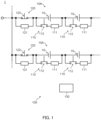
- FIG. 1 illustrates an exemplary configuration of a battery pack 1 according to the present invention.
- the battery pack 1 is, for example, a battery pack mounted on a vehicle such as an electric car and includes a plurality of secondary batteries 10 and an assessment section 100.
- the plurality of secondary batteries 10 are, for example, lithium-ion batteries, and supply power to a load (not illustrated) connected thereto. In addition, the plurality of secondary batteries 10 are supplied with power from an external power source at the time of charging.
- the plurality of secondary batteries 10 are connected in series or in parallel.
- n series groups 10A in which m secondary batteries 10 are connected in series are connected in parallel with each other.
- the m and n are any numbers greater than or equal to 2.
- the assessment section 100 is configured to be able to assess the plurality of secondary batteries 10, and includes first circuit sections 110, second circuit sections 120, and a control section 130.
- the plurality of first circuit sections 110 are provided corresponding to the plurality of secondary batteries 10 respectively, and each include a parallel element section 111 and a first switching section 112.
- the plurality of second circuit sections 120 are provided corresponding to the plurality of series groups 10A in the battery pack 1 respectively, and each include a series element section 121 and a second switching section 122.
- the series element section 121 is, for example, an electrical circuit element section such as a coil, and is connected in series with the plurality of secondary batteries 10 included in each series group 10A.
- the series element section 121 is not used when the power of the plurality of secondary batteries 10 can be inputted and outputted, and is used when the plurality of secondary batteries 10 are assessed.
- the series element sections 121 have the same electrical parameter.
- the electrical parameter is a generic term for a parameter that determines a characteristic of the element, such as capacitance, inductance, and resistance.
- the second switching section 122 is, for example, a switching circuit section such as a switching element and a relay element, and is placed in parallel with each series element section 121.
- the second switching section 122 is configured to be able to switch wires 1C (see FIG. 2B ), to which both ends of the second switching section 122 are connected, between a conductive state and a non-conductive state.
- the second switching section 122 is in the conductive state (see FIG. 1 and the two-dot-dash line of FIG. 2B ) when the series element section 121 is not used.
- the second switching section 122 is in the non-conductive state (see the solid line of FIG. 2B ) when the series element section 121 is used.
- the switching of the second switching section 122 between when the series element section 121 is used and not used in this manner causes a difference in the impedance characteristic between when the series element section 121 is used and not used. For example, the change in the impedance characteristics in one series group 10A and in one series element section 121 and one second switching section 122 is checked when the series element section 121 is used and not used.
- the impedance of the series group 10A portion is Zx
- the impedance of the series element section 121 portion is Zs.
- the admittance of the entire circuit portion including the secondary batteries 10 and the series element section 121 is 1/Zx.
- the admittance of the entire circuit portion including the series group 10A and the series element section 121 is 1/(Zx + Zs).
- ⁇ Y which is a difference in the admittance between when the series element section 121 is used and not used, is 1/Zx - 1/(Zx + Zs).
- Zx can be calculated from this ⁇ Y and the above Zs.
- the present embodiment it is possible to cause a difference in the impedance (admittance) characteristic of the entire battery pack 1 by switching the second switching section 122 between when the series element section 121 is used and not used.
- separately switching each of the plurality of second switching sections 122 makes it easier to determine whether the secondary batteries 10 included in which series group 10A are deteriorated.
- the electrical parameter of the series element section 121 can be set to any value according to an assumed noise amount or the like. A larger value of the above ⁇ Y regarding the series element section 121 is better from the viewpoint of accuracy improvement, and thus it is preferable that Zs is as large as possible for the electrical parameter of the series element section 121.
- the parallel element section 111 is, for example, an electrical circuit element section such as a capacitor, and is placed in parallel with the secondary battery 10.
- a plurality of the parallel element sections 111 are provided corresponding to the plurality of secondary batteries 10 respectively, not used when the power of the plurality of secondary batteries 10 can be inputted and outputted, and used when the plurality of secondary batteries 10 are assessed.
- the parallel element sections 111 each have the same electrical parameter.
- the first switching section 112 is, for example, a switching circuit section such as a switching element and a relay element, and is connected in series with each parallel element section 111.
- the first switching section 112 is configured to be able to switch the parallel element section 111 and the secondary battery 10 between a connected state and a disconnected state.
- a case where the parallel element section 111 and the secondary battery 10 are in the connected state corresponds to a case where a wire 1A to which one end of the first switching section 112 is connected and a wire 1B to which the other end is connected are in the conductive state (see the solid line in FIG. 2A ).
- a case where the parallel element section 111 and the secondary battery 10 are in the disconnected state corresponds to a case where the wire 1A to which one end of the first switching section 112 is connected and the wire 1B to which the other end is connected are in the non-conductive state (see FIG. 1 and the two-dot-dash line of FIG. 2A ).
- the first switching section 112 sets the parallel element section 111 and the secondary battery 10 in the disconnected state (see the two-dot-dash line of FIG. 2A ).
- the first switching section 112 sets the parallel element section 111 and the plurality of secondary batteries 10 in the connected state (see the solid line of FIG. 2A ).
- Switching the first switching section 112 between when the parallel element section 111 is used and not used in this manner causes a difference in the impedance characteristic between when the parallel element section 111 is used and not used. For example, the change in the impedance characteristics in one secondary battery 10 and in one parallel element section 111 and one first switching section 112 is checked when the parallel element section 111 is used and not used.
- the impedance of the secondary battery 10 portion is Zx
- the impedance of the parallel element section 111 portion is Zp.
- the impedance of the entire series group 10A including the secondary battery 10 and the parallel element section 111 is Zx.
- the impedance of the entire series group 10A including the secondary battery 10 and the parallel element section 111 is Zx ⁇ Zp/(Zx + Zp).
- ⁇ Z which is a difference between when the secondary battery 10 is used and assessed, is Zx - Zx ⁇ Zp/(Zx + Zp).
- Zx can be calculated from this ⁇ Z and the above Zp.
- the electrical parameter of the parallel element section 111 can be set to any value according to an assumed noise amount or the like. A larger value of the above ⁇ Z regarding the parallel element section 111 is better from the viewpoint of accuracy improvement, and thus it is preferable that Zp is as small as possible for the electrical parameter of the parallel element section 111.
- the impedance of the secondary battery 10 is calculated by switching each of the first switching section 112 and the second switching section 122. For example, in order to calculate the impedance of a particular secondary battery 10, the impedance of the entire battery pack 1 is measured under four conditions of the first measurement, the second measurement, the third measurement, and the fourth measurement.
- the condition of the first measurement is a condition in which all first switching sections 112 are in the non-conductive state (the parallel element sections 111 are in the disconnected state) and all second switching sections 122 are in the conductive state. This is the same condition as when the battery pack 1 supplies power and is supplied with power.
- the condition of the second measurement is a condition in which all first switching sections 112 are in the non-conductive state, the second switching section 122 corresponding to the series group 10A including the particular secondary battery 10 is in the non-conductive state, and the second switching sections 122 corresponding to the other series groups 10A are in the conductive state.
- the condition of the third measurement is a condition in which the first switching section 112 corresponding to the particular secondary battery 10 is in the conductive state (the parallel element section 111 is in the connected state), the other first switching sections 112 are in the non-conductive state, and all second switching sections 122 are in the conductive state.
- the condition of the fourth measurement is a condition in which the first switching section 112 corresponding to the particular secondary battery 10 is in the conductive state, the other first switching sections 112 are in the non-conductive state, the second switching section 122 corresponding to the series group 10A including the particular secondary battery 10 is in the non-conductive state, and the second switching sections 122 corresponding to the other series groups 10A are in the conductive state.
- the impedance of the particular secondary battery 10 can be measured based on the impedance of the entire battery pack 1 measured under the above four conditions. Note that the above conditions are examples, and any condition may be used as long as the impedance of the secondary battery 10 can be measured.
- the control section 130 is, for example, an electronic control section (ECU) mounted on a vehicle, and includes a central processing unit (CPU), read only memory (ROM), random access memory (RAM), and input/output circuitry that are not illustrated.
- the control section 130 performs control to switch the first switching section 112 and the second switching section 122 between when the electrical circuit element section is used and not used, based on a preset program.
- the first switching section 112 and the second switching section 122 may be switched by, for example, a manual operation of a user.
- a measurement device is connected to the battery pack 1, and the secondary battery 10 in a deteriorated state is determined by user's visual inspection etc.
- the control section 130 may perform control to switch the first switching section 112 and the second switching section 122 by combining the first measurement, the second measurement, the third measurement, and the fourth measurement described above, to finally measure the impedances of the secondary batteries 10 composing the entire battery pack 1.
- control section 130 may perform control to notify a user of an assessment result of the battery pack 1.
- assessment result of the battery pack information such as the presence or absence of the secondary battery 10 in the deteriorated state and which secondary battery 10 is in the deteriorated state is obtained.
- the notification of the assessment result may be in any way as long as a user can receive the notification, such as displaying information related to the assessment result on a display device and outputting the information by voice or the like.
- FIG. 3 is a flowchart describing the exemplary assessment method for the battery pack 1 in the assessment section 100.
- control section 130 switches the state of each second switching section 122 to assess each series group 10A in the battery pack 1 (step S101).
- step S101 for example, it is assumed that a deteriorated series group 10A is present when the difference in the impedance in each series group 10A measured by the above first measurement and second measurement is large.
- control section 130 switches the state of each first switching section 112 and assesses each of secondary batteries 10 of that series group 10A (step S102).
- each of the secondary batteries 10 is assessed by performing the above first measurement, second measurement, third measurement, and fourth measurement on each of the secondary batteries 10 of the deteriorated series group 10A, for example.
- control section 130 specifies a deteriorated secondary battery 10 and performs processing for notifying a user (step S103). This control is terminated after step S103.
- the impedance characteristic of the entire battery pack 1 is switched between when the electrical circuit element section is used and not used.
- the impedance characteristic of the entire battery pack 1 is switched by using the parallel element section 111 and the series element section 121 together. That is, the impedances of the respective series groups 10A can be calculated by separately switching the second switching sections 122 corresponding to the series element sections 121. To be more specific, by switching the second switching sections 122, the impedances of the respective series groups 10A can be individually calculated from the impedance of the entire series groups 10A (the secondary batteries 10, in the case of FIG. 5 described later) connected in parallel with each other. That is, the sum of admittances of the series groups 10A connected in parallel with each other can be broken down into the admittances of the respective series groups 10A, which are the components.
- the impedances of the respective secondary batteries 10 in the series group 10A can be calculated.
- the impedance of each of the secondary batteries 10 can be calculated even in a configuration including a plurality of secondary batteries 10 for which a series connection and a parallel connection are combined, thereby improving the assessment efficiency.
- the plurality of parallel element sections 111 or the plurality of series element sections 121 have the same electrical parameter, it is possible to easily calculate the impedance as compared with a configuration with different electrical parameters.
- first switching section 112 is connected to one parallel element section 111 in the above embodiment, the present invention is not limited to this.
- the first switching section 112 may be configured to be connected to either one of two parallel element sections 111A and 111B as illustrated in FIG. 4A .
- the first circuit section 110 includes a first parallel element section 111A, a second parallel element section 111B, and the first switching section 112.
- the first parallel element section 111A and the second parallel element section 111B have different electrical parameters.
- the first switching section 112 is connected to the first parallel element section 111A when the first parallel element section 111A is used and the second parallel element section 111B is not used, and is connected to the second parallel element section 111B when the first parallel element section 111A is not used and the second parallel element section 111B is used. Note that, in this configuration, a parallel element section connected (used) at the time of the assessment of the battery pack 1 may be determined freely.
- the electrical parameter of the parallel element section can be different between when used and not used.
- the impedance characteristic of the entire battery pack 1 can also be switched in this manner between when each parallel element section is used and not used; accordingly, the impedance of each of the secondary batteries 10 can be calculated, and the states of the plurality of secondary batteries can be easily understood.
- the second switching section 122 is connected to one series element section 121 in the above embodiment, the present invention is not limited to this.
- the second switching section 122 may be configured to be connected to one of two series element sections 121A and 121B as illustrated in FIG. 4B .
- the second circuit section 120 includes a first series element section 121A, a second series element section 121B, and the second switching section 122.
- the first series element section 121A and the second series element section 121B have different electrical parameters.
- the second switching section 122 is connected to the first series element section 121Awhen the first series element section 121Ais used and the second series element section 121B is not used, and is connected to the second series element section 121B when the first series element section 121A is not used and the second series element section 121B is used. Note that, in this configuration, a series element section connected (used) at the time of the assessment of the battery pack 1 may be determined freely.
- the electrical parameter of the series element section can be different between when used and not used.
- the impedance characteristic can also be switched in this manner between when each series element section is used and not used; accordingly, the impedance of each of the series groups 10A can be calculated, and the states of the plurality of secondary batteries can be easily understood.
- switching section is connected to any one of the electrical circuit element sections in the configurations illustrated in FIG. 4A and FIG. 4B , non-ideality of the switching section (variation in on-resistance and off-resistance) can be cancelled by any one of the electrical circuit element sections.
- the electrical parameter of the element section can be adjusted by providing two (a plurality of) parallel element sections or series element sections having different electrical parameters, but the present invention is not limited to this.
- the parallel element section or the series element section may be a variable element (variable resistance, variable capacitor, etc.), so that the parallel element section or the series element section is configured to be able to adjust the electrical parameter.
- the switching section in this case is, for example, an operation section or the like that can adjust the electrical parameter of the variable element.
- the battery pack 1 is configured to include a group of secondary batteries connected in series, but the present invention is not limited to this.
- the battery pack 1 may be configured to include a parallel group 10B of the secondary batteries 10 connected in parallel.
- one first circuit section 110 is provided to each parallel group 10B, and the second circuit section 120 is provided corresponding to each of the plurality of secondary batteries 10 in each parallel group 10B.
- the parallel element section 111 is connected in parallel with each parallel group 10B.
- the first switching section 112 is connected in series with the parallel element section 111 and is connected in parallel with each parallel group 10B.
- the series element section 121 is connected in series with each secondary battery 10.
- the second switching section 122 is connected in parallel with the series element section 121 and is connected in series with the secondary battery 10.
- the first switching section 112 sets the parallel element section 111 and the parallel group 10B to the disconnected state when the parallel element section 111 is not used, and sets the parallel element section 111 and the parallel group 10B to the connected state when the parallel element section 111 is used.
- the second switching section 122 is brought into the conductive state when the series element section 121 is not used, and is brought into the non-conductive state when the series element section 121 is used.
- the impedance characteristic of the parallel group 10B can be calculated from the impedance characteristic of the entire battery pack by using the first circuit section 110. Further, the impedance of each of the secondary batteries 10 can be calculated from the impedance of the parallel group 10B by using the second circuit section 120. As a result, the states of the plurality of secondary batteries 10 can also be easily understood in such a configuration.
- the parallel element section 111 is provided corresponding to one secondary battery 10 in the above embodiment, the present invention is not limited to this.
- the present invention may be provided corresponding to two or more secondary batteries 10 connected in series.
- one parallel element section 111 is connected in parallel with two secondary batteries 10.
- the states of the plurality of secondary batteries can also be easily understood in such a configuration. Further, since the parallel element section 111 is provided corresponding to two or more secondary batteries 10, the number of parallel element sections 111 can be reduced.
- a single secondary battery 10 is connected to two parallel element sections 111 in an overlapping manner.
- one end of the single secondary battery 10 is connected to a third parallel element section 111C, and the other end of the secondary battery 10 is connected to a fourth parallel element section 111D.
- the other end of the secondary battery 10 is connected to the fourth parallel element section 111D via the first switching section 112 connected to the fourth parallel element section 111D.
- the deteriorated secondary battery 10 can be accurately specified in the configuration illustrated in FIG. 6B .
- the parallel element section 111 is configured to have only a capacitor, but the present invention is not limited to this, and other electrical circuit elements may be configured to be included in addition to the capacitor.
- the series element section 121 is configured to have only a coil, but the present invention is not limited to this, and the series element section 121 may be configured to have only a resistance element, or may be configured to include other electrical circuit elements in addition to the coil or the resistance element.
- the resistance value is 0, and it is thus possible to perform the assessment measurement while charging and discharging the battery pack.
- the resistance element may have infinite resistance.
- the series element section may be configured to be in an open circuit state, and the above assessment method is valid by considering that the impedance of the series element section is infinite. When the resistance element has infinite resistance, there is no difference between the second measurement and the fourth measurement described above, thereby reducing the number of times of measurement as a whole.
- the plurality of parallel element sections 111 have the same electrical parameter, but the present invention is not limited to this, and they may have different electrical parameters.
- the plurality of series element sections 121 have the same electrical parameter, but the present invention is not limited to this, and they may have different electrical parameters.
- the parallel element section 111 and the series element section 121 are used in combination, that is, the series-connected secondary battery and the parallel-connected secondary battery are combined, but the present invention is not limited to this.
- only one of the parallel element section and the series element section, that is, only the parallel-connected secondary battery or only the series-connected secondary battery may be configured to be provided, or the configuration may correspond to all possible combinations of the series-connected secondary battery and the parallel-connected secondary battery.
- control section 130 is an ECU in the above embodiment, the present invention is not limited to this, and it may be an external device.
- the external device include a device installed in a vehicle and capable of measuring the impedance characteristic while in use or inactive, a device installed in a vehicle charging facility and capable of measuring the impedance characteristic during charging, and an independent measurement device for measuring the impedance characteristic in a repair shop or a recycling facility.
- the assessment method based on the flowchart illustrated in FIG. 3 is used, but the present invention is not limited to this, and another method such as a method of calculating the impedances of all the secondary batteries 10 may be used.
- a battery pack of the present invention is useful for a battery pack and an assessment method each capable of understanding the conditions of a plurality of secondary batteries easily.
Landscapes
- Engineering & Computer Science (AREA)
- Chemical & Material Sciences (AREA)
- Chemical Kinetics & Catalysis (AREA)
- Electrochemistry (AREA)
- General Chemical & Material Sciences (AREA)
- Manufacturing & Machinery (AREA)
- Physics & Mathematics (AREA)
- General Physics & Mathematics (AREA)
- Power Engineering (AREA)
- Microelectronics & Electronic Packaging (AREA)
- Secondary Cells (AREA)
Abstract
Description
- The present invention relates to a battery pack and an assessment method.
- For a battery pack composed of a plurality of secondary batteries, it is required to be able to easily assess the condition of the battery pack, specifically, the condition of each of the secondary batteries composing the battery pack, without destroying a product on which the battery pack is mounted. In particular, for a battery pack mounted on an electric car (vehicle), there is an increasing need for a user to understand the condition of the battery pack in a non-destructive manner, considering that the vehicle is traded in a used market.
- A conventionally known method of assessing individual secondary batteries inside a battery pack is a method in which information on a secondary battery can be extracted only by measuring an impedance characteristic of the entire battery pack. For example, Patent Literature (hereinafter, referred to as PTL) 1 discloses an apparatus in which different label elements with different impedance characteristics are respectively added in parallel to a plurality of secondary batteries in order to apply different modulations to the impedance characteristics of the secondary batteries, in a battery pack composed of the plurality of secondary batteries connected in series.
-
PTL 1
Japanese Patent Application Laid-Open No. 2018-179652 - The method disclosed in
PTL 1, however, limits an assumed internal configuration of the battery pack to a configuration in which the secondary batteries are connected in series, and the number of label elements that can be used simultaneously is limited. In addition, obtainable information is also limited to the impedance characteristic around the frequency assumed in the design stage of the label element. That is, it is difficult to determine the presence or absence of a secondary battery in a deteriorated state only by measuring a change in the impedance characteristic of the entire battery pack as in the conventional method, and it is difficult to understand the condition of each secondary battery. Meanwhile, a method of measuring the condition of each secondary battery by disassembling a battery pack or a method of adding to a battery pack a configuration for outputting an electrical characteristic of each secondary battery externally is not practical for application to products distributed on the market. Thus, a configuration capable of easily understanding the conditions of a plurality of secondary batteries is desired. - It is an object of the present invention to provide a battery pack and an assessment method each capable of understanding the conditions of a plurality of secondary batteries easily.
- A battery pack according to the present invention includes a plurality of secondary batteries, and the battery pack is capable of assessing the plurality of secondary batteries and includes: an electrical circuit element section that is used in assessing the plurality of secondary batteries and is placed such that it is connectable to the plurality of secondary batteries; and a switching section that is connected to the electrical circuit element section and the plurality of secondary batteries and is configured to be capable of switching an impedance characteristic of the battery pack as a whole between use of the electrical circuit element section and non-use of the electrical circuit element section.
- An assessment method according to the present invention is for a battery pack including a plurality of secondary batteries, an electrical circuit element section that is used in assessing the plurality of secondary batteries and is placed such that it is connectable to the plurality of secondary batteries, and a switching section that is connected to the electrical circuit element section and the plurality of secondary batteries, and the method includes: switching an impedance characteristic of the battery pack as a whole between use of the electrical circuit element section and non-use of the electrical circuit element section; and assessing the plurality of secondary batteries.
- According to the present invention, it is possible to understand the conditions of a plurality of secondary batteries easily.
-
-
FIG. 1 illustrates an exemplary configuration of a battery pack according to the present invention; -
FIG. 2A illustrates a parallel element section in an assessment of a secondary battery; -
FIG. 2B illustrates a series element section in an assessment of a secondary battery; -
FIG. 3 is a flowchart describing an exemplary method of assessing a battery pack in an assessment section; -
FIG. 4A illustrates an example of the parallel element section according to a variation; -
FIG. 4B illustrates an example of the series element section according to a variation; -
FIG. 5 illustrates an exemplary configuration of the battery pack according to a variation; -
FIG. 6A illustrates an example of the parallel element section according to a variation; and -
FIG. 6B illustrates an example of the parallel element section according to a variation. - Hereinafter, an embodiment of the present invention will be described in detail with reference to the accompanying drawings.
FIG. 1 illustrates an exemplary configuration of abattery pack 1 according to the present invention. - The
battery pack 1 is, for example, a battery pack mounted on a vehicle such as an electric car and includes a plurality ofsecondary batteries 10 and anassessment section 100. - The plurality of
secondary batteries 10 are, for example, lithium-ion batteries, and supply power to a load (not illustrated) connected thereto. In addition, the plurality ofsecondary batteries 10 are supplied with power from an external power source at the time of charging. The plurality ofsecondary batteries 10 are connected in series or in parallel. In the present embodiment,n series groups 10A in which msecondary batteries 10 are connected in series are connected in parallel with each other. The m and n are any numbers greater than or equal to 2. - The
assessment section 100 is configured to be able to assess the plurality ofsecondary batteries 10, and includesfirst circuit sections 110,second circuit sections 120, and acontrol section 130. - The plurality of
first circuit sections 110 are provided corresponding to the plurality ofsecondary batteries 10 respectively, and each include aparallel element section 111 and afirst switching section 112. - The plurality of
second circuit sections 120 are provided corresponding to the plurality ofseries groups 10A in thebattery pack 1 respectively, and each include aseries element section 121 and asecond switching section 122. - First, the
second circuit section 120 will be described in detail. Theseries element section 121 is, for example, an electrical circuit element section such as a coil, and is connected in series with the plurality ofsecondary batteries 10 included in eachseries group 10A. Theseries element section 121 is not used when the power of the plurality ofsecondary batteries 10 can be inputted and outputted, and is used when the plurality ofsecondary batteries 10 are assessed. Theseries element sections 121 have the same electrical parameter. The electrical parameter is a generic term for a parameter that determines a characteristic of the element, such as capacitance, inductance, and resistance. - The
second switching section 122 is, for example, a switching circuit section such as a switching element and a relay element, and is placed in parallel with eachseries element section 121. Thesecond switching section 122 is configured to be able to switchwires 1C (seeFIG. 2B ), to which both ends of thesecond switching section 122 are connected, between a conductive state and a non-conductive state. - The
second switching section 122 is in the conductive state (seeFIG. 1 and the two-dot-dash line ofFIG. 2B ) when theseries element section 121 is not used. Thesecond switching section 122 is in the non-conductive state (see the solid line ofFIG. 2B ) when theseries element section 121 is used. - The switching of the
second switching section 122 between when theseries element section 121 is used and not used in this manner causes a difference in the impedance characteristic between when theseries element section 121 is used and not used. For example, the change in the impedance characteristics in oneseries group 10A and in oneseries element section 121 and onesecond switching section 122 is checked when theseries element section 121 is used and not used. - For example, the impedance of the
series group 10A portion is Zx, and the impedance of theseries element section 121 portion is Zs. When theseries element section 121 is not used, i.e., when thesecond switching section 122 is in the conductive state, the admittance of the entire circuit portion including thesecondary batteries 10 and theseries element section 121 is 1/Zx. - Meanwhile, when the
series element section 121 is used, i.e., when thesecond switching section 122 is in the non-conductive state, the admittance of the entire circuit portion including theseries group 10A and theseries element section 121 is 1/(Zx + Zs). As a consequence, ΔY, which is a difference in the admittance between when theseries element section 121 is used and not used, is 1/Zx - 1/(Zx + Zs). Zx can be calculated from this ΔY and the above Zs. - As described above, in the present embodiment, it is possible to cause a difference in the impedance (admittance) characteristic of the
entire battery pack 1 by switching thesecond switching section 122 between when theseries element section 121 is used and not used. Thus, separately switching each of the plurality ofsecond switching sections 122 makes it easier to determine whether thesecondary batteries 10 included in whichseries group 10A are deteriorated. - Note that the electrical parameter of the
series element section 121 can be set to any value according to an assumed noise amount or the like. A larger value of the above ΔY regarding theseries element section 121 is better from the viewpoint of accuracy improvement, and thus it is preferable that Zs is as large as possible for the electrical parameter of theseries element section 121. - Next, the
first circuit section 110 will be described in detail. Theparallel element section 111 is, for example, an electrical circuit element section such as a capacitor, and is placed in parallel with thesecondary battery 10. A plurality of theparallel element sections 111 are provided corresponding to the plurality ofsecondary batteries 10 respectively, not used when the power of the plurality ofsecondary batteries 10 can be inputted and outputted, and used when the plurality ofsecondary batteries 10 are assessed. In addition, theparallel element sections 111 each have the same electrical parameter. - The
first switching section 112 is, for example, a switching circuit section such as a switching element and a relay element, and is connected in series with eachparallel element section 111. Thefirst switching section 112 is configured to be able to switch theparallel element section 111 and thesecondary battery 10 between a connected state and a disconnected state. - A case where the
parallel element section 111 and thesecondary battery 10 are in the connected state corresponds to a case where a wire 1A to which one end of thefirst switching section 112 is connected and a wire 1B to which the other end is connected are in the conductive state (see the solid line inFIG. 2A ). A case where theparallel element section 111 and thesecondary battery 10 are in the disconnected state corresponds to a case where the wire 1A to which one end of thefirst switching section 112 is connected and the wire 1B to which the other end is connected are in the non-conductive state (seeFIG. 1 and the two-dot-dash line ofFIG. 2A ). - When the
parallel element section 111 is not used, thefirst switching section 112 sets theparallel element section 111 and thesecondary battery 10 in the disconnected state (see the two-dot-dash line ofFIG. 2A ). When theparallel element section 111 is used, thefirst switching section 112 sets theparallel element section 111 and the plurality ofsecondary batteries 10 in the connected state (see the solid line ofFIG. 2A ). - Switching the
first switching section 112 between when theparallel element section 111 is used and not used in this manner causes a difference in the impedance characteristic between when theparallel element section 111 is used and not used. For example, the change in the impedance characteristics in onesecondary battery 10 and in oneparallel element section 111 and onefirst switching section 112 is checked when theparallel element section 111 is used and not used. - For example, the impedance of the
secondary battery 10 portion is Zx, and the impedance of theparallel element section 111 portion is Zp. When theparallel element section 111 is not used, i.e., when theparallel element section 111 and thesecondary battery 10 are in the disconnected state, the impedance of theentire series group 10A including thesecondary battery 10 and theparallel element section 111 is Zx. - Meanwhile, when the plurality of
secondary batteries 10 are assessed, i.e., when theparallel element section 111 and thesecondary battery 10 are in the connected state, the impedance of theentire series group 10A including thesecondary battery 10 and theparallel element section 111 is Zx · Zp/(Zx + Zp). As a consequence, ΔZ, which is a difference between when thesecondary battery 10 is used and assessed, is Zx - Zx · Zp/(Zx + Zp). Zx can be calculated from this ΔZ and the above Zp. - As described above, in the present embodiment, it is possible to cause a difference in the impedance characteristic of the entire series group 10Aby switching the
first switching section 112 between when theparallel element section 111 is used and not used. Thus, separately switching each of the plurality offirst switching sections 112 makes it easier to determine whichsecondary battery 10 is deteriorated. - Note that the electrical parameter of the
parallel element section 111 can be set to any value according to an assumed noise amount or the like. A larger value of the above ΔZ regarding theparallel element section 111 is better from the viewpoint of accuracy improvement, and thus it is preferable that Zp is as small as possible for the electrical parameter of theparallel element section 111. - The impedance of the
secondary battery 10 is calculated by switching each of thefirst switching section 112 and thesecond switching section 122. For example, in order to calculate the impedance of a particularsecondary battery 10, the impedance of theentire battery pack 1 is measured under four conditions of the first measurement, the second measurement, the third measurement, and the fourth measurement. - The condition of the first measurement is a condition in which all
first switching sections 112 are in the non-conductive state (theparallel element sections 111 are in the disconnected state) and allsecond switching sections 122 are in the conductive state. This is the same condition as when thebattery pack 1 supplies power and is supplied with power. - The condition of the second measurement is a condition in which all
first switching sections 112 are in the non-conductive state, thesecond switching section 122 corresponding to theseries group 10A including the particularsecondary battery 10 is in the non-conductive state, and thesecond switching sections 122 corresponding to theother series groups 10A are in the conductive state. - The condition of the third measurement is a condition in which the
first switching section 112 corresponding to the particularsecondary battery 10 is in the conductive state (theparallel element section 111 is in the connected state), the otherfirst switching sections 112 are in the non-conductive state, and allsecond switching sections 122 are in the conductive state. - The condition of the fourth measurement is a condition in which the
first switching section 112 corresponding to the particularsecondary battery 10 is in the conductive state, the otherfirst switching sections 112 are in the non-conductive state, thesecond switching section 122 corresponding to theseries group 10A including the particularsecondary battery 10 is in the non-conductive state, and thesecond switching sections 122 corresponding to theother series groups 10A are in the conductive state. - The impedance of the particular
secondary battery 10 can be measured based on the impedance of theentire battery pack 1 measured under the above four conditions. Note that the above conditions are examples, and any condition may be used as long as the impedance of thesecondary battery 10 can be measured. - The
control section 130 is, for example, an electronic control section (ECU) mounted on a vehicle, and includes a central processing unit (CPU), read only memory (ROM), random access memory (RAM), and input/output circuitry that are not illustrated. Thecontrol section 130 performs control to switch thefirst switching section 112 and thesecond switching section 122 between when the electrical circuit element section is used and not used, based on a preset program. - Note that, in the
assessment section 100, it is not limited to this, and thefirst switching section 112 and thesecond switching section 122 may be switched by, for example, a manual operation of a user. In this case, for example, a measurement device is connected to thebattery pack 1, and thesecondary battery 10 in a deteriorated state is determined by user's visual inspection etc. - The
control section 130 may perform control to switch thefirst switching section 112 and thesecond switching section 122 by combining the first measurement, the second measurement, the third measurement, and the fourth measurement described above, to finally measure the impedances of thesecondary batteries 10 composing theentire battery pack 1. - This makes it possible to understand a change in the impedance characteristic of each
secondary battery 10. - In addition, the
control section 130 may perform control to notify a user of an assessment result of thebattery pack 1. As the assessment result of thebattery pack 1, information such as the presence or absence of thesecondary battery 10 in the deteriorated state and whichsecondary battery 10 is in the deteriorated state is obtained. - Further, the notification of the assessment result may be in any way as long as a user can receive the notification, such as displaying information related to the assessment result on a display device and outputting the information by voice or the like.
- Next, an exemplary assessment method for the
battery pack 1 in theassessment section 100 will be described.FIG. 3 is a flowchart describing the exemplary assessment method for thebattery pack 1 in theassessment section 100. - As illustrated in
FIG. 3 , thecontrol section 130 switches the state of eachsecond switching section 122 to assess eachseries group 10A in the battery pack 1 (step S101). - In step S101, for example, it is assumed that a
deteriorated series group 10A is present when the difference in the impedance in eachseries group 10A measured by the above first measurement and second measurement is large. - Next, when the deteriorated
series group 10A is present, thecontrol section 130 switches the state of eachfirst switching section 112 and assesses each ofsecondary batteries 10 of thatseries group 10A (step S102). - In step S102, each of the
secondary batteries 10 is assessed by performing the above first measurement, second measurement, third measurement, and fourth measurement on each of thesecondary batteries 10 of the deterioratedseries group 10A, for example. - After step S102, the
control section 130 specifies a deterioratedsecondary battery 10 and performs processing for notifying a user (step S103). This control is terminated after step S103. - According to the present embodiment configured as described above, the impedance characteristic of the
entire battery pack 1 is switched between when the electrical circuit element section is used and not used. - To be more specific, by switching the
first switching section 112 corresponding to thesecondary batteries 10 connected in series with each other (in the case ofFIG. 5 described later, aparallel group 10B connected in series with each other), a change in the impedance of the entiresecondary batteries 10 connected in series with each other can be associated with a value of a particularsecondary battery 10; accordingly, the impedance of eachsecondary battery 10 can be calculated individually. - That is, in the present embodiment, it is possible to break down the sum of the impedances of the
secondary batteries 10 connected in series with each other into the impedances of the respectivesecondary batteries 10, which are the components. As a result, a deterioratedsecondary battery 10 can be specified more easily, and thus the states of the plurality ofsecondary batteries 10 can be easily understood. - Further, in the present embodiment, the impedance characteristic of the
entire battery pack 1 is switched by using theparallel element section 111 and theseries element section 121 together. That is, the impedances of therespective series groups 10A can be calculated by separately switching thesecond switching sections 122 corresponding to theseries element sections 121. To be more specific, by switching thesecond switching sections 122, the impedances of therespective series groups 10A can be individually calculated from the impedance of theentire series groups 10A (thesecondary batteries 10, in the case ofFIG. 5 described later) connected in parallel with each other. That is, the sum of admittances of theseries groups 10A connected in parallel with each other can be broken down into the admittances of therespective series groups 10A, which are the components. - In addition, by separately switching the
first switching sections 112 corresponding to theparallel element sections 111 in eachseries group 10A, the impedances of the respectivesecondary batteries 10 in theseries group 10A can be calculated. - Thus, the impedance of each of the
secondary batteries 10 can be calculated even in a configuration including a plurality ofsecondary batteries 10 for which a series connection and a parallel connection are combined, thereby improving the assessment efficiency. - Further, since the plurality of
parallel element sections 111 or the plurality ofseries element sections 121 have the same electrical parameter, it is possible to easily calculate the impedance as compared with a configuration with different electrical parameters. - In addition, since it is not necessary to prepare elements with different electrical parameters, manufacturing processing of the battery pack can be simplified.
- Note that, although the
first switching section 112 is connected to oneparallel element section 111 in the above embodiment, the present invention is not limited to this. For example, thefirst switching section 112 may be configured to be connected to either one of twoparallel element sections FIG. 4A . - In this configuration, the
first circuit section 110 includes a firstparallel element section 111A, a secondparallel element section 111B, and thefirst switching section 112. The firstparallel element section 111A and the secondparallel element section 111B have different electrical parameters. - The
first switching section 112 is connected to the firstparallel element section 111A when the firstparallel element section 111A is used and the secondparallel element section 111B is not used, and is connected to the secondparallel element section 111B when the firstparallel element section 111A is not used and the secondparallel element section 111B is used. Note that, in this configuration, a parallel element section connected (used) at the time of the assessment of thebattery pack 1 may be determined freely. - As described above, by switching the connection to the
secondary battery 10 using either the firstparallel element section 111A or the secondparallel element section 111B, the electrical parameter of the parallel element section can be different between when used and not used. - That is, the impedance characteristic of the
entire battery pack 1 can also be switched in this manner between when each parallel element section is used and not used; accordingly, the impedance of each of thesecondary batteries 10 can be calculated, and the states of the plurality of secondary batteries can be easily understood. - Note that, although the
second switching section 122 is connected to oneseries element section 121 in the above embodiment, the present invention is not limited to this. For example, thesecond switching section 122 may be configured to be connected to one of twoseries element sections FIG. 4B . - In this configuration, the
second circuit section 120 includes a firstseries element section 121A, a secondseries element section 121B, and thesecond switching section 122. The firstseries element section 121A and the secondseries element section 121B have different electrical parameters. - The
second switching section 122 is connected to the first series element section 121Awhen the first series element section 121Ais used and the secondseries element section 121B is not used, and is connected to the secondseries element section 121B when the firstseries element section 121A is not used and the secondseries element section 121B is used. Note that, in this configuration, a series element section connected (used) at the time of the assessment of thebattery pack 1 may be determined freely. - As described above, by switching the connection to the
secondary battery 10 using either the firstseries element section 121A or the secondseries element section 121B, the electrical parameter of the series element section can be different between when used and not used. - That is, the impedance characteristic can also be switched in this manner between when each series element section is used and not used; accordingly, the impedance of each of the
series groups 10A can be calculated, and the states of the plurality of secondary batteries can be easily understood. - Further, since the switching section is connected to any one of the electrical circuit element sections in the configurations illustrated in
FIG. 4A and FIG. 4B , non-ideality of the switching section (variation in on-resistance and off-resistance) can be cancelled by any one of the electrical circuit element sections. - In the configurations illustrated in
FIG. 4A and FIG. 4B , the electrical parameter of the element section can be adjusted by providing two (a plurality of) parallel element sections or series element sections having different electrical parameters, but the present invention is not limited to this. For example, the parallel element section or the series element section may be a variable element (variable resistance, variable capacitor, etc.), so that the parallel element section or the series element section is configured to be able to adjust the electrical parameter. The switching section in this case is, for example, an operation section or the like that can adjust the electrical parameter of the variable element. - In the above embodiment, the
battery pack 1 is configured to include a group of secondary batteries connected in series, but the present invention is not limited to this. For example, as illustrated inFIG. 5 , thebattery pack 1 may be configured to include aparallel group 10B of thesecondary batteries 10 connected in parallel. - In this configuration, one
first circuit section 110 is provided to eachparallel group 10B, and thesecond circuit section 120 is provided corresponding to each of the plurality ofsecondary batteries 10 in eachparallel group 10B. - To be more specific, the
parallel element section 111 is connected in parallel with eachparallel group 10B. Thefirst switching section 112 is connected in series with theparallel element section 111 and is connected in parallel with eachparallel group 10B. Theseries element section 121 is connected in series with eachsecondary battery 10. Thesecond switching section 122 is connected in parallel with theseries element section 121 and is connected in series with thesecondary battery 10. - The
first switching section 112 sets theparallel element section 111 and theparallel group 10B to the disconnected state when theparallel element section 111 is not used, and sets theparallel element section 111 and theparallel group 10B to the connected state when theparallel element section 111 is used. Thesecond switching section 122 is brought into the conductive state when theseries element section 121 is not used, and is brought into the non-conductive state when theseries element section 121 is used. - In such a configuration, the impedance characteristic of the
parallel group 10B can be calculated from the impedance characteristic of the entire battery pack by using thefirst circuit section 110. Further, the impedance of each of thesecondary batteries 10 can be calculated from the impedance of theparallel group 10B by using thesecond circuit section 120. As a result, the states of the plurality ofsecondary batteries 10 can also be easily understood in such a configuration. - Note that, although the
parallel element section 111 is provided corresponding to onesecondary battery 10 in the above embodiment, the present invention is not limited to this. For example, as illustrated inFIG. 6A and FIG. 6B , it may be provided corresponding to two or moresecondary batteries 10 connected in series. - In the configurations illustrated in
FIG. 6A and FIG. 6B , oneparallel element section 111 is connected in parallel with twosecondary batteries 10. - The states of the plurality of secondary batteries can also be easily understood in such a configuration. Further, since the
parallel element section 111 is provided corresponding to two or moresecondary batteries 10, the number ofparallel element sections 111 can be reduced. - In the configuration illustrated in
FIG. 6B , a singlesecondary battery 10 is connected to twoparallel element sections 111 in an overlapping manner. To be more specific, one end of the singlesecondary battery 10 is connected to a thirdparallel element section 111C, and the other end of thesecondary battery 10 is connected to a fourthparallel element section 111D. Note that the other end of thesecondary battery 10 is connected to the fourthparallel element section 111D via thefirst switching section 112 connected to the fourthparallel element section 111D. - In the configuration illustrated in
FIG. 6A , it is only possible to specify a location of theparallel element section 111 corresponding to a deterioratedsecondary battery 10. In contrast, in the configuration illustrated inFIG. 6B , onesecondary battery 10 is connected to twoparallel element sections 111 in an overlapping manner, and thus, when thesecondary battery 10 is deteriorated, it is possible to specify that thesecondary battery 10 is deteriorated by switching each of thefirst switching sections 112 corresponding to the twoparallel element sections 111 and switching the impedance characteristic. - Consequently, the deteriorated
secondary battery 10 can be accurately specified in the configuration illustrated inFIG. 6B . - In the above embodiment, the
parallel element section 111 is configured to have only a capacitor, but the present invention is not limited to this, and other electrical circuit elements may be configured to be included in addition to the capacitor. - Further, in the above embodiment, the
series element section 121 is configured to have only a coil, but the present invention is not limited to this, and theseries element section 121 may be configured to have only a resistance element, or may be configured to include other electrical circuit elements in addition to the coil or the resistance element. In the case where the series element section is configured to have only a coil, the resistance value is 0, and it is thus possible to perform the assessment measurement while charging and discharging the battery pack. In the case where the series element section is configured to have only a resistance element, the resistance element may have infinite resistance. In this case, the series element section may be configured to be in an open circuit state, and the above assessment method is valid by considering that the impedance of the series element section is infinite. When the resistance element has infinite resistance, there is no difference between the second measurement and the fourth measurement described above, thereby reducing the number of times of measurement as a whole. - Further, in the above embodiment, the plurality of
parallel element sections 111 have the same electrical parameter, but the present invention is not limited to this, and they may have different electrical parameters. - In addition, in the above embodiment, the plurality of
series element sections 121 have the same electrical parameter, but the present invention is not limited to this, and they may have different electrical parameters. - In the above embodiment, the
parallel element section 111 and theseries element section 121 are used in combination, that is, the series-connected secondary battery and the parallel-connected secondary battery are combined, but the present invention is not limited to this. For example, only one of the parallel element section and the series element section, that is, only the parallel-connected secondary battery or only the series-connected secondary battery may be configured to be provided, or the configuration may correspond to all possible combinations of the series-connected secondary battery and the parallel-connected secondary battery. - Although the
control section 130 is an ECU in the above embodiment, the present invention is not limited to this, and it may be an external device. Examples of the external device include a device installed in a vehicle and capable of measuring the impedance characteristic while in use or inactive, a device installed in a vehicle charging facility and capable of measuring the impedance characteristic during charging, and an independent measurement device for measuring the impedance characteristic in a repair shop or a recycling facility. - Further, in the above embodiment, the assessment method based on the flowchart illustrated in
FIG. 3 is used, but the present invention is not limited to this, and another method such as a method of calculating the impedances of all thesecondary batteries 10 may be used. - As for the rest, the above described embodiment merely illustrates an example of embodiment for practicing the present disclosure, and the technical scope of the present disclosure shall not be construed to be limited thereto. In other words, the present disclosure can be practiced in various forms without deviating from the gist or essential characteristics of the present invention.
- The present disclosure is based on Japanese Patent Application (No. 2021-155462) filed on September 24, 2021, and the contents are incorporated herein by reference in its entirety.
- A battery pack of the present invention is useful for a battery pack and an assessment method each capable of understanding the conditions of a plurality of secondary batteries easily.
-
- 1 Battery pack
- 10 Secondary battery
- 100 Assessment section
- 110 First circuit section
- 111 Parallel element section
- 112 First switching section
- 120 Second circuit section
- 121 Series element section
- 122 Second switching section
- 130 Control section
Claims (12)
- A battery pack with a plurality of secondary batteries, the battery pack being capable of assessing the plurality of secondary batteries and comprising:an electrical circuit element section that is used in assessing the plurality of secondary batteries and is placed such that it is connectable to the plurality of secondary batteries; anda switching section that is connected to the electrical circuit element section and the plurality of secondary batteries and is configured to be capable of switching an impedance characteristic of the battery pack as a whole between use of the electrical circuit element section and non-use of the electrical circuit element section.
- The battery pack according to claim 1, wherein,the electrical circuit element section comprises a parallel element section placed in parallel with the plurality of secondary batteries, and wherein,the switching section is placed in series with the parallel element section, andthe switching section sets the parallel element section and the plurality of secondary batteries in a disconnected state during the non-use, and sets the parallel element section and the plurality of secondary batteries in a connected state during the use.
- The battery pack according to claim 2, wherein a plurality of the parallel element sections are provided corresponding to the plurality of secondary batteries respectively.
- The battery pack according to claim 3, wherein the plurality of parallel element sections have electrical parameters identical to each other, respectively.
- The battery pack according to claim 2, wherein,the parallel element section is configured to be capable of adjusting an electrical parameter, andthe switching section switches the electrical parameter in the parallel element section between the use and the non-use.
- The battery pack according to claim 2, wherein the parallel element section comprises a capacitor.
- The battery pack according to claim 1, wherein,the electrical circuit element section comprises a series element section placed in series with the plurality of secondary batteries, and wherein,the switching section is placed in parallel with the series element section, andthe switching section sets the switching section in a conductive state during the non-use, and sets the switching section in a non-conductive state during the use.
- The battery pack according to claim 7, wherein,the plurality of secondary batteries includes a plurality of groups connected in parallel with each other, anda plurality of the series element sections are provided corresponding to the plurality of groups respectively.
- The battery pack according to claim 8, wherein the plurality of series element sections have electrical parameters identical to each other, respectively.
- The battery pack according to claim 7, wherein,the series element section is configured to be capable of adjusting an electrical parameter, andthe switching section switches the electrical parameter in the series element section between the use and the non-use.
- The battery pack according to claim 7, wherein the series element section comprises at least one of a resistance and a coil.
- An assessment method for a battery pack comprising a plurality of secondary batteries, an electrical circuit element section that is used in assessing the plurality of secondary batteries and is placed such that it is connectable to the plurality of secondary batteries, and a switching section that is connected to the electrical circuit element section and the plurality of secondary batteries, the method, comprising:switching an impedance characteristic of the battery pack as a whole between use of the electrical circuit element section and non-use of the electrical circuit element section; andassessing the plurality of secondary batteries.
Applications Claiming Priority (2)
| Application Number | Priority Date | Filing Date | Title |
|---|---|---|---|
| JP2021155462 | 2021-09-24 | ||
| PCT/JP2022/033852 WO2023047978A1 (en) | 2021-09-24 | 2022-09-09 | Battery pack and assessment method |
Publications (2)
| Publication Number | Publication Date |
|---|---|
| EP4407331A1 true EP4407331A1 (en) | 2024-07-31 |
| EP4407331A4 EP4407331A4 (en) | 2025-10-15 |
Family
ID=85720599
Family Applications (1)
| Application Number | Title | Priority Date | Filing Date |
|---|---|---|---|
| EP22872733.5A Pending EP4407331A4 (en) | 2021-09-24 | 2022-09-09 | BATTERY PACK AND ASSESSMENT PROCEDURE |
Country Status (5)
| Country | Link |
|---|---|
| US (1) | US12601792B2 (en) |
| EP (1) | EP4407331A4 (en) |
| JP (1) | JP7687726B2 (en) |
| CN (1) | CN117980756A (en) |
| WO (1) | WO2023047978A1 (en) |
Family Cites Families (15)
| Publication number | Priority date | Publication date | Assignee | Title |
|---|---|---|---|---|
| KR20130142409A (en) | 2012-06-19 | 2013-12-30 | 삼성에스디아이 주식회사 | Battery pack and its control method |
| FR3004855B1 (en) * | 2013-04-22 | 2015-04-24 | Commissariat Energie Atomique | POWER BATTERY SYSTEM FOR DETERMINING THE IMPEDANCE OF A FLOOR |
| DE102013218081A1 (en) | 2013-09-10 | 2015-03-12 | Robert Bosch Gmbh | Battery module device and method for determining a complex impedance of a battery module arranged in a battery module |
| JP6209173B2 (en) * | 2015-02-26 | 2017-10-04 | 東洋ゴム工業株式会社 | Degradation diagnosis method and degradation diagnosis system for sealed secondary battery |
| JP6679342B2 (en) * | 2016-02-24 | 2020-04-15 | Ntn株式会社 | Secondary battery deterioration determination device |
| EP3333008B1 (en) * | 2016-12-12 | 2022-06-15 | Honeywell International Inc. | Adaptive balancing for battery management |
| US10670639B2 (en) * | 2017-02-21 | 2020-06-02 | Canon Kabushiki Kaisha | Apparatus for detecting alternating current zero cross and voltage |
| JP6561407B2 (en) | 2017-04-07 | 2019-08-21 | 学校法人早稲田大学 | Battery pack, battery module and battery module evaluation method |
| JP2021155462A (en) | 2018-06-29 | 2021-10-07 | Jnc株式会社 | Crosslinking-cured product of siloxane polymer |
| US11018384B2 (en) | 2018-07-27 | 2021-05-25 | Nxp B.V. | Dual-cell supervisor circuit for high-voltage automotive battery packs |
| JP6477964B1 (en) * | 2018-09-13 | 2019-03-06 | ミツミ電機株式会社 | Secondary battery protection circuit |
| JP7172838B2 (en) | 2019-04-26 | 2022-11-16 | 株式会社デンソー | battery monitor |
| US11362536B2 (en) | 2019-06-27 | 2022-06-14 | Motorola Solutions, Inc. | Methods and apparatus for detecting open circuit faults in a battery pack containing parallel cells |
| JP2022056756A (en) * | 2020-09-30 | 2022-04-11 | Tdk株式会社 | Current detection circuit, power conversion device, and electric power system |
| US20240142534A1 (en) * | 2022-10-28 | 2024-05-02 | Volvo Car Corporation | Intelligent battery system |
-
2022
- 2022-09-09 WO PCT/JP2022/033852 patent/WO2023047978A1/en not_active Ceased
- 2022-09-09 JP JP2023549473A patent/JP7687726B2/en active Active
- 2022-09-09 EP EP22872733.5A patent/EP4407331A4/en active Pending
- 2022-09-09 CN CN202280063933.8A patent/CN117980756A/en active Pending
- 2022-09-09 US US18/694,080 patent/US12601792B2/en active Active
Also Published As
| Publication number | Publication date |
|---|---|
| JPWO2023047978A1 (en) | 2023-03-30 |
| EP4407331A4 (en) | 2025-10-15 |
| CN117980756A (en) | 2024-05-03 |
| US12601792B2 (en) | 2026-04-14 |
| US20240385257A1 (en) | 2024-11-21 |
| JP7687726B2 (en) | 2025-06-03 |
| WO2023047978A1 (en) | 2023-03-30 |
Similar Documents
| Publication | Publication Date | Title |
|---|---|---|
| US10429449B2 (en) | Battery pack tester | |
| US9291681B2 (en) | Monitoring apparatus and method of battery contact point in charge/discharge system with batteries connected in series | |
| JP5728343B2 (en) | Transformer soundness diagnosis method and soundness diagnosis device | |
| JP6365431B2 (en) | Calibration method for charge / discharge test equipment | |
| US9132733B2 (en) | Insulation failure diagnosis apparatus and method of diagnosing insulation failure | |
| US20220050142A1 (en) | High capacity battery balancer | |
| US20150168478A1 (en) | Method and apparatus for measuring load tap changer characteristics | |
| US11067635B2 (en) | Battery cell evaluation system | |
| US8427182B2 (en) | Test apparatus and power supply apparatus | |
| KR20150005953A (en) | Insulation inspection method and insulation inspection device | |
| EP4407331A1 (en) | Battery pack and assessment method | |
| JP6337836B2 (en) | Calibration method for charge / discharge test equipment | |
| RU2534387C1 (en) | Computer-aided testing method for electric circuits of sophisticated engineering products and device for its implementation | |
| EP2506024B1 (en) | Battery tester for cold cranking amperes test | |
| JP2012220344A (en) | Cell voltage measurement device | |
| EP3729576A2 (en) | Automatic multi-channel electronic test and measurement device | |
| KR102764452B1 (en) | Apparatus and method for testing high-voltage junction block of vehicle | |
| JP5608935B2 (en) | High precision tester | |
| JP7826019B2 (en) | Inspection device and method for inspecting battery monitoring device | |
| CN210465619U (en) | Direct-current high-voltage high-breaking testing device | |
| JP2011059124A (en) | Test device and power source device | |
| WO2025197306A1 (en) | Inspection system | |
| JP2009198522A (en) | Insulation inspecting device | |
| JP5367045B2 (en) | Control circuit inspection device and control circuit inspection method | |
| JPH06148299A (en) | Electronic component measuring device |
Legal Events
| Date | Code | Title | Description |
|---|---|---|---|
| STAA | Information on the status of an ep patent application or granted ep patent |
Free format text: STATUS: THE INTERNATIONAL PUBLICATION HAS BEEN MADE |
|
| PUAI | Public reference made under article 153(3) epc to a published international application that has entered the european phase |
Free format text: ORIGINAL CODE: 0009012 |
|
| STAA | Information on the status of an ep patent application or granted ep patent |
Free format text: STATUS: REQUEST FOR EXAMINATION WAS MADE |
|
| 17P | Request for examination filed |
Effective date: 20240321 |
|
| AK | Designated contracting states |
Kind code of ref document: A1 Designated state(s): AL AT BE BG CH CY CZ DE DK EE ES FI FR GB GR HR HU IE IS IT LI LT LU LV MC MK MT NL NO PL PT RO RS SE SI SK SM TR |
|
| DAV | Request for validation of the european patent (deleted) | ||
| DAX | Request for extension of the european patent (deleted) | ||
| A4 | Supplementary search report drawn up and despatched |
Effective date: 20250916 |
|
| RIC1 | Information provided on ipc code assigned before grant |
Ipc: G01R 31/389 20190101AFI20250910BHEP Ipc: G01R 31/396 20190101ALI20250910BHEP Ipc: H01M 10/48 20060101ALI20250910BHEP Ipc: H02J 7/00 20060101ALI20250910BHEP |