EP4404428A1 - Vollbrücken-halbbrückenkonfiguration - Google Patents
Vollbrücken-halbbrückenkonfiguration Download PDFInfo
- Publication number
- EP4404428A1 EP4404428A1 EP23152435.6A EP23152435A EP4404428A1 EP 4404428 A1 EP4404428 A1 EP 4404428A1 EP 23152435 A EP23152435 A EP 23152435A EP 4404428 A1 EP4404428 A1 EP 4404428A1
- Authority
- EP
- European Patent Office
- Prior art keywords
- rectifying
- half bridge
- mode
- mobile side
- switching element
- Prior art date
- Legal status (The legal status is an assumption and is not a legal conclusion. Google has not performed a legal analysis and makes no representation as to the accuracy of the status listed.)
- Pending
Links
Images


Classifications
-
- H—ELECTRICITY
- H02—GENERATION; CONVERSION OR DISTRIBUTION OF ELECTRIC POWER
- H02J—ELECTRIC POWER NETWORKS; CIRCUIT ARRANGEMENTS OR SYSTEMS FOR SUPPLYING OR DISTRIBUTING ELECTRIC POWER; SYSTEMS FOR STORING ELECTRIC ENERGY
- H02J50/00—Circuit arrangements or systems for wireless supply or distribution of electric power
- H02J50/10—Circuit arrangements or systems for wireless supply or distribution of electric power using inductive coupling
- H02J50/12—Circuit arrangements or systems for wireless supply or distribution of electric power using inductive coupling of the resonant type
-
- H—ELECTRICITY
- H02—GENERATION; CONVERSION OR DISTRIBUTION OF ELECTRIC POWER
- H02J—ELECTRIC POWER NETWORKS; CIRCUIT ARRANGEMENTS OR SYSTEMS FOR SUPPLYING OR DISTRIBUTING ELECTRIC POWER; SYSTEMS FOR STORING ELECTRIC ENERGY
- H02J7/00—Circuit arrangements for charging or discharging batteries or for supplying loads from batteries
-
- H—ELECTRICITY
- H02—GENERATION; CONVERSION OR DISTRIBUTION OF ELECTRIC POWER
- H02M—APPARATUS FOR CONVERSION BETWEEN AC AND AC, BETWEEN AC AND DC, OR BETWEEN DC AND DC, AND FOR USE WITH MAINS OR SIMILAR POWER SUPPLY SYSTEMS; CONVERSION OF DC OR AC INPUT POWER INTO SURGE OUTPUT POWER; CONTROL OR REGULATION THEREOF
- H02M1/00—Details of apparatus for conversion
- H02M1/0067—Converter structures employing plural converter units, other than for parallel operation of the units on a single load
- H02M1/007—Plural converter units in cascade
-
- H—ELECTRICITY
- H02—GENERATION; CONVERSION OR DISTRIBUTION OF ELECTRIC POWER
- H02M—APPARATUS FOR CONVERSION BETWEEN AC AND AC, BETWEEN AC AND DC, OR BETWEEN DC AND DC, AND FOR USE WITH MAINS OR SIMILAR POWER SUPPLY SYSTEMS; CONVERSION OF DC OR AC INPUT POWER INTO SURGE OUTPUT POWER; CONTROL OR REGULATION THEREOF
- H02M7/00—Conversion of AC power input into DC power output; Conversion of DC power input into AC power output
- H02M7/02—Conversion of AC power input into DC power output without possibility of reversal
- H02M7/04—Conversion of AC power input into DC power output without possibility of reversal by static converters
- H02M7/12—Conversion of AC power input into DC power output without possibility of reversal by static converters using discharge tubes with control electrode or semiconductor devices with control electrode
- H02M7/21—Conversion of AC power input into DC power output without possibility of reversal by static converters using discharge tubes with control electrode or semiconductor devices with control electrode using devices of a triode or transistor type requiring continuous application of a control signal
- H02M7/217—Conversion of AC power input into DC power output without possibility of reversal by static converters using discharge tubes with control electrode or semiconductor devices with control electrode using devices of a triode or transistor type requiring continuous application of a control signal using semiconductor devices only
- H02M7/219—Conversion of AC power input into DC power output without possibility of reversal by static converters using discharge tubes with control electrode or semiconductor devices with control electrode using devices of a triode or transistor type requiring continuous application of a control signal using semiconductor devices only in a bridge configuration
Definitions
- the present invention relates to adaptive mobile side rectification in a wireless power transmission system, in particular to an adaptive mobile side rectifying circuit converting a mobile side AC voltage into a DC load voltage with respect to a plurality of voltage levels and to a related control method.
- wireless power transmission systems have a number of advantages over conductive power transmission systems. E.g., for electric vehicles it means that a plugging of a cable is no longer required.
- Fig. 1 shows a schematic diagram of a wireless power transmission system 100 using series-series compensation as known in the art.
- wireless power transmission systems are widely used for supply of electric power to mobile vehicles/batteries.
- the present invention to be described in the following is not restricted to any type of compensation and that any other type of compensation compared to series-series compensation is applicable as well, e.g., series-parallel compensation, parallel-parallel-compensation, LCC-LCC-compensation, etc.
- the wireless power transmission system 100 comprises at a stationary side a DC/AC converter 102, a stationary side compensation capacitor 104, and a transmitter coil 106 connected in series to the stationary side compensation capacitor 104.
- the series connection of the stationary side compensation capacitor 104 and the transmitter coil 106 is connected to the output side of the DC/AC converter 102.
- the wireless power transmission system 100 comprises at a mobile side a receiver coil 108 connected in series to a mobile side compensation capacitor 110.
- the series connection of the receiver coil 108 and the mobile side compensation capacitor 110 is connected to an input side of a mobile side AC/DC converter 112.
- a load 114 At the output of the mobile side AC/DC converter 112 there is connected a load 114.
- the stationary side DC/AC converter 102 is adapted to receive a DC input signal and further adapted to convert the DC input signal into a stationary side AC signal.
- the stationary side AC signal is output to the series connection of the stationary side compensation capacitor 104 and the transmitter coil 106 for generation of an oscillating magnetic field.
- a stationary side controller is adapted to measure the characteristics of the stationary side AC signal and optionally the DC input signal for control of the stationary side DC/AC converter 102.
- the stationary side controller is adapted to control the stationary side DC/AC converter 102 such that the generated magnetic field oscillates at a resonant frequency of the series connection of the stationary side compensation capacitor 104 and the transmitter coil 106.
- the receiver coil 108 when placed in the magnetic field produced by the transmitter coil 106, receives energy transmitted by the transmitter coil 106 through inductive coupling.
- the inductive coupling leads to the generation of a mobile side AC input signal.
- the mobile side AC/DC converter 112 Under control of a mobile side controller the mobile side AC/DC converter 112 is adapted to convert the mobile side AC input signal into a mobile side DC load signal which is then output to the load 114.
- a mobile side rectifying circuit 112 is used to convert the received mobile side AC input signal in the frequency range of, e.g., kHz or MHz.
- a mobile side AC current I 2,hf and mobile side AC voltage U 2,hf are converted into DC signals I 2,dc and U 2,dc , optionally filtered with a capacitor and then output to charge a battery with a DC current or to supply a load with DC power.
- the mobile side rectifier circuit may be realized as a full bridge rectifying circuit, a half bridge rectifying circuit, a voltage doubler circuit, a center tapped rectifying circuit or similar.
- the mobile side rectifying circuit may be a passive rectifying circuit, an active rectifying circuit or a semi active/passive rectifying circuit.
- US 2011/285349 A1 discloses a change of mobile side rectifying mode in a wireless power transmission system from a full bride mode to a half bride mode when a coupling coefficient threshold of a coil set-up is exceeded, nevertheless, there is no consideration of variations in DC load voltage levels in the sense outlined above and consequently no indication towards the technical problems addressed by the present invention.
- the object of the present invention is to provide a wireless power transmission system having capability to supply DC load voltages at a plurality of voltage levels at minimized wireless power transmission system manufacturing costs.
- this object is achieved by a mobile side rectifying module operated in a wireless power transmission system for conversion of an mobile side AC input voltage into a mobile side DC load voltage either at a first load voltage level or at a second load voltage level.
- the second load voltage level is higher than the first load voltage level.
- the mobile side rectifying module comprises an adaptive mobile side rectifying circuit adapted to operate according to a rectifying mode being either a full bridge rectifying mode or a half bridge rectifying mode.
- the mobile side rectifying module comprises a rectifying mode controller adapted to switch the rectifying mode of the adaptive mobile side rectifying circuit to the full bridge rectifying mode when the mobile side rectifier module is to supply the DC load voltage at the first load voltage level.
- the rectifying mode controller is adapted to switch the rectifying mode of the adaptive mobile side rectifying circuit to the half bridge rectifying mode when the mobile side rectifier module is to supply the DC load voltage at the second load voltage level.
- the object outlined above is achieved by a method of controlling an adaptive mobile side rectifying circuit being operated in a wireless power transmission system for conversion of a mobile side AC input voltage into a mobile side DC load voltage either at a first load voltage level or at a second load voltage level.
- the second load voltage level is assumed to be higher than the first load voltage level.
- the method comprises a first step switching a rectifying mode of the adaptive mobile side rectifying circuit to a full bridge rectifying mode when the adaptive mobile side rectifying circuit is to supply the mobile side DC load voltage at the first load voltage level.
- the method comprises a second step of switching the rectifying mode of the adaptive mobile side rectifier circuit to a half bridge rectifying mode when the adaptive mobile side rectifying circuit is to supply the mobile DC load voltage at the second load voltage level.
- the maximum current on the stationary side I 1,hf may be determined. This is achieved by dimensioning the stationary side electronic components and the stationary side coil for the maximum nominal current I 1,hf max .
- doubling the main inductance L m can only be achieved by increasing the size or the amount of constructive components like ferrite, copper, etc. of the coil systems which also leads to an increase in cost.
- the present invention overcomes the design challenges indicated to above by providing wireless power transfer systems having capability to supply a wide range of load voltages at low product implementation costs.
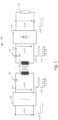
- Fig. 2 shows a schematic of a mobile side rectifying module 10 according to the present invention.
- mobile side rectifying module 10 comprises an adaptive mobile side rectifying circuit 12 and a capacitor 14 connected in series between an input terminal of the mobile side rectifying module 10 and the adaptive mobile side rectifying circuit 12.
- the capacitor 14 may also be realized by a mobile side compensation capacitor, if available.
- the adaptive mobile side rectifying circuit 12 is adapted to operate according to a specific and controlled rectifying mode, e.g., a full bridge rectifying mode or half bridge rectifying mode.
- the capacitor 14 is adapted to filter a mobile side DC voltage signal component U R pending at the input side of the adaptive mobile side rectifying circuit for generation of an input voltage U FB or U HB pending the input terminals 16 and 18 of the mobile side rectifying module 10.
- Fig. 3 shows a voltage U FB at the input terminals 16, 18 of the mobile side rectifying module 10 upon operation thereof in the full bride rectifying mode.
- the voltage U FB is equal to the voltage U R pending at the input side of the adaptive mobile side rectifying circuit 12 as the capacitor 14 has a high pass filter functionality for the oscillating mobile side AC voltage processed by the adaptive mobile side rectifying circuit 12.
- Fig. 4 shows a voltage U HB at the input side of the mobile side rectifying module upon operation hereof in the half bride rectifying mode.
- the capacitor 14 filters the DC component V/2 of the rectangle function U R .
- the input impedance Z of the mobile side rectifying module 10 is invariant against a doubling of the load voltage level through change of the rectifying mode from full bridge mode for a load volage level of V to a half bridge rectifying mode for a load voltage level of 2V.
- any circuitry to the left of the input terminals 16, 18 of the mobile side rectifying module is of a one-design fits all type with respect to different load voltage levels.
- the complete wireless power transmission system design can remain the same as the high frequency AC current and AC-part of the voltages U FB and U HB are the same when operating the rectifier in a full bridge rectifying mode with a battery voltage V or in a half bridge rectifying mode with a battery voltage 2V.
- the present invention enables avoidance of unnecessary over dimensioning of circuit components and achieves significant manufacturing cost advantages through use of an adaptive mobile side rectifying circuit 12.
- Fig. 5 shows a further detailed schematic diagram of the mobile side rectifying module 10 according to the present invention.
- the mobile side rectifier module 10 comprises the adaptive mobile side rectifying circuit 12 and the capacitor 14. As the elements have already been explained above, related description will not be repeated.
- the mobile side rectifier module 10 comprises a rectifying mode controller 24 and a load characteristic evaluation circuit 26.
- the load voltage levels may be selected freely, e.g., according to a first load voltage level or a second load voltage level such that the second load voltage level is higher than the first load voltage level.
- the rectifying mode controller 24 is adapted to switch the adaptive rectifying mode of the adaptive mobile side rectifying circuit 12 to the full bridge rectifying mode when the mobile side rectifying module 10 is to supply the mobile DC load voltage at the first load voltage level.
- the rectifying mode controller 24 is adapted to switch the adaptive rectifying mode of the adaptive mobile side rectifying circuit 12 to the half bridge rectifying mode when the mobile side rectifying module 10 is to supply the mobile DC load voltage at the second load voltage level.
- Fig. 6 shows a change of the mobile side rectifying mode over time in relation to a change of a mobile side load voltage from a higher load voltage value V 2 to a lower load voltage value V 1 and vice versa.
- Fig. 7 shows further aspects for a change of the mobile side rectifying mode over time in relation to a change of a mobile side load voltage from a higher load voltage value V 2 to a lower load voltage value V 1 and vice versa.
- the higher voltage value V 2 may be selected from a higher load voltage range and the lower load voltage value V 1 may be selected from a lower load voltage range.
- the higher load voltage range and the lower load voltage level only differ partially, i.e., have a certain overlapping range.
- the design of the wireless power transmission system is to fit maximum mobile side DC voltage level of max ⁇ V 1, V 2/2 ⁇ . Even if no multiple relationship applies to the voltage levels of e V 1 and V 2 the buffer to be designed in relates to
- Fig. 8 shows a flowchart of operation for the mobile side rectifying module 10 shown in Fig. 5 .
- a load characteristic or a change of the load characteristic is determined.
- the step S10 is executed by measuring a DC load voltage according to a predetermined evaluation timing scheme or by receipt of an instantaneous load characteristic change indication.
- the predetermined evaluation timing scheme may be a periodic timing scheme, a non-periodic timing scheme, or initiated according to operative context related conditions.
- the mobile side load itself provides the indication towards a change of load characteristics.
- step S12 operatively being executed by the rectifying mode controller 24, it is checked whether the load voltage level is in the first, lower load voltage range.
- step S14 operatively being executed by the rectifying mode controller 24, to switch the rectifying mode of the adaptive mobile side rectifying circuit 12 to the full bridge rectifying mode, if this is not yet the case.
- step S16 operatively being executed by the rectifying mode controller 24, to operate/control the adaptive mobile side rectifying circuit 12 in the full bridge rectifying mode.
- step S18 operatively being executed by the load characteristic evaluation circuit 26, to reconsider characteristics of the load and necessity of a change of the rectifying mode. If a change of the rectifying mode is not necessary the flow of operation branches back to step S16 and otherwise to step S10.
- step S12 should the interrogation in step S12 indicate that the load voltage level is outside the first load voltage range then follows a step S20, operatively being executed by the rectifying mode controller 24, to check whether the load voltage level is in the second, higher load voltage range.
- step S20 if the interrogation in step S20 is affirmative there follows a step S22, operatively being executed by the rectifying mode controller 24, to switch the rectifying mode of the adaptive mobile side rectifying circuit 12 to the half bridge rectifying mode, if this is not yet the case.
- step S24 operatively being executed by the rectifying mode controller 24, to operate/control the adaptive mobile side rectifying circuit 12 in the half bridge rectifying mode.
- step S26 operatively being executed by the load characteristic evaluation circuit 26, to reconsider characteristics of the load and necessity of a change of the rectifying mode. If a change of the rectifying mode is not necessary the flow of operation branches back to step S24 and otherwise to step S10.
- step S20 should the interrogation in step S20 indicate that the load voltage level is outside the first load voltage range and outside the second load voltage range then there may follow an optional step S28, operatively under control of the rectifying mode controller 24, to check why the load voltage level is outside specified load voltage ranges and to achieve error recovery.
- Fig. 9 shows a schematic diagram of a first adaptive mobile side rectifying circuit adapted to operate according to full bridge rectifying mode or a half bridge rectifying mode.
- the adaptive mobile side rectifying circuit 12 may be set up from a dedicated uncontrolled full bridge rectifying circuit 28 and a dedicated uncontrolled half bridge rectifying circuit 30.
- the dedicated uncontrolled full bridge rectifying circuit 28 and the dedicated uncontrolled half bridge rectifying circuit 30 are connected in parallel via a first switching element 32, a second switching element 34, a third switching element 36, and a fourth switching element 38.
- the rectifying mode controller 24 is adapted to switch the rectifying mode to the full bride rectifying mode by controlling the first to fourth switching elements 32 to 38 for activation of the dedicated uncontrolled full bridge rectifying circuit 28.
- the rectifying mode controller 24 is adapted to switch the rectifying mode to the half bridge rectifying mode by controlling the first to fourth switching elements 32 to 38 for activation of the dedicated uncontrolled half bridge rectifying circuit 30.
- Fig. 10 shows further detailed schematic diagrams of a dedicated full bridge rectifying circuit 28 and of a dedicated half bridge rectifying circuit 30 for application in the first adaptive mobile side rectifying 12 circuit shown in Fig. 9 .
- the dedicated full bridge rectifying circuit 28 may be realized by four diodes connected in full bride circuit topology.
- the dedicated half bridge rectifying circuit 30 may be realized by two diodes connected in half bride circuit topology.
- Fig. 11 shows a schematic diagram of a second adaptive mobile side rectifying circuit 12 adapted to operate according to a full bridge rectifying mode or a half bridge rectifying mode.
- the adaptive mobile side rectifying circuit 12 is a full bridge rectifying circuit 40 having a first controllable half bridge 42.
- a fifth switching element 44 is connected in series between an upper and a lower rectification element of the first controllable half bridge 42 and a sixth switching element 46 is connected across the lower rectification element of the first controllable half bridge 42.
- the rectifying mode controller 24 is adapted to switch the rectifying mode to the full bridge rectifying mode by opening the fifth switching element 44 in the first controllable half bridge 42. Further, the rectifying mode controller 24 is adapted to switch the rectifying mode to the half bridge rectifying mode by closing the fifth switching element 44 in the first controllable half bridge 42.
- circuit topology shown in Fig. 11 is beneficial in that only four diodes are necessary to realize both rectifying modes applicable according to the present invention, i.e. the full bridge rectifying mode and the half bridge rectifying mode.
- the adaptive mobile side rectifying circuit 12 is adapted to operate according the full bridge rectifying mode or the half bridge rectifying mode.
- the capacitor 14 filters mobile side DC voltage signal U_HB_1 pending at the input side of the adaptive mobile side rectifying circuit 12 for generation of the input voltage U FB or U HB pending the input terminals 16 and 18 of the mobile side rectifying module 10.
- Fig. 13 shows a voltage U FB at the input terminals 16, 18 of the mobile side rectifying module 10 upon operation thereof in the full bridge rectifying mode.
- Fig. 14 shows a voltage U HB at the input side of the mobile side rectifying module 10 upon operation hereof in the half bride rectifying mode.
- the input impedance Z of the mobile side rectifying module 10 is invariant against a doubling of the load voltage level through change of the rectifying mode any circuitry to the left of the input terminals 16, 18 of the mobile side rectifying module 10 is of the one-design fits all type with respect to different load voltage levels.
- Fig. 15 shows a schematic diagram of a third adaptive mobile side rectifying circuit 12 being an asymmetric half-controlled rectifying circuit adapted to operate according to a full bridge rectifying mode or a half bridge rectifying mode.
- the adaptive mobile side rectifying circuit 12 is an asymmetric half-controlled rectifying circuit having a dedicated uncontrollable half bridge set-up from two diodes 46, 48 and a second controllable half bridge 50 with an upper sixth switching element 52 and a lower seventh switching element 54.
- the rectifying mode controller 24 is adapted to switch the rectifying mode to the full bridge rectifying mode by controlling the sixth switching element 52 and the seventh switching element 54 in the second controllable half bridge 50 according to the full bridge rectifying mode.
- the rectifying mode controller 24 is adapted to switch the rectifying mode to the half bridge rectifying mode by constantly switching OFF the upper sixth switching element 52 and by constantly switching ON the lower seventh switching element 54 in the second controllable half bridge 50.
- Such switching control achieves a modification of the operation of the asymmetric half-controlled rectifying circuit into the half bridge rectification mode where only the two diodes 46 and 48 are operative for rectification.
- Fig. 16 shows a schematic diagram of a fourth adaptive mobile side rectifying circuit 12 being a fully-controlled rectifying circuit adapted to operate according to a full bridge rectifying mode or a half bridge rectifying mode.
- the adaptive mobile side rectifying circuit 12 is a fully-controlled rectifying circuit having a third controllable half bridge 56 with an upper eighth switching element 58 and a lower ninth switching element 60 and a fourth controllable half bridge 62 with an upper tenth switching element 64 and a lower eleventh switching element 66
- the rectifying mode controller 24 is adapted to switch the rectifying mode to the full bridge rectifying mode by operating the eighth, ninth, tenth, and eleventh switching element of the fully-controlled rectifying circuit according to the full bridge rectifying mode.
- control of such full bridge rectifying mode is related to standard functionality and that therefore description thereof is omitted.
- the rectifying mode controller 24 is adapted to switch the rectifying mode to the half bridge rectifying mode by constantly switching OFF the upper eighth switching element 58 and by constantly switching ON the lower ninth switching element 60 in the third controllable half bridge 56 or vice versa while controlling the tenth switching element 64 and the eleventh switching element 66 in the fourth controllable half bridge 62 according to the half bridge rectifying mode.
- the rectifying mode controller 24 is adapted to switch the rectifying mode to switch the rectifying mode to the half bridge rectifying mode by constantly switching OFF the upper tenth switching 64 and by constantly switching ON the lower eleventh switching element 68 or vice versa in the fourth controllable half bridge 64 while controlling the eighth switching element 58 and the ninth switching element 60 in the third controllable half bridge 56 according to the half bridge rectifying mode.
- Fig. 17 shows details of operation in the full bridge operation mode for the third and fourth adaptive mobile side rectifying circuit shown in Fig. 15 and Fig. 16 .
- the output of the mobile side rectification module 10 will be a voltage u 2, dc reflecting an amplitude of the oscillating rectangular shape AC input voltage u 2 ,hf and a current i 2, rect being described as continuous sequence of positive sinus half-waves.
- Fig. 18 shows details of operation in the half bridge operation mode for the third and fourth adaptive mobile side rectifying circuit shown in Fig. 15 and Fig. 16 .
- the output of the mobile side rectification module 10 will be a voltage u 2, dc reflecting again an amplitude of the oscillating rectangular shape AC input voltage u 2, hf and a current i 2, rect being described as interrupted sequence of positive sinus half-waves.
- both, the level of the voltage u 2, dc as well as the amplitude of the current i 2, rect are the same as in the full bridge rectifying mode allowing for use of a same circuitry up to the input of the mobile side rectification module 10.
- the present invention adds flexibility to mobile side rectification in a wireless power transmission system by selecting an appropriate mode of rectification as a function of a load voltage level.
- a main part of the wireless power transmission system is realizable in a one design fits all type thus reducing design effort and overall manufacturing costs.
Landscapes
- Engineering & Computer Science (AREA)
- Power Engineering (AREA)
- Computer Networks & Wireless Communication (AREA)
- Rectifiers (AREA)
Priority Applications (1)
| Application Number | Priority Date | Filing Date | Title |
|---|---|---|---|
| EP23152435.6A EP4404428A1 (de) | 2023-01-19 | 2023-01-19 | Vollbrücken-halbbrückenkonfiguration |
Applications Claiming Priority (1)
| Application Number | Priority Date | Filing Date | Title |
|---|---|---|---|
| EP23152435.6A EP4404428A1 (de) | 2023-01-19 | 2023-01-19 | Vollbrücken-halbbrückenkonfiguration |
Publications (1)
| Publication Number | Publication Date |
|---|---|
| EP4404428A1 true EP4404428A1 (de) | 2024-07-24 |
Family
ID=85017528
Family Applications (1)
| Application Number | Title | Priority Date | Filing Date |
|---|---|---|---|
| EP23152435.6A Pending EP4404428A1 (de) | 2023-01-19 | 2023-01-19 | Vollbrücken-halbbrückenkonfiguration |
Country Status (1)
| Country | Link |
|---|---|
| EP (1) | EP4404428A1 (de) |
Citations (5)
| Publication number | Priority date | Publication date | Assignee | Title |
|---|---|---|---|---|
| US20110285349A1 (en) | 2010-05-19 | 2011-11-24 | Qualcomm Incorporated | Adaptive wireless energy transfer system |
| US20170063251A1 (en) * | 2015-08-26 | 2017-03-02 | Futurewei Technologies, Inc. | AC/DC Converters |
| US20180358844A1 (en) * | 2017-06-09 | 2018-12-13 | Ningbo Weie Electronics Technology Ltd. | Wireless power receiving terminal and wireless charging system |
| EP3215393B1 (de) * | 2014-12-19 | 2020-02-19 | WiTricity Corporation | Systeme, vorrichtung und verfahren zur adaptiven drahtlosen stromübertragung |
| US20220320905A1 (en) * | 2021-03-30 | 2022-10-06 | Nuvolta Technologies (Hefei) Co., Ltd. | Rectifier in Low Gain Wireless Power Transfer System |
-
2023
- 2023-01-19 EP EP23152435.6A patent/EP4404428A1/de active Pending
Patent Citations (5)
| Publication number | Priority date | Publication date | Assignee | Title |
|---|---|---|---|---|
| US20110285349A1 (en) | 2010-05-19 | 2011-11-24 | Qualcomm Incorporated | Adaptive wireless energy transfer system |
| EP3215393B1 (de) * | 2014-12-19 | 2020-02-19 | WiTricity Corporation | Systeme, vorrichtung und verfahren zur adaptiven drahtlosen stromübertragung |
| US20170063251A1 (en) * | 2015-08-26 | 2017-03-02 | Futurewei Technologies, Inc. | AC/DC Converters |
| US20180358844A1 (en) * | 2017-06-09 | 2018-12-13 | Ningbo Weie Electronics Technology Ltd. | Wireless power receiving terminal and wireless charging system |
| US20220320905A1 (en) * | 2021-03-30 | 2022-10-06 | Nuvolta Technologies (Hefei) Co., Ltd. | Rectifier in Low Gain Wireless Power Transfer System |
Similar Documents
| Publication | Publication Date | Title |
|---|---|---|
| EP2950423B1 (de) | Stromübertragungsvorrichtung und system zur drahtlosen stromübertragung | |
| EP1609235B1 (de) | Phasenverschobener resonanzwandler mit reduzierter ausgangswelligkeit | |
| EP0758160B1 (de) | Treiberimpuls-Begrenzerschaltung | |
| US11395378B2 (en) | Induction heating device having improved interference noise removal function and power control function | |
| US11139693B2 (en) | Contactless power transmission apparatus | |
| US8369110B2 (en) | Switching power supply device of half-wave rectification current resonance type and method for starting same | |
| WO1991000643A1 (en) | Ac/dc conversion with reduced supply waveform distortion | |
| WO1998034319A1 (fr) | Equipement et procede pour le transfert d'energie electrique | |
| US20190067997A1 (en) | Wireless power transmitting apparatus and method thereof | |
| US5303137A (en) | Multiresonant self-oscillating converter circuit | |
| KR102200786B1 (ko) | 무선 전력 송신용 lcc 인버터 및 그 동작 방법 | |
| EP4404428A1 (de) | Vollbrücken-halbbrückenkonfiguration | |
| KR20190074578A (ko) | 간섭 소음 제거 및 출력 제어 기능이 개선된 유도 가열 장치 | |
| US4812960A (en) | Power feeding apparatus | |
| US6043470A (en) | Energy converter for electromagnetic induction heating units for foodstuffs | |
| Fujiki et al. | Experimental verification of impedance matching method for repeater to improve spatial freedom of 6.78 MHz resonant inductive coupling wireless power transfer systems | |
| KR20240045106A (ko) | 수전 장치 및 비접촉 전력 전송 시스템 | |
| US20090302932A1 (en) | Feeding Arrangement for an Ultrasonic Device | |
| CN112994183B (zh) | 一种最大效率点跟踪相控电容谐振适应无线充电系统 | |
| KR20240027409A (ko) | 임피던스 매칭 회로를 포함하는 무선 전력 송신 장치 및 무선 전력 송신 방법 | |
| US20210242790A1 (en) | Control unit for improving conversion efficiency | |
| JP2017005841A (ja) | 送電機器 | |
| EP4679675A1 (de) | Stromübertragungsvorrichtung und kontaktloses stromversorgungssystem | |
| US20250309785A1 (en) | Inverter circuit and electric field coupling non-contact power feeding device | |
| US7830112B2 (en) | Method for operating a traction converter circuit for coupling to an electric DC voltage network |
Legal Events
| Date | Code | Title | Description |
|---|---|---|---|
| PUAI | Public reference made under article 153(3) epc to a published international application that has entered the european phase |
Free format text: ORIGINAL CODE: 0009012 |
|
| STAA | Information on the status of an ep patent application or granted ep patent |
Free format text: STATUS: REQUEST FOR EXAMINATION WAS MADE |
|
| 17P | Request for examination filed |
Effective date: 20230119 |
|
| AK | Designated contracting states |
Kind code of ref document: A1 Designated state(s): AL AT BE BG CH CY CZ DE DK EE ES FI FR GB GR HR HU IE IS IT LI LT LU LV MC ME MK MT NL NO PL PT RO RS SE SI SK SM TR |