EP4404155A1 - Verfahren zur verbesserten erkennung, erfassung und segmentierung von id-dokumenten mithilfe einer visuellen darstellung - Google Patents
Verfahren zur verbesserten erkennung, erfassung und segmentierung von id-dokumenten mithilfe einer visuellen darstellung Download PDFInfo
- Publication number
- EP4404155A1 EP4404155A1 EP23152962.9A EP23152962A EP4404155A1 EP 4404155 A1 EP4404155 A1 EP 4404155A1 EP 23152962 A EP23152962 A EP 23152962A EP 4404155 A1 EP4404155 A1 EP 4404155A1
- Authority
- EP
- European Patent Office
- Prior art keywords
- interest
- region
- identity document
- visual representation
- data
- Prior art date
- Legal status (The legal status is an assumption and is not a legal conclusion. Google has not performed a legal analysis and makes no representation as to the accuracy of the status listed.)
- Granted
Links
Images




Classifications
-
- G—PHYSICS
- G06—COMPUTING OR CALCULATING; COUNTING
- G06V—IMAGE OR VIDEO RECOGNITION OR UNDERSTANDING
- G06V30/00—Character recognition; Recognising digital ink; Document-oriented image-based pattern recognition
- G06V30/40—Document-oriented image-based pattern recognition
- G06V30/41—Analysis of document content
- G06V30/414—Extracting the geometrical structure, e.g. layout tree; Block segmentation, e.g. bounding boxes for graphics or text
-
- B—PERFORMING OPERATIONS; TRANSPORTING
- B42—BOOKBINDING; ALBUMS; FILES; SPECIAL PRINTED MATTER
- B42D—BOOKS; BOOK COVERS; LOOSE LEAVES; PRINTED MATTER CHARACTERISED BY IDENTIFICATION OR SECURITY FEATURES; PRINTED MATTER OF SPECIAL FORMAT OR STYLE NOT OTHERWISE PROVIDED FOR; DEVICES FOR USE THEREWITH AND NOT OTHERWISE PROVIDED FOR; MOVABLE-STRIP WRITING OR READING APPARATUS
- B42D25/00—Information-bearing cards or sheet-like structures characterised by identification or security features; Manufacture thereof
- B42D25/30—Identification or security features, e.g. for preventing forgery
- B42D25/305—Associated digital information
-
- G—PHYSICS
- G06—COMPUTING OR CALCULATING; COUNTING
- G06F—ELECTRIC DIGITAL DATA PROCESSING
- G06F21/00—Security arrangements for protecting computers, components thereof, programs or data against unauthorised activity
- G06F21/30—Authentication, i.e. establishing the identity or authorisation of security principals
- G06F21/31—User authentication
- G06F21/32—User authentication using biometric data, e.g. fingerprints, iris scans or voiceprints
-
- G—PHYSICS
- G06—COMPUTING OR CALCULATING; COUNTING
- G06K—GRAPHICAL DATA READING; PRESENTATION OF DATA; RECORD CARRIERS; HANDLING RECORD CARRIERS
- G06K19/00—Record carriers for use with machines and with at least a part designed to carry digital markings
- G06K19/06—Record carriers for use with machines and with at least a part designed to carry digital markings characterised by the kind of the digital marking, e.g. shape, nature, code
- G06K19/06009—Record carriers for use with machines and with at least a part designed to carry digital markings characterised by the kind of the digital marking, e.g. shape, nature, code with optically detectable marking
-
- G—PHYSICS
- G06—COMPUTING OR CALCULATING; COUNTING
- G06K—GRAPHICAL DATA READING; PRESENTATION OF DATA; RECORD CARRIERS; HANDLING RECORD CARRIERS
- G06K19/00—Record carriers for use with machines and with at least a part designed to carry digital markings
- G06K19/06—Record carriers for use with machines and with at least a part designed to carry digital markings characterised by the kind of the digital marking, e.g. shape, nature, code
- G06K19/08—Record carriers for use with machines and with at least a part designed to carry digital markings characterised by the kind of the digital marking, e.g. shape, nature, code using markings of different kinds or more than one marking of the same kind in the same record carrier, e.g. one marking being sensed by optical and the other by magnetic means
- G06K19/10—Record carriers for use with machines and with at least a part designed to carry digital markings characterised by the kind of the digital marking, e.g. shape, nature, code using markings of different kinds or more than one marking of the same kind in the same record carrier, e.g. one marking being sensed by optical and the other by magnetic means at least one kind of marking being used for authentication, e.g. of credit or identity cards
-
- G—PHYSICS
- G06—COMPUTING OR CALCULATING; COUNTING
- G06V—IMAGE OR VIDEO RECOGNITION OR UNDERSTANDING
- G06V30/00—Character recognition; Recognising digital ink; Document-oriented image-based pattern recognition
- G06V30/40—Document-oriented image-based pattern recognition
- G06V30/42—Document-oriented image-based pattern recognition based on the type of document
-
- H—ELECTRICITY
- H04—ELECTRIC COMMUNICATION TECHNIQUE
- H04L—TRANSMISSION OF DIGITAL INFORMATION, e.g. TELEGRAPHIC COMMUNICATION
- H04L63/00—Network architectures or network communication protocols for network security
- H04L63/08—Network architectures or network communication protocols for network security for authentication of entities
- H04L63/0861—Network architectures or network communication protocols for network security for authentication of entities using biometrical features, e.g. fingerprint, retina-scan
-
- G—PHYSICS
- G06—COMPUTING OR CALCULATING; COUNTING
- G06V—IMAGE OR VIDEO RECOGNITION OR UNDERSTANDING
- G06V40/00—Recognition of biometric, human-related or animal-related patterns in image or video data
- G06V40/10—Human or animal bodies, e.g. vehicle occupants or pedestrians; Body parts, e.g. hands
- G06V40/12—Fingerprints or palmprints
- G06V40/1365—Matching; Classification
-
- G—PHYSICS
- G06—COMPUTING OR CALCULATING; COUNTING
- G06V—IMAGE OR VIDEO RECOGNITION OR UNDERSTANDING
- G06V40/00—Recognition of biometric, human-related or animal-related patterns in image or video data
- G06V40/10—Human or animal bodies, e.g. vehicle occupants or pedestrians; Body parts, e.g. hands
- G06V40/16—Human faces, e.g. facial parts, sketches or expressions
- G06V40/172—Classification, e.g. identification
-
- G—PHYSICS
- G06—COMPUTING OR CALCULATING; COUNTING
- G06V—IMAGE OR VIDEO RECOGNITION OR UNDERSTANDING
- G06V40/00—Recognition of biometric, human-related or animal-related patterns in image or video data
- G06V40/10—Human or animal bodies, e.g. vehicle occupants or pedestrians; Body parts, e.g. hands
- G06V40/18—Eye characteristics, e.g. of the iris
- G06V40/197—Matching; Classification
-
- G—PHYSICS
- G07—CHECKING-DEVICES
- G07C—TIME OR ATTENDANCE REGISTERS; REGISTERING OR INDICATING THE WORKING OF MACHINES; GENERATING RANDOM NUMBERS; VOTING OR LOTTERY APPARATUS; ARRANGEMENTS, SYSTEMS OR APPARATUS FOR CHECKING NOT PROVIDED FOR ELSEWHERE
- G07C9/00—Individual registration on entry or exit
- G07C9/20—Individual registration on entry or exit involving the use of a pass
- G07C9/22—Individual registration on entry or exit involving the use of a pass in combination with an identity check of the pass holder
- G07C9/25—Individual registration on entry or exit involving the use of a pass in combination with an identity check of the pass holder using biometric data, e.g. fingerprints, iris scans or voice recognition
- G07C9/257—Individual registration on entry or exit involving the use of a pass in combination with an identity check of the pass holder using biometric data, e.g. fingerprints, iris scans or voice recognition electronically
Definitions
- the present invention generally relates to computer vision and more specifically to object detection in an identity document, such as an identity card or a driver's license or a passport, comprising a visual representation of encoded data.
- the invention also concerns a method for capturing a region-of-interest of an identity document, and a capturing device.
- identity control is sometimes required when a person accesses a protected area or an on-line service for example.
- identity documents such as passports, driver's licenses, identity cards and the like
- a mobile device whereby holders themselves can generate a digital image of their identity document or of a particular page of their document.
- a user accesses an on-line service, she/he may need to take a photo of its identity document and eventually share it with a service provider.
- the photos taken by the users using a mobile device can have a range of issues in terms of illumination, focus, orientation, and background.
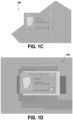
- an identity document 100 can be captured in various environmental conditions.
- the user may take a photo of an identity document 100 with relatively adequate but varying illumination. This is evidenced by the low contrast around the boundaries of the identity document.
- the photo may be taken with varying illumination over the identity document such that a portion of the identification is in the shadow.
- the identity document may be taken with portions of the boundaries almost indistinguishable from the immediately surrounding background.
- Example 104 in Fig. 1D illustrates a cluttered background, which confounds the detection of boundaries of the identity document.
- FIGS 2A and 2B illustrate an example of an erroneous segmentation 220 of a digital image of an identity document 100.
- This identity document 100 comprises an area 210 characterizing the issuing authority of the identity document 100. Since the contrast is low between the background of the area 210 and the background 230 used when capturing the identity document 100, it results in an erroneous segmentation 220 of the image of the identity document 100, whereby the area 210 is not considered as a portion of the image to process.
- the present disclosure first provides an identity document comprising a visual representation of encoded data, the encoded data being data for determining location of at least a part of the outlines of a region-of-interest of the identity document relative to at least one reference point of the visual representation, the region-of-interest being different from the visual representation.
- the visual representation of data is a one-dimensional, a two-dimensional barcode or a Machine Readable Zone (MRZ).
- the MRZ may be compliant with the OACI/ICAO 9303 and/or with the ISO/CEI 7501-1 :2008 Standards.
- dimensions of the region-of-interest correspond to dimensions of an entire side of the identity document.
- the present disclosure concerns an identity document comprising a visual representation of encoded data, the encoded data being data for determining dimensions of a region-of-interest of the identity document, the region-of-interest being different from the visual representation.
- the present disclosure provides a computer-implemented method for processing a region-of-interest of an identity document, the method being implemented by a capturing device and comprising:
- This method offers the advantage of precisely determine location of outlines of a region-of-interest of this identity document, and this even if the digital image has issues in terms of illumination, focus, orientation, and/or background.
- the location of at least parts of the outlines is determined relative to at least one reference point of the visual representation.
- the encoded data includes a reference to a predetermined format
- the determining step comprises:
- the encoded data includes dimensions of the region-of-interest and data for determining a location of the region-of-interest relative to at least one reference point of the visual representation, and the location of the outlines of the region-of-interest is determined as a function of the dimensions and of the relative location.
- the region-of-interest and the visual representation are rectangular and get parallel outlines
- the encoded data comprises:
- the encoded data comprises dimensions of the visual representation
- the method further comprises determining resolution of the visual representation as a function of the dimensions and of a detected pixel dimension.
- the processing step comprises storing the region-of-interest in an electronic card wallet.
- the processing step comprises determining whether the identity document is a genuine copy or not by segmenting at least a part of the region-of-interest.
- the processing step comprises determining whether the person attempting to enroll is the holder of the identity document or not by:
- collecting a biometric comprises at least one of :
- the processing step comprises determining whether the person attempting to enroll is the holder of the identity document or not by:
- the processing step comprises:
- a further aspect of the disclosure concerns a device for capturing an identity document and comprising a camera for capturing images, at least one processor, and a memory containing a program implementing a method for processing a region-of-interest of an identity document, the method comprising:
- Embodiments of the present disclosure also extend to programs which, when run on a computer or processor, cause the computer or processor to carry out the method described above or which, when loaded into a programmable device, cause that device to become the device described above.
- the program may be provided by itself, or carried by a carrier medium.
- the carrier medium may be a storage or recording medium, or it may be a transmission medium such as a signal.
- a program embodying the present disclosure may be transitory or non-transitory.
- Figure 3 depicts for illustrative purposes a system 300 in which the disclosure is applicable.
- the system 300 comprises a capturing device 400 for capturing an image of an identity document 600.
- the capturing device 400 may be a mobile phone, a personal digital assistant, a portable electronic device, a tablet computer or any other electronic device capable of capturing an image.
- the capturing device 400 is typically equipped with a camera 340, a screen or a touchscreen to display captured images and videos, and a capturing user interface.
- the capturing user interface may be implemented through a dedicated mobile application.
- the mobile application captures and stores a digital image of an identity document 600 first.
- the identity document 600 is the identity document 600.
- the identity document 600 may be a physical identity document, such as a driver's license, a passport, an identity card, a birth certificate, a visa, a permanent resident card, a social security card, a Medicare/Medicaid card, a military ID card, and the like.
- identity document may encompass any governmentissued credentials that can be used to assert an identity claim, depending on the purpose and context. In a variant, the document may also be issued for secure access, rewards programs or general identification purposes.
- biometric data such as fingerprints or minutiae, photographs, and face, hand, or iris measurements.
- the identity document 600 of the disclosure also comprises a visual representation 605 of encoded data which is printed on or inserted in a layer of this identity document.
- the encoded data allows the capturing device to determine location of at least a part of the outlines of a region-of-interest of this identity document relative to at least one reference point of the visual representation.
- the encoded data allows the capturing device to determine dimensions of a region-of-interest of said identity document.
- the visual representation 605 of data is a one-dimensional barcode, e.g., a barcode that is made up of lines and spaces of various widths, or a two-dimensional barcode, such as a quick response (QR) code, an Aztec code or a PDF417 code.
- the visual representation 605 of data is a Machine Readable Zone (MRZ).
- the MRZ may be compliant with the OACI/ ICAO 9303 or with the ISO/CEI 7501-1:2008 Standards.
- the visual representation 605 should be located and have a size so that it can be easily detected by a capturing device, for example, a size of 10 ⁇ 10 mm for an identity document having a size of 125 ⁇ 88 mm.
- the camera 340 of the capturing device 400 is utilized to capture an image of this identity document.
- the camera may generate a high resolution image of this document so as to process a region-of-interest of that identity document.
- the region-of-interest corresponds to a portion of a side of the identity document.
- dimensions of the region-of-interest correspond to dimensions of an entire side of the identity document.
- the processing may comprise the storage of a digital image of an entire side of the identity document in a dedicated application, such as an electronic card wallet, of the capturing device 400.
- a dedicated application such as an electronic card wallet
- the storage of an image of an identity document in a capturing device, such as a mobile phone, offers the advantage for a person to store all its important documents, and in particular its identity documents, at one safe place, and to easily organize and eventually share these documents.
- the mobile application is configured to search for a visual representation 605 that could allow this mobile application to precisely determine outlines of the identity document 600.
- the visual representation 605 encodes a reference to a format (e.g., ID-000, ID-1, ID-2, ID-3), and further data for determining locations of the outlines are stored in a remote database 320.
- the mobile application may be configured to access the remote database 320 once the reference to a format is obtained from the decoding of the visual representation 605.
- the remote database 320 may then comprise an association table associating to each of a plurality of references to a format, dimensions of the region-of-interest and data for determining a location of said region-of-interest relatively to the visual representation. Thanks to that information, the mobile application is able to precisely determine the outlines of the region-of-interest, and then to scan and store the portion of the image defined by said outlines (and named "region-of-interest" in the following), even if the initial photo of the identity document 600 was taken under non-optimal environmental conditions.
- the visual representation 605 directly encodes dimensions of the region-of-interest and data for determining a location of said region-of-interest relatively to the visual representation.
- the capturing device may be configured to share an image of the region-of-interest with a service provider 310, using a communication network 330.
- Examples of communication networks 330 include a local area network (LAN), a radio access network (RAN), a metropolitan area network (MAN), a wide area network (WAN), Worldwide Interoperability for Microwave Access (WIMAX), a wireless local area network (WLAN) using, for example, 802.11 a/b/g/n/ac/ax, all or a portion of the Internet, or a combination of communication networks.
- the communication network 330 can communicate with, for example, Internet Protocol (IP) packets, Frame Relay frames, Asynchronous Transfer Mode (ATM) cells, voice, video, data, or other information between networks addresses.
- IP Internet Protocol
- ATM Asynchronous Transfer Mode
- the capturing device 400 may also be configured to determine whether the identity document 600 is a genuine copy as issued by an issuing agency. To verify whether an identity document is authentic, the device may identify features of the identity document (more precisely of the region-of-interest of this identity document) and then verify that certain security features (such as an hologram, UV image, micro-printing, laser perforation) and personalization fonts are correctly placed on the identity document. In an alternative, this verification may be directly implemented by the service provider 310.
- security features such as an hologram, UV image, micro-printing, laser perforation
- the identity document 400 carries information about the biometrics of the holder, and this information is stored in an embedded electronic microprocessor chip 610.
- the capturing device may also be configured to rely on this identity document to validate that the person attempting to enroll is the holder of the identity document.
- the capturing device is further configured to collect a biometric from the holder of the identity document, and to compare it with a digital version of the biometric stored in the embedded electronic microprocessor chip 610 or with a version of the biometric displayed on the identity document.
- the mobile application may request the person to capture its face using the camera 340 of the capturing device.
- the mobile application of the capturing device may prompt the person to press his or her fingertip(s) on the touchscreen of the capturing device, so that a fingerprint of at least one of the fingers can be captured.
- the capturing device may perform a retina scan by prompting the person to stare into an iris, retina, or eye-scanning device.
- the mobile application may configure the touchscreen of the capturing device to capture a signature freshly executed by the person and then compare the lively captured signature with a digital version of the signature previously stored in the electronic microprocessor chip 610 of the identity document 600.
- the mobile application may then generate a mobile ID for the individual, such as an electronic version of the individual's driver's license.
- the validation that the person attempting to enroll is the holder of the identity document may be directly implemented by the service provider 310.
- FIG. 4 illustrates a particular embodiment of a capturing device 400 according to the disclosure.
- Said capturing device 400 is configured to capture an image of this identity document 600 and then to determine and process a region-of-interest of this capturing device, by implementing a capturing method according to the disclosure.
- Figure 5 illustrates an example of the hardware architecture of the capturing device 400 for the implementation of the capturing method according to the disclosure.
- the capturing device 400 has the hardware architecture of a computer. As shown in Figure 5 , the capturing device 400 comprises a processor 1. Although illustrated as a single processor 1, two or more processors can be used according to particular needs, desires, or particular implementations of the capturing device 400. Generally, the processor 1 executes instructions and manipulates data to perform the operations of the device 400 and any algorithms, methods, functions, processes, flows, and procedures as described in the present disclosure.
- the capturing device 400 also comprises communication means 5. Although illustrated as a single communication means 5 in Fig. 5 , two or more communication means can be used according to particular needs, desires, or particular implementations of the capturing device 400.
- the communication means are used by the device 400 for communicating with another computing system that is communicatively linked to the communication network 330 in a distributed environment.
- the communication means 5 are operable to communicate with the network 330 and comprises logic encoded in software, hardware, or a combination of software and hardware. More specifically, the communication means 5 can comprise software supporting one or more communication protocols associated with communications such that the network 330 or interface's hardware is operable to communicate physical signals within and outside of the illustrated device 400.
- the capturing device 400 also comprises a random access memory 2, a read-only memory 3, and a non-volatile memory 4.
- the read-only memory 3 of the capturing device 400 constitutes a recording medium conforming to the invention, which is readable by processor 1 and on which is recorded a computer program PROG conforming to the invention, containing instructions for carrying out the steps of the capturing method according to the invention.
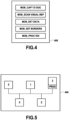
- the program PROG defines functional modules of the capturing device 400, which are based on or control the aforementioned elements 1 to 5 of the capturing device 400, and which comprise in particular a module MOD_CAPT for capturing a document, a module MOD_SCAN for searching for a visual representation in a capture, a module MOD_DEC for decoding data encoded in the visual representation 405, a module MOD_DET for determining outlines of a region-of-interest of the identity document, and a module MOD_PROC for processing the region-of-interest.
- a module MOD_CAPT for capturing a document
- a module MOD_SCAN for searching for a visual representation in a capture
- a module MOD_DEC for decoding data encoded in the visual representation 405
- a module MOD_DET for determining outlines of a region-of-interest of the identity document
- MOD_PROC for processing the region-of-interest.
- Figure 6 illustrates an example of identity document 600 according to an embodiment of the disclosure.
- the identity document 600 may be a physical identity document, such as a driver's license, a passport, an identity card, a birth certificate, a visa, a permanent resident card, a social security card, a Medicare/Medicaid card, a military ID card, and the like.
- the document may also be issued for secure access, rewards programs or general identification purposes.
- a first area yields recognized text 601.
- Text 601 points the issuing authority of the identity document 600.
- a second area shows recognized text 602 that corresponds to the document title of the identity document (i.e., U.S. Passport, drivers licence, identity card, etc.).
- a third area shows recognized text 603 that corresponds to the personally identifiable information (PII) of the holder of the identity document. Text 603 can also include the address information of the holder.
- a fourth area shows text 604 that corresponds to an issued date and an expiration date of the identity document. Additional areas can yield further textual information, such as the parents' names, age, date and place of birth, sex, address, profession, nationality as well as other biographic information.
- the identity document 600 may also comprise security features (such as an hologram, UV image, micro-printing, laser perforation) and personalization fonts.
- the identity document comprises an embedded electronic microprocessor chip 610, which stores electronic biometric data such as fingerprints, a digital image of the face of the holders, and hand and/or iris measurements.
- the identity document 600 of the invention also comprises a visual representation 605 of encoded data which is printed on or inserted in a layer of this identification document.
- the encoded data allows the capturing device to determine location of at least a part of outlines of a region-of-interest of this identity document relatively at least one reference point of the visual representation.
- the encoded data allows the capturing device to determine dimensions of a region-of-interest of said identity document.
- the visual representation 605 of data is a one-dimensional barcode, e.g., a barcode that is made up of lines and spaces of various widths, or a two-dimensional barcode, such as a quick response (QR) code, an Aztec code or a PDF417 code.
- a barcode that is made up of lines and spaces of various widths
- a two-dimensional barcode such as a quick response (QR) code, an Aztec code or a PDF417 code.
- Figure 7 is a flowchart of a capturing method executed by a capturing device 400 according to an embodiment of the disclosure.
- the capturing method comprises a first step S710 of obtaining a capture or capturing an identity document 600.
- This capturing step S710 is performed by the module MOD_CAPT and the camera 340 equipping the capturing device 600.
- the digital image of an identity document is captured from a remote device and received by the communication means 5 of the capturing device.
- the capturing method also comprises a step S720 of verifying whether the captured image comprises or not a visual representation 605.
- the visual representation 605 of encoded data may be printed on or inserted in a layer of this identity document.
- the visual representation 605 of data is a one-dimensional barcode, e.g., a barcode that is made up of lines and spaces of various widths.
- the visual representation 605 of data is a two-dimensional barcode, such as a quick response (QR) code, an Aztec code or a PDF417 code.
- This detecting step S720 is performed by the module MOD_SCAN.
- step S710 While no visual representation is detected, the algorithm loops and goes back to step S710 (arrow referenced “N”). Once a visual representation is detected (arrow referenced “Y"), a step S730 of decoding the data encoded by the visual representation 605 is performed by the module MOD_DEC equipping the capturing device 600.
- the identity document is processed using legacy techniques. This alternative offers the advantage of supporting the existence of older non-conformant documents in circulation.
- the visual representation 605 encodes a reference to a format (e.g., ID-000, ID-1, ID-2, ID-3), and the decoding results in obtaining said reference.
- the visual representation 605 directly encodes the dimensions of the region-of-interest and data for determining a location of said region-of-interest relatively to the visual representation, and the decoding results in obtaining said dimensions and said data.
- the capturing method also comprises a step S740 of determining location of at least a part of the outlines of a region-of-interest of the identity document.
- step S750 comprises:
- the visual representation 605 encodes a reference to a format, and a correspondence between the format and dimensions associated to that format are stored in a memory of the capturing device.
- the visual representation 605 directly encodes the dimensions of the region-of-interest and data for determining a location of said region-of-interest relatively to at least one reference point of the visual representation.
- the data for determining a location of said region-of-interest may comprise a distance between a point of this region-of-interest and a reference point of the visual representation 605, and the reference point may correspond to the top-left pixel of the visual representation 605, or to the barycenter of the visual representation 605.
- the region-of-interest and the visual representation are rectangular and get parallel outlines
- the encoded data comprises:
- the capturing device comprises a QR code reader.
- the capturing device detects the boundaries of the QR code (named "QR rectangle" in the following) in the image obtained at step S710, and decodes the payload encoded in the QR code at step 730.
- the QR code encodes the following information:
- the visual representation is a rectangle and the four corners of the visual representation and the relative position information stored in the code are used to generate a Source and Target set of four points.
- An homography transform is then applied that allows rendering of the region-of-interest in the captured image to a standard flattened format.
- the capturing method comprises a step S750 of processing the region-of-interest.
- the processing step may then comprise storing the digital image of the entire identity document in a dedicated application, such as an electronic card wallet, of the capturing device 400.
- a capturing device such as a mobile phone
- a mobile phone offers the advantage for a person to store all its important documents, and in particular its identity documents, at one safe place, and to easily organize and eventually share these documents.
- the processing step may comprise determining whether the identity document 600 is a genuine copy as issued by an issuing agency.
- the method comprises identifying features of the identity document (more precisely of the region-of-interest of this identity document) and then verify that certain security features (such as an hologram, UV image, micro-printing, laser perforation) and personalization fonts are correctly placed on the identity document.
- the step of verifying certain security features may also comprise a sub-step extracting features by applying an optical character recognition method on at least portions of the region-of-interest.
- the processing step may comprise checking whether the person attempting to enroll is the holder of the identity document or not. In that case, the processing step comprises :
- the sub-step of collect a biometric may comprise at least one of :
- the step of checking whether the person attempting to enroll is the holder of the identity document or not may rely on the person's signature.
- the method may comprise:
- the method further comprises a step of generating a mobile ID for the individual, such as a certified electronic version of the individual's identity document.
- Implementations of the subject matter and the functional operations described in this specification can be implemented in digital electronic circuitry, in tangibly embodied computer software or firmware, in computer hardware, including the structures disclosed in this specification and their structural equivalents, or in combinations of one or more of them.
- Software implementations of the described subject matter can be implemented as one or more computer programs, that is, one or more modules of computer program instructions encoded on a tangible, non-transitory, computer-readable computer-storage medium for execution by, or to control the operation of, data processing apparatus.
- the program instructions can be encoded in/on an artificially generated propagated signal, for example, a machine-generated electrical, optical, or electromagnetic signal that is generated to encode information for transmission to a receiver apparatus for execution by a data processing apparatus.
- the computer-storage medium can be a machine-readable storage device, a machine-readable storage substrate, a random or serial access memory device, or a combination of computer-storage mediums.
- Configuring one or more computers means that the one or more computers have installed hardware, firmware, or software (or combinations of hardware, firmware, and software) so that when the software is executed by the one or more computers, particular computing operations are performed.
- a computer program which can also be referred to or described as a program, software, a software application, a unit, a module, a software module, a script, code, or other component can be written in any form of programming language, including compiled or interpreted languages, or declarative or procedural languages, and it can be deployed in any form, including, for example, as a stand-alone program, module, component, or subroutine, for use in a computing environment.
- a computer program can, but need not, correspond to a file in a file system.
- a program can be stored in a portion of a file that holds other programs or data, for example, one or more scripts stored in a markup language document, in a single file dedicated to the program in question, or in multiple coordinated files, for example, files that store one or more modules, sub-programs, or portions of code.
- a computer program can be deployed to be executed on one computer or on multiple computers that are located at one site or distributed across multiple sites and interconnected by a communication network.
- While portions of the programs illustrated in the various figures can be illustrated as individual components, such as units or modules, that implement described features and functionality using various objects, methods, or other processes, the programs can instead include a number of sub-units, sub-modules, third-party services, components, libraries, and other components, as appropriate. Conversely, the features and functionality of various components can be combined into single components, as appropriate. Thresholds used to make computational determinations can be statically, dynamically, or both statically and dynamically determined.
- Described methods, processes, or logic flows represent one or more examples of functionality consistent with the present disclosure and are not intended to limit the disclosure to the described or illustrated implementations, but to be accorded the widest scope consistent with described principles and features.
- the described methods, processes, or logic flows can be performed by one or more programmable computers executing one or more computer programs to perform functions by operating on input data and generating output data.
- the methods, processes, or logic flows can also be performed by, and apparatus can also be implemented as, special purpose logic circuitry, for example, a CPU, an FPGA, or an ASIC.
- Non-transitory computer-readable media for storing computer program instructions and data can include all forms of media and memory devices, magnetic devices, magneto optical disks, and optical memory device.
- Memory devices include semiconductor memory devices, for example, random access memory (RAM), read-only memory (ROM), phase change memory (PRAM), static random access memory (SRAM), dynamic random access memory (DRAM), erasable programmable read-only memory (EPROM), electrically erasable programmable read-only memory (EEPROM), and flash memory devices.
- RAM random access memory
- ROM read-only memory
- PRAM phase change memory
- SRAM static random access memory
- DRAM dynamic random access memory
- EPROM erasable programmable read-only memory
- EEPROM electrically erasable programmable read-only memory
- flash memory devices for example, random access memory (RAM), read-only memory (ROM), phase change memory (PRAM), static random access memory (SRAM), dynamic random access memory (DRAM), erasable programmable read-only memory (EPROM
- any claimed implementation is considered to be applicable to at least a computer-implemented method; a non-transitory, computer-readable medium storing computer-readable instructions to perform the computer-implemented method; and a computer system comprising a computer memory interoperably coupled with a hardware processor configured to perform the computer-implemented method or the instructions stored on the non-transitory, computer-readable medium.
Landscapes
- Engineering & Computer Science (AREA)
- Physics & Mathematics (AREA)
- Theoretical Computer Science (AREA)
- General Physics & Mathematics (AREA)
- Computer Vision & Pattern Recognition (AREA)
- Computer Security & Cryptography (AREA)
- Computer Hardware Design (AREA)
- General Engineering & Computer Science (AREA)
- Multimedia (AREA)
- Artificial Intelligence (AREA)
- Signal Processing (AREA)
- Health & Medical Sciences (AREA)
- Software Systems (AREA)
- General Health & Medical Sciences (AREA)
- Computing Systems (AREA)
- Biomedical Technology (AREA)
- Computer Networks & Wireless Communication (AREA)
- Computer Graphics (AREA)
- Geometry (AREA)
- Collating Specific Patterns (AREA)
Priority Applications (1)
| Application Number | Priority Date | Filing Date | Title |
|---|---|---|---|
| EP23152962.9A EP4404155B1 (de) | 2023-01-23 | 2023-01-23 | Verfahren zur verbesserten erkennung, erfassung und segmentierung von id-dokumenten mithilfe einer visuellen darstellung |
Applications Claiming Priority (1)
| Application Number | Priority Date | Filing Date | Title |
|---|---|---|---|
| EP23152962.9A EP4404155B1 (de) | 2023-01-23 | 2023-01-23 | Verfahren zur verbesserten erkennung, erfassung und segmentierung von id-dokumenten mithilfe einer visuellen darstellung |
Publications (3)
| Publication Number | Publication Date |
|---|---|
| EP4404155A1 true EP4404155A1 (de) | 2024-07-24 |
| EP4404155B1 EP4404155B1 (de) | 2026-02-25 |
| EP4404155C0 EP4404155C0 (de) | 2026-02-25 |
Family
ID=85036414
Family Applications (1)
| Application Number | Title | Priority Date | Filing Date |
|---|---|---|---|
| EP23152962.9A Active EP4404155B1 (de) | 2023-01-23 | 2023-01-23 | Verfahren zur verbesserten erkennung, erfassung und segmentierung von id-dokumenten mithilfe einer visuellen darstellung |
Country Status (1)
| Country | Link |
|---|---|
| EP (1) | EP4404155B1 (de) |
Citations (6)
| Publication number | Priority date | Publication date | Assignee | Title |
|---|---|---|---|---|
| US20170200247A1 (en) * | 2016-01-08 | 2017-07-13 | Confirm, Inc. | Systems and methods for authentication of physical features on identification documents |
| CA2931469A1 (en) * | 2016-03-27 | 2017-09-27 | Sal Khan | Portable verifiable credentials and methods thereof |
| US20180033020A1 (en) * | 2016-07-29 | 2018-02-01 | Confirm, Inc. | System and apparatus for detecting forgery features on identification documents |
| US20190012558A1 (en) * | 2017-07-04 | 2019-01-10 | Idemia Identity & Security France | Method for processing an image showing a structured document comprising a visual inspection zone from an automatic reading zone or of barcode type |
| US20190070887A1 (en) * | 2016-03-02 | 2019-03-07 | Ovd Kinegram Ag | Security Document and Method for the Authentication Thereof |
| US20200265417A1 (en) * | 2016-01-13 | 2020-08-20 | American Express Travel Related Services Company, Inc. | System and Method for Creating and Administering Electronic Credentials |
-
2023
- 2023-01-23 EP EP23152962.9A patent/EP4404155B1/de active Active
Patent Citations (6)
| Publication number | Priority date | Publication date | Assignee | Title |
|---|---|---|---|---|
| US20170200247A1 (en) * | 2016-01-08 | 2017-07-13 | Confirm, Inc. | Systems and methods for authentication of physical features on identification documents |
| US20200265417A1 (en) * | 2016-01-13 | 2020-08-20 | American Express Travel Related Services Company, Inc. | System and Method for Creating and Administering Electronic Credentials |
| US20190070887A1 (en) * | 2016-03-02 | 2019-03-07 | Ovd Kinegram Ag | Security Document and Method for the Authentication Thereof |
| CA2931469A1 (en) * | 2016-03-27 | 2017-09-27 | Sal Khan | Portable verifiable credentials and methods thereof |
| US20180033020A1 (en) * | 2016-07-29 | 2018-02-01 | Confirm, Inc. | System and apparatus for detecting forgery features on identification documents |
| US20190012558A1 (en) * | 2017-07-04 | 2019-01-10 | Idemia Identity & Security France | Method for processing an image showing a structured document comprising a visual inspection zone from an automatic reading zone or of barcode type |
Also Published As
| Publication number | Publication date |
|---|---|
| EP4404155B1 (de) | 2026-02-25 |
| EP4404155C0 (de) | 2026-02-25 |
Similar Documents
| Publication | Publication Date | Title |
|---|---|---|
| US11256943B2 (en) | Method and apparatus for verifying identity document, electronic device, and storage medium | |
| US8908977B2 (en) | System and method for comparing images | |
| CN107636732B (zh) | 电子访问控制方法、电子访问控制系统以及可读存储介质 | |
| US20150086088A1 (en) | System, method and computer program for verifying a signatory of a document | |
| US20140105449A1 (en) | System and Method for Analysis and Authentication of Covert Security Information Using a Smart Device | |
| CN207264409U (zh) | 人证核验装置 | |
| CN105553919A (zh) | 一种身份认证方法及装置 | |
| US20230132261A1 (en) | Unified framework for analysis and recognition of identity documents | |
| KR20190122206A (ko) | 신분 인증 방법 및 장치, 전자 기기, 컴퓨터 프로그램 및 저장 매체 | |
| US12333887B2 (en) | System, method, and computer program product for authenticating identification documents | |
| CN108875495B (zh) | 人证核验装置及人证核验方法 | |
| US10685520B2 (en) | Border control system and method | |
| US20230046591A1 (en) | Document authenticity verification in real-time | |
| EP4404155B1 (de) | Verfahren zur verbesserten erkennung, erfassung und segmentierung von id-dokumenten mithilfe einer visuellen darstellung | |
| US20230316794A1 (en) | Method for improved id document detection, capture and segmentation using a visual representation | |
| EP4468250B1 (de) | Verfahren und systeme zur bestimmung der authentizität eines identitätsdokuments | |
| EP4336469A1 (de) | Verfahren zur bestimmung der qualität eines aufgenommenen bildes | |
| CN104011745A (zh) | 具有机读区的身份证件以及证件读取设备 | |
| JP7559030B2 (ja) | 電子身分証明(eID)カードに格納された保護されたデータにマッチ・オン・カード技術および機械読み取りゾーン技術を利用してアクセスする方法、その方法に適合したスマートカード、およびその方法を実施するシステム | |
| BR102023010329A2 (pt) | Método para acessar dados protegidos armazenados em um cartão de identificação eletrônica (eid) utilizando tecnologias de match-on-card e zona legível por máquina, cartão inteligente adaptado ao método e sistema que implementa o método | |
| BR102023010329B1 (pt) | Método para acessar dados protegidos armazenados em um cartão de identificação eletrônica (eid) utilizando tecnologias de match-on-card e zona legível por máquina, cartão inteligente adaptado ao método e sistema que implementa o método | |
| JP2024134395A (ja) | 判定装置、判定方法、および、判定装置用のプログラム | |
| CN115605864A (zh) | 用于敏感数据混淆的系统、方法和计算机程序产品 | |
| Vošcek | Identity verification based on ePassports | |
| TH19567C3 (th) | กระบวนการยืนยันตัวตนของบุคคล(kyc)ด้วยการใช้ข้อมูลบนหนังสือเดินทางข้อมูลจากเอ็นเอฟซีซิฟ(nfcchip)ในหนังสือเดินทางและการตรวจจับใบหน้าแบบเคลื่อนไหว(faceactiondetection) |
Legal Events
| Date | Code | Title | Description |
|---|---|---|---|
| PUAI | Public reference made under article 153(3) epc to a published international application that has entered the european phase |
Free format text: ORIGINAL CODE: 0009012 |
|
| STAA | Information on the status of an ep patent application or granted ep patent |
Free format text: STATUS: REQUEST FOR EXAMINATION WAS MADE |
|
| 17P | Request for examination filed |
Effective date: 20230123 |
|
| AK | Designated contracting states |
Kind code of ref document: A1 Designated state(s): AL AT BE BG CH CY CZ DE DK EE ES FI FR GB GR HR HU IE IS IT LI LT LU LV MC ME MK MT NL NO PL PT RO RS SE SI SK SM TR |
|
| RAP1 | Party data changed (applicant data changed or rights of an application transferred) |
Owner name: IDEMIA PUBLIC SECURITY FRANCE |
|
| P01 | Opt-out of the competence of the unified patent court (upc) registered |
Free format text: CASE NUMBER: APP_14771/2025 Effective date: 20250326 |
|
| GRAP | Despatch of communication of intention to grant a patent |
Free format text: ORIGINAL CODE: EPIDOSNIGR1 |
|
| STAA | Information on the status of an ep patent application or granted ep patent |
Free format text: STATUS: GRANT OF PATENT IS INTENDED |
|
| INTG | Intention to grant announced |
Effective date: 20250918 |
|
| RIN1 | Information on inventor provided before grant (corrected) |
Inventor name: MAYER, JOSEPH |
|
| GRAJ | Information related to disapproval of communication of intention to grant by the applicant or resumption of examination proceedings by the epo deleted |
Free format text: ORIGINAL CODE: EPIDOSDIGR1 |
|
| STAA | Information on the status of an ep patent application or granted ep patent |
Free format text: STATUS: REQUEST FOR EXAMINATION WAS MADE |
|
| GRAP | Despatch of communication of intention to grant a patent |
Free format text: ORIGINAL CODE: EPIDOSNIGR1 |
|
| STAA | Information on the status of an ep patent application or granted ep patent |
Free format text: STATUS: GRANT OF PATENT IS INTENDED |
|
| INTC | Intention to grant announced (deleted) | ||
| INTG | Intention to grant announced |
Effective date: 20251117 |
|
| GRAS | Grant fee paid |
Free format text: ORIGINAL CODE: EPIDOSNIGR3 |
|
| GRAA | (expected) grant |
Free format text: ORIGINAL CODE: 0009210 |
|
| STAA | Information on the status of an ep patent application or granted ep patent |
Free format text: STATUS: THE PATENT HAS BEEN GRANTED |
|
| AK | Designated contracting states |
Kind code of ref document: B1 Designated state(s): AL AT BE BG CH CY CZ DE DK EE ES FI FR GB GR HR HU IE IS IT LI LT LU LV MC ME MK MT NL NO PL PT RO RS SE SI SK SM TR |
|
| REG | Reference to a national code |
Ref country code: CH Ref legal event code: F10 Free format text: ST27 STATUS EVENT CODE: U-0-0-F10-F00 (AS PROVIDED BY THE NATIONAL OFFICE) Effective date: 20260225 Ref country code: GB Ref legal event code: FG4D |
|
| REG | Reference to a national code |
Ref country code: DE Ref legal event code: R096 Ref document number: 602023012394 Country of ref document: DE |
|
| REG | Reference to a national code |
Ref country code: IE Ref legal event code: FG4D |
|
| U01 | Request for unitary effect filed |
Effective date: 20260225 |
|
| U07 | Unitary effect registered |
Designated state(s): AT BE BG DE DK EE FI FR IT LT LU LV MT NL PT RO SE SI Effective date: 20260313 |
|
| P04 | Withdrawal of opt-out of the competence of the unified patent court (upc) registered |
Free format text: CASE NUMBER: APP_14771_1/2025 Effective date: 20260313 |