EP4403238A1 - Process and apparatus for recovering methoxypropanols from an aqueous stream - Google Patents
Process and apparatus for recovering methoxypropanols from an aqueous stream Download PDFInfo
- Publication number
- EP4403238A1 EP4403238A1 EP23184784.9A EP23184784A EP4403238A1 EP 4403238 A1 EP4403238 A1 EP 4403238A1 EP 23184784 A EP23184784 A EP 23184784A EP 4403238 A1 EP4403238 A1 EP 4403238A1
- Authority
- EP
- European Patent Office
- Prior art keywords
- methoxypropanols
- adsorption
- aqueous stream
- unit
- agent
- Prior art date
- Legal status (The legal status is an assumption and is not a legal conclusion. Google has not performed a legal analysis and makes no representation as to the accuracy of the status listed.)
- Withdrawn
Links
Images


Classifications
-
- B—PERFORMING OPERATIONS; TRANSPORTING
- B01—PHYSICAL OR CHEMICAL PROCESSES OR APPARATUS IN GENERAL
- B01D—SEPARATION
- B01D3/00—Distillation or related exchange processes in which liquids are contacted with gaseous media, e.g. stripping
- B01D3/14—Fractional distillation or use of a fractionation or rectification column
- B01D3/143—Fractional distillation or use of a fractionation or rectification column by two or more of a fractionation, separation or rectification step
-
- C—CHEMISTRY; METALLURGY
- C02—TREATMENT OF WATER, WASTE WATER, SEWAGE, OR SLUDGE
- C02F—TREATMENT OF WATER, WASTE WATER, SEWAGE, OR SLUDGE
- C02F1/00—Treatment of water, waste water, or sewage
- C02F1/28—Treatment of water, waste water, or sewage by sorption
- C02F1/283—Treatment of water, waste water, or sewage by sorption using coal, charred products, or inorganic mixtures containing them
-
- C—CHEMISTRY; METALLURGY
- C07—ORGANIC CHEMISTRY
- C07C—ACYCLIC OR CARBOCYCLIC COMPOUNDS
- C07C41/00—Preparation of ethers; Preparation of compounds having groups, groups or groups
- C07C41/01—Preparation of ethers
- C07C41/34—Separation; Purification; Stabilisation; Use of additives
- C07C41/36—Separation; Purification; Stabilisation; Use of additives by solid-liquid treatment; by chemisorption
-
- C—CHEMISTRY; METALLURGY
- C07—ORGANIC CHEMISTRY
- C07C—ACYCLIC OR CARBOCYCLIC COMPOUNDS
- C07C41/00—Preparation of ethers; Preparation of compounds having groups, groups or groups
- C07C41/01—Preparation of ethers
- C07C41/34—Separation; Purification; Stabilisation; Use of additives
- C07C41/40—Separation; Purification; Stabilisation; Use of additives by change of physical state, e.g. by crystallisation
- C07C41/42—Separation; Purification; Stabilisation; Use of additives by change of physical state, e.g. by crystallisation by distillation
-
- C—CHEMISTRY; METALLURGY
- C07—ORGANIC CHEMISTRY
- C07D—HETEROCYCLIC COMPOUNDS
- C07D301/00—Preparation of oxiranes
- C07D301/02—Synthesis of the oxirane ring
- C07D301/03—Synthesis of the oxirane ring by oxidation of unsaturated compounds, or of mixtures of unsaturated and saturated compounds
- C07D301/12—Synthesis of the oxirane ring by oxidation of unsaturated compounds, or of mixtures of unsaturated and saturated compounds with hydrogen peroxide or inorganic peroxides or peracids
-
- C—CHEMISTRY; METALLURGY
- C02—TREATMENT OF WATER, WASTE WATER, SEWAGE, OR SLUDGE
- C02F—TREATMENT OF WATER, WASTE WATER, SEWAGE, OR SLUDGE
- C02F2101/00—Nature of the contaminant
- C02F2101/30—Organic compounds
- C02F2101/34—Organic compounds containing oxygen
Definitions
- the invention is directed to a process and an apparatus for recovering 1-methoxy-2-propanol and 2-methoxy-1-propanol from an aqueous stream, in particular from an effluent stream formed in a process for making propylene oxide by epoxidation of propylene with hydrogen peroxide in an organic solvent, preferably methanol.
- the epoxidation of propylene with hydrogen peroxide in a methanol solvent has become a major industrial process for manufacturing propylene oxide. Since water is formed from hydrogen peroxide in the reaction and hydrogen peroxide is used as an aqueous solution, this process produces an aqueous effluent stream. Besides other by-products, which occur in smaller amounts, this aqueous effluent stream contains dissolved 1-methoxy-2-propanol and 2-methoxy-1-propanol formed as by-products from the reaction of propylene oxide with solvent methanol as main components.
- Recovering the methoxypropanols from the aqueous effluent stream is desirable not only because they have commercial value, but also for reducing the TOC (total organic carbon) of the aqueous effluent stream.
- TOC total organic carbon
- the aqueous stream is treated in an extraction column with an extracting agent in countercurrent.
- the extract stream is then separated by an extractive distillation, giving a bottoms stream, which is depleted of water content relative to the feed extract stream.
- This bottom stream is then distilled, drawing off a mixture of 1-methoxypropanol and 2-methoxypropanol overheads and recovered extracting agent as bottoms stream.
- US 5,999,955 A describes the treatment of a water stream from an epoxidation zone for the production of propylene oxide in order to remove heavy components like propyleneglycols and methoxypropanols.
- the water phase is treated in a separation zone, such as an evaporator, a distillation zone or a sorption zone. From the sorption zone, a mixture of heavy organic components is recovered by desorption.
- the heavy organ-ics stream can be used as a solvent or can be further processed for the recovery of propylene glycol.
- US 5,999,955 A does not disclose how the desorption of heavy components is effected and which desorption mechanism is to be used. Furthermore, US 5,999,955 A does not disclose a process for the recovery of methoxypropanols from the wastewater or the heavy components stream.
- US 2016/0130160 A1 discloses a process for reducing the total organic carbon in wastewater from a process for the production of propylene oxide by combining an adsorbing agent and a reverse osmosis membrane. According to US 2016/0130160 A1 , the waste water first passes an adsorbing agent, where a part of the contained oxygenates is adsorbed and after that passes a reverse osmosis membrane, where the water stream is furtherly depleted of oxygenates.
- the adsorbing agent mainly serves to protect of the reverse osmosis membrane from being deactivated by anthraquinone or anthraquinone derivatives from an upstream plant for the production of hydrogen peroxide, which is used as an oxidation agent in the process for the production of propylene oxide.
- US 2016/0130160 A1 furtherly discloses that all oxygenates can be adsorbed by the adsorbing agent for a certain time in case that the reverse osmosis membrane is spent and needs to be replaced or for the time that is needed to direct the waste water stream from a spent reverse osmosis membrane unit to a fresh one.
- US 2016/0130160 A1 does not disclose a process for the desorption or recovery of adsorbed compounds from the adsorbing agent. Furthermore, US 2016/0130160 A1 does not disclose a process for the recovery of methoxypropanols from the wastewater stream.
- the object of the invention therefore is to provide a process and an apparatus for recovering methoxypropanols from an aqueous stream that effectively reduces the TOC of the aqueous stream, makes available the methoxypropanols for further use and is easy to integrate in a plant for producing propylene oxide.
- a process for recovering methoxypropanols from an aqueous stream comprises the steps of obtaining a purified aqueous stream by passing the aqueous stream through an adsorption unit containing an adsorption agent for adsorbing the methoxypropanols to the adsorption agent and afterwards desorbing the methoxypropanols from the adsorption agent.
- the step of desorbing the methoxypropanols comprises passing an alcohol as a desorption agent through the adsorption unit to desorb and discharge the methoxypropanols from the adsorption agent and separating the methoxypropanols from the desorption agent by distillation.
- the adsorption agent is regenerated by way of solvent desorption, using an alcohol as the desorption agent.
- solvent desorption has the advantage that it results in a very efficient and effective desorption process in a rather short period of time and, moreover, allows the adsorption agent to stay within the adsorption unit during regeneration.
- the use of a liquid desorption agent for solvent desorption therefore has major advantages in a setup, in which large amounts of adsorption agent are to be regenerated on a regular basis.
- an alcohol as the desorption agent for desorbing methoxypropanols has the advantage that this combination is particularly well suited for a downstream separation by distillation, as the boiling points show a sufficient difference, and no azeotrope is formed.
- the methoxypropanols may be used as a product of value and the alcohol may be reused as desorption agent. Recycling the desorption agent has the advantage that the distillation may be optimized to recover the methoxypropanols at a high purity, leaving remnants of methoxypropanols in the desorption agent, that do not harm in a further desorption process.
- a polyhydric alcohol preferably propylene glycol is used as the desorption agent.
- Polyhydric alcohols show a particularly high selectivity for desorbing methoxypropanols and thus improve the desorption process.
- propylene glycol is a polyhydric alcohol that is typically produced as a by-product in plants for producing of propylene oxide, and thus can readily be used when integrating the process in a propylene oxide production plant.
- the desorption is carried out at an elevated temperature compared to ambient temperature.
- the temperature of the desorption agent passed through the adsorption unit may preferably be at least 60 °C, and even more preferred, at least 70 °C. Desorption at elevated temperatures increases the efficiency of the desorption process, leading to reduced desorption times.
- methanol is removed from the aqueous stream by distillation.
- Methanol is a contaminant that is typically present in effluent aqueous streams of propylene oxide production plants.
- it is preferred to remove the methanol prior to the adsorption unit because methanol in the feed stream to the adsorption competes with methoxypropanols in regard to adsorption capacitiy and may cause problems in the methoxypropanol purification step. Furthermore it can be removed from the feed to the adsorption rather easily by way of distillation.
- the adsorption unit is flushed with the desorption agent to displace remaining water in the adsorption unit resulting in a desorption agent/water-mixture forming a first flushing effluent. Flushing the adsorption unit before starting the desorption and discharging the first flushing effluent protects the desorption agent cycle from the introduction of and contamination with water.
- the adsorption unit is flushed with the aqueous stream to displace remaining desorption agent in the adsorption unit resulting in a desorption agent/water-mixture forming a second flushing effluent. Flushing the adsorption unit after the end of the desorption and discharging the second flushing effluent protects the purified aqueous stream from being contaminated by remaining desorption agent, when the adsorption process for the aqueous stream is started once again.
- the adsorption unit is divided in at least two separately operable sections, whereof at least temporarily the first section is operated in an adsorption mode, while a second section is operated in a desorption mode at the same time. Having two sections of the adsorption unit that are separately operable in this way allows the adsorption unit to be operated continuously in adsorption mode with at least one of the sections, and thus being continuously able to treat an aqueous input stream. Desorption of the individual sections of the adsorption unit can thus be carried out on-line, without the need to stop the aqueous input stream in the meantime.
- the propylene glycol obtained as reaction by-product is used as the desorption agent.
- the first flushing effluent and/or the second flushing effluent is recycled to the propylene glycol separation unit.
- the advantages of flushing the adsorption unit prior and/or after desorption can be accomplished without the need for separate equipment for treating the flushing effluents.
- the flushing effluents mainly comprise a mixture of water and desorption agent, i.e. in this case propylene glycol
- the propylene glycol separation unit that is needed in the process for producing propylene oxide, anyhow, can be used for treating the flushing effluents, as well.
- the object is achieved by an apparatus for recovering methoxypropanols from an aqueous stream.
- the apparatus comprises an adsorption unit comprising an adsorption agent for adsorbing the methoxypropanols and having an inlet and an outlet.
- the apparatus further comprises a buffer vessel for storing a desorption agent, a distillation unit for separating the methoxypropanols from the desorption agent, and first and second switching means.
- the buffer vessel and a source of the aqueous stream are connected to the inlet via the first switching means and the distillation unit and a sink for a purified aqueous stream are connected to the outlet via the second switching means, for alternately passing the aqueous stream and the desorption agent through the adsorption unit to switch over between in an adsorption mode and a desorption mode of the adsorption unit.
- the distillation unit is connected to the buffer vessel for recycling the desorption agent.
- a methanol stripping column is arranged in order to remove methanol from the aqueous stream by distillation.
- the object is achieved by a plant for producing of propylene oxide.
- the plant comprises a reactor section for catalytically oxidizing propylene with an aqueous hydrogen peroxide solution using methanol as solvent thereby obtaining a reaction mixture. Downstream of the reactor section the plant further comprises a separation section for obtaining an aqueous stream from the reaction mixture.
- the separation section comprises a propylene separation unit for separating unreacted propylene from the reaction mixture to be recycled to the reactor section, a propylene oxide separation unit for separating and purifying propylene oxide from the reaction mixture as main reaction product, a methanol separation unit for separating methanol from the reaction mixture to be recycled to the reactor section, and a propylene glycol separation unit for separating propylene glycol from the reaction mixture as a reaction by-product.
- the plant comprises downstream of the separation section an apparatus for recovering methoxypropanols from the aqueous stream obtained by the separation section as described above.
- the propylene glycol separation unit is connected to the buffer vessel in order to provide the reaction by-product propylene glycol as the desorption agent.
- propylene glycol can be initially provided to the propylene glycol cycle and the propylene glycol cycle may be topped-up for any propylene glycol leaving the cycle, e.g. during flushing of the adsorption unit.
- the second switching means is connected to the propylene glycol separation unit by means of a connecting line for recycling flushing effluents obtained in a flushing mode of the adsorption unit to the propylene glycol separation unit.
- the adsorption unit contains at least two sections that are connected to the first and second switching means in such a way, that a first section can be operated in an adsorption mode, while a second section is operated in a desorption mode at the same time.
- a continuous operation in the adsorption mode is facilitated, while the sections of the adsorption unit may be regenerated on-line individually by desorption, when needed.
- a plant for producing of propylene oxide, 10, is shown.
- fresh propylene 1 and recycled propylene 6 are fed into a reactor section 3 for catalytically oxidizing the propylene 1, 6.
- the oxidization is carried out with an aqueous hydrogen peroxide solution 2 using (recycled) methanol 12 as solvent.
- propylene 1, 6 is catalytically oxidized by hydrogen peroxide 2, forming propylene oxide and water as a co-product.
- a resulting reaction mixture 4 is obtained and discharged via an outlet of the reactor section 3.
- the reaction mixture 4 typically contains propylene oxide, water, unconverted propylene, methanol and oxygenated by-products, among them monopropylene glycol (MPG), 1-methoxypropanol (1-MPol) and 2-methoxypropanol (2-MPol). Further oxygenated by-products are high boiling compounds like dipropylene glycol (DPG) and tripropylene glycol (TPG) and their methylethers.
- MPG monopropylene glycol
- 1-MPol 1-methoxypropanol
- 2-MPol 2-methoxypropanol
- Further oxygenated by-products are high boiling compounds like dipropylene glycol (DPG) and tripropylene glycol (TPG) and their methylethers.
- the plant Downstream of the reactor section 3 the plant comprises a separation section 52.
- the separation section is used to separate several components of the reaction mixture 4 and to obtain an aqueous stream 16 that is left over at the end of the separation section 52.
- the separation section 52 comprises at least
- the reaction mixture depleted by methanol, 13 contains propylene glycols (MPG, DPG, TPG) and their methylethers, as well as other high boiling organic components and dissolved salts. Furthermore, the reaction mixture depleted by methanol 13 contains methoxypropanols, in particular 1-methoxypropanol and 2-methoxypropanol.
- the reaction mixture depleted by methanol 13 is fed to the propylene glycol (PG) separation unit 14, in which propylene glycol 15 is separated.
- the propylene glycol separation unit 14 may further comprise a purification unit, in which propylene glycol 15 is purified, e.g. by evaporation and distillation, resulting in a purified propylene glycol stream 15 and a mixed stream 40.
- the mixed stream 40 comprises higher glycols and possibly other higher boiling compounds that are separated from the propylene glycol 15, which mainly comprises monopropylene glycol.
- the aqueous stream 16 leaving the propylene glycol separation unit 14 is depleted by glycols and contains methoxypropanols and possibly methanol residues as main contaminants as well as traces of other organic components. Especially methanol and methoxypropanols need to be reduced before the aqueous stream 16 can be treated in a conventional waste-water treatment plant in order to reduce investment and operational cost for said waste-water treatment plant.
- the plant for production of propylene oxide comprises an apparatus 17 for recovering methoxypropanols from the aqueous stream 16 according to the invention that will be described in more detail below with regard to Fig. 2 and 3 .
- the apparatus 17 for recovering methoxypropanols is preferably integrated into the plant for producing propylene oxide as follows:
- the apparatus 17 treats the aqueous stream 16 by means of an adsorption unit, resulting in a purified aqueous stream 21.
- the apparatus 17 optionally contains a methanol stripping column in order to recover remaining methanol 18 from the aqueous stream 16 by distillation.
- the recovered methanol 18 is then preferably fed back to the methanol separation unit 11 and/or recycled to the reactor section 3 as recycled methanol 12.
- the adsorption unit needs to be regenerated by means of desorption using a desorption agent.
- the apparatus 17 makes use of the reaction by-product propylene glycol 15 as the desorption agent.
- the flushing effluents are preferably returned to the propylene glycol separation unit 14.
- the methoxypropanols are separated by distillation.
- the methoxypropanols may be discharged from the apparatus 17 as a stream of mixed methoxypropanols 24, or it may contain additional means for obtaining purified 1-methoxypropanol 22 and purified 2-methoxypropanol 23.
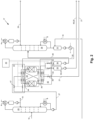
- Fig. 2 shows a first embodiment of an apparatus for recovering methoxypropanols 24 from an aqueous stream 16, 27.
- the apparatus 17 comprises an adsorption unit 28 comprising an adsorption agent for adsorbing the methoxypropanols and having at least one inlet 44 and at least one outlet 45.
- the adsorption agent may for example be based on activated charcoal.
- the apparatus 17 further comprises a buffer vessel 31 for storing a desorption agent 30 and a distillation unit 35 for separating the methoxypropanols 24 from the desorption agent 30.
- the distillation unit 35 is connected to the buffer vessel 31 for recycling the desorption agent 30.
- the apparatus 17 comprises first and second switching means 41, 42.
- the desorption agent buffer vessel 31 and a source of the aqueous stream, 16, 27, are connected to the inlet 44 of the adsorption unit 28 via the first switching means 41.
- the distillation unit 35 and a sink for a purified aqueous stream 21 are connected to the outlet 45 of the adsorption unit 28 via the second switching means 42.
- the switching means 41, 42 are configured for alternately passing the aqueous stream 16, 27 and the desorption agent 30 through the adsorption unit 28 to switch over between in an adsorption mode and a desorption mode of the adsorption unit 28.
- the propylene glycol separation unit 14 forms the source of the aqueous stream 16.
- the buffer vessel 31 is connected to the propylene glycol separation unit 14 in order to provide the reaction by-product propylene glycol 19 as make-up stream to the desorption agent 30.
- the second switching means 42 is connected to the propylene glycol separation unit 14 by means of a connecting line for recycling flushing effluents 49 obtained in a flushing mode of the adsorption unit 28 to the propylene glycol separation unit 14.
- the adsorption unit 28 contains at least two sections 28', 28", that are individually connected to the first 41 and second switching means 42 in such a way, that a first section 28' can be operated in an adsorption mode, while a second section 28"is operated in a desorption mode at the same time.
- the first 41 and second switching means 42 may comprise controllable valves 47, 46 that are actuated by a control unit 43.
- the first switching means 41 is configured such that either of the input streams, the aqueous stream 16, 27 and the desorption agent 30, can be fed into any one of the sections 28', 28" of the adsorption unit 28, independently.
- the second switching means 42 is preferably configured such that the effluent stream of each of the sections 28', 28" of the adsorption unit 28 can be discharged either to the distillation column 35, to the purified aqueous stream 21 or - as a flushing effluent 50, 51 - to the connecting line for recycling flushing effluents 49.
- a methanol stripping column 25 is arranged between the source of the aqueous stream 16 and the first switching means 41 in order to remove remaining methanol 18 from the aqueous stream 16 by distillation.
- the apparatus 17 When in operation, the apparatus 17 carries out the following process for recovering methoxypropanols 24 from the aqueous stream 16.
- the aqueous stream 16 besides water contains 1-methoxypropanol, 2-methoxypropanol and remnant methanol.
- methanol 18 Prior to passing the aqueous stream through the adsorption unit 28, methanol 18 is removed from the aqueous stream 16 by distillation, resulting in another aqueous stream 27, the bottoms stream of methanol stripping column 25, which is depleted by methanol. The recovered methanol 18 leaves the stripping column 25 overheads. In order to have a purified aqueous stream 27 that is depleted by practically all methanol 18, the distillation is carried out at a sump temperature that will also cause a certain amount of water leaving the stripping column 25 overheads.
- the methanol stream 18 thus may comprise a methanol/water mixture.
- the methanol/water mixture is partly fed back to the stripping column 25 as reflux and may be partly fed to the methanol separation section 11 of the plant for the production of propylene oxide. Thereby, additional methanol contained in the process water stream 16 is recovered and reused as solvent.
- the purified aqueous stream 21, depleted of methanol and methoxypropanols can be subject to further treatment, e.g. a biological waste water treatment unit (not shown), forming a sink for the purified aqueous stream 21.
- the adsorption unit 28 For recovering the methoxypropanols 24 adsorbed in the adsorption agent, the adsorption unit 28 is operated in a desorption mode, in which the methoxypropanols are desorbed from the adsorption agent.
- the step of desorbing the methoxypropanols comprises passing an alcohol as a desorption agent 30 through the adsorption unit 28 to desorb and discharge the methoxypropanols 24 from the adsorption agent.
- desorption agent 30 is pumped from the buffer vessel 31 through the adsorption unit 28 and to the buffer vessel 34 for desorption agent loaded with methoxypropanols.
- the loaded desorption agent 48 is fed to the methoxypropanol/desorption agent separation column 35.
- separation column 35 the methoxypropanols 24 are separated from the desorption agent 30 by distillation.
- the desorption agent 30 depleted by methoxypropanols leaves the separation column 35 as bottoms stream back to buffer vessel 31.
- the methoxypropanols 24 are discharged overheads.
- propylene glycol can be supplied from the propylene glycol separation unit 15 (cf. Fig. 1 ) as a glycol make-up stream 19.
- the desorption agent 30 is passed through the adsorption unit 28 at a temperature of at least 60 °C, more preferably of at least 70 °C, in order to improve desorption efficiency.
- the adsorption unit 28 is preferably flushed with the desorption agent 30 to displace remaining water in the adsorption unit 28 resulting in a desorption agent/water-mixture 20 being a first flushing effluent 50.
- the adsorption unit 28 is preferably flushed with the aqueous stream 27 to displace remaining desorption agent 30 in the adsorption unit 28 resulting in a desorption agent/water-mixture 20 being a second flushing effluent 51.
- Both flushing effluents 50, 51 may be collected in buffer vessel 33 and be returned via the connecting line for recycling flushing effluents 49 to the propylene glycol separation unit 14 (cf. Fig. 1 ).
- the regeneration of the adsorption unit 28 is preferably controlled by control unit 43.
- the control unit 43 may switch between adsorption, desorption and flushing modes of the adsorption unit 28 by controlling the first and second switching means 41, 42, accordingly.
- the switching between the modes may be carried out based on continuous monitoring of the adsorption unit's 28 effluents, e.g. by means of sensors 53, 54, 55.
- the loading condition of the adsorption unit 28 can be detected by analysis of the stream outgoing from the adsorption unit 28 for breakthrough of methoxypropanols by means of the first sensor 53.
- online analyzers are used for this task. Suitable analysis methods to be used are known to those skilled in the art.
- the adsorption unit 28, or a section 28', 28" thereof is considered as fully loaded, if a breakthrough of methoxypropanols in the outgoing water stream 21 is detected.
- the adsorption unit 28, or a section 28', 28" thereof is considered as fully loaded if a certain threshold concentration of methoxypropanols in the outgoing purified aqueous stream 21 is reached. In other words, in these embodiments a predefined "slip amount" of methoxypropanols in the outgoing purified aqueous stream 21 is allowed.
- the regeneration of the loaded adsorption unit 28, or a particular section 28', 28" thereof is preferably executed as follows:
- the still contained, remaining aqueous phase in the adsorption unit 28 is displaced by, preferably tempered, propylene glycol 30 from glycol buffer vessel 31.
- the resulting mixture of propylene glycol and water 20 is collected in the glycol/water buffering vessel 33 and from there pumped to the glycols recovery section 14 of the plant for the production of propylene oxide (cf. Fig. 1 ), where its glycol content is recovered from the water phase.
- propylene oxide cf. Fig. 1
- the progress of displacement of water from the adsorption unit 28 is determined by analyzing the outgoing stream for water, e.g. by means of the second sensor 54.
- online analyzers are used for this task. Suitable analysis methods are known to those skilled in the art.
- the flushing mode is terminated and the desorption mode is initiated.
- Methoxypropanols are desorbed from the adsorption unit 28, or a particular section 28', 28" thereof, by further propylene glycol 30 and the desorption agent/methoxypropanols mixture is collected in the desorption agent/methoxypropanols buffer vessel 34 and from there fed to the desorption agent/methoxypropanols separation column 35.
- the progress of the desorption process is determined by analyzing the outflowing stream for methoxypropanols, e.g. by means of a third sensor 55.
- online analyzers are used for this task. Suitable analysis methods are known to those skilled in the art.
- an azeotropic mixture of methoxypropanols and water is distilled overheads.
- the water content of this mixture is caused by the water content of the used desorption agent 30 on the one hand and a small water amount formed by thermal decomposition of the desorption agent during distillation on the other hand.
- the overheads stream 24 of column 35 containing 1-methoxypropanol, 2-methoxypropanol and water, is given to battery limits for further processing, preferably for combustion in an incineration unit and generating process steam.
- the desorption agent separated at the column bottoms 35 is collected in buffer vessel 31 and re-used for displacement/desorption.
- the desorption agent holdup within the adsorption unit 28 is displaced by a part of the bottoms stream 27 of the methanol stripping column 25.
- the outflowing desorption agent/water mixture is collected in desorption agent/water buffer vessel 33 and may be fed to the propylene glycol separation section 14 of a plant for the production of propylene oxide.
- the displacement of desorption agent from the adsorption unit 28 is monitored by analyzing the water content of the outflowing stream from the adsorption bed, e.g. by the second sensor 54. When the content of desorption agent is reduced to a predefined threshold level, the adsorption unit 28 is considered fully regenerated and ready for operation in adsorption mode, again.
- the adsorption unit 28 shown in Fig. 2 is divided in two separately operable sections 28', 28", whereof at least temporarily a first section 28', 28" is operated in an adsorption mode, while a second section 28", 28' is operated in a desorption mode at the same time.
- the sections 28', 28" may for example be operated independently in parallel with a shifted regeneration time schedule, such that at least one section 28', 28" is operating in adsorption mode at any time.
- Another possibility is to operate the section 28', 28" in series. Then, the first section of the series will absorb the largest part of methoxypropanols. It will therefore become fully loaded first and will be switched to regeneration. During regeneration of the first section, the sections downstream of the first section will be operated in adsorption mode alone. After regeneration of the first section, all sections will be operated in series again, preferably with the first section being then connected downstream of the other sections, as the last section of the series.
- the time schedule of adsorption and desorption/regeneration should be set up in a way that assures continuous operation regarding the aqueous stream to be treated by adsorption of methoxypropanols.
- the apparatus 17 may comprise also a system for heat recovery, in order to optimize energy consumption.
- the sensible heat of the bottoms stream 27 of the methanol stripping column 25 may be utilized for heating up the propylene glycol/methoxypropanol stream 48 from vessel 34 by heat exchange using a suitable heat exchanger.
- the sensible heat of the bottoms stream of glycol/methoxypropanol separation column 35 may be utilized for heating up the propylene glycol/water stream 20 from vessel 33 by heat exchange using a suitable heat exchanger.
- Fig. 3 shows a second embodiment of an apparatus 17 for recovering methoxypropanols 22, 23 from an aqueous stream 16, 27.
- the apparatus 17 shown in Fig. 3 differs by the fact that the mixed stream of methoxypropanols 24 being the overheads stream of column 35 is further treated in separation columns 36 and 38 for obtaining purified streams of 1-methoxypropanols 22 and 2-methoxypropanols 23.
- the overheads stream of separation column 35 is fed to a 2-methoxypropanol separation column 36.
- the 2-methoxypropanol separation column 36 the higher boiling 2-methoxypropanol 23 is separated as bottoms product.
- a mixture of 1-methoxypropanol and water 37 is distilled off.
- the water-containing 1-methoxypropanol 37 is fed to the 1-methoxypropanol-dewatering column 38.
- pure 1-methoxypropanol 22 is separated as bottoms product, while at the overhead of column 38, an azeotropic mixture of water and 1-methoxypropanol 37 is separated.
- the separation columns 36 and 38 share a common overheads system.
- the separated and condensed azeotropic mixture of 1-methoxypropanol and water 37 is similarly used as reflux to column 36 as well as reflux and as feed to column 38.
- a part of the azeotropic 1-methoxypropanol/water mixture 39 may be recycled to the bottoms of methanol stripping column 25.
- the 2-methoxypropanol separation column and the 1-methoxypropanol dewatering column are equipped with separate overhead condensing systems, comprising a condenser, a reflux vessel and a pump.
- the product stream of the 2-methoxypropanol separation column is fed to the 1-methoxypropanol dewatering column and the product stream of 1-methoxypropanol dewatering column is recycled to the bottom of the methanol stripping column.
- the embodiment of Fig. 3 may further be improved by utilizing the latent heat of the overheads stream 18 of the methanol stripping column 25 for heating of the reboilers of the 2-methoxypropanol separation column 36 and/or the 1-methoxypropanol dewatering column 38.
Landscapes
- Chemical & Material Sciences (AREA)
- Organic Chemistry (AREA)
- Crystallography & Structural Chemistry (AREA)
- Life Sciences & Earth Sciences (AREA)
- Hydrology & Water Resources (AREA)
- Engineering & Computer Science (AREA)
- Environmental & Geological Engineering (AREA)
- Water Supply & Treatment (AREA)
- Inorganic Chemistry (AREA)
- Chemical Kinetics & Catalysis (AREA)
- Epoxy Compounds (AREA)
Abstract
The invention relates to a process for recovering methoxypropanols (24) from an aqueous stream (16, 27), wherein the process comprises the steps of obtaining a purified aqueous stream (21) by passing the aqueous stream (16, 27) through an adsorption unit (28) containing an adsorption agent for adsorbing the methoxypropanols to the adsorption agent, desorbing the methoxypropanols from the adsorption agent, wherein the step of desorbing the methoxypropanols comprises passing an alcohol as a desorption agent (30) through the adsorption unit (28) to desorb and discharge the methoxypropanols (24) from the adsorption agent, separating the methoxypropanols (24) from the desorption agent (30) by distillation, an apparatus for recovering methoxypropanols using the aforementioned process and a plant for producing of propylene oxide comprising such an apparatus.
Description
- The invention is directed to a process and an apparatus for recovering 1-methoxy-2-propanol and 2-methoxy-1-propanol from an aqueous stream, in particular from an effluent stream formed in a process for making propylene oxide by epoxidation of propylene with hydrogen peroxide in an organic solvent, preferably methanol.
- The epoxidation of propylene with hydrogen peroxide in a methanol solvent, typically in the presence of a titanium zeolite epoxidation catalyst, has become a major industrial process for manufacturing propylene oxide. Since water is formed from hydrogen peroxide in the reaction and hydrogen peroxide is used as an aqueous solution, this process produces an aqueous effluent stream. Besides other by-products, which occur in smaller amounts, this aqueous effluent stream contains dissolved 1-methoxy-2-propanol and 2-methoxy-1-propanol formed as by-products from the reaction of propylene oxide with solvent methanol as main components.
- Recovering the methoxypropanols from the aqueous effluent stream is desirable not only because they have commercial value, but also for reducing the TOC (total organic carbon) of the aqueous effluent stream. By reducing the TOC of the aqueous effluent stream, it is possible to reduce the size and thereby the investment cost of a downstream biological wastewater treatment unit. Furthermore, removal of the methoxypropanols significantly lowers the operating cost of the biological wastewater treatment unit, which significantly contributes to the operating cost of a propylene oxide production process.
- In the literature, several processes and facilities for removing by-products of the propylene epoxidation from an aqueous stream are described. A major part of this bibliography discloses processes and devices based on extractive removal of such by-products from the water stream. As an example, representative for extractive processes, the process according to
WO 2021/204531 A1 is referred to. This process is directed to the recovery of methoxypropanols from an aqueous stream. - According to
WO 2021/204531 A1 , the aqueous stream is treated in an extraction column with an extracting agent in countercurrent. The extract stream is then separated by an extractive distillation, giving a bottoms stream, which is depleted of water content relative to the feed extract stream. This bottom stream is then distilled, drawing off a mixture of 1-methoxypropanol and 2-methoxypropanol overheads and recovered extracting agent as bottoms stream. - Due to the usage of extraction equipment, especially extraction columns, those processes are technically complex. Furthermore, a certain amount of the extracting agent remains in the treated water stream and causes the need for an additional separation step for its removal.
- In order to overcome the drawbacks of an extraction-based recovery process of methoxypropanols, several adsorption/desorption processes in the treatment of water streams have already been described in the patent literature:
US 5,999,955 A describes the treatment of a water stream from an epoxidation zone for the production of propylene oxide in order to remove heavy components like propyleneglycols and methoxypropanols. According toUS 5,999,955 A , the water phase is treated in a separation zone, such as an evaporator, a distillation zone or a sorption zone. From the sorption zone, a mixture of heavy organic components is recovered by desorption. The heavy organ-ics stream can be used as a solvent or can be further processed for the recovery of propylene glycol. - However,
US 5,999,955 A does not disclose how the desorption of heavy components is effected and which desorption mechanism is to be used. Furthermore,US 5,999,955 A does not disclose a process for the recovery of methoxypropanols from the wastewater or the heavy components stream. -
US 2016/0130160 A1 discloses a process for reducing the total organic carbon in wastewater from a process for the production of propylene oxide by combining an adsorbing agent and a reverse osmosis membrane. According toUS 2016/0130160 A1 , the waste water first passes an adsorbing agent, where a part of the contained oxygenates is adsorbed and after that passes a reverse osmosis membrane, where the water stream is furtherly depleted of oxygenates. In the process disclosed byUS 2016/0130160 A1 , the adsorbing agent mainly serves to protect of the reverse osmosis membrane from being deactivated by anthraquinone or anthraquinone derivatives from an upstream plant for the production of hydrogen peroxide, which is used as an oxidation agent in the process for the production of propylene oxide.US 2016/0130160 A1 furtherly discloses that all oxygenates can be adsorbed by the adsorbing agent for a certain time in case that the reverse osmosis membrane is spent and needs to be replaced or for the time that is needed to direct the waste water stream from a spent reverse osmosis membrane unit to a fresh one. - However,
US 2016/0130160 A1 does not disclose a process for the desorption or recovery of adsorbed compounds from the adsorbing agent. Furthermore,US 2016/0130160 A1 does not disclose a process for the recovery of methoxypropanols from the wastewater stream. - The object of the invention therefore is to provide a process and an apparatus for recovering methoxypropanols from an aqueous stream that effectively reduces the TOC of the aqueous stream, makes available the methoxypropanols for further use and is easy to integrate in a plant for producing propylene oxide.
- This object is achieved by the process for recovering methoxypropanols from an aqueous stream according to the features of
claim 1. - Hereby, a process for recovering methoxypropanols from an aqueous stream is provided, which comprises the steps of obtaining a purified aqueous stream by passing the aqueous stream through an adsorption unit containing an adsorption agent for adsorbing the methoxypropanols to the adsorption agent and afterwards desorbing the methoxypropanols from the adsorption agent. According to the invention, the step of desorbing the methoxypropanols comprises passing an alcohol as a desorption agent through the adsorption unit to desorb and discharge the methoxypropanols from the adsorption agent and separating the methoxypropanols from the desorption agent by distillation.
- According to the invention, the adsorption agent is regenerated by way of solvent desorption, using an alcohol as the desorption agent. As compared to purely thermal desorption, solvent desorption has the advantage that it results in a very efficient and effective desorption process in a rather short period of time and, moreover, allows the adsorption agent to stay within the adsorption unit during regeneration. The use of a liquid desorption agent for solvent desorption therefore has major advantages in a setup, in which large amounts of adsorption agent are to be regenerated on a regular basis. Further, using an alcohol as the desorption agent for desorbing methoxypropanols has the advantage that this combination is particularly well suited for a downstream separation by distillation, as the boiling points show a sufficient difference, and no azeotrope is formed. By means of distillation, both components can be put to a further use: The methoxypropanols may be used as a product of value and the alcohol may be reused as desorption agent. Recycling the desorption agent has the advantage that the distillation may be optimized to recover the methoxypropanols at a high purity, leaving remnants of methoxypropanols in the desorption agent, that do not harm in a further desorption process.
- In advantageous embodiments, a polyhydric alcohol, preferably propylene glycol is used as the desorption agent. Polyhydric alcohols show a particularly high selectivity for desorbing methoxypropanols and thus improve the desorption process. In particular, propylene glycol is a polyhydric alcohol that is typically produced as a by-product in plants for producing of propylene oxide, and thus can readily be used when integrating the process in a propylene oxide production plant.
- Preferably, the desorption is carried out at an elevated temperature compared to ambient temperature. The temperature of the desorption agent passed through the adsorption unit may preferably be at least 60 °C, and even more preferred, at least 70 °C. Desorption at elevated temperatures increases the efficiency of the desorption process, leading to reduced desorption times.
- In advantageous embodiments, prior to passing the aqueous stream through the adsorption unit, methanol is removed from the aqueous stream by distillation. Methanol is a contaminant that is typically present in effluent aqueous streams of propylene oxide production plants. When applying the process according to the invention it is preferred to remove the methanol prior to the adsorption unit, because methanol in the feed stream to the adsorption competes with methoxypropanols in regard to adsorption capacitiy and may cause problems in the methoxypropanol purification step. Furthermore it can be removed from the feed to the adsorption rather easily by way of distillation.
- Preferably, before the desorbing step is started, the adsorption unit is flushed with the desorption agent to displace remaining water in the adsorption unit resulting in a desorption agent/water-mixture forming a first flushing effluent. Flushing the adsorption unit before starting the desorption and discharging the first flushing effluent protects the desorption agent cycle from the introduction of and contamination with water.
- Further preferably, after the desorbing step, the adsorption unit is flushed with the aqueous stream to displace remaining desorption agent in the adsorption unit resulting in a desorption agent/water-mixture forming a second flushing effluent. Flushing the adsorption unit after the end of the desorption and discharging the second flushing effluent protects the purified aqueous stream from being contaminated by remaining desorption agent, when the adsorption process for the aqueous stream is started once again.
- In preferred embodiments, the adsorption unit is divided in at least two separately operable sections, whereof at least temporarily the first section is operated in an adsorption mode, while a second section is operated in a desorption mode at the same time. Having two sections of the adsorption unit that are separately operable in this way allows the adsorption unit to be operated continuously in adsorption mode with at least one of the sections, and thus being continuously able to treat an aqueous input stream. Desorption of the individual sections of the adsorption unit can thus be carried out on-line, without the need to stop the aqueous input stream in the meantime.
- The object is further solved by a process for producing propylene oxide, comprising the steps of
- catalytically oxidizing propylene with an aqueous hydrogen peroxide solution using methanol as solvent thereby obtaining a reaction mixture,
- separating from the reaction mixture
- unreacted propylene in a propylene separation unit to be recycled,
- propylene oxide as main reaction product in a propylene oxide separation unit,
- methanol as the solvent in a methanol separation unit to be recycled, and
- propylene glycol as a reaction by-product in a propylene glycol separation unit,
- leaving a remaining aqueous stream containing methoxypropanols.
- Preferably, the propylene glycol obtained as reaction by-product is used as the desorption agent. This has the advantage that the reaction by-product propylene glycol is put to direct use within the process for producing propylene oxide and the recovery of methoxypropanols can be integrated more easily into the process for producing propylene oxide.
- In particular, it is preferred, if the first flushing effluent and/or the second flushing effluent is recycled to the propylene glycol separation unit. In the combination of the use of propylene glycol as the desorption agent and recycling the flushing effluents to the propylene glycol separation unit, the advantages of flushing the adsorption unit prior and/or after desorption can be accomplished without the need for separate equipment for treating the flushing effluents. As the flushing effluents mainly comprise a mixture of water and desorption agent, i.e. in this case propylene glycol, the propylene glycol separation unit that is needed in the process for producing propylene oxide, anyhow, can be used for treating the flushing effluents, as well.
- In terms of apparatus features, the object is achieved by an apparatus for recovering methoxypropanols from an aqueous stream. The apparatus comprises an adsorption unit comprising an adsorption agent for adsorbing the methoxypropanols and having an inlet and an outlet. According to the invention, the apparatus further comprises a buffer vessel for storing a desorption agent, a distillation unit for separating the methoxypropanols from the desorption agent, and first and second switching means. The buffer vessel and a source of the aqueous stream are connected to the inlet via the first switching means and the distillation unit and a sink for a purified aqueous stream are connected to the outlet via the second switching means, for alternately passing the aqueous stream and the desorption agent through the adsorption unit to switch over between in an adsorption mode and a desorption mode of the adsorption unit. The distillation unit is connected to the buffer vessel for recycling the desorption agent.
- Preferably, between the source of the aqueous stream and the first switching means a methanol stripping column is arranged in order to remove methanol from the aqueous stream by distillation.
- Finally, the object is achieved by a plant for producing of propylene oxide. The plant comprises a reactor section for catalytically oxidizing propylene with an aqueous hydrogen peroxide solution using methanol as solvent thereby obtaining a reaction mixture. Downstream of the reactor section the plant further comprises a separation section for obtaining an aqueous stream from the reaction mixture. The separation section comprises a propylene separation unit for separating unreacted propylene from the reaction mixture to be recycled to the reactor section, a propylene oxide separation unit for separating and purifying propylene oxide from the reaction mixture as main reaction product, a methanol separation unit for separating methanol from the reaction mixture to be recycled to the reactor section, and a propylene glycol separation unit for separating propylene glycol from the reaction mixture as a reaction by-product. According to the invention, the plant comprises downstream of the separation section an apparatus for recovering methoxypropanols from the aqueous stream obtained by the separation section as described above.
- Preferably, in the plant for producing of propylene oxide the propylene glycol separation unit is connected to the buffer vessel in order to provide the reaction by-product propylene glycol as the desorption agent. By this connection, propylene glycol can be initially provided to the propylene glycol cycle and the propylene glycol cycle may be topped-up for any propylene glycol leaving the cycle, e.g. during flushing of the adsorption unit.
- In preferred embodiments, the second switching means is connected to the propylene glycol separation unit by means of a connecting line for recycling flushing effluents obtained in a flushing mode of the adsorption unit to the propylene glycol separation unit.
- Preferably, the adsorption unit contains at least two sections that are connected to the first and second switching means in such a way, that a first section can be operated in an adsorption mode, while a second section is operated in a desorption mode at the same time. Thereby a continuous operation in the adsorption mode is facilitated, while the sections of the adsorption unit may be regenerated on-line individually by desorption, when needed.
- Further advantages of the invention are described in the following with regard to the embodiments shown in the attached drawings.
-
- Fig. 1
- shows schematically a plant for producing of propylene oxide according to the invention, which comprises an apparatus for recovering methoxypro-panols from an aqueous stream,
- Fig. 2
- shows schematically a first embodiment of an apparatus for recovering 1-methoxypropanols and 2-methoxypropanols from an aqueous stream in a mixed methoxypropanol stream,
- Fig. 3
- shows schematically a second embodiment of an apparatus for recovering methoxypropanols from an aqueous stream comprising additional devices to separate the recovered 1-methoxypropanol and 2-methoxypropanol fractions by distillation.
- In the drawings same parts are consistently identified by the same reference signs and are therefore generally described and referred to only once.
- In
Fig. 1 , a plant for producing of propylene oxide, 10, is shown. In the plant,fresh propylene 1 andrecycled propylene 6 are fed into a reactor section 3 for catalytically oxidizing thepropylene hydrogen peroxide solution 2 using (recycled)methanol 12 as solvent. In the reactor section 3,propylene hydrogen peroxide 2, forming propylene oxide and water as a co-product. A resulting reaction mixture 4 is obtained and discharged via an outlet of the reactor section 3. - The reaction mixture 4 typically contains propylene oxide, water, unconverted propylene, methanol and oxygenated by-products, among them monopropylene glycol (MPG), 1-methoxypropanol (1-MPol) and 2-methoxypropanol (2-MPol). Further oxygenated by-products are high boiling compounds like dipropylene glycol (DPG) and tripropylene glycol (TPG) and their methylethers.
- Downstream of the reactor section 3 the plant comprises a
separation section 52. The separation section is used to separate several components of the reaction mixture 4 and to obtain anaqueous stream 16 that is left over at the end of theseparation section 52. In detail theseparation section 52 comprises at least - a
propylene separation unit 5 for separatingunreacted propylene 6 from the reaction mixture 4 to be recycled to the reactor section 3, leaving behind a reaction mixture depleted bypropylene 7, - a propylene oxide separation unit 8 for separating
propylene oxide 10 from thereaction mixture 7 as main reaction product of the plant, leaving behind a reaction mixture depleted by propylene oxide, 9, - a
methanol separation unit 11 for separatingmethanol 12 from the reaction mixture 9 to be recycled to the reactor section 3 as solvent, leaving behind a reaction mixture depleted by methanol 13, and - a propylene
glycol separation unit 14 for separatingpropylene glycol 15 from the reaction mixture 13 as a reaction by-product and other high boilingcomponents 40, leaving behind anaqueous stream 16. - After having passed the
methanol separation unit 11, the reaction mixture depleted by methanol, 13, contains propylene glycols (MPG, DPG, TPG) and their methylethers, as well as other high boiling organic components and dissolved salts. Furthermore, the reaction mixture depleted by methanol 13 contains methoxypropanols, in particular 1-methoxypropanol and 2-methoxypropanol. - The reaction mixture depleted by methanol 13 is fed to the propylene glycol (PG)
separation unit 14, in whichpropylene glycol 15 is separated. The propyleneglycol separation unit 14 may further comprise a purification unit, in whichpropylene glycol 15 is purified, e.g. by evaporation and distillation, resulting in a purifiedpropylene glycol stream 15 and amixed stream 40. In this case, themixed stream 40 comprises higher glycols and possibly other higher boiling compounds that are separated from thepropylene glycol 15, which mainly comprises monopropylene glycol. - The
aqueous stream 16 leaving the propyleneglycol separation unit 14 is depleted by glycols and contains methoxypropanols and possibly methanol residues as main contaminants as well as traces of other organic components. Especially methanol and methoxypropanols need to be reduced before theaqueous stream 16 can be treated in a conventional waste-water treatment plant in order to reduce investment and operational cost for said waste-water treatment plant. - To this end, the plant for production of propylene oxide comprises an
apparatus 17 for recovering methoxypropanols from theaqueous stream 16 according to the invention that will be described in more detail below with regard toFig. 2 and3 . - As shown in
Fig. 1 , theapparatus 17 for recovering methoxypropanols is preferably integrated into the plant for producing propylene oxide as follows:
Theapparatus 17 treats theaqueous stream 16 by means of an adsorption unit, resulting in a purifiedaqueous stream 21. Theapparatus 17 optionally contains a methanol stripping column in order to recover remainingmethanol 18 from theaqueous stream 16 by distillation. The recoveredmethanol 18 is then preferably fed back to themethanol separation unit 11 and/or recycled to the reactor section 3 asrecycled methanol 12. - On a regular basis, the adsorption unit needs to be regenerated by means of desorption using a desorption agent. Preferably, the
apparatus 17 makes use of the reaction by-product propylene glycol 15 as the desorption agent. To this end, it is advantageous to branch off at least a partial stream ofpropylene glycol 19 from the by-product propylene glycol 15 and feed it to theapparatus 17 as a source of desorption agent. - In order to make sure that water is not introduced into the desorption agent cycle and that remnants of desorption agent are not introduced into the purified
aqueous stream 21, it is advantageous to flush the adsorption unit with desorption agent before desorption agent and after desorption flushing the adsorption unit with aqueous stream. The flushing effluents, being desorption agent/water mixtures, 20, are preferably returned to the propyleneglycol separation unit 14. - From the desorption agent loaded with methoxypropanols the methoxypropanols are separated by distillation. Depending on the embodiment of the
apparatus 17, the methoxypropanols may be discharged from theapparatus 17 as a stream ofmixed methoxypropanols 24, or it may contain additional means for obtaining purified 1-methoxypropanol 22 and purified 2-methoxypropanol 23. -
Fig. 2 shows a first embodiment of an apparatus for recovering methoxypropanols 24 from anaqueous stream apparatus 17 comprises anadsorption unit 28 comprising an adsorption agent for adsorbing the methoxypropanols and having at least oneinlet 44 and at least oneoutlet 45. The adsorption agent may for example be based on activated charcoal. - The
apparatus 17 further comprises abuffer vessel 31 for storing adesorption agent 30 and adistillation unit 35 for separating themethoxypropanols 24 from thedesorption agent 30. Thedistillation unit 35 is connected to thebuffer vessel 31 for recycling thedesorption agent 30. - Also, the
apparatus 17 comprises first and second switching means 41, 42. The desorptionagent buffer vessel 31 and a source of the aqueous stream, 16, 27, are connected to theinlet 44 of theadsorption unit 28 via the first switching means 41. Thedistillation unit 35 and a sink for a purifiedaqueous stream 21 are connected to theoutlet 45 of theadsorption unit 28 via the second switching means 42. The switching means 41, 42 are configured for alternately passing theaqueous stream desorption agent 30 through theadsorption unit 28 to switch over between in an adsorption mode and a desorption mode of theadsorption unit 28. - Within the plant for producing propylene oxide shown in
Fig. 1 , the propyleneglycol separation unit 14 forms the source of theaqueous stream 16. Preferably, thebuffer vessel 31 is connected to the propyleneglycol separation unit 14 in order to provide the reaction by-product propylene glycol 19 as make-up stream to thedesorption agent 30. Further preferably, the second switching means 42 is connected to the propyleneglycol separation unit 14 by means of a connecting line for recycling flushing effluents 49 obtained in a flushing mode of theadsorption unit 28 to the propyleneglycol separation unit 14. - In advantageous embodiments as shown in
Fig. 2 , theadsorption unit 28 contains at least twosections 28', 28", that are individually connected to the first 41 and second switching means 42 in such a way, that a first section 28' can be operated in an adsorption mode, while asecond section 28"is operated in a desorption mode at the same time. The first 41 and second switching means 42 may comprisecontrollable valves control unit 43. Preferably, the first switching means 41 is configured such that either of the input streams, theaqueous stream desorption agent 30, can be fed into any one of thesections 28', 28" of theadsorption unit 28, independently. The second switching means 42 is preferably configured such that the effluent stream of each of thesections 28', 28" of theadsorption unit 28 can be discharged either to thedistillation column 35, to the purifiedaqueous stream 21 or - as a flushing effluent 50, 51 - to the connecting line for recycling flushing effluents 49. - In the preferred embodiment shown in
Fig. 2 , in the apparatus 17 amethanol stripping column 25 is arranged between the source of theaqueous stream 16 and the first switching means 41 in order to remove remainingmethanol 18 from theaqueous stream 16 by distillation. - When in operation, the
apparatus 17 carries out the following process for recovering methoxypropanols 24 from theaqueous stream 16. Theaqueous stream 16 besides water contains 1-methoxypropanol, 2-methoxypropanol and remnant methanol. - Prior to passing the aqueous stream through the
adsorption unit 28,methanol 18 is removed from theaqueous stream 16 by distillation, resulting in anotheraqueous stream 27, the bottoms stream ofmethanol stripping column 25, which is depleted by methanol. The recoveredmethanol 18 leaves the strippingcolumn 25 overheads. In order to have a purifiedaqueous stream 27 that is depleted by practically allmethanol 18, the distillation is carried out at a sump temperature that will also cause a certain amount of water leaving the strippingcolumn 25 overheads. Themethanol stream 18 thus may comprise a methanol/water mixture. The methanol/water mixture is partly fed back to the strippingcolumn 25 as reflux and may be partly fed to themethanol separation section 11 of the plant for the production of propylene oxide. Thereby, additional methanol contained in theprocess water stream 16 is recovered and reused as solvent. - The
aqueous stream 27 of themethanol stripping column 25, containing water, 1-methoxypropanol and 2-methoxypropanol, is then fed to theadsorption unit 28, In an adsorption mode of theadsorption unit 28, a purifiedaqueous stream 21 is obtained by passing theaqueous stream 27 through theadsorption unit 28 that contains an adsorption agent for adsorbing the methoxypropanols to the adsorption agent. The purifiedaqueous stream 21, depleted of methanol and methoxypropanols, can be subject to further treatment, e.g. a biological waste water treatment unit (not shown), forming a sink for the purifiedaqueous stream 21. - For recovering the
methoxypropanols 24 adsorbed in the adsorption agent, theadsorption unit 28 is operated in a desorption mode, in which the methoxypropanols are desorbed from the adsorption agent. The step of desorbing the methoxypropanols comprises passing an alcohol as adesorption agent 30 through theadsorption unit 28 to desorb and discharge themethoxypropanols 24 from the adsorption agent. - To this end,
desorption agent 30 is pumped from thebuffer vessel 31 through theadsorption unit 28 and to thebuffer vessel 34 for desorption agent loaded with methoxypropanols. Frombuffer vessel 34 the loadeddesorption agent 48 is fed to the methoxypropanol/desorptionagent separation column 35. Withinseparation column 35 themethoxypropanols 24 are separated from thedesorption agent 30 by distillation. Thedesorption agent 30 depleted by methoxypropanols leaves theseparation column 35 as bottoms stream back tobuffer vessel 31. The methoxypropanols 24 are discharged overheads. - Preferably, a polyhydric alcohol, and even more preferred propylene glycol is used as the desorption agent. As already discussed before, propylene glycol can be supplied from the propylene glycol separation unit 15 (cf.
Fig. 1 ) as a glycol make-upstream 19. - Preferably, the
desorption agent 30 is passed through theadsorption unit 28 at a temperature of at least 60 °C, more preferably of at least 70 °C, in order to improve desorption efficiency. - Before the desorbing step is started, the
adsorption unit 28 is preferably flushed with thedesorption agent 30 to displace remaining water in theadsorption unit 28 resulting in a desorption agent/water-mixture 20 being a first flushing effluent 50. After the desorbing step theadsorption unit 28 is preferably flushed with theaqueous stream 27 to displace remainingdesorption agent 30 in theadsorption unit 28 resulting in a desorption agent/water-mixture 20 being a second flushing effluent 51. Both flushing effluents 50, 51 may be collected inbuffer vessel 33 and be returned via the connecting line for recycling flushing effluents 49 to the propylene glycol separation unit 14 (cf.Fig. 1 ). - The regeneration of the
adsorption unit 28 is preferably controlled bycontrol unit 43. Thecontrol unit 43 may switch between adsorption, desorption and flushing modes of theadsorption unit 28 by controlling the first and second switching means 41, 42, accordingly. The switching between the modes may be carried out based on continuous monitoring of the adsorption unit's 28 effluents, e.g. by means ofsensors - In particular, in the adsorption mode, the loading condition of the
adsorption unit 28 can be detected by analysis of the stream outgoing from theadsorption unit 28 for breakthrough of methoxypropanols by means of thefirst sensor 53. Preferably, online analyzers are used for this task. Suitable analysis methods to be used are known to those skilled in the art. - In a preferred embodiment of the invention, the
adsorption unit 28, or asection 28', 28" thereof, is considered as fully loaded, if a breakthrough of methoxypropanols in theoutgoing water stream 21 is detected. In a furtherly preferred embodiment of the invention, theadsorption unit 28, or asection 28', 28" thereof, is considered as fully loaded if a certain threshold concentration of methoxypropanols in the outgoing purifiedaqueous stream 21 is reached. In other words, in these embodiments a predefined "slip amount" of methoxypropanols in the outgoing purifiedaqueous stream 21 is allowed. - After having detected the loading condition, the regeneration of the loaded
adsorption unit 28, or aparticular section 28', 28" thereof, is preferably executed as follows: - From the loaded
adsorption unit 28, or asection 28', 28" thereof, the still contained, remaining aqueous phase in theadsorption unit 28 is displaced by, preferably tempered,propylene glycol 30 fromglycol buffer vessel 31. The resulting mixture of propylene glycol andwater 20 is collected in the glycol/water buffering vessel 33 and from there pumped to theglycols recovery section 14 of the plant for the production of propylene oxide (cf.Fig. 1 ), where its glycol content is recovered from the water phase. During this flushing mode, the methoxypropanols contained in the glycol/water mixture remain in the glycol/water phase and subsequently are recycled to theadsorption unit 28 with thewater stream 16. - The progress of displacement of water from the
adsorption unit 28 is determined by analyzing the outgoing stream for water, e.g. by means of thesecond sensor 54. Preferably, online analyzers are used for this task. Suitable analysis methods are known to those skilled in the art. - When the water content in the flushing effluent 50 has been reduced to a predefined water threshold level, the flushing mode is terminated and the desorption mode is initiated.
- Methoxypropanols are desorbed from the
adsorption unit 28, or aparticular section 28', 28" thereof, byfurther propylene glycol 30 and the desorption agent/methoxypropanols mixture is collected in the desorption agent/methoxypropanols buffer vessel 34 and from there fed to the desorption agent/methoxypropanols separation column 35. The progress of the desorption process is determined by analyzing the outflowing stream for methoxypropanols, e.g. by means of athird sensor 55. Preferably, online analyzers are used for this task. Suitable analysis methods are known to those skilled in the art. - In the desorption agent/
methoxypropanols separation column 35, an azeotropic mixture of methoxypropanols and water is distilled overheads. The water content of this mixture is caused by the water content of the useddesorption agent 30 on the one hand and a small water amount formed by thermal decomposition of the desorption agent during distillation on the other hand. The overheads stream 24 ofcolumn 35, containing 1-methoxypropanol, 2-methoxypropanol and water, is given to battery limits for further processing, preferably for combustion in an incineration unit and generating process steam. - The desorption agent separated at the
column bottoms 35 is collected inbuffer vessel 31 and re-used for displacement/desorption. Desorption agent frombattery limits 19, preferably propylene glycol from the propyleneglycol separation unit 14 of a plant for the production of propylene oxide, is used for make-up. - After the regeneration/desorption phase, the desorption agent holdup within the
adsorption unit 28 is displaced by a part of the bottoms stream 27 of themethanol stripping column 25. The outflowing desorption agent/water mixture is collected in desorption agent/water buffer vessel 33 and may be fed to the propyleneglycol separation section 14 of a plant for the production of propylene oxide. The displacement of desorption agent from theadsorption unit 28 is monitored by analyzing the water content of the outflowing stream from the adsorption bed, e.g. by thesecond sensor 54. When the content of desorption agent is reduced to a predefined threshold level, theadsorption unit 28 is considered fully regenerated and ready for operation in adsorption mode, again. - In order to ensure a continuous treatment of the
aqueous stream 27 in theadsorption unit 28, even inspite of the need of regular regeneration, theadsorption unit 28 shown inFig. 2 is divided in two separatelyoperable sections 28', 28", whereof at least temporarily afirst section 28', 28" is operated in an adsorption mode, while asecond section 28", 28' is operated in a desorption mode at the same time. - The
sections 28', 28" may for example be operated independently in parallel with a shifted regeneration time schedule, such that at least onesection 28', 28" is operating in adsorption mode at any time. - Another possibility is to operate the
section 28', 28" in series. Then, the first section of the series will absorb the largest part of methoxypropanols. It will therefore become fully loaded first and will be switched to regeneration. During regeneration of the first section, the sections downstream of the first section will be operated in adsorption mode alone. After regeneration of the first section, all sections will be operated in series again, preferably with the first section being then connected downstream of the other sections, as the last section of the series. - In both cases, the time schedule of adsorption and desorption/regeneration should be set up in a way that assures continuous operation regarding the aqueous stream to be treated by adsorption of methoxypropanols.
- The
apparatus 17 may comprise also a system for heat recovery, in order to optimize energy consumption. In particular, the sensible heat of the bottoms stream 27 of themethanol stripping column 25 may be utilized for heating up the propylene glycol/methoxypropanol stream 48 fromvessel 34 by heat exchange using a suitable heat exchanger. In addition or alternatively, the sensible heat of the bottoms stream of glycol/methoxypropanol separation column 35 may be utilized for heating up the propylene glycol/water stream 20 fromvessel 33 by heat exchange using a suitable heat exchanger. -
Fig. 3 shows a second embodiment of anapparatus 17 for recoveringmethoxypropanols aqueous stream - In comparison to the first embodiment shown in
Fig. 2 theapparatus 17 shown inFig. 3 differs by the fact that the mixed stream ofmethoxypropanols 24 being the overheads stream ofcolumn 35 is further treated inseparation columns methoxypropanols 23. - To this end, the overheads stream of
separation column 35 is fed to a 2-methoxypropanol separation column 36. In the 2-methoxypropanol separation column 36, the higher boiling 2-methoxypropanol 23 is separated as bottoms product. At the top of theseparation column 36, a mixture of 1-methoxypropanol andwater 37, is distilled off. - The water-containing 1-
methoxypropanol 37 is fed to the 1-methoxypropanol-dewateringcolumn 38. In this column, pure 1-methoxypropanol 22, is separated as bottoms product, while at the overhead ofcolumn 38, an azeotropic mixture of water and 1-methoxypropanol 37 is separated. In this embodiment of the invention, theseparation columns water 37, is similarly used as reflux tocolumn 36 as well as reflux and as feed tocolumn 38. A part of the azeotropic 1-methoxypropanol/water mixture 39 may be recycled to the bottoms ofmethanol stripping column 25. - Alternatively (not shown), the 2-methoxypropanol separation column and the 1-methoxypropanol dewatering column are equipped with separate overhead condensing systems, comprising a condenser, a reflux vessel and a pump. In this embodiment, the product stream of the 2-methoxypropanol separation column is fed to the 1-methoxypropanol dewatering column and the product stream of 1-methoxypropanol dewatering column is recycled to the bottom of the methanol stripping column.
- Regarding heat recovery, the embodiment of
Fig. 3 may further be improved by utilizing the latent heat of the overheads stream 18 of themethanol stripping column 25 for heating of the reboilers of the 2-methoxypropanol separation column 36 and/or the 1-methoxypropanol dewatering column 38. - In all other respects, the above description of the first embodiment shown in
Fig. 2 applies to the embodiment ofFig. 3 , accordingly. -
- 1
- Fresh propylene
- 2
- Aqueous hydrogen peroxide solution
- 3
- Reactor section
- 4
- Reaction mixture
- 5
- Propylene separation unit
- 6
- Recycle propylene
- 7
- Reaction mixture depleted by propylene
- 8
- Propylene oxide separation unit
- 9
- Reaction mixture depleted by propylene oxide
- 10
- Purified propylene oxide
- 11
- Methanol separation unit
- 12
- Methanol to be recycled
- 13
- Reaction mixture depleted by methanol
- 14
- Propylene glycol separation unit
- 15
- Purified propylene glycol
- 16
- Aqueous stream of process water from propylene oxide plant
- 17
- Apparatus for recovering methoxypropanols from an aqueous stream
- 18
- Removed methanol (diluted with water)
- 19
- Glycol make-up stream
- 20
- Desorption agent/water mixture
- 21
- Purified aqueous stream
- 22
- Purified 1-methoxypropanol
- 23
- Purified 2-methoxypropanol
- 24
- Mixed methoxypropanols
- 25
- Methanol stripping column
- 26
- 2-methoxypropanol separation column
- 27
- Bottoms stream of methanol stripping column, depleted by methanol
- 28
- Adsorption unit
- 28', 28"
- Separately operable sections
- 30
- Desorption agent
- 31
- Buffer vessel for desorption agent
- 33
- Buffer vessel for flushing effluents
- 34
- Buffer vessel for desorption agent loaded with methoxypropanols
- 35
- Methoxypropanol/desorption agent separation column
- 36
- 2-methoxypropanol separation column
- 37
- 1-methoxypropanol/water mixture
- 38
- 1-methoxypropanol dewatering column
- 39
- 1-methoxypropanol /water recycle stream
- 40
- Mixed stream
- 41
- First switching means
- 42
- Second switching means
- 43
- Control unit
- 44
- Inlet
- 45
- Outlet
- 46
- Valves of second switching means
- 47
- Valves of first switching means
- 48
- Desorption agent loaded with methoxypropanols
- 49
- Connecting line for recycling flushing effluents
- 50
- First flushing effluent
- 51
- Second flushing effluent
- 52
- Separation section
- 53, 54, 55
- Sensors
Claims (16)
- Process for recovering methoxypropanols (22, 23, 24) from an aqueous stream (16, 27), wherein the process comprises the steps of:obtaining a purified aqueous stream (21) by passing the aqueous stream (16, 27) through an adsorption unit (28) containing an adsorption agent for adsorbing the methoxypropanols to the adsorption agent,desorbing the methoxypropanols from the adsorption agent,characterized in that the step of desorbing the methoxypropanols comprisespassing an alcohol as a desorption agent (30) through the adsorption unit (28) to desorb and discharge the methoxypropanols (22, 23, 24) from the adsorption agent,separating the methoxypropanols (22, 23, 24) from the desorption agent (30) by distillation.
- Process according to claim 1, characterized in that a polyhydric alcohol, preferably propylene glycol is used as the desorption agent (30).
- Process according to claim 1 or 2, characterized in that the desorption agent (30) is passed through the adsorption unit (28) at a temperature of at least 60 °C, preferably at least 70 °C.
- Process according to any one of the claims 1 to 3, characterized in that prior to passing the aqueous stream (27) through the adsorption unit (28), methanol (18) is removed from the aqueous stream (16) by distillation.
- Process according to any one of the claims 1 to 4, characterized in that before the desorbing step is started, the adsorption unit (28) is flushed with the desorption agent (30) to displace remaining water in the adsorption unit (28) resulting in a desorption agent/water-mixture (20) forming a first flushing effluent (50).
- Process according to any one of the claims 1 to 5, characterized in that after the desorbing step the adsorption unit (28) is flushed with the aqueous stream (16, 27) to displace remaining desorption agent (30) in the adsorption unit (28) resulting in a desorption agent/water-mixture (20) forming a second flushing effluent (51).
- Process according to any one of the claims 1 to 6, characterized in that the adsorption unit (28) is divided in at least two separately operable sections (28', 28"), whereof at least temporarily a first section (28') is operated in an adsorption mode, while a second section (28") is operated in a desorption mode at the same time.
- Process for producing of propylene oxide (10), comprising the steps ofcatalytically oxidizing propylene (1, 6) with an aqueous hydrogen peroxide solution (2) using methanol (12) as solvent thereby obtaining a reaction mixture (4),separating from the reaction mixture (4)unreacted propylene (6) in a propylene separation unit (5) to be recycled, propylene oxide (10) as main reaction product in a propylene oxide separation unit (8),methanol (12) as the solvent in a methanol separation unit (11) to be recycled, and propylene glycol (15) as a reaction by-product in a propylene glycol separation unit (14),leaving a remaining aqueous stream containing methoxypropanols (16),characterized in that methoxypropanols (22, 23, 24) are recovered from the aqueous stream (16) using the process according to any one of the claims 1 to 7.
- Process according to claim 8, characterized in that the propylene glycol (15) obtained as reaction by-product is used as the desorption agent (30).
- Process according to claim 9 and claim 5 and 6, characterized in that the first flushing effluent (51) and/or the second flushing effluent (52) is recycled to the propylene glycol separation unit (14).
- Apparatus for recovering methoxypropanols (22, 23, 24) from an aqueous stream (16, 27), comprising:an adsorption unit (28) comprising an adsorption agent for adsorbing the methoxypropanols and having an inlet (44) and an outlet (45),
characterized in that the apparatus (17) further comprisesa buffer vessel (31) for storing a desorption agent (30),a distillation unit (35) for separating the methoxypropanols (22, 23, 24) from the desorption agent (30), andfirst and second switching means (41, 42),wherein the buffer vessel (31) and a source of the aqueous stream (16, 27) are connected to the inlet (44) via the first switching means (41) and the distillation unit (35) and a sink for a purified aqueous stream (21) are connected to the outlet via the second switching means (42), for alternately passing the aqueous stream (16, 27) and the desorption agent (30) through the adsorption unit (28) to switch over between in an adsorption mode and a desorption mode of the adsorption unit (28),wherein the distillation unit (35) is connected to the buffer vessel (31) for recycling the desorption agent (30). - Apparatus according to claim 11, characterized in that between the source of the aqueous stream (16) and the first switching means (41) a methanol stripping column (25) is arranged in order to remove methanol (18) from the aqueous stream (16) by distillation.
- Plant for producing of propylene oxide (10), comprisinga reactor section (3) for catalytically oxidizing propylene (1, 6) with an aqueous hydrogen peroxide solution (2) using methanol (12) as solvent thereby obtaining a reaction mixture (4),and downstream of the reactor section (3) a separation section (52) for obtaining an aqueous stream (16, 27) from the reaction mixture (4), the separation section (52) comprisinga propylene separation unit (5) for separating unreacted propylene (6) from the reaction mixture (4) to be recycled to the reactor section (3),a propylene oxide separation unit (8) for separating propylene oxide (10) from the reaction mixture (4) as main reaction product,a methanol separation unit (11) for separating methanol (12) from the reaction mixture (4) to be recycled to the reactor section (3), anda propylene glycol separation unit (14) for separating propylene glycol (15) from the reaction mixture (4) as a reaction by-product,characterized in that the plant comprises downstream of the separation section (52) an apparatus (17) for recovering methoxypropanols according to claim 11 or 12 from the aqueous stream (16) obtained by the separation section (52).
- Plant for producing of propylene oxide according to claim 13, characterized in that the propylene glycol separation unit (14) is connected to the buffer vessel (31) in order to provide the reaction by-product propylene glycol (19) as the desorption agent (30).
- Plant for producing of propylene oxide according to claim 13 or 14, characterized in that the second switching means (42) is connected to the propylene glycol separation unit (14) by means of a connecting line for recycling flushing effluents (49) obtained in a flushing mode of the adsorption unit (28) to the propylene glycol separation unit (14).
- Plant for producing of propylene oxide according to any one of the claims 13 to 15, characterized in that the adsorption unit (28) contains at least two sections (28', 28"), that are connected to the first (41) and second switching means (42) in such a way, that a first section (28') can be operated in an adsorption mode, while a second section (28") is operated in a desorption mode at the same time.
Priority Applications (1)
| Application Number | Priority Date | Filing Date | Title |
|---|---|---|---|
| EP23184784.9A EP4403238A1 (en) | 2023-07-11 | 2023-07-11 | Process and apparatus for recovering methoxypropanols from an aqueous stream |
Applications Claiming Priority (1)
| Application Number | Priority Date | Filing Date | Title |
|---|---|---|---|
| EP23184784.9A EP4403238A1 (en) | 2023-07-11 | 2023-07-11 | Process and apparatus for recovering methoxypropanols from an aqueous stream |
Publications (1)
| Publication Number | Publication Date |
|---|---|
| EP4403238A1 true EP4403238A1 (en) | 2024-07-24 |
Family
ID=87245708
Family Applications (1)
| Application Number | Title | Priority Date | Filing Date |
|---|---|---|---|
| EP23184784.9A Withdrawn EP4403238A1 (en) | 2023-07-11 | 2023-07-11 | Process and apparatus for recovering methoxypropanols from an aqueous stream |
Country Status (1)
| Country | Link |
|---|---|
| EP (1) | EP4403238A1 (en) |
Citations (8)
| Publication number | Priority date | Publication date | Assignee | Title |
|---|---|---|---|---|
| GB1384315A (en) * | 1971-04-13 | 1975-02-19 | Framcorporation | Waste treatment |
| US3979287A (en) * | 1974-07-12 | 1976-09-07 | Rohm And Haas Company | Adsorption process |
| US4141826A (en) * | 1977-03-30 | 1979-02-27 | The Standard Oil Company | Treatment of acrylonitrile waste water with activated carbon |
| US5599955A (en) * | 1996-02-22 | 1997-02-04 | Uop | Process for producing propylene oxide |
| US5999955A (en) | 1994-09-30 | 1999-12-07 | Ford Global Technologies, Inc. | Delay generation filter |
| US7439405B1 (en) * | 2008-01-14 | 2008-10-21 | Lyondell Chemical Technology, L.P. | Purification of propylene glycol monoalkyl ether |
| US20160130160A1 (en) | 2013-06-04 | 2016-05-12 | Basf Se | Process for reducing the total organic carbon in wastewater |
| WO2021204531A1 (en) | 2020-04-06 | 2021-10-14 | Evonik Operations Gmbh | Process and facility for recovering methoxypropanols from an aqueous stream |
-
2023
- 2023-07-11 EP EP23184784.9A patent/EP4403238A1/en not_active Withdrawn
Patent Citations (8)
| Publication number | Priority date | Publication date | Assignee | Title |
|---|---|---|---|---|
| GB1384315A (en) * | 1971-04-13 | 1975-02-19 | Framcorporation | Waste treatment |
| US3979287A (en) * | 1974-07-12 | 1976-09-07 | Rohm And Haas Company | Adsorption process |
| US4141826A (en) * | 1977-03-30 | 1979-02-27 | The Standard Oil Company | Treatment of acrylonitrile waste water with activated carbon |
| US5999955A (en) | 1994-09-30 | 1999-12-07 | Ford Global Technologies, Inc. | Delay generation filter |
| US5599955A (en) * | 1996-02-22 | 1997-02-04 | Uop | Process for producing propylene oxide |
| US7439405B1 (en) * | 2008-01-14 | 2008-10-21 | Lyondell Chemical Technology, L.P. | Purification of propylene glycol monoalkyl ether |
| US20160130160A1 (en) | 2013-06-04 | 2016-05-12 | Basf Se | Process for reducing the total organic carbon in wastewater |
| WO2021204531A1 (en) | 2020-04-06 | 2021-10-14 | Evonik Operations Gmbh | Process and facility for recovering methoxypropanols from an aqueous stream |
Similar Documents
| Publication | Publication Date | Title |
|---|---|---|
| RU2672877C2 (en) | Method for producing butadiene and hydrogen from ethanol in two reaction steps with low water and power consumption | |
| US4374283A (en) | Purification of aqueous effluent streams containing BPA and phenol | |
| EP1594803B1 (en) | Extraction of phenol from wastewater | |
| JPH041147A (en) | Separation of impurities in aqueous solution of crude ethanol | |
| JP2602713B2 (en) | Recovery method of ethylene oxide / glycol | |
| JP2005506694A (en) | Central carbon dioxide purifier | |
| KR20130113310A (en) | System and method for reduction of water consumption in purified telephthalic acid production | |
| EP3966189B1 (en) | Methods of chemical recovery for propylene oxide-styrene monomer processes | |
| JP5150757B2 (en) | Carbon dioxide recovery | |
| US4026791A (en) | Treatment of aqueous waste | |
| JP2009515967A (en) | Recovery of cumene hydroperoxide decomposition products by distillation | |
| RU2235710C2 (en) | High-purity monoethylene glycol production process | |
| CN105408297B (en) | For continuously reclaiming (methyl) acrylic acid and device for the method | |
| KR101435569B1 (en) | Method for recovering acetic acid in preparing aromatic carboxylic acid | |
| JPH11347536A (en) | Treatment of phenol-containing wastewater | |
| EP2657192B1 (en) | Reducing organic impurities in waste water | |
| KR100774803B1 (en) | Method of removing methanol from waste gas | |
| EP1237638A2 (en) | Method and apparatus for purifying low grade acetonitrile and other constituents from hazardous waste | |
| CN218371988U (en) | Contain processing of benzene waste water and recovery unit of benzene | |
| JP5802115B2 (en) | Method for purifying crude terephthalic acid | |
| JP4224877B2 (en) | Method for producing purified phenol | |
| WO2015030396A1 (en) | Method and device for continuously recovering (meth)acrylic acid | |
| RU2258044C1 (en) | Method of treating process waste waters containing dimethylacetamide and isobutyl alcohol | |
| JPH01139124A (en) | Method for recovering and purifying ketone solvent | |
| RU2367623C2 (en) | Method for purification of dimethylamide-containing process water |
Legal Events
| Date | Code | Title | Description |
|---|---|---|---|
| PUAI | Public reference made under article 153(3) epc to a published international application that has entered the european phase |
Free format text: ORIGINAL CODE: 0009012 |
|
| STAA | Information on the status of an ep patent application or granted ep patent |
Free format text: STATUS: THE APPLICATION HAS BEEN PUBLISHED |
|
| AK | Designated contracting states |
Kind code of ref document: A1 Designated state(s): AL AT BE BG CH CY CZ DE DK EE ES FI FR GB GR HR HU IE IS IT LI LT LU LV MC ME MK MT NL NO PL PT RO RS SE SI SK SM TR |
|
| STAA | Information on the status of an ep patent application or granted ep patent |
Free format text: STATUS: THE APPLICATION IS DEEMED TO BE WITHDRAWN |
|
| 18D | Application deemed to be withdrawn |
Effective date: 20250125 |