EP4399236B1 - Abbaubare härtungsmittel, zusammensetzungen und härtbare zusammensetzungen davon - Google Patents
Abbaubare härtungsmittel, zusammensetzungen und härtbare zusammensetzungen davon Download PDFInfo
- Publication number
- EP4399236B1 EP4399236B1 EP22789552.1A EP22789552A EP4399236B1 EP 4399236 B1 EP4399236 B1 EP 4399236B1 EP 22789552 A EP22789552 A EP 22789552A EP 4399236 B1 EP4399236 B1 EP 4399236B1
- Authority
- EP
- European Patent Office
- Prior art keywords
- compound
- moieties
- acid
- alkyl
- curable composition
- Prior art date
- Legal status (The legal status is an assumption and is not a legal conclusion. Google has not performed a legal analysis and makes no representation as to the accuracy of the status listed.)
- Active
Links
Images


Classifications
-
- C—CHEMISTRY; METALLURGY
- C08—ORGANIC MACROMOLECULAR COMPOUNDS; THEIR PREPARATION OR CHEMICAL WORKING-UP; COMPOSITIONS BASED THEREON
- C08G—MACROMOLECULAR COMPOUNDS OBTAINED OTHERWISE THAN BY REACTIONS ONLY INVOLVING UNSATURATED CARBON-TO-CARBON BONDS
- C08G59/00—Polycondensates containing more than one epoxy group per molecule; Macromolecules obtained by polymerising compounds containing more than one epoxy group per molecule using curing agents or catalysts which react with the epoxy groups
- C08G59/18—Macromolecules obtained by polymerising compounds containing more than one epoxy group per molecule using curing agents or catalysts which react with the epoxy groups ; e.g. general methods of curing
- C08G59/40—Macromolecules obtained by polymerising compounds containing more than one epoxy group per molecule using curing agents or catalysts which react with the epoxy groups ; e.g. general methods of curing characterised by the curing agents used
- C08G59/42—Polycarboxylic acids; Anhydrides, halides or low molecular weight esters thereof
-
- C—CHEMISTRY; METALLURGY
- C08—ORGANIC MACROMOLECULAR COMPOUNDS; THEIR PREPARATION OR CHEMICAL WORKING-UP; COMPOSITIONS BASED THEREON
- C08G—MACROMOLECULAR COMPOUNDS OBTAINED OTHERWISE THAN BY REACTIONS ONLY INVOLVING UNSATURATED CARBON-TO-CARBON BONDS
- C08G65/00—Macromolecular compounds obtained by reactions forming an ether link in the main chain of the macromolecule
- C08G65/02—Macromolecular compounds obtained by reactions forming an ether link in the main chain of the macromolecule from cyclic ethers by opening of the heterocyclic ring
- C08G65/26—Macromolecular compounds obtained by reactions forming an ether link in the main chain of the macromolecule from cyclic ethers by opening of the heterocyclic ring from cyclic ethers and other compounds
- C08G65/2603—Macromolecular compounds obtained by reactions forming an ether link in the main chain of the macromolecule from cyclic ethers by opening of the heterocyclic ring from cyclic ethers and other compounds the other compounds containing oxygen
- C08G65/2615—Macromolecular compounds obtained by reactions forming an ether link in the main chain of the macromolecule from cyclic ethers by opening of the heterocyclic ring from cyclic ethers and other compounds the other compounds containing oxygen the other compounds containing carboxylic acid, ester or anhydride groups
Definitions
- the present invention relates to the field of polymers.
- the present invention pertains to degradable polymers, curable compositions and methods of manufacturing thereof.
- the present invention pertains to curing agents for epoxy resins.
- Epoxy resins have an irreplaceable position in the polymer industry because of high mechanical performance, and chemical and thermal resistance, and they are widely used in wind power and aerospace structures.
- uncured epoxy resins have only poor mechanical, chemical and heat resistance properties.
- good properties are obtained by reacting the linear epoxy resin with suitable curatives to form three-dimensional cross-linked thermoset structures. This process is commonly referred to as curing or gelation process.
- This curing is what produces the qualities of the substance such as resistance, durability, versatility, and adhesion.
- their high resistance hampers recycling of epoxy resins which limits their sustainable utilization and further developments.
- the main challenges for epoxy resins and their composites include the design of high processability (low-viscosity) epoxy resins and cured epoxy resins with high strength and toughness that can be recycled and reused.
- Morancho et al., 2020 discloses epoxy resins cured with dicarboxylic acids.
- a disadvantage of the cured resins thereby described is that they are difficult to implement due to crystallinity and high melting points of most dicarboxylic acids.
- the traditional epoxy resin cured with amine hardener fulfil requirement regarding the application (low viscosity liquids) but are not easily recyclable or /and reusable.
- the present invention pertains to a curable composition
- a curable composition comprising:
- compound A is a divinylether of formula (I): wherein, R 8 , represents a linear, aromatic or cyclic alkyl, with or without heteroatoms, such as O, N, saturated or unsaturated, substituted or unsubstituted; and wherein R 9 , R 10 , R 11 , R 12 , R 13 , R 14 are groups each independently selected from the list comprising: H, linear, aromatic or cyclic alkyl, with or without heteroatoms, such as O, N, saturated or unsaturated, substituted or unsubstituted.
- An advantage of the present embodiment is that divinyl ethers were found to provide a low viscosity component that; - can modify other components (e.g.
- carboxylic acid enabling its application in liquid epoxy resins, - can react with formed hydroxyl groups, but also act as dynamic cross-linkers, and, by doing so, provides a method to introduce re-processable moieties into epoxy resins and improves chemical resistance.
- Ra is a group selected from a linear or cyclic alkyl, with or without heteroatoms, such as O, N, saturated or unsaturated, substituted or unsubstituted.
- Ra is a group selected from a cyclic alkyl without heteroatoms, or a linear alkyl, with or without heteroatoms, such as O, N, saturated or unsaturated, substituted or unsubstituted; more in particular a cyclic alkyl without heteroatoms, or a linear alkyl, with heteroatoms, such as O, N, (preferably with O) saturated or unsaturated, substituted or unsubstituted.
- compound A is a divinylether, preferably selected from the list comprising: 1,4-cyclohexanemethanol divinyl ether (R 8 is cyclohexane; R 9 to R 14 are hydrogen), 1,4-butanediol divinyl ether (R 8 is butane; R 9 to R 14 are hydrogen), di(ethylene glycol) divinyl ether (R 8 is C 2 alkyl-oxy-C 2 alkyl; R 9 to R 14 are hydrogen), poly(ethyleneglycol) divinyl ether, Tri(ethylene glycol) divinyl ether (Ra is C 2 alkyl-oxy-C 2 alkyl-oxy-C 2 alkyl; R 9 to R 14 are hydrogen).
- compound B is of formula (II): wherein,
- compound B is of formula (Ila): wherein,
- An advantage of the present embodiment is that di(poly)carboxylic acids are widely available, very often renewable and yield esters that can be easily degraded, for example as part of recycling by solvolysis.
- compound B is a dicarboxylic acid (including salts) of formula (II) wherein R 2 is a C 1-15 alkyl; in particular a C 1-10 alkyl.
- compound B is selected from the list comprising: glutaric acid (R 2 is propane), adipic acid (R 2 is hexane), suberic acid (R 2 is octane), azelaic acid (R 2 is nonane), sebacic acid (R 2 is decane).
- glutaric acid R 2 is propane
- adipic acid R 2 is hexane
- suberic acid R 2 is octane
- azelaic acid R 2 is nonane
- sebacic acid R 2 is decane
- compound C comprises an epoxy moiety of formula (III): wherein R 4 , R 5 , R 6 are groups each independently selected from the list comprising: H, linear, aromatic or cyclic alkyl, with or without heteroatoms, such as O, N, saturated or unsaturated, substituted or unsubstituted.
- compound C is of formula (Illa): and wherein
- An advantage of the present embodiment is that epoxy components are widely available and result in materials with good mechanical properties, such as high toughness, and high cross linking density.
- the present invention pertains to a cured reaction product of the composition according to the present invention.
- Cured reaction products according to the present invention provide for several advantages, in particular, cured reaction products of the present invention provide the advantage of being both processable and degradable and yet have good mechanical properties as a consequence of being highly cross-linked.
- the cured reaction product is of a polymer of any one of formulae: (Vla), (Vlb), (Vlc), (VId) and (Vle) wherein
- the cured product is comprising at least an equimolar amount of vinyl moieties with respect to the carboxyl moieties. It has been found that from such equimolar amount onwards, even with the slightest excess of vinyl moiety, shelf life, hydrophobicity, and chemical resistance including hydrolytic stability are improved.
- the slight excess of vinyl moieties with respect to carboxyl moieties is in a molar ratio of vinyl moiety to carboxyl moiety from 1.01:1 to 1.5:1, preferably from 1.05:1 to 1.1:1. It has been found that this embodiment is advantageous, whilst it provides a mean to avoid unreacted monomers which can crystallize (carboxylic acid component).
- the cured product is comprising an excess of carboxyl moieties respect to vinyl moieties. It has been found that an excess of carboxyl moieties provides faster curing kinetics, and improves hydrophilicity.
- the excess of carboxyl moieties respect to vinyl moieties is according to a molar ratio vinyl moiety:carboxyl moiety from 1:1.01 to 1:1.5, preferably from about 1:1.05 to 1:1.1. It has been found that this embodiment is advantageous because it provides a mean to reach higher cross-linking density.
- the present invention pertains to a method for obtaining a cured product, comprising the steps of:
- the curable composition is a one-component resin, i.e. meaningthat the curable resin is ready to use, without needing mixing of reactive components.
- curable polymer in the context of the present invention, by means of the term "curable polymer”, reference is made to a polymer comprising chemical groups which are suitable to be crosslinked i.e. can undergo one or more chemical reaction providing a polymer network.
- dynamic polymer or “dynamically cured polymer”
- Dynamic covalent polymer networks combine intrinsic reversibility with the robustness of covalent bonds, creating chemically stable materials that are responsive to external stimuli.
- the dynamic covalent polymer network is provided by acetal groups, which are equilibrium polymer species.
- the present invention pertains to a curable composition
- a curable composition comprising:
- Curable compositions according to the present invention provide for several advantages, in particular, compositions according to the present invention provide epoxy resins with controlled degradability and processability. Further, curable compositions according to the present invention provide for high tunability of properties of the obtainable cured reaction products, which properties (e.g. curing window, degradability, processability) can be easily tuned by modifying e.g. the type and quantity of compounds A, B and C. Further, the compound comprising vinyl moieties can be released during the thermal dissociation can crosslink the resin via dynamic and degradable bonds and improve thermal properties by protecting the hydroxyl group. Further, the viscosity of the composition can also be easily tuned, thereby allowing ease of use.
- properties e.g. curing window, degradability, processability
- alkyl by itself or as part of another substituent refers to a fully saturated hydrocarbon of Formula C x H 2x+1 wherein x is a number greater than or equal to 1.
- alkyl groups of this invention comprise from 1 to 20 carbon atoms.
- linear alkyl includes linear or branched alkyl and may be substituted as indicated herein.
- the subscript refers to the number of carbon atoms that the named group may contain.
- C 1-4 alkyl means an alkyl of one to four carbon atoms.
- alkyl groups are methyl, ethyl, n-propyl, i-propyl, butyl, and its isomers (e.g. n-butyl, i-butyl and t-butyl); pentyl and its isomers, hexyl and its isomers, heptyl and its isomers, octyl and its isomers, nonyl and its isomers; decyl and its isomers.
- C 1 -C 6 alkyl includes all linear, or branched alkyl groups with between 1 and 6 carbon atoms, and thus includes methyl, ethyl, n-propyl, i-propyl, butyl and its isomers (e.g. n-butyl, i-butyl and t-butyl); pentyl and its isomers, and hexyl and its isomers.
- cycloalkyl or "cyclic alkyl” by itself or as part of another substituent is a cyclic alkyl group, that is to say, a monovalent, saturated, or unsaturated hydrocarbyl group having 1, 2, or 3 cyclic structure.
- Cycloalkyl includes all saturated or partially saturated (containing 1 or 2 double bonds) hydrocarbon groups containing 1 to 3 rings, including monocyclic, bicyclic, or polycyclic alkyl groups. Cycloalkyl groups may comprise 3 or more carbon atoms in the ring and generally, according to this invention comprise from 3 to 15 atoms.
- the further rings of multi-ring cycloalkyls may be either fused, bridged and/or joined through one or more spiro atoms.
- Cycloalkyl groups may also be considered to be a subset of homocyclic rings discussed hereinafter.
- Examples of cycloalkyl groups include but are not limited to cyclopropyl, cyclobutyl, cyclopentyl, cyclohexyl, cycloheptyl, cyclooctyl, cyclononyl, adamantanyl and cyclodecyl with cyclopropyl being particularly preferred.
- aromatic alkyl or "aryl” as used herein refers to a polyunsaturated, aromatic hydrocarbyl group having a single ring (i.e. phenyl) or multiple aromatic rings fused together (e.g. naphthalene or anthracene) or linked covalently, typically containing 6 to 10 atoms; wherein at least one ring is aromatic.
- the aromatic ring may optionally include one to three additional rings (either cycloalkyl, heterocyclyl, or heteroaryl) fused thereto.
- Aryl is also intended to include the partially hydrogenated derivatives of the carbocyclic systems enumerated herein.
- Non-limiting examples of aryl comprise phenyl, biphenylyl, biphenylenyl, 5- or 6-tetralinyl, 1-, 2-, 3-, 4-, 5-, 6-, 7-, or 8-azulenyl, 1- or 2-naphthyl, 1-, 2-, or 3-indenyl, 1-, 2-, or 9-anthryl, 1- 2-, 3-, 4-, or 5-acenaphtylenyl, 3-, 4-, or 5-acenaphtenyl, 1-, 2-, 3-, 4-, or 10-phenanthryl, 1- or 2-pentalenyl, 1, 2-, 3-, or 4-fluorenyl, 4- or 5-indanyl, 5-, 6-, 7-, or 8-tetrahydronaphthyl, 1,2,3,4-tetrahydronaphthyl, 1,4-dihydronaphthyl, dibenzo[a,d]cylcoheptenyl, and 1-, 2-, 3-
- substituted refers to a linear, aromatic or cyclic alkyl group optionally substituted with one or more substituents (for example 1 to 4 substituents, for example 1, 2, 3, or 4 substituents or 1 to 2 substituents) at any available point of attachment.
- Non-limiting examples of such substituents include halo, hydroxyl, carbonyl, nitro, amino, oxime, imino, azido, hydrazino, cyano, aryl, heteroaryl, cycloalkyl, acyl, alkylamino, alkoxy, thiol, alkylthio, carboxylic acid, acylamino, alkyl esters, carbamate, thioamido, urea, sullfonamido and the like.
- R 4 , R 5 , R 6 are groups each independently selected from the list comprising: H, linear or cyclic alkyl, with or without heteroatoms, such as O, N, saturated or unsaturated, substituted or unsubstituted.
- compound A is of formula (I):
- compound A is divinylether, preferably selected from the list comprising: 1,4-cyclohexanemethanol divinyl ether, 1,4-butanediol divinyl ether, Di(ethylene glycol) divinyl ether, poly(ethyleneglycol) divinyl ether, Tri(ethylene glycol) divinyl ether.
- compound B has at least 2 carboxyl moieties, preferably 2 carboxylic acid moieties.
- Compound B of the present invention therefore can be for example a dicarboxylic acid, tricarboxylic acid, tetracarboxylic acid, aliphatic or aromatic, and salts thereof.
- an ester of a carboxylic acid is used, conditions should be provided for its hydrolysis and hence transformation into a carboxylic acid.
- dicarboxylates can also be used, provided that their ester moieties are hydrolised, e.g. in situ, thereby providing access to carboxyl moieties.
- compound B is of formula (II): wherein,
- compound B is of formula (Ila): wherein,
- compound B can for example be selected from the group comprising ethanedioic acid, propanedioic acid, butanedioic acid, pentanedioic acid, pentanedioic acid, hexanedioic acid, heptanedioic acid, octanedioic acid, nonanedioic acid, decanedioic acid, undecanedioic acid, dodecanedioic acid, tridecanedioic acid, hexadecanedioic acid, heneicosadioic acid, docosanedioic acid, tricontanedioic acid, hemimellitic acid and citric acid.
- compound B is an aliphatic dicarboxylic acid.
- compound B is a compound according to formula (II) wherein R 2 is a C 1 -C 15 linear alkyl chain, preferably selected from the list comprising: glutaric acid (a.k.a. pentanedioic acid), adipic acid (a.k.a. hexanedioic acid), suberic acid (a.k.a. octanedioic acid), azelaic acid (a.k.a. nonanedioic acid), sebacic acid (a.k.a. decanedioic acid).
- R 2 is a C 1 -C 15 linear alkyl chain, preferably selected from the list comprising: glutaric acid (a.k.a. pentanedioic acid), adipic acid (a.k.a. hexanedioic acid), suberic acid (a.k.a. octanedioic acid), azelaic acid (a
- compound C has at least 1 epoxy moiety and preferably 2 or more epoxy moieties. Therefore, in accordance with the present invention compound C is a monoepoxide, diepoxide, triepoxide, tetraepoxide etc.
- compound C comprises an epoxy moiety of formula (III): wherein R 4 , R 5 , R 6 are groups each independently selected from the list comprising: H, linear or cyclic alkyl, with or without heteroatoms, such as O, N, saturated or unsaturated, substituted or unsubstituted.
- compound C is of formula (Illa): and wherein
- compound C is of formula (Illb): and wherein
- compound C is either a monoepoxide or a diepoxide.
- compound C can for example be selected from the list comprising, and not limited to: bisphenol A diglycidyl ether, 1,4-Butanediol diglycidyl ether, Tris(4-hydroxyphenyl)methane triglycidyl ether, 1,2,7,8-Diepoxyoctane, Tris(2,3-epoxypropyl) isocyanurate.
- the present invention pertains to a cured reaction product of the composition according to the present invention.
- Cured reaction products according to the present invention provide for several advantages, in particular, cured reaction products of the present invention provide the advantage of being both processable and degradable and still maintain good mechanical properties of cross-linked epoxy resins.
- the cured reaction product is of a polymer of any one of formulae: (Vla), (Vlb), (Vlc), (VId) and (Vle) wherein
- cured reaction products according to the present invention can comprise one or more of polymers of formula (Vla), (Vlb), (VIc), (VId), (Vle).
- the cured reaction products above can be obtained according to various synthetic methods.
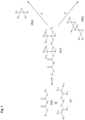
- Fig. 1 schematically illustrates a method to obtain cure reaction products according to the present invention, wherein compound A and B are firstly admixed together and at a later stage compound C is added.
- Compound C is in this example either a monoepoxide or a diepoxide.
- the mixture obtained is then heated, leading to the cured products e.g. (Vla) and (Vle).
- the cured product is comprising an excess of vinyl moieties respect to carboxyl moieties. It has been found that that an excess of vinyl moiety improve shelf life, hydrophobicity, and chemical resistance including hydrolytic stability.
- the excess of vinyl moieties respect to carboxyl moieties is in a molar ratio vinyl moiety:carboxyl moiety from 1.01:1 to 1.5:1, preferably from 1.05:1 to 1.1:1. It has been found that this embodiment is advantageous, in that the ratios herein allow to be advantageous whilst provides a mean to avoid unreacted monomers which can crystallize or evaporate during curing.
- the cured product is comprising an excess of carboxyl moieties respect to vinyl moieties. It has been surprisingly found that an excess of carboxyl moieties provide faster curing kinetics, improves hydrophilicity.
- the excess of carboxyl moieties respect to vinyl moieties is according to a molar ratio vinyl moiety:carboxyl moiety from 1:1.01 to 1:1.5, preferably from about 1:1.05 to 1:1.1. It has been found that this embodiment is advantageous, in that the ratios herein allow to be advantageous whilst provides a mean to avoid unreacted monomers which can crystallize or evaporate during curing.
- the present invention pertains to a method for obtaining a cured product, comprising the steps of:
- the curable composition is a one-component resin.
- Cured reaction products according to the present invention can be obtained starting from the curable composition according to the present invention, but also other composition comprising reaction intermediates of the compounds A, B and C.
- cured reaction products according to the present invention can be obtained from a curable composition comprising a curable polymer of formula (IV) and a compound C, as defined according to the present invention, wherein wherein:
- Compound of formula (IV) can be obtained for example by reacting a compound A with a compound B, nevertheless, other synthetic methodologies might be used.
- a method for obtaining a curable polymer of formula (IV) can comprise the steps of:
- cured reaction products according to the present invention can be obtained from a curable composition comprising a curable polymer of formula (Va) or (Vb) with a compound A. wherein:
- the curable polymer of formula (IV) and compound C are heated at temperature from about 100 to 180 °C, preferably from about 130 to 150 °C.
- the compound A and the compound B are firstly admixed together, and secondly compound C is added.
- NMR Nuclear magnetic resonance
- FTIR Fourier transform infrared spectroscopy
- TGA Thermal gravimetric analysis
- DSC Differential scanning calorimetry
- Curing process The DSC pan was heated with 10 °C min -1 until the oven reached the test temperature and kept in isothermal conditions for 48 hours. The glass transition temperature (midpoint) was measured at equal intervals by heating and cooling rate of 10 °C min -1 .
- Rheology Stress relaxation, creep recovery experiments were performed on a Discovery HR-2 hybrid rheometer of TA Instruments. The instrument was equipped with an oven surrounding the 8 mm plate-plate configuration. Stress relaxation was measured in linear viscoelastic region (LVE), a strain of 1 % was applied with an axial force of 2N or 5N. Creep-recovery experiments were performed with an alternating stress of 0 Pa (1000 s) and 3000 Pa (600 s) with an axial force of 5N.
- LVE linear viscoelastic region
- Tensile test Tensile analysis was conducted on an Instron 6800 Single column tensile tester using pneumatic clamps. 3-5 replicates were measured for each sample with dimensions of 22 x 5 x 0.6-0.7 mm. The tests were performed at room temperature and ambient conditions. The samples were dried prior to the test in the vacuum oven at 80 °C overnight. The crosshead speed was 5 mm/min.
- Contact Angle was measured on a goniometer via dynamic sessile drop method in 5 places on the polymer surface.
- LC-MS Liquid chromatography-mass spectrometry
- GPC Gel permeation chromatography
- 1,3-propylenedicarboxylic acid 99% (glutaric acid, GA), 1,4-butanedicarboxylic acid 99% (adipic acid, AA), 1,7-heptanedicarboxylic acid 98% (azelaic acid, AzA), 1,8-octanedicarboxylic acid 99% (sebacic acid, SA), 1,4-cyclohexanemethanol divinyl ether 98% (14CHD), 1,4-butanediol divinyl ether 98% (14BD), Bis[2-(vinyloxy)ethyl] ether 99% (di(ethylene glycol) divinyl ether, DEG), ethylene glycol 99% (EG) styrene oxide 97% (SO), citric acid 99% (CA), Tris(4-hydroxyphenyl)methane triglycidyl ether (TGE) and 2,2-Bis[4-(glycidyloxy)phenyl]propane (bisphenol
- Tetrahydrofuran (THF), deuterated DMSO-d6 and p-toluenesulfonic acid monohydrate 99% (pTSA) were supplied by VWR.
- pTSA pTSA.H 2 O (1g, 5.2 mmol) was dissolved in 10 mL THF. The final concentration was 0.52mmol/1mL or 0.1g/mL.
- SA Sebacic Acid
- CHD 1,4-cyclohexanemethanol divinyl ether
- BADGE 2,2-Bis[4-(glycidyloxy)phenylipropane
- SA Sebacic Acid
- BD 1,4-butanediol divinyl ether
- BADGE 2,2-Bis(4-(glycidyloxy)phenyl]propane
- SA Sebacic Acid
- BD 1,4-butanediol divinyl ether
- BADGE 2,2-Bis[4-(glycidyloxy)phenyl]propane
- Example 3 Azelaic Acid (AzA) - 1,4-butanediol divinyl ether (BD) - 2,2-Bis[4-(glycidyloxy)phenyl]propane (BADGE)
- Azelaic Acid (AzA) - 1,4-butanediol divinyl ether (BD) - 2,2-Bis[4-(glycidyloxy)phenyl]propane (BADGE) was prepared according to the Example 1. 5.000 g (26.6 mmol) of AzA, 3.777 g (26.6 mmol) of BD, 9.043 g (26.6 mmol) of BADGE and 0.253 g (1.3 mmol) of pTSA was used.
- Adipic Acid (AA) - 1,4-butanediol divinyl ether (BD) - 2,2-Bis[4-(glycidyloxy)phenyl]propane (BADGE) was prepared according to the Example 1. 5.000 g (34.2 mmol) of AA, 3.777 g (34.2 mmol) of BD, 11.647 g (34.2 mmol) of BADGE and 0.325 g (1.7 mmol) of pTSA was used.
- Glutaric Acid (GA) - 1,4-butanediol divinyl ether (BD) - 2,2-Bis[4-(glycidyloxy)phenyl]propane (BADGE) was prepared according to the Example 1. 5.000 g (37.8 mmol) of GA, 5.381 g (37.8 mmol) of BD, 12.883 g (37.8 mmol) of BADGE and 0.360 g (1.9 mmol) of pTSA was used.
- SA Sebacic Acid
- DEG divinyl ether
- BADGE 2,2-Bis[4- (glycidyloxy)phenyl]propane
- SA Sebacic Acid
- DEG di(ethylene glycol) divinyl ether
- BADGE 2,2-Bis[4-(glycidyloxy)phenyl]propane
- SA Sebacic Acid
- CHD 1,4-cyclohexanemethanol divinyl ether
- SA Sebacic Acid
- CHD 1,4-cyclohexanemethanol divinyl ether
- Cardolite NC514 was prepared according to the Example 1. 3.000 g (29.7 mmol) of SA, 2.911 g (29.7 mmol) of CHD, 13.172 g (29.7 mmol) of Cardolite NC514 and 0.141 g (0.7 mmol) of pTSA was used.
- SA Sebacic Acid
- BD 1,4-butanediol divinyl ether
- TGE Tris(4-hydroxyphenyl)methane triglycidyl ether
- SA Sebacic Acid
- BD 1,4-butanediol divinyl ether
- TGE Tris(4-hydroxyphenyl)methane triglycidyl ether
- SA Sebacic Acid
- CHD 1,4-cyclohexanemethanol divinyl ether
- BADGE 2,2-Bis[4-(glycidyloxy)phenyl]propane
- SA Sebacic Acid
- CHD 1,4-cyclohexanemethanol divinyl ether
- BADGE 2,2-Bis[4-(glycidyloxy)phenyl]propane
- SA Sebacic Acid
- CHD 1,4-cyclohexanemethanol divinyl ether
- BADGE 2,2-Bis[4-(glycidyloxy)phenyl]propane
- Glutaric Acid (GA) - 1,4-cyclohexanemethanol divinyl ether (CHD) - Styrene oxide (SO) was prepared according to the Example 13 with different curing procedure. The sample was cured at 150°C in an oven on air. The obtained material swelled in organic solvent but was not soluble.
- Example 1 Material from Example 1 was placed in the vial with ethylene glycol (EG) and pTSA (1wt%) and heated to 90°C. The polymer dissolved after couple of minutes and the aliquots were taken after 2h and 48h.
- EG ethylene glycol
- pTSA pTSA
- TGE Tris(4-hydroxyphenyl)methane triglycidyl ether
- Example 8 results in higher cross-linking density and the use of monomer with functionality 1 or with higher epoxy value (Example 7) leads to less cross-linked (Example 13) or even linear materials (Example 12) depending on the curing.
- the thermal properties show that variation in monomers allow to obtain materials with broad range of glass transition temperatures ( T g,DMTA ) from -12.6 °C in Example 7 to 90.3 °C in Example 8 but not limited to this range.
- Table 1 Properties of materials obtained in Examples 1-13. More specifically: E 0 DMTA , T g,DMTA , E', ⁇ .
- Example 1 SA,CHD ,BADGE 25.0 304 430 84.0
- Example 2 SA,BD ,BADGE 34.0 277 429 95.3
- Example 3 AzA,BD ,BADGE 41.0 311 -* 99.6
- Example 4 AA,BD ,BADGE 52.0 279 417 98.6
- Example 5 GA,BD, BADGE 60.0 299 439 99.5
- Example 6 SA ,EG,BADGE 28.0 275 426 94.4
- Example 8 SA, BD, TGE 94.0 291 430 99.2
- Example 9 CA, BD ,SO - Example 10 SA,CHD,BADGE 33.0 306 430 -
- Example 11 SA,CHD,BADGE 18.0 305 428 -
- Example 12 SA,CHD,BADGE 18.0 305 428 -
- Example 12 SA,CHD,BADGE 18.0 305 4
- Curable compositions according to the present invention are stable and can be stored at ambient conditions for at least 28 days, and have low viscosity, allowing ease of use in various applications, e.g. coatings.
- Fig. 2 illustrates the rotational flow sweep viscosity measurement at various temperatures of curable compositions from Example 10 and Example 11. Further, it has been found from measured 1 H NMR and FT-IR data (not shown) that curable composition from Example 1 in day 1 and after storage at ambient conditions for 7 and 28 days are stable. The application of other dynamic chemistries in epoxy resins very often result in high viscosity, heterogenous solutions or fast curable mixtures that do not leave a processing window for an application of a product.
- Fig. 3 illustrates the stress relaxation (a) by rheology and recyclability under load via compression molding (b). More specifically: Fig. 3a shows that sample even though is fully cross-linked shows relaxation (Example 1).
- the stress relaxation test is a standard test which can quantitatively evaluate the potential of material to be reprocessed.
- the traditional cross-linked materials do not show a drop in the relaxation modulus (G(t)/G(0)) whereas dynamic networks do.
- the epoxy resins can be reshaped and possess flow properties when heated under load ( Fig.3b ).
- Fig.4a demonstrates the elastic response of the materials to the applied load at different temperatures (Example 2), DMTA curves after repeated deformations and shape recovery ( Fig. 4b ), creep experiment at investigated temperatures ( Fig. 4c ) and elastic response of selected materials to deformation ( Fig.4d ).
- the material with T g,DSC 34°C which is just above RT is able to recover the original shape in 24h after deformation. If the same material is conditioned at temperatures above its T g the recovery time decreases and the full recovery is observed within seconds ( Fig. 4a ).
- the cyclic deformation-recovery experiment was conducted on a DMTA specimen ( Fig. 4b ). the sample was twisted and reformed at 105°C for 5 minutes.
- a DMTA analyses was performed revealing little to no influence of the repeated deformation on the mechanical performance of the material.
- a cyclic creep recovery measurement ( Fig. 4c ) revealed that the material show predominant delayed elastic response at 25°C and instantaneous elastic response at 80 °C.
- the recovery ability of materials can be tuned by thermal properties ( Fig. 4d ). More specifically, materials with T g below RT will show instantaneous elastic response at RT and materials with T g higher than RT will show predominant delayed elastic response. All materials can be returned to the original shape by short heating stage. The property can be interesting for shock absorbing materials.
- Cured reaction products according to the present invention can be chemically recycled, for example by means of solvolysis at 90°C, in accordance with Example 14.
- Table 3 here below illustrates an LC-MS chromatogram of the solvolysis product obtained. In Table 4, a list of the fragments obtained after solvolysis is shown. Table 3: An LC-MS chromatogram of a solvolysis product with an indication of which m/z regime was detected and screened and also its intensity for the two investigated reaction times, the various fragments A to H were identified.
- Fig. 5 illustrates the DMTA of Example 10 and Example 11 which demonstrates the tunability of T g of material by a change of ratio of acid to vinyl component.
- the ratio of monomers influences the stress relaxation curves ( Fig.6 ). In general, shorter relaxation times are obtained when an excess of vinyl is used (Example 11).
- Fig. 7 illustrates the contact angle of Example 10 and Example 11. From the figure, it is apparent that the materials with an excess of vinyl groups (product of Example 11) are more hydrophobic.
- Fig. 8 illustrates the development of a T g of Example 10 and 11 during curing at 150°C.
Landscapes
- Chemical & Material Sciences (AREA)
- Health & Medical Sciences (AREA)
- Chemical Kinetics & Catalysis (AREA)
- Medicinal Chemistry (AREA)
- Polymers & Plastics (AREA)
- Organic Chemistry (AREA)
- Epoxy Resins (AREA)
Claims (15)
- Härtbare Zusammensetzung, umfassend:- eine Verbindung A, die mindestens 2 Vinylreste, vorzugsweise ein Divinylether, aufweist;- eine Verbindung B, die mindestens 2 Carboxylreste, vorzugsweise 2 Carbonsäurereste, aufweist,- eine Verbindung C, die mindestens 1 Epoxidrest und vorzugsweise 2 oder mehr aufweist.
- Härtbare Zusammensetzung nach Anspruch 1, wobei:- Verbindung A von Formel (I) ist:

R8 ein lineares, aromatisches oder zyklisches Alkyl, mit oder ohne Heteroatome, wie O, N, gesättigt oder ungesättigt, substituiert oder unsubstituiert, darstellt; und wobei R9, R10, R11, R12, R13, R14 Gruppen sind, die jeweils unabhängig voneinander aus der Liste ausgewählt sind, umfassend: H, lineares, aromatisches oder zyklisches Alkyl, mit oder ohne Heteroatome, wie O, N, gesättigt oder ungesättigt, substituiert oder unsubstituiert. - Härtbare Zusammensetzung nach einem der Ansprüche 1 bis 2, wobei Verbindung A ein Divinylether von Formel (I) ist, wobei: R8 ein C3-6-Cycloalkyl ist, ein C1-6-Alkyloxy-C1-6-Alkyl oder R8 zusammen mit einem der Sauerstoffatome, an die es gebunden ist, -{C1-6-Alkyl-O}n- darstellen, wobei n mindestens 2 ist; und R9 bis R14 Wasserstoff sind; es vorzugsweise aus der Liste ausgewählt ist, umfassend: 1,4-Cyclohexanmethanoldivinylether, 1,4-Butandioldivinylether, Di(ethylenglycol)divinylether, Poly(ethylenglycol)divinylether, Tri(ethylenglycol)divinylether.
- Härtbare Zusammensetzung nach einem der Ansprüche 1 bis 3, wobei:
Verbindung B von Formel (II) ist: - R1 unabhängig aus einem beliebigen ausgewählt ist von: H, Metall, Alkyl, Carbonyl;- R2 eine Gruppe ist, die ausgewählt ist aus: linearem, aromatischem oder zyklischem Alkyl, mit oder ohne Heteroatome, wie O, N, gesättigt oder ungesättigt, substituiert oder unsubstituiert, Direktbindung,- und n ≥ 2.
 - Härtbare Zusammensetzung nach Anspruch 4, wobei:- Verbindung B von Formel (IIa) ist:
 - R1 und R3 Gruppen sind, die jeweils unabhängig voneinander aus einem beliebigen ausgewählt sind von: H, Metall, Alkyl, Carbonyl;- R2 eine Gruppe ist, die ausgewählt ist aus: linearem, aromatischem oder zyklischem Alkyl, mit oder ohne Heteroatome, wie O, N, gesättigt oder ungesättigt, substituiert oder unsubstituiert, Direktbindung.
 - Härtbare Zusammensetzung nach Anspruch 5, wobei Verbindung B eine Dicarbonsäure oder ein Salz davon von Formel (IIa) ist, wobei R2 ein C1-15-Alkyl; insbesondere ein C1-10-Alkyl, und vorzugsweise aus der Liste ausgewählt ist, umfassend: Glutarsäure, Adipinsäure, Korksäure, Azelainsäure, Sebacinsäure.
- Härtbare Zusammensetzung nach einem der Ansprüche 1 bis 6, wobei Verbindung C einen oder mehrere eines Epoxidrests von Formel (III) umfasst:

- Härtbare Zusammensetzung nach Anspruch 7, wobei Verbindung C aus der Liste ausgewählt ist, umfassend: Bisphenol-A-Diglycidylether, 1,4-Butandioldiglycidylether, Tris(4-hydroxyphenyl)methantriglycidylether, 1,2,7,8-Diepoxyoctan, Tris(2,3-epoxypropyl)isocyanurat.
- Gehärtetes Reaktionsprodukt der Zusammensetzung nach einem der Ansprüche 1 bis 8.
- Gehärtetes Produkt nach Anspruch 9, umfassend mindestens eine äquimolare Menge von Vinylresten in Bezug auf die Carboxylreste; wobei die Vinylreste und die Carboxylreste insbesondere in einem Molverhältnis Vinylrest : Carboxylrest von 1,01 : 1 bis 1,5 : 1, vorzugsweise von 1,05 : 1 bis 1,1 : 1, vorliegen.
- Gehärtetes Produkt nach Anspruch 9, umfassend einen Überschuss von Carboxylresten in Bezug auf die Vinylreste; wobei die Vinylreste und die Carboxylreste insbesondere in einem Molverhältnis Vinylrest : Carboxylrest von 1 : 1,01 bis 1 : 1,5, vorzugsweise von etwa 1 : 1,05 bis 1 : 1,1, vorliegen.
- Gehärtetes Reaktionsprodukt nach einem der Ansprüche 9 bis 11, umfassend ein Polymer von einer beliebigen der Formeln: (Vla), (Vlb), (Vlc), (Vld) und (Vle)


 - R1, R2, R3, R4, R5, R6, R7, R8, R9, R10, R11, R12, R13, R14 Gruppen sind, die nach einem der Ansprüche 1 bis 6 definiert sind, und R15, R16 Gruppen sind, die jeweils unabhängig voneinander aus der Liste ausgewählt sind, umfassend: H, lineares, aromatisches oder zyklisches Alkyl, mit oder ohne Heteroatome, wie O, N, gesättigt oder ungesättigt, substituiert oder unsubstituiert.
 - Verfahren zum Erhalten eines gehärteten Produkts nach einem der Ansprüche 9 bis 12, umfassend die Schritte:a) Bereitstellen einer härtbaren Zusammensetzung, umfassend eine Verbindung A, die mindestens 2 Vinylreste aufweist, eine Verbindung B, die mindestens 2 Carboxylreste, vorzugsweise mindestens 2 Carbonsäurereste, aufweist, und eine Verbindung C, die mindestens 1 Epoxidrest aufweist;b) Härten der härtbaren Zusammensetzung, die in Schritt a) bereitgestellt wird, wobei dadurch ein gehärtetes Produkt erhalten wird.
- Verfahren nach Anspruch 13, wobei in Schritt b) die härtbare Zusammensetzung ein Einkomponentenharz ist.
- Verfahren nach einem der Ansprüche 13 bis 14, wobei in Schritt a) die härtbare Zusammensetzung dadurch bereitgestellt wird, dass erstens Verbindung A und die Verbindung B zusammengemischt werden und zweitens Verbindung C hinzufügt wird.
Applications Claiming Priority (2)
| Application Number | Priority Date | Filing Date | Title |
|---|---|---|---|
| EP21197981.0A EP4151666A1 (de) | 2021-09-21 | 2021-09-21 | Abbaubare härtungsmittel, zusammensetzungen und härtbare zusammensetzungen davon |
| PCT/EP2022/076049 WO2023046662A1 (en) | 2021-09-21 | 2022-09-20 | Degradable curing agents, compositions and curable compositions thereof |
Publications (3)
| Publication Number | Publication Date |
|---|---|
| EP4399236A1 EP4399236A1 (de) | 2024-07-17 |
| EP4399236B1 true EP4399236B1 (de) | 2025-02-26 |
| EP4399236C0 EP4399236C0 (de) | 2025-02-26 |
Family
ID=77864507
Family Applications (2)
| Application Number | Title | Priority Date | Filing Date |
|---|---|---|---|
| EP21197981.0A Withdrawn EP4151666A1 (de) | 2021-09-21 | 2021-09-21 | Abbaubare härtungsmittel, zusammensetzungen und härtbare zusammensetzungen davon |
| EP22789552.1A Active EP4399236B1 (de) | 2021-09-21 | 2022-09-20 | Abbaubare härtungsmittel, zusammensetzungen und härtbare zusammensetzungen davon |
Family Applications Before (1)
| Application Number | Title | Priority Date | Filing Date |
|---|---|---|---|
| EP21197981.0A Withdrawn EP4151666A1 (de) | 2021-09-21 | 2021-09-21 | Abbaubare härtungsmittel, zusammensetzungen und härtbare zusammensetzungen davon |
Country Status (4)
| Country | Link |
|---|---|
| US (1) | US20240384029A1 (de) |
| EP (2) | EP4151666A1 (de) |
| CN (1) | CN117999303A (de) |
| WO (1) | WO2023046662A1 (de) |
Family Cites Families (2)
| Publication number | Priority date | Publication date | Assignee | Title |
|---|---|---|---|---|
| US6916890B1 (en) * | 2001-10-09 | 2005-07-12 | Henkel Corporation | Thermally reworkable epoxy resins and compositions based thereon |
| US6777027B2 (en) * | 2002-10-08 | 2004-08-17 | Rohm And Haas Company | Coating powders for smooth, low gloss finishes, and powder coatings formed therefrom |
-
2021
- 2021-09-21 EP EP21197981.0A patent/EP4151666A1/de not_active Withdrawn
-
2022
- 2022-09-20 US US18/692,608 patent/US20240384029A1/en active Pending
- 2022-09-20 WO PCT/EP2022/076049 patent/WO2023046662A1/en not_active Ceased
- 2022-09-20 CN CN202280063803.4A patent/CN117999303A/zh active Pending
- 2022-09-20 EP EP22789552.1A patent/EP4399236B1/de active Active
Also Published As
| Publication number | Publication date |
|---|---|
| CN117999303A (zh) | 2024-05-07 |
| EP4399236A1 (de) | 2024-07-17 |
| US20240384029A1 (en) | 2024-11-21 |
| WO2023046662A1 (en) | 2023-03-30 |
| EP4151666A1 (de) | 2023-03-22 |
| EP4399236C0 (de) | 2025-02-26 |
Similar Documents
| Publication | Publication Date | Title |
|---|---|---|
| Sini et al. | Renewable benzoxazine monomer from Vanillin: Synthesis, characterization, and studies on curing behavior | |
| Yang et al. | Study on the synthesis of bio-based epoxy curing agent derived from myrcene and castor oil and the properties of the cured products | |
| Jamdar et al. | Depolymerization study of PET waste using aminoethylethanolamine and recycled product application as polyesteramide synthesis | |
| US20200172658A1 (en) | Renewable furan based amine curing agents for epoxy thermoset | |
| Zhou et al. | Epoxy adhesive with high underwater adhesion and stability based on low viscosity modified Mannich bases | |
| EP3170849A1 (de) | Stickstoffhaltige heterocyclische epoxidhärtungsmittel, zusammensetzungen und verfahren | |
| Nameer et al. | Biobased cationically polymerizable epoxy thermosets from furan and fatty acid derivatives | |
| Bal et al. | Epoxy-based paints from glycolysis products of postconsumer PET bottles: synthesis, wet paint properties and film properties | |
| Fu et al. | Green preparation of robust hydrophobic bio-based epoxy resin with low dielectric constant | |
| Rashid et al. | A vanillin-derived hardener for recyclable, degradable and self-healable high-performance epoxy vitrimers based on transimination | |
| Kalita et al. | Bio-based poly (vinyl ether) s and their application as alkyd-type surface coatings | |
| Wang et al. | Synthesis of epoxy‐ended hyperbranched polyesters with reinforcing and toughening function for diglycidyl ether of bisphenol‐A | |
| Srivastava et al. | Mechanical, chemical, and curing characteristics of cardanol–furfural-based novolac resin for application in green coatings | |
| Xiao et al. | A hyperbranched polymer from tung oil for the modification of epoxy thermoset with simultaneous improvement in toughness and strength | |
| Hosseini et al. | Synthesis and characterization of novel epoxy‐urethane coating and its graphene nanocomposites | |
| Jahandideh et al. | Synthesis and characterization of novel star-shaped itaconic acid based thermosetting resins | |
| Liu et al. | Room temperature-curable, easily degradable, and highly malleable and recyclable vanillin-based vitrimers with catalyst-free bond exchange | |
| Lu et al. | Facile and eco-friendly synthesis of hydrogen bonding-rich bio-based bisbenzoxazine resins with low surface free energy, strong adhesion strength and high thermal stability | |
| TWI555771B (zh) | 潛在性硬化劑組成物及一液硬化性環氧樹脂組成物 | |
| Zhou et al. | High-performance fully bio-based dynamic covalent supramolecular epoxy resin: synthesis and properties | |
| Jia et al. | Mechanical and thermal properties of elastic epoxy thermoset cured by cardanol-based diglycidyl epoxy modified polyetheramine | |
| Hu et al. | Epoxy resin with excellent ultraviolet resistance and mechanical properties derived from renewable camphoric acid | |
| Altamura et al. | Fully biobased epoxy vitrimers from phloroglucinol triglycidyl ether and 2, 5-furandicarboxylic acid | |
| Varley et al. | Effect of aromatic substitution on the cure reaction and network properties of anhydride cured triphenyl ether tetraglycidyl epoxy resins | |
| Yadav et al. | Studies on synthesis of modified epoxidized novolac resin from renewable resource material for application in surface coating |
Legal Events
| Date | Code | Title | Description |
|---|---|---|---|
| STAA | Information on the status of an ep patent application or granted ep patent |
Free format text: STATUS: UNKNOWN |
|
| STAA | Information on the status of an ep patent application or granted ep patent |
Free format text: STATUS: THE INTERNATIONAL PUBLICATION HAS BEEN MADE |
|
| PUAI | Public reference made under article 153(3) epc to a published international application that has entered the european phase |
Free format text: ORIGINAL CODE: 0009012 |
|
| STAA | Information on the status of an ep patent application or granted ep patent |
Free format text: STATUS: REQUEST FOR EXAMINATION WAS MADE |
|
| 17P | Request for examination filed |
Effective date: 20240412 |
|
| AK | Designated contracting states |
Kind code of ref document: A1 Designated state(s): AL AT BE BG CH CY CZ DE DK EE ES FI FR GB GR HR HU IE IS IT LI LT LU LV MC MK MT NL NO PL PT RO RS SE SI SK SM TR |
|
| GRAP | Despatch of communication of intention to grant a patent |
Free format text: ORIGINAL CODE: EPIDOSNIGR1 |
|
| STAA | Information on the status of an ep patent application or granted ep patent |
Free format text: STATUS: GRANT OF PATENT IS INTENDED |
|
| GRAS | Grant fee paid |
Free format text: ORIGINAL CODE: EPIDOSNIGR3 |
|
| INTG | Intention to grant announced |
Effective date: 20240917 |
|
| GRAJ | Information related to disapproval of communication of intention to grant by the applicant or resumption of examination proceedings by the epo deleted |
Free format text: ORIGINAL CODE: EPIDOSDIGR1 |
|
| GRAL | Information related to payment of fee for publishing/printing deleted |
Free format text: ORIGINAL CODE: EPIDOSDIGR3 |
|
| STAA | Information on the status of an ep patent application or granted ep patent |
Free format text: STATUS: REQUEST FOR EXAMINATION WAS MADE |
|
| GRAP | Despatch of communication of intention to grant a patent |
Free format text: ORIGINAL CODE: EPIDOSNIGR1 |
|
| STAA | Information on the status of an ep patent application or granted ep patent |
Free format text: STATUS: GRANT OF PATENT IS INTENDED |
|
| INTC | Intention to grant announced (deleted) | ||
| INTG | Intention to grant announced |
Effective date: 20241108 |
|
| DAV | Request for validation of the european patent (deleted) | ||
| DAX | Request for extension of the european patent (deleted) | ||
| GRAA | (expected) grant |
Free format text: ORIGINAL CODE: 0009210 |
|
| STAA | Information on the status of an ep patent application or granted ep patent |
Free format text: STATUS: THE PATENT HAS BEEN GRANTED |
|
| AK | Designated contracting states |
Kind code of ref document: B1 Designated state(s): AL AT BE BG CH CY CZ DE DK EE ES FI FR GB GR HR HU IE IS IT LI LT LU LV MC MK MT NL NO PL PT RO RS SE SI SK SM TR |
|
| REG | Reference to a national code |
Ref country code: GB Ref legal event code: FG4D |
|
| REG | Reference to a national code |
Ref country code: CH Ref legal event code: EP |
|
| REG | Reference to a national code |
Ref country code: DE Ref legal event code: R096 Ref document number: 602022011223 Country of ref document: DE |
|
| REG | Reference to a national code |
Ref country code: IE Ref legal event code: FG4D |
|
| U01 | Request for unitary effect filed |
Effective date: 20250313 |
|
| U07 | Unitary effect registered |
Designated state(s): AT BE BG DE DK EE FI FR IT LT LU LV MT NL PT RO SE SI Effective date: 20250320 |
|
| PG25 | Lapsed in a contracting state [announced via postgrant information from national office to epo] |
Ref country code: RS Free format text: LAPSE BECAUSE OF FAILURE TO SUBMIT A TRANSLATION OF THE DESCRIPTION OR TO PAY THE FEE WITHIN THE PRESCRIBED TIME-LIMIT Effective date: 20250526 |
|
| PG25 | Lapsed in a contracting state [announced via postgrant information from national office to epo] |
Ref country code: PL Free format text: LAPSE BECAUSE OF FAILURE TO SUBMIT A TRANSLATION OF THE DESCRIPTION OR TO PAY THE FEE WITHIN THE PRESCRIBED TIME-LIMIT Effective date: 20250226 |
|
| PG25 | Lapsed in a contracting state [announced via postgrant information from national office to epo] |
Ref country code: ES Free format text: LAPSE BECAUSE OF FAILURE TO SUBMIT A TRANSLATION OF THE DESCRIPTION OR TO PAY THE FEE WITHIN THE PRESCRIBED TIME-LIMIT Effective date: 20250226 |
|
| PG25 | Lapsed in a contracting state [announced via postgrant information from national office to epo] |
Ref country code: IS Free format text: LAPSE BECAUSE OF FAILURE TO SUBMIT A TRANSLATION OF THE DESCRIPTION OR TO PAY THE FEE WITHIN THE PRESCRIBED TIME-LIMIT Effective date: 20250626 Ref country code: NO Free format text: LAPSE BECAUSE OF FAILURE TO SUBMIT A TRANSLATION OF THE DESCRIPTION OR TO PAY THE FEE WITHIN THE PRESCRIBED TIME-LIMIT Effective date: 20250526 |
|
| PG25 | Lapsed in a contracting state [announced via postgrant information from national office to epo] |
Ref country code: HR Free format text: LAPSE BECAUSE OF FAILURE TO SUBMIT A TRANSLATION OF THE DESCRIPTION OR TO PAY THE FEE WITHIN THE PRESCRIBED TIME-LIMIT Effective date: 20250226 |
|
| PG25 | Lapsed in a contracting state [announced via postgrant information from national office to epo] |
Ref country code: GR Free format text: LAPSE BECAUSE OF FAILURE TO SUBMIT A TRANSLATION OF THE DESCRIPTION OR TO PAY THE FEE WITHIN THE PRESCRIBED TIME-LIMIT Effective date: 20250527 |
|
| U20 | Renewal fee for the european patent with unitary effect paid |
Year of fee payment: 4 Effective date: 20250820 |
|
| REG | Reference to a national code |
Ref country code: CH Ref legal event code: U11 Free format text: ST27 STATUS EVENT CODE: U-0-0-U10-U11 (AS PROVIDED BY THE NATIONAL OFFICE) Effective date: 20251001 |
|
| PG25 | Lapsed in a contracting state [announced via postgrant information from national office to epo] |
Ref country code: SM Free format text: LAPSE BECAUSE OF FAILURE TO SUBMIT A TRANSLATION OF THE DESCRIPTION OR TO PAY THE FEE WITHIN THE PRESCRIBED TIME-LIMIT Effective date: 20250226 |
|
| PG25 | Lapsed in a contracting state [announced via postgrant information from national office to epo] |
Ref country code: CZ Free format text: LAPSE BECAUSE OF FAILURE TO SUBMIT A TRANSLATION OF THE DESCRIPTION OR TO PAY THE FEE WITHIN THE PRESCRIBED TIME-LIMIT Effective date: 20250226 |
|
| PG25 | Lapsed in a contracting state [announced via postgrant information from national office to epo] |
Ref country code: SK Free format text: LAPSE BECAUSE OF FAILURE TO SUBMIT A TRANSLATION OF THE DESCRIPTION OR TO PAY THE FEE WITHIN THE PRESCRIBED TIME-LIMIT Effective date: 20250226 |
|
| PLBE | No opposition filed within time limit |
Free format text: ORIGINAL CODE: 0009261 |
|
| STAA | Information on the status of an ep patent application or granted ep patent |
Free format text: STATUS: NO OPPOSITION FILED WITHIN TIME LIMIT |
|
| PGFP | Annual fee paid to national office [announced via postgrant information from national office to epo] |
Ref country code: CH Payment date: 20251001 Year of fee payment: 4 |
|
| 26N | No opposition filed |
Effective date: 20251127 |