EP4398642A2 - System und verfahren zur reichweitenverbesserung von rundfunkkanälen - Google Patents
System und verfahren zur reichweitenverbesserung von rundfunkkanälen Download PDFInfo
- Publication number
- EP4398642A2 EP4398642A2 EP24177132.8A EP24177132A EP4398642A2 EP 4398642 A2 EP4398642 A2 EP 4398642A2 EP 24177132 A EP24177132 A EP 24177132A EP 4398642 A2 EP4398642 A2 EP 4398642A2
- Authority
- EP
- European Patent Office
- Prior art keywords
- pbch
- enb
- sib
- transmission
- repetitions
- Prior art date
- Legal status (The legal status is an assumption and is not a legal conclusion. Google has not performed a legal analysis and makes no representation as to the accuracy of the status listed.)
- Pending
Links
Images



















Classifications
-
- H—ELECTRICITY
- H04—ELECTRIC COMMUNICATION TECHNIQUE
- H04W—WIRELESS COMMUNICATION NETWORKS
- H04W72/00—Local resource management
- H04W72/30—Resource management for broadcast services
-
- H—ELECTRICITY
- H04—ELECTRIC COMMUNICATION TECHNIQUE
- H04L—TRANSMISSION OF DIGITAL INFORMATION, e.g. TELEGRAPHIC COMMUNICATION
- H04L1/00—Arrangements for detecting or preventing errors in the information received
- H04L1/08—Arrangements for detecting or preventing errors in the information received by repeating transmission, e.g. Verdan system
-
- H—ELECTRICITY
- H04—ELECTRIC COMMUNICATION TECHNIQUE
- H04L—TRANSMISSION OF DIGITAL INFORMATION, e.g. TELEGRAPHIC COMMUNICATION
- H04L5/00—Arrangements affording multiple use of the transmission path
- H04L5/003—Arrangements for allocating sub-channels of the transmission path
- H04L5/0044—Allocation of payload; Allocation of data channels, e.g. PDSCH or PUSCH
-
- H—ELECTRICITY
- H04—ELECTRIC COMMUNICATION TECHNIQUE
- H04L—TRANSMISSION OF DIGITAL INFORMATION, e.g. TELEGRAPHIC COMMUNICATION
- H04L5/00—Arrangements affording multiple use of the transmission path
- H04L5/003—Arrangements for allocating sub-channels of the transmission path
- H04L5/0053—Allocation of signalling, i.e. of overhead other than pilot signals
-
- H—ELECTRICITY
- H04—ELECTRIC COMMUNICATION TECHNIQUE
- H04L—TRANSMISSION OF DIGITAL INFORMATION, e.g. TELEGRAPHIC COMMUNICATION
- H04L5/00—Arrangements affording multiple use of the transmission path
- H04L5/003—Arrangements for allocating sub-channels of the transmission path
- H04L5/0058—Allocation criteria
- H04L5/0073—Allocation arrangements that take into account other cell interferences
-
- H—ELECTRICITY
- H04—ELECTRIC COMMUNICATION TECHNIQUE
- H04L—TRANSMISSION OF DIGITAL INFORMATION, e.g. TELEGRAPHIC COMMUNICATION
- H04L5/00—Arrangements affording multiple use of the transmission path
- H04L5/0091—Signalling for the administration of the divided path, e.g. signalling of configuration information
- H04L5/0094—Indication of how sub-channels of the path are allocated
-
- H—ELECTRICITY
- H04—ELECTRIC COMMUNICATION TECHNIQUE
- H04L—TRANSMISSION OF DIGITAL INFORMATION, e.g. TELEGRAPHIC COMMUNICATION
- H04L5/00—Arrangements affording multiple use of the transmission path
- H04L5/14—Two-way operation using the same type of signal, i.e. duplex
-
- H—ELECTRICITY
- H04—ELECTRIC COMMUNICATION TECHNIQUE
- H04W—WIRELESS COMMUNICATION NETWORKS
- H04W48/00—Access restriction; Network selection; Access point selection
- H04W48/08—Access restriction or access information delivery, e.g. discovery data delivery
- H04W48/12—Access restriction or access information delivery, e.g. discovery data delivery using downlink control channel
-
- H—ELECTRICITY
- H04—ELECTRIC COMMUNICATION TECHNIQUE
- H04L—TRANSMISSION OF DIGITAL INFORMATION, e.g. TELEGRAPHIC COMMUNICATION
- H04L1/00—Arrangements for detecting or preventing errors in the information received
- H04L2001/0092—Error control systems characterised by the topology of the transmission link
- H04L2001/0093—Point-to-multipoint
Definitions
- a method includes transmitting, by a base station to User Equipments (UEs), a first broadcast channel in a first Sub-Frame (SF) of every frame in every quadruple of frames and in the center six Resource Blocks (RBs) of a bandwidth and a second broadcast channel in a one or more SFs of every frame in a first number of quadruples of frames and in the center six RBs of the bandwidth.
- a frame includes ten SFs.
- the first number of quadruples of frames is from a second number of quadruples of frames with the first number being smaller than the second number.
- the first broadcast channel conveys a first encoded Master Information Block (MIB) for the quadruple of frames and the second broadcast channel conveys a second encoded MIB for the quadruple of frames.
- MIB Master Information Block
- a method in a second embodiment, includes transmitting, by a base station to User Equipments (UEs), a broadcast channel conveying a Master Information Block (MIB) and a Physical Downlink Shared CHannel (PDSCH) conveying a System Information Block (SIB). Additionally, a UE detects the MIB and determines a downlink bandwidth. The UE also receives the PDSCH wherein the PDSCH is transmitted in a bandwidth determined by the downlink bandwidth.
- MIB Master Information Block
- PDSCH Physical Downlink Shared CHannel
- SIB System Information Block
- a base station in a fourth embodiment, includes an encoder, a modulator, and a transmitter.
- the encoder is configured to encode a first Master Information Block (MIB) and a second MIB.
- the modulator is configured to modulate the first encoded MIB and the second encoded MIB.
- the transmitter is configured to transmit a first broadcast channel in a first Sub-Frame (SF) of every frame in every quadruple of frames and in the center six Resource Blocks (RBs) of a bandwidth and a second broadcast channel in a one or more SFs of every frame in a first number of quadruples of frames and in the center six RBs of the bandwidth.
- a frame includes ten SFs.
- a User Equipment includes a receiver, a combiner, a demodulator, and a decoder.
- the receiver is configured to receive a first signal in a first Sub-Frame (SF) of every frame in every quadruple of frames and in the center six Resource Blocks (RBs) of a bandwidth and a second signal in a one or more SFs of every frame in a quadruple of frames and in the center six RBs of the bandwidth.
- a frame includes ten SFs.
- the UE considers that the first signal conveys a first encoded Master Information Block (MIB) for the quadruple of frames and that the second signal conveys a second encoded MIB for the quadruple of frames.
- MIB Master Information Block
- the combiner is configured to combine multiple receptions of the second signal in the one or more SFs of a frame and in the center six RBs of the bandwidth, and also combine the reception of the first signal in the first SF of the frame if the first MIB and the second MIB have the same information contents, to provide a third signal.
- the demodulator is configured to demodulate the first signal and the third signal to provide respective first demodulated symbols and second demodulated symbols.
- the decoder is configured to decode the first demodulated symbols and the second demodulated symbols.
- Couple and its derivatives refer to any direct or indirect communication between two or more elements, whether or not those elements are in physical contact with one another.
- transmit and “communicate,” as well as derivatives thereof, encompass both direct and indirect communication.
- the term “or” is inclusive, meaning and/or.
- phrases "at least one of,” when used with a list of items, means that different combinations of one or more of the listed items may be used, and only one item in the list may be needed.
- “at least one of: A, B, and C” includes any of the following combinations: A, B, C, A and B, A and C, B and C, and A and B and C.
- various functions described below can be implemented or supported by one or more computer programs, each of which is formed from computer readable program code and embodied in a computer readable medium.
- application and “program” refer to one or more computer programs, software components, sets of instructions, procedures, functions, objects, classes, instances, related data, or a portion thereof adapted for implementation in a suitable computer readable program code.
- computer readable program code includes any type of computer code, including source code, object code, and executable code.
- computer readable medium includes any type of medium capable of being accessed by a computer, such as read only memory (ROM), random access memory (RAM), a hard disk drive, a compact disc (CD), a digital video disc (DVD), or any other type of memory.
- ROM read only memory
- RAM random access memory
- CD compact disc
- DVD digital video disc
- a "non-transitory” computer readable medium excludes wired, wireless, optical, or other communication links that transport transitory electrical or other signals.
- a non-transitory computer readable medium includes media where data can be permanently stored and media where data can be stored and later overwritten, such as a rewritable optical disc or an erasable memory device.
- FIGURES 1 through 36 discussed below, and the various embodiments used to describe the principles of the present disclosure in this patent document are by way of illustration only and should not be construed in any way to limit the scope of the disclosure. Those skilled in the art will understand that the principles of the present disclosure may be implemented in any suitably arranged wireless communication system.
- a wireless communication network includes a DownLink (DL) that conveys signals from transmission points, such as base stations or enhanced NodeBs (eNBs), to UEs.
- the wireless communication network also includes an UpLink (UL) that conveys signals from UEs to reception points, such as eNBs.
- DL DownLink
- UL UpLink
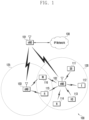
- FIGURE 1 illustrates an example wireless network 100 according to this disclosure.
- the embodiment of the wireless network 100 shown in FIGURE 1 is for illustration only. Other embodiments of the wireless network 100 could be used without departing from the scope of this disclosure.
- the wireless network 100 includes an eNB 101, an eNB 102, and an eNB 103.
- the eNB 101 communicates with the eNB 102 and the eNB 103.
- the eNB 101 also communicates with at least one Internet Protocol (IP) network 130, such as the Internet, a proprietary IP network, or other data network.
- IP Internet Protocol
- eNodeB eNodeB
- base station eNodeB
- access point eNodeB
- eNodeB and eNB are used in this patent document to refer to network infrastructure components that provide wireless access to remote terminals.
- UE user equipment
- a UE may be fixed or mobile and may be a cellular phone, a personal computer device, and the like.
- the terms "user equipment” and "UE” are used in this patent document to refer to remote wireless equipment that wirelessly accesses an eNB, whether the UE is a mobile device (such as a mobile telephone or smart-phone) or is normally considered a stationary device (such as a desktop computer or vending machine).
- the eNB 102 provides wireless broadband access to the network 130 for a first plurality of UEs within a coverage area 120 of the eNB 102.
- the first plurality of UEs includes a UE 111, which may be located in a small business (SB); a UE 112, which may be located in an enterprise (E); a UE 113, which may be located in a WiFi hotspot (HS); a UE 114, which may be located in a first residence (R); a UE 115, which may be located in a second residence (R); and a UE 116, which may be a mobile device (M) like a cell phone, a wireless laptop, a wireless PDA, or the like.
- M mobile device
- the eNB 103 provides wireless broadband access to the network 130 for a second plurality of UEs within a coverage area 125 of the eNB 103.
- the second plurality of UEs includes the UE 115 and the UE 116.
- one or more of the eNBs 101-103 may communicate with each other and with the UEs 111-116 using 5G, LTE, LTE-A, WiMAX, or other advanced wireless communication techniques.
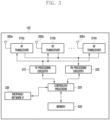
- the RF transceiver 210 receives, from the antenna 205, an incoming RF signal transmitted by an eNB or another UE.
- the RF transceiver 210 down-converts the incoming RF signal to generate an intermediate frequency (IF) or baseband signal.
- the IF or baseband signal is sent to the RX processing circuitry 225, which generates a processed baseband signal by filtering, decoding, and/or digitizing the baseband or IF signal.
- the RX processing circuitry 225 transmits the processed baseband signal to the speaker 230 (such as for voice data) or to the main processor 240 for further processing (such as for web browsing data).
- the TX processing circuitry 315 receives analog or digital data (such as voice data, web data, e-mail, or interactive video game data) from the controller/processor 325.
- the TX processing circuitry 315 encodes, multiplexes, and/or digitizes the outgoing baseband data to generate processed baseband or IF signals.
- the RF transceivers 310a-310n receive the outgoing processed baseband or IF signals from the TX processing circuitry 315 and up-converts the baseband or IF signals to RF signals that are transmitted via the antennas 305a-305n.
- DL signals include data signals conveying information content, control signals conveying DL Control Information (DCI), and Reference Signals (RS), which are also known as pilot signals.
- DL signals can be transmitted using Orthogonal Frequency Division Multiplexing (OFDM).
- An eNB such as eNB 102, can transmit data information or DCI through respective Physical DL Shared CHannels (PDSCHs) or Physical DL Control CHannels (PDCCHs) or Enhanced PDCCHs (EPDCCHs) - see also REF 1.
- PDSCHs Physical DL Shared CHannels
- PDCCHs Physical DL Control CHannels
- EPDCCHs Enhanced PDCCHs
- the eNB can transmit one or more of multiple types of RS, including a UE-Common RS (CRS), a Channel State Information RS (CSI-RS), and a DeModulation RS (DMRS) - see also REF 1.
- CRS can be transmitted over a DL system Bandwidth (BW) and can be used by UEs, such as UE 114 or UE 116, to demodulate data or control signals or to perform measurements.
- BW DL system Bandwidth
- UEs such as UE 114 or UE 116
- eNB 102 can transmit a CSI-RS with a smaller density in the time or frequency domain than a CRS.
- FIGURE 4 illustrates example time domain positions for PSS and SSS for FDD and TDD according to this disclosure.
- the embodiments of the time domain positions for PSS and SSS shown in FIGURE 4 are for illustration only. Other embodiments could be used without departing from the scope of the present disclosure.
- FIGURE 5A illustrates an example PBCH transmitter according to this disclosure.
- the embodiment of the PBCH transmitter shown in FIGURE 5A is for illustration only. Other embodiments could be used without departing from the scope of the present disclosure.
- eNB 102 first processes a BCH transport block corresponding to a MIB 510 by including a 16-bit CRC 520 followed by channel coding 530 using a rate-1/3 tail-biting convolutional code, rate matching 540, and bit-level scrambling 550. Subsequently, eNB 102 applies QPSK modulation 560 to a coded and scrambled BCH transport block. In case eNB 102 includes more than one transmitter antenna ports, eNB 102 can transmit the BCH using multi-antenna transmission 570 such as transmitter antenna diversity.
- eNB 102 transmits one BCH transport block, corresponding to a MIB, every 40 msec or, equivalently, every 4 frames. Therefore, a BCH Transmission Time Interval (TTI) is 40 msec.
- TTI BCH Transmission Time Interval
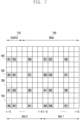
- the eNB 102 maps a coded BCH transport block to a first SF 610 of each frame in four consecutive frames 620, 630, 640, 650.
- a PBCH is transmitted within a first four symbols of a second slot of SF#0 and over the 72 center REs (6 RBs) 660.
- FDD Frequency Division Duplex
- a PBCH transmission follows immediately after a PSS and SSS transmission in SF#0.
- Random access is used for several purposes including initial access when establishing a radio link, re-establishing a radio link after radio-link failure, handover when UL synchronization needs to be established to a new cell, UL synchronization, UE positioning based on UL measurements, and as a Scheduling Request (SR) if no dedicated SR resources are configured to a UE.
- SR Scheduling Request
- a random-access process when establishing an initial radio link, a random-access process also serves for assigning a unique identity, referred to as Cell Radio Network Temporary Identifier (C-RNTI), to a UE.
- C-RNTI Cell Radio Network Temporary Identifier
- a random access scheme can be either contention based (multiple UEs can use same resources) or contention-free (a dedicated resource is used by a UE) - see also REF 1 and REF 3.
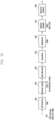
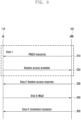
- FIGURE 8 illustrates steps for a random access process according to this disclosure. While the signaling diagram depicts a series of sequential signals, unless explicitly stated, no inference should be drawn from that sequence regarding specific order of performance, performance of signals (or steps) or portions thereof serially rather than concurrently or in an overlapping manner, or performance of the signals depicted exclusively without the occurrence of intervening or intermediate steps.
- the process depicted in the example depicted is implemented by a transmitter chain and receiver chains in, for example, a mobile station and base station.
- Step 1 UE 116 acquires information of Physical Random Access CHannel (PRACH) resources 810 from eNB 102 and determines PRACH resources for a transmission of a Random-Access (RA) preamble 820 (also referred to as PRACH preamble).
- PRACH Physical Random Access CHannel
- RA Random-Access
- Step 2 UE 116 receives a Random Access Response (RAR) 830 from eNB 102.
- RAR Random Access Response
- Step 3 Message 3
- eNB 102 and UE 114 perform contention resolution 850 and a respective message is referred to as Message 4 (Msg4).
- Msg4 Message 4
- Step 2 upon detecting a RA preamble transmitted from UE 116, eNB 102 transmits a RAR including a Timing Advance (TA) command for UE 116 to adjust its transmission timing. eNB 102 also transmits an UL grant assigning UL resources for UE 116 to transmit Msg3 and a Temporary C-RNTI (TC-RNTI). Failing to detect a transmitted RA preamble in a RAR within a RAR time window configured by eNB 102, UE 116 can transmit a new RA preamble and repeat the first step. UE 116 can also apply power ramping to its RA preamble transmission if it does not detect a RAR for its RA preamble transmission.
- TA Timing Advance
- Contention-free random access can only be used for reestablishing UL synchronization upon DL data arrival, handover, and positioning (see also REF 5). Only Step 1 and Step 2 of the random access process in FIGURE 8 are used as there is no need for contention resolution in a contention-free scheme where Step 2 can deliver C-RNTI instead of TC-RNTI.
- Table 2 provides a special SF configuration in terms of a number of symbols for DwPTS, GP, and UpPTS.
- DwPTS 12 11 10 9 6 3 GP 1 1 2 2 3 3 4 6 9 10 UpPTS 1 2 1 2 2 2 1 2 2 1 TDD special subframe configurations
- a DL SF can be a unicast SF or it can be a Multicast-Broadcast Single Frequency Network (MBSFN) SF.
- MBSFN Multicast-Broadcast Single Frequency Network
- Each DL SF (including the DwPTS of a special SF in case of TDD) is typically divided into a control region, consisting of first few SF symbols, and a data region consisting of a remaining SF symbols.
- a unicast DL SF has a control region of 1, 2, or 3 symbols (or 2, 3, or 4 symbols for small DL operating bandwidths) while an MBSFN SF has a unicast control region of one or two SF symbols followed by an MBSFN region having contents that depend on a usage type for the MBSFN SF.
- Information about a set of SFs configured as MBSFN SFs in a cell is provided as part of the system information.
- an arbitrary pattern of MBSFN SFs can be configured with a pattern repeating after 40 msec.
- SFs where information necessary to operate a network (specifically, synchronization signals, system information, and paging) needs to be transmitted cannot be configured as MBSFN SFs. Therefore, SF#0, SF#4, SF#5, and SF#9 for FDD and SF#0, SF#1, SF#5, and SF#6 for TDD are always unicast SFs and cannot be configured as MBSFN SFs (see also REF 3 or REF 5).
- FIGURE 9 illustrates an example of TDM-ICIC in a co-channel deployment for a macro-cell, a pico-cell, and a femto-cell Home eNB (HeNB) according to this disclosure.
- the embodiment of the TDM-ICIC shown in FIGURE 9 is for illustration only. Other embodiments could be used without departing from the scope of the present disclosure.
- SF#1, SF#2, SF#3, SF#6, and SF#7 are ABSs for the macro eNB
- SF#0, SF#5, and SF#8 are ABSs for the HeNB. This allows the pico eNB to serve its UEs with reduced interference during ABS in interfering eNB thereby improving a reception performance for its serving UEs.
- an eNB scheduler uses ABS patterns at interfering transmitting nodes in order to perform a link adaptation.
- an ABS pattern is periodic with a period that is an integer multiple of 40 SFs (4 frames).
- the ABS pattern period depends on a respective TDD UL-DL configuration.
- ABS patterns are configured and signaled between nodes over an X2 interface or via a HeNB gateway if an X2 interface is not available. Since a period of an ABS pattern is an integer multiple of 40 msec, X2 signaling uses a bit-map of a same length as the ABS pattern.
- MTC Machine-Type Communication
- CE Coverage Enhancement
- MTC UEs can be installed in basements of residential buildings or, generally, in locations experiencing significantly larger penetration losses than conventional UEs, in extreme coverage scenarios MTC UEs can have characteristics such as very low data rate, greater delay tolerance, and limited or no mobility, thereby potentially being capable to operate without some messages/channels.
- MTC needs to be supported in both FDD and TDD systems.
- Required system functionalities for MTC UEs, but also for conventional UEs in general, in a CE operating mode are assumed to include synchronization, cell search, power control, random access process, channel estimation, measurement reporting, and DL/UL data transmission (including DL/UL resource allocation). Not all MTC UEs require CE or require a same amount of CE. Conversely, conventional UEs can also require CE. Therefore, as CE for physical channels consume additional resources and consequently result to lower spectral efficiency, it should be possible to enable associated techniques only for UEs that require such CEs.
- a required CE level for all deployment scenarios of UEs in general and MTC UEs in particular as a CE as high as, for example, 15 deciBell (dB) can be required for UEs located in environments with severe propagation loss to a serving eNB.
- a required CE level can be different for different eNBs, for example depending on an eNB transmission power or an associated cell size, as well as for different UEs, for example depending on a location of a UE or on a number of UE receiver antennas.
- Embodiments of this disclosure provide mechanisms to support scalable CE levels for broadcast signaling according to a CE level required in a cell. Embodiments of this disclosure also provide mechanisms for CE of broadcast system information including MIB and SIBs. Additionally, embodiments of this disclosure provide mechanisms to maximize commonalities in supporting CE for broadcast signaling in a FDD system and a TDD system in order to minimize an associated design cost. Further, embodiments of this disclosure provide mechanisms to support CE for broadcast signaling in conjunction with a configuration of ABS for TDM ICIC or with a configuration of MBSFN SFs.
- the following embodiments are not limited to MTC UEs and can be applicable to any type of UEs requiring an enhancement in coverage beyond a coverage supported by a conventional operation. Moreover, although the descriptions consider SF structures with symbols having a normal Cyclic Prefix (CP), they are also applicable for SF structures with symbols having a extended CP (see also REF 1).
- CP Cyclic Prefix
- designs for supporting scalable CE levels for a PBCH are provided.
- a transmission of a PBCH segment in a frame can be repeated multiple times in order to provide a respective CE.
- a resulting PBCH is referred to as CE-PBCH.
- the eNB 102 can transmit each CE-PBCH segment over a larger number of SFs than a PBCH segment but, as for the PBCH, the CE-PBCH is transmitted only in the central 72 sub-carriers (6 RBs) of a DL operating bandwidth.
- a CE-PBCH conveys a CE-MIB that can have a same content as the MIB conveyed by the PBCH.
- the CE-MIB can have different, including reduced, content than the MIB (for example, if PHICH-related information that exists in the MIB is omitted from the CE-MIB). Then, it is not meaningful for UE 114 to combine a reception of CE-PBCH repetitions with a PBCH reception prior to decoding as the PBCH cannot be considered as another repetition of the CE-PBCH.
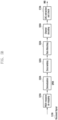
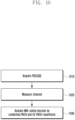
- FIGURE 10 illustrates example operations for coverage limited UE to detect a CE-MIB according to this disclosure. While the flow chart depicts a series of sequential steps, unless explicitly stated, no inference should be drawn from that sequence regarding specific order of performance, performance of steps or portions thereof serially rather than concurrently or in an overlapping manner, or performance of the steps depicted exclusively without the occurrence of intervening or intermediate steps.
- the process depicted in the example depicted is implemented by processing circuitry in, for example, a mobile station.
- FIGURE 11B illustrates a CE-PBCH receiver according to this disclosure.
- the embodiment of the CE-PBCH receiver shown in FIGURE 11B is for illustration only. Other embodiments could be used without departing from the scope of the present disclosure.
- UE 114 operating in CE mode can still attempt to detect the MIB if its contents are a superset of the contents of the CE-MIB. In this manner, when a CE-PBCH transmission is intermittent, UE 114 can shorten a time required to establish a communication link with eNB 102.
- UE 114 can perform two decoding operations in each frame to detect a MIB or a CE-MIB; one decoding operation for PBCH reception and one decoding operation for reception of CE-PBCH repetitions.
- SF#0 and SF#5 can be used in practice for CE-PBCH repetitions, considering that a smallest DwPTS length in special SF is 3 symbols (as in Table 2).
- SF#9 can be ensured to be a DL SF and can also be used to transmit CE-PBCH.
- the special SF configuration having a DwPTS length of 3 symbols or 6 symbols is not supported for CE-PBCH transmissions, SF#1 and SF#6 can also be used to transmit CE-PBCH.
- SF#6 is a DL SF
- symbols after the first 9 symbols are not used to transmit CE-PBCH.
- a DwPTS can include at least 6 symbols and UE 114 can assume that a DwPTS length in a special SF is the minimum one of 6 symbols.
- UE 114 can assume that a DwPTS length in a special SF is NDwPTS symbols. The same applies for transmissions of a PDSCH conveying a SIB for UEs operating in CE mode.
- SF#1 and SF#6 are additionally used got eNB 102 to transmit CE-PBCH repetitions and UE 114 assumes that SF#6 is a special SF and that a CE-PBCH is transmitted in the six symbols after the first three symbols in a unicast SF (that is, UE 114 assumes a DwPTS length of 9 symbols where DwPTS length of 3 or 6 symbols is not supported). Then, 12 additional symbols in SF#1 and SF#6 can be used by eNB 102 to transmit CE-PBCH. If only a DwPTS length of 3 symbols is not supported, then 6 additional symbols in SF#1 and SF#6 can be used. The same applies for transmissions of a PDSCH conveying a SIB for UEs operating in CE mode.
- resources for CE-PBCH can consider limitations in available resources for both TDD and FDD, such as the resources used to transmit PSS/SSS, TDD UL-DL configurations, and so on.
- a common design for CE-PBCH repetitions in TDD and in FDD can result to same implementation at a UE thereby minimizing cost and testing requirements.
- eNB 102 can also transmit CE-PBCH in special SFs in TDD where a DwPTS length is assumed to be 9 symbols. Then, by excluding the first three SF symbols, eNB 102 can use 12 additional symbols in SF#1 and SF#6 to transmit CE-PBCH.
- resources for CE-PBCH repetitions can be predefined through a function that maps system information, such as SFN and PCID, to parameters related to resources used for CE-PBCH repetitions.
- Different eNBs can have a different offset value m.
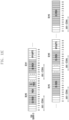
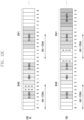
- FIGURE 15 illustrates two eNBs transmitting CE-PBCH repetitions using a different starting frame according to this disclosure.
- the embodiment of the CE-PBCH repetitions shown in FIGURE 15 is for illustration only. Other embodiments could be used without departing from the scope of the present disclosure.
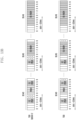
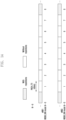
- FIGURE 16 illustrates repetitions of a CE-PBCH starting from a frame determined from a PCID value according to this disclosure.
- the embodiment of the CE-PBCH shown in FIGURE 16 is for illustration only. Other embodiments could be used without departing from the scope of the present disclosure.
- the CE-PBCH can be predefined in a system operation. If there are multiple levels, the UE 114 operating in CE can determine a level used by eNB 102 to transmit CE-PBCH by blind decoding.
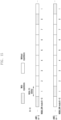
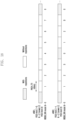
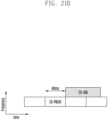
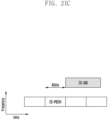
- FIGURES 21A , 21B and 21C illustrate examples for mapping of resources for a CE-SIB transmission according to this disclosure.
- the embodiments of the mappings shown in FIGURES 21A , 21B and 21C are for illustration only. Other embodiments could be used without departing from the scope of the present disclosure.
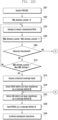
- the UE 114 determines that it is coverage limited if UE 114 does not detect a conventional PBCH after a predefined number of MAX_MIB_Attempt decoding attempts. Also, if UE 114 detects a conventional PBCH with a number of attempts no greater than MAX_MIB_Attempt but fails to subsequently detect a SIB according to a procedure that is subsequently described, UE 114 determines that it is coverage limited.
- UE 114 If UE 114 fails to detect the PBCH, in operation 2210, UE 114 examines whether MIB_Attempt_counter has a value MAX_MIB_Attempt. If MIB_Attempt_counter is less than MAX_MIB_Attempt, UE 114 performs another decoding of the PBCH in operation 2203. If MIB_Attempt_counter equals MAX_MIB_Attemp, UE 114 starts operating in CE mode in operation 2215 and decodes CE-PBCH in operation 2220 in addition to decoding PBCH. Specific decoding operations for operation 2220 are subsequently described herein below with respect to FIGURES 24 and 25 . After detecting PBCH, in operation 2225, UE 114 proceeds to detect a SIB that can be transmitted using repetitions.
- MIB_Attempt_counter has a value MAX_MIB_Attempt. If MIB_Attempt_counter is less than MAX_MIB_Attempt, UE 114 performs another decoding of the PBCH in operation 2203. If MIB_Attempt
- UE 114 determines that a decoding of SIB1 is successful, UE 114 continues to operate in a normal coverage mode in operation 2262, and proceeds to detect SIB2 in operation 2265. UE 114 then determines whether a SIB2 decoding is successful in operation 2270. If SIB2 decoding fails after a number of MAX_SIB2_Attempt decoding attempts, similar to PBCH detection, UE 114 continues operation in a CE mode in operation 2275 and proceeds to detect SIB2 or a combined single CE-SIB in operation 2230.
- UE 114 determines that a decoding of SIB2 is successful, UE 114 continues to operate in a normal coverage mode in operation 2278, transmits PRACH in operation 2280 and, if the random access process is successful, UE 114 continues operating in a normal coverage mode in operation 2285.
- previous functionalities considered initial access of a UE to an eNB, similar functionalities can apply for subsequent access such as access from an idle mode.
- UE 114 operating in CE mode can perform two decoding operations in each frame to acquire a MIB or a CE-MIB; one decoding operation for a PBCH reception and one decoding operation for reception of combined CE-PBCH repetitions that can include a PBCH reception if the MIB and the CE-MIB have same contents (including a same CRC).
- Decoding a PBCH in a frame can benefit UE 114 in case of intermittent transmissions of CE-PBCH and in case the contents of the MIB are a superset of the contents of the CE-MIB, by enabling a faster detection of the MIB.
- a UE operating in CE mode also benefits from decoding CE-PBCH receptions as a respective detection probability is higher than the one for a PBCH reception in a frame where CE-PBCH repetitions are transmitted.
- FIGURE 24 illustrates example operations for a UE to detect a PBCH according to this disclosure.
- the embodiment of the operations shown in FIGURE 24 is for illustration only. Other embodiments could be used without departing from the scope of the present disclosure.
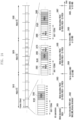
- eNB 102 transmits PBCH 2440 in SF#0 of each frame.
- PBCH_TTI 2420 eNB transmits PBCH 2460 in SF#0 of each frame and CE-PBCH in SF#0 and SF#5 2450, 2470, 2480, and 2490 of each frame.
- PBCH_TTI 2430 eNB 102 transmits PBCH 2495 in SF#0 of each frame.
- UE 114 performs decoding operations 2405 that can be same as in 2403.
- UE 114 determines that it fails to detect MIB or CE-MIB 2406.
- UE 114 performs decoding operations 2407.
- time D UE 114 determines that it detects MIB or CE-MIB 2408 from either decoding PBCH or combined PBCH and CE-PBCH or from decoding CE-PBCH. Note that A, B, C, D can be after any frame in a PBCH_TTI.
- FIGURE 25 illustrates example operations for a UE to decode a PBCH, or decode a combined PBCH and CE-PBCH, or decode CE-PBCH according to this disclosure. While the flow chart depicts a series of sequential steps, unless explicitly stated, no inference should be drawn from that sequence regarding specific order of performance, performance of steps or portions thereof serially rather than concurrently or in an overlapping manner, or performance of the steps depicted exclusively without the occurrence of intervening or intermediate steps. The process depicted in the example depicted is implemented by processing circuitry in, for example, a mobile station.
- UE 114 fails to detect a conventional PBCH after MAX_MIB_Attempt attempts. UE 114 then operates according to a CE mode in operation 2505. UE receives a subsequent frame in operation 2510 and, in operation 2520, UE 114 attempts to detect a conventional PBCH in the subsequent frame. UE 114 also attempts to detect a CE-PBCH (CE-PBCH repetitions) combined with a PBCH in a same frame in case of a same MIB or not combined with a PBCH in case of a different MIB in operation 2525. UE 114 can perform both decoding operations or first decode a PBCH and, if MIB detection fails, decode receptions of CE-PBCH repetitions.
- CE-PBCH CE-PBCH repetitions
- UE 114 determines whether either detection is successful. If either of the two detections is successful, UE 114 proceeds to detect SIB in operation 2540 according to a CE mode. If neither of the two detections is successful, UE 114 repeats operations 2510, 2520, 2525, and 2530.
- an outer loop for a maximum allowable time for UE 114 to detect a MIB or a CE-MIB applies. If after the maximum allowable time, UE 114 cannot decode PBCH or CE-PBCH, a failure of timeout applies and UE 114 can select another cell. The same can apply to SIB detection with a respective maximum allowable time.
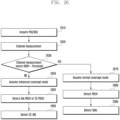
- FIGURE 26 illustrates an example operation for a UE to determine whether to operate in a normal coverage mode or in a CE mode based on a channel measurement according to this disclosure. While the flow chart depicts a series of sequential steps, unless explicitly stated, no inference should be drawn from that sequence regarding specific order of performance, performance of steps or portions thereof serially rather than concurrently or in an overlapping manner, or performance of the steps depicted exclusively without the occurrence of intervening or intermediate steps.
- the process depicted in the example depicted is implemented by processing circuitry in, for example, a mobile station.
- the UE 114 acquires PSS/SSS. UE 114 then performs a channel measurement in operation 2620, such as a RSRP measurement, and determines whether a channel measurement metric is greater than a threshold that can be predefined in the system operation. For example, in operation 2630, UE 114 determines whether a RSRP measurement is larger than Threshold. If it is, UE 114 operates in normal coverage mode in operation 2670 and accordingly attempts to detect PBCH in operation 2680 and SIBs in operation 2690. If the RSRP measurement is not larger than Threshold in operation 2630, UE 114 operates in CE mode in operation 2660 and accordingly attempts to detect PBCH or CE-PBCH in operation 2650 and CE-SIB in operation 2660.
- a channel measurement in operation 2620 such as a RSRP measurement
- UE 114 when UE 114 operates in a CE mode, UE 114 informs eNB 102 of a number of decoding attempts that UE 114 needed to detect PSS/SSS, PBCH, CE-PBCH, a SIB, or a CE-SIB, or any combination therefore.
- UE 114 can provide this information implicitly through a resource selection for a PRACH transmission (for example, a RA preamble selection or a frequency/time resource selection) or explicitly in a PUSCH transmission.
- eNB 102 can use this information to obtain an estimate of a CE level required by UE 114.
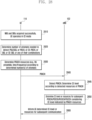
- FIGURE 27 illustrates example operations for a UE operating in CE mode to explicitly inform an eNB of a number of attempts that the UE needed to detect one or more of a PSS/SSS, a PBCH, a CE-PBCH, an SIB, a CE-SIB, or any combination thereof according to this disclosure. While the signaling diagram depicts a series of sequential signals, unless explicitly stated, no inference should be drawn from that sequence regarding specific order of performance, performance of signals (or steps) or portions thereof serially rather than concurrently or in an overlapping manner, or performance of the signals depicted exclusively without the occurrence of intervening or intermediate steps.
- the process depicted in the example depicted is implemented by a transmitter chain and receiver chains in, for example, a mobile station and base station.
- UE 114 detects MIB and SIB transmitted by eNB 102 and operates in CE mode.
- the UE 114 determines a number of decoding attempts that the UE requires to detect PSS/SSS, a PBCH (MIB), a CE-PBCH (CE-MIB), a SIB, a CE-SIB, or any combination thereof.
- UE 114 includes the number in a PUSCH, such as Msg3 and transmits the PUSCH 2740 to eNB 102.
- eNB 102 After successful reception of the PUSCH 2740, in operation 2750, eNB 102 determines a CE level or resources for subsequent PDSCH/PDCCH/PUSCH/PUCCH transmissions to or from UE 114 at least partially based on the number provided by UE 114. Subsequently, eNB 102 can inform a CE level or resources for subsequent communication 2760 to UE 114 by transmitting respective information to UE 114.
- FIGURE 28 illustrates example operations for a UE operating in CE mode to implicitly inform an eNB of a number of attempts that the UE requires to detect a PSS/SSS, a PBCH, a CE-PBCH, an SIB, a CE-SIB, or any combination thereof according to this disclosure. While the signaling diagram depicts a series of sequential signals, unless explicitly stated, no inference should be drawn from that sequence regarding specific order of performance, performance of signals (or steps) or portions thereof serially rather than concurrently or in an overlapping manner, or performance of the signals depicted exclusively without the occurrence of intervening or intermediate steps.
- the process depicted in the example depicted is implemented by a transmitter chain and receiver chains in, for example, a mobile station and base station.
- UE 114 detects MIB and SIB transmitted by eNB 102. In operation 2810, the UE 114 operates in CE mode. In operation 2820, the UE 114 determines a number of attempts it required to detect a PSS/SSS, a PBCH (MIB), a CE-PBCH (CE-MIB), an SIB, a CE-SIB, or any combination thereof. In operation 2830, the UE 114 further determines PRACH resources (such as a RA preamble or time/frequency resources) according to determined number of attempts based on a predefined mapping or on a configured mapping (for example, configured by a SIB) between a number of attempts and PRACH resources.
- PRACH resources such as a RA preamble or time/frequency resources
- UE 114 transmits a RA preamble 2840 to eNB 102.
- eNB 102 determines a CE level suggested by UE 114 according to resources used by the detected RA preamble. The determination can be based on an association between RA preamble resources and CE level.
- the eNB 102 can determine a CE level or resources for subsequent PDSCH/PDCCH/PUSCH/PUCCH transmissions to or from UE 114 at least partly based on the CE level indicated by the detected RA preamble.
- the eNB 102 can inform the determined CE level or resources for subsequent communication 2860 through DL signaling to UE 114.
- UE 114 detects MIB and SIB and operates in CE mode.
- the UE 114 determines a number of attempts it required to detect PSS/SSS, or PBCH (MIB), or CE-PBCH (CE-MIB), or a SIB, or a CE-SIB, or any of their combinations in operation 2920.
- the UE 114 determines a CE level for selecting a number of repetitions for a subsequent RA preamble transmission based on the number of attempts (including number of repetitions for CE-SIB reception) that the UE requires to detect PSS/SSS, or PBCH, or CE-PBCH, or SIB, or CE-SIB, or any of their combinations.
- repetitions for transmissions of DL channels are considered in conjunction with an existence of MBSFN SFs.
- eNB 102 does not transmit CE-PBCH or CE-SIB PDSCH in any SF that can be configured as MBSFN SF. Therefore, for commonality of CE-PBCH repetitions in FDD and TDD, transmission of CE-PBCH repetitions can occur only in SF#0 and SF#5. The same can apply for transmissions of a CE-SIB as UE 114 cannot be aware of the MBSFN SF pattern (this information is assumed to be included in the CE-SIB and not provided by CE-MIB).
- CE-PBCH repetitions or CE-SIB repetitions can be only in SFs that cannot be configured as MBSFN SFs (such as, for example, SF#0 and SF#5 for CE-PBCH transmission and SFs#0,4,5,9 in FDD and SFs#0,1,5,6 in TDD can be used for CE-SIB PDSCH transmission).
- eNB 102 overrides a configuration of a SF as an MBSFN SF when transmitting CE-PBCH in that SF.
- the overriding can be only in the middle 6 RBs where CE-PBCH is transmitted while in the remaining part of a DL operating bandwidth a configuration of a SF as an MBSFN one can remain valid. Therefore, eNB 102 can transmit CRS as in a unicast SF in the middle 6 RBs of a DL operating bandwidth while transmitting CRS as in a MBSFN SF in the remaining part of the DL operating bandwidth.
- UE 114 assumes that all SFs used to transmit CE-PBCH are unicast SFs.
- No other DL channel (for control or data) is transmitted in resources used to transmit CE-PBCH.
- the second approach is valid when a same CP (normal or extended) is used both for unicast SFs and MBSFN SFs. The same can apply for transmissions of a CE-SIB PDSCH where the overriding can be only in respective RBs.
- FIGURE 30 illustrates an example operation for an eNB to transmit CE-PBCH repetitions in the middle 6 RBs of a DL operating bandwidth in a SF configured as MBSFN SF according to this disclosure.
- the embodiment of the operation shown in FIGURE 30 is for illustration only. Other embodiments could be used without departing from the scope of the present disclosure.
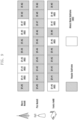
- a SF 3010 is configured as MBSFN and a control region 3020 can be the first one or two symbols.
- the middle 72 sub-carriers (6 RBs) 3030 excluding the control region can be used for transmission of CE-PBCH repetitions where for each RB 3040, a CRS pattern can be as in a unicast SF.
- the remaining regions of the SF 3010 contain CRS 3050 as for a MBSFN SF 3060.
- resources that can be used by eNB 102 to transmit CE-PBCH exclude CRS in both unicast SFs and MBSFN SFs.
- resources that can be used by eNB 102 to transmit CE-PBCH do not include a joint set of CRS sub-carriers corresponding to either a unicast SF or an MBSFN SF.
- UE 114 can estimate a DL channel assuming an existence of either a unicast SF or a MBSFN SF. The same can apply for transmissions of a CE-SIB PDSCH.
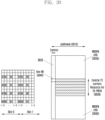
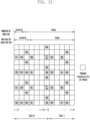
- FIGURE 31 illustrates an example for resources an eNB can use to transmit CE-PBCH in an RB and in a SF that is configured as a MBSFN SF according to this disclosure.
- the embodiment of the resources shown in FIGURE 31 is for illustration only. Other embodiments could be used without departing from the scope of the present disclosure.
- resources used by eNB 102 to transmit CE-PBCH exclude a control region, CRS R0-R3 for a unicast SF, and CRS R4 for a MBSFN SF.
- a UE with connection to eNB 102 can be informed by eNB 102 of a CE-PBCH repetition pattern or of a repetition pattern for a PDSCH conveying a CE-SIB if the PDSCH is not dynamically scheduled by eNB 102, for example by higher layer signaling such as Radio Resource Control (RRC) signaling, and can puncture resources, if any, that are allocated for reception of a DL channel and overlap with resources used to transmit CE-PBCH repetitions or the PDSCH repetitions.
- RRC Radio Resource Control
- a first eNB that is signaled from a second interfering eNB an ABS pattern and a CE-PBCH or CE-SIB transmission pattern that the second eNB applies to its transmissions can assume that the CE-PBCH or CE-SIB transmission pattern overrides the ABS pattern in the middle 6 RBs of the DL operating bandwidth of the second eNB in a SF that is indicated as both being an ABS one (based on the ABS pattern) and one with CE-PBCH or CE-SIB transmission (based on the CE-PBCH or CE-SIB transmission pattern).
- the CE-PBCH or CE-SIB transmission pattern can be explicitly signaled.
- CE-PBCH or the CE-SIB transmission pattern can be determined by specification, such as for example using a predefined mapping function from certain configurable parameters, then the parameters can be signaled and the CE-PBCH or CE-SIB transmission pattern can be derived by UE 114 based on the received parameters.
- FIGURE 32 illustrates an example ABS pattern where a first eNB cannot assume that an interfering second eNB applies reduced transmission power in the central 6 RBs of a DL operating bandwidth according to this disclosure.
- the embodiment of the ABS pattern shown in FIGURE 32 is for illustration only. Other embodiments could be used without departing from the scope of the present disclosure.
- eNB 101 is signaled an ABS pattern and a SF pattern for CE-PBCH or CE-SIB transmissions from eNB 102. Then, if an ABS aligns with a SF containing resources for a CE-PBCH or CE-SIB transmission, eNB 101 cannot assume that eNB 102 transmits with reduced power (including zero power) in the center 72 sub-carries (6 RBs) 3205 of a DL operating bandwidth for CE-PBCH transmission or in signaled RBs for CE-SIB transmission while it can make such an assumption for the remaining RBs.
- FIGURE 33 illustrates an example set of CE-PBCH or CE-SIB transmission patterns according to this disclosure.
- the embodiment of the CE-PBCH or CE-SIB transmission patterns shown in FIGURE 33 is for illustration only. Other embodiments could be used without departing from the scope of the present disclosure.
- signaling to UE 116 can include a 10-bit SFN value indicating a frame for transmission of a first CE-PBCH segment or of a first CE-SIB repetition and a 4-bit value indicating a periodicity.
- information for a CE-PBCH or a CE-SIB repetition pattern can be as shown in Table 3 or Table 4. If repetitions for a CE-PBCH segment are not in predetermined SFs within a frame, SFs for repetitions of a CE-PBCH segment within a frame or symbols for each respective SF need to also be signaled to UE 116.
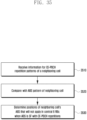
- FIGURE 36 illustrates example operations for a UE operating in a normal (non-CE) mode after receiving information for a CE-PBCH or CE-SIB repetitions pattern according to this disclosure. While the flow chart depicts a series of sequential steps, unless explicitly stated, no inference should be drawn from that sequence regarding specific order of performance, performance of steps or portions thereof serially rather than concurrently or in an overlapping manner, or performance of the steps depicted exclusively without the occurrence of intervening or intermediate steps.
- the process depicted in the example depicted is implemented by processing circuitry in, for example, a mobile station.
- a CE-MIB can include information for resources (SFs or RBs) that eNB 102 uses to transmit a CE-SIB.
- a respective information field in the CE-MIB can be an indicator for a configuration of CE-SIB or an index of a configuration of CE-SIB, where the configuration of CE-SIB can be a set of resources (SFs or RBs) for one or multiple transmissions (repetitions) of CE-SIB, or a number of CE-SIB repetitions, and so on.
Landscapes
- Engineering & Computer Science (AREA)
- Signal Processing (AREA)
- Computer Networks & Wireless Communication (AREA)
- Computer Security & Cryptography (AREA)
- Mobile Radio Communication Systems (AREA)
Applications Claiming Priority (9)
| Application Number | Priority Date | Filing Date | Title |
|---|---|---|---|
| US201361880673P | 2013-09-20 | 2013-09-20 | |
| US201361880683P | 2013-09-20 | 2013-09-20 | |
| US201361882417P | 2013-09-25 | 2013-09-25 | |
| US201361889947P | 2013-10-11 | 2013-10-11 | |
| US14/483,938 US9775134B2 (en) | 2013-09-20 | 2014-09-11 | System and method for coverage enhancements of broadcast channels |
| EP14846266.6A EP3047620A4 (de) | 2013-09-20 | 2014-09-22 | System und verfahren zur reichweitenerhöhung von rundfunkkanälen |
| EP19170315.6A EP3534564B1 (de) | 2013-09-20 | 2014-09-22 | Coverage-verbesserungen von broadcast-kanälen |
| EP22155628.5A EP4012969B1 (de) | 2013-09-20 | 2014-09-22 | Vorrichtung und verfahren zur reichweitenerhöhung von rundfunkkanälen |
| PCT/KR2014/008767 WO2015041487A1 (en) | 2013-09-20 | 2014-09-22 | System and method for coverage enhancements of broadcast channels |
Related Parent Applications (3)
| Application Number | Title | Priority Date | Filing Date |
|---|---|---|---|
| EP19170315.6A Division EP3534564B1 (de) | 2013-09-20 | 2014-09-22 | Coverage-verbesserungen von broadcast-kanälen |
| EP22155628.5A Division EP4012969B1 (de) | 2013-09-20 | 2014-09-22 | Vorrichtung und verfahren zur reichweitenerhöhung von rundfunkkanälen |
| EP14846266.6A Division EP3047620A4 (de) | 2013-09-20 | 2014-09-22 | System und verfahren zur reichweitenerhöhung von rundfunkkanälen |
Publications (2)
| Publication Number | Publication Date |
|---|---|
| EP4398642A2 true EP4398642A2 (de) | 2024-07-10 |
| EP4398642A3 EP4398642A3 (de) | 2024-11-06 |
Family
ID=52689087
Family Applications (4)
| Application Number | Title | Priority Date | Filing Date |
|---|---|---|---|
| EP14846266.6A Withdrawn EP3047620A4 (de) | 2013-09-20 | 2014-09-22 | System und verfahren zur reichweitenerhöhung von rundfunkkanälen |
| EP19170315.6A Active EP3534564B1 (de) | 2013-09-20 | 2014-09-22 | Coverage-verbesserungen von broadcast-kanälen |
| EP24177132.8A Pending EP4398642A3 (de) | 2013-09-20 | 2014-09-22 | System und verfahren zur reichweitenverbesserung von rundfunkkanälen |
| EP22155628.5A Active EP4012969B1 (de) | 2013-09-20 | 2014-09-22 | Vorrichtung und verfahren zur reichweitenerhöhung von rundfunkkanälen |
Family Applications Before (2)
| Application Number | Title | Priority Date | Filing Date |
|---|---|---|---|
| EP14846266.6A Withdrawn EP3047620A4 (de) | 2013-09-20 | 2014-09-22 | System und verfahren zur reichweitenerhöhung von rundfunkkanälen |
| EP19170315.6A Active EP3534564B1 (de) | 2013-09-20 | 2014-09-22 | Coverage-verbesserungen von broadcast-kanälen |
Family Applications After (1)
| Application Number | Title | Priority Date | Filing Date |
|---|---|---|---|
| EP22155628.5A Active EP4012969B1 (de) | 2013-09-20 | 2014-09-22 | Vorrichtung und verfahren zur reichweitenerhöhung von rundfunkkanälen |
Country Status (5)
| Country | Link |
|---|---|
| US (4) | US9775134B2 (de) |
| EP (4) | EP3047620A4 (de) |
| KR (1) | KR102370178B1 (de) |
| CN (2) | CN114221741B (de) |
| WO (1) | WO2015041487A1 (de) |
Cited By (2)
| Publication number | Priority date | Publication date | Assignee | Title |
|---|---|---|---|---|
| US20230422166A1 (en) * | 2020-11-20 | 2023-12-28 | Zte Corporation | Control method and apparatus for energy conservation of base station, and computer-readable storage medium |
| US12501358B2 (en) * | 2020-11-20 | 2025-12-16 | Zte Corporation | Control method and apparatus for energy conservation of base station, and computer-readable storage medium |
Families Citing this family (91)
| Publication number | Priority date | Publication date | Assignee | Title |
|---|---|---|---|---|
| CN104411202A (zh) * | 2012-07-09 | 2015-03-11 | 大卫·保罗·萨姆特 | 一种保护装置 |
| CN103582024B (zh) * | 2012-08-06 | 2018-01-23 | 华为技术有限公司 | 下行信号的发送、接收方法和网络系统及终端 |
| US9723497B2 (en) * | 2013-04-04 | 2017-08-01 | Qualcomm Incorporated | Network assisted interference cancellation/suppression for multiple services |
| US9775134B2 (en) | 2013-09-20 | 2017-09-26 | Samsung Electronics Co., Ltd. | System and method for coverage enhancements of broadcast channels |
| US9596660B2 (en) * | 2013-10-14 | 2017-03-14 | Kt Corporation | Method for transmitting and receiving random access preamble and device therefor |
| WO2015108331A1 (ko) * | 2014-01-16 | 2015-07-23 | 한양대학교 산학협력단 | Mtc 단말을 위한 하향링크 채널 전송 및 수신 방법, 그 장치 |
| US20160353440A1 (en) * | 2014-01-29 | 2016-12-01 | Interdigital Patent Holdings, Inc. | Method of access and link adaptation for coverage enhanced wireless transmissions |
| JP6380413B2 (ja) | 2014-01-30 | 2018-08-29 | 日本電気株式会社 | Machine−to−machine(M2M)端末、基地局、方法、及びプログラム |
| CA2938389C (en) * | 2014-01-30 | 2021-02-16 | Nec Corporation | Machine-to-machine (m2m) terminal, base station, method, and computer readable medium |
| US9706336B2 (en) * | 2014-03-14 | 2017-07-11 | Intel Corporation | Efficient coordination between a 3GPP node and MTC devices for coverage enhancement mode |
| AU2015231128A1 (en) | 2014-03-19 | 2016-10-06 | Interdigital Patent Holdings, Inc. | Method and apparatus for system information block (SIB) acquisition for wireless transmit/receive units (WTRUS) in non-CE and coverage enhanced (CE) modes |
| CN118828939A (zh) * | 2014-08-15 | 2024-10-22 | 交互数字专利控股公司 | 时分双工的覆盖增强和长期演进系统中增强的干扰减轻和业务适配 |
| US10306681B2 (en) | 2014-09-23 | 2019-05-28 | Lg Electronics Inc. | Method and apparatus for signaling usable downlink subframes for low cost user equipment in wireless communication system |
| US11581999B2 (en) * | 2014-10-08 | 2023-02-14 | Qualcomm Incorporated | Reference signal design for wireless communications |
| US9872286B2 (en) | 2014-11-21 | 2018-01-16 | Apple Inc. | Compressed system information for link budget limited UEs in a radio access network |
| EP3703427B1 (de) | 2014-11-28 | 2023-11-01 | Sony Group Corporation | Verfahren und vorrichtungen zur aktivierung eines maschinenartigen kommunikation (mtc)-reichweitenverstärkungsmodus |
| WO2016106680A1 (zh) * | 2014-12-31 | 2016-07-07 | 华为技术有限公司 | 信号发送和检测装置、系统及方法 |
| US11382080B2 (en) * | 2015-01-09 | 2022-07-05 | Apple Inc. | System information signaling for link budget limited wireless devices |
| JPWO2016121776A1 (ja) * | 2015-01-28 | 2017-11-02 | 株式会社Nttドコモ | ユーザ端末および無線通信方法 |
| CN113382367B (zh) * | 2015-04-10 | 2022-08-16 | 株式会社Ntt都科摩 | 用户装置 |
| CN107211309B (zh) * | 2015-04-10 | 2021-08-03 | 松下电器(美国)知识产权公司 | 无线通信方法和无线通信设备 |
| EP3273725B1 (de) | 2015-04-17 | 2019-01-30 | Panasonic Intellectual Property Corporation of America | Signalisierung der abdeckungsverstärkungsstufe und effiziente verpackung von mtc-systeminformationen |
| US11146376B2 (en) * | 2015-04-22 | 2021-10-12 | Qualcomm Incorporated | System type dependent master information block (MIB) |
| US10057815B2 (en) * | 2015-05-14 | 2018-08-21 | Qualcomm Incorporated | Physical broadcast channel repetition for evolved machine type communication |
| US10334617B2 (en) | 2015-06-16 | 2019-06-25 | Qualcomm Incorporated | System information for enhanced machine type communication |
| US11012976B2 (en) * | 2015-07-02 | 2021-05-18 | Qualcomm Incorporated | Broadcast channel repetition |
| WO2017010773A1 (ko) * | 2015-07-10 | 2017-01-19 | 엘지전자 주식회사 | 비면허 대역을 지원하는 무선접속시스템에서 디스커버리 참조 신호를 전송하는 방법 및 장치 |
| US9999039B2 (en) * | 2015-07-23 | 2018-06-12 | Qualcomm Incorporated | Semi-persistent scheduling for enhanced machine type communications |
| CN107925530B (zh) * | 2015-07-30 | 2021-03-23 | 苹果公司 | 物理广播信道设计 |
| US10091775B2 (en) | 2015-08-18 | 2018-10-02 | Apple Inc. | Non-PDCCH signaling of SIB resource assignment |
| WO2017032701A1 (en) * | 2015-08-24 | 2017-03-02 | Telefonaktiebolaget Lm Ericsson (Publ) | Method of adapting radio resources, device and computer program |
| RU2018118605A (ru) * | 2015-11-05 | 2019-12-06 | Нтт Докомо, Инк. | Пользовательское устройство и способ радиосвязи |
| KR102607575B1 (ko) | 2015-11-16 | 2023-11-30 | 삼성전자주식회사 | 무선 통신 시스템에서 방송 정보 수신을 위한 방법 및 장치 |
| KR102396800B1 (ko) * | 2015-11-19 | 2022-05-11 | 삼성전자 주식회사 | 무선 통신 시스템에서 공공 안전망 접속 지원 방법 및 장치 |
| CN106921468B (zh) * | 2015-12-28 | 2020-05-22 | 中兴通讯股份有限公司 | 一种信息传输方法及装置 |
| US11296837B2 (en) * | 2016-01-28 | 2022-04-05 | Qualcomm Incorporated | Physical broadcast channel (PBCH) transmission and reception on a shared communication medium |
| CN107040903B (zh) | 2016-02-03 | 2019-04-26 | 中兴通讯股份有限公司 | 一种系统信息发送方法和装置 |
| US9661663B1 (en) | 2016-03-16 | 2017-05-23 | Telefonaktiebolaget Lm Ericsson (Publ) | Network access of a wireless device to a communications network |
| WO2017164663A1 (ko) * | 2016-03-23 | 2017-09-28 | 엘지전자 주식회사 | 탐색 신호 전송 방법 및 장치 |
| WO2017180030A1 (en) * | 2016-04-12 | 2017-10-19 | Telefonaktiebolaget Lm Ericsson (Publ) | Transmission and reception of system information in parts |
| US11563505B2 (en) * | 2016-06-01 | 2023-01-24 | Qualcomm Incorporated | Time division multiplexing of synchronization channels |
| US11218236B2 (en) | 2016-06-01 | 2022-01-04 | Qualcomm Incorporated | Time division multiplexing of synchronization channels |
| US10531313B2 (en) * | 2016-07-15 | 2020-01-07 | Huawei Technologies Co., Ltd. | Method and system for generating and processing user-equipment-to-user-equipment probe signal |
| WO2018031290A1 (en) * | 2016-08-10 | 2018-02-15 | Intel Corporation | Synchronization signal transmission for new radio standard |
| US10397924B2 (en) * | 2016-08-10 | 2019-08-27 | Apple Inc. | Robust downlink control information with flexible resource assignments |
| RU2715520C1 (ru) * | 2016-08-11 | 2020-02-28 | Телефонактиеболагет Лм Эрикссон (Пабл) | Способ и оборудование для синхронизации беспроводных устройств в системе связи на основе лучей |
| CN107734596B (zh) | 2016-08-12 | 2023-06-16 | 华为技术有限公司 | 一种物理广播信道发送和接收方法及装置 |
| CN107770831B (zh) * | 2016-08-22 | 2022-08-12 | 上海诺基亚贝尔软件有限公司 | 用于传输小区系统信息的方法和设备 |
| JP6898439B2 (ja) * | 2016-09-28 | 2021-07-07 | アイディーエーシー ホールディングス インコーポレイテッド | 柔軟な無線サービスのための5g nrデータ送達 |
| US10200918B2 (en) * | 2016-10-03 | 2019-02-05 | Qualcomm Incorporated | Signaling to indicate whether physical broadcast channel repetition is enabled in a target cell |
| EP3520492B1 (de) * | 2016-11-04 | 2023-03-01 | Samsung Electronics Co., Ltd. | Verfahren und benutzergerät zur bereitstellung von minimalen systeminformationen in einem drahtloskommunikationssystem |
| US10470191B2 (en) | 2016-12-09 | 2019-11-05 | Samsung Electronics Co., Ltd. | Method and apparatus of broadcast signals and channels for system information transmission |
| US10863484B2 (en) * | 2017-01-09 | 2020-12-08 | Qualcomm Incorporated | Indication of random-access channel MSG3 resource duration via random-access channel MSG2 |
| CN112492692A (zh) * | 2017-02-27 | 2021-03-12 | 上海朗帛通信技术有限公司 | 一种ue、基站中的用于下行信息传输的方法和装置 |
| US10973047B2 (en) * | 2017-03-02 | 2021-04-06 | Lg Electronics Inc. | Method and apparatus for supporting variable bandwidth |
| US10411795B2 (en) * | 2017-03-14 | 2019-09-10 | Qualcomm Incorporated | Coverage enhancement mode switching for wireless communications using shared radio frequency spectrum |
| US12317273B2 (en) * | 2017-03-31 | 2025-05-27 | Qualcomm Incorporated | Reliable delivery of system information |
| US11223967B2 (en) * | 2017-04-18 | 2022-01-11 | Qualcomm Incorporated | Techniques to provide energy efficient radio resource management |
| US11006376B2 (en) | 2017-04-21 | 2021-05-11 | Qualcomm Incorporated | Techniques to encode or decode a self-decodable portion of a physical broadcast channel in a synchronization signal block |
| EP3616452B1 (de) * | 2017-04-24 | 2025-09-24 | Apple Inc. | Physikalische abwärtsstreckensteuerungskanäle (pdcch) und verbesserte pddch (epdcch) in anordnungen zur breitbandabdeckungsverbesserung (wce) |
| CN110226313B (zh) * | 2017-04-27 | 2022-02-15 | 北京小米移动软件有限公司 | 物理广播信道的处理方法及装置 |
| US12278708B2 (en) | 2017-05-03 | 2025-04-15 | Interdigital Patent Holdings, Inc. | Infrastructure equipment, mobile terminal, computer software and methods |
| US11122497B2 (en) * | 2017-05-04 | 2021-09-14 | Samsung Electronics Co., Ltd. | Method and apparatus for SS block index and timing indication in wireless systems |
| CN108811086B (zh) | 2017-05-04 | 2024-05-07 | 华为技术有限公司 | Pbch传输方法及装置 |
| CN109302741B (zh) * | 2017-05-05 | 2019-11-19 | 华为技术有限公司 | 通信方法和通信装置 |
| US10616875B2 (en) * | 2017-05-05 | 2020-04-07 | Qualcomm Incorporated | Techniques and apparatuses for downlink channel monitoring |
| US20180337759A1 (en) * | 2017-05-16 | 2018-11-22 | Qualcomm Incorporated | Bandwidth dependent control size |
| CN108933641B (zh) | 2017-05-22 | 2022-10-11 | 中兴通讯股份有限公司 | 数据发送、处理方法及装置,网络侧设备和终端 |
| CN109150437B (zh) * | 2017-06-16 | 2020-10-20 | 电信科学技术研究院 | 一种pbch符号映射方法及装置 |
| CN109275187B (zh) * | 2017-07-17 | 2021-01-08 | 维沃移动通信有限公司 | 一种随机接入方法、终端及计算机可读存储介质 |
| EP3668248B1 (de) * | 2017-08-16 | 2025-03-12 | Koninklijke Philips N.V. | Zufallszugriffsverfahren und vorrichtung |
| US10461896B2 (en) | 2017-09-08 | 2019-10-29 | At&T Intellectual Property I, L.P. | Configuration of repetition factors for transmitting feedback data for 5G or other next generation network |
| US10123322B1 (en) | 2017-09-18 | 2018-11-06 | Qualcomm Incorporated | Transmission of beam switch commands through control channel signaling |
| EP3688903A4 (de) * | 2017-09-29 | 2021-07-07 | Telefonaktiebolaget LM Ericsson (publ.) | Konfiguration von zusätzlichen systeminformationsblockwiederholungen |
| US11310769B2 (en) * | 2017-10-02 | 2022-04-19 | Telefonaktiebolaget Lm Ericsson (Publ) | Method, apparatus, and computer-readable medium for enhanced decoding of narrowband master information blocks (MIB-NB) |
| US11483204B2 (en) | 2017-11-17 | 2022-10-25 | Telefonaktiebolaget Lm Ericsson (Publ) | Compressed table-based configuration of remaining minimum system information coreset in a new radio physical broadcast channel |
| AU2018402576B2 (en) * | 2018-01-16 | 2022-02-03 | Zte Corporation | System and method for performing a random access procedure |
| US11019504B2 (en) * | 2018-04-04 | 2021-05-25 | Qualcomm Incorporated | On-demand coverage extended broadcast signal |
| US12057945B2 (en) * | 2018-04-19 | 2024-08-06 | Qualcomm Incorporated | Repetition-based transmissions for uplink ultra-reliable low latency communication |
| US11147102B2 (en) | 2018-04-23 | 2021-10-12 | Qualcomm Incorporated | Random access coverage extension in wireless communications |
| US10428844B1 (en) * | 2018-06-08 | 2019-10-01 | Eugene Holt | Method and system for generating electrical power from a wheeled engine-driven vehicle for powering a transport refrigeration unit |
| US11985674B2 (en) * | 2018-08-10 | 2024-05-14 | Apple Inc. | Data and control transmission enhancements for new radio (NR) |
| CN112823562A (zh) * | 2018-09-27 | 2021-05-18 | 联想(北京)有限公司 | 用于网络优化的ue信息传输的方法和装置 |
| WO2020188369A1 (en) | 2019-03-18 | 2020-09-24 | Girardet, François | Watchband and method for enhancing the utility inherent in the application of smartwatches |
| CN110768752B (zh) * | 2019-10-30 | 2022-01-28 | 紫光展锐(重庆)科技有限公司 | 通信方式确定方法及装置 |
| US11570752B2 (en) * | 2019-12-30 | 2023-01-31 | Qualcomm Incorporated | Monitoring multicast broadcast control information |
| EP4118767A4 (de) * | 2020-03-11 | 2024-03-13 | Qualcomm Incorporated | Verbesserung der abdeckung eines downlink-rundfunkkanals |
| CN113678526B (zh) * | 2020-03-13 | 2024-12-24 | 北京小米移动软件有限公司 | 下行传输发送方法、下行传输接收方法、装置和通信设备 |
| US20220322450A1 (en) * | 2021-04-05 | 2022-10-06 | Qualcomm Incorporated | Techniques for indicating message repetition parameters |
| CN115515159B (zh) * | 2021-06-23 | 2025-03-18 | 华为技术有限公司 | 一种通信方法及装置 |
| US12075449B2 (en) * | 2021-07-01 | 2024-08-27 | Nokia Technologies Oy | Blind physical broadcast channel detection for narrowband new radio |
Family Cites Families (33)
| Publication number | Priority date | Publication date | Assignee | Title |
|---|---|---|---|---|
| US8185726B2 (en) | 2006-04-27 | 2012-05-22 | Qualcomm Incorporated | Sleep optimization based on system information block scheduling |
| EP1874070B1 (de) * | 2006-06-29 | 2014-05-21 | Panasonic Corporation | Leistungsfähiger Mechanismus zur Paginierung mit massstabsgerechter Bandbreite Verteilung |
| EP1909520A1 (de) * | 2006-10-02 | 2008-04-09 | Matsushita Electric Industrial Co., Ltd. | Übertragung und Empfang von Systeminformationen auf grund einer Veränderung der Verbindung oder des Zugangspunkts in einem Mobilkommunikationssystem |
| US8295209B2 (en) * | 2008-02-21 | 2012-10-23 | Nokia Corporation | Frame structures with flexible partition boundary for wireless networks |
| WO2009116751A2 (en) | 2008-03-16 | 2009-09-24 | Lg Electronics Inc. | Method and apparatus for acquiring resource allocation of control channel |
| US8843115B2 (en) * | 2008-06-23 | 2014-09-23 | Qualcomm Incorporated | Method and apparatus for managing system information modification in a wireless communication system |
| CN101640902B (zh) * | 2008-08-01 | 2012-01-11 | 中兴通讯股份有限公司 | 一种物理上行控制信道资源压缩的通知方法 |
| WO2010085054A2 (en) * | 2009-01-21 | 2010-07-29 | Lg Electronics Inc. | Method of transmitting and receiving data in a wireless system |
| WO2010114304A2 (en) * | 2009-03-31 | 2010-10-07 | Lg Electronics Inc. | Transmitting / receiving system and method of processing broadcast signal in transmitting / receiving system |
| KR101349842B1 (ko) * | 2009-04-13 | 2014-01-10 | 엘지전자 주식회사 | 개선 시스템을 지원하는 기지국에서의 시스템 정보 전송 방법 및 장치 |
| CN101868029B (zh) * | 2009-04-15 | 2012-12-26 | 电信科学技术研究院 | 一种确定寻呼控制信道pcch资源的方法、系统和装置 |
| CN101877880A (zh) | 2009-04-28 | 2010-11-03 | 中兴通讯股份有限公司 | 一种解决中继节点系统广播信息冲突的方法 |
| CN101990308B (zh) * | 2009-07-31 | 2015-05-20 | 中兴通讯股份有限公司 | 中继链路的物理下行控制信道通知的方法及基站 |
| US9693299B2 (en) * | 2009-11-30 | 2017-06-27 | Nokia Technology Oy | Method and apparatus for power saving operations in wireless network elements |
| US9392608B2 (en) | 2010-04-13 | 2016-07-12 | Qualcomm Incorporated | Resource partitioning information for enhanced interference coordination |
| US8768263B2 (en) | 2010-12-01 | 2014-07-01 | Qualcomm Incorporated | Determining an uplink control path with blind decoding |
| US8885560B2 (en) * | 2011-06-27 | 2014-11-11 | Telefonaktiebolaget L M Ericsson (Publ) | Cellular communication system support for limited bandwidth communication devices |
| US8705556B2 (en) * | 2011-08-15 | 2014-04-22 | Blackberry Limited | Notifying a UL/DL configuration in LTE TDD systems |
| KR101962245B1 (ko) * | 2011-09-23 | 2019-03-27 | 삼성전자 주식회사 | 광대역 단말과 협대역 단말을 함께 운용하는 무선통신시스템에서 협대역 단말의 시스템 접속 방법 및 장치 |
| US8989121B2 (en) * | 2011-11-02 | 2015-03-24 | Qualcomm Incorporated | Blindly decoding interfering cell PDCCH to acquire interfering cell PDSCH transmission information |
| CN103139764B (zh) * | 2011-12-01 | 2015-09-09 | 华为技术有限公司 | 业务调度方法及装置 |
| CN103220811B (zh) * | 2012-01-19 | 2018-04-27 | 中兴通讯股份有限公司 | 信息处理方法、mtc ue随机接入lte系统的方法 |
| US20130188624A1 (en) | 2012-01-20 | 2013-07-25 | Jung Seung Lee | Apparatus and method for searching neighbor cells of small cell base station |
| US20130195069A1 (en) * | 2012-01-30 | 2013-08-01 | Nokia Siemens Networks Oy | Signaling mechanism for supporting flexible physical broadcast channel and common reference signal configurations |
| US9198120B2 (en) * | 2012-04-27 | 2015-11-24 | Marvell World Trade Ltd. | Method and apparatus for scanning multiple channels in a wireless network |
| US9749771B2 (en) * | 2012-05-11 | 2017-08-29 | Qualcomm Incorporated | Methods and apparatus for managing machine-type communications |
| US8761109B2 (en) * | 2012-08-03 | 2014-06-24 | Motorola Mobility Llc | Method and apparatus for receiving a control channel |
| US9185697B2 (en) * | 2012-12-27 | 2015-11-10 | Google Technology Holdings LLC | Method and apparatus for device-to-device communication |
| WO2014110804A1 (en) * | 2013-01-18 | 2014-07-24 | Broadcom Corporation | Enhanced broadcast channel for low cost machine type communication with coverage enhancement |
| US20140274011A1 (en) * | 2013-03-14 | 2014-09-18 | Qualcomm Incorporated | Method and apparatus for controlling operation of a user equipment based on physical layer parameters |
| CN105453629B (zh) * | 2013-08-05 | 2019-03-15 | 三星电子株式会社 | 在无线通信系统中用于通过波束分组发送和接收参考信号的方法和装置 |
| US9565573B2 (en) * | 2013-08-16 | 2017-02-07 | Blackberry Limited | Providing secondary coverage in a mobile communication system |
| US9775134B2 (en) * | 2013-09-20 | 2017-09-26 | Samsung Electronics Co., Ltd. | System and method for coverage enhancements of broadcast channels |
-
2014
- 2014-09-11 US US14/483,938 patent/US9775134B2/en active Active
- 2014-09-22 EP EP14846266.6A patent/EP3047620A4/de not_active Withdrawn
- 2014-09-22 WO PCT/KR2014/008767 patent/WO2015041487A1/en not_active Ceased
- 2014-09-22 EP EP19170315.6A patent/EP3534564B1/de active Active
- 2014-09-22 CN CN202111289934.8A patent/CN114221741B/zh active Active
- 2014-09-22 EP EP24177132.8A patent/EP4398642A3/de active Pending
- 2014-09-22 EP EP22155628.5A patent/EP4012969B1/de active Active
- 2014-09-22 CN CN201480063595.3A patent/CN105745892B/zh active Active
- 2014-09-22 KR KR1020167007459A patent/KR102370178B1/ko active Active
-
2017
- 2017-09-20 US US15/710,401 patent/US10334562B2/en active Active
-
2019
- 2019-06-21 US US16/449,266 patent/US10973003B2/en active Active
- 2019-11-12 US US16/681,603 patent/US11337178B2/en active Active
Cited By (2)
| Publication number | Priority date | Publication date | Assignee | Title |
|---|---|---|---|---|
| US20230422166A1 (en) * | 2020-11-20 | 2023-12-28 | Zte Corporation | Control method and apparatus for energy conservation of base station, and computer-readable storage medium |
| US12501358B2 (en) * | 2020-11-20 | 2025-12-16 | Zte Corporation | Control method and apparatus for energy conservation of base station, and computer-readable storage medium |
Also Published As
| Publication number | Publication date |
|---|---|
| CN105745892A (zh) | 2016-07-06 |
| US11337178B2 (en) | 2022-05-17 |
| CN114221741B (zh) | 2024-04-19 |
| CN105745892B (zh) | 2021-11-19 |
| EP3047620A4 (de) | 2017-05-17 |
| US10973003B2 (en) | 2021-04-06 |
| US20200084751A1 (en) | 2020-03-12 |
| US20190159172A9 (en) | 2019-05-23 |
| KR102370178B1 (ko) | 2022-03-04 |
| US9775134B2 (en) | 2017-09-26 |
| CN114221741A (zh) | 2022-03-22 |
| EP4012969A1 (de) | 2022-06-15 |
| EP4398642A3 (de) | 2024-11-06 |
| EP3534564B1 (de) | 2022-02-09 |
| KR20160058804A (ko) | 2016-05-25 |
| US20150085717A1 (en) | 2015-03-26 |
| US20190313371A1 (en) | 2019-10-10 |
| EP4012969B1 (de) | 2024-05-22 |
| EP3047620A1 (de) | 2016-07-27 |
| WO2015041487A1 (en) | 2015-03-26 |
| EP4012969C0 (de) | 2024-05-22 |
| US10334562B2 (en) | 2019-06-25 |
| EP3534564A1 (de) | 2019-09-04 |
| US20180014278A1 (en) | 2018-01-11 |
Similar Documents
| Publication | Publication Date | Title |
|---|---|---|
| US11337178B2 (en) | System and method for coverage enhancements of broadcast channels | |
| US10270565B2 (en) | Transmission of system information for low cost user equipment | |
| US11050517B2 (en) | Transmission of control channel and data channels for coverage enhancements | |
| US11582733B2 (en) | Method and apparatus for SS/PBCH block repetition | |
| EP3050243B1 (de) | System und verfahren für ressourcenmapping zur reichweitenerhöhung von rundfunkkanälen | |
| KR102623199B1 (ko) | 저비용 사용자 장비들을 위한 하향링크 제어 채널들의 전송 | |
| KR102263703B1 (ko) | Lte 어드밴스드용 증대된 커버리지 송신을 위한 방법 및 장치 | |
| US11109448B2 (en) | Method and apparatus for timing configuration of discovery signal and channel | |
| KR102887420B1 (ko) | 저가 사용자 단말에 대한 시스템 정보의 전송 |
Legal Events
| Date | Code | Title | Description |
|---|---|---|---|
| PUAI | Public reference made under article 153(3) epc to a published international application that has entered the european phase |
Free format text: ORIGINAL CODE: 0009012 |
|
| STAA | Information on the status of an ep patent application or granted ep patent |
Free format text: STATUS: REQUEST FOR EXAMINATION WAS MADE |
|
| 17P | Request for examination filed |
Effective date: 20240521 |
|
| AC | Divisional application: reference to earlier application |
Ref document number: 3047620 Country of ref document: EP Kind code of ref document: P Ref document number: 3534564 Country of ref document: EP Kind code of ref document: P Ref document number: 4012969 Country of ref document: EP Kind code of ref document: P |
|
| AK | Designated contracting states |
Kind code of ref document: A2 Designated state(s): AL AT BE BG CH CY CZ DE DK EE ES FI FR GB GR HR HU IE IS IT LI LT LU LV MC MK MT NL NO PL PT RO RS SE SI SK SM TR |
|
| REG | Reference to a national code |
Ref country code: DE Ref legal event code: R079 Free format text: PREVIOUS MAIN CLASS: H04W0048120000 Ipc: H04L0005000000 |
|
| PUAL | Search report despatched |
Free format text: ORIGINAL CODE: 0009013 |
|
| AK | Designated contracting states |
Kind code of ref document: A3 Designated state(s): AL AT BE BG CH CY CZ DE DK EE ES FI FR GB GR HR HU IE IS IT LI LT LU LV MC MK MT NL NO PL PT RO RS SE SI SK SM TR |
|
| RIC1 | Information provided on ipc code assigned before grant |
Ipc: H04W 48/12 20090101ALI20241001BHEP Ipc: H04L 1/08 20060101ALI20241001BHEP Ipc: H04L 1/00 20060101ALI20241001BHEP Ipc: H04L 5/00 20060101AFI20241001BHEP |