EP4398248A2 - Codierer mit vorwärts-aliasing-unterdrückung - Google Patents
Codierer mit vorwärts-aliasing-unterdrückung Download PDFInfo
- Publication number
- EP4398248A2 EP4398248A2 EP24167821.8A EP24167821A EP4398248A2 EP 4398248 A2 EP4398248 A2 EP 4398248A2 EP 24167821 A EP24167821 A EP 24167821A EP 4398248 A2 EP4398248 A2 EP 4398248A2
- Authority
- EP
- European Patent Office
- Prior art keywords
- frame
- sub
- aliasing cancellation
- time
- coding mode
- Prior art date
- Legal status (The legal status is an assumption and is not a legal conclusion. Google has not performed a legal analysis and makes no representation as to the accuracy of the status listed.)
- Granted
Links
Images









Classifications
-
- G—PHYSICS
- G10—MUSICAL INSTRUMENTS; ACOUSTICS
- G10L—SPEECH ANALYSIS TECHNIQUES OR SPEECH SYNTHESIS; SPEECH RECOGNITION; SPEECH OR VOICE PROCESSING TECHNIQUES; SPEECH OR AUDIO CODING OR DECODING
- G10L19/00—Speech or audio signals analysis-synthesis techniques for redundancy reduction, e.g. in vocoders; Coding or decoding of speech or audio signals, using source filter models or psychoacoustic analysis
- G10L19/04—Speech or audio signals analysis-synthesis techniques for redundancy reduction, e.g. in vocoders; Coding or decoding of speech or audio signals, using source filter models or psychoacoustic analysis using predictive techniques
-
- G—PHYSICS
- G10—MUSICAL INSTRUMENTS; ACOUSTICS
- G10L—SPEECH ANALYSIS TECHNIQUES OR SPEECH SYNTHESIS; SPEECH RECOGNITION; SPEECH OR VOICE PROCESSING TECHNIQUES; SPEECH OR AUDIO CODING OR DECODING
- G10L19/00—Speech or audio signals analysis-synthesis techniques for redundancy reduction, e.g. in vocoders; Coding or decoding of speech or audio signals, using source filter models or psychoacoustic analysis
- G10L19/005—Correction of errors induced by the transmission channel, if related to the coding algorithm
-
- G—PHYSICS
- G10—MUSICAL INSTRUMENTS; ACOUSTICS
- G10L—SPEECH ANALYSIS TECHNIQUES OR SPEECH SYNTHESIS; SPEECH RECOGNITION; SPEECH OR VOICE PROCESSING TECHNIQUES; SPEECH OR AUDIO CODING OR DECODING
- G10L19/00—Speech or audio signals analysis-synthesis techniques for redundancy reduction, e.g. in vocoders; Coding or decoding of speech or audio signals, using source filter models or psychoacoustic analysis
- G10L19/02—Speech or audio signals analysis-synthesis techniques for redundancy reduction, e.g. in vocoders; Coding or decoding of speech or audio signals, using source filter models or psychoacoustic analysis using spectral analysis, e.g. transform vocoders or subband vocoders
-
- G—PHYSICS
- G10—MUSICAL INSTRUMENTS; ACOUSTICS
- G10L—SPEECH ANALYSIS TECHNIQUES OR SPEECH SYNTHESIS; SPEECH RECOGNITION; SPEECH OR VOICE PROCESSING TECHNIQUES; SPEECH OR AUDIO CODING OR DECODING
- G10L19/00—Speech or audio signals analysis-synthesis techniques for redundancy reduction, e.g. in vocoders; Coding or decoding of speech or audio signals, using source filter models or psychoacoustic analysis
- G10L19/02—Speech or audio signals analysis-synthesis techniques for redundancy reduction, e.g. in vocoders; Coding or decoding of speech or audio signals, using source filter models or psychoacoustic analysis using spectral analysis, e.g. transform vocoders or subband vocoders
- G10L19/0212—Speech or audio signals analysis-synthesis techniques for redundancy reduction, e.g. in vocoders; Coding or decoding of speech or audio signals, using source filter models or psychoacoustic analysis using spectral analysis, e.g. transform vocoders or subband vocoders using orthogonal transformation
-
- G—PHYSICS
- G10—MUSICAL INSTRUMENTS; ACOUSTICS
- G10L—SPEECH ANALYSIS TECHNIQUES OR SPEECH SYNTHESIS; SPEECH RECOGNITION; SPEECH OR VOICE PROCESSING TECHNIQUES; SPEECH OR AUDIO CODING OR DECODING
- G10L19/00—Speech or audio signals analysis-synthesis techniques for redundancy reduction, e.g. in vocoders; Coding or decoding of speech or audio signals, using source filter models or psychoacoustic analysis
- G10L19/04—Speech or audio signals analysis-synthesis techniques for redundancy reduction, e.g. in vocoders; Coding or decoding of speech or audio signals, using source filter models or psychoacoustic analysis using predictive techniques
- G10L19/16—Vocoder architecture
- G10L19/18—Vocoders using multiple modes
- G10L19/20—Vocoders using multiple modes using sound class specific coding, hybrid encoders or object based coding
Definitions
- MDCT causes aliasing. This is, thus, true, at TXC and FD frame boundaries.
- aliasing occurs at the window overlap regions, that is cancelled by the help of the neighbouring frames. That is, for any transitions between two FD frames or between two TCX (MDCT) frames or transition between either FD to TCX or TCX to FD, there is an implicit aliasing cancelation by the overlap/add procedure within the reconstruction at the decoding side. Then, there is no more aliasing after the overlap add.
- FAC forward aliasing cancellation
- time-domain aliasing cancellation transform coding is used, such as MDCT, i.e. a coding mode using a overlapped transform where overlapping windowed portions of a signal are transformed using a transform according to which the number of transform coefficients per portion is less than the number of samples per portion so that aliasing occurs as far as the individual portions are concerned, with this aliasing being cancelled by time-domain aliasing cancellation, i. e. by adding the overlapping aliasing portions of neighboring re-transformed signal portions.
- MDCT is such a time-domain aliasing cancellation transform.
- the TDAC time-domain aliasing cancellation
- the decoder does not know for the immediately succeeding (received) frames as to whether a coding mode change occurred or not, and as to whether the bit stream of the current frame encoded data contains FAC data or not. Accordingly, the decoder has to discard the current frame and wait for the next frame.
- the decoder may parse the current frame by performing two decoding trials, one assuming that FAC data is present, and another assuming that FAC data is not present, with subsequently deciding as to whether one of both alternatives fails.
- the decoding process would most likely make the decoder crashing in one of the two conditions. That is, in reality, the latter possibility is not a feasible approach.
- the decoder should at any time know how to interpret the data and not rely on its own speculation on how to treat the data.
- the present invention is based on the finding that a more error robust or frame loss robust codec supporting switching between time-domain aliasing cancellation transform coding mode and time-domain coding mode is achievable if a further syntax portion is added to the frames depending on which the parser of the decoder may select between a first action of expecting the current frame to comprise, and thus reading forward aliasing cancellation data from the current frame and a second action of not-expecting the current frame to comprise, and thus not reading forward aliasing cancellation data from the current frame.
- a bit of coding efficiency is lost due to the provision of the second syntax portion, it is merely the second syntax portion which provides for the ability to use the codec in case of a communication channel with frame loss.
- FIG. 1 shows a decoder 10 according to an embodiment of the present invention.
- Decoder 10 is for decoding a data stream comprising a sequence of frames 14a, 14b and 14c into which time segments 16a-c of an information signal 18 are coded, respectively.
- the time segments 16a to 16c are non-overlapping segments which directly abut each other in time and are sequentially ordered in time.
- the time segments 16a to 16c may be of equal size but alternative embodiments are also feasible.
- Each of the time segments 16a to 16c is coded into a respective one of frames 14a to 14c.
- each time segment 16a to 16c is uniquely associated with one of frames 14a to 14c which, in turn, have also an order defined among them, which follows the order of the segments 16a to 16c which are coded into the frames 14a to 14c, respectively.
- figure 1 suggests that each frame 14a to 14c is of equal length measured in, for example, coded bits, this is, of course, not mandatory. Rather, the length of frames 14a to 14c may vary according to the complexity of the time segment 16a to 16c the respective frame 14a to 14c is associated with.
- the information signal 18 is an audio signal.
- the information signal could also be any other signal, such as a signal output by a physical sensor or the like, such as an optical sensor or the like.
- signal 18 may be sampled at a certain sampling rate and the time segments 16a to 16c may cover immediately consecutive portions of this signal 18 equal in time and number of samples, respectively.
- a number of samples per time segment 16a to 16c may, for example, be 1024 samples.
- the decoder 10 comprises a parser 20 and a reconstructor 22.
- the parser 20 is configured to parse the data stream 12 and, in parsing the data stream 12, read a first syntax portion 24 and a second syntax portion 26 from a current frame 14b, i.e. a frame currently to be decoded.
- a current frame 14b i.e. a frame currently to be decoded.
- frame 14b is the frame currently to be decoded
- frame 14a is the frame which has been decoded immediately before.
- Each frame 14a to 14c has a first syntax portion and a second syntax portion incorporated therein with a significance or meaning thereof being outlined below.
- the first syntax portion within frames 14a to 14c is indicated with a box having a "1" in it and the second syntax portion indicated with a box entitled "2".
- each frame 14a to 14c also has further information incorporated therein which is for representing the associated time segment 16a to 16c in a way outlined in more detail below.
- This information is indicated in figure 1 by a hatched block wherein a reference sign 28 is used for the further information of the current frame 14b.
- the parser 20 is configured to, in parsing the data stream 12, also read the information 28 from the current frame 14b.
- the reconstructor 22 is configured to reconstruct the current time segment 16b of the information signal 18 associated with the current frame 14b based of the further information 28 using a selected one of the time-domain aliasing cancellation transform decoding mode and a time-domain decoding mode.
- the selection depends on the first syntax element 24.
- Both decoding modes differ from each other by the presence or absence of any transition from spectral domain back to time-domain using a re-transform.
- the re-transform (along with its corresponding transform) introduces aliasing as far as the individual time segments are concerned which aliasing is, however, compensable by a time-domain aliasing cancellation as far as the transitions at boundaries between consecutive frames coded in the time-domain aliasing cancellation transform coding mode is concerned.
- parser 20 exploits a second syntax portion 26 in order to ascertain as to whether forward aliasing cancellation data 34 is present in the current frame 14b or not.
- parser 20 may selected one of a first action of expecting the current frame 14b to comprise, and thus reading forward aliasing cancellation data 34 from the current frame 14b and a second action of not-expecting the current frame 14b to comprise, and thus not reading forward aliasing cancellation data 34 from the current frame 14b, the selection depending on the second syntax portion 26.
- the reconstructor 22 is configured to perform forward aliasing cancellation at the boundary between the current time segment 16b and the previous time segment 16a of the previous frame 14a using the forward aliasing cancellation data.
- the inserter 44 is configured to insert the information 28 into the current frame 14b along with a first syntax portion 24 and a second syntax portion 26, wherein the first syntax portion signals the first selection, i.e. the selection of the coding mode.
- the constructor 42 is configured to determine forward aliasing cancellation data for forward aliasing cancellation at a boundary between the current time segment 16b and a previous time segment 16a of a previous frame 14a and inserts forward aliasing cancellation data 34 into the current frame 14b in case the current frame 14b and the previous frame 14a are encoded using different ones of a time-domain aliasing cancellation transform coding mode and a time-domain coding mode, and refraining from inserting any forward aliasing cancellation data into the current frame 14b in case the current frame 14b and the previous frame 14a are encoded using equal ones of the time-domain aliasing cancellation transform coding mode and the time-domain coding mode.
- All coding modules 54 to 58 output signal segments reconstructing the respective time segments associated with the respective frames and sub-frames from which these signal segments have been derived by the respective decoding mode, and a transition handler 60 receives the signal segments at respective inputs thereof in order to perform the transition handling and aliasing cancellation described above and described in more detail below in order to output at its output of the reconstructed information signal.
- Transition handler 60 uses the forward aliasing cancellation data 34 as illustrated in figure 3 .
- the reconstructor 22 operates as follows. If the first syntax portion 24 associates the current frame with a first frame type, FD coding mode, switch 50 forwards the information 28 to FD decoding module 54 for using frequency domain decoding as a first version of the time-domain aliasing cancellation transform decoding mode to reconstruct the time segment 16b associated with the current frame 15b. Otherwise, i.e. if the first syntax portion 24 associates the current frame 14b with the second frame type, LPD coding mode, switch 50 forwards information 28 to sub-switch 52 which, in turn, operates on the sub-frame structure of the current frame 14.
- Re-transformer 72 then performs a re-transform on the de-quantized transform coefficient information to obtain a re-transformed signal segment 78 extending, in time, over and beyond the time segment 16b associated with the current frame 14b.
- the re-transform performed by re-transformer 72 may be an IMDCT (Inverse Modified Discrete Cosine Transform) involving a DCT IV followed by an unfolding operation wherein after a windowing is performed using a re-transform window which might be equal to, or deviate from, the transform window used in generating the transform coefficient information 74 by performing the afore-mentioned steps in the inverse order, namely windowing followed by a folding operation followed by a DCT IV followed by the quantization which may be steered by psycho acoustic principles in order to keep the quantization noise below the masking threshold.
- IMDCT Inverse Modified Discrete Cosine Transform
- the TCX LP decoding module 56 comprises a spectral weighting derivator 94, a spectral weighter 96 and a re-transformer 98.
- the first sub-frame 90a is shown to be a TCX sub-frame, whereas the second sub-frame 90b is assumed to be ACELP sub-frame.
- Re-transformer 98 re-transforms the spectrally weighted transform coefficient information to obtain a re-transformed signal segment 108 extending, in time t, over and beyond the sub-portion 92a of the current time segment.
- the re-transform performed by re-transformer 98 may be the same as performed by re-transformer 72.
- re-transformer 72 and 98 may have hardware, a software-routine or a programmable hardware portion in common.
- re-transformed signal segment 108 suffers from aliasing.
- re-transform signal segments 78 and 108 of consecutive frames and sub-frames, respectively may have their aliasing cancelled out by transition handler 60 merely by adding the overlapping portions thereof.
- transition handler 60 which, in turn, puts together all signal segments in the correct time order.
- the transition handler 60 performs time-domain aliasing cancellation within temporarily overlapping window portions at boundaries between time segments of immediately consecutive ones of FD frames and TCX sub-frames to reconstruct the information signal across these boundaries.
- the transition handler 60 performs time-domain aliasing cancellation within temporarily overlapping window portions at boundaries between time segments of immediately consecutive ones of FD frames and TCX sub-frames to reconstruct the information signal across these boundaries.
- forward aliasing cancellation data for boundaries between consecutive FD frames, boundaries between FD frames followed by TCX frames and TCX sub-frames followed by FD frames, respectively.
- transition handler may ascertain the existence of the respective forward aliasing cancellation data for these transitions from first syntax portion 24 and the sub-framing structure defined therein.
- the syntax portion 26 is not needed.
- the previous frame 14a may have got lost or not.
- parser 20 has to inspect the second syntax portion 26 within the current frame in order to determine as to whether the current frame 14b has forward aliasing cancellation data 34, the FAC data 34 being for cancelling aliasing occurring at the leading end of the current time segment 16b, because either the previous frame is an FD frame or the last sub-frame of the preceding LPD frame is a TCX sub-frame. At least, parser 20 needs to know syntax portion 26 in case, the content of the previous frame got lost.
- parser 20 needs to inspect the second syntax portion 26 in order to determine as to whether forward aliasing cancellation data 34 is present for the transition at the leading end of the current time segment 16b or not - at least in case of having no access to the previous frame.
- the transition handler 60 derives a second forward aliasing cancellation synthesis signal from the forward aliasing cancellation data 34 and adds the second forward aliasing cancellation synthesis signal to the re-transformed signal segment within the current time segment in order to reconstruct the information signal across the boundary.
- Window switching in USAC has several purposes. It mixes FD frames, i.e. frames encoded with frequency coding, and LPD frames which are, in turn, structured into ACELP (sub-frames and TCX (sub-)frames.
- ACELP frames time-domain coding
- TCX frames frequency-domain coding
- TDAC time-domain aliasing cancellation
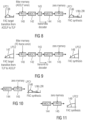
- Figure 6 shows the processing at the encoder in a frame 120 encoded with transform coding (TC) which is preceded and followed by a frame 122, 124 encoded with ACELP.
- TC transform coding
- frame 120 may either be an FD frame or an TCX (sub-)frame as the sub-frame 90a, 92a in figure 5 , for example.
- Figure 6 shows time-domain markers and frame boundaries. Frame or time segment boundaries are indicated by dotted lines while the time-domain markers are the short vertical lines along the horizontal axes. It should be mentioned that in the following description the terms "time segment" and "frame” are sometimes used synonymously due to the unique association there between.
- LPC1 and LPC2 shall indicate the center of an analysis window corresponding to LPC filter coefficients or LPC filters which are used in the following in order to perform the aliasing cancellation.
- LPC filters comprise: LPC1 corresponding to a calculation thereof at the beginning of the frame 120, and LPC2 corresponding to a calculation thereof at the end of frame 120.
- Frame 122 is assumed to have been encoded with ACELP. The same applies to frame 124.
- Figure 6 is structured into four lines numbered at the right hand side of figure 6 . Each line represents a step in the processing at the encoder. It is to be understood that each line is time alined with the line above.
- Line 1 of figure 6 represents the original audio signal, segmented in frames 122, 120 and 124 as stated above.
- the original signal is encoded with ACELP.
- the original signal is encoded using TC.
- the noise shaping is applied directly in the transform domain rather than in the time domain.
- the original signal is again encoded with ACELP, i.e. a time domain coding mode.
- This sequence of coding modes (ACELP then TC then ACELP) is chosen so as to illustrate the processing in FAC since FAC is concerned with both transitions (ACELP to TC and TC to ACELP).
- the transitions at LPC1 and LPC2 in Fig. 6 may occur within the inner of a current time segment or may coincide with the leading end thereof.
- the determination of the existence of the associated FAC data may be performed by parser 20 merely based on the first syntax portion 24, whereas in case of frame loss, parser 20 may need the syntax portion 26 to do so in the latter case.
- Line 2 of figure 6 corresponds to the decoded (synthesis) signals in each of frames 122, 120 and 124.
- the reference sign 110 of figure 5 is used within frame 122 corresponding to the possibility that the last sub-portion of frame 122 is an ACELP encoded sub-portion like 92b in figure 5 , while a reference sign combination 108/78 is used in order to indicated the signal contribution for frame 120, analogously to figures 5 and 4 .
- the synthesis of that frame 122 is assumed to have been encoded with ACELP.
- the synthesis signal 110 at the left of marker LPC1 is identified as an ACELP synthesis signal.
- the TC frame output represents a re-windowed TLP synthesis signal, where TLP stands for "Transform-coding with Linear Prediction" to indicate that in case of TCX, noise shaping of the respective segment is accomplished in the transform domain by filtering the MDCT coefficients using spectral information from the LPC filters LPC1 and LPC2, respectively, what has also been described above with respect to figure 5 with regard to spectral weighter 96.
- the synthesis signal i.e. the preliminarily re-constructed signal including the aliasing, between markers "LPC1" and "LPC2" on line 2 of figure 6 , i.e.
- the time-domain aliasing may be symbolized as unfoldings 126a and 126b, respectively.
- the upper curve in line 2 of figure 6 which extends from the beginning to the end of that segment 120 and is indicated with reference signs 108/78, shows the windowing effect due to the transform windowing being flat in the middle in order to leave the transformed signal unchanged, but not at the beginning and end.
- the folding effect is shown by the lower curves 126a and 126b at the beginning and end of the segment 120 with the minus sign at the beginning of the segment and the plus sign at the end of the segment.
- line 2 in figure 6 contains the synthesis of preliminary reconstructed signals from the consecutive frames 122, 120 and 124, including the effect of windowing in time-domain aliasing at the output of the inverse MDCT for the frame between markers LPC1 and LPC2.
- figure 7 Before proceeding to describe the encoding process in order to obtain the forward aliasing cancellation data, reference is made to figure 7 in order to briefly explain the MDCT as one example of TDAC transform processing. Both transform directions are depicted and described with respect to figure 7 . The transition from time-domain to transform-domain is illustrated in the upper half of figure 7 , whereas the re-transform is depicted in the lower part of figure 7 .
- the TDAC transform involves a windowing 150 applied to an interval 152 of the signal to be transformed which extends beyond the time segment 154 for which the later resulting transform coefficients are actually be transmitted within the data stream.
- the window applied in the windowing 150 is shown in figure 7 as comprising an aliasing part L k crossing the leading end of time segment 154 and an aliasing part R k at a rear end of time segment 154 with a non-aliasing part M k extending therebetween.
- An MDCT 156 is applied to the windowed signal.
- a folding 158 is performed so as to fold a first quarter of interval 152 extending between the leading end of interval 152 and the leading end of time segment 154 back along the left hand (leading) boundary of time segment 154.
- aliasing portion R k is performed.
- a DCT IV 160 is performed on the resulting windowed and folded signal having as much samples as time signal 154 so as to obtain transform coefficients of the same number.
- a conversation is performed then at 162.
- the quantization 162 may be seen as being not comprised by the TDAC transform.
- a re-transform does the reverse. That is, following a de-quantization 164, an IMDCT 166 is performed involving, firstly, a DCT -1 IV 168 so as to obtain time samples the number of which equals the number of samples of the time segment 154 to be re-constructed. Thereafter, an unfolding process 168 is performed on the inversely transformed signal portion received from module 168 thereby expanding the time interval or the number of time samples of the IMDCT result by doubling the length of the aliasing portions. Then, a windowing is performed at 170, using a re-transform window 172 which may be same as the one used by windowing 150, but may also be different.
- the remaining blocks in figure 7 illustrate the TDAC or overlap/add processing performed at the overlapping portions of consecutive segments 154, i.e. the adding of the unfolded aliasing portions thereof, as performed by the transition handler in Fig. 3 .
- the TDAC by blocks 172 and 174 results in aliasing cancellation.
- figure 6 To efficiently compensate windowing and time-domain aliasing effects at the beginning and end of the TC frame 120 on line 4 of figure 6 , and assuming that the TC frame 120 uses frequency-domain noise shaping (FDNS), forward aliasing correction (FAC) is applied following the processing described in figure 8 .
- FAC forward aliasing correction
- figure 8 describes this processing for both, the left part of the TC frame 120 around marker LPC1, and for the right part of the TC frame 120 around marker LPC2.
- the TC frame 120 in figure 6 as assumed to be preceded by an ACELP frame 122 at the LPC1 marker boundary and followed by an ACELP frame 124 at the LPC2 marker boundary.
- a weighting filter W(z) is computed from the LPC1 filter.
- the weighting filter W(z) might be a modified analysis or whitening filter A(z) of LPC1.
- W(z) A(z/ ⁇ ) with ⁇ being a predetermined weighting factor.
- the error signal at the beginning of the TC frame is indicated with reference sign 138 jus as it is the case on line 4 of figure 6 . This error is called the FAC target in figure 8 .
- the error signal 138 is filtered by filter W (z) at 140, with an initial state of this filter, i.e.
- the output of filter W(z) then forms the input of a transform 142 in figure 6 .
- the transform is exemplarily shown to be an MDCT.
- the transform coefficients output by the MDCT are then quantized and encoded in processing module 143. These encoded coefficients might form at least a part of the afore-mentioned FAC data 34. These encoded coefficients may be transmitted to the coding side.
- the output of process Q is then the input of an inverse transform such as an IMDCT 144 to form a time-domain signal which is then filtered by the inverse filter 1/W(z) at 145 which has zero-memory (zero initial state). Filtering through 1/W(z) is extended to past the length of the FAC target using zero-input for the samples that extend after the FAC target.
- the output of filter 1/W(z) is a FAC synthesis signal 146, which is a correction signal that may now be applied at the beginning of the TC frame 120 to compensate for the windowing and time-domain aliasing effect occurring there.
- transition handler 60 may subject transform coefficient information within the FAC data 34 present within the current frame 14b to a re-transform in order to yield a first FAC synthesis signal 146 in case of transition from an ACELP time segment sub-part to an FD time segment or TCX sup-part, or a second FAC synthesis signal 149 when transitioning from an FD time segment or TCX sub-part of an time segment to an ACELP time segment sub-part.
- Figure 12 shows how to the complete synthesis or reconstructed signal for the current frame 120 can be obtained by using the FAC synthesis signals in figures 8 to 11 and applying the inverse steps of figure 6 . Note again, that even the steps which are shown now in figure 12 , are also performed by the encoder in order to ascertain as to whether the coding mode for the current frame leads to the best optimization in, for example, rate/distortion sense or the like.
- the ACELP frame 122 at the left of marker LPC1 is already synthesized or reconstructed such as by module 58 of figure 3 , up to marker LPC1 thereby leading to the ACELP synthesis signal on line 2 of figure 12 with reference sign 110.
- figure 13 pertains the current processing of the CELP coded frame k and leads to forward aliasing cancellation at the end of the preceding TC coded segment.
- the finally reconstructed audio signal is aliasing less reconstructed across the boundary between segments k-1 and k.
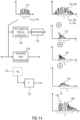
- Processing of figure 14 leads to forward aliasing cancellation at the beginning of the current TC coded segment k as illustrated at reference sign 198 showing the reconstructed signal across the boundary between segments k and k-1.
- the remaining aliasing at the rear end of the current segment k is either cancelled by TDAC in case the following segment is a TC coded segment, or FAC according to figure 13 in case the subsequent segment is ACELP coded segment.
- Figure 13 mentions this latter possibility by assigning reference sign 198 to signal segment of time segment k-1.
- the syntax portion 26 may be embodied as a 2-bit field prev_mode that signals within the current frame 14b explicitly the coding mode that was applied in the previous frame 14a according to the following table: prev_mode ACELP 0 0 TCX 0 1 FD_long 1 0 FD_short 1 1
- this 2-bit field may be called prev_mode and may thus indicate a coding mode of the previous frame 14a.
- prev_mode may indicate a coding mode of the previous frame 14a.
- four different states are differentiated, namely:
- the parser 20 could be configured to buffer at least the currently decoded frame 14b within a buffer with passing all the frames 14a to 14c through this buffer in a FIFO (first in first out) manner.
- parser 20 could perform the removal of frames from this buffer in units of frames 14a to 14c. That is, the filling and removal of the buffer of parser 20 could be performed in units of frames 14a to 14c so as to obey the constraints imposed by the maximally available buffer space which, for example, accommodates merely one, or more than one, frames of maximum size at a time.
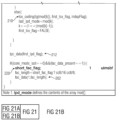
- the other 1-bit flag prev_frame_was_lpd is then only transmitted in the current frame if same was encoded using the LPD part of USAC, and signals whether the previous frame was encoded using the LPD path of the USAC as well. This is shown in the table of figure 17 .
- the table of figure 17 shows a part of the information 28 in figure 1 in case of the current fame 14b being an LPD frame.
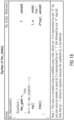
- each LPD frame is provided with a flag prev_frame_was_lpd. This information is used to parse the syntax of the current LPD frame. That the content and the position of the FAC data 34 in LPD frames depends on the transition at the leading end of the current LPD frame being a transition between TCX coding mode and CELP coding mode or a transition from FD coding mode to CELP coding mode is derivable from figure 18 .
- the current frame is an LPD frame with the preceding frame being also an LPD frame, i.e. if a transition between TCX and CELP sub-frames occurs between the current frame and the previous frame
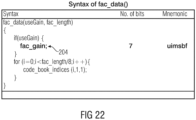
- FAC data is read at 206 without the gain adjustability option, i.e. without the FAC data 34 including the FAC gain syntax element fac_gain.
- the position of the FAC data read at 206 differs from the position at which FAC data is read at 202 in case of the current frame being an LPD frame and the previous frame being an FD frame. While the position of reading 202 occurs at the end of the current LPD frame, the reading of the FAC data at 206 occurs before the reading of the sub-frame specific data, i.e. the ACELP or TCX data depending on the modes of the sub-frames of the sub-frames structure, at 208 and 210, respectively.
- the sub-frame specific data i.e. the ACELP or TCX data depending on the modes of the sub-frames of the sub
- the LPC information 104 ( figure 5 ) is read after the sub-frames specific data such as 90a and 90b (compare figure 5 ) at 212.
- the syntax structure of the LPD frame according to figure 17 is further explained with regard to FAC data potentially additionally contained within the LPD frame in order to provide FAC information with regard to transitions between TCX and ACELP sub-frames in the inner of the current LPD coded time segment.
- the LPD sub-frame structure is restricted to sub-divide the current LPD coded time segment merely in units of quarters with assigning these quarters to either TCX or ACELP.
- the exact LPD structure is defined by the syntax element lpd_mode read at 214.
- the first and the second and the third and the fourth quarter may form together a TCX sub-frame whereas ACELP frames are restricted to the length of a quarter only.
- a TCX sub-frame may also extend over the whole LPD encoded time segment in which case the number sub-frames is merely one.
- the while loop in figure 17 steps through the quarters of the currently LPD coded time segment and transmits, whenever the current quarter k is the beginning of a new sub-frame within the inner of the currently LPD coded time segment, FAC data at 216 provided the immediately preceding sub-frame of the currently beginning/decoded LPD frame is of the other mode, i.e. TCX mode if the current sub-frame is of ACELP mode and these versa.
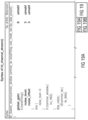
- figure 19 shows a possible syntax structure of an FD frame in accordance with the embodiment of figures 15 to 18 . It can be seen that FAC data is read at the end of the FD frame with the decision as to whether FAC data 34 is present or not, merely involving the fac_data_present flag. Compared thereto, parsing of the fac_data 34 in case of LPD frames as shown in figure 17 necessitates, for a correct parsing, the knowledge of the flag prev_frame_was_lpd.
- fac_data_present 0.
- the parser is configured to perform the reading of the forward aliasing cancellation data (34) from the current frame (14b), if the current frame (14b) is of the second frame type, depending on the second flag in that a forward aliasing cancellation gain is parsed from the forward aliasing cancellation data (34) in case of the previous frame being of the first frame type, and not if previous frame being of the second frame type with the last sub frame thereof being of the first sub frame type, the reconstructor is configured to perform the forward aliasing cancellation at an intensity which depends on the forward aliasing cancellation gain in case of the previous frame being of the first frame type.
- embodiments of the invention can be implemented in hardware or in software.
- the implementation can be performed using a digital storage medium, for example a floppy disk, a DVD, a Blue-Ray, a CD, a ROM, a PROM, an EPROM, an EEPROM or a FLASH memory, having electronically readable control signals stored thereon, which cooperate (or are capable of cooperating) with a programmable computer system such that the respective method is performed. Therefore, the digital storage medium may be computer readable.
Landscapes
- Engineering & Computer Science (AREA)
- Physics & Mathematics (AREA)
- Health & Medical Sciences (AREA)
- Signal Processing (AREA)
- Audiology, Speech & Language Pathology (AREA)
- Human Computer Interaction (AREA)
- Computational Linguistics (AREA)
- Acoustics & Sound (AREA)
- Multimedia (AREA)
- Spectroscopy & Molecular Physics (AREA)
- Compression, Expansion, Code Conversion, And Decoders (AREA)
- Compression Or Coding Systems Of Tv Signals (AREA)
- Detection And Prevention Of Errors In Transmission (AREA)
- Error Detection And Correction (AREA)
Applications Claiming Priority (7)
| Application Number | Priority Date | Filing Date | Title |
|---|---|---|---|
| US36254710P | 2010-07-08 | 2010-07-08 | |
| US37234710P | 2010-08-10 | 2010-08-10 | |
| PCT/EP2011/061521 WO2012004349A1 (en) | 2010-07-08 | 2011-07-07 | Coder using forward aliasing cancellation |
| EP23217389.8A EP4322160A3 (de) | 2010-07-08 | 2011-07-07 | Codierer mit vorwärts-aliasing-unterdrückung |
| EP11730006.1A EP2591470B1 (de) | 2010-07-08 | 2011-07-07 | Codierer mit vorwärts-aliasing-unterdrückung |
| EP18200492.9A EP3451333B1 (de) | 2010-07-08 | 2011-07-07 | Kodierer mit direkter aliasing-unterdrückung |
| EP22194160.2A EP4120248B1 (de) | 2010-07-08 | 2011-07-07 | Decodierer mit direkter aliasing-unterdrückung |
Related Parent Applications (5)
| Application Number | Title | Priority Date | Filing Date |
|---|---|---|---|
| EP23217389.8A Division EP4322160A3 (de) | 2010-07-08 | 2011-07-07 | Codierer mit vorwärts-aliasing-unterdrückung |
| EP23217389.8A Division-Into EP4322160A3 (de) | 2010-07-08 | 2011-07-07 | Codierer mit vorwärts-aliasing-unterdrückung |
| EP18200492.9A Division EP3451333B1 (de) | 2010-07-08 | 2011-07-07 | Kodierer mit direkter aliasing-unterdrückung |
| EP22194160.2A Division EP4120248B1 (de) | 2010-07-08 | 2011-07-07 | Decodierer mit direkter aliasing-unterdrückung |
| EP11730006.1A Division EP2591470B1 (de) | 2010-07-08 | 2011-07-07 | Codierer mit vorwärts-aliasing-unterdrückung |
Publications (4)
| Publication Number | Publication Date |
|---|---|
| EP4398248A2 true EP4398248A2 (de) | 2024-07-10 |
| EP4398248A3 EP4398248A3 (de) | 2024-07-31 |
| EP4398248C0 EP4398248C0 (de) | 2025-11-19 |
| EP4398248B1 EP4398248B1 (de) | 2025-11-19 |
Family
ID=44584140
Family Applications (10)
| Application Number | Title | Priority Date | Filing Date |
|---|---|---|---|
| EP18200492.9A Active EP3451333B1 (de) | 2010-07-08 | 2011-07-07 | Kodierer mit direkter aliasing-unterdrückung |
| EP11730006.1A Active EP2591470B1 (de) | 2010-07-08 | 2011-07-07 | Codierer mit vorwärts-aliasing-unterdrückung |
| EP24167822.6A Active EP4372742B1 (de) | 2010-07-08 | 2011-07-07 | Codierer mit vorwärts-aliasing-unterdrückung |
| EP24167817.6A Active EP4398244B1 (de) | 2010-07-08 | 2011-07-07 | Codierer mit vorwärts-aliasing-unterdrückung |
| EP24167819.2A Active EP4398246B1 (de) | 2010-07-08 | 2011-07-07 | Codierer mit vorwärts-aliasing-unterdrückung |
| EP24167820.0A Active EP4398247B1 (de) | 2010-07-08 | 2011-07-07 | Codierer mit vorwärts-aliasing-unterdrückung |
| EP22194160.2A Active EP4120248B1 (de) | 2010-07-08 | 2011-07-07 | Decodierer mit direkter aliasing-unterdrückung |
| EP24167818.4A Active EP4398245B1 (de) | 2010-07-08 | 2011-07-07 | Codierer mit vorwärts-aliasing-unterdrückung |
| EP23217389.8A Pending EP4322160A3 (de) | 2010-07-08 | 2011-07-07 | Codierer mit vorwärts-aliasing-unterdrückung |
| EP24167821.8A Active EP4398248B1 (de) | 2010-07-08 | 2011-07-07 | Codierer mit vorwärts-aliasing-unterdrückung |
Family Applications Before (9)
| Application Number | Title | Priority Date | Filing Date |
|---|---|---|---|
| EP18200492.9A Active EP3451333B1 (de) | 2010-07-08 | 2011-07-07 | Kodierer mit direkter aliasing-unterdrückung |
| EP11730006.1A Active EP2591470B1 (de) | 2010-07-08 | 2011-07-07 | Codierer mit vorwärts-aliasing-unterdrückung |
| EP24167822.6A Active EP4372742B1 (de) | 2010-07-08 | 2011-07-07 | Codierer mit vorwärts-aliasing-unterdrückung |
| EP24167817.6A Active EP4398244B1 (de) | 2010-07-08 | 2011-07-07 | Codierer mit vorwärts-aliasing-unterdrückung |
| EP24167819.2A Active EP4398246B1 (de) | 2010-07-08 | 2011-07-07 | Codierer mit vorwärts-aliasing-unterdrückung |
| EP24167820.0A Active EP4398247B1 (de) | 2010-07-08 | 2011-07-07 | Codierer mit vorwärts-aliasing-unterdrückung |
| EP22194160.2A Active EP4120248B1 (de) | 2010-07-08 | 2011-07-07 | Decodierer mit direkter aliasing-unterdrückung |
| EP24167818.4A Active EP4398245B1 (de) | 2010-07-08 | 2011-07-07 | Codierer mit vorwärts-aliasing-unterdrückung |
| EP23217389.8A Pending EP4322160A3 (de) | 2010-07-08 | 2011-07-07 | Codierer mit vorwärts-aliasing-unterdrückung |
Country Status (17)
| Country | Link |
|---|---|
| US (1) | US9257130B2 (de) |
| EP (10) | EP3451333B1 (de) |
| JP (10) | JP5981913B2 (de) |
| KR (1) | KR101456639B1 (de) |
| CN (1) | CN103109318B (de) |
| AR (1) | AR082142A1 (de) |
| AU (1) | AU2011275731B2 (de) |
| BR (3) | BR122021002034B1 (de) |
| CA (1) | CA2804548C (de) |
| ES (9) | ES3048684T3 (de) |
| MX (1) | MX2013000086A (de) |
| MY (1) | MY161986A (de) |
| PL (9) | PL2591470T3 (de) |
| PT (2) | PT2591470T (de) |
| SG (1) | SG186950A1 (de) |
| TW (1) | TWI476758B (de) |
| WO (1) | WO2012004349A1 (de) |
Families Citing this family (22)
| Publication number | Priority date | Publication date | Assignee | Title |
|---|---|---|---|---|
| MY152252A (en) * | 2008-07-11 | 2014-09-15 | Fraunhofer Ges Forschung | Apparatus and method for encoding/decoding an audio signal using an aliasing switch scheme |
| TR201900663T4 (tr) | 2010-01-13 | 2019-02-21 | Voiceage Corp | Doğrusal öngörücü filtreleme kullanarak ileri doğru zaman alanı alıasıng iptali ile ses kod çözümü. |
| KR101456639B1 (ko) * | 2010-07-08 | 2014-11-04 | 프라운호퍼 게젤샤프트 쭈르 푀르데룽 데어 안겐반텐 포르슝 에. 베. | 포워드 앨리어싱 취소를 이용한 코더 |
| JP6110314B2 (ja) * | 2011-02-14 | 2017-04-05 | フラウンホーファー−ゲゼルシャフト・ツール・フェルデルング・デル・アンゲヴァンテン・フォルシュング・アインゲトラーゲネル・フェライン | 整列したルックアヘッド部分を用いてオーディオ信号を符号化及び復号するための装置並びに方法 |
| CN105074819B (zh) | 2013-02-20 | 2019-06-04 | 弗劳恩霍夫应用研究促进协会 | 使用多重叠部分来生成经编码的信号或对经编码的音频信号进行解码的设备及方法 |
| KR101739789B1 (ko) * | 2013-04-05 | 2017-05-25 | 돌비 인터네셔널 에이비 | 오디오 인코더 및 디코더 |
| CA2915805C (en) | 2013-06-21 | 2021-10-19 | Jeremie Lecomte | Apparatus and method for improved concealment of the adaptive codebook in acelp-like concealment employing improved pitch lag estimation |
| CN105453173B (zh) | 2013-06-21 | 2019-08-06 | 弗朗霍夫应用科学研究促进协会 | 利用改进的脉冲再同步化的似acelp隐藏中的自适应码本的改进隐藏的装置及方法 |
| WO2015025052A1 (en) * | 2013-08-23 | 2015-02-26 | Fraunhofer-Gesellschaft zur Förderung der angewandten Forschung e.V. | Apparatus and method for processing an audio signal using an aliasing error signal |
| EP3069338B1 (de) | 2013-11-13 | 2018-12-19 | Fraunhofer Gesellschaft zur Förderung der Angewand | Kodierer zum kodieren eines audiosignals, audioübertragungssytem und verfahren zum bestimmen von korrekturwerten |
| EP2980797A1 (de) * | 2014-07-28 | 2016-02-03 | Fraunhofer-Gesellschaft zur Förderung der angewandten Forschung e.V. | Audiodecodierer, Verfahren und Computerprogramm mit Zero-Input-Response zur Erzeugung eines sanften Übergangs |
| EP2980795A1 (de) | 2014-07-28 | 2016-02-03 | Fraunhofer-Gesellschaft zur Förderung der angewandten Forschung e.V. | Audiokodierung und -decodierung mit Nutzung eines Frequenzdomänenprozessors, eines Zeitdomänenprozessors und eines Kreuzprozessors zur Initialisierung des Zeitdomänenprozessors |
| EP2980794A1 (de) * | 2014-07-28 | 2016-02-03 | Fraunhofer-Gesellschaft zur Förderung der angewandten Forschung e.V. | Audiocodierer und -decodierer mit einem Frequenzdomänenprozessor und Zeitdomänenprozessor |
| EP2980796A1 (de) * | 2014-07-28 | 2016-02-03 | Fraunhofer-Gesellschaft zur Förderung der angewandten Forschung e.V. | Verfahren und Vorrichtung zur Verarbeitung eines Audiosignals, Audiodecodierer und Audiocodierer |
| FR3024582A1 (fr) * | 2014-07-29 | 2016-02-05 | Orange | Gestion de la perte de trame dans un contexte de transition fd/lpd |
| KR101892086B1 (ko) | 2016-05-19 | 2018-08-27 | 주식회사 삼양사 | 옥심에스테르 유도체 화합물, 이를 포함하는 광중합 개시제, 및 감광성 조성물 |
| US10438597B2 (en) * | 2017-08-31 | 2019-10-08 | Dolby International Ab | Decoder-provided time domain aliasing cancellation during lossy/lossless transitions |
| KR101991903B1 (ko) | 2017-12-07 | 2019-10-01 | 주식회사 삼양사 | 카바졸 옥심에스테르 유도체 화합물 및 이를 포함하는 광중합 개시제와 감광성 조성물 |
| WO2020094263A1 (en) | 2018-11-05 | 2020-05-14 | Fraunhofer-Gesellschaft zur Förderung der angewandten Forschung e.V. | Apparatus and audio signal processor, for providing a processed audio signal representation, audio decoder, audio encoder, methods and computer programs |
| KR102228630B1 (ko) | 2018-12-28 | 2021-03-16 | 주식회사 삼양사 | 카바졸 멀티 베타 옥심에스테르 유도체 화합물 및 이를 포함하는 광중합 개시제와 포토레지스트 조성물 |
| US11488613B2 (en) * | 2019-11-13 | 2022-11-01 | Electronics And Telecommunications Research Institute | Residual coding method of linear prediction coding coefficient based on collaborative quantization, and computing device for performing the method |
| KR20230011416A (ko) | 2020-05-20 | 2023-01-20 | 돌비 인터네셔널 에이비 | 통합 음성 및 오디오 디코딩 개선들을 위한 방법들 및 장치들 |
Family Cites Families (33)
| Publication number | Priority date | Publication date | Assignee | Title |
|---|---|---|---|---|
| ATE302991T1 (de) * | 1998-01-22 | 2005-09-15 | Deutsche Telekom Ag | Verfahren zur signalgesteuerten schaltung zwischen verschiedenen audiokodierungssystemen |
| US7516064B2 (en) | 2004-02-19 | 2009-04-07 | Dolby Laboratories Licensing Corporation | Adaptive hybrid transform for signal analysis and synthesis |
| FI118834B (fi) * | 2004-02-23 | 2008-03-31 | Nokia Corp | Audiosignaalien luokittelu |
| FI118835B (fi) * | 2004-02-23 | 2008-03-31 | Nokia Corp | Koodausmallin valinta |
| RU2500043C2 (ru) * | 2004-11-05 | 2013-11-27 | Панасоник Корпорэйшн | Кодер, декодер, способ кодирования и способ декодирования |
| KR100878766B1 (ko) * | 2006-01-11 | 2009-01-14 | 삼성전자주식회사 | 오디오 데이터 부호화 및 복호화 방법과 장치 |
| US20070168197A1 (en) | 2006-01-18 | 2007-07-19 | Nokia Corporation | Audio coding |
| US8379868B2 (en) | 2006-05-17 | 2013-02-19 | Creative Technology Ltd | Spatial audio coding based on universal spatial cues |
| BRPI0718738B1 (pt) * | 2006-12-12 | 2023-05-16 | Fraunhofer-Gesellschaft Zur Forderung Der Angewandten Forschung E.V. | Codificador, decodificador e métodos para codificação e decodificação de segmentos de dados representando uma corrente de dados de domínio de tempo |
| CN101231850B (zh) * | 2007-01-23 | 2012-02-29 | 华为技术有限公司 | 编解码方法及装置 |
| US8706480B2 (en) * | 2007-06-11 | 2014-04-22 | Fraunhofer-Gesellschaft Zur Foerderung Der Angewandten Forschung E.V. | Audio encoder for encoding an audio signal having an impulse-like portion and stationary portion, encoding methods, decoder, decoding method, and encoding audio signal |
| EP2144230A1 (de) * | 2008-07-11 | 2010-01-13 | Fraunhofer-Gesellschaft zur Förderung der angewandten Forschung e.V. | Audiokodierungs-/Audiodekodierungsschema geringer Bitrate mit kaskadierten Schaltvorrichtungen |
| MY152252A (en) * | 2008-07-11 | 2014-09-15 | Fraunhofer Ges Forschung | Apparatus and method for encoding/decoding an audio signal using an aliasing switch scheme |
| RU2515704C2 (ru) * | 2008-07-11 | 2014-05-20 | Фраунхофер-Гезелльшафт Цур Фердерунг Дер Ангевандтен Форшунг Е.Ф. | Аудиокодер и аудиодекодер для кодирования и декодирования отсчетов аудиосигнала |
| KR20100007738A (ko) * | 2008-07-14 | 2010-01-22 | 한국전자통신연구원 | 음성/오디오 통합 신호의 부호화/복호화 장치 |
| ES2592416T3 (es) * | 2008-07-17 | 2016-11-30 | Fraunhofer-Gesellschaft zur Förderung der angewandten Forschung e.V. | Esquema de codificación/decodificación de audio que tiene una derivación conmutable |
| US9037474B2 (en) * | 2008-09-06 | 2015-05-19 | Huawei Technologies Co., Ltd. | Method for classifying audio signal into fast signal or slow signal |
| FR2936898A1 (fr) * | 2008-10-08 | 2010-04-09 | France Telecom | Codage a echantillonnage critique avec codeur predictif |
| KR101649376B1 (ko) * | 2008-10-13 | 2016-08-31 | 한국전자통신연구원 | Mdct 기반 음성/오디오 통합 부호화기의 lpc 잔차신호 부호화/복호화 장치 |
| KR101315617B1 (ko) * | 2008-11-26 | 2013-10-08 | 광운대학교 산학협력단 | 모드 스위칭에 기초하여 윈도우 시퀀스를 처리하는 통합 음성/오디오 부/복호화기 |
| KR101797033B1 (ko) * | 2008-12-05 | 2017-11-14 | 삼성전자주식회사 | 부호화 모드를 이용한 음성신호의 부호화/복호화 장치 및 방법 |
| US8457975B2 (en) * | 2009-01-28 | 2013-06-04 | Fraunhofer-Gesellschaft Zur Foerderung Der Angewandten Forschung E.V. | Audio decoder, audio encoder, methods for decoding and encoding an audio signal and computer program |
| KR101622950B1 (ko) * | 2009-01-28 | 2016-05-23 | 삼성전자주식회사 | 오디오 신호의 부호화 및 복호화 방법 및 그 장치 |
| WO2010125228A1 (en) | 2009-04-30 | 2010-11-04 | Nokia Corporation | Encoding of multiview audio signals |
| KR20100136890A (ko) * | 2009-06-19 | 2010-12-29 | 삼성전자주식회사 | 컨텍스트 기반의 산술 부호화 장치 및 방법과 산술 복호화 장치 및 방법 |
| JP5699141B2 (ja) * | 2009-06-23 | 2015-04-08 | ヴォイスエイジ・コーポレーション | 重み付けされた信号領域またはオリジナルの信号領域で適用される順方向時間領域エイリアシング取り消し |
| US20110087494A1 (en) * | 2009-10-09 | 2011-04-14 | Samsung Electronics Co., Ltd. | Apparatus and method of encoding audio signal by switching frequency domain transformation scheme and time domain transformation scheme |
| KR101137652B1 (ko) * | 2009-10-14 | 2012-04-23 | 광운대학교 산학협력단 | 천이 구간에 기초하여 윈도우의 오버랩 영역을 조절하는 통합 음성/오디오 부호화/복호화 장치 및 방법 |
| WO2011059254A2 (en) * | 2009-11-12 | 2011-05-19 | Lg Electronics Inc. | An apparatus for processing a signal and method thereof |
| TR201900663T4 (tr) * | 2010-01-13 | 2019-02-21 | Voiceage Corp | Doğrusal öngörücü filtreleme kullanarak ileri doğru zaman alanı alıasıng iptali ile ses kod çözümü. |
| WO2011158485A2 (ja) * | 2010-06-14 | 2011-12-22 | パナソニック株式会社 | オーディオハイブリッド符号化装置およびオーディオハイブリッド復号装置 |
| KR101456639B1 (ko) * | 2010-07-08 | 2014-11-04 | 프라운호퍼 게젤샤프트 쭈르 푀르데룽 데어 안겐반텐 포르슝 에. 베. | 포워드 앨리어싱 취소를 이용한 코더 |
| KR101748756B1 (ko) * | 2011-03-18 | 2017-06-19 | 프라운호퍼 게젤샤프트 쭈르 푀르데룽 데어 안겐반텐 포르슝 에.베. | 오디오 콘텐츠를 표현하는 비트스트림의 프레임들 내의 프레임 요소 배치 |
-
2011
- 2011-07-07 KR KR1020137003325A patent/KR101456639B1/ko active Active
- 2011-07-07 EP EP18200492.9A patent/EP3451333B1/de active Active
- 2011-07-07 PT PT11730006T patent/PT2591470T/pt unknown
- 2011-07-07 PL PL11730006T patent/PL2591470T3/pl unknown
- 2011-07-07 ES ES24167822T patent/ES3048684T3/es active Active
- 2011-07-07 ES ES22194160T patent/ES2968927T3/es active Active
- 2011-07-07 PT PT182004929T patent/PT3451333T/pt unknown
- 2011-07-07 BR BR122021002034-5A patent/BR122021002034B1/pt active IP Right Grant
- 2011-07-07 PL PL24167818.4T patent/PL4398245T3/pl unknown
- 2011-07-07 EP EP11730006.1A patent/EP2591470B1/de active Active
- 2011-07-07 WO PCT/EP2011/061521 patent/WO2012004349A1/en not_active Ceased
- 2011-07-07 ES ES24167817T patent/ES3050118T3/es active Active
- 2011-07-07 ES ES18200492T patent/ES2930103T3/es active Active
- 2011-07-07 CN CN201180043476.8A patent/CN103109318B/zh active Active
- 2011-07-07 PL PL18200492.9T patent/PL3451333T3/pl unknown
- 2011-07-07 EP EP24167822.6A patent/EP4372742B1/de active Active
- 2011-07-07 EP EP24167817.6A patent/EP4398244B1/de active Active
- 2011-07-07 ES ES24167821T patent/ES3057951T3/es active Active
- 2011-07-07 AU AU2011275731A patent/AU2011275731B2/en active Active
- 2011-07-07 ES ES24167820T patent/ES3052670T3/es active Active
- 2011-07-07 EP EP24167819.2A patent/EP4398246B1/de active Active
- 2011-07-07 PL PL22194160.2T patent/PL4120248T3/pl unknown
- 2011-07-07 EP EP24167820.0A patent/EP4398247B1/de active Active
- 2011-07-07 BR BR122021002104-0A patent/BR122021002104B1/pt active IP Right Grant
- 2011-07-07 EP EP22194160.2A patent/EP4120248B1/de active Active
- 2011-07-07 PL PL24167819.2T patent/PL4398246T3/pl unknown
- 2011-07-07 ES ES24167818T patent/ES3057950T3/es active Active
- 2011-07-07 JP JP2013517388A patent/JP5981913B2/ja active Active
- 2011-07-07 PL PL24167822.6T patent/PL4372742T3/pl unknown
- 2011-07-07 ES ES24167819T patent/ES3048629T3/es active Active
- 2011-07-07 EP EP24167818.4A patent/EP4398245B1/de active Active
- 2011-07-07 MY MYPI2013000043A patent/MY161986A/en unknown
- 2011-07-07 CA CA2804548A patent/CA2804548C/en active Active
- 2011-07-07 BR BR112013000489-4A patent/BR112013000489B1/pt active IP Right Grant
- 2011-07-07 PL PL24167820.0T patent/PL4398247T3/pl unknown
- 2011-07-07 EP EP23217389.8A patent/EP4322160A3/de active Pending
- 2011-07-07 MX MX2013000086A patent/MX2013000086A/es active IP Right Grant
- 2011-07-07 SG SG2013000971A patent/SG186950A1/en unknown
- 2011-07-07 ES ES11730006T patent/ES2710554T3/es active Active
- 2011-07-07 PL PL24167817.6T patent/PL4398244T3/pl unknown
- 2011-07-07 PL PL24167821.8T patent/PL4398248T3/pl unknown
- 2011-07-07 EP EP24167821.8A patent/EP4398248B1/de active Active
- 2011-07-08 AR ARP110102462A patent/AR082142A1/es active IP Right Grant
- 2011-07-08 TW TW100124235A patent/TWI476758B/zh active
-
2013
- 2013-01-08 US US13/736,762 patent/US9257130B2/en active Active
-
2015
- 2015-08-28 JP JP2015169621A patent/JP6417299B2/ja active Active
-
2018
- 2018-10-05 JP JP2018189917A patent/JP6773743B2/ja active Active
-
2020
- 2020-10-01 JP JP2020166836A patent/JP7227204B2/ja active Active
-
2023
- 2023-02-09 JP JP2023018225A patent/JP7488926B2/ja active Active
-
2024
- 2024-04-12 JP JP2024064910A patent/JP7693888B2/ja active Active
- 2024-04-12 JP JP2024064919A patent/JP7693892B2/ja active Active
- 2024-04-12 JP JP2024064918A patent/JP7693891B2/ja active Active
- 2024-04-12 JP JP2024064916A patent/JP7693890B2/ja active Active
- 2024-04-12 JP JP2024064912A patent/JP7693889B2/ja active Active
Also Published As
Similar Documents
| Publication | Publication Date | Title |
|---|---|---|
| EP2591470B1 (de) | Codierer mit vorwärts-aliasing-unterdrückung | |
| HK40110866A (en) | Decoder using forward aliasing cancellation | |
| HK40113259A (en) | Decoder using forward aliasing cancellation | |
| HK40112769A (en) | Decoder using forward aliasing cancellation | |
| HK40112152A (en) | Decoder using forward aliasing cancellation | |
| HK40102311A (en) | Decoder using forward aliasing cancellation | |
| HK40081909A (en) | Decoder using forward aliasing cancellation | |
| HK40081909B (en) | Decoder using forward aliasing cancellation | |
| HK40112152B (en) | Decoder using forward aliasing cancellation | |
| HK40110866B (en) | Decoder using forward aliasing cancellation | |
| HK40113259B (en) | Decoder using forward aliasing cancellation | |
| HK40112769B (en) | Decoder using forward aliasing cancellation | |
| HK40107159A (en) | Coder using forward aliasing cancellation | |
| HK40107159B (en) | Coder using forward aliasing cancellation | |
| HK40113261B (en) | Coder using forward aliasing cancellation | |
| HK40113261A (en) | Coder using forward aliasing cancellation | |
| HK40004842B (en) | Coder using forward aliasing cancellation | |
| HK40004842A (en) | Coder using forward aliasing cancellation | |
| HK1185440A (en) | Coder using forward aliasing cancellation | |
| HK1185440B (en) | Coder using forward aliasing cancellation |
Legal Events
| Date | Code | Title | Description |
|---|---|---|---|
| PUAI | Public reference made under article 153(3) epc to a published international application that has entered the european phase |
Free format text: ORIGINAL CODE: 0009012 |
|
| STAA | Information on the status of an ep patent application or granted ep patent |
Free format text: STATUS: THE APPLICATION HAS BEEN PUBLISHED |
|
| REG | Reference to a national code |
Ref country code: DE Ref legal event code: R079 Free format text: PREVIOUS MAIN CLASS: G10L0019020000 Ipc: G10L0019000000 Ref country code: DE Ref legal event code: R079 Ref document number: 602011075539 Country of ref document: DE Free format text: PREVIOUS MAIN CLASS: G10L0019020000 Ipc: G10L0019000000 |
|
| PUAL | Search report despatched |
Free format text: ORIGINAL CODE: 0009013 |
|
| AC | Divisional application: reference to earlier application |
Ref document number: 2591470 Country of ref document: EP Kind code of ref document: P Ref document number: 3451333 Country of ref document: EP Kind code of ref document: P Ref document number: 4120248 Country of ref document: EP Kind code of ref document: P Ref document number: 4322160 Country of ref document: EP Kind code of ref document: P |
|
| AK | Designated contracting states |
Kind code of ref document: A2 Designated state(s): AL AT BE BG CH CY CZ DE DK EE ES FI FR GB GR HR HU IE IS IT LI LT LU LV MC MK MT NL NO PL PT RO RS SE SI SK SM TR |
|
| AK | Designated contracting states |
Kind code of ref document: A3 Designated state(s): AL AT BE BG CH CY CZ DE DK EE ES FI FR GB GR HR HU IE IS IT LI LT LU LV MC MK MT NL NO PL PT RO RS SE SI SK SM TR |
|
| RIC1 | Information provided on ipc code assigned before grant |
Ipc: G10L 19/04 20130101ALN20240624BHEP Ipc: G10L 19/02 20130101ALI20240624BHEP Ipc: G10L 19/00 20130101AFI20240624BHEP |
|
| STAA | Information on the status of an ep patent application or granted ep patent |
Free format text: STATUS: REQUEST FOR EXAMINATION WAS MADE |
|
| 17P | Request for examination filed |
Effective date: 20240923 |
|
| RBV | Designated contracting states (corrected) |
Designated state(s): AL AT BE BG CH CY CZ DE DK EE ES FI FR GB GR HR HU IE IS IT LI LT LU LV MC MK MT NL NO PL PT RO RS SE SI SK SM TR |
|
| STAA | Information on the status of an ep patent application or granted ep patent |
Free format text: STATUS: EXAMINATION IS IN PROGRESS |
|
| 17Q | First examination report despatched |
Effective date: 20241209 |
|
| REG | Reference to a national code |
Ref country code: HK Ref legal event code: DE Ref document number: 40113259 Country of ref document: HK |
|
| RIC1 | Information provided on ipc code assigned before grant |
Ipc: G10L 19/04 20130101ALN20250324BHEP Ipc: G10L 19/02 20130101ALI20250324BHEP Ipc: G10L 19/00 20130101AFI20250324BHEP |
|
| GRAP | Despatch of communication of intention to grant a patent |
Free format text: ORIGINAL CODE: EPIDOSNIGR1 |
|
| STAA | Information on the status of an ep patent application or granted ep patent |
Free format text: STATUS: GRANT OF PATENT IS INTENDED |
|
| RIC1 | Information provided on ipc code assigned before grant |
Ipc: G10L 19/00 20130101AFI20250829BHEP Ipc: G10L 19/02 20130101ALI20250829BHEP Ipc: G10L 19/04 20130101ALN20250829BHEP |
|
| GRAS | Grant fee paid |
Free format text: ORIGINAL CODE: EPIDOSNIGR3 |
|
| RIC1 | Information provided on ipc code assigned before grant |
Ipc: G10L 19/00 20130101AFI20250909BHEP Ipc: G10L 19/02 20130101ALI20250909BHEP Ipc: G10L 19/04 20130101ALN20250909BHEP |
|
| GRAA | (expected) grant |
Free format text: ORIGINAL CODE: 0009210 |
|
| STAA | Information on the status of an ep patent application or granted ep patent |
Free format text: STATUS: THE PATENT HAS BEEN GRANTED |
|
| INTG | Intention to grant announced |
Effective date: 20250917 |
|
| AC | Divisional application: reference to earlier application |
Ref document number: 4322160 Country of ref document: EP Kind code of ref document: P Ref document number: 4120248 Country of ref document: EP Kind code of ref document: P Ref document number: 3451333 Country of ref document: EP Kind code of ref document: P Ref document number: 2591470 Country of ref document: EP Kind code of ref document: P |
|
| AK | Designated contracting states |
Kind code of ref document: B1 Designated state(s): AL AT BE BG CH CY CZ DE DK EE ES FI FR GB GR HR HU IE IS IT LI LT LU LV MC MK MT NL NO PL PT RO RS SE SI SK SM TR |
|
| REG | Reference to a national code |
Ref country code: CH Ref legal event code: F10 Free format text: ST27 STATUS EVENT CODE: U-0-0-F10-F00 (AS PROVIDED BY THE NATIONAL OFFICE) Effective date: 20251119 Ref country code: GB Ref legal event code: FG4D |
|
| REG | Reference to a national code |
Ref country code: DE Ref legal event code: R096 Ref document number: 602011075539 Country of ref document: DE |
|
| REG | Reference to a national code |
Ref country code: IE Ref legal event code: FG4D |
|
| U01 | Request for unitary effect filed |
Effective date: 20251218 |
|
| U07 | Unitary effect registered |
Designated state(s): AT BE BG DE DK EE FI FR IT LT LU LV MT NL PT RO SE SI Effective date: 20260102 |
|
| REG | Reference to a national code |
Ref country code: ES Ref legal event code: FG2A Ref document number: 3057951 Country of ref document: ES Kind code of ref document: T3 Effective date: 20260305 |
|
| PG25 | Lapsed in a contracting state [announced via postgrant information from national office to epo] |
Ref country code: NO Free format text: LAPSE BECAUSE OF FAILURE TO SUBMIT A TRANSLATION OF THE DESCRIPTION OR TO PAY THE FEE WITHIN THE PRESCRIBED TIME-LIMIT Effective date: 20260219 |
|
| PG25 | Lapsed in a contracting state [announced via postgrant information from national office to epo] |
Ref country code: HR Free format text: LAPSE BECAUSE OF FAILURE TO SUBMIT A TRANSLATION OF THE DESCRIPTION OR TO PAY THE FEE WITHIN THE PRESCRIBED TIME-LIMIT Effective date: 20251119 |
|
| PG25 | Lapsed in a contracting state [announced via postgrant information from national office to epo] |
Ref country code: RS Free format text: LAPSE BECAUSE OF FAILURE TO SUBMIT A TRANSLATION OF THE DESCRIPTION OR TO PAY THE FEE WITHIN THE PRESCRIBED TIME-LIMIT Effective date: 20260219 |
|
| PG25 | Lapsed in a contracting state [announced via postgrant information from national office to epo] |
Ref country code: IS Free format text: LAPSE BECAUSE OF FAILURE TO SUBMIT A TRANSLATION OF THE DESCRIPTION OR TO PAY THE FEE WITHIN THE PRESCRIBED TIME-LIMIT Effective date: 20260319 |