EP4398221A1 - Informationsverarbeitungsvorrichtung, informationsverarbeitungsverfahren und informationsverarbeitungssystem - Google Patents
Informationsverarbeitungsvorrichtung, informationsverarbeitungsverfahren und informationsverarbeitungssystem Download PDFInfo
- Publication number
- EP4398221A1 EP4398221A1 EP22863909.2A EP22863909A EP4398221A1 EP 4398221 A1 EP4398221 A1 EP 4398221A1 EP 22863909 A EP22863909 A EP 22863909A EP 4398221 A1 EP4398221 A1 EP 4398221A1
- Authority
- EP
- European Patent Office
- Prior art keywords
- information
- sensors
- sensor
- sound
- information processing
- Prior art date
- Legal status (The legal status is an assumption and is not a legal conclusion. Google has not performed a legal analysis and makes no representation as to the accuracy of the status listed.)
- Pending
Links
Images

















Classifications
-
- G—PHYSICS
- G09—EDUCATION; CRYPTOGRAPHY; DISPLAY; ADVERTISING; SEALS
- G09B—EDUCATIONAL OR DEMONSTRATION APPLIANCES; APPLIANCES FOR TEACHING, OR COMMUNICATING WITH, THE BLIND, DEAF OR MUTE; MODELS; PLANETARIA; GLOBES; MAPS; DIAGRAMS
- G09B15/00—Teaching music
- G09B15/001—Boards or like means for providing an indication of chords
- G09B15/002—Electrically operated systems
- G09B15/003—Electrically operated systems with indication of the keys or strings to be played on instruments
-
- G—PHYSICS
- G09—EDUCATION; CRYPTOGRAPHY; DISPLAY; ADVERTISING; SEALS
- G09B—EDUCATIONAL OR DEMONSTRATION APPLIANCES; APPLIANCES FOR TEACHING, OR COMMUNICATING WITH, THE BLIND, DEAF OR MUTE; MODELS; PLANETARIA; GLOBES; MAPS; DIAGRAMS
- G09B15/00—Teaching music
-
- G—PHYSICS
- G10—MUSICAL INSTRUMENTS; ACOUSTICS
- G10C—PIANOS, HARPSICHORDS, SPINETS OR SIMILAR STRINGED MUSICAL INSTRUMENTS WITH ONE OR MORE KEYBOARDS
- G10C1/00—General design of pianos, harpsichords, spinets or similar stringed musical instruments with one or more keyboards
-
- G—PHYSICS
- G10—MUSICAL INSTRUMENTS; ACOUSTICS
- G10C—PIANOS, HARPSICHORDS, SPINETS OR SIMILAR STRINGED MUSICAL INSTRUMENTS WITH ONE OR MORE KEYBOARDS
- G10C3/00—Details or accessories
-
- G—PHYSICS
- G10—MUSICAL INSTRUMENTS; ACOUSTICS
- G10G—REPRESENTATION OF MUSIC; RECORDING MUSIC IN NOTATION FORM; ACCESSORIES FOR MUSIC OR MUSICAL INSTRUMENTS NOT OTHERWISE PROVIDED FOR, e.g. SUPPORTS
- G10G1/00—Means for the representation of music
- G10G1/02—Chord or note indicators, fixed or adjustable, for keyboard of fingerboards
-
- G—PHYSICS
- G10—MUSICAL INSTRUMENTS; ACOUSTICS
- G10G—REPRESENTATION OF MUSIC; RECORDING MUSIC IN NOTATION FORM; ACCESSORIES FOR MUSIC OR MUSICAL INSTRUMENTS NOT OTHERWISE PROVIDED FOR, e.g. SUPPORTS
- G10G3/00—Recording music in notation form, e.g. recording the mechanical operation of a musical instrument
- G10G3/04—Recording music in notation form, e.g. recording the mechanical operation of a musical instrument using electrical means
-
- G—PHYSICS
- G10—MUSICAL INSTRUMENTS; ACOUSTICS
- G10H—ELECTROPHONIC MUSICAL INSTRUMENTS; INSTRUMENTS IN WHICH THE TONES ARE GENERATED BY ELECTROMECHANICAL MEANS OR ELECTRONIC GENERATORS, OR IN WHICH THE TONES ARE SYNTHESISED FROM A DATA STORE
- G10H1/00—Details of electrophonic musical instruments
- G10H1/0008—Associated control or indicating means
- G10H1/0016—Means for indicating which keys, frets or strings are to be actuated, e.g. using lights or leds
-
- G—PHYSICS
- G10—MUSICAL INSTRUMENTS; ACOUSTICS
- G10H—ELECTROPHONIC MUSICAL INSTRUMENTS; INSTRUMENTS IN WHICH THE TONES ARE GENERATED BY ELECTROMECHANICAL MEANS OR ELECTRONIC GENERATORS, OR IN WHICH THE TONES ARE SYNTHESISED FROM A DATA STORE
- G10H1/00—Details of electrophonic musical instruments
- G10H1/36—Accompaniment arrangements
- G10H1/361—Recording/reproducing of accompaniment for use with an external source, e.g. karaoke systems
- G10H1/368—Recording/reproducing of accompaniment for use with an external source, e.g. karaoke systems displaying animated or moving pictures synchronized with the music or audio part
-
- G—PHYSICS
- G10—MUSICAL INSTRUMENTS; ACOUSTICS
- G10H—ELECTROPHONIC MUSICAL INSTRUMENTS; INSTRUMENTS IN WHICH THE TONES ARE GENERATED BY ELECTROMECHANICAL MEANS OR ELECTRONIC GENERATORS, OR IN WHICH THE TONES ARE SYNTHESISED FROM A DATA STORE
- G10H2210/00—Aspects or methods of musical processing having intrinsic musical character, i.e. involving musical theory or musical parameters or relying on musical knowledge, as applied in electrophonic musical tools or instruments
- G10H2210/031—Musical analysis, i.e. isolation, extraction or identification of musical elements or musical parameters from a raw acoustic signal or from an encoded audio signal
- G10H2210/051—Musical analysis, i.e. isolation, extraction or identification of musical elements or musical parameters from a raw acoustic signal or from an encoded audio signal for extraction or detection of onsets of musical sounds or notes, i.e. note attack timings
-
- G—PHYSICS
- G10—MUSICAL INSTRUMENTS; ACOUSTICS
- G10H—ELECTROPHONIC MUSICAL INSTRUMENTS; INSTRUMENTS IN WHICH THE TONES ARE GENERATED BY ELECTROMECHANICAL MEANS OR ELECTRONIC GENERATORS, OR IN WHICH THE TONES ARE SYNTHESISED FROM A DATA STORE
- G10H2210/00—Aspects or methods of musical processing having intrinsic musical character, i.e. involving musical theory or musical parameters or relying on musical knowledge, as applied in electrophonic musical tools or instruments
- G10H2210/031—Musical analysis, i.e. isolation, extraction or identification of musical elements or musical parameters from a raw acoustic signal or from an encoded audio signal
- G10H2210/091—Musical analysis, i.e. isolation, extraction or identification of musical elements or musical parameters from a raw acoustic signal or from an encoded audio signal for performance evaluation, i.e. judging, grading or scoring the musical qualities or faithfulness of a performance, e.g. with respect to pitch, tempo or other timings of a reference performance
-
- G—PHYSICS
- G10—MUSICAL INSTRUMENTS; ACOUSTICS
- G10H—ELECTROPHONIC MUSICAL INSTRUMENTS; INSTRUMENTS IN WHICH THE TONES ARE GENERATED BY ELECTROMECHANICAL MEANS OR ELECTRONIC GENERATORS, OR IN WHICH THE TONES ARE SYNTHESISED FROM A DATA STORE
- G10H2220/00—Input/output interfacing specifically adapted for electrophonic musical tools or instruments
- G10H2220/005—Non-interactive screen display of musical or status data
-
- G—PHYSICS
- G10—MUSICAL INSTRUMENTS; ACOUSTICS
- G10H—ELECTROPHONIC MUSICAL INSTRUMENTS; INSTRUMENTS IN WHICH THE TONES ARE GENERATED BY ELECTROMECHANICAL MEANS OR ELECTRONIC GENERATORS, OR IN WHICH THE TONES ARE SYNTHESISED FROM A DATA STORE
- G10H2220/00—Input/output interfacing specifically adapted for electrophonic musical tools or instruments
- G10H2220/155—User input interfaces for electrophonic musical instruments
- G10H2220/441—Image sensing, i.e. capturing images or optical patterns for musical purposes or musical control purposes
- G10H2220/455—Camera input, e.g. analyzing pictures from a video camera and using the analysis results as control data
Definitions
- the present disclosure relates to an information processing device, an information processing method, and an information processing system.
- Patent Literature 1 proposes a method of supporting improvement in music performance skill.
- Patent Literature 1 Japanese Patent Application Laid-open No. 2019-61006
- One aspect of the present disclosure makes it possible to organize and make it easier to utilize information useful for skill acquisition support.
- the processing unit 24 processes the detection results of the plurality of sensors 1 which results are acquired by the acquisition unit 22. Some examples of the specific processing will be described.
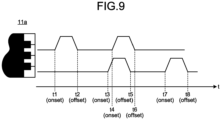
- the processing unit 24 extracts (detects, for example) a plurality of pieces of information in the piano performance on the basis of the detection result of the keyboard sensor 11a.
- Examples of the information are single motion information, simultaneous motion information, and continuous motion information.
- an example of a single motion is a key stroke of one keyboard key
- an example of the single motion information is a single sound.
- An example of simultaneous motions is simultaneous key strokes of a plurality of keyboard keys, and an example of the simultaneous motion information is a chord.
- An example of continuous motions is continuous key strokes of a plurality of keyboard keys, and an example of the continuous motion information is continuous sounds.
- the processing unit 24 extracts a chord and continuous sounds on the basis of the keyboard movement amount data in the generation period of each of the plurality of extracted single sounds. An extraction method of the chord and continuous sounds will be described later.
- the processing unit 24 calculates a feature amount (described later) acquired from the keyboard sensor 11a among feature amounts of the chord and the continuous sounds.
- An example of the feature amounts of the chord and the continuous sounds which amounts are acquired from the keyboard sensor 11a is uniformity of the keyboard movement velocity, and is also referred to as "vel_uniformity".
- the processing unit 24 calculates vel_uniformity in such a manner that a value of vel_uniformity becomes larger as the uniformity of the keyboard movement velocity of the plurality of single sounds included in the chord or the continuous sounds becomes higher.
- a value acquired by subtraction of a value acquired by division of a standard deviation of the keyboard movement velocity of the single sounds by an average value (0 to 1) from 1 may be calculated as vel_uniformity.
- FIG. 11 is a view schematically illustrating examples of the chord and the phrase.
- the examples of the chord and the phrase are referred to as chordA and phraseA in the drawing.
- the phraseA includes the noteA, the noteB and the noteC (chordA), and the noteD.
- the phraseA is a data packet of continuous sounds including a single sound of the noteA, the single sound of the noteB and the single sound of the noteC (chord of the chordA), and a single sound of the noteD. Examples of other information included in the phraseA include onset, offset, and vel uniformity of the phraseA.
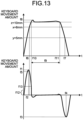
- FIG. 12 and FIG. 13 are views illustrating examples of the feature amounts of the single sound.
- “peak key stroke velocity”, “key stroke velocity peak timing”, “peak key release velocity”, “key release velocity peak timing”, “velocity at the time of escapement passage”, “escapement passing timing”, “mute passing timing”, a “maximum movement amount of a keyboard”, “pressing time”, “bottom contact timing”, “bottom release timing”, “touch noise”, and “bottom noise” are illustrated as the examples in FIG. 12 .
- These feature amounts are schematically illustrated as a feature amount f1 to a feature amount f13 in FIG. 13 .
- the "pressing time” (f9) is a feature amount related to unnecessary strain, and can be used to grasp a problem such as fatigue caused by excessive force.
- the processing unit 24 calculates, as the pressing time, time (period) during which the keyboard movement amount exceeds a keyboard depth z during the key stroke.
- the keyboard depth z is a keyboard depth at which the keyboard collides with the bottom, and is based on the physical characteristic of the piano mechanism. In the example illustrated in FIG. 13 , the keyboard depth z is 10 mm.
- the "bottom noise” (f13) is a feature amount related to hardness and softness of sound, and can be used to grasp a problem such that the sound is hard.
- the processing unit 24 calculates, as the bottom noise, the keyboard movement velocity at timing at which the keyboard movement amount exceeds the keyboard depth z during the key stroke.
- the above-described feature amounts of the single sound are merely examples, and another feature amount may also be calculated.
- Examples of the other feature amount include keyboard movement acceleration, and the like.
- the keyboard movement acceleration is a time change in the keyboard movement velocity, and is acquired by, for example, differentiation of the keyboard movement velocity with the time t.
- FIG. 14 is a view illustrating examples of a feature amount of the chord.
- the feature amount of the chord is, for example, a feature amount related to variation (such as deviation and nonuniformity) in feature amounts of a plurality of single sounds included in the chord. It is possible to grasp a problem such that pieces of sound are not uniform, sound of the chord is bad, pieces of the sound are not uniform, and the chord sounds disorganized.
- the feature amount is calculated on the basis of, for example, a standard deviation or the like.
- An “onset variation”, an “offset variation”, a “variation in escapement passing timing”, a “variation in velocity at the time of escapement passage”, a “variation in mute passing timing”, a “variation in velocity at the time of mute passage”, and a “variation in peak key stroke velocity” are illustrated as examples of the feature amounts of the chord in FIG. 14 .
- “Variation in a sound length” can be used to grasp a problem such that lines are not connected.
- the processing unit 24 calculates, as the variation in the sound length, variation in sound production time (time acquired by subtraction of the escapement passing timing from the mute passing timing) of the plurality of single sounds included in the continuous sounds.
- the processing unit 24 may extract the chord and the continuous sounds on the basis of a comparison result of the keyboard movement amount data of the plurality of extracted single sounds.
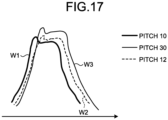
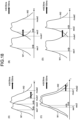
- the chord and the continuous sounds may be extracted on the basis of the feature amount of each of the single sounds. Description will be made with reference to FIG. 16 to FIG. 21 .
- Waveforms of two single sounds in which at least a part of waveforms of the keyboard movement amounts overlaps are illustrated as examples in each of (A) to (D) of FIG. 16 .
- (Waveforms of) each single sound is referred to as a single sound W1 and a single sound W2 in the drawings.
- the escapement passing timing of the single sound W1 and that of the single sound W2 are respectively referred to as timing esc1 and timing esc2 in the drawings.
- the processing unit 24 extracts the single sound W1 and the single sound W2 as the continuous sounds.
- 35 ms and 100 ms in the expressions are examples of the threshold.
- 35 ms is the same as that in the expression (1) and expression (2) of the chord extraction described above. esc 1 + 35 ms ⁇ esc 2 ⁇ mute 1 + 100 ms mute 1 ⁇ mute 2
- the "feature amount” represents a feature amount acquired from a detection result of each sensor (such as the above-described time-series data).
- the note, chord, and phrase may respectively have different feature amounts.
- Examples of the feature amount of the "handPosture” includes “range” and “peakVel”.
- the “range” indicates a range of movements of the fingers.
- the “peakVel” indicates peak velocity of the fingers.
- Examples of the feature amount of the "hackkey” include “peakDesVel”, “legato”, “phrasing”, and “dynamic”.
- the “peakDesVel” is as described above.
- the "legato” indicates an overlapping state of sounds in the phrase.
- the “phrasing” indicates how to pause between sounds in the phrase.
- the “dynamic” indicates a balance of the volume of sounds in the phrase.
- the "pieceInfo” indicates information of a performed piece. Examples of the “pieceInfo” include “title”, “measure”, and “number”. The “title” indicates a name of the piece or the like. The “measure” indicates a bar number. The “number” indicates a sound number in a bar.
- the data 23b organizes (associates) and describes the detection results of the plurality of sensors 1 and the feature amounts for each of the single sound, the chord, and the continuous sounds in an understandable manner.
- the data 23b By generating the data 23b in such a data format (data structure), it becomes possible to organize and easily utilize information useful for supporting improvement in the piano performance skill of the user U.
- Examples of utilization of the data 23b include presentation of information based on the data 23b and utilization as machine learning data.
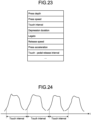
- FIG. 23 is a view illustrating examples of feature amounts that may be presented as useful information.
- the examples of the feature amounts include "Press depth”, “Press speed”, “Touch interval”, “Depression duration”, “Legato”, “Release speed”, “Press acceleration”, and "Touch-pedal release interval”.
- the "Press depth” indicates the “maxDepth” (maximum depth of the key stroke) described above.
- the “Press speed” indicates the “peakDesVel” (peak velocity at the time of the key stroke) described above.
- the "Touch interval" is a feature amount of the continuous sounds and indicates a key stroke interval of adjacent sounds. The description will be made also with reference to FIG. 24 .
- FIG. 24 is a view schematically illustrating an example of the Touch interval.
- the Touch interval between adjacent (continuous) single sounds is schematically illustrated.
- the processing unit 24 calculates the Touch interval by using the following expression (5).
- "escapement timing2 + onset2” in the expression indicates the escapement passing timing of a later single sound of the adjacent single sounds.
- "escapement_timing1 + onset1” indicates the escapement passing timing of an earlier single sound of the adjacent single sounds.
- Touch interval escapement _ timing 2 + onset 2 ⁇ escapement _ timing 1 + onset 1
- the "Depression duration" indicates the above-described pressing time.
- “Legato” indicates an overlap of sounds and smoothness of a tone row as described above. Description will be made also with reference to FIG. 25 .
- FIG. 25 is a view schematically illustrating an example of Legato. Legato between the adjacent single sounds is schematically illustrated.
- the processing unit 24 calculates Legato by using the following expression (6).
- mute_timing1 + onset1 in the expression indicates the mute passing timing of an earlier single sound of the adjacent single sounds.
- scapement timing2 + onset2 indicates the escapement passing timing of a later single sound of the adjacent single sounds.
- Legato mute _ timing 1 + onset 1 ⁇ escapement _ timing 2 + onset 2
- the "Release speed" indicates the peak key release velocity described above.
- the "Press acceleration” indicates the maximum value of the keyboard movement acceleration.
- the processing unit 24 calculates the maximum value of the keyboard movement acceleration between onset and offset of one single sound as the Press acceleration of the single sound.
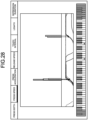
- the user interface unit 21 presents (displays) the feature amounts and the like calculated by the processing unit 24, that is, various feature amounts and the like described above. Examples of a specific user interface will be described with reference to FIG. 27 to FIG. 33 .
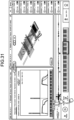
- the user interface illustrated as the example in FIG. 27 displays a waveform (time-series data) of the keyboard movement amount, bars indicating the feature amounts, a keyboard, and the like. Each position of the waveform and the feature amount are displayed in association with each other. A tab-selected feature amount among the plurality of feature amounts is displayed. The generation time of the feature amount, a position in the waveform, magnitude of the feature amount, and the like can be grasped. The feature amount generated between two key strokes is represented by a position and a width in the waveform.
- feature amounts of a plurality of single sounds included in the chord may be color-coded.
- the chord variation is visualized. Color-coding is performed on the basis of the note of each of the single sounds included in the components of the chord corresponding to the chord to be displayed.
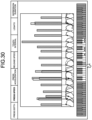
- Examples of a user interface that makes it easy to reach a focus point are illustrated in FIG. 29 to FIG. 33 .
- the user interface unit 21 presents a feature amount corresponding to selection (designation or the like) by user operation. Examples of the selection include selection of an operation range (range of keyboard keys) on a keyboard, selection of a time range in the piano performance, selection of time in the piano performance, and selection of lesson information.
- the corresponding keyboard key may be highlighted.
- a sound of the corresponding keyboard key may be output.
- a struck key in the selection range may be displayed as a circle.
- a target range can be easily designated.
- the user interface illustrated as the example in FIG. 31 enables marking and annotation of a point of interest while reproducing sound.
- the marking is performed according to user operation. Subsequently, an icon can be changed.
- the selection range may be reproduced in a looped manner. A focus point can be repeatedly checked.
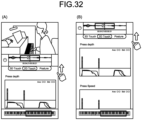
- FIG. 32 An example of a user interface in a case where the information processing device 2 is a smartphone or the like is illustrated in FIG. 32 .
- An image (imaging data) of the user U, a feature amount "Press depth” (maximum depth of the key stroke), a feature amount “Press Speed” (peak velocity at the time of the key stroke), and the like are sequentially displayed from an upper side toward a lower side of a screen.
- the feature amounts are switched by scrolling.
- the screen is scrolled downward in a state illustrated in (A) of FIG. 32
- a state illustrated on a right side of (B) of FIG. 32 is acquired.
- data to be compared is designated by, for example, user operation.
- the processing unit 24 aligns corresponding note of the both pieces of data and calculates the similarity between the pieces of data. For example, the similarity of the feature amounts within the selection range is calculated.
- the processing unit 24 determines whether the calculated similarity is distant, and displays an alert or the like of a portion where the similarity is distant.
- the processing unit 24 may calculate similarity of a single feature amount.
- a feature amount of the reference data 23c of an i-th key stroke is a feature amount a i
- a feature amount of the data 23b is a feature amount b i .
- the processing unit 24 calculates similarity and determines similarity by using the following expressions (8) to (12), for example.
- a left side of each expression is the similarity. In a case where each of the expressions is satisfied, it is determined that similarity is distant (dissimilar).
- abs in the above expressions is an absolute value.
- ave is an average value.
- thresh is a threshold (absolute value) set for each feature amount, and may be adjusted by, for example, a style of a piece (such as a fast piece or a slow piece).
- iqr, upper, and lower are values related to the quartile and are calculated from all abs (a i - b i ) in the performed piece.
- iqr is in a quartile range (IQR), and is from the 75th percentile to the 25th percentile.
- upper is the 75th percentile.
- lower is the 25th percentile.
- iqr global , upper global , and lower global are iqr, upper, and lower of global data.
- the global data is data for all the pieces accumulated so far or all the pieces of the same style accumulated so far.
- the processing unit 24 may calculate similarities of a plurality of feature amounts within the selection range.
- the feature amounts of m key strokes included in the selection range are respectively referred to as feature amounts a 1 to a m .
- the processing unit 24 performs similarity calculation and similarity determination by using the following expressions (13) to (18), for example. A left side of each expression is the similarity. In a case where each of the expressions is satisfied, it is determined that similarity is distant (dissimilar).
- the data 23b and the reference data 23c are compared by the similarity determination as described above.
- the user interface unit 21 presents a comparison result.
- the user interface unit 21 displays an alert indicating a portion where the similarity between the data 23b and the reference data 23c is distant. Examples of a specific user interface will be described with reference to FIG. 34 and FIG. 35 .
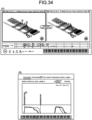
- FIG. 34 and FIG. 35 are views illustrating the example of the user interface.
- the user interface illustrated as the example in FIG. 34 displays an alert (exclamation mark in this example) in such a manner that a portion having a large difference in the similarity can be easily grasped.
- Different kinds (such as different colors) of alerts may be displayed for each feature amount of a comparison target.
- an alert is displayed on some of 3D displayed key strokes, or an alert is displayed during a sequence indicating the entire piece.
- an alert in the selection range is displayed as illustrated in (B) of FIG. 34 .
- the note may also include information such as a movement amount (pressed position) of a pedal and postures of the whole body and fingers. Comparison of these pieces of information is also possible. For example, the time-series movement of the fingers at the moment of the key stroke and the feature amount such as joint angular velocity at that time may be compared. Acoustic information and an acoustic feature amount of each key stroke may be compared. Information such as a performance video of one continuous sound (one phrase), an operating range of a joint measured by motion capture, and a posture may be compared. Information such as a pedaling amount and a difference between pedaling timing and key stroke timing may be compared.
- the user interface illustrated as the example in FIG. 35 performs pop-up display of specific information corresponding to the selected alert.
- a comparison result indicating that timing of releasing the pedal is later than the reference data 23c is displayed.
- a detection result of the sub-sensor 12 may also be displayed.
- the feature amount and the like are presented by various user interfaces as described above.
- the user interfaces are not limited to the above examples. Some examples of other user interfaces are described with reference to FIG. 36 to FIG. 38 .
- FIG. 36 to FIG. 38 are views illustrating examples of the user interfaces.
- a user interface illustrated as the example in FIG. 36 performs color-coding display of keyboard keys. A difference between the sounds can be easily understood.
- the color-coding may be HSB based or Lab based. A difference between a high sound and a low sound may be represented by color shading. Sensuous perception is made easier.
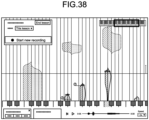
- 2D display illustrated as the example in FIG. 38 is also possible.
- a waveform of a key stroke movement amount corresponding to a key stroke is displayed to float from each keyboard key.
- the corresponding feature amount is displayed in the waveform.
- the waveform of the performance data and the waveform of the reference data 23c are displayed on the left and right, and comparison is easy.
- FIG. 39 is a flowchart illustrating an example of processing (information processing method) executed in the information processing system.
- processing information processing method
- Step S1 detection results of the plurality of sensors are acquired.
- the plurality of sensors 1 detects piano performance.
- the acquisition unit 22 of the information processing device 2 acquires detection results of the plurality of sensors 1.
- Step S2 preprocessing is executed.
- the processing unit 24 of the information processing device 2 filters the detection results of the plurality of sensors 1, such as the detection result of the keyboard sensor 11a. Note that the preprocessing may not be performed, and the processing of Step S2 is skipped in that case.
- Step S3 onset and offset are extracted on the basis of the detection result of the main sensor.
- the processing unit 24 of the information processing device 2 extracts the onset and the offset from the detection result (keyboard movement amount data) of the keyboard sensor 11a.
- Step S4 a single sound is extracted on the basis of the detection result of the main sensor, and a feature amount is calculated.
- the processing unit 24 of the information processing device 2 extracts a single sound on the basis of the onset and offset extracted in Step S3 described above, and calculates a feature amount acquired from the keyboard sensor 11a among the feature amounts of the single sounds.
- Step S5 a chord and continuous sounds are extracted on the basis of the detection result of the main sensor, and a feature amount is calculated.
- the processing unit 24 of the information processing device 2 extracts a chord and continuous sounds on the basis of the single sound extracted in Step S4 described above. Furthermore, the processing unit 24 calculates a feature amount acquired from the keyboard sensor 11a among the feature amounts of the chord and the continuous sounds on the basis of the feature amount of the single sound calculated in Step S4 described above.
- Step S6 the feature amount is calculated on the basis of the detection result of the sub-sensor.
- the processing unit 24 of the information processing device 2 calculates a feature amount acquired from the detection result of the sub-sensor 12 among the feature amounts of the single sound, the chord, and the continuous sounds which feature amounts are extracted in Step S4 and S5 described above.
- Step S7 data is generated.
- the processing unit 24 of the information processing device 2 stores the note, the chord, and the phrase generated on the basis of the single sound, the chord, and the continuous sounds extracted in Step S4 to Step S6 described above and the calculated feature amounts thereof in the storage unit 23 as the data 23b.
- Step S8 the data is utilized.
- the user interface unit 21 of the information processing device 2 presents, to the user U, various kinds of information that can be used to support the piano performance of the user.
- the data 23b may be used as the machine learning data.
- FIG. 40 is a view illustrating a hardware configuration example of the information processing device.
- the information processing device 2 includes a CPU 950, a ROM 952, a RAM 954, a recording medium 956, and an input/output interface 958.
- the information processing device 2 includes a display device 962, an audio output device 964, a communication interface 968, and a sensor 980.
- the information processing device 2 connects the components by a bus 970 as a transmission path of data, for example.
- the CPU 950 includes, for example, one or two more processors including an arithmetic circuit such as a CPU, various processing circuits, and the like, and functions as the processing unit 24 that controls the entire information processing device 2.
- the ROM 952 stores programs used by the CPU 950, control data such as a calculation parameter, and the like.
- the RAM 954 temporarily stores, for example, a program or the like executed by the CPU 950.
- the ROM 952 and the RAM 954 function as the storage unit 23 of the information processing device 2.
- the recording medium 956 functions as the storage unit 23.
- Examples of the recording medium 956 include a magnetic recording medium such as a hard disk, and a nonvolatile memory such as a flash memory. Furthermore, the recording medium 956 may be detachable from the information processing device 2.
- the input/output interface 958 connects, for example, the display device 962, the audio output device 964, and the like.
- Examples of the input/output interface 958 include a universal serial bus (USB) terminal, a digital visual interface (DVI) terminal, a high-definition multimedia interface (HDMI) (registered trademark) terminal, various processing circuits, and the like.
- USB universal serial bus
- DVI digital visual interface
- HDMI high-definition multimedia interface
- the display device 962 and the audio output device 964 function as the user interface unit 21 of the information processing device 2.
- Examples of the display device 962 include a liquid crystal display, an organic electro-luminescence (EL) display, and the like.
- the input/output interface 958 can be connected to an external device such as an operation input device (such as keyboard, mouse, or the like) outside the information processing device 2, or an external display device.
- an operation input device such as keyboard, mouse, or the like
- the communication interface 968 is a communication means included in the information processing device 2, and functions as a communication unit for performing wireless or wired communication with an external device via a network or directly.
- the communication interface 968 is, for example, a communication antenna and a radio frequency (RF) circuit (wireless communication), an IEEE 802.15.1 port and a transmission/reception circuit (wireless communication), an IEEE 802.11 port and a transmission/reception circuit (wireless communication), or a local area network (LAN) terminal and a transmission/reception circuit (wired communication).
- RF radio frequency
- the disclosed technique is not limited to the above embodiment. Some modification examples will be described.
- the piano performance has been described as an example of the skill acquisition operation.
- the skill acquisition operation may be a performance of a musical instrument other than the piano, or may be operation other than the performance of the musical instrument. Some examples of other operation are described.
- Another example of the skill acquisition operation is driving of a vehicle.
- driving is performed from one point to another point, for example, description in a nested data format (data structure) as follows is possible.
Landscapes
- Engineering & Computer Science (AREA)
- Physics & Mathematics (AREA)
- Multimedia (AREA)
- Acoustics & Sound (AREA)
- Business, Economics & Management (AREA)
- Educational Administration (AREA)
- Educational Technology (AREA)
- General Physics & Mathematics (AREA)
- Theoretical Computer Science (AREA)
- Auxiliary Devices For Music (AREA)
- Electrophonic Musical Instruments (AREA)
Applications Claiming Priority (2)
| Application Number | Priority Date | Filing Date | Title |
|---|---|---|---|
| JP2021141494 | 2021-08-31 | ||
| PCT/JP2022/013344 WO2023032319A1 (ja) | 2021-08-31 | 2022-03-23 | 情報処理装置、情報処理方法及び情報処理システム |
Publications (2)
| Publication Number | Publication Date |
|---|---|
| EP4398221A1 true EP4398221A1 (de) | 2024-07-10 |
| EP4398221A4 EP4398221A4 (de) | 2024-12-25 |
Family
ID=85411680
Family Applications (1)
| Application Number | Title | Priority Date | Filing Date |
|---|---|---|---|
| EP22863909.2A Pending EP4398221A4 (de) | 2021-08-31 | 2022-03-23 | Informationsverarbeitungsvorrichtung, informationsverarbeitungsverfahren und informationsverarbeitungssystem |
Country Status (5)
| Country | Link |
|---|---|
| US (1) | US20240355223A1 (de) |
| EP (1) | EP4398221A4 (de) |
| JP (1) | JPWO2023032319A1 (de) |
| CN (1) | CN117836831A (de) |
| WO (1) | WO2023032319A1 (de) |
Families Citing this family (2)
| Publication number | Priority date | Publication date | Assignee | Title |
|---|---|---|---|---|
| JP2024108340A (ja) * | 2023-01-31 | 2024-08-13 | ブリヂストンスポーツ株式会社 | 情報処理方法、プログラム、情報処理装置 |
| JP2025114027A (ja) * | 2024-01-24 | 2025-08-05 | ヤマハ株式会社 | 情報処理システム、情報処理方法およびプログラム |
Family Cites Families (5)
| Publication number | Priority date | Publication date | Assignee | Title |
|---|---|---|---|---|
| JP3826697B2 (ja) * | 2000-09-19 | 2006-09-27 | ヤマハ株式会社 | 演奏表示装置および演奏表示方法 |
| JP4646140B2 (ja) * | 2006-04-12 | 2011-03-09 | 株式会社河合楽器製作所 | 練習機能付き電子楽器 |
| JP5051530B2 (ja) * | 2007-08-22 | 2012-10-17 | カシオ計算機株式会社 | 演奏評価装置および演奏評価処理のプログラム |
| JP2019061006A (ja) | 2017-09-26 | 2019-04-18 | 株式会社河合楽器製作所 | 演奏練習支援装置 |
| DE112019004986T5 (de) * | 2018-10-05 | 2021-07-01 | Sony Corporation | Informationsverarbeitungsvorrichtung |
-
2022
- 2022-03-23 CN CN202280056938.8A patent/CN117836831A/zh active Pending
- 2022-03-23 WO PCT/JP2022/013344 patent/WO2023032319A1/ja not_active Ceased
- 2022-03-23 US US18/685,732 patent/US20240355223A1/en active Pending
- 2022-03-23 EP EP22863909.2A patent/EP4398221A4/de active Pending
- 2022-03-23 JP JP2023545061A patent/JPWO2023032319A1/ja active Pending
Also Published As
| Publication number | Publication date |
|---|---|
| US20240355223A1 (en) | 2024-10-24 |
| CN117836831A (zh) | 2024-04-05 |
| WO2023032319A1 (ja) | 2023-03-09 |
| EP4398221A4 (de) | 2024-12-25 |
| JPWO2023032319A1 (de) | 2023-03-09 |
Similar Documents
| Publication | Publication Date | Title |
|---|---|---|
| US10825432B2 (en) | Smart detecting and feedback system for smart piano | |
| US20160216770A1 (en) | Method and system for motion based interactive service | |
| US12142249B2 (en) | Information processing apparatus | |
| EP4398221A1 (de) | Informationsverarbeitungsvorrichtung, informationsverarbeitungsverfahren und informationsverarbeitungssystem | |
| EP2532396A1 (de) | Schwunganalysevorrichtung, Schwunganalyseprogramm und Aufzeichnungsmedium | |
| EP4057211A1 (de) | Informationsverarbeitungsvorrichtung, informationsverarbeitungsverfahren und programm | |
| US20170221377A1 (en) | Musical performance assistance apparatus and method | |
| CN113674565B (zh) | 一种用于钢琴教学的教学系统及方法 | |
| Kim et al. | An overview of automatic piano performance assessment within the music education context | |
| EP3088058A1 (de) | Analysevorrichtung, aufzeichnungsmedium und analyseverfahren | |
| EP3563911B1 (de) | Ausgabesteuerungsvorrichtung, ausgabesteuerungsverfahren und programm | |
| CN110379253A (zh) | 小提琴综合辅助学习的方法、装置、软件与系统 | |
| CN109658909A (zh) | 一种智能手鼓系统及其实现方法 | |
| CN110910712B (zh) | 一种基于ar的古筝辅助教学系统及方法 | |
| CN114495255A (zh) | 自动侦测动作的评分系统、自动侦测动作的评分方法以及非暂态计算机可读取储存媒体 | |
| CN112802439B (zh) | 一种演奏数据识别方法、装置、设备及存储介质 | |
| Dalmazzo et al. | A machine learning approach to violin bow technique classification: a comparison between imu and mocap systems | |
| CN111724812A (zh) | 音频处理方法、存储介质与音乐练习终端 | |
| KR101221673B1 (ko) | 전자기타 연습장치 | |
| CN113255470A (zh) | 基于手部姿态估计的多模态钢琴陪练系统及方法 | |
| Bayd et al. | Automatic scoring of synchronization from fingers motion capture and music beats | |
| Matsushita | Single-note electric guitar picking detection by using wrist-worn inertial motion sensors | |
| Shang et al. | A music performance method based on visual gesture recognition | |
| MacRitchie | Elucidating musical structure through empirical measurement of performance parameters | |
| Argueta et al. | Interacting with a music conducting system |
Legal Events
| Date | Code | Title | Description |
|---|---|---|---|
| STAA | Information on the status of an ep patent application or granted ep patent |
Free format text: STATUS: THE INTERNATIONAL PUBLICATION HAS BEEN MADE |
|
| PUAI | Public reference made under article 153(3) epc to a published international application that has entered the european phase |
Free format text: ORIGINAL CODE: 0009012 |
|
| STAA | Information on the status of an ep patent application or granted ep patent |
Free format text: STATUS: REQUEST FOR EXAMINATION WAS MADE |
|
| 17P | Request for examination filed |
Effective date: 20240324 |
|
| AK | Designated contracting states |
Kind code of ref document: A1 Designated state(s): AL AT BE BG CH CY CZ DE DK EE ES FI FR GB GR HR HU IE IS IT LI LT LU LV MC MK MT NL NO PL PT RO RS SE SI SK SM TR |
|
| DAV | Request for validation of the european patent (deleted) | ||
| DAX | Request for extension of the european patent (deleted) | ||
| A4 | Supplementary search report drawn up and despatched |
Effective date: 20241121 |
|
| RIC1 | Information provided on ipc code assigned before grant |
Ipc: G10C 3/00 20190101ALI20241118BHEP Ipc: G10G 3/04 20060101ALI20241118BHEP Ipc: G10C 1/00 20060101ALI20241118BHEP Ipc: G10H 1/00 20060101ALI20241118BHEP Ipc: G10G 1/00 20060101ALI20241118BHEP Ipc: G09B 15/00 20060101AFI20241118BHEP |