EP4398159B1 - Asynchrones tiefenverstärkungslernen - Google Patents
Asynchrones tiefenverstärkungslernen Download PDFInfo
- Publication number
- EP4398159B1 EP4398159B1 EP24178066.7A EP24178066A EP4398159B1 EP 4398159 B1 EP4398159 B1 EP 4398159B1 EP 24178066 A EP24178066 A EP 24178066A EP 4398159 B1 EP4398159 B1 EP 4398159B1
- Authority
- EP
- European Patent Office
- Prior art keywords
- neural network
- baseline
- policy
- parameters
- observation
- Prior art date
- Legal status (The legal status is an assumption and is not a legal conclusion. Google has not performed a legal analysis and makes no representation as to the accuracy of the status listed.)
- Active
Links
Images


Classifications
-
- G—PHYSICS
- G06—COMPUTING OR CALCULATING; COUNTING
- G06N—COMPUTING ARRANGEMENTS BASED ON SPECIFIC COMPUTATIONAL MODELS
- G06N3/00—Computing arrangements based on biological models
- G06N3/02—Neural networks
- G06N3/08—Learning methods
-
- G—PHYSICS
- G06—COMPUTING OR CALCULATING; COUNTING
- G06N—COMPUTING ARRANGEMENTS BASED ON SPECIFIC COMPUTATIONAL MODELS
- G06N3/00—Computing arrangements based on biological models
- G06N3/02—Neural networks
- G06N3/08—Learning methods
- G06N3/092—Reinforcement learning
-
- G—PHYSICS
- G06—COMPUTING OR CALCULATING; COUNTING
- G06N—COMPUTING ARRANGEMENTS BASED ON SPECIFIC COMPUTATIONAL MODELS
- G06N3/00—Computing arrangements based on biological models
- G06N3/02—Neural networks
- G06N3/04—Architecture, e.g. interconnection topology
- G06N3/047—Probabilistic or stochastic networks
-
- G—PHYSICS
- G06—COMPUTING OR CALCULATING; COUNTING
- G06N—COMPUTING ARRANGEMENTS BASED ON SPECIFIC COMPUTATIONAL MODELS
- G06N3/00—Computing arrangements based on biological models
- G06N3/02—Neural networks
- G06N3/04—Architecture, e.g. interconnection topology
- G06N3/0499—Feedforward networks
-
- G—PHYSICS
- G06—COMPUTING OR CALCULATING; COUNTING
- G06N—COMPUTING ARRANGEMENTS BASED ON SPECIFIC COMPUTATIONAL MODELS
- G06N3/00—Computing arrangements based on biological models
- G06N3/02—Neural networks
- G06N3/08—Learning methods
- G06N3/084—Backpropagation, e.g. using gradient descent
-
- G—PHYSICS
- G06—COMPUTING OR CALCULATING; COUNTING
- G06N—COMPUTING ARRANGEMENTS BASED ON SPECIFIC COMPUTATIONAL MODELS
- G06N3/00—Computing arrangements based on biological models
- G06N3/02—Neural networks
- G06N3/08—Learning methods
- G06N3/098—Distributed learning, e.g. federated learning
-
- G—PHYSICS
- G06—COMPUTING OR CALCULATING; COUNTING
- G06N—COMPUTING ARRANGEMENTS BASED ON SPECIFIC COMPUTATIONAL MODELS
- G06N3/00—Computing arrangements based on biological models
- G06N3/02—Neural networks
- G06N3/04—Architecture, e.g. interconnection topology
- G06N3/045—Combinations of networks
Definitions
- This specification relates to reinforcement learning.
- an agent interacts with an environment by performing actions that are selected by the reinforcement learning system in response to receiving observations that characterize the current state of the environment.
- Some reinforcement learning systems select the action to be performed by the agent in response to receiving a given observation in accordance with an output of a neural network.
- Neural networks are machine learning models that employ one or more layers of nonlinear units to predict an output for a received input.
- Some neural networks are deep neural networks that include one or more hidden layers in addition to an output layer. The output of each hidden layer is used as input to the next layer in the network, i.e., the next hidden layer or the output layer. Each layer of the network generates an output from a received input in accordance with current values of a respective set of parameters.
- Hao Yi Ong et al. "Distributed Deep Q-learning", Stanford University 2015 discloses a technique for training a neural network.
- This specification describes technologies that relate to reinforcement learning.
- this specification describes techniques for asynchronously training a deep neural network used by a reinforcement learning system to select actions to be performed by an agent when interacting with an environment. Aspects of the present specification have the technical effect of faster training of a neural network and/or reducing the memory requirements for the training.
- a system of one or more computers to be configured to perform particular operations or actions means that the system has installed on it software, firmware, hardware, or a combination of them that in operation cause the system to perform the operations or actions.
- one or more computer programs to be configured to perform particular operations or actions means that the one or more programs include instructions that, when executed by data processing apparatus, cause the apparatus to perform the operations or actions.
- a neural network used by a reinforcement learning system can be trained faster. More particularly, by parallelizing the training using multiple workers operating independently on a single machine, communication costs incurred as a result of the parallelization can be reduced. Additionally, by removing the need for the workers to store experience tuples in a replay memory or other storage as is generally required in parallelization techniques that include multiple workers on multiple machines, memory requirements for the training can be reduced and on-policy reinforcement learning methods can be employed.
- This specification generally describes techniques for asynchronous deep reinforcement learning.
- this specification describes how multiple workers can asynchronously train a deep neural network used by a reinforcement learning system to select actions to be performed by an agent interacting with an environment.
- the environment is a simulated environment and the agent is implemented as one or more computer programs interacting with the simulated environment.
- the simulated environment may be a video game and the agent may be a simulated user playing the video game.
- the simulated environment may be a motion simulation environment, e.g., a driving simulation or a flight simulation, and the agent is a simulated vehicle navigating through the motion simulation.
- the actions may be control inputs to control the simulated user or simulated vehicle.
- the reinforcement learning system receives observations characterizing the current state of the environment and selects actions to be performed by the agent using the observations. In response to the agent performing a selected action, the environment transitions into a new state and the reinforcement learning system receives a reward.
- the reward is a numeric value that is a function of the state of the environment. While interacting with the environment, the reinforcement learning system attempts to maximize the long-term reward received by the agent in response to the actions performed by the agent.
- the reinforcement learning system selects the action to be performed by the agent in accordance with an output generated by a deep neural network.
- a neural network training system trains the deep neural network to adjust the values of the parameters of the deep neural network from initial values of the parameters.
- the neural network training system includes multiple workers that asynchronously train the deep neural network by selecting actions to be performed by actors interacting with replicas of the environment.
- Each actor is an instance of the agent that operates independently from each other instance.
- each actor is also a separate mechanical agent that is the same as or is approximately the same as the agent, e.g., has the same or approximately the same properties and can perform the same actions as the agent, and operates independently from each other actor.
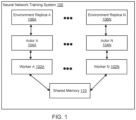
- FIG. 1 shows an example neural network training system 100.
- the neural network training system 100 is an example of a system implemented as computer programs on one or more computers in one or more locations in which the systems, components, and techniques described below are implemented.
- the neural network training system 100 includes multiple workers 102A-N and a shared memory 110.
- Each of the workers 102A-102N is associated with a respective actor 104A-N that interacts with a corresponding environment replica 106A-106N.
- the worker 102A is associated with the actor 104A that interacts with the environment replica 106A.
- each of the workers 110A-N is implemented on the same computer but executes in a separate thread, process or other hardware or software within the computer capable of independently performing the computation for the worker.
- the shared memory 110 is memory of the computer that is accessible to each of the workers 102A-102N.
- the environment is a virtualized environment
- the actor and environment replica associated with a given worker also execute in the same thread or other hardware or software as the given worker.
- Each of the workers 102A-102N maintains an instance of the deep neural network that is being trained and accesses the shared memory 110 to obtain current values of the parameters of the deep neural network that are stored in the shared memory 110. Each worker then uses the worker's instance of the deep neural network to select actions to be performed by the actor associated with the worker in accordance with the current values of the parameters of the neural network obtained from the shared memory 110.
- each worker receives observations characterizing the state of the environment replica associated with the worker and, in response to each observation, selects an action to be performed by the actor associated with the environment replica using the deep neural network.
- the worker receives a next observation characterizing the next state of the environment replica, i.e., the state that the environment replica transitions into as a result of the actor performing the selected action, and a reward resulting from the actor performing the selected action.
- the worker uses the reward and the next observation to determine a gradient and periodically uses gradients determined by the worker to update the parameter values that are stored in the shared memory 110. Determining gradients and updating parameter values stored in a shared memory is described in more detail below with reference to FIG. 2 .
- the workers 102A-102N By each of the workers 102A-102N repeatedly and asynchronously updating the parameter values stored in the shared memory 110, the workers 102A-102N collectively train the deep neural network to determine trained values of the parameters of the deep neural network.
- FIG. 2 is a flow diagram of an example process 200 for training a deep neural network.
- the process 200 will be described as being performed by a worker, e.g., one of the workers 120A-N of FIG. 1 .
- the worker determines current values of the parameters of the deep neural network (step 202).
- the worker only obtains the current values from the memory after updating the shared memory as described below and writes them to a local memory. In these implementations, the worker determines the current values to be the values stored in the local memory.
- the action selection policy for a given worker is different from the action selection policy for each other worker.
- the action selection policy for each worker is an ⁇ -greedy policy in which the worker selects an action randomly from the predetermined set of actions with probability ⁇ and selects the action having the highest Q value with probability 1 - ⁇ , but with the value of ⁇ being different for each worker.
- each worker can periodically sample a value for ⁇ for the worker from a distribution of possible values of ⁇ for the worker to determine the ⁇ to be used in the action selection policy.
- the worker could select the action by applying a softmax nonlinearity to the Q values and sampling an action from the resulting distribution. Each worker could then use a different temperature parameter in the softmax to ensure that each worker had a different action selection policy.
- the worker performs an iteration of a reinforcement learning procedure to determine a current gradient using the actual reward and the next observation (step 210).
- the gradient is the gradient of a loss function being optimized in order to train the deep neural network.
- the loss function and the manner in which the worker determines the gradient are dependent on the reinforcement learning procedure being used to train the deep neural network, which is in turn dependent on how the deep neural network is configured.
- the worker determines updated parameter values using the accumulated gradients (step 216) and writes the updated parameter values to the shared memory (step 218).
- the worker determines parameter value updates from the accumulated gradients, accesses the current values in the shared memory, and then updates those values using the parameter value updates.
- the worker multiplies the accumulated gradients by a learning rate parameter and then sums the current parameter values and the parameter value updates to determine the updated parameter values.
- the worker uses an asynchronous variant of the RMSProp optimization procedure to update the parameter values.
- the worker After the worker writes the updated parameter values to the shared memory, the worker clears the accumulated gradient, i.e., so that no gradient is maintained by the worker when the next iteration of the process 200 is initiated.
- the worker refrains from writing anything to the shared memory (step 220), i.e., the worker proceeds to perform another iteration of the process 200 without updating the current parameter values.
- Each of multiple workers can asynchronously repeatedly perform the process 200 to collectively determine trained values of the parameters of the deep neural network.
- a reinforcement learning system can use the deep neural network to select values to be performed by an agent interacting with the environment, i.e., by processing neural network inputs using the deep neural network in accordance with the trained values of the neural network parameters.
- the reinforcement learning system uses the deep neural network to select values to be performed by the agent while the workers continue to perform the process 200, i.e., by periodically obtaining the values stored in the shared memory and using those values to select the actions performed by the agent.
- FIG. 3 is a flow diagram of an example process 300 for performing an iteration of a Q-learning technique.
- the process 300 will be described as being performed by a worker, e.g., one of the workers 102A-N of FIG. 1 .
- a computer can be embedded in another device, e.g., a mobile telephone, a personal digital assistant (PDA), a mobile audio or video player, a game console, a Global Positioning System (GPS) receiver, or a portable storage device, e.g., a universal serial bus (USB) flash drive, to name just a few.
- PDA personal digital assistant
- GPS Global Positioning System
- USB universal serial bus
- Computer-readable media suitable for storing computer program instructions and data include all forms of non-volatile memory, media and memory devices, including by way of example semiconductor memory devices, e.g., EPROM, EEPROM, and flash memory devices; magnetic disks, e.g., internal hard disks or removable disks; magneto-optical disks; and CD-ROM and DVD-ROM disks.
- semiconductor memory devices e.g., EPROM, EEPROM, and flash memory devices
- magnetic disks e.g., internal hard disks or removable disks
- magneto-optical disks e.g., CD-ROM and DVD-ROM disks.
- the processor and the memory can be supplemented by, or incorporated in, special purpose logic circuitry.
- a computer having a display device, e.g., a CRT (cathode ray tube) or LCD (liquid crystal display) monitor, for displaying information to the user and a keyboard and a pointing device, e.g., a mouse or a trackball, by which the user can provide input to the computer.
- a display device e.g., a CRT (cathode ray tube) or LCD (liquid crystal display) monitor
- keyboard and a pointing device e.g., a mouse or a trackball
- Other kinds of devices can be used to provide for interaction with a user as well; for example, feedback provided to the user can be any form of sensory feedback, e.g., visual feedback, auditory feedback, or tactile feedback; and input from the user can be received in any form, including acoustic, speech, or tactile input.
- a computer can interact with a user by sending documents to and receiving documents from a device that is used by the user; for example, by sending web pages to a
- Embodiments of the subject matter described in this specification can be implemented in a computing system that includes a back-end component, e.g., as a data server, or that includes a middleware component, e.g., an application server, or that includes a front-end component, e.g., a client computer having a relationship graphical user interface or a Web browser through which a user can interact with an implementation of the subject matter described in this specification, or any combination of one or more such back-end, middleware, or front-end components.
- the components of the system can be interconnected by any form or medium of digital data communication, e.g., a communication network. Examples of communication networks include a local area network (“LAN”) and a wide area network (“WAN”), e.g., the Internet.
- LAN local area network
- WAN wide area network
- the computing system can include clients and servers.
- a client and server are generally remote from each other and typically interact through a communication network.
- the relationship of client and server arises by virtue of computer programs running on the respective computers and having a client-server relationship to each other.
Landscapes
- Engineering & Computer Science (AREA)
- Physics & Mathematics (AREA)
- Theoretical Computer Science (AREA)
- Biomedical Technology (AREA)
- General Engineering & Computer Science (AREA)
- Artificial Intelligence (AREA)
- Health & Medical Sciences (AREA)
- Biophysics (AREA)
- Computational Linguistics (AREA)
- Data Mining & Analysis (AREA)
- Evolutionary Computation (AREA)
- General Health & Medical Sciences (AREA)
- Molecular Biology (AREA)
- Computing Systems (AREA)
- Life Sciences & Earth Sciences (AREA)
- General Physics & Mathematics (AREA)
- Mathematical Physics (AREA)
- Software Systems (AREA)
- Probability & Statistics with Applications (AREA)
- Feedback Control In General (AREA)
- User Interface Of Digital Computer (AREA)
- General Factory Administration (AREA)
- Management, Administration, Business Operations System, And Electronic Commerce (AREA)
- Electrically Operated Instructional Devices (AREA)
Claims (11)
- System (100), umfassend mehrere Prozessoren zum Trainieren eines neuronalen Richtliniennetzes und eines neuronalen Basisnetzes, die verwendet werden, um einen Agenten zu steuern, der mit einer Umgebung interagiert, indem er Aktionen durchführt, die aus einem vorbestimmten Satz von Aktionen ausgewählt sind, wobei das neuronale Richtliniennetz eine Vielzahl von Richtlinienparametern aufweist und das neuronale Basisnetz eine Vielzahl von Basisparametern aufweist und das System dazu konfiguriert ist, Folgendes umzusetzen:einen gemeinsam genutzten Speicher (110), auf den jeder einer Vielzahl von Arbeitern (102A-102N) zugreifen kann, wobei der gemeinsam genutzte Speicher Werte der Parameter des neuronalen Richtliniennetzes und des neuronalen Basisnetzes speichert; unddie Vielzahl der Arbeiter, wobei jeder Arbeiter dazu konfiguriert ist, parallel zu den anderen Arbeitern zu arbeiten, wobei jeder Arbeiter einem jeweiligen Akteur (104A-104N) zugeordnet ist, der mit einer jeweiligen Instanz der Umgebung (106A-106N) während des Trainings des neuronalen Richtliniennetzes und des neuronalen Basisnetzes interagiert, und wobei jeder Arbeiter ferner dazu konfiguriert ist, wiederholt Operationen durchzuführen, die Folgendes umfassen:
Bestimmen der aktuellen Werte der Parameter des neuronalen Richtliniennetzes und des neuronalen Basisnetzes, umfassend:Empfangen von aktuellen Werten der Basisparameter des neuronalen Basisnetzes aus dem gemeinsam genutzten Speicher; undEmpfangen von aktuellen Werten der Richtlinienparameter des neuronalen Richtliniennetzes aus dem gemeinsam genutzten Speicher;bis die Umweltinstanz, mit der der dem Arbeiter zugeordnete Akteur interagiert, in einen Zustand übergeht, der besondere Kriterien erfüllt:
Empfangen von Kommentaren, die Zustände der Umgebungsinstanz kennzeichnen, und, als Reaktion auf jede Beobachtung, Auswählen einer Aktion, die durch den dem Arbeiter zugeordneten Akteur als Reaktion auf die Beobachtung gemäß einer jeweiligen Aktionsauswahlrichtlinie für den Arbeiter durchzuführen ist, wobei das Auswählen für jede Beobachtung Folgendes umfasst:Verarbeiten des Kommentars unter Verwendung des neuronalen Richtliniennetzes und gemäß den aktuellen Werten der Parameter des neuronalen Richtliniennetzes, um eine entsprechende Bewertung für jede Aktion in dem vorbestimmten Satz von Aktionen gemäß den aktuellen Werten der Parameter des neuronalen Richtliniennetzes zu erzeugen, undAuswählen der aktuellen Aktion, die durch den Akteur durchzuführen ist, anhand der jeweiligen Bewertungen;für jede empfangene Beobachtung, bevor die besonderen Kriterien erfüllt sind:Erzeugen einer Basisbewertung, die eine geschätzte Belohnung darstellt, die der Agent ausgehend von einem durch die Beobachtung gekennzeichneten Zustand empfängt, basierend auf den aktuellen Werten der Parameter des Basisnetzes;Identifizieren einer tatsächlichen Belohnung, die daraus resultiert, dass der Akteur die ausgewählte Aktion als Reaktion auf die Beobachtung durchführt;Bestimmen einer tatsächlichen langfristigen Belohnung aus mindestens der tatsächlichen Belohnung und einer Basisbewertung für die Beobachtung, die den Zustand kennzeichnet, der die besonderen Kriterien erfüllt; undDurchführen einer Iteration einer Verstärkungslerntechnik, um die jeweiligen aktuellen Gradienten für das Basis- und das Richtliniennetzes auf Grundlage des Basisergebnisses und der tatsächlichen langfristigen Belohnung zu bestimmen;Aktualisieren der jeweiligen akkumulierten Gradienten für das Basis- und das Richtliniennetz auf Grundlage der jeweiligen aktuellen Gradientenaktualisierungen, um die jeweiligen aktualisierten akkumulierten Gradienten zu bestimmen;Bestimmen, ob die Kriterien zum Aktualisieren der aktuellen Werte der Parameter des neuronalen Richtliniennetzes und des neuronalen Basisnetzes erfüllt sind; undwenn die Kriterien zum Aktualisieren der aktuellen Werte der Parameter des neuronalen Richtliniennetzes und des neuronalen Basisnetzes erfüllt sind:
Aktualisieren der Parameter des neuronalen Richtliniennetzes und des neuronalen Basisnetzes, wobei das Aktualisieren Folgendes umfasst:Bestimmen aktualisierter Werte der Parameter unter Verwendung der aktualisierten akkumulierten Gradienten, undSpeichern der aktualisierten Werte in dem gemeinsam genutzten Speicher, auf den jeder der Arbeiter Zugriff hat. - System nach Anspruch 1, wobei sich die jeweilige Aktionsauswahlrichtlinie für jeden Arbeiter von der jeweiligen Aktionsauswahlrichtlinie für jeden anderen Arbeiter unterscheidet.
- System nach Anspruch 1, wobei die Operationen ferner Löschen des aktualisierten akkumulierten Gradienten umfassen, wenn die Kriterien zum Aktualisieren der aktuellen Werte der Parameter des neuronalen Richtliniennetzes und des neuronalen Basisnetzes erfüllt sind.
- System nach Anspruch 1, wobei das Bestimmen, ob die Kriterien zum Aktualisieren der aktuellen Werte der Parameter des neuronalen Richtliniennetzes und des neuronalen Basisnetzes erfüllt sind, Bestimmen, dass eine festgelegte Anzahl von Iterationen der Verstärkungslerntechnik seit einer vorhergehenden Aktualisierung der Werte der Parameter des neuronalen Richtliniennetzes und des neuronalen Basisnetzes durchgeführt worden ist, umfasst.
- System nach Anspruch 1, wobei das Bestimmen der tatsächlichen langfristigen Belohnung Folgendes umfasst:für die letzte empfangene Beobachtung, bevor die Kriterien erfüllt sind, Festlegen der tatsächlichen langfristigen Belohnung auf Grundlage der tatsächlichen Belohnung für die Beobachtung und der Basisbewertung für die Beobachtung, die den Zustand kennzeichnet, der die besonderen Kriterien erfüllt; undfür jede weitere Beobachtung, die empfangen wird, bevor die Kriterien erfüllt sind, Festlegen der tatsächlichen langfristigen Belohnung für die Beobachtung als tatsächliche Belohnung zuzüglich eines diskontierten Betrags der tatsächlichen langfristigen Belohnungen für Beobachtungen, die nach der Beobachtung empfangen werden.
- System nach Anspruch 1, wobei die Gradientenaktualisierung für das neuronale Richtliniennetz durch Folgendes bestimmt wird:

- System nach Anspruch 6, wobei die Gradientenaktualisierung für das neuronale Basisnetz durch Folgendes bestimmt wird:

- System nach einem der vorhergehenden Ansprüche, wobei die Umgebung eine reale Umgebung ist und der Agent ein mechanischer Agent ist, der mit der realen Umgebung interagiert, wobei jeder Akteur ein mechanischer Agent ist und mit einer entsprechenden Nachbildung der realen Umgebung während des Trainings des neuronalen Richtliniennetzes und des neuronalen Basisnetzes interagiert, und wobei jede aktuelle Aktion eine Steuereingabe zum Steuern des mechanischen Agenten umfasst.
- Verfahren, das auf mehreren Prozessoren zum Trainieren eines neuronalen Richtliniennetzes und eines neuronalen Basisnetzes umgesetzt ist, die verwendet werden, um einen Agenten zu steuern, der mit einer Umgebung interagiert, indem er Aktionen durchführt, die aus einem vorbestimmten Satz von Aktionen ausgewählt sind, wobei das neuronale Richtliniennetz eine Vielzahl von Richtlinienparametern aufweist und das neuronale Basisnetz eine Vielzahl von Basisparametern aufweist, wobei das Verfahren Folgendes umfasst:
Verwenden einer Vielzahl von Arbeitern (102A-102N) zum wiederholten Aktualisieren von Werten der Parameter des neuronalen Richtliniennetzes und des neuronalen Basisnetzes, die in einem gemeinsam genutzten Speicher (110) gespeichert sind, auf den alle der Vielzahl von Arbeitern zugreifen können, wobei jeder Arbeiter dazu konfiguriert ist, parallel zu den anderen Arbeitern zu arbeiten, wobei jeder Arbeiter einem jeweiligen Akteur (104A-104N) zugeordnet ist, der mit einer jeweiligen Nachbildung der Umgebung (106A-106N) während des Trainings des neuronalen Richtliniennetzes und des neuronalen Basisnetzes interagiert, und wobei jeder Arbeiter ferner dazu konfiguriert ist, wiederholt Operationen durchzuführen, die Folgendes umfassen:
Bestimmen der aktuellen Werte der Parameter des neuronalen Richtliniennetzes und des neuronalen Basisnetzes, wobei das Bestimmen Folgendes umfasst:Empfangen von aktuellen Werten der Basisparameter des neuronalen Basisnetzes aus dem gemeinsam genutzten Speicher (110); undEmpfangen von aktuellen Werten der Richtlinienparameter des neuronalen Richtliniennetzes aus dem gemeinsam genutzten Speicher;bis die Umweltinstanz, mit der der dem Arbeiter zugeordnete Akteur interagiert, in einen Zustand übergeht, der besondere Kriterien erfüllt:
Empfangen von Kommentaren, die Zustände der Umgebungsinstanz kennzeichnen, und, als Reaktion auf jede Beobachtung, Auswählen einer Aktion, die durch den dem Arbeiter zugeordneten Akteur als Reaktion auf die Beobachtung gemäß einer jeweiligen Aktionsauswahlrichtlinie für den Arbeiter durchzuführen ist, wobei das Auswählen für jede Beobachtung Folgendes umfasst:Verarbeiten des Kommentars unter Verwendung des neuronalen Richtliniennetzes und gemäß den aktuellen Werten der Parameter des neuronalen Richtliniennetzes, um eine entsprechende Bewertung für jede Aktion in dem vorbestimmten Satz von Aktionen gemäß den aktuellen Werten der Parameter des neuronalen Richtliniennetzes zu erzeugen, undAuswählen der aktuellen Aktion, die durch den Akteur durchzuführen ist, anhand der jeweiligen Bewertungen;für jede empfangene Beobachtung, bevor die besonderen Kriterien erfüllt sind:Erzeugen einer Basisbewertung, die eine geschätzte Belohnung darstellt, die der Agent ausgehend von einem durch die Beobachtung gekennzeichneten Zustand empfängt, basierend auf den aktuellen Werten der Parameter des Basisnetzes;Identifizieren einer tatsächlichen Belohnung, die daraus resultiert, dass der Akteur die ausgewählte Aktion als Reaktion auf die Beobachtung durchführt;Bestimmen einer tatsächlichen langfristigen Belohnung aus mindestens der tatsächlichen Belohnung und einer Basisbewertung für die Beobachtung, die den Zustand kennzeichnet, der die besonderen Kriterien erfüllt; undDurchführen einer Iteration einer Verstärkungslerntechnik, um die jeweiligen aktuellen Gradienten für das Basis- und das Richtliniennetzes auf Grundlage des Basisergebnisses und der tatsächlichen langfristigen Belohnung zu bestimmen;Aktualisieren der jeweiligen akkumulierten Gradienten für das Basis- und das Richtliniennetz auf Grundlage der jeweiligen aktuellen Gradientenaktualisierungen, um die jeweiligen aktualisierten akkumulierten Gradienten zu bestimmen;Bestimmen, ob die Kriterien zum Aktualisieren der aktuellen Werte der Parameter des neuronalen Richtliniennetzes und des neuronalen Basisnetzes erfüllt sind; undwenn die Kriterien zum Aktualisieren der aktuellen Werte der Parameter des neuronalen Richtliniennetzes und des neuronalen Basisnetzes erfüllt sind:
Aktualisieren der Parameter des neuronalen Richtliniennetzes und des neuronalen Basisnetzes, wobei das Aktualisieren Folgendes umfasst:Bestimmen aktualisierter Werte der Parameter unter Verwendung der aktualisierten akkumulierten Gradienten, undSpeichern der aktualisierten Werte in dem gemeinsam genutzten Speicher, auf den jeder der Arbeiter Zugriff hat. - Verfahren nach Anspruch 9, wobei die Umgebung eine reale Umgebung ist und der Agent ein mechanischer Agent ist, der mit der realen Umgebung interagiert, wobei jeder Akteur ein mechanischer Agent ist und mit einer entsprechenden Nachbildung der realen Umgebung während des Trainings des neuronalen Richtliniennetzes und des neuronalen Basisnetzes interagiert, und wobei jede aktuelle Aktion eine Steuereingabe zum Steuern des mechanischen Agenten umfasst.
- Ein oder mehrere nicht transitorische Speichermedien, auf denen Anweisungen gespeichert sind, die bei Ausführung durch einen oder mehrere Computer den einen oder die mehreren Computer veranlassen, ein System zum Trainieren eines neuronalen Richtliniennetzes und eines neuronalen Basisnetzes nach einem der Ansprüche 1 bis 8 umzusetzen oder das Verfahren nach Anspruch 9 oder 10 durchzuführen.
Applications Claiming Priority (4)
| Application Number | Priority Date | Filing Date | Title |
|---|---|---|---|
| US201562254701P | 2015-11-12 | 2015-11-12 | |
| PCT/US2016/061698 WO2017083772A1 (en) | 2015-11-12 | 2016-11-11 | Asynchronous deep reinforcement learning |
| EP21167274.6A EP3872715B8 (de) | 2015-11-12 | 2016-11-11 | Asynchrones tiefes verstärkungslernen |
| EP16805618.2A EP3360085B1 (de) | 2015-11-12 | 2016-11-11 | Asynchrones tiefes verstärkungslernen |
Related Parent Applications (3)
| Application Number | Title | Priority Date | Filing Date |
|---|---|---|---|
| EP21167274.6A Division EP3872715B8 (de) | 2015-11-12 | 2016-11-11 | Asynchrones tiefes verstärkungslernen |
| EP21167274.6A Division-Into EP3872715B8 (de) | 2015-11-12 | 2016-11-11 | Asynchrones tiefes verstärkungslernen |
| EP16805618.2A Division EP3360085B1 (de) | 2015-11-12 | 2016-11-11 | Asynchrones tiefes verstärkungslernen |
Publications (3)
| Publication Number | Publication Date |
|---|---|
| EP4398159A2 EP4398159A2 (de) | 2024-07-10 |
| EP4398159A3 EP4398159A3 (de) | 2024-10-02 |
| EP4398159B1 true EP4398159B1 (de) | 2025-07-09 |
Family
ID=57472034
Family Applications (3)
| Application Number | Title | Priority Date | Filing Date |
|---|---|---|---|
| EP21167274.6A Active EP3872715B8 (de) | 2015-11-12 | 2016-11-11 | Asynchrones tiefes verstärkungslernen |
| EP16805618.2A Active EP3360085B1 (de) | 2015-11-12 | 2016-11-11 | Asynchrones tiefes verstärkungslernen |
| EP24178066.7A Active EP4398159B1 (de) | 2015-11-12 | 2016-11-11 | Asynchrones tiefenverstärkungslernen |
Family Applications Before (2)
| Application Number | Title | Priority Date | Filing Date |
|---|---|---|---|
| EP21167274.6A Active EP3872715B8 (de) | 2015-11-12 | 2016-11-11 | Asynchrones tiefes verstärkungslernen |
| EP16805618.2A Active EP3360085B1 (de) | 2015-11-12 | 2016-11-11 | Asynchrones tiefes verstärkungslernen |
Country Status (8)
| Country | Link |
|---|---|
| US (6) | US10936946B2 (de) |
| EP (3) | EP3872715B8 (de) |
| JP (5) | JP6621920B2 (de) |
| KR (1) | KR102156303B1 (de) |
| CN (2) | CN108885717B (de) |
| AU (1) | AU2016354558B2 (de) |
| CA (1) | CA3004885C (de) |
| WO (1) | WO2017083772A1 (de) |
Families Citing this family (59)
| Publication number | Priority date | Publication date | Assignee | Title |
|---|---|---|---|---|
| KR102156303B1 (ko) | 2015-11-12 | 2020-09-15 | 딥마인드 테크놀로지스 리미티드 | 비동기 심층 강화 학습 |
| US11188821B1 (en) * | 2016-09-15 | 2021-11-30 | X Development Llc | Control policies for collective robot learning |
| US11062207B2 (en) * | 2016-11-04 | 2021-07-13 | Raytheon Technologies Corporation | Control systems using deep reinforcement learning |
| US10594560B2 (en) * | 2017-03-27 | 2020-03-17 | Cisco Technology, Inc. | Intent driven network policy platform |
| EP3596661B1 (de) * | 2017-05-19 | 2025-02-12 | DeepMind Technologies Limited | Dateneffiziente imitation von diversen verhalten |
| US20180351816A1 (en) * | 2017-06-02 | 2018-12-06 | Yan Li | Methods and apparatus for parameter tuning using a cloud service |
| CN109204308B (zh) * | 2017-07-03 | 2020-04-07 | 上海汽车集团股份有限公司 | 车道保持算法的确定方法、车道保持的控制方法及系统 |
| US11093827B2 (en) * | 2017-09-20 | 2021-08-17 | International Business Machines Corporation | Variable ISA vector-based compaction in distributed training of neural networks |
| EP3467717A1 (de) * | 2017-10-04 | 2019-04-10 | Prowler.io Limited | Maschinenlernsystem |
| US10935982B2 (en) * | 2017-10-04 | 2021-03-02 | Huawei Technologies Co., Ltd. | Method of selection of an action for an object using a neural network |
| DE102017123205A1 (de) * | 2017-10-06 | 2019-04-11 | Valeo Schalter Und Sensoren Gmbh | Konfiguration einer Kraftfahrzeug-Fahrerassistenzvorrichtung mit einem neuronalen Netzwerk im laufenden Betrieb |
| US11126929B2 (en) | 2017-11-09 | 2021-09-21 | Ciena Corporation | Reinforcement learning for autonomous telecommunications networks |
| US10715395B2 (en) | 2017-11-27 | 2020-07-14 | Massachusetts Institute Of Technology | Methods and apparatus for communication network |
| CN107832836B (zh) * | 2017-11-27 | 2020-04-21 | 清华大学 | 无模型深度增强学习探索方法及装置 |
| CN108052004B (zh) * | 2017-12-06 | 2020-11-10 | 湖北工业大学 | 基于深度增强学习的工业机械臂自动控制方法 |
| WO2019149949A1 (en) | 2018-02-05 | 2019-08-08 | Deepmind Technologies Limited | Distributed training using off-policy actor-critic reinforcement learning |
| US11086317B2 (en) * | 2018-03-30 | 2021-08-10 | Intel Corporation | Emotional adaptive driving policies for automated driving vehicles |
| US11614978B2 (en) * | 2018-04-24 | 2023-03-28 | EMC IP Holding Company LLC | Deep reinforcement learning for workflow optimization using provenance-based simulation |
| WO2019210300A1 (en) * | 2018-04-27 | 2019-10-31 | Carnegie Mellon University | Polynomial convolutional neural network with late fan-out |
| DE102018207015B4 (de) * | 2018-05-07 | 2023-08-24 | Audi Ag | Verfahren zum Trainieren selbstlernender Steuerungsalgorithmen für autonom bewegbare Vorrichtungen und autonom bewegbare Vorrichtung |
| WO2019241145A1 (en) | 2018-06-12 | 2019-12-19 | Intergraph Corporation | Artificial intelligence applications for computer-aided dispatch systems |
| JP7139524B2 (ja) | 2018-10-12 | 2022-09-20 | ディープマインド テクノロジーズ リミテッド | 時間的価値移送を使用した長いタイムスケールにわたるエージェントの制御 |
| MX2021004619A (es) * | 2018-10-26 | 2021-07-07 | Dow Global Technologies Llc | Aprendizaje por refuerzo profundo para la programación de la producción. |
| CN109344969B (zh) * | 2018-11-01 | 2022-04-08 | 石家庄创天电子科技有限公司 | 神经网络系统及其训练方法以及计算机可读介质 |
| US11868866B2 (en) * | 2018-11-16 | 2024-01-09 | Deep Mind Technologies Limited | Controlling agents using amortized Q learning |
| US12118456B1 (en) * | 2018-11-21 | 2024-10-15 | Amazon Technologies, Inc. | Integrated machine learning training |
| US12112259B1 (en) * | 2018-11-21 | 2024-10-08 | Amazon Technologies, Inc. | Dynamic environment configurations for machine learning services |
| KR101990326B1 (ko) | 2018-11-28 | 2019-06-18 | 한국인터넷진흥원 | 감가율 자동 조정 방식의 강화 학습 방법 |
| WO2020113228A1 (en) | 2018-11-30 | 2020-06-04 | Google Llc | Controlling robots using entropy constraints |
| EP3668050A1 (de) * | 2018-12-12 | 2020-06-17 | Siemens Aktiengesellschaft | Anpassen einer software-anwendung, die auf einem gateway ausgeführt wird |
| DE102019203634A1 (de) * | 2019-03-18 | 2020-09-24 | Robert Bosch Gmbh | Verfahren und Vorrichtung zum Ansteuern eines Roboters |
| US11416743B2 (en) | 2019-04-25 | 2022-08-16 | International Business Machines Corporation | Swarm fair deep reinforcement learning |
| US11176368B2 (en) | 2019-06-13 | 2021-11-16 | International Business Machines Corporation | Visually focused first-person neural network interpretation |
| JP7128152B2 (ja) | 2019-06-14 | 2022-08-30 | 株式会社東芝 | 学習方法及びプログラム |
| KR102917009B1 (ko) | 2019-07-26 | 2026-01-23 | 삼성전자주식회사 | 인공지능 모델의 학습 방법 및 전자 장치 |
| SE1950924A1 (en) * | 2019-08-13 | 2021-02-14 | Kaaberg Johard Leonard | Improved machine learning for technical systems |
| CN110737529B (zh) * | 2019-09-05 | 2022-02-08 | 北京理工大学 | 一种面向短时多变大数据作业集群调度自适应性配置方法 |
| US20220366245A1 (en) * | 2019-09-25 | 2022-11-17 | Deepmind Technologies Limited | Training action selection neural networks using hindsight modelling |
| CN114467101A (zh) * | 2019-10-07 | 2022-05-10 | 瑞典爱立信有限公司 | 用于联邦学习的仲裁器 |
| CN110809306B (zh) * | 2019-11-04 | 2021-03-16 | 电子科技大学 | 一种基于深度强化学习的终端接入选择方法 |
| CN111031387B (zh) * | 2019-11-21 | 2020-12-04 | 南京大学 | 一种监控视频发送端视频编码流速控制的方法 |
| CN111461500B (zh) * | 2020-03-12 | 2022-04-05 | 北京航空航天大学 | 一种基于动态电子围栏和强化学习的共享单车系统潮汐现象控制方法 |
| CN112533681B (zh) * | 2020-04-02 | 2024-07-12 | 支付宝(杭州)信息技术有限公司 | 确定执行设备的动作选择方针 |
| KR20210133084A (ko) | 2020-04-28 | 2021-11-05 | 삼성전자주식회사 | 뉴럴 네트워크의 학습 방법 및 장치 |
| US11685605B2 (en) | 2020-05-14 | 2023-06-27 | Intelligrated Headquarters, Llc | Reinforcement learning based conveyoring control |
| CN111935724B (zh) * | 2020-07-06 | 2022-05-03 | 天津大学 | 基于异步深度强化学习的无线传感器网络拓扑优化方法 |
| TWI741760B (zh) * | 2020-08-27 | 2021-10-01 | 財團法人工業技術研究院 | 學習式生產資源配置方法、學習式生產資源配置系統與使用者介面 |
| CN112216124B (zh) * | 2020-09-17 | 2021-07-27 | 浙江工业大学 | 一种基于深度强化学习的交通信号控制方法 |
| US20220114439A1 (en) * | 2020-10-08 | 2022-04-14 | Here Global B.V. | Method, apparatus, and system for generating asynchronous learning rules and/architectures |
| US12484959B2 (en) * | 2020-12-16 | 2025-12-02 | Biosense Webster (Israel) Ltd. | Accurate tissue proximity |
| US20220215265A1 (en) * | 2021-01-04 | 2022-07-07 | Tencent America LLC | Method and apparatus for end-to-end task-oriented latent compression with deep reinforcement learning |
| US20230119208A1 (en) * | 2021-10-20 | 2023-04-20 | Blinkfire Analytics, Inc. | Sponsorship Exposure Metric System |
| US12505653B2 (en) | 2021-12-01 | 2025-12-23 | Blinkfire Analytics, Inc. | Auto-review system |
| US12001320B2 (en) | 2022-05-13 | 2024-06-04 | Microsoft Technology Licensing, Llc | Cloud architecture for reinforcement learning |
| US20240143995A1 (en) * | 2022-10-31 | 2024-05-02 | Gm Cruise Holdings Llc | Determining a distribution for a neural network architecture |
| KR20240105773A (ko) | 2022-12-29 | 2024-07-08 | 국립부경대학교 산학협력단 | 비동기적 연합학습 기반의 도면부품번호 인식 및 연동 시스템 및 이를 이용한 학습방법 |
| KR102695449B1 (ko) * | 2022-12-29 | 2024-08-16 | 주식회사 써로마인드 | 탈중앙화 분산 딥러닝을 위한 가십 기반 통신 장치 및 방법 |
| CN119311470A (zh) * | 2023-07-13 | 2025-01-14 | 华为技术有限公司 | 参数处理方法、设备和系统 |
| US12513424B2 (en) * | 2024-04-18 | 2025-12-30 | Himax Technologies Limited | Time of flight correction method by neural network |
Family Cites Families (17)
| Publication number | Priority date | Publication date | Assignee | Title |
|---|---|---|---|---|
| JPH0981205A (ja) | 1995-09-11 | 1997-03-28 | Fujitsu Ltd | 学習システム |
| JP4929449B2 (ja) * | 2005-09-02 | 2012-05-09 | 国立大学法人横浜国立大学 | 強化学習装置および強化学習方法 |
| CN100524354C (zh) * | 2007-07-26 | 2009-08-05 | 上海交通大学 | 基于多智能体和非适应性行为的微观交通仿真系统 |
| JP5152780B2 (ja) | 2007-09-06 | 2013-02-27 | 国立大学法人 筑波大学 | 関数近似装置、強化学習システム、関数近似システムおよび関数近似プログラム |
| WO2010045272A1 (en) * | 2008-10-14 | 2010-04-22 | Honda Motor Co., Ltd. | Smoothed sarsa: reinforcement learning for robot delivery tasks |
| US8892487B2 (en) * | 2010-12-30 | 2014-11-18 | International Business Machines Corporation | Electronic synapses for reinforcement learning |
| US8909590B2 (en) * | 2011-09-28 | 2014-12-09 | Nice Systems Technologies Uk Limited | Online asynchronous reinforcement learning from concurrent customer histories |
| US9256823B2 (en) * | 2012-07-27 | 2016-02-09 | Qualcomm Technologies Inc. | Apparatus and methods for efficient updates in spiking neuron network |
| US8788439B2 (en) | 2012-12-21 | 2014-07-22 | InsideSales.com, Inc. | Instance weighted learning machine learning model |
| CN103248693A (zh) * | 2013-05-03 | 2013-08-14 | 东南大学 | 基于多智能体强化学习的大规模服务组合优化方法 |
| JP5785589B2 (ja) * | 2013-06-27 | 2015-09-30 | 日本電信電話株式会社 | バースト光信号送信装置及びバースト光信号送信装置の制御方法 |
| US9679258B2 (en) | 2013-10-08 | 2017-06-13 | Google Inc. | Methods and apparatus for reinforcement learning |
| KR20150053179A (ko) * | 2013-11-07 | 2015-05-15 | 경희대학교 산학협력단 | 인지 무선 네트워크에서 큐-학습 기법을 이용한 부사용자의 데이터 전송 속도 향상 방법 |
| EP3129920B1 (de) * | 2014-04-11 | 2022-06-08 | Google LLC | Parallelisierung des trainings von neuralen faltungsnetzwerken |
| CN104932267B (zh) * | 2015-06-04 | 2017-10-03 | 曲阜师范大学 | 一种采用资格迹的神经网络学习控制方法 |
| KR102156303B1 (ko) | 2015-11-12 | 2020-09-15 | 딥마인드 테크놀로지스 리미티드 | 비동기 심층 강화 학습 |
| CN110114783B (zh) * | 2016-11-04 | 2023-07-18 | 渊慧科技有限公司 | 利用辅助任务的强化学习 |
-
2016
- 2016-11-11 KR KR1020187013091A patent/KR102156303B1/ko active Active
- 2016-11-11 EP EP21167274.6A patent/EP3872715B8/de active Active
- 2016-11-11 JP JP2018523817A patent/JP6621920B2/ja active Active
- 2016-11-11 CA CA3004885A patent/CA3004885C/en active Active
- 2016-11-11 WO PCT/US2016/061698 patent/WO2017083772A1/en not_active Ceased
- 2016-11-11 AU AU2016354558A patent/AU2016354558B2/en active Active
- 2016-11-11 EP EP16805618.2A patent/EP3360085B1/de active Active
- 2016-11-11 EP EP24178066.7A patent/EP4398159B1/de active Active
- 2016-11-11 CN CN201680065534.XA patent/CN108885717B/zh active Active
- 2016-11-11 CN CN202210422678.3A patent/CN114897156A/zh active Pending
- 2016-11-11 US US15/349,950 patent/US10936946B2/en active Active
-
2018
- 2018-05-11 US US15/977,923 patent/US10346741B2/en active Active
-
2019
- 2019-05-03 US US16/403,388 patent/US11334792B2/en active Active
- 2019-11-19 JP JP2019208760A patent/JP6911089B2/ja active Active
-
2021
- 2021-02-08 US US17/170,316 patent/US11783182B2/en active Active
- 2021-07-06 JP JP2021112034A patent/JP7247274B2/ja active Active
-
2022
- 2022-04-29 US US17/733,594 patent/US12020155B2/en active Active
-
2023
- 2023-03-14 JP JP2023039773A patent/JP7516596B2/ja active Active
-
2024
- 2024-05-13 US US18/662,481 patent/US20240362481A1/en active Pending
- 2024-07-03 JP JP2024107334A patent/JP7783351B2/ja active Active
Also Published As
Similar Documents
| Publication | Publication Date | Title |
|---|---|---|
| US12020155B2 (en) | Reinforcement learning using baseline and policy neural networks | |
| US11886992B2 (en) | Training reinforcement learning neural networks | |
| US10706352B2 (en) | Training action selection neural networks using off-policy actor critic reinforcement learning | |
| EP3593288B1 (de) | Trainieren von neuronalen aktionsauswahlnetzen mithilfe vorausschauender suche | |
| EP3326114B1 (de) | Kontinuierliche steuerung mit tiefenverstärkungslernen |
Legal Events
| Date | Code | Title | Description |
|---|---|---|---|
| PUAI | Public reference made under article 153(3) epc to a published international application that has entered the european phase |
Free format text: ORIGINAL CODE: 0009012 |
|
| STAA | Information on the status of an ep patent application or granted ep patent |
Free format text: STATUS: REQUEST FOR EXAMINATION WAS MADE |
|
| 17P | Request for examination filed |
Effective date: 20240524 |
|
| AC | Divisional application: reference to earlier application |
Ref document number: 3360085 Country of ref document: EP Kind code of ref document: P Ref document number: 3872715 Country of ref document: EP Kind code of ref document: P |
|
| AK | Designated contracting states |
Kind code of ref document: A2 Designated state(s): AL AT BE BG CH CY CZ DE DK EE ES FI FR GB GR HR HU IE IS IT LI LT LU LV MC MK MT NL NO PL PT RO RS SE SI SK SM TR |
|
| REG | Reference to a national code |
Ref country code: DE Ref legal event code: R079 Free format text: PREVIOUS MAIN CLASS: G06N0003098000 Ipc: G06N0003092000 Ref country code: DE Ref legal event code: R079 Ref document number: 602016092892 Country of ref document: DE Free format text: PREVIOUS MAIN CLASS: G06N0003098000 Ipc: G06N0003092000 |
|
| PUAL | Search report despatched |
Free format text: ORIGINAL CODE: 0009013 |
|
| AK | Designated contracting states |
Kind code of ref document: A3 Designated state(s): AL AT BE BG CH CY CZ DE DK EE ES FI FR GB GR HR HU IE IS IT LI LT LU LV MC MK MT NL NO PL PT RO RS SE SI SK SM TR |
|
| RIC1 | Information provided on ipc code assigned before grant |
Ipc: G06N 3/098 20230101ALN20240826BHEP Ipc: G06N 3/045 20230101ALN20240826BHEP Ipc: G06N 3/092 20230101AFI20240826BHEP |
|
| GRAP | Despatch of communication of intention to grant a patent |
Free format text: ORIGINAL CODE: EPIDOSNIGR1 |
|
| STAA | Information on the status of an ep patent application or granted ep patent |
Free format text: STATUS: GRANT OF PATENT IS INTENDED |
|
| RIC1 | Information provided on ipc code assigned before grant |
Ipc: G06N 3/098 20230101ALN20250331BHEP Ipc: G06N 3/045 20230101ALN20250331BHEP Ipc: G06N 3/092 20230101AFI20250331BHEP |
|
| INTG | Intention to grant announced |
Effective date: 20250409 |
|
| GRAS | Grant fee paid |
Free format text: ORIGINAL CODE: EPIDOSNIGR3 |
|
| GRAA | (expected) grant |
Free format text: ORIGINAL CODE: 0009210 |
|
| STAA | Information on the status of an ep patent application or granted ep patent |
Free format text: STATUS: THE PATENT HAS BEEN GRANTED |
|
| P01 | Opt-out of the competence of the unified patent court (upc) registered |
Free format text: CASE NUMBER: APP_23828/2025 Effective date: 20250519 |
|
| AC | Divisional application: reference to earlier application |
Ref document number: 3360085 Country of ref document: EP Kind code of ref document: P Ref document number: 3872715 Country of ref document: EP Kind code of ref document: P |
|
| AK | Designated contracting states |
Kind code of ref document: B1 Designated state(s): AL AT BE BG CH CY CZ DE DK EE ES FI FR GB GR HR HU IE IS IT LI LT LU LV MC MK MT NL NO PL PT RO RS SE SI SK SM TR |
|
| REG | Reference to a national code |
Ref country code: GB Ref legal event code: FG4D |
|
| REG | Reference to a national code |
Ref country code: CH Ref legal event code: EP |
|
| REG | Reference to a national code |
Ref country code: IE Ref legal event code: FG4D |
|
| REG | Reference to a national code |
Ref country code: DE Ref legal event code: R096 Ref document number: 602016092892 Country of ref document: DE |
|
| REG | Reference to a national code |
Ref country code: CH Ref legal event code: W10 Free format text: ST27 STATUS EVENT CODE: U-0-0-W10-W00 (AS PROVIDED BY THE NATIONAL OFFICE) Effective date: 20251105 |
|
| REG | Reference to a national code |
Ref country code: NL Ref legal event code: MP Effective date: 20250709 |
|
| RAP2 | Party data changed (patent owner data changed or rights of a patent transferred) |
Owner name: GDM HOLDING LLC |
|
| PG25 | Lapsed in a contracting state [announced via postgrant information from national office to epo] |
Ref country code: PT Free format text: LAPSE BECAUSE OF FAILURE TO SUBMIT A TRANSLATION OF THE DESCRIPTION OR TO PAY THE FEE WITHIN THE PRESCRIBED TIME-LIMIT Effective date: 20251110 |
|
| PG25 | Lapsed in a contracting state [announced via postgrant information from national office to epo] |
Ref country code: NL Free format text: LAPSE BECAUSE OF FAILURE TO SUBMIT A TRANSLATION OF THE DESCRIPTION OR TO PAY THE FEE WITHIN THE PRESCRIBED TIME-LIMIT Effective date: 20250709 |
|
| REG | Reference to a national code |
Ref country code: AT Ref legal event code: MK05 Ref document number: 1812533 Country of ref document: AT Kind code of ref document: T Effective date: 20250709 |
|
| PG25 | Lapsed in a contracting state [announced via postgrant information from national office to epo] |
Ref country code: IS Free format text: LAPSE BECAUSE OF FAILURE TO SUBMIT A TRANSLATION OF THE DESCRIPTION OR TO PAY THE FEE WITHIN THE PRESCRIBED TIME-LIMIT Effective date: 20251109 |
|
| PGFP | Annual fee paid to national office [announced via postgrant information from national office to epo] |
Ref country code: DE Payment date: 20251128 Year of fee payment: 10 |
|
| PGFP | Annual fee paid to national office [announced via postgrant information from national office to epo] |
Ref country code: GB Payment date: 20251127 Year of fee payment: 10 |
|
| PG25 | Lapsed in a contracting state [announced via postgrant information from national office to epo] |
Ref country code: NO Free format text: LAPSE BECAUSE OF FAILURE TO SUBMIT A TRANSLATION OF THE DESCRIPTION OR TO PAY THE FEE WITHIN THE PRESCRIBED TIME-LIMIT Effective date: 20251009 |
|
| REG | Reference to a national code |
Ref country code: LT Ref legal event code: MG9D |
|
| PG25 | Lapsed in a contracting state [announced via postgrant information from national office to epo] |
Ref country code: AT Free format text: LAPSE BECAUSE OF FAILURE TO SUBMIT A TRANSLATION OF THE DESCRIPTION OR TO PAY THE FEE WITHIN THE PRESCRIBED TIME-LIMIT Effective date: 20250709 |
|
| PG25 | Lapsed in a contracting state [announced via postgrant information from national office to epo] |
Ref country code: FI Free format text: LAPSE BECAUSE OF FAILURE TO SUBMIT A TRANSLATION OF THE DESCRIPTION OR TO PAY THE FEE WITHIN THE PRESCRIBED TIME-LIMIT Effective date: 20250709 |
|
| PG25 | Lapsed in a contracting state [announced via postgrant information from national office to epo] |
Ref country code: HR Free format text: LAPSE BECAUSE OF FAILURE TO SUBMIT A TRANSLATION OF THE DESCRIPTION OR TO PAY THE FEE WITHIN THE PRESCRIBED TIME-LIMIT Effective date: 20250709 |
|
| PGFP | Annual fee paid to national office [announced via postgrant information from national office to epo] |
Ref country code: FR Payment date: 20251125 Year of fee payment: 10 |
|
| PG25 | Lapsed in a contracting state [announced via postgrant information from national office to epo] |
Ref country code: GR Free format text: LAPSE BECAUSE OF FAILURE TO SUBMIT A TRANSLATION OF THE DESCRIPTION OR TO PAY THE FEE WITHIN THE PRESCRIBED TIME-LIMIT Effective date: 20251010 |
|
| PG25 | Lapsed in a contracting state [announced via postgrant information from national office to epo] |
Ref country code: SE Free format text: LAPSE BECAUSE OF FAILURE TO SUBMIT A TRANSLATION OF THE DESCRIPTION OR TO PAY THE FEE WITHIN THE PRESCRIBED TIME-LIMIT Effective date: 20250709 |
|
| PG25 | Lapsed in a contracting state [announced via postgrant information from national office to epo] |
Ref country code: LV Free format text: LAPSE BECAUSE OF FAILURE TO SUBMIT A TRANSLATION OF THE DESCRIPTION OR TO PAY THE FEE WITHIN THE PRESCRIBED TIME-LIMIT Effective date: 20250709 |
|
| PG25 | Lapsed in a contracting state [announced via postgrant information from national office to epo] |
Ref country code: BG Free format text: LAPSE BECAUSE OF FAILURE TO SUBMIT A TRANSLATION OF THE DESCRIPTION OR TO PAY THE FEE WITHIN THE PRESCRIBED TIME-LIMIT Effective date: 20250709 Ref country code: PL Free format text: LAPSE BECAUSE OF FAILURE TO SUBMIT A TRANSLATION OF THE DESCRIPTION OR TO PAY THE FEE WITHIN THE PRESCRIBED TIME-LIMIT Effective date: 20250709 |
|
| REG | Reference to a national code |
Ref country code: DE Ref legal event code: R081 Ref document number: 602016092892 Country of ref document: DE Owner name: GDM HOLDING LLC (N.D.GES.D.STAATES DELAWARE), , US Free format text: FORMER OWNER: DEEPMIND TECHNOLOGIES LIMITED, LONDON, GB |
|
| PG25 | Lapsed in a contracting state [announced via postgrant information from national office to epo] |
Ref country code: RS Free format text: LAPSE BECAUSE OF FAILURE TO SUBMIT A TRANSLATION OF THE DESCRIPTION OR TO PAY THE FEE WITHIN THE PRESCRIBED TIME-LIMIT Effective date: 20251009 |
|
| PG25 | Lapsed in a contracting state [announced via postgrant information from national office to epo] |
Ref country code: ES Free format text: LAPSE BECAUSE OF FAILURE TO SUBMIT A TRANSLATION OF THE DESCRIPTION OR TO PAY THE FEE WITHIN THE PRESCRIBED TIME-LIMIT Effective date: 20250709 |