EP4389727A1 - Procédé de récupération de monomère de styrène à partir de polystyrène résiduaire - Google Patents
Procédé de récupération de monomère de styrène à partir de polystyrène résiduaire Download PDFInfo
- Publication number
- EP4389727A1 EP4389727A1 EP22215170.6A EP22215170A EP4389727A1 EP 4389727 A1 EP4389727 A1 EP 4389727A1 EP 22215170 A EP22215170 A EP 22215170A EP 4389727 A1 EP4389727 A1 EP 4389727A1
- Authority
- EP
- European Patent Office
- Prior art keywords
- polystyrene
- styrene
- stream
- aromatic solvent
- reactor
- Prior art date
- Legal status (The legal status is an assumption and is not a legal conclusion. Google has not performed a legal analysis and makes no representation as to the accuracy of the status listed.)
- Withdrawn
Links
Images
Classifications
-
- C—CHEMISTRY; METALLURGY
- C07—ORGANIC CHEMISTRY
- C07C—ACYCLIC OR CARBOCYCLIC COMPOUNDS
- C07C4/00—Preparation of hydrocarbons from hydrocarbons containing a larger number of carbon atoms
- C07C4/22—Preparation of hydrocarbons from hydrocarbons containing a larger number of carbon atoms by depolymerisation to the original monomer, e.g. dicyclopentadiene to cyclopentadiene
-
- C—CHEMISTRY; METALLURGY
- C08—ORGANIC MACROMOLECULAR COMPOUNDS; THEIR PREPARATION OR CHEMICAL WORKING-UP; COMPOSITIONS BASED THEREON
- C08J—WORKING-UP; GENERAL PROCESSES OF COMPOUNDING; AFTER-TREATMENT NOT COVERED BY SUBCLASSES C08B, C08C, C08F, C08G or C08H
- C08J11/00—Recovery or working-up of waste materials
- C08J11/04—Recovery or working-up of waste materials of polymers
- C08J11/10—Recovery or working-up of waste materials of polymers by chemically breaking down the molecular chains of polymers or breaking of crosslinks, e.g. devulcanisation
- C08J11/12—Recovery or working-up of waste materials of polymers by chemically breaking down the molecular chains of polymers or breaking of crosslinks, e.g. devulcanisation by dry-heat treatment only
-
- C—CHEMISTRY; METALLURGY
- C08—ORGANIC MACROMOLECULAR COMPOUNDS; THEIR PREPARATION OR CHEMICAL WORKING-UP; COMPOSITIONS BASED THEREON
- C08J—WORKING-UP; GENERAL PROCESSES OF COMPOUNDING; AFTER-TREATMENT NOT COVERED BY SUBCLASSES C08B, C08C, C08F, C08G or C08H
- C08J2325/00—Characterised by the use of homopolymers or copolymers of compounds having one or more unsaturated aliphatic radicals, each having only one carbon-to-carbon double bond, and at least one being terminated by an aromatic carbocyclic ring; Derivatives of such polymers
- C08J2325/02—Homopolymers or copolymers of hydrocarbons
- C08J2325/04—Homopolymers or copolymers of styrene
- C08J2325/06—Polystyrene
Definitions
- the present invention generally relates to processing of waste polystyrene. More specifically, the present invention relates to processing of waste polystyrene to produce styrene monomer.
- Expanded polystyrene foam is used in a variety of consumer products.
- polystyrene foam is used as food containers and hot drink cups. These consumer items are particularly difficult to collect and recycle because of their light weight (densities range from 0.1 - 0.3 gm/cc). While polystyrene foam can be mechanically recycled, such recycling downgrades its value. And chemical recycling of polystyrene by contemporary commercial processes is energy intensive and inefficient.
- the present inventor has discovered a selective process for depolymerizing polystyrene to form styrene monomer, which can be used to resynthesize the original polystyrene polymer or be converted to other chemicals that, in turn, can be used to manufacture polymers such as acrylonitrile-butadiene-styrene (ABS).
- ABS acrylonitrile-butadiene-styrene
- the discovered process involves the use of a solvent, which can enhance heat transfer and mass transfer and incorporates the use of a slight vacuum; all of which allows the process to occur at an overall lower temperature than contemporary processes, thereby saving energy.
- the discovered process does not require a catalyst (although in embodiments of the invention one or more catalysts could be used).
- Embodiments of the invention include a method of processing polystyrene.
- the method includes contacting polystyrene with an aromatic solvent at a temperature in a range of 325 to 425 °C and a pressure in a range of 50 to 400 torr to produce a gas comprising styrene monomer.
- the method further includes separating the styrene monomer from one or more components of the gas to form a product stream comprising styrene.
- Embodiments of the invention include a method of processing polystyrene.
- the method includes processing polystyrene bricks to produce polystyrene particles.
- the method further includes mixing, in a reactor, the polystyrene particles, a polymerization inhibitor (optionally), and a highly aromatic, high boiling point solvent, at a temperature in a range of 325 to 425 °C and a pressure in a range of 50 to 400 torr to produce a gas product comprising styrene, ethylbenzene, toluene, and benzene.
- the method includes flowing the gas from the reactor to a first vacuum distillation column and distilling the gas in the first vacuum distillation column to produce a first stream comprising primarily toluene and benzene and a second stream comprising primarily styrene and ethylbenzene.
- the method also includes flowing the second stream to a second vacuum distillation column and distilling the second stream in the second vacuum distillation column to produce a third stream comprising primarily ethylbenzene and a fourth stream comprising primarily styrene.
- X, Y, and/or Z can be construed as X only, Y only, Z only, or any combination of two or more items X, Y, and Z (e.g., XYZ, XY, XZ, YZ).
- wt.% refers to a weight, volume, or molar percentage of a component, respectively, based on the total weight, the total volume, or the total moles of material that includes the component.
- 10 moles of component in 100 moles of the material is 10 mol.% of component.
- primarily means greater than any of 50 wt.%, 50 mol.%, and 50 vol.%.
- “primarily” may include 50.1 wt.% to 100 wt.% and all values and ranges there between, 50.1 mol.% to 100 mol.% and all values and ranges there between, or 50.1 vol.% to 100 vol.% and all values and ranges there between.
- the present inventor has discovered a method for processing polystyrene that uses a readily available, cheap, highly aromatic solvent as a process fluid that facilitates thermal decomposition of polystyrene, in a reactor, into volatile liquids that can be removed from the reactor using a light vacuum.
- a solvent enhances heat transfer and mass transfer and allows the process to occur at an overall lower temperature than contemporary processes-thereby being more energy efficient than contemporary processes.
- Embodiments of the invention can also be carried out without a catalyst-thereby avoiding the cost of catalytic materials.
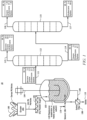
- FIG. 1 shows system 10 for processing polystyrene, according to embodiments of the invention.
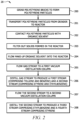
- FIG. 2 shows method 20 for processing polystyrene, according embodiments of the invention.
- method 20 can be implemented using system 10.
- system 10 comprises grinder 101, which is adapted to grind polystyrene bricks 100 to form polystyrene particles 102, which may have a range of particle sizes.
- System 10 further includes dry powder auger 105, which is adapted to transport polystyrene particles 102 from grinder 101 to reactor 103, according to embodiments of the invention.
- reactor 103 can be a continuous flow stirred tank reactor (CSTR), which is relatively cheap and can easily be operated under a slight vacuum.
- Reactor 103 in embodiments of the invention, comprises agitator 104 for agitating contents of reactor 103-contents such as polystyrene particles 102 and aromatic solvent 106.
- aromatic solvent 106 comprises a high boiling point aromatic solvent such as light cat cycle oil (LCO), heavy cat cycle oil (HCCO), preferably lube extract, or any other suitable aromatic solvent.
- reactor 103 is adapted to heat polystyrene suspension in heavy aromatic solvent 118 under a vacuum so as to decompose polystyrene and produce gas stream 111.
- Reactor 103 in embodiments of the invention, is in fluid communication with first vacuum distillation column 112 such that gas stream 111 can flow from reactor 103 to first vacuum distillation column 112.
- gas stream 111 comprises styrene, ethylbenzene, toluene, and benzene.
- first vacuum distillation column 112 is adapted to separate gas stream 111 into first stream 113, comprising primarily toluene and benzene, second stream 114, comprising primarily styrene and ethylbenzene.
- second vacuum distillation column 115 is adapted to receive and distill second stream 114 to produce third stream 116, comprising primarily ethylbenzene and fourth stream 117 comprising primarily styrene.
- System 10 in embodiments of the invention, also includes solids filter 108, which is adapted to filter solids 110 from recycle stream 109.
- method 20 comprises, at block 200, grinder 101 grinding polystyrene material, such as polystyrene bricks 100, to form polystyrene particles 102.
- Block 201, of method 20, in embodiments of the invention, involves dry powder auger 105 transporting polystyrene particles 102 from grinder 101 to reactor 103.
- method 20 at block 202, involves contacting polystyrene particles 102 with aromatic solvent 106.
- Aromatic solvent 106 can comprise light cat cycle oil, heavy cat cycle oil, lube extract, or any other suitable aromatic solvent; and aromatic solvent 106 can be disposed in reactor 103 prior to flowing polystyrene particles 102 into reactor 103.
- the contacting at block 202 can be enhanced by agitator 104 mixing polystyrene particles 102 and aromatic solvent 106 in reactor 103 to form polystyrene suspension in heavy aromatic solvent 118.
- concentration of polystyrene in aromatic solvent in embodiments of the invention, is 5-20 wt.% with processing rates of 1-10 KTA.
- the contacting of polystyrene particles 102 and aromatic solvent 106, in reactor 103, at suitable reaction conditions decomposes polystyrene particles 102 to form gas stream 111, comprising styrene, toluene, ethylbenzene, and benzene.
- the reaction conditions in embodiments of the invention, for carrying out the polystyrene decomposition process, include a temperature in a range of 325 to 425 °C, including ranges of 325 to 335 °C, 335 to 345 °C, 345 to 355 °C, 355 to 365 °C, 365 to 375 °C, 375 to 385 °C, 385 to 395 °C, 395 to 405 °C, 405 to 415 °C, and 415 to 425 °C.
- External heating may be used to maintain reaction conditions in the desired temperature range, in embodiments of the invention.
- reaction conditions for carrying out the polystyrene decomposition process, include having reactor 103 under vacuum such that there is a pressure in a range of 50 to 400 torr, including ranges of 50 to 75 torr, 75 to 100 torr, 100 to 125 torr, 125 to 150 torr, 150 to 175 torr, 175 to 200 torr, 200 to 225 torr, 225 to 250 torr, 250 to 275 torr, 275 to 300 torr, 300 to 325 torr, 325 to 350 torr, 350 to 375 torr, 375 to 400 torr.
- a polymerization inhibitor, polymerization inhibitor 119 such as tert-butylcatechol (TBC, bp 285 °C) can be added to aromatic solvent 106, in reactor 103, and thus polystyrene suspension in heavy aromatic solvent 118 can be comprised of aromatic solvent 106, polystyrene particles 102, and polymerization inhibitor 119.
- block 202 can include contacting aromatic solvent 106, polystyrene particles 102, and polymerization inhibitor 119 with each other.
- block 203 involves flowing recycle stream 109 through filter 108, which filters out solids 110 formed in reactor 103.
- Filter 108 according to embodiments of the invention, is adapted with the right sieve size to remove solids 110. If any of aromatic solvent 106 is lost overhead, at block 204, make-up aromatic solvent 106 is flowed into reactor 103, in embodiments of the invention.
- block 205 includes flowing gas stream 111 to first vacuum distillation column 112. And at block 206, in embodiments of the invention, first vacuum distillation column 112 distills gas stream 111 to produce first stream 113 (comprising primarily toluene and benzene) and second stream 114 (comprising primarily styrene and ethylbenzene).
- gas stream 111 comprises 69 to 75 wt.% styrene, 10 to 15 wt.% toluene, 8 to 12 wt.% ethylbenzene, 2 to 7 wt.% benzene.
- first stream 113 comprises 0.1 to 1.0 wt.% styrene, 65 to 75 wt.% toluene, 0.1 to 1.5 wt.% ethylbenzene, 27 to 33 wt.% benzene.
- second stream 114 comprises 82 to 92 wt.% styrene, 0.1 to 1.0 wt.% toluene, and 10 to 15 wt.% ethylbenzene.
- block 207 includes flowing second stream 114 to second vacuum distillation column 115. And at block 208, in embodiments of the invention, second vacuum distillation column 115 distills second stream 114 to produce third stream 116 (comprising primarily ethylbenzene) and fourth stream 117 (comprising primarily styrene).
- third stream 116 comprises 1.0 to 2.0 wt.% styrene, 1.0 to 2.0 wt.% toluene, and 95 to 99.9 wt.% ethylbenzene.
- fourth stream 117 comprises 99 to 99.9 wt.
- reactor 103 is operated under vacuum and the separation process is carried out by first vacuum distillation column 112 and second vacuum distillation column 115, all of which helps in carrying out the distillation separation at lower temperatures than conventional methods and thereby circumventing the possibilities of runaway polymerization between components.
- embodiments of the present invention have been described with reference to blocks of FIG. 2 , it should be appreciated that operation of the present invention is not limited to the particular blocks and/or the particular order of the blocks illustrated in FIG. 2 . Accordingly, embodiments of the invention may provide functionality as described herein using various blocks in a sequence different than that of FIG. 2 .
- the systems and processes described herein can also include various equipment that is not shown and is known to one of skill in the art of chemical processing. For example, some controllers, piping, computers, valves, pumps, heaters, thermocouples, pressure indicators, mixers, heat exchangers, and the like may not be shown.
- Embodiment 1 is a method of processing polystyrene.
- the method includes contacting polystyrene with an aromatic solvent at a temperature in a range of 325 to 425 °C and a pressure in a range of 50 to 400 torr to produce a gas comprising styrene monomer.
- the method further includes separating the styrene monomer from one or more components of the gas to form a product stream comprising styrene.
- Embodiment 2 is the method of embodiment 1 further comprising processing the styrene monomer to produce a polymer.
- Embodiment 3 is the method of embodiment 2, wherein the polymer comprises polystyrene and acrylonitrile-butadiene-styrene (ABS).
- Embodiment 4 is the method of any of embodiments 1 to 3, further comprising grinding polystyrene bricks to form polystyrene particles, wherein the polystyrene particles are used for the contacting of the polystyrene with the aromatic solvent.
- Embodiment 5 is the method of embodiment 4, wherein the polystyrene bricks are derived from polystyrene waste.
- Embodiment 6 is the method of any of embodiments 1 to 5, further comprising contacting a polymerization inhibitor with the polystyrene and aromatic solvent.
- Embodiment 7 is the method of embodiment 6, wherein the polymerization inhibitor comprises tert-butylcatechol.
- Embodiment 8 is the method of any of embodiments 1 to 7, further comprising carrying out the contacting of the polystyrene with the aromatic solvent in a reactor comprising an agitator adapted to mix contents of the reactor.
- Embodiment 9 is the method of embodiment 8, wherein the reactor comprises a continuous flow stirred tank reactor (CSTR).
- Embodiment 10 is the method of any of embodiments 1 to 9, wherein the separating of the gas is carried out by a first vacuum distillation column and a second vacuum distillation column.
- Embodiment 11 is the method of embodiment 10, wherein the first vacuum distillation column distills the gas to produce a first stream comprising primarily toluene and benzene and a second stream comprising primarily styrene and ethylbenzene.
- Embodiment 12 is the method of embodiment 11, wherein the second vacuum distillation column distills the second stream to produce a third stream comprising primarily ethylbenzene and the product stream comprising styrene.
- Embodiment 13 is the method of any of embodiments 1 to 12, wherein the aromatic solvent is selected from the list consisting of: light cat cycle oil (LCO), heavy cat cycle oil (HCCO), and lube extract.
- LCO light cat cycle oil
- HCCO heavy cat cycle oil
- Embodiment 14 is the method of any of embodiments 1 to 13, wherein the product stream comprises 99 to 99.9 wt.% styrene and 0.1 to 1 wt.% ethylbenzene.
- Embodiment 15 is the method of any of embodiments 1 to 14, wherein the contacting of the polystyrene with the aromatic solvent occurs at a pressure in a range of 50 to 300 torr.
- Embodiment 16 is a method of processing polystyrene. The method comprises processing polystyrene bricks to produce polystyrene particles.
- the method further comprises mixing, in a reactor, the polystyrene particles, a polymerization inhibitor, and an aromatic solvent, at a temperature in a range of 325 to 425 °C and a pressure in a range of 50 to 400 torr to produce a gas comprising styrene, ethylbenzene, toluene, and benzene.
- the method still further comprises flowing the gas from the reactor to a first vacuum distillation column; distilling the gas in the first vacuum distillation column to produce a first stream comprising primarily toluene and benzene and a second stream comprising primarily styrene and ethylbenzene; flowing the second stream to a second vacuum distillation column; and distilling the second stream in the second vacuum distillation column to produce a third stream comprising primarily ethylbenzene and a fourth stream comprising primarily styrene.
Landscapes
- Chemical & Material Sciences (AREA)
- Organic Chemistry (AREA)
- Chemical Kinetics & Catalysis (AREA)
- Sustainable Development (AREA)
- Health & Medical Sciences (AREA)
- Life Sciences & Earth Sciences (AREA)
- Physics & Mathematics (AREA)
- Medicinal Chemistry (AREA)
- Polymers & Plastics (AREA)
- Thermal Sciences (AREA)
- Engineering & Computer Science (AREA)
- General Chemical & Material Sciences (AREA)
- Oil, Petroleum & Natural Gas (AREA)
- Organic Low-Molecular-Weight Compounds And Preparation Thereof (AREA)
Priority Applications (1)
| Application Number | Priority Date | Filing Date | Title |
|---|---|---|---|
| EP22215170.6A EP4389727A1 (fr) | 2022-12-20 | 2022-12-20 | Procédé de récupération de monomère de styrène à partir de polystyrène résiduaire |
Applications Claiming Priority (1)
| Application Number | Priority Date | Filing Date | Title |
|---|---|---|---|
| EP22215170.6A EP4389727A1 (fr) | 2022-12-20 | 2022-12-20 | Procédé de récupération de monomère de styrène à partir de polystyrène résiduaire |
Publications (1)
| Publication Number | Publication Date |
|---|---|
| EP4389727A1 true EP4389727A1 (fr) | 2024-06-26 |
Family
ID=84547373
Family Applications (1)
| Application Number | Title | Priority Date | Filing Date |
|---|---|---|---|
| EP22215170.6A Withdrawn EP4389727A1 (fr) | 2022-12-20 | 2022-12-20 | Procédé de récupération de monomère de styrène à partir de polystyrène résiduaire |
Country Status (1)
| Country | Link |
|---|---|
| EP (1) | EP4389727A1 (fr) |
Citations (1)
| Publication number | Priority date | Publication date | Assignee | Title |
|---|---|---|---|---|
| JPH11199875A (ja) * | 1998-01-16 | 1999-07-27 | Toshiba Plant Kensetsu Co Ltd | スチレンの回収方法 |
-
2022
- 2022-12-20 EP EP22215170.6A patent/EP4389727A1/fr not_active Withdrawn
Patent Citations (1)
| Publication number | Priority date | Publication date | Assignee | Title |
|---|---|---|---|---|
| JPH11199875A (ja) * | 1998-01-16 | 1999-07-27 | Toshiba Plant Kensetsu Co Ltd | スチレンの回収方法 |
Non-Patent Citations (1)
| Title |
|---|
| DEMENT'EV KONSTANTIN I ET AL: "Thermal depolymerization of polystyrene in highly aromatic hydrocarbon medium", JOURNAL OF ANALYTICAL AND APPLIED PYROLYSIS, ELSEVIER BV, NL, vol. 142, 5 May 2019 (2019-05-05), XP085795141, ISSN: 0165-2370, [retrieved on 20190505], DOI: 10.1016/J.JAAP.2019.05.001 * |
Similar Documents
| Publication | Publication Date | Title |
|---|---|---|
| EP2289952B2 (fr) | Procédé de polyoléfine éco-énergétique | |
| EP2054781B1 (fr) | Procédé et appareil permettant de gérer la teneur en composés organiques volatils d' une polyoléfine | |
| EP2536765A2 (fr) | Système et procédé d'activation d'un catalyseur | |
| EP4389727A1 (fr) | Procédé de récupération de monomère de styrène à partir de polystyrène résiduaire | |
| EP4453135A1 (fr) | Procédés de traitement d'huile de pyrolyse | |
| GB2038852A (en) | Process for producing polyethylene | |
| RU2626880C2 (ru) | Способ непрерывного синтеза диенового эластомера | |
| EP1007576A1 (fr) | Polymerisation vinylaromatique syndiotactique recourant a plusieurs reacteurs en serie | |
| EP4495208A1 (fr) | Procédé et dispositif de conversion de déchets plastiques en huile craquée thermiquement et catalyseur fcc | |
| US3684783A (en) | Diluent recovery process | |
| US2963525A (en) | Method of supplying a catalyst to a reactor and apparatus therefor | |
| WO2020121154A1 (fr) | Procédé de préparation d'alkylbenzène linéaire | |
| US12012556B2 (en) | Dense phase riser to maximize light olefins yields for naphtha catalytic cracking | |
| TW512143B (en) | Method of producing ethylbenzene | |
| US2900078A (en) | Continuous separation of mercury-containing sulfuric acid from organic liquids | |
| Tsangaris et al. | Evaluation of batch and semi-batch reactor operation for enzymatic reactions with inhibitory kinetics | |
| JP2003193064A (ja) | スチレン系樹脂廃材の油化処理方法 | |
| EP3990576A1 (fr) | Colonnes montantes à phases denses multiples destinées à maximiser les rendements en oléfines légères pour le craquage catalytique de naphta | |
| JPH0832889B2 (ja) | ポリスチレン廃棄物の処理方法 | |
| WO1996018659A1 (fr) | Procede et installation de production de polyvinylchlorure en suspension aqueuse avec recuperation des reflux |
Legal Events
| Date | Code | Title | Description |
|---|---|---|---|
| PUAI | Public reference made under article 153(3) epc to a published international application that has entered the european phase |
Free format text: ORIGINAL CODE: 0009012 |
|
| STAA | Information on the status of an ep patent application or granted ep patent |
Free format text: STATUS: THE APPLICATION HAS BEEN PUBLISHED |
|
| AK | Designated contracting states |
Kind code of ref document: A1 Designated state(s): AL AT BE BG CH CY CZ DE DK EE ES FI FR GB GR HR HU IE IS IT LI LT LU LV MC ME MK MT NL NO PL PT RO RS SE SI SK SM TR |
|
| STAA | Information on the status of an ep patent application or granted ep patent |
Free format text: STATUS: THE APPLICATION IS DEEMED TO BE WITHDRAWN |
|
| 18D | Application deemed to be withdrawn |
Effective date: 20250103 |