EP4389595A2 - Ensemble aile d'aéronef - Google Patents
Ensemble aile d'aéronef Download PDFInfo
- Publication number
- EP4389595A2 EP4389595A2 EP23212980.9A EP23212980A EP4389595A2 EP 4389595 A2 EP4389595 A2 EP 4389595A2 EP 23212980 A EP23212980 A EP 23212980A EP 4389595 A2 EP4389595 A2 EP 4389595A2
- Authority
- EP
- European Patent Office
- Prior art keywords
- spar
- aircraft wing
- wing assembly
- drive mechanism
- secured
- Prior art date
- Legal status (The legal status is an assumption and is not a legal conclusion. Google has not performed a legal analysis and makes no representation as to the accuracy of the status listed.)
- Granted
Links
Images



Classifications
-
- B—PERFORMING OPERATIONS; TRANSPORTING
- B64—AIRCRAFT; AVIATION; COSMONAUTICS
- B64C—AEROPLANES; HELICOPTERS
- B64C9/00—Adjustable control surfaces or members, e.g. rudders
- B64C9/14—Adjustable control surfaces or members, e.g. rudders forming slots
- B64C9/22—Adjustable control surfaces or members, e.g. rudders forming slots at the front of the wing
-
- B—PERFORMING OPERATIONS; TRANSPORTING
- B64—AIRCRAFT; AVIATION; COSMONAUTICS
- B64C—AEROPLANES; HELICOPTERS
- B64C9/00—Adjustable control surfaces or members, e.g. rudders
- B64C9/02—Mounting or supporting thereof
-
- B—PERFORMING OPERATIONS; TRANSPORTING
- B64—AIRCRAFT; AVIATION; COSMONAUTICS
- B64C—AEROPLANES; HELICOPTERS
- B64C1/00—Fuselages; Constructional features common to fuselages, wings, stabilising surfaces or the like
- B64C1/06—Frames; Stringers; Longerons ; Fuselage sections
- B64C1/065—Spars
-
- B—PERFORMING OPERATIONS; TRANSPORTING
- B64—AIRCRAFT; AVIATION; COSMONAUTICS
- B64C—AEROPLANES; HELICOPTERS
- B64C13/00—Control systems or transmitting systems for actuating flying-control surfaces, lift-increasing flaps, air brakes, or spoilers
- B64C13/24—Transmitting means
- B64C13/38—Transmitting means with power amplification
- B64C13/50—Transmitting means with power amplification using electrical energy
-
- B—PERFORMING OPERATIONS; TRANSPORTING
- B64—AIRCRAFT; AVIATION; COSMONAUTICS
- B64C—AEROPLANES; HELICOPTERS
- B64C3/00—Wings
- B64C3/18—Spars; Ribs; Stringers
- B64C3/185—Spars
-
- B—PERFORMING OPERATIONS; TRANSPORTING
- B64—AIRCRAFT; AVIATION; COSMONAUTICS
- B64C—AEROPLANES; HELICOPTERS
- B64C3/00—Wings
- B64C3/28—Leading or trailing edges attached to primary structures, e.g. forming fixed slots
-
- B—PERFORMING OPERATIONS; TRANSPORTING
- B64—AIRCRAFT; AVIATION; COSMONAUTICS
- B64C—AEROPLANES; HELICOPTERS
- B64C3/00—Wings
- B64C3/38—Adjustment of complete wings or parts thereof
- B64C3/44—Varying camber
- B64C3/50—Varying camber by leading or trailing edge flaps
-
- B—PERFORMING OPERATIONS; TRANSPORTING
- B64—AIRCRAFT; AVIATION; COSMONAUTICS
- B64C—AEROPLANES; HELICOPTERS
- B64C9/00—Adjustable control surfaces or members, e.g. rudders
- B64C9/14—Adjustable control surfaces or members, e.g. rudders forming slots
- B64C9/22—Adjustable control surfaces or members, e.g. rudders forming slots at the front of the wing
- B64C9/24—Adjustable control surfaces or members, e.g. rudders forming slots at the front of the wing by single flap
-
- B—PERFORMING OPERATIONS; TRANSPORTING
- B64—AIRCRAFT; AVIATION; COSMONAUTICS
- B64C—AEROPLANES; HELICOPTERS
- B64C9/00—Adjustable control surfaces or members, e.g. rudders
- B64C9/32—Air braking surfaces
- B64C9/323—Air braking surfaces associated with wings
-
- B—PERFORMING OPERATIONS; TRANSPORTING
- B64—AIRCRAFT; AVIATION; COSMONAUTICS
- B64C—AEROPLANES; HELICOPTERS
- B64C9/00—Adjustable control surfaces or members, e.g. rudders
- B64C9/34—Adjustable control surfaces or members, e.g. rudders collapsing or retracting against or within other surfaces or other members
-
- B—PERFORMING OPERATIONS; TRANSPORTING
- B64—AIRCRAFT; AVIATION; COSMONAUTICS
- B64F—GROUND OR AIRCRAFT-CARRIER-DECK INSTALLATIONS SPECIALLY ADAPTED FOR USE IN CONNECTION WITH AIRCRAFT; DESIGNING, MANUFACTURING, ASSEMBLING, CLEANING, MAINTAINING OR REPAIRING AIRCRAFT, NOT OTHERWISE PROVIDED FOR; HANDLING, TRANSPORTING, TESTING OR INSPECTING AIRCRAFT COMPONENTS, NOT OTHERWISE PROVIDED FOR
- B64F5/00—Designing, manufacturing, assembling, cleaning, maintaining or repairing aircraft, not otherwise provided for; Handling, transporting, testing or inspecting aircraft components, not otherwise provided for
- B64F5/10—Manufacturing or assembling aircraft, e.g. jigs therefor
-
- B—PERFORMING OPERATIONS; TRANSPORTING
- B64—AIRCRAFT; AVIATION; COSMONAUTICS
- B64C—AEROPLANES; HELICOPTERS
- B64C9/00—Adjustable control surfaces or members, e.g. rudders
- B64C9/14—Adjustable control surfaces or members, e.g. rudders forming slots
- B64C2009/143—Adjustable control surfaces or members, e.g. rudders forming slots comprising independently adjustable elements for closing or opening the slot between the main wing and leading or trailing edge flaps
Definitions
- the present invention relates to an aircraft, an aircraft wing assembly, and a method of assembling an aircraft wing assembly.
- Aircraft wing assemblies can form an integrated part of a wing of an aircraft.
- aircraft wing assemblies can comprise high lift devices to increase the amount of lift the wing can provide during flight of the aircraft.
- an aircraft wing assembly comprising: a wing box comprising: an upper surface; a lower surface; and a leading edge structure connecting the upper surface to the lower surface and secured to the upper surface at a connection point; a drive mechanism secured to the wing box; and a high lift device mounted to the drive mechanism, wherein the drive mechanism is configured to move the high lift device between a retracted position and an extended position in use, and wherein the high lift device is configured to overlap the connection point when in the retracted position.
- the aircraft wing assembly according to the first aspect of the present invention may provide improved aerodynamic performance over conventional wing assemblies.
- the high lift device overlaps the connection point between the upper surface and the leading edge structure, there may be fewer fasteners (or the like) within the path of the airflow over the upper surface when the high lift device is in the retracted position, which may improve airflow, e.g. the laminarity of the airflow, over the upper surface.
- this may also reduce the need for strict tolerances for the connection between the leading edge structure and the upper surface, as any imperfection in the connection will be covered by the high lift device (so will not affect airflow when the high lift device is in the retracted position).
- the leading edge structure may be secured to the upper surface using a fastener.
- the fastener may comprise a nut and bolt, or may comprise a rivet.
- the fastener comprises a single-sided fastener, such that the fastener is secured from a single-side.
- the upper surface may comprise a recess to receive a portion of the high lift device when the high lift device is in the retracted position.
- the recess may help to reduce sudden steps between the high lift device and the upper surface, which may help to create a smooth surface transition between the leading edge structure and the upper surface. This may help to improve airflow over the upper surface and may improve the aerodynamic performance of the aircraft wing assembly.
- the high lift device may be a droop or a flap, such as a Krueger flap.
- the high lift device may comprise a slat.
- the slat may help to increase lift generated by the aircraft wing assembly.
- the slat may be moved between the extended position and the retracted position at different times of flight. For example, the slat may be moved to the extended position during take-off and/or landing and may be move to the retracted position during cruise and/or taxi.
- the drive mechanism may be configured to move the high lift device so that the high lift device does not overlap the connection point when in the extended position. This may expose the connection point to airflow passing over the wing assembly structure in use, which may help to generate a turbulent airflow over the upper surface.
- the wing box may comprise a spar located between the upper surface and the lower surface and secured at a first end to the upper surface and at a second end to the lower surface, and the drive mechanism may be removably secured to the spar.
- the spar may provide structural support to the upper surface and the lower surface.
- the spar may also seal a section of the wing box to form a fuel tank.
- the aircraft wing assembly may comprise a support secured to the spar, and the drive mechanism may be secured to the support.
- the support may allow the drive mechanism to be secured to the spar without having to directly secure the drive mechanism to the spar. As such, it may be easier to install the drive mechanism once the spar is already in place, as direct access to the spar may not be required. This may also allow the drive mechanism to be secured to the spar from a single side of the spar, which may be easier and/or more convenient during assembly.
- the support may comprise aluminium, such as machined aluminium.
- the aircraft wing assembly may comprise a plurality of supports secured to the spar, such as two supports, and the drive mechanism may be secured to the spar using the plurality of brackets. This may help to increase the strength of the connection between the drive mechanism and the spar.
- the drive mechanism may be secured to the support by a plurality of fasteners, such as nuts and bolts. This may allow the drive mechanism to be relatively easily removed for servicing and/or repair.
- the support may be secured to the upper surface. Securing the support to the upper surface as well as the spar may help to transfer load to the upper surface in use. This may help to distribute load, which may reduce the likelihood of any part of the aircraft wing assembly encountering higher than desired loads.
- the spar may comprise a first flange at the first end and a second flange at the second end, wherein the first flange extends in a first direction along the upper surface and the second flange extends in a second direction along the lower surface, the first direction being substantially opposite to the second direction.
- the cross-sectional shape of the spar may allow the upper surface to be secured to the spar at a first side of the spar, and the lower surface to be secured to the spar at a second side of the spar.
- the shape of the spar may also allow relatively easy access to the first end and second end of the spar as the first end is not obstructed by the second end and vice versa. As such, the shape of the spar may make assembly of the aircraft wing assembly easier.
- the spar may comprise carbon fibre. This may provide a relative strong and light spar.
- the spar may extend along substantially the entire length of the upper surface and/or the lower surface.
- the drive mechanism may be located such that no part of the drive mechanism extends through the spar. This may help to improve ergonomics of the aircraft wing assembly by only requiring access to a single side of the spar to inspect the drive mechanism, e.g. for service and/or repair.
- the leading edge structure may comprise a curved sheet defining a fixed leading edge of the aircraft wing assembly.
- the curved sheet may comprise sheet metal which is bent into a desired shape.
- the curved sheet may comprise aluminium.
- the curved sheet may comprise a thermoplastic or a thermoset.
- the curved sheet may have a thickness of around 1mm to 6mm, such as between 1mm and 4mm, or between 1mm and 2mm. This may allow the fixed leading edge, and therefore the leading edge structure, to be relatively lightweight. This may help to reduce the overall weight of the aircraft wing assembly.
- the leading edge structure may comprise a reinforcing element. This may help to increase the structural rigidity/strength of the leading edge structure, such that it less susceptible to deforming when under load.
- the leading edge structure and/or the lower surface may comprise a removable access panel. This may allow access through the leading edge structure and/or the lower surface without having to remove the leading edge structure and/or the lower surface. This may make service and maintenance of the aircraft wing assembly quicker and easier than if the entire leading edge structure and/or lower surface is removed.
- the drive mechanism may comprise an electric motor.
- the electric motor may allow for more precise control of the drive mechanism over conventional mechanical arrangement. If more than one drive mechanism is provided, each drive mechanism may comprise its own electric motor, which may allow for individual control and/or monitoring of each drive mechanism.
- the use of an electric motor may also reduce the number of ancillary component required in the aircraft wing assembly, such as hydraulic lines if hydraulics were used instead of electric motors.
- the aircraft wing assembly may comprise a plurality of drive mechanisms, wherein the high lift device is mounted to each of the plurality of drive mechanisms. This may help to provide redundancy in the event that one of the drive mechanisms fails to operate correctly. This may also help to increase stability of the high lift device by providing multiple contact points.
- the aircraft wing assembly may comprise two, three or four drive mechanisms per high lift device.
- the drive mechanism may comprise an actuable element which is moveable using a rack and pinion assembly.
- a sprocket may be rotated which is turn drives the actuable element.
- the actuable element may comprise an elongate rod which is attached to the high lift device, such that rotation of the sprocket drives the high lift device between the extended and the retracted positions.
- the drive mechanism may comprise a modular unit, for example comprising a housing within which constituent components of the drive mechanism are located.
- the drive mechanism may comprise a housing within which the electric motor, the actuable element, and the rack and pinion assembly, are located.
- the actuable element may extend partly out of the housing, and an extent to which the actuable element extends out of the housing may be variable, for example in response to the electric motor, to move the high lift device between the retracted position and the extended position
- a method of assembling an aircraft wing assembly comprising: securing a spar to an upper surface of the aircraft wing assembly; securing a lower surface of the aircraft wing assembly to the spar; securing a drive mechanism to the spar such that no part of the drive mechanism passes through the spar; securing a leading edge structure to the upper surface and to the lower surface; and mounting a high lift device to the drive mechanism.
- the method according to the second aspect of the present invention may provide a relatively straightforward way in which to assemble the aircraft wing assembly.
- the method may provide a one-way assembly process which does not require the removal/disconnection of components once they have been secured. This may help to speed up the assembly process (e.g. reduce cycle time for assembly) and may reduce time taken disassembling and reassembling parts of the aircraft wing assembly. This may also help to reduce costs during assembly, e.g. by reducing material wasted as a result of needing to assemble and then disassemble components, and/or reducing time spent in assembly.
- the method may comprise securing a rib of the aircraft wing assembly to the upper surface before securing the lower surface. This may allow ribs to be easily located and secured before the lower surface is secured. This may also provide better access to the ribs to install other devices/components within the wing assembly.
- the method may comprise securing the spar to the upper surface prior to securing the lower surface to the spar. This may allow components of the aircraft wing assembly to the secured to the upper surface and/or the rib before the wing box is closed off with the lower surface. This may be useful when working on the aircraft wing assembly from an underside of the aircraft wing assembly (e.g. when installed on a rig or aircraft).
- the method may comprise securing the lower surface to the spar prior to securing the spar to the upper surface.
- the method may comprise securing the leading edge structure to the upper surface and to the lower surface after securing the spar to the upper surface, securing the lower surface to the spar and securing the drive mechanism to the spar. This may allow the leading edge structure to only be secured once the rest of the aircraft wing assembly has been assembled. This may help with installing, e.g., the drive mechanism, as access to the spar is not restricted by the leading edge structure.
- an aircraft wing assembly comprising: an upper surface; a lower surface; and a spar located between the upper surface and the lower surface and secured at a first end to the upper surface and at a second end to the lower surface, wherein the spar comprises a first flange at the first end and a second flange at the second end, wherein the first flange extends in a first direction along the upper surface and the second flange extends in a second direction along the lower surface, the first direction being substantially opposite to the second direction.
- the spar having a substantially Z-shaped cross-sectional shape when viewed from an end of the spar.
- the cross-sectional shape of the spar may allow the upper surface to be secured to the spar at a first side of the spar, and the lower surface to be secured to the spar at a second side of the spar.
- the shape of the spar may also allow relatively easy access to the first end and second end of the spar as the first end is not obstructed by the second end and vice versa. As such, the shape of the spar may make assembly of the aircraft wing assembly easier.
- the spar may comprise carbon fibre. This may provide a relative strong and light spar.
- the aircraft wing assembly may comprise a support secured to the spar and a drive mechanism secured to the support.
- the support may allow the drive mechanism to be secured to the spar without having to directly secure the drive mechanism to the spar. As such, it may be easier to instal the drive mechanism once the spar is already in place. This may also allow the drive mechanism to be secured to the spar from a single side of the spar, which may be easier and/or more convenient during assembly.
- the support may comprise aluminium, such as machined aluminium.
- the aircraft wing assembly may comprise a plurality of supports secured to the spar, such as two supports, and the drive mechanism may be secured to the spar using the plurality of brackets. This may help to increase the strength of the connection between the drive mechanism and the spar.
- the drive mechanism may be secured to the support by a plurality of fasteners, such as nuts and bolts. This may allow the drive mechanism to be relatively easily removed for servicing and/or repair.
- the aircraft wing assembly may comprise a high lift device mounted to the drive mechanism.
- the high lift device may help to increase lift generated by the aircraft wing assembly in use.
- the support may be secured to the upper surface. Securing the support to the upper surface as well as the spar may help to transfer load to the upper surface in use. This may help to distribute load, which may reduce the likelihood of any part of the aircraft wing assembly encountering higher than desired loads.
- an aircraft comprising the aircraft wing assembly according to the first aspect of the present invention or the third aspect of the present invention.
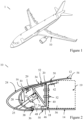
- FIG. 1 An aircraft 1 is shown schematically in Figure 1 .
- the aircraft 1 comprises an aircraft wing assembly 10.
- FIG. 2 and 3 A cross-sectional side view of the aircraft wing assembly 10 is shown in Figures 2 and 3 .
- the aircraft wing assembly 10 comprises an upper surface 12, a lower surface 14, a leading edge structure 16, a spar 18, a support 20 secured to the spar 18 and a rib 19.
- the upper surface 12, the lower surface 14, the leading edge structure 16 and the spar 18 collectively form a wing box.
- a drive mechanism 24 is secured to the support 20 and a slat 26 is mounted to the drive mechanism 24.
- the aircraft wing assembly 10 is shown with the slat 26 in a retracted position in Figure 2 , and in an extended position in Figure 3 .
- the leading edge structure 16 comprises sheet metal which is bent into a desired shape for the leading edge structure 16.
- the leading edge structure 16 is covered by the slat 26, such that the leading edge structure 16 is not exposed to airflow passing over the aircraft wing assembly 10.
- the leading edge structure 16 is exposed to the airflow passing over the aircraft wing assembly 10.
- the leading edge structure 16 may help to generate a turbulent flow over the upper surface 12.
- the leading edge structure 16 also comprises a reinforcing element 28 to strengthen the leading edge structure 16.
- the reinforcing element 28 comprises a rib, and it will be appreciated that a plurality of reinforcing elements 28, such as a plurality of ribs, may be utilised in practice.
- the upper surface 12 is secured to the leading edge structure 16 with fasteners 30 (only one of which is shown in Figure 2 ) which extend through the leading edge structure 16 and the upper surface 12. This creates a line of fasteners 30 along the upper surface 12 at a connection point between upper surface 12 and the leading edge structure 16.
- An end 32 of the upper surface 12 is shaped to accommodate the leading edge structure 16.
- the upper surface 12 comprises a recess 34 which is shaped to receive a part of the slat 26 when the slat 26 is in the retracted position.
- the leading edge structure 16 is secured to the lower surface 14 in a similar way as to the upper surface 16. Fasteners 36 extend through the lower surface 14 and the leading edge structure 16 to secure the leading edge structure 16 to the lower surface 14. As with the upper surface 12, an end 38 of the lower surface 14 is shaped where it is connected to the leading edge structure 16 to reduce the size of any step between surfaces of the leading edge structure 16 and the lower surface 14.
- the fasteners 30, 36 used to secure the leading edge structure 16 to the upper surface 12 and to the lower surface 14 are removable, so that the leading edge structure 16 can be detached and re-attached if required. This may be useful in situations where inspection and/or maintenance of the leading edge structure 16 (or any other part of the aircraft wing assembly 10) is required, as it does not require the whole aircraft wing assembly 10 to be disassembled.
- the spar 18 comprises carbon fibre, is located between the upper surface 12 and the lower surface 14, and extends along the upper surface 12 and lower surface 14.
- the spar 18 comprises a linear mid-portion 40 along with a first end portion 42 (or flange) at a first end of the spar 18 and a second end portion 46 (or flange) at a second end of the spar 18.
- the first and second end portions 42, 46 extend from the linear mid-portion 40 in substantially opposite directions along the upper surface 12 and the lower surface 14 respectively. This gives the spar 18 a substantially Z-shaped cross-sectional shape when viewed from an end of the spar 18 (from the opposite direction of Figures 2 and 3 ).
- the first end portion 42 is secured to the upper surface 12 and the second end portion 46 is secured to the lower surface 14 using fasteners 50 (only two of which are shown in Figured 2 and 3).
- the spar 18 is set back from the ends 32, 38 of the upper surface 12 and the lower surface 14. This creates an opening between the end 32 of the upper surface 12 and the end 38 of the lower surface 14 on a first side 48 of the spar 18 (i.e. to the left of the spar 18 in Figures 2 and 3 ), through which additional components of the aircraft wing assembly 10 are installed.
- a cavity 54 is located on a second side 56 of the spar 18 (i.e. to the right of the spar 18 in Figures 2 and 3 ), within which the rib 19 is located.
- fuel is stored within the cavity 54.
- the support 20, shown in isolation with the spar 18 in Figure 4 comprises aluminium and is located on the first side 48 of the spar 18 between the upper surface 12 and the lower surface 13.
- the support 20 has a substantially triangular cross-sectional shape and is secured to the spar 18 and the upper surface 12 by a plurality fasteners 52.
- two fasteners 52 are provided between the support 20 and the spar 18, and one fastener 54 is provided between the support 20 and the upper surface 12.
- the drive mechanism 24 comprises an elongate arm 25 which is attached to the slat 26. Although illustrated as linear, the elongate arm 25 may be curved in practice, and may extend along a curved track within an interior of a housing of the drive mechanism 24.
- the drive mechanism 24 also comprises an electric motor 29 which drives a sprocket 27 within the drive mechanism 24.
- the arm 25 is driven by the sprocket 27, such that the arm 25 and sprocket 27 act as a rack and pinion arrangement. As the sprocket 27 rotates, the sprocket 27 engages with the arm 25 to either extend the arm 25 (and therefore the slat 26) or retract the arm 25 (and therefore the slat 26).
- the elongate arm 25, the sprocket 27, and the electric motor 29 are located within a common housing, such that the drive mechanism 24 is modular in nature.
- the drive mechanism 24 is fixed to the support 20 as a single modular unit, as will be described hereinafter.
- the drive mechanism 24 moves the slat 26 between the extended and the retracted position.
- the slat 26 covers the leading edge structure 16 as well as the fasteners 30 connecting the upper surface 12 to the leading edge structure 16.
- the slat 26 is kept in the retracted position while the aircraft 1 is at cruise or is taxiing (e.g. when increased lift and/or drag is not needed).
- the slat 26 In the extended position, as shown in Figure 3 , the slat 26 is moved away from the leading edge structure 16 such that a part of the leading edge structure 16 is exposed. The slat 26 is moved to the extended position for take-off and/or landing (e.g. when increased lift and/or drag is desirable).
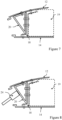
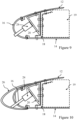
- Figures 5 to 10 show the various stages of assembly of the aircraft wing assembly 10.
- the spar 18 is secured to the upper surface 12 and the support 20 is secured to the spar 18 and the upper surface 12.
- the rib 19 (along with any other components to be installed within the cavity 54, such as stringers or conduits) is then installed in the aircraft wing assembly 10 (shown in Figure 6 ).
- the lower surface 14 is secured to the spar 12 (shown in Figure 7 ).
- the drive mechanism 24 is secured, as a single modular unit, to the support 20 while the leading edge structure 16 is not attached to the aircraft wing assembly 10 (shown in Figure 8 ). Given the modular nature of the drive mechanism 24, increased simplicity of attachment of the drive mechanism 24 to the support may be achieved in comparison to an arrangement where components of the drive mechanism 24 are required to be individually mounted.
- the drive mechanism 24 is secured to the support 20 without needing access to the cavity 54 on the second side 56 of the spar 18 (i.e. without having to remove the lower surface 14).
- the leading edge structure 16 is secured to the upper surface 12 and to the lower surface 14 (shown in Figure 9 ), and the slat 26 is then mounted to the drive mechanism 24 (shown in Figure 10 ).
- Figure 11 shows a flow chart of a method 100 of assembling the aircraft wing assembly 10 as described above in relation to Figures 5 to 10 .
- the method 100 comprises securing 102 the spar 18 to the upper surface 12.
- the method 100 then comprises securing 104 the rib 19 to the upper surface 12.
- the method 100 comprises securing 106 the lower surface 14 to the spar 18.
- the method 100 comprises securing 108 the drive mechanism 24 to the spar 18 (such as via the support 20), securing 110 the leading edge structure 16 to the upper surface 12 and the lower surface 14, and mounting 112 the slat 26 to the drive mechanism 24.
- securing the rib 10 to the upper surface 12 also includes installing any additional components required to be located in the cavity 54. In other examples, the securing the rib to the upper surface 12 may be omitted.
- the method 100 described above may provide a one-way assembly process which does not require the removal/disconnection of components once they have been secured. This may help to speed up the assembly process and may reduce time taken disassembling and reassembling parts of the aircraft wing assembly 10.
- the spar 18 and rib 19 are secured to the upper surface 12 before the lower surface 14 is secured to the spar 18, however, in other examples the spar 18 and/or the rib 19 may be secured to the lower surface 14 first, and then the upper surface may be secured to the spar 18.
- the aircraft wing assembly 10 described above comprises a slat 26, in other examples the aircraft wing assembly 10 comprises an alternative high lift device, such as a droop or flap (e.g. a Krueger flap).
- a droop or flap e.g. a Krueger flap
- the slat 26 shown in Figures 2 and 3 does not cover the fastener 54 between the support 20 and the upper surface 12, in some examples the slat 26 also extends over the fastener 54 between the support 20 and the upper surface 12 when the slat 26 is in the extended position.
- the slat 26 extends past the end 38 of the lower surface 14 (and therefore past the leading edge structure 16) when the slat 26 is in the retracted position
- the leading edge structure 16 extends further towards the spar 18 than the slat 26, to allow greater access to the first side 48 of the spar 18 when the leading edge structure 16 is removed.
Landscapes
- Engineering & Computer Science (AREA)
- Aviation & Aerospace Engineering (AREA)
- Mechanical Engineering (AREA)
- Automation & Control Theory (AREA)
- Manufacturing & Machinery (AREA)
- Transportation (AREA)
- Connection Of Plates (AREA)
- Toys (AREA)
- Transmission Devices (AREA)
Applications Claiming Priority (1)
| Application Number | Priority Date | Filing Date | Title |
|---|---|---|---|
| GB2217919.6A GB2624887A (en) | 2022-11-29 | 2022-11-29 | Aircraft wing assembly |
Publications (3)
| Publication Number | Publication Date |
|---|---|
| EP4389595A2 true EP4389595A2 (fr) | 2024-06-26 |
| EP4389595A3 EP4389595A3 (fr) | 2024-08-14 |
| EP4389595B1 EP4389595B1 (fr) | 2026-07-22 |
Family
ID=84889514
Family Applications (1)
| Application Number | Title | Priority Date | Filing Date |
|---|---|---|---|
| EP23212980.9A Active EP4389595B1 (fr) | 2022-11-29 | 2023-11-29 | Ensemble aile d'aéronef |
Country Status (4)
| Country | Link |
|---|---|
| US (1) | US12479569B2 (fr) |
| EP (1) | EP4389595B1 (fr) |
| CN (1) | CN118107777A (fr) |
| GB (1) | GB2624887A (fr) |
Cited By (1)
| Publication number | Priority date | Publication date | Assignee | Title |
|---|---|---|---|---|
| EP4752048A1 (fr) * | 2024-11-29 | 2026-06-03 | Airbus Operations Limited | Ensemble de bord d'attaque fixe |
Families Citing this family (4)
| Publication number | Priority date | Publication date | Assignee | Title |
|---|---|---|---|---|
| EP4385887B1 (fr) * | 2022-12-14 | 2026-02-18 | Airbus Operations GmbH | Système d'introduction de charge et procédé de fabrication d'un système d'introduction de charge |
| DE102024137083A1 (de) * | 2024-12-11 | 2026-06-11 | Airbus Operations Gmbh | Vorflügel-hohlkehlen-fülleinrichtung für einen vorflügel eines luftfahrzeugs, zugehöriger vorflügel, tragfläche, luftfahrzeug und verfahren zum rekonfigurieren einer tragfläche |
| GB2703021A (en) * | 2024-12-16 | 2026-07-08 | Airbus Operations Ltd | Enclosure device |
| US20260175963A1 (en) * | 2024-12-20 | 2026-06-25 | The Boeing Company | System and method for supporting a leading edge of a wing of an aircraft |
Citations (2)
| Publication number | Priority date | Publication date | Assignee | Title |
|---|---|---|---|---|
| US4285482A (en) * | 1979-08-10 | 1981-08-25 | The Boeing Company | Wing leading edge high lift device |
| WO2021099710A1 (fr) * | 2019-11-18 | 2021-05-27 | Airbus ( Sas ) | Élement aerodynamique, en particulier pour aeronef, comportant deux pieces aerodynamiques formant une jonction de profil ascendant |
Family Cites Families (16)
| Publication number | Priority date | Publication date | Assignee | Title |
|---|---|---|---|---|
| US4469297A (en) * | 1980-08-13 | 1984-09-04 | The Boeing Company | Extendible airfoil cable drum track assembly |
| EP0045988B2 (fr) | 1980-08-13 | 1993-10-06 | The Boeing Company | Assemblage de guide pour ailerons extensibles |
| US4471928A (en) * | 1980-08-13 | 1984-09-18 | The Boeing Company | Extendible airfoil track assembly |
| US4687162A (en) | 1985-06-25 | 1987-08-18 | The Boeing Company | Apparatus for supporting an aircraft guide track for a movable airfoil |
| US5927656A (en) | 1996-06-26 | 1999-07-27 | The Boeing Company | Wing leading edge flap and method therefor |
| US20070102587A1 (en) * | 2005-11-07 | 2007-05-10 | The Boeing Company | Wing leading edge slat system |
| GB0805963D0 (en) | 2008-04-02 | 2008-05-07 | Airbus Uk Ltd | Aircraft structure |
| US9522512B2 (en) * | 2010-08-17 | 2016-12-20 | The Boeing Company | Methods for making composite structures having composite-to-metal joints |
| ES2426111B1 (es) * | 2012-04-17 | 2015-03-24 | Airbus Operations S.L. | Interfaz para superficie de sustentación de aeronave |
| GB2557274A (en) * | 2016-12-02 | 2018-06-20 | Airbus Operations Ltd | Aerofoil structure components |
| WO2018197265A1 (fr) | 2017-04-28 | 2018-11-01 | Airbus Operations Gmbh | Aile pour aéronef |
| EP3395679B1 (fr) | 2017-04-28 | 2021-09-01 | Airbus Operations GmbH | Aile d'avion |
| US10974816B2 (en) * | 2017-09-28 | 2021-04-13 | The Boeing Company | High-fowler flap actuation apparatus and related methods |
| GB2571508A (en) * | 2017-12-13 | 2019-09-04 | Airbus Operations Ltd | Aerofoil structures |
| US11427302B2 (en) | 2019-04-01 | 2022-08-30 | Yaborã Indústria Aeronáutica S.A. | Closure fairings for wing leading edge slat track openings |
| WO2021037981A1 (fr) | 2019-08-30 | 2021-03-04 | Airbus Operations Gmbh | Ensemble bord d'attaque, aile et aéronef |
-
2022
- 2022-11-29 GB GB2217919.6A patent/GB2624887A/en active Pending
-
2023
- 2023-11-27 CN CN202311602519.2A patent/CN118107777A/zh active Pending
- 2023-11-29 EP EP23212980.9A patent/EP4389595B1/fr active Active
- 2023-11-29 US US18/522,419 patent/US12479569B2/en active Active
Patent Citations (2)
| Publication number | Priority date | Publication date | Assignee | Title |
|---|---|---|---|---|
| US4285482A (en) * | 1979-08-10 | 1981-08-25 | The Boeing Company | Wing leading edge high lift device |
| WO2021099710A1 (fr) * | 2019-11-18 | 2021-05-27 | Airbus ( Sas ) | Élement aerodynamique, en particulier pour aeronef, comportant deux pieces aerodynamiques formant une jonction de profil ascendant |
Cited By (1)
| Publication number | Priority date | Publication date | Assignee | Title |
|---|---|---|---|---|
| EP4752048A1 (fr) * | 2024-11-29 | 2026-06-03 | Airbus Operations Limited | Ensemble de bord d'attaque fixe |
Also Published As
| Publication number | Publication date |
|---|---|
| EP4389595B1 (fr) | 2026-07-22 |
| US12479569B2 (en) | 2025-11-25 |
| EP4389595A3 (fr) | 2024-08-14 |
| GB2624887A (en) | 2024-06-05 |
| GB202217919D0 (en) | 2023-01-11 |
| CN118107777A (zh) | 2024-05-31 |
| US20240174351A1 (en) | 2024-05-30 |
Similar Documents
| Publication | Publication Date | Title |
|---|---|---|
| US12479569B2 (en) | Aircraft wing assembly including high lift device with an overlapped connection point | |
| CN102971213B (zh) | 起落架架舱舱门的调节方法以及实施用的舱门 | |
| US11352124B2 (en) | Continuous skin leading edge slats | |
| EP3114030B1 (fr) | Structure de pylône pour moteur | |
| US11845350B2 (en) | Energy-harvesting spoiler on a wing of an aircraft | |
| CN114174167B (zh) | 前缘组件、机翼和飞行器 | |
| US10486791B2 (en) | Aerofoil structure components | |
| CA2562929C (fr) | Structure porteuse pour un volet, pouvant etre rentre et sorti, et utilisation de ladite structure | |
| EP0045988B2 (fr) | Assemblage de guide pour ailerons extensibles | |
| US12071239B2 (en) | Aircraft wing with trailing edge panel | |
| CN110015401A (zh) | 零件套件、翼型结构和用于组装翼型结构的方法 | |
| CN110654527A (zh) | 用于推力反向器的吸声板 | |
| CN110920859A (zh) | 机翼组件 | |
| EP3835038B1 (fr) | Bord de fuite pour une surface de levage intégrée multilongerons composite et procédé de fabrication dudit bord de fuite | |
| US10450079B2 (en) | Propulsive wing of an aircraft | |
| EP2944564B1 (fr) | Élément de carénage de porteuses pour un mécanisme de réglage de volet et aéronef comprenant un tel élément | |
| CN111824393B (zh) | 飞机主起落架阻力支架备用配件组件及相关方法 | |
| US11845549B2 (en) | Trailing edge panel support with movable connector | |
| US11993376B2 (en) | Trailing edge panel support with biasing arrangement | |
| US9889923B2 (en) | Krueger flap assembly systems and methods | |
| US20250019071A1 (en) | Aeronautical propulsion system having electric fans | |
| US11338905B2 (en) | Offset drive arm actuation of inboard flaps |
Legal Events
| Date | Code | Title | Description |
|---|---|---|---|
| PUAI | Public reference made under article 153(3) epc to a published international application that has entered the european phase |
Free format text: ORIGINAL CODE: 0009012 |
|
| STAA | Information on the status of an ep patent application or granted ep patent |
Free format text: STATUS: THE APPLICATION HAS BEEN PUBLISHED |
|
| AK | Designated contracting states |
Kind code of ref document: A2 Designated state(s): AL AT BE BG CH CY CZ DE DK EE ES FI FR GB GR HR HU IE IS IT LI LT LU LV MC ME MK MT NL NO PL PT RO RS SE SI SK SM TR |
|
| PUAL | Search report despatched |
Free format text: ORIGINAL CODE: 0009013 |
|
| AK | Designated contracting states |
Kind code of ref document: A3 Designated state(s): AL AT BE BG CH CY CZ DE DK EE ES FI FR GB GR HR HU IE IS IT LI LT LU LV MC ME MK MT NL NO PL PT RO RS SE SI SK SM TR |
|
| RIC1 | Information provided on ipc code assigned before grant |
Ipc: B64C 3/28 20060101ALI20240711BHEP Ipc: B64C 3/18 20060101ALI20240711BHEP Ipc: B64C 9/22 20060101AFI20240711BHEP |
|
| STAA | Information on the status of an ep patent application or granted ep patent |
Free format text: STATUS: REQUEST FOR EXAMINATION WAS MADE |
|
| 17P | Request for examination filed |
Effective date: 20250214 |
|
| GRAP | Despatch of communication of intention to grant a patent |
Free format text: ORIGINAL CODE: EPIDOSNIGR1 |
|
| STAA | Information on the status of an ep patent application or granted ep patent |
Free format text: STATUS: GRANT OF PATENT IS INTENDED |
|
| INTG | Intention to grant announced |
Effective date: 20260212 |
|
| GRAS | Grant fee paid |
Free format text: ORIGINAL CODE: EPIDOSNIGR3 |
|
| GRAA | (expected) grant |
Free format text: ORIGINAL CODE: 0009210 |
|
| STAA | Information on the status of an ep patent application or granted ep patent |
Free format text: STATUS: THE PATENT HAS BEEN GRANTED |
|
| AK | Designated contracting states |
Kind code of ref document: B1 Designated state(s): AL AT BE BG CH CY CZ DE DK EE ES FI FR GB GR HR HU IE IS IT LI LT LU LV MC ME MK MT NL NO PL PT RO RS SE SI SK SM TR |
|
| REG | Reference to a national code |
Ref country code: CH Ref legal event code: F10 Free format text: ST27 STATUS EVENT CODE: U-0-0-F10-F00 (AS PROVIDED BY THE NATIONAL OFFICE) Effective date: 20260722 Ref country code: GB Ref legal event code: FG4D |
|
| REG | Reference to a national code |
Ref country code: IE Ref legal event code: FG4D |
|
| REG | Reference to a national code |
Ref country code: DE Ref legal event code: R096 Ref document number: 602023020169 Country of ref document: DE |