EP4389254A1 - Filterelement mit matrixförmiger stützstruktur - Google Patents
Filterelement mit matrixförmiger stützstruktur Download PDFInfo
- Publication number
- EP4389254A1 EP4389254A1 EP22214456.0A EP22214456A EP4389254A1 EP 4389254 A1 EP4389254 A1 EP 4389254A1 EP 22214456 A EP22214456 A EP 22214456A EP 4389254 A1 EP4389254 A1 EP 4389254A1
- Authority
- EP
- European Patent Office
- Prior art keywords
- filter element
- support structure
- bulk material
- element according
- matrix
- Prior art date
- Legal status (The legal status is an assumption and is not a legal conclusion. Google has not performed a legal analysis and makes no representation as to the accuracy of the status listed.)
- Withdrawn
Links
Images


Classifications
-
- B—PERFORMING OPERATIONS; TRANSPORTING
- B01—PHYSICAL OR CHEMICAL PROCESSES OR APPARATUS IN GENERAL
- B01D—SEPARATION
- B01D39/00—Filtering material for liquid or gaseous fluids
- B01D39/02—Loose filtering material, e.g. loose fibres
- B01D39/06—Inorganic material, e.g. asbestos fibres, glass beads or fibres
-
- B—PERFORMING OPERATIONS; TRANSPORTING
- B01—PHYSICAL OR CHEMICAL PROCESSES OR APPARATUS IN GENERAL
- B01D—SEPARATION
- B01D39/00—Filtering material for liquid or gaseous fluids
- B01D39/14—Other self-supporting filtering material ; Other filtering material
- B01D39/20—Other self-supporting filtering material ; Other filtering material of inorganic material, e.g. asbestos paper, metallic filtering material of non-woven wires
- B01D39/2055—Carbonaceous material
- B01D39/2058—Carbonaceous material the material being particulate
- B01D39/2062—Bonded, e.g. activated carbon blocks
-
- B—PERFORMING OPERATIONS; TRANSPORTING
- B01—PHYSICAL OR CHEMICAL PROCESSES OR APPARATUS IN GENERAL
- B01D—SEPARATION
- B01D53/00—Separation of gases or vapours; Recovering vapours of volatile solvents from gases; Chemical or biological purification of waste gases, e.g. engine exhaust gases, smoke, fumes, flue gases, aerosols
- B01D53/02—Separation of gases or vapours; Recovering vapours of volatile solvents from gases; Chemical or biological purification of waste gases, e.g. engine exhaust gases, smoke, fumes, flue gases, aerosols by adsorption, e.g. preparative gas chromatography
- B01D53/04—Separation of gases or vapours; Recovering vapours of volatile solvents from gases; Chemical or biological purification of waste gases, e.g. engine exhaust gases, smoke, fumes, flue gases, aerosols by adsorption, e.g. preparative gas chromatography with stationary adsorbents
- B01D53/0407—Constructional details of adsorbing systems
-
- B—PERFORMING OPERATIONS; TRANSPORTING
- B01—PHYSICAL OR CHEMICAL PROCESSES OR APPARATUS IN GENERAL
- B01J—CHEMICAL OR PHYSICAL PROCESSES, e.g. CATALYSIS OR COLLOID CHEMISTRY; THEIR RELEVANT APPARATUS
- B01J20/00—Solid sorbent compositions or filter aid compositions; Sorbents for chromatography; Processes for preparing, regenerating or reactivating thereof
- B01J20/02—Solid sorbent compositions or filter aid compositions; Sorbents for chromatography; Processes for preparing, regenerating or reactivating thereof comprising inorganic material
- B01J20/20—Solid sorbent compositions or filter aid compositions; Sorbents for chromatography; Processes for preparing, regenerating or reactivating thereof comprising inorganic material comprising free carbon; comprising carbon obtained by carbonising processes
-
- B—PERFORMING OPERATIONS; TRANSPORTING
- B01—PHYSICAL OR CHEMICAL PROCESSES OR APPARATUS IN GENERAL
- B01J—CHEMICAL OR PHYSICAL PROCESSES, e.g. CATALYSIS OR COLLOID CHEMISTRY; THEIR RELEVANT APPARATUS
- B01J20/00—Solid sorbent compositions or filter aid compositions; Sorbents for chromatography; Processes for preparing, regenerating or reactivating thereof
- B01J20/28—Solid sorbent compositions or filter aid compositions; Sorbents for chromatography; Processes for preparing, regenerating or reactivating thereof characterised by their form or physical properties
- B01J20/28014—Solid sorbent compositions or filter aid compositions; Sorbents for chromatography; Processes for preparing, regenerating or reactivating thereof characterised by their form or physical properties characterised by their form
- B01J20/28016—Particle form
-
- B—PERFORMING OPERATIONS; TRANSPORTING
- B01—PHYSICAL OR CHEMICAL PROCESSES OR APPARATUS IN GENERAL
- B01J—CHEMICAL OR PHYSICAL PROCESSES, e.g. CATALYSIS OR COLLOID CHEMISTRY; THEIR RELEVANT APPARATUS
- B01J20/00—Solid sorbent compositions or filter aid compositions; Sorbents for chromatography; Processes for preparing, regenerating or reactivating thereof
- B01J20/28—Solid sorbent compositions or filter aid compositions; Sorbents for chromatography; Processes for preparing, regenerating or reactivating thereof characterised by their form or physical properties
- B01J20/28014—Solid sorbent compositions or filter aid compositions; Sorbents for chromatography; Processes for preparing, regenerating or reactivating thereof characterised by their form or physical properties characterised by their form
- B01J20/28042—Shaped bodies; Monolithic structures
- B01J20/28045—Honeycomb or cellular structures; Solid foams or sponges
-
- B—PERFORMING OPERATIONS; TRANSPORTING
- B01—PHYSICAL OR CHEMICAL PROCESSES OR APPARATUS IN GENERAL
- B01J—CHEMICAL OR PHYSICAL PROCESSES, e.g. CATALYSIS OR COLLOID CHEMISTRY; THEIR RELEVANT APPARATUS
- B01J20/00—Solid sorbent compositions or filter aid compositions; Sorbents for chromatography; Processes for preparing, regenerating or reactivating thereof
- B01J20/28—Solid sorbent compositions or filter aid compositions; Sorbents for chromatography; Processes for preparing, regenerating or reactivating thereof characterised by their form or physical properties
- B01J20/28014—Solid sorbent compositions or filter aid compositions; Sorbents for chromatography; Processes for preparing, regenerating or reactivating thereof characterised by their form or physical properties characterised by their form
- B01J20/28052—Several layers of identical or different sorbents stacked in a housing, e.g. in a column
-
- B—PERFORMING OPERATIONS; TRANSPORTING
- B01—PHYSICAL OR CHEMICAL PROCESSES OR APPARATUS IN GENERAL
- B01D—SEPARATION
- B01D2239/00—Aspects relating to filtering material for liquid or gaseous fluids
- B01D2239/04—Additives and treatments of the filtering material
- B01D2239/0407—Additives and treatments of the filtering material comprising particulate additives, e.g. adsorbents
-
- B—PERFORMING OPERATIONS; TRANSPORTING
- B01—PHYSICAL OR CHEMICAL PROCESSES OR APPARATUS IN GENERAL
- B01D—SEPARATION
- B01D2239/00—Aspects relating to filtering material for liquid or gaseous fluids
- B01D2239/04—Additives and treatments of the filtering material
- B01D2239/0464—Impregnants
-
- B—PERFORMING OPERATIONS; TRANSPORTING
- B01—PHYSICAL OR CHEMICAL PROCESSES OR APPARATUS IN GENERAL
- B01D—SEPARATION
- B01D2253/00—Adsorbents used in seperation treatment of gases and vapours
- B01D2253/10—Inorganic adsorbents
- B01D2253/102—Carbon
-
- B—PERFORMING OPERATIONS; TRANSPORTING
- B01—PHYSICAL OR CHEMICAL PROCESSES OR APPARATUS IN GENERAL
- B01D—SEPARATION
- B01D2253/00—Adsorbents used in seperation treatment of gases and vapours
- B01D2253/30—Physical properties of adsorbents
- B01D2253/34—Specific shapes
- B01D2253/342—Monoliths
- B01D2253/3425—Honeycomb shape
Definitions
- the invention relates to a filter element for air filtration with a matrix-shaped support structure which has a plurality of channels separated from one another by channel walls and which is filled with a bulk material containing solid sorbents.
- Filter elements are known in the state of the art which filter particles and adsorb gases. Filter elements of this type can be used to reliably keep passenger compartments and rooms in buildings free of substances that are harmful to human health, in particular gases and vapors.
- the EN 10 2013 011 457 A1 It is proposed to use activated carbon in a pourable or free-flowing form. In particular, it is proposed to use activated carbon in the form of granules which can be applied to nonwovens.
- the DE 101 04 882 B4 Also known is an activated carbon molded body which has a honeycomb structure.
- the activated carbon molded body is made by extruding a mixture of activated carbon and other materials and is used as an adsorption filter.
- Another filter element which has an activated carbon molded body with a honeycomb structure, is known from DE 101 50 062 B4 known.
- the EN 10 2004 063 434 B4 discloses another activated carbon molded body with channels.
- a disadvantage of the solutions known from the state of the art is that in the case of bulk material applied to nonwovens, the bulk material must be at least partially wetted with adhesive in order to fix it to the nonwoven. This reduces the active, i.e. effective, surface of the bulk material and thus the cleaning potential.
- honeycomb-shaped support bodies made of plastic or aluminum that are filled with bulk material can move and slip in the individual honeycombs if the filter element is moved or is exposed to shocks or vibrations. Slipping of the bulk material can result in the bulk material being unevenly distributed in a honeycomb and free spaces can arise in the area of individual walls of the support structure in which no bulk material is present. If air to be cleaned now flows through this free space along the wall, the air is not cleaned.
- the object of the present invention is to create a filter element which has an improved adsorbing or absorbing effect. Even if the filter element is exposed to vibrations, a good filtering effect should be ensured.
- the matrix-shaped support structure from an adsorbent material.
- the filter element according to the invention is used for air filtration and has a matrix-shaped support structure which has a large number of channels separated from one another by channel walls.
- the channels can also be referred to as cavities or chambers.
- the support structure is, more precisely, its channels are filled with a bulk material containing solid sorbents.
- the matrix-shaped support structure is advantageously made of an adsorbent material.
- the adsorbing material of the support structure comprises activated carbon or is made of activated carbon.
- Support structures can be manufactured from activated carbon material without any problems. For example, it is conceivable to use activated carbon ceramic.
- the support structure can be designed as an activated carbon honeycomb body.
- a honeycomb body comprises a plurality of channels arranged in a matrix-like manner, which are arranged directly adjacent to one another, similar to the honeycombs of a bee honeycomb, and form a grid-like structure.
- Such a filter element can also be referred to as a honeycomb filter.
- the bulk material of the filter element can be a granulate made of adsorbents and/or absorbents.
- Adsorbents are also known as adsorbents and cause substances from the air stream to be cleaned to accumulate.
- Absorbents are also known as absorbents and cause substances from the air stream to be cleaned to be absorbed.
- Spherical, powdery and granular media are also considered granular media and therefore granules.
- the shape of the granulate allows for appropriate gaps in the channels so that the air to be cleaned can flow through the channels.
- the gaps allow for maximum contact area between the adsorbent/absorbent surface and the air to be cleaned, which benefits the separation performance.
- Impregnated activated carbon, ion exchangers and/or potassium permanganate in various forms can be used as absorbents or adsorbents.
- Corresponding ion exchanger beads can, for example, ensure ammonia (NH3) adsorption in the activated carbon honeycomb body.
- Potassium permanganate pellets can, for example, be used for nitrogen monoxide separation.
- the bulk material can be present in several layers in the matrix-shaped support structure. This means that different adsorbents and/or absorbents are layered in the channels of the support structure. The different layers can then be successively flowed through by an air stream to be cleaned and the air stream can be cleaned in a targeted manner. For example, by choosing the right layering of different bulk materials, an upstream oxidation of NO to NO2/NOx with subsequent adsorption can be achieved.
- the maximum grain size of the bulk material should be smaller than the minimum width of a channel in the support structure so that the bulk material can be easily accommodated in the channels.
- the support structure is provided with a cover on its top and bottom, i.e. on the openings of the channels.
- the two covers can be flat or plate-shaped, for example, and glued to the support structure. This ensures that the bulk material remains safely in the channels of the support structure even when the filter element is handled or when the filter element is exposed to vibrations.
- the cover can be made of a nonwoven fabric, a paper, a membrane or a fine-mesh grid.
- the maximum mesh size of the grid should be smaller than the minimum grain size of the bulk material.
- Fig.1 shows a section through a filter element 10, which is designed as a honeycomb filter.
- the filter element 10 has a matrix-shaped support body 1, whose channels 11 are filled with a granular bulk material 2.
- the bulk material 2 is a granulate made of adsorbents and/or absorbents.
- Fig. 2 shows the process of manufacturing a filter element 10.
- a matrix-shaped support structure 1 is filled with a granular bulk material 2, as indicated by an arrow.
- the matrix-shaped support structure 1 is formed by a honeycomb body which has a plurality of channels 11 which are separated from one another by channel walls 12.
- a cover 3 is applied, e.g. glued, to the top and bottom of the support structure 1.
- a cover 3 could first be attached to the support structure 1, then the filling with bulk material 2 takes place and then the second cover 3 is attached.
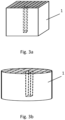
- Fig. 3a and b show two variants of a matrix-shaped support body 1, both of which have a plurality of directly adjacent channels 11, which are separated from one another by channel walls 12.
- the support bodies 1 differ in their external shape.
- the rectangular support body 1 can be used for filter elements 10, which are in a filter arrangement in series or in a matrix in rows and columns.
- the cylindrical support body 1 can be used for filter elements 10 which are to be placed in pipes or hoses.
Landscapes
- Chemical & Material Sciences (AREA)
- Chemical Kinetics & Catalysis (AREA)
- Analytical Chemistry (AREA)
- Organic Chemistry (AREA)
- Engineering & Computer Science (AREA)
- Inorganic Chemistry (AREA)
- Life Sciences & Earth Sciences (AREA)
- Geology (AREA)
- General Chemical & Material Sciences (AREA)
- Oil, Petroleum & Natural Gas (AREA)
- Materials Engineering (AREA)
- Filtering Materials (AREA)
Abstract
Die Erfindung betrifft ein Filterelement (10) zur Luftfiltration mit einer matrixförmigen Stützstruktur (1), welche eine Vielzahl von durch Kanalwände (12) voneinander getrennte Kanäle (11) aufweist und die mit einem feste Sorbentien enthaltenen Schüttgut (2) gefüllt ist. Das Schüttgut (2) kann ein Granulat aus Adsorbentien und/oder Absorbentien sein. Erfindungsgemäß ist die matrixförmige Stützstruktur (1) aus einem adsorbierenden Material gefertigt. Ein solches Filterelement weist in vorteilhafter Weise eine gute adsorbierende bzw. absorbierende Wirkung auf.
Description
- Die Erfindung betrifft ein Filterelement zur Luftfiltration mit einer matrixförmigen Stützstruktur, welche eine Vielzahl von durch Kanalwände voneinander getrennte Kanäle aufweist und die mit einem feste Sorbentien enthaltenen Schüttgut gefüllt ist.
- Im Stand der Technik sind Filterelemente bekannt, welche Partikel filtern und Gase adsorbieren. Filterelemente dieser Art können verwendet werden, um Fahrgasträume als auch Räume von Gebäuden von für Menschen gesundheitsschädlichen Stoffen, insbesondere von Gasen und Dämpfen, in hohem Maße zuverlässig freizuhalten
- Vor diesem Hintergrund wird in der
DE 10 2013 011 457 A1 vorgeschlagen, Aktivkohle in schütt- oder rieselfähiger Form zu verwenden. Es wird insbesondere vorgeschlagen, Aktivkohle in Form von Granulaten zu verwenden, welche auf Vliesstoffe aufgebracht werden können. - Vor diesem Hintergrund ist aus der
DE 101 04 882 B4 auch ein Aktivkohleformkörper bekannt, welcher eine Wabenstruktur aufweist. Der Aktivkohleformkörper ist durch Extrusion einer Mischung aus Aktivkohle und weiterer Stoffe gefertigt und dient zur Verwendung als Adsorptionsfilter. - Ein weiteres Filterelement, welches einen Aktivkohleformkörper mit einer Wabenstruktur aufweist, ist aus der
DE 101 50 062 B4 bekannt. - Die
DE 10 2004 063 434 B4 offenbart einen weiteren Aktivkohleformkörper mit Kanälen. - Nachteilig bei den aus dem Stand der Technik bekannten Lösungen ist, dass im Fall von auf Vliesstoffe aufgebrachtem Schüttgut, das Schüttgut zumindest teilweise mit Klebstoff benetzt werden muss, um es an dem Vliesstoff zu fixieren. Dabei wird die aktive also wirksame Fläche des Schüttguts und damit das Reinigungspotential reduziert.
- Problematisch bei der Verwendung von wabenförmigen Stützkörpern aus Kunststoff oder Aluminium, welche mit Schüttgut befüllt sind, ist, dass sich das Schüttgut in den einzelnen Waben bewegen und verrutschen kann, wenn das Filterelement bewegt wird oder Erschütterungen bzw. Vibrationen ausgesetzt ist. Mit dem Verrutschen des Schüttguts kann einhergehen, dass das Schüttgut ungleichmäßig in einer Wabe verteilt vorliegt und im Bereich einzelner Wände der Stützstruktur Freiräume entstehen können, in welchen kein Schüttgut vorliegt. Strömt zu reinigende Luft nun durch diesen Freiraum an der Wand entlang, so erfährt die Luft keine Reinigung.
- Aufgabe der vorliegenden Erfindung ist es ein Filterelement zu schaffen, welches eine verbesserte adsorbierende bzw. absorbierende Wirkung aufweist. Auch wenn das Filterelement Vibrationen ausgesetzt ist, soll eine gute Filterwirkung sichergestellt werden.
- Gelöst wird diese Aufgabe durch ein Filterelement wie es nachfolgend beschrieben und beansprucht ist.
- Erfindungsgemäß wurde als vorteilhaft erkannt, die matrixförmige Stützstruktur aus einem adsorbierenden Material zu fertigen.
- Das erfindungsgemäße Filterelement dient zur Luftfiltration und verfügt über eine matrixförmige Stützstruktur, welche eine Vielzahl von durch Kanalwände voneinander getrennte Kanäle aufweist. Die Kanäle können auch als Hohlräume oder Kammern bezeichnet werden. Die Stützstruktur ist, genauer, deren Kanäle sind mit einem feste Sorbentien enthaltenen Schüttgut gefüllt. In vorteilhafter Weise ist die matrixförmige Stützstruktur aus einem adsorbierenden Material gefertigt.
- In einer besonders vorteilhaften Weiterbildung des Filterelements weist das adsorbierende Material der Stützstruktur Aktivkohle auf oder ist aus Aktivkohle. Die Fertigung von Stützstrukturen aus Aktivkohlematerial ist problemlos möglich. Denkbar ist beispielsweise die Ausbildung aus einer Aktivkohlekeramik.
- In Weiterbildung des Filterelements kann die Stützstruktur als Aktivkohle-Wabenkörper ausgebildet sein. Ein Wabenkörper umfasst eine Vielzahl von matrixartig angeordneten Kanälen, welche ähnlich den Waben einer Bienenwabe, direkt aneinander angrenzend angeordnet sind, und eine gitterförmige Struktur bilden. Ein solches Filterelement kann auch als Wabenfilter bezeichnet werden.
- Das Schüttgut des Filterelements kann ein Granulat aus Adsorbentien und/oder Absorbentien sein. Adsorbentien werden auch als Adsorbens bezeichnet und bewirken eine Anlagerung von Stoffen aus dem zu reinigenden Luftstrom. Absorbentien werden auch als Absorbens bezeichnet und bewirken eine Aufnahme von Stoffen aus dem zu reinigenden Luftstrom.
- Auch kugelförmige, pulverförmige und körnige Medien werden hier als granulare Medien und damit als Granulat angesehen.
- Es ist darauf zu achten, dass die Form des Granulats entsprechende Zwischenräume in den Kanälen ermöglicht, sodass die zu reinigende Luft durch die Kanäle strömen kann. Die Zwischenräume ermöglichen eine maximale Kontaktfläche zwischen Adsorbentien/Absorbentien-Oberfläche und der zu reinigenden Luft, was der Abscheideleistung zugutekommt.
- Als Ab- bzw. Adsorbentien kann beispielsweise imprägnierte Aktivkohle, Ionentauscher und / oder Kaliumpermanganat in unterschiedlichen Formen eingesetzt werden. Entsprechende lonentauscherkügelchen können beispielsweise für eine Ammoniak (NH3)-Adsorption im Aktivkohle-Wabenkörper sorgen. Kaliumpermanganat-Pellets können beispielsweise für die Stickstoffmonoxid-Abscheidung eingesetzt werden.
- In möglicher Ausgestaltung des Filterelements kann das Schüttgut in mehreren Schichten in der matrixförmigen Stützstruktur vorliegen. Das meint, dass unterschiedliche Adsorbentien und /oder Absorbentien in die Kanäle der Stützstruktur geschichtet sind. Die unterschiedlichen Schichten können so nacheinander von einem zu reinigenden Luftstrom durchströmt und der Luftstrom so gezielt gereinigt werden. So kann beispielsweise durch eine passende Wahl der Schichtung unterschiedlicher Schüttgüter eine vorgelagerte Oxidation von NO zu NO2/NOx mit einer anschließenden Adsorption erreicht werden.
- Die maximale Korngröße des Schüttguts sollte kleiner als die minimale Weite eines Kanals der Stützstruktur sein, damit das Schüttgut gut in den Kanälen aufgenommen werden kann.
- In Weiterbildung des Filterelements ist die Stützstruktur an ihrer Oberseite und ihrer Unterseite, also an den Öffnungen der Kanäle, jeweils mit einer Abdeckung versehen. Die beiden Abdeckungen können z.B. flächig bzw. plattenförmig ausgestaltet und an die Stützstruktur angeklebt sein. So wird sichergestellt, dass das Schüttgut auch bei Handhabung des Filterelements oder wenn das Filterelement Vibrationen ausgesetzt ist, sicher in den Kanälen der Stützstruktur verbleibt.
- In möglicher Ausgestaltung kann die Abdeckung durch einen Vliesstoff, ein Papier, eine Membran oder ein feinmaschiges Gitter ausgeführt sein. Im Falle der Ausgestaltung als feinmaschiges Gitter sollte die maximale Maschenweite des Gitters dabei kleiner sein als die minimale Korngröße des Schüttguts.
- Die beschriebene Erfindung und die beschriebenen vorteilhaften Weiterbildungen der Erfindung stellen auch in Kombination miteinander - soweit dies technisch sinnvoll ist - vorteilhafte Weiterbildungen der Erfindung dar.
- Hinsichtlich weiterer Vorteile und in konstruktiver und funktioneller Hinsicht vorteilhafter Ausgestaltungen der Erfindung wird auf die Unteransprüche sowie die Beschreibung von Ausführungsbeispielen unter Bezugnahme auf die beiliegenden Figuren verwiesen.
- Die Erfindung soll anhand beigefügter Figuren noch näher erläutert werden. Einander entsprechende Elemente und Bauteile sind in den Figuren mit gleichen Bezugszeichen versehen. Zugunsten einer besseren Übersichtlichkeit der Figuren wurde auf eine maßstabsgetreue Darstellung verzichtet.
- Es zeigen in schematischer Darstellung
- Fig. 1
- eine Schnittansicht durch ein Filterelement, welches als Wabenfilter ausgeführt ist
- Fig. 2
- den Vorgang der Herstellung des Wabenfilters
- Fig. 3a und b
- zwei Varianten eines Stützkörpers
-
Fig. 1 zeigt einen Schnitt durch ein Filterelement 10, welches als Wabenfilter ausgeführt ist. Das Filterelement 10 weist einen matrixförmigen Stützkörper 1 auf, dessen Kanäle 11 mit einem granularen Schüttgut 2 befüllt sind. Das Schüttgut 2 ist ein Granulat aus Adsorbentien und/oder Absorbentien. -
Fig. 2 zeigt den Vorgang der Herstellung eines Filterelement 10. Eine matrixförmige Stützstruktur 1 wird mit einem granularen Schüttgut 2 befüllt, wie dies durch einen Pfeil angedeutet ist. Die matrixförmige Stützstruktur 1 wird durch einen Wabenkörper ausgebildet, welcher eine Vielzahl von Kanälen 11 aufweist, die durch Kanalwände 12 voneinander getrennt sind. Nach erfolgter Befüllung wird auf die Oberseite und die Unterseite der Stützstruktur 1 jeweils eine Abdeckung 3 aufgebracht, z.B. aufgeklebt. Alternativ könnte auch zuerst eine Abdeckung 3 an der Stützstruktur 1 angebracht werden, dann die Befüllung mit Schüttgut 2 erfolgen und sodann die zweite Abdeckung 3 angebracht werden. -
Fig. 3a und b zeigen zwei Varianten eines matrixförmigen Stützkörpers 1, welche beide eine Vielzahl von direkt aneinander angrenzenden Kanälen 11 aufweisen, die durch Kanalwände 12 voneinander getrennt sind. Die Stützkörper 1 unterscheiden sich in ihrer äußeren Form. So kann der rechteckige Stützkörper 1 für Filterelemente 10 verwendet werden, welche in einer Filteranordnung in Reihe oder matrixartig in Reihen und Spalten angeordnet werden. Der zylinderförmige Stützkörper 1 kann für Filterelemente 10 verwendet werden, welche in Rohren oder Schläuchen platziert werden sollen. -
- 1
- matrixförmige Stützstruktur
- 2
- Schüttgut (Granulat)
- 3
- Abdeckung
- 10
- Filterelement
- 11
- Kanal
- 12
- Kanalwand
Claims (9)
- Filterelement (10) zur Luftfiltration mit einer matrixförmigen Stützstruktur (1), welche eine Vielzahl von durch Kanalwände (12) voneinander getrennte Kanäle (11) aufweist und die mit einem feste Sorbentien enthaltenen Schüttgut (2) gefüllt ist, dadurch gekennzeichnet, dass die matrixförmige Stützstruktur (1) aus einem adsorbierenden Material gefertigt ist.
- Filterelement nach Anspruch 1, dadurch gekennzeichnet, dass das adsorbierende Material Aktivkohle aufweist.
- Filterelement nach Anspruch 2, dadurch gekennzeichnet, dass die Stützstruktur (1) als Aktivkohle-Wabenkörper ausgebildet ist.
- Filterelement nach einem der vorangehenden Ansprüche, dadurch gekennzeichnet, dass
das Schüttgut (2) ein Granulat aus Adsorbentien und/oder Absorbentien ist. - Filterelement nach einem der vorangehenden Ansprüche, dadurch gekennzeichnet, dass
das Schüttgut (2) in mehreren Schichten vorliegt. - Filterelement nach einem der vorangehenden Ansprüche, dadurch gekennzeichnet, dass
die Korngröße des Schüttguts (2) kleiner als die Weite eines Kanals (11) der Stützstruktur (1) ist. - Filterelement nach einem der Ansprüche 4 bis 6, dadurch gekennzeichnet, dass
das Schüttgut (2) imprägnierte Aktivkohle, Ionentauscher und/oder Kaliumpermanganat aufweist. - Filterelement nach einem der vorangehenden Ansprüche, dadurch gekennzeichnet, dass
die Stützstruktur (1) an ihrer Oberseite und ihrer Unterseite jeweils mit einer Abdeckung (3) versehen ist. - Filterelement nach Anspruch 8, dadurch gekennzeichnet, dass
die Abdeckung (3) durch einen Vliesstoff, ein Papier, eine Membran oder ein feinmaschiges Gitter ausgeführt ist.
Priority Applications (1)
| Application Number | Priority Date | Filing Date | Title |
|---|---|---|---|
| EP22214456.0A EP4389254A1 (de) | 2022-12-19 | 2022-12-19 | Filterelement mit matrixförmiger stützstruktur |
Applications Claiming Priority (1)
| Application Number | Priority Date | Filing Date | Title |
|---|---|---|---|
| EP22214456.0A EP4389254A1 (de) | 2022-12-19 | 2022-12-19 | Filterelement mit matrixförmiger stützstruktur |
Publications (1)
| Publication Number | Publication Date |
|---|---|
| EP4389254A1 true EP4389254A1 (de) | 2024-06-26 |
Family
ID=84537907
Family Applications (1)
| Application Number | Title | Priority Date | Filing Date |
|---|---|---|---|
| EP22214456.0A Withdrawn EP4389254A1 (de) | 2022-12-19 | 2022-12-19 | Filterelement mit matrixförmiger stützstruktur |
Country Status (1)
| Country | Link |
|---|---|
| EP (1) | EP4389254A1 (de) |
Citations (9)
| Publication number | Priority date | Publication date | Assignee | Title |
|---|---|---|---|---|
| JP2001145816A (ja) * | 1999-11-19 | 2001-05-29 | Ebara Corp | 気体浄化用フィルタ |
| DE10104882B4 (de) | 2001-02-01 | 2005-01-05 | Helsa-Werke Helmut Sandler Gmbh & Co. Kg | Aktivkohleformkörper, Verfahren zu dessen Herstellung, dessen Verwendung sowie Verfahren zur Regeneration desselben |
| DE10150062B4 (de) | 2001-07-26 | 2005-06-30 | Helsa-Werke Helmut Sandler Gmbh & Co. Kg | Filtervorrichtung |
| DE102004063434B4 (de) | 2004-12-23 | 2009-03-19 | Mann+Hummel Innenraumfilter Gmbh & Co. Kg | Aktivkohleformkörper, Verfahren zu dessen Herstellung und dessen Verwendung |
| US20090178566A1 (en) * | 2006-05-10 | 2009-07-16 | Meadwestvaco Corporation | Honeycomb adsorbents for vapor recovery systems |
| KR20130105553A (ko) * | 2012-03-16 | 2013-09-25 | 코웨이 주식회사 | 알칼리 금속 화합물이 첨착된 이산화질소 흡착 제거용 필터 및 이를 포함하는 공기 정화장치 |
| DE102013011457A1 (de) | 2012-07-11 | 2014-01-16 | Mann + Hummel Gmbh | Luftfilter für die Innenraumluft von Kabinen von Fahrzeugen, Land-, Bau- und Arbeitsmaschinen |
| US20190275454A1 (en) * | 2016-11-14 | 2019-09-12 | 3M Innovative Properties Company | Air Filters Comprising Metal-Containing Polymeric Sorbents |
| CN113019306A (zh) * | 2019-12-25 | 2021-06-25 | 广东美的白色家电技术创新中心有限公司 | 一种吸附材料及其制备方法与应用 |
-
2022
- 2022-12-19 EP EP22214456.0A patent/EP4389254A1/de not_active Withdrawn
Patent Citations (9)
| Publication number | Priority date | Publication date | Assignee | Title |
|---|---|---|---|---|
| JP2001145816A (ja) * | 1999-11-19 | 2001-05-29 | Ebara Corp | 気体浄化用フィルタ |
| DE10104882B4 (de) | 2001-02-01 | 2005-01-05 | Helsa-Werke Helmut Sandler Gmbh & Co. Kg | Aktivkohleformkörper, Verfahren zu dessen Herstellung, dessen Verwendung sowie Verfahren zur Regeneration desselben |
| DE10150062B4 (de) | 2001-07-26 | 2005-06-30 | Helsa-Werke Helmut Sandler Gmbh & Co. Kg | Filtervorrichtung |
| DE102004063434B4 (de) | 2004-12-23 | 2009-03-19 | Mann+Hummel Innenraumfilter Gmbh & Co. Kg | Aktivkohleformkörper, Verfahren zu dessen Herstellung und dessen Verwendung |
| US20090178566A1 (en) * | 2006-05-10 | 2009-07-16 | Meadwestvaco Corporation | Honeycomb adsorbents for vapor recovery systems |
| KR20130105553A (ko) * | 2012-03-16 | 2013-09-25 | 코웨이 주식회사 | 알칼리 금속 화합물이 첨착된 이산화질소 흡착 제거용 필터 및 이를 포함하는 공기 정화장치 |
| DE102013011457A1 (de) | 2012-07-11 | 2014-01-16 | Mann + Hummel Gmbh | Luftfilter für die Innenraumluft von Kabinen von Fahrzeugen, Land-, Bau- und Arbeitsmaschinen |
| US20190275454A1 (en) * | 2016-11-14 | 2019-09-12 | 3M Innovative Properties Company | Air Filters Comprising Metal-Containing Polymeric Sorbents |
| CN113019306A (zh) * | 2019-12-25 | 2021-06-25 | 广东美的白色家电技术创新中心有限公司 | 一种吸附材料及其制备方法与应用 |
Similar Documents
| Publication | Publication Date | Title |
|---|---|---|
| DE4303936C1 (de) | Vorrichtung zur Entfernung von gasförmigen Stoffen aus einem Gasstrom | |
| DE69809581T2 (de) | Gasfilter | |
| DE69706306T2 (de) | Kontinuierliches system zum einfangen und entfernen von gasmolekülen | |
| DE3813563A1 (de) | Adsorptionsfilter mit hoher luftdurchlaessigkeit | |
| DE1757764B1 (de) | Plattenfoermiges Einweg-Aktivkohlefilter | |
| WO2011054504A1 (de) | Gewelltes packungsgitter sowie geordnete, aus mehreren packungsgittern aufgebaute packung | |
| DE102018114351A1 (de) | Filtermedium | |
| EP2869907B1 (de) | Verfahren zur reinigung von rauchgas und filteranlage hierzu | |
| DE102013011511A1 (de) | Filtereinrichtung, insbesondere für die einer Brennstoffzelle zuzuführenden Luft | |
| DE3611582A1 (de) | Traegermaterial zur imobilisierung von mikroorganismen | |
| EP0018511B1 (de) | Austausch-Schüttkörper mit reaktivem Material | |
| CH676799A5 (de) | ||
| WO2017198427A1 (de) | Brennstoffzellen-filterelement und brennstoffzellen-filtersystem mit einem brennstoffzellen-filterelement | |
| DE202017107185U1 (de) | Adsorptionstrockner für gasförmige Medien | |
| EP0056584A1 (de) | Bifunktionaler Filter zur Behandlung von Abgasen | |
| EP0045516A1 (de) | Filtereinsatz für Gasadsorptionsfilter, insbesondere für die Luftreinigung | |
| EP3695895B1 (de) | Filterelement mit wabenkörper zur luftreinigung | |
| EP4389255A1 (de) | Luftfiltermedium, filtermediumkörper und filterelement | |
| DE19816871C2 (de) | Filtrationseinheit zur Entfernung von Schadstoffen aus Fluiden | |
| AT391629B (de) | Filterboden fuer eine biofilteranlage | |
| DE19538074C1 (de) | Atemfilter | |
| DE8021061U1 (de) | Gasadsorptionsfilter, insbesondere fuer die luftreinigung | |
| DE102019134186B4 (de) | Adsorberelement für ein Filtersystem und Filtersystem mit einem Adsorberelement | |
| DE10141524A1 (de) | Stoff- und Wärmeaustauscherfläche | |
| DE3131498C2 (de) |
Legal Events
| Date | Code | Title | Description |
|---|---|---|---|
| PUAI | Public reference made under article 153(3) epc to a published international application that has entered the european phase |
Free format text: ORIGINAL CODE: 0009012 |
|
| STAA | Information on the status of an ep patent application or granted ep patent |
Free format text: STATUS: THE APPLICATION HAS BEEN PUBLISHED |
|
| AK | Designated contracting states |
Kind code of ref document: A1 Designated state(s): AL AT BE BG CH CY CZ DE DK EE ES FI FR GB GR HR HU IE IS IT LI LT LU LV MC ME MK MT NL NO PL PT RO RS SE SI SK SM TR |
|
| STAA | Information on the status of an ep patent application or granted ep patent |
Free format text: STATUS: THE APPLICATION IS DEEMED TO BE WITHDRAWN |
|
| 18D | Application deemed to be withdrawn |
Effective date: 20250103 |