EP4388908A1 - Kompressionskleidung aus flachgestrick - Google Patents
Kompressionskleidung aus flachgestrick Download PDFInfo
- Publication number
- EP4388908A1 EP4388908A1 EP23219596.6A EP23219596A EP4388908A1 EP 4388908 A1 EP4388908 A1 EP 4388908A1 EP 23219596 A EP23219596 A EP 23219596A EP 4388908 A1 EP4388908 A1 EP 4388908A1
- Authority
- EP
- European Patent Office
- Prior art keywords
- compression
- elastic element
- elasticity
- longitudinal tensile
- base body
- Prior art date
- Legal status (The legal status is an assumption and is not a legal conclusion. Google has not performed a legal analysis and makes no representation as to the accuracy of the status listed.)
- Withdrawn
Links
Images

Classifications
-
- A—HUMAN NECESSITIES
- A41—WEARING APPAREL
- A41B—SHIRTS; UNDERWEAR; BABY LINEN; HANDKERCHIEFS
- A41B11/00—Hosiery; Panti-hose
- A41B11/02—Reinforcements
-
- A—HUMAN NECESSITIES
- A41—WEARING APPAREL
- A41B—SHIRTS; UNDERWEAR; BABY LINEN; HANDKERCHIEFS
- A41B11/00—Hosiery; Panti-hose
- A41B11/003—Hosiery with intermediate sections of different elasticity
-
- A—HUMAN NECESSITIES
- A41—WEARING APPAREL
- A41B—SHIRTS; UNDERWEAR; BABY LINEN; HANDKERCHIEFS
- A41B11/00—Hosiery; Panti-hose
- A41B11/14—Panti-hose; Body-stockings
-
- A—HUMAN NECESSITIES
- A61—MEDICAL OR VETERINARY SCIENCE; HYGIENE
- A61F—FILTERS IMPLANTABLE INTO BLOOD VESSELS; PROSTHESES; DEVICES PROVIDING PATENCY TO, OR PREVENTING COLLAPSING OF, TUBULAR STRUCTURES OF THE BODY, e.g. STENTS; ORTHOPAEDIC, NURSING OR CONTRACEPTIVE DEVICES; FOMENTATION; TREATMENT OR PROTECTION OF EYES OR EARS; BANDAGES, DRESSINGS OR ABSORBENT PADS; FIRST-AID KITS
- A61F13/00—Bandages or dressings; Absorbent pads
- A61F13/06—Bandages or dressings; Absorbent pads specially adapted for feet or legs; Corn-pads; Corn-rings
- A61F13/08—Elastic stockings; for contracting aneurisms
-
- A—HUMAN NECESSITIES
- A41—WEARING APPAREL
- A41B—SHIRTS; UNDERWEAR; BABY LINEN; HANDKERCHIEFS
- A41B2300/00—Details of shirts, underwear, baby linen or handkerchiefs not provided for in other groups of this subclass
- A41B2300/20—Inserts
- A41B2300/22—Elastic inserts
-
- A—HUMAN NECESSITIES
- A41—WEARING APPAREL
- A41B—SHIRTS; UNDERWEAR; BABY LINEN; HANDKERCHIEFS
- A41B2400/00—Functions or special features of shirts, underwear, baby linen or handkerchiefs not provided for in other groups of this subclass
- A41B2400/38—Shaping the contour of the body or adjusting the figure
-
- A—HUMAN NECESSITIES
- A41—WEARING APPAREL
- A41B—SHIRTS; UNDERWEAR; BABY LINEN; HANDKERCHIEFS
- A41B2500/00—Materials for shirts, underwear, baby linen or handkerchiefs not provided for in other groups of this subclass
- A41B2500/10—Knitted
-
- A—HUMAN NECESSITIES
- A41—WEARING APPAREL
- A41B—SHIRTS; UNDERWEAR; BABY LINEN; HANDKERCHIEFS
- A41B9/00—Undergarments
- A41B9/06—Undershirts; Chemises
-
- A—HUMAN NECESSITIES
- A41—WEARING APPAREL
- A41D—OUTERWEAR; PROTECTIVE GARMENTS; ACCESSORIES
- A41D15/00—Convertible garments
- A41D15/007—Convertible garments with bolero structure
Definitions
- the invention relates to compression garments made of flat knit fabric.
- Compression garments made of flat knits for example in the form of compression stockings or arm bands, are well known.
- a flat knit generally consists of knitting threads and weft threads. The weft thread penetrates the stitches of the knit and is responsible for the compression.
- the object of the invention is therefore to offer compression clothing with improved wearing comfort.
- the compression clothing according to the invention made of flat knit fabric has a base body with a longitudinal tensile compression and a transverse tensile compression and at least one elastic element incorporated into the base body.
- This elastic element has a lower longitudinal tensile compression than the base body surrounding the elastic element and a transverse tensile compression that corresponds to the transverse tensile compression of the base body surrounding the elastic element.
- the compression garment has one or more regions that have a higher elasticity or flexibility due to their lower longitudinal compression compared to the main body, which in turn allows easier body movement of the person wearing the compression garment and increases wearing comfort.
- Longitudinal compression refers to the compression of the clothing in the direction of the heart of the wearer of the compression clothing.
- Transverse compression refers to the compression of the clothing in the orthogonal direction to the longitudinal compression.
- the longitudinal compression between the elastic element and the surrounding base body changes.
- the transverse compression remains the same, because the transverse compression corresponds to the compression class of the compression clothing and is the actual compression that is important for the success of the medical treatment.
- This transverse compression should decrease slightly in the direction of the heart in order to achieve a flow in the direction of the heart. In order to ensure this drainage path, the transverse compression does not change in the areas of the elastic element, but but the longitudinal compression. This achieves increased flexibility and increased comfort.
- the elastic element is formed in an area of the compression clothing which, when worn, contacts a bending or stretching region of the wearer's body.
- bending or stretching regions include in particular the instep, ankle, hip, groin, upper arm, elbow and/or armpit area.
- the elastic element can be designed in such a way that it completely encloses the body region in the circumferential direction.
- the elastic element can completely surround the ankle area. In this way, the compression in this area can be reliably maintained.
- the elasticity element it is also possible to limit the elasticity element to certain, precisely defined areas of the body, for example in a circle or a rectangle. For example, in the instep area, it is possible to create an oval elasticity element or one that is otherwise limited to the instep region.
- the compression clothing is advantageously designed as a stocking or tights, possibly without feet, or as upper body clothing, in particular as a bolero.
- the compression clothing can be designed as a short stocking up to the knee A-D, as a long stocking up to the groin A-G, as tights A-T or as tights without feet B-T.
- a single elasticity element consists of a plurality of partial elasticity elements arranged in spatial proximity to one another.
- These partial elasticity elements can differ in their dimensions and/or their longitudinal tensile compression In this way, wearing comfort can be further increased, as an even more precise adjustment of the elasticity or flexibility in locally defined body regions is possible.
- the longitudinal tensile compression within a single elastic element can vary.
- the longitudinal tensile compression within the elastic element can vary in such a way that the longitudinal tensile compression in an edge area of the elastic element is either higher or lower than in a central area of the elastic element. In this way, wearing comfort can also be further increased, since an even more precise adjustment of the elasticity or flexibility in locally narrowly defined body regions is possible.
- the compression clothing has an elastic element.
- the wearing comfort is further increased if the compression clothing has more than one elastic element.
- two elastic elements are present. These elastic elements are preferably formed in areas of the compression clothing which, when worn, each contact a different bending or stretching region of the wearer's body.
- the first elastic element has a first longitudinal tension compression and the second elastic element has a second longitudinal tension compression which differs from the first longitudinal tension compression, with both the first longitudinal tension compression and the second longitudinal tension compression being greater than the longitudinal tension compression of the base body.
- the second Elasticity element can be designed as a plurality of partial elasticity elements and/or have a longitudinal tensile compression that varies within the elasticity element.
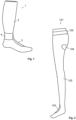
- Fig.1 shows a stocking 1.
- This stocking 1 has a stocking base body 2, a first elastic element 3 in the instep area and a second elastic element 4 in the ankle area of the stocking 1.
- the stocking 1 is designed as a compression stocking made of flat knit and thus represents compression clothing in the sense of the present invention.
- the stocking base body 2, the first elastic element 3 and the second elastic element 4 consist of a flat knit.
- the stocking base body 2 has a longitudinal tension compression in its longitudinal direction (i.e. from the forefoot area towards the leg cutout) and, orthogonal to the longitudinal tension compression, a transverse tension compression in its circumferential direction (i.e. in the circumferential direction of the lower leg or in the circumferential direction of the foot).
- the first elastic element 3 is formed in the instep area of the stocking 1, more precisely from the middle of the forefoot to the front at ankle height.
- the first elastic element 3 has a first longitudinal tension compression.
- the second elastic element 3 is formed in the circumferential direction of the lower leg around the ankle.
- the second elastic element 4 has a second longitudinal tension compression.
- the first and second longitudinal tension compressions differ from one another. However, each of the first and second longitudinal tension compressions is higher than the longitudinal tension compression of the stocking base body 2.
- the transverse tension compression of the first elastic element 3 and the second elastic element 4 corresponds to the transverse tension compression of the base body 2.
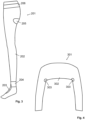
- Fig.2 shows a pair of tights 101 with a tights base body 102, a first elasticity element 103 in the instep area, a second elasticity element 104 in the area of the gluteus maximus (more precisely in the area of the gluteal fold) and a third elasticity element 105 in the waist area of the tights 101.
- the pantyhose base body 102 consists of a flat knit and the pantyhose 101 represents a compression garment in the sense of the present invention.
- the pantyhose base body 102 In the longitudinal direction of the pantyhose 101 (ie the direction from the toe area to the waist area) the pantyhose base body 102 has a longitudinal tensile compression.
- the pantyhose base body 102 has a transverse tension compression in the circumferential direction of each leg or in the circumferential direction of the hip area.
- the elastic elements 103, 104 and 105 of the tights 101 also consist of flat knit and each have a longitudinal tensile compression that is higher than the longitudinal tensile compression of the area of the tights base body 102 surrounding the respective elastic element 103, 104 and 105.
- Fig.3 shows a pair of tights 201 (with foot) made of flat knit with a tights base body 202, a first elastic element 203 in the instep area, a second elastic element 204 in the ankle area, a third elastic element 205 in the gluteal fold area and a fourth elastic element 206 in the waist area of the tights 201.
- the tights 201 represent another compression garment in the sense of the present invention.
- the tights base body 202 In the longitudinal direction of the tights 201 (ie the direction from the toe area to the waist area), the tights base body 202 has a longitudinal compression.
- the tights base body 202 In the circumferential direction of each leg or in the circumferential direction of the hip area, the tights base body 202 has a transverse compression.
- the elasticity elements 203 to 206 of the tights 201 also consist of flat knit and each have a longitudinal tensile compression that is higher than the longitudinal tensile compression of the area of the tights base body 202 surrounding the respective elasticity element 203 to 206.
- Fig.4 shows a rear view of an upper body garment 301 made of flat knit in the form of a bolero with a bolero base body 302 and two elastic elements 303, which are incorporated congruently in the two armpit areas (more precisely in the armpits) of the upper body garment 301 into the bolero base body 302.
- the upper body garment 301 represents another compression garment in the sense of the present invention.
- the elastic elements 303 each have a longitudinal tensile compression that is higher than the longitudinal tensile compression of the bolero base body 302.
- Fig.5 shows another stocking 401.
- This stocking 401 has a stocking base body 402, a first elastic element 403 in the instep area and a second elastic element 404 in the ankle area of the stocking 401.
- the stocking 401 is designed as a compression stocking made of flat knit and thus also represents compression clothing in the sense of the present invention.
- the stocking base body 402, the first elastic element 403 and the second elastic element 404 consist of a flat knit.
- the elastic element 404 does not surround the ankle area in a ring shape, but is circular in the area of the outer ankle.
- the elastic elements 403 and 404 each have a longitudinal tensile compression that is higher than the longitudinal tensile compression of the stocking base body 402.
Landscapes
- Engineering & Computer Science (AREA)
- Textile Engineering (AREA)
- Health & Medical Sciences (AREA)
- Biomedical Technology (AREA)
- Heart & Thoracic Surgery (AREA)
- Vascular Medicine (AREA)
- Life Sciences & Earth Sciences (AREA)
- Animal Behavior & Ethology (AREA)
- General Health & Medical Sciences (AREA)
- Public Health (AREA)
- Veterinary Medicine (AREA)
- Socks And Pantyhose (AREA)
Abstract
Die Erfindung betrifft eine Kompressionsbekleidung aus Flachgestrick, aufweisend: einem Grundkörper (2) mit einer Längszugkompression und einer Querzugkompression; und mindestens ein, in den Grundkörper eingearbeitetes Elastizitätselement (3, 4) mit einer geringeren Längszugkompression als der das Elastizitätselement (3, 4) umgebende Grundkörper (2) und mit einer Querzugkompression, die der Querzugkompression des das Elastizitätselement (3, 4) umgebenden Grundkörpers (2) entspricht.
Description
- Die Erfindung betrifft Kompressionsbekleidung aus Flachgestrick.
- Kompressionsbekleidungsstücke aus Flachgestrick, beispielweise in Form von Kompressionsstrümpfen oder Armbandagen, sind allgemein bekannt. Ein Flachgestrick besteht im Allgemeinen aus Strickfäden und aus Schussfäden. Der Schussfaden durchdringt die Maschen des Gestricks und ist für die Kompression verantwortlich.
- Zur Erfüllung ihres Zweckes - nämlich die Kompression bestimmter Körperregionen - wird Kompressionsbekleidung im Allgemeinen aus einem relativ steifen Flachgestrick hergestellt, wobei aus medizinischer Sicht sichergestellt werden muss, dass sowohl ein ausreichender Ruhedruck als auch ein ausreichender Arbeitsdruck durch die Kompressionsbekleidung aufgebracht wird. Dies führt jedoch zu einem verminderten Tragekomfort, da es - insbesondere in Beuge- oder Streckregionen des Körpers (z.B. Knöchel, Rist,... ) - zu einer eingeschränkten Beweglichkeit und/oder zu Hautirritationen kommen kann.
- Aufgabe der Erfindung ist es daher, eine Kompressionsbekleidung mit verbessertem Tragekomfort anzubieten.
- Diese Aufgabe wird gelöst durch eine Kompressionsbekleidung mit den Merkmalen des Anspruchs 1. Vorteilhafte Ausführungsformen sind in den Unteransprüchen beschrieben.
- Die erfindungsgemäße Kompressionsbekleidung aus Flachgestrick weist einen Grundkörper mit einer Längszugkompression und einer Querzugkompression sowie mindestens ein, in den Grundkörper eingearbeitetes Elastizitätselement auf. Dieses Elastizitätselement besitzt eine geringere Längszugkompression als der das Elastizitätselement umgebende Grundkörper und eine Querzugkompression, die der Querzugkompression des das Elastizitätselement umgebenden Grundkörpers entspricht.
- Auf diese Weise besitzt die Kompressionsbekleidung einen oder mehrere Regionen, die durch ihre geringere Längszugkompression im Vergleich zum Grundkörper eine höhere Elastizität bzw. Flexibilität aufweisen, was wiederum eine einfachere Körperbewegung des die Kompressionsbekleidung Tragenden zulässt und den Tragekomfort erhöht.
- Unter der Längszugkompression wird hierbei die Kompression der Bekleidung in Richtung des Herzens des die Kompressionsbekleidung Tragenden verstanden. Unter der Querzugkompression wird die Kompression der Bekleidung in orthogonaler Richtung zur Längszugkompression verstanden.
- In der erfindungsgemäßen Kompressionsbekleidung aus Flachgestrick ändert sich die Längszugkompression zwischen dem Elastizitätselement und dem umgebenden Grundkörper. Die Querzugkompression hingegen bleibt gleich, denn die Querzugkompression entspricht der Kompressionsklasse der Kompressionsbekleidung und ist die eigentliche Kompression, die für den medizinischen Behandlungserfolg wichtig ist. Diese Querkompression sollte in Richtung Herzen leicht abnehmend sein, um einen Fluss in die Richtung des Herzens zu erreichen. Um diesen Abflussweg zu sichern, ändert sich in den Bereichen des Elastizitätselements die Querzugkompression nicht, wohl aber die Längskompression. Hierdurch erreicht man die erhöhte Flexibilität und die Erhöhung des Tragekomforts.
- In vorteilhafter Weise ist das Elastizitätselement in einem Bereich der Kompressionsbekleidung ausgebildet, welches im Tragezustand eine Beuge- oder Streckregion des Körpers des Tragenden kontaktiert. Zu derartigen Beuge- oder Streckregionen gehören insbesondere der Rist-, Knöchel-, Hüft-, Leisten-, Oberarm-, Ellbogen- und/oder Achselbereich.
- Das Elastizitätselement kann hierbei derart ausgebildet sein, dass es die Körperregion in Umfangsrichtung vollständig umschließt. Zum Beispiel kann das Elastizitätselement den Knöchelbereich vollständig umgeben. Auf diese Weise kann die Kompression in diesem Bereich zuverlässig beibehalten bleiben.
- Es ist jedoch auch möglich, das Elastizitätselement beispielsweise kreis- oder rechteckförmig auf bestimmte, exakt definierte Körperregionen zu begrenzen. Zum Beispiel bietet sich im Ristbereich die Ausbildung eines ovalen oder anderweitig auf die Ristregion begrenzten Elastizitätselements an.
- Die Kompressionsbekleidung ist in vorteilhafter Weise als Strumpf oder Strumpfhose, ggf. ohne Fuß oder als Oberkörperbekleidung, insbesondere als Bolero, ausgebildet. Insbesondere kann die Kompressionsbekleidung als kurzer Strumpf bis zum Knie A-D, als langer Strumpf bis Leiste A-G, als Strumpfhose A-T oder als Strumpfhose ohne Fuß B-T ausgebildet sein.
- In einer bevorzugten Ausführungsform besteht ein einzelnes Elastizitätselement aus einer Mehrzahl von in räumlicher Nähe zueinander angeordneten Teilelastizitätselementen. Diese Teilelastizitätselemente können sich in ihren Abmessungen und/oder ihrer Längszugkompression unterscheiden. Auf diese Weise kann der Tragekomfort weiter gesteigert werden, da eine noch exaktere Einstellung der Elastizität bzw. Flexibilität in lokal eng definierten Körperregionen möglich ist.
- Unabhängig von der Ausbildung eines einzelnen Elastizitätselements als eine Mehrzahl von Teilelastizitätselementen kann die Längszugkompression innerhalb eines einzelnen Elastizitätselements variieren. Insbesondere kann die Längszugkompression innerhalb des Elastizitätselements derart variieren, dass die Längszugkompression in einem Randbereich des Elastizitätselements entweder höher oder niedriger ist als in einem zentralen Bereich des Elastizitätselements. Auf diese Weise kann der Tragekomfort ebenfalls weiter gesteigert werden, da auch hier eine noch exaktere Einstellung der Elastizität bzw. Flexibilität in lokal eng definierten Körperregionen möglich ist.
- Erfindungsgemäß weist die Kompressionsbekleidung ein Elastizitätselement auf. Der Tragekomfort wird jedoch weiter gesteigert, wenn die Kompressionsbekleidung mehr als ein einziges Elastizitätselement aufweist. So sind in einem bevorzugten Ausführungsbeispiel zwei Elastizitätselemente vorhanden. Diese Elastizitätselemente sind in bevorzugter Weise in Bereichen der Kompressionsbekleidung ausgebildet, welche im Tragezustand jeweils eine andere Beuge- oder Streckregion des Körpers des Tragenden kontaktieren. Besonders bevorzugt weist das erste Elastizitätselement eine erste Längszugkompression und das zweite Elastizitätselement eine zweite, sich von der ersten Längszugkompression unterscheidenden Längszugkompression auf, wobei sowohl die erste Längszugkompression als auch die zweite Längszugkompression größer sind als die Längszugkompression des Grundkörpers. In ähnlicher Weise sind auch Ausführungsbeispiele denkbar, in denen mehr als zwei Elastizitätselemente mit jeweils sich unterscheidenden Längszugkompressionswerten vorhanden sind. Auch das zweite Elastizitätselement kann als eine Mehrzahl von Teilelastizitätselementen ausgebildet sein und/oder eine Längszugkompression besitzen, die innerhalb des Elastizitätselements variiert.
- Die Erfindung ist anhand von Ausführungsbeispielen in den Zeichnungsfiguren weiter erläutert. Es zeigen:
- Fig. 1
- ein Ausführungsbeispiel der Kompressionsbekleidung, wobei die Kompressionsbekleidung als Strumpf ausgebildet ist;
- Fig. 2
- ein Ausführungsbeispiel der Kompressionsbekleidung, wobei die Kompressionsbekleidung als Strumpfhose mit Fuß ausgebildet ist;
- Fig. 3
- ein Ausführungsbeispiel der Kompressionsbekleidung, wobei die Kompressionsbekleidung als weitere Strumpfhose mit Fuß ausgebildet ist;
- Fig. 4
- ein Ausführungsbeispiel der Kompressionsbekleidung, wobei die Kompressionsbekleidung als boleroartige Oberkörperbekleidung ausgebildet ist; und
- Fig. 5
- ein weiteres Ausführungsbeispiel der Kompressionsbekleidung, wobei die Kompressionsbekleidung als Strumpf ausgebildet ist.
-
Fig. 1 zeigt einen Strumpf 1. Dieser Strumpf 1 weist einen Strumpfgrundkörper 2, ein erstes Elastizitätselement 3 im Ristbereich und ein zweites Elastizitätselement 4 im Knöchelbereich des Strumpfes 1 auf. Der Strumpf 1 ist als Kompressionsstrumpf aus Flachgestrick ausgebildet und stellt damit eine Kompressionsbekleidung im Sinn der vorliegenden Erfindung dar. Der Strumpfgrundkörper 2, das erste Elastizitätselement 3 und das zweite Elastizitätselement 4 bestehen aus einem Flachgestrick. - Der Strumpfgrundkörper 2 weist eine Längszugkompression in dessen Längsrichtung (d.h. vom Vorderfußbereich in Richtung Beinausschnitt) und, orthogonal zur Längszugkompression, eine Querzugkompression in dessen Umfangsrichtung (d.h. in Umfangsrichtung des Unterschenkels bzw. in Umfangsrichtung des Fußes) auf.
- Das erste Elastizitätselement 3 ist im Ristbereich des Strumpfes 1 ausgebildet, genauer von der Mitte des Vorderfußes bis frontal auf Höhe der Knöchel. Das erste Elastizitätselement 3 besitzt eine erste Längszugkompression. Das zweite Elastizitätselement 3 ist in Umfangsrichtung des Unterschenkels um den Knöchel herum ausgebildet. Das zweite Elastizitätselement 4 besitzt eine zweite Längszugkompression. Die erste und zweite Längszugkompression unterscheiden sich voneinander. Jede der ersten und zweiten Längszugkompression ist jedoch höher als die Längszugkompression des Strumpfgrundkörpers 2. Die Querzugkompression des ersten Elastizitätselements 3 und des zweiten Elastizitätselements 4 hingegen entspricht der Querzugkompression des Grundkörpers 2.
-
Fig. 2 zeigt eine Strumpfhose 101 mit einem Strumpfhosengrundkörper 102, einem ersten Elastizitätselement 103 im Ristbereich, ein zweites Elastizitätselement 104 im Bereich des Gluteus Maximus (genauer im Bereich der Glutealfalte) und ein drittes Elastizitätselement 105 im Taillenbereich der Strumpfhose 101. - Der Strumpfhosengrundkörper 102 besteht aus einem Flachgestrick und die Strumpfhose 101 stellt eine Kompressionsbekleidung im Sinn der vorliegenden Erfindung dar. In Längsrichtung der Strumpfhose 101 (d.h. die Richtung vom Zehenbereich bis zum Taillenbereich) besitzt der Strumpfhosengrundkörper 102 eine Längszugkompression. In Umfangsrichtung jeden Beines bzw. in Umfangsrichtung des Hüftbereichs besitzt der Strumpfhosengrundkörper 102 eine Querzugkompression.
- Die Elastizitätselemente 103, 104 und 105 der Strumpfhose 101 bestehen ebenfalls aus Flachgestrick und besitzen jeweils eine Längszugkompression, die höher ist als die Längszugkompression des den jeweiligen Elastizitätselement 103, 104 und 105 umgebenden Bereichs des Strumpfhosengrundkörpers 102.
-
Fig. 3 zeigt eine Strumpfhose 201 (mit Fuß) aus Flachgestrick mit einem Strumpfhosengrundkörper 202, einem ersten Elastizitätselement 203 im Ristbereich, einem zweiten Elastizitätselement 204 im Knöchelbereich, ein drittes Elastizitätselement 205 im Bereich der Glutealfalte und ein viertes Elastizitätselement 206 im Taillenbereich der Strumpfhose 201. Die Strumpfhose 201 stellt eine weitere Kompressionsbekleidung im Sinn der vorliegenden Erfindung dar. In Längsrichtung der Strumpfhose 201 (d.h. die Richtung vom Zehenbereich bis zum Taillenbereich) besitzt der Strumpfhosengrundkörper 202 eine Längszugkompression. In Umfangsrichtung jeden Beines bzw. in Umfangsrichtung des Hüftbereichs besitzt der Strumpfhosengrundkörper 202 eine Querzugkompression. Die Elastizitätselemente 203 bis 206 der Strumpfhose 201 bestehen ebenfalls aus Flachgestrick und besitzen jeweils eine Längszugkompression, die höher ist als die Längszugkompression des den jeweiligen Elastizitätselement 203 bis 206 umgebenden Bereichs des Strumpfhosengrundkörpers 202. -
Fig. 4 zeigt eine Rückansicht einer Oberkörperbekleidung 301 aus Flachgestrick in Form eines Boleros mit einem Bolerogrundkörper 302 und zwei Elastizitätselement 303, die deckungsgleich in den beiden Achselbereichen (genauer in den Achselhöhlen) der Oberkörperbekleidung 301 in den Bolerogrundkörper 302 eingearbeitet sind. Die Oberkörperbekleidung 301 stellt eine weitere Kompressionsbekleidung im Sinn der vorliegenden Erfindung dar. Die Elastizitätselemente 303 besitzen jeweils eine Längszugkompression, die höher ist als die Längszugkompression des Bolerogrundkörpers 302. -
Fig. 5 zeigt einen weiteren Strumpf 401. Dieser Strumpf 401 weist einen Strumpfgrundkörper 402, ein erstes Elastizitätselement 403 im Ristbereich und ein zweites Elastizitätselement 404 im Knöchelbereich des Strumpfes 401 auf. Der Strumpf 401 ist als Kompressionsstrumpf aus Flachgestrick ausgebildet und stellt damit ebenfalls eine Kompressionsbekleidung im Sinn der vorliegenden Erfindung dar. Der Strumpfgrundkörper 402, das erste Elastizitätselement 403 und das zweite Elastizitätselement 404 bestehen aus einem Flachgestrick. Anders als beispielsweise das Elastizitätselement 4 inFig. 1 oder das Elastizitätselement 204 inFig. 3 umgibt das Elastizitätselement 404 den Knöchelbereich nicht ringförmig, sondern ist kreisförmig im Bereich des äußeren Knöchels ausgebildet. Die Elastizitätselemente 403 und 404 besitzen jeweils eine Längszugkompression, die höher ist als die Längszugkompression des Strumpfgrundkörpers 402. -
- 1
- Strumpf
- 2
- Strumpfgrundkörper
- 3, 4
- Elastizitätselement
- 101
- Strumpfhose
- 102
- Strumpfhosengrundkörper
- 103, 104, 105
- Elastizitätselement
- 201
- Strumpfhose
- 202
- Strumpfhosengrundkörper
- 203, 204, 205, 206
- Elastizitätselement
- 301
- Oberkörperbekleidung
- 302
- Bolerogrundkörper
- 303
- Elastizitätselement
- 401
- Strumpf
- 402
- Grundkörper
- 403, 404
- Elastizitätselement
Claims (10)
- Kompressionsbekleidung aus Flachgestrick, aufweisend:- einem Grundkörper (2) mit einer Längszugkompression und einer Querzugkompression; und- mindestens ein, in den Grundkörper eingearbeitetes Elastizitätselement (3, 4) mit einer geringeren Längszugkompression als der das Elastizitätselement (3, 4) umgebende Grundkörper (2) und mit einer Querzugkompression, die der Querzugkompression des das Elastizitätselement (3, 4) umgebenden Grundkörpers (2) entspricht.
- Kompressionsbekleidung nach Anspruch 1, wobei die Kompressionsbekleidung als Strumpf (1, 401) oder Strumpfhose (101, 201) ausgebildet ist und sich das Elastizitätselement im Ristbereich, im Knöchelbereich, im Leistenbereich und/oder im Bereich der Glutealfalte des Strumpfes (1, 401) bzw. der Strumpfhose (101, 201) befindet.
- Kompressionsbekleidung nach einem der vorhergehenden Ansprüche, wobei die Kompressionsbekleidung als Oberkörperbekleidung (301) ausgebildet ist und sich das Elastizitätselement im Achselbereich Oberkörperbekleidung (301) befindet.
- Kompressionsbekleidung nach einem der vorhergehenden Ansprüche wobei das Elastizitätselement aus einer Mehrzahl von in räumlicher Nähe zueinander angeordneter Teilelastizitätselementen besteht.
- Kompressionsbekleidung nach Anspruch 4, wobei die Teilelastizitätselemente unterschiedliche Längszugkompressionswerte und/oder unterschiedliche Abmessungen aufweisen.
- Kompressionsbekleidung nach einem der vorhergehenden Ansprüche, wobei die Längszugkompression innerhalb des Elastizitätselements variiert.
- Kompressionsbekleidung nach Anspruch 6, wobei die Längszugkompression innerhalb des Elastizitätselements derart variiert, dass die Längszugkompression in einem Randbereich des Elastizitätselements höher ist als in einem zentralen Bereich des Elastizitätselements.
- Kompressionsbekleidung nach Anspruch 6, wobei die Längszugkompression innerhalb des Elastizitätselements derart variiert, dass die Längszugkompression in einem Randbereich des Elastizitätselements geringer ist als in einem zentralen Bereich des Elastizitätselements.
- Kompressionsbekleidung nach einem der vorhergehenden Ansprüche, aufweisend ein erstes Elastizitätselement mit einer ersten Längszugkompression und ein zweites Elastizitätselement mit einer zweiten, sich von der ersten Elastizität unterscheidenden Längszugkompression, wobei sowohl die erste Längszugkompression als auch die zweite Längszugkompression größer sind als die Längszugkompression des Grundkörpers.
- Kompressionsbekleidung nach einem der vorhergehenden Ansprüche, wobei sich der Grundkörper und das Elastizitätselement beide aus Flachgestrick sind, sich aber in den bei der Herstellung verwendeten Strickparametern und/oder dem verwendeten Garn unterscheiden.
Applications Claiming Priority (1)
| Application Number | Priority Date | Filing Date | Title |
|---|---|---|---|
| DE202022107174.8U DE202022107174U1 (de) | 2022-12-22 | 2022-12-22 | Kompressionsbekleidung aus Flachgestrick |
Publications (1)
| Publication Number | Publication Date |
|---|---|
| EP4388908A1 true EP4388908A1 (de) | 2024-06-26 |
Family
ID=85132417
Family Applications (1)
| Application Number | Title | Priority Date | Filing Date |
|---|---|---|---|
| EP23219596.6A Withdrawn EP4388908A1 (de) | 2022-12-22 | 2023-12-22 | Kompressionskleidung aus flachgestrick |
Country Status (2)
| Country | Link |
|---|---|
| EP (1) | EP4388908A1 (de) |
| DE (1) | DE202022107174U1 (de) |
Citations (4)
| Publication number | Priority date | Publication date | Assignee | Title |
|---|---|---|---|---|
| DE7515833U (de) * | 1900-01-01 | |||
| US5040245A (en) * | 1990-02-05 | 1991-08-20 | Staley William L | Undergarment having stretch panels |
| CZ20002215A3 (cs) * | 1998-12-23 | 2000-11-15 | Hippies Pty. Ltd. | Pletené zboží |
| KR200351975Y1 (ko) * | 2003-12-23 | 2004-06-02 | 박영수 | 치수 보정용 신축부를 갖는 양말 |
-
2022
- 2022-12-22 DE DE202022107174.8U patent/DE202022107174U1/de active Active
-
2023
- 2023-12-22 EP EP23219596.6A patent/EP4388908A1/de not_active Withdrawn
Patent Citations (4)
| Publication number | Priority date | Publication date | Assignee | Title |
|---|---|---|---|---|
| DE7515833U (de) * | 1900-01-01 | |||
| US5040245A (en) * | 1990-02-05 | 1991-08-20 | Staley William L | Undergarment having stretch panels |
| CZ20002215A3 (cs) * | 1998-12-23 | 2000-11-15 | Hippies Pty. Ltd. | Pletené zboží |
| KR200351975Y1 (ko) * | 2003-12-23 | 2004-06-02 | 박영수 | 치수 보정용 신축부를 갖는 양말 |
Also Published As
| Publication number | Publication date |
|---|---|
| DE202022107174U1 (de) | 2023-01-18 |
Similar Documents
| Publication | Publication Date | Title |
|---|---|---|
| DE60028786T2 (de) | Nahtlose stützunterwäsche und deren herstellungsverfahren | |
| EP4302737B1 (de) | Beinbekleidungsstück zur massage und kompression | |
| DE69917456T2 (de) | Kompresionsstrumpf oder -strumpfhose | |
| EP3673878B1 (de) | Gestrickter kompressionsartikel | |
| DE2828299C2 (de) | ||
| DE102007063148A1 (de) | Nahtloses Kompressionsgestrick und Verfahren zu dessen Herstellung | |
| EP3351667B1 (de) | Kompressions-leibteil oder kompressionsstrumpfhose mit leibteil zur kompressionsbehandlung während der schwangerschaft | |
| EP3840600B1 (de) | Sportsocken oder sportbandage | |
| EP3141644B1 (de) | Kompressives gestrickteil und verfahren zu seiner herstellung | |
| DE602004006851T2 (de) | Kompressionsartikel oder Kompressionsartikelzubehör | |
| EP4137626B1 (de) | Verfahren zur herstellung eines nahtlosen kompressionsartikels auf einer flachstrickmaschine | |
| EP4388908A1 (de) | Kompressionskleidung aus flachgestrick | |
| WO2011117247A1 (de) | Herren-stützhose, insbesondere stütz- oder kompressions-strumpfhose | |
| DE102017109689A1 (de) | Venenkompressions-Orthese mit variablem Druck-Profil | |
| WO2005085509A1 (de) | Kompressionsgestrick und daraus hergestellter kompressionsartikel | |
| EP3954817B1 (de) | Beinbekleidungsstück | |
| DE102007006453A1 (de) | Medizinisches Gestrick | |
| EP3914763B1 (de) | Bekleidungsstück mit feuchtetransportzone | |
| DE19503459C1 (de) | Thrombosestrumpf oder Strumpfteil einer Thrombosestrumpfhose und Verfahren zu ihrer Herstellung | |
| DE10326890B4 (de) | Beinbekleidungsstück | |
| EP3831994B1 (de) | Gestrickteil | |
| DE102015122018B4 (de) | Kompressives Strickteil | |
| DE2909426A1 (de) | Maschenstrumpf sowie verfahren zu seiner herstellung | |
| CH722040A2 (de) | Socke mit Schutzzwickel | |
| DE202005019392U1 (de) | Strumpf aus gestricktem Garn zur Fußbekleidung |
Legal Events
| Date | Code | Title | Description |
|---|---|---|---|
| PUAI | Public reference made under article 153(3) epc to a published international application that has entered the european phase |
Free format text: ORIGINAL CODE: 0009012 |
|
| STAA | Information on the status of an ep patent application or granted ep patent |
Free format text: STATUS: THE APPLICATION HAS BEEN PUBLISHED |
|
| AK | Designated contracting states |
Kind code of ref document: A1 Designated state(s): AL AT BE BG CH CY CZ DE DK EE ES FI FR GB GR HR HU IE IS IT LI LT LU LV MC ME MK MT NL NO PL PT RO RS SE SI SK SM TR |
|
| STAA | Information on the status of an ep patent application or granted ep patent |
Free format text: STATUS: THE APPLICATION IS DEEMED TO BE WITHDRAWN |
|
| 18D | Application deemed to be withdrawn |
Effective date: 20250103 |