EP4386911A1 - Vorrichtung und verfahren zum zuführen eines rahmenmaterials für eine membran-baugruppe - Google Patents
Vorrichtung und verfahren zum zuführen eines rahmenmaterials für eine membran-baugruppe Download PDFInfo
- Publication number
- EP4386911A1 EP4386911A1 EP23205010.4A EP23205010A EP4386911A1 EP 4386911 A1 EP4386911 A1 EP 4386911A1 EP 23205010 A EP23205010 A EP 23205010A EP 4386911 A1 EP4386911 A1 EP 4386911A1
- Authority
- EP
- European Patent Office
- Prior art keywords
- frame material
- protective film
- roller
- delamination
- station
- Prior art date
- Legal status (The legal status is an assumption and is not a legal conclusion. Google has not performed a legal analysis and makes no representation as to the accuracy of the status listed.)
- Pending
Links
Images

Classifications
-
- H—ELECTRICITY
- H01—ELECTRIC ELEMENTS
- H01M—PROCESSES OR MEANS, e.g. BATTERIES, FOR THE DIRECT CONVERSION OF CHEMICAL ENERGY INTO ELECTRICAL ENERGY
- H01M8/00—Fuel cells; Manufacture thereof
- H01M8/02—Details
- H01M8/0271—Sealing or supporting means around electrodes, matrices or membranes
- H01M8/0273—Sealing or supporting means around electrodes, matrices or membranes with sealing or supporting means in the form of a frame
-
- H—ELECTRICITY
- H01—ELECTRIC ELEMENTS
- H01M—PROCESSES OR MEANS, e.g. BATTERIES, FOR THE DIRECT CONVERSION OF CHEMICAL ENERGY INTO ELECTRICAL ENERGY
- H01M8/00—Fuel cells; Manufacture thereof
- H01M8/02—Details
- H01M8/0271—Sealing or supporting means around electrodes, matrices or membranes
- H01M8/0286—Processes for forming seals
Definitions
- the invention relates to a device and a method for supplying a frame material for a membrane assembly, in particular in the production of membrane assemblies as rolled goods.
- the membrane assembly is a membrane electrode assembly (MEA for short) or parts thereof for a fuel cell or an electrolyzer.
- an MEA comprises a catalyst-coated membrane (CCM for short), on which edge reinforcements or frames (frame or rim) made of cheaper and more resistant material are provided on one or both sides.
- CCM catalyst-coated membrane
- edge reinforcements or frames frame or rim
- two gas diffusion layers can be attached to the outside of the MEA.
- the GDL can be attached in one process with the production of the MEA comprising the CCM and the edge reinforcements or in a spatially and/or temporally separate process.
- an MEA comprising a membrane and two gas diffusion layers arranged on it is provided, with edge reinforcements or frames being attached to this MEA on one or both sides.
- membrane assemblies are known for other applications, such as electrolyzers, redox flow batteries or membrane-based humidifiers.
- a method and a device for producing membrane assemblies in a web processing process are known, wherein a material composite comprising a frame material and a protective film is provided and wherein a vacuum transport device is provided on which the membrane assembly is at least partially built up, wherein the protective film is delaminated from the frame material before the frame material is transferred to the vacuum transport device.
- a device for feeding a frame material for the production of a membrane assembly, in particular a membrane electrode assembly (MEA), to a transport device as a roll product wherein the frame material is provided as a roll product in a material composite with a protective film laminated to a first side of the frame material, the device comprising a delamination station which is configured to delaminate the protective film from the frame material before the frame material is transferred to the transport device, and a carrier web lamination station arranged downstream of the delamination station and upstream of the transport device, which is configured to laminate a carrier web to the frame material.
- a delamination station which is configured to delaminate the protective film from the frame material before the frame material is transferred to the transport device
- a carrier web lamination station arranged downstream of the delamination station and upstream of the transport device, which is configured to laminate a carrier web to the frame material.
- a method for supplying a frame material for the production of a membrane assembly as a roll product, in particular a membrane electrode assembly (MEA), to a transport device, wherein the frame material is provided as a roll product in a material composite with a protective film laminated to a first side of the frame material, the method comprising the steps of delaminating the protective film from the frame material before transferring the frame material to the transport device, and constructing the membrane assembly as a roll product, wherein a membrane material is laminated to the first frame material, wherein after the delamination of the protective film from the first frame material and before transferring the frame material to the transport device, the frame material is laminated to a closed carrier web.
- MEA membrane electrode assembly
- first and second are used merely to distinguish between them and do not indicate a sequence.
- first, second also do not necessarily require the presence of second identical or similar elements.
- a, “an” etc. are used in the context of the application as indefinite articles and not as number words.
- a web-shaped frame material, a web-shaped protective film, a carrier web or another web-shaped material are referred to as material webs in connection with the application.
- lamination refers to both a temporary and a permanent joining of material webs. Accordingly, detachment or separation of the material webs is referred to as delamination.
- a closed carrier web is a material web which has no or only insignificant cuts or perforations and thus a high stability against distortion during processing.
- the frame material is a material used to make the frames.
- the frame material can be provided as uncut rolls, with cuts or with the windows for the frames already cut out and separated.
- the frame material which is provided as a roll, is initially stabilized using the protective film. After the protective film has been delaminated, it is laminated to a carrier web, which ensures that the frame material is stabilized and that it can be transported without distortion using the carrier web. To ensure that the protective film delaminates reliably from the frame material, the protective film is delaminated before the first frame material is laminated to the carrier web.
- the membrane assembly is built up at least in sections on the carrier web after the carrier web with the frame material laminated thereto has been transferred to the transport device.
- the membrane assembly built up on the carrier web and stabilized by means of the carrier web is temporarily stored as rolled goods for further processing at a different location and/or space. In other embodiments, further processing takes place immediately in a web processing system.
- the carrier track allows transport of the frame material to the transport device as well as transport of the membrane assembly, which is completely or partially built on the carrier track, along various devices and/or stations.
- the transport device comprises a conveyor belt or several conveyor belts on which the carrier web is deposited. In other embodiments, the transport device comprises a rotating roller by means of which the carrier web is transported. In embodiments of the device, the transport device is a vacuum transport device. In one embodiment, the vacuum transport device comprises a vacuum conveyor belt by means of which linear conveying takes place. Alternatively or additionally, in another embodiment, the vacuum transport device comprises a vacuum roller.
- Transporting the frame material during construction of the membrane assembly by means of a carrier track also allows easy switching between transport means of a transport device, for example between different conveyor belts and/or between a roller and a conveyor belt.
- the carrier web has adhesive properties on its side facing the frame material, wherein in one embodiment the carrier web can be delaminated from the frame material without leaving any residue, so that the surface of the frame material exposed by delamination has no adhesive properties. In other embodiments, the exposed surface is connected to further layers in a further processing, so that adhesive residues are acceptable.
- the protective film serves to cover an adhesive layer provided on the frame material, which serves to securely connect the frame material to the membrane material and/or a second frame material.
- the membrane material is a CCM for an MEA.
- the membrane material is a membrane with two electrodes.
- the membrane material is supplied in the form of cut pieces which are placed on the web-shaped frame material.
- a web-shaped membrane material is provided, wherein the web-shaped membrane material in one embodiment has active and non-active areas.
- the carrier web is laminated to a second side opposite the first side of the frame material.
- the carrier web is attached in particular to an opposite side of the frame material to form an adhesive layer that is exposed after delamination of the protective film.
- the delamination station has a first roller, in particular a first vacuum roller, to which the material composite comprising the frame material and the protective film can be transferred before delamination of the protective film and which is designed to to support the frame material in the event of delamination of the protective film.
- the roller in particular the vacuum roller, can be used to securely support the frame material in the event of delamination of the protective film.
- the delamination station comprises a second roller, in particular a second vacuum roller, wherein the first roller and the second roller are arranged such that the frame material can be transferred from the first roller to the second roller, and wherein the second roller is designed to transport the frame material to the carrier web lamination station.
- a second roller in particular a second vacuum roller
- the first roller and the second roller are arranged such that the frame material can be transferred from the first roller to the second roller
- the second roller is designed to transport the frame material to the carrier web lamination station.
- the material composite comprising the frame material and the protective film is provided as a roll product, wherein the frame material has punching contours for window cutouts and other structures for the frame to be produced from the frame material.
- a punching station is provided upstream of the delamination station, which is designed to introduce contour cuts into the material composite from a second side of the frame material opposite the first side, severing the frame material to form punching residues, wherein the contour cuts are introduced without severing the protective film and wherein the delamination station is designed to delaminate the protective film from the frame material with the punching residues.
- the contour cuts are made into the frame material using a punching process, in particular using rotary punching.
- the protective film serves as a cutting base. The contour cuts are made in a joint process with further processing of the material composite.
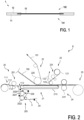
- Fig.1 shows schematically a membrane assembly 1 comprising a first frame 11, a second frame 12 and a membrane 10 arranged between them.
- the frames 11, 12 surround a functional area of the membrane 10 and preferably completely cover the outer edges of the membrane 10.
- the frames 11, 12 serve as a connection for further components and/or a seal for the membrane 10.
- the recesses delimited by the frames 11, 12 in the area of the membrane 10 are referred to as windows 101, 102 in connection with the application.
- Fig.2 shows a first embodiment of a system 2 for producing a membrane assembly according to Fig.1 , wherein a first frame material 110 and a second frame material 120 are provided as roll goods for the frames 11, 12.
- the system 2 shown comprises a device 20 for feeding the first frame material 110, a transport device 21, a membrane lamination device 22, a material feed device 23 for the second web-shaped frame material 120, a fixing device 24 and a winding device 25.
- the first web-shaped frame material 110 for the first frame 11 is provided as a material composite 111 with a protective film 112.
- the first frame material 110 is provided as an uncut roll product.
- the device 20 shown for feeding the first frame material 110 comprises a punching station 201, a delamination station 202 for delaminating or stripping of the protective film 112 and a carrier web lamination station 203, which is set up to laminate a carrier web 3 with the first frame material 110 after delamination of the protective film 112 for stabilizing the first frame material 110.
- the protective film 112 is arranged on a first side of the frame material 110.
- the protective film 112 covers, for example, an adhesive layer for connecting the first frame material 110 to the second frame material 120 and/or to the membrane 10.
- the carrier web 3 is laminated downstream of the delamination station 202 with a second side opposite the first side of the first frame material 110.
- the carrier web 3 then serves to stabilize the frame material 120 for further transport in the system 2 and/or in subsequent processes and systems.
- Fig.3 shows schematically the first material composite 111 comprising the first web-shaped frame material 110 and the protective film 112, which covers, for example, an adhesive layer provided on the frame material 110.
- the web-shaped frame material 110 by means of the Fig.2
- contour cuts 114 are made along the inner contours of the first frame 11, wherein the frame material 110 is severed by means of the contour cuts 114 without the protective film 112 being severed.
- the protective film 112 thus also serves to stabilize the first web-shaped frame material 110.
- a punching residue 116 delimited by the contour cut 114 remains on the protective film 112 in the event of delamination of the protective film 112.
- the material composite 111 is cut in a separate device, separated in time and place from the system 2.
- the delamination station 202 is designed to delaminate the protective film 112 with the punching residues 116 from the remaining frame material 110.
- the delamination station 202 comprises a delamination edge 2020, by means of which the protective film 112 with the punching residues 116 adhering thereto (cf. Fig.3 ) is deflected.
- the delamination edge 2020 is in one embodiment a delamination edge described in the subsequently published application EN 102022206200.0 described deflection element.
- the delamination edge 2020 interacts with a first roller 2021.
- the first roller is a vacuum roller, wherein the frame material 110 is sucked onto the roller 2021 by means of a suction flow.
- the frame material 110 is stabilized by means of the first roller 2021, so that a distortion-free transport of the first frame material 110 is ensured even after the delamination of the protective film 112.
- the illustrated delamination station 202 comprises a second roller 2022, in particular a second vacuum roller, wherein the first frame material 110 is transferable from the first roller 2021 to the second roller 2022.
- the second roller 2022 is configured to transport the first frame material 110 to the carrier web lamination station 203, wherein the frame material 110 is turned so that a second side of the frame material 110 is exposed for lamination of the carrier web 3.
- Fig.4 shows the web-shaped frame material 110 with window cutouts after delamination of the protective film 112 with the punching residues 116 (see Fig. 3 ) and after lamination with the carrier web 3.
- the carrier web 3 in the illustrated embodiment is provided on a protective film 30 which is delaminated from the carrier web 3 upstream of the carrier web lamination station 203.
- the device 20 for feeding the first frame material 110 also comprises a plurality of schematically arranged deflection rollers.
- the number and arrangement of the deflection rollers can be selected by the person skilled in the art depending on the application.
- the frame material 110 laminated with the carrier web 3 and stabilized by means of the carrier web 3 is transferred to the transport device 21.
- the transport device 21 shown is designed as a vacuum transport device comprising a vacuum conveyor belt 210, wherein the carrier web 3 rests on the vacuum conveyor belt 210.
- the membrane lamination device 22 and the second material feed device 23 are arranged along the transport device 21 in the illustrated embodiment.
- the membrane lamination device 22 is set up in the embodiment shown to lay down a membrane material in the form of blanks 100 on the web-shaped frame material 110.
- the blanks 100 are arranged on a protective film 101 in the embodiment shown and are laminated onto the frame material 110 by means of a device schematically shown as a roll 220. Laying takes place in an embodiment according to a method described in the subsequently published application EN 102020214263.7 described method and/or by means of a device described in this application.
- a membrane material is provided as a roll product, wherein the roll product is coated in sections to create active areas.
- the second frame material 120 is provided in web form and as a material composite 121 with a protective film 122 on the second material feed device 23.
- the material feed device 23 shown for feeding the second frame material comprises a punching station 231 which is set up to make contour cuts in the second web-shaped frame material 120 along inner contours of the second frame 12, wherein the protective film 122 is not severed or damaged.
- the protective film 122 with punching residues of the second frame material 120 is delaminated from the second frame material before lamination of the second frame material 120 with the first frame material 110 and the blanks 100 arranged therebetween.
- the protective film 122 with the punching residues of the second frame material 120 remains on the second frame material 120 and thus serves as a protective film for the side of the produced membrane assembly facing away from the carrier web 3 after lamination.
- the membrane assembly 1 which is stabilized by means of the carrier web 3 and is in the form of a roll, is fed to the fixing station 24 after the transport device 21, in which one of the adhesive layers provided on the first frame material 110 and/or the second frame material 120 is cured in order to fix the membrane assembly comprising the first frame material 110, the membrane blanks 100 and the second frame material 120.
- curing takes place under pressure by means of schematically illustrated pressure rollers 241.
- thermal curing and/or radiation curing of the adhesive layer takes place alternatively or additionally.
- the membrane assembly is guided between the pressure rollers 241 by means of the carrier web 3.
- the web-shaped material composite, stabilized by means of the carrier web 3, can then be fed to the system 2 shown in a web processing system for further processing.
- the membrane assembly 1 arranged on the carrier web 3 in the illustrated embodiment is fed to a winding device 25 for producing material rolls for intermediate storage.
- rollers 2021, 2022 of the device 20 for feeding the first frame material 100 are arranged below a transport plane of the vacuum transport device 21.
- the arrangement allows efficient use of installation space.
- the invention is not limited to this arrangement.
Landscapes
- Life Sciences & Earth Sciences (AREA)
- Engineering & Computer Science (AREA)
- Manufacturing & Machinery (AREA)
- Sustainable Development (AREA)
- Sustainable Energy (AREA)
- Chemical & Material Sciences (AREA)
- Chemical Kinetics & Catalysis (AREA)
- Electrochemistry (AREA)
- General Chemical & Material Sciences (AREA)
- Laminated Bodies (AREA)
Abstract
Die Erfindung betrifft eine Vorrichtung und ein Verfahren zum Zuführen eines Rahmenmaterials (110) für eine Membran-Baugruppe, insbesondere eine Membran-Elektroden-Anordnung (MEA), zu einer Transporteinrichtung, wobei das Rahmenmaterial als Rollenware in einem Materialverbund mit einem mit einer ersten Seite des Rahmenmaterials (110) laminierten Schutzfilm (112) bereitgestellt ist, umfassend:eine Delaminationsstation (202), die eingerichtet ist, um vor einem Übertragen des Rahmenmaterials (110) an die Transporteinrichtung den Schutzfilm (112) von dem Rahmenmaterial (110) zu delaminieren, wobei stromabwärts der Delaminationsstation (202) und stromaufwärts der Transporteinrichtung eine Trägerbahn-Laminationsstation (203) vorgesehen ist, die eingerichtet ist, um eine Trägerbahn (3) mit dem Rahmenmaterial (110) zu laminieren.
Description
- Die Erfindung betrifft eine Vorrichtung und ein Verfahren zum Zuführen eines Rahmenmaterials für eine Membran-Baugruppe, insbesondere bei der Herstellung von Membran-Baugruppen als Rollenware.
- Bei der Membran-Baugruppe handelt es sich in einer Ausgestaltung um eine Membran-Elektroden-Anordnung (kurz MEA) oder Teilen davon für eine Brennstoffzelle oder einen Elektrolyseur. Eine MEA umfasst in einer Ausgestaltung eine Katalysator-beschichtete Membran (engl. Catalyst Coated Membrane, kurz CCM), an welcher einseitig oder beidseitig Randverstärkungen oder Rahmen (engl. Frame oder rim) aus kostengünstigerem und widerstandsfähigerem Material vorgesehen sind. Für einen weiteren Aufbau können an Außenseiten der MEA zwei Gasdiffusionslagen (kurz GDL) angebracht werden. Ein Anbringen der GDL kann dabei in einem Prozess mit der Herstellung der MEA umfassend die CCM und die Randverstärkungen oder in einem räumlich und/oder zeitlich getrennten Prozess erfolgen. In einer anderen Ausgestaltung wird eine MEA umfassend eine Membran und zwei daran angeordnete Gasdiffusionslagen bereitgestellt, wobei an dieser MEA einseitig oder beidseitig Randverstärkungen oder Rahmen angebracht werden.
- Daneben sind Membran-Baugruppen für andere Anwendungen bekannt, beispielsweise für Elektrolyseure, Redox-Flow-Batterien oder Membran-basierte Luftbefeuchter.
- Aus
DE 10 2020 206 609 A1 sind ein Verfahren und eine Vorrichtung zur Herstellung von Membran-Baugruppen in einem bahnverarbeitenden Prozess bekannt, wobei ein Materialverbund umfassend ein Rahmenmaterial und einen Schutzfilm bereitgestellt wird und wobei eine Vakuumtransporteinrichtung vorgesehen ist, auf welcher die Membran-Baugruppe zumindest teilweise aufgebaut wird, wobei der Schutzfilm vor einem Übertragen des Rahmenmaterials an die Vakuumtransporteinrichtung von dem Rahmenmaterial delaminiert wird. - Es ist eine Aufgabe, eine Vorrichtung und ein Verfahren zum Zuführen eines Rahmenmaterials für die Herstellung von Membran-Baugruppen als Rollenware mit einer verbesserten Stabilität zu schaffen.
- Diese Aufgabe wird gelöst durch die Gegenstände mit den Merkmalen der Ansprüche 1 und 6. Vorteilhafte Ausgestaltungen ergeben sich aus den Unteransprüchen.
- Gemäß einem ersten Aspekt wird eine Vorrichtung zum Zuführen eines Rahmenmaterials für die Herstellung einer Membran-Baugruppe, insbesondere einer Membran-Elektroden-Anordnung (MEA), zu einer Transporteinrichtung als Rollenware geschaffen, wobei das Rahmenmaterial als Rollenware in einem Materialverbund mit einem mit einer ersten Seite des Rahmenmaterials laminierten Schutzfilm bereitgestellt ist, die Vorrichtung umfassend eine Delaminationsstation, die eingerichtet ist, um vor dem Übertragen des Rahmenmaterials an die Transporteinrichtung den Schutzfilm von dem Rahmenmaterial zu delaminieren, und eine stromabwärts der Delaminationsstation und stromaufwärts der Transporteinrichtung angeordnete Trägerbahn-Laminationsstation, die eingerichtet ist, um eine Trägerbahn mit dem Rahmenmaterial zu laminieren.
- Gemäß einem zweiten Aspekt wird ein Verfahren zum Zuführen eines Rahmenmaterials für die Herstellung einer Membran-Baugruppe als Rollenware, insbesondere einer Membran-Elektroden-Anordnung (MEA), zu einer Transporteinrichtung geschaffen, wobei das Rahmenmaterial als Rollenware in einem Materialverbund mit einem mit einer ersten Seite des Rahmenmaterials laminierten Schutzfilm bereitgestellt wird, das Verfahren umfassend die Schritte Delamination des Schutzfilms von dem Rahmenmaterial vor einem Übertragen des Rahmenmaterials an die Transporteinrichtung, und Aufbauen der Membran-Baugruppe als Rollenware, wobei ein Membran-Material mit dem ersten Rahmenmaterial laminiert wird, wobei nach der Delamination des Schutzfilms von dem ersten Rahmenmaterial und vor einem Übertragen des Rahmenmaterials an die Transporteinrichtung, eine Lamination des Rahmenmaterials mit einer geschlossenen Trägerbahn erfolgt.
- Die Begriffe "erster" und "zweiter" dienen im Zusammenhang mit der Anmeldung lediglich zur Unterscheidung und geben keine Reihenfolge an. Auch verlangen die Begriffe "erste", "erster" etc. nicht zwangsweise ein Vorhandensein von zweiten baugleichen oder ähnlichen Elementen. Die Begriffe "ein", "einer" etc. werden im Zusammenhang mit der Anmeldung als unbestimmte Artikel und nicht als Zählwörter verwendet.
- Ein bahnförmiges Rahmenmaterial, ein bahnförmiger Schutzfilm, eine Trägerbahn oder ein anderes bahnförmiges Material werden im Zusammenhang mit der Anmeldung als Materialbahnen bezeichnet. Als Lamination wird dabei im Zusammenhang mit der Anmeldung sowohl ein temporäres als auch ein dauerhaftes Verbinden von Materialbahnen bezeichnet. Entsprechend wird ein Ablösen oder Trennen der Materialbahnen als Delamination bezeichnet.
- Als geschlossene Trägerbahn wird eine Materialbahn bezeichnet, welche keine oder nur unwesentliche Einschnitte oder Durchbrüche und somit eine hohe Stabilität gegen einen Verzug bei einer Verarbeitung aufweist.
- Als Rahmenmaterial wird dabei ein Material zur Herstellung der Rahmen bezeichnet. Das Rahmenmaterial kann als ungeschnittene Rollenware, mit Einschnitten oder bereits mit ausgeschnittenen und herausgetrennten Fenstern für die Rahmen bereitgestellt werden.
- Das als Rollenware bereitgestellte Rahmenmaterial ist zunächst mittels des Schutzfilms stabilisiert. Nach der Delamination des Schutzfilms erfolgt eine Lamination mit einer Trägerbahn, wobei eine Stabilisierung des Rahmenmaterials und ein verzugfreier Transport mittels der Trägerbahn sichergestellt ist. Um eine zuverlässige Delamination des Schutzfilms von dem Rahmenmaterial sicherzustellen, erfolgt eine Delamination des Schutzfilms vor einer Lamination des ersten Rahmenmaterials mit der Trägerbahn.
- Ein Aufbau der Membran-Baugruppe erfolgt in Ausgestaltungen zumindest abschnittsweise auf der Trägerbahn, nachdem die Trägerbahn mit dem damit laminierten Rahmenmaterial an die Transporteinrichtung übertragen wurde. Die auf der Trägerbahn aufgebaute und mittels der Trägerbahn stabilisierte Membran-Baugruppe wird in einer Ausgestaltung als Rollenware für eine örtlich und/oder räumlich getrennte Weiterverarbeitung zwischengespeichert. In anderen Ausgestaltungen erfolgt eine unmittelbare Weiterverarbeitung in einer bahnverarbeitenden Anlage.
- Die Trägerbahn erlaubt einen Transport des Rahmenmaterials zu der Transporteinrichtung sowie einen Transport der auf der Trägerbahn ganz oder teilweise aufgebauten Membran-Baugruppe entlang verschiedener Einrichtungen und/oder Stationen.
- Die Transporteinrichtung umfasst in einer Ausgestaltung ein Förderband oder mehrere Förderbänder, auf welchem oder welchen die Trägerbahn abgelegt ist. In anderen Ausgestaltungen umfasst die Transporteinrichtung eine rotierende Walze, mittels welcher die Trägerbahn transportiert wird. In Ausgestaltungen der Vorrichtung ist die Transporteinrichtung eine Vakuumtransporteinrichtung. Die Vakuumtransporteinrichtung umfasst in einer Ausgestaltung ein Vakuumtransportband, mittels welchem eine lineare Förderung erfolgt. Alternativ oder zusätzlich umfasst die Vakuumtransporteinrichtung in einer anderen Ausgestaltung eine Vakuumwalze.
- Ein Transport des Rahmenmaterials beim Aufbau der Membran-Baugruppe mittels einer Trägerbahn erlaubt dabei auch einen einfachen Wechsel zwischen Transportmitteln einer Transporteinrichtung, beispielsweise zwischen unterschiedlichen Förderbändern und/oder zwischen einer Walze und einem Förderband.
- In einer Ausgestaltung weist die Trägerbahn an ihrer dem Rahmenmaterial zugewandten Seite adhäsive Eigenschaften auf, wobei die Trägerbahn in einer Ausgestaltung rückstandslos von dem Rahmenmaterial delaminierbar ist, so dass mittels der Delamination freigelegte Oberfläche des Rahmenmaterials keine adhäsiven Eigenschaften aufweist. In anderen Ausgestaltungen wird die freigelegte Oberfläche in einer Weiterverarbeitung mit weiteren Schichten verbunden, so dass adhäsive Rückstände akzeptabel sind.
- Der Schutzfilm dient in einer Ausgestaltung einer Abdeckung einer an dem Rahmenmaterial vorgesehenen Klebeschicht, welche einer sicheren Verbindung des Rahmenmaterials mit dem Membran-Material und/oder einem zweiten Rahmenmaterial dient.
- Bei dem Membran-Material handelt es sich in einer Ausgestaltung um eine CCM für eine MEA. In anderen Ausgestaltungen handelt es sich bei dem Membran-Material um eine Membran mit zwei Elektroden. Das Membran-Material wird in vorteilhaften Ausgestaltungen in Form von Zuschnitten zugeführt, welche auf dem bahnförmigen Rahmenmaterial abgelegt werden. In anderen Ausgestaltungen ist ein bahnförmiges Membran-Material vorgesehen, wobei das bahnförmige Membran-Material in einer Ausgestaltung aktive und nicht aktive Bereiche aufweist.
- In einer Ausgestaltung ist vorgesehen, die Trägerbahn mit einer der ersten Seite des Rahmenmaterials gegenüberliegenden zweiten Seite zu laminieren. Die Trägerbahn wird dabei insbesondere an einer gegenüberliegenden Seite des Rahmenmaterials zu einer nach Delamination des Schutzfilms freigelegten Klebeschicht angebracht.
- Die Delaminationsstation weist in Ausgestaltungen eine erste Walze, insbesondere eine erste Vakuumwalze, auf, an welche der Materialverbund umfassend das Rahmenmaterial und den Schutzfilm vor einer Delamination des Schutzfilms übertragbar ist und die eingerichtet ist, um das Rahmenmaterial bei einer Delamination des Schutzfilms abzustützen. Mittels der Walze, insbesondere mittels der Vakuumwalze, ist eine sichere Abstützung des Rahmenmaterials für die Delamination des Schutzfilms möglich.
- In einer Ausgestaltung umfasst die Delaminationsstation eine zweite Walze, insbesondere eine zweite Vakuumwalze, wobei die erste Walze und die zweite Walze derart angeordnet sind, dass das Rahmenmaterial von der ersten Walze an die zweite Walze übertragbar ist, und wobei die zweite Walze eingerichtet ist, um das Rahmenmaterial zu der Trägerbahn-Laminationsstation zu transportieren. Dadurch ist ein Wenden des bahnförmigen Rahmenmaterials zwischen der Delamtionsstation und der Membran-Laminationseinrichtung möglich, sodass an der Delamtionsstation die erste Seite des Rahmenmaterials und der Membran-Laminationseinrichtung die zweite Seite des Rahmenmaterials frei liegt. Gleichzeitig wird mittels der Walzen ein freier, nicht abgestützter Transport des Rahmenmaterials vermieden.
- In einer Ausgestaltung wird der Materialverbund umfassend das Rahmenmaterial und den Schutzfilm als Rollenware bereitgestellt, wobei das Rahmenmaterial Stanzkonturen für Fensterausschnitte und andere Strukturen für den aus dem Rahmenmaterial herzustellenden Rahmen aufweist.
- Alternativ ist stromaufwärts der Delaminationsstation eine Stanzstation vorgesehen, die eingerichtet ist, um in den Materialverbunds von einer der ersten Seite gegenüberliegenden zweite Seite des Rahmenmaterials das Rahmenmaterial durchtrennende Konturschnitte unter Bildung von Stanzresten einzubringen, wobei die Konturschnitte eingebracht werden ohne den Schutzfilm zu durchtrennen und wobei die Delaminationsstation eingerichtet ist, um den Schutzfilms von dem Rahmenmaterial mit den Stanzresten zu delaminieren.
- Die Konturschnitte werden in Ausgestaltungen mittels eines Stanzverfahrens, insbesondere mittels Rotationsstanzen, in das Rahmenmaterial eingebracht. Der Schutzfilm dient dabei in vorteilhaften Ausgestaltungen als Schneidunterlage. Ein Einbringen der Konturschnitte erfolgt dabei in einem gemeinsamen Prozess mit einer Weiterverarbeitung des Materialverbunds.
- Weitere Vorteile und Aspekte der Erfindung ergeben sich aus den Ansprüchen und aus der Beschreibung von Ausführungsbeispielen der Erfindung, die nachfolgend anhand der schematischen Figuren erläutert sind. Dabei zeigen:
- Fig. 1
- eine Membran-Baugruppe umfassend einen ersten Rahmen, einen zweiten Rahmen und eine dazwischen angeordnete Membran;
- Fig. 2
- eine erste Ausgestaltung einer Vorrichtung zur Herstellung der Membran-Baugruppe gemäß
Fig. 1 als Rollenware; - Fig. 3
- eine ersten Materialverbund umfassend ein erstes bahnförmiges Rahmenmaterial zur Herstellung der Membran-Baugruppe gemäß
Fig. 1 ; und - Fig. 4
- das bahnförmige Rahmenmaterial gemäß
Fig. 3 nach Delamination eines Schutzfilms und Lamination mit einer Trägerbahn. -
Fig. 1 zeigt schematisch eine Membran-Baugruppen 1 umfassend einen ersten Rahmen 11, einen zweiten Rahmen 12 und eine dazwischen angeordnete Membran 10. Die Rahmen 11, 12 umgeben einen Funktionsbereich der Membran 10 und decken Außenränder der Membran 10 vorzugsweise vollumfänglich ab. Je nach Ausgestaltung dienen die Rahmen 11, 12 als Anschluss für weiterer Bauteile und/oder einer Abdichtung der Membran 10. Die durch die Rahmen 11, 12 begrenzten Ausnehmungen im Bereich der Membran 10 werden im Zusammenhang mit der Anmeldung als Fenster 101, 102 bezeichnet. -
Fig. 2 zeigt ein erstes Ausführungsbeispiel einer Anlage 2 zur Herstellung einer Membran-Baugruppe gemäßFig. 1 , wobei für die Rahmen 11, 12 ein erstes Rahmenmaterial 110 und ein zweites Rahmenmaterial 120 als Rollenware bereitgestellt werden. - Die dargestellte Anlage 2 umfasst eine Vorrichtung 20 zum Zuführen des ersten Rahmenmaterials 110, eine Transporteinrichtung 21, eine Membran-Laminationseinrichtung 22, eine Materialzufuhreinrichtung 23 für das zweite bahnförmigen Rahmenmaterial 120, eine Fixiereinrichtung 24 und eine Aufwickeleinrichtung 25.
- Das erste bahnförmigen Rahmenmaterial 110 für den ersten Rahmen 11 wird als Materialverbund 111 mit einem Schutzfilm 112 bereitgestellt. Das erste Rahmenmaterial 110 wird in dem Ausführungsbeispiel als ungeschnittene Rollenware bereitgestellt.
- Die in
Fig. 2 dargestellte Vorrichtung 20 zum Zuführen des ersten Rahmenmaterials 110 umfasst eine Stanzstation 201, eine Delaminationsstation 202 zum Delaminieren oder Abziehen des Schutzfilms 112 und eine Trägerbahn-Laminationsstation 203, die eingerichtet ist, um eine Trägerbahn 3 mit dem ersten Rahmenmaterial 110 nach einer Delamination des Schutzfilms 112 für eine Stabilisierung des ersten Rahmenmaterials 110 zu laminieren. In dem dargestellten Ausführungsbeispiel ist der Schutzfilm 112 an einer ersten Seite des Rahmenmaterials 110 angeordnet. Der Schutzfilm 112 deckt dabei beispielsweise eine Klebeschicht zur Verbindung des ersten Rahmenmaterials 110 mit dem zweiten Rahmenmaterial 120 und/oder mit der Membran 10 ab. Die Trägerbahn 3 wird stromabwärts der Delaminationsstation 202 mit einer der ersten Seite des ersten Rahmenmaterials 110 gegenüberliegenden zweiten Seite laminiert. Die Trägerbahn 3 dient dann einer Stabilisierung des Rahmenmaterials 120 für einen weiteren Transport in der Anlage 2 und/oder in nachfolgenden Prozessen und Anlagen. -
Fig. 3 zeigt schematisch den ersten Materialverbund 111 umfassend das erste bahnförmige Rahmenmaterial 110 und den Schutzfilms 112, welcher beispielsweise eine an dem Rahmenmaterial 110 vorgesehene Klebeschicht abgedeckt. In das bahnförmige Rahmenmaterial 110 sind mittels der inFig. 2 schematisch dargestellten Stanzstation 201 Konturschnitte 114 entlang Innenkonturen des ersten Rahmens 11 eingebracht, wobei das Rahmenmaterial 110 mittels der Konturschnitte 114 durchtrennt ist, ohne dass der Schutzfilm 112 durchtrennt ist. Der Schutzfilm 112 dient so zudem auch einer Stabilisierung des ersten bahnförmigen Rahmenmaterial 110. Ein durch den Konturschnitt 114 begrenzter Stanzrest 116 verbleibt bei einer Delamination des Schutzfilms 112 an dem Schutzfilm 112. In anderen Ausgestaltungen erfolgt ein Einschneiden des Materialverbunds 111 in einer separaten Vorrichtung, zeitlich und örtlich getrennt von der Anlage 2. - Die Delaminationsstation 202 ist in dem dargestellten Ausführungsbeispiel geeignet gestaltet, um den Schutzfilm 112 mit den Stanzresten 116 von dem verbleibenden Rahmenmaterial 110 zu delaminieren. Delaminationsstation 202 umfasst eine Delaminationskante 2020, mittels welcher der Schutzfilm 112 mit den daran anhaftenden Stanzresten 116 (vgl.
Fig. 3 ) umgelenkt wird. Bei der Delaminationskante 2020 handelt es sich in einer Ausgestaltung um ein in der nachveröffentlichten AnmeldungDE 102022206200.0 beschriebenes Umlenkelement. - Die Delaminationskante 2020 wirkt in dem dargestellten Ausführungsbeispiel mit einer ersten Walze 2021 zusammen. Bei der ersten Walze handelt es sich in Ausgestaltungen um eine Vakuumwalze, wobei das Rahmenmaterial 110 mittels einer Saugströmung an die Walze 2021 angesaugt wird. Das Rahmenmaterial 110 wird mittels der ersten Walze 2021 stabilisiert, sodass ein verzugfreier Transport des ersten Rahmenmaterials 110 auch nach der Delamination des Schutzfilms 112 sichergestellt ist.
- Die dargestellte Delaminationsstation 202 umfasst eine zweite Walze 2022, insbesondere eine zweite Vakuumwalze, wobei das erste Rahmenmaterial 110 von der ersten Walze 2021 an die zweite Walze 2022 übertragbar ist. Die zweite Walze 2022 ist eingerichtet, um das erste Rahmenmaterial 110 zu der Trägerbahn-Laminationsstation 203 zu transportieren, wobei das Rahmenmaterial 110 gewendet wird, sodass eine zweite Seite des Rahmenmaterials 110 für eine Lamination der Trägerbahn 3 freiliegt.
-
Fig. 4 zeigt das bahnförmige, Fensterausschnitte aufweisende Rahmenmaterial 110 nach Delamination des Schutzfilms 112 mit den Stanzresten 116 (s.Fig. 3 ) und nach Lamination mit der Trägerbahn 3. - Wie in
Fig. 2 dargestellt, wird die Trägerbahn 3 in dem dargestellten Ausführungsbeispiel auf einem Schutzfilm 30 bereitgestellt, welcher stromaufwärts der Trägerbahn-Laminationsstation 203 von der Trägerbahn 3 delaminiert wird. - Die Vorrichtung 20 zum Zuführen des ersten Rahmenmaterials 110 umfasst zudem eine Vielzahl an schematisch angeordneten Umlenkrollen. Die Anzahl und Anordnung der Umlenkrollen ist je nach Anwendungsfall durch den Fachmann geeignet wählbar.
- Das mit der Trägerbahn 3 laminierte und mittels der Trägerbahn 3 stabilisierte Rahmenmaterial 110 wird an die Transporteinrichtung 21 übertragen. Die dargestellte Transporteinrichtung 21 ist als Vakuumtransporteinrichtung umfassend ein Vakuumtransportband 210 gestaltet, wobei die Trägerbahn 3 auf dem Vakuumtransportband 210 aufliegt.
- Die Membran-Laminationseinrichtung 22 und die zweite Materialzuführeinrichtung 23 sind in dem dargestellten Ausführungsbeispiel entlang der Transporteinrichtung 21 angeordnet.
- Die Membran-Laminationseinrichtung 22 ist in dem dargestellten Ausführungsbeispiel eingerichtet, um ein Membran-Material in Form von Zuschnitten 100 auf dem bahnförmigen Rahmenmaterial 110 abzulegen. Die Zuschnitte 100 sind in dem dargestellten Ausführungsbeispiel auf eine Schutzfilm 101 angeordnet und werden mittels einer schematisch als Rolle 220 dargestellten Einrichtung auf das Rahmenmaterial 110 laminiert. Ein Ablegen erfolgt dabei in einer Ausgestaltung gemäß einem in der nachveröffentlichten Anmeldung
DE 102020214263.7 beschriebenen Verfahren und/oder mittels einer in dieser Anmeldung beschriebenen Vorrichtung. - Anstelle der Zuschnitte 100 wird in einer alternativen Ausgestaltung ein Membran-Material als Rollenware bereitgestellt, wobei die Rollenware abschnittsweise beschichtet ist, um aktive Bereiche zu schaffen.
- In dem in
Fig. 2 dargestellten Ausführungsbeispiel wird das zweite Rahmenmaterial 120 bahnförmig und als Materialverbund 121 mit einem Schutzfilm 122 an der zweiten Materialzuführeinrichtung 23 bereitgestellt. - Die in
Fig. 2 dargestellte Materialzuführeinrichtung 23 zum Zuführen des zweiten Rahmenmaterials umfasst eine Stanzstation 231, die eingerichtet ist, um in das zweite bahnförmige Rahmenmaterial 120 Konturschnitte entlang Innenkonturen des zweiten Rahmens 12 einzubringen, wobei der Schutzfilm 122 nicht durchtrennt oder beschädigt wird. In dem dargestellten Ausführungsbeispiel wird der Schutzfilm 122 mit Stanzresten des zweiten Rahmenmaterials 120 vor einer Lamination des zweiten Rahmenmaterials 120 mit dem ersten Rahmenmaterial 110 und den dazwischen angeordneten Zuschnitten 100 von dem zweiten Rahmenmaterial delaminiert. In anderen Ausgestaltungen verbleibt der Schutzfilm 122 mit den Stanzresten des zweiten Rahmenmaterials 120 an dem zweiten Rahmenmaterial 120 und dient so nach der Lamination als Schutzfilm für die der Trägerbahn 3 abgewandte Seite der hergestellten Membran-Baugruppe. - In dem dargestellten Ausführungsbeispiel wird anschließend an die Transporteinrichtung 21 die mittels der Trägerbahn 3 stabilisierte, als Rollenware vorliegende Membran-Baugruppe 1 der Fixierstation 24 zugeführt, in welcher ein Aushärten einer der an dem ersten Rahmenmaterial 110 und/oder dem zweiten Rahmenmaterial 120 vorgesehenen Klebeschicht erfolgt, um die Membran-Baugruppe umfassend das erste Rahmenmaterial 110, die Membran-Zuschnitte 100 und das zweite Rahmenmaterial 120 zu fixieren. In einer Ausgestaltung erfolgt ein Aushärten unter Druck mittels schematisch dargestellter Druckwalzen 241. Je nach Anwendungsfall erfolgt alternativ oder zusätzlich ein thermisches Aushärten und/oder ein Strahlungshärten der Klebeschicht. Die Membran-Baugruppe wird dabei mittels der Trägerbahn 3 zwischen den Druckwalzen 241 geführt.
- Der mittels der Trägerbahn 3 stabilisierte, bahnförmige Materialverbund ist anschließend zu der dargestellten Anlage 2 einer bahnverarbeitenden Anlage für eine Weiterverarbeitung zuführbar. Wie schematisch in
Fig. 2 dargestellt, wird die auf der Trägerbahn 3 angeordneten Membran-Baugruppe 1 in dem dargestellten Ausführungsbeispiel zu diesem Zweck einer Aufwickeleinrichtung 25 für eine Herstellung von Materialrollen für eine Zwischenspeicherung zugeführt. - Die in
Fig. 2 dargestellte Ausgestaltung der Anlage 2 ist lediglich beispielhaft und es sind zahlreiche Abwandlungen denkbar. - In dem dargestellten Ausführungsbeispiel sind die Walzen 2021, 2022 der Vorrichtung 20 zum Zuführen des ersten Rahmenmaterials 100 unterhalb einer Transportebene der Vakuumtransporteinrichtung 21 angeordnet. Die Anordnung erlaubt eine effiziente Bauraumausnutzung. Die Erfindung ist jedoch nicht auf diese Anordnung beschränkt.
Claims (10)
- Vorrichtung zum Zuführen eines Rahmenmaterials (110) für eine Membran-Baugruppe, insbesondere eine Membran-Elektroden-Anordnung (MEA), zu einer Transporteinrichtung (21), wobei das Rahmenmaterial als Rollenware in einem Materialverbund mit einem mit einer ersten Seite des Rahmenmaterials (110) laminierten Schutzfilm (112) bereitgestellt ist, umfassend:- eine Delaminationsstation (202), die eingerichtet ist, um vor einem Übertragen des Rahmenmaterials (110) an die Transporteinrichtung den Schutzfilm (112) von dem Rahmenmaterial (110) zu delaminieren,dadurch gekennzeichnet, dass stromabwärts der Delaminationsstation (202) und stromaufwärts der Transporteinrichtung eine Trägerbahn-Laminationsstation (203) vorgesehen ist, die eingerichtet ist, um eine Trägerbahn (3) mit dem Rahmenmaterial (110) zu laminieren.
- Vorrichtung nach Anspruch 1, dadurch gekennzeichnet, dass die Vorrichtung eingerichtet ist, um die Trägerbahn (3) mit einer der ersten Seite des Rahmenmaterials (110) gegenüberliegenden zweiten Seite zu laminieren.
- Vorrichtung nach Anspruch 1 oder 2, dadurch gekennzeichnet, dass die Delaminationsstation (202) eine erste Walze (2021), insbesondere eine erste Vakuumwalze, aufweist, eingerichtet ist, um das Rahmenmaterial (110) bei einer Delamination des Schutzfilms (112) abzustützen.
- Vorrichtung nach Anspruch 1, 2 oder 3, dadurch gekennzeichnet, dass die Delaminationsstation (202) eine zweite Walze (2022), insbesondere eine zweite Vakuumwalze, aufweist, wobei die erste Walze (2021) und die zweite Walze (2022) derart angeordnet sind, dass das Rahmenmaterial (110) von der ersten Walze(2021) an die zweite Walze (2022) übertragbar ist, und wobei die zweite Walze (2022) eingerichtet ist, um das Rahmenmaterial (110) zu der Trägerbahn-Laminationsstation (203) zu transportieren.
- Vorrichtung nach einem der Ansprüche 1 bis 4, dadurch gekennzeichnet, dass stromaufwärts der Delaminationsstation (202) eine Stanzstation (201) vorgesehen ist, die eingerichtet ist, um in den Materialverbunds (111) umfassend das Rahmenmaterial (110) und den Schutzfilm (112) von einer der ersten Seite gegenüberliegenden zweite Seite des Rahmenmaterials (110) das Rahmenmaterial (110) durchtrennende Konturschnitte (114) unter Bildung von Stanzresten (116) einzubringen, wobei die Konturschnitte (114) eingebracht werden ohne den Schutzfilm (112) zu durchtrennen und wobei die Delaminationsstation (202) eingerichtet ist, um den Schutzfilms (112) von dem Rahmenmaterial (110) mit den Stanzresten (116) zu delaminieren.
- Verfahren zum Zuführen eines Rahmenmaterials (110) für eine Membran-Baugruppe, insbesondere eine Membran-Elektroden-Anordnung (MEA), zu einer Transporteinrichtung (21), wobei das Rahmenmaterial als Rollenware in einem Materialverbund mit einem mit einer ersten Seite des Rahmenmaterials (110) laminierten Schutzfilm (112) bereitgestellt wird, umfassend:- eine Delamination des Schutzfilms (112) von dem Rahmenmaterial (110) vor einem Übertragen des Rahmenmaterials (110) an die Transporteinrichtung,dadurch gekennzeichnet, dass nach der Delamination des Schutzfilms (112) von dem Rahmenmaterial (110) und vor dem Übertragen des Rahmenmaterials (110) an die Transporteinrichtung eine Lamination des Rahmenmaterials (110) mit einer geschlossenen Trägerbahn (13) erfolgt.
- Verfahren nach Anspruch 6, dadurch gekennzeichnet, dass die Trägerbahn (3) mit einer der ersten Seite des Rahmenmaterials (110) gegenüberliegenden zweiten Seite laminiert wird.
- Verfahren nach Anspruch 6 oder 7, dadurch gekennzeichnet, dass der Materialverbund (111) umfassend das Rahmenmaterial (110) und den Schutzfilm (112) vor einer Delamination des Schutzfilms (112) an eine Walze (2021), insbesondere eine erste Vakuumwalze, übertragen wird, wobei das Rahmenmaterial (110) bei der Delamination des Schutzfilms (112) mittels der ersten Walze (2021) abgestützt wird.
- Verfahren nach Anspruch 8, dadurch gekennzeichnet, dass das Rahmenmaterial (110) nach der Delamination des Schutzfilms von der ersten Walze (2021) an eine zweite Walze (2022), insbesondere eine zweite Vakuumwalze, übertragen wird, wobei das Rahmenmaterial (110) bei der Lamination des bahnförmigen Trägerbahns (3) mittels der zweitem Walze (2022) abgestützt wird.
- Verfahren nach einem der Ansprüche 6 bis 9, dadurch gekennzeichnet, dass in den Materialverbund (111) umfassend das Rahmenmaterial (110) und den Schutzfilm (112) von einer der ersten Seite gegenüberliegenden zweite Seite des Rahmenmaterials (110) das Rahmenmaterial (110) durchtrennende Konturschnitte (114) unter Bildung von Stanzresten (116) eingebracht werden, wobei die Konturschnitte (114) eingebracht werden ohne den Schutzfilm (112) zu durchtrennen und wobei die Delamination des Schutzfilms (112) von dem Rahmenmaterial (110) mit den Stanzresten (116) erfolgt.
Applications Claiming Priority (1)
| Application Number | Priority Date | Filing Date | Title |
|---|---|---|---|
| DE102022213438.9A DE102022213438A1 (de) | 2022-12-12 | 2022-12-12 | Vorrichtung und Verfahren zum Zuführen eines Rahmenmaterials für eine Membran-Baugruppe |
Publications (1)
| Publication Number | Publication Date |
|---|---|
| EP4386911A1 true EP4386911A1 (de) | 2024-06-19 |
Family
ID=88506653
Family Applications (1)
| Application Number | Title | Priority Date | Filing Date |
|---|---|---|---|
| EP23205010.4A Pending EP4386911A1 (de) | 2022-12-12 | 2023-10-20 | Vorrichtung und verfahren zum zuführen eines rahmenmaterials für eine membran-baugruppe |
Country Status (2)
| Country | Link |
|---|---|
| EP (1) | EP4386911A1 (de) |
| DE (1) | DE102022213438A1 (de) |
Citations (9)
| Publication number | Priority date | Publication date | Assignee | Title |
|---|---|---|---|---|
| US20080142152A1 (en) * | 2006-12-15 | 2008-06-19 | 3M Innovative Properties Company | Method and apparatus for fabricating roll good fuel cell subassemblies |
| JP2016048612A (ja) * | 2014-08-27 | 2016-04-07 | 株式会社Screenホールディングス | 膜・触媒層接合体の製造装置および製造方法 |
| JP2018142407A (ja) * | 2017-02-27 | 2018-09-13 | 株式会社Screenホールディングス | ガスケット付加装置およびガスケット付加方法 |
| US20200014017A1 (en) * | 2018-07-04 | 2020-01-09 | Toray Engineering Co., Ltd. | Electrode sheet manufacturing method and electrode sheet manufacturing apparatus |
| EP3823071A1 (de) * | 2019-11-15 | 2021-05-19 | SCREEN Holdings Co., Ltd. | Herstellungsvorrichtung und verfahren zur herstellung einer membranelektrodenanordnung mit zusätzlicher unterdichtung und membranelektrodenanordnung mit zusätzlicher unterdichtung |
| DE102020206609A1 (de) | 2019-12-31 | 2021-07-01 | Hyundai Motor Company | Verfahren zum Herstellen einer Membran-Elektroden-Anordnung |
| DE102020214263A1 (de) * | 2020-11-12 | 2022-05-12 | OPTIMA life science GmbH | Vorrichtung und Verfahren zum Übertragen einer Membran |
| WO2023036690A1 (de) * | 2021-09-10 | 2023-03-16 | Greenerity Gmbh | Verfahren zur herstellung von membranelektrodenanordnungen in form einer kontinuierlichen bahn |
| EP4318687A2 (de) * | 2022-07-14 | 2024-02-07 | Optima Life Science GmbH | Verfahren und vorrichtung zur herstellung einer membran-elektroden-baugruppe für eine brennstoffzelle in einem bahnverarbeitenden prozess |
Family Cites Families (3)
| Publication number | Priority date | Publication date | Assignee | Title |
|---|---|---|---|---|
| DE102021209815A1 (de) | 2021-09-06 | 2023-03-09 | OPTIMA life science GmbH | Verfahren und Vorrichtung zur Herstellung einer Membran-Baugruppe |
| DE102021212252A1 (de) | 2021-10-29 | 2023-05-04 | OPTIMA life science GmbH | Verfahren und Vorrichtung zur Herstellung von Membran-Baugruppen |
| DE102022206200A1 (de) | 2022-06-21 | 2023-12-21 | OPTIMA life science GmbH | Umlenkelement zum Trennen und Abziehen einer Materialbahn |
-
2022
- 2022-12-12 DE DE102022213438.9A patent/DE102022213438A1/de active Pending
-
2023
- 2023-10-20 EP EP23205010.4A patent/EP4386911A1/de active Pending
Patent Citations (9)
| Publication number | Priority date | Publication date | Assignee | Title |
|---|---|---|---|---|
| US20080142152A1 (en) * | 2006-12-15 | 2008-06-19 | 3M Innovative Properties Company | Method and apparatus for fabricating roll good fuel cell subassemblies |
| JP2016048612A (ja) * | 2014-08-27 | 2016-04-07 | 株式会社Screenホールディングス | 膜・触媒層接合体の製造装置および製造方法 |
| JP2018142407A (ja) * | 2017-02-27 | 2018-09-13 | 株式会社Screenホールディングス | ガスケット付加装置およびガスケット付加方法 |
| US20200014017A1 (en) * | 2018-07-04 | 2020-01-09 | Toray Engineering Co., Ltd. | Electrode sheet manufacturing method and electrode sheet manufacturing apparatus |
| EP3823071A1 (de) * | 2019-11-15 | 2021-05-19 | SCREEN Holdings Co., Ltd. | Herstellungsvorrichtung und verfahren zur herstellung einer membranelektrodenanordnung mit zusätzlicher unterdichtung und membranelektrodenanordnung mit zusätzlicher unterdichtung |
| DE102020206609A1 (de) | 2019-12-31 | 2021-07-01 | Hyundai Motor Company | Verfahren zum Herstellen einer Membran-Elektroden-Anordnung |
| DE102020214263A1 (de) * | 2020-11-12 | 2022-05-12 | OPTIMA life science GmbH | Vorrichtung und Verfahren zum Übertragen einer Membran |
| WO2023036690A1 (de) * | 2021-09-10 | 2023-03-16 | Greenerity Gmbh | Verfahren zur herstellung von membranelektrodenanordnungen in form einer kontinuierlichen bahn |
| EP4318687A2 (de) * | 2022-07-14 | 2024-02-07 | Optima Life Science GmbH | Verfahren und vorrichtung zur herstellung einer membran-elektroden-baugruppe für eine brennstoffzelle in einem bahnverarbeitenden prozess |
Also Published As
| Publication number | Publication date |
|---|---|
| DE102022213438A1 (de) | 2024-06-13 |
Similar Documents
| Publication | Publication Date | Title |
|---|---|---|
| DE102015220381B4 (de) | Vorrichtung zum Herstellen einer Membran-Elektrodenanordnung für eine Brennstoffzelle | |
| EP3278967B1 (de) | Verfahren und vorrichtung zum herstellen eines dichtbandes | |
| DE112008001580T5 (de) | Vorrichtung und Verfahren zur Herstellung eines Brennstoffzellen-Elektrodenmaterialverbunds und Brennstoffzelle | |
| EP4248510A1 (de) | Verfahren zur herstellung einer membran-elektroden-anordnung sowie eine membran-elektroden-anordnung für eine brennstoffzelle | |
| EP4543648A1 (de) | Umlenkeinrichtung zum trennen und abziehen einer materialbahn | |
| DE102021212296A1 (de) | Einrichtung zum herstellen einer membran-elektroden-subgasket-anordnung und verfahren zum herstellen der membran-elektroden-subgasket-anordnung unter verwendung derselben | |
| WO2023041441A1 (de) | Verfahren und vorrichtung zum herstellen eines elektroden-separator-verbunds für eine batteriezelle | |
| EP4423825B1 (de) | Verfahren und vorrichtung zur herstellung von membran-baugruppen | |
| DE102021209815A1 (de) | Verfahren und Vorrichtung zur Herstellung einer Membran-Baugruppe | |
| EP4386911A1 (de) | Vorrichtung und verfahren zum zuführen eines rahmenmaterials für eine membran-baugruppe | |
| DE102015100737B4 (de) | Elektrochemische Einheit für eine elektrochemische Vorrichtung und Verfahren zum Herstellen einer solchen | |
| EP4318687A2 (de) | Verfahren und vorrichtung zur herstellung einer membran-elektroden-baugruppe für eine brennstoffzelle in einem bahnverarbeitenden prozess | |
| EP4490792B1 (de) | Verfahren und vorrichtung zur herstellung einer membran-elektroden-anordnung | |
| DE102021117069B4 (de) | Verfahren und Vorrichtung zur Herstellung einer Membran-Elektroden-Anordnung | |
| DE102015118889B4 (de) | Verfahren und Vorrichtung zum Herstellen einer Membranelektrodenanordnung | |
| DE102021212253A1 (de) | Verfahren und Vorrichtung zur Bearbeitung eines Materialverbunds | |
| EP4491358A1 (de) | Vorrichtung und verfahren zum einbringen von fensterausschnitten in ein bahnförmiges rahmenmaterial | |
| CA3235164C (en) | Method and device for producing membrane assemblies | |
| DE102025118913A1 (de) | Membran-Baugruppe und Verfahren und Vorrichtung zur Herstellung einer Membran-Baugruppe | |
| DE102023107211A1 (de) | Verfahren und Vorrichtung zum Übertragen eines Zuschnitts auf ein Gegenelement | |
| DE102022109431B4 (de) | Separatorfalten | |
| DE102022214160A1 (de) | Verfahren zur Herstellung einer mehrlagigen, insbesondere fünf- oder sechslagigen, Membran-Elektroden-Anordnung | |
| WO2025131954A1 (de) | Verfahren zum herstellen katalysatorbeschichteter membrane für eine brennstoffzelle oder elektrolysezelle einer elektrochemievorrichtung | |
| DE102022201947A1 (de) | Verfahren zur Herstellung eines Elektroden-Separator-Verbunds | |
| DE102020006911A1 (de) | Verfahren und Vorrichtung zum Zwischenspeichern von flexiblen Flachteilen |
Legal Events
| Date | Code | Title | Description |
|---|---|---|---|
| PUAI | Public reference made under article 153(3) epc to a published international application that has entered the european phase |
Free format text: ORIGINAL CODE: 0009012 |
|
| STAA | Information on the status of an ep patent application or granted ep patent |
Free format text: STATUS: THE APPLICATION HAS BEEN PUBLISHED |
|
| AK | Designated contracting states |
Kind code of ref document: A1 Designated state(s): AL AT BE BG CH CY CZ DE DK EE ES FI FR GB GR HR HU IE IS IT LI LT LU LV MC ME MK MT NL NO PL PT RO RS SE SI SK SM TR |
|
| STAA | Information on the status of an ep patent application or granted ep patent |
Free format text: STATUS: REQUEST FOR EXAMINATION WAS MADE |
|
| 17P | Request for examination filed |
Effective date: 20241218 |
|
| RAP3 | Party data changed (applicant data changed or rights of an application transferred) |
Owner name: OPTIMA LIFE SCIENCE GMBH |