EP4386902A1 - Cathode active material for all-solid-state batteries, and cathode for all-solid-state batteries and all-solid-state battery including same - Google Patents
Cathode active material for all-solid-state batteries, and cathode for all-solid-state batteries and all-solid-state battery including same Download PDFInfo
- Publication number
- EP4386902A1 EP4386902A1 EP23843286.8A EP23843286A EP4386902A1 EP 4386902 A1 EP4386902 A1 EP 4386902A1 EP 23843286 A EP23843286 A EP 23843286A EP 4386902 A1 EP4386902 A1 EP 4386902A1
- Authority
- EP
- European Patent Office
- Prior art keywords
- solid
- positive electrode
- active material
- electrode active
- state battery
- Prior art date
- Legal status (The legal status is an assumption and is not a legal conclusion. Google has not performed a legal analysis and makes no representation as to the accuracy of the status listed.)
- Pending
Links
Images





Classifications
-
- H—ELECTRICITY
- H01—ELECTRIC ELEMENTS
- H01M—PROCESSES OR MEANS, e.g. BATTERIES, FOR THE DIRECT CONVERSION OF CHEMICAL ENERGY INTO ELECTRICAL ENERGY
- H01M4/00—Electrodes
- H01M4/02—Electrodes composed of, or comprising, active material
- H01M4/36—Selection of substances as active materials, active masses, active liquids
- H01M4/48—Selection of substances as active materials, active masses, active liquids of inorganic oxides or hydroxides
- H01M4/485—Selection of substances as active materials, active masses, active liquids of inorganic oxides or hydroxides of mixed oxides or hydroxides for inserting or intercalating light metals, e.g. LiTi2O4 or LiTi2OxFy
-
- H—ELECTRICITY
- H01—ELECTRIC ELEMENTS
- H01M—PROCESSES OR MEANS, e.g. BATTERIES, FOR THE DIRECT CONVERSION OF CHEMICAL ENERGY INTO ELECTRICAL ENERGY
- H01M4/00—Electrodes
- H01M4/02—Electrodes composed of, or comprising, active material
-
- H—ELECTRICITY
- H01—ELECTRIC ELEMENTS
- H01M—PROCESSES OR MEANS, e.g. BATTERIES, FOR THE DIRECT CONVERSION OF CHEMICAL ENERGY INTO ELECTRICAL ENERGY
- H01M10/00—Secondary cells; Manufacture thereof
- H01M10/05—Accumulators with non-aqueous electrolyte
- H01M10/052—Li-accumulators
-
- H—ELECTRICITY
- H01—ELECTRIC ELEMENTS
- H01M—PROCESSES OR MEANS, e.g. BATTERIES, FOR THE DIRECT CONVERSION OF CHEMICAL ENERGY INTO ELECTRICAL ENERGY
- H01M10/00—Secondary cells; Manufacture thereof
- H01M10/05—Accumulators with non-aqueous electrolyte
- H01M10/052—Li-accumulators
- H01M10/0525—Rocking-chair batteries, i.e. batteries with lithium insertion or intercalation in both electrodes; Lithium-ion batteries
-
- H—ELECTRICITY
- H01—ELECTRIC ELEMENTS
- H01M—PROCESSES OR MEANS, e.g. BATTERIES, FOR THE DIRECT CONVERSION OF CHEMICAL ENERGY INTO ELECTRICAL ENERGY
- H01M10/00—Secondary cells; Manufacture thereof
- H01M10/05—Accumulators with non-aqueous electrolyte
- H01M10/056—Accumulators with non-aqueous electrolyte characterised by the materials used as electrolytes, e.g. mixed inorganic/organic electrolytes
- H01M10/0561—Accumulators with non-aqueous electrolyte characterised by the materials used as electrolytes, e.g. mixed inorganic/organic electrolytes the electrolyte being constituted of inorganic materials only
- H01M10/0562—Solid materials
-
- H—ELECTRICITY
- H01—ELECTRIC ELEMENTS
- H01M—PROCESSES OR MEANS, e.g. BATTERIES, FOR THE DIRECT CONVERSION OF CHEMICAL ENERGY INTO ELECTRICAL ENERGY
- H01M4/00—Electrodes
- H01M4/02—Electrodes composed of, or comprising, active material
- H01M4/13—Electrodes for accumulators with non-aqueous electrolyte, e.g. for lithium-accumulators; Processes of manufacture thereof
- H01M4/131—Electrodes based on mixed oxides or hydroxides, or on mixtures of oxides or hydroxides, e.g. LiCoOx
-
- H—ELECTRICITY
- H01—ELECTRIC ELEMENTS
- H01M—PROCESSES OR MEANS, e.g. BATTERIES, FOR THE DIRECT CONVERSION OF CHEMICAL ENERGY INTO ELECTRICAL ENERGY
- H01M4/00—Electrodes
- H01M4/02—Electrodes composed of, or comprising, active material
- H01M4/36—Selection of substances as active materials, active masses, active liquids
-
- H—ELECTRICITY
- H01—ELECTRIC ELEMENTS
- H01M—PROCESSES OR MEANS, e.g. BATTERIES, FOR THE DIRECT CONVERSION OF CHEMICAL ENERGY INTO ELECTRICAL ENERGY
- H01M4/00—Electrodes
- H01M4/02—Electrodes composed of, or comprising, active material
- H01M4/36—Selection of substances as active materials, active masses, active liquids
- H01M4/362—Composites
- H01M4/366—Composites as layered products
-
- H—ELECTRICITY
- H01—ELECTRIC ELEMENTS
- H01M—PROCESSES OR MEANS, e.g. BATTERIES, FOR THE DIRECT CONVERSION OF CHEMICAL ENERGY INTO ELECTRICAL ENERGY
- H01M4/00—Electrodes
- H01M4/02—Electrodes composed of, or comprising, active material
- H01M4/36—Selection of substances as active materials, active masses, active liquids
- H01M4/48—Selection of substances as active materials, active masses, active liquids of inorganic oxides or hydroxides
- H01M4/50—Selection of substances as active materials, active masses, active liquids of inorganic oxides or hydroxides of manganese
- H01M4/505—Selection of substances as active materials, active masses, active liquids of inorganic oxides or hydroxides of manganese of mixed oxides or hydroxides containing manganese for inserting or intercalating light metals, e.g. LiMn2O4 or LiMn2OxFy
-
- H—ELECTRICITY
- H01—ELECTRIC ELEMENTS
- H01M—PROCESSES OR MEANS, e.g. BATTERIES, FOR THE DIRECT CONVERSION OF CHEMICAL ENERGY INTO ELECTRICAL ENERGY
- H01M4/00—Electrodes
- H01M4/02—Electrodes composed of, or comprising, active material
- H01M4/36—Selection of substances as active materials, active masses, active liquids
- H01M4/48—Selection of substances as active materials, active masses, active liquids of inorganic oxides or hydroxides
- H01M4/52—Selection of substances as active materials, active masses, active liquids of inorganic oxides or hydroxides of nickel, cobalt or iron
- H01M4/525—Selection of substances as active materials, active masses, active liquids of inorganic oxides or hydroxides of nickel, cobalt or iron of mixed oxides or hydroxides containing iron, cobalt or nickel for inserting or intercalating light metals, e.g. LiNiO2, LiCoO2 or LiCoOxFy
-
- H—ELECTRICITY
- H01—ELECTRIC ELEMENTS
- H01M—PROCESSES OR MEANS, e.g. BATTERIES, FOR THE DIRECT CONVERSION OF CHEMICAL ENERGY INTO ELECTRICAL ENERGY
- H01M4/00—Electrodes
- H01M4/02—Electrodes composed of, or comprising, active material
- H01M4/36—Selection of substances as active materials, active masses, active liquids
- H01M4/58—Selection of substances as active materials, active masses, active liquids of inorganic compounds other than oxides or hydroxides, e.g. sulfides, selenides, tellurides, halogenides or LiCoFy; of polyanionic structures, e.g. phosphates, silicates or borates
- H01M4/5825—Oxygenated metallic salts or polyanionic structures, e.g. borates, phosphates, silicates, olivines
-
- H—ELECTRICITY
- H01—ELECTRIC ELEMENTS
- H01M—PROCESSES OR MEANS, e.g. BATTERIES, FOR THE DIRECT CONVERSION OF CHEMICAL ENERGY INTO ELECTRICAL ENERGY
- H01M4/00—Electrodes
- H01M4/02—Electrodes composed of, or comprising, active material
- H01M4/62—Selection of inactive substances as ingredients for active masses, e.g. binders, fillers
-
- H—ELECTRICITY
- H01—ELECTRIC ELEMENTS
- H01M—PROCESSES OR MEANS, e.g. BATTERIES, FOR THE DIRECT CONVERSION OF CHEMICAL ENERGY INTO ELECTRICAL ENERGY
- H01M4/00—Electrodes
- H01M4/02—Electrodes composed of, or comprising, active material
- H01M2004/021—Physical characteristics, e.g. porosity, surface area
-
- H—ELECTRICITY
- H01—ELECTRIC ELEMENTS
- H01M—PROCESSES OR MEANS, e.g. BATTERIES, FOR THE DIRECT CONVERSION OF CHEMICAL ENERGY INTO ELECTRICAL ENERGY
- H01M4/00—Electrodes
- H01M4/02—Electrodes composed of, or comprising, active material
- H01M2004/026—Electrodes composed of, or comprising, active material characterised by the polarity
- H01M2004/028—Positive electrodes
-
- H—ELECTRICITY
- H01—ELECTRIC ELEMENTS
- H01M—PROCESSES OR MEANS, e.g. BATTERIES, FOR THE DIRECT CONVERSION OF CHEMICAL ENERGY INTO ELECTRICAL ENERGY
- H01M2300/00—Electrolytes
- H01M2300/0017—Non-aqueous electrolytes
- H01M2300/0065—Solid electrolytes
- H01M2300/0068—Solid electrolytes inorganic
-
- H—ELECTRICITY
- H01—ELECTRIC ELEMENTS
- H01M—PROCESSES OR MEANS, e.g. BATTERIES, FOR THE DIRECT CONVERSION OF CHEMICAL ENERGY INTO ELECTRICAL ENERGY
- H01M2300/00—Electrolytes
- H01M2300/0017—Non-aqueous electrolytes
- H01M2300/0065—Solid electrolytes
- H01M2300/0068—Solid electrolytes inorganic
- H01M2300/008—Halides
-
- Y—GENERAL TAGGING OF NEW TECHNOLOGICAL DEVELOPMENTS; GENERAL TAGGING OF CROSS-SECTIONAL TECHNOLOGIES SPANNING OVER SEVERAL SECTIONS OF THE IPC; TECHNICAL SUBJECTS COVERED BY FORMER USPC CROSS-REFERENCE ART COLLECTIONS [XRACs] AND DIGESTS
- Y02—TECHNOLOGIES OR APPLICATIONS FOR MITIGATION OR ADAPTATION AGAINST CLIMATE CHANGE
- Y02E—REDUCTION OF GREENHOUSE GAS [GHG] EMISSIONS, RELATED TO ENERGY GENERATION, TRANSMISSION OR DISTRIBUTION
- Y02E60/00—Enabling technologies; Technologies with a potential or indirect contribution to GHG emissions mitigation
- Y02E60/10—Energy storage using batteries
Definitions
- the present invention relates to a positive electrode active material for an all-solid-state battery, a positive electrode for an all-solid-state battery comprising the same, and an all-solid-state battery.
- Lithium secondary batteries are widely used as a power source for portable devices, including IT mobile devices, and the market has recently grown from small lithium secondary batteries to medium or large secondary batteries. Particularly, the use of batteries for automobiles is rapidly increasing. To be used as a power source for an electric vehicle, a lithium secondary battery requires high energy density and high power characteristics, and it is considered especially important to secure safety.
- An all-solid-state battery refers to a battery in which the liquid organic electrolyte is replaced with a solid one, and all components of the battery including the electrode and the electrolyte are solids. Due to the high safety of the solid electrolyte therein, the risk of ignition or explosion can be fundamentally eliminated.
- a gel-type polymer electrolyte, or a sulfide- or oxide-based solid electrolyte can be used as a solid electrolyte of an all-solid-state lithium secondary battery.
- a sulfide-based solid electrolyte has a high lithium ion conductivity of more than 1 ⁇ 10 -2 S/cm, and a wide potential window of more than 5V, which causes less deterioration of characteristics even in extreme environments, and has a great advantage in designing a lithium ion secondary battery having high energy density.
- interfacial resistance is considered to mainly occur by the following causes: 1) a space charge layer phenomenon in which a lithium deficient layer is formed on the interface of the solid electrolyte due to the difference in chemical potentials of the positive electrode active material and the solid electrolyte, and 2) formation of an interfacial impurity layer due to the chemical reaction at the interface of the positive electrode active material and the solid electrolyte.
- the interface between a positive electrode active material and a solid electrolyte was coated with a lithium metal oxide (LiMe x O y ) having lithium ion conductivity as a buffer layer, so as to suppress formation of a space charge layer.
- a lithium metal oxide LiMe x O y
- formation of a space charge layer was not sufficiently suppressed by such method of coating the interface with a lithium metal oxide. Therefore, it is required to develop a new coating material that can suppress the interfacial resistance between a solid electrolyte and a positive electrode active material.
- the inventors of the present invention have conducted various studies and found that coating the surface of a lithium metal oxide with a dielectric having a cubic structure can reduce the interfacial resistance between a positive electrode active material and a sulfide-based solid electrolyte, and as a result, have completed the present invention.
- the present invention aims to provide a positive electrode active material capable of reducing the interfacial resistance between a positive electrode active material and a sulfide-based solid electrolyte, and a positive electrode comprising the same.
- the present invention aims to provide an all-solid-state battery comprising the positive electrode, which has excellent initial efficiency, rate characteristics and reproducibility, and is capable of reducing overvoltage.
- the present invention provides a positive electrode active material for an all-solid-state battery, the positive electorode active material comprising: a core portion comprising a lithium metal oxide; and a coating portion comprising a dielectric having a cubic structure on the surface of the core portion.
- the present invention provides a positive electrode for an all-solid-state battery, the positive electrode comprising the positive electrode active material of the present invention.
- the present invention provides an all-solid-state battery comprising a positive electrode of the present invention; a negative electrode; and a solid electrolyte layer between these electrodes.
- the surface of the positive electrode active material of the present invention is coated with a dielectric with a cubic structure, the resistance generated at the interface between the sulfide-based solid electrolyte and the positive electrode active material can be reduced.
- an all-solid-state battery comprising the positive electrode active material of the present invention can improve initial efficiency, rate characteristics and reproducibility, and can reduce overvoltage.
- An all-solid-state battery uses a solid electrolyte to conduct lithium ions, and accordingly, the movement of lithium ions caused by charge and discharge occurs in a solid state. That is, in an all-solid-state battery, lithium ions can move only through an actual contact area between a positive electrode and a solid electrolyte. Therefore, the performance of an all-solid-state battery can be improved by minimizing the interfacial resistance between a positive electrode and a solid electrolyte.
- the present invention aims to provide a positive electrode active material that can reduce the interfacial resistance of a positive electrode and a solid electrolyte.
- the present invention relates to a positive electrode active material for an all-solid-state battery, the positive electrode active material comprising: a core portion comprising a lithium metal oxide; and a coating portion comprising a dielectric having a cubic structure on a surface of the core portion.
- the positive electrode active material of the present invention has a core-shell structure, wherein the core portion may include a lithium metal oxide, and the coating portion corresponding to the shell may include a dielectric having a cubic structure.
- the lithium metal oxide is a material capable of inserting and detaching lithium ions, and is not particularly limited as long as it can be used as a positive electrode active material for a lithium ion secondary battery.
- the lithium metal oxide may be a compound represented by Formula 2.
- Formula 2 Li x M y O 2 ,
- M may preferably comprise at least one selected from the group consisting of Co, Mn and Ni.
- formula 2 may include a layered compound such as a lithium cobalt oxide (LiCoO 2 ) or a lithium nickel oxide (LiNiO 2 ), or a compound substituted with other transition metals, such as Li 1+a [Ni x Mn y Co (1-x-y) ]M z O 2 (wherein 0 ⁇ a ⁇ 0.2, 0.4 ⁇ x ⁇ 0.9, 0 ⁇ x+y ⁇ 1, M is at least one element selected from the group consisting of Co, Mn, Ni, Al, Fe, V, Cr, Ti, Ta, Mg, Mo, Zr, W, Sn, Hf, Nd and Gd, and 0 ⁇ z ⁇ 0.1).
- a layered compound such as a lithium cobalt oxide (LiCoO 2 ) or a lithium nickel oxide (LiNiO 2 ), or a compound substituted with other transition metals, such as Li 1+a [Ni x Mn y Co (1-x-y) ]M z O 2 (wherein 0
- the lithium metal oxide may further comprise one or two or more selected from the group consisting of a lithium manganese oxide such as Li 1+x Mn 2-x O 4 (wherein 0 ⁇ x ⁇ 0.33), Li 1.1 Mn 1.9 O 4 or LiMn 2 O 4 ; a lithium copper oxide (Li 2 CuO 2 ); a vanadium oxide such as LiV 3 O 8 , V 2 O 5 or Cu 2 V 2 O 7 ; a lithium nickel oxide, LiNi 1-x M x O 2 (wherein M is Co, Mn, Al, Cu, Fe, Mg, B, Zr or Ga, and 0.1 ⁇ x ⁇ 0.3); a lithium manganese composite oxide represented by LiMn 2-x M x O 2 (wherein M is Co, Ni, Fe, Cr, Zn, Zr or Ta, and 0.01 ⁇ x ⁇ 0.1) or Li 2 Mn 3 MO 8 (wherein M is Fe, Co, Ni, Cu, Zr or Zn);
- the coating portion coated on the surface of the core portion includes a dielectric with a cubic structure.
- the positive electrode active material for an all-solid-state battery of the present invention is a lithium metal oxide coated with a dielectric having a cubic structure.
- the coating suggests that a dielectric with a cubic structure is physically and/or chemically bonded to the surface of the core portion. More specifically, the dielectric with a cubic structure is distributed in the form of an island type on the surface of the core portion, and may be spaced apart from each other at a predetermined interval.
- the concentration of lithium increases around the area coated with the dielectric, thereby securing a passage for lithium ions, so that the interfacial resistance of the sulfide-based solid electrolyte can be reduced.
- the interfacial resistance may increase due to the difficulty in securing a passage for lithium, and accordingly, output characteristics may be deteriorated.
- the dielectric with a cubic structure may have paraelectricity.
- an all-solid-state battery comprising same can suppress irreversible reactions during the initial charging stage, thereby resulting in improved initial efficiency.
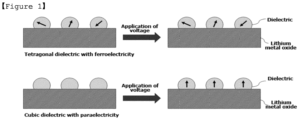
- FIG. 1 is a diagram schematically showing the direction of dipole formation in the dielectric when a voltage is applied to a positive electrode active material in which the surface of a lithium metal oxide is coated with a tetragonal dielectric or a positive electrode active material in which the surface of a lithium metal oxide is coated with a cubic dielectric.
- the tetragonal dielectric has ferroelectricity, and the cubic dielectric has paraelectricity.
- the tetragonal dielectric since the tetragonal dielectric has ferroelectricity, it has a pre-determined direction of dipole, and the direction of dipole on the surface of the lithium metal oxide is randomly distributed according to the direction to which the tetragonal dielectric is coated. Therefore, the orientation of the dipole does not change under the voltage applied during charge and discharge of the all-solid-state battery, and depends on the orientation to which the surface of the lithium metal oxide is coated. As the orientation of the dipole is randomly distributed, there is a problem of low reproducibility when charging and discharging an all-solid-state battery.
- the cubic dielectric has paraelectricity, so it does not have a dipole property before the voltage is applied, and the dipole is arranged in the vertical direction under the voltage applied during charge and discharge.
- the cubic dielectric can secure uniform dielectric properties, so it can achieve high reproducibility when charging and discharging an all-solid-state battery.
- the present invention includes a dielectric having a cubic structure with paraelectricity, and accordingly, it can provide an all-solid-state battery with excellent reproducibility.
- the dielectric having a cubic structure with paraelectricity of the present invention preferably has a dielectric constant of 100 to 400 at 25°C.
- the dielectric having a cubic structure may comprise at least one selected from the compounds represented by Formula 1. [Formula 1] ABO 3 ,
- Formula 1 preferably includes at least one selected from the group consisting of BaTiO 3 , SrTiO 3 , PbTiO 3 , KNbO 3 , NaTaO 3 , BiFeO 3 and PbZrTiO 3 , and may most preferably include at least one selected from the group consisting of BaTiO 3 and SrTiO 3 .
- the dielectric having a cubic structure may have an average particle size of 1 to 100 nm, preferably 3 to 80 nm, most preferably 25 to 60 nm. Since the dielectric having a cubic structure has an average particle size of 1 to 100 nm, the surface of the lithium metal oxide can be uniformly coated. If the average particle size is less than 1 nm, the dielectrics are too small, thereby agglomerating with each other, resulting in failure to reduce interfacial resistance, and if the average particle size exceeds 100 nm, some portions will remain uncoated on the surface of the lithium metal oxide, which is undesirable.
- the dielectric of the cubic structure may be comprised in an amount of from 0.5 to 5 wt%, preferably from 2 to 3 wt%, of the total weight of the positive electrode active material.
- the interfacial resistance can be reduced within the amount range of 0.5 to 5 wt%, while the interfacial resistance increases outside the above range, so that the electrochemical properties of an all-solid-state battery comprising same cannot be improved.
- the positive electrode active material for an all-solid-state battery of the present invention can be prepared by the following steps.
- a lithium metal oxide and a cubic dielectric are dispersed in a suitable solvent to prepare a dispersion.
- the solvent is not particularly limited as long as it can be quickly removed without degrading the electrochemical properties of the lithium metal oxide.
- the materials may preferably be prepared by stirring so that the material powder does not aggregate and has a uniform dispersed phase in a solvent.
- the dispersion is then heated to about 50 ° C to 100 ° C, and the solvent is removed by evaporation while the above temperature is maintained.
- the dispersion is preferably stirred to prevent the material powder from precipitating during the removal of the solvent from the dispersion. After removing the solvent, the resulting product is sintered at about 300°C to 500°C.
- a method of manufacturing a positive electrode active material is not limited to the above method, and any method can be utilized without limitation as long as a positive electrode active material having the above described structure can be obtained.
- the present invention also relates to a positive electrode for an all-solid-state battery, wherein the positive electrode may comprise the positive electrode active material of the present invention as described above, a sulfide-based solid electrolyte and a conductive material.
- the positive electrode may further comprise a binder resin, as needed.
- the solid electrolyte may comprise a polymeric solid electrolyte and/or an inorganic solid electrolyte, preferably an inorganic solid electrolyte.
- the inorganic solid electrolyte may include a sulfide-based solid electrolyte or an oxide-based solid electrolyte, and in the present invention, the solid electrolyte may preferably include a sulfide-based solid electrolyte.
- the polymeric solid electrolyte comprises a polymeric resin and a lithium salt, and may be a solid polymeric electrolyte in the form of a mixture of a solvated lithium salt and a polymeric resin, or a polymeric gel electrolyte in which an organic electrolyte containing an organic solvent and a lithium salt is added to a polymeric resin.
- the sulfide-based solid electrolyte comprises sulfur atoms among electrolyte components, but is not limited to a particularly specific component, and may include one or more of a crystalline solid electrolyte, an amorphous solid electrolyte (glassy solid electrolyte) or a glass-ceramic solid electrolyte.
- the sulfide-based solid electrolyte may comprise, but are not limited to, an LPS-type sulfide containing sulfur and phosphorus, Li 4-x Ge-P x S 4 (wherein 0.1 ⁇ x ⁇ 2, specifically 2/3 ⁇ x ⁇ 3/4), Li 10 ⁇ 1 MP 2 X 12 (wherein M is Ge, Si, Sn or Al, and X is S or Se), Li 3.833 Sn 0.833 As 0.
- LPS-type sulfide containing sulfur and phosphorus Li 4-x Ge-P x S 4 (wherein 0.1 ⁇ x ⁇ 2, specifically 2/3 ⁇ x ⁇ 3/4), Li 10 ⁇ 1 MP 2 X 12 (wherein M is Ge, Si, Sn or Al, and X is S or Se), Li 3.833 Sn 0.833 As 0.
- the conductive material is not particularly limited as long as it has conductivity without causing chemical changes in a battery comprising the material.
- the conductive material may include one or two or more mixtures selected from the group consisting of graphite, such as natural graphite or artificial graphite; a carbon black, such as carbon black, acetylene black, ketjhen black, channel black, furnace black, lamp black or summer black; a conductive fiber, such as a carbon fiber like a vapor grown carbon fiber (VGCF) or a metal fiber; a metal powder, such as carbon fluoride, aluminum, or nickel powder; a conductive whiskey, such as zinc oxide or potassium titanate; a conductive metal oxide, such as titanium oxide; and a conductive material, such as a polyphenylene derivative.
- graphite such as natural graphite or artificial graphite
- a carbon black such as carbon black, acetylene black, ketjhen black, channel black, furnace black, lamp black or summer black
- a conductive fiber such as
- the present invention also relates to an all-solid-state battery comprising a positive electrode; a negative electrode; and a solid electrolyte layer between these electrodes.
- the negative electrode includes a negative electrode active material, a solid electrolyte, and a conductive material, wherein the negative electrode active material can be any material that can be used as a negative electrode active material of a lithium ion secondary battery.
- the negative electrode active material may be one or two or more selected from the group consisting of carbon, such as anthracite carbon or graphitized carbon; a metal composite oxide such as Li x Fe 2 O 3 (wherein 0 ⁇ x ⁇ 1), Li x WO 2 (wherein 0 ⁇ x ⁇ 1), or Sn x Me 1-x Me' y O z (wherein Me is Mn, Fe, Pb, or Ge; Me' is Al, B, P, Si, elements of groups 1, 2 and 3 of the periodic table, or halogen; 0 ⁇ x ⁇ 1; 1 ⁇ y ⁇ 3; and 1 ⁇ z ⁇ 8); a lithium metal; a lithium alloy; a silicon-based alloy; a tin-based alloy; an indium-based alloy; a metal oxide such as S
- a solid electrolyte and a conductive material included in the negative electrode may refer to those described above for the positive electrode.
- the solid electrolyte layer comprises an ionically conductive material, wherein the ionically conductive material may comprise a polymeric solid electrolyte and/or an inorganic solid electrolyte component, and can be any material which is used for a solid electrolyte for an all-solid-state battery.
- the ionically conductive material contained in the solid electrolyte layer may refer to the polymer-based solid electrolyte and the inorganic-based solid electrolyte as described above.
- the present invention also provides a battery module including the secondary battery as a unit cell, a battery pack comprising the battery module, and a device comprising the battery pack as a power source.
- the device include, but are not limited to, a power tool that moves by the power from an electric motor; electric vehicles including an electric vehicle (EV), a hybrid electric vehicle (HEV), and a plug-in hybrid electric vehicle (PHEV); an electric two-wheeler including an electric bicycle (E-bike) and an electric scooter (E-scooter); an electric golf cart; or a power storage system, etc.
- electric vehicles including an electric vehicle (EV), a hybrid electric vehicle (HEV), and a plug-in hybrid electric vehicle (PHEV)
- E-bike electric bicycle
- E-scooter electric scooter
- an electric golf cart or a power storage system, etc.
- BaTiO 3 (MTI Korea) having a cubic structure with an average particle size of 50 to 60 nm and 5g of LiCoO 2 were added to 60 mL of isopropyl alcohol.
- the agglomerated BaTiO 3 particles were dispersed by using ultrasonication.
- the isopropyl alcohol was then evaporated by stirring the dispersion at 70 ° C, and the solvent and other impurities were removed by heat treatment at 400°C for 4 hours in an air atmosphere to prepare a positive electrode active material in which the LiCoO 2 surface was coated with BaTiO 3 particles.
- BaTiO 3 was contained in an amount of 1 wt% relative to the total weight of the positive electrode active material.
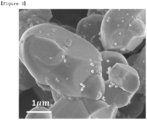
- the positive electrode active material was confirmed by using SEM, and it was found that the LiCoO 2 surface was coated with BaTiO 3 ( FIG. 2 ).
- a positive electrode composite was prepared by mixing a positive electrode active material, a solid electrolyte, and a conductive material at a weight ratio of 60:35:5, and the surface of an aluminum current collector was coated with the composite to prepare a positive electrode.
- the solid electrolyte was Li 6 PS 5 Cl
- the conductive material was Super-P
- the current collector was a composite material in which aluminum mesh and foil are laminated.
- a thin film of the alloy of lithium and indium (having a thickness of 100 ⁇ m) was bonded to the surface of a copper-based current collector.
- the current collector used a composite material in which copper mesh and thin film are laminated.
- a solid electrolyte layer was prepared. 100 mg of Li 6 PS 5 Cl was compressed at a pressure of 250 MPa to form a solid electrolyte layer with a thickness of about 500 um.
- FIG. 12 is a diagram schematically showing an exploded perspective view of the battery manufactured in this example.
- Example 1 Except for using SrTiO 3 (Sigma Aldrich) having a cubic structure with an average particle size of 50 to 60 nm, instead of BaTiO 3 having a cubic structure with an average particle size of 50 to 60 nm, the same procedure as in Example 1 was carried out to prepare an all-solid-state battery.
- SrTiO 3 Sigma Aldrich
- the positive electrode active material was confirmed by using SEM, and it was found that the LiCoO 2 surface was coated with SrTiO 3 ( FIG. 3 ).
- An all-solid-state battery was prepared in the same manner as in Example 1, except that LiCoO 2 was used as a positive electrode active material.
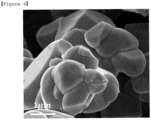
- the positive electrode active material was confirmed by using SEM, and only LiCoO 2 particles were observed ( FIG. 4 ).
- An all-solid-state battery was prepared in the same manner as in Example 1, except that BaTiO 3 (Sigma Aldrich) having a tetragonal structure with an average particle size of 50 to 60 nm was used, instead of BaTiO 3 having a cubic structure with an average particle size of 50 to 60 nm.
- BaTiO 3 Sigma Aldrich
- the positive electrode active material was confirmed by using SEM, and it was found that the LiCoO 2 surface was coated with BaTiO 3 ( FIG. 5 ).
- BaTiO 3 and SrTiO 3 with a cubic structure used in Examples 1 and 2 were measured by XRD to confirm their crystal structures, and the measurement results are shown in FIG. 6 .
- BaTiO 3 of Example 1 and SrTiO 3 of Example 2 were observed to have a (002) peak, indicating that they have a cubic structure.
- BaTiO 3 of Comparative Example 2 was observed to have peaks of (002) and (200), indicating that it has a tetragonal structure.
- the all-solid-state batteries of Example 1 Compared to the all-solid-state battery of Comparative Example 1, the all-solid-state batteries of Example 1, Example 2 and Comparative Example 2 exhibited higher discharge capacities. In addition, the all-solid-state batteries of Examples 1 and 2 exhibited higher discharge capacities than the all-solid-state battery of Comparative Example 2, and that of Example 2 exhibited the highest discharge capacity ( FIG. 7 ) .
- Example 1 Comparative Example 1 Comparative Example 2 Capacity at 3.9V or less during initial charge (mAh/g) 4.6 3.2 7.6 5.5 Initial efficiency 86.2% 90.6% 85.0% 86.0%
- Example 2 According to Table 1, it was confirmed that the irreversible capacity at 3.9V or less during initial charging in the all-solid-state battery of Comparative Example 2 was lower than that in the all-solid-state battery of Comparative Example 1, and the irreversible capacity at 3.9 V or less during initial charge was improved in Example 1. In particular, it was confirmed that the irreversible capacity of the all-solid-state battery of Example 2 was the lowest.
- Excellent characteristics exhibited in Example 2 compared to Example 1 are attributable to the fact that the dielectric constant of SrTiO 3 with a cubic structure of Example 2 is 300 at 25 °C, the dielectric constant of BaTiO 3 with a cubic structure is 150 at 25 °C, and SrTiO 3 has a higher dielectric constant than BaTiO 3 .
- Example 2 had the highest initial efficiency attributable thereto, which can be seen as a result of suppression of the initial irreversible reaction.
- the positive electrode active material in which the surface of lithium metal oxide is coated with a dielectric having a cubic structure suppresses the development of irreversible capacity during the initial charging process.
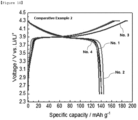
- Example 1 As a result, it was found that the three all-solid-state batteries of Example 1 had the almost same level of charge/discharge capacity and charge/discharge curve behavior ( FIG. 9 ).
- the difference in reproducibility is due to difference in the crystal structure of the dielectric, which is a coating material of lithium metal oxide.
- a dielectric having a tetragonal structure with ferroelectricity has poor reproducibility due to irregular distribution of dipole, while a dielectric having a cubic structure with paraelectricity can achieve high reproducibility due to uniform distribution of dipole in the vertical direction.
- rate characteristics was conducted to verify the effects of the dielectric in accordance with crystal structure, specifically to confirm that the interfacial resistance between the positive electrode and the solid electrolyte is reduced depending on the crystal structure of the dielectric coated on the surface of lithium metal oxide.
- Example 1 Example 2 Comparative Example 2 0.05C(mAh/g) 147.2 156 145 2C(mAh/g) 99.6 119.4 92.3
- Example 1 The all-solid-state batteries of Example 1 and Comparative Example 2 showed similar results at the low rate of 0.05C, but at the high rate of 2C, the all-solid-state battery of Example 1 showed a higher discharge capacity than the all-solid-state battery of Comparison 2 and a significant improvement in overvoltage. Furthermore, Example 2 exhibited superior properties at both low and high rate conditions compared to Example 1, which are attributable to the fact that SrTiO 3 with a cubic structure has a higher dielectric constant than BaTiO 3 with a cubic structure.
- a dielectric having a cubic structure with paraelectricity can reduce the interfacial resistance more than a dielectric having a tetragonal structure with ferroelectricity can, thereby providing an all-solid-state battery with improved rate characteristics and improved overvoltage.
- a dielectric with a cubic structure the higher the dielectric constant, the more improved effect described above can be achieved.
Landscapes
- Chemical & Material Sciences (AREA)
- General Chemical & Material Sciences (AREA)
- Chemical Kinetics & Catalysis (AREA)
- Electrochemistry (AREA)
- Engineering & Computer Science (AREA)
- Inorganic Chemistry (AREA)
- Composite Materials (AREA)
- Manufacturing & Machinery (AREA)
- Materials Engineering (AREA)
- General Physics & Mathematics (AREA)
- Condensed Matter Physics & Semiconductors (AREA)
- Physics & Mathematics (AREA)
- Crystallography & Structural Chemistry (AREA)
- Secondary Cells (AREA)
- Battery Electrode And Active Subsutance (AREA)
Abstract
Description
- This application claims the benefit of priority based on
Korean Patent Application No. 10-2022-0090983 filed on July 22, 2022 - The present invention relates to a positive electrode active material for an all-solid-state battery, a positive electrode for an all-solid-state battery comprising the same, and an all-solid-state battery.
- Lithium secondary batteries are widely used as a power source for portable devices, including IT mobile devices, and the market has recently grown from small lithium secondary batteries to medium or large secondary batteries. Particularly, the use of batteries for automobiles is rapidly increasing. To be used as a power source for an electric vehicle, a lithium secondary battery requires high energy density and high power characteristics, and it is considered especially important to secure safety.
- Conventional lithium secondary batteries use liquid, nonaqueous organic electrolytes, which have the risk of ignition and explosion. Since there are continuous explosion accidents of products applied with this technology, it is urgent to resolve this problem.
- An all-solid-state battery refers to a battery in which the liquid organic electrolyte is replaced with a solid one, and all components of the battery including the electrode and the electrolyte are solids. Due to the high safety of the solid electrolyte therein, the risk of ignition or explosion can be fundamentally eliminated.
- As a solid electrolyte of an all-solid-state lithium secondary battery, a gel-type polymer electrolyte, or a sulfide- or oxide-based solid electrolyte can be used. Among them, a sulfide-based solid electrolyte has a high lithium ion conductivity of more than 1×10⁻² S/cm, and a wide potential window of more than 5V, which causes less deterioration of characteristics even in extreme environments, and has a great advantage in designing a lithium ion secondary battery having high energy density.
- In an all-solid-state battery with such sulfide-based solid electrolyte, capacity is not properly expressed due to high interfacial resistance at the interface between the positive electrode active material and the sulfide-based solid electrolyte. Such interfacial resistance is considered to mainly occur by the following causes: 1) a space charge layer phenomenon in which a lithium deficient layer is formed on the interface of the solid electrolyte due to the difference in chemical potentials of the positive electrode active material and the solid electrolyte, and 2) formation of an interfacial impurity layer due to the chemical reaction at the interface of the positive electrode active material and the solid electrolyte.
- Conventionally, in order to solve this problem, the interface between a positive electrode active material and a solid electrolyte was coated with a lithium metal oxide (LiMexOy) having lithium ion conductivity as a buffer layer, so as to suppress formation of a space charge layer. However, formation of a space charge layer was not sufficiently suppressed by such method of coating the interface with a lithium metal oxide. Therefore, it is required to develop a new coating material that can suppress the interfacial resistance between a solid electrolyte and a positive electrode active material.
- In order to solve the above problem, the inventors of the present invention have conducted various studies and found that coating the surface of a lithium metal oxide with a dielectric having a cubic structure can reduce the interfacial resistance between a positive electrode active material and a sulfide-based solid electrolyte, and as a result, have completed the present invention.
- Accordingly, the present invention aims to provide a positive electrode active material capable of reducing the interfacial resistance between a positive electrode active material and a sulfide-based solid electrolyte, and a positive electrode comprising the same.
- Also, the present invention aims to provide an all-solid-state battery comprising the positive electrode, which has excellent initial efficiency, rate characteristics and reproducibility, and is capable of reducing overvoltage.
- To achieve the above objectives,
the present invention provides a positive electrode active material for an all-solid-state battery, the positive electorode active material comprising: a core portion comprising a lithium metal oxide; and a coating portion comprising a dielectric having a cubic structure on the surface of the core portion. - In addition, the present invention provides a positive electrode for an all-solid-state battery, the positive electrode comprising the positive electrode active material of the present invention.
- Moreover, the present invention provides an all-solid-state battery comprising a positive electrode of the present invention; a negative electrode; and a solid electrolyte layer between these electrodes.
- Since the surface of the positive electrode active material of the present invention is coated with a dielectric with a cubic structure, the resistance generated at the interface between the sulfide-based solid electrolyte and the positive electrode active material can be reduced.
- Furthermore, an all-solid-state battery comprising the positive electrode active material of the present invention can improve initial efficiency, rate characteristics and reproducibility, and can reduce overvoltage.
-
-
FIG. 1 is a diagram schematically showing the direction of dipole formation in a dielectric as a result of voltage application. -
FIG. 2 is an SEM image of the positive electrode active material of Example 1. -
FIG. 3 is an SEM image of the positive electrode active material of Example 2. -
FIG. 4 is an SEM image of the positive electrode active material of Comparative Example 1. -
FIG. 5 is an SEM image of the positive electrode active material of Comparative Example 2. -
FIG. 6 is a graph of the XRD patterns of the positive electrode active materials of Example 1, Example 2 and Comparative Example 2. -
FIG. 7 is a graph of the initial charge and discharge curves of the all-solid-state batteries of Example 1, Example 2, Comparative Example 1 and Comparative Example 2. -
FIG. 8 is a graph of initial irreversible capacities of the all-solid-state batteries of Example 1, Example 2, Comparative Example 1 and Comparative Example 2. -
FIG. 9 is a graph of the initial charge and discharge reproducibility of the all-solid-state battery of Example 1. -
FIG. 10 is a graph of the initial charge and discharge reproducibility of the all-solid-state battery of Comparative Example 2. -
FIG. 11 is a graph of the discharge curves of the all-solid-state batteries at 0.05C and 2C of Example 1, Example 2 and Comparative Example 2. -
FIG. 12 is a schematic diagram of an exploded perspective view of an all-solid-state battery manufactured in this embodiment. - The present invention is described in detail hereinafter.
- An all-solid-state battery uses a solid electrolyte to conduct lithium ions, and accordingly, the movement of lithium ions caused by charge and discharge occurs in a solid state. That is, in an all-solid-state battery, lithium ions can move only through an actual contact area between a positive electrode and a solid electrolyte. Therefore, the performance of an all-solid-state battery can be improved by minimizing the interfacial resistance between a positive electrode and a solid electrolyte.
- Accordingly, the present invention aims to provide a positive electrode active material that can reduce the interfacial resistance of a positive electrode and a solid electrolyte.
- The present invention relates to a positive electrode active material for an all-solid-state battery, the positive electrode active material comprising: a core portion comprising a lithium metal oxide; and a coating portion comprising a dielectric having a cubic structure on a surface of the core portion.
- The positive electrode active material of the present invention has a core-shell structure, wherein the core portion may include a lithium metal oxide, and the coating portion corresponding to the shell may include a dielectric having a cubic structure.
- The lithium metal oxide is a material capable of inserting and detaching lithium ions, and is not particularly limited as long as it can be used as a positive electrode active material for a lithium ion secondary battery.
- Preferably, the lithium metal oxide may be a compound represented by Formula 2.
[Formula 2] LixMyO2,
- wherein M includes at least one selected from the group consisting of Co, Mn, Ni, Al, Fe, V, Zn, Cr, Ti, Ta, Mg, Mo, Zr, W, Sn, Hf, Nd and Gd,
- wherein 0<x≤1.5, and
- wherein 0<y≤1.
- Furthermore, in
Formula 2, M may preferably comprise at least one selected from the group consisting of Co, Mn and Ni. - Specific examples of
formula 2 may include a layered compound such as a lithium cobalt oxide (LiCoO2) or a lithium nickel oxide (LiNiO2), or a compound substituted with other transition metals, such as Li1+a [NixMnyCo(1-x-y)]MzO2 (wherein 0≤a≤0.2, 0.4≤x≤0.9, 0<x+y<1, M is at least one element selected from the group consisting of Co, Mn, Ni, Al, Fe, V, Cr, Ti, Ta, Mg, Mo, Zr, W, Sn, Hf, Nd and Gd, and 0≤z≤0.1). - In one embodiment of the present invention, the lithium metal oxide, independently or simultaneously with the lithium metal oxide of
Formula 2, may further comprise one or two or more selected from the group consisting of a lithium manganese oxide such as Li1+xMn2-xO4 (wherein 0≤x≤0.33), Li1.1Mn1.9O4 or LiMn2O4; a lithium copper oxide (Li2CuO2); a vanadium oxide such as LiV3O8, V2O5 or Cu2V2O7; a lithium nickel oxide, LiNi1-xMxO2 (wherein M is Co, Mn, Al, Cu, Fe, Mg, B, Zr or Ga, and 0.1≤x≤0.3); a lithium manganese composite oxide represented by LiMn2-xMxO2 (wherein M is Co, Ni, Fe, Cr, Zn, Zr or Ta, and 0.01≤x≤0.1) or Li2Mn3MO8 (wherein M is Fe, Co, Ni, Cu, Zr or Zn); a lithium manganese composite oxide having a spinel structure represented by LiNixMn2-xO4; LiMn2O4 in which a portion of Li is substituted with an alkaline earth metal ion; a disulfide compound; and Fe2(MoO4)3. - The coating portion coated on the surface of the core portion includes a dielectric with a cubic structure.
- That is, the positive electrode active material for an all-solid-state battery of the present invention is a lithium metal oxide coated with a dielectric having a cubic structure. The coating suggests that a dielectric with a cubic structure is physically and/or chemically bonded to the surface of the core portion. More specifically, the dielectric with a cubic structure is distributed in the form of an island type on the surface of the core portion, and may be spaced apart from each other at a predetermined interval.
- When the surface of the lithium metal oxide is coated with the dielectric having a cubic structure in the form of an island type, the concentration of lithium increases around the area coated with the dielectric, thereby securing a passage for lithium ions, so that the interfacial resistance of the sulfide-based solid electrolyte can be reduced.
- If the surface of the core portion is coated by the dielectric having a cubic structure in the form of a layer covering the entire surface, the interfacial resistance may increase due to the difficulty in securing a passage for lithium, and accordingly, output characteristics may be deteriorated.
- The dielectric with a cubic structure may have paraelectricity.
- As the dielectric has paraelectricity, an all-solid-state battery comprising same can suppress irreversible reactions during the initial charging stage, thereby resulting in improved initial efficiency.
-
FIG. 1 is a diagram schematically showing the direction of dipole formation in the dielectric when a voltage is applied to a positive electrode active material in which the surface of a lithium metal oxide is coated with a tetragonal dielectric or a positive electrode active material in which the surface of a lithium metal oxide is coated with a cubic dielectric. - The tetragonal dielectric has ferroelectricity, and the cubic dielectric has paraelectricity.
- In
FIG. 1 , since the tetragonal dielectric has ferroelectricity, it has a pre-determined direction of dipole, and the direction of dipole on the surface of the lithium metal oxide is randomly distributed according to the direction to which the tetragonal dielectric is coated. Therefore, the orientation of the dipole does not change under the voltage applied during charge and discharge of the all-solid-state battery, and depends on the orientation to which the surface of the lithium metal oxide is coated. As the orientation of the dipole is randomly distributed, there is a problem of low reproducibility when charging and discharging an all-solid-state battery. - On the other hand, the cubic dielectric has paraelectricity, so it does not have a dipole property before the voltage is applied, and the dipole is arranged in the vertical direction under the voltage applied during charge and discharge. Thus, the cubic dielectric can secure uniform dielectric properties, so it can achieve high reproducibility when charging and discharging an all-solid-state battery.
- In other words, the present invention includes a dielectric having a cubic structure with paraelectricity, and accordingly, it can provide an all-solid-state battery with excellent reproducibility.
- The dielectric having a cubic structure with paraelectricity of the present invention preferably has a dielectric constant of 100 to 400 at 25°C.
- The dielectric having a cubic structure may comprise at least one selected from the compounds represented by
Formula 1.
[Formula 1] ABO3,
- wherein A is at least one selected from the group consisting of Ba, Pb, K, Na, Bi, Sr, Ca and La,
- wherein B is at least one selected from the group consisting of Ti, Nb, Ta, Fe, Zr, Bi, Ca, Ru, Pr and Sn,
- wherein A and B are different from each other.
-
Formula 1 preferably includes at least one selected from the group consisting of BaTiO3, SrTiO3, PbTiO3, KNbO3, NaTaO3, BiFeO3 and PbZrTiO3, and may most preferably include at least one selected from the group consisting of BaTiO3 and SrTiO3. - Further, the dielectric having a cubic structure may have an average particle size of 1 to 100 nm, preferably 3 to 80 nm, most preferably 25 to 60 nm. Since the dielectric having a cubic structure has an average particle size of 1 to 100 nm, the surface of the lithium metal oxide can be uniformly coated. If the average particle size is less than 1 nm, the dielectrics are too small, thereby agglomerating with each other, resulting in failure to reduce interfacial resistance, and if the average particle size exceeds 100 nm, some portions will remain uncoated on the surface of the lithium metal oxide, which is undesirable.
- Further, the dielectric of the cubic structure may be comprised in an amount of from 0.5 to 5 wt%, preferably from 2 to 3 wt%, of the total weight of the positive electrode active material. The interfacial resistance can be reduced within the amount range of 0.5 to 5 wt%, while the interfacial resistance increases outside the above range, so that the electrochemical properties of an all-solid-state battery comprising same cannot be improved.
- The positive electrode active material for an all-solid-state battery of the present invention can be prepared by the following steps.
- First, a lithium metal oxide and a cubic dielectric are dispersed in a suitable solvent to prepare a dispersion. The solvent is not particularly limited as long as it can be quickly removed without degrading the electrochemical properties of the lithium metal oxide.
- In one embodiment of the present invention, the materials may preferably be prepared by stirring so that the material powder does not aggregate and has a uniform dispersed phase in a solvent. The dispersion is then heated to about 50°C to 100°C, and the solvent is removed by evaporation while the above temperature is maintained. In one embodiment of the present invention, the dispersion is preferably stirred to prevent the material powder from precipitating during the removal of the solvent from the dispersion. After removing the solvent, the resulting product is sintered at about 300°C to 500°C. However, a method of manufacturing a positive electrode active material is not limited to the above method, and any method can be utilized without limitation as long as a positive electrode active material having the above described structure can be obtained.
- The present invention also relates to a positive electrode for an all-solid-state battery, wherein the positive electrode may comprise the positive electrode active material of the present invention as described above, a sulfide-based solid electrolyte and a conductive material.
- Further, the positive electrode may further comprise a binder resin, as needed.
- The solid electrolyte may comprise a polymeric solid electrolyte and/or an inorganic solid electrolyte, preferably an inorganic solid electrolyte. The inorganic solid electrolyte may include a sulfide-based solid electrolyte or an oxide-based solid electrolyte, and in the present invention, the solid electrolyte may preferably include a sulfide-based solid electrolyte.
- The polymeric solid electrolyte comprises a polymeric resin and a lithium salt, and may be a solid polymeric electrolyte in the form of a mixture of a solvated lithium salt and a polymeric resin, or a polymeric gel electrolyte in which an organic electrolyte containing an organic solvent and a lithium salt is added to a polymeric resin.
- The sulfide-based solid electrolyte comprises sulfur atoms among electrolyte components, but is not limited to a particularly specific component, and may include one or more of a crystalline solid electrolyte, an amorphous solid electrolyte (glassy solid electrolyte) or a glass-ceramic solid electrolyte. Specific examples of the sulfide-based solid electrolyte may comprise, but are not limited to, an LPS-type sulfide containing sulfur and phosphorus, Li4-xGe-PxS4 (wherein 0.1≤x≤2, specifically 2/3≤x≤3/4), Li10±1MP2X12 (wherein M is Ge, Si, Sn or Al, and X is S or Se), Li3.833Sn0.833As0. 166S4, Li4SnS4, Li3.25Ge0.25P0.75S4, Li2S-P2S5, B2S3-Li2S, xLi2S-(100-x)P2S5 (wherein 70≤x≤80), Li2SSiS2-Li3N, Li2S-P2S5-LiI, Li2S-SiS2-LiI, Li2S-B2S3-LiI, and Li3.25Ge0.25P0.75S4.
- The oxide-based solid electrolyte is an LLTO-based compound such as (La,Li)TiO3, Li6La2CaTa2O12, Li6La2ANb2O12 (wherein A=Ca, Sr), Li2Nd3TeSbO12, Li3BO2.5N0.5, Li9SiAlO8, an LAGP-based compound (Li1+xAlxGe2-x(PO4)3, wherein 0≤x≤1, and 0≤y≤1), an LATP-based compound such as Li2OAl2O3-TiO2-P2O5 (Li1+xAlxTi2-x(PO4)3, wherein 0≤x≤1, and 0≤y≤1), Li1+xTi2-xAlxSiy(PO4)3-y (wherein 0≤x≤1, and 0≤y≤1), LiAlxZr2-x(PO4)3 (wherein 0≤x≤1, and 0≤y≤1), LiTixZr2-x(PO4)3 (wherein 0≤x≤1, and 0≤y≤1), Li3N, LISICON, an LIPON-based compound (Li3+yPO4-xNx, wherein 0≤x≤1, and 0≤y≤1), a perovskite-based compound ((La, Li)TiO3), or a nasicon-based compound such as LiTi2(PO4)3, and may include at least one from an LLZO-based compound including lithium, lanthanum, zirconium and oxygen as components.
- The conductive material is not particularly limited as long as it has conductivity without causing chemical changes in a battery comprising the material. For example, the conductive material may include one or two or more mixtures selected from the group consisting of graphite, such as natural graphite or artificial graphite; a carbon black, such as carbon black, acetylene black, ketjhen black, channel black, furnace black, lamp black or summer black; a conductive fiber, such as a carbon fiber like a vapor grown carbon fiber (VGCF) or a metal fiber; a metal powder, such as carbon fluoride, aluminum, or nickel powder; a conductive whiskey, such as zinc oxide or potassium titanate; a conductive metal oxide, such as titanium oxide; and a conductive material, such as a polyphenylene derivative.
- The present invention also relates to an all-solid-state battery comprising a positive electrode; a negative electrode; and a solid electrolyte layer between these electrodes.
- The negative electrode includes a negative electrode active material, a solid electrolyte, and a conductive material, wherein the negative electrode active material can be any material that can be used as a negative electrode active material of a lithium ion secondary battery. For example, the negative electrode active material may be one or two or more selected from the group consisting of carbon, such as anthracite carbon or graphitized carbon; a metal composite oxide such as LixFe2O3 (wherein 0≤x≤1), LixWO2 (wherein 0≤x≤1), or SnxMe1-xMe'yOz (wherein Me is Mn, Fe, Pb, or Ge; Me' is Al, B, P, Si, elements of
groups - A solid electrolyte and a conductive material included in the negative electrode may refer to those described above for the positive electrode.
- The solid electrolyte layer comprises an ionically conductive material, wherein the ionically conductive material may comprise a polymeric solid electrolyte and/or an inorganic solid electrolyte component, and can be any material which is used for a solid electrolyte for an all-solid-state battery. In the present invention, the ionically conductive material contained in the solid electrolyte layer may refer to the polymer-based solid electrolyte and the inorganic-based solid electrolyte as described above.
- The present invention also provides a battery module including the secondary battery as a unit cell, a battery pack comprising the battery module, and a device comprising the battery pack as a power source.
- Specific examples of the device include, but are not limited to, a power tool that moves by the power from an electric motor; electric vehicles including an electric vehicle (EV), a hybrid electric vehicle (HEV), and a plug-in hybrid electric vehicle (PHEV); an electric two-wheeler including an electric bicycle (E-bike) and an electric scooter (E-scooter); an electric golf cart; or a power storage system, etc.
- Hereinafter, Examples are presented to further describe the present invention, but the following Examples are provided to illustrate the present invention, but the present invention is not limited thereto.
- 0.05g of BaTiO3 (MTI Korea) having a cubic structure with an average particle size of 50 to 60 nm and 5g of LiCoO2 were added to 60 mL of isopropyl alcohol. The agglomerated BaTiO3 particles were dispersed by using ultrasonication. The isopropyl alcohol was then evaporated by stirring the dispersion at 70°C, and the solvent and other impurities were removed by heat treatment at 400°C for 4 hours in an air atmosphere to prepare a positive electrode active material in which the LiCoO2 surface was coated with BaTiO3 particles. At this time, BaTiO3 was contained in an amount of 1 wt% relative to the total weight of the positive electrode active material. The positive electrode active material was confirmed by using SEM, and it was found that the LiCoO2 surface was coated with BaTiO3 (
FIG. 2 ). - A positive electrode composite was prepared by mixing a positive electrode active material, a solid electrolyte, and a conductive material at a weight ratio of 60:35:5, and the surface of an aluminum current collector was coated with the composite to prepare a positive electrode.
- The solid electrolyte was Li6PS5Cl, the conductive material was Super-P, and the current collector was a composite material in which aluminum mesh and foil are laminated.
- As a counter electrode, a thin film of the alloy of lithium and indium (having a thickness of 100µm) was bonded to the surface of a copper-based current collector. The current collector used a composite material in which copper mesh and thin film are laminated.
- Next, a solid electrolyte layer was prepared. 100 mg of Li6PS5Cl was compressed at a pressure of 250 MPa to form a solid electrolyte layer with a thickness of about 500 um.
- The prepared positive electrode, solid electrolyte layer, and negative electrode were stacked in order in a 10 mm mold type pressure cell and pressurized to a pressure of 440 MPa to produce an all-solid-state battery.
FIG. 12 is a diagram schematically showing an exploded perspective view of the battery manufactured in this example. - Except for using SrTiO3 (Sigma Aldrich) having a cubic structure with an average particle size of 50 to 60 nm, instead of BaTiO3 having a cubic structure with an average particle size of 50 to 60 nm, the same procedure as in Example 1 was carried out to prepare an all-solid-state battery.
- The positive electrode active material was confirmed by using SEM, and it was found that the LiCoO2 surface was coated with SrTiO3 (
FIG. 3 ). - An all-solid-state battery was prepared in the same manner as in Example 1, except that LiCoO2 was used as a positive electrode active material.
- The positive electrode active material was confirmed by using SEM, and only LiCoO2 particles were observed (
FIG. 4 ). - An all-solid-state battery was prepared in the same manner as in Example 1, except that BaTiO3 (Sigma Aldrich) having a tetragonal structure with an average particle size of 50 to 60 nm was used, instead of BaTiO3 having a cubic structure with an average particle size of 50 to 60 nm.
- The positive electrode active material was confirmed by using SEM, and it was found that the LiCoO2 surface was coated with BaTiO3 (
FIG. 5 ). - BaTiO3 and SrTiO3 with a cubic structure used in Examples 1 and 2, and BaTiO3 with a tetragonal structure used in Comparative Example 2 were measured by XRD to confirm their crystal structures, and the measurement results are shown in
FIG. 6 . - BaTiO3 of Example 1 and SrTiO3 of Example 2 were observed to have a (002) peak, indicating that they have a cubic structure. BaTiO3 of Comparative Example 2 was observed to have peaks of (002) and (200), indicating that it has a tetragonal structure.
- The initial charge and discharge characteristics of the all-solid-state batteries of Example 1, Example 2, Comparative Example 1, and Comparative Example 2 were measured.
- The above measurements were carried out in a voltage range of 2.5 to 4.3V (Li/Li+) at 0.05C.
- Compared to the all-solid-state battery of Comparative Example 1, the all-solid-state batteries of Example 1, Example 2 and Comparative Example 2 exhibited higher discharge capacities. In addition, the all-solid-state batteries of Examples 1 and 2 exhibited higher discharge capacities than the all-solid-state battery of Comparative Example 2, and that of Example 2 exhibited the highest discharge capacity (
FIG. 7 ) . - The measurement results of the initial efficiency are shown in Table 1 below, and the capacity at 3.9V or less during initial charge are shown in Table 1 and
FIG. 8 below.[Table 1] Example 1 Example 2 Comparative Example 1 Comparative Example 2 Capacity at 3.9V or less during initial charge (mAh/g) 4.6 3.2 7.6 5.5 Initial efficiency 86.2% 90.6% 85.0% 86.0% - According to Table 1, it was confirmed that the irreversible capacity at 3.9V or less during initial charging in the all-solid-state battery of Comparative Example 2 was lower than that in the all-solid-state battery of Comparative Example 1, and the irreversible capacity at 3.9 V or less during initial charge was improved in Example 1. In particular, it was confirmed that the irreversible capacity of the all-solid-state battery of Example 2 was the lowest. Excellent characteristics exhibited in Example 2 compared to Example 1 are attributable to the fact that the dielectric constant of SrTiO3 with a cubic structure of Example 2 is 300 at 25 °C, the dielectric constant of BaTiO3 with a cubic structure is 150 at 25 °C, and SrTiO3 has a higher dielectric constant than BaTiO3.
- In addition, the all-solid-state battery in Example 2 had the highest initial efficiency attributable thereto, which can be seen as a result of suppression of the initial irreversible reaction.
- That is, it can be seen that the positive electrode active material in which the surface of lithium metal oxide is coated with a dielectric having a cubic structure suppresses the development of irreversible capacity during the initial charging process.
- In order to confirm the reproducibility of the all-solid-state batteries of Example 1 and Comparative Example 2, three all-solid-state batteries prepared by the method of Example 1 and four all-solid-state batteries prepared by the method of Comparative Example 2 were prepared, and the initial charge and discharge characteristics of these batteries were measured by using the same method as in Experimental Example 2 above.
- As a result, it was found that the three all-solid-state batteries of Example 1 had the almost same level of charge/discharge capacity and charge/discharge curve behavior (
FIG. 9 ). - On the other hand, the four all-solid-state batteries of Comparative Example 2 exhibited deviations in charge and discharge capacity depending on the type of battery (
FIG. 10 ). - The difference in reproducibility is due to difference in the crystal structure of the dielectric, which is a coating material of lithium metal oxide.
- Specifically, a dielectric having a tetragonal structure with ferroelectricity has poor reproducibility due to irregular distribution of dipole, while a dielectric having a cubic structure with paraelectricity can achieve high reproducibility due to uniform distribution of dipole in the vertical direction.
- Therefore, it can be seen that the use of a dielectric having a cubic structure with paraelectricity can secure the reproducibility of the surface of a positive electrode, thereby obtaining characteristics of a superior all-solid-state battery.
- The rate characteristics of the all-solid-state batteries of Example 1, Example 2, and Comparative Example 2 were measured.
- The evaluation of rate characteristics was conducted to verify the effects of the dielectric in accordance with crystal structure, specifically to confirm that the interfacial resistance between the positive electrode and the solid electrolyte is reduced depending on the crystal structure of the dielectric coated on the surface of lithium metal oxide.
- The above measurements were conducted in a voltage range of 2.5 to 4.3 V (vs Li/Li+) at 0.05C and 2C.
- The measurement results are shown in Table 2 and
Figure 11 below.[Table 2] Example 1 Example 2 Comparative Example 2 0.05C(mAh/g) 147.2 156 145 2C(mAh/g) 99.6 119.4 92.3 - The all-solid-state batteries of Example 1 and Comparative Example 2 showed similar results at the low rate of 0.05C, but at the high rate of 2C, the all-solid-state battery of Example 1 showed a higher discharge capacity than the all-solid-state battery of
Comparison 2 and a significant improvement in overvoltage. Furthermore, Example 2 exhibited superior properties at both low and high rate conditions compared to Example 1, which are attributable to the fact that SrTiO3 with a cubic structure has a higher dielectric constant than BaTiO3 with a cubic structure. - In this regard, it can be seen that a dielectric having a cubic structure with paraelectricity can reduce the interfacial resistance more than a dielectric having a tetragonal structure with ferroelectricity can, thereby providing an all-solid-state battery with improved rate characteristics and improved overvoltage. Moreover, it can be seen that in a dielectric with a cubic structure, the higher the dielectric constant, the more improved effect described above can be achieved.
Claims (11)
- A positive electrode active material for an all-solid-state battery, the positive electrode active material comprising:a core portion comprising a lithium metal oxide; anda coating portion comprising a dielectric having a cubic structure on a surface of the core portion.
- The positive electrode active material for an all-solid-state battery according to claim 1, wherein the dielectric having a cubic structure has paraelectricity.
- The positive electrode active material for an all-solid-state battery according to claim 2, wherein the dielectric having a cubic structure comprises at least one selected from the compounds represented by Formula 1:
[Formula 1] ABO3,
wherein A is at least one selected from the group consisting of Ba, Pb, K, Na, Bi, Sr, Ca and La,wherein B is at least one selected from the group consisting of Ti, Nb, Ta, Fe, Zr, Bi, Ca, Ru, Pr and Sn,wherein A and B are different from each other. - The positive electrode active material for an all-solid-state battery according to claim 3, wherein the dielectric comprises at least one selected from the group consisting of BaTiO3 and SrTiO3 having a cubic structure.
- The positive electrode active material for an all-solid-state battery according to claim 1, wherein the dielectric having a cubic structure with paraelectricity has a dielectric constant of 100 to 400 at 25 °C.
- The positive electrode active material for an all-solid-state battery according to claim 1, wherein the dielectric has an average particle size of 1 to 100 nm.
- The positive electrode active material for an all-solid-state battery according to claim 1, wherein the dielectric having a cubic structure is distributed in the form of an island type on the surface of the core portion and spaced apart from each other at a predetermined interval.
- The positive electrode active material for an all-solid-state battery according to claim 1, wherein the positive electrode active material comprises a dielectric in an amount of from 0.5 to 5 wt% based on the total weight of the positive electrode active material.
- The positive electrode active material for an all-solid-state battery according to claim 1, wherein the lithium metal oxide is represented by Formula 2:
[Formula 2] LixMyO2,
wherein M includes at least one selected from the group consisting of Co, Mn, Ni, Al, Fe, V, Zn, Cr, Ti, Ta, Mg, Mo, Zr, W, Sn, Hf, Nd and Gd,wherein 0<x≤1.5, andwherein 0<y≤1. - A positive electrode for an all-solid-state battery, the positive electrode comprising:the positive electrode active material according to any one of claims 1 to 9;a sulfide-based solid electrolyte; anda conductive material.
- An all-solid-state battery comprising:the positive electrode according to claim 10;a negative electrode; anda solid electrolyte layer between the positive electrode and the negative electrode.
Applications Claiming Priority (2)
| Application Number | Priority Date | Filing Date | Title |
|---|---|---|---|
| KR1020220090983A KR20240013447A (en) | 2022-07-22 | 2022-07-22 | Positive electrode active material for an all solid type battery, positive electrode and all solid type battery comprising the same |
| PCT/KR2023/010124 WO2024019437A1 (en) | 2022-07-22 | 2023-07-14 | Cathode active material for all-solid-state batteries, and cathode for all-solid-state batteries and all-solid-state battery including same |
Publications (2)
| Publication Number | Publication Date |
|---|---|
| EP4386902A1 true EP4386902A1 (en) | 2024-06-19 |
| EP4386902A4 EP4386902A4 (en) | 2026-03-11 |
Family
ID=89618042
Family Applications (1)
| Application Number | Title | Priority Date | Filing Date |
|---|---|---|---|
| EP23843286.8A Pending EP4386902A4 (en) | 2022-07-22 | 2023-07-14 | Cathode active material for solid-state batteries and cathode for solid-state batteries and solid-state battery so that |
Country Status (6)
| Country | Link |
|---|---|
| US (1) | US20240387811A1 (en) |
| EP (1) | EP4386902A4 (en) |
| JP (1) | JP2024539112A (en) |
| KR (1) | KR20240013447A (en) |
| CN (1) | CN118043993A (en) |
| WO (1) | WO2024019437A1 (en) |
Family Cites Families (9)
| Publication number | Priority date | Publication date | Assignee | Title |
|---|---|---|---|---|
| JP4237074B2 (en) * | 2004-02-16 | 2009-03-11 | ソニー株式会社 | Cathode active material for non-aqueous electrolyte secondary battery and non-aqueous electrolyte secondary battery |
| KR102238558B1 (en) * | 2017-12-28 | 2021-04-08 | 삼성에스디아이 주식회사 | Cathode active material, cathode for non-aqueous electrolyte secondary battery, and non-aqueous electrolyte secondary battery |
| KR102678330B1 (en) * | 2018-07-12 | 2024-06-24 | 주식회사 엘지에너지솔루션 | A cathode active material for an all solid type battery and a cathode for an all solid type battery comprising the same |
| JP7190650B2 (en) * | 2018-09-05 | 2022-12-16 | パナソニックIpマネジメント株式会社 | POSITIVE ACTIVE MATERIAL AND BATTERY INCLUDING SAME |
| KR102201326B1 (en) * | 2019-01-08 | 2021-01-11 | 한국생산기술연구원 | Method of manufacturing cathode active material coated titanium dioxide |
| US11264602B2 (en) * | 2019-05-08 | 2022-03-01 | Samsung Electronics Co., Ltd. | Sulfide glass-ceramic lithium-ion solid-state conductor |
| CN110299518A (en) * | 2019-06-14 | 2019-10-01 | 厦门大学 | High pressure lithium cobaltate cathode material, preparation method and lithium ion secondary battery |
| KR102478544B1 (en) | 2020-12-23 | 2022-12-16 | 목포대학교산학협력단 | Manufacturing method of yttria suspension for plasma spray coating |
| CN113353988B (en) * | 2021-02-18 | 2023-06-02 | 厦门厦钨新能源材料股份有限公司 | Lithium ion battery positive electrode material, preparation method thereof, lithium ion battery positive electrode and all-solid-state lithium battery |
-
2022
- 2022-07-22 KR KR1020220090983A patent/KR20240013447A/en active Pending
-
2023
- 2023-07-14 WO PCT/KR2023/010124 patent/WO2024019437A1/en not_active Ceased
- 2023-07-14 JP JP2024523497A patent/JP2024539112A/en active Pending
- 2023-07-14 EP EP23843286.8A patent/EP4386902A4/en active Pending
- 2023-07-14 CN CN202380013857.4A patent/CN118043993A/en active Pending
- 2023-07-14 US US18/696,312 patent/US20240387811A1/en active Pending
Also Published As
| Publication number | Publication date |
|---|---|
| EP4386902A4 (en) | 2026-03-11 |
| US20240387811A1 (en) | 2024-11-21 |
| KR20240013447A (en) | 2024-01-30 |
| CN118043993A (en) | 2024-05-14 |
| WO2024019437A1 (en) | 2024-01-25 |
| JP2024539112A (en) | 2024-10-28 |
Similar Documents
| Publication | Publication Date | Title |
|---|---|---|
| EP3869584B1 (en) | All-solid secondary battery, and method of manufacturing all solid secondary battery | |
| US20230055212A1 (en) | All-solid secondary battery and method of preparing the same | |
| KR101256641B1 (en) | Positive active material for lithium secondary battery and method for thereof | |
| CN101510605B (en) | Positive electrode active material, positive electrode having same, and nonaqueous electrolyte secondary battery | |
| EP3486979A1 (en) | Cathode active material for secondary battery, and preparation method therefor | |
| CN107210438B (en) | Non-aqueous electrolyte batteries and battery packs | |
| KR20110027617A (en) | Method for producing a positive electrode active material, a positive electrode, a nonaqueous electrolyte battery and a positive electrode active material | |
| WO2003043109A1 (en) | Electrode active materials for lithium secondary batteries, method for preparing the same, and lithium secondary batteries using the same | |
| KR20080114524A (en) | Positive electrode active material for nonaqueous electrolyte secondary batteries, a manufacturing method thereof, and nonaqueous electrolyte secondary battery | |
| KR20150000564A (en) | Composite cathode active material, preparation method thereof, and cathode and lithium battery containing the material | |
| KR20160081111A (en) | Composite positive active material, preparing method thereof, positive electrode including the same, and lithium secondary battery including the positive electrode | |
| US20240145767A1 (en) | Solid-state electrolyte, lithium battery comprising solid-state electrolyte, and preparation method of solid-state electrolyte | |
| US20230307704A1 (en) | Solid electrolyte material, and battery in which same is used | |
| CN113381020A (en) | Porous dielectric particles, electrode for lithium ion secondary battery, and lithium ion secondary battery | |
| US20230253612A1 (en) | Solid electrolyte, preparing method thereof, and all solid state battery | |
| US20240222631A1 (en) | Cathode, lithium secondary battery including the same, and method of preparing cathode | |
| KR20220053459A (en) | Electrode active material, preparing method thereof, an electrode including the same, and secondary battery including the same | |
| KR102678330B1 (en) | A cathode active material for an all solid type battery and a cathode for an all solid type battery comprising the same | |
| JP2017183055A (en) | Positive electrode material for lithium ion secondary batteries, positive electrode for lithium ion secondary battery, and lithium ion secondary battery | |
| KR20230141651A (en) | A cathode for an all- solid-state battery and an all- solid-state battery comprising the same | |
| US20240113327A1 (en) | Solid-state electrolyte, lithium battery comprising solid-state electrolyte, and preparation method of solid-state electrolyte | |
| EP4614607A1 (en) | Method for manufacturing positive electrode active material for lithium-ion secondary battery | |
| US20240387811A1 (en) | Positive electrode active material for all-solid-state battery, positive electrode comprising the same, and all-solid-state battery | |
| KR20240041822A (en) | Solid state electrolyte, Lithium battery comprising soldi state electrolyte, and Preparation method of solid state electrolyte | |
| US20240154159A1 (en) | Electrolyte, Lithium Battery Including the Same, and Method of Preparing the Electrolyte |
Legal Events
| Date | Code | Title | Description |
|---|---|---|---|
| STAA | Information on the status of an ep patent application or granted ep patent |
Free format text: STATUS: THE INTERNATIONAL PUBLICATION HAS BEEN MADE |
|
| PUAI | Public reference made under article 153(3) epc to a published international application that has entered the european phase |
Free format text: ORIGINAL CODE: 0009012 |
|
| STAA | Information on the status of an ep patent application or granted ep patent |
Free format text: STATUS: REQUEST FOR EXAMINATION WAS MADE |
|
| 17P | Request for examination filed |
Effective date: 20240315 |
|
| AK | Designated contracting states |
Kind code of ref document: A1 Designated state(s): AL AT BE BG CH CY CZ DE DK EE ES FI FR GB GR HR HU IE IS IT LI LT LU LV MC ME MK MT NL NO PL PT RO RS SE SI SK SM TR |
|
| DAV | Request for validation of the european patent (deleted) | ||
| DAX | Request for extension of the european patent (deleted) | ||
| A4 | Supplementary search report drawn up and despatched |
Effective date: 20260206 |
|
| RIC1 | Information provided on ipc code assigned before grant |
Ipc: H01M 4/36 20060101AFI20260202BHEP Ipc: H01M 4/62 20060101ALI20260202BHEP Ipc: H01M 4/131 20100101ALI20260202BHEP Ipc: H01M 10/052 20100101ALI20260202BHEP Ipc: H01M 10/0562 20100101ALI20260202BHEP Ipc: H01M 4/02 20060101ALI20260202BHEP Ipc: H01M 4/505 20100101ALI20260202BHEP Ipc: H01M 4/525 20100101ALI20260202BHEP Ipc: H01M 10/0525 20100101ALI20260202BHEP |