EP4386095A1 - Method for producing agglomerated raw material - Google Patents
Method for producing agglomerated raw material Download PDFInfo
- Publication number
- EP4386095A1 EP4386095A1 EP22875539.3A EP22875539A EP4386095A1 EP 4386095 A1 EP4386095 A1 EP 4386095A1 EP 22875539 A EP22875539 A EP 22875539A EP 4386095 A1 EP4386095 A1 EP 4386095A1
- Authority
- EP
- European Patent Office
- Prior art keywords
- raw material
- heating
- agglomerated
- temperature
- pressure
- Prior art date
- Legal status (The legal status is an assumption and is not a legal conclusion. Google has not performed a legal analysis and makes no representation as to the accuracy of the status listed.)
- Pending
Links
Images

Classifications
-
- C—CHEMISTRY; METALLURGY
- C22—METALLURGY; FERROUS OR NON-FERROUS ALLOYS; TREATMENT OF ALLOYS OR NON-FERROUS METALS
- C22B—PRODUCTION AND REFINING OF METALS; PRETREATMENT OF RAW MATERIALS
- C22B1/00—Preliminary treatment of ores or scrap
- C22B1/14—Agglomerating; Briquetting; Binding; Granulating
-
- C—CHEMISTRY; METALLURGY
- C22—METALLURGY; FERROUS OR NON-FERROUS ALLOYS; TREATMENT OF ALLOYS OR NON-FERROUS METALS
- C22B—PRODUCTION AND REFINING OF METALS; PRETREATMENT OF RAW MATERIALS
- C22B1/00—Preliminary treatment of ores or scrap
- C22B1/14—Agglomerating; Briquetting; Binding; Granulating
- C22B1/24—Binding; Briquetting ; Granulating
-
- B—PERFORMING OPERATIONS; TRANSPORTING
- B30—PRESSES
- B30B—PRESSES IN GENERAL
- B30B11/00—Presses specially adapted for forming shaped articles from material in particulate or plastic state, e.g. briquetting presses, tabletting presses
- B30B11/20—Roller-and-ring machines, i.e. with roller disposed within a ring and co-operating with the inner surface of the ring
- B30B11/201—Roller-and-ring machines, i.e. with roller disposed within a ring and co-operating with the inner surface of the ring for extruding material
- B30B11/208—Roller constructions; Mounting of the rollers
-
- B—PERFORMING OPERATIONS; TRANSPORTING
- B30—PRESSES
- B30B—PRESSES IN GENERAL
- B30B15/00—Details of, or accessories for, presses; Auxiliary measures in connection with pressing
- B30B15/34—Heating or cooling presses or parts thereof
-
- C—CHEMISTRY; METALLURGY
- C21—METALLURGY OF IRON
- C21B—MANUFACTURE OF IRON OR STEEL
- C21B13/00—Making spongy iron or liquid steel, by direct processes
- C21B13/0046—Making spongy iron or liquid steel, by direct processes making metallised agglomerates or iron oxide
-
- C—CHEMISTRY; METALLURGY
- C21—METALLURGY OF IRON
- C21B—MANUFACTURE OF IRON OR STEEL
- C21B13/00—Making spongy iron or liquid steel, by direct processes
- C21B13/02—Making spongy iron or liquid steel, by direct processes in shaft furnaces
-
- C—CHEMISTRY; METALLURGY
- C21—METALLURGY OF IRON
- C21B—MANUFACTURE OF IRON OR STEEL
- C21B13/00—Making spongy iron or liquid steel, by direct processes
- C21B13/12—Making spongy iron or liquid steel, by direct processes in electric furnaces
-
- C—CHEMISTRY; METALLURGY
- C21—METALLURGY OF IRON
- C21B—MANUFACTURE OF IRON OR STEEL
- C21B5/00—Making pig-iron in the blast furnace
- C21B5/008—Composition or distribution of the charge
Definitions
- the present invention relates to a method for producing an agglomerated raw material, which involves agglomerating a raw material containing powdered iron oxide.
- Non-Patent Literature 1 describes a production method which involves agglomerating a powdered raw material, either in a powdery or granular form, whose melting point or decomposition temperature and sintering temperature are close to each other.
- silicon nitride is used as the powdered raw material, and the powdered raw material is agglomerated by a hot press which presses the powdered raw material while heating it.
- the heating of the powdered raw material by the hot press is performed by heating a mold filled with the powdered raw material.
- Non-Patent Literature 1 states that the mold may be heated by a resistance heating method, an induction heating method, or the like.
- the heating temperature of silicon nitride as the powdered raw material is set at 1800°C, which is close to 1900°C which is the melting point of silicon nitride or the temperature at which silicon nitride begins to decompose.
- the pressure applied to silicon nitride in the hot press is set at 10 atmospheres.
- the literature states that such a hot-press method can sinter silicon nitride without melting it.
- NPL 1 Yoneya, M., "Pressure Application Technology for Sintering of Ceramics", Journal of High Pressure Institute of Japan, 1992, vol 30, no. 2, pp. 60-68
- Non-Patent Literature 1 silicon nitride as a powdered raw material is heated to the melting point or decomposition temperature of silicon nitride while it is being pressed. Since the heating temperature is high, the method described in Non-Patent Literature 1 may consume a large amount of energy when agglomerating silicon nitride. Also, when agglomerating a raw material for use in a blast furnace or a shaft furnace, it is preferred to perform the agglomeration at a temperature lower than conventional methods, and as low as possible.
- the present invention has been made to solve the above problem. It is therefore an object of the present invention to provide an agglomerated raw material production method which can agglomerate a raw material at a lower temperature than the conventional methods, thereby reducing energy consumption.
- the present invention for solving the above problem can be embodied as follows.
- a raw material containing iron oxide can be agglomerated at a lower temperature than the conventional methods, thus enabling an overall reduction in energy consumption.
- An agglomerated raw material production method is a production method which involves agglomeration of a raw material containing more than 50% by mass of iron oxide having a particle size smaller than a preset particle size (hereinafter referred to as "the raw material"). It is also a production method which, by agglomerating the raw material, allows it to be used as a raw material in a pig iron production process using, for example, a blast furnace or a shaft furnace.
- the preset particle size is a size suited for a raw material for use in a pig iron production process using a blast furnace or a shaft furnace. In particular, the preset particle size may be not less than 5 mm and less than 50 mm.
- the raw material containing iron oxide having a particle size smaller than a preset particle size is a raw material containing iron ore having a particle size of less than 5 mm, or return ore having a particle size of less than 5 mm produced in a sintered ore production process.
- the raw material may contain a metal oxide such as silicon dioxide, calcium oxide, or aluminum oxide, and a non-ferrous material in addition to iron oxide as the main component.
- the total amount of the metal oxide other than iron oxide, the non-ferrous material, etc. is preferably not more than 20% by mass of the raw material.
- the particle size is determined by a screen; for example, iron ore having a particle size of less than 5 mm refers to iron ore which is screened out by a 5 mm-mesh screen.
- the raw material is agglomerated by heating it at a target temperature while pressing it at a target pressure.
- the raw material is agglomerated by increasing the temperature of the raw material to the target temperature while increasing the pressure applied to the raw material to the target pressure.
- the pressure and temperature of the raw material may be increased to their target values substantially simultaneously.
- the raw material may be agglomerated by increasing the temperature of the raw material to the target temperature when the target pressure of the raw material has been reached, or the raw material may be agglomerated by increasing the pressure of the raw material to the target pressure when the target temperature of the raw material has been reached.
- the target pressure and the target temperature are a pressure and a temperature at which the raw material can be agglomerated and which can be experimentally determined.
- the pressure may be determined by measuring the pressure in a container filled with the raw material using a conventionally known pressure sensor, or may be calculated based on a load applied to the container to apply a pressure to the raw material.
- the temperature may be determined by measuring the temperature in the container filled with the raw material using a temperature sensor provided on the inner wall of the container.
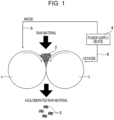
- FIG. 1 is a diagram schematically showing an example of a double-roll type pressure device to which an agglomerated raw material production method according to an embodiment of the present invention can be applied.
- the double-roll type pressure device includes a pair of rolls 1 disposed with a predetermined clearance (not shown) therebetween and having a plurality of molds (not shown), each corresponding to the shape of a half of a molded product, formed in their peripheral surfaces.
- a raw material 2 is filled into molds of the rolls 1, and the raw material 2 is pressed as the rolls 1 rotate and the molds of the rolls 1 approach each other.
- the raw material 2 may be pressed using, instead of such a double-roll type pressure device, a tablet-compression method which involves filling the raw material 2 into a space formed by a mold and a punch, and compression-molding the raw material 2 by pushing the punch into the space.
- a tablet-compression method which involves filling the raw material 2 into a space formed by a mold and a punch, and compression-molding the raw material 2 by pushing the punch into the space.
- the raw material 2 may be heated using an electric furnace; however, it is preferred to heat the raw material 2 mainly by electrical heating.
- Electrical heating is a method which involves applying an electric current to a raw material to heat it.
- an anode 5 and a cathode 6 of a power supply device 4 are connected to one and the other, respectively, of the rolls 1.
- the double-roll type pressure device shown in FIG. 1 is thus configured to be capable of electrically heating the raw material 2 while pressing it.
- Induction heating is a method which involves placing the raw material 2 in a magnetic field, generated by applying an alternating current to a conducting wire, to cause an electric current in the raw material 2, thereby heating the raw material 2.
- induction heating likewise heats the raw material 2 by allowing electricity to flow through the raw material 2.
- the electrical heating according to the present embodiments therefore includes not only direct electrical heating but induction heating as well.
- a magnetic field is generated around it to cause an electric current in the raw material 2, thereby heating the raw material 2.
- heat the raw material 2 mainly by electrical heating means that when the raw material 2 is heated using electrical heating and other heating method(s) in combination, the amount of heat generated in the raw material 2 by the electrical heating is at least 50% of the total heat generated in the raw material 2.
- the “other heating method(s)” includes, for example, heating in an electric furnace, and heating of the raw material with heat generated upon the combustion of a given fuel.
- the raw material 2 is heated while its particles are being pressed or compressed to each other.
- heating of the raw material 2 can be performed with the contact areas of the particles increased as compared to heating of non-pressed raw material 2.
- This promotes binding between particles of the raw material 2, making it possible to agglomerate the raw material 2 at a lower temperature than that in agglomeration of non-pressed raw material 2 even though the raw material 2 contains 50% by mass or more of iron oxide which is difficult to agglomerate.
- a granular or powdered metal which deforms plastically and has a higher electrical conductivity than iron
- the additive metal to be added to the raw material 2 is, for example, copper, iron, or niobium.
- the additive metal is pressed by the raw material 2 and deforms plastically. Particles of the raw material 2 are brought into close contact with each other via the plastically deformed additive metal, whereby the particles are strongly bound together.
- the additive metal functions as a binder. Therefore, compared with the case where the raw material 2 contains no additive metal, particles of the raw material 2 can be bound together at a lower temperature to obtain an agglomerated raw material 3.
- the amount of the additive metal in the raw material 2 increases, the amount of iron oxide to be reduced decreases. Since the agglomerated raw material 3 is used as a raw material in a pig iron production process that performs gas reduction of the raw material, a decrease in the amount of iron oxide contained in the agglomerated raw material 3 is undesirable. Therefore, it is preferred to use the raw material 2 containing more than 50% by mass of iron oxide, and to use the additive metal in the smallest possible amount. Further, while the additive metal deforms plastically and binds particles of the raw material 2 together, it fills gaps between particles of the raw material 2.
- the amount of the additive metal is preferably as small as possible.
- the amount of the additive metal may be not less than 10% by mass and less than 50% by mass, preferably not less than 10% by mass and not more than 30% by mass.
- particles of the raw material 2 can be bound together and agglomerated without heating the entire raw material 2. This can reduce the energy consumption required to agglomerate the raw material 2.
- the reduction in the heating temperature can facilitate heating of the raw material and can reduce the heat resistance of a mold(s) required for the agglomeration of the raw material.
- An agglomeration agent such as coke powder
- an agglomerated ore which is to be used as a raw material in a blast furnace or a shaft furnace; the ore is agglomerated through combustion of the agglomeration agent.
- an agglomerated ore can be produced by heating using an electric furnace or by electrical heating.
- the present production method has the advantage of being capable of reducing the generation of CO 2 associated with the combustion of an agglomeration agent.
- agglomerated raw material production method of the present embodiments will now be described in more detail by reference to experimental examples in which agglomerated raw materials were produced on a laboratory scale.
- FIG. 2 is a diagram showing a mold used in Experimental Example 1.
- the mold 7 shown in FIG. 2 has a cylindrical shape.
- the raw material was filled into the mold 7, and punches 8 having a cylindrical shape were inserted into the mold 7 through openings formed at both axial ends of the mold 7 to seal the raw material. Since the mold 7 and the punches 8 are to be heated to about 1100°C, they are made of a heat-resistant material.
- the punches 8 are required to conduct electricity upon its electrical heating; therefore, they are made of a conductive material.
- the raw material was pressed to a target pressure and kept at the pressure.
- the raw material was pressed by pressing the punches 8 using Autograph (registered trademark).
- the pressure applied to the raw material was calculated based on the compressive load applied by the Autograph (registered trademark) and on the cross-sectional area of the mold 7.
- the raw material was pressed by pressing the punches 8 at a compressive load corresponding to the target pressure.
- the mold 7 containing the raw material was heated to a predetermined target temperature.
- the temperature of the mold 7 was raised to the target temperature at a heating rate of 200°C/min in an electric furnace. After the target temperature was reached, the pressure and temperature conditions were maintained for about 5 minutes. A determination as to whether the target temperature has been reached was made by measuring the temperature of the inner surface of the mold 7 using a not-shown thermometer provided on the inner surface, and comparing the measured temperature with the target temperature.
- the raw material was taken from the mold 7, and the raw material was evaluated for its agglomeration.
- the agglomerated raw material, which had been taken from the mold 7, was dropped from a height of 1.0 m, and whether it was broken or not was visually determined.
- the raw material was determined to be non-agglomerated.
- the heating temperature and pressure of the raw material, and the results of the evaluation of agglomeration are shown in Table 1 below. In Table 1 and subsequent tables, "O" indicates that the raw material was agglomerated, and "X" indicates that the raw material was not agglomerated.
- Example 1 Temperature (°C) Pressure (MPa) Agglomeration Inventive Example 1 1100 20 o Comp.
- Example 1 1000 20 ⁇ Comp.
- Example 2 900 20 ⁇ Comp.
- Example 3 700
- Example 4 700 40 ⁇
- the data indicates that there is a correlation between a pressure and a heating temperature, at which the raw material is agglomerated; the raw material is agglomerated when the pressure and temperature, applied to the raw material, satisfy the following inequality (1).
- P is a pressure (MPa) at which the raw material is pressed
- T is a temperature (°C) at which the raw material is heated.
- metallic iron was added to the raw material of Experimental Example 1.
- the metallic iron refers to non-oxidized iron
- metallic iron having a particle size of about 150 um or less and a purity of 90% by mass was added to the raw material. After thoroughly stirring and mixing the raw material and the metallic iron, they were filled into the mold 7. The heating temperature and pressure of the raw material, the amount of metallic iron, and the results of the evaluation of agglomeration in Experimental Example 2 are shown in Table 2 below. Heating and pressing of the raw material were performed by the same procedure as that of Experimental Example 1.
- the raw material was agglomerated under the conditions of a pressure of 20 MPa and a heating temperature of 1000°C.
- the result indicates that by adding 10% by mass of metallic iron to the raw material, the heating temperature for achieving agglomeration of the raw material can be made lower by 100°C than that in Inventive Example 1 of Experimental Example 1.
- the raw material was agglomerated under the conditions of a pressure of 20 MPa and a heating temperature of 1000°C. This indicates that metallic iron may be added to the raw material in an amount of 10% by mass or more.
- Experimental Example 3 agglomeration of the raw material was performed by the same procedure as that of Experimental Example 1 except that the raw material was filled into the mold 7 under a nitrogen atmosphere, and that the temperature of the raw material was raised at a rate of 200°C per minute to a target temperature by electrical heating instead of electric furnace heating.
- an anode 5 and a cathode 6 were connected to the punches 8 inserted into the openings at both ends of the mold 7, and 3 kWh of pulsed power was applied from a power supply device 4 under a nitrogen atmosphere to electrically heat the raw material.
- the heating temperature and pressure of the raw material 2 and the results of the evaluation of agglomeration in Experimental Example 3 are shown in Table 3 below.
- T is a temperature (°C) at which the raw material is heated.
- the lowest temperature for achieving agglomeration of the raw material can be determined by determining the minimum value of T that satisfies the inequality (2).
- the raw material was agglomerated under the conditions of a pressure of 20 MPa and a heating temperature of 700°C.
- the result indicates that by adding 10% by mass of metallic iron to the raw material and by electrically heating the raw material, the heating temperature for achieving agglomeration of the raw material can be made lower by 400°C than that in Inventive Example 1 of Experimental Example 1.
- the raw material was agglomerated under the conditions of a pressure of 20 MPa and a heating temperature of 700°C. This indicates that metallic iron may be added to the raw material in an amount of 10% by mass or more also in the case of electrically heating the raw material.
- Inventive Example 11 in which 10% by mass of metallic copper was added to the raw material, the raw material was agglomerated under the conditions of a pressure of 20 MPa and a heating temperature of 700°C.
- Reference Example 3 in which 10% by mass of metallic niobium was added to the raw material, the raw material was not agglomerated under the conditions of a pressure of 20 MPa and a heating temperature of 700°C.
- Q is the amount of heat (J) generated
- V is a voltage (V)
- R is an electrical resistance ( ⁇ ).
- the amount of heat generated by electrical heating is higher for a metal having a relatively high electrical conductivity than for a metal having a relatively low electrical conductivity when the same voltage is applied to the metals.
- the electrical conductivity of iron is 11 ⁇ 10 6 S/m
- the electrical conductivity of copper is 64 ⁇ 10 6 S/m
- the electrical conductivity of niobium is 7 ⁇ 10 6 S/m
- the electrical conductivity of a metal for use as an additive metal is preferably at least 11 ⁇ 10 6 S/m which is the electrical conductivity of iron.
- the binder effect of a metal is achieved regardless of its electrical conductivity. Therefore, even when 10% by mass of metallic niobium is added to the raw material, the raw material can be agglomerated under the conditions of a pressure of 20 MPa and a heating temperature of 900°C.
- the following inequality (3) can be derived from the results of Inventive Examples 9 to 11 shown in Table 4.
- the data indicates that in the case where the raw material contains 10% by mass or more of a metal which deforms plastically and has an electrical conductivity of 11 ⁇ 10 6 S/m or more, and the raw material is heated by electrical heating, the raw material is agglomerated when the pressure and temperature, applied to the raw material, satisfy the following inequality (3).
- Experimental Example 5 agglomeration of a raw material was performed by the same procedure as that of Experimental Example 1 or Experimental Example 2 except that the raw material used had a component composition different from that of the raw material used in Experimental Examples 1 to 4.
- the heating temperature and pressure of the raw material, the amount of metallic iron, and the results of the evaluation of agglomeration in Experimental Example 5 are shown in Table 5 below.
- the raw material used in Experimental Example 5 had an average particle size of not more than 1.0 mm and had the following component composition: Fe 2 O 3 81.3% by mass, FeO 11.6% by mass, SiO 2 4.2% by mass, CaO 0.4% by mass, Al 2 O 3 0.2% by mass, and the balance being incidental impurities.
- the T. Fe was 65.9% by mass.
- the raw material used in Experimental Example 5 was iron ore powder containing almost no calcium oxide.
- the iron ore powder containing no metallic iron or the raw material containing metallic iron was prepared and filled into the mold under a nitrogen atmosphere, and was heated in an electric furnace at a rate of 200°C per minute to a target temperature.
- the heating temperature and pressure of the raw material, the amount of metallic iron, and the results of the evaluation of agglomeration in Experimental Example 5 are shown in Table 5 below.
- Inventive Example 12 900 20 Electrical heating 0 o Ref.
- Example 1 700 20 Electrical heating 0 ⁇
- Inventive Example 13 700 700 20 Electrical heating 10 o
- a raw material containing iron oxide can be agglomerated at a lower temperature than the conventional methods. This can reduce the energy consumption required to agglomerate the raw material. Further, by using electric furnace heating or electrical heating, a raw material can be heated without adding an agglomeration agent, such as coke powder, to the raw material and combusting the agglomeration agent. This can reduce the amount of carbon dioxide generated upon the production of an agglomerated raw material.
- an agglomeration agent such as coke powder
Landscapes
- Engineering & Computer Science (AREA)
- Chemical & Material Sciences (AREA)
- Manufacturing & Machinery (AREA)
- Materials Engineering (AREA)
- Metallurgy (AREA)
- Organic Chemistry (AREA)
- Mechanical Engineering (AREA)
- Life Sciences & Earth Sciences (AREA)
- Environmental & Geological Engineering (AREA)
- General Life Sciences & Earth Sciences (AREA)
- Geochemistry & Mineralogy (AREA)
- Geology (AREA)
- Manufacture And Refinement Of Metals (AREA)
Abstract
Description
- The present invention relates to a method for producing an agglomerated raw material, which involves agglomerating a raw material containing powdered iron oxide.
- When a raw material containing powdered iron oxide is used in a pig iron production process, which involves gas reduction of a raw material using a blast furnaces, a shaft furnace, or the like, it is necessary to agglomerate the raw material containing powdered iron oxide in order to ensure gas permeability in the furnace. As a technique for agglomerating a powdered raw material, Non-Patent
Literature 1 describes a production method which involves agglomerating a powdered raw material, either in a powdery or granular form, whose melting point or decomposition temperature and sintering temperature are close to each other. In the production method, silicon nitride is used as the powdered raw material, and the powdered raw material is agglomerated by a hot press which presses the powdered raw material while heating it. The heating of the powdered raw material by the hot press is performed by heating a mold filled with the powdered raw material. Non-PatentLiterature 1 states that the mold may be heated by a resistance heating method, an induction heating method, or the like. The heating temperature of silicon nitride as the powdered raw material is set at 1800°C, which is close to 1900°C which is the melting point of silicon nitride or the temperature at which silicon nitride begins to decompose. Further, the pressure applied to silicon nitride in the hot press is set at 10 atmospheres. The literature states that such a hot-press method can sinter silicon nitride without melting it. - NPL 1: Yoneya, M., "Pressure Application Technology for Sintering of Ceramics", Journal of High Pressure Institute of Japan, 1992, vol 30, no. 2, pp. 60-68
- As described above, in the method described in
Non-Patent Literature 1, silicon nitride as a powdered raw material is heated to the melting point or decomposition temperature of silicon nitride while it is being pressed. Since the heating temperature is high, the method described in Non-PatentLiterature 1 may consume a large amount of energy when agglomerating silicon nitride. Also, when agglomerating a raw material for use in a blast furnace or a shaft furnace, it is preferred to perform the agglomeration at a temperature lower than conventional methods, and as low as possible. - The present invention has been made to solve the above problem. It is therefore an object of the present invention to provide an agglomerated raw material production method which can agglomerate a raw material at a lower temperature than the conventional methods, thereby reducing energy consumption.
- The present invention for solving the above problem can be embodied as follows.
- [1] A method for producing an agglomerated raw material, including pressing and heating a raw material containing iron oxide having a particle size smaller than a preset particle size, thereby agglomerating the raw material, wherein the raw material contains the iron oxide in an amount of more than 50% by mass, and wherein the raw material is heated by electrical heating.
- [2] The method for producing an agglomerated raw material described in [1], wherein the raw material contains 10% by mass or more of a metal which deforms plastically.
- [3] The method for producing an agglomerated raw material described in [2], wherein the raw material is agglomerated by heating it at 700°C or more while pressing it at 20 MPa or more.
- [4] The method for producing an agglomerated raw material described in [2] or [3], wherein the metal has an electrical conductivity of 11 × 106 S/m or more.
- [5] A method for producing an agglomerated raw material, including pressing and heating a raw material containing iron oxide having a particle size smaller than a preset particle size, thereby agglomerating the raw material, wherein the raw material contains the iron oxide in an amount of more than 50% by mass, and wherein a pressure upon the pressing and a temperature upon the heating satisfy the following inequality (1):

- [6] The method for producing an agglomerated raw material described in [5], wherein when the heating of the raw material is electrical heating, the pressure and the temperature satisfy the following inequality (2) instead of the inequality (1):

- [7] The method for producing an agglomerated raw material described in [5], wherein the raw material contains 10% by mass or more of a metal which deforms plastically and has an electrical conductivity of 11 × 106 S/m or more, and wherein when the heating of the raw material is electrical heating, the pressure and the temperature satisfy the following inequality (3) instead of the inequality (1):

- According to the present invention, a raw material containing iron oxide can be agglomerated at a lower temperature than the conventional methods, thus enabling an overall reduction in energy consumption.
-
- [
FIG. 1] FIG. 1 is a diagram schematically showing an example of a double-roll type pressure device to which an agglomerated raw material production method according to an embodiment of the present invention can be applied. - [
FIG. 2] FIG. 2 is a diagram showing a mold used in Experimental Examples. - An agglomerated raw material production method according to an embodiment of the present invention is a production method which involves agglomeration of a raw material containing more than 50% by mass of iron oxide having a particle size smaller than a preset particle size (hereinafter referred to as "the raw material"). It is also a production method which, by agglomerating the raw material, allows it to be used as a raw material in a pig iron production process using, for example, a blast furnace or a shaft furnace. The preset particle size is a size suited for a raw material for use in a pig iron production process using a blast furnace or a shaft furnace. In particular, the preset particle size may be not less than 5 mm and less than 50 mm. Thus, in the present embodiments, the raw material containing iron oxide having a particle size smaller than a preset particle size is a raw material containing iron ore having a particle size of less than 5 mm, or return ore having a particle size of less than 5 mm produced in a sintered ore production process. The raw material may contain a metal oxide such as silicon dioxide, calcium oxide, or aluminum oxide, and a non-ferrous material in addition to iron oxide as the main component. The total amount of the metal oxide other than iron oxide, the non-ferrous material, etc. is preferably not more than 20% by mass of the raw material. In the present embodiments, the particle size is determined by a screen; for example, iron ore having a particle size of less than 5 mm refers to iron ore which is screened out by a 5 mm-mesh screen.
- In the agglomerated raw material production method of the present embodiments, the raw material is agglomerated by heating it at a target temperature while pressing it at a target pressure. Thus, the raw material is agglomerated by increasing the temperature of the raw material to the target temperature while increasing the pressure applied to the raw material to the target pressure. The pressure and temperature of the raw material may be increased to their target values substantially simultaneously. Alternatively, the raw material may be agglomerated by increasing the temperature of the raw material to the target temperature when the target pressure of the raw material has been reached, or the raw material may be agglomerated by increasing the pressure of the raw material to the target pressure when the target temperature of the raw material has been reached. The target pressure and the target temperature are a pressure and a temperature at which the raw material can be agglomerated and which can be experimentally determined. For example, the pressure may be determined by measuring the pressure in a container filled with the raw material using a conventionally known pressure sensor, or may be calculated based on a load applied to the container to apply a pressure to the raw material. The temperature may be determined by measuring the temperature in the container filled with the raw material using a temperature sensor provided on the inner wall of the container.
- The raw material may be pressed by any conventionally known pressing method, for example, a double-roll method.
FIG. 1 is a diagram schematically showing an example of a double-roll type pressure device to which an agglomerated raw material production method according to an embodiment of the present invention can be applied. As shown inFIG. 1 , the double-roll type pressure device includes a pair ofrolls 1 disposed with a predetermined clearance (not shown) therebetween and having a plurality of molds (not shown), each corresponding to the shape of a half of a molded product, formed in their peripheral surfaces. Araw material 2 is filled into molds of therolls 1, and theraw material 2 is pressed as therolls 1 rotate and the molds of therolls 1 approach each other. Alternatively, theraw material 2 may be pressed using, instead of such a double-roll type pressure device, a tablet-compression method which involves filling theraw material 2 into a space formed by a mold and a punch, and compression-molding theraw material 2 by pushing the punch into the space. - The
raw material 2 may be heated using an electric furnace; however, it is preferred to heat theraw material 2 mainly by electrical heating. Electrical heating is a method which involves applying an electric current to a raw material to heat it. In the double-roll type pressure device shown inFIG. 1 , ananode 5 and acathode 6 of a power supply device 4 are connected to one and the other, respectively, of therolls 1. The double-roll type pressure device shown inFIG. 1 is thus configured to be capable of electrically heating theraw material 2 while pressing it. - Induction heating is a method which involves placing the
raw material 2 in a magnetic field, generated by applying an alternating current to a conducting wire, to cause an electric current in theraw material 2, thereby heating theraw material 2. Thus, induction heating likewise heats theraw material 2 by allowing electricity to flow through theraw material 2. The electrical heating according to the present embodiments therefore includes not only direct electrical heating but induction heating as well. In the double-roll type pressure device shown inFIG. 1 , a magnetic field is generated around it to cause an electric current in theraw material 2, thereby heating theraw material 2. The phrase "heat theraw material 2 mainly by electrical heating" means that when theraw material 2 is heated using electrical heating and other heating method(s) in combination, the amount of heat generated in theraw material 2 by the electrical heating is at least 50% of the total heat generated in theraw material 2. The "other heating method(s)" includes, for example, heating in an electric furnace, and heating of the raw material with heat generated upon the combustion of a given fuel. - As described above, according to the agglomerated raw material production method of the present embodiments, the
raw material 2 is heated while its particles are being pressed or compressed to each other. Thus, heating of theraw material 2 can be performed with the contact areas of the particles increased as compared to heating of non-pressedraw material 2. This promotes binding between particles of theraw material 2, making it possible to agglomerate theraw material 2 at a lower temperature than that in agglomeration of non-pressedraw material 2 even though theraw material 2 contains 50% by mass or more of iron oxide which is difficult to agglomerate. - In the agglomerated raw material production method of the present embodiments, it is preferred to add a granular or powdered metal, which deforms plastically and has a higher electrical conductivity than iron, to the
raw material 2 in order to facilitate the agglomeration of theraw material 2. The additive metal to be added to theraw material 2 is, for example, copper, iron, or niobium. When theraw material 2 to which such a metal has been added is pressed and heated in the above-described manner, the additive metal is pressed by theraw material 2 and deforms plastically. Particles of theraw material 2 are brought into close contact with each other via the plastically deformed additive metal, whereby the particles are strongly bound together. Thus, the additive metal functions as a binder. Therefore, compared with the case where theraw material 2 contains no additive metal, particles of theraw material 2 can be bound together at a lower temperature to obtain an agglomeratedraw material 3. - As the amount of the additive metal in the
raw material 2 increases, the amount of iron oxide to be reduced decreases. Since the agglomeratedraw material 3 is used as a raw material in a pig iron production process that performs gas reduction of the raw material, a decrease in the amount of iron oxide contained in the agglomeratedraw material 3 is undesirable. Therefore, it is preferred to use theraw material 2 containing more than 50% by mass of iron oxide, and to use the additive metal in the smallest possible amount. Further, while the additive metal deforms plastically and binds particles of theraw material 2 together, it fills gaps between particles of theraw material 2. Therefore, if the amount of the additive metal is too large, the gas permeability of the agglomeratedraw material 3 will be low, leading to low reducibility of the raw material. Therefore, the amount of the additive metal is preferably as small as possible. For the above reasons, the amount of the additive metal may be not less than 10% by mass and less than 50% by mass, preferably not less than 10% by mass and not more than 30% by mass. - When the
raw material 2 is electrically heated while it is being pressed, electricity flows along the surface of iron oxide. Electricity flows to contact portions of particles of theraw material 2, and therefore the contact portions are heated and their temperatures are raised, whereby the particles of theraw material 2 are bound together and agglomerated. Due to the pressure applied to theraw material 2, its particles are brought close to each other with narrow gaps between them. Theraw material 2 is directly heated electrically, with air present in the gaps. Specifically, the potential difference between the electrodes is increased. Iron oxide, which is an insulator, and the above-described air exist between the electrodes. It is conceivable that the potential difference breaks down the insulation of the air, allowing electricity to flow along the surface of theraw material 2. In the case of induction heating, it is conceivable that a magnetic field, generated by applying an alternating current to a conducting wire, generates an electric current, so that electricity flows along the surface of theraw material 2. - When the
raw material 2 contains the above-described additive metal, electricity flows to the additive metal, and a high amount of heat (Joule heat) is generated by the metal. Accordingly, compared with the case where theraw material 2 contains no additive metal, a higher amount of heat (Joule heat) is generated at contact portions of particles of theraw material 2, and the particles are bound together and agglomerated. Since heat is generated mainly by the additive metal, particles of theraw material 2 can be bound together and agglomerated without heating the entireraw material 2 to a target temperature. In other words, particles of theraw material 2 can be bound together and agglomerated at a lower averaged temperature of the entireraw material 2 containing the additive metal. Thus, by electrically heating theraw material 2, particles of theraw material 2 can be bound together and agglomerated without heating the entireraw material 2. This can reduce the energy consumption required to agglomerate theraw material 2. In addition, the reduction in the heating temperature can facilitate heating of the raw material and can reduce the heat resistance of a mold(s) required for the agglomeration of the raw material. - An agglomeration agent, such as coke powder, is conventionally used in the production of an agglomerated ore which is to be used as a raw material in a blast furnace or a shaft furnace; the ore is agglomerated through combustion of the agglomeration agent. On the other hand, in the agglomerated raw material production method of the present embodiments, an agglomerated ore can be produced by heating using an electric furnace or by electrical heating. The present production method has the advantage of being capable of reducing the generation of CO2 associated with the combustion of an agglomeration agent.
- The agglomerated raw material production method of the present embodiments will now be described in more detail by reference to experimental examples in which agglomerated raw materials were produced on a laboratory scale.
- Return ore having a particle size of less than 5 mm were used as a raw material. The component composition of the return ore was as follows: Fe2O3 74.8% by mass, FeO 7.0% by mass, SiO2 5.0% by mass, CaO 10.0% by mass, Al2O3 1.5% by mass, and the balance being incidental impurities. The T. Fe was 57.7% by mass.
FIG. 2 is a diagram showing a mold used in Experimental Example 1. Themold 7 shown inFIG. 2 has a cylindrical shape. The raw material was filled into themold 7, and punches 8 having a cylindrical shape were inserted into themold 7 through openings formed at both axial ends of themold 7 to seal the raw material. Since themold 7 and thepunches 8 are to be heated to about 1100°C, they are made of a heat-resistant material. Thepunches 8 are required to conduct electricity upon its electrical heating; therefore, they are made of a conductive material. - Subsequently, the raw material was pressed to a target pressure and kept at the pressure. In Experimental Example 1, the raw material was pressed by pressing the
punches 8 using Autograph (registered trademark). The pressure applied to the raw material was calculated based on the compressive load applied by the Autograph (registered trademark) and on the cross-sectional area of themold 7. In Experimental Example 1, the raw material was pressed by pressing thepunches 8 at a compressive load corresponding to the target pressure. - Thereafter, the
mold 7 containing the raw material was heated to a predetermined target temperature. In Experimental Example 1, the temperature of themold 7 was raised to the target temperature at a heating rate of 200°C/min in an electric furnace. After the target temperature was reached, the pressure and temperature conditions were maintained for about 5 minutes. A determination as to whether the target temperature has been reached was made by measuring the temperature of the inner surface of themold 7 using a not-shown thermometer provided on the inner surface, and comparing the measured temperature with the target temperature. - After 5 minutes, the raw material was taken from the
mold 7, and the raw material was evaluated for its agglomeration. In particular, the agglomerated raw material, which had been taken from themold 7, was dropped from a height of 1.0 m, and whether it was broken or not was visually determined. When the agglomerated raw material, which had been taken from themold 7, was broken or chipped due to the impact of the drop, the raw material was determined to be non-agglomerated. The heating temperature and pressure of the raw material, and the results of the evaluation of agglomeration are shown in Table 1 below. In Table 1 and subsequent tables, "O" indicates that the raw material was agglomerated, and "X" indicates that the raw material was not agglomerated.[Table 1] Temperature (°C) Pressure (MPa) Agglomeration Inventive Example 1 1100 20 o Comp. Example 1 1000 20 × Comp. Example 2 900 20 × Comp. Example 3 700 20 × Inventive Example 2 900 40 o Comp. Example 4 700 40 × - As shown in Table 1, in Experimental Example 1, the raw material was agglomerated under the conditions of a pressure of 20 MPa and a heating temperature of 1100°C. On the other hand, even at a pressure of 20 MPa, the raw material was not agglomerated when the heating temperature was less than 1100°C. When the pressure was 40 MPa, the raw material was agglomerated even at a heating temperature of 900° C, which is less than 1100°C. The following inequality (1) can be derived from the results of Inventive Examples 1 and 2 in Table 1. Thus, the data indicates that there is a correlation between a pressure and a heating temperature, at which the raw material is agglomerated; the raw material is agglomerated when the pressure and temperature, applied to the raw material, satisfy the following inequality (1).

- In the inequality (1), P is a pressure (MPa) at which the raw material is pressed, and T is a temperature (°C) at which the raw material is heated. When a predetermined pressure is applied to the raw material, the lowest temperature for achieving agglomeration of the raw material can be determined by determining the minimum value of T that satisfies the inequality (1). Similarly, when the raw material is heated at a predetermined temperature, the lowest pressure for achieving agglomeration of the raw material can be determined by determining the minimum value of P that satisfies the inequality (1).
- In Experimental Example 2, metallic iron was added to the raw material of Experimental Example 1. The metallic iron refers to non-oxidized iron, and in Experimental Example 2, metallic iron having a particle size of about 150 um or less and a purity of 90% by mass was added to the raw material. After thoroughly stirring and mixing the raw material and the metallic iron, they were filled into the
mold 7. The heating temperature and pressure of the raw material, the amount of metallic iron, and the results of the evaluation of agglomeration in Experimental Example 2 are shown in Table 2 below. Heating and pressing of the raw material were performed by the same procedure as that of Experimental Example 1.[Table 2] Temperature (°C) Pressure (MPa) Amount of metallic iron (mass % (included in total)) Agglomeration Inventive Example 3 1100 20 10 o Inventive Example 4 1000 20 10 o Inventive Example 5 1000 20 20 o Comp. Examples 900 20 10 × - As shown in Table 2, in Inventive Example 4 of Experimental Example 2, the raw material was agglomerated under the conditions of a pressure of 20 MPa and a heating temperature of 1000°C. The result indicates that by adding 10% by mass of metallic iron to the raw material, the heating temperature for achieving agglomeration of the raw material can be made lower by 100°C than that in Inventive Example 1 of Experimental Example 1. Also, in Inventive Example 5 in which the amount of metallic iron was increased to 20% by mass, the raw material was agglomerated under the conditions of a pressure of 20 MPa and a heating temperature of 1000°C. This indicates that metallic iron may be added to the raw material in an amount of 10% by mass or more.
- These results are considered to be due to the fact that the metallic iron was pressed and plastically deformed by pressing and heating of the raw material, and the plastically deformed metallic iron functioned as a binder, so that particles of the raw material were bound together and agglomerated via the metallic iron. Thus, the reduction in the temperature for achieving agglomeration of the raw material is considered to be due to the metallic iron having functioned as a binder.
- In Experimental Example 3, agglomeration of the raw material was performed by the same procedure as that of Experimental Example 1 except that the raw material was filled into the
mold 7 under a nitrogen atmosphere, and that the temperature of the raw material was raised at a rate of 200°C per minute to a target temperature by electrical heating instead of electric furnace heating. In Experimental Example 3, ananode 5 and acathode 6 were connected to thepunches 8 inserted into the openings at both ends of themold raw material 2, and the results of the evaluation of agglomeration in Experimental Example 3 are shown in Table 3 below.[Table 3] Temperature (°C) Pressure (MPa) Heating method Agglomeration Inventive Example 6 1100 20 Electrical heating o Inventive Example 7 900 20 Electrical heating o Inventive Example 8 700 40 Electrical heating o Ref. Example 1 700 20 Electrical heating × Ref. Example 2 500 20 Electrical heating × - As shown in Table 3, in Inventive Example 7 of Experimental Example 3, the raw material was agglomerated under the conditions of a pressure of 20 MPa and a heating temperature of 900°C. The result indicates that by heating the raw material by electrical heating, the heating temperature for achieving agglomeration of the raw material can be made lower by 200°C than that in Inventive Example 1 of Experimental Example 1. Similarly, in Inventive Example 8 of Experimental Example 3, the
raw material 2 was agglomerated under the conditions of a pressure of 40 MPa and a heating temperature of 700°C. This indicates that the heating temperature for achieving agglomeration of the raw material can be made lower by 200°C than that in Inventive Example 2 of Experimental Example 1. - When the raw material is heated electrically, the insulation of air, existing in gaps between particles of the
raw material 2, is broken down due to the potential difference between theelectrodes - The following inequality (2) can be derived from the results of Inventive Examples 7 and 8 shown in Table 3. Thus, the data indicates that in the case of electrical heating of the
raw material 2, the raw material is agglomerated when the pressure and temperature, applied to the raw material, satisfy the following inequality (2).
- In the inequality (2), P is a pressure (MPa) at which the raw material is pressed, and T is a temperature (°C) at which the raw material is heated. The lowest temperature for achieving agglomeration of the raw material can be determined by determining the minimum value of T that satisfies the inequality (2).
- In Experimental Example 4, agglomeration of the raw material was performed by the same procedure as that of Experimental Example 3 except that metallic iron, metallic copper, or metallic niobium was added to the raw material. The heating temperature and pressure of the raw material, the amount of metallic iron, and the results of the evaluation of agglomeration in Experimental Example 4 are shown in Table 4 below.
[Table 4] Temperature (°C) Pressure (MPa) Heating method Type and amount of metal (mass% (included in total)) Agglomeration Inventive Example 9 700 20 Electrical heating Metallic iron 10 o Inventive Example 10 700 20 Electrical heating Metallic iron 20 o Inventive Example 11 700 20 Electrical heating Metallic copper 10 o Ref. Example 3 700 20 Electrical heating Metallic niobium 10 × - As shown in Table 4, in Inventive Example 9 of Experimental Example 4, the raw material was agglomerated under the conditions of a pressure of 20 MPa and a heating temperature of 700°C. The result indicates that by adding 10% by mass of metallic iron to the raw material and by electrically heating the raw material, the heating temperature for achieving agglomeration of the raw material can be made lower by 400°C than that in Inventive Example 1 of Experimental Example 1. Also, in Inventive Example 10 in which the amount of metallic iron was 20% by mass, the raw material was agglomerated under the conditions of a pressure of 20 MPa and a heating temperature of 700°C. This indicates that metallic iron may be added to the raw material in an amount of 10% by mass or more also in the case of electrically heating the raw material.
- In Inventive Example 11 in which 10% by mass of metallic copper was added to the raw material, the raw material was agglomerated under the conditions of a pressure of 20 MPa and a heating temperature of 700°C. On the other hand, in Reference Example 3 in which 10% by mass of metallic niobium was added to the raw material, the raw material was not agglomerated under the conditions of a pressure of 20 MPa and a heating temperature of 700°C.
- The amount of heat generated by electrical heating can be calculated by the following equation (4).

- In the equation (4), Q is the amount of heat (J) generated, V is a voltage (V), and R is an electrical resistance (Ω).
- As can be seen from the equation (4), the amount of heat generated by electrical heating is higher for a metal having a relatively high electrical conductivity than for a metal having a relatively low electrical conductivity when the same voltage is applied to the metals. Considering that the electrical conductivity of iron is 11 × 106 S/m, the electrical conductivity of copper is 64 × 106 S/m, and the electrical conductivity of niobium is 7 × 10⁶ S/m, it can be said that the electrical conductivity of a metal for use as an additive metal is preferably at least 11 × 106 S/m which is the electrical conductivity of iron. The binder effect of a metal is achieved regardless of its electrical conductivity. Therefore, even when 10% by mass of metallic niobium is added to the raw material, the raw material can be agglomerated under the conditions of a pressure of 20 MPa and a heating temperature of 900°C.
- The following inequality (3) can be derived from the results of Inventive Examples 9 to 11 shown in Table 4. Thus, the data indicates that in the case where the raw material contains 10% by mass or more of a metal which deforms plastically and has an electrical conductivity of 11 × 106 S/m or more, and the raw material is heated by electrical heating, the raw material is agglomerated when the pressure and temperature, applied to the raw material, satisfy the following inequality (3).

- In Experimental Example 5, agglomeration of a raw material was performed by the same procedure as that of Experimental Example 1 or Experimental Example 2 except that the raw material used had a component composition different from that of the raw material used in Experimental Examples 1 to 4. The heating temperature and pressure of the raw material, the amount of metallic iron, and the results of the evaluation of agglomeration in Experimental Example 5 are shown in Table 5 below. The raw material used in Experimental Example 5 had an average particle size of not more than 1.0 mm and had the following component composition: Fe2O3 81.3% by mass, FeO 11.6% by mass, SiO2 4.2% by mass, CaO 0.4% by mass, Al2O3 0.2% by mass, and the balance being incidental impurities. The T. Fe was 65.9% by mass. The raw material used in Experimental Example 5 was iron ore powder containing almost no calcium oxide.
- The iron ore powder containing no metallic iron or the raw material containing metallic iron was prepared and filled into the mold under a nitrogen atmosphere, and was heated in an electric furnace at a rate of 200°C per minute to a target temperature. The heating temperature and pressure of the raw material, the amount of metallic iron, and the results of the evaluation of agglomeration in Experimental Example 5 are shown in Table 5 below.
[Table 5] Temperature (°C) Pressure (MPa) Heating method Amount of metallic iron (mass % (included in total)) Agglomeration Inventive Example 12 900 20 Electrical heating 0 o Ref. Example 1 700 20 Electrical heating 0 × Inventive Example 13 700 20 Electrical heating 10 o - As shown in Table 5, in Invention Examples 12 and 13, the iron ore was agglomerated even though it contained almost no calcium oxide that functions as a binder upon the granulation of iron ore powder. It was confirmed by the results that as with the raw material containing calcium oxide, even the raw material containing no calcium oxide can be agglomerated by the hot press. It was also confirmed by the results of Invention Example 13 that as with the raw material containing calcium oxide, even the raw material containing no calcium oxide can be agglomerated under the conditions of a pressure of 20 MPa and a heating temperature of 700°C by adding 10% by mass of metallic iron to the raw material.
- As described hereinabove, according to the agglomerated raw material production method of the present embodiments, a raw material containing iron oxide can be agglomerated at a lower temperature than the conventional methods. This can reduce the energy consumption required to agglomerate the raw material. Further, by using electric furnace heating or electrical heating, a raw material can be heated without adding an agglomeration agent, such as coke powder, to the raw material and combusting the agglomeration agent. This can reduce the amount of carbon dioxide generated upon the production of an agglomerated raw material.
-
- 1
- roll of a double-roll type pressure device
- 2
- raw material containing iron oxide
- 3
- agglomerated raw material
- 4
- power supply device
- 5
- anode
- 6
- cathode
- 7
- mold
- 8
- punch
Claims (7)
- A method for producing an agglomerated raw material, comprising pressing and heating a raw material containing iron oxide having a particle size smaller than a preset particle size, thereby agglomerating the raw material,wherein the raw material contains the iron oxide in an amount of more than 50% by mass, andwherein the raw material is heated by electrical heating.
- The method for producing an agglomerated raw material according to claim 1,
wherein the raw material contains 10% by mass or more of a metal which deforms plastically. - The method for producing an agglomerated raw material according to claim 2,
wherein the raw material is agglomerated by heating it at 700°C or more while pressing it at 20 MPa or more. - The method for producing an agglomerated raw material according to claim 2 or 3,
wherein the metal has an electrical conductivity of 11 × 106 S/m or more. - A method for producing an agglomerated raw material, comprising pressing and heating a raw material containing iron oxide having a particle size smaller than a preset particle size, thereby agglomerating the raw material,wherein the raw material contains the iron oxide in an amount of more than 50% by mass, andwherein a pressure upon the pressing and a temperature upon the heating satisfy the following inequality (1):
 where P is the pressure (MPa), and T is the temperature (°C).
 - The method for producing an agglomerated raw material according to claim 5,wherein when the heating of the raw material is electrical heating, the pressure and the temperature satisfy the following inequality (2) instead of the inequality (1):
 where P is the pressure (MPa), and T is the temperature (°C).
 - The method for producing an agglomerated raw material according to claim 5,wherein the raw material contains 10% by mass or more of a metal which deforms plastically and has an electrical conductivity of 11 × 106 S/m or more, andwherein when the heating of the raw material is electrical heating, the pressure and the temperature satisfy the following inequality (3) instead of the inequality (1):
 where P is the pressure (MPa), and T is the temperature (°C).
Applications Claiming Priority (2)
| Application Number | Priority Date | Filing Date | Title |
|---|---|---|---|
| JP2021158957 | 2021-09-29 | ||
| PCT/JP2022/027240 WO2023053661A1 (en) | 2021-09-29 | 2022-07-11 | Method for producing agglomerated raw material |
Publications (2)
| Publication Number | Publication Date |
|---|---|
| EP4386095A1 true EP4386095A1 (en) | 2024-06-19 |
| EP4386095A4 EP4386095A4 (en) | 2025-05-14 |
Family
ID=85782243
Family Applications (1)
| Application Number | Title | Priority Date | Filing Date |
|---|---|---|---|
| EP22875539.3A Pending EP4386095A4 (en) | 2021-09-29 | 2022-07-11 | Method for producing agglomerated raw material |
Country Status (9)
| Country | Link |
|---|---|
| US (1) | US20240425942A1 (en) |
| EP (1) | EP4386095A4 (en) |
| JP (1) | JP7420283B2 (en) |
| KR (1) | KR20240051992A (en) |
| CN (1) | CN117940591A (en) |
| AU (1) | AU2022354355B2 (en) |
| TW (1) | TWI849452B (en) |
| UA (1) | UA130146C2 (en) |
| WO (1) | WO2023053661A1 (en) |
Family Cites Families (12)
| Publication number | Priority date | Publication date | Assignee | Title |
|---|---|---|---|---|
| JPH01246308A (en) * | 1988-03-26 | 1989-10-02 | Nippon Steel Corp | Method for charging ore into smelting reduction furnace |
| JPH09143578A (en) * | 1995-11-27 | 1997-06-03 | Sumitomo Metal Mining Co Ltd | How to make reduced iron pellets |
| JP3754553B2 (en) * | 1997-07-22 | 2006-03-15 | 株式会社神戸製鋼所 | Agglomerated product for reduced iron and method for producing the same |
| ATE243766T1 (en) * | 1998-08-21 | 2003-07-15 | Sherwood William L | DIRECT PRODUCTION OF IRON AND STEEL |
| KR100569518B1 (en) * | 2000-05-29 | 2006-04-07 | 제이에프이 스틸 가부시키가이샤 | Pseudo-grained raw material for sintering and its manufacturing method |
| JP2010059491A (en) | 2008-09-04 | 2010-03-18 | Saburo Maruseko | Tablet for iron-making raw material and manufacturing method therefor |
| JP5463571B2 (en) | 2009-11-13 | 2014-04-09 | 新東工業株式会社 | Method of agglomerating iron raw material and its agglomeration equipment |
| TWI464270B (en) * | 2011-12-22 | 2014-12-11 | Jfe Steel Corp | Manufacture method of iron source raw material for blast furnace |
| KR101398345B1 (en) * | 2012-04-27 | 2014-05-22 | 주식회사 포스코 | Apparatus using induction-heating type for sintering material and method thereof |
| CN103848620B (en) * | 2012-12-06 | 2015-07-22 | 北京有色金属研究总院 | LiMnZn ferrite material and preparation method thereof |
| WO2019082749A1 (en) * | 2017-10-25 | 2019-05-02 | Jfeスチール株式会社 | Sintered ore manufacturing method |
| JP7285103B2 (en) * | 2019-03-27 | 2023-06-01 | 健次 前山 | Method for producing iron-making raw materials and method for producing pig iron |
-
2022
- 2022-07-11 WO PCT/JP2022/027240 patent/WO2023053661A1/en not_active Ceased
- 2022-07-11 CN CN202280062605.6A patent/CN117940591A/en active Pending
- 2022-07-11 AU AU2022354355A patent/AU2022354355B2/en active Active
- 2022-07-11 KR KR1020247009339A patent/KR20240051992A/en active Pending
- 2022-07-11 EP EP22875539.3A patent/EP4386095A4/en active Pending
- 2022-07-11 UA UAA202401482A patent/UA130146C2/en unknown
- 2022-07-11 US US18/693,762 patent/US20240425942A1/en active Pending
- 2022-07-11 JP JP2022562110A patent/JP7420283B2/en active Active
- 2022-07-13 TW TW111126355A patent/TWI849452B/en active
Also Published As
| Publication number | Publication date |
|---|---|
| AU2022354355A1 (en) | 2024-02-22 |
| KR20240051992A (en) | 2024-04-22 |
| WO2023053661A1 (en) | 2023-04-06 |
| AU2022354355B2 (en) | 2025-06-05 |
| JPWO2023053661A1 (en) | 2023-04-06 |
| UA130146C2 (en) | 2025-11-26 |
| JP7420283B2 (en) | 2024-01-23 |
| US20240425942A1 (en) | 2024-12-26 |
| EP4386095A4 (en) | 2025-05-14 |
| TWI849452B (en) | 2024-07-21 |
| TW202330944A (en) | 2023-08-01 |
| CN117940591A (en) | 2024-04-26 |
Similar Documents
| Publication | Publication Date | Title |
|---|---|---|
| Bizhanov et al. | Extruded briquettes–new charge component for the manganese ferroalloys production | |
| US20130300021A1 (en) | Mixed powder high-density molding method and mixed powder high-density molding system | |
| Turkova et al. | CO reactivity and porosity of manganese materials | |
| CN100441701C (en) | Method for producing reduced iron compact in rotary hearth reducing furnace | |
| CN113088752B (en) | Preparation method of beryllium-copper master alloy | |
| Mondal et al. | Effect of heating mode and copper content on the densification of W‐Cu alloys | |
| CN113088753A (en) | Method for preparing beryllium-copper master alloy by adopting vacuum consumable arc melting | |
| CN103849788A (en) | Method for preparing tantalum billet or tantalum alloy billet | |
| US20230211411A1 (en) | Current assisted sintering method and current assisted sintering apparatus | |
| CN103794385B (en) | Electric contact material | |
| CN108149059A (en) | A kind of TiC enhances the preparation method of copper-based electric contact composite material | |
| US2175899A (en) | Process for making metal articles | |
| CN100523236C (en) | Special copper alloy and manufacturing method thereof | |
| TW460595B (en) | Sintering material on the basis of silver-tin oxide for electrical contacts and process for its manufacture | |
| CN117701884A (en) | Method for heating and reducing oxide minerals | |
| US20240425942A1 (en) | Method for producing agglomerated raw material | |
| CN102737864B (en) | Silver tungsten carbon graphite electric contact terminal and production process thereof | |
| EP3026129A1 (en) | Method for manufacturing briquettes and reduced iron | |
| CN104064253A (en) | Copper-based contact material applied to lower-voltage apparatus and preparation method of copper-based contact material | |
| Desplats et al. | Pressureless sintering behavior and properties of Ag–SnO2 | |
| US20150076729A1 (en) | High-density molding device and high-density molding method for mixed powder | |
| JP2013014487A (en) | Method for producing conductive ceramics | |
| US927935A (en) | Method of manufacturing filaments for electric lamps. | |
| JP7285103B2 (en) | Method for producing iron-making raw materials and method for producing pig iron | |
| CN106834884A (en) | The method for adding WC to strengthen particle in half steel material |
Legal Events
| Date | Code | Title | Description |
|---|---|---|---|
| STAA | Information on the status of an ep patent application or granted ep patent |
Free format text: STATUS: THE INTERNATIONAL PUBLICATION HAS BEEN MADE |
|
| PUAI | Public reference made under article 153(3) epc to a published international application that has entered the european phase |
Free format text: ORIGINAL CODE: 0009012 |
|
| STAA | Information on the status of an ep patent application or granted ep patent |
Free format text: STATUS: REQUEST FOR EXAMINATION WAS MADE |
|
| 17P | Request for examination filed |
Effective date: 20240312 |
|
| AK | Designated contracting states |
Kind code of ref document: A1 Designated state(s): AL AT BE BG CH CY CZ DE DK EE ES FI FR GB GR HR HU IE IS IT LI LT LU LV MC MK MT NL NO PL PT RO RS SE SI SK SM TR |
|
| DAV | Request for validation of the european patent (deleted) | ||
| DAX | Request for extension of the european patent (deleted) | ||
| A4 | Supplementary search report drawn up and despatched |
Effective date: 20250411 |
|
| RIC1 | Information provided on ipc code assigned before grant |
Ipc: C22B 1/243 20060101ALI20250407BHEP Ipc: C21B 13/00 20060101ALI20250407BHEP Ipc: C22B 1/14 20060101AFI20250407BHEP |