EP4386079B1 - Zellkulturvorrichtung mit mechanischer stimulationsfunktion - Google Patents
Zellkulturvorrichtung mit mechanischer stimulationsfunktion Download PDFInfo
- Publication number
- EP4386079B1 EP4386079B1 EP23209959.8A EP23209959A EP4386079B1 EP 4386079 B1 EP4386079 B1 EP 4386079B1 EP 23209959 A EP23209959 A EP 23209959A EP 4386079 B1 EP4386079 B1 EP 4386079B1
- Authority
- EP
- European Patent Office
- Prior art keywords
- membrane
- culture
- actuating
- component
- cavity
- Prior art date
- Legal status (The legal status is an assumption and is not a legal conclusion. Google has not performed a legal analysis and makes no representation as to the accuracy of the status listed.)
- Active
Links
Images


Classifications
-
- C—CHEMISTRY; METALLURGY
- C12—BIOCHEMISTRY; BEER; SPIRITS; WINE; VINEGAR; MICROBIOLOGY; ENZYMOLOGY; MUTATION OR GENETIC ENGINEERING
- C12M—APPARATUS FOR ENZYMOLOGY OR MICROBIOLOGY; APPARATUS FOR CULTURING MICROORGANISMS FOR PRODUCING BIOMASS, FOR GROWING CELLS OR FOR OBTAINING FERMENTATION OR METABOLIC PRODUCTS, i.e. BIOREACTORS OR FERMENTERS
- C12M21/00—Bioreactors or fermenters specially adapted for specific uses
- C12M21/08—Bioreactors or fermenters specially adapted for specific uses for producing artificial tissue or for ex-vivo cultivation of tissue
-
- C—CHEMISTRY; METALLURGY
- C12—BIOCHEMISTRY; BEER; SPIRITS; WINE; VINEGAR; MICROBIOLOGY; ENZYMOLOGY; MUTATION OR GENETIC ENGINEERING
- C12M—APPARATUS FOR ENZYMOLOGY OR MICROBIOLOGY; APPARATUS FOR CULTURING MICROORGANISMS FOR PRODUCING BIOMASS, FOR GROWING CELLS OR FOR OBTAINING FERMENTATION OR METABOLIC PRODUCTS, i.e. BIOREACTORS OR FERMENTERS
- C12M23/00—Constructional details, e.g. recesses, hinges
- C12M23/02—Form or structure of the vessel
- C12M23/12—Well or multiwell plates
-
- C—CHEMISTRY; METALLURGY
- C12—BIOCHEMISTRY; BEER; SPIRITS; WINE; VINEGAR; MICROBIOLOGY; ENZYMOLOGY; MUTATION OR GENETIC ENGINEERING
- C12M—APPARATUS FOR ENZYMOLOGY OR MICROBIOLOGY; APPARATUS FOR CULTURING MICROORGANISMS FOR PRODUCING BIOMASS, FOR GROWING CELLS OR FOR OBTAINING FERMENTATION OR METABOLIC PRODUCTS, i.e. BIOREACTORS OR FERMENTERS
- C12M23/00—Constructional details, e.g. recesses, hinges
- C12M23/02—Form or structure of the vessel
- C12M23/16—Microfluidic devices; Capillary tubes
-
- C—CHEMISTRY; METALLURGY
- C12—BIOCHEMISTRY; BEER; SPIRITS; WINE; VINEGAR; MICROBIOLOGY; ENZYMOLOGY; MUTATION OR GENETIC ENGINEERING
- C12M—APPARATUS FOR ENZYMOLOGY OR MICROBIOLOGY; APPARATUS FOR CULTURING MICROORGANISMS FOR PRODUCING BIOMASS, FOR GROWING CELLS OR FOR OBTAINING FERMENTATION OR METABOLIC PRODUCTS, i.e. BIOREACTORS OR FERMENTERS
- C12M25/00—Means for supporting, enclosing or fixing the microorganisms, e.g. immunocoatings
- C12M25/02—Membranes; Filters
-
- C—CHEMISTRY; METALLURGY
- C12—BIOCHEMISTRY; BEER; SPIRITS; WINE; VINEGAR; MICROBIOLOGY; ENZYMOLOGY; MUTATION OR GENETIC ENGINEERING
- C12M—APPARATUS FOR ENZYMOLOGY OR MICROBIOLOGY; APPARATUS FOR CULTURING MICROORGANISMS FOR PRODUCING BIOMASS, FOR GROWING CELLS OR FOR OBTAINING FERMENTATION OR METABOLIC PRODUCTS, i.e. BIOREACTORS OR FERMENTERS
- C12M29/00—Means for introduction, extraction or recirculation of materials, e.g. pumps
- C12M29/10—Perfusion
-
- C—CHEMISTRY; METALLURGY
- C12—BIOCHEMISTRY; BEER; SPIRITS; WINE; VINEGAR; MICROBIOLOGY; ENZYMOLOGY; MUTATION OR GENETIC ENGINEERING
- C12M—APPARATUS FOR ENZYMOLOGY OR MICROBIOLOGY; APPARATUS FOR CULTURING MICROORGANISMS FOR PRODUCING BIOMASS, FOR GROWING CELLS OR FOR OBTAINING FERMENTATION OR METABOLIC PRODUCTS, i.e. BIOREACTORS OR FERMENTERS
- C12M35/00—Means for application of stress for stimulating the growth of microorganisms or the generation of fermentation or metabolic products; Means for electroporation or cell fusion
- C12M35/04—Mechanical means, e.g. sonic waves, stretching forces, pressure or shear stimuli
Definitions
- the present invention relates to a cell culture device with mechanical stimulation function.
- the organs and tissues of a living being are subjected to different mechanical stimuli such as shear stresses in the vessels, interstitial flow, compression or on the contrary stretching.
- the reproduction of these biomechanical constraints in microsystems, as well as the integration of the microenvironment of the cells, is crucial to the establishment of a physiological and functional organ-on-chip model.
- Organ-on-chips allow to recreate in vitro the complexity of the three-dimensional organization and the chemical and mechanical stimuli specific to a specific organ.
- An OOC is a microfluidic platform designed to accommodate and maintain in culture a multicellular biological object imitating the physiological 3D architecture of a tissue or organ. This platform allows to control the microenvironment of the biological object, in particular by ensuring a vascular perfusion.
- the patent application WO2018/096054A1 describes a dual elastic membrane system for reproducing diaphragmatic movements and lung extension/contraction cycles.
- the system uses a microperforated culture membrane to perfuse the stimulated tissues and an actuation membrane that indirectly stresses the culture membrane via the culture medium by increasing the pressure in the circuit used for the culture medium.
- the aim of the invention is to propose a stimulation device suitable for overcoming the drawbacks of the state of the art.
- the culture membrane is a three-dimensional foam of constant thickness along the main direction.
- the three-dimensional foam is structured on its upper face so as to have thickness variations along the main direction.
- the foam is made of a material chosen from polyethylene, polyurethane, polyvinyl chloride, rubber.
- the culture membrane is a strip of perforated material, arranged transversely to said main direction.
- the membrane is then for example made of PDMS.
- the means for actuating the actuating membrane comprise a second fluid actuating circuit, integrated into said component and comprising at least one second pressurization cavity located under the actuating membrane and intended to receive a fluid.
- the fluid is a liquid or a gas.
- the invention also relates to a cell culture system which comprises several cell culture devices with mechanical stimulation function as defined above, said devices being juxtaposed within the same fluidic component.
- the device of the invention aims to enable mechanical stimulation of tissues perfused with a culture medium.
- the device comprises a fluidic component 1.
- This fluidic component 1 can be made by assembling several layers. It can be made of a material such as for example COC (Cyclic Olefin Copolymer), glass or PMMA (Polymethyl Methacrylate).
- the different layers of component 1 are assembled in a direction, hereinafter called the main direction (X) oriented towards the top of the sheet.
- This main direction (X) is vertical when the component is placed on a support.
- the terms “upper”, “lower”, “top”, “bottom”, “above” and “below” are to be understood taking into account this main direction.
- a well 10 is dug in said component 1, along said main direction (X), so as to pass through several layers of the component.
- the well 10 is open on the upper side of the component 1 and closed on the lower side of the component.
- the device comprises a first deformable porous membrane 2_1, 2_2, integrated in the component 1, closing the well 10 on the upper side, extending transversely to the main direction (X), while leaving a deposition space above it.
- This membrane 2_1, 2_2 is the culture membrane, that is to say it is the seat of the cell culture. It thus comprises an upper face accessible from the top of the well 10 and a lower, opposite face. Its upper face is intended to receive a cell culture (ECH sample of cell culture initially deposited in the form of liquid or gel in the well 10, as shown in the Figure 1A , there Figure 2A and on the Figure 3A ) to be stimulated and perfused.
- the biological T tissues obtained after culture are intended to be mechanically stimulated using the device.
- This culture membrane 2_1, 2_2 is deformable. In its resting state, it has a flat shape, and in a deployed state, it is able to expand or swell upwards, towards the outside of the well.
- this culture membrane 2_1 can be a strip of material made in two dimensions (i.e. with a very low thickness compared to its other dimensions) and perforated so that a culture medium M necessary for the perfusion of the tissues T supported by its upper face can pass through it.
- the membrane can be made of a material such as PDMS (PolyDiMethylSiloxane).
- the culture membrane 2_2 used is a three-dimensional porous foam. It thus comprises one or more rows of superimposed open cells. Its porosity allows the cells of the cultured T tissues to anchor themselves in the pores of the foam, thus avoiding detachment of the T tissues during mechanical stimulation.
- the foam forming the culture membrane 2_2 has a constant thickness in the main direction. It is cut in the other two directions to be integrated into the component and seal the cavity upwards.
- this foam can be made of a material chosen from polyethylene (PE), polyurethane (PU), polyvinyl chloride (PVC), rubber or equivalent materials.
- PE polyethylene
- PU polyurethane
- PVC polyvinyl chloride
- rubber or equivalent materials.
- polyethylene foam allows significant elastic deformation (more than 100% elasticity), while having sufficient porosity to allow the culture medium to pass through.
- Foam also has the advantage of being very easy to manufacture, with the desired porosity and dimensions adapted to the mechanical stimulation device.
- the component 1 also comprises a first fluid circuit 11 having a first cavity 110 made in the well 10, under the culture membrane 2_1, 2_2.
- This first fluid circuit 11 is dedicated to the circulation of the culture medium 3, injected in liquid form inside the first cavity 110.
- the lower face of the membrane 2_1, 2_2 culture thus comes into contact with the culture medium 3 present in the cavity 110.
- the culture medium 3 can diffuse through the culture membrane 2_1, 2_2 to perfuse the tissues T deposited on the upper face of the culture membrane 2_1, 2_2.
- the device also comprises a second deformable and non-porous membrane 4, called the actuating membrane 4.
- This actuating membrane 4 is integrated into the component 1 so as to close the first cavity 110 from below, in a sealed manner, and thus form the bottom of said first cavity 110.
- a highly elastic material for example a silicone-based material (for example an Ecoflex membrane - registered trademark).
- a membrane 4 is capable of deforming elastically (by more than 100% compared to its initial configuration) without risk of rupture and without compromising the sealing of the device.
- the actuating membrane 4 is actuated using a second fluid circuit 12, advantageously integrated into the component 1.
- This second fluid circuit 12 comprises for example a second cavity 120 made in the component 1, under the actuating membrane 4.
- a fluid 5 can thus be injected into said second cavity 120, an increase in the pressure of the fluid 5 in the second cavity 120 causing an upward deformation of the actuating membrane 4.
- the culture membrane 2_1, 2_2 and the actuating membrane 4 are located in the same axis, parallel to the main direction X, and are both arranged transversely to cover the section of the well 10 at two different heights. They are located one above the other, the actuating membrane 4 being positioned under the culture membrane 2_1, 2_2, separated therefrom by the first cavity 110 ( Figure 1B And Figure 2B ).
- the culture membrane 2_1, 2_2 closes the first cavity 110 from above and the actuating membrane 4 closes the first cavity 110 from below.
- the first cavity 110 is located between the two membranes.
- the deformation of the culture membrane 2_1, 2_2 is obtained by exerting a direct mechanical stress on the actuating membrane 4.
- the actuating membrane 4 is deformed sufficiently to come into physical contact with the culture membrane 2_1, 2_2 and push it so as to deform it.
- the deformation of the culture membrane 2_1, 2_2 is then transmitted to the biological T tissues which are placed on its upper face ( Figure 1C And Figure 2C ).
- the deformation of the actuating membrane 4 is permitted by the presence of the first cavity 110 in which the culture medium 3 is placed.
- the volume occupied by the culture medium 3 in the first cavity 110 is less significant and can be almost zero if the deformed actuating membrane 4 matches the shape of the lower face of the culture membrane 2_1, 2_2.
- the fluid 5 injected into this second fluid circuit 12 is a non-compressible liquid.
- a liquid makes it possible to better adjust the deformation of the actuation membrane 4 and therefore the mechanical stimulation applied to the tissues T, via the culture membrane 2_1, 2_2.
- the use of a gas to achieve pneumatic actuation would also be possible.
- the mechanical deformation applied during culture is a cyclic deformation of the order of a few deformations per minute to a few deformations per second.
- the amplitude of the deformation is of the order of 5% to 50%, carried out in a precise and reproducible manner from one cycle to another.
- FIG. 3A illustrates the deposition of the ECH cell culture into well 10 of the fluidic component 1.
- the three-dimensional foam used to produce the culture membrane 2_3 is structured.
- structuring it is meant that the foam can have variations in thickness, following the main direction (X) ( Figure 3B ). These thickness variations are materialized for example by hollows 230 or points or studs 231 on its upper face.
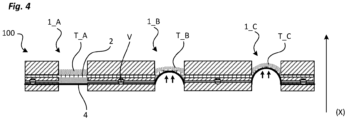
- the device of the invention can be duplicated, for example within the same component, with several juxtaposed devices 1_A, 1_B, 1_C, which makes it possible to obtain a complete system 100. It is thus possible to use a single actuating membrane 4 and a single culture membrane 2, common to all the devices.
- the culture membrane is for example the foam used in the variant of Figures 2A to 2C . It could also be structured, at least partially, for example at the level of a single device among all the juxtaposed devices.
- Valves V are for example placed on the first fluid circuit 11 to control the contributions of the culture medium 3. Independent actuation of the actuation membrane 4 at the level of each device can be provided to possibly ensure distinct stimulation levels from one device to another.
- the biological tissues T_A, T_B, T_C can be mechanically stimulated separately, in each device 1_A, 1_B, 1_C of the system 100.
- the invention described above will be particularly relevant for mechanical stimulation of the skin. It will also be possible to use it for a pulmonary or intestinal model.
Landscapes
- Health & Medical Sciences (AREA)
- Engineering & Computer Science (AREA)
- Life Sciences & Earth Sciences (AREA)
- Chemical & Material Sciences (AREA)
- Wood Science & Technology (AREA)
- Organic Chemistry (AREA)
- Bioinformatics & Cheminformatics (AREA)
- Zoology (AREA)
- Genetics & Genomics (AREA)
- Biotechnology (AREA)
- Biomedical Technology (AREA)
- Biochemistry (AREA)
- Sustainable Development (AREA)
- General Engineering & Computer Science (AREA)
- General Health & Medical Sciences (AREA)
- Microbiology (AREA)
- Immunology (AREA)
- Mechanical Engineering (AREA)
- Cell Biology (AREA)
- Clinical Laboratory Science (AREA)
- Molecular Biology (AREA)
- Dispersion Chemistry (AREA)
- Apparatus Associated With Microorganisms And Enzymes (AREA)
Claims (8)
- Zellkulturvorrichtung, die über eine Funktion der mechanischen Stimulation biologischer Gewebe (T) verfügt, umfassend:- ein Fluidmodul (1), das mit einer Vertiefung (10) versehen ist, die sich entlang einer sogenannten Hauptrichtung (X) erstreckt;- eine erste elastisch verformbare poröse Membran, die als Kulturmembran (2_1, 2_2, 2_3) bezeichnet wird, wobei sie fester Bestandteil des Moduls ist und sich quer zur Hauptrichtung (X) erstreckt, um die Vertiefung zu verschließen, wobei die Kulturmembran eine Oberseite, die für die Aufnahme einer Zellkultur bestimmt ist, und eine gegenüberliegende Unterseite umfasst;- einen ersten Fluidkreislauf (11), der fester Bestandteil des Moduls ist und einen ersten Hohlraum (110) umfasst, der sich in der Vertiefung unter der Kulturmembran (2_1, 2_2, 2_3) befindet und dazu bestimmt ist, ein Kulturmedium (3) aufzunehmen, welches sich zur Perfusion des biologischen Gewebes (T) eignet;- eine zweite nicht poröse Membran, die als elastisch verformbare Betätigungsmembran (4) bezeichnet wird und fester Bestandteil des Moduls (1) ist,- Mittel zum Betätigen der Betätigungsmembran (4),- dadurch gekennzeichnet, dass- die Betätigungsmembran (4) derart angeordnet ist, dass sie den Boden des ersten Hohlraums (110) abdichtend verschließt, wobei sie dafür ausgelegt ist, sich unter Einwirkung der Betätigungsmittel in Richtung einer Position zu verformen, in welcher sie mechanischen Druck auf die Kulturmembran (2_1, 2_2, 2_3) ausübt, um diese zu verformen.
- Vorrichtung nach Anspruch 1, dadurch gekennzeichnet, dass es sich bei der Kulturmembran (2_2, 2_3) um einen dreidimensionalen Schaumstoff handelt, dessen Dicke gemäß der Hauptrichtung (X) konstant ist.
- Vorrichtung nach Anspruch 2, dadurch gekennzeichnet, dass der dreidimensionale Schaumstoff auf seiner Oberseite derart strukturiert ist, dass seine Dicke gemäß der Hauptrichtung (X) variiert.
- Vorrichtung nach Anspruch 2 oder 3, dadurch gekennzeichnet, dass der Schaumstoff aus einem Material hergestellt ist, das aus Polyethylen, Polyurethan, Polyvinylchlorid und Gummi ausgewählt ist.
- Vorrichtung nach Anspruch 1, dadurch gekennzeichnet, dass er sich bei der Kulturmembran (2_1) um einen perforierten Materialstreifen handelt, der quer zur Hauptrichtung angeordnet ist.
- Vorrichtung nach Anspruch 5, dadurch gekennzeichnet, dass die Membran (2_1) aus PDMS hergestellt ist.
- Vorrichtung nach einem der Ansprüche 1 bis 6, dadurch gekennzeichnet, dass die Mittel zur Betätigung der Betätigungsmembran (4) einen zweiten Betätigungsfluidkreislauf (12) aufweisen, der fester Bestandteil des Moduls ist und mindestens einen zweiten Hohlraum (120) zum Druckaufbau umfasst, welcher sich unter der Betätigungsmembran (4) befindet und dazu bestimmt ist, ein Fluid (5) aufzunehmen.
- Zellkultursystem, dadurch gekennzeichnet, dass es mehrere Zellkulturvorrichtungen mit einer mechanischen Stimulationsfunktion gemäß der Begriffsbestimmung in einem der Ansprüche 1 bis 7 umfasst, wobei die Vorrichtungen innerhalb ein und desselben Fluidmoduls nebeneinander angeordnet sind.
Applications Claiming Priority (1)
| Application Number | Priority Date | Filing Date | Title |
|---|---|---|---|
| FR2213409A FR3143627B1 (fr) | 2022-12-15 | 2022-12-15 | Dispositif de culture cellulaire avec fonction de stimulation mécanique |
Publications (2)
| Publication Number | Publication Date |
|---|---|
| EP4386079A1 EP4386079A1 (de) | 2024-06-19 |
| EP4386079B1 true EP4386079B1 (de) | 2024-11-20 |
Family
ID=85685443
Family Applications (1)
| Application Number | Title | Priority Date | Filing Date |
|---|---|---|---|
| EP23209959.8A Active EP4386079B1 (de) | 2022-12-15 | 2023-11-15 | Zellkulturvorrichtung mit mechanischer stimulationsfunktion |
Country Status (3)
| Country | Link |
|---|---|
| US (1) | US20240200013A1 (de) |
| EP (1) | EP4386079B1 (de) |
| FR (1) | FR3143627B1 (de) |
Families Citing this family (1)
| Publication number | Priority date | Publication date | Assignee | Title |
|---|---|---|---|---|
| CN120173741B (zh) * | 2025-05-21 | 2025-08-12 | 江苏艾玮得生物科技有限公司 | 体外模型培养芯片、装置及动态培养系统 |
Family Cites Families (3)
| Publication number | Priority date | Publication date | Assignee | Title |
|---|---|---|---|---|
| FR2803852B1 (fr) * | 2000-01-17 | 2004-11-05 | Farzin Sarem | Dispositif de culture cellulaire et tissulaire a circulation de fluide de culture controlee |
| DE102009057698A1 (de) * | 2009-12-03 | 2011-06-09 | Martin-Luther-Universität Halle-Wittenberg | Zweikammerkultivierungssystem mit elastischer, poröser Membran zur uniaxialen mechanischen Stimulation von Epithelzellen und Epithelzellverbänden für die Testung endogener und exogener Faktoren |
| KR20230019986A (ko) | 2016-11-24 | 2023-02-09 | 알베오릭스 테크놀러지스 아게 | 세포 배양 시스템 및 방법 |
-
2022
- 2022-12-15 FR FR2213409A patent/FR3143627B1/fr active Active
-
2023
- 2023-11-15 EP EP23209959.8A patent/EP4386079B1/de active Active
- 2023-12-14 US US18/539,369 patent/US20240200013A1/en active Pending
Also Published As
| Publication number | Publication date |
|---|---|
| EP4386079A1 (de) | 2024-06-19 |
| FR3143627B1 (fr) | 2024-11-01 |
| FR3143627A1 (fr) | 2024-06-21 |
| US20240200013A1 (en) | 2024-06-20 |
Similar Documents
| Publication | Publication Date | Title |
|---|---|---|
| US20240218309A1 (en) | Open-top microfluidic devices and methods for simulating a function of a tissue | |
| US9618500B2 (en) | Vascular model, method for producing said model and use thereof | |
| CA2219643C (fr) | Bioreacteur | |
| Leoni et al. | Nanoporous biocapsules for the encapsulation of insulinoma cells: biotransport and biocompatibility considerations | |
| Desai et al. | Nanoporous microsystems for islet cell replacement | |
| FR2803853A1 (fr) | Dispositif de culture cellulaire et tissulaire a circulation perfectionnee de fluide de culture | |
| AU2020256224B2 (en) | Multicompartment macroencapsulation devices | |
| JP5800901B2 (ja) | 埋め込み可能な人工臓器を構成するポーチ | |
| US20160244727A1 (en) | Artificial microvascular device and methods for manufacturing and using the same | |
| JP7055386B2 (ja) | 細胞培養用流体チップ、培養容器及び培養方法 | |
| CN113164244A (zh) | 用于可植入医疗装置和血管化膜的方法和系统 | |
| EP4386079A1 (de) | Zellkulturvorrichtung mit mechanischer stimulationsfunktion | |
| US20240002898A1 (en) | Biocompatible composite membrane, method for fabricating the membrane, bioreactor and method for investigating cells attached to the biocompatible composite membrane | |
| KR101866494B1 (ko) | 피부조직과 혈관을 모사한 무펌프 미세유체 스킨칩의 제작과 다중세포배양 방법 | |
| EP3326717B1 (de) | Herstellungsverfahren einer mikrofluid-vorrichtung, und anhand dieses verfahrens erhaltene mikrofluid-vorrichtung | |
| JP2011244713A (ja) | 細胞培養デバイス、細胞培養システム、及び細胞培養方法 | |
| Desai | Microfabrication technology for pancreatic cell encapsulation | |
| WO2019033096A1 (en) | MEMBRANE INSERTS DERIVED FROM NATIVE EXTRACELLULAR MATRIX FOR CHIP ORGANS, MULTILAYER MICROFLUIDIC MICRODISPOSITIVES, AND THREE DIMENSIONAL CELL CULTURE SYSTEMS | |
| FR2950359A1 (fr) | Dispositif et systeme de filtration | |
| EP2429787B1 (de) | Formvorrichtung und herstellungsverfahren | |
| WO2024017663A1 (fr) | Assemblage et culture d'objets cellulaires sur une structure de contact sous l'action de forces de radiation acoustique axiale et transversale | |
| CN120882855A (zh) | 用于培育薄切片的微流体装置 | |
| Ikeuchi et al. | Artificial capillary network chip for in vitro 3D tissue culture | |
| FR3105026A1 (fr) | Dispositif micro-fluidique à substrats à base de papier | |
| FR2736823A1 (fr) | Procede de fabrication de matelas anti-escarres |
Legal Events
| Date | Code | Title | Description |
|---|---|---|---|
| PUAI | Public reference made under article 153(3) epc to a published international application that has entered the european phase |
Free format text: ORIGINAL CODE: 0009012 |
|
| STAA | Information on the status of an ep patent application or granted ep patent |
Free format text: STATUS: REQUEST FOR EXAMINATION WAS MADE |
|
| 17P | Request for examination filed |
Effective date: 20231115 |
|
| AK | Designated contracting states |
Kind code of ref document: A1 Designated state(s): AL AT BE BG CH CY CZ DE DK EE ES FI FR GB GR HR HU IE IS IT LI LT LU LV MC ME MK MT NL NO PL PT RO RS SE SI SK SM TR |
|
| GRAP | Despatch of communication of intention to grant a patent |
Free format text: ORIGINAL CODE: EPIDOSNIGR1 |
|
| STAA | Information on the status of an ep patent application or granted ep patent |
Free format text: STATUS: GRANT OF PATENT IS INTENDED |
|
| GRAS | Grant fee paid |
Free format text: ORIGINAL CODE: EPIDOSNIGR3 |
|
| INTG | Intention to grant announced |
Effective date: 20240913 |
|
| GRAA | (expected) grant |
Free format text: ORIGINAL CODE: 0009210 |
|
| STAA | Information on the status of an ep patent application or granted ep patent |
Free format text: STATUS: THE PATENT HAS BEEN GRANTED |
|
| RAP3 | Party data changed (applicant data changed or rights of an application transferred) |
Owner name: COMMISSARIAT A L'ENERGIE ATOMIQUE ET AUX ENERGIESALTERNATIVES |
|
| AK | Designated contracting states |
Kind code of ref document: B1 Designated state(s): AL AT BE BG CH CY CZ DE DK EE ES FI FR GB GR HR HU IE IS IT LI LT LU LV MC ME MK MT NL NO PL PT RO RS SE SI SK SM TR |
|
| REG | Reference to a national code |
Ref country code: GB Ref legal event code: FG4D Free format text: NOT ENGLISH |
|
| REG | Reference to a national code |
Ref country code: CH Ref legal event code: EP |
|
| REG | Reference to a national code |
Ref country code: DE Ref legal event code: R096 Ref document number: 602023001106 Country of ref document: DE |
|
| REG | Reference to a national code |
Ref country code: IE Ref legal event code: FG4D Free format text: LANGUAGE OF EP DOCUMENT: FRENCH |
|
| REG | Reference to a national code |
Ref country code: LT Ref legal event code: MG9D |
|
| REG | Reference to a national code |
Ref country code: NL Ref legal event code: MP Effective date: 20241120 |
|
| PG25 | Lapsed in a contracting state [announced via postgrant information from national office to epo] |
Ref country code: PT Free format text: LAPSE BECAUSE OF FAILURE TO SUBMIT A TRANSLATION OF THE DESCRIPTION OR TO PAY THE FEE WITHIN THE PRESCRIBED TIME-LIMIT Effective date: 20250320 Ref country code: HR Free format text: LAPSE BECAUSE OF FAILURE TO SUBMIT A TRANSLATION OF THE DESCRIPTION OR TO PAY THE FEE WITHIN THE PRESCRIBED TIME-LIMIT Effective date: 20241120 Ref country code: IS Free format text: LAPSE BECAUSE OF FAILURE TO SUBMIT A TRANSLATION OF THE DESCRIPTION OR TO PAY THE FEE WITHIN THE PRESCRIBED TIME-LIMIT Effective date: 20250320 |
|
| PG25 | Lapsed in a contracting state [announced via postgrant information from national office to epo] |
Ref country code: FI Free format text: LAPSE BECAUSE OF FAILURE TO SUBMIT A TRANSLATION OF THE DESCRIPTION OR TO PAY THE FEE WITHIN THE PRESCRIBED TIME-LIMIT Effective date: 20241120 Ref country code: NL Free format text: LAPSE BECAUSE OF FAILURE TO SUBMIT A TRANSLATION OF THE DESCRIPTION OR TO PAY THE FEE WITHIN THE PRESCRIBED TIME-LIMIT Effective date: 20241120 |
|
| REG | Reference to a national code |
Ref country code: AT Ref legal event code: MK05 Ref document number: 1743593 Country of ref document: AT Kind code of ref document: T Effective date: 20241120 |
|
| PG25 | Lapsed in a contracting state [announced via postgrant information from national office to epo] |
Ref country code: BG Free format text: LAPSE BECAUSE OF FAILURE TO SUBMIT A TRANSLATION OF THE DESCRIPTION OR TO PAY THE FEE WITHIN THE PRESCRIBED TIME-LIMIT Effective date: 20241120 |
|
| PG25 | Lapsed in a contracting state [announced via postgrant information from national office to epo] |
Ref country code: ES Free format text: LAPSE BECAUSE OF FAILURE TO SUBMIT A TRANSLATION OF THE DESCRIPTION OR TO PAY THE FEE WITHIN THE PRESCRIBED TIME-LIMIT Effective date: 20241120 |
|
| PG25 | Lapsed in a contracting state [announced via postgrant information from national office to epo] |
Ref country code: NO Free format text: LAPSE BECAUSE OF FAILURE TO SUBMIT A TRANSLATION OF THE DESCRIPTION OR TO PAY THE FEE WITHIN THE PRESCRIBED TIME-LIMIT Effective date: 20250220 |
|
| PG25 | Lapsed in a contracting state [announced via postgrant information from national office to epo] |
Ref country code: LV Free format text: LAPSE BECAUSE OF FAILURE TO SUBMIT A TRANSLATION OF THE DESCRIPTION OR TO PAY THE FEE WITHIN THE PRESCRIBED TIME-LIMIT Effective date: 20241120 Ref country code: GR Free format text: LAPSE BECAUSE OF FAILURE TO SUBMIT A TRANSLATION OF THE DESCRIPTION OR TO PAY THE FEE WITHIN THE PRESCRIBED TIME-LIMIT Effective date: 20250221 Ref country code: AT Free format text: LAPSE BECAUSE OF FAILURE TO SUBMIT A TRANSLATION OF THE DESCRIPTION OR TO PAY THE FEE WITHIN THE PRESCRIBED TIME-LIMIT Effective date: 20241120 |
|
| PG25 | Lapsed in a contracting state [announced via postgrant information from national office to epo] |
Ref country code: PL Free format text: LAPSE BECAUSE OF FAILURE TO SUBMIT A TRANSLATION OF THE DESCRIPTION OR TO PAY THE FEE WITHIN THE PRESCRIBED TIME-LIMIT Effective date: 20241120 |
|
| PG25 | Lapsed in a contracting state [announced via postgrant information from national office to epo] |
Ref country code: RS Free format text: LAPSE BECAUSE OF FAILURE TO SUBMIT A TRANSLATION OF THE DESCRIPTION OR TO PAY THE FEE WITHIN THE PRESCRIBED TIME-LIMIT Effective date: 20250220 |
|
| PG25 | Lapsed in a contracting state [announced via postgrant information from national office to epo] |
Ref country code: SM Free format text: LAPSE BECAUSE OF FAILURE TO SUBMIT A TRANSLATION OF THE DESCRIPTION OR TO PAY THE FEE WITHIN THE PRESCRIBED TIME-LIMIT Effective date: 20241120 |
|
| PG25 | Lapsed in a contracting state [announced via postgrant information from national office to epo] |
Ref country code: DK Free format text: LAPSE BECAUSE OF FAILURE TO SUBMIT A TRANSLATION OF THE DESCRIPTION OR TO PAY THE FEE WITHIN THE PRESCRIBED TIME-LIMIT Effective date: 20241120 |
|
| PG25 | Lapsed in a contracting state [announced via postgrant information from national office to epo] |
Ref country code: EE Free format text: LAPSE BECAUSE OF FAILURE TO SUBMIT A TRANSLATION OF THE DESCRIPTION OR TO PAY THE FEE WITHIN THE PRESCRIBED TIME-LIMIT Effective date: 20241120 |
|
| PG25 | Lapsed in a contracting state [announced via postgrant information from national office to epo] |
Ref country code: RO Free format text: LAPSE BECAUSE OF FAILURE TO SUBMIT A TRANSLATION OF THE DESCRIPTION OR TO PAY THE FEE WITHIN THE PRESCRIBED TIME-LIMIT Effective date: 20241120 |
|
| PG25 | Lapsed in a contracting state [announced via postgrant information from national office to epo] |
Ref country code: SK Free format text: LAPSE BECAUSE OF FAILURE TO SUBMIT A TRANSLATION OF THE DESCRIPTION OR TO PAY THE FEE WITHIN THE PRESCRIBED TIME-LIMIT Effective date: 20241120 |
|
| PG25 | Lapsed in a contracting state [announced via postgrant information from national office to epo] |
Ref country code: CZ Free format text: LAPSE BECAUSE OF FAILURE TO SUBMIT A TRANSLATION OF THE DESCRIPTION OR TO PAY THE FEE WITHIN THE PRESCRIBED TIME-LIMIT Effective date: 20241120 |
|
| PG25 | Lapsed in a contracting state [announced via postgrant information from national office to epo] |
Ref country code: IT Free format text: LAPSE BECAUSE OF FAILURE TO SUBMIT A TRANSLATION OF THE DESCRIPTION OR TO PAY THE FEE WITHIN THE PRESCRIBED TIME-LIMIT Effective date: 20241120 |
|
| REG | Reference to a national code |
Ref country code: DE Ref legal event code: R097 Ref document number: 602023001106 Country of ref document: DE |
|
| PG25 | Lapsed in a contracting state [announced via postgrant information from national office to epo] |
Ref country code: SE Free format text: LAPSE BECAUSE OF FAILURE TO SUBMIT A TRANSLATION OF THE DESCRIPTION OR TO PAY THE FEE WITHIN THE PRESCRIBED TIME-LIMIT Effective date: 20241120 |
|
| PLBE | No opposition filed within time limit |
Free format text: ORIGINAL CODE: 0009261 |
|
| STAA | Information on the status of an ep patent application or granted ep patent |
Free format text: STATUS: NO OPPOSITION FILED WITHIN TIME LIMIT |
|
| 26N | No opposition filed |
Effective date: 20250821 |
|
| PGFP | Annual fee paid to national office [announced via postgrant information from national office to epo] |
Ref country code: DE Payment date: 20251118 Year of fee payment: 3 |
|
| PGFP | Annual fee paid to national office [announced via postgrant information from national office to epo] |
Ref country code: FR Payment date: 20251125 Year of fee payment: 3 |