EP4385764A1 - Tire comprising a pattern providing a high contrast - Google Patents
Tire comprising a pattern providing a high contrast Download PDFInfo
- Publication number
- EP4385764A1 EP4385764A1 EP23215358.5A EP23215358A EP4385764A1 EP 4385764 A1 EP4385764 A1 EP 4385764A1 EP 23215358 A EP23215358 A EP 23215358A EP 4385764 A1 EP4385764 A1 EP 4385764A1
- Authority
- EP
- European Patent Office
- Prior art keywords
- recesses
- surface portion
- protrusions
- hexagonal
- tire
- Prior art date
- Legal status (The legal status is an assumption and is not a legal conclusion. Google has not performed a legal analysis and makes no representation as to the accuracy of the status listed.)
- Granted
Links
Images


Classifications
-
- B—PERFORMING OPERATIONS; TRANSPORTING
- B60—VEHICLES IN GENERAL
- B60C—VEHICLE TYRES; TYRE INFLATION; TYRE CHANGING; CONNECTING VALVES TO INFLATABLE ELASTIC BODIES IN GENERAL; DEVICES OR ARRANGEMENTS RELATED TO TYRES
- B60C13/00—Tyre sidewalls; Protecting, decorating, marking, or the like, thereof
- B60C13/001—Decorating, marking or the like
-
- B—PERFORMING OPERATIONS; TRANSPORTING
- B60—VEHICLES IN GENERAL
- B60C—VEHICLE TYRES; TYRE INFLATION; TYRE CHANGING; CONNECTING VALVES TO INFLATABLE ELASTIC BODIES IN GENERAL; DEVICES OR ARRANGEMENTS RELATED TO TYRES
- B60C13/00—Tyre sidewalls; Protecting, decorating, marking, or the like, thereof
- B60C13/02—Arrangement of grooves or ribs
Definitions
- the present invention relates to a tire comprising a sidewall, the sidewall having a surface comprising a surface portion with a high contrast pattern.
- the visibility of the letters, numbers or symbols may decrease over time. This may happen e.g. in use when dust or mud covers the letters, numbers or symbols.
- the invention relates to a tire in accordance with claim 1.
- the invent serves to enhance the visibility of the letters, numbers or symbols shown on the sidewall. In addition, such visibility should not decrease in use over time.
- a first preferred aspect of the present invention relates to a tire comprising a sidewall, the sidewall having a surface comprising a surface portion including a hexagonal textured base pattern repeated over the surface portion so as to form a periodic textured pattern providing a high contrast to the surface portion.
- the hexagonal textured base pattern comprises protrusions and recesses, the protrusions and the recesses of the repeated textured base pattern cooperating to form respective lineal features extending over at least two of the repeated hexagonal textured base patterns.
- a difference of height between the (highest of the) protrusions and the (lowest of the) recesses is comprised in the range from 0.1 to 0.6 mm, preferably in the range from 0.2 to 0.5 mm.
- the hexagonal textured base pattern comprises a highest point and a lowest point, a difference of height between the highest point and a lowest point is comprised in the range from 0.1 to 0.6 mm, preferably in the range from 0.2 to 0.5 mm.
- the hexagonal textured base pattern comprises inclined surfaces joining the protrusions and the recesses.
- the inclined surfaces have a slope comprised in the range from 2 to 6 (mm/mm), preferably in the range from 3 to 5 (mm/mm).
- the hexagonal textured base pattern comprises substantially vertical surfaces joining the protrusions and the recesses.
- substantially vertical it is meant that the surfaces joining the protrusions and the recesses do not deviate from more than 5°, preferably 4°, even more preferably 3°, most preferably 2°, from the normal to the surface of sidewall.
- the lineal features comprise at least one of lines and curves.
- the lineal features comprise (or consist of) lines, wherein at least two of the lines are not mutually parallel.
- At least one of the protrusions and the recesses forms a plateau having a thickness comprised in the range from 0.1 to 0.5 mm, preferably in the range from 0.2 to 0.4 mm.
- the sidewall is the exterior sidewall of the tire. In another embodiment, the sidewall is the interior sidewall of the tire. In a further embodiment, both exterior and interior sidewalls of the tire comprise the surface portion as described herein, so that both exterior and interior sidewalls have a portion thereof having a high contrast surface portion.
- the hexagonal textured base pattern has a surface roughness comprised in the range from 2 ⁇ m to 20 ⁇ m, preferably in the range from 5 ⁇ m to 16 ⁇ m.
- a second preferred aspect of the present invention relates to a tire comprising a sidewall, the sidewall having a surface comprising a surface portion including a hexagonal textured base pattern repeated over the surface portion so as to form a periodic textured pattern providing a high contrast to the surface portion.
- the hexagonal textured base pattern comprises protruding features and recessed features, the protruding features and recessed features intersecting so as to form at least two non-parallel edges.
- the hexagonal textured base pattern comprises a highest point and a lowest point, wherein a difference of height between the highest point and the lowest point is comprised in the range from 0.1 to 0.6 mm, preferably in the range from 0.2 to 0.5 mm.
- the protruding features and the recessed features comprise inclined surfaces, preferably inclined planes.
- the inclined surfaces (preferably planes) have a slope comprised in the range from 2 to 6 (mm/mm), preferably in the range from 3 to 5 (mm/mm).
- the hexagonal textured base pattern comprises three inclined surfaces (preferably planes) intersecting at an intersection point.
- the hexagonal textured base pattern may comprise four inclined surfaces (preferably planes) intersecting at an intersection point.
- the at least two non-parallel edges comprise at least one of lines and curves.
- the sidewall is the exterior sidewall of the tire. In another embodiment, the sidewall is the interior sidewall of the tire. In a further embodiment, both exterior and interior sidewalls of the tire comprise the surface portion as described herein, so that both exterior and interior sidewalls have a portion thereof having a high contrast surface portion.
- the hexagonal textured base pattern has a surface roughness comprised in the range from 2 ⁇ m to 20 ⁇ m, preferably in the range from 5 ⁇ m to 16 ⁇ m.
- a third preferred aspect of the present invention relates to a tire comprising a sidewall, the sidewall having a surface comprising a surface portion comprising a three-dimensional tessellation.
- the three-dimensional tessellation comprises a plurality of inclined planes (or surfaces) intersecting so as to form edges, at least two of the edges being non-parallel.
- three of the plurality of inclined planes (or surfaces) further intersect at an intersection point.
- four of the plurality of inclined planes (or surfaces) may intersect at an intersection point.
- the three-dimensional tessellation comprises a highest point and a lowest point, wherein a difference of height between the highest point and the lowest point is comprised in the range from 0.1 to 0.6 mm, preferably in the range from 0.2 to 0.5 mm.
- the three-dimensional tessellation has a surface roughness comprised in the range from 2 ⁇ m to 20 ⁇ m, preferably in the range from 5 ⁇ m to 16 ⁇ m.
- the tire may be a rubber tire.
- the textured patterns and three-dimensional tessellation may be produced by molding, with a mold comprising the texture or tessellation negative, and/or by laser etching the molded rubber.
- rubber is intended to include both natural rubber compositions and synthetic rubber compositions.
- specific examples of rubbers include neoprene (polychloroprene), polybutadiene (e.g., cis-1,4-polybutadiene), polyisoprene (e.g., cis-1,4-polyisoprene), butyl rubber, halobutyl rubber (such as, e.g., chlorobutyl rubber or bromobutyl rubber), styrene/isoprene/butadiene rubber, copolymers of 1,3-butadiene or isoprene with monomers such as, e.g., styrene, acrylonitrile and methyl methacrylate.
- Other types of rubber include carboxylated rubber, silicon-coupled rubber, or tin-coupled star-branched polymers. Rubber may include (or consist of) green rubber.
- sidewall of a tire designates the axially outer parts of a tire that provide protection for the carcass ply and withstand flexing and weathering.
- hexagonal textured base pattern designates a textured pattern defined within a hexagon base, the hexagon base having six straight sides forming a closed geometrical shape.
- the hexagon may be regular or may not be regular. In case of a regular hexagon, all the sides have the same length.
- Two distinct lines or curves I and m are parallel if and only if the distance from a point P on line m to the nearest point on line I is independent of the location of P on line m.
- the various embodiments described herein relate to a tire comprising a sidewall, the sidewall having a surface comprising a surface portion.
- the surface portion has a high contrast.
- the surface portion may include a hexagonal textured base pattern repeated over the surface portion so as to form a periodic textured pattern.
- the periodic textured pattern provides the surface portion with high contrast.
- the hexagonal textured base pattern may comprise protrusions and recesses, the protrusions and the recesses of the repeated textured base pattern cooperating to form respective lineal features extending over at least two of the repeated hexagonal textured base patterns.
- the hexagonal textured base pattern may comprise protruding features and recessed features, the protruding features and recessed features intersecting so as to form at least two non-parallel edges.
- the repeated textured base patterns may pave the whole surface portion, i.e. they are arranged side-by-side, without gaps.
- the surface portion may comprise a three-dimensional tessellation providing a high contrast to the surface portion, the three-dimensional tessellation comprising a plurality of inclined planes intersecting so as to form edges, at least two of the edges being non-parallel.
- the sidewall is the exterior sidewall of the tire. In another embodiment, the sidewall is the interior sidewall of the tire. In a further embodiment, both exterior and interior sidewalls of the tire comprising the surface portion as described herein, so that both exterior and interior sidewalls have a portion thereof having a high contrast.
- the tire may be a rubber tire.
- the textured patterns and/or the three-dimensional tessellation may be produced by molding, with mold comprising the negative of the texture and/or tessellation, and/or by laser etching the molded rubber itself.
- Said structures have been found to be particularly advantageous in particular for enhancing the visibility of letters, numbers or symbols defined by the surface portion. Also, it has been discovered that said structures particularly enhance the hydrophobic nature of the tire thereby reducing the possibility of the letters, numbers or symbols to become less visible due to presence of mud or the like, e.g. during use.
- the surface portion has a surface roughness comprised in the range from 2 ⁇ m to 20 ⁇ m, preferably in the range from 5 ⁇ m to 16 ⁇ m.
- the surface portion comprises a highest point and a lowest point, wherein a difference of height between the highest point and the lowest point is comprised in the range from 0.1 to 0.6 mm, preferably in the range from 0.2 to 0.5 mm.
- FIG. 1 shows a height map of a high contrast surface portion of a tire according to an embodiment of the present invention.
- a periodic textured pattern 100 is shown.
- the periodic textured pattern 100 comprises multiple hexagonal textured base patterns 102 (depicted in white in FIG. 1 ) repeated over the surface portion.
- the hexagonal textured base pattern comprises protrusions 106 and recesses 104.
- the protrusions 106 and recesses 104 within the hexagonal textured base pattern 102 cooperate with the protrusions 106 and recesses 104 located within a neighboring hexagonal textured base pattern 102 to form lineal features 108 extending over the two hexagonal textured base patterns 102.
- the lineal features are (at least two) lines which are not mutually parallel.
- lineal features may be (at least two) curves.
- lines and curves may be used.
- the pattern 100 comprises interlocked tripods made of three inclined surfaces 110, 112, 114 intersecting at an intersection point 116 (shown in another tripod for the sake of clarity of the figure).
- the minimal distance between two parallel lineal features of the textured pattern 100 is greater than 0.55 mm, preferably greater than 0.6 mm.
- the maximal distance between two parallel lineal features of the textured pattern 100 is preferably below 1 mm.
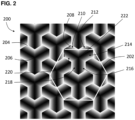
- FIG. 2 shows a height map of a high contrast surface portion of a tire according to an embodiment of the present invention.
- a periodic textured pattern 200 is shown.
- the periodic textured pattern 200 comprises multiple hexagonal textured base patterns 202 (depicted in white in FIG. 2 ) repeated over the surface portion.
- the hexagonal textured base pattern 202 comprises protruding features 206 and recessed features 204, the protruding features 206 and the recessed features 204 intersecting so as to form at least two non-parallel edges 208.
- the pattern 200 is formed by interlocked tripods made of six inclined surfaces 210, 212, 214, 216, 218, 220 intersecting at an intersection point 222.
- the inclined surfaces may be paired two by two, the intersection of such pairs being a line, thereby forming three lines intersecting at the intersection point 222.
- the minimal distance between two parallel lines of the pattern 200 is greater than 0.55 mm, preferably greater than 0.6 mm.
- the maximal distance between two parallel lines of the pattern 200 is preferably below 1 mm.
- FIG. 3 shows a height map of a high contrast surface portion of a tire according to an embodiment of the present invention.
- a periodic textured pattern 300 is shown.
- the periodic textured pattern 300 comprises multiple hexagonal textured base patterns 302 repeated over the surface portion.
- the hexagonal textured base pattern comprises protrusions 304 and recesses 306.
- the protrusions 304 and the recesses 306 each form a plateau (i.e. each of the protrusions and recesses have a constant height).
- the protrusions 304 form lines and curves.
- the thickness of the lines and curves is comprised in the range from 0.1 to 0.5 mm, preferably in the range from 0.2 to 0.4 mm.
- the protrusions 304 and the recesses 306 may be interchanged.
- the pattern 300 is formed by interlocked shapes, the shapes comprising protrusions 304 including three lines 308 joining together at one end 310, and including a circle segment 312 at the other end of each of the lines 308.
- the circle segments 312 preferably have the same radius of curvature.
- the circle segments 312 of a shape interlock circle segments of neighboring shapes.
- the minimal distance between two parallel lines of the interlocked shapes is greater than 0.55 mm, preferably greater than 0.6 mm.
- the maximal distance between two parallel lines of the interlocked shapes is preferably below 1 mm.
- the interlocked shapes are separated by the recesses 306.
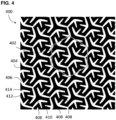
- FIG. 4 shows a height map of a high contrast surface portion of a tire according to an embodiment of the present invention.
- a periodic textured pattern 400 is shown.
- the periodic textured pattern 400 comprises multiple hexagonal textured base patterns 402 repeated over the surface portion.
- the hexagonal textured base pattern 402 comprises protrusions 404 and recesses 406.
- the protrusions 404 and the recesses 406 each form a plateau (i.e. each of the protrusions and recesses have a constant height over some area).
- the recesses 406 form lines and curves.
- the thickness of the lines and curves is comprised in the range from 0.1 to 0.5 mm, preferably in the range from 0.2 to 0.4 mm.
- the protrusions 404 and the recesses 406 may be interchanged.
- the pattern 400 is formed by interlocked shapes, the shapes comprising recesses 406 being generally formed as chevrons 408 joining each other at one end 410 thereof.
- the shapes comprise three chevrons 408 joining each other at one end 410 thereof.
- four chevrons 408 or more may be used.
- the chevrons 408 may comprise a projection 412 at their apex 414, the projection projecting downwards (i.e. towards the inside of the chevron).
- the chevrons 408 of a shape interlock with one or more chevrons 408 of one or more neighboring shapes.
- the minimal distance between two parallel lines of the interlocked shapes is greater than 0.55 mm, preferably greater than 0.6 mm.
- the maximal distance between two parallel lines is preferably below 1 mm.
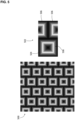
- FIG. 5 shows a height map of a high contrast surface portion of a tire according to an embodiment of the present invention.
- a three-dimensional tessellation 500 of the surface portion is shown on the left side of FIG. 5 .
- the base structure 502 used for tessellating the surface portion is shown.
- the tessellation 500 comprises three-dimensional objects 504 comprising plurality of inclined planes 508.
- Each of the three-dimensional objects 504 comprises 8 inclined planes 508.
- Part (i.e. four) of the inclined planes 508 form a pyramid, the other part (i.e. four) intersect the base of the pyramid and forming walls around the pyramid. At least two of the intersections forming edges are non-parallel.
- the base structure 502 comprises a three-dimensional object 504 such as described hereinabove as well as two translated halves 506 of such an object, side by side.
- the three-dimensional tessellation 500 may be seen as a waffle mold with a walled unit cells having a pyramidal protrusion therein, wherein every other line (or column) of the walled unit cell is translated from half of the size of the unit cell in that direction.
- FIGS. 1 through 5 Each embodiment disclosed herein may be combined, in particular it may be particularly advantageous to combine the different embodiments as disclosed in FIGS. 1 through 5 to provide multiple degrees of contrast to the surface portion.
Landscapes
- Engineering & Computer Science (AREA)
- Mechanical Engineering (AREA)
- Tires In General (AREA)
Abstract
Description
- The present invention relates to a tire comprising a sidewall, the sidewall having a surface comprising a surface portion with a high contrast pattern.
- It is known in the art to have a tire with a sidewall surface that includes letters, numbers or symbols. Because the tire is typically made of rubber which has a black color, the letters, numbers or symbols can be difficult to see and/or read.
- Furthermore, the visibility of the letters, numbers or symbols may decrease over time. This may happen e.g. in use when dust or mud covers the letters, numbers or symbols.
- The invention relates to a tire in accordance with claim 1.
- Dependent claims refer to preferred embodiments of the invention.
- The invent serves to enhance the visibility of the letters, numbers or symbols shown on the sidewall. In addition, such visibility should not decrease in use over time.
- This, as well as other advantages which will become apparent in the following, is met by the different aspects of the present invention.
- A first preferred aspect of the present invention relates to a tire comprising a sidewall, the sidewall having a surface comprising a surface portion including a hexagonal textured base pattern repeated over the surface portion so as to form a periodic textured pattern providing a high contrast to the surface portion. The hexagonal textured base pattern comprises protrusions and recesses, the protrusions and the recesses of the repeated textured base pattern cooperating to form respective lineal features extending over at least two of the repeated hexagonal textured base patterns.
- In a preferred embodiment, a difference of height between the (highest of the) protrusions and the (lowest of the) recesses is comprised in the range from 0.1 to 0.6 mm, preferably in the range from 0.2 to 0.5 mm. In other words, the hexagonal textured base pattern comprises a highest point and a lowest point, a difference of height between the highest point and a lowest point is comprised in the range from 0.1 to 0.6 mm, preferably in the range from 0.2 to 0.5 mm.
- In a preferred embodiment, the hexagonal textured base pattern comprises inclined surfaces joining the protrusions and the recesses.
- In a preferred embodiment, the inclined surfaces have a slope comprised in the range from 2 to 6 (mm/mm), preferably in the range from 3 to 5 (mm/mm).
- In a preferred embodiment, the hexagonal textured base pattern comprises substantially vertical surfaces joining the protrusions and the recesses. By substantially vertical, it is meant that the surfaces joining the protrusions and the recesses do not deviate from more than 5°, preferably 4°, even more preferably 3°, most preferably 2°, from the normal to the surface of sidewall.
- In a preferred embodiment, the lineal features comprise at least one of lines and curves.
- In a preferred embodiment, the lineal features comprise (or consist of) lines, wherein at least two of the lines are not mutually parallel.
- In a preferred embodiment, at least one of the protrusions and the recesses forms a plateau having a thickness comprised in the range from 0.1 to 0.5 mm, preferably in the range from 0.2 to 0.4 mm.
- In a preferred embodiment, the sidewall is the exterior sidewall of the tire. In another embodiment, the sidewall is the interior sidewall of the tire. In a further embodiment, both exterior and interior sidewalls of the tire comprise the surface portion as described herein, so that both exterior and interior sidewalls have a portion thereof having a high contrast surface portion.
- In a preferred embodiment, the hexagonal textured base pattern has a surface roughness comprised in the range from 2 µm to 20 µm, preferably in the range from 5 µm to 16 µm.
- A second preferred aspect of the present invention relates to a tire comprising a sidewall, the sidewall having a surface comprising a surface portion including a hexagonal textured base pattern repeated over the surface portion so as to form a periodic textured pattern providing a high contrast to the surface portion. The hexagonal textured base pattern comprises protruding features and recessed features, the protruding features and recessed features intersecting so as to form at least two non-parallel edges.
- In a preferred embodiment, the hexagonal textured base pattern comprises a highest point and a lowest point, wherein a difference of height between the highest point and the lowest point is comprised in the range from 0.1 to 0.6 mm, preferably in the range from 0.2 to 0.5 mm.
- In a preferred embodiment, the protruding features and the recessed features comprise inclined surfaces, preferably inclined planes.
- In a preferred embodiment, the inclined surfaces (preferably planes) have a slope comprised in the range from 2 to 6 (mm/mm), preferably in the range from 3 to 5 (mm/mm).
- In a preferred embodiment, the hexagonal textured base pattern comprises three inclined surfaces (preferably planes) intersecting at an intersection point. Alternatively or additionally, the hexagonal textured base pattern may comprise four inclined surfaces (preferably planes) intersecting at an intersection point.
- In a preferred embodiment, the at least two non-parallel edges comprise at least one of lines and curves.
- In a preferred embodiment, the sidewall is the exterior sidewall of the tire. In another embodiment, the sidewall is the interior sidewall of the tire. In a further embodiment, both exterior and interior sidewalls of the tire comprise the surface portion as described herein, so that both exterior and interior sidewalls have a portion thereof having a high contrast surface portion.
- In a preferred embodiment, the hexagonal textured base pattern has a surface roughness comprised in the range from 2 µm to 20 µm, preferably in the range from 5 µm to 16 µm.
- A third preferred aspect of the present invention relates to a tire comprising a sidewall, the sidewall having a surface comprising a surface portion comprising a three-dimensional tessellation. The three-dimensional tessellation comprises a plurality of inclined planes (or surfaces) intersecting so as to form edges, at least two of the edges being non-parallel.
- In a preferred embodiment, three of the plurality of inclined planes (or surfaces) further intersect at an intersection point. Alternatively or additionally, four of the plurality of inclined planes (or surfaces) may intersect at an intersection point.
- In a preferred embodiment, the three-dimensional tessellation comprises a highest point and a lowest point, wherein a difference of height between the highest point and the lowest point is comprised in the range from 0.1 to 0.6 mm, preferably in the range from 0.2 to 0.5 mm.
- In a preferred embodiment, the three-dimensional tessellation has a surface roughness comprised in the range from 2 µm to 20 µm, preferably in the range from 5 µm to 16 µm.
- Any combination of the different aspects disclosed herein and their related embodiments is also contemplated.
- In all the embodiments and aspects of the present in invention, the tire may be a rubber tire. The textured patterns and three-dimensional tessellation may be produced by molding, with a mold comprising the texture or tessellation negative, and/or by laser etching the molded rubber.
- As used herein, the term "rubber" is intended to include both natural rubber compositions and synthetic rubber compositions. Specific examples of rubbers include neoprene (polychloroprene), polybutadiene (e.g., cis-1,4-polybutadiene), polyisoprene (e.g., cis-1,4-polyisoprene), butyl rubber, halobutyl rubber (such as, e.g., chlorobutyl rubber or bromobutyl rubber), styrene/isoprene/butadiene rubber, copolymers of 1,3-butadiene or isoprene with monomers such as, e.g., styrene, acrylonitrile and methyl methacrylate. Other types of rubber include carboxylated rubber, silicon-coupled rubber, or tin-coupled star-branched polymers. Rubber may include (or consist of) green rubber.
- The term "sidewall" of a tire designates the axially outer parts of a tire that provide protection for the carcass ply and withstand flexing and weathering.
- The term "hexagonal textured base pattern" designates a textured pattern defined within a hexagon base, the hexagon base having six straight sides forming a closed geometrical shape. The hexagon may be regular or may not be regular. In case of a regular hexagon, all the sides have the same length.
- Two distinct lines or curves I and m (in three-dimensional space) are parallel if and only if the distance from a point P on line m to the nearest point on line I is independent of the location of P on line m.
- In the present document, the verb "to comprise" and the expression "to be comprised of" are used as open transitional phrases meaning "to include" or "to consist at least of". Unless otherwise implied by context, the use of singular word form is intended to encompass the plural, except when the cardinal number "one" is used: "one" herein means "exactly one". Ordinal numbers ("first", "second", etc.) are used herein to differentiate between different instances of a generic object; no particular order, importance or hierarchy is intended to be implied by the use of these expressions. Furthermore, when plural instances of an object are referred to by ordinal numbers, this does not necessarily mean that no other instances of that object are present (unless this follows clearly from context). When reference is made to "an embodiment", "one embodiment", "embodiments", etc., this means that these embodiments may be combined with one another. Furthermore, the features of those embodiments can be used in the combination explicitly presented but also that the features can be combined across embodiments without departing from the invention, unless it follows from context that features cannot be combined.
- The invention will be described by way of example and with reference to the accompanying drawings in which:
-
FIG. 1 shows a height map of a high contrast surface portion of a tire according to an embodiment of the present invention; -
FIG. 2 shows a height map of a high contrast surface portion of a tire according to an embodiment of the present invention; -
FIG. 3 shows a height map of a high contrast surface portion of a tire according to an embodiment of the present invention; -
FIG. 4 shows a height map of a high contrast surface portion of a tire according to an embodiment of the present invention; and -
FIG. 5 shows a height map of a high contrast surface portion of a tire according to an embodiment of the present invention. - The reader's attention is drawn to the fact that the drawings are not to scale.
- Furthermore, for the sake of clarity, proportions between height, length and/or width may not have been represented correctly.
- The various embodiments described herein relate to a tire comprising a sidewall, the sidewall having a surface comprising a surface portion. The surface portion has a high contrast.
- The surface portion may include a hexagonal textured base pattern repeated over the surface portion so as to form a periodic textured pattern. The periodic textured pattern provides the surface portion with high contrast. The hexagonal textured base pattern may comprise protrusions and recesses, the protrusions and the recesses of the repeated textured base pattern cooperating to form respective lineal features extending over at least two of the repeated hexagonal textured base patterns.
- Alternatively or additionally, the hexagonal textured base pattern may comprise protruding features and recessed features, the protruding features and recessed features intersecting so as to form at least two non-parallel edges.
- The repeated textured base patterns may pave the whole surface portion, i.e. they are arranged side-by-side, without gaps.
- Alternatively or additionally, the surface portion may comprise a three-dimensional tessellation providing a high contrast to the surface portion, the three-dimensional tessellation comprising a plurality of inclined planes intersecting so as to form edges, at least two of the edges being non-parallel.
- In one embodiment, the sidewall is the exterior sidewall of the tire. In another embodiment, the sidewall is the interior sidewall of the tire. In a further embodiment, both exterior and interior sidewalls of the tire comprising the surface portion as described herein, so that both exterior and interior sidewalls have a portion thereof having a high contrast.
- The tire may be a rubber tire. The textured patterns and/or the three-dimensional tessellation may be produced by molding, with mold comprising the negative of the texture and/or tessellation, and/or by laser etching the molded rubber itself.
- In the following, several particularly advantageous structures for the surface portion are discussed. Said structures have been found to be particularly advantageous in particular for enhancing the visibility of letters, numbers or symbols defined by the surface portion. Also, it has been discovered that said structures particularly enhance the hydrophobic nature of the tire thereby reducing the possibility of the letters, numbers or symbols to become less visible due to presence of mud or the like, e.g. during use.
- In a preferred embodiment, the surface portion has a surface roughness comprised in the range from 2 µm to 20 µm, preferably in the range from 5 µm to 16 µm.
- In a preferred embodiment, the surface portion comprises a highest point and a lowest point, wherein a difference of height between the highest point and the lowest point is comprised in the range from 0.1 to 0.6 mm, preferably in the range from 0.2 to 0.5 mm.
-
FIG. 1 shows a height map of a high contrast surface portion of a tire according to an embodiment of the present invention. InFIG. 1 , a periodictextured pattern 100 is shown. The periodictextured pattern 100 comprises multiple hexagonal textured base patterns 102 (depicted in white inFIG. 1 ) repeated over the surface portion. The hexagonal textured base pattern comprisesprotrusions 106 and recesses 104. Theprotrusions 106 and recesses 104 within the hexagonaltextured base pattern 102 cooperate with theprotrusions 106 and recesses 104 located within a neighboring hexagonaltextured base pattern 102 to formlineal features 108 extending over the two hexagonaltextured base patterns 102. In the present embodiment, the lineal features are (at least two) lines which are not mutually parallel. In other embodiments, lineal features may be (at least two) curves. Of course, in embodiments, lines and curves may be used. - In further detail, the
pattern 100 comprises interlocked tripods made of threeinclined surfaces textured pattern 100 is greater than 0.55 mm, preferably greater than 0.6 mm. The maximal distance between two parallel lineal features of thetextured pattern 100 is preferably below 1 mm. -
FIG. 2 shows a height map of a high contrast surface portion of a tire according to an embodiment of the present invention. InFIG. 2 , a periodictextured pattern 200 is shown. The periodictextured pattern 200 comprises multiple hexagonal textured base patterns 202 (depicted in white inFIG. 2 ) repeated over the surface portion. The hexagonaltextured base pattern 202 comprises protrudingfeatures 206 and recessedfeatures 204, the protruding features 206 and the recessed features 204 intersecting so as to form at least twonon-parallel edges 208. - In further detail, the
pattern 200 is formed by interlocked tripods made of sixinclined surfaces intersection point 222. The inclined surfaces may be paired two by two, the intersection of such pairs being a line, thereby forming three lines intersecting at theintersection point 222. The minimal distance between two parallel lines of thepattern 200 is greater than 0.55 mm, preferably greater than 0.6 mm. The maximal distance between two parallel lines of thepattern 200 is preferably below 1 mm. -
FIG. 3 shows a height map of a high contrast surface portion of a tire according to an embodiment of the present invention. InFIG. 3 , a periodictextured pattern 300 is shown. The periodictextured pattern 300 comprises multiple hexagonaltextured base patterns 302 repeated over the surface portion. The hexagonal textured base pattern comprisesprotrusions 304 and recesses 306. Theprotrusions 304 and therecesses 306 each form a plateau (i.e. each of the protrusions and recesses have a constant height). In the present embodiment, theprotrusions 304 form lines and curves. The thickness of the lines and curves is comprised in the range from 0.1 to 0.5 mm, preferably in the range from 0.2 to 0.4 mm. Of course, in another embodiment, theprotrusions 304 and therecesses 306 may be interchanged. - In further detail, the
pattern 300 is formed by interlocked shapes, theshapes comprising protrusions 304 including threelines 308 joining together at oneend 310, and including acircle segment 312 at the other end of each of thelines 308. Thecircle segments 312 preferably have the same radius of curvature. Thecircle segments 312 of a shape interlock circle segments of neighboring shapes. The minimal distance between two parallel lines of the interlocked shapes is greater than 0.55 mm, preferably greater than 0.6 mm. The maximal distance between two parallel lines of the interlocked shapes is preferably below 1 mm. The interlocked shapes are separated by therecesses 306. -
FIG. 4 shows a height map of a high contrast surface portion of a tire according to an embodiment of the present invention. InFIG. 4 , a periodictextured pattern 400 is shown. The periodictextured pattern 400 comprises multiple hexagonaltextured base patterns 402 repeated over the surface portion. The hexagonaltextured base pattern 402 comprisesprotrusions 404 and recesses 406. Theprotrusions 404 and therecesses 406 each form a plateau (i.e. each of the protrusions and recesses have a constant height over some area). In the present embodiment, therecesses 406 form lines and curves. The thickness of the lines and curves is comprised in the range from 0.1 to 0.5 mm, preferably in the range from 0.2 to 0.4 mm. Of course, in another embodiment, theprotrusions 404 and therecesses 406 may be interchanged. - In further detail, the
pattern 400 is formed by interlocked shapes, theshapes comprising recesses 406 being generally formed aschevrons 408 joining each other at oneend 410 thereof. In the present embodiment, the shapes comprise threechevrons 408 joining each other at oneend 410 thereof. Of course, in other embodiments, fourchevrons 408 or more may be used. Thechevrons 408 may comprise aprojection 412 at theirapex 414, the projection projecting downwards (i.e. towards the inside of the chevron). Thechevrons 408 of a shape interlock with one ormore chevrons 408 of one or more neighboring shapes. The minimal distance between two parallel lines of the interlocked shapes is greater than 0.55 mm, preferably greater than 0.6 mm. The maximal distance between two parallel lines is preferably below 1 mm. -
FIG. 5 shows a height map of a high contrast surface portion of a tire according to an embodiment of the present invention. On the left side ofFIG. 5 , a three-dimensional tessellation 500 of the surface portion is shown. On the right side ofFIG. 5 , thebase structure 502 used for tessellating the surface portion is shown. Thetessellation 500 comprises three-dimensional objects 504 comprising plurality ofinclined planes 508. Each of the three-dimensional objects 504 comprises 8inclined planes 508. Part (i.e. four) of theinclined planes 508 form a pyramid, the other part (i.e. four) intersect the base of the pyramid and forming walls around the pyramid. At least two of the intersections forming edges are non-parallel. - The
base structure 502 comprises a three-dimensional object 504 such as described hereinabove as well as two translatedhalves 506 of such an object, side by side. In other words, the three-dimensional tessellation 500 may be seen as a waffle mold with a walled unit cells having a pyramidal protrusion therein, wherein every other line (or column) of the walled unit cell is translated from half of the size of the unit cell in that direction. - Each embodiment disclosed herein may be combined, in particular it may be particularly advantageous to combine the different embodiments as disclosed in
FIGS. 1 through 5 to provide multiple degrees of contrast to the surface portion.
Claims (10)
- A tire comprising a sidewall, preferably an exterior sidewall or the tire, the sidewall having a surface comprising a surface portion including: (i) a hexagonal textured base pattern (100, 200, 300, 400) repeated over the surface portion so as to form a periodic textured pattern for providing a relatively high contrast to the surface portion, the hexagonal textured base pattern (100, 200, 300, 400) comprising protrusions and recesses (104, 106, 204, 206, 304, 306, 404, 406), the protrusions and the recesses of the repeated textured base pattern cooperating to form respective lineal features (108) extending over at least two of the repeated hexagonal textured base patterns (100, 200, 300, 400) or the protrusions and the recesses (104, 106, 204, 206, 304, 306, 404, 406) intersecting so as to form at least two non-parallel edges; or (ii) a three-dimensional tessellation (500) for providing a relatively high contrast to the surface portion, the three-dimensional tessellation (500) comprising a plurality of inclined planes (508) intersecting so as to form edges, at least two of the edges being non-parallel.
- The tire according to claim 1, wherein a difference in height between the protrusions and the recesses (104, 106, 204, 206, 304, 306, 404, 406) is in a range of from 0.1 to 0.6 mm or from 0.2 to 0.4 mm, or wherein the hexagonal textured base pattern (100, 200, 300, 400) comprises a highest point and a lowest point, wherein a difference of height between the highest point and the lowest point is comprised in a range of from 0.1 to 0.6 mm or from 0.2 to 0.4 mm.
- The tire according to claim 1 or 2, wherein the hexagonal textured base pattern (100, 200, 300, 400) comprises inclined surfaces (110, 112, 114) preferably joining the protrusions and the recesses (104, 106).
- The tire according to at least one of the previous claims, wherein the hexagonal textured base pattern (100, 200, 300, 400) comprises substantially vertical surfaces joining the protrusions and the recesses (104, 106, 204, 206, 304, 306, 404, 406).
- The tire according to at least one of the previous claims, wherein the lineal features (118) comprise at least one of lines and curves.
- The tire according to at least one of the previous claims, wherein the lineal features (118) comprise lines, wherein at least two of the lines are not mutually parallel.
- The tire according to at least one of the previous claims, wherein at least one of the protrusions and the recesses recesses (104, 106, 204, 206, 304, 306, 404, 406) forms a plateau.
- The tire according to at least one of the previous claims, wherein the hexagonal textured base pattern (100, 200, 300, 400) has a surface roughness in a range of from 2 µm to 20 µm.
- The tire according to at least one of the previous claims, wherein the hexagonal textured base pattern (100, 200, 300, 400) comprises three inclined surfaces (110, 112, 114) intersecting at an intersection point (116).
- The tire according to at least one of the previous claims, wherein the at least two non-parallel edges comprise at least one of lines and curves.
Applications Claiming Priority (1)
| Application Number | Priority Date | Filing Date | Title |
|---|---|---|---|
| US18/064,983 US20240190180A1 (en) | 2022-12-13 | 2022-12-13 | Tire comprising a pattern providing a high contrast |
Publications (2)
| Publication Number | Publication Date |
|---|---|
| EP4385764A1 true EP4385764A1 (en) | 2024-06-19 |
| EP4385764B1 EP4385764B1 (en) | 2025-10-08 |
Family
ID=89164347
Family Applications (1)
| Application Number | Title | Priority Date | Filing Date |
|---|---|---|---|
| EP23215358.5A Active EP4385764B1 (en) | 2022-12-13 | 2023-12-08 | Tire comprising a pattern providing a high contrast |
Country Status (3)
| Country | Link |
|---|---|
| US (1) | US20240190180A1 (en) |
| EP (1) | EP4385764B1 (en) |
| CN (1) | CN118182020A (en) |
Citations (4)
| Publication number | Priority date | Publication date | Assignee | Title |
|---|---|---|---|---|
| EP2502758A1 (en) * | 2009-11-19 | 2012-09-26 | Bridgestone Corporation | Tire |
| EP3698989A1 (en) * | 2019-02-19 | 2020-08-26 | Sumitomo Rubber Industries, Ltd. | Tire |
| WO2021261553A1 (en) * | 2020-06-24 | 2021-12-30 | 横浜ゴム株式会社 | Pneumatic tire |
| EP4029706A1 (en) * | 2021-01-14 | 2022-07-20 | Hankook Tire & Technology Co., Ltd | Tire |
Family Cites Families (3)
| Publication number | Priority date | Publication date | Assignee | Title |
|---|---|---|---|---|
| FR2973286B1 (en) * | 2011-03-31 | 2013-08-16 | Michelin Soc Tech | HIGH CONTRAST PNEUMATIC PATTERN |
| JP7207224B2 (en) * | 2019-08-05 | 2023-01-18 | 横浜ゴム株式会社 | pneumatic tire |
| CN115768634B (en) * | 2020-07-13 | 2025-08-12 | 株式会社普利司通 | Tire with a tire body |
-
2022
- 2022-12-13 US US18/064,983 patent/US20240190180A1/en active Pending
-
2023
- 2023-12-08 EP EP23215358.5A patent/EP4385764B1/en active Active
- 2023-12-13 CN CN202311714005.6A patent/CN118182020A/en active Pending
Patent Citations (4)
| Publication number | Priority date | Publication date | Assignee | Title |
|---|---|---|---|---|
| EP2502758A1 (en) * | 2009-11-19 | 2012-09-26 | Bridgestone Corporation | Tire |
| EP3698989A1 (en) * | 2019-02-19 | 2020-08-26 | Sumitomo Rubber Industries, Ltd. | Tire |
| WO2021261553A1 (en) * | 2020-06-24 | 2021-12-30 | 横浜ゴム株式会社 | Pneumatic tire |
| EP4029706A1 (en) * | 2021-01-14 | 2022-07-20 | Hankook Tire & Technology Co., Ltd | Tire |
Also Published As
| Publication number | Publication date |
|---|---|
| CN118182020A (en) | 2024-06-14 |
| EP4385764B1 (en) | 2025-10-08 |
| US20240190180A1 (en) | 2024-06-13 |
Similar Documents
| Publication | Publication Date | Title |
|---|---|---|
| US6564840B2 (en) | Lamella of high stability for a vulcanization mold, vulcanization mold with such lamellas, vehicle tire with tire tread in which sipes are produced by such lamellas | |
| JP4411975B2 (en) | Pneumatic tire and tire mold | |
| CA2727327C (en) | Pneumatic tire with sidewall defining recesses | |
| CN100352676C (en) | Three-dimensional sipes for treads | |
| US7077180B2 (en) | Pneumatic tire having sipes formed by shifting pitches of zigzag shape | |
| US10173472B2 (en) | Pneumatic tire | |
| US10532614B2 (en) | Tire | |
| US9421829B2 (en) | Pneumatic tire | |
| US10179482B2 (en) | Pneumatic tire | |
| EP2857225A1 (en) | Pneumatic tire | |
| CN108621706A (en) | tire | |
| EP1310384A2 (en) | Vehicle tire | |
| CN102442165B (en) | Pneumatic tire | |
| US8985166B2 (en) | Pneumatic tire | |
| JP2013248927A (en) | Pneumatic tire | |
| CN114643810B (en) | Pneumatic tire | |
| EP4385764A1 (en) | Tire comprising a pattern providing a high contrast | |
| JP5533239B2 (en) | Pneumatic tire | |
| JP7053352B2 (en) | Pneumatic tires | |
| JP2019156342A (en) | Pneumatic tire | |
| JP2012218511A (en) | Pneumatic tire | |
| EP4733087A1 (en) | A tread block arrangement having a sipe, and a lamella plate | |
| CN114312163B (en) | Tire with a tire body | |
| US20250074118A1 (en) | Pneumatic tire | |
| JP7587406B2 (en) | tire |
Legal Events
| Date | Code | Title | Description |
|---|---|---|---|
| PUAI | Public reference made under article 153(3) epc to a published international application that has entered the european phase |
Free format text: ORIGINAL CODE: 0009012 |
|
| STAA | Information on the status of an ep patent application or granted ep patent |
Free format text: STATUS: THE APPLICATION HAS BEEN PUBLISHED |
|
| AK | Designated contracting states |
Kind code of ref document: A1 Designated state(s): AL AT BE BG CH CY CZ DE DK EE ES FI FR GB GR HR HU IE IS IT LI LT LU LV MC ME MK MT NL NO PL PT RO RS SE SI SK SM TR |
|
| STAA | Information on the status of an ep patent application or granted ep patent |
Free format text: STATUS: REQUEST FOR EXAMINATION WAS MADE |
|
| 17P | Request for examination filed |
Effective date: 20241203 |
|
| RBV | Designated contracting states (corrected) |
Designated state(s): AL AT BE BG CH CY CZ DE DK EE ES FI FR GB GR HR HU IE IS IT LI LT LU LV MC ME MK MT NL NO PL PT RO RS SE SI SK SM TR |
|
| GRAP | Despatch of communication of intention to grant a patent |
Free format text: ORIGINAL CODE: EPIDOSNIGR1 |
|
| STAA | Information on the status of an ep patent application or granted ep patent |
Free format text: STATUS: GRANT OF PATENT IS INTENDED |
|
| RIC1 | Information provided on ipc code assigned before grant |
Ipc: B60C 13/00 20060101AFI20250429BHEP |
|
| INTG | Intention to grant announced |
Effective date: 20250520 |
|
| RIN1 | Information on inventor provided before grant (corrected) |
Inventor name: BYLDA, VINCENT Inventor name: EL-SEBALY, WENDY Inventor name: WINDESHAUSEN, MICHEL JEAN YVES Inventor name: FONTAINE, SEBASTIEN WILLY |
|
| GRAS | Grant fee paid |
Free format text: ORIGINAL CODE: EPIDOSNIGR3 |
|
| GRAA | (expected) grant |
Free format text: ORIGINAL CODE: 0009210 |
|
| STAA | Information on the status of an ep patent application or granted ep patent |
Free format text: STATUS: THE PATENT HAS BEEN GRANTED |
|
| AK | Designated contracting states |
Kind code of ref document: B1 Designated state(s): AL AT BE BG CH CY CZ DE DK EE ES FI FR GB GR HR HU IE IS IT LI LT LU LV MC ME MK MT NL NO PL PT RO RS SE SI SK SM TR |
|
| REG | Reference to a national code |
Ref country code: GB Ref legal event code: FG4D Ref country code: CH Ref legal event code: F10 Free format text: ST27 STATUS EVENT CODE: U-0-0-F10-F00 (AS PROVIDED BY THE NATIONAL OFFICE) Effective date: 20251008 |
|
| REG | Reference to a national code |
Ref country code: DE Ref legal event code: R096 Ref document number: 602023007313 Country of ref document: DE |
|
| REG | Reference to a national code |
Ref country code: IE Ref legal event code: FG4D |
|
| PGFP | Annual fee paid to national office [announced via postgrant information from national office to epo] |
Ref country code: DE Payment date: 20251126 Year of fee payment: 3 |
|
| PGFP | Annual fee paid to national office [announced via postgrant information from national office to epo] |
Ref country code: AT Payment date: 20260113 Year of fee payment: 3 |
|
| PGFP | Annual fee paid to national office [announced via postgrant information from national office to epo] |
Ref country code: FR Payment date: 20251119 Year of fee payment: 3 |
|
| REG | Reference to a national code |
Ref country code: NL Ref legal event code: MP Effective date: 20251008 |
|
| REG | Reference to a national code |
Ref country code: AT Ref legal event code: MK05 Ref document number: 1844548 Country of ref document: AT Kind code of ref document: T Effective date: 20251008 |
|
| PG25 | Lapsed in a contracting state [announced via postgrant information from national office to epo] |
Ref country code: NL Free format text: LAPSE BECAUSE OF FAILURE TO SUBMIT A TRANSLATION OF THE DESCRIPTION OR TO PAY THE FEE WITHIN THE PRESCRIBED TIME-LIMIT Effective date: 20251008 |
|
| PG25 | Lapsed in a contracting state [announced via postgrant information from national office to epo] |
Ref country code: ES Free format text: LAPSE BECAUSE OF FAILURE TO SUBMIT A TRANSLATION OF THE DESCRIPTION OR TO PAY THE FEE WITHIN THE PRESCRIBED TIME-LIMIT Effective date: 20251008 |
|
| REG | Reference to a national code |
Ref country code: LT Ref legal event code: MG9D |
|
| PG25 | Lapsed in a contracting state [announced via postgrant information from national office to epo] |
Ref country code: NO Free format text: LAPSE BECAUSE OF FAILURE TO SUBMIT A TRANSLATION OF THE DESCRIPTION OR TO PAY THE FEE WITHIN THE PRESCRIBED TIME-LIMIT Effective date: 20260108 |
|
| PG25 | Lapsed in a contracting state [announced via postgrant information from national office to epo] |
Ref country code: AT Free format text: LAPSE BECAUSE OF FAILURE TO SUBMIT A TRANSLATION OF THE DESCRIPTION OR TO PAY THE FEE WITHIN THE PRESCRIBED TIME-LIMIT Effective date: 20251008 Ref country code: HR Free format text: LAPSE BECAUSE OF FAILURE TO SUBMIT A TRANSLATION OF THE DESCRIPTION OR TO PAY THE FEE WITHIN THE PRESCRIBED TIME-LIMIT Effective date: 20251008 Ref country code: FI Free format text: LAPSE BECAUSE OF FAILURE TO SUBMIT A TRANSLATION OF THE DESCRIPTION OR TO PAY THE FEE WITHIN THE PRESCRIBED TIME-LIMIT Effective date: 20251008 |
|
| PGFP | Annual fee paid to national office [announced via postgrant information from national office to epo] |
Ref country code: IT Payment date: 20251231 Year of fee payment: 3 |
|
| PG25 | Lapsed in a contracting state [announced via postgrant information from national office to epo] |
Ref country code: RS Free format text: LAPSE BECAUSE OF FAILURE TO SUBMIT A TRANSLATION OF THE DESCRIPTION OR TO PAY THE FEE WITHIN THE PRESCRIBED TIME-LIMIT Effective date: 20260108 |
|
| PG25 | Lapsed in a contracting state [announced via postgrant information from national office to epo] |
Ref country code: IS Free format text: LAPSE BECAUSE OF FAILURE TO SUBMIT A TRANSLATION OF THE DESCRIPTION OR TO PAY THE FEE WITHIN THE PRESCRIBED TIME-LIMIT Effective date: 20260208 |
|
| PG25 | Lapsed in a contracting state [announced via postgrant information from national office to epo] |
Ref country code: PT Free format text: LAPSE BECAUSE OF FAILURE TO SUBMIT A TRANSLATION OF THE DESCRIPTION OR TO PAY THE FEE WITHIN THE PRESCRIBED TIME-LIMIT Effective date: 20260209 |
|
| PG25 | Lapsed in a contracting state [announced via postgrant information from national office to epo] |
Ref country code: PL Free format text: LAPSE BECAUSE OF FAILURE TO SUBMIT A TRANSLATION OF THE DESCRIPTION OR TO PAY THE FEE WITHIN THE PRESCRIBED TIME-LIMIT Effective date: 20251008 |
|
| PG25 | Lapsed in a contracting state [announced via postgrant information from national office to epo] |
Ref country code: LV Free format text: LAPSE BECAUSE OF FAILURE TO SUBMIT A TRANSLATION OF THE DESCRIPTION OR TO PAY THE FEE WITHIN THE PRESCRIBED TIME-LIMIT Effective date: 20251008 |