EP4385349B1 - Gestrickter bekleidungshals mit einem ersten gebogenen abschnitt und einem zweiten starren abschnitt mit strukturierter maschenkurve, verfahren zur herstellung solch eines halss und kleidungsstück mit solch einem hals - Google Patents
Gestrickter bekleidungshals mit einem ersten gebogenen abschnitt und einem zweiten starren abschnitt mit strukturierter maschenkurve, verfahren zur herstellung solch eines halss und kleidungsstück mit solch einem hals Download PDFInfo
- Publication number
- EP4385349B1 EP4385349B1 EP23216380.8A EP23216380A EP4385349B1 EP 4385349 B1 EP4385349 B1 EP 4385349B1 EP 23216380 A EP23216380 A EP 23216380A EP 4385349 B1 EP4385349 B1 EP 4385349B1
- Authority
- EP
- European Patent Office
- Prior art keywords
- collar
- knitting
- garment
- longitudinal end
- height
- Prior art date
- Legal status (The legal status is an assumption and is not a legal conclusion. Google has not performed a legal analysis and makes no representation as to the accuracy of the status listed.)
- Active
Links
Images

Classifications
-
- A—HUMAN NECESSITIES
- A41—WEARING APPAREL
- A41D—OUTERWEAR; PROTECTIVE GARMENTS; ACCESSORIES
- A41D27/00—Details of garments or of their making
- A41D27/18—Cloth collars
-
- A—HUMAN NECESSITIES
- A41—WEARING APPAREL
- A41B—SHIRTS; UNDERWEAR; BABY LINEN; HANDKERCHIEFS
- A41B3/00—Collars
-
- A—HUMAN NECESSITIES
- A41—WEARING APPAREL
- A41B—SHIRTS; UNDERWEAR; BABY LINEN; HANDKERCHIEFS
- A41B3/00—Collars
- A41B3/005—Methods or devices for their manufacture
-
- A—HUMAN NECESSITIES
- A41—WEARING APPAREL
- A41D—OUTERWEAR; PROTECTIVE GARMENTS; ACCESSORIES
- A41D1/00—Garments
- A41D1/04—Vests, jerseys, sweaters or the like
-
- D—TEXTILES; PAPER
- D04—BRAIDING; LACE-MAKING; KNITTING; TRIMMINGS; NON-WOVEN FABRICS
- D04B—KNITTING
- D04B1/00—Weft knitting processes for the production of fabrics or articles not dependent on the use of particular machines; Fabrics or articles defined by such processes
- D04B1/14—Other fabrics or articles characterised primarily by the use of particular thread materials
-
- D—TEXTILES; PAPER
- D04—BRAIDING; LACE-MAKING; KNITTING; TRIMMINGS; NON-WOVEN FABRICS
- D04B—KNITTING
- D04B1/00—Weft knitting processes for the production of fabrics or articles not dependent on the use of particular machines; Fabrics or articles defined by such processes
- D04B1/22—Weft knitting processes for the production of fabrics or articles not dependent on the use of particular machines; Fabrics or articles defined by such processes specially adapted for knitting goods of particular configuration
- D04B1/24—Weft knitting processes for the production of fabrics or articles not dependent on the use of particular machines; Fabrics or articles defined by such processes specially adapted for knitting goods of particular configuration wearing apparel
- D04B1/246—Upper torso garments, e.g. sweaters, shirts, leotards
-
- D—TEXTILES; PAPER
- D04—BRAIDING; LACE-MAKING; KNITTING; TRIMMINGS; NON-WOVEN FABRICS
- D04B—KNITTING
- D04B21/00—Warp knitting processes for the production of fabrics or articles not dependent on the use of particular machines; Fabrics or articles defined by such processes
- D04B21/14—Fabrics characterised by the incorporation by knitting, in one or more thread, fleece, or fabric layers, of reinforcing, binding, or decorative threads; Fabrics incorporating small auxiliary elements, e.g. for decorative purposes
-
- D—TEXTILES; PAPER
- D04—BRAIDING; LACE-MAKING; KNITTING; TRIMMINGS; NON-WOVEN FABRICS
- D04B—KNITTING
- D04B21/00—Warp knitting processes for the production of fabrics or articles not dependent on the use of particular machines; Fabrics or articles defined by such processes
- D04B21/20—Warp knitting processes for the production of fabrics or articles not dependent on the use of particular machines; Fabrics or articles defined by such processes specially adapted for knitting articles of particular configuration
- D04B21/207—Wearing apparel or garment blanks
-
- A—HUMAN NECESSITIES
- A41—WEARING APPAREL
- A41B—SHIRTS; UNDERWEAR; BABY LINEN; HANDKERCHIEFS
- A41B2500/00—Materials for shirts, underwear, baby linen or handkerchiefs not provided for in other groups of this subclass
- A41B2500/10—Knitted
-
- A—HUMAN NECESSITIES
- A41—WEARING APPAREL
- A41D—OUTERWEAR; PROTECTIVE GARMENTS; ACCESSORIES
- A41D2500/00—Materials for garments
- A41D2500/10—Knitted
-
- D—TEXTILES; PAPER
- D10—INDEXING SCHEME ASSOCIATED WITH SUBLASSES OF SECTION D, RELATING TO TEXTILES
- D10B—INDEXING SCHEME ASSOCIATED WITH SUBLASSES OF SECTION D, RELATING TO TEXTILES
- D10B2201/00—Cellulose-based fibres, e.g. vegetable fibres
- D10B2201/01—Natural vegetable fibres
- D10B2201/02—Cotton
-
- D—TEXTILES; PAPER
- D10—INDEXING SCHEME ASSOCIATED WITH SUBLASSES OF SECTION D, RELATING TO TEXTILES
- D10B—INDEXING SCHEME ASSOCIATED WITH SUBLASSES OF SECTION D, RELATING TO TEXTILES
- D10B2501/00—Wearing apparel
- D10B2501/06—Details of garments
Definitions
- the present invention belongs to the field of manufacturing clothing (or articles of clothing) by knitting. More particularly, the invention relates to a knitted garment collar, for example a leisure polo shirt (usually referred to as " casual wear ”) or a sports polo shirt (for example golf), and a method of manufacturing such a collar by knitting, this method making it possible to stabilize said collar both during daily wear and during a moving activity.
- a knitted garment collar for example a leisure polo shirt (usually referred to as " casual wear ") or a sports polo shirt (for example golf)
- the knitting technique for manufacturing textile articles has been known for many years and is used in a wide variety of fields: clothing, medical articles, filters, reinforcements for composite materials, etc.
- Knitting may have traditionally been done by hand, but today knitting machines have made their way into textile manufacturing plants.
- Knitting combines several techniques, including the technique of arrow knitting, also called partial knitting. It consists of placing the needles of the knitting machine on standby for knitting on a part of the fabric, at the level of a row, while the other needles are working, thus allowing the production of knits with different heights. The more a needle is on standby, the lower the height of this column of stitches will be.
- This allows specific shapes to be given to the knitted element, for example a curved shape, as taught in particular by the American patent application US 3,293,662 A
- This technique allows textiles with specific shapes to be manufactured solely by knitting, eliminating the need for a material cutting step. It also has the advantage of being economical and having a positive impact on the environment, due to the material savings and reduction of waste involved in this process, thanks to the elimination of the material cutting step.
- this technique when applied to the making of a garment collar, for example a polo shirt collar, does not specifically ensure better fit of the collar when worn, nor better fall of the collar during movement, in particular a relatively intense movement of an athlete.
- Knit stitches create volume, while purl stitches create a hollow.
- 1&1 ribbing specifically refers to alternating one knit stitch and one purl stitch.
- Another well-known knitting technique is structured knit, which uses a more rigid knitting bond than 1&1 rib. Ribs are known for being very elastic. Structured knit thus provides the textile with more rigidity and thickness compared to a more flexible rib, which will bend much more easily. It also helps avoid the stretchy effect of ribbing.
- This manufacturing technique therefore has the disadvantage of being relatively time-consuming, particularly when you want to offer a quality collar, which has a good fit and an adequate fall.
- Most collars have the disadvantage of rising easily during movement, and even during daily wear, thus unsightly revealing the seam in the back.
- Such a manufacturing process also does not avoid material losses, in particular by cutting sections of textile to give a specific final shape to the collar.
- the document CN113412982A discloses a garment with a knitted collar.
- the inventors of the present invention have thus succeeded in designing a knitted garment collar which comprises at least two distinct portions, one relatively flexible and the other more rigid, this collar having a curved shape. To this end, they have developed a method for manufacturing such a collar which implements the technique of arrow knitting and that of structured mesh knitting.
- This collar further comprises two lateral ends of rectilinear shape, and defines a height H1 between each external longitudinal end at its central part and a height H2 at each of its two lateral ends, with H1 equal to or greater than H2.
- the invention is therefore based on a completely new and original approach of proposing a collar having at least two structurally distinct sections, made by two specific knitting techniques, in order to ensure both better wearing of the collar on a daily basis, and improved hold and replacement of this collar during larger or more powerful movements, such as during a sporting activity.
- the first and second portions of the collar according to the invention are knitted using the arrow knitting technique, which makes it possible to give the two external longitudinal ends of the collar a very specific final shape, in an arc of a circle, without having to carry out a material cutting step, which systematically causes a loss of material and therefore waste.
- this technique which makes it possible to knit sections of the collar while other sections are put on hold, makes it possible to give shapes to the collar, in particular at the external longitudinal ends, which collars can thus adopt a configuration other than rectilinear.
- this collar also has the advantage of having a positive impact on the environment, since less waste is produced and therefore thrown away, which is not always easily recyclable.
- This arrow knitting technique also makes it possible to form a collar whose dimensions are not uniform across the entire element. That is to say, this collar with its ends in an arc of a circle can have different heights over its entire length.
- the collar of the invention therefore has a height in its center which is greater than the height at its two ends. In particular, this allows the part of the collar furthest from the collar stand and which can be folded at the neck along a longitudinal axis to be longer in its central part than at its lateral external ends. This characteristic advantageously allows an optimal fall of the collar at the back, for better hold during daily wear.
- Knitting by arrowing also makes it possible to produce a collar which, when folded along the longitudinal folding axis described above, covers the seam present at the junction of the collar/garment, that is to say between the collar stand and the rest of the garment in the upper back, which seam can be considered inelegant. It is in fact by the curved shape of the external longitudinal end of the first portion that the phenomenon of detachment of the selvedge of the collar is avoided, thus preventing the back seam from appearing.
- the second portion of the collar according to the invention is also knitted using the structured mesh knitting technique, which allows the collar element thus knitted to be stiffened.
- the collar of the invention has its collar stand portion designed in this way. The combination of this rigid portion at the collar stand with the more flexible portion of the rest of the collar reinforces the improved fit of the collar during daily wear. This also supports the advantage of optimized replacement of the collar after a movement more intense than everyday gestures, in particular during a sporting activity or leisure activity that requires ample movements.
- the height H1 is between 7 cm and 10 cm, preferably between 8.5 cm and 9.5 cm.
- the height H2 is between 5 cm and 8 cm, preferably between 6.5 cm and 7.5 cm.
- a collar having these heights is also configured to ensure good fit and improved replacement, both for everyday wear and during physical activity.
- the collar according to the invention consists of a single piece.
- the second portion of the structured mesh collar extends over a height at its central part of between 0.5 cm and 2.5 cm, preferably between 1 cm and 2 cm.
- the collar is made of cotton or synthetic material, and preferably cotton.
- the collar according to the invention is thus designed with materials that are easy to access, easy to handle and modulate, and relatively inexpensive.
- This method makes it possible to design a neck as defined previously, and presenting all the advantages of the invention.
- the structured mesh knitting step is carried out using a technique chosen from Milano knitting, Interlock knitting, double-sided knitting, tubular knitting or combined rib/tubular knitting, said at least one structured mesh knitting step being preferentially carried out using the Milano knitting technique.
- a third object of the invention relates to a garment comprising a collar as defined previously.
- this garment is a polo shirt.
- the general principle of the invention is based on the design of a garment collar implementing at least two knitting techniques, which collar thus has two distinct knitted sections.
- This combination of knitting techniques allows this innovative collar to have a better everyday hold, compared to the collars of the prior art, while also ensuring improved hold and replacement of the collar during a sporting activity, or at the very least during an activity involving more energetic gestures than everyday gestures.
- wearing a polo-type garment, comprising a foldable collar generally has the disadvantage for its user of seeing its collar unfold easily, and in particular during intense movements, for example during the practice of a sporting activity such as golf, involving the player making broad gestures with the shoulders and arms, and more generally with the entire upper body.
- the inventors of the present invention therefore propose a collar as illustrated in Figure 1 , according to a particular embodiment.
- This collar 11 combines a portion of rigid knit at the collar stand, obtained by structured mesh knitting, and a portion of flexible knit corresponding to the rest of the collar, these two portions being further designed by arrow knitting.
- This collar 11 is here integrated into the final garment 12, which is a men's golf polo shirt.
- the collar according to the invention can be adapted to clothing other than men's golf polo shirts, and can in particular be used for polo shirts suitable for practicing other sports, or even polo shirts for leisure or everyday wear.
- This collar according to the invention can also be configured for polo shirts intended for women and children. It can also be integrated into clothing other than polo shirts.
- This collar 11 is therefore a collar which folds back on itself along a longitudinal folding axis, located in the flexible upper portion of the collar, unlike for example so-called Mao collars. These The latter are more commonly used on shirt-type garments. They are small, high, straight and short, and do not have flaps for folding.
- Such a collar 11 according to the invention can be made of cotton or synthetic material, or any other material suitable for the manufacture of clothing.
- Cotton is a preferred material, because it is associated with many advantageous characteristics. It is indeed a material which has a certain insulating power, and which is soft, comfortable and supple. It is also hypoallergenic and allows skin to breathe. It is a material which takes dyes easily, thus making it possible to offer clothing in a wide variety of colors. It is also easy to maintain and generally inexpensive. However, there are several types of cotton, the costs of which can then vary, impacting the price of the final garment.
- This collar 11 has the particularity of having its two external longitudinal ends of curved shape, and this characteristic is obtained by a manufacturing process which advantageously does not include a step of cutting material, but which involves implementing the technique of knitting by arrowing; This technique in fact advantageously allows for giving shapes other than rectilinear to knitted textile elements, and this directly via the knitting process itself.
- Figure 2 illustrates this classic step of cutting material in the manufacturing process for collars of the prior art which have a non-rectilinear shape.
- section 21 corresponds to a portion of the final collar, one end of which is curved, while the hatched section 22 corresponds to a part of the knitted material which will be cut in order to obtain the final curved portion 21.
- This step of cutting material of the prior art disadvantageously involves a use of more knitting material than what is ultimately necessary to manufacture the final collar 21.
- Such a method of designing a collar according to the state of the art is therefore more expensive in terms of material.
- This method is also more complex, insofar as it comprises at least one additional step compared to the method according to the invention.
- this additional cutting step has the disadvantage of generating material waste, which has a negative impact on the environment, in particular in the case where the waste material is not or is difficult to recycle.
- the method of manufacturing a neck according to the invention makes it possible to obtain such a neck 11 for which its two external longitudinal ends are curved in shape, avoiding this step of cutting material.
- the collar according to the invention when it is not yet integrated into the final garment, is illustrated according to the Figure 3 , which clearly distinguishes the two portions of knitting constituting the collar according to the same embodiment.
- the collar 11 thus has a first section 31, knitted in 1&1 rib stitches.
- this section can be knitted in rib stitches other than 1&1, see still according to another knitting technique which allows to ensure a certain extensibility of the knitting.
- the collar 11 also has a second section 32, knitted in structured mesh. These two sections are also knitted using the arrow knitting technique.
- the method for manufacturing a collar combining these techniques, and in particular structured mesh knitting and arrow knitting, can be carried out on a knitting machine, for example of the type used in textile manufacturing plants.
- a knitting machine generally corresponds to a standard knitting machine, which for example includes specific options to be able to implement these two knitting techniques according to the invention successively.
- Such a knitting machine can for example be controlled by a computer program, including instructions for implementing the arrow knitting technique in due time, and for also implementing the structured mesh knitting technique in due time.
- the knitting method according to the invention could probably also be implemented entirely by hand, without using a knitting machine.
- the arrow knitting technique for making a collar according to the invention makes it possible to modulate the external ends of the collar into an arcuate shape, in particular the external end 312 of the first section 31 and the external end 314 of the second section 32.
- these two ends are the mirror of each other, and are convex.
- the central part of the collar 11 thus logically has a height H1 different from the height H2, which corresponds to the two lateral ends 313 of the entire collar.
- H1 is greater than H2.
- the height H1 is 9 cm and the height H2 is 7 cm.
- the height H1 for a collar according to the invention is between 7 cm and 10 cm, preferably between 8.5 cm and 9.5 cm, and the height H2 is between 5 cm and 8 cm, preferably between 6.5 cm and 7.5 cm.
- Section 31 is knitted in 1&1 rib stitches, which is a classic knitting method consisting of regularly alternating knit and purl stitches on the same row. As seen previously, this section 31 uses the arrow knitting technique on these 1&1 rib stitches, in order to give a specific final shape to the external longitudinal end 312 of this section 31, in particular a curved shape. This section 31, due to its 1&1 rib stitches, is thus relatively extensible.
- the structured mesh of section 32 makes it an element that has a certain stiffness and thickness. This section 32 thus has a greater rigidity than the flexible upper section 31. This section 32 in structured mesh is also thicker than section 31. It is located at the collar stand, which is a strategic location to ensure adequate support of the collar.
- the structured mesh knitting can be Milano, Interlock, double-sided, tubular or even combined rib/tubular knitting.
- section 32 is knitted in Milano, which has the advantage of providing the textile with sufficient rigidity and thickness to adequately ensure the function of the collar stand, but without making this rigidity too great, which could then hinder the assembly of the collar to the garment.
- This section 32 is also knitted by arrowing, making it possible to give the external longitudinal end 314 of this section also a curved shape.
- This section 32 extends, at its central part, over a height of 1 cm for this embodiment (men's golf polo collar). But this height is more generally between 0.5 cm and 2 cm, and preferably between 1 cm and 2 cm, with regard to the various parameters applicable to the invention, such as those mentioned above.
- This collar 11 also comprises a longitudinal folding axis 33, which is adapted so that the part of the flexible section 31 located above this axis folds along it to cover the part of the section 31 located below this axis and the section 32.
- This axis follows the curvature of the external end 312 of the first section 31.
- the central height H1 of the collar being greater than the height H2 of its lateral ends 313, the section 31 thus folded makes it possible to hide the seam which connects the collar to the rest of the polo shirt, and which is often considered inelegant.
- sections 31 and 32 for the collar 11 according to the invention therefore makes it possible to achieve a collar which advantageously has improved hold for daily wear, such as for leisure, and also allows optimized hold and replacement of the collar when it is moved by daily wear or by a more intense activity, such as a sporting activity, such as the golf swing.
- FIG. 4 A back view of the collar 11 according to the invention, integrated into a polo shirt 12, is illustrated in Figure 4 .
- This figure illustrates that, due to the specific height H1 of the middle of the collar, which is greater than the height of the rest of the collar, the seam located at the collar/garment connection is completely covered by the collar when it is folded.
- This height H1 also allows the collar, once folded, to rise relatively high on the user's neck, ensuring better protection against weather elements, such as the sun or wind.
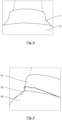
- FIG. 5 For comparison, a prior art collar 51 is illustrated in Figure 5 . It is clearly visible that, when this collar 51 is integrated into the garment 52 by a seam 53, the latter remains visible when the collar is folded. It is also visible that such a collar 51 rises less significantly in the neck, thus protecting it less from external elements (rain, wind, cold, sun, etc.).
Landscapes
- Engineering & Computer Science (AREA)
- Textile Engineering (AREA)
- Manufacturing & Machinery (AREA)
- Details Of Garments (AREA)
- Outer Garments And Coats (AREA)
- Professional, Industrial, Or Sporting Protective Garments (AREA)
Claims (10)
- Gestrickter Kleidungskragen (30), insbesondere Polo, umfassend:- einen ersten weichen Stoffabschnitt (31), umfassend ein inneres Längsende (311) von gerader Form und ein äußeres Längsende (312) von im Wesentlichen gebogener Form;- einen zweiten festen Stoffabschnitt aus strukturierten Maschen (32), der von dem ersten Abschnitt (31) getrennt ist und den Unterkragen darstellt, wobei der zweite Abschnitt (32) ein inneres Längsende von gerader Form entsprechend dem inneren Längsende (311) des ersten Abschnitts (31) und ein äußeres Längsende (314) von im Wesentlichen gebogener Form umfasst, wobei der zweite Abschnitt (32) mit dem ersten Abschnitt (31) im Bereich des inneren Längsendes (311) verbunden ist,
wobei der Kragen gekennzeichnet ist durch- eine Längsfaltachse (33) von im Wesentlichen gebogener Form des ersten Abschnitts (31), wobei sich die Längsfaltachse (33) in dem ersten Abschnitt (31) parallel zum äußeren Längsende (312) befindet, so dass sich der erste Abschnitt (31) entlang der Längsfaltachse (33) faltet, um einen Teil des ersten Abschnitts (31) und den gesamten zweiten Abschnitt (32) zu bedecken;wobei der Kragen zwei seitliche Enden (313) von gerader Form umfasst; undwobei der Kragen eine Höhe H1 zwischen dem äußeren Längsende (312) und dem äußeren Längsende (314) im Bereich seines Mittelteils und eine Höhe H2 im Bereich jedes seiner seitlichen Enden (313) definiert, wobei H1 gleich oder größer als H2 ist. - Kleidungskragen nach Anspruch 1, bei dem die Höhe H1 zwischen 7 cm und 10 cm, vorzugsweise zwischen 8,5 cm und 9,5 cm beträgt.
- Kleidungskragen nach Anspruch 1 oder 2, bei dem die Höhe H2 zwischen 5 cm und 8 cm, vorzugsweise zwischen 6,5 cm und 7,5 cm beträgt.
- Kleidungskragen nach einem der Ansprüche 1 bis 3, bei dem der Kragen aus einem einzigen Stück besteht.
- Kleidungskragen nach einem der Ansprüche 1 bis 4, bei dem sich der zweite Abschnitt (32) des Kragens aus strukturierten Maschen auf einer Höhe im Bereich seines Mittelteils zwischen 0,5 cm und 2,5 cm, vorzugsweise zwischen 1 cm und 2 cm erstreckt.
- Kleidungskragen nach einem der Ansprüche 1 bis 5, wobei der Kragen aus Baumwolle oder Kunststoff ist, wob ei der Kragen vorzugsweise aus Baumwolle ist.
- Verfahren zur Herstellung eines gestrickten Kleidungskragens (30), insbesondere Polos, nach den Ansprüchen 1 bis 6, wobei das Verfahren umfasst:- mindestens einen Schritt der Herstellung eines ersten weichen Stoffabschnitts (31) des Kragens;- mindestens einen Schritt der Herstellung eines zweiten festen Stoffabschnitts (32) des Kragens durch strukturierten Maschenstrick, der sich vom ersten Abschnitt (31) unterscheidet und den Unterkragen darstellt;wobei diese zwei Herstellungsschritte die Pfeilstricktechnik einsetzen und nacheinander durchgeführt werden.
- Verfahren nach Anspruch 7, bei dem der mindestens eine Schritt des strukturierten Maschenstricks nach einer Technik durchgeführt wird, die unter dem Milano-Strick, dem Interlock-Strick, dem Double-Face-Strick, dem Rundstrick oder dem kombinierten Reihen-/Rundstrick ausgewählt ist, wobei der mindestens eine strukturierte Maschenstrick vorzugsweise nach der Milano-Stricktechnik durch geführt wird.
- Kleidung, umfassend einen Kragen (30), wie nach einem der Ansprüche 1 bis 6 definiert.
- Kleidung nach Anspruch 9, die ein Polo ist.
Priority Applications (1)
| Application Number | Priority Date | Filing Date | Title |
|---|---|---|---|
| MA66266A MA66266B1 (fr) | 2022-12-14 | 2023-12-13 | Col de vêtement tricoté comprenant une première portion souple courbe et une deuxième portion rigide courbe en maille structurée, procédé de fabrication d'un tel col et vêtement comprenant un tel col |
Applications Claiming Priority (1)
| Application Number | Priority Date | Filing Date | Title |
|---|---|---|---|
| FR2213382A FR3143275B1 (fr) | 2022-12-14 | 2022-12-14 | Col de vêtement tricoté comprenant une première portion souple courbe et une deuxième portion rigide courbe en maille structurée, procédé de fabrication d’un tel col et vêtement comprenant un tel col |
Publications (3)
| Publication Number | Publication Date |
|---|---|
| EP4385349A1 EP4385349A1 (de) | 2024-06-19 |
| EP4385349C0 EP4385349C0 (de) | 2025-05-21 |
| EP4385349B1 true EP4385349B1 (de) | 2025-05-21 |
Family
ID=85726718
Family Applications (1)
| Application Number | Title | Priority Date | Filing Date |
|---|---|---|---|
| EP23216380.8A Active EP4385349B1 (de) | 2022-12-14 | 2023-12-13 | Gestrickter bekleidungshals mit einem ersten gebogenen abschnitt und einem zweiten starren abschnitt mit strukturierter maschenkurve, verfahren zur herstellung solch eines halss und kleidungsstück mit solch einem hals |
Country Status (6)
| Country | Link |
|---|---|
| US (1) | US20240197013A1 (de) |
| EP (1) | EP4385349B1 (de) |
| CN (1) | CN118177436A (de) |
| ES (1) | ES3037930T3 (de) |
| FR (1) | FR3143275B1 (de) |
| MA (1) | MA66266B1 (de) |
Family Cites Families (8)
| Publication number | Priority date | Publication date | Assignee | Title |
|---|---|---|---|---|
| GB653389A (en) * | 1947-05-23 | 1951-05-16 | F W & H J Bevins Ltd | Improvements in knitted collars and shirts incorporating the same |
| US2514646A (en) * | 1948-03-05 | 1950-07-11 | Ruth M Johnson | Garment collar lining shield |
| CH390841A (fr) | 1962-04-17 | 1965-04-30 | Dubied & Cie Sa E | Col double tricoté et procédé pour sa fabrication |
| US6167732B1 (en) * | 2000-01-03 | 2001-01-02 | Marc Friedman | Knitwear having no curl collars |
| US8161574B2 (en) * | 2008-05-16 | 2012-04-24 | Nike, Inc. | Apparel with raised course crease |
| US20210127758A1 (en) * | 2019-10-30 | 2021-05-06 | Amy Morisch Hurst | Shirt with uv protection collar and collar stay |
| US12302953B2 (en) * | 2021-07-02 | 2025-05-20 | Puma SE | Collar for a garment |
| CN113412982A (zh) * | 2021-07-24 | 2021-09-21 | 广东航宇纺织科技有限公司 | 一种服装双层扇弧形横机领 |
-
2022
- 2022-12-14 FR FR2213382A patent/FR3143275B1/fr active Active
-
2023
- 2023-12-13 EP EP23216380.8A patent/EP4385349B1/de active Active
- 2023-12-13 ES ES23216380T patent/ES3037930T3/es active Active
- 2023-12-13 US US18/537,860 patent/US20240197013A1/en active Pending
- 2023-12-13 MA MA66266A patent/MA66266B1/fr unknown
- 2023-12-14 CN CN202311719345.8A patent/CN118177436A/zh active Pending
Also Published As
| Publication number | Publication date |
|---|---|
| US20240197013A1 (en) | 2024-06-20 |
| MA66266B1 (fr) | 2025-09-30 |
| ES3037930T3 (en) | 2025-10-08 |
| EP4385349C0 (de) | 2025-05-21 |
| FR3143275A1 (fr) | 2024-06-21 |
| EP4385349A1 (de) | 2024-06-19 |
| CN118177436A (zh) | 2024-06-14 |
| FR3143275B1 (fr) | 2024-11-08 |
Similar Documents
| Publication | Publication Date | Title |
|---|---|---|
| EP2545793B1 (de) | Kleidungsartikel | |
| WO2016107990A1 (fr) | Procede de fabrication d'un article chaussant, article chaussant obtenu par ce procede, et machine servant a la fabrication d'un article chaussant | |
| FR2751668A1 (fr) | Procede et tricotage d'articles de bonneterie, et articles, notamment collants, realises selon ce procede | |
| WO2001061093A1 (fr) | Article de lingerie tricote de type 'boxer' et son procede de fabrication | |
| EP4385349B1 (de) | Gestrickter bekleidungshals mit einem ersten gebogenen abschnitt und einem zweiten starren abschnitt mit strukturierter maschenkurve, verfahren zur herstellung solch eines halss und kleidungsstück mit solch einem hals | |
| US20150264989A1 (en) | Abraham twist necktie | |
| CH621470A5 (de) | ||
| FR2799347A1 (fr) | Casquette a taille variable comportant des soufflets en tricot trame deux fontures | |
| EP0112215A1 (de) | Verfahren zum Zeichnen, Schneiden und Herstellen von Bekleidungsstücken und Ärmeln die für den Oberkörper bestimmt sind, und so hergestellte Bekleidungsstücke | |
| FR3153832A1 (fr) | Vêtement de type polo tricoté sans couture | |
| CN218127129U (zh) | 一种翻驳领制板 | |
| BE562317A (de) | ||
| CN220441937U (zh) | 一种符合人体工程学坐姿状态的衬衫门筒 | |
| WO2007031610A1 (fr) | Maillot bi-composant, notamment pour la pratique des sports de raquettes | |
| FR2819271A1 (fr) | Chaussette avec demi-pointe et demi-talon en bouclettes et semelle en mailles aerees | |
| EP4316293A1 (de) | Armstopf zur maskierung von adiillar-spiration | |
| BE352733A (de) | ||
| FR2458236A1 (fr) | Doublure de fourrure pour veste ou manteau | |
| FR2569086A1 (fr) | Procede pour la confection de vetements a partir de tissus composites, tissus composites et vetements obtenus par la mise en oeuvre du procede | |
| FR3146398A1 (fr) | Procédé de fabrication d'un article de compression et article de compression associé | |
| WO2025181322A1 (fr) | Orthèse tricotée comprenant au moins une protubérance | |
| CH135198A (fr) | Bas tricoté et procédé pour le fabriquer. | |
| FR2588163A1 (fr) | Article vestimentaire transformable et reversible | |
| FR2613594A1 (fr) | Nouveau procede de decoupe et de confection de vestes et de bustiers | |
| FR2481582A1 (fr) | Epauliere sans coutures au niveau des epaules |
Legal Events
| Date | Code | Title | Description |
|---|---|---|---|
| PUAI | Public reference made under article 153(3) epc to a published international application that has entered the european phase |
Free format text: ORIGINAL CODE: 0009012 |
|
| STAA | Information on the status of an ep patent application or granted ep patent |
Free format text: STATUS: THE APPLICATION HAS BEEN PUBLISHED |
|
| AK | Designated contracting states |
Kind code of ref document: A1 Designated state(s): AL AT BE BG CH CY CZ DE DK EE ES FI FR GB GR HR HU IE IS IT LI LT LU LV MC ME MK MT NL NO PL PT RO RS SE SI SK SM TR |
|
| STAA | Information on the status of an ep patent application or granted ep patent |
Free format text: STATUS: REQUEST FOR EXAMINATION WAS MADE |
|
| 17P | Request for examination filed |
Effective date: 20240923 |
|
| RBV | Designated contracting states (corrected) |
Designated state(s): AL AT BE BG CH CY CZ DE DK EE ES FI FR GB GR HR HU IE IS IT LI LT LU LV MC ME MK MT NL NO PL PT RO RS SE SI SK SM TR |
|
| GRAP | Despatch of communication of intention to grant a patent |
Free format text: ORIGINAL CODE: EPIDOSNIGR1 |
|
| STAA | Information on the status of an ep patent application or granted ep patent |
Free format text: STATUS: GRANT OF PATENT IS INTENDED |
|
| INTG | Intention to grant announced |
Effective date: 20250123 |
|
| GRAS | Grant fee paid |
Free format text: ORIGINAL CODE: EPIDOSNIGR3 |
|
| GRAA | (expected) grant |
Free format text: ORIGINAL CODE: 0009210 |
|
| STAA | Information on the status of an ep patent application or granted ep patent |
Free format text: STATUS: THE PATENT HAS BEEN GRANTED |
|
| AK | Designated contracting states |
Kind code of ref document: B1 Designated state(s): AL AT BE BG CH CY CZ DE DK EE ES FI FR GB GR HR HU IE IS IT LI LT LU LV MC ME MK MT NL NO PL PT RO RS SE SI SK SM TR |
|
| REG | Reference to a national code |
Ref country code: GB Ref legal event code: FG4D Free format text: NOT ENGLISH |
|
| REG | Reference to a national code |
Ref country code: CH Ref legal event code: EP |
|
| REG | Reference to a national code |
Ref country code: DE Ref legal event code: R096 Ref document number: 602023003613 Country of ref document: DE |
|
| REG | Reference to a national code |
Ref country code: IE Ref legal event code: FG4D Free format text: LANGUAGE OF EP DOCUMENT: FRENCH |
|
| U01 | Request for unitary effect filed |
Effective date: 20250620 |
|
| U07 | Unitary effect registered |
Designated state(s): AT BE BG DE DK EE FI FR IT LT LU LV MT NL PT RO SE SI Effective date: 20250701 |
|
| REG | Reference to a national code |
Ref country code: MA Ref legal event code: VAGR Ref document number: 66266 Country of ref document: MA Kind code of ref document: B1 |
|
| REG | Reference to a national code |
Ref country code: ES Ref legal event code: FG2A Ref document number: 3037930 Country of ref document: ES Kind code of ref document: T3 Effective date: 20251008 |
|
| PG25 | Lapsed in a contracting state [announced via postgrant information from national office to epo] |
Ref country code: NO Free format text: LAPSE BECAUSE OF FAILURE TO SUBMIT A TRANSLATION OF THE DESCRIPTION OR TO PAY THE FEE WITHIN THE PRESCRIBED TIME-LIMIT Effective date: 20250821 Ref country code: GR Free format text: LAPSE BECAUSE OF FAILURE TO SUBMIT A TRANSLATION OF THE DESCRIPTION OR TO PAY THE FEE WITHIN THE PRESCRIBED TIME-LIMIT Effective date: 20250822 |
|
| PG25 | Lapsed in a contracting state [announced via postgrant information from national office to epo] |
Ref country code: PL Free format text: LAPSE BECAUSE OF FAILURE TO SUBMIT A TRANSLATION OF THE DESCRIPTION OR TO PAY THE FEE WITHIN THE PRESCRIBED TIME-LIMIT Effective date: 20250521 |
|
| PG25 | Lapsed in a contracting state [announced via postgrant information from national office to epo] |
Ref country code: HR Free format text: LAPSE BECAUSE OF FAILURE TO SUBMIT A TRANSLATION OF THE DESCRIPTION OR TO PAY THE FEE WITHIN THE PRESCRIBED TIME-LIMIT Effective date: 20250521 |
|
| PG25 | Lapsed in a contracting state [announced via postgrant information from national office to epo] |
Ref country code: RS Free format text: LAPSE BECAUSE OF FAILURE TO SUBMIT A TRANSLATION OF THE DESCRIPTION OR TO PAY THE FEE WITHIN THE PRESCRIBED TIME-LIMIT Effective date: 20250821 |
|
| PG25 | Lapsed in a contracting state [announced via postgrant information from national office to epo] |
Ref country code: IS Free format text: LAPSE BECAUSE OF FAILURE TO SUBMIT A TRANSLATION OF THE DESCRIPTION OR TO PAY THE FEE WITHIN THE PRESCRIBED TIME-LIMIT Effective date: 20250921 |
|
| VSFP | Annual fee paid to validation state [announced via postgrant information from national office to epo] |
Ref country code: MA Payment date: 20251112 Year of fee payment: 3 |
|
| PG25 | Lapsed in a contracting state [announced via postgrant information from national office to epo] |
Ref country code: SM Free format text: LAPSE BECAUSE OF FAILURE TO SUBMIT A TRANSLATION OF THE DESCRIPTION OR TO PAY THE FEE WITHIN THE PRESCRIBED TIME-LIMIT Effective date: 20250521 |
|
| PGFP | Annual fee paid to national office [announced via postgrant information from national office to epo] |
Ref country code: TR Payment date: 20251027 Year of fee payment: 3 |
|
| PG25 | Lapsed in a contracting state [announced via postgrant information from national office to epo] |
Ref country code: CZ Free format text: LAPSE BECAUSE OF FAILURE TO SUBMIT A TRANSLATION OF THE DESCRIPTION OR TO PAY THE FEE WITHIN THE PRESCRIBED TIME-LIMIT Effective date: 20250521 |
|
| U20 | Renewal fee for the european patent with unitary effect paid |
Year of fee payment: 3 Effective date: 20251218 |
|
| PG25 | Lapsed in a contracting state [announced via postgrant information from national office to epo] |
Ref country code: SK Free format text: LAPSE BECAUSE OF FAILURE TO SUBMIT A TRANSLATION OF THE DESCRIPTION OR TO PAY THE FEE WITHIN THE PRESCRIBED TIME-LIMIT Effective date: 20250521 |
|
| PLBE | No opposition filed within time limit |
Free format text: ORIGINAL CODE: 0009261 |
|
| STAA | Information on the status of an ep patent application or granted ep patent |
Free format text: STATUS: NO OPPOSITION FILED WITHIN TIME LIMIT |