EP4384165B1 - Monoacylglycerol-lipasemodulatoren zur verwendung bei störungen des autistischen spektrums - Google Patents
Monoacylglycerol-lipasemodulatoren zur verwendung bei störungen des autistischen spektrums Download PDFInfo
- Publication number
- EP4384165B1 EP4384165B1 EP22764606.4A EP22764606A EP4384165B1 EP 4384165 B1 EP4384165 B1 EP 4384165B1 EP 22764606 A EP22764606 A EP 22764606A EP 4384165 B1 EP4384165 B1 EP 4384165B1
- Authority
- EP
- European Patent Office
- Prior art keywords
- azabicyclo
- azaspiro
- carbonyl
- octan
- oxa
- Prior art date
- Legal status (The legal status is an assumption and is not a legal conclusion. Google has not performed a legal analysis and makes no representation as to the accuracy of the status listed.)
- Active
Links
Images

Classifications
-
- A—HUMAN NECESSITIES
- A61—MEDICAL OR VETERINARY SCIENCE; HYGIENE
- A61K—PREPARATIONS FOR MEDICAL, DENTAL OR TOILETRY PURPOSES
- A61K31/00—Medicinal preparations containing organic active ingredients
- A61K31/33—Heterocyclic compounds
- A61K31/395—Heterocyclic compounds having nitrogen as a ring hetero atom, e.g. guanethidine or rifamycins
- A61K31/41—Heterocyclic compounds having nitrogen as a ring hetero atom, e.g. guanethidine or rifamycins having five-membered rings with two or more ring hetero atoms, at least one of which being nitrogen, e.g. tetrazole
-
- A—HUMAN NECESSITIES
- A61—MEDICAL OR VETERINARY SCIENCE; HYGIENE
- A61K—PREPARATIONS FOR MEDICAL, DENTAL OR TOILETRY PURPOSES
- A61K31/00—Medicinal preparations containing organic active ingredients
- A61K31/33—Heterocyclic compounds
- A61K31/395—Heterocyclic compounds having nitrogen as a ring hetero atom, e.g. guanethidine or rifamycins
- A61K31/41—Heterocyclic compounds having nitrogen as a ring hetero atom, e.g. guanethidine or rifamycins having five-membered rings with two or more ring hetero atoms, at least one of which being nitrogen, e.g. tetrazole
- A61K31/42—Oxazoles
- A61K31/423—Oxazoles condensed with carbocyclic rings
-
- A—HUMAN NECESSITIES
- A61—MEDICAL OR VETERINARY SCIENCE; HYGIENE
- A61K—PREPARATIONS FOR MEDICAL, DENTAL OR TOILETRY PURPOSES
- A61K31/00—Medicinal preparations containing organic active ingredients
- A61K31/33—Heterocyclic compounds
- A61K31/395—Heterocyclic compounds having nitrogen as a ring hetero atom, e.g. guanethidine or rifamycins
- A61K31/40—Heterocyclic compounds having nitrogen as a ring hetero atom, e.g. guanethidine or rifamycins having five-membered rings with one nitrogen as the only ring hetero atom, e.g. sulpiride, succinimide, tolmetin, buflomedil
- A61K31/403—Heterocyclic compounds having nitrogen as a ring hetero atom, e.g. guanethidine or rifamycins having five-membered rings with one nitrogen as the only ring hetero atom, e.g. sulpiride, succinimide, tolmetin, buflomedil condensed with carbocyclic rings, e.g. carbazole
-
- A—HUMAN NECESSITIES
- A61—MEDICAL OR VETERINARY SCIENCE; HYGIENE
- A61K—PREPARATIONS FOR MEDICAL, DENTAL OR TOILETRY PURPOSES
- A61K31/00—Medicinal preparations containing organic active ingredients
- A61K31/33—Heterocyclic compounds
- A61K31/395—Heterocyclic compounds having nitrogen as a ring hetero atom, e.g. guanethidine or rifamycins
- A61K31/435—Heterocyclic compounds having nitrogen as a ring hetero atom, e.g. guanethidine or rifamycins having six-membered rings with one nitrogen as the only ring hetero atom
-
- A—HUMAN NECESSITIES
- A61—MEDICAL OR VETERINARY SCIENCE; HYGIENE
- A61P—SPECIFIC THERAPEUTIC ACTIVITY OF CHEMICAL COMPOUNDS OR MEDICINAL PREPARATIONS
- A61P25/00—Drugs for disorders of the nervous system
Definitions
- the present invention relates to 3.1.0 and 4.1.0 azabicycle chemical entities having MGL modulating properties, and pharmaceutical compositions comprising these chemical entities, for use in the treatment of autism spectrum disorder, including Asperger's syndrome.
- Cannabis sativa and analogs of ⁇ 9 -tetrahydrocannabinol have been used since the days of folk medicine for therapeutic purposes.
- the endocannabinoid system consists of two G-protein coupled receptors, cannabinoid receptor type 1 (CB1) ( Matsuda et al., Nature, 1990, 346, 561-4 ) and cannabinoid receptor type 2 (CB2) ( Munro et al., Nature, 1993, 365, 61-5 ).
- CB1 receptor is one of the most abundant G-protein coupled receptor expressed in the brain ( Herkenam et al., Proc. Nat. Acad. Sci., 1990, 87(5), 1932-1936 ).
- CB1 is also expressed peripherally in the liver, gastrointestinal tract, pancreas, adipose tissue, and skeletal muscles ( Di Marzo et al., Curr. Opin. Lipidol., 2007, 18, 129-140 ).
- CB2 is predominantly expressed in immune cells such as monocytes ( Pacher et al., Amer. J. Physiol., 2008, 294, H1133-H1134 ) and under certain conditions (inflammation) in the brain (( Benito et al., Brit. J. Pharmacol., 2008, 153, 277-285 ) and in skeletal ( Cavuoto et al., Biochem. Biophys. Res. Commun., 2007, 364, 105-110 ) and cardiac muscles ( Hajrasouliha et al., Eur. J. Pharmacol., 2008, 579, 246-252 ).
- N-arachidonoylethanolamine (AEA or anandamide) was found to be an endogenous ligand for cannabinoid receptors ( Devane et al., Science, 1992, 258, 1946-9 ). Subsequently, 2-arachidonoylglycerol (2-AG) was identified as an additional endogenous ligand for the cannabinoid receptors ( Mechoulam et al., Biochem. Pharmacol., 1995, 50, 83-90 ; Sugiura et al., Biochem. Biophys. Res. Commun., 1995, 215, 89-97 ).
- 2-AG Concentrations of 2-AG were reported to be at least 100 times higher than those of anandamide in the rat brain ( Buczynski and Parsons, Brit. J. Pharmacol., 2010, 160 (3), 423-42 ). Therefore, 2-AG may play more essential physiological roles than anandamide in the brain endocannabinoid system ( Sugiura et al. Prostaglandins Leukot. Essent. Fatty Acids., 2002, 66(2-3), 173-92 ).
- the endocannabinoid 2-AG is a full agonist for CB1 and CB2 receptors, while anandamide is a partial agonist for both receptors ( Suguira et al., Prog. Lipid Res., 2006, 45(5), 405-46 ).
- endocannabinoids signal through a retrograde mechanism. They are synthesized on demand in postsynaptic neurons and then rapidly degraded following binding to presynaptic cannabinoid receptors ( Ahn et al., Chem. Rev., 2008, 108(5), 1687-707 ).
- Monoacylglycerol lipase (MGLL, also known as MAG lipase and MGL) is the serine hydrolase responsible for the degradation of 2-AG into arachidonic acid and glycerol in the central nervous system ( Mechoulam et al., Biochem. Pharmacol., 1995, 50, 83-90 ; Sugiura et al., Biochem. Biophys. Res.
- MGL modulation In addition to the role of MGL in terminating 2-AG signaling, MGL modulation, including MGL inhibition, also promotes CB1/2-independent effects on neuroinflammation ( Nomura et al., Science, 2011, 334(6057), 809-13 ). MGL modulation, including MGL inhibition, leads to reduction in proinflammatory prostanoid signaling in animal models of traumatic brain injury ( Katz et al., J. Neurotrauma, 2015, 32(5), 297-306 ; Zhang et al., J. Cereb.
- Neurodegeneration including Alzheimer's disease ( Piro et al., Cell Rep., 2012, 1(6), 617-23 ; Wenzel et al., Life Sci., 2018, 207, 314-322 ; Chen et al., Cell Rep., 2012, 2(5), 1329-39 ), Parkinson's disease ( Nomura et al., Science, 2011, 334(6057), 809-13 ; Pasquarelli et al., Neurochem.
- amyotrophic lateral sclerosis Pasquarelli et al., Neuropharmacology, 2017, 124:157-169
- multiple sclerosis Hernadez-Torres et al., Angew. Chem. Int. Ed.
- MGL modulation offers a compelling therapeutic approach for the treatment of a vast array of complex neurological diseases.
- MGL modulation does not produce the full spectrum of neurobehavioral effects observed with ⁇ 9 -tetrahydrocannabinol and other CB1 agonists ( Tuo et al., J. Med. Chem., 2017, 60(1), 4-46 ; Mulvihill et al., Life Sci., 2013, 92(8-9), 492-7 ).
- Endocannabinoid hypoactivity is a risk factor for the treatment of depression, anxiety, and post-traumatic stress disorders. Millennia of human use of cannabis sativa, and a brief period in which humans were treated with the endocannabinoid antagonist, rimonabant, provide support for that hypothesis.
- 2-AG levels are decreased in individuals with major depression ( Hill et al., Pharmacopsychiatry, 2008, 41(2), 48-53 ; Hill et al., Psychoneuroendocrinology, 2009, 34(8), 1257-1262 .). Low circulating 2-AG levels predict rates of depression ( Hauer et al., Rev. Neurosci., 2012, 23(5-6), 681-90 ).
- Autism spectrum disorder is a neurodevelopmental disability that can cause significant social, communication, and behavioral challenges.
- ASD includes several conditions that have been diagnosed separately, including autistic disorder, pervasive developmental disorder not otherwise specified (PDD-NOS), and Asperger's syndrome (DSM-V), and is commonly referred to in the ICD-10 system as autistic disorder.
- PDD-NOS pervasive developmental disorder not otherwise specified
- DSM-V Asperger's syndrome
- the endocannabinoid system regulates several central nervous system functions, including motor functions such as motor control and repetitive behaviors, cognitive functions such as perception, learning, and memory, mood functions such as anxiety and stress, and social behaviors, which are hallmark symptoms of autism spectrum disorder (ASD), this system provides a potential target for treatment for ASD and related disorders.
- WO 2020/079422 A1 describes compounds as Kv3 modulators.
- halogen or "halo” represents chlorine, fluorine, bromine, or iodine.
- R at a stereocenter designates that the stereocenter is purely of the R-configuration as defined in the art; likewise, the term “S” means that the stereocenter is purely of the S-configuration.
- RS refers to a stereocenter that exists as a mixture of the R- and S-configurations.
- Compounds containing one stereocenter drawn without a stereo bond designation are a mixture of 2 enantiomers.
- Compounds containing 2 stereocenters both drawn without stereo bond designations are a mixture of 4 diastereomers.
- Compounds with 2 stereocenters both labeled "RS" and drawn with stereo bond designations are a 2-component mixture with relative stereochemistry as drawn.
- Unlabeled stereocenters drawn without stereo bond designations are a mixture of the R- and S-configurations. For unlabeled stereocenters drawn with stereo bond designations, the absolute stereochemistry is as depicted.
- an expression such as "exposing an entity to compound of formula R-COOH” refers to the exposure of such entity to the form, or forms, of the compound R-COOH that exists, or exist, in the medium in which such exposure takes place.
- an expression such as "reacting an entity with a compound of formula R-COOH” refers to the reacting of (a) such entity in the chemically relevant form, or forms, of such entity that exists, or exist, in the medium in which such reacting takes place, with (b) the chemically relevant form, or forms, of the compound R-COOH that exists, or exist, in the medium in which such reacting takes place.
- isotopes that can be incorporated into compounds of the invention in a form that exceeds natural abundances include isotopes of hydrogen, carbon, nitrogen, oxygen, phosphorous, fluorine, chlorine, and iodine, such as 2 H (or chemical symbol D), 3 H (or chemical symbol T), 11 C, 13 C, 14 C, 15 N, 18 O, 17 O, 31 P, 32 P, 35 S, 18 F, 36 Cl, and 125 I, respectively.
- Additional active ingredients include treatments for comorbid attention deficit-hyperactivity disorder (ADHD) such as stimulants (such as dexamphetamine or methylphenidate salts) and non-stimulants such as those prescribed for hyperactivity, inattention, or impulsivity, or SSRIs/SNRIs for mood symptoms such as depression or anxiety symptoms, or sleep disorders (such as melatonin and derivatives thereof, e.g., Circadin).
- ADHD attention deficit-hyperactivity disorder
- stimulants such as dexamphetamine or methylphenidate salts
- non-stimulants such as those prescribed for hyperactivity, inattention, or impulsivity, or SSRIs/SNRIs for mood symptoms such as depression or anxiety symptoms, or sleep disorders (such as melatonin and derivatives thereof, e.g., Circadin).
- SSRIs/SNRIs for mood symptoms such as depression or anxiety symptoms
- sleep disorders such as melatonin and derivatives thereof, e.g., Circadin
- compositions containing one or more dosage units of the active agents may be prepared using pharmaceutically acceptable excipients and compounding techniques known or that become available to those of ordinary skill in the art.
- the compositions for use according to the invention may be administered by a suitable route of delivery, e.g., oral, parenteral, rectal, topical, or ocular routes, or by inhalation.
- the preparation may be in the form of tablets, capsules, sachets, dragees, powders, granules, lozenges, powders for reconstitution, liquid preparations, or suppositories.
- the compositions may be formulated for any one of a plurality of administration routes, such as intravenous infusion, topical administration, or oral administration.
- the compositions may be formulated for oral administration.
- the active agents of the invention can be provided in the form of tablets or capsules, or as a solution, emulsion, or suspension.
- the active agents may be formulated to yield a dosage of, e.g., for a 70-kg human, an illustrative range for a suitable dosage amount is from about 1 to 1000 mg/day in single or multiple dosage units.
- an illustrative range for suitable daily dosage amount is as described herein.
- bodyweight-based dosing may be considered for boys and girls, as treatments for ASD may be expected to be used in school-aged children.
- boys aged 8 years have an expected 50th percentile weight of ⁇ 25 kg
- boys aged 12 years have an expected 50th percentile weight of ⁇ 40 kg. It may be determined that different doses may be required for safe and efficacious treatment in younger children as compared with adolescents and adults.
- Binding agents may include starch and gelatin.
- the lubricating agent if present, may be magnesium stearate, stearic acid or talc. If desired, the tablets may be coated with a material such as glyceryl monostearate or glyceryl distearate to delay absorption in the gastrointestinal tract or may be coated with an enteric coating.
- Capsules for oral administration include hard and soft gelatin or (hydroxypropyl)methyl cellulose capsules.
- active ingredient(s) may be mixed with a solid, semi-solid, or liquid diluent.
- Liquids for oral administration may be in the form of suspensions, solutions, emulsions or syrups or may be lyophilized or presented as a dry product for reconstitution with water or other suitable vehicle before use.
- the agents may be mixed with a pharmaceutical carrier at a concentration of about 0.01% to about 20% of drug to vehicle, preferably 0.1% to 10%.
- a pharmaceutical carrier for topical administration, may be mixed with a pharmaceutical carrier at a concentration of about 0.01% to about 20% of drug to vehicle, preferably 0.1% to 10%.
- Another mode of administering the agents of the invention may utilize a patch formulation to affect transdermal delivery.
- the invention is directed to active agents for use in a method of treating a subject suffering from or diagnosed with a disease, disorder, or condition associated with MGL modulation, comprising administering to the subject in need of such treatment a therapeutically effective amount of the active agent.
- the compounds of Formula (I) are useful as compounds for use in methods for treating, ameliorating and/or preventing ASD. Such methods comprise administering to a subject, such as an animal, a mammal, or a human, in need of such treatment, amelioration and/or prevention, a therapeutically effective amount of a compound of Formula (I), or an enantiomer, diastereomer, solvate or pharmaceutically acceptable salt thereof.
- a subject such as an animal, a mammal, or a human
- the subject is a human.
- the subject is 18, 17, 16, 15, 14, 13, 12, 11, 10, 9, 8, 7, 6, 5, 4, 3, or 2 years of age or younger.
- the subject is 18 years of age or older.
- the compounds of Formula (I), or pharmaceutically acceptable salts, isotopes, N-oxides, solvates and stereoisomers thereof are useful as compounds for use in treating, ameliorating and/or preventing ASD. More particularly, the compounds of Formula (I), or pharmaceutically acceptable salts, isotopes, N-oxides, solvates and stereoisomers thereof, are useful as compounds for use in treating, ameliorating and/or preventing ASD, autistic disorder, pervasive developmental disorder not otherwise specified (PDD-NOS), Asperger's syndrome, Fragile X syndrome, Rett syndrome, childhood disintegrative disorder, Kanner's syndrome, Phelan McDermid Syndrome, Angelman syndrome, SCN2a related autism, SYNGAP related autism, Dub15q related autism, Dyrk1a related autism, GRIN2B related autism, Malan syndrome, ADNP syndrome, or tuberous sclerosis by administering to a subject in need thereof a therapeutically effective amount of a compound of Formula (I)
- Embodiments of the azabicycle compounds for use as described herein are compounds of Formula (I): wherein
- X is CH 2 . In some embodiments, X is O.
- Y is In some embodiments, Y is or In some embodiments, Y is
- R a and R b are both H. In some embodiments, R a and R b are each independently H or Cl. In some embodiments, R a and R b are both F.
- R 3 is In some embodiments, R 3 phenyl, or phenyl substituted with one or two members each independently selected from the group consisting of: Cl, F, CH 3 , CH 2 CH 3 , CH(CH 3 ) 2 , C(CH 3 ) 3 , CH 2 CH(CH 3 ) 2 , C(CH3) 2 CH 2 OH, C(CH 3 ) 2 CH 2 CO 2 H, CF 3 , OCF 3 , cyclopropyl, cyclopropyl substituted with CH 3 , and O-phenyl.
- R 3 is In some embodiments, R 3 is 3-tert-butylphenyl, 4-tert-butylphenyl, 4-methyl-3-trifluoromethylphenyl, or 3,4-dimethylphenyl.
- the compound of Formula (I) is a compound as shown below in Table 1.
- Table 1 Ex # Compound Name 1 (rac)-(2s,4s)-2-(1-(p-Tolyl)-3-azabicyclo[3 .1.0]hexane-3-carbonyl)-7-oxa-5-azaspiro[3.4]octan-6-one; 2 (2s,4*R)-2-((1*S,5*R)-1-(p-Tolyl)-3-azabicyclo[3.1.0]hexane-3-carbonyl)-7-oxa-5-azaspiro[3.4]octan-6-one; 3 (2s,4*S)-2-((1*R,5*S)-1-(p-Tolyl)-3-azabicyclo[3.1.0]hexane-3-carbonyl)-7-oxa-5-azaspiro[3.4]octan-6-one; 4 (rac)-(2s,4s)-2-(1-(
- the azabicycle compound is selected from the group consisting of:
- the azabicycle compound is (2 s ,4 * R )-2-((1 * S ,5 * R )-1-(3-Isopropylphenyl)-3-azabicyclo[3.1.0]hexane-3-carbonyl)-7-oxa-5-azaspiro[3.4]octan-6-one, or a pharmaceutically acceptable salt thereof.
- the azabicycle compound is (2s,4 *R)-2-((1* S ,6* R )-6-(3-(Trifluoromethoxy)phenyl)-3-azabicyclo[4.1.0]heptane-3-carbonyl)-7-oxa-5-azaspiro[3.4]octan-6-one, or a pharmaceutically acceptable salt, isotope, N-oxides, solvate, or stereoisomer thereof.
- the azabicycle compound is (2s,4 *S)-2-((1 *R,6*S)-6-(3-(Trifluoromethoxy)phenyl)-3-azabicyclo[4.1.0]heptane-3-carbonyl)-7-oxa-5-azaspiro[3.4]octan-6-one, or a pharmaceutically acceptable salt, isotope, N-oxide, solvate, or stereoisomer thereof.
- the azabicycle compound is (2s,4S)-2-((1R,5S,6S)-6-(3-Chloro-4-methylphenyl)-3-azabicyclo[3.1.0]hexane-3-carbonyl)-7-oxa-5-azaspiro[3.4]octan-6-one, or a pharmaceutically acceptable salt thereof.
- the azabicycle compound is (2 s ,4 S )-2-((1 R ,5 S ,6 S )-6-(3-( tert -Butyl)phenyl)-3-azabicyclo[3.1.0]hexane-3-carbonyl)-7-oxa-5-azaspiro[3.4]octan-6-one, or a pharmaceutically acceptable salt, isotope, N-oxide, solvate, or stereoisomer thereof.
- the azabicycle compound is (2 s ,4* S )-2-((1* R ,6* S )-6-(3-Fluoro-4-methylphenyl)-3-azabicyclo[4.1.0]heptane-3-carbonyl)-7-oxa-5-azaspiro[3.4]octan-6-one, or a pharmaceutically acceptable salt thereof.
- a compound of formula (XXIV), where R 3 is suitably substituted aryl group, is condensed with 4-methylbenzenesulfonhydrazide; in a suitable solvent such as THF, MeOH, and the like; at room temperature for a period of 1-16 h to provide a compound of formula (XXV).
- a compound of formula (XXIV), where R 3 is substituted with Br and CH 3 ; is reacted with a commercially available suitably substituted boronic acid such as cyclopropylboronic acid; in the presence of a palladium catalyst such as Pd(OAc) 2 , bis(triphenylphosphine)palladium(II)chloride (PdCl 2 (PPh 3 ) 2 ), [1,1'-bis(diphenylphosphino)ferrocene]dichloropalladium(II) (PdCl 2 (dppf)), tetrakis(triphenylphosphine)palladium(0) (Pd(PPh 3 ) 4 ), 2-dicyclohexylphosphino-2',6'-diisopropoxy-1,1'-biphenyl)[2-(2'-amino-1,1'-biphenyl)]palladium(II) methane
- a compound of formula (XXVIII), where R c is H and R 3 is phenyl substituted with C(CH 3 ) 2 CH 2 OH is prepared in two steps from a compound of formula (XXVII), where R c is H and R 3 is phenyl substituted with C(CH 3 ) 2 CO 2 CH 3 .
- a compound of formula (XXVII), where R c is H and R 3 is phenyl substituted with C(CH 3 ) 2 CO 2 CH 3 is reduced employing conditions known to one skilled in the art.
- a compound of formula (XXVII), where R c is H and R 3 is phenyl substituted with C(CH 3 ) 2 CO 2 CH 3 is reduced with a suitable reducing agent such as NaBH 4 , LiAlH 4 , LiBH 4 , diisobutylaluminum hydride (DIBAL-H), and the like; in a suitable solvent such as tetrahydrofuran (THF), methanol (MeOH), ethanol (EtOH), and the like; at temperatures ranging from -78 to 0 °C; for a period of 30 min to 16 h.
- a suitable reducing agent such as NaBH 4 , LiAlH 4 , LiBH 4 , diisobutylaluminum hydride (DIBAL-H), and the like
- DIBAL-H diisobutylaluminum hydride
- suitable solvent such as tetrahydrofuran (THF), methanol (MeOH), ethanol (
- a compound of formula (XXIX), where R 3 is as described in claim 1, is treated with tert-butyl 2,5-dioxo-2,5-dihydro-1H-pyrrole-1-carboxylate, employing conditions previously described in SCHEME 10, to provide a compound of formula (XXXIV).
- a compound of formula (XXVIII) is prepared in two steps from a compound of formula (XXXIV). In a first step, deprotection of the tert-butyl carbamate protecting group is achieved employing conditions known to one skilled in the art, or as previously described.
- Compounds of Formula (I) may be converted to their corresponding salts using methods known to one of ordinary skill in the art.
- an amine of Formula (I) is treated with trifluoroacetic acid, HCl, or citric acid in a solvent such as Et 2 O, CH 2 Cl 2 , THF, MeOH, chloroform, or isopropanol to provide the corresponding salt form.
- trifluoroacetic acid or formic acid salts are obtained as a result of reverse phase HPLC purification conditions.
- the compounds according to this invention may accordingly exist as enantiomers. Where the compounds possess two or more chiral centers, they may additionally exist as diastereomers. It is to be understood that all such isomers and mixtures thereof are encompassed within the scope of the present invention.
- Compounds prepared according to the schemes described above may be obtained as single forms, such as single enantiomers, by form-specific synthesis, or by resolution. Compounds prepared according to the schemes above may alternately be obtained as mixtures of various forms, such as racemic (1: 1) or non-racemic (not 1:1) mixtures. Where racemic and non-racemic mixtures of enantiomers are obtained, single enantiomers may be isolated using conventional separation methods known to one of ordinary skill in the art, such as chiral chromatography, recrystallization, diastereomeric salt formation, derivatization into diastereomeric adducts, biotransformation, or enzymatic transformation. Where regioisomeric or diastereomeric mixtures are obtained, as applicable, single isomers may be separated using conventional methods such as chromatography or crystallization.
- reaction mixtures were magnetically stirred at room temperature (rt) under a nitrogen atmosphere. Where solutions were “dried,” they were generally dried over a drying agent such as Na 2 SO 4 or MgSO 4 . Where mixtures, solutions, and extracts were “concentrated”, they were typically concentrated on a rotary evaporator under reduced pressure. Reactions under microwave irradiation conditions were carried out in a Biotage Initiator or CEM (Microwave Reactor) Discover instrument.
- SFC supercritical fluid high performance liquid chromatography
- Mass spectra were obtained on an Agilent series 1100 MSD using electrospray ionization (ESI) in positive mode unless otherwise indicated. Calculated (calcd.) mass corresponds to the exact mass.
- NMR Nuclear magnetic resonance
- s singlet
- d doublet
- t triplet
- q quartet
- p pentet
- hept heptet
- dd doublet of doublets
- dt doublet of triplets
- dq double of quartets
- dp doublet of pentets
- td triplet of doublets
- tt triplet of triplets
- ddd doublet of doublet of doublets
- m multiplet
- br broad. It will be understood that for compounds comprising an exchangeable proton, said proton may or may not be visible on an NMR spectrum depending on the choice of solvent used for running the NMR spectrum and the concentration of the compound in the solution.
- Step D (2 s ,4 s )-6-Oxo-7-oxa-5-azaspiro[3.4]octane-2-carboxylic acid .
- TFA trifluoroacetic acid
- tert-butyl (2s,4s)-6-oxo-7-oxa-5-azaspiro[3.4]octane-2-carboxylate 17.7 g, 77.9 mmol
- Step A Ethyl (1 r ,3 s )-3-(3-methoxy-3-oxopropyl)-3-nitrocyclobutane-1-carboxylate.
- MeCN MeCN
- methyl acrylate 10.3 mL, 114 mmol.
- 1,8-diazabicyclo[5.4.0]undec-7-ene 7.1 mL, 47.6 mmol
- Step B (2 r ,4 s )-6-Oxo-5-azaspiro[3.4]octane-2-carboxylic acid .
- ethyl (1 r ,3 s ) - 3-(3-methoxy-3-oxopropyl)-3-nitrocyclobutane-1-carboxylate (13.6 g, 52.5 mmol) in methanol (MeOH) (133 mL) was added nickel(II) chloride hexahydrate (12.5 g, 52.6 mmol).
- Step A tert -Butyl 1-(4,4,5,5-tetramethyl-1,3,2-dioxaborolan-2-yl)-3-azabicyclo[3.1.0]hexane-3-carboxylate .
- anhydrous DCM 62 mL
- diethylzinc 68 mL, 1 M in hexanes, 68 mmol.
- the mixture was cooled to -40 °C and a solution of diiodomethane (11 mL, 135 mmol) in DCM (26 mL) was slowly added by addition funnel over 30 min. The reaction was then allowed to stir at -40 °C for 1 h.
- Step B Potassium (3-( tert -butoxycarbonyl)-3-azabicyclo[3.1.0]hexan-1-yl)trifluoroborate.
- tert- Butyl 1-(4,4,5,5-tetramethyl-1,3,2-dioxaborolan-2-yl)-3-azabicyclo[3.1.0]hexane-3-carboxylate (1 g, 3.2 mmol) was dissolved in MeOH (20 mL), treated with KHF 2 (1.8 g, 22.6 mmol) and stirred at 65 °C for 16 h. The reaction mixture was cooled to room temperature and concentrated under reduced pressure. The resulting residue was triturated with 20% Et 2 O in heptane (13 mL) for 10 min.
- Example 1 ( rac )-(2 s ,4 s )-2-(1-( p -Tolyl)-3-azabicyclo[3.1.0]hexane-3-carbonyl)-7-oxa-5-azaspiro[3.4]octan-6-one.
- Example 3 (2 s ,4* S )-2-((1* R ,5* S )-1-( p -Tolyl)-3-azabicyclo[3.1.0]hexane-3-carbonyl)-7-oxa-5-azaspiro[3.4]octan-6-one.
- Example 1 The title compound was prepared by chiral supercritical fluid chromatography of Example 1 (Stationary phase: Lux Cellulose 4, 5 ⁇ m 250 x 21 mm, Mobile phase: 50% MeOH, 50% CO 2 ). MS (ESI): mass calcd. for C 19 H 22 N 2 O 3 , 326.2; m/z found, 327.2 [M+H] + .
- Example 4 ( rac )-(2 s ,4 s )-2-(1-Phenyl-3-azabicyclo[3.1.0]hexane-3-carbonyl)-7-oxa-5-azaspiro[3.4]octan-6-one.
- Example 5 ( rac )-(2 s ,4 s )-2-(1-(4-( tert -Butyl)phenyl)-3-azabicyclo[3.1.0]hexane-3-carbonyl)-7-oxa-5-azaspiro[3.4]octan-6-one.
- Step A tert -Butyl 1-(4-( tert -butyl)phenyl)-3-azabicyclo[3.1.0]hexane-3-carboxylate .
- potassium (3-( tert -butoxycarbonyl)-3-azabicyclo[3.1.0]hexan-1-yl)trifluoroborate (Intermediate 5, 210 mg, 0.73 mmol)
- CatacXium ® A Pd G3 (30 mg, 0.036 mmol)
- 1-bromo-4-( tert -butyl)benzene 250 ⁇ L, 1.4 mmol
- Cs 2 CO 3 (709.9 mg, 2.2 mmol
- toluene 14 mL
- water 1.4 mL.
- Example 9 ( rac )-(2 s ,4 s )-2-(1-(4-Isopropylphenyl)-3-azabicyclo[3.1.0]hexane-3-carbonyl)-7-oxa-5-azaspiro[3.4]octan-6-one.
- Example 10 (2 s ,4* S )-2-((1* R ,5* S )-1-(4-Isopropylphenyl)-3-azabicyclo[3.1.0]hexane-3-carbonyl)-7-oxa-5-azaspiro[3.4]octan-6-one.
- Example 21 ( rac )-(2 s ,4 s) -2-(1-( m -Toly])-3-azabicyclo[3.1.0]hexane-3-carbonyl)-7-oxa-5-azaspiro[3.4]octan-6-one.
- Example 22 ( rac )-(2 s ,4 s )-2-(1-(4-(Trifluoromethoxy)phenyl)-3-azabicyclo[3.1.0]hexane-3-carbonyl)-7-oxa-5-azaspiro[3.4]octan-6-one.
- Example 23 ( rac )-(2 s ,4 s )-2-(1-(3-(Trifluoromethyl)phenyl)-3-azabicyclo[3.1.0]hexane-3-carbonyl)-7-oxa-5-azaspiro[3.4]octan-6-one.
- Example 27 ( rac )-(2 r ,4 s )-2-(1-(4-(1-Methylcyclopropyl)phenyl)-3-azabicyclo[3.1.0]hexane-3-carbonyl)-5-azaspiro[3.4]octan-6-one.
- Example 33 ( rac )-(2 s ,4 s )-2-(1-(2-Methyl-4-(trifluoromethyl)phenyl)-3-azabicyclo[3.1.0]hexane-3-carbonyl)-7-oxa-5-azaspiro[3.4]octan-6-one.
- Example 34 ( rac )-(2 s ,4 s )-2-(1-(2-Methyl-4-(trifluoromethoxy)phenyl)-3-azabicyclo[3.1.0]hexane-3-carbonyl)-7-oxa-5-azaspiro[3.4]octan-6-one.
- Example 35 ( rac )-(2 s ,4 s )-2-(1-(3-Methyl-4-(trifluoromethoxy)phenyl)-3-azabicyclo[3.1.0]hexane-3-carbonyl)-7-oxa-5-azaspiro[3.4]octan-6-one.
- Example 36 ( rac )-(2 s ,4 s )-2-(1-(3-Methyl-4-(trifluoromethyl)phenyl)-3-azabicyclo[3.1.0]hexane-3-carbonyl)-7-oxa-5-azaspiro[3.4]octan-6-one.
- Example 40 (2 s ,4 S )-2-((1 R ,6 S )-6-Phenyl-3-azabicyclo[4.1.0]heptane-3-carbonyl)-7-oxa-5-azaspiro[3.4]octan-6-one.
- Example 39 The title compound was prepared by chiral supercritical fluid chromatography of Example 39 (Stationary phase: Chiralpak AD, 5 ⁇ m 250 x 21 mm, Mobile phase: 40% MeOH:isopropanol (1:1) with 0.2% isopropylamine, 60% CO 2 ). MS (ESI): mass calcd. for C 19 H 22 N 2 O 3 , 326.2; m/z found, 327.2 [M+H] + .
- Example 41 (2 s ,4 R )-2-((1 S ,6 R )-6-Phenyl-3-azabicyclo[4.1.0]heptane-3-carbonyl)-7-oxa-5-azaspiro[3.4]octan-6-one.
- Example 39 The title compound was prepared by chiral supercritical fluid chromatography of Example 39 (Stationary phase: Chiralpak AD, 5 ⁇ m 250 x 21 mm, Mobile phase: 40% MeOH:isopropanol (1:1) with 0.2% isopropylamine, 60% CO 2 ). MS (ESI): mass calcd. for C 19 H 22 N 2 O 3 , 326.2; m/z found, 327.2 [M+H] + .
- Example 43 ( rac )-(2 s ,4 s )-2-(6-( m -Tolyl)-3-azabicyclo[4.1.0]heptane-3-carbonyl)-7-oxa-5-azaspiro[3.4]octan-6-one.
- Example 44 (2 s ,4* R )-2-((1* S ,6* R )-6-( m -Tolyl)-3-azabicyclo[4.1.0]heptane-3-carbonyl)-7-oxa-5-azaspiro[3.4]octan-6-one.
- Example 43 The title compound was prepared by chiral supercritical fluid chromatography of Example 43 (Stationary phase: Chiralpak AD, 5 ⁇ m 250 x 21 mm, Mobile phase: 40% MeOH with 0.2% TEA, 60% CO 2 ). MS (ESI): mass calcd. for C 20 H 24 N 2 O 3 , 340.2; m/z found, 341.1 [M+H] - .
- Example 45 (2 s ,4* S )-2-((1* R ,6* S )-6-( m -Tolyl)-3-azabicyclo[4.1.0]heptane-3-carbonyl)-7-oxa-5-azaspiro[3.4]octan-6-one.
- Example 43 The title compound was prepared by chiral supercritical fluid chromatography of Example 43 (Stationary phase: Chiralpak AD, 5 ⁇ m 250 x 21 mm, Mobile phase: 40% MeOH with 0.2% TEA, 60% CO 2 ). MS (ESI): mass calcd. for C 20 H 24 N 2 O 3 , 340.2; m/z found, 341.2 [M+H] - .
- Example 48 (2 s ,4* S )-2-((1* R ,6* S )-6-(3-Fluoro-4-methylphenyl)-3-azabicyclo[4.1.0]heptane-3-carbonyl)-7-oxa-5-azaspiro[3.4]octan-6-one.
- Example 49 ( rac )-(2 s ,4 s )-2-(6-(3-(Trifluoromethoxy)phenyl)-3-azabicyclo[4.1.0]heptane-3-carbonyl)-7-oxa-5-azaspiro[3.4]octan-6-one.
- Example 49 The title compound was prepared by chiral supercritical fluid chromatography of Example 49 (Stationary phase: Chiralpak AD, 5 ⁇ m 250 x 30 mm, Mobile phase: 25% MeOH with 0.2% TEA, 75% CO 2 ). MS (ESI): mass calcd. for C 20 H 21 F 3 N 2 O 4 , 410.1; m/z found, 411.1 [M+H] + .
- Example 51 (2 s ,4* S )-2-((1* R ,6* S )-6-(3-(Trifluoromethoxy)phenyl)-3-azabicyclo[4.1.0]heptane-3-carbonyl)-7-oxa-5-azaspiro[3.4]octan-6-one.
- Example 49 The title compound was prepared by chiral supercritical fluid chromatography of Example 49 (Stationary phase: Chiralpak AD, 5 ⁇ m 250 x 30 mm, Mobile phase: 25% MeOH with 0.2% TEA, 75% CO 2 ). MS (ESI): mass calcd. for C 20 H 21 F 3 N 2 O 4 , 410.1; m/z found, 411.1 [M+H] + .
- Example 53 ( rac )-(2 s ,4 s )-2-(6-( o -Tolyl)-3-azabicyclo[4.1.0]heptane-3-carbonyl)-7-oxa-5-azaspiro[3.4]octan-6-one.
- Example 54 ( rac )-(2 s ,4 s )-2-(6-(4-(Trifluoromethoxy)phenyl)-3-azabicyclo[4.1.0]heptane-3-carbonyl)-7-oxa-5-azaspiro[3.4]octan-6-one.
- Example 55 ( rac )-(2 r ,4 s )-2-(6-(4-(Trifluoromethoxy)phenyl)-3-azabicyclo[4.1.0]heptane-3-carbonyl)-5-azaspiro[3.4]octan-6-one.
- Example 56 ( rac )-(2 s ,4 s )-2-(6-( p -Tolyl)-3-azabicyclo[4.1.0]heptane-3-carbonyl)-7-oxa-5-azaspiro[3.4]octan-6-one.
- Example 59 ( rac )-(2 r ,4 s )-2-(6-(4-(Trifluoromethyl)phenyl)-3-azabicyclo[4.1.0]heptane-3-carbonyl)-5-azaspiro[3.4]octan-6-one.
- Example 60 ( rac )-(2 s ,4 s )-2-(6-(3-( tert -Butyl)phenyl)-3-azabicyclo[4.1.0]heptane-3-carbonyl)-7-oxa-5-azaspiro[3.4]octan-6-one.
- Example 62 ( rac )-(2 s ,4 s )-2-(6-(4-( tert -Butyl)phenyl)-3-azabicyclo[4.1.0]heptane-3-carbonyl)-7-oxa-5-azaspiro[3.4]octan-6-one.
- Example 72 ( rac )-(2 s ,4 s )-2-(6-(4-Cyclopropyl-2-methylphenyl)-3-azabicyclo[4.1.0]heptane-3-carbonyl)-7-oxa-5-azaspiro[3 .4]octan-6-one.
- Example 73 ( rac )-(2 s ,4 s )-2-(6-(3-Isopropylphenyl)-3-azabicyclo[4.1.0]heptane-3-carbonyl)-7-oxa-5-azaspiro[3.4]octan-6-one.
- Example 75 ( rac )-(2 s ,4 s )-2-(6-(4-Methyl-3-(trifluoromethoxy)phenyl)-3-azabicyclo[4.1.0]heptane-3-carbonyl)-7-oxa-5-azaspiro[3.4]octan-6-one.
- Example 76 ( rac )-(2 r ,4 s )-2-(6-(4-Methyl-3-(trifluoromethoxy)phenyl)-3-azabicyclo[4.1.0]heptane-3-carbonyl)-5-azaspiro[3.4]octan-6-one.
- Example 82 (2 s ,4 S )-2-((1 R ,5 S ,6 S )-6-(4-( tert -Butyl)phenyl)-3-azabicyclo[3.1.0]hexane-3-carbonyl)-7-oxa-5-azaspiro[3 .4]octan-6-one.
- Example 83 (2 r ,4 S )-2-((1 R ,5 S ,6 S )-6-(4-( tert -Bulyl)phenyl)-3-azabicyclo[3.1.0]hexane-3-carbonyl)-5-azaspiro[3.4]octan-6-one.
- Example 85 (2 s ,4 S )-2-((1 R ,5 S ,6 S )-6-(4-Methyl-3-(trifluoromethyl)phenyl)-3-azabicyclo[3.1.0]hexane-3-carbonyl)-7-oxa-5-azaspiro[3.4]octan-6-one.
- Example 86 (2 s ,4 S )-2-((1 R ,5 S ,6 S )-6-(4-Ethylphenyl)-3-azabicyclo[3.1.0]hexane-3-carbonyl)-7-oxa-5-azaspiro[3.4]octan-6-one.
- Step A N' -(4-Ethylbenzylidene)-4-methylbenzenesulfonohydrazide.
- 4-ethylbenzaldehyde 2.0 g, 15 mmol
- 4-methylbenzenesulfonhydrazide 2.8 g, 15 mmol
- Step B (1 R ,5 S ,6 s )-3-Benzyl-6-(4-ethylphenyl)-3-azabicyclo[3.1.0]hexane.
- N'- (4-ethylbenzylidene)-4-methylbenzenesulfonohydrazide 500 mg, 1.65 mmol
- NaH 50% dispersion in mineral oil, 80 mg, 2.00 mmol
- the reaction was then heated with stirring at 60 °C for 1 h whereupon the reaction turned into a red slurry. After cooling to room temperature, the mixture was filtered, and the filtrate carefully concentrated in vacuo using a room temperature water bath to yield crude diazo intermediate.
- Step C (1 R ,5 S ,6 s )-6-(4-Ethylphenyl)-3-azabicyclo[3.1.0]hexane.
- (1 R ,5 S ,6 s )-3-Benzyl-6-(4-ethylphenyl)-3-azabicyclo[3.1.0]hexane (50 mg, 0.18 mmol) was taken up in EtOH (1.8 mL). 10% Pd/C (19 mg, 0.02 mmol) was added and the reaction vessel was evacuated and left under a H 2 balloon to stir at rt for 16 h. The reaction mixture was filtered through Celite ® with MeOH and concentrated under reduced pressure. The title compound was used without further purification in the next step.
- Step D (2 s ,4 S )-2-((1 R ,5 S ,6 S )-6-(4-Ethylphenyl)-3-azabicyclo[3.1.0]hexane-3-carbonyl)-7-oxa-5-azaspiro[3.4]octan-6-one.
- Example 87 (2 r ,4 S )-2-((1 R ,5 S ,6 S )-6-(4-Ethylphenyl)-3-azabicyclo[3.1.0]hexane-3-carbonyl)-5-azaspiro[3.4]octan-6-one.
- Example 26 The title compound was prepared by chiral supercritical fluid chromatography of Example 26 (Stationary phase: Whelk-O1 (S,S), 5 ⁇ m 250 x 21.2 mm, Mobile phase: 0.3% isopropylamine, 60% CO 2 , 40% ACN/iPrOH (v/v 50/50)). MS (ESI): mass calcd. for C 23 H 28 N 2 O 2 , 364.2; m/z found, 365.2 [M+H] + .
- Example 96 (2 r ,4* R )-2-((1* S ,5* R )-1-(4-(1-Methylcyclopropyl)phenyl)-3-azabicyclo[3.1.0]hexane-3-carbonyl)-5-azaspiro[3.4]octan-6-one.
- Example 26 The title compound was prepared by chiral supercritical fluid chromatography of Example 26 (Stationary phase: Whelk-O1 (S,S), 5 ⁇ m 250 x 21.2 mm, Mobile phase: 0.3% isopropylamine, 60% CO 2 , 40% ACN/iPrOH (v/v 50/50)). MS (ESI): mass calcd. for C 23 H 28 N 2 O 2 , 364.2; m/z found, 365.2 [M+H] + .
- Example 97 ( rac )-(2 s ,4* S )-2-((1* R ,5* S ,6* R )-1-Methyl-6-( o -tolyl)-3-azabicyclo[3.1.0]hexane-3-carbonyl)-7-oxa-5-azaspiro[3.4]octan-6-one.
- Step A 4-Methyl- N' -(2-methylbenzylidene)benzenesulfonohydrazide.
- 4-Methylbenzenesulfonhydrazide (3.1 g, 16.6 mmol) was added to a solution of 2-methylbenzaldehyde (2.0 g, 16.6 mmol) in MeOH (40 mL). The reaction mixture was stirred for 16 hours at room temperature. The precipitate was collected by filtration and washed with chilled MeOH before drying under reduced pressure to afford the title compound as a white solid (3.7 g, 77% yield).
- Step B ( rac )-(1* R ,5* S ,6* R )-3-Benzyl-1-methyl-6-( o -tolyl)-3-azabicyclo[3.1.0]hexane.
- Benzyltriethylammonium chloride (237 mg, 1.04 mmol) was added to a mixture of 4-methyl- N'- (2-methylbenzylidene)benzenesulfonohydrazide (1.0 g, 3.47 mmol) in aq. NaOH (15%, 8 mL) and toluene (8 mL).
- the reaction mixture was stirred vigorously at 80 °C for 1 hour.
- the toluene layer was separated, washed with sat.
- Step C ( rac )-(1* R ,5* S ,6* R )-1-Methyl-6-( o -tolyl)-3-azabicyclo[3.1.0]hexane.
- Step D ( rac )-(2 s ,4* S )-2-((1 *R,5 * S ,6* R )-1-Methyl-6-(o-tolyl)-3-azabicyclo[3.1.0]hexane-3-carbonyl)-7-oxa-5-azaspiro[3.4]octan-6-one.
- T 3 P ® (1.2 mL, 50% in ethyl acetate, 2.0 mmol) was added to a solution of (1* R ,5* S ,6* R )-1-methyl-6-( o -tolyl)-3-azabicyclo[3.1.0]hexane (360 mg, 1.9 mmol), (2s,4s)-6-oxo-7-oxa-5-azaspiro[3.4]octane-2-carboxylic acid (Intermediate 3, 200 mg, 1.2 mmol), and DIPEA (1.2 mL, 6.8 mmol) in DCM (5 mL). The reaction was stirred at room temperature for 16 hours before being quenched with H 2 O and extracted with DCM.
- Example 98 (2 s ,4 S )-2-((1 R ,5 S ,6 S )-6-( o -Tolyl)-3-azabicyclo[3.1.0]hexane-3-carbonyl)-7-oxa-5-azaspiro[3.4]octan-6-one.
- Example 99 (2 s ,4* S )-2-((1* R ,5* S ,6* R )-6-(3-( tert -Butyl)phenyl)-1-methyl-3-azabicyclo[3.1.0]hexane-3-carbonyl)-7-oxa-5-azaspiro[3.4]octan-6-one.
- Example 93 The title compound was prepared by chiral supercritical fluid chromatography of Example 93 (Stationary phase: OD-H, 2 x 25 cm, Mobile phase: 0.1% TEA, 60% CO 2 , 40% heptane/iPrOH (v/v 50/50)). MS (ESI): mass calcd. for C 23 H 30 N 2 O 3 , 382.2; m/z found, 383.2 [M+H] + .
- Example 100 (2 s ,4* R )-2-((1* S ,5* R ,6* S )-6-(3-( tert- Butyl)phenyl)-1-methyl-3-azabicyclo[3.1.0]hexane-3-carbonyl)-7-oxa-5-azaspiro[3.4]octan-6-one.
- Example 93 The title compound was prepared by chiral supercritical fluid chromatography of Example 93 (Stationary phase: OD-H, 2 x 25 cm, Mobile phase: 0.1% TEA, 60% CO 2 , 40% heptane/iPrOH (v/v 50/50)). MS (ESI): mass calcd. for C 23 H 30 N 2 O 3 , 382.2; m/z found, 383.2 [M+H] + .
- Example 101 (2 s ,4 S )-2-((1 R ,5 S ,6 S )-6-(3-Isobutylphenyl)-3-azabicyclo[3.1.0]hexane-3-carbonyl)-7-oxa-5-azaspiro[3.4]octan-6-one.
- Example 102 ( rac )-(2 s ,4* S )-2-((1* R ,5* S ,6* R )-6-(3,4-Dimethylphenyl)-1-methyl-3-azabicyclo[3.1.0]hexane-3-carbonyl)-7-oxa-5-azaspiro[3.4]octan-6-one.
- Example 103 (2 s ,4 S )-2-((1 R ,5 S ,6 S )-6-(3-( tert -Butyl)phenyl-5-D)-3-azabicyclo[3.1.0]hexane-3-carbonyl)-7-oxa-5-azaspiro[3.4 ]octan-6-one.
- Step A (1 R ,5 S ,6 s )-3-Benzyl-6-(3-( tert -butyl)-5-iodophenyl)-3-azabicyclo[3.1.0]hexane.
- the title compound was prepared in a manner analogous to Example 86, Steps A and B using 3- tert- butyl-5-iodobenzaldehyde (Intermediate 13) instead of 4-ethylbenzaldehyde in Step A.
- Step B (1 R ,5 S ,6 s )-6-(3-( tert -Butyl)-5-iodophenyl)-3-azabicyclo[3.1.0]hexane.
- Step C (2 s ,4 S )-2-((1 R ,5 S ,6 S )-6-(3-( tert -Butyl)-5-iodophenyl)-3-azabicyclo[3.1.0]hexane-3-carbonyl)-7-oxa-5-azaspiro[3.4]octan-6-one.
- Example 104 (2 s ,4 S )-2-((1 R ,5 S ,6 S )-6-(3-(1-Hydroxy-2-methylpropan-2-yl)phenyl)-3-azabicyclo[3.1.0]hexane-3-carbonyl)-7-oxa-5-azaspiro[3.4]octan-6-one.
- Step A (1 R ,5 S ,6 s )-3-Benzyl-6-(3-bromophenyl)-3-azabicyclo[3.1.0]hexane .
- the title compound was prepared in a manner analogous to Example 97, Steps A and B using 3-bromobenzaldehyde instead of 2-methylbenzaldehyde in Step A and 1-benzyl-2,5-dihydro-1 H -pyrrole instead of 1-benzyl-3-methyl-2,5-dihydro-1H-pyrrole (Intermediate 9) in Step B.
- Step C 2-(3-((1 R ,5 S ,6 s )-3-Benzyl-3-azabicyclo[3.1.0]hexan-6-yl)phenyl)-2-methylpropan-1-ol.
- LiAlH 4 65 mg, 1.7 mmol
- Step D 2-(3-((1 R ,5 S ,6 s )-3-Azabicyclo[3.1.0]hexan-6-yl)phenyl)-2-methylpropan-1-ol.
- 2-(3-((1 R ,5 S ,6 s )-3-Benzyl-3-azabicyclo[3.1.0]hexan-6-yl)phenyl)-2-methylpropan-1-ol (280 mg, 0.871 mmol) and dry Pd/C (150 mg, 10 wt%) were taken up in a mixture of THF:MeOH (5:1, 18 mL). The resultant mixture was stirred at room temperature for 5 hours under H 2 (15 psi). The suspension was filtered through a pad of Celite ® and the pad washed with THF. The filtrate was concentrated under reduced pressure to afford the title product (200 mg, crude), which was used in the next step without further purification.
- Step E (2 s ,4 S )-2-((1 R ,5 S ,6S ) -6-(3-(1-Hydroxy-2-methylpropan-2-yl)phenyl)-3-azabicyclo[3.1.0]hexane-3-carbonyl)-7-oxa-5-azaspiro[3.4]octan-6-one.
- T 3 P ® (825 mg, 50% in ethyl acetate, 1.30 mmol) was added to a solution of 2-(3-((1 R ,5 S ,6 s )-3-azabicyclo[3.1.0]hexan-6-yl)phenyl)-2-methylpropan-1-ol (200 mg, 0.865 mmol), (2 s ,4 s )-6-oxo-7-oxa-5-azaspiro[3.4]octane-2-carboxylic acid (Intermediate 3, 163 mg, 0.952 mmol), and Et 3 N (0.36 mL, 2.59 mmol) in DCM (10 mL).
- Example 105 2-Methyl-2-(3-((1 R ,5 S ,6 S )-3-((2 s ,4 S )-6-oxo-7-oxa-5-azaspiro[3.4]octane-2-carbonyl)-3-azabicyclo[3.1.0]hexan-6-yl)phenyl)propanoic acid.
- Step A Methyl 2-(3-((1 R ,5 S ,6 s )-3-azabicyclo[3.1.0]hexan-6-yl)phenyl)-2-methylpropanoate.
- Methyl 2-(3-((1 R ,5 S ,6 s )-3-benzyl-3-azabicyclo[3.1.0]hexan-6-yl)phenyl)-2-methylpropanoate (from Example 104, Step B) (330 mg, 0.944 mmol) and dry Pd/C (100 mg, 10 wt%) were taken up in a mixture of THF:MeOH (10:1, 22 mL).
- Step B Methyl 2-methyl-2-(3-((1 R ,5 S ,6 S )-3-((2 s ,4 S )-6-oxo-7-oxa-5-azaspiro[3.4]octane-2-carbonyl)-3-azabicyclo[3.1.0]hexan-6-yl)phenyl)propanoate .
- T 3 P ® (920 mg, 50% in ethyl acetate, 1.45 mmol) was added to a solution of methyl 2-(3-((1 R ,5 S ,6 s )-3-azabicyclo[3.1.0]hexan-6-yl)phenyl)-2-methylpropanoate (250 mg, 0.964 mmol), (2 s ,4 s )-6-oxo-7-oxa-5-azaspiro[3.4]octane-2-carboxylic acid (Intermediate 3, 165 mg, 0.964 mmol), and Et 3 N (0.40 mL, 2.90 mmol) in DCM (10 mL).
- Step C 2-Methyl-2-(3-((1 R ,5 S ,6 S )-3-((2 s ,4 S )-6-oxo-7-oxa-5-azaspiro[3.4]octane-2-carbonyl)-3-azabicyclo[3.1.0]hexan-6-yl)phenyl)propanoic acid.
- Example 106 ( rac )-(2 s ,4* S )-2-((1* R ,5* S ,6* R )-1-Methyl-6-(3-(trifluoromethyl)phenyl)-3-azabicyclo[3.1.0]hexane-3-carbonyl)-7-oxa-5-azaspiro[3.4]octan-6-one.
- Example 107 ( rac )-(2 s ,4* S )-2-((1* R ,5* S ,6* R )-1-Methyl-6-(4-(trifluoromethoxy)phenyl)-3-azabicyclo[3.1.0]hexane-3-carbonyl)-7-oxa-5-azaspiro[3.4]octan-6-one.
- Step A tert -Butyl (1 R ,5 S ,6 s )-6-(4-cyclopropyl-2-methylphenyl)-2,4-dioxo-3-azabicyclo[3.1.0]hexane-3-carboxylate .
- the title compound was prepared in a manner analogous to Example 78, Steps A and B using 4-cyclopropyl-2-methylbenzaldehyde (Intermediate 12) instead of 3- tert -butylbenzaldehyde in Step A and tert -butyl 2,5-dioxo-2,5-dihydro-1 H -pyrrole-1-carboxylate instead of N -benzylmaleimide in Step B.
- Step B (1 R ,5 S ,6 s )-6-(4-Cyclopropyl-2-methylphenyl)-3-azabicyclo[3.1.0]hexane-2,4-dione .
- tert -Butyl (1 R ,5 S ,6 s )-6-(4-cyclopropyl-2-methylphenyl)-2,4-dioxo-3-azabicyclo[3.1.0]hexane-3-carboxylate (560 mg, 1.64 mmol) was taken up in DCM (7 mL) and cooled to 0 °C.
- Step C (1 R ,5 S ,6 s )-6-(4-Cyclopropyl-2-methylphenyl)-3-azabicyclo[3.1.0]hexane.
- (1 R ,5 S ,6 s )-6-(4-Cyclopropyl-2-methylphenyl)-3-azabicyclo[3.1.0]hexane-2,4-dione (209 mg, 0.866 mmol) was taken up in anhydrous THF (5 mL).
- NaBH 4 (72.1 mg, 1.91 mmol) was added and this was stirred at rt for 15 min.
- BF 3 •OEt 2 (0.29 mL, 2.34 mmol
- Step D (2 s ,4 S )-2-((1 R ,5 S ,6 S )-6-(4-Cyclopropyl-2-methylphenyl)-3-azabicyclo[3.1.0]hexane-3-carbonyl)-7-oxa-5-azaspiro[3.4]octan-6-one.
- Example 110 (2 s ,4 S )-2-((1 R ,5 S ,6 S )-6-(3-Chloro-4-methylphenyl)-3-azabicyclo[3.1.0]hexane-3-carbonyl)-7-oxa-5-azaspiro[3.4]octan-6-one.
- Example 111 (2 s ,4 S )-2-((1 R ,5 S, 6 S )-6-(3-Ethyl-4-fluorophenyl)-3-azabicyclo[3.1.0]hexane-3-carbonyl)-7-oxa-5-azaspiro[3 .4]octan-6-one.
- Example 112 ( rac )-(2 s ,4* S )-2-((1 * R ,5* S ,6*R)-1-Methyl-6-(4-methyl-3- (trifluoromethyl)phenyl)-3-azabicyclo[3.1.0]hexane-3-carbonyl)-7-oxa-5-azaspiro[3.4]octan-6-one.
- Example 113 (2 s ,4 S )-2-((1 R ,5 S ,6 S )-6-(2-Methyl-3-(trifluoromethyl)phenyl)-3-azabicyclo[3.1.0]hexane-3-carbonyl)-7-oxa-5-azaspiro[3.4]octan-6-one.
- Example 114 ( rac )-(2 s ,4* S )-2-((1* R ,5* S ,6* R )-1-Methyl-6-(4-methyl-3-(trifluoromethoxy)phenyl)-3-azabicyclo[3.1.0]hexane-3-carbonyl)-7-oxa-5-azaspiro[3.4]octan-6-one.
- Step A N '-(4-Bromo-3-(trifluoromethoxy)benzylidene)-4-methylbenzenesulfonohydrazide .
- 4-Methylbenzenesulfonohydrazide (1.7 g, 9.29 mmol) was added to a solution of 4-bromo-3-(trifluoromethoxy)benzaldehyde (2.5 g, 9.29 mmol) in MeOH (50 mL). The reaction mixture was stirred for 16 hours at room temperature and then cooled to -10 °C.
- Step C ( rac )-(1 *R,5 * S ,6* R )-3-Benzyl-1-methyl-6-(4-methyl-3-(trifluoromethoxy)phenyl)-3-azabicyclo[3.1.0]hexane.
- Step E ( rac )-(2 s ,4* S )-2-((1* R ,5* S ,6* R )-1-Methyl-6-(4-methyl-3-(trifluoromethoxy)phenyl)-3-azabicyclo[3.1.0]hexane-3-carbonyl)-7-oxa-5-azaspiro[3.4]octan-6-one.
- T 3 P ® (0.30 mL, 50% in ethyl acetate, 0.50 mmol) was added to a solution of ( rac )-(1* R ,5* S ,6* R )-1-methyl-6-(4-methyl-3-(trifluoromethoxy)phenyl)-3-azabicyclo[3.1.0]hexane (90 mg, 0.33 mmol), (2 s ,4 s )-6-oxo-7-oxa-5-azaspiro[3.4]octane-2-carboxylic acid (Intermediate 3, 56 mg, 0.33 mmol), and DIPEA (0.29 mL, 1.6 mmol) in DCM (10 mL).
- Example 115 (2 s ,4 S )-2-((1 R ,5 S ,6 S )-6-(4-Methyl-3-(trifluoromethoxy)phenyl)-3-azabicyclo[3.1.0]hexane-3-carbonyl)-7-oxa-5-azaspiro[3.4]octan-6-one.
- Example 116 (2 s ,4 S )-2-((1 R ,5 S ,6 R )-6-(6-( tert -Butyl)pyridin-2-yl)-3-azabicyclo[3.1.0]hexane-3-carbonyl)-7-oxa-5-azaspiro[3.4]octan-6-one.
- Step A tert-Butyl (1 R ,5 S ,6 s )-6-(4,4,5,5-tetramethyl-1,3,2-dioxaborolan-2-yl)-3-azabicyclo[3.1.0]hexane-3-carboxylate.
- TMEDA (1.42 mL, 9.47 mmol) was added to a solution of CrCl 2 (1.16 g, 9.44 mmol) in THF (30 mL). The resultant blue mixture was stirred at room temperature for 15 mins.
- Step B tert -Butyl (1 R ,5 S ,6 r )-6-(6-( tert -butyl)pyridin-2-yl)-3-azabicyclo[3.1.0]hexane-3-carboxylate.
- Step C (1 R ,5 S ,6 r )-6-(6-( tert -Butyl)pyridin-2-yl)-3-azabicyclo[3.1.0]hexane.
- tert -Butyl (1 R ,5 S ,6 r )-6-(6-( tert -butyl)pyridin-2-yl)-3-azabicyclo[3.1.0]hexane-3-carboxylate 300 mg, 0.948 mmol
- TFA 3 mL, 17.7 mmol
- Step D (2 s ,4 S )-2-((1 R ,5 S ,6 R )-6-(6-( tert -Butyl)pyridin-2-yl)-3-azabicyclo[3.1.0]hexane-3-carbonyl)-7-oxa-5-azaspiro[3.4]octan-6-one.
- T 3 P ® (0.83 mL, 50% in ethyl acetate, 1.40 mmol) was added to a solution of 6-(6-( tert -butyl)pyridin-2-yl)-3-azabicyclo[3.1.0]hexane (350 mg, crude, 1.62 mmol), (2 s ,4 s )-6-oxo-7-oxa-5-azaspiro[3.4]octane-2-carboxylic acid (Intermediate 3, 160 mg, 0.935 mmol), and DIPEA (0.83 mL, 4.70 mmol) in DCM (10 mL). The reaction was stirred at room temperature for 16 hours before being quenched with H 2 O and extracted with DCM.
- Example 117 (2 s ,4* R )-2-((1* S ,6* R )-6-(4-(Trifluoromethyl)phenyl)-3-azabicyclo[4.1.0]heptane-3-carbonyl)-7-oxa-5-azaspiro[3.4]octan-6-one.
- Example 118 (2 s ,4* S )-2-((1* R ,6* S )-6-(4-(Trifluoromethyl)phenyl)-3-azabicyclo[4.1.0]heptane-3-carbonyl)-7-oxa-5-azaspiro[3.4]octan-6-one.
- Example 119 (2 r ,4* S )-2-((1* R ,6* S )-6-(3-(Trifluoromethoxy)phenyl)-3-azabicyclo[4.1.0]heptane-3-carbonyl)-5-azaspiro[3.4]octan-6-one.
- Example 121 (2 r ,4* S )-2-((1* R ,6* S )-6-(4-(Trifluoromethoxy)phenyl)-3-azabicyclo[4.1.0]heptane-3-carbonyl)-5-azaspiro[3.4]octan-6-one.
- Example 55 The title compound was prepared by chiral supercritical fluid chromatography of Example 55 (Stationary phase: CHIRALPAK AD-H, 5 ⁇ m 250 x 30 mm, Mobile phase: 50% MeOH, 50% CO 2 ). MS (ESI): mass calcd. for C 21 H 23 F 3 N 2 O 3 , 408.2; m/z found, 409.2 [M+H] - .
- Example 122 (2 r ,4* R )-2-((1* S ,6* R )-6-(4-(Trifluoromethoxy)phenyl)-3-azabicyclo[4.1.0]heptane-3-carbonyl)-5-azaspiro[3.4]octan-6-one.
- Example 55 The title compound was prepared by chiral supercritical fluid chromatography of Example 55 (Stationary phase: CHIRALPAK AD-H, 5 ⁇ m 250 x 30 mm, Mobile phase: 50% MeOH, 50% CO 2 ). MS (ESI): mass calcd. for C 21 H 23 F 3 N 2 O 3 , 408.2; m/z found, 409.2 [M+H] - .
- Example 123 ( rac )-(2 s ,4 s )-2-(7-Chloro-6-phenyl-3-azabicyclo[4.1.0]heptane-3-carbonyl)-7-oxa-5-azaspiro[3.4]octan-6-one.
- Example 124 (rac)-(2s,4s)-2-(7,7-Dichloro-6-phenyl-3-azabicyclo[4.1.0]heptane-3-carbonyl)-7-oxa-5-azaspiro[3.4]octan-6-one.
- the assay used to measure the in vitro activity of MGL is adapted from the assay used for another serine hydrolase (FAAH) described in Wilson et al., 2003 (A high-throughput-compatible assay for determining the activity of fatty acid amide hydrolase. Wilson SJ, Lovenberg TW, Barbier AJ. Anal Biochem. 2003 Jul 15;318(2):270-5 .).
- the assay consists of combining endogenously expressed MGL from HeLa cells with test compounds, adding [glycerol-1,3- 3 H]-oleoyl glycerol, incubating for one hour, and then measuring the amount of cleaved [1,3- 3 H]-glycerol that passes through an activated carbon filter. The amount of cleaved, tritiated glycerol passing through the carbon filter is proportional to the activity of the MGL enzyme in a particular well/test condition.
- Standard conditions for this assay combine 300 nM [Glycerol-1,3- 3 H]-oleoyl glycerol with human MGL from HeLa cells and test compounds for one hour, after which the reaction is filtered through activated carbon and tritium is measured in the flow through.
- the test compound concentration in screening mode is 10 ⁇ M, while the highest compound concentration in IC 50 assays is determined empirically.
- MGL is the predominant hydrolase in HeLa cells/cell homogenates. Results are shown in Table 3. Table 3.
- Example 3 The behavioral effects of the compound of Example 78 were evaluated using an animal model of autism in a sociability assay after administration of the compound.
- the sociability assay was conducted using C57BL/6J mice (commerically available from the Jackon Laboratory, Bar Harbor, ME) as control, and BTBR T + Itpr3 tf / J mice (referred herein as "BTBR")(commerically available from the Jackon Laboratory, Bar Harbor, ME) as an autism model.
- the BTBR mice used in Biological Example 3 was derived from the inbred strain BTBR (Black and Tan BRachyury) that carried the mutations a t (nonagouti; black and tan), Itpr3 tf (inositol 1,4,5-triphosphate receptor 3; tufted), and T (brachyury).
- This BTBR strain of mice exhibit a 100% absence of the corpus callosum and a severely reduced hippocampal commissure. ( Wahlsten D, 2003 Brain Res ). This strain exhibits several symptoms of autism including reduced social interactions, impaired play, low exploratory behavior, unusual vocalizations and high anxiety as compared to other inbred strains.
- mice contains the Trem2S148E allele - a naturally occurring variant at position 48351151-48351152 on Chr 17 (rs108080490 and rs107649577; Ensembl GRCm38.p6).
- This TC to GA transition results in a serine to glutamic acid substitution at amino acid 148 (S148E).
- mice Thirty (30) C57BL/6J female mice and thirty (30) BTBR female mice (7-8 weeks old) were used in Biological Example 3. Upon arrival, mice were group-housed (4-5/cage) and acclimated for at least 5 days prior to commencing studies. Animals were maintained on a 12hr light/dark cycle with room temperature maintained at 22 ⁇ 2°C and approximately 50% humidity and had access to food and water ad libitum until the day before the experiment.
- the two solutions listed in Table 4 were formulated fresh daily for p.o. administration. Both solutions comprise 20% 2-Hydroxypropyl- ⁇ -cyclodextrin (HP- ⁇ -CD).
- the solution containing Example 78 is in a concentration of 0.3 mg/mL. Table 4.
- mice Each type of mice is divided into two different treatment groups: those orally administered a Vehicle solution, and those orally administered with a solution of Example 78, both prepared according to Table 4 above.
- the mice were randomly assigned to treatment groups according to Table 5 below. Mice were administered the test article 60 minutes prior to testing. Table 5.
- Table 6 A summary of the three-chamber sociability test settings of Biological Example 3 is provided below in Table 6. Table 6. Test Three-chamber sociability test Assessment Social preference Apparatus Three-chamber arena Lighting Dim ( ⁇ 10 lux) Scoring system Noldus EthoVision Readout Duration and number of contacts with wire cups and entries into each chamber; time spent in each chamber
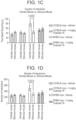
- Figs. 1A-1D provide data from the three-chamber sociability test results comparing social communications of the C57BL/6 or BTBR mouse spent with familiar mouse and stimulus mouse.
- the bars shown in Figs. 1A-1D represent mean ⁇ SEM.
- Tables 7 and 8 provide two-way analysis of variance (ANOVA) of the data for the amount of time and the number of entries the C57BL/6 or BTBR mouse and the mice spent exploring familiar mouse chamber and stimulus mouse chamber.
- Tables 9 and 10 provide two-way analysis of variance (ANOVA) of the data the amount of time and the number of interactions the C57BL/6 or BTBR mouse spent interacting with familiar mouse or stimulus mouse.
- Fig. 1A shows the amount of time the C57BL/6 or BTBR mouse spent exploring familiar mouse chamber and stimulus mouse chamber.
- the data of Fig. 1A shows that there was no significant difference in the amount of time the C57BL/6 mice or BTBR spent in each chamber.
- Table 7 below provides two-way analysis of variance (ANOVA) of the data for the amount of time the C57BL/6 or BTBR mouse spent exploring familiar mouse chamber and stimulus mouse chamber.
- Fig. 1C shows the amount of time the C57BL/6 or BTBR mouse spent interacting with familiar mouse or stimulus mouse.
Landscapes
- Health & Medical Sciences (AREA)
- Chemical & Material Sciences (AREA)
- Medicinal Chemistry (AREA)
- Pharmacology & Pharmacy (AREA)
- Life Sciences & Earth Sciences (AREA)
- Animal Behavior & Ethology (AREA)
- General Health & Medical Sciences (AREA)
- Public Health (AREA)
- Veterinary Medicine (AREA)
- Epidemiology (AREA)
- Engineering & Computer Science (AREA)
- Bioinformatics & Cheminformatics (AREA)
- Biomedical Technology (AREA)
- Neurology (AREA)
- Neurosurgery (AREA)
- Chemical Kinetics & Catalysis (AREA)
- General Chemical & Material Sciences (AREA)
- Nuclear Medicine, Radiotherapy & Molecular Imaging (AREA)
- Organic Chemistry (AREA)
- Indole Compounds (AREA)
- Pharmaceuticals Containing Other Organic And Inorganic Compounds (AREA)
- Nitrogen Condensed Heterocyclic Rings (AREA)
Claims (15)
- Verbindung der Formel (I) zur Verwendung in einem Verfahren zur Behandlung von Autismus-Spektrum-Störungen bei einem Patienten, der diese benötigt, wobei das Verfahren die Verabreichung einer therapeutisch wirksamen Menge einer Verbindung der Formel (I) an den Patienten umfasst,
 X CH2 oder O ist;
 R1 H ist;R2a und R2b jeweils H sind;R3 2,3-Dihydro-1H-inden ist; Pyridyl, substituiert mit C1-6-Alkyl; Phenyl; oder Phenyl, substituiert mit einem oder zwei Elementen, jeweils unabhängig ausgewählt aus der Gruppe bestehend aus: Halogen, C1-6-Alkyl, C1-6-Alkyl, substituiert mit OH, C1-6-Alkyl, substituiert mit CO2H, C1-6-Halogenalkyl, OC1-6-Halogenalkyl, substituiert mit CO2H, C1-6-Halogenalkyl, OC1-6-Halogenalkyl, C3-6-Cycloalkyl, O-Phenyl, und C3-6-Cycloalkyl, substituiert mit CH3;wobei Ra und Rb jeweils unabhängig voneinander H oder Halogen sind; undRc H oder CH3 ist;oder ein pharmazeutisch verträgliches Salz, Isotop, N-Oxid, Solvat oder Stereoisomer davon ist.
 - Verbindung zur Verwendung nach Anspruch 1, wobei X CH2 ist.
- Verbindung zur Verwendung nach Anspruch 1, wobei X O ist.
- Verbindung zur Verwendung nach Anspruch 1, wobei Y Folgendes ist:(a)
 (b)
(b)
 (c)
(c)

- Verbindung zur Verwendung nach Anspruch 1, wobei Ra und Rb jeweils unabhängig voneinander H oder Cl sind, wobei Ra und Rb gegebenenfalls jeweils H sind.
- Verbindung zur Verwendung nach Anspruch 1, wobei Ra und Rb jeweils F sind.
- Verbindung zur Verwendung nach Anspruch 1, wobei R3

- Verbindung zur Verwendung nach Anspruch 1, wobei R3 Phenyl oder Phenyl ist, das mit einem oder zwei Elementen substituiert ist, die jeweils unabhängig ausgewählt sind aus der Gruppe bestehend aus: Cl, F, CH3, CH2CH3, CH(CH3)2, C(CH3)3, CH2CH(CH3)2, C(CH3)2CH2OH, C(CH3)2CH2CO2H, CF3, OCF3, Cyclopropyl, Cyclopropyl, substituiert mit CH3, und O-Phenyl.
- Verbindung zur Verwendung nach Anspruch 1, wobei R3 ist:



- Verbindung zur Verwendung nach Anspruch 1, wobei die Verbindung der Formel (I) ausgewählt ist aus:(rac)-(2s,4s)-2-(1-(p-Tolyl)-3-azabicyclo[3.1.0]hexan-3-carbonyl)-7-oxa-5-azaspiro[3.4]octan-6-on;(2s,4*R)-2-((1*S,5*R)-1-(p-Tolyl)-3-azabicyclo[3.1.0]hexan-3-carbonyl)-7-oxa-5-azaspiro[3.4]octan-6-on;(2s,4*S)-2-((1*R,5*S)-1-(p-Tolyl)-3-azabicyclo[3.1.0]hexan-3-carbonyl)-7-oxa-5-azaspiro[3.4]octan-6-on;(rac)-(2s,4s)-2-(1-Phenyl-3-azabicyclo[3.1.0]hexan-3-carbonyl)-7-oxa-5-azaspiro[3.4]octan-6-on;(rac)-(2s,4s)-2-(1-(4-(tert-Butyl)phenyl)-3-azabicyclo[3.1.0]hexan-3-carbonyl)-7-oxa-5-azaspiro[3.4]octan-6-on;(rac)-(2s,4s)-2-(1-(3-Isopropylphenyl)-3-azabicyclo[3.1.0]hexan-3-carbonyl)-7-oxa-5-azaspiro[3.4]octan-6-on;(2s,4*S)-2-((1*R,5*S)-1-(3-Isopropylphenyl)-3-azabicyclo[3.1.0]hexan-3-carbonyl)-7-oxa-5-azaspiro[3.4]octan-6-on;(2s,4*R)-2-((1*S,5*R)-1-(3-Isopropylphenyl)-3-azabicyclo[3.1.0]hexan-3-carbonyl)-7-oxa-5-azaspiro[3.4]octan-6-on;(rac)-(2s,4s)-2-(1-(4-Isopropylphenyl)-3-azabicyclo[3.1.0]hexan-3-carbonyl)-7-oxa-5-azaspiro[3.4]octan-6-on;(2s,4*S)-2-((1*R,5*S)-1-(4-Isopropylphenyl)-3-azabicyclo[3.1.0]hexan-3-carbonyl)-7-oxa-5-azaspiro[3.4]octan-6-on;(2s,4*R)-2-((1*S,5*R)-1-(4-Isopropylphenyl)-3-azabicyclo[3.1.0]hexan-3-carbonyl)-7-oxa-5-azaspiro[3.4]octan-6-on;(rac)-(2r,4s)-2-(1-(4-Isopropylphenyl)-3-azabicyclo[3.1.0]hexan-3-carbonyl)-5-azaspiro[3.4]octan-6-on;(rac)-(2r,4s)-2-(1-(4-(tert-Butyl)phenyl)-3-azabicyclo[3.1.0]hexan-3-carbonyl)-5-azaspiro[3.4]octan-6-on;(2r,4*S)-2-((1*R,5*S)-1-(4-(tert-Butyl)phenyl)-3-azabicyclo[3.1.0]hexan-3-carbonyl)-5-azaspiro[3.4]octan-6-on;(2r,4*R)-2-((1*S,5*R)-1-(4-(tert-Butyl)phenyl)-3-azabicyclo[3.1.0]hexan-3-carbonyl)-5-azaspiro[3.4]octan-6-on;(rac)-(2s,4s)-2-(1-(3-Cyclopropylphenyl)-3-azabicyclo[3.1.0]hexan-3-carbonyl)-7-oxa-5-azaspiro[3.4]octan-6-on;(rac)-(2s,4s)-2-(1-(3-(tert-Butyl)phenyl)-3-azabicyclo[3.1.0]hexan-3-carbonyl)-7-oxa-5-azaspiro[3.4]octan-6-on;(rac)-(2s,4s)-2-(1-(4-Cyclopropylphenyl)-3-azabicyclo[3.1.0]hexan-3-carbonyl)-7-oxa-5-azaspiro[3.4]octan-6-on;(rac)-(2s,4s)-2-(1-(3-(Trifluoromethoxy)phenyl)-3-azabicyclo[3.1.0]hexan-3-carbonyl)-7-oxa-5-azaspiro[3.4]octan-6-on;(rac)-(2s,4s)-2-(1-(o-Tolyl)-3-azabicyclo[3.1.0]hexan-3-carbonyl)-7-oxa-5-azaspiro[3.4]octan-6-on;(rac)-(2s,4s)-2-(1-(m-Tolyl)-3-azabicyclo[3.1.0]hexan-3-carbonyl)-7-oxa-5-azaspiro[3.4]octan-6-on;(rac)-(2s,4s)-2-(1-(4-(Trifluoromethoxy)phenyl)-3-azabicyclo[3.1.0]hexan-3-carbonyl)-7-oxa-5-azaspiro[3.4]octan-6-on;(rac)-(2s,4s)-2-(1-(3-(Trifluoromethyl)phenyl)-3-azabicyclo[3.1.0]hexan-3-carbonyl)-7-oxa-5-azaspiro [3.4]octan-6-on;(rac)-(2s,4s)-2-(1-(4-(Trifluoromethyl)phenyl)-3-azabicyclo[3.1.0]hexan-3-carbonyl)-7-oxa-5-azaspiro[3.4]octan-6-on;(rac)-(2s,4s)-2-(1-(4-Methyl-3-(trifluoromethyl)phenyl)-3-azabicyclo[3.1.0]hexan-3-carbonyl)-7-oxa-5-azaspiro[3.4]octan-6-on;(rac)-(2s,4s)-2-(1-(4-(1-Methylcyclopropyl)phenyl)-3-azabicyclo[3.1.0]hexan-3-carbonyl)-7-oxa-5-azaspiro[3.4]octan-6-on;(rac)-(2r,4s)-2-(1-(4-(1-Methylcyclopropyl)phenyl)-3-azabicyclo[3.1.0]hexan-3-carbonyl)-5-azaspiro[3.4]octan-6-on;(rac)-(2s,4s)-2-(1-(4-Phenoxyphenyl)-3-azabicyclo[3.1.0]hexan-3-carbonyl)-7-oxa-5-azaspiro[3.4]octan-6-on;(rac)-(2s,4s)-2-(1-(3-Phenoxyphenyl)-3-azabicyclo[3.1.0]hexan-3-carbonyl)-7-oxa-5-azaspiro[3.4]octan-6-on;(rac)-(2s,4s)-2-(1-(3-Chloro-4-methylphenyl)-3-azabicyclo[3.1.0]hexan-3-carbonyl)-7-oxa-5-azaspiro[3.4]octan-6-on;(rac)-(2s,4s)-2-(1-(3-(1-Methylcyclopropyl)phenyl)-3-azabicyclo[3.1.0]hexan-3-carbonyl)-7-oxa-5-azaspiro[3.4]octan-6-on;(rac)-(2s,4s)-2-(1-(4-Cyclopropyl-2-methylphenyl)-3-azabicyclo[3.1.0]hexan-3-carbonyl)-7-oxa-5-azaspiro[3.4]octan-6-on;(rac)-(2s,4s)-2-(1-(2-Methyl-4-(trifluoromethyl)phenyl)-3-azabicyclo[3.1.0]hexan-3-carbonyl)-7-oxa-5-azaspiro[3.4]octan-6-on;(rac)-(2s,4s)-2-(1-(2-Methyl-4-(trifluoromethoxy)phenyl)-3-azabicyclo[3.1.0]hexan-3-carbonyl)-7-oxa-5-azaspiro[3.4]octan-6-on;(rac)-(2s,4s)-2-(1-(3-Methyl-4-(trifluoromethoxy)phenyl)-3-azabicyclo[3.1.0]hexan-3-carbonyl)-7-oxa-5-azaspiro[3.4]octan-6-on;(rac)-(2s,4s)-2-(1-(3-Methyl-4-(trifluoromethyl)phenyl)-3-azabicyclo[3.1,0]hexan-3-carbonyl)-7-oxa-5-azaspiro[3.4]octan-6-on;(rac)-(2s,4s)-2-(1-(3-Fluoro-4-methylphenyl)-3-azabicyclo[3.1.0]hexan-3-carbonyl)-7-oxa-5-azaspiro[3.4]octan-6-on;(2s,4S)-2-((1R,5S,6S)-6-(3-(Trifluoromethoxy)phenyl)-3-azabicyclo[3.1.0]hexan-3-carbonyl)-7-oxa-5-azaspiro[3.4]octan-6-on;(rac)-(2s,4s)-2-(6-Phenyl-3-azabicyclo[4.1.0]heptan-3-carbonyl)-7-oxa-5-azaspiro[3.4]octan-6-on;(2s,4S)-2-((1R,6S)-6-Phenyl-3-azabicyclo[4.1.0]heptan-3-carbonyl)-7-oxa-5-azaspiro[3.4]octan-6-on;(2s,4R)-2-((1S,6R)-6-Phenyl-3-azabicyclo[4.1.0]heptan-3-carbonyl)-7-oxa-5-azaspiro[3.4]octan-6-on;(rac)-(2s,4s)-2-(7,7-Difluoro-6-phenyl-3-azabicyclo[4.1,0]heptan-3-carbonyl)-7-oxa-5-azaspiro[3.4]octan-6-on;(rac)-(2s,4s)-2-(6-(m-Tolyl)-3-azabicyclo[4.1.0]heptan-3-carbonyl)-7-oxa-5-azaspiro[3.4]octan-6-on;(2s,4*R)-2-((1*S,6*R)-6-(m-Tolyl)-3-azabicyclo[4.1.0]heptan-3-carbonyl)-7-oxa-5-azaspiro[3.4]octan-6-on;(2s,4*S)-2-((1*R,6*S)-6-(m-Tolyl)-3-azabicyclo[4.1.0]heptan-3-carbonyl)-7-oxa-5-azaspiro[3.4]octan-6-on;(rac)-(2s,4s)-2-(6-(3-Fluoro-4-methylphenyl)-3-azabicyclo[4.1.0]heptan-3-carbonyl)-7-oxa-5-azaspiro[3.4]octan-6-on;(2s,4*R)-2-((1*S,6*R)-6-(3-Fluoro-4-methylphenyl)-3-azabicyclo[4.1.0]heptan-3-carbonyl)-7-oxa-5-azaspiro[3.4]octan-6-on;(2s,4*S)-2-((1*R,6*S)-6-(3-Fluoro-4-methylphenyl)-3-azabicyclo[4.1.0]heptan-3-carbonyl)-7-oxa-5-azaspiro[3.4]octan-6-on;(rac)-(2s,4s)-2-(6-(3-(Trifluoromethoxy)phenyl)-3-azabicyclo[4.1.0]heptan-3-carbonyl)-7-oxa-5-azaspiro[3.4]octan-6-on;(2s,4*R)-2-((1*S, 6*R)-6-(3-(Trifluoromethoxy)phenyl)-3-azabicyclo[4.1.0]heptan-3-carbonyl)-7-oxa-5-azaspiro[3.4]octan-6-on;(2s,4*S)-2-((1*R,6*S)-6-(3-(Trifluoromethoxy)phenyl)-3-azabicyclo[4.1.0]heptan-3-carbonyl)-7-oxa-5-azaspiro[3.4]octan-6-on;(rac)-(2r,4s)-2-(6-(3-(Trifluoromethoxy)phenyl)-3-azabicyclo[4.1.0]heptan-3-carbonyl)-5-azaspiro[3.4]octan-6-on;(rac)-(2s,4s)-2-(6-(o-Tolyl)-3-azabicyclo[4.1.0]heptan-3-carbonyl)-7-oxa-5-azaspiro[3.4]octan-6-on;(rac)-(2s,4s)-2-(6-(4-(Trifluoromethoxy)phenyl)-3-azabicyclo[4.1.0]heptan-3-carbonyl)-7-oxa-5-azaspiro[3.4]octan-6-on;(rac)-(2r,4s)-2-(6-(4-(Trifluoromethoxy)phenyl)-3-azabicyclo[4.1.0]heptan-3-carbonyl)-5-azaspiro[3.4]octan-6-on;(rac)-(2s,4s)-2-(6-(p-Tolyl)-3-azabicyclo[4.1.0]heptan-3-carbonyl)-7-oxa-5-azaspiro[3.4]octan-6-on;(rac)-(2s,4s)-2-(6-(3-(Trifluoromethyl)phenyl)-3-azabicyclo[4.1.0]heptan-3-carbonyl)-7-oxa-5-azaspiro[3.4]octan-6-on;(rac)-(2s,4s)-2-(6-(4-(Trifluoromethyl)phenyl)-3-azabicyclo[4.1.0]heptan-3-carbonyl)-7-oxa-5-azaspiro[3.4]octan-6-on;(rac)-(2r,4s)-2-(6-(4-(Trifluoromethyl)phenyl)-3-azabicyclo[4.1.0]heptan-3-carbonyl)-5-azaspiro[3.4]octan-6-on;(rac)-(2s,4s)-2-(6-(3-(tert-Butyl)phenyl)-3-azabicyclo[4.1.0]heptan-3-carbonyl)-7-oxa-5-azaspiro[3.4]octan-6-on;(rac)-(2r,4s)-2-(6-(3-(tert-Butyl)phenyl)-3-azabicyclo[4.1.0]heptan-3-carbonyl)-5-azaspiro[3.4]octan-6-on;(rac)-(2s,4s)-2-(6-(4-(tert-Butyl)phenyl)-3-azabicyclo[4.1.0]heptan-3-carbonyl)-7-oxa-5-azaspiro[3.4]octan-6-on;(rac)-(2r,4s)-2-(6-(4-(tert-Butyl)phenyl)-3-azabicyclo[4.1.0]heptan-3-carbonyl)-5-azaspiro[3.4]octan-6-on;(rac)-(2s,4s)-2-(6-(3-Cyclopropylphenyl)-3-azabicyclo[4.1.0]heptan-3-carbonyl)-7-oxa-5-azaspiro[3.4]octan-6-on;(rac)-(2r,4s)-2-(6-(3-Cyclopropylphenyl)-3-azabicyclo[4.1.0]heptan-3-carbonyl)-5-azaspiro[3.4]octan-6-on;(rac)-(2s,4s)-2-(6-(4-Cyclopropylphenyl)-3-azabicyclo[4.1.0]heptan-3-carbonyl)-7-oxa-5-azaspiro[3.4]octan-6-on;(rac)-(2s,4s)-2-(6-(3-Chloro-4-methylphenyl)-3-azabicyclo[4.1.0]heptan-3-carbonyl)-7-oxa-5-azaspiro[3.4]octan-6-on;(rac)-(2r,4s)-2-(6-(3-Chloro-4-methylphenyl)-3-azabicyclo[4.1.0]heptan-3-carbonyl)-5-azaspiro[3.4]octan-6-on;(rac)-(2s,4s)-2-(6-(4-(1-Methylcyclopropyl)phenyl)-3-azabicyclo[4.1.0]heptan-3-carbonyl)-7-oxa-5-azaspiro[3.4]octan-6-on;(rac)-(2r,4s)-2-(6-(4-(1-Methylcyclopropyl)phenyl)-3-azabicyclo[4.1.0]heptan-3-carbonyl)-5-azaspiro[3.4]octan-6-on;(rac)-(2s,4s)-2-(6-(3-(1-Methylcyclopropyl)phenyl)-3-azabicyclo[4.1.0]heptan-3-carbonyl)-7-oxa-5-azaspiro[3.4]octan-6-on;(rac)-(2s,4s)-2-(6-(4-Cyclopropyl-2-methylphenyl)-3-azabicyclo[4.1.0]heptan-3-carbonyl)-7-oxa-5-azaspiro[3.4]octan-6-on;(rac)-(2s,4s)-2-(6-(3-Isopropylphenyl)-3-azabicyclo[4.1.0]heptan-3-carbonyl)-7-oxa-5-azaspiro[3.4]octan-6-on;(rac)-(2s,4s)-2-(6-(4-Isopropylphenyl)-3-azabicyclo[4.1.0]heptan-3-carbonyl)-7-oxa-5-azaspiro[3.4]octan-6-on;(rac)-(2s,4s)-2-(6-(4-Methyl-3-(trifluoromethoxy)phenyl)-3-azabicyclo[4.1.0]heptan-3-carbonyl)-7-oxa-5-azaspiro[3.4]octan-6-on;(rac)-(2r,4s)-2-(6-(4-Methyl-3-(trifluoromethoxy)phenyl)-3-azabicyclo[4.1.0]heptan-3-carbonyl)-5-azaspiro[3.4]octan-6-on;(rac)-(2s,4s)-2-(1-Phenyl-3-azabicyclo[4.1.0]heptan-3-carbonyl)-7-oxa-5-azaspiro[3.4]octan-6-on;(2s,4S)-2-((1R,5S,6S)-6-(3-(tert-Butyl)phenyl)-3-azabicyclo[3.1.0]hexan-3-carbonyl)-7-oxa-5-azaspiro[3.4]octan-6-on;(2r,4S)-2-((1R,5S,6S)-6-(3-(tert-Butyl)phenyl)-3-azabicyclo[3.1.0]hexan-3-carbonyl)-5-azaspiro[3.4]octan-6-on;(2s,4S)-2-((1R,5S,6S)-6-(4-(Trifluoromethyl)phenyl)-3-azabicyclo[3.1.0]hexan-3-carbonyl)-7-oxa-5-azaspiro[3.4]octan-6-on;(2r,4S)-2-((1R,5S,6S)-6-(4-(Trifluoromethyl)phenyl)-3-azabicyclo[3.1.0]hexan-3-carbonyl)-5-azaspiro[3.4]octan-6-on;(2s,4S)-2-((1R,5S,6S)-6-(4-(tert-Butyl)phenyl)-3-azabicyclo[3.1.0]hexan-3-carbonyl)-7-oxa-5-azaspiro[3.4]octan-6-on;(2r,4S)-2-((1R,5S,6S)-6-(4-(tert-Butyl)phenyl)-3-azabicyclo[3.1.0]hexan-3-carbonyl)-5-azaspiro[3.4]octan-6-on;(2s,4S)-2-((1R,5S,6S)-6-(3-Isopropylphenyl)-3-azabicyclo[3.1.0]hexan-3-carbonyl)-7-oxa-5- azaspiro[3.4]octan-6-on;(2s,4S)-2-((1R,5S,6S)-6-(4-Methyl-3-(trifluoromethyl)phenyl)-3-azabicyclo[3.1.0]hexan-3-carbonyl)-7-oxa-5-azaspiro[3.4]octan-6-on;(2s,4S)-2-((1R,5S,6S)-6-(4-Ethylphenyl)-3-azabicyclo[3.1.0]hexan-3-carbonyl)-7-oxa-5-azaspiro[3.4]octan-6-on;(2r,4S)-2-((1R,5S,6S)-6-(4-Ethylphenyl)-3-azabicyclo[3.1.0]hexan-3-carbonyl)-5-azaspiro[3.4]octan-6-on;(2s,4S)-2-((1R,5S,6S)-6-(3,4-Dimethylphenyl)-3-azabicyclo[3.1.0]hexan-3-carbonyl)-7-oxa-5-azaspiro[3.4]octan-6-on;(2r,4S)-2-((1R,5S,6S)-6-(3,4-Dimethylphenyl)-3-azabicyclo[3.1.0]hexan-3-carbonyl)-5-azaspiro[3.4]octan-6-on;(2s,4S)-2-((1R,5S,6S)-6-(4-Isopropylphenyl)-3-azabicyclo[3.1.0]hexan-3-carbonyl)-7-oxa-5-azaspiro[3.4]octan-6-on;(2r,4S)-2-((1R,5S,6S)-6-(4-Isopropylphenyl)-3-azabicyclo[3.1.0]hexan-3-carbonyl)-5-azaspiro[3.4]octan-6-on;(2s,4S)-2-((1R,5S,6S)-6-(2,3-Dihydro-1H-inden-5-yl)-3-azabicyclo[3.1.0]hexan-3-carbonyl)-7-oxa-5-azaspiro[3.4]octan-6-on;(rac)-(2s,4*S)-2-((1*R,5*S,6*R)-6-(3-(tert-Butyl)phenyl)-1-methyl-3-azabicyclo[3.1.0]hexan-3-carbonyl)-7-oxa-5-azaspiro[3.4]octan-6-on;(rac)-(2s,4s)-2-(1-(4-Ethylphenyl)-3-azabicyclo[3.1.0]hexan-3-carbonyl)-7-oxa-5-azaspiro[3.4]octan-6-on;(2r,4*S)-2-((1*R,5*S)-1-(4-(1-Methylcyclopropyl)phenyl)-3-azabicyclo[3.1.0]hexan-3- carbonyl)-5-azaspiro[3.4]octan-6-on;(2r,4*R)-2-((1*S,5*R)-1-(4-(1-Methylcyclopropyl)phenyl)-3-azabicyclo[3.1.0]hexan-3-carbonyl)-5-azaspiro[3.4]octan-6-on;(rac)-(2s,4*S)-2-((1*R,5*S,6*R)-1-Methyl-6-(o-tolyl)-3-azabicyclo[3.1.0]hexan-3-carbonyl)-7-oxa-5-azaspiro[3.4]octan-6-on;(2s,4S)-2-((1R,5S,6S)-6-(o-Tolyl)-3-azabicyclo[3.1.0]hexan-3-carbonyl)-7-oxa-5-azaspiro[3.4]octan-6-on;(2s,4*S)-2-((1*R,5*S,6*R)-6-(3-(tert-Butyl)phenyl)-1-methyl-3-azabicyclo[3.1.0]hexan-3-carbonyl)-7-oxa-5-azaspiro[3.4]octan-6-on;(2s,4*R)-2-((1*S,5*R,6*S)-6-(3-(tert-Butyl)phenyl)-1-methyl-3-azabicyclo[3.1.0]hexan-3-carbonyl)-7-oxa-5-azaspiro[3.4]octan-6-on;(2s,4S)-2-((1R,5S,6S)-6-(3-Isobutylphenyl)-3-azabicyclo[3.1.0]hexan-3-carbonyl)-7-oxa-5-azaspiro[3.4]octan-6-on;(rac)-(2s,4*S)-2-((1*R,5*S,6*R)-6-(3,4-Dimethylphenyl)-1-methyl-3-azabicyclo[3.1.0]hexan-3- carbonyl)-7-oxa-5-azaspiro[3.4]octan-6-on;(2s,4S)-2-((1R,5S,6S)-6-(3-(tert-Butyl)phenyl-5-D)-3-azabicyclo[3.1.0]hexan-3-carbonyl)-7-oxa-5-azaspiro[3.4]octan-6-on;(2s,4S)-2-((1R,5S,6S)-6-(3-(1-Hydroxy-2-methylpropan-2-yl)phenyl)-3-azabicyclo[3.1.0]hexan-3-carbonyl)-7-oxa-5-azaspiro[3.4]octan-6-on;2-Methyl-2-(3-((1R,5S,6S)-3-((2s,4S)-6-oxo-7-oxa-5-azaspiro[3.4]octan-2-carbonyl)-3-azabicyclo[3.1,0]hexan-6-yl)phenyl)Propansäure;(rac)-(2s,4*S)-2-((1*R,5*S,6*R)-1-Methyl-6-(3-(trifluoromethyl)phenyl)-3-azabicyclo[3.1.0]hexan-3-carbonyl)-7-oxa-5-azaspiro[3.4]octan-6-on;(rac)-(2s,4*S)-2-((1*R,5*S,6*R)-1-Methyl-6-(4-(trifluoromethoxy)phenyl)-3-azabicyclo[3.1.0]hexan-3-carbonyl)-7-oxa-5-azaspiro[3.4]octan-6-on;(rac)-(2s,4*S)-2-((1*R,5*S,6*R)-6-(4-Cyclopropylphenyl)-1-methyl-3-azabicyclo[3.1.0]hexan-3-carbonyl)-7-oxa-5-azaspiro[3.4]octan-6-on;(2s,4S)-2-((1R,5S,6S)-6-(4-Cyclopropyl-2-methylphenyl)-3-azabicyclo[3.1.0]hexan-3-carbonyl)-7-oxa-5-azaspiro[3.4]octan-6-on;(2s,4S)-2-((1R,5S,6S)-6-(3-Chloro-4-methylphenyl)-3-azabicyclo[3.1.0]hexan-3-carbonyl)-7-oxa-5-azaspiro[3.4]octan-6-on;(2s,4S)-2-((1R,5S,6S)-6-(3-Ethyl-4-fluorophenyl)-3-azabicyclo[3.1.0]hexan-3-carbonyl)-7-oxa-5-azaspiro[3.4]octan-6-on;(rac)-(2s,4*S)-2-((1*R,5*S,6*R)-1-Methyl-6-(4-methyl-3-(trifluoromethyl)phenyl)-3-azabicyclo[3.1.0]hexan-3-carbonyl)-7-oxa-5-azaspiro[3.4]octan-6-on;(2s,4S)-2-((1R,5S,6S)-6-(2-Methyl-3-(trifluoromethyl)phenyl)-3-azabicyclo[3.1.0]hexan-3- carbonyl)-7-oxa-5-azaspiro[3.4]octan-6-on;(rac)-(2s,4*S)-2-((1*R,5*S,6*R)-1-Methyl-6-(4-methyl-3-(trifluoromethoxy)phenyl)-3-azabicyclo[3.1.0]hexan-3-carbonyl)-7-oxa-5-azaspiro[3.4]octan-6-on;(2s,4S)-2-((1R,5S,6S)-6-(4-Methyl-3-(trifluoromethoxy)phenyl)-3-azabicyclo[3.1.0]hexan-3-carbonyl)-7-oxa-5-azaspiro[3.4]octan-6-on;(2s,4S)-2-((1R,5S,6R)-6-(6-(tert-Butyl)pyridin-2-yl)-3-azabicyclo[3.1.0]hexan-3-carbonyl)-7-oxa-5-azaspiro[3.4]octan-6-on;(2s,4*R)-2-((1*S,6*R)-6-(4-(Trifluoromethyl)phenyl)-3-azabicyclo[4.1.0]heptan-3-carbonyl)-7-oxa-5-azaspiro[3.4]octan-6-on;(2s,4*S)-2-((1*R,6*S)-6-(4-(Trifluoromethyl)phenyl)-3-azabicyclo[4.1.0]heptan-3-carbonyl)-7-oxa-5-azaspiro[3.4]octan-6-on;(2r,4*S)-2-((1*R,6*S)-6-(3-(Trifluoromethoxy)phenyl)-3-azabicyclo[4.1.0]heptan-3-carbonyl)-5-azaspiro[3.4]octan-6-on;(2r,4*R)-2-((1*S,6*R)-6-(3-(Trifluoromethoxy)phenyl)-3-azabicyclo[4.1.0]heptan-3-carbonyl)-5-azaspiro[3.4]octan-6-on;(2r,4*S)-2-((1*R,6*S)-6-(4-(Trifluoromethoxy)phenyl)-3-azabicyclo[4.1.0]heptan-3-carbonyl)-5-azaspiro[3.4]octan-6-on;(2r,4*R)-2-((1*S,6*R)-6-(4-(Trifluoromethoxy)phenyl)-3-azabicyclo[4.1.0]heptan-3-carbonyl)-5-azaspiro[3.4]octan-6-on;(rac)-(2s,4s)-2-(7-Chloro-6-phenyl-3-azabicyclo[4.1.0]heptan-3-carbonyl)-7-oxa-5-azaspiro[3.4]octan-6-on; und(rac)-(2s,4s)-2-(7,7-Dichloro-6-phenyl-3-azabicyclo[4.1.0]heptan-3-carbonyl)-7-oxa-5-azaspiro[3.4]octan-6-on;und pharmazeutisch verträgliche Salze, Isotope, N-Oxide, Solvate und Stereoisomere davon, wobei die Verbindung der Formel (I) wahlweise ausgewählt ist aus:(rac)-(2s,4s)-2-(1-(4-Isopropylphenyl)-3-azabicyclo[3.1.0]hexan-3-carbonyl)-7-oxa-5-azaspiro[3.4]octan-6-on;(2s,4*R)-2-((1*S,6*R)-6-(3-(Trifluoromethoxy)phenyl)-3-azabicyclo[4.1.0]heptan-3-carbonyl)-7-oxa-5-azaspiro[3.4]octan-6-on;(2s,4*S)-2-((1*R,6*S)-6-(3-(Trifluoromethoxy)phenyl)-3-azabicyclo[4.1.0]heptan-3-carbonyl)-7-oxa-5-azaspiro[3.4]octan-6-on;(2s,4S)-2-((1R,5S,6S)-6-(3-(tert-Butyl)phenyl)-3-azabicyclo[3.1.0]hexan-3-carbonyl)-7-oxa-5-azaspiro[3.4]octan-6-on; und(2r,4S)-2-((1R,5S,6S)-6-(3-(tert-Butyl)phenyl)-3-azabicyclo[3.1.0]hexan-3-carbonyl)-5-azaspiro[3.4]octan-6-on;und pharmazeutisch verträgliche Salze, Isotope, N-Oxide, Solvate und Stereoisomere davon.
- Verbindung zur Verwendung nach Anspruch 1, wobei die Verbindung eine Verbindung der Formel (IA) ist:
 X CH2 oder O ist; undR3 Phenyl ist; oder Phenyl, substituiert mit einem oder zwei Elementen, die jeweils unabhängig ausgewählt sind aus der Gruppe bestehend aus: Halogen, C1-6-Alkyl, C1-6-Halogenalkyl, OC1-6-Halogenalkyl, C3-6-Cycloalkyl, O-Phenyl und C3-6-Cycloalkyl, substituiert mit CH3;oder ein pharmazeutisch verträgliches Salz, Isotop, N-Oxid, Solvat oder Stereoisomer davon, oder wobei die Verbindung eine Verbindung der Formel (IB) ist:
 X CH2 oder O ist;R3 2,3-Dihydro-1H-inden ist; Pyridyl, substituiert mit C1-6-Alkyl; oder Phenyl, substituiert mit einem oder zwei Elementen, jeweils unabhängig ausgewählt aus der Gruppe bestehend aus: Halogen, C1-6-Alkyl, C1-6-Alkyl, substituiert mit OH, C1-6-Alkyl, substituiert mit CO2H, C1-6-Halogenalkyl, OC1-6-Halogenalkyl und Cyclopropyl; undRc H oder CH3 ist;oder ein pharmazeutisch verträgliches Salz, Isotop, N-Oxid, Solvat oder Stereoisomer davon, oder wobei die Verbindung eine Verbindung der Formel (IC) ist:
 X CH2 oder O ist;R3 Phenyl ist; oder Phenyl, substituiert mit einem oder zwei Elementen, jeweils unabhängig ausgewählt aus der Gruppe bestehend aus: Halogen, C1-6-Alkyl, C1-6-Halogenalkyl, OC1-6-Halogenalkyl, C3-6-Cycloalkyl und C3-6-Cycloalkyl, substituiert mit CH3; undRa und Rb jeweils unabhängig H, Cl oder F sind;oder ein pharmazeutisch verträgliches Salz, Isotop, N-Oxid, Solvat oder Stereoisomer davon ist.
 - Verbindung zur Verwendung nach Anspruch 1, wobei das Verfahren zur Behandlung einer Autismus-Spektrum-Störung bei einem Patienten, der diese benötigt, die Verabreichung einer therapeutisch wirksamen Menge einer pharmazeutischen Zusammensetzung an den Patienten umfasst, die (a) mindestens eine Verbindung der Formel (I) oder ein pharmazeutisch verträgliches Salz, Isotop, N-Oxid, Solvat oder Stereoisomer davon und (b) einen pharmazeutisch verträglichen Träger umfasst, wobei die pharmazeutische Zusammensetzung gegebenenfalls mindestens eine Verbindung nach Anspruch 10 umfasst.
- Verbindung zur Verwendung nach einem der Ansprüche 1 bis 12, wobei es sich bei der Autismus-Spektrum-Störung um eine autistische Störung, eine nicht näher bezeichnete tiefgreifende Entwicklungsstörung (PDD-NOS), das Asperger-Syndrom, das Fragile-X-Syndrom, das Rett-Syndrom, eine desintegrative Störung des Kindesalters, das Kanner-Syndrom, das Phelan-McDermid-Syndrom, das Angelman-Syndrom, SCN2a-assoziierten Autismus, SYNGAP-assoziierten Autismus, Dub15q-assoziierten Autismus, Dyrk1a-assoziierten Autismus, GRIN2B-assoziierten Autismus, das Malan-Syndrom, das ADNP-Syndrom oder die tuberöse Sklerose handelt.
- Verbindung zur Verwendung nach Anspruch 13, wobei die Autismus-Spektrum-Störung eine autistische Störung oder das Asperger-Syndrom ist, wobei die Verbindung wahlweise (2s,4S)-2-((1R,5S,6S)-6-(3-(tert-Butyl)phenyl)-3-azabicyclo[3.1.0]hexan-3-carbonyl)-7-oxa-5-azaspiro[3.4]octan-6-on oder ein pharmazeutisch verträgliches Salz, Isotop, N-Oxid, Solvat oder Stereoisomer davon ist.
- Verbindung zur Verwendung nach Anspruch 14, wobei die Verabreichung der therapeutisch wirksamen Menge der Verbindung der Formel (I) die soziale Interaktion des Subjekts verbessert, wobei die Verbesserung der sozialen Interaktion gegebenenfalls eine Steigerung des Interesses des Subjekts an sozialen Neuheiten ist.
Applications Claiming Priority (2)
| Application Number | Priority Date | Filing Date | Title |
|---|---|---|---|
| US202163231094P | 2021-08-09 | 2021-08-09 | |
| PCT/US2022/074644 WO2023019094A1 (en) | 2021-08-09 | 2022-08-08 | Monoacylglycerol lipase modulators for use in autism spectrum disorders |
Publications (3)
| Publication Number | Publication Date |
|---|---|
| EP4384165A1 EP4384165A1 (de) | 2024-06-19 |
| EP4384165C0 EP4384165C0 (de) | 2025-07-09 |
| EP4384165B1 true EP4384165B1 (de) | 2025-07-09 |
Family
ID=83188921
Family Applications (1)
| Application Number | Title | Priority Date | Filing Date |
|---|---|---|---|
| EP22764606.4A Active EP4384165B1 (de) | 2021-08-09 | 2022-08-08 | Monoacylglycerol-lipasemodulatoren zur verwendung bei störungen des autistischen spektrums |
Country Status (10)
| Country | Link |
|---|---|
| US (2) | US11974987B2 (de) |
| EP (1) | EP4384165B1 (de) |
| JP (1) | JP2024532740A (de) |
| KR (1) | KR20240046538A (de) |
| CN (1) | CN118076351A (de) |
| AU (1) | AU2022328310A1 (de) |
| CA (1) | CA3228446A1 (de) |
| ES (1) | ES3037918T3 (de) |
| MX (1) | MX2024001839A (de) |
| WO (1) | WO2023019094A1 (de) |
Families Citing this family (2)
| Publication number | Priority date | Publication date | Assignee | Title |
|---|---|---|---|---|
| US12115154B2 (en) | 2020-12-16 | 2024-10-15 | Srx Cardio, Llc | Compounds for the modulation of proprotein convertase subtilisin/kexin type 9 (PCSK9) |
| EP4384165B1 (de) | 2021-08-09 | 2025-07-09 | Janssen Pharmaceutica NV | Monoacylglycerol-lipasemodulatoren zur verwendung bei störungen des autistischen spektrums |
Family Cites Families (6)
| Publication number | Priority date | Publication date | Assignee | Title |
|---|---|---|---|---|
| MY194647A (en) | 2016-03-31 | 2022-12-09 | Takeda Pharmaceuticals Co | Heterocyclic compound |
| GB201613163D0 (en) | 2016-07-29 | 2016-09-14 | Autifony Therapeutics Ltd | Novel compounds |
| KR102854594B1 (ko) | 2018-10-16 | 2025-09-02 | 오티포니 세라피틱스 리미티드 | 신규한 화합물 |
| BR112021025132A2 (pt) | 2019-06-14 | 2022-01-25 | Janssen Pharmaceutica Nv | Carbamatos de piridina e seu uso como moduladores do receptor glun2b |
| AU2021220539A1 (en) | 2020-02-10 | 2022-10-06 | Janssen Pharmaceutica Nv | Monoacylglycerol lipase modulators |
| EP4384165B1 (de) | 2021-08-09 | 2025-07-09 | Janssen Pharmaceutica NV | Monoacylglycerol-lipasemodulatoren zur verwendung bei störungen des autistischen spektrums |
-
2022
- 2022-08-08 EP EP22764606.4A patent/EP4384165B1/de active Active
- 2022-08-08 CN CN202280067903.4A patent/CN118076351A/zh active Pending
- 2022-08-08 CA CA3228446A patent/CA3228446A1/en active Pending
- 2022-08-08 WO PCT/US2022/074644 patent/WO2023019094A1/en not_active Ceased
- 2022-08-08 AU AU2022328310A patent/AU2022328310A1/en active Pending
- 2022-08-08 JP JP2024507986A patent/JP2024532740A/ja active Pending
- 2022-08-08 KR KR1020247007698A patent/KR20240046538A/ko active Pending
- 2022-08-08 US US17/883,210 patent/US11974987B2/en active Active
- 2022-08-08 ES ES22764606T patent/ES3037918T3/es active Active
- 2022-08-08 MX MX2024001839A patent/MX2024001839A/es unknown
-
2024
- 2024-05-03 US US18/654,424 patent/US12502378B2/en active Active
Also Published As
| Publication number | Publication date |
|---|---|
| WO2023019094A1 (en) | 2023-02-16 |
| US12502378B2 (en) | 2025-12-23 |
| US20230117611A1 (en) | 2023-04-20 |
| EP4384165C0 (de) | 2025-07-09 |
| US20240299365A1 (en) | 2024-09-12 |
| MX2024001839A (es) | 2024-05-20 |
| CN118076351A (zh) | 2024-05-24 |
| US11974987B2 (en) | 2024-05-07 |
| KR20240046538A (ko) | 2024-04-09 |
| JP2024532740A (ja) | 2024-09-10 |
| CA3228446A1 (en) | 2023-02-16 |
| AU2022328310A1 (en) | 2024-03-28 |
| EP4384165A1 (de) | 2024-06-19 |
| ES3037918T3 (en) | 2025-10-08 |
Similar Documents
| Publication | Publication Date | Title |
|---|---|---|
| EP4103557B1 (de) | Monoacylglycerol-lipasemodulatoren | |
| US12502378B2 (en) | Monoacylglycerol lipase modulators for use in autism spectrum disorders | |
| US11505546B2 (en) | Azaspirocycles as monoacylglycerol lipase modulators | |
| US11787798B2 (en) | Aryl piperidines as monoacylglycerol lipase modulators | |
| US11512059B2 (en) | Aminocyclobutanes as monoacylglycerol lipase modulators | |
| KR20210049089A (ko) | Trk 억제제로서 이미다조[1,2-b]피리다진 |
Legal Events
| Date | Code | Title | Description |
|---|---|---|---|
| STAA | Information on the status of an ep patent application or granted ep patent |
Free format text: STATUS: UNKNOWN |
|
| STAA | Information on the status of an ep patent application or granted ep patent |
Free format text: STATUS: THE INTERNATIONAL PUBLICATION HAS BEEN MADE |
|
| PUAI | Public reference made under article 153(3) epc to a published international application that has entered the european phase |
Free format text: ORIGINAL CODE: 0009012 |
|
| STAA | Information on the status of an ep patent application or granted ep patent |
Free format text: STATUS: REQUEST FOR EXAMINATION WAS MADE |
|
| 17P | Request for examination filed |
Effective date: 20240308 |
|
| AK | Designated contracting states |
Kind code of ref document: A1 Designated state(s): AL AT BE BG CH CY CZ DE DK EE ES FI FR GB GR HR HU IE IS IT LI LT LU LV MC MK MT NL NO PL PT RO RS SE SI SK SM TR |
|
| DAV | Request for validation of the european patent (deleted) | ||
| DAX | Request for extension of the european patent (deleted) | ||
| GRAP | Despatch of communication of intention to grant a patent |
Free format text: ORIGINAL CODE: EPIDOSNIGR1 |
|
| STAA | Information on the status of an ep patent application or granted ep patent |
Free format text: STATUS: GRANT OF PATENT IS INTENDED |
|
| INTG | Intention to grant announced |
Effective date: 20250220 |
|
| GRAS | Grant fee paid |
Free format text: ORIGINAL CODE: EPIDOSNIGR3 |
|
| GRAA | (expected) grant |
Free format text: ORIGINAL CODE: 0009210 |
|
| STAA | Information on the status of an ep patent application or granted ep patent |
Free format text: STATUS: THE PATENT HAS BEEN GRANTED |
|
| AK | Designated contracting states |
Kind code of ref document: B1 Designated state(s): AL AT BE BG CH CY CZ DE DK EE ES FI FR GB GR HR HU IE IS IT LI LT LU LV MC MK MT NL NO PL PT RO RS SE SI SK SM TR |
|
| REG | Reference to a national code |
Ref country code: GB Ref legal event code: FG4D |
|
| REG | Reference to a national code |
Ref country code: CH Ref legal event code: EP |
|
| REG | Reference to a national code |
Ref country code: IE Ref legal event code: FG4D |
|
| REG | Reference to a national code |
Ref country code: DE Ref legal event code: R096 Ref document number: 602022017398 Country of ref document: DE |
|
| U01 | Request for unitary effect filed |
Effective date: 20250806 |
|
| U07 | Unitary effect registered |
Designated state(s): AT BE BG DE DK EE FI FR IT LT LU LV MT NL PT RO SE SI Effective date: 20250818 |
|
| U20 | Renewal fee for the european patent with unitary effect paid |
Year of fee payment: 4 Effective date: 20250813 |
|
| REG | Reference to a national code |
Ref country code: ES Ref legal event code: FG2A Ref document number: 3037918 Country of ref document: ES Kind code of ref document: T3 Effective date: 20251008 |
|
| PGFP | Annual fee paid to national office [announced via postgrant information from national office to epo] |
Ref country code: ES Payment date: 20250905 Year of fee payment: 4 |
|
| PGFP | Annual fee paid to national office [announced via postgrant information from national office to epo] |
Ref country code: CH Payment date: 20250901 Year of fee payment: 4 |
|
| PGFP | Annual fee paid to national office [announced via postgrant information from national office to epo] |
Ref country code: IE Payment date: 20250709 Year of fee payment: 4 |
|
| PG25 | Lapsed in a contracting state [announced via postgrant information from national office to epo] |
Ref country code: IS Free format text: LAPSE BECAUSE OF FAILURE TO SUBMIT A TRANSLATION OF THE DESCRIPTION OR TO PAY THE FEE WITHIN THE PRESCRIBED TIME-LIMIT Effective date: 20251109 |
|
| PG25 | Lapsed in a contracting state [announced via postgrant information from national office to epo] |
Ref country code: NO Free format text: LAPSE BECAUSE OF FAILURE TO SUBMIT A TRANSLATION OF THE DESCRIPTION OR TO PAY THE FEE WITHIN THE PRESCRIBED TIME-LIMIT Effective date: 20251009 |
|
| PG25 | Lapsed in a contracting state [announced via postgrant information from national office to epo] |
Ref country code: HR Free format text: LAPSE BECAUSE OF FAILURE TO SUBMIT A TRANSLATION OF THE DESCRIPTION OR TO PAY THE FEE WITHIN THE PRESCRIBED TIME-LIMIT Effective date: 20250709 |
|
| PG25 | Lapsed in a contracting state [announced via postgrant information from national office to epo] |
Ref country code: GR Free format text: LAPSE BECAUSE OF FAILURE TO SUBMIT A TRANSLATION OF THE DESCRIPTION OR TO PAY THE FEE WITHIN THE PRESCRIBED TIME-LIMIT Effective date: 20251010 |
|
| PG25 | Lapsed in a contracting state [announced via postgrant information from national office to epo] |
Ref country code: PL Free format text: LAPSE BECAUSE OF FAILURE TO SUBMIT A TRANSLATION OF THE DESCRIPTION OR TO PAY THE FEE WITHIN THE PRESCRIBED TIME-LIMIT Effective date: 20250709 |
|
| PG25 | Lapsed in a contracting state [announced via postgrant information from national office to epo] |
Ref country code: RS Free format text: LAPSE BECAUSE OF FAILURE TO SUBMIT A TRANSLATION OF THE DESCRIPTION OR TO PAY THE FEE WITHIN THE PRESCRIBED TIME-LIMIT Effective date: 20251009 |
|
| PG25 | Lapsed in a contracting state [announced via postgrant information from national office to epo] |
Ref country code: SM Free format text: LAPSE BECAUSE OF FAILURE TO SUBMIT A TRANSLATION OF THE DESCRIPTION OR TO PAY THE FEE WITHIN THE PRESCRIBED TIME-LIMIT Effective date: 20250709 |
|
| PG25 | Lapsed in a contracting state [announced via postgrant information from national office to epo] |
Ref country code: CZ Free format text: LAPSE BECAUSE OF FAILURE TO SUBMIT A TRANSLATION OF THE DESCRIPTION OR TO PAY THE FEE WITHIN THE PRESCRIBED TIME-LIMIT Effective date: 20250709 |
|
| PG25 | Lapsed in a contracting state [announced via postgrant information from national office to epo] |
Ref country code: SK Free format text: LAPSE BECAUSE OF FAILURE TO SUBMIT A TRANSLATION OF THE DESCRIPTION OR TO PAY THE FEE WITHIN THE PRESCRIBED TIME-LIMIT Effective date: 20250709 |
|
| PLBE | No opposition filed within time limit |
Free format text: ORIGINAL CODE: 0009261 |
|
| STAA | Information on the status of an ep patent application or granted ep patent |
Free format text: STATUS: NO OPPOSITION FILED WITHIN TIME LIMIT |