EP4383419A1 - Battery pack and vehicle comprising same - Google Patents
Battery pack and vehicle comprising same Download PDFInfo
- Publication number
- EP4383419A1 EP4383419A1 EP23843251.2A EP23843251A EP4383419A1 EP 4383419 A1 EP4383419 A1 EP 4383419A1 EP 23843251 A EP23843251 A EP 23843251A EP 4383419 A1 EP4383419 A1 EP 4383419A1
- Authority
- EP
- European Patent Office
- Prior art keywords
- cover
- cell
- battery pack
- battery
- pack according
- Prior art date
- Legal status (The legal status is an assumption and is not a legal conclusion. Google has not performed a legal analysis and makes no representation as to the accuracy of the status listed.)
- Pending
Links
Images






Classifications
-
- H—ELECTRICITY
- H01—ELECTRIC ELEMENTS
- H01M—PROCESSES OR MEANS, e.g. BATTERIES, FOR THE DIRECT CONVERSION OF CHEMICAL ENERGY INTO ELECTRICAL ENERGY
- H01M50/00—Constructional details or processes of manufacture of the non-active parts of electrochemical cells other than fuel cells, e.g. hybrid cells
- H01M50/30—Arrangements for facilitating escape of gases
- H01M50/35—Gas exhaust passages comprising elongated, tortuous or labyrinth-shaped exhaust passages
- H01M50/367—Internal gas exhaust passages forming part of the battery cover or case; Double cover vent systems
-
- H—ELECTRICITY
- H01—ELECTRIC ELEMENTS
- H01M—PROCESSES OR MEANS, e.g. BATTERIES, FOR THE DIRECT CONVERSION OF CHEMICAL ENERGY INTO ELECTRICAL ENERGY
- H01M50/00—Constructional details or processes of manufacture of the non-active parts of electrochemical cells other than fuel cells, e.g. hybrid cells
- H01M50/30—Arrangements for facilitating escape of gases
- H01M50/383—Flame arresting or ignition-preventing means
-
- H—ELECTRICITY
- H01—ELECTRIC ELEMENTS
- H01M—PROCESSES OR MEANS, e.g. BATTERIES, FOR THE DIRECT CONVERSION OF CHEMICAL ENERGY INTO ELECTRICAL ENERGY
- H01M50/00—Constructional details or processes of manufacture of the non-active parts of electrochemical cells other than fuel cells, e.g. hybrid cells
- H01M50/10—Primary casings; Jackets or wrappings
- H01M50/116—Primary casings; Jackets or wrappings characterised by the material
- H01M50/124—Primary casings; Jackets or wrappings characterised by the material having a layered structure
- H01M50/1243—Primary casings; Jackets or wrappings characterised by the material having a layered structure characterised by the internal coating on the casing
-
- H—ELECTRICITY
- H01—ELECTRIC ELEMENTS
- H01M—PROCESSES OR MEANS, e.g. BATTERIES, FOR THE DIRECT CONVERSION OF CHEMICAL ENERGY INTO ELECTRICAL ENERGY
- H01M50/00—Constructional details or processes of manufacture of the non-active parts of electrochemical cells other than fuel cells, e.g. hybrid cells
- H01M50/10—Primary casings; Jackets or wrappings
- H01M50/147—Lids or covers
- H01M50/148—Lids or covers characterised by their shape
-
- H—ELECTRICITY
- H01—ELECTRIC ELEMENTS
- H01M—PROCESSES OR MEANS, e.g. BATTERIES, FOR THE DIRECT CONVERSION OF CHEMICAL ENERGY INTO ELECTRICAL ENERGY
- H01M50/00—Constructional details or processes of manufacture of the non-active parts of electrochemical cells other than fuel cells, e.g. hybrid cells
- H01M50/10—Primary casings; Jackets or wrappings
- H01M50/147—Lids or covers
- H01M50/155—Lids or covers characterised by the material
- H01M50/157—Inorganic material
- H01M50/159—Metals
-
- H—ELECTRICITY
- H01—ELECTRIC ELEMENTS
- H01M—PROCESSES OR MEANS, e.g. BATTERIES, FOR THE DIRECT CONVERSION OF CHEMICAL ENERGY INTO ELECTRICAL ENERGY
- H01M50/00—Constructional details or processes of manufacture of the non-active parts of electrochemical cells other than fuel cells, e.g. hybrid cells
- H01M50/20—Mountings; Secondary casings or frames; Racks, modules or packs; Suspension devices; Shock absorbers; Transport or carrying devices; Holders
- H01M50/204—Racks, modules or packs for multiple batteries or multiple cells
- H01M50/207—Racks, modules or packs for multiple batteries or multiple cells characterised by their shape
- H01M50/211—Racks, modules or packs for multiple batteries or multiple cells characterised by their shape adapted for pouch cells
-
- H—ELECTRICITY
- H01—ELECTRIC ELEMENTS
- H01M—PROCESSES OR MEANS, e.g. BATTERIES, FOR THE DIRECT CONVERSION OF CHEMICAL ENERGY INTO ELECTRICAL ENERGY
- H01M50/00—Constructional details or processes of manufacture of the non-active parts of electrochemical cells other than fuel cells, e.g. hybrid cells
- H01M50/20—Mountings; Secondary casings or frames; Racks, modules or packs; Suspension devices; Shock absorbers; Transport or carrying devices; Holders
- H01M50/233—Mountings; Secondary casings or frames; Racks, modules or packs; Suspension devices; Shock absorbers; Transport or carrying devices; Holders characterised by physical properties of casings or racks, e.g. dimensions
- H01M50/242—Mountings; Secondary casings or frames; Racks, modules or packs; Suspension devices; Shock absorbers; Transport or carrying devices; Holders characterised by physical properties of casings or racks, e.g. dimensions adapted for protecting batteries against vibrations, collision impact or swelling
-
- H—ELECTRICITY
- H01—ELECTRIC ELEMENTS
- H01M—PROCESSES OR MEANS, e.g. BATTERIES, FOR THE DIRECT CONVERSION OF CHEMICAL ENERGY INTO ELECTRICAL ENERGY
- H01M50/00—Constructional details or processes of manufacture of the non-active parts of electrochemical cells other than fuel cells, e.g. hybrid cells
- H01M50/20—Mountings; Secondary casings or frames; Racks, modules or packs; Suspension devices; Shock absorbers; Transport or carrying devices; Holders
- H01M50/249—Mountings; Secondary casings or frames; Racks, modules or packs; Suspension devices; Shock absorbers; Transport or carrying devices; Holders specially adapted for aircraft or vehicles, e.g. cars or trains
-
- H—ELECTRICITY
- H01—ELECTRIC ELEMENTS
- H01M—PROCESSES OR MEANS, e.g. BATTERIES, FOR THE DIRECT CONVERSION OF CHEMICAL ENERGY INTO ELECTRICAL ENERGY
- H01M50/00—Constructional details or processes of manufacture of the non-active parts of electrochemical cells other than fuel cells, e.g. hybrid cells
- H01M50/20—Mountings; Secondary casings or frames; Racks, modules or packs; Suspension devices; Shock absorbers; Transport or carrying devices; Holders
- H01M50/256—Carrying devices, e.g. belts
-
- H—ELECTRICITY
- H01—ELECTRIC ELEMENTS
- H01M—PROCESSES OR MEANS, e.g. BATTERIES, FOR THE DIRECT CONVERSION OF CHEMICAL ENERGY INTO ELECTRICAL ENERGY
- H01M50/00—Constructional details or processes of manufacture of the non-active parts of electrochemical cells other than fuel cells, e.g. hybrid cells
- H01M50/20—Mountings; Secondary casings or frames; Racks, modules or packs; Suspension devices; Shock absorbers; Transport or carrying devices; Holders
- H01M50/289—Mountings; Secondary casings or frames; Racks, modules or packs; Suspension devices; Shock absorbers; Transport or carrying devices; Holders characterised by spacing elements or positioning means within frames, racks or packs
-
- H—ELECTRICITY
- H01—ELECTRIC ELEMENTS
- H01M—PROCESSES OR MEANS, e.g. BATTERIES, FOR THE DIRECT CONVERSION OF CHEMICAL ENERGY INTO ELECTRICAL ENERGY
- H01M50/00—Constructional details or processes of manufacture of the non-active parts of electrochemical cells other than fuel cells, e.g. hybrid cells
- H01M50/30—Arrangements for facilitating escape of gases
- H01M50/35—Gas exhaust passages comprising elongated, tortuous or labyrinth-shaped exhaust passages
- H01M50/358—External gas exhaust passages located on the battery cover or case
-
- H—ELECTRICITY
- H01—ELECTRIC ELEMENTS
- H01M—PROCESSES OR MEANS, e.g. BATTERIES, FOR THE DIRECT CONVERSION OF CHEMICAL ENERGY INTO ELECTRICAL ENERGY
- H01M2220/00—Batteries for particular applications
- H01M2220/20—Batteries in motive systems, e.g. vehicle, ship, plane
-
- Y—GENERAL TAGGING OF NEW TECHNOLOGICAL DEVELOPMENTS; GENERAL TAGGING OF CROSS-SECTIONAL TECHNOLOGIES SPANNING OVER SEVERAL SECTIONS OF THE IPC; TECHNICAL SUBJECTS COVERED BY FORMER USPC CROSS-REFERENCE ART COLLECTIONS [XRACs] AND DIGESTS
- Y02—TECHNOLOGIES OR APPLICATIONS FOR MITIGATION OR ADAPTATION AGAINST CLIMATE CHANGE
- Y02E—REDUCTION OF GREENHOUSE GAS [GHG] EMISSIONS, RELATED TO ENERGY GENERATION, TRANSMISSION OR DISTRIBUTION
- Y02E60/00—Enabling technologies; Technologies with a potential or indirect contribution to GHG emissions mitigation
- Y02E60/10—Energy storage using batteries
Definitions
- the present disclosure relates to a battery pack and a vehicle including the same, and more particularly, to a battery pack manufactured in a cell-to-pack method and a vehicle including the battery pack.
- a secondary battery refers to a battery that may be repeatedly charged and discharged, such as a lithium-ion battery, a lithium polymer battery, a nickel cadmium battery, a nickel hydride battery, or a nickel zinc battery.
- An output voltage of a battery cell corresponding to a basic unit of a secondary battery capable of charging and discharging is about 2.5 V to about 4.2 V.
- a battery pack manufactured by connecting a plurality of battery cells in series or in parallel to form a battery module and connecting a plurality of battery modules in series or in parallel is widely used.
- a battery pack is manufactured by accommodating battery cells in a metal case having a box shape to form a battery module and accommodating battery modules in a battery pack case, the overall weight and volume of the battery pack is increased and the energy density of the battery pack is reduced.
- the present disclosure is designed to solve the problems of the related art, and therefore the present disclosure is directed to providing a battery pack in which the overall weight and volume of the battery pack may be reduced and the energy density of the battery pack may be increased, and a vehicle including the battery pack.
- the present disclosure is directed to providing a battery pack in which, in a process of manufacturing a battery pack including a plurality of battery cells, handling and mounting of the battery cells may be facilitated, damage to the battery cells may be prevented, and manufacturing costs may be reduced by simplifying and lightening structures required to mount the battery cells, and a vehicle including the battery pack.
- the present disclosure is directed to providing a battery pack in which chain thermal runaway may be prevented by discharging gas or flame generated during thermal runaway of a battery cell in an intended direction, and a vehicle including the battery pack.
- a battery pack including a plurality of pouch-type battery cells, a pack case having an inner space in which the plurality of pouch-type battery cells are accommodated, and a cell cover at least partially surrounding and supporting at least some of the plurality of pouch-type battery cells, in the inner space of the pack case, wherein the cell cover includes a bent portion formed in a bent shape, and at least one venting hole for discharging a flame or gas is formed in the bent portion of the cell cover.
- a plurality of venting holes may be formed, wherein the plurality of venting holes formed in the bent portion are arranged in a line.
- a plurality of venting holes may be formed, wherein the plurality of venting holes formed in the bent portion have a dotted line shape and are spaced apart from each other at a pre-set interval.
- the plurality of venting holes may be formed side by side.
- the plurality of venting holes may be formed in a zigzag shape.
- the plurality of venting holes may be formed so that an interval between the plurality of venting holes decreases from a central portion of the cell cover toward both ends.
- the plurality of venting holes may be formed so that an interval between the plurality of venting holes increases from a central portion of the cell cover toward both ends.
- the venting hole may be a through-hole passing through a part of the cell cover, or may be a slit hole formed in a slit shape by cutting a part of the cell cover.
- the cell cover may include at least two bent portions, wherein the venting hole is formed in at least one of the at least two bent portions.
- the cell cover may include a first cover portion covering one side surface of at least one of the plurality of battery cells, a second cover portion covering the other side surface of at least one of the plurality of battery cells, and a third cover portion connecting the first cover portion to the second cover portion and covering an upper end portion of the at least one battery cell, wherein the venting hole is formed between two of the first cover portion, the second cover portion, and the third cover portion.
- the bent portion may include a first bent portion formed between the first cover portion and the third cover portion, and a second bent portion formed between the second cover portion and the third cover portion, wherein the venting hole is formed in at least one of the first bent portion and the second bent portion.
- a plurality of venting holes may be formed, and may be arranged in a line in at least one of the first bent portion and the second portion.
- the plurality of venting holes may be formed in a dotted line shape and may be spaced apart from each other at a pre-set interval.
- At least some of the plurality of pouch-type battery cells may be adhered and fixed to inner surfaces of the first cover portion and the second cover portion.
- the cell cover may be configured to support at least some of the plurality of pouch-type battery cells in an erected state.
- the cell cover may include an insulating coating layer on an inner surface thereof.
- the cell cover may be integrally formed.
- the cell cover may be formed of a material including stainless steel (SUS).
- SUS stainless steel
- the battery pack may include a battery assembly including a plurality of battery cells surrounded by the cell cover.
- the battery assembly may include a cell unit in which a plurality of battery cells each surrounded by the cell cover are stacked, a pair of side plates located at both ends of the cell unit to support the cell unit, and a pair of integrated end covers located in a direction intersecting the pair of side plates and configured to support the cell unit and integrally cover terminal portions of the plurality of battery cells.
- the battery pack may further include a handle unit coupled to the pair of side plates.
- each of the pair of side plates may include a support portion contacting the cell unit to support the cell unit, an end cover coupling portion coupled to the integrated end cover, and a handle coupling portion coupled to the handle unit.
- a vehicle including the battery pack.
- the overall weight and volume of a battery pack may be reduced and the energy density of the battery pack may be increased.
- handling and mounting of the battery cells may be facilitated, damage to the battery cells may be prevented, and manufacturing costs may be reduced by simplifying and lightening structures required to mount the battery cells.
- chain thermal runaway may be prevented by discharging gas or flame generated during thermal runaway of a battery cell in an intended direction.
- each element or a specific portion of the element shown in the drawings may be exaggerated, omitted or schematically drawn for the purpose of convenience and clarity of explanation. Accordingly, the size of each element may not substantially reflect its actual size. While describing the present disclosure, detailed descriptions of related well-known functions or configurations that may blur the points of the present disclosure are omitted.
- FIG. 1 is a schematic exploded perspective view illustrating a battery pack according to an embodiment of the present disclosure.
- FIG. 2 is an enlarged view illustrating a portion A of FIG. 1 .
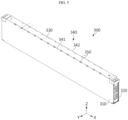
- FIG. 3 is a perspective view illustrating a battery cell surrounded by a cell cover according to one embodiment of the present disclosure in a battery pack according to an embodiment of the present disclosure.
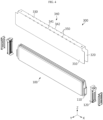
- FIG. 4 is an exploded perspective view illustrating the cell cover and the battery cell of FIG. 3 .
- a battery pack is manufactured by accommodating battery cells in a metal case having a box shape to form a battery module and accommodating battery modules in a battery pack.
- the overall weight and volume of the battery pack are increased and the energy density of the battery pack is reduced.
- a battery pack 10 is configured to directly accommodate a battery cell 100 in a pack case 200 of the battery pack 10 by removing a module case of a battery module.
- the battery cell 100 may be further accommodated in a space occupied by the module case of the battery module in the battery pack 10, space efficiency may be improved and battery capacity may be improved. That is, in the present disclosure, the module case of the battery module may not be included in a configuration.
- the pouch-type battery cell 100 of each embodiment of the present disclosure may be configured to be accommodated in the module case provided in the battery module when necessary.
- the battery module including the pouch-type battery cell 100 to which a cell cover 300 in each embodiment is coupled also falls within the scope of the present disclosure.
- the battery pack 10 may include a control module configured to control charging and discharging of the pouch-type battery cells 100.
- the control module may include a battery management system (BMS) 500 and a battery blocking unit 600, and may be accommodated in the pack case 200 together with the battery cell 100 and the cell cover 300.
- BMS battery management system
- the battery cell 100 refers to the pouch-type battery cell 100.
- the battery pack 10 includes the pouch-type battery cell 100, the module case 200, and the cell cover 300.
- the battery cell 100 that is a pouch-type battery cell 100 may include an electrode assembly, an electrolyte, and a pouch casing. That is, the battery cell 100 corresponds to a basic unit for charging and discharging, and may be manufactured by accommodating an electrode assembly and an electrolyte in a soft metal case and sealing the metal case. In this case, the electrode assembly may be manufactured by locating a separator between a positive electrode and a negative electrode.
- electrode leads 110 electrically connected to the electrode assembly may be provided at a front end and a rear end of the battery cell 100.
- the battery cell 100 may be a pouch-type battery cell.
- a plurality of pouch-type battery cells 100 may be included in the battery pack 10.
- the plurality of pouch-type battery cells 100 may be stacked in at least one direction.
- the pack case 200 may have an empty inner space, and the plurality of pouch-type battery cells 100 may be accommodated in the inner space.
- the pouch-type battery cell 100 may be directly seated on the pack case 200.
- the pack case 200 may include a lower frame 210, a side frame 220, and an upper cover 230.
- the pack case 200 may be formed of a plastic or metal material.
- the pack case 200 may include any of various casing materials for the battery pack 10 which are known at the time of filing the present application.
- the plurality of battery cells 100 are seated on the lower frame 210.
- a reinforcing frame 240 may be formed on the lower frame 210.
- the side frame 220 may extend upward from an edge of the lower frame 210 to form an inner space in which the plurality of battery cells 100 are accommodated.
- the reinforcing frame 240 is formed on the lower frame 210, the battery cell 100 is accommodated in a space formed by the side frame 220 and the reinforcing frame 240.
- the cell cover 300 is coupled to the battery cell 100.
- the upper cover 230 is coupled to the side frame 220 to cover the side frame 220 and the lower frame 210.
- a gas channel (not shown) through which gas may move may be formed in the upper cover 230.
- the cell cover 300 may at least partially surround at least some of the plurality of pouch-type battery cells 100. That is, the cell cover 300 may partially surround the pouch-type battery cell 100 so that at least one side of the pouch-type battery cell 100 surrounded by the cell cover 300 is exposed to the outside.
- the cell cover 300 may be configured to support the pouch-type battery cell 100 in an upright state. In general, it is not easy to stack the pouch-type battery cells 100 in a vertical direction.
- the cell cover 300 may be configured to surround one or more pouch-type battery cells 100 and maintain the surrounded battery cells 100 in an upright state, that is, an erected state.
- the cell cover 300 may be integrally formed.
- the cell cover 300 may be formed by bending a metal plate having a plate structure. That is, the cell cover 300 may be formed by bending one plate. Accordingly, a bent portion 340 (see FIG. 3 ) may be formed on the cell cover 300. Also, at least one venting hole 350 for discharging a flame or gas may be formed in the bent portion 340 of the cell cover 300.
- a plurality of venting holes 350 may be formed.
- the plurality of venting holes 350 may be arranged in a line in the bent portion 340.
- the plurality of venting holes 350 may be arranged in a line in at least one of a first bent portion 341 and a second bent portion 342.
- the present disclosure is not limited thereto, and the plurality of venting holes may be formed in a curved shape or shape including a curved line and a straight line together.
- the plurality of venting holes 350 may be formed in a dotted line shape on a straight line.
- the plurality of venting holes 350 formed on the bent portion 340 may be spaced apart from each other at a pre-set interval.
- the present disclosure is not necessarily limited to a dotted line shape, and the pre-set interval does not have to be the same interval. As such, because bending becomes easier when the venting holes 350 are formed in a dotted line shape on a straight line, the cell cover 300 may be easily manufactured.
- the plurality of venting holes 350 may be formed side by side.
- the venting hole 350 formed in the first bent portion 341 and the venting hole 350 formed in the second bent portion 342 may be located on one dotted line of FIG. 3 to face each other.
- the first bent portion 341 and the second bent portion 342 will be described below.
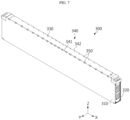
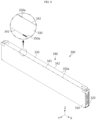
- FIGS. 5 to 8 are views illustrating the battery cell surrounded by the cell cover of FIG. 3 according to other embodiments.
- the plurality of venting holes 350 may be formed in a zigzag shape.
- the venting hole 350 formed in the first bent portion 341 and the venting hole 350 formed in the second bent portion 342 may be located at different dotted lines of FIG. 5 and may be alternately formed not to face each other.
- the plurality of venting holes 350 when the plurality of venting holes 350 are formed in a zigzag shape and a thermal event occurs in one pouch-type battery cell 100, a flame or gas from the pouch-type battery cell 100 may be fundamentally blocked from moving to other neighboring pouch-type battery cells 100.
- the plurality of venting holes 350 may be formed side by side to face each other as shown in FIG. 3 , and in this case, a heat insulating material may be appropriately located to prevent a flame or gas from moving from one pouch-type battery cell 100 to other neighboring pouch-type battery cells 100.
- the plurality of venting holes 350 may be formed so that an interval between the plurality of venting holes 350 decreases from a central portion of the cell cover 300 toward both ends, that is, toward portions where the electrode leads 110 (see FIG. 4 ) of the battery cell 100 are located. That is, more venting holes 350 may be formed at both ends than at the central portion of the cell cover 300.
- This embodiment is advantageous for side venting configured to discharge more gas through a side portion.
- the plurality of venting holes 350 may be formed so that an interval between the plurality of venting holes 350 increases from the central portion of the cell cover 300 toward both ends. That is, more venting holes 350 may be formed at the central portion than at both ends of the cell cover 300. This embodiment is advantageous for central venting configured to discharge more gas through the central portion.
- the venting hole 350 may include a slit hole 350a formed in a slit shape by cutting a part of the cell cover 300.
- the venting hole 350 in FIG. 3 is a through-hole passing through a part of the cell cover 300.
- the cell cover 300 may be formed of a material including stainless steel (SUS) that is easily processed and has high corrosion resistance.
- the cell cover 300 may be formed of any of various materials other than SUS to ensure rigidity.
- the cell cover 300 may be formed of a metal material.
- the cell cover 300 may be formed of a chromium (Cr)-based metal material.
- Cr chromium
- the cell cover 300 may more stably maintain a state in which the battery cells 100 are stacked and more safely protect the battery cells 100 from external impact.
- the overall structure may be stably maintained when a flame is generated from the battery cell 100 due to a high melting point.
- the cell cover 300 may not be melted by the flame ejected from the battery cell 100 and a shape of the cell cover 300 may be stably maintained. Accordingly, the effect of preventing or delaying flame propagation between the battery cells 100, a venting control effect, and the like may be excellent.
- the cell cover 300 may include an insulating coating layer (not shown) on an inner surface thereof.
- the insulating coating layer (not shown) may be obtained by coating, applying, or attaching any one insulating material such as silicone resin, polyamide, or rubber. According to the insulating coating layer of the cell cover 300 according to the present embodiment, the insulating coating effect may be maximized with a minimum amount of coating. Also, because the insulating coating layer (not shown) is applied to the inner surface of the cell cover 300, insulation between the battery cell 100 and the cell cover 300 may be enhanced.
- the cell cover 300 may be configured so that at least one side of the surrounded pouch-type battery cell 100 is exposed toward a bottom surface of the battery pack 10.
- the present disclosure is not limited thereto.
- the cell cover 300 configured to surround at least some of the plurality of pouch-type battery cells 100 may be accommodated in the inner space of the pack case 200.
- the cell cover 300 may be configured to surround a various number of pouch-type battery cells 100 together. For example, one cell cover 300 may be configured to surround one pouch-type battery cell 100 together. Alternatively, one cell cover 300 may be configured to surround two pouch-type battery cells 100 together. Alternatively, one cell cover 300 may be configured to surround three pouch-type battery cells 100 together. Alternatively, one cell cover 300 may be configured to surround a larger number of pouch-type battery cells 100 together.
- the cell cover 300 may include at least two bent portions 340, and the venting hole 350 may be formed in at least one of the two bent portions 340. Referring to FIGS. 3 and 4 , the cell cover 300 may include a first cover portion 310, a second cover portion 320, and a third cover portion 330.
- the first cover portion 310 may be configured to cover one side surface of at least one of the plurality of battery cells 100.
- the first cover portion 310 may extend downward from one end of the third cover portion 330.
- the first cover portion 310 may extend long downward from a left end of the third cover portion 330.
- the first cover portion 310 may surround a wide surface of the battery cell 100 accommodated therein.
- the second cover portion 320 may be configured to cover the other side surface of at least one of the plurality of battery cells 100.
- the second cover portion 320 may be horizontally spaced apart from the first cover portion 310.
- the second cover portion 320 may extend downward from the other end of the third cover portion 330.
- the second cover portion 320 may extend long downward from a right end of the third cover portion 330.
- the second cover portion 320 may surround a wide surface of the battery cell 100 accommodated therein.
- the third cover portion 330 connects the first cover portion 310 to the second cover portion 320 and covers an upper end portion of at least one battery cell 100.
- the bent portion 340 may be formed on the cell cover 300.
- the bent portion 340 may include the first bent portion 341 and the second bent portion 342.
- the first bent portion 341 may be formed between the first cover portion 310 and the third cover portion 330.
- the first cover portion 310 may be formed by being bent at a right angle from one side of the third cover portion 330 downward, and the first bent portion 341 may be formed in a portion bent from the third cover portion 330.
- the second bent portion 342 may be formed between the second cover portion 320 and the third cover portion 330.
- the second cover portion 320 may be formed by being bent at a right angle from the other side of the third cover portion 330 downward, and the second bent portion 342 may be formed in a portion bent from the third cover portion 330.
- the bending from the third cover portion 330 does not have to be at a right angle, the bending at a right angle is only an example, and there may be various bending angles.
- the venting hole 350 for discharging gas or flame may be formed between two of the first cover portion 310, the second cover portion 320, and the third cover portion 330.
- the venting hole 350 may be formed in at least one of the first bent portion 341 and the second bent portion 342. That is, the venting hole 350 may be formed only in the first bent portion 341, may be formed only in the second bent portion 342, or may be formed in both the first bent portion 341 and the second bent portion 342.
- At least some of the plurality of pouch-type battery cells 100 may be adhered and fixed to inner surfaces of the first cover portion 310 and the second cover portion 320.
- a member for adhesion may be thermally conductive. Through the adhesion, the cell cover 300 may be firmly coupled to the battery cell 100, and may help discharge heat generated in the battery cell 100 to the outside of the battery cell 100.
- FIG. 9 is a view illustrating a modified embodiment of the battery cell surrounded by the cell cover of FIG. 3 .
- FIG. 10 is an exploded perspective view illustrating the cell cover and the battery cell of FIG. 9 .
- the venting hole 350 may be formed at any of various positions of the cell cover 300 according to an intended venting direction.
- the venting hole 350 may be formed in a central portion of the third cover portion 330.
- the venting hole 350 may be formed by forming a notch in a certain portion of the cell cover 300.
- One or more venting holes 350 may be formed.
- gas or the like may be discharged upward. Accordingly, because gas or flame generated during thermal runaway of a battery cell is discharged in an intended direction, for example, toward an upper side where other battery cells or other battery modules are not located, chain thermal runaway may be prevented.
- an inner space may be limited by the first cover portion 310, the second cover portion 320, and the third cover portion 330 of the cell cover 300.
- One or more battery cells 100 may be accommodated in the limited inner space of the cell cover 300.
- the cell cover 300 may be provided in an 'n' shape, a ⁇ u' shape, or a ' ' shape surrounding three surfaces of at least one battery cell 100. Referring to FIG. 1 , the cell cover 300 may be configured so that the plurality of battery cells 100 are horizontally stacked while being erected in a vertical direction.
- each cell cover 300 may surround one or more battery cells 100, and the plurality of battery cells 100 surrounded by each cell cover 300 may be stacked in a Y-axis direction of FIG. 2 .
- a structure in which the plurality of battery cells 100 are stacked side by side in the Y-axis direction in an upright state may be stably maintained by the cell cover 300.
- the cell cover 300 surrounds three surfaces of at least one battery cell 100, a bus bar or a terminal of each unit may be easily located on a side surface not surrounded by each cell cover 300.
- the battery cell 100 such as the pouch-type battery cell 100 may be formed in a substantially hexahedral shape.
- the electrode leads 110 (see FIG. 4 ), that is, a negative electrode lead and a positive electrode lead, may be respectively formed on two of six surfaces.
- the cell cover 300 is provided to surround at least parts of three of the four surfaces of the battery cell 100 having the six surfaces excluding the two surfaces on which the electrode leads are formed.
- a bus bar frame 120 may be coupled to the cell cover 300.
- the bus bar frame may be configured to support a bus bar electrically connected to the electrode lead 110 of at least one battery cell 100 covered by the cell cover 300.
- the bus bar frame 120 may include a terminal electrically connected to the bus bar.
- FIG. 11 is a view illustrating a battery assembly mounted on a battery pack according to an embodiment of the present disclosure.
- FIG. 12 is an exploded perspective view illustrating the battery assembly of FIG. 11 .
- FIG. 13 is a partial enlarged view illustrating a bottom surface of a portion P1 of FIG. 11 .
- FIGS. 11 to 13 are views illustrating a modified embodiment of the battery cell of FIG. 1 .
- the battery pack 10 may include a battery assembly 400 including a plurality of battery cells 100 surrounded by the cell cover 300.
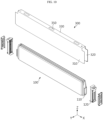
- the battery assembly 400 may include a cell unit 410, a pair of side plates 420, and a pair of integrated end covers 430, and according to an embodiment, may further include a handle unit 440 coupled to the pair of side plates 420.
- a plurality of battery cells 100 each surrounded by the cell cover 300 are stacked in the cell unit 410.
- the cell cover 300 and the battery cell 100 are the same as those described above, and thus, a detailed description thereof will be omitted.
- the pair of side plates 420 may be located at both ends of a plurality of cell units 410 in a width direction (Y-axis direction of FIG. 11 ) to support the plurality of cell units 410.
- at least one of the pair of side plates 420 may include a support portion 421, an end cover coupling portion 422, and a handle coupling portion 423.
- the support portion 421 may contact one side surface or the other side surface of the plurality of cell units 410 in the width direction to support the plurality of cell units 410.
- the support portion 421 may have a plate structure.
- the end cover coupling portion 422 may extend from both ends of the support portion 421 sideward (X-axis direction of FIG. 11 ) to be coupled to one end of the integrated end cover 430 in a side direction.
- the handle coupling portion 423 may extend, for example, from an upper end of the support portion 421 upward (Z-axis direction of FIG. 11 ) to be coupled to at least one of the plurality of handle units 440.
- the handle coupling portion 423 may be configured to be coupled to and separated from at least one handle unit 440.
- the pair of side plates 420 may block or group the plurality of cell units 410 along with the integrated end cover 430 to uniformly distribute pressure applied to the plurality of cell units 410 to the entire cell units 410. Also, the pair of side plates 420 may be formed of a metal material including aluminum, or may be formed of a material obtained by combining aluminum with a polymer synthetic resin through insert molding.
- the pair of integrated end covers 430 are located in a direction intersecting the pair of side plates 420 to support the cell units 410.
- the pair of integrated end covers 430 are located at both ends of the plurality of cell units 410 in a longitudinal direction (X-axis direction of FIG. 11 ) to support the plurality of cell units 410.
- the pair of integrated end covers 430 may be configured to integrally cover terminal portions of the battery cells 100 included in the plurality of cell units 410.
- each integrated end cover 430 may include, in the side direction, one end coupled to a first side plate 420a that is one of the pair of side plates 420 and the other end connected to a second side plate 420b that is the other of the pair of side plates 420, to integrally cover the terminal portions of the battery cells 100 included in the plurality of cell units 410.
- the integrated end cover 430 may include a vent hole 434 at a position corresponding to each of the plurality of cell units 410.
- the integrated end cover 430 may be formed of a metal material including aluminum or a polymer synthetic resin, or may be formed of a material obtained by combining a metal material including aluminum with a polymer synthetic resin through insert molding.
- the handle unit 440 may be configured to be hold by an operator who carries the battery assembly 400 or to be connected to a certain transfer device for lifting or transferring the battery assembly 400.
- the handle unit 440 may be configured to be detachably coupled to the pair of side plates 420. Also, the handle unit 440 may be formed of a metal material having a certain strength, a polymer synthetic resin, or a combination thereof.
- the scale of the battery assembly may be increased by increasing the number of cell units 410 that are stacked.
- the pair of side plates 420 and the pair of integrated end covers 430 of the battery assembly 400 may be coupled to each other to block or group the plurality of cell units 410.
- the integrated end cover 430 may include a terminal cover portion 431, a first coupling portion 432, and a second coupling portion 433.
- the terminal cover portion 431 may be configured to integrally cover the terminal portions (electrode lead portions) of the battery cells 100 included in the plurality of cell units 410.
- the terminal cover portion 431 may include the vent hole 434 at a position corresponding to each cell unit 410.
- the first coupling portion 432 may extend from the terminal cover portion 431 toward the first side plate 420a to be coupled to the end cover coupling portion 422 of the first side plate 420a.
- the first coupling portion 432 and the end cover coupling portion 422 may be coupled to each other by a fastening member such as a bolt or rivet.
- the second coupling portion 433 may extend from the terminal cover portion 431 toward the second side plate 420b to be coupled to the end cover coupling portion 422 of the second side plate 420b.
- the second coupling portion 433 and the end cover coupling portion 422 may be coupled to each other by a fastening member such as a bolt or a rivet.
- the handle unit 440 may be coupled to the handle coupling unit 423 of the corresponding side plate 420 in various ways to be coupled and separated.
- the first coupling portion 432 of the integrated end cover 430 may be coupled to the end cover coupling portion 422 of the first side plate 420a through a fastening member 700.
- the integrated end cover 430 may include a cell unit support portion 435.
- the cell unit support portion 435 may extend from the terminal cover portion 431 including the vent hole 434 toward bottom surfaces of the plurality of cell units 410 to support the plurality of cell units 410.
- the cell unit support portion 435 may be configured to support lower ends of the bus bar frames 120 provided in the plurality of cell units 410.
- the cell units 410 each including at least one battery cell 100 is blocked and fixed to the pair of side plates 420 and the integrated end covers 430, handling and mounting of the battery cells 100 mounted on the battery pack 10 may be facilitated, structures required to mount the battery cells 100 may be simplified and lightened, and manufacturing costs may be reduced.
- the overall weight and volume of the battery pack 10 may be reduced, the energy density of the battery pack 10 may be increased, damage to the battery cells 100 occurring in a process of directly mounting the plurality of battery cells 100 on the case and using the battery cells may be prevented, and swelling control of the battery cell 100 and design of a gas venting path may be facilitated.
- the plurality of venting holes 350 are formed along a bent portion of the cell cover 300, a sheet metal process of manufacturing the cell cover 300 and an assembly process of inserting the battery cells 100 into the cell cover 300 may be facilitated, and a venting passage of gas discharged from the battery cell 100 may be secured.
- the cell units 410 each including at least one battery cell 100 are blocked and fixed to the pair of side plates 420 and the integrated end cover 430, handling and mounting of the battery cells 100 mounted on the battery pack 10 may be facilitated, structures required to mount the battery cells 100 may be simplified and lightened, and manufacturing costs may be reduced.
- FIG. 14 is a view for describing a vehicle including a battery pack according to each embodiment of the present disclosure.
- a vehicle 20 according to an embodiment of the present disclosure may include one or more battery packs 10 according to each of the above embodiments.
- the vehicle 20 includes any of various vehicles 20 provided to use electricity such as an electric vehicle or a hybrid vehicle.
- the present disclosure relates to a battery pack and a vehicle including the same, and particularly, may be used in industries related to secondary batteries.
Landscapes
- Chemical & Material Sciences (AREA)
- Chemical Kinetics & Catalysis (AREA)
- Electrochemistry (AREA)
- General Chemical & Material Sciences (AREA)
- Engineering & Computer Science (AREA)
- Aviation & Aerospace Engineering (AREA)
- Inorganic Chemistry (AREA)
- Battery Mounting, Suspending (AREA)
- Gas Exhaust Devices For Batteries (AREA)
Abstract
Description
- The present application claims priority to
Korean Patent Application Nos. 10-2022-0089867 10-2023-0055787, respectively filed on July 20, 2022 and April 27, 2023 - The present disclosure relates to a battery pack and a vehicle including the same, and more particularly, to a battery pack manufactured in a cell-to-pack method and a vehicle including the battery pack.
- In general, a secondary battery refers to a battery that may be repeatedly charged and discharged, such as a lithium-ion battery, a lithium polymer battery, a nickel cadmium battery, a nickel hydride battery, or a nickel zinc battery. An output voltage of a battery cell corresponding to a basic unit of a secondary battery capable of charging and discharging is about 2.5 V to about 4.2 V.
- Recently, as secondary batteries have been applied to devices requiring high output voltage and large charge capacity such as electric vehicles or energy storage systems (ESSs), a battery pack manufactured by connecting a plurality of battery cells in series or in parallel to form a battery module and connecting a plurality of battery modules in series or in parallel is widely used.
- However, according to existing technology, because a battery pack is manufactured by accommodating battery cells in a metal case having a box shape to form a battery module and accommodating battery modules in a battery pack case, the overall weight and volume of the battery pack is increased and the energy density of the battery pack is reduced.
- Also, when an existing cell-to-pack method of directly mounting a plurality of battery cells on a pack case of a battery pack is applied to a pouch-type battery cell with a soft case in order to increase the energy density of the battery pack, it is difficult to simultaneously handle or stack the plurality of battery cells and there is a risk of damage to the battery cells during a process of mounting the battery cells on the pack case.
- Furthermore, in an existing cell-to-pack method, because a plurality of battery cells are space-intensively arranged in a pack case, it is difficult discharge gas or flame generated during thermal runaway in an intended direction, and when thermal runaway occurs in some battery cells, chain thermal runaway of the remaining battery cells may occur.
- The present disclosure is designed to solve the problems of the related art, and therefore the present disclosure is directed to providing a battery pack in which the overall weight and volume of the battery pack may be reduced and the energy density of the battery pack may be increased, and a vehicle including the battery pack.
- Also, the present disclosure is directed to providing a battery pack in which, in a process of manufacturing a battery pack including a plurality of battery cells, handling and mounting of the battery cells may be facilitated, damage to the battery cells may be prevented, and manufacturing costs may be reduced by simplifying and lightening structures required to mount the battery cells, and a vehicle including the battery pack.
- Also, the present disclosure is directed to providing a battery pack in which chain thermal runaway may be prevented by discharging gas or flame generated during thermal runaway of a battery cell in an intended direction, and a vehicle including the battery pack.
- In one aspect of the present disclosure, there is provided a battery pack including a plurality of pouch-type battery cells, a pack case having an inner space in which the plurality of pouch-type battery cells are accommodated, and a cell cover at least partially surrounding and supporting at least some of the plurality of pouch-type battery cells, in the inner space of the pack case, wherein the cell cover includes a bent portion formed in a bent shape, and at least one venting hole for discharging a flame or gas is formed in the bent portion of the cell cover.
- In an embodiment, a plurality of venting holes may be formed, wherein the plurality of venting holes formed in the bent portion are arranged in a line.
- In an embodiment, a plurality of venting holes may be formed, wherein the plurality of venting holes formed in the bent portion have a dotted line shape and are spaced apart from each other at a pre-set interval.
- In an embodiment, the plurality of venting holes may be formed side by side.
- In an embodiment, the plurality of venting holes may be formed in a zigzag shape.
- In an embodiment, the plurality of venting holes may be formed so that an interval between the plurality of venting holes decreases from a central portion of the cell cover toward both ends.
- In an embodiment, the plurality of venting holes may be formed so that an interval between the plurality of venting holes increases from a central portion of the cell cover toward both ends.
- In an embodiment, the venting hole may be a through-hole passing through a part of the cell cover, or may be a slit hole formed in a slit shape by cutting a part of the cell cover.
- In an embodiment, the cell cover may include at least two bent portions, wherein the venting hole is formed in at least one of the at least two bent portions.
- In an embodiment, the cell cover may include a first cover portion covering one side surface of at least one of the plurality of battery cells, a second cover portion covering the other side surface of at least one of the plurality of battery cells, and a third cover portion connecting the first cover portion to the second cover portion and covering an upper end portion of the at least one battery cell, wherein the venting hole is formed between two of the first cover portion, the second cover portion, and the third cover portion.
- In an embodiment, the bent portion may include a first bent portion formed between the first cover portion and the third cover portion, and a second bent portion formed between the second cover portion and the third cover portion, wherein the venting hole is formed in at least one of the first bent portion and the second bent portion.
- In an embodiment, a plurality of venting holes may be formed, and may be arranged in a line in at least one of the first bent portion and the second portion.
- In an embodiment, the plurality of venting holes may be formed in a dotted line shape and may be spaced apart from each other at a pre-set interval.
- In an embodiment, at least some of the plurality of pouch-type battery cells may be adhered and fixed to inner surfaces of the first cover portion and the second cover portion.
- In an embodiment, the cell cover may be configured to support at least some of the plurality of pouch-type battery cells in an erected state.
- In an embodiment, the cell cover may include an insulating coating layer on an inner surface thereof.
- In an embodiment, the cell cover may be integrally formed.
- In an embodiment, the cell cover may be formed of a material including stainless steel (SUS).
- In an embodiment, the battery pack may include a battery assembly including a plurality of battery cells surrounded by the cell cover.
- In an embodiment, the battery assembly may include a cell unit in which a plurality of battery cells each surrounded by the cell cover are stacked, a pair of side plates located at both ends of the cell unit to support the cell unit, and a pair of integrated end covers located in a direction intersecting the pair of side plates and configured to support the cell unit and integrally cover terminal portions of the plurality of battery cells.
- In an embodiment, the battery pack may further include a handle unit coupled to the pair of side plates.
- In an embodiment, each of the pair of side plates may include a support portion contacting the cell unit to support the cell unit, an end cover coupling portion coupled to the integrated end cover, and a handle coupling portion coupled to the handle unit.
- In another aspect of the present disclosure, there is provided a vehicle including the battery pack.
- According to embodiments of the present disclosure, the overall weight and volume of a battery pack may be reduced and the energy density of the battery pack may be increased.
- Also, in a process of manufacturing a battery pack including a plurality of battery cells, handling and mounting of the battery cells may be facilitated, damage to the battery cells may be prevented, and manufacturing costs may be reduced by simplifying and lightening structures required to mount the battery cells.
- Also, chain thermal runaway may be prevented by discharging gas or flame generated during thermal runaway of a battery cell in an intended direction.
- The accompanying drawings illustrate a preferred embodiment of the present disclosure and together with the foregoing disclosure, serve to provide further understanding of the technical features of the present disclosure, and thus, the present disclosure is not construed as being limited to the drawing.
-
FIG. 1 is a schematic exploded perspective view illustrating a battery pack according to an embodiment of the present disclosure. -
FIG. 2 is an enlarged view illustrating a portion A ofFIG. 1 . -
FIG. 3 is a perspective view illustrating a battery cell surrounded by a cell cover according to one embodiment in a battery pack according to an embodiment of the present disclosure. -
FIG. 4 is an exploded perspective view illustrating the cell cover and the battery cell ofFIG. 3 . -
FIGS. 5 to 8 are views illustrating the battery cell surrounded by the cell cover ofFIG. 3 according to other embodiments. -
FIG. 9 is a view illustrating a modified embodiment of the battery cell surrounded by the cell cover ofFIG. 3 . -
FIG. 10 is an exploded perspective view illustrating the cell cover and the battery cell ofFIG. 9 . -
FIG. 11 is a view illustrating a battery assembly mounted on a battery pack according to an embodiment of the present disclosure. -
FIG. 12 is an exploded perspective view illustrating the battery assembly ofFIG. 11 . -
FIG. 13 is a partial enlarged view illustrating a bottom surface of a portion P1 ofFIG. 11 . -
FIG. 14 is a view for describing a vehicle including a battery pack according to each embodiment of the present disclosure. - Hereinafter, preferred embodiments of the present disclosure will be described in detail with reference to the accompanying drawings. It should be understood that the terms used in the specification and the appended claims should not be construed as limited to general and dictionary meanings, but interpreted based on the meanings and concepts corresponding to technical aspects of the present disclosure on the basis of the principle that the inventor is allowed to define terms appropriately for the best explanation. Therefore, the description proposed herein is just a preferable example for the purpose of illustrations only, not intended to limit the scope of the present disclosure, so it should be understood that other equivalents and modifications could be made thereto without departing from the scope of the present disclosure.
- The size of each element or a specific portion of the element shown in the drawings may be exaggerated, omitted or schematically drawn for the purpose of convenience and clarity of explanation. Accordingly, the size of each element may not substantially reflect its actual size. While describing the present disclosure, detailed descriptions of related well-known functions or configurations that may blur the points of the present disclosure are omitted.
- Also, in the present specification, it will be understood that when elements are "coupled" or "connected" to each other, the elements may be directly coupled or connected to each other, or may be indirectly coupled or connected to each other with an intervening element therebetween.
-
FIG. 1 is a schematic exploded perspective view illustrating a battery pack according to an embodiment of the present disclosure.FIG. 2 is an enlarged view illustrating a portion A ofFIG. 1 .FIG. 3 is a perspective view illustrating a battery cell surrounded by a cell cover according to one embodiment of the present disclosure in a battery pack according to an embodiment of the present disclosure.FIG. 4 is an exploded perspective view illustrating the cell cover and the battery cell ofFIG. 3 . - As described above, in general, a battery pack is manufactured by accommodating battery cells in a metal case having a box shape to form a battery module and accommodating battery modules in a battery pack. However, in this case, the overall weight and volume of the battery pack are increased and the energy density of the battery pack is reduced.
- In order to solve this problem, a
battery pack 10 according to an embodiment of the present disclosure is configured to directly accommodate abattery cell 100 in apack case 200 of thebattery pack 10 by removing a module case of a battery module. - Accordingly, because the
battery cell 100 may be further accommodated in a space occupied by the module case of the battery module in thebattery pack 10, space efficiency may be improved and battery capacity may be improved. That is, in the present disclosure, the module case of the battery module may not be included in a configuration. - However, an embodiment of using the module case is not completely excluded, and the pouch-
type battery cell 100 of each embodiment of the present disclosure may be configured to be accommodated in the module case provided in the battery module when necessary. - That is, the battery module including the pouch-
type battery cell 100 to which acell cover 300 in each embodiment is coupled also falls within the scope of the present disclosure. - Also, the
battery pack 10 according to the present embodiment may include a control module configured to control charging and discharging of the pouch-type battery cells 100. Referring toFIG. 1 , the control module may include a battery management system (BMS) 500 and abattery blocking unit 600, and may be accommodated in thepack case 200 together with thebattery cell 100 and thecell cover 300. - Even when simply described as the
battery cell 100 in the specification, thebattery cell 100 refers to the pouch-type battery cell 100. - Referring to
FIGS. 1 and2 , thebattery pack 10 according to a first embodiment of the present disclosure includes the pouch-type battery cell 100, themodule case 200, and thecell cover 300. - The
battery cell 100 that is a pouch-type battery cell 100 may include an electrode assembly, an electrolyte, and a pouch casing. That is, thebattery cell 100 corresponds to a basic unit for charging and discharging, and may be manufactured by accommodating an electrode assembly and an electrolyte in a soft metal case and sealing the metal case. In this case, the electrode assembly may be manufactured by locating a separator between a positive electrode and a negative electrode. - Also, electrode leads 110 electrically connected to the electrode assembly may be provided at a front end and a rear end of the
battery cell 100. Thebattery cell 100 may be a pouch-type battery cell. A plurality of pouch-type battery cells 100 may be included in thebattery pack 10. The plurality of pouch-type battery cells 100 may be stacked in at least one direction. - The
pack case 200 may have an empty inner space, and the plurality of pouch-type battery cells 100 may be accommodated in the inner space. In particular, in the present disclosure, the pouch-type battery cell 100 may be directly seated on thepack case 200. - Referring to
FIGS. 1 and2 , thepack case 200 may include alower frame 210, aside frame 220, and anupper cover 230. Thepack case 200 may be formed of a plastic or metal material. In addition, thepack case 200 may include any of various casing materials for thebattery pack 10 which are known at the time of filing the present application. - The plurality of
battery cells 100 are seated on thelower frame 210. A reinforcingframe 240 may be formed on thelower frame 210. Theside frame 220 may extend upward from an edge of thelower frame 210 to form an inner space in which the plurality ofbattery cells 100 are accommodated. When the reinforcingframe 240 is formed on thelower frame 210, thebattery cell 100 is accommodated in a space formed by theside frame 220 and the reinforcingframe 240. Thecell cover 300 is coupled to thebattery cell 100. Theupper cover 230 is coupled to theside frame 220 to cover theside frame 220 and thelower frame 210. A gas channel (not shown) through which gas may move may be formed in theupper cover 230. - Referring to
FIGS. 3 and4 , thecell cover 300 may at least partially surround at least some of the plurality of pouch-type battery cells 100. That is, thecell cover 300 may partially surround the pouch-type battery cell 100 so that at least one side of the pouch-type battery cell 100 surrounded by thecell cover 300 is exposed to the outside. - The
cell cover 300 may be configured to support the pouch-type battery cell 100 in an upright state. In general, it is not easy to stack the pouch-type battery cells 100 in a vertical direction. - However, in the
battery pack 10 according to an embodiment of the present disclosure, thecell cover 300 may be configured to surround one or more pouch-type battery cells 100 and maintain the surroundedbattery cells 100 in an upright state, that is, an erected state. - Also, the
cell cover 300 may be integrally formed. In this case, thecell cover 300 may be formed by bending a metal plate having a plate structure. That is, thecell cover 300 may be formed by bending one plate. Accordingly, a bent portion 340 (seeFIG. 3 ) may be formed on thecell cover 300. Also, at least oneventing hole 350 for discharging a flame or gas may be formed in thebent portion 340 of thecell cover 300. - Referring to
FIGS. 3 and4 , for example, a plurality of ventingholes 350 may be formed. Referring toFIGS. 3 and4 , in an embodiment, the plurality of ventingholes 350 may be arranged in a line in thebent portion 340. For example, the plurality of ventingholes 350 may be arranged in a line in at least one of a firstbent portion 341 and a secondbent portion 342. However, the present disclosure is not limited thereto, and the plurality of venting holes may be formed in a curved shape or shape including a curved line and a straight line together. - As shown in
FIGS. 3 and4 , the plurality of ventingholes 350 may be formed in a dotted line shape on a straight line. In this case, the plurality of ventingholes 350 formed on thebent portion 340 may be spaced apart from each other at a pre-set interval. However, the present disclosure is not necessarily limited to a dotted line shape, and the pre-set interval does not have to be the same interval. As such, because bending becomes easier when the venting holes 350 are formed in a dotted line shape on a straight line, thecell cover 300 may be easily manufactured. - Referring to
FIG. 3 , the plurality of ventingholes 350 may be formed side by side. For example, the ventinghole 350 formed in the firstbent portion 341 and theventing hole 350 formed in the secondbent portion 342 may be located on one dotted line ofFIG. 3 to face each other. The firstbent portion 341 and the secondbent portion 342 will be described below. -
FIGS. 5 to 8 are views illustrating the battery cell surrounded by the cell cover ofFIG. 3 according to other embodiments. - Referring to
FIG. 5 , the plurality of ventingholes 350 may be formed in a zigzag shape. For example, the ventinghole 350 formed in the firstbent portion 341 and theventing hole 350 formed in the secondbent portion 342 may be located at different dotted lines ofFIG. 5 and may be alternately formed not to face each other. - As such, when the plurality of venting
holes 350 are formed in a zigzag shape and a thermal event occurs in one pouch-type battery cell 100, a flame or gas from the pouch-type battery cell 100 may be fundamentally blocked from moving to other neighboring pouch-type battery cells 100. However, according to a position of an injection molded product, the plurality of ventingholes 350 may be formed side by side to face each other as shown inFIG. 3 , and in this case, a heat insulating material may be appropriately located to prevent a flame or gas from moving from one pouch-type battery cell 100 to other neighboring pouch-type battery cells 100. - Also, in another embodiment, referring to
FIG. 6 , the plurality of ventingholes 350 may be formed so that an interval between the plurality of ventingholes 350 decreases from a central portion of thecell cover 300 toward both ends, that is, toward portions where the electrode leads 110 (seeFIG. 4 ) of thebattery cell 100 are located. That is, more venting holes 350 may be formed at both ends than at the central portion of thecell cover 300. This embodiment is advantageous for side venting configured to discharge more gas through a side portion. - In another embodiment, referring to
FIG. 7 , the plurality of ventingholes 350 may be formed so that an interval between the plurality of ventingholes 350 increases from the central portion of thecell cover 300 toward both ends. That is, more venting holes 350 may be formed at the central portion than at both ends of thecell cover 300. This embodiment is advantageous for central venting configured to discharge more gas through the central portion. - In another embodiment, referring to
FIG. 8 , the ventinghole 350 may include aslit hole 350a formed in a slit shape by cutting a part of thecell cover 300. This is another embodiment of an embodiment in which theventing hole 350 inFIG. 3 is a through-hole passing through a part of thecell cover 300. - The
cell cover 300 may be formed of a material including stainless steel (SUS) that is easily processed and has high corrosion resistance. Thecell cover 300 may be formed of any of various materials other than SUS to ensure rigidity. In particular, thecell cover 300 may be formed of a metal material. For example, thecell cover 300 may be formed of a chromium (Cr)-based metal material. When thecell cover 300 is formed of a metal material, thecell cover 300 may more stably maintain a state in which thebattery cells 100 are stacked and more safely protect thebattery cells 100 from external impact. Also, as an example, when thecell cover 300 is formed of a steel material such as SUS, the overall structure may be stably maintained when a flame is generated from thebattery cell 100 due to a high melting point. In particular, because a steel material has a higher melting point than an aluminum material, thecell cover 300 may not be melted by the flame ejected from thebattery cell 100 and a shape of thecell cover 300 may be stably maintained. Accordingly, the effect of preventing or delaying flame propagation between thebattery cells 100, a venting control effect, and the like may be excellent. - The
cell cover 300 may include an insulating coating layer (not shown) on an inner surface thereof. The insulating coating layer (not shown) may be obtained by coating, applying, or attaching any one insulating material such as silicone resin, polyamide, or rubber. According to the insulating coating layer of thecell cover 300 according to the present embodiment, the insulating coating effect may be maximized with a minimum amount of coating. Also, because the insulating coating layer (not shown) is applied to the inner surface of thecell cover 300, insulation between thebattery cell 100 and thecell cover 300 may be enhanced. - The
cell cover 300 may be configured so that at least one side of the surrounded pouch-type battery cell 100 is exposed toward a bottom surface of thebattery pack 10. However, the present disclosure is not limited thereto. - Referring to
FIGS. 1 and2 , thecell cover 300 configured to surround at least some of the plurality of pouch-type battery cells 100 may be accommodated in the inner space of thepack case 200. - The
cell cover 300 may be configured to surround a various number of pouch-type battery cells 100 together. For example, onecell cover 300 may be configured to surround one pouch-type battery cell 100 together. Alternatively, onecell cover 300 may be configured to surround two pouch-type battery cells 100 together. Alternatively, onecell cover 300 may be configured to surround three pouch-type battery cells 100 together. Alternatively, onecell cover 300 may be configured to surround a larger number of pouch-type battery cells 100 together. - The
cell cover 300 may include at least twobent portions 340, and theventing hole 350 may be formed in at least one of the twobent portions 340. Referring toFIGS. 3 and4 , thecell cover 300 may include afirst cover portion 310, asecond cover portion 320, and athird cover portion 330. - The
first cover portion 310 may be configured to cover one side surface of at least one of the plurality ofbattery cells 100. Thefirst cover portion 310 may extend downward from one end of thethird cover portion 330. For example, thefirst cover portion 310 may extend long downward from a left end of thethird cover portion 330. Thefirst cover portion 310 may surround a wide surface of thebattery cell 100 accommodated therein. - The
second cover portion 320 may be configured to cover the other side surface of at least one of the plurality ofbattery cells 100. Thesecond cover portion 320 may be horizontally spaced apart from thefirst cover portion 310. Thesecond cover portion 320 may extend downward from the other end of thethird cover portion 330. For example, thesecond cover portion 320 may extend long downward from a right end of thethird cover portion 330. Thesecond cover portion 320 may surround a wide surface of thebattery cell 100 accommodated therein. - The
third cover portion 330 connects thefirst cover portion 310 to thesecond cover portion 320 and covers an upper end portion of at least onebattery cell 100. - As described above, the
bent portion 340 may be formed on thecell cover 300. Thebent portion 340 may include the firstbent portion 341 and the secondbent portion 342. The firstbent portion 341 may be formed between thefirst cover portion 310 and thethird cover portion 330. For example, thefirst cover portion 310 may be formed by being bent at a right angle from one side of thethird cover portion 330 downward, and the firstbent portion 341 may be formed in a portion bent from thethird cover portion 330. Also, the secondbent portion 342 may be formed between thesecond cover portion 320 and thethird cover portion 330. For example, thesecond cover portion 320 may be formed by being bent at a right angle from the other side of thethird cover portion 330 downward, and the secondbent portion 342 may be formed in a portion bent from thethird cover portion 330. However, the bending from thethird cover portion 330 does not have to be at a right angle, the bending at a right angle is only an example, and there may be various bending angles. - The
venting hole 350 for discharging gas or flame may be formed between two of thefirst cover portion 310, thesecond cover portion 320, and thethird cover portion 330. In detail, for example, the ventinghole 350 may be formed in at least one of the firstbent portion 341 and the secondbent portion 342. That is, the ventinghole 350 may be formed only in the firstbent portion 341, may be formed only in the secondbent portion 342, or may be formed in both the firstbent portion 341 and the secondbent portion 342. - At least some of the plurality of pouch-
type battery cells 100 may be adhered and fixed to inner surfaces of thefirst cover portion 310 and thesecond cover portion 320. A member for adhesion may be thermally conductive. Through the adhesion, thecell cover 300 may be firmly coupled to thebattery cell 100, and may help discharge heat generated in thebattery cell 100 to the outside of thebattery cell 100. -
FIG. 9 is a view illustrating a modified embodiment of the battery cell surrounded by the cell cover ofFIG. 3 .FIG. 10 is an exploded perspective view illustrating the cell cover and the battery cell ofFIG. 9 . - The
venting hole 350 may be formed at any of various positions of thecell cover 300 according to an intended venting direction. For example, referring toFIGS. 9 and10 , the ventinghole 350 may be formed in a central portion of thethird cover portion 330. Theventing hole 350 may be formed by forming a notch in a certain portion of thecell cover 300. One or more venting holes 350 may be formed. As such, when theventing hole 350 is formed at a central portion of thethird cover portion 330, gas or the like may be discharged upward. Accordingly, because gas or flame generated during thermal runaway of a battery cell is discharged in an intended direction, for example, toward an upper side where other battery cells or other battery modules are not located, chain thermal runaway may be prevented. - In this embodiment, an inner space may be limited by the
first cover portion 310, thesecond cover portion 320, and thethird cover portion 330 of thecell cover 300. One ormore battery cells 100 may be accommodated in the limited inner space of thecell cover 300. - The
cell cover 300 may be provided in an 'n' shape, a `u' shape, or a '' shape surrounding three surfaces of at least one
battery cell 100. Referring toFIG. 1 , thecell cover 300 may be configured so that the plurality ofbattery cells 100 are horizontally stacked while being erected in a vertical direction. - For example, referring to
FIG. 1 , eachcell cover 300 may surround one ormore battery cells 100, and the plurality ofbattery cells 100 surrounded by eachcell cover 300 may be stacked in a Y-axis direction ofFIG. 2 . In this case, a structure in which the plurality ofbattery cells 100 are stacked side by side in the Y-axis direction in an upright state may be stably maintained by thecell cover 300. - Also, because the
cell cover 300 surrounds three surfaces of at least onebattery cell 100, a bus bar or a terminal of each unit may be easily located on a side surface not surrounded by eachcell cover 300. - The
battery cell 100 such as the pouch-type battery cell 100 may be formed in a substantially hexahedral shape. The electrode leads 110 (seeFIG. 4 ), that is, a negative electrode lead and a positive electrode lead, may be respectively formed on two of six surfaces. Thecell cover 300 is provided to surround at least parts of three of the four surfaces of thebattery cell 100 having the six surfaces excluding the two surfaces on which the electrode leads are formed. - Referring to
FIGS. 3 and4 , abus bar frame 120 may be coupled to thecell cover 300. The bus bar frame may be configured to support a bus bar electrically connected to theelectrode lead 110 of at least onebattery cell 100 covered by thecell cover 300. In this case, thebus bar frame 120 may include a terminal electrically connected to the bus bar. -
FIG. 11 is a view illustrating a battery assembly mounted on a battery pack according to an embodiment of the present disclosure.FIG. 12 is an exploded perspective view illustrating the battery assembly ofFIG. 11 .FIG. 13 is a partial enlarged view illustrating a bottom surface of a portion P1 ofFIG. 11 .FIGS. 11 to 13 are views illustrating a modified embodiment of the battery cell ofFIG. 1 . - Referring to
FIGS. 11 to 13 , thebattery pack 10 may include abattery assembly 400 including a plurality ofbattery cells 100 surrounded by thecell cover 300. - The
battery assembly 400 may include acell unit 410, a pair ofside plates 420, and a pair of integrated end covers 430, and according to an embodiment, may further include ahandle unit 440 coupled to the pair ofside plates 420. - A plurality of
battery cells 100 each surrounded by thecell cover 300 are stacked in thecell unit 410. Thecell cover 300 and thebattery cell 100 are the same as those described above, and thus, a detailed description thereof will be omitted. - Referring to
FIGS. 11 and12 , the pair ofside plates 420 may be located at both ends of a plurality ofcell units 410 in a width direction (Y-axis direction ofFIG. 11 ) to support the plurality ofcell units 410. To this end, at least one of the pair ofside plates 420 may include asupport portion 421, an endcover coupling portion 422, and ahandle coupling portion 423. - The
support portion 421 may contact one side surface or the other side surface of the plurality ofcell units 410 in the width direction to support the plurality ofcell units 410. In this case, thesupport portion 421 may have a plate structure. - The end
cover coupling portion 422 may extend from both ends of thesupport portion 421 sideward (X-axis direction ofFIG. 11 ) to be coupled to one end of theintegrated end cover 430 in a side direction. - The
handle coupling portion 423 may extend, for example, from an upper end of thesupport portion 421 upward (Z-axis direction ofFIG. 11 ) to be coupled to at least one of the plurality ofhandle units 440. Thehandle coupling portion 423 may be configured to be coupled to and separated from at least onehandle unit 440. - The pair of
side plates 420 may block or group the plurality ofcell units 410 along with theintegrated end cover 430 to uniformly distribute pressure applied to the plurality ofcell units 410 to theentire cell units 410. Also, the pair ofside plates 420 may be formed of a metal material including aluminum, or may be formed of a material obtained by combining aluminum with a polymer synthetic resin through insert molding. - The pair of integrated end covers 430 are located in a direction intersecting the pair of
side plates 420 to support thecell units 410. For example, the pair of integrated end covers 430 are located at both ends of the plurality ofcell units 410 in a longitudinal direction (X-axis direction ofFIG. 11 ) to support the plurality ofcell units 410. The pair of integrated end covers 430 may be configured to integrally cover terminal portions of thebattery cells 100 included in the plurality ofcell units 410. - That is, referring to
FIG. 12 , eachintegrated end cover 430 may include, in the side direction, one end coupled to afirst side plate 420a that is one of the pair ofside plates 420 and the other end connected to asecond side plate 420b that is the other of the pair ofside plates 420, to integrally cover the terminal portions of thebattery cells 100 included in the plurality ofcell units 410. In this case, theintegrated end cover 430 may include avent hole 434 at a position corresponding to each of the plurality ofcell units 410. Theintegrated end cover 430 may be formed of a metal material including aluminum or a polymer synthetic resin, or may be formed of a material obtained by combining a metal material including aluminum with a polymer synthetic resin through insert molding. - In the
battery assembly 400, because theintegrated end cover 430 is applied, individual end covers respectively applied to thecell units 410 and covering terminals or bus bar portions of thebattery cells 100 included in thecell units 410 may be omitted, thereby simplifying a manufacturing process. - The
handle unit 440 may be configured to be hold by an operator who carries thebattery assembly 400 or to be connected to a certain transfer device for lifting or transferring thebattery assembly 400. - The
handle unit 440 may be configured to be detachably coupled to the pair ofside plates 420. Also, thehandle unit 440 may be formed of a metal material having a certain strength, a polymer synthetic resin, or a combination thereof. - The scale of the battery assembly may be increased by increasing the number of
cell units 410 that are stacked. - As shown in detail in
FIG. 12 , the pair ofside plates 420 and the pair of integrated end covers 430 of thebattery assembly 400 may be coupled to each other to block or group the plurality ofcell units 410. To this end, theintegrated end cover 430 may include aterminal cover portion 431, afirst coupling portion 432, and asecond coupling portion 433. - The
terminal cover portion 431 may be configured to integrally cover the terminal portions (electrode lead portions) of thebattery cells 100 included in the plurality ofcell units 410. Theterminal cover portion 431 may include thevent hole 434 at a position corresponding to eachcell unit 410. - The
first coupling portion 432 may extend from theterminal cover portion 431 toward thefirst side plate 420a to be coupled to the endcover coupling portion 422 of thefirst side plate 420a. In this case, thefirst coupling portion 432 and the endcover coupling portion 422 may be coupled to each other by a fastening member such as a bolt or rivet. - The
second coupling portion 433 may extend from theterminal cover portion 431 toward thesecond side plate 420b to be coupled to the endcover coupling portion 422 of thesecond side plate 420b. In this case, thesecond coupling portion 433 and the endcover coupling portion 422 may be coupled to each other by a fastening member such as a bolt or a rivet. - The
handle unit 440 may be coupled to thehandle coupling unit 423 of thecorresponding side plate 420 in various ways to be coupled and separated. - As shown in
FIG. 13 , thefirst coupling portion 432 of theintegrated end cover 430 may be coupled to the endcover coupling portion 422 of thefirst side plate 420a through afastening member 700. - Also, the
integrated end cover 430 may include a cellunit support portion 435. The cellunit support portion 435 may extend from theterminal cover portion 431 including thevent hole 434 toward bottom surfaces of the plurality ofcell units 410 to support the plurality ofcell units 410. In this case, the cellunit support portion 435 may be configured to support lower ends of the bus bar frames 120 provided in the plurality ofcell units 410. - As such, because the
cell units 410 each including at least onebattery cell 100 is blocked and fixed to the pair ofside plates 420 and the integrated end covers 430, handling and mounting of thebattery cells 100 mounted on thebattery pack 10 may be facilitated, structures required to mount thebattery cells 100 may be simplified and lightened, and manufacturing costs may be reduced. - According to the present disclosure, because the plurality of
battery cells 100 are partially covered by thecell cover 300 having a simplified structure and are directly mounted on thepack case 200 rather than being accommodated in a separate module case and mounted on thepack case 200 of thebattery pack 10, the overall weight and volume of thebattery pack 10 may be reduced, the energy density of thebattery pack 10 may be increased, damage to thebattery cells 100 occurring in a process of directly mounting the plurality ofbattery cells 100 on the case and using the battery cells may be prevented, and swelling control of thebattery cell 100 and design of a gas venting path may be facilitated. - Also, because the plurality of venting
holes 350 are formed along a bent portion of thecell cover 300, a sheet metal process of manufacturing thecell cover 300 and an assembly process of inserting thebattery cells 100 into thecell cover 300 may be facilitated, and a venting passage of gas discharged from thebattery cell 100 may be secured. - Also, because the
cell units 410 each including at least onebattery cell 100 are blocked and fixed to the pair ofside plates 420 and theintegrated end cover 430, handling and mounting of thebattery cells 100 mounted on thebattery pack 10 may be facilitated, structures required to mount thebattery cells 100 may be simplified and lightened, and manufacturing costs may be reduced. - Furthermore, one of ordinary skill in the art will clearly understand from the following description that various embodiments of the present disclosure may also be used to solve various technical problems not mentioned above.
-
FIG. 14 is a view for describing a vehicle including a battery pack according to each embodiment of the present disclosure. - A
vehicle 20 according to an embodiment of the present disclosure may include one or more battery packs 10 according to each of the above embodiments. Thevehicle 20 includes any ofvarious vehicles 20 provided to use electricity such as an electric vehicle or a hybrid vehicle. - It will be understood by one of ordinary skill in the art that when terms indicating directions such as upper, lower, left, and right are used, these terms are only for convenience of explanation and may vary according to a position of a target object, a position of an observer, etc.
- Although the embodiments of the present disclosure have been illustrated and described above, the present disclosure is not limited to the above-described specific embodiments. Various modified embodiments may be made by one of ordinary skill in the art without departing from the scope of the present disclosure as claimed in the claims. Hence, the disclosed embodiments should be considered in descriptive sense only and not for purposes of limitation. That is, the scope of the present disclosure is defined only by the following claims, and all differences within the scope will be construed as being included in the present disclosure.
- The present disclosure relates to a battery pack and a vehicle including the same, and particularly, may be used in industries related to secondary batteries.
Claims (21)
- A battery pack comprising:a plurality of pouch-type battery cells;a pack case having an inner space in which the plurality of pouch-type battery cells are accommodated; anda cell cover at least partially surrounding and supporting at least some of the plurality of pouch-type battery cells, in the inner space of the pack case,wherein the cell cover comprises a bent portion formed in a bent shape, and at least one venting hole for discharging a flame or gas is formed in the bent portion of the cell cover.
- The battery pack according to claim 1, wherein a plurality of venting holes are formed,
wherein the plurality of venting holes formed in the bent portion are arranged in a line. - The battery pack according to claim 1, wherein a plurality of venting holes are formed,
wherein the plurality of venting holes formed in the bent portion have a dotted line shape and are spaced apart from each other at a pre-set interval. - The battery pack according to claim 3, wherein the plurality of venting holes are formed side by side.
- The battery pack according to claim 3, wherein the plurality of venting holes are formed in a zigzag shape.
- The battery pack according to claim 3, wherein the plurality of venting holes are formed so that an interval between the plurality of venting holes decreases from a central portion of the cell cover toward both ends.
- The battery pack according to claim 3, wherein the plurality of venting holes are formed so that an interval between the plurality of venting holes increases from a central portion of the cell cover toward both ends.
- The battery pack according to claim 1, wherein the venting hole is a through-hole passing through a part of the cell cover, or is a slit hole formed in a slit shape by cutting a part of the cell cover.
- The battery pack according to claim 1, wherein the cell cover comprises at least two bent portions,
wherein the venting hole is formed in at least one of the at least two bent portions. - The battery pack according to claim 9, wherein the cell cover comprises:a first cover portion covering one side surface of at least one of the plurality of battery cells;a second cover portion covering the other side surface of at least one of the plurality of battery cells; anda third cover portion connecting the first cover portion to the second cover portion and covering an upper end portion of the at least one battery cell,wherein the venting hole is formed between two of the first cover portion, the second cover portion, and the third cover portion.
- The battery pack according to claim 10, wherein the bent portion comprises:a first bent portion formed between the first cover portion and the third cover portion; anda second bent portion formed between the second cover portion and the third cover portion,wherein the venting hole is formed in at least one of the first bent portion and the second bent portion.
- The battery pack according to claim 10, wherein at least some of the plurality of pouch-type battery cells are adhered and fixed to inner surfaces of the first cover portion and the second cover portion.
- The battery pack according to claim 1, wherein the cell cover is configured to support at least some of the plurality of pouch-type battery cells in an erected state.
- The battery pack according to claim 1, wherein the cell cover comprises an insulating coating layer on an inner surface thereof.
- The battery pack according to claim 1, wherein the cell cover is integrally formed.
- The battery pack according to claim 1, wherein the cell cover is formed of a material comprising stainless steel (SUS).
- The battery pack according to claim 1, comprising a battery assembly comprising a plurality of battery cells surrounded by the cell cover.
- The battery pack according to claim 17, wherein the battery assembly comprises:a cell unit in which a plurality of battery cells each surrounded by the cell cover are stacked;a pair of side plates located at both ends of the cell unit to support the cell unit; anda pair of integrated end covers located in a direction intersecting the pair of side plates and configured to support the cell unit and integrally cover terminal portions of the plurality of battery cells.
- The battery pack according to claim 18, further comprising a handle unit coupled to the pair of side plates.
- The battery pack according to claim 19, wherein each of the pair of side plates comprises:a support portion contacting the cell unit to support the cell unit;an end cover coupling portion coupled to the integrated end cover; anda handle coupling portion coupled to the handle unit.
- A vehicle comprising the battery pack according to any one of claims 1 to 20.
Applications Claiming Priority (3)
| Application Number | Priority Date | Filing Date | Title |
|---|---|---|---|
| KR20220089867 | 2022-07-20 | ||
| KR1020230055787A KR20240012282A (en) | 2022-07-20 | 2023-04-27 | Battery pack and vehicle including same |
| PCT/KR2023/009883 WO2024019400A1 (en) | 2022-07-20 | 2023-07-11 | Battery pack and vehicle comprising same |
Publications (2)
| Publication Number | Publication Date |
|---|---|
| EP4383419A1 true EP4383419A1 (en) | 2024-06-12 |
| EP4383419A4 EP4383419A4 (en) | 2025-03-12 |
Family
ID=89618005
Family Applications (1)
| Application Number | Title | Priority Date | Filing Date |
|---|---|---|---|
| EP23843251.2A Pending EP4383419A4 (en) | 2022-07-20 | 2023-07-11 | BATTERY PACK AND VEHICLE WITH IT |
Country Status (5)
| Country | Link |
|---|---|
| US (1) | US20250183471A1 (en) |
| EP (1) | EP4383419A4 (en) |
| JP (1) | JP7693101B2 (en) |
| KR (1) | KR20240012314A (en) |
| WO (1) | WO2024019400A1 (en) |
Cited By (2)
| Publication number | Priority date | Publication date | Assignee | Title |
|---|---|---|---|---|
| EP4478508A4 (en) * | 2022-12-05 | 2025-06-11 | LG Energy Solution, Ltd. | Battery module and battery pack including same |
| EP4383428A4 (en) * | 2022-07-20 | 2025-06-18 | LG Energy Solution, Ltd. | BATTERY ARRANGEMENT AS WELL AS BATTERY PACK AND VEHICLE THEREOF |
Family Cites Families (19)
| Publication number | Priority date | Publication date | Assignee | Title |
|---|---|---|---|---|
| WO2013125748A1 (en) * | 2012-02-23 | 2013-08-29 | 세방전지(주) | Battery cell casing using engraved structure |
| US9166260B2 (en) * | 2012-04-25 | 2015-10-20 | Samsung Sdi Co., Ltd. | Battery module |
| JP6507612B2 (en) * | 2014-12-11 | 2019-05-08 | 株式会社Gsユアサ | Storage element |
| JP6376273B2 (en) * | 2015-02-16 | 2018-08-22 | 三洋電機株式会社 | Power supply |
| KR102005488B1 (en) * | 2015-06-16 | 2019-10-01 | 주식회사 엘지화학 | Cell Cover for secondary battery and battery module including the same |
| KR20170010531A (en) * | 2015-07-20 | 2017-02-01 | 현대자동차주식회사 | Battery module |
| KR101679982B1 (en) * | 2015-09-14 | 2016-11-25 | 현대자동차주식회사 | Battery device |
| JP6755741B2 (en) * | 2016-07-29 | 2020-09-16 | 株式会社東芝 | Battery device and battery system |
| KR20190134756A (en) * | 2017-04-14 | 2019-12-04 | 세키스이가가쿠 고교가부시키가이샤 | Battery Module and Battery Unit |
| JP2019046537A (en) * | 2017-08-29 | 2019-03-22 | 積水化学工業株式会社 | Method of manufacturing storage battery cell, storage battery cell, storage battery module and storage battery unit |
| JP2020107458A (en) * | 2018-12-27 | 2020-07-09 | トヨタ自動車株式会社 | Battery pack |
| KR102913987B1 (en) * | 2019-10-18 | 2026-01-15 | 주식회사 엘지에너지솔루션 | Battery module and battery pack including the same |
| KR102851455B1 (en) * | 2020-10-14 | 2025-08-26 | 주식회사 엘지에너지솔루션 | Battery module and battery pack including the same |
| KR20220089867A (en) | 2020-12-22 | 2022-06-29 | 엔지엘 주식회사 | Data Exchange System Between Port Resource and Port System Based on Smart Port IoT Platform Environment |
| KR102927031B1 (en) * | 2021-01-04 | 2026-02-11 | 한화에어로스페이스 주식회사 | Battery pack |
| US20230043355A1 (en) * | 2021-08-04 | 2023-02-09 | Lg Energy Solution, Ltd. | Battery pack and vehicle including the same |
| CN113794011A (en) * | 2021-09-23 | 2021-12-14 | 恒大新能源技术(深圳)有限公司 | Single battery and battery pack |
| KR102683286B1 (en) | 2021-10-19 | 2024-07-10 | 삼성전기주식회사 | Optical polymer and lens including thereof |
| CN216597893U (en) * | 2021-11-10 | 2022-05-24 | 恒大新能源技术(深圳)有限公司 | Laminate polymer battery core module and laminate polymer battery |
-
2023
- 2023-07-11 KR KR1020230090099A patent/KR20240012314A/en active Pending
- 2023-07-11 WO PCT/KR2023/009883 patent/WO2024019400A1/en not_active Ceased
- 2023-07-11 US US18/293,642 patent/US20250183471A1/en active Pending
- 2023-07-11 JP JP2024515490A patent/JP7693101B2/en active Active
- 2023-07-11 EP EP23843251.2A patent/EP4383419A4/en active Pending
Cited By (2)
| Publication number | Priority date | Publication date | Assignee | Title |
|---|---|---|---|---|
| EP4383428A4 (en) * | 2022-07-20 | 2025-06-18 | LG Energy Solution, Ltd. | BATTERY ARRANGEMENT AS WELL AS BATTERY PACK AND VEHICLE THEREOF |
| EP4478508A4 (en) * | 2022-12-05 | 2025-06-11 | LG Energy Solution, Ltd. | Battery module and battery pack including same |
Also Published As
| Publication number | Publication date |
|---|---|
| EP4383419A4 (en) | 2025-03-12 |
| JP7693101B2 (en) | 2025-06-16 |
| US20250183471A1 (en) | 2025-06-05 |
| JP2024534979A (en) | 2024-09-26 |
| WO2024019400A1 (en) | 2024-01-25 |
| KR20240012314A (en) | 2024-01-29 |
Similar Documents
| Publication | Publication Date | Title |
|---|---|---|
| US11239511B2 (en) | Battery module having heat dissipation plate | |
| US11223093B2 (en) | Battery module comprising bus bar assembly | |
| US12206131B2 (en) | Battery module comprising bus bar plate, battery pack comprising same, and electronic device | |
| EP4050718A1 (en) | Battery pack having improved fixing structure and gas discharge structure, and electronic device and vehicle including same | |
| KR20220125786A (en) | Battery pack and vehicle comprising same | |
| EP3937299A1 (en) | Battery module and battery pack | |
| JP7566139B2 (en) | Battery module including multiple parallel battery cells | |
| US12469903B2 (en) | Battery cell pack for electric vehicle | |
| EP4383419A1 (en) | Battery pack and vehicle comprising same | |
| EP4395040A1 (en) | Battery pack and vehicle including same | |
| EP4432446B1 (en) | Battery module, and battery pack and vehicle including the same | |
| KR102714029B1 (en) | Battery module and battery pack including the same and vehicle including the same | |
| CN117813721A (en) | Battery pack and vehicle including the battery pack | |
| EP4376191B1 (en) | Battery cell block, and battery pack and vehicle including the same | |
| EP4391188B1 (en) | Battery pack and vehicle including the same | |
| KR20240012282A (en) | Battery pack and vehicle including same | |
| EP4404363A1 (en) | Battery cell, and battery pack and vehicle including same | |
| EP4625683A1 (en) | Battery module and battery pack comprising same | |
| EP4708508A1 (en) | Battery pack and vehicle including same | |
| EP4726886A1 (en) | Battery module, and battery pack and vehicle including same | |
| EP4618272A2 (en) | End plate for battery frame and battery module and battery pack including the same | |
| EP4287389A1 (en) | Battery module with reinforced safety | |
| KR20240012293A (en) | Battery pack and device including same | |
| JP2024539662A (en) | Battery pack and device including same | |
| CN121925748A (en) | Battery module, battery pack including the same, and vehicle |
Legal Events
| Date | Code | Title | Description |
|---|---|---|---|
| STAA | Information on the status of an ep patent application or granted ep patent |
Free format text: STATUS: THE INTERNATIONAL PUBLICATION HAS BEEN MADE |
|
| PUAI | Public reference made under article 153(3) epc to a published international application that has entered the european phase |
Free format text: ORIGINAL CODE: 0009012 |
|
| STAA | Information on the status of an ep patent application or granted ep patent |
Free format text: STATUS: REQUEST FOR EXAMINATION WAS MADE |
|
| 17P | Request for examination filed |
Effective date: 20240304 |
|
| AK | Designated contracting states |
Kind code of ref document: A1 Designated state(s): AL AT BE BG CH CY CZ DE DK EE ES FI FR GB GR HR HU IE IS IT LI LT LU LV MC ME MK MT NL NO PL PT RO RS SE SI SK SM TR |
|
| A4 | Supplementary search report drawn up and despatched |
Effective date: 20250207 |
|
| RIC1 | Information provided on ipc code assigned before grant |
Ipc: H01M 50/256 20210101ALI20250203BHEP Ipc: H01M 50/358 20210101ALI20250203BHEP Ipc: H01M 50/249 20210101ALI20250203BHEP Ipc: H01M 50/242 20210101ALI20250203BHEP Ipc: H01M 50/211 20210101AFI20250203BHEP |
|
| GRAP | Despatch of communication of intention to grant a patent |
Free format text: ORIGINAL CODE: EPIDOSNIGR1 |
|
| STAA | Information on the status of an ep patent application or granted ep patent |
Free format text: STATUS: GRANT OF PATENT IS INTENDED |
|
| DAV | Request for validation of the european patent (deleted) | ||
| DAX | Request for extension of the european patent (deleted) | ||
| INTG | Intention to grant announced |
Effective date: 20250903 |
|
| P01 | Opt-out of the competence of the unified patent court (upc) registered |
Free format text: CASE NUMBER: UPC_APP_8753_4383419/2025 Effective date: 20251002 |
|
| GRAJ | Information related to disapproval of communication of intention to grant by the applicant or resumption of examination proceedings by the epo deleted |
Free format text: ORIGINAL CODE: EPIDOSDIGR1 |
|
| STAA | Information on the status of an ep patent application or granted ep patent |
Free format text: STATUS: REQUEST FOR EXAMINATION WAS MADE |
|
| GRAP | Despatch of communication of intention to grant a patent |
Free format text: ORIGINAL CODE: EPIDOSNIGR1 |
|
| STAA | Information on the status of an ep patent application or granted ep patent |
Free format text: STATUS: GRANT OF PATENT IS INTENDED |
|
| INTC | Intention to grant announced (deleted) | ||
| INTG | Intention to grant announced |
Effective date: 20260127 |