EP4383397A1 - Electrolyte, secondary battery, and power device - Google Patents
Electrolyte, secondary battery, and power device Download PDFInfo
- Publication number
- EP4383397A1 EP4383397A1 EP21942141.9A EP21942141A EP4383397A1 EP 4383397 A1 EP4383397 A1 EP 4383397A1 EP 21942141 A EP21942141 A EP 21942141A EP 4383397 A1 EP4383397 A1 EP 4383397A1
- Authority
- EP
- European Patent Office
- Prior art keywords
- electrolyte solution
- compound
- formula
- solvent
- lithium
- Prior art date
- Legal status (The legal status is an assumption and is not a legal conclusion. Google has not performed a legal analysis and makes no representation as to the accuracy of the status listed.)
- Pending
Links
- 239000003792 electrolyte Substances 0.000 title claims description 28
- 239000008151 electrolyte solution Substances 0.000 claims abstract description 127
- 150000001875 compounds Chemical class 0.000 claims abstract description 70
- 239000002904 solvent Substances 0.000 claims abstract description 54
- LMBFAGIMSUYTBN-MPZNNTNKSA-N teixobactin Chemical compound C([C@H](C(=O)N[C@@H]([C@@H](C)CC)C(=O)N[C@@H](CO)C(=O)N[C@H](CCC(N)=O)C(=O)N[C@H]([C@@H](C)CC)C(=O)N[C@@H]([C@@H](C)CC)C(=O)N[C@@H](CO)C(=O)N[C@H]1C(N[C@@H](C)C(=O)N[C@@H](C[C@@H]2NC(=N)NC2)C(=O)N[C@H](C(=O)O[C@H]1C)[C@@H](C)CC)=O)NC)C1=CC=CC=C1 LMBFAGIMSUYTBN-MPZNNTNKSA-N 0.000 claims abstract description 33
- 239000000654 additive Substances 0.000 claims abstract description 26
- 230000000996 additive effect Effects 0.000 claims abstract description 21
- 125000000217 alkyl group Chemical group 0.000 claims abstract description 11
- 125000001153 fluoro group Chemical group F* 0.000 claims abstract description 9
- 125000004435 hydrogen atom Chemical group [H]* 0.000 claims abstract description 8
- 229910052731 fluorine Inorganic materials 0.000 claims abstract description 5
- 125000001997 phenyl group Chemical group [H]C1=C([H])C([H])=C(*)C([H])=C1[H] 0.000 claims abstract description 5
- 125000000882 C2-C6 alkenyl group Chemical group 0.000 claims abstract description 4
- 125000003342 alkenyl group Chemical group 0.000 claims abstract description 4
- 125000004093 cyano group Chemical group *C#N 0.000 claims abstract description 4
- 125000006165 cyclic alkyl group Chemical group 0.000 claims abstract description 4
- XEKOWRVHYACXOJ-UHFFFAOYSA-N Ethyl acetate Chemical compound CCOC(C)=O XEKOWRVHYACXOJ-UHFFFAOYSA-N 0.000 claims description 89
- KMTRUDSVKNLOMY-UHFFFAOYSA-N Ethylene carbonate Chemical compound O=C1OCCO1 KMTRUDSVKNLOMY-UHFFFAOYSA-N 0.000 claims description 47
- PYLWMHQQBFSUBP-UHFFFAOYSA-N monofluorobenzene Chemical compound FC1=CC=CC=C1 PYLWMHQQBFSUBP-UHFFFAOYSA-N 0.000 claims description 39
- 229910052744 lithium Inorganic materials 0.000 claims description 31
- 239000007774 positive electrode material Substances 0.000 claims description 28
- WHXSMMKQMYFTQS-UHFFFAOYSA-N Lithium Chemical compound [Li] WHXSMMKQMYFTQS-UHFFFAOYSA-N 0.000 claims description 27
- 150000003839 salts Chemical class 0.000 claims description 24
- TZIHFWKZFHZASV-UHFFFAOYSA-N methyl formate Chemical compound COC=O TZIHFWKZFHZASV-UHFFFAOYSA-N 0.000 claims description 14
- VAYTZRYEBVHVLE-UHFFFAOYSA-N 1,3-dioxol-2-one Chemical compound O=C1OC=CO1 VAYTZRYEBVHVLE-UHFFFAOYSA-N 0.000 claims description 12
- SBLRHMKNNHXPHG-UHFFFAOYSA-N 4-fluoro-1,3-dioxolan-2-one Chemical compound FC1COC(=O)O1 SBLRHMKNNHXPHG-UHFFFAOYSA-N 0.000 claims description 12
- BAPJBEWLBFYGME-UHFFFAOYSA-N Methyl acrylate Chemical compound COC(=O)C=C BAPJBEWLBFYGME-UHFFFAOYSA-N 0.000 claims description 12
- BVKZGUZCCUSVTD-UHFFFAOYSA-L Carbonate Chemical compound [O-]C([O-])=O BVKZGUZCCUSVTD-UHFFFAOYSA-L 0.000 claims description 9
- 229910019142 PO4 Inorganic materials 0.000 claims description 9
- NBIIXXVUZAFLBC-UHFFFAOYSA-K phosphate Chemical compound [O-]P([O-])([O-])=O NBIIXXVUZAFLBC-UHFFFAOYSA-K 0.000 claims description 9
- 239000010452 phosphate Substances 0.000 claims description 9
- BTBUEUYNUDRHOZ-UHFFFAOYSA-N Borate Chemical compound [O-]B([O-])[O-] BTBUEUYNUDRHOZ-UHFFFAOYSA-N 0.000 claims description 8
- ZUOUZKKEUPVFJK-UHFFFAOYSA-N diphenyl Chemical compound C1=CC=CC=C1C1=CC=CC=C1 ZUOUZKKEUPVFJK-UHFFFAOYSA-N 0.000 claims description 8
- VEWLDLAARDMXSB-UHFFFAOYSA-N ethenyl sulfate;hydron Chemical compound OS(=O)(=O)OC=C VEWLDLAARDMXSB-UHFFFAOYSA-N 0.000 claims description 8
- 229910003473 lithium bis(trifluoromethanesulfonyl)imide Inorganic materials 0.000 claims description 7
- QSZMZKBZAYQGRS-UHFFFAOYSA-N lithium;bis(trifluoromethylsulfonyl)azanide Chemical compound [Li+].FC(F)(F)S(=O)(=O)[N-]S(=O)(=O)C(F)(F)F QSZMZKBZAYQGRS-UHFFFAOYSA-N 0.000 claims description 7
- JIGUQPWFLRLWPJ-UHFFFAOYSA-N Ethyl acrylate Chemical compound CCOC(=O)C=C JIGUQPWFLRLWPJ-UHFFFAOYSA-N 0.000 claims description 6
- KXKVLQRXCPHEJC-UHFFFAOYSA-N acetic acid trimethyl ester Natural products COC(C)=O KXKVLQRXCPHEJC-UHFFFAOYSA-N 0.000 claims description 6
- YKYONYBAUNKHLG-UHFFFAOYSA-N n-Propyl acetate Natural products CCCOC(C)=O YKYONYBAUNKHLG-UHFFFAOYSA-N 0.000 claims description 6
- PNJWIWWMYCMZRO-UHFFFAOYSA-N pent‐4‐en‐2‐one Natural products CC(=O)CC=C PNJWIWWMYCMZRO-UHFFFAOYSA-N 0.000 claims description 6
- 229940090181 propyl acetate Drugs 0.000 claims description 6
- NQPDZGIKBAWPEJ-UHFFFAOYSA-N valeric acid Chemical compound CCCCC(O)=O NQPDZGIKBAWPEJ-UHFFFAOYSA-N 0.000 claims description 6
- FSSPGSAQUIYDCN-UHFFFAOYSA-N 1,3-Propane sultone Chemical compound O=S1(=O)CCCO1 FSSPGSAQUIYDCN-UHFFFAOYSA-N 0.000 claims description 5
- XBDQKXXYIPTUBI-UHFFFAOYSA-M Propionate Chemical compound CCC([O-])=O XBDQKXXYIPTUBI-UHFFFAOYSA-M 0.000 claims description 5
- HHNHBFLGXIUXCM-GFCCVEGCSA-N cyclohexylbenzene Chemical compound [CH]1CCCC[C@@H]1C1=CC=CC=C1 HHNHBFLGXIUXCM-GFCCVEGCSA-N 0.000 claims description 5
- 125000003709 fluoroalkyl group Chemical group 0.000 claims description 5
- 235000010290 biphenyl Nutrition 0.000 claims description 4
- 239000004305 biphenyl Substances 0.000 claims description 4
- 230000002265 prevention Effects 0.000 abstract description 24
- -1 lithium hexafluorophosphate Chemical compound 0.000 description 54
- IEJIGPNLZYLLBP-UHFFFAOYSA-N dimethyl carbonate Chemical compound COC(=O)OC IEJIGPNLZYLLBP-UHFFFAOYSA-N 0.000 description 36
- 238000002360 preparation method Methods 0.000 description 29
- 239000011259 mixed solution Substances 0.000 description 24
- 239000003960 organic solvent Substances 0.000 description 24
- 239000010410 layer Substances 0.000 description 23
- 238000000034 method Methods 0.000 description 17
- 230000000052 comparative effect Effects 0.000 description 13
- OKTJSMMVPCPJKN-UHFFFAOYSA-N Carbon Chemical compound [C] OKTJSMMVPCPJKN-UHFFFAOYSA-N 0.000 description 12
- 239000002131 composite material Substances 0.000 description 11
- 230000000694 effects Effects 0.000 description 10
- XLYOFNOQVPJJNP-UHFFFAOYSA-N water Substances O XLYOFNOQVPJJNP-UHFFFAOYSA-N 0.000 description 10
- 230000008569 process Effects 0.000 description 9
- 239000011248 coating agent Substances 0.000 description 8
- 238000000576 coating method Methods 0.000 description 8
- 239000011267 electrode slurry Substances 0.000 description 8
- 229910003002 lithium salt Inorganic materials 0.000 description 8
- 159000000002 lithium salts Chemical class 0.000 description 8
- 239000000463 material Substances 0.000 description 8
- 239000007773 negative electrode material Substances 0.000 description 8
- 229910001290 LiPF6 Inorganic materials 0.000 description 7
- HBBGRARXTFLTSG-UHFFFAOYSA-N Lithium ion Chemical compound [Li+] HBBGRARXTFLTSG-UHFFFAOYSA-N 0.000 description 7
- 229910001416 lithium ion Inorganic materials 0.000 description 7
- 239000004698 Polyethylene Substances 0.000 description 6
- 239000004743 Polypropylene Substances 0.000 description 6
- 239000004793 Polystyrene Substances 0.000 description 6
- 239000011230 binding agent Substances 0.000 description 6
- 239000006258 conductive agent Substances 0.000 description 6
- 239000011888 foil Substances 0.000 description 6
- 229910052751 metal Inorganic materials 0.000 description 6
- 239000002184 metal Substances 0.000 description 6
- 229920000573 polyethylene Polymers 0.000 description 6
- 239000002861 polymer material Substances 0.000 description 6
- 229920001155 polypropylene Polymers 0.000 description 6
- 238000003825 pressing Methods 0.000 description 6
- 229910052799 carbon Inorganic materials 0.000 description 5
- 238000007599 discharging Methods 0.000 description 5
- 238000001035 drying Methods 0.000 description 5
- GELKBWJHTRAYNV-UHFFFAOYSA-K lithium iron phosphate Chemical compound [Li+].[Fe+2].[O-]P([O-])([O-])=O GELKBWJHTRAYNV-UHFFFAOYSA-K 0.000 description 5
- 229920001707 polybutylene terephthalate Polymers 0.000 description 5
- 229920002981 polyvinylidene fluoride Polymers 0.000 description 5
- 239000000758 substrate Substances 0.000 description 5
- PXHVJJICTQNCMI-UHFFFAOYSA-N Nickel Chemical compound [Ni] PXHVJJICTQNCMI-UHFFFAOYSA-N 0.000 description 4
- 239000002033 PVDF binder Substances 0.000 description 4
- 229910052782 aluminium Inorganic materials 0.000 description 4
- XAGFODPZIPBFFR-UHFFFAOYSA-N aluminium Chemical compound [Al] XAGFODPZIPBFFR-UHFFFAOYSA-N 0.000 description 4
- 239000006229 carbon black Substances 0.000 description 4
- 150000004649 carbonic acid derivatives Chemical class 0.000 description 4
- 238000010586 diagram Methods 0.000 description 4
- 150000002500 ions Chemical class 0.000 description 4
- VNWKTOKETHGBQD-UHFFFAOYSA-N methane Chemical compound C VNWKTOKETHGBQD-UHFFFAOYSA-N 0.000 description 4
- 230000003647 oxidation Effects 0.000 description 4
- 238000007254 oxidation reaction Methods 0.000 description 4
- 229920000139 polyethylene terephthalate Polymers 0.000 description 4
- 239000005020 polyethylene terephthalate Substances 0.000 description 4
- 229920002223 polystyrene Polymers 0.000 description 4
- 238000007086 side reaction Methods 0.000 description 4
- 239000000126 substance Substances 0.000 description 4
- RYGMFSIKBFXOCR-UHFFFAOYSA-N Copper Chemical compound [Cu] RYGMFSIKBFXOCR-UHFFFAOYSA-N 0.000 description 3
- RTAQQCXQSZGOHL-UHFFFAOYSA-N Titanium Chemical compound [Ti] RTAQQCXQSZGOHL-UHFFFAOYSA-N 0.000 description 3
- 230000015572 biosynthetic process Effects 0.000 description 3
- 238000004146 energy storage Methods 0.000 description 3
- 239000000243 solution Substances 0.000 description 3
- 238000004804 winding Methods 0.000 description 3
- IXPNQXFRVYWDDI-UHFFFAOYSA-N 1-methyl-2,4-dioxo-1,3-diazinane-5-carboximidamide Chemical compound CN1CC(C(N)=N)C(=O)NC1=O IXPNQXFRVYWDDI-UHFFFAOYSA-N 0.000 description 2
- 229910001316 Ag alloy Inorganic materials 0.000 description 2
- OIFBSDVPJOWBCH-UHFFFAOYSA-N Diethyl carbonate Chemical compound CCOC(=O)OCC OIFBSDVPJOWBCH-UHFFFAOYSA-N 0.000 description 2
- 229910052493 LiFePO4 Inorganic materials 0.000 description 2
- 229910000990 Ni alloy Inorganic materials 0.000 description 2
- 229920002845 Poly(methacrylic acid) Polymers 0.000 description 2
- 239000004372 Polyvinyl alcohol Substances 0.000 description 2
- BQCADISMDOOEFD-UHFFFAOYSA-N Silver Chemical compound [Ag] BQCADISMDOOEFD-UHFFFAOYSA-N 0.000 description 2
- 229910001069 Ti alloy Inorganic materials 0.000 description 2
- 239000006230 acetylene black Substances 0.000 description 2
- 229910021383 artificial graphite Inorganic materials 0.000 description 2
- 239000002134 carbon nanofiber Substances 0.000 description 2
- 229910021393 carbon nanotube Inorganic materials 0.000 description 2
- 239000002041 carbon nanotube Substances 0.000 description 2
- 239000003795 chemical substances by application Substances 0.000 description 2
- 239000011889 copper foil Substances 0.000 description 2
- 238000005520 cutting process Methods 0.000 description 2
- 238000009792 diffusion process Methods 0.000 description 2
- 238000010494 dissociation reaction Methods 0.000 description 2
- 230000005593 dissociations Effects 0.000 description 2
- 125000002573 ethenylidene group Chemical group [*]=C=C([H])[H] 0.000 description 2
- JBTWLSYIZRCDFO-UHFFFAOYSA-N ethyl methyl carbonate Chemical compound CCOC(=O)OC JBTWLSYIZRCDFO-UHFFFAOYSA-N 0.000 description 2
- FKRCODPIKNYEAC-UHFFFAOYSA-N ethyl propionate Chemical compound CCOC(=O)CC FKRCODPIKNYEAC-UHFFFAOYSA-N 0.000 description 2
- 238000004880 explosion Methods 0.000 description 2
- 229910021389 graphene Inorganic materials 0.000 description 2
- 239000003273 ketjen black Substances 0.000 description 2
- 238000003475 lamination Methods 0.000 description 2
- 229910021437 lithium-transition metal oxide Inorganic materials 0.000 description 2
- DVATZODUVBMYHN-UHFFFAOYSA-K lithium;iron(2+);manganese(2+);phosphate Chemical compound [Li+].[Mn+2].[Fe+2].[O-]P([O-])([O-])=O DVATZODUVBMYHN-UHFFFAOYSA-K 0.000 description 2
- ILXAVRFGLBYNEJ-UHFFFAOYSA-K lithium;manganese(2+);phosphate Chemical compound [Li+].[Mn+2].[O-]P([O-])([O-])=O ILXAVRFGLBYNEJ-UHFFFAOYSA-K 0.000 description 2
- 230000014759 maintenance of location Effects 0.000 description 2
- 239000012528 membrane Substances 0.000 description 2
- 239000007769 metal material Substances 0.000 description 2
- 229910052759 nickel Inorganic materials 0.000 description 2
- 239000010450 olivine Substances 0.000 description 2
- 229910052609 olivine Inorganic materials 0.000 description 2
- 238000009783 overcharge test Methods 0.000 description 2
- 229920003023 plastic Polymers 0.000 description 2
- 239000004033 plastic Substances 0.000 description 2
- 229920002401 polyacrylamide Polymers 0.000 description 2
- 229920001343 polytetrafluoroethylene Polymers 0.000 description 2
- 239000004810 polytetrafluoroethylene Substances 0.000 description 2
- 229920002451 polyvinyl alcohol Polymers 0.000 description 2
- RUOJZAUFBMNUDX-UHFFFAOYSA-N propylene carbonate Chemical compound CC1COC(=O)O1 RUOJZAUFBMNUDX-UHFFFAOYSA-N 0.000 description 2
- 239000002210 silicon-based material Substances 0.000 description 2
- 229910052709 silver Inorganic materials 0.000 description 2
- 239000004332 silver Substances 0.000 description 2
- 239000011734 sodium Substances 0.000 description 2
- 239000000661 sodium alginate Substances 0.000 description 2
- 235000010413 sodium alginate Nutrition 0.000 description 2
- 229940005550 sodium alginate Drugs 0.000 description 2
- 239000007790 solid phase Substances 0.000 description 2
- 229920003048 styrene butadiene rubber Polymers 0.000 description 2
- 230000002194 synthesizing effect Effects 0.000 description 2
- 229920001897 terpolymer Polymers 0.000 description 2
- 239000011366 tin-based material Substances 0.000 description 2
- 239000010936 titanium Substances 0.000 description 2
- 229910052719 titanium Inorganic materials 0.000 description 2
- KZJUHXVCAHXJLR-UHFFFAOYSA-N 1,1,2,2,3,3,4,4,4-nonafluoro-n-(1,1,2,2,3,3,4,4,4-nonafluorobutylsulfonyl)butane-1-sulfonamide Chemical compound FC(F)(F)C(F)(F)C(F)(F)C(F)(F)S(=O)(=O)NS(=O)(=O)C(F)(F)C(F)(F)C(F)(F)C(F)(F)F KZJUHXVCAHXJLR-UHFFFAOYSA-N 0.000 description 1
- UHOPWFKONJYLCF-UHFFFAOYSA-N 2-(2-sulfanylethyl)isoindole-1,3-dione Chemical compound C1=CC=C2C(=O)N(CCS)C(=O)C2=C1 UHOPWFKONJYLCF-UHFFFAOYSA-N 0.000 description 1
- WOAGDWWRYOZHDS-UHFFFAOYSA-N 4,4,5,5,6,6-hexafluoro-1,3,2-dithiazinane 1,1,3,3-tetraoxide Chemical compound FC1(F)C(F)(F)S(=O)(=O)NS(=O)(=O)C1(F)F WOAGDWWRYOZHDS-UHFFFAOYSA-N 0.000 description 1
- JRLTTZUODKEYDH-UHFFFAOYSA-N 8-methylquinoline Chemical group C1=CN=C2C(C)=CC=CC2=C1 JRLTTZUODKEYDH-UHFFFAOYSA-N 0.000 description 1
- QTBSBXVTEAMEQO-UHFFFAOYSA-M Acetate Chemical compound CC([O-])=O QTBSBXVTEAMEQO-UHFFFAOYSA-M 0.000 description 1
- 239000004925 Acrylic resin Substances 0.000 description 1
- 229910000838 Al alloy Inorganic materials 0.000 description 1
- 229920002134 Carboxymethyl cellulose Polymers 0.000 description 1
- 229920001661 Chitosan Polymers 0.000 description 1
- 229910000881 Cu alloy Inorganic materials 0.000 description 1
- KRHYYFGTRYWZRS-UHFFFAOYSA-N Fluorane Chemical compound F KRHYYFGTRYWZRS-UHFFFAOYSA-N 0.000 description 1
- DGAQECJNVWCQMB-PUAWFVPOSA-M Ilexoside XXIX Chemical compound C[C@@H]1CC[C@@]2(CC[C@@]3(C(=CC[C@H]4[C@]3(CC[C@@H]5[C@@]4(CC[C@@H](C5(C)C)OS(=O)(=O)[O-])C)C)[C@@H]2[C@]1(C)O)C)C(=O)O[C@H]6[C@@H]([C@H]([C@@H]([C@H](O6)CO)O)O)O.[Na+] DGAQECJNVWCQMB-PUAWFVPOSA-M 0.000 description 1
- 229910032387 LiCoO2 Inorganic materials 0.000 description 1
- 229910002993 LiMnO2 Inorganic materials 0.000 description 1
- 229910000668 LiMnPO4 Inorganic materials 0.000 description 1
- 229910012619 LiNi0.5Co0.25Mn0.25O2 Inorganic materials 0.000 description 1
- 229910002991 LiNi0.5Co0.2Mn0.3O2 Inorganic materials 0.000 description 1
- 229910011328 LiNi0.6Co0.2Mn0.2O2 Inorganic materials 0.000 description 1
- 229910015717 LiNi0.85Co0.15Al0.05O2 Inorganic materials 0.000 description 1
- 229910015872 LiNi0.8Co0.1Mn0.1O2 Inorganic materials 0.000 description 1
- 229910003005 LiNiO2 Inorganic materials 0.000 description 1
- 229910001228 Li[Ni1/3Co1/3Mn1/3]O2 (NCM 111) Inorganic materials 0.000 description 1
- 229910002097 Lithium manganese(III,IV) oxide Inorganic materials 0.000 description 1
- RJUFJBKOKNCXHH-UHFFFAOYSA-N Methyl propionate Chemical compound CCC(=O)OC RJUFJBKOKNCXHH-UHFFFAOYSA-N 0.000 description 1
- SECXISVLQFMRJM-UHFFFAOYSA-N N-Methylpyrrolidone Chemical compound CN1CCCC1=O SECXISVLQFMRJM-UHFFFAOYSA-N 0.000 description 1
- 229910000676 Si alloy Inorganic materials 0.000 description 1
- XUIMIQQOPSSXEZ-UHFFFAOYSA-N Silicon Chemical compound [Si] XUIMIQQOPSSXEZ-UHFFFAOYSA-N 0.000 description 1
- 229910001128 Sn alloy Inorganic materials 0.000 description 1
- 229920002125 Sokalan® Polymers 0.000 description 1
- 229910000831 Steel Inorganic materials 0.000 description 1
- 229920006172 Tetrafluoroethylene propylene Polymers 0.000 description 1
- ATJFFYVFTNAWJD-UHFFFAOYSA-N Tin Chemical compound [Sn] ATJFFYVFTNAWJD-UHFFFAOYSA-N 0.000 description 1
- HMDDXIMCDZRSNE-UHFFFAOYSA-N [C].[Si] Chemical class [C].[Si] HMDDXIMCDZRSNE-UHFFFAOYSA-N 0.000 description 1
- VIEVWNYBKMKQIH-UHFFFAOYSA-N [Co]=O.[Mn].[Li] Chemical class [Co]=O.[Mn].[Li] VIEVWNYBKMKQIH-UHFFFAOYSA-N 0.000 description 1
- QTHKJEYUQSLYTH-UHFFFAOYSA-N [Co]=O.[Ni].[Li] Chemical class [Co]=O.[Ni].[Li] QTHKJEYUQSLYTH-UHFFFAOYSA-N 0.000 description 1
- IDSMHEZTLOUMLM-UHFFFAOYSA-N [Li].[O].[Co] Chemical class [Li].[O].[Co] IDSMHEZTLOUMLM-UHFFFAOYSA-N 0.000 description 1
- UMVBXBACMIOFDO-UHFFFAOYSA-N [N].[Si] Chemical class [N].[Si] UMVBXBACMIOFDO-UHFFFAOYSA-N 0.000 description 1
- FBDMTTNVIIVBKI-UHFFFAOYSA-N [O-2].[Mn+2].[Co+2].[Ni+2].[Li+] Chemical class [O-2].[Mn+2].[Co+2].[Ni+2].[Li+] FBDMTTNVIIVBKI-UHFFFAOYSA-N 0.000 description 1
- OBNDGIHQAIXEAO-UHFFFAOYSA-N [O].[Si] Chemical class [O].[Si] OBNDGIHQAIXEAO-UHFFFAOYSA-N 0.000 description 1
- DPXJVFZANSGRMM-UHFFFAOYSA-N acetic acid;2,3,4,5,6-pentahydroxyhexanal;sodium Chemical compound [Na].CC(O)=O.OCC(O)C(O)C(O)C(O)C=O DPXJVFZANSGRMM-UHFFFAOYSA-N 0.000 description 1
- 239000002671 adjuvant Substances 0.000 description 1
- NDPGDHBNXZOBJS-UHFFFAOYSA-N aluminum lithium cobalt(2+) nickel(2+) oxygen(2-) Chemical class [Li+].[O--].[O--].[O--].[O--].[Al+3].[Co++].[Ni++] NDPGDHBNXZOBJS-UHFFFAOYSA-N 0.000 description 1
- 239000012300 argon atmosphere Substances 0.000 description 1
- 230000000712 assembly Effects 0.000 description 1
- 238000000429 assembly Methods 0.000 description 1
- 239000001768 carboxy methyl cellulose Substances 0.000 description 1
- 125000002057 carboxymethyl group Chemical group [H]OC(=O)C([H])([H])[*] 0.000 description 1
- 239000003153 chemical reaction reagent Substances 0.000 description 1
- 239000000470 constituent Substances 0.000 description 1
- 229920001577 copolymer Polymers 0.000 description 1
- 229910052802 copper Inorganic materials 0.000 description 1
- 239000010949 copper Substances 0.000 description 1
- 230000007423 decrease Effects 0.000 description 1
- 239000008367 deionised water Substances 0.000 description 1
- 229910021641 deionized water Inorganic materials 0.000 description 1
- 230000006866 deterioration Effects 0.000 description 1
- 238000004090 dissolution Methods 0.000 description 1
- 229940093499 ethyl acetate Drugs 0.000 description 1
- 125000001495 ethyl group Chemical group [H]C([H])([H])C([H])([H])* 0.000 description 1
- 239000011737 fluorine Substances 0.000 description 1
- 229920002313 fluoropolymer Polymers 0.000 description 1
- 239000004811 fluoropolymer Substances 0.000 description 1
- 239000003365 glass fiber Substances 0.000 description 1
- 229910021385 hard carbon Inorganic materials 0.000 description 1
- 229910000040 hydrogen fluoride Inorganic materials 0.000 description 1
- 238000002347 injection Methods 0.000 description 1
- 239000007924 injection Substances 0.000 description 1
- 230000016507 interphase Effects 0.000 description 1
- 239000007788 liquid Substances 0.000 description 1
- 229910000625 lithium cobalt oxide Inorganic materials 0.000 description 1
- 229910002102 lithium manganese oxide Inorganic materials 0.000 description 1
- FRMOHNDAXZZWQI-UHFFFAOYSA-N lithium manganese(2+) nickel(2+) oxygen(2-) Chemical class [O-2].[Mn+2].[Ni+2].[Li+] FRMOHNDAXZZWQI-UHFFFAOYSA-N 0.000 description 1
- QEXMICRJPVUPSN-UHFFFAOYSA-N lithium manganese(2+) oxygen(2-) Chemical class [O-2].[Mn+2].[Li+] QEXMICRJPVUPSN-UHFFFAOYSA-N 0.000 description 1
- ACFSQHQYDZIPRL-UHFFFAOYSA-N lithium;bis(1,1,2,2,2-pentafluoroethylsulfonyl)azanide Chemical compound [Li+].FC(F)(F)C(F)(F)S(=O)(=O)[N-]S(=O)(=O)C(F)(F)C(F)(F)F ACFSQHQYDZIPRL-UHFFFAOYSA-N 0.000 description 1
- URIIGZKXFBNRAU-UHFFFAOYSA-N lithium;oxonickel Chemical class [Li].[Ni]=O URIIGZKXFBNRAU-UHFFFAOYSA-N 0.000 description 1
- 238000004519 manufacturing process Methods 0.000 description 1
- 230000007246 mechanism Effects 0.000 description 1
- 125000002496 methyl group Chemical group [H]C([H])([H])* 0.000 description 1
- 229940017219 methyl propionate Drugs 0.000 description 1
- 238000012986 modification Methods 0.000 description 1
- 230000004048 modification Effects 0.000 description 1
- 229910021382 natural graphite Inorganic materials 0.000 description 1
- 239000004745 nonwoven fabric Substances 0.000 description 1
- 239000002245 particle Substances 0.000 description 1
- 229920000058 polyacrylate Polymers 0.000 description 1
- 229920002961 polybutylene succinate Polymers 0.000 description 1
- 239000004631 polybutylene succinate Substances 0.000 description 1
- 125000001436 propyl group Chemical group [H]C([*])([H])C([H])([H])C([H])([H])[H] 0.000 description 1
- 230000009467 reduction Effects 0.000 description 1
- 238000000926 separation method Methods 0.000 description 1
- 239000010703 silicon Substances 0.000 description 1
- 229910052710 silicon Inorganic materials 0.000 description 1
- 239000002153 silicon-carbon composite material Substances 0.000 description 1
- 239000002356 single layer Substances 0.000 description 1
- 239000000779 smoke Substances 0.000 description 1
- 229910052708 sodium Inorganic materials 0.000 description 1
- 235000019812 sodium carboxymethyl cellulose Nutrition 0.000 description 1
- 229920001027 sodium carboxymethylcellulose Polymers 0.000 description 1
- 229910021384 soft carbon Inorganic materials 0.000 description 1
- 239000007784 solid electrolyte Substances 0.000 description 1
- 239000010959 steel Substances 0.000 description 1
- 238000006467 substitution reaction Methods 0.000 description 1
- 230000002195 synergetic effect Effects 0.000 description 1
- 238000010998 test method Methods 0.000 description 1
- 239000002562 thickening agent Substances 0.000 description 1
- QHGNHLZPVBIIPX-UHFFFAOYSA-N tin(ii) oxide Chemical class [Sn]=O QHGNHLZPVBIIPX-UHFFFAOYSA-N 0.000 description 1
Images
Classifications
-
- H—ELECTRICITY
- H01—ELECTRIC ELEMENTS
- H01M—PROCESSES OR MEANS, e.g. BATTERIES, FOR THE DIRECT CONVERSION OF CHEMICAL ENERGY INTO ELECTRICAL ENERGY
- H01M10/00—Secondary cells; Manufacture thereof
- H01M10/05—Accumulators with non-aqueous electrolyte
- H01M10/056—Accumulators with non-aqueous electrolyte characterised by the materials used as electrolytes, e.g. mixed inorganic/organic electrolytes
- H01M10/0564—Accumulators with non-aqueous electrolyte characterised by the materials used as electrolytes, e.g. mixed inorganic/organic electrolytes the electrolyte being constituted of organic materials only
- H01M10/0566—Liquid materials
- H01M10/0569—Liquid materials characterised by the solvents
-
- H—ELECTRICITY
- H01—ELECTRIC ELEMENTS
- H01M—PROCESSES OR MEANS, e.g. BATTERIES, FOR THE DIRECT CONVERSION OF CHEMICAL ENERGY INTO ELECTRICAL ENERGY
- H01M10/00—Secondary cells; Manufacture thereof
- H01M10/05—Accumulators with non-aqueous electrolyte
- H01M10/056—Accumulators with non-aqueous electrolyte characterised by the materials used as electrolytes, e.g. mixed inorganic/organic electrolytes
- H01M10/0564—Accumulators with non-aqueous electrolyte characterised by the materials used as electrolytes, e.g. mixed inorganic/organic electrolytes the electrolyte being constituted of organic materials only
- H01M10/0566—Liquid materials
- H01M10/0567—Liquid materials characterised by the additives
-
- H—ELECTRICITY
- H01—ELECTRIC ELEMENTS
- H01M—PROCESSES OR MEANS, e.g. BATTERIES, FOR THE DIRECT CONVERSION OF CHEMICAL ENERGY INTO ELECTRICAL ENERGY
- H01M10/00—Secondary cells; Manufacture thereof
- H01M10/05—Accumulators with non-aqueous electrolyte
- H01M10/052—Li-accumulators
-
- H—ELECTRICITY
- H01—ELECTRIC ELEMENTS
- H01M—PROCESSES OR MEANS, e.g. BATTERIES, FOR THE DIRECT CONVERSION OF CHEMICAL ENERGY INTO ELECTRICAL ENERGY
- H01M10/00—Secondary cells; Manufacture thereof
- H01M10/42—Methods or arrangements for servicing or maintenance of secondary cells or secondary half-cells
- H01M10/4235—Safety or regulating additives or arrangements in electrodes, separators or electrolyte
-
- H—ELECTRICITY
- H01—ELECTRIC ELEMENTS
- H01M—PROCESSES OR MEANS, e.g. BATTERIES, FOR THE DIRECT CONVERSION OF CHEMICAL ENERGY INTO ELECTRICAL ENERGY
- H01M4/00—Electrodes
- H01M4/02—Electrodes composed of, or comprising, active material
- H01M4/13—Electrodes for accumulators with non-aqueous electrolyte, e.g. for lithium-accumulators; Processes of manufacture thereof
- H01M4/136—Electrodes based on inorganic compounds other than oxides or hydroxides, e.g. sulfides, selenides, tellurides, halogenides or LiCoFy
-
- H—ELECTRICITY
- H01—ELECTRIC ELEMENTS
- H01M—PROCESSES OR MEANS, e.g. BATTERIES, FOR THE DIRECT CONVERSION OF CHEMICAL ENERGY INTO ELECTRICAL ENERGY
- H01M10/00—Secondary cells; Manufacture thereof
- H01M10/05—Accumulators with non-aqueous electrolyte
- H01M10/056—Accumulators with non-aqueous electrolyte characterised by the materials used as electrolytes, e.g. mixed inorganic/organic electrolytes
- H01M10/0564—Accumulators with non-aqueous electrolyte characterised by the materials used as electrolytes, e.g. mixed inorganic/organic electrolytes the electrolyte being constituted of organic materials only
- H01M10/0566—Liquid materials
- H01M10/0568—Liquid materials characterised by the solutes
-
- H—ELECTRICITY
- H01—ELECTRIC ELEMENTS
- H01M—PROCESSES OR MEANS, e.g. BATTERIES, FOR THE DIRECT CONVERSION OF CHEMICAL ENERGY INTO ELECTRICAL ENERGY
- H01M4/00—Electrodes
- H01M4/02—Electrodes composed of, or comprising, active material
- H01M2004/021—Physical characteristics, e.g. porosity, surface area
-
- H—ELECTRICITY
- H01—ELECTRIC ELEMENTS
- H01M—PROCESSES OR MEANS, e.g. BATTERIES, FOR THE DIRECT CONVERSION OF CHEMICAL ENERGY INTO ELECTRICAL ENERGY
- H01M4/00—Electrodes
- H01M4/02—Electrodes composed of, or comprising, active material
- H01M2004/026—Electrodes composed of, or comprising, active material characterised by the polarity
- H01M2004/028—Positive electrodes
-
- H—ELECTRICITY
- H01—ELECTRIC ELEMENTS
- H01M—PROCESSES OR MEANS, e.g. BATTERIES, FOR THE DIRECT CONVERSION OF CHEMICAL ENERGY INTO ELECTRICAL ENERGY
- H01M10/00—Secondary cells; Manufacture thereof
- H01M10/42—Methods or arrangements for servicing or maintenance of secondary cells or secondary half-cells
- H01M2010/4292—Aspects relating to capacity ratio of electrodes/electrolyte or anode/cathode
-
- H—ELECTRICITY
- H01—ELECTRIC ELEMENTS
- H01M—PROCESSES OR MEANS, e.g. BATTERIES, FOR THE DIRECT CONVERSION OF CHEMICAL ENERGY INTO ELECTRICAL ENERGY
- H01M2220/00—Batteries for particular applications
- H01M2220/20—Batteries in motive systems, e.g. vehicle, ship, plane
-
- H—ELECTRICITY
- H01—ELECTRIC ELEMENTS
- H01M—PROCESSES OR MEANS, e.g. BATTERIES, FOR THE DIRECT CONVERSION OF CHEMICAL ENERGY INTO ELECTRICAL ENERGY
- H01M2300/00—Electrolytes
- H01M2300/0017—Non-aqueous electrolytes
- H01M2300/0025—Organic electrolyte
- H01M2300/0028—Organic electrolyte characterised by the solvent
- H01M2300/0037—Mixture of solvents
-
- H—ELECTRICITY
- H01—ELECTRIC ELEMENTS
- H01M—PROCESSES OR MEANS, e.g. BATTERIES, FOR THE DIRECT CONVERSION OF CHEMICAL ENERGY INTO ELECTRICAL ENERGY
- H01M2300/00—Electrolytes
- H01M2300/0017—Non-aqueous electrolytes
- H01M2300/0025—Organic electrolyte
- H01M2300/0028—Organic electrolyte characterised by the solvent
- H01M2300/0037—Mixture of solvents
- H01M2300/004—Three solvents
-
- H—ELECTRICITY
- H01—ELECTRIC ELEMENTS
- H01M—PROCESSES OR MEANS, e.g. BATTERIES, FOR THE DIRECT CONVERSION OF CHEMICAL ENERGY INTO ELECTRICAL ENERGY
- H01M2300/00—Electrolytes
- H01M2300/0017—Non-aqueous electrolytes
- H01M2300/0048—Molten electrolytes used at high temperature
- H01M2300/0051—Carbonates
-
- H—ELECTRICITY
- H01—ELECTRIC ELEMENTS
- H01M—PROCESSES OR MEANS, e.g. BATTERIES, FOR THE DIRECT CONVERSION OF CHEMICAL ENERGY INTO ELECTRICAL ENERGY
- H01M4/00—Electrodes
- H01M4/02—Electrodes composed of, or comprising, active material
- H01M4/36—Selection of substances as active materials, active masses, active liquids
- H01M4/58—Selection of substances as active materials, active masses, active liquids of inorganic compounds other than oxides or hydroxides, e.g. sulfides, selenides, tellurides, halogenides or LiCoFy; of polyanionic structures, e.g. phosphates, silicates or borates
- H01M4/5825—Oxygenated metallic salts or polyanionic structures, e.g. borates, phosphates, silicates, olivines
-
- Y—GENERAL TAGGING OF NEW TECHNOLOGICAL DEVELOPMENTS; GENERAL TAGGING OF CROSS-SECTIONAL TECHNOLOGIES SPANNING OVER SEVERAL SECTIONS OF THE IPC; TECHNICAL SUBJECTS COVERED BY FORMER USPC CROSS-REFERENCE ART COLLECTIONS [XRACs] AND DIGESTS
- Y02—TECHNOLOGIES OR APPLICATIONS FOR MITIGATION OR ADAPTATION AGAINST CLIMATE CHANGE
- Y02E—REDUCTION OF GREENHOUSE GAS [GHG] EMISSIONS, RELATED TO ENERGY GENERATION, TRANSMISSION OR DISTRIBUTION
- Y02E60/00—Enabling technologies; Technologies with a potential or indirect contribution to GHG emissions mitigation
- Y02E60/10—Energy storage using batteries
Definitions
- the present application relates to the technical field of batteries, and in particular, to an electrolyte solution, a secondary battery, and a power consumption apparatus.
- the present application is made in view of the foregoing problems, and an objective is to provide an electrolyte solution, a secondary battery, and a power consumption apparatus.
- a secondary battery using an electrolyte solution of the present application can achieve good kinetic performance, high-temperature performance, as well as excellent overcharge prevention performance.
- an electrolyte solution including a solvent and an additive, where the solvent includes a compound of formula I, and a mass percentage of the compound of formula I in the solvent is 35% or more,
- a mass percentage of the compound of formula II in the electrolyte solution may be 9% or less, optionally 3%-5%.
- the mass percentage of the compound of formula II in the electrolyte solution is set to the foregoing range, and the overcharge prevention performance can be further improved.
- the compound of formula II may include at least one of biphenyl, fluorobenzene and cyclohexylbenzene.
- the foregoing compound is selected, and the overcharge prevention performance can be further improved.
- the electrolyte solution may make true a/b ⁇ 11, optionally 11 ⁇ a/b ⁇ 35, where a is a mass percentage of the compound of formula I in the solvent, and b is a mass percentage of the compound of formula II in the electrolyte solution.
- a/b is set to the foregoing range, and the kinetic performance and the overcharge prevention performance can be further improved.
- the electrolyte solution may further include an electrolyte salt
- the electrolyte salt may include a compound of formula III, optionally a molar percentage of the compound of formula III in the electrolyte salt is 10% or more, optionally 20% or more, where R 6 and R 7 are each independently an F atom or a fluoroalkyl group, optionally, R 6 and R 7 linked to form a cycle.
- the compound of formula III may include at least one selected from lithium bisfluorosulfonimide and lithium bis(trifluoromethanesulfonyl)imide.
- the foregoing compound is selected, and the resistance of the electrolyte solution to water can be further improved, and high-temperature cycle performance of the battery can be improved.
- the solvent may further include a carbonate, and a mass percentage of the carbonate in the solvent is 30% or more, optionally 35%-65%, more optionally 40%-50%.
- the solvent may further include ethylene carbonate, and a mass percentage of the ethylene carbonate in the solvent is 30% or more.
- the solvent further includes carbonate, and the mass percentage of the carbonate in the solvent is set to the foregoing range, which can ensure sufficient dissociation of the electrolyte, especially the lithium salt, and stable film formation of the negative electrode. Thus stability of a negative electrode interface is improved.
- the additive may further include at least one selected from vinylene carbonate (VC), fluoroethylene carbonate (FEC), vinyl sulfate (DTD), 1,3-propane sultone (PS), lithium difluorobisoxalate phosphate (LiDFOP), lithium difluoro(oxalato)borate (LiDFOB), and lithium bis(oxalato)borate (LiBOB).
- VC vinylene carbonate
- FEC fluoroethylene carbonate
- DTD vinyl sulfate
- PS 1,3-propane sultone
- LiDFOP lithium difluorobisoxalate phosphate
- LiDFOB lithium difluoro(oxalato)borate
- LiBOB lithium bis(oxalato)borate
- a secondary battery including the electrolyte solution of the first aspect.
- the secondary battery of the present application can achieve good kinetic performance, high-temperature performance, as well as excellent overcharge prevention performance.
- the secondary battery may include a positive electrode sheet, the positive electrode sheet includes a positive electrode film layer, the positive electrode film layer may include a positive active material, and the positive active material may include an olivine-structured lithium-containing phosphate.
- the olivine-structured lithium-containing phosphate is used as a positive active material, and cycle life can be improved.
- the secondary battery may make true 1 g/1000m 2 ⁇ L ⁇ 5 g/1000m 2 , preferably 1 g/1000m2 ⁇ L ⁇ 4 g/1000m 2 , more preferably 1.5 g/1000m 2 ⁇ L ⁇ 4 g/1000m 2 .
- L M1/[M2 ⁇ B ⁇ (a+c)]*1000
- M1 is mass of the compound of formula II with a unit of g
- M2 is mass of the positive active material with a unit of g
- b is a specific surface area of the positive active material with a unit of m 2 /g
- a is a mass percentage of the compound of formula I in the solvent
- c is a molar percentage of the compound of formula III in the electrolyte salt.
- L is in the foregoing range, and the kinetic performance, high-temperature performance, and overcharge prevention performance of the battery can be further improved.
- the specific surface area of the positive active material is set to the foregoing range, and solid phase diffusion inside the positive electrode sheet can be improved, which is conducive to improving the kinetic performance of the battery cell.
- a thickness of the single-faced positive electrode film layer is 0.08 mm or more, optionally 0.09 mm-0.3 mm.
- a power consumption apparatus including the secondary battery of the second aspect.
- the power consumption apparatus of the present application includes the foregoing secondary battery, and therefore has all the advantageous effects of the secondary battery.
- a “range” disclosed herein is defined in the form of a lower limit and an upper limit.
- a given range is defined by selecting a lower limit and an upper limit, and the selected lower limit and upper limit define a boundary of a particular range.
- the range defined in this manner may or may not include end values, and may be combined arbitrarily, that is, any lower limit may be combined with any upper limit to form a range. For example, if ranges of 60-120 and 80-110 are listed for a particular parameter, it is understood that ranges of 60-110 and 80-120 are also contemplated.
- a numerical range "a-b" represents an abbreviated representation of any combination of real numbers between a and b, where both a and b are real numbers.
- a numerical range "0-5" means that all real numbers between "0-5" have been listed herein, and "0-5" is just an abbreviated representation of a combination of these numerical values.
- a certain parameter is expressed as an integer ⁇ 2, it is equivalent to disclosing that the parameter is, for example, an integer of 2, 3, 4, 5, 6, 7, 8, 9, 10, 11, 12, or the like.
- a method includes steps (a) and (b), which means that the method may include steps (a) and (b) performed sequentially, or steps (b) and (a) performed sequentially.
- the method mentioned may further include step (c), which means that step (c) may be added to the method in any order, for example, the method may include steps (a), (b) and (c), steps (a), (c) and (b), steps (c), (a) and (b), or the like.
- the term "or” is inclusive.
- the phrase “A or B” means “A, B or both A and B”. More particularly, a condition "A or B” is satisfied by any one of the following: A is true (or present) and B is false (or not present); A is false (or not present) and B is true (or present); or both A and B are true (or present).
- the present application provides an electrolyte solution, a secondary battery including the electrolyte solution, and a power consumption apparatus including the secondary battery.
- the electrolyte solution, the secondary battery, and the power consumption apparatus of the present application are described in detail below.
- an electrolyte solution including a solvent and an additive, where the solvent includes a compound of formula I, and a mass percentage of the compound of formula I in the solvent is 35% or more,
- the compound of formula I and the compound of formula II both are used in the electrolyte solution, and the content of the compound of formula I is set to a specific amount. Therefore, good kinetic performance, high-temperature performance, as well as excellent overcharge prevention performance of the battery can be taken into account.
- the most commonly used measure is to thicken a coating thickness of the positive electrode sheet so as to increase space efficiency of the internal portion of the battery cell, but thickened coating also brings new problems. Thickened coating of the positive electrode means that the transport path of lithium ions in the electrode sheet is lengthened, the transport of lithium ions is more difficult, and conductivity of the electrolyte solution needs to be further improved. This problem becomes more serious as the positive electrode coating thickens.
- a solvent with low viscosity and high dielectric constant such as the foregoing compound of formula I
- an electrolyte solution which can greatly improve conductivity of the electrolyte solution, and improve the transport difficulties of lithium ions due to thick coating.
- an oxidation potential of the compound of formula I is low, which greatly affects overcharge performance of LFP battery cells.
- the compound of formula II is added to the electrolyte solution to be used as an overcharge-prevention additive, and the purpose of increasing the safety of the battery can be improved.
- the addition of the overcharge-prevention additive such as, the compound of formula II affects the kinetic performance of the battery.
- the compound of formula I may be listed as methyl formate, methyl acetate, ethyl acetate, propyl acetate, methyl propionate, ethyl propionate, propyl propionate, methyl acrylate, ethyl acrylate, or the like.
- the compound of formula I preferably includes at least one selected from methyl formate, methyl acetate, ethyl acetate, propyl acetate, methyl acrylate and ethyl acrylate. More preferably, methyl formate and ethyl acetate are included.
- These compounds are used as a solvent for an electrolyte solution, these compounds have viscosity lower than that of linear carbonates, and have dielectric constants higher than those of the linear carbonates. These compounds are added to the electrolyte solution, and the linear carbonates can be replaced, thereby effectively increasing conductivity of the electrolyte solution, and further improving the kinetic performance of the battery.
- the solvent of the electrolyte solution of the present application includes the compound of formula I, and a mass percentage of the compound of formula I in the solvent is 35% or more, preferably a mass percentage of the compound of formula I in the solvent is 40%-70%, preferably 50%-60%.
- a mass percentage of the compound of formula I in the solvent is set to the foregoing range, and it can ensure that the electrolyte solution has high conductivity and low viscosity and can be applied to a thick coating system. The kinetic performance of the battery can be further improved.
- the mass percentage of the compound of formula I in the solvent is greater than 70%, it is not conducive to the overcharge prevention performance.
- the solvent of the electrolyte solution may further include one or two or more carbonates selected from ethylene carbonate (EC), propylene carbonate (PC), dimethyl carbonate (DMC), ethyl methyl carbonate (EMC) and diethyl carbonate (DEC).
- EC ethylene carbonate
- PC propylene carbonate
- DMC dimethyl carbonate
- EMC ethyl methyl carbonate
- DEC diethyl carbonate
- a mass percentage of the foregoing carbonate in the solvent may be 30% or more, preferably 35%-65%, more preferably 40%-50%.
- Ethylene carbonate is preferably included; further preferably, a mass percentage of the ethylene carbonate in the solvent is 30% or more.
- the solvent includes ethylene carbonate, and the mass percentage of the ethylene carbonate in the solvent is set to the foregoing range, which can ensure sufficient dissociation of the electrolyte, especially the lithium salt, and stable film formation of the negative electrode. Thus stability of a negative electrode interface is improved.
- the electrolyte solution of the present application includes the compound of formula II as an additive, and the compound of formula II acts as an overcharge prevention agent.
- the compound of formula II may include at least one selected from biphenyl, fluorobenzene, and cyclohexylbenzene.
- the foregoing compound is used as an overcharge prevention agent, and the overcharge prevention performance can be further improved.
- Fluorobenzene is preferably included in the present application. The voltage rises when the battery cell is overcharged, the overcharge-prevention additive is polymerized, to form an insulating film on the surface of the electrode, which increases the internal resistance of the battery, and reduces or cuts off an overcharge current to improve the safety performance of the battery.
- fluorobenzene substances are polymerized under a high voltage to form a fluoropolymer with better high-temperature resistance.
- fluorobenzene substances are more easily combined with electrons due to substitution of fluorine, which can inhibit the reduction side reaction of the compound of formula I at the negative electrode to some extent.
- the mass percentage of the compound of formula II in the electrolyte solution is 9% or less, preferably 3-8%, more preferably 3-7%, further preferably 3-6%, and particularly preferably 3-5%.
- the mass percentage of the compound of formula II in the electrolyte solution is set to the foregoing range, which can further improve the overcharge prevention performance without affecting the conductivity of the electrolyte solution.
- the electrolyte solution makes true: a/b ⁇ 11, preferably 11 ⁇ a/b ⁇ 35, more preferably 11 ⁇ a/b ⁇ 33, further preferably 15 ⁇ a/b ⁇ 30, especially preferably, 16 ⁇ a/b ⁇ 27, where a is a mass percentage of the compound of formula I in the solvent, and b is a mass percentage of the compound of formula II in the electrolyte solution.
- a/b is set to the foregoing range, which can further improve the kinetic performance.
- the LFP material is very easy to absorb water, moisture in the positive electrode sheet cannot be completely removed when the battery cell is packaged before liquid injection in the production process, and in the subsequent use process, the moisture in the positive electrode sheet gradually diffuses into the electrolyte solution, and undergoes a side reaction with lithium hexafluorophosphate (LiPF 6 ) in the electrolyte solution to generate hydrogen fluoride, and an SEI (solid electrolyte interphase) film is destroyed, so that stability of the negative electrode interface is deteriorated, resulting in accelerated cycle decay.
- LiPF 6 lithium hexafluorophosphate
- a lithium salt that is not sensitive to water such as the compound of formula III described below
- water such as the compound of formula III
- an oxidation potential of the compound of formula III is also low, which greatly affects overcharge performance of LFP battery cells.
- the compound of formula II is added to the electrolyte solution to be used as an overcharge-prevention additive, and the purpose of increasing the safety of the battery can be improved.
- the electrolyte solution of the present application includes an electrolyte salt, and preferably the electrolyte salt includes a compound of formula III, where R 6 and R 7 are each independently an F atom or a fluoroalkyl group.
- the alkyl group in the fluoroalkyl group may be a methyl group, an ethyl group, a propyl group, or the like, and the fluoroalkyl group may be a partially fluorinated alkyl group or a fully fluorinated alkyl group, and examples thereof include: lithium bis(trifluoromethanesulfonyl)imide, lithium bis(perfluorobutanesulfonyl)imide, lithium bis(pentafluoroethanesulfonyl)imide (C 4 F 10 LiNO 4 S 2 ).
- R 6 and R 7 may be linked to form a cycle, and examples thereof include: 1,1,2,2,3,3-hexafluoropropane-1,3-disulfonimide lithium (C 3 F 6 LiNO 4 S 2 ).
- the compound of formula III described above preferably includes at least one selected from lithium bisfluorosulfonimide (LiFSI) and lithium bis(trifluoromethanesulfonyl)imide (LiTFSI). More preferably, lithium bisfluorosulfonimide (LiFSI) is included.
- LiFSI lithium bisfluorosulfonimide
- the lithium salts described above are not sensitive to moisture and can mitigate a negative effect of increased moisture caused by thick-coated electrode sheet. Therefore, the compound of formula III is selected as the electrolyte salt, which can further improve the resistance of the electrolyte solution to water and improve thermal cycle characteristics of the battery, especially the thermal cycle characteristic at 45°C.
- the molar percentage of the compound of formula III in the electrolyte salt may be 10% or more, preferably 20% or more, more preferably 30% or more, further preferably 40% or more, and particularly preferably 50% or more, in addition, it may be preferably 80% or less, more preferably 75% or less, further preferably 70% or less, and particularly preferably 60% or less.
- the molar percentage of the compound of formula III in the electrolyte salt is set to the foregoing range, the resistance of the electrolyte solution to water can be increased.
- the electrolyte salt may further include lithium hexafluorophosphate (LiPF 6 ), which is strong in oxidation resistance, but poor in thermal stability, and is easy to decompose when exposed to water.
- the electrolyte solution of the present application includes lithium salts of the compound of formula III, and these lithium salts have good thermal stability. Therefore, by adding lithium hexafluorophosphate and the lithium salt of the compound of formula III, oxidation resistance as well as thermal stability can be achieved.
- the electrolyte solution of the present application may further include the following additives, specifically, for example, vinylene carbonate (VC), fluoroethylene carbonate (FEC), vinyl sulfate (DTD), 1,3-propane sultone (PS), lithium difluorobisoxalate phosphate (LiDFOP), lithium difluoro(oxalato)borate (LiDFOB), and lithium bis(oxalato)borate (LiBOB).
- Vinylene carbonate (VC), fluoroethylene carbonate (FEC), vinyl sulfate (DTD), and 1,3-propane sultone (PS) can be used as film-forming additives.
- the resistance is large, and the film-forming stability is good.
- fluoroethylene carbonate (FEC), and vinyl sulfate (DTD) are used as film-forming additives, the resistance is low, and the film-forming stability is poor.
- the additives such as lithium difluorobisoxalate phosphate (LiDFOP), lithium difluoro(oxalato)borate (LiDFOB), and lithium bis(oxalato)borate (LiBOB) are not sensitive to water, which can mitigate the negative effects of increased moisture caused by thick-coated electrode sheets. Therefore, the additive is added, and the cycle characteristic and thermal stability of the battery can be further improved.
- the electrolyte solution of the present application has a conductivity of 13 mS/cm or more at 25 °C , for example, 14 mS/cm-18 mS/cm, 15 mS/cm-17 mS/cm, and 16 mS/cm-17 mS/cm.
- the conductivity of the electrolyte solution is too small, the kinetic performance of the electrolyte solution is insufficient, and when a coating thickness of the positive electrode sheet is thick, the kinetic performance of the battery is affected; and when the conductivity of the electrolyte solution is too large, the thermal stability of the electrolyte solution is insufficient, and the high-temperature performance of the battery may be affected.
- the conductivity of the electrolyte solution when the conductivity of the electrolyte solution is within the foregoing range at 25 °C, the kinetic performance of the electrolyte solution can be improved, and the high and low temperature performance of the battery and the energy density of the battery can be improved.
- a secondary battery including the foregoing electrolyte solution.
- the secondary battery of the present application can achieve good kinetic performance, high-temperature performance, as well as excellent overcharge prevention performance.
- the secondary battery of the present application may be a lithium-ion secondary battery, or the like.
- a secondary battery includes a positive electrode sheet, a negative electrode sheet, an electrolyte solution, and a separator.
- active ions are intercalated and deintercalated back and forth between the positive electrode sheet and the negative electrode sheet.
- the electrolyte solution plays a role of conducting ions between the positive electrode sheet and the negative electrode sheet.
- the separator is disposed between the positive electrode sheet and the negative electrode sheet, which mainly plays the role of preventing a short circuit between the positive and negative electrodes while allowing ions to pass through.
- the positive electrode sheet includes a positive electrode current collector, and a positive electrode film layer disposed on at least one surface of the positive electrode current collector, and the positive electrode film layer includes a positive active material.
- the positive electrode current collector has two opposite surfaces in its thickness direction, and the positive electrode film layer is disposed on either or both of the two opposite surfaces of the positive electrode current collector.
- the positive electrode current collector may be a metal foil or a composite current collector.
- the metal foil an aluminum foil may be used.
- the composite current collector may include a polymer material base layer and a metal layer formed on at least one surface of the polymer material base layer.
- the composite current collector may be formed by synthesizing a metal material (aluminum, aluminum alloy, nickel, nickel alloy, titanium, titanium alloy, silver, silver alloy, or the like) on a polymer material substrate (such as a substrate of polypropylene (PP), polyethylene terephthalate (PET), polybutylene terephthalate (PBT), polystyrene (PS), polyethylene (PE), or the like).
- PP polypropylene
- PET polyethylene terephthalate
- PBT polybutylene terephthalate
- PS polystyrene
- PE polyethylene
- the positive active material may employ a positive active material for a battery known in the art.
- the positive active material may include a lithium-containing phosphate of an olivine structure, whereby the cycle life of the battery can be improved.
- the positive active material may further include a lithium transition metal oxide and modified compounds thereof.
- the present application is not limited to these materials, and other conventional materials that can be used as a positive active material for a battery may also be used.
- One type of these positive active materials may be used alone, or two or more types thereof may be used in combination.
- lithium-containing phosphate of the olivine structure may include, but are not limited to, at least one of lithium iron phosphate (such as LiFePO 4 (LFP for short)), composite materials of lithium iron phosphate and carbon, lithium manganese phosphate (such as LiMnPO 4 ), composite materials of lithium manganese phosphate and carbon, lithium manganese iron phosphate, and composite materials of lithium manganese iron phosphate and carbon.
- lithium iron phosphate such as LiFePO 4 (LFP for short
- LiMnPO 4 lithium manganese phosphate
- composite materials of lithium manganese phosphate and carbon such as LiMnPO 4
- lithium transition metal oxide may include, but are not limited to, at least one of lithium cobalt oxides (such as LiCoO 2 ), lithium nickel oxides (such as LiNiO 2 ), lithium manganese oxides (such as LiMnO 2 , LiMn 2 O 4 ), lithium nickel cobalt oxides, lithium manganese cobalt oxides, lithium nickel manganese oxides, lithium nickel cobalt manganese oxides (such as LiNi 1/3 Co 1/3 Mn 1/3 O 2 (NCM 333 for short), LiNi 0.5 Co 0.2 Mn 0.3 O 2 (NCM 523 for short), LiNi 0.5 Co 0.25 Mn 0.25 O 2 (NCM 211 for short), LiNi 0.6 Co 0.2 Mn 0.2 O 2 (NCM 622 for short), LiNi 0.8 Co 0.1 Mn 0.1 O 2 (NCM 811 for short)), lithium nickel cobalt aluminum oxides (such as LiNi 0.85 Co 0.15 Al 0.05 O 2 ), their modified compounds, or the like.
- the positive electrode film layer also optionally includes a binder.
- the binder may include at least one of polyvinylidene fluoride (PVDF), polytetrafluoroethylene (PTFE), vinylidene fluoride-tetrafluoroethylene-propylene terpolymer, vinylidene fluoride-hexafluoropropylene-tetrafluoroethylene terpolymer, tetrafluoroethylene-hexafluoropropylene copolymer and fluoro containing acrylate resin.
- PVDF polyvinylidene fluoride
- PTFE polytetrafluoroethylene
- PTFE polytetrafluoroethylene
- vinylidene fluoride-tetrafluoroethylene-propylene terpolymer vinylidene fluoride-hexafluoropropylene-tetrafluoroethylene terpolymer
- the positive electrode film layer also optionally includes a conductive agent.
- the conductive agent may include at least one of superconducting carbon, acetylene black, carbon black, Ketjen black, carbon dots, carbon nanotubes, graphene, and carbon nanofibers.
- a thickness of the single-faced positive electrode film layer is 0.08 mm or more, optionally 0.09 mm-0.3 mm.
- the positive electrode sheet may be prepared in the following manner.
- the foregoing components for preparing the positive electrode sheet such as the positive active material, the conductive agent, the binder, and any other components are dispersed in a solvent (such as N-methylpyrrolidone), to form a positive electrode slurry, the positive electrode slurry is coated on the positive electrode current collector, and then after drying, cold pressing and other processes are performed, a positive electrode sheet may be obtained.
- a solvent such as N-methylpyrrolidone
- a negative electrode sheet includes a negative electrode current collector and a negative electrode film layer disposed on at least one surface of the negative electrode current collector, and the negative electrode film layer includes a negative active material.
- the negative electrode current collector has two opposite surfaces in its thickness direction, and the negative electrode film layer is disposed on either or both of the two opposite surfaces of the negative electrode current collector.
- the negative electrode current collector may be a metal foil or a composite current collector.
- a metal foil a copper foil may be used.
- the composite current collector may include a polymer material base layer and a metal layer formed on at least one surface of the polymer material substrate.
- the composite current collector may be formed by synthesizing a metal material (copper, copper alloy, nickel, nickel alloy, titanium, titanium alloy, silver, silver alloy, or the like) on a polymer material substrate (such as a substrate of polypropylene (PP), polyethylene terephthalate (PET), polybutylene terephthalate (PBT), polystyrene (PS), polyethylene (PE), or the like).
- PP polypropylene
- PET polyethylene terephthalate
- PBT polybutylene terephthalate
- PS polystyrene
- PE polyethylene
- the negative active material may employ a negative active material for a battery known in the art.
- the negative active material may include at least one of artificial graphite, natural graphite, soft carbon, hard carbon, silicon-based materials, tin-based materials, lithium titanate, or the like.
- the silicon-based material may be selected from at least one of elemental silicon, silicon-oxygen compounds, silicon-carbon composites, silicon-nitrogen composites, and silicon alloys.
- the tin-based material may be selected from at least one of elemental tin, tin oxide compounds, and tin alloys.
- the present application is not limited to these materials, and other conventional materials that can be used as a negative active material for a battery may also be used.
- One type of these negative active materials may be used alone, or two or more types thereof may be used in combination.
- the negative electrode film layer also optionally includes a binder.
- the binder may be selected from at least one of styrene-butadiene rubber (SBR), polyacrylic acid (PAA), polyacrylate sodium (PAAS), polyacrylamide (PAM), polyvinyl alcohol (PVA), sodium alginate (SA), polymethacrylic acid (PMAA), and carboxymethyl chitosan (CMCS).
- the negative electrode film layer also optionally includes a conductive agent.
- the conductive agent may be selected from at least one of superconducting carbon, acetylene black, carbon black, Ketjen black, carbon dots, carbon nanotubes, graphene, and carbon nanofibers.
- the negative electrode film layer also optionally includes other adjuvants, for example, thickening agents (such as sodium carboxymethyl cellulose (CMC-Na)), or the like.
- thickening agents such as sodium carboxymethyl cellulose (CMC-Na)
- the negative electrode sheet may be prepared in the following manner.
- the foregoing components for preparing the negative electrode sheet such as the negative active material, the conductive agent, the binder, and any other components are dispersed in a solvent (such as deionized water), to form a negative electrode slurry, the negative electrode slurry is coated on the negative electrode current collector, and then after drying, cold pressing and other processes are performed, a negative electrode sheet may be obtained.
- a solvent such as deionized water
- the electrolyte solution plays the role of conducting ions between the positive electrode sheet and the negative electrode sheet.
- the electrolyte solution described in the item "Electrolyte solution” is used.
- a separator is further included in the secondary battery.
- the type of the separator is not particularly limited in the present application, and any known porous structure separator with good chemical stability and mechanical stability may be selected.
- the material of the separator may be selected from at least one of glass fiber, non-woven fabric, polyethylene, polypropylene, and polyvinylidene difluoride.
- the separator may be a single-layer film or a multi-layer composite film, which is not particularly limited.
- the materials of each layer may be the same or different, which is not particularly limited.
- the positive electrode sheet, the negative electrode sheet, and the separator may be subject to a winding process or a lamination process, to obtain an electrode assembly.
- the secondary battery may include an outer package.
- the outer package may be used to package the foregoing electrode assembly and electrolyte.
- the outer package of the secondary battery may be a hard shell such as a hard plastic shell, an aluminum shell, or a steel shell.
- the outer package of the secondary battery may be a soft package, such as a bag-type soft package.
- a material of the soft package may be plastic, for example, polypropylene, polybutylene terephthalate, and polybutylene succinate.
- the shape of the secondary battery is not particularly limited in the present application, and may be cylindrical, square, or any other shape.
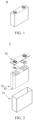
- FIG. 1 shows a secondary battery 5 of a square structure as an example.
- the outer package may include a housing 51 and a cover plate 53.
- the housing 51 may include a bottom plate and a side plate connected to the bottom plate. The bottom plate and the side plate are enclosed to form an accommodating cavity.
- the housing 51 has an opening communicating with the accommodating cavity, and the cover plate 53 can cover the opening to close the accommodating cavity.
- a positive electrode sheet, a negative electrode sheet, and a separator may be subject to a winding process or a lamination process to form an electrode assembly 52.
- the electrode assembly 52 is packaged in the accommodating cavity.
- the electrolyte solution is infiltrated in the electrode assembly 52.
- the number of electrode assemblies 52 included in the secondary battery 5 may be one or more, and the specific number may be selected by persons skilled in the art according to specific actual needs.
- secondary batteries may be assembled into a battery module, and the number of secondary batteries included in the battery module may include one or more, and the specific number may be selected by persons skilled in the art according to application and capacity of the battery module.
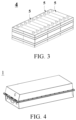
- FIG. 3 shows a battery module 4 as an example.
- a plurality of secondary batteries 5 may be sequentially arranged along a length direction of the battery module 4. Certainly, they may be arranged in accordance with any other manner. Further, the plurality of secondary batteries 5 may be fixed by using fasteners.
- the battery module 4 may further include a shell with an accommodating space, and the plurality of secondary batteries 5 are accommodated in the accommodating space.
- battery modules may be further assembled into a battery pack, and the number of battery modules included in the battery pack may be one or more, and the specific number may be selected by persons skilled in the art according to application and capacity of the battery pack.
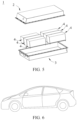
- FIG. 4 and FIG. 5 show a battery pack 1 as an example.
- the battery pack 1 may include a battery box and a plurality of battery modules 4 disposed in the battery box.
- the battery box includes an upper box 2 and a lower box 3.
- the upper box 2 can cover the lower box 3 and form an enclosed space for accommodating the battery modules 4.
- the plurality of battery modules 4 may be arranged in the battery box in any manner.
- the secondary battery of the present application makes true 1 g/1000m 2 ⁇ L ⁇ 5 g/1000m 2 , preferably 1 g/1000m 2 ⁇ L ⁇ 4 g/1000m 2 , further preferably 1.5 g/1000m 2 ⁇ L ⁇ 4 g/1000m 2 , more preferably 1.5 g/1000m 2 or more and 3.5 g/1000m 2 or less.
- L M1/[M2 ⁇ B ⁇ (a+c)]*1000, where M1 is mass of the compound of formula II with a unit of g, M2 is mass of the positive active material with a unit of g, B is a specific surface area of the positive active material with a unit of m 2 /g, a is a mass percentage of the compound of formula I in the solvent, and c is a molar percentage of the compound of formula III in the electrolyte salt.
- L is in the foregoing range, and the kinetic performance, high-temperature performance, and overcharge prevention performance of the battery can be further improved.
- the specific surface area of the positive active material is set to the foregoing range, and solid phase diffusion inside the positive electrode sheet can be improved, which is conducive to improving the kinetic performance of the battery cell.
- a power consumption apparatus including the foregoing secondary battery.
- the power consumption apparatus of the present application includes the foregoing secondary battery, and therefore has all the advantageous effects of the secondary battery.
- the secondary battery may be used as a power source of the power consumption apparatus or may be used as an energy storage unit of the power consumption apparatus.
- the power consumption apparatus may be selected from a mobile device (for example, a mobile phone, a notebook computer), an electric vehicle (for example, a pure electric vehicle, a hybrid electric vehicle, a plug-in hybrid electric vehicle, an electric bicycle, an electric scooter, an electric golf cart, an electric truck), an electric train, a ship and a satellite, an energy storage system, or the like, but is not limited to this.
- a secondary battery, a battery module, or a battery pack may be selected according to usage requirements.
- FIG. 6 shows a power consumption apparatus as an example.
- the power consumption apparatus is a pure electric vehicle, a hybrid electric vehicle, a plug-in hybrid electric vehicle, or the like.
- a battery pack or a battery module may be used.
- the apparatus may be a mobile phone, a tablet computer, a notebook computer, or the like.
- the apparatus usually requires lightness and thinness, and a secondary battery may be used as a power source.
- olivine-structured lithium iron phosphate LFP
- PVDF polyvinylidene fluoride
- SP carbon black
- the olivine-structured lithium iron phosphate was used as a positive active material, a specific surface area thereof was 12 m 2 /g, and a thickness of the single-layered membrane after cold pressing was 0.1 mm.
- a negative active material artificial graphite
- carbon black SP
- SBR styrene butadiene rubber
- CMC carboxymethyl cellulose
- a polyethylene film was used as the separator.
- a positive electrode sheet, a separator and a negative electrode sheet were stacked in order, so that the separator was placed between the positive electrode sheet and the negative electrode sheet to play the role of separation, and then winding was performed, to obtain an electrode assembly; the electrode assembly was put in an outer package, drying was performed and then an electrolyte solution was injected, and processes such as formation, and standing were performed, to obtain a secondary battery.
- the final lithium-ion battery contained 1400 g of the positive active material and 620 g of the electrolyte solution.
- lithium hexafluorophosphate (LiPF 6 ) with a concentration of 0.5 mol/L and lithium bisfluorosulfonimide with a concentration of 0.5 mol/L were slowly added as electrolyte salts, where molar percentages of lithium hexafluorophosphate (LiPF 6 ) and lithium bisfluorosulfonimide in the electrolyte salts were 50%, respectively.
- LiPF 6 lithium hexafluorophosphate
- lithium bisfluorosulfonimide lithium bisfluorosulfonimide
- lithium hexafluorophosphate (LiPF 6 ) with a concentration of 0.5 mol/L and lithium bis(trifluoromethanesulfonyl)imide with a concentration of 0.5 mol/L were slowly added as electrolyte salts, where molar percentages of lithium hexafluorophosphate (LiPF 6 ) and lithium bis(trifluoromethanesulfonyl)imide in the electrolyte salts were 50%, respectively.
- LiPF 6 lithium hexafluorophosphate
- lithium bis(trifluoromethanesulfonyl)imide lithium bis(trifluoromethanesulfonyl)imide
- Embodiments 1-23 and Comparative Examples 1-3 are shown in Table 1 below.
- Table 1 Serial number Solvent Additive Electrolyte salt a/b L(g/1000m 2 ) Battery performance Type Content Type Content Type Molar concentration mol/L Initial DCR mohm Capacity retention rate after 100 cycles at 45°C Overcharge prevention performance (the number of times of which the overcharge test is passed)
- Embodiment 1 Ethyl acetate : ethylene carbonate : dimethyl carbonate 35%:30%:35% Fluorobenzene 3% Lithium hexafluorophosphate 1 11.7 3.16 3.0 83.0% 30/30
- Embodiment 2 Ethvl acetate : ethvlene carbonate : dimethyl carbonate 40%:30%:30% Fluorobenzene 3% Lithium hexafluorophosphate 1 13.3 2.77 2.9 83.0% 30/30 Embodiment 3 Ethyl acetate : ethylene carbonate
- the battery of each Embodiment and Comparative Example was charged at a constant current of 0.5C until a voltage was 3.65 V, and then was charged at a constant voltage until a current was 0.05C; discharging was performed on the battery at a constant current of 0.5C for 30 minutes, to adjust the battery to 50% SOC, at which time the voltage of the battery was recorded as U1; and discharging was performed on the battery at a constant current of 4C for 30 seconds with a result being collected every 0.1 seconds, and the voltage at the end of the discharge was recorded as U2.
- the battery of each Embodiment and Comparative Example was charged at a constant current of 1.0C until a voltage was 3.65 V, and then was charged at a constant voltage until a current was 0.05C; standing was performed on the battery for 5 minutes and discharging was performed at a constant current of 1.0C until a voltage was 2.5 V; this was the first charge-discharge cycle process of the battery, and a discharge capacity at this time was recorded as a discharge capacity at the first cycle of the battery.
- Charging and discharging were performed on the battery for 100 cycles according to the foregoing method, and a discharge capacity of the battery after 100 cycles was recorded.
- a capacity retention rate (%) of the battery after 100 cycles at 45 °C (a discharge capacity of the battery after 100 cycles/a discharge capacity of the battery at the first cycle) ⁇ 100%.
- the battery of each Embodiment and Comparative Example was charged at a constant current of 1C until a voltage was 3.65 V and a cutoff current was 0.05C; after the battery was fully charged, the battery was charged at a constant current of 1C until the voltage reaches 6 V, and observation was performed for 1 hour to confirm whether the battery catches fire and explodes. If there was only smoke and no fire and explosion, it means that the test was passed. If there was a fire or explosion, it means that the test was not passed.
- the above operations were repeated for 30 times, and the number of times of passing the test (the number of times of which the overcharge test was passed) was recorded.
- Embodiments 1-23 good kinetic performance, high-temperature performance and excellent overcharge prevention performance of the battery are taken into account, and good effects are achieved.
- Comparative Example 1 since the content of the compound of formula I was not within the range of the present application, no effective effect was achieved. In particular, the initial DCR increased to 3.6. In Comparative Example 2, no effective effect was achieved since the compound of formula I was not added. In particular, the initial DCR was increased significantly, reaching 6.0, and the kinetics of the battery were deteriorated significantly. In Comparative Example 3, no effective effect was achieved since the compound of formula II was not added. In particular, the overcharge prevention performance was significantly deteriorated. It can be seen that the compound of formula I in a specific amount together with the compound of formula II is used, good kinetic performance, high-temperature performance and excellent overcharge prevention performance of the battery can be taken into account.
Landscapes
- Chemical & Material Sciences (AREA)
- Electrochemistry (AREA)
- General Chemical & Material Sciences (AREA)
- Chemical Kinetics & Catalysis (AREA)
- Engineering & Computer Science (AREA)
- Manufacturing & Machinery (AREA)
- Inorganic Chemistry (AREA)
- Physics & Mathematics (AREA)
- Condensed Matter Physics & Semiconductors (AREA)
- General Physics & Mathematics (AREA)
- Crystallography & Structural Chemistry (AREA)
- Materials Engineering (AREA)
- Secondary Cells (AREA)
- Battery Electrode And Active Subsutance (AREA)
Abstract

Description
- The present application relates to the technical field of batteries, and in particular, to an electrolyte solution, a secondary battery, and a power consumption apparatus.
- In recent years, secondary batteries have been widely used in energy storage power systems such as hydropower, firepower, wind power and solar power plants, as well as many fields such as, electric tools, electric bicycles, electric motorcycles, electric mobiles, military devices, and aerospace.
- As secondary batteries have been greatly developed, higher demands have been placed on their energy density, cycle performance, safety performance, or the like.
- The present application is made in view of the foregoing problems, and an objective is to provide an electrolyte solution, a secondary battery, and a power consumption apparatus. A secondary battery using an electrolyte solution of the present application can achieve good kinetic performance, high-temperature performance, as well as excellent overcharge prevention performance.
- In order to achieve the foregoing objective, according to a first aspect of the present application, an electrolyte solution is provided, including a solvent and an additive, where the solvent includes a compound of formula I, and a mass percentage of the compound of formula I in the solvent is 35% or more,

- where R1, and R2 are each independently selected from any one of a hydrogen atom, a C1-C3 chain alkyl group, and a C2-C3 alkenyl group;
- the additive includes a compound of formula II,

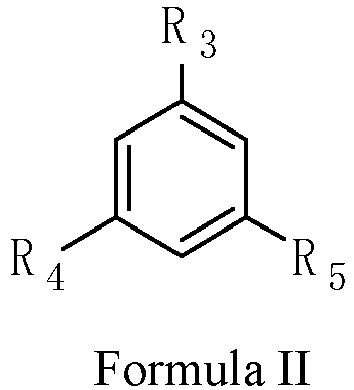
- where R3, R4, and R5 are each independently selected from any one of a hydrogen atom, a fluorine atom, a phenyl group, a cyano group, a C1-C6 chain alkyl group, a C3-C6 cyclic alkyl group, and a C2-C6 alkenyl group.
- In the present application, an electrolyte solution includes a compound of formula I and a compound of formula II, and good kinetic performance, high-temperature performance, and excellent overcharge prevention performance can be taken into account.
- In any embodiment, the mass percentage of the compound of formula I in the solvent may be 40%-70%. In the present application, the mass percentage of the compound of formula I in the solvent is set to the foregoing range, and it can ensure that the electrolyte solution has high conductivity and low viscosity and can be applied to a thick coating system. The kinetic performance of the battery can be further improved.
- In any embodiment, a mass percentage of the compound of formula II in the electrolyte solution may be 9% or less, optionally 3%-5%. In the present application, the mass percentage of the compound of formula II in the electrolyte solution is set to the foregoing range, and the overcharge prevention performance can be further improved.
- In any embodiment, the compound of formula I may include at least one selected from methyl formate, methyl acetate, ethyl acetate, propyl acetate, methyl acrylate and ethyl acrylate. In the present application, the foregoing compound is selected, and the kinetic performance can be further improved.
- In any embodiment, the compound of formula II may include at least one of biphenyl, fluorobenzene and cyclohexylbenzene. In the present application, the foregoing compound is selected, and the overcharge prevention performance can be further improved.
- In any embodiment, the electrolyte solution may make true a/b≥11, optionally 11≤a/b≤35, where a is a mass percentage of the compound of formula I in the solvent, and b is a mass percentage of the compound of formula II in the electrolyte solution. In the present application, a/b is set to the foregoing range, and the kinetic performance and the overcharge prevention performance can be further improved.
- In any embodiment, the electrolyte solution may further include an electrolyte salt, and the electrolyte salt may include a compound of formula III, optionally a molar percentage of the compound of formula III in the electrolyte salt is 10% or more, optionally 20% or more,

- In the present application, the compound of formula III is added to the electrolyte solution, the molar percentage of the compound of formula III in the electrolyte salt is set to the foregoing range, the resistance of the electrolyte solution to water can be improved, and high-temperature cycle performance of the battery can be improved.
- In any embodiment, the compound of formula III may include at least one selected from lithium bisfluorosulfonimide and lithium bis(trifluoromethanesulfonyl)imide. The foregoing compound is selected, and the resistance of the electrolyte solution to water can be further improved, and high-temperature cycle performance of the battery can be improved.
- In any embodiment, the solvent may further include a carbonate, and a mass percentage of the carbonate in the solvent is 30% or more, optionally 35%-65%, more optionally 40%-50%.
- In any embodiment, the solvent may further include ethylene carbonate, and a mass percentage of the ethylene carbonate in the solvent is 30% or more.
- The solvent further includes carbonate, and the mass percentage of the carbonate in the solvent is set to the foregoing range, which can ensure sufficient dissociation of the electrolyte, especially the lithium salt, and stable film formation of the negative electrode. Thus stability of a negative electrode interface is improved.
- In any embodiment, the additive may further include at least one selected from vinylene carbonate (VC), fluoroethylene carbonate (FEC), vinyl sulfate (DTD), 1,3-propane sultone (PS), lithium difluorobisoxalate phosphate (LiDFOP), lithium difluoro(oxalato)borate (LiDFOB), and lithium bis(oxalato)borate (LiBOB). The additive is added, and cycle performance and thermal stability of the battery can be further improved.
- According to a second aspect of the present application, a secondary battery is provided, including the electrolyte solution of the first aspect. The secondary battery of the present application can achieve good kinetic performance, high-temperature performance, as well as excellent overcharge prevention performance.
- In any embodiment, the secondary battery may include a positive electrode sheet, the positive electrode sheet includes a positive electrode film layer, the positive electrode film layer may include a positive active material, and the positive active material may include an olivine-structured lithium-containing phosphate. The olivine-structured lithium-containing phosphate is used as a positive active material, and cycle life can be improved.
- In any embodiment, the secondary battery may make true 1 g/1000m2≤L≤5 g/1000m2, preferably 1 g/1000m2≤L≤4 g/1000m2, more preferably 1.5 g/1000m2≤L≤4 g/1000m2. L=M1/[M2×B×(a+c)]*1000, M1 is mass of the compound of formula II with a unit of g, M2 is mass of the positive active material with a unit of g, b is a specific surface area of the positive active material with a unit of m2/g, a is a mass percentage of the compound of formula I in the solvent, and c is a molar percentage of the compound of formula III in the electrolyte salt. L is in the foregoing range, and the kinetic performance, high-temperature performance, and overcharge prevention performance of the battery can be further improved.
- In any embodiment, 8 m2/g≤B≤16 m2/g, optionally 10 m2/g≤B≤14 m2/g. The specific surface area of the positive active material is set to the foregoing range, and solid phase diffusion inside the positive electrode sheet can be improved, which is conducive to improving the kinetic performance of the battery cell.
- In any embodiment, a thickness of the single-faced positive electrode film layer is 0.08 mm or more, optionally 0.09 mm-0.3 mm.
- According to a third aspect of the present application, a power consumption apparatus is provided, including the secondary battery of the second aspect. The power consumption apparatus of the present application includes the foregoing secondary battery, and therefore has all the advantageous effects of the secondary battery.
- According to the present application, good kinetic performance, high-temperature performance, as well as excellent overcharge prevention performance of the battery can be taken into account.
-
-
FIG. 1 is a schematic diagram of a secondary battery according to an embodiment of the present application. -
FIG. 2 is an exploded view of the secondary battery according to the embodiment of the present application shown inFIG. 1 . -
FIG. 3 is a schematic diagram of a battery module according to an embodiment of the present application. -
FIG. 4 is a schematic diagram of a battery pack according to an embodiment of the present application. -
FIG. 5 is an exploded view of the battery pack according to the embodiment of the present application shown inFIG. 4 . -
FIG. 6 is a schematic diagram of a power consumption apparatus in which a secondary battery is used as a power source according to an embodiment of the present application. - 1: battery pack; 2: upper box; 3: lower box; 4: battery module; 5: secondary battery; 51: housing; 52: electrode assembly; 53: top cover assembly.
- Hereinafter, embodiments that specifically disclose an electrolyte solution, a secondary battery, and a power consumption apparatus of the present application will be described in detail with reference to the accompanying drawings as appropriate. However, unnecessarily detailed descriptions may be omitted in some cases. For example, detailed descriptions of well-known matters and repeated descriptions of practically identical structures are omitted. This is done to avoid unnecessarily redundant descriptions for ease of understanding by persons skilled in the art. In addition, the drawings and the following description are provided for a full understanding of the present application by persons skilled in the art, and are not intended to limit the subject matter in the claims.
- A "range" disclosed herein is defined in the form of a lower limit and an upper limit. A given range is defined by selecting a lower limit and an upper limit, and the selected lower limit and upper limit define a boundary of a particular range. The range defined in this manner may or may not include end values, and may be combined arbitrarily, that is, any lower limit may be combined with any upper limit to form a range. For example, if ranges of 60-120 and 80-110 are listed for a particular parameter, it is understood that ranges of 60-110 and 80-120 are also contemplated. In addition, if the minimum range values listed are 1 and 2, and the maximum range values listed are 3, 4 and 5, all the following ranges are contemplated: 1-3, 1-4, 1-5, 2-3, 2-4, and 2-5. In the present application, unless otherwise specified, a numerical range "a-b" represents an abbreviated representation of any combination of real numbers between a and b, where both a and b are real numbers. For example, a numerical range "0-5" means that all real numbers between "0-5" have been listed herein, and "0-5" is just an abbreviated representation of a combination of these numerical values. In addition, when a certain parameter is expressed as an integer ≥2, it is equivalent to disclosing that the parameter is, for example, an integer of 2, 3, 4, 5, 6, 7, 8, 9, 10, 11, 12, or the like.
- Unless otherwise specified, all embodiments and optional embodiments of the present application may be combined with each other to form a new technical solution.
- Unless otherwise specified, all technical features and optional technical features of the present application may be combined with each other to form a new technical solution.
- Unless otherwise specified, all steps of the present application may be performed sequentially or randomly, but preferably, performed sequentially. For example, a method includes steps (a) and (b), which means that the method may include steps (a) and (b) performed sequentially, or steps (b) and (a) performed sequentially. For example, the method mentioned may further include step (c), which means that step (c) may be added to the method in any order, for example, the method may include steps (a), (b) and (c), steps (a), (c) and (b), steps (c), (a) and (b), or the like.
- Unless otherwise specified, "comprising" and "containing" mentioned in the present application are open-ended or closed-ended. For example, the "comprising" and "containing" may mean that other components that are not listed may further be comprised or contained, or only listed components may be comprised or contained.
- In the present application, unless otherwise specified, the term "or" is inclusive. For example, the phrase "A or B" means "A, B or both A and B". More particularly, a condition "A or B" is satisfied by any one of the following: A is true (or present) and B is false (or not present); A is false (or not present) and B is true (or present); or both A and B are true (or present).
- The present application provides an electrolyte solution, a secondary battery including the electrolyte solution, and a power consumption apparatus including the secondary battery. The electrolyte solution, the secondary battery, and the power consumption apparatus of the present application are described in detail below.
- In an embodiment of the present application, an electrolyte solution is provided, including a solvent and an additive, where the solvent includes a compound of formula I, and a mass percentage of the compound of formula I in the solvent is 35% or more,

- where R1, and R2 are each independently selected from any one of a hydrogen atom, a C1-C3 chain alkyl group, and a C2-C3 alkenyl group;
- the additive includes a compound of formula II,

- where R3, R4, and R5 are each independently selected from any one of a hydrogen atom, a fluorine atom, a phenyl group, a cyano group, a C1-C6 chain alkyl group, a C3-C6 cyclic alkyl group, and a C2-C6 alkenyl group.
- Although the mechanism is not clear yet, the applicant surprisingly found that: the compound of formula I and the compound of formula II both are used in the electrolyte solution, and the content of the compound of formula I is set to a specific amount. Therefore, good kinetic performance, high-temperature performance, as well as excellent overcharge prevention performance of the battery can be taken into account.
- In a battery using lithium iron phosphate (such as LiFePO4 (LFP for short)) as a positive active material, in order to increase energy density, the most commonly used measure is to thicken a coating thickness of the positive electrode sheet so as to increase space efficiency of the internal portion of the battery cell, but thickened coating also brings new problems. Thickened coating of the positive electrode means that the transport path of lithium ions in the electrode sheet is lengthened, the transport of lithium ions is more difficult, and conductivity of the electrolyte solution needs to be further improved. This problem becomes more serious as the positive electrode coating thickens.
- In order to solve this problem, the applicant found that a solvent with low viscosity and high dielectric constant (such as the foregoing compound of formula I) may be used in an electrolyte solution, which can greatly improve conductivity of the electrolyte solution, and improve the transport difficulties of lithium ions due to thick coating. However, an oxidation potential of the compound of formula I is low, which greatly affects overcharge performance of LFP battery cells. In order to reduce safety problems such as thermal runaway of the battery in the case of overcharging, the applicant found that the compound of formula II is added to the electrolyte solution to be used as an overcharge-prevention additive, and the purpose of increasing the safety of the battery can be improved. However, the addition of the overcharge-prevention additive such as, the compound of formula II affects the kinetic performance of the battery.
- Through careful study, the applicant found that a specific content of the compound of formula I is added to an electrolyte solution containing the foregoing compound of formula II, the kinetic performance and high-temperature performance of the battery can be improved. Thus, through synergistic effect of the compound of formula I with the specific content and the compound of formula II, good kinetic performance, high-temperature performance, as well as overcharge prevention performance can be taken into account.
- In some embodiments, the compound of formula I may be listed as methyl formate, methyl acetate, ethyl acetate, propyl acetate, methyl propionate, ethyl propionate, propyl propionate, methyl acrylate, ethyl acrylate, or the like. The compound of formula I preferably includes at least one selected from methyl formate, methyl acetate, ethyl acetate, propyl acetate, methyl acrylate and ethyl acrylate. More preferably, methyl formate and ethyl acetate are included. These compounds are used as a solvent for an electrolyte solution, these compounds have viscosity lower than that of linear carbonates, and have dielectric constants higher than those of the linear carbonates. These compounds are added to the electrolyte solution, and the linear carbonates can be replaced, thereby effectively increasing conductivity of the electrolyte solution, and further improving the kinetic performance of the battery.
- The solvent of the electrolyte solution of the present application includes the compound of formula I, and a mass percentage of the compound of formula I in the solvent is 35% or more, preferably a mass percentage of the compound of formula I in the solvent is 40%-70%, preferably 50%-60%. When the mass percentage of the compound of formula I in the solvent is less than 35%, the conductivity decreases, initial DCR (Directive Current Resistance, directive current resistance) increases, resulting in deterioration of the kinetic performance of the battery. Therefore, in the present application, the mass percentage of the compound of formula I in the solvent is set to the foregoing range, and it can ensure that the electrolyte solution has high conductivity and low viscosity and can be applied to a thick coating system. The kinetic performance of the battery can be further improved. In addition, when the mass percentage of the compound of formula I in the solvent is greater than 70%, it is not conducive to the overcharge prevention performance.
- In addition, in the present application, the solvent of the electrolyte solution may further include one or two or more carbonates selected from ethylene carbonate (EC), propylene carbonate (PC), dimethyl carbonate (DMC), ethyl methyl carbonate (EMC) and diethyl carbonate (DEC). A mass percentage of the foregoing carbonate in the solvent may be 30% or more, preferably 35%-65%, more preferably 40%-50%. Ethylene carbonate is preferably included; further preferably, a mass percentage of the ethylene carbonate in the solvent is 30% or more. The solvent includes ethylene carbonate, and the mass percentage of the ethylene carbonate in the solvent is set to the foregoing range, which can ensure sufficient dissociation of the electrolyte, especially the lithium salt, and stable film formation of the negative electrode. Thus stability of a negative electrode interface is improved.
- In some embodiments, the electrolyte solution of the present application includes the compound of formula II as an additive, and the compound of formula II acts as an overcharge prevention agent. Preferably, the compound of formula II may include at least one selected from biphenyl, fluorobenzene, and cyclohexylbenzene. In the present application, the foregoing compound is used as an overcharge prevention agent, and the overcharge prevention performance can be further improved. Fluorobenzene is preferably included in the present application. The voltage rises when the battery cell is overcharged, the overcharge-prevention additive is polymerized, to form an insulating film on the surface of the electrode, which increases the internal resistance of the battery, and reduces or cuts off an overcharge current to improve the safety performance of the battery. On the other hand, a large amount of heat is released, and fluorobenzene substances are polymerized under a high voltage to form a fluoropolymer with better high-temperature resistance. In addition, compared with other benzene ring substances, fluorobenzene substances are more easily combined with electrons due to substitution of fluorine, which can inhibit the reduction side reaction of the compound of formula I at the negative electrode to some extent.
- In addition, the mass percentage of the compound of formula II in the electrolyte solution is 9% or less, preferably 3-8%, more preferably 3-7%, further preferably 3-6%, and particularly preferably 3-5%. When the content of the compound of formula II is too high, it is not conducive to the conductivity of the electrolyte solution, and thus not conducive to the kinetic performance of the battery. When the content of the compound of formula II is too low, it is not conducive to the overcharge prevention performance. In the present application, the mass percentage of the compound of formula II in the electrolyte solution is set to the foregoing range, which can further improve the overcharge prevention performance without affecting the conductivity of the electrolyte solution.
- In some embodiments, the electrolyte solution makes true: a/b≥11, preferably 11≤a/b≤35, more preferably 11≤a/b≤33, further preferably 15≤a/b≤30, especially preferably, 16≤a/b≤27, where a is a mass percentage of the compound of formula I in the solvent, and b is a mass percentage of the compound of formula II in the electrolyte solution. In the present application, a/b is set to the foregoing range, which can further improve the kinetic performance.
- On the other hand, since the LFP material is very easy to absorb water, moisture in the positive electrode sheet cannot be completely removed when the battery cell is packaged before liquid injection in the production process, and in the subsequent use process, the moisture in the positive electrode sheet gradually diffuses into the electrolyte solution, and undergoes a side reaction with lithium hexafluorophosphate (LiPF6) in the electrolyte solution to generate hydrogen fluoride, and an SEI (solid electrolyte interphase) film is destroyed, so that stability of the negative electrode interface is deteriorated, resulting in accelerated cycle decay. The applicant found that a lithium salt that is not sensitive to water (such as the compound of formula III described below) is used, which can reduce the influence of moisture on the electrode sheet and avoid side reactions between the lithium salt and water. However, similar to the compound of formula I, an oxidation potential of the compound of formula III is also low, which greatly affects overcharge performance of LFP battery cells. The compound of formula II is added to the electrolyte solution to be used as an overcharge-prevention additive, and the purpose of increasing the safety of the battery can be improved.
- Therefore, in some embodiments, the electrolyte solution of the present application includes an electrolyte salt, and preferably the electrolyte salt includes a compound of formula III,

- In some embodiments, the compound of formula III described above preferably includes at least one selected from lithium bisfluorosulfonimide (LiFSI) and lithium bis(trifluoromethanesulfonyl)imide (LiTFSI). More preferably, lithium bisfluorosulfonimide (LiFSI) is included. The lithium salts described above are not sensitive to moisture and can mitigate a negative effect of increased moisture caused by thick-coated electrode sheet. Therefore, the compound of formula III is selected as the electrolyte salt, which can further improve the resistance of the electrolyte solution to water and improve thermal cycle characteristics of the battery, especially the thermal cycle characteristic at 45°C.
- The molar percentage of the compound of formula III in the electrolyte salt may be 10% or more, preferably 20% or more, more preferably 30% or more, further preferably 40% or more, and particularly preferably 50% or more, in addition, it may be preferably 80% or less, more preferably 75% or less, further preferably 70% or less, and particularly preferably 60% or less. In the present application, the molar percentage of the compound of formula III in the electrolyte salt is set to the foregoing range, the resistance of the electrolyte solution to water can be increased.
- In addition, the electrolyte salt may further include lithium hexafluorophosphate (LiPF6), which is strong in oxidation resistance, but poor in thermal stability, and is easy to decompose when exposed to water. The electrolyte solution of the present application includes lithium salts of the compound of formula III, and these lithium salts have good thermal stability. Therefore, by adding lithium hexafluorophosphate and the lithium salt of the compound of formula III, oxidation resistance as well as thermal stability can be achieved.
- In some embodiments, the electrolyte solution of the present application may further include the following additives, specifically, for example, vinylene carbonate (VC), fluoroethylene carbonate (FEC), vinyl sulfate (DTD), 1,3-propane sultone (PS), lithium difluorobisoxalate phosphate (LiDFOP), lithium difluoro(oxalato)borate (LiDFOB), and lithium bis(oxalato)borate (LiBOB). Vinylene carbonate (VC), fluoroethylene carbonate (FEC), vinyl sulfate (DTD), and 1,3-propane sultone (PS) can be used as film-forming additives. When vinylene carbonate (VC) and 1,3-propane sultone (PS) are used as film-forming additives, the resistance is large, and the film-forming stability is good. However, when fluoroethylene carbonate (FEC), and vinyl sulfate (DTD) are used as film-forming additives, the resistance is low, and the film-forming stability is poor. In addition, the additives such as lithium difluorobisoxalate phosphate (LiDFOP), lithium difluoro(oxalato)borate (LiDFOB), and lithium bis(oxalato)borate (LiBOB) are not sensitive to water, which can mitigate the negative effects of increased moisture caused by thick-coated electrode sheets. Therefore, the additive is added, and the cycle characteristic and thermal stability of the battery can be further improved.
- In some embodiments, the electrolyte solution of the present application has a conductivity of 13 mS/cm or more at 25 °C , for example, 14 mS/cm-18 mS/cm, 15 mS/cm-17 mS/cm, and 16 mS/cm-17 mS/cm. When the conductivity of the electrolyte solution is too small, the kinetic performance of the electrolyte solution is insufficient, and when a coating thickness of the positive electrode sheet is thick, the kinetic performance of the battery is affected; and when the conductivity of the electrolyte solution is too large, the thermal stability of the electrolyte solution is insufficient, and the high-temperature performance of the battery may be affected. In the present application, when the conductivity of the electrolyte solution is within the foregoing range at 25 °C, the kinetic performance of the electrolyte solution can be improved, and the high and low temperature performance of the battery and the energy density of the battery can be improved.
- In a second aspect of the present application, a secondary battery is provided, including the foregoing electrolyte solution. The secondary battery of the present application can achieve good kinetic performance, high-temperature performance, as well as excellent overcharge prevention performance.
- The secondary battery of the present application may be a lithium-ion secondary battery, or the like. Generally, a secondary battery includes a positive electrode sheet, a negative electrode sheet, an electrolyte solution, and a separator. During charging and discharging of a battery, active ions are intercalated and deintercalated back and forth between the positive electrode sheet and the negative electrode sheet. The electrolyte solution plays a role of conducting ions between the positive electrode sheet and the negative electrode sheet. The separator is disposed between the positive electrode sheet and the negative electrode sheet, which mainly plays the role of preventing a short circuit between the positive and negative electrodes while allowing ions to pass through.
- The positive electrode sheet includes a positive electrode current collector, and a positive electrode film layer disposed on at least one surface of the positive electrode current collector, and the positive electrode film layer includes a positive active material.
- As an example, the positive electrode current collector has two opposite surfaces in its thickness direction, and the positive electrode film layer is disposed on either or both of the two opposite surfaces of the positive electrode current collector.
- The positive electrode current collector may be a metal foil or a composite current collector. For example, as the metal foil, an aluminum foil may be used. The composite current collector may include a polymer material base layer and a metal layer formed on at least one surface of the polymer material base layer. The composite current collector may be formed by synthesizing a metal material (aluminum, aluminum alloy, nickel, nickel alloy, titanium, titanium alloy, silver, silver alloy, or the like) on a polymer material substrate (such as a substrate of polypropylene (PP), polyethylene terephthalate (PET), polybutylene terephthalate (PBT), polystyrene (PS), polyethylene (PE), or the like).
- The positive active material may employ a positive active material for a battery known in the art. As an example, the positive active material may include a lithium-containing phosphate of an olivine structure, whereby the cycle life of the battery can be improved. In addition, the positive active material may further include a lithium transition metal oxide and modified compounds thereof. However, the present application is not limited to these materials, and other conventional materials that can be used as a positive active material for a battery may also be used. One type of these positive active materials may be used alone, or two or more types thereof may be used in combination. Examples of the lithium-containing phosphate of the olivine structure may include, but are not limited to, at least one of lithium iron phosphate (such as LiFePO4 (LFP for short)), composite materials of lithium iron phosphate and carbon, lithium manganese phosphate (such as LiMnPO4), composite materials of lithium manganese phosphate and carbon, lithium manganese iron phosphate, and composite materials of lithium manganese iron phosphate and carbon. Examples of the lithium transition metal oxide may include, but are not limited to, at least one of lithium cobalt oxides (such as LiCoO2), lithium nickel oxides (such as LiNiO2), lithium manganese oxides (such as LiMnO2, LiMn2O4), lithium nickel cobalt oxides, lithium manganese cobalt oxides, lithium nickel manganese oxides, lithium nickel cobalt manganese oxides (such as LiNi1/3Co1/3Mn1/3O2 (NCM333 for short), LiNi0.5Co0.2Mn0.3O2 (NCM523 for short), LiNi0.5Co0.25Mn0.25O2 (NCM211 for short), LiNi0.6Co0.2Mn0.2O2 (NCM622 for short), LiNi0.8Co0.1Mn0.1O2 (NCM811 for short)), lithium nickel cobalt aluminum oxides (such as LiNi0.85Co0.15Al0.05O2), their modified compounds, or the like.
- The positive electrode film layer also optionally includes a binder. As an example, the binder may include at least one of polyvinylidene fluoride (PVDF), polytetrafluoroethylene (PTFE), vinylidene fluoride-tetrafluoroethylene-propylene terpolymer, vinylidene fluoride-hexafluoropropylene-tetrafluoroethylene terpolymer, tetrafluoroethylene-hexafluoropropylene copolymer and fluoro containing acrylate resin.
- The positive electrode film layer also optionally includes a conductive agent. As an example, the conductive agent may include at least one of superconducting carbon, acetylene black, carbon black, Ketjen black, carbon dots, carbon nanotubes, graphene, and carbon nanofibers.
- In some embodiments, a thickness of the single-faced positive electrode film layer is 0.08 mm or more, optionally 0.09 mm-0.3 mm.
- In some embodiments, the positive electrode sheet may be prepared in the following manner. The foregoing components for preparing the positive electrode sheet such as the positive active material, the conductive agent, the binder, and any other components are dispersed in a solvent (such as N-methylpyrrolidone), to form a positive electrode slurry, the positive electrode slurry is coated on the positive electrode current collector, and then after drying, cold pressing and other processes are performed, a positive electrode sheet may be obtained.
- A negative electrode sheet includes a negative electrode current collector and a negative electrode film layer disposed on at least one surface of the negative electrode current collector, and the negative electrode film layer includes a negative active material.
- As an example, the negative electrode current collector has two opposite surfaces in its thickness direction, and the negative electrode film layer is disposed on either or both of the two opposite surfaces of the negative electrode current collector.
- The negative electrode current collector may be a metal foil or a composite current collector. For example, as the metal foil, a copper foil may be used. The composite current collector may include a polymer material base layer and a metal layer formed on at least one surface of the polymer material substrate. The composite current collector may be formed by synthesizing a metal material (copper, copper alloy, nickel, nickel alloy, titanium, titanium alloy, silver, silver alloy, or the like) on a polymer material substrate (such as a substrate of polypropylene (PP), polyethylene terephthalate (PET), polybutylene terephthalate (PBT), polystyrene (PS), polyethylene (PE), or the like).
- The negative active material may employ a negative active material for a battery known in the art. As an example, the negative active material may include at least one of artificial graphite, natural graphite, soft carbon, hard carbon, silicon-based materials, tin-based materials, lithium titanate, or the like. The silicon-based material may be selected from at least one of elemental silicon, silicon-oxygen compounds, silicon-carbon composites, silicon-nitrogen composites, and silicon alloys. The tin-based material may be selected from at least one of elemental tin, tin oxide compounds, and tin alloys. However, the present application is not limited to these materials, and other conventional materials that can be used as a negative active material for a battery may also be used. One type of these negative active materials may be used alone, or two or more types thereof may be used in combination.
- The negative electrode film layer also optionally includes a binder. The binder may be selected from at least one of styrene-butadiene rubber (SBR), polyacrylic acid (PAA), polyacrylate sodium (PAAS), polyacrylamide (PAM), polyvinyl alcohol (PVA), sodium alginate (SA), polymethacrylic acid (PMAA), and carboxymethyl chitosan (CMCS).
- The negative electrode film layer also optionally includes a conductive agent. The conductive agent may be selected from at least one of superconducting carbon, acetylene black, carbon black, Ketjen black, carbon dots, carbon nanotubes, graphene, and carbon nanofibers.
- The negative electrode film layer also optionally includes other adjuvants, for example, thickening agents (such as sodium carboxymethyl cellulose (CMC-Na)), or the like.
- In some embodiments, the negative electrode sheet may be prepared in the following manner. The foregoing components for preparing the negative electrode sheet such as the negative active material, the conductive agent, the binder, and any other components are dispersed in a solvent (such as deionized water), to form a negative electrode slurry, the negative electrode slurry is coated on the negative electrode current collector, and then after drying, cold pressing and other processes are performed, a negative electrode sheet may be obtained.
- The electrolyte solution plays the role of conducting ions between the positive electrode sheet and the negative electrode sheet. As for the electrolyte solution, the electrolyte solution described in the item "Electrolyte solution" is used.
- In some embodiments, a separator is further included in the secondary battery. The type of the separator is not particularly limited in the present application, and any known porous structure separator with good chemical stability and mechanical stability may be selected.
- In some embodiments, the material of the separator may be selected from at least one of glass fiber, non-woven fabric, polyethylene, polypropylene, and polyvinylidene difluoride. The separator may be a single-layer film or a multi-layer composite film, which is not particularly limited. When the separator is a multi-layer composite film, the materials of each layer may be the same or different, which is not particularly limited.
- In some embodiments, the positive electrode sheet, the negative electrode sheet, and the separator may be subject to a winding process or a lamination process, to obtain an electrode assembly.
- In some embodiments, the secondary battery may include an outer package. The outer package may be used to package the foregoing electrode assembly and electrolyte.
- In some embodiments, the outer package of the secondary battery may be a hard shell such as a hard plastic shell, an aluminum shell, or a steel shell. The outer package of the secondary battery may be a soft package, such as a bag-type soft package. A material of the soft package may be plastic, for example, polypropylene, polybutylene terephthalate, and polybutylene succinate.
- The shape of the secondary battery is not particularly limited in the present application, and may be cylindrical, square, or any other shape. For example,
FIG. 1 shows asecondary battery 5 of a square structure as an example. - In some embodiments, referring to
FIG. 2 , the outer package may include ahousing 51 and acover plate 53. Thehousing 51 may include a bottom plate and a side plate connected to the bottom plate. The bottom plate and the side plate are enclosed to form an accommodating cavity. Thehousing 51 has an opening communicating with the accommodating cavity, and thecover plate 53 can cover the opening to close the accommodating cavity. A positive electrode sheet, a negative electrode sheet, and a separator may be subject to a winding process or a lamination process to form anelectrode assembly 52. Theelectrode assembly 52 is packaged in the accommodating cavity. The electrolyte solution is infiltrated in theelectrode assembly 52. The number ofelectrode assemblies 52 included in thesecondary battery 5 may be one or more, and the specific number may be selected by persons skilled in the art according to specific actual needs. - In some embodiments, secondary batteries may be assembled into a battery module, and the number of secondary batteries included in the battery module may include one or more, and the specific number may be selected by persons skilled in the art according to application and capacity of the battery module.
-
FIG. 3 shows abattery module 4 as an example. Referring toFIG. 3 , in thebattery module 4, a plurality ofsecondary batteries 5 may be sequentially arranged along a length direction of thebattery module 4. Certainly, they may be arranged in accordance with any other manner. Further, the plurality ofsecondary batteries 5 may be fixed by using fasteners. - Optionally, the
battery module 4 may further include a shell with an accommodating space, and the plurality ofsecondary batteries 5 are accommodated in the accommodating space. - In some embodiments, battery modules may be further assembled into a battery pack, and the number of battery modules included in the battery pack may be one or more, and the specific number may be selected by persons skilled in the art according to application and capacity of the battery pack.
-
FIG. 4 andFIG. 5 show abattery pack 1 as an example. Referring toFIG. 4 andFIG. 5 , thebattery pack 1 may include a battery box and a plurality ofbattery modules 4 disposed in the battery box. The battery box includes anupper box 2 and alower box 3. Theupper box 2 can cover thelower box 3 and form an enclosed space for accommodating thebattery modules 4. The plurality ofbattery modules 4 may be arranged in the battery box in any manner. - In some embodiments, the secondary battery of the present application makes true 1 g/1000m2≤L≤5 g/1000m2, preferably 1 g/1000m2≤L≤4 g/1000m2, further preferably 1.5 g/1000m2≤L≤4 g/1000m2, more preferably 1.5 g/1000m2 or more and 3.5 g/1000m2 or less. L=M1/[M2×B×(a+c)]*1000, where M1 is mass of the compound of formula II with a unit of g, M2 is mass of the positive active material with a unit of g, B is a specific surface area of the positive active material with a unit of m2/g, a is a mass percentage of the compound of formula I in the solvent, and c is a molar percentage of the compound of formula III in the electrolyte salt. L is in the foregoing range, and the kinetic performance, high-temperature performance, and overcharge prevention performance of the battery can be further improved.
- In some embodiments, 8 m2/g≤B≤16 m2/g; optionally 10 m2/g≤B≤14 m2/g. When the specific surface area of the positive active material is too large, side reactions may increase, thereby affecting performance of the battery. When the specific surface area of the positive active material is too small, the transport of lithium ions inside the particles is hindered, thereby affecting performance of the battery. The specific surface area of the positive active material is set to the foregoing range, and solid phase diffusion inside the positive electrode sheet can be improved, which is conducive to improving the kinetic performance of the battery cell.
- In a third aspect of the present application, a power consumption apparatus is provided, including the foregoing secondary battery. The power consumption apparatus of the present application includes the foregoing secondary battery, and therefore has all the advantageous effects of the secondary battery.
- The secondary battery may be used as a power source of the power consumption apparatus or may be used as an energy storage unit of the power consumption apparatus. The power consumption apparatus may be selected from a mobile device (for example, a mobile phone, a notebook computer), an electric vehicle (for example, a pure electric vehicle, a hybrid electric vehicle, a plug-in hybrid electric vehicle, an electric bicycle, an electric scooter, an electric golf cart, an electric truck), an electric train, a ship and a satellite, an energy storage system, or the like, but is not limited to this.
- As the power consumption apparatus, a secondary battery, a battery module, or a battery pack may be selected according to usage requirements.
-
FIG. 6 shows a power consumption apparatus as an example. The power consumption apparatus is a pure electric vehicle, a hybrid electric vehicle, a plug-in hybrid electric vehicle, or the like. To meet a requirement of the power consumption apparatus for high power and high energy density of a secondary battery, a battery pack or a battery module may be used. - In another example, the apparatus may be a mobile phone, a tablet computer, a notebook computer, or the like. The apparatus usually requires lightness and thinness, and a secondary battery may be used as a power source.
- Hereinafter, an embodiment of the present application will be described. The embodiments described below are illustrative, only used to explain the present application, and should not be construed as a limitation to the present application. Where specific techniques or conditions are not specified in the embodiments, they are performed according to techniques or conditions described in the literature in the art or according to product specifications. The reagents or instruments used without specifying the manufacturer are conventional products that can be obtained from the market.
- An olivine-structured lithium iron phosphate (LFP), polyvinylidene fluoride (PVDF), and carbon black (SP) were mixed with a solvent in a mass ratio of 97:2.5:0.5, and were stirred to obtain a uniformly dispersed positive electrode slurry; and the positive electrode slurry was uniformly coated on both surfaces of an aluminum foil, and drying, cold pressing and cutting were performed, to obtain a positive electrode sheet. The olivine-structured lithium iron phosphate was used as a positive active material, a specific surface area thereof was 12 m2/g, and a thickness of the single-layered membrane after cold pressing was 0.1 mm.
- A negative active material (artificial graphite), carbon black (SP), styrene butadiene rubber (SBR), carboxymethyl cellulose (CMC) were mixed with a solvent in a ratio of 97:0.5:1.5:1, and were stirred, to obtain a uniformly dispersed negative electrode slurry; and the negative electrode slurry was uniformly coated on both surfaces of a copper foil, and drying, cold pressing and cutting were performed, to obtain a negative electrode sheet. A thickness of the single-layered membrane after cold pressing was 0.07 mm.
- A polyethylene film was used as the separator.
- In an argon atmosphere glove box, 35% of ethyl acetate, 30% of ethylene carbonate, and 35% of dimethyl carbonate were mixed in mass%, to obtain an organic solvent mixed solution, then fluorobenzene was added to the organic solvent mixed solution in such a manner that a mass percentage in the obtained electrolyte solution was 3%, and then lithium hexafluorophosphate (LiPF6) with a concentration of 1mol/L was slowly added as an electrolyte salt; and they were stirred until complete dissolution, to obtain an electrolyte solution.
- A positive electrode sheet, a separator and a negative electrode sheet were stacked in order, so that the separator was placed between the positive electrode sheet and the negative electrode sheet to play the role of separation, and then winding was performed, to obtain an electrode assembly; the electrode assembly was put in an outer package, drying was performed and then an electrolyte solution was injected, and processes such as formation, and standing were performed, to obtain a secondary battery. The final lithium-ion battery contained 1400 g of the positive active material and 620 g of the electrolyte solution.
- In the preparation of an electrolyte solution, 40% of ethyl acetate, 30% of ethylene carbonate, and 30% of dimethyl carbonate were mixed in mass %, to obtain an organic solvent mixed solution. Other than that, it is the same as
Embodiment 1. - In the preparation of an electrolyte solution, 50% of ethyl acetate, 30% of ethylene carbonate, and 20% of dimethyl carbonate were mixed in mass %, to obtain an organic solvent mixed solution. Other than that, it is the same as
Embodiment 1. - In the preparation of an electrolyte solution, 60% of ethyl acetate, 30% of ethylene carbonate, and 10% of dimethyl carbonate were mixed in mass %, to obtain an organic solvent mixed solution. Other than that, it is the same as
Embodiment 1. - In the preparation of an electrolyte solution, 70% of ethyl acetate and 30% of ethylene carbonate were mixed in mass %, to obtain an organic solvent mixed solution. Other than that, it is the same as
Embodiment 1. - In the preparation of an electrolyte solution, 80% of ethyl acetate and 20% of ethylene carbonate were mixed in mass %, to obtain an organic solvent mixed solution. Other than that, it is the same as
Embodiment 1. - In the preparation of an electrolyte solution, 50% of methyl formate, 30% of ethylene carbonate and 20% of dimethyl carbonate were mixed in mass %, to obtain an organic solvent mixed solution. Other than that, it is the same as
Embodiment 1. - In the preparation of an electrolyte solution, 50% of methyl acetate, 30% of ethylene carbonate and 20% of dimethyl carbonate were mixed in mass %, to obtain an organic solvent mixed solution. Other than that, it is the same as
Embodiment 1. - In the preparation of an electrolyte solution, 50% of propyl acetate, 30% of ethylene carbonate and 20% of dimethyl carbonate were mixed in mass %, to obtain an organic solvent mixed solution. Other than that, it is the same as
Embodiment 1. - In the preparation of an electrolyte solution, 50% of methyl acrylate, 30% of ethylene carbonate and 20% of dimethyl carbonate were mixed in mass %, to obtain an organic solvent mixed solution. Other than that, it is the same as
Embodiment 1. - In the preparation of an electrolyte solution, 50% of ethyl acrylate, 30% of ethylene carbonate and 20% of dimethyl carbonate were mixed in mass %, to obtain an organic solvent mixed solution. Other than that, it is the same as
Embodiment 1. - In the preparation of an electrolyte solution, in an organic solvent mixed solution, fluorobenzene was added in such a manner that a mass percentage thereof in the obtained electrolyte solution was 1%. Other than that, it is the same as
Embodiment 3. - In the preparation of an electrolyte solution, in an organic solvent mixed solution, fluorobenzene was added in such a manner that a mass percentage thereof in the obtained electrolyte solution was 2%. Other than that, it is the same as
Embodiment 3. - In the preparation of an electrolyte solution, in an organic solvent mixed solution, fluorobenzene was added in such a manner that a mass percentage thereof in the obtained electrolyte solution was 4%. Other than that, it is the same as
Embodiment 3. - In the preparation of an electrolyte solution, in an organic solvent mixed solution, fluorobenzene was added in such a manner that a mass percentage thereof in the obtained electrolyte solution was 5%. Other than that, it is the same as
Embodiment 3. - In the preparation of an electrolyte solution, in an organic solvent mixed solution, fluorobenzene was added in such a manner that a mass percentage thereof in the obtained electrolyte solution was 9%. Other than that, it is the same as
Embodiment 3. - In the preparation of an electrolyte solution, in an organic solvent mixed solution, biphenyl was added in such a manner that a mass percentage thereof in the obtained electrolyte solution was 3%. Other than that, it is the same as
Embodiment 3. - In the preparation of an electrolyte solution, in an organic solvent mixed solution, cyclohexylbenzene was added in such a manner that a mass percentage thereof in the obtained electrolyte solution was 3%. Other than that, it is the same as
Embodiment 3. - In the preparation of an electrolyte solution, lithium hexafluorophosphate (LiPF6) with a concentration of 0.5 mol/L and lithium bisfluorosulfonimide with a concentration of 0.5 mol/L were slowly added as electrolyte salts, where molar percentages of lithium hexafluorophosphate (LiPF6) and lithium bisfluorosulfonimide in the electrolyte salts were 50%, respectively. Other than that, it is the same as
Embodiment 3. - In the preparation of an electrolyte solution, lithium hexafluorophosphate (LiPF6) with a concentration of 0.5 mol/L and lithium bis(trifluoromethanesulfonyl)imide with a concentration of 0.5 mol/L were slowly added as electrolyte salts, where molar percentages of lithium hexafluorophosphate (LiPF6) and lithium bis(trifluoromethanesulfonyl)imide in the electrolyte salts were 50%, respectively. Other than that, it is the same as
Embodiment 3. - In the preparation of an electrolyte solution, in an organic solvent mixed solution, fluorobenzene was added in such a manner that a mass percentage thereof in the obtained electrolyte solution was 3%, and vinylene carbonate was added in such a manner that a mass percentage thereof in the obtained electrolyte solution was 2%. Other than that, it is the same as Embodiment 19.
- In the preparation of an electrolyte solution, in an organic solvent mixed solution, fluorobenzene was added in such a manner that a mass percentage thereof in the obtained electrolyte solution was 3%, and fluoroethylene carbonate was added in such a manner that a mass percentage thereof in the obtained electrolyte solution was 1%. Other than that, it is the same as Embodiment 19.
- In the preparation of an electrolyte solution, in an organic solvent mixed solution, fluorobenzene was added in such a manner that a mass percentage thereof in the obtained electrolyte solution was 3%, and vinyl sulfate was added in such a manner that a mass percentage thereof in the obtained electrolyte solution was 1%. Other than that, it is the same as Embodiment 19.
- In the preparation of an electrolyte solution, 30% of ethyl acetate, 30% of ethylene carbonate, and 40% of dimethyl carbonate were mixed in mass %, to obtain an organic solvent mixed solution. Other than that, it is the same as
Embodiment 1. - In the preparation of an electrolyte solution, 30% of ethylene carbonate and 70% of dimethyl carbonate were mixed in mass %, to obtain an organic solvent mixed solution. Other than that, it is the same as
Embodiment 1. - In the preparation of an electrolyte solution, no fluorobenzene was added. Other than that, it is the same as
Embodiment 3. - The relevant parameters for Embodiments 1-23 and Comparative Examples 1-3 are shown in Table 1 below.
[Table 1] Serial number Solvent Additive Electrolyte salt a/b L(g/1000m2) Battery performance Type Content Type Content Type Molar concentration mol/L Initial DCR mohm Capacity retention rate after 100 cycles at 45°C Overcharge prevention performance (the number of times of which the overcharge test is passed) Embodiment 1 Ethyl acetate : ethylene carbonate : dimethyl carbonate 35%:30%:35% Fluorobenzene 3% Lithium hexafluorophosphate 1 11.7 3.16 3.0 83.0% 30/30 Embodiment 2 Ethvl acetate : ethvlene carbonate : dimethyl carbonate 40%:30%:30% Fluorobenzene 3% Lithium hexafluorophosphate 1 13.3 2.77 2.9 83.0% 30/30 Embodiment 3 Ethyl acetate : ethylene carbonate : dimethyl carbonate 50%:30%:20% Fluorobenzene 3% Lithium hexafluorophosphate 1 16.7 2.21 2.8 82.8 % 30/30 Embodiment 4 Ethyl acetate : ethylene carbonate : dimethyl carbonate 60%:30%:10% Fluorobenzene 3% Lithium hexafluorophosphate 1 20.0 1.85 2.7 82.7% 30/30 Embodiment 5 Ethyl acetate : ethylene carbonate 70%:30% Fluorobenzene 3% Lithium hexafluorophosphate 1 23.3 1.58 2.6 82.6% 30/30 Embodiment 6 Ethyl acetate : ethylene carbonate 80%:20% Fluorobenzene 3% Lithium hexafluorophosphate 1 26.7 1.38 2.8 82.4 % 24/30 Embodiment 7 Methyl formate : ethylene carbonate : dimethyl carbonate 50%:30%:20% Fluorobenzene 3% Lithium hexafluorophosphate 1 16.7 2.21 2.2 82.1 % 30/30 Embodiment 8 Methyl acetate : ethylene carbonate : dimethyl carbonate 50%:30%:20% Fluorobenzene 3% Lithium hexafluorophosphate 1 16.7 2.21 2.5 82.4 % 30/30 Embodiment 9 Propyl acetate : etlylene carbonate : dimethyl carbonate 50%:30%:20% Fluorobenzene 3% Lithium hexafluorophosphate 1 16.7 2.21 2.9 83.0% 30/30 Embodiment 10 Methyl acrylate : ethylene carbonate: dimethyl carbonate 50%:30%:20% Fluorobenzene 3% Lithium hexafluorophosphate 1 16.7 2.21 2.9 83.0% 30/30 Embodiment 11 Ethyl acrylate : ethylene carbonate : dimethyl carbonate 50%:30%:20% Fluorobenzene 3% Lithium hexafluorophosphate 1 16.7 2.21 3.0 83.2% 30/30 Embodiment 12 Ethyl acetate : ethylene carbonate : dimethyl carbonate 50%:30%:20% Fluorobenzene 1% Lithium hexafluorophosphate 1 50.0 0.74 2.2 83.0% 15/30 Embodiment 13 Ethyl acetate : ethylene carbonate : dimethyl carbonate 50%:30%:20% Fluorobenzene 2% Lithium hexafluorophosphate 1 25.0 1.48 2.6 82.8 % 27/30 Embodiment 14 Ethyl acetate : ethylene carbonate : dimethyl carbonate 50%:30%:20% Fluorobenzene 4% Lithiumhexafluorophosphate 1 12.5 2.95 3.2 82.8 % 30/30 Embodiment 15 Ethyl acetate : ethylene carbonate : dimethyl carbonate 50%:30%:20% Fluorobenzene 5% Lithium hexafluorophosphate 1 100 3.96 3.5 82.6% 30/30 Embodiment 16 Ethyl acetate : ethylene carbonate : dimethyl carbonate 50%:30%:20% Fluorobenzene 9% Lithium hexafluorophosphate 1 5.6 6.64 4.0 82.2% 30/30 Embodiment 17 Ethyl acetate : ethylene carbonate : dimethyl carbonate 50%:30%:20% Bphenyl 3% Lithium hexafluorophosphate 1 16.7 2.21 3.0 82.6% 30/30 Embodiment 18 Ethyl acetate : ethylene carbonate : dimethyl carbonate 50%:30%:20% Cyclohexylbenzene 3% Lithium hexafluorophosphate 1 16.7 2.21 2.9 82.7% 30/30 Embodiment 19 Ethyl acetate : ethylene carbonate : dimethyl carbonate 50%:30%:20% Fluorobenzene 3% Lithium hexafluorophosphate, and lithium bisfluorosulfonimide 0.5, 0.5 16.7 1.11 2.6 85.8 % 17/30 Embodiment 20 Ethyl acetate : ethylene carbonate : dimethyl carbonate 50%:30%:20% Fluorobenzene 3% Lithium hexafluorophosphate, and lithium bis(trifluoromethanesulfonyl)i mide 0.5, 0.5 16.7 1.11 2.6 85.8 % 18/30 Embodiment 21 Ethyl acetate : ethylene carbonate : dimethyl carbonate 50%:30%:20% Fluorobenzene, and vinylene carbonate 3%, 2% Lithium hexafluorophosphate, and lithium bisfluorosulfonimide 0.5, 0.5 16.7 1.11 2.6 89.7% 20/30 Embodiment 22 Ethyl acetate : ethylene carbonate : dimethyl carbonate 50%:30%:20% Fluorobenzene, and fluoroethylene carbonate 3%, 1% Lithium hexafluorophosphate, and lithium bisfluorosulfonimide 0.5, 0.5 16.7 1.11 2.5 87.4 % 19/30 Embodiment 23 Ethyl acetate : ethylene carbonate : dimethyl carbonate 50%:30%:20% Fluorobenzene, and vinyl sulfate 3%, 1% Lithium hexafluorophosphate, and lithium bisfluorosulfonimide 0.5, 0.5 16.7 1.11 2.5 87.1 % 19/30 Comparative Example 1 Ethyl acetate : ethylene carbonate : dimethyl carbonate 30%:30%:40% Fluorobenzene 3% Lithium hexafluorophosphate 1 100 3.69 3.6 82.1 % 30/30 Comparative Example 2 Ethylene carbonate : dimethyl carbonate 30%:70% Fluorobenzene 3% Lithium hexafluorophosphate 1 0.0 / 6.0 81.0% 30/30 Comparative Example 3 Ethyl acetate : ethylene carbonate : dimethyl carbonate 50%:30%:20% / 0 Lithium hexafluorophosphate 1 / 0.00 2.1 83.0 % 0/30 Note: in Table 1,
content of each solvent refers to a mass percentage of each solvent in total mass of solvents;
content of each additive refers to a mass percentage of each additive in an electrolyte solution;
a is a mass percentage of a compound of formula I as a solvent in total mass of solvents; and
b is a mass percentage of a compound of formula II as an additive in an electrolyte solution;
L=M1/[M2×B×(a+c)]*1000, where M1 is mass of the compound of formula II with a unit of g, M2 is mass of the positive active material with a unit of g, B is a specific surface area of the positive active material with a unit of m2/g, the meaning of a is the same as above, and c is a molar percentage of the compound of formula III as an electrolyte salt in the electrolyte salt. - The test methods are described below.
- At room temperature, the battery of each Embodiment and Comparative Example was charged at a constant current of 0.5C until a voltage was 3.65 V, and then was charged at a constant voltage until a current was 0.05C; discharging was performed on the battery at a constant current of 0.5C for 30 minutes, to adjust the battery to 50% SOC, at which time the voltage of the battery was recorded as U1; and discharging was performed on the battery at a constant current of 4C for 30 seconds with a result being collected every 0.1 seconds, and the voltage at the end of the discharge was recorded as U2. The initial DCR of the battery was represented by the discharge DCR at 50% SOC of the battery, and the initial DCR of the battery = (U1-U2)/4C.
- At 45°C, the battery of each Embodiment and Comparative Example was charged at a constant current of 1.0C until a voltage was 3.65 V, and then was charged at a constant voltage until a current was 0.05C; standing was performed on the battery for 5 minutes and discharging was performed at a constant current of 1.0C until a voltage was 2.5 V; this was the first charge-discharge cycle process of the battery, and a discharge capacity at this time was recorded as a discharge capacity at the first cycle of the battery. Charging and discharging were performed on the battery for 100 cycles according to the foregoing method, and a discharge capacity of the battery after 100 cycles was recorded. A capacity retention rate (%) of the battery after 100 cycles at 45 °C=(a discharge capacity of the battery after 100 cycles/a discharge capacity of the battery at the first cycle)×100%.
- At 25°C, the battery of each Embodiment and Comparative Example was charged at a constant current of 1C until a voltage was 3.65 V and a cutoff current was 0.05C; after the battery was fully charged, the battery was charged at a constant current of 1C until the voltage reaches 6 V, and observation was performed for 1 hour to confirm whether the battery catches fire and explodes. If there was only smoke and no fire and explosion, it means that the test was passed. If there was a fire or explosion, it means that the test was not passed. The above operations were repeated for 30 times, and the number of times of passing the test (the number of times of which the overcharge test was passed) was recorded.
- It can be seen from the results that in Embodiments 1-23, good kinetic performance, high-temperature performance and excellent overcharge prevention performance of the battery are taken into account, and good effects are achieved.
- In contrast, in Comparative Example 1, since the content of the compound of formula I was not within the range of the present application, no effective effect was achieved. In particular, the initial DCR increased to 3.6. In Comparative Example 2, no effective effect was achieved since the compound of formula I was not added. In particular, the initial DCR was increased significantly, reaching 6.0, and the kinetics of the battery were deteriorated significantly. In Comparative Example 3, no effective effect was achieved since the compound of formula II was not added. In particular, the overcharge prevention performance was significantly deteriorated. It can be seen that the compound of formula I in a specific amount together with the compound of formula II is used, good kinetic performance, high-temperature performance and excellent overcharge prevention performance of the battery can be taken into account.
- It should be noted that the present application is not limited to the foregoing embodiments. The foregoing embodiments are merely examples, and embodiments having substantially the same constitution as the technical idea and exerting the same effects within the technical solution of the present application are all included within the technical scope of the present application. In addition, various modifications may be made to the embodiments by persons skilled in the art without departing from the spirit and scope of the present application, and other embodiments that are constructed by combining some of the constituent elements of the embodiments are also included in the scope of the present application.
Claims (17)
- An electrolyte solution, comprising a solvent and an additive,wherein the solvent comprises a compound of formula I, and a mass percentage of the compound of formula I in the solvent is 35% or more,
 wherein R1, and R2 are each independently selected from any one of a hydrogen atom, a C1-C3 chain alkyl group, and a C2-C3 alkenyl group;the additive comprises a compound of formula II,
 wherein R3, R4, and R5 are each independently selected from any one of a hydrogen atom, a fluorine atom, a phenyl group, a cyano group, a C1-C6 chain alkyl group, a C3-C6 cyclic alkyl group, and a C2-C6 alkenyl group.
 - The electrolyte solution according to claim 1, wherein the mass percentage of the compound of formula I in the solvent is 40%-70%.
- The electrolyte solution according to claim 1 or 2, wherein a mass percentage of the compound of formula II in the electrolyte solution is 9% or less, optionally 3%-5%.
- The electrolyte solution according to any one of claims 1 to 3, wherein the compound of formula I comprises at least one selected from methyl formate, methyl acetate, ethyl acetate, propyl acetate, methyl acrylate and ethyl acrylate.
- The electrolyte solution according to any one of claims 1 to 4, wherein the compound of formula II comprises at least one of biphenyl, fluorobenzene and cyclohexylbenzene.
- The electrolyte solution according to any one of claims 1 to 5, wherein the electrolyte solution satisfies a/b≥11, optionally 11≤a/b≤35,wherein a is a mass percentage of the compound of formula I in the solvent, andb is a mass percentage of the compound of formula II in the electrolyte solution.
- The electrolyte solution according to claim 1, wherein the electrolyte solution comprises an electrolyte salt, and the electrolyte salt comprises a compound of formula III, optionally a molar percentage of the compound of formula III in the electrolyte salt is 10% or more,
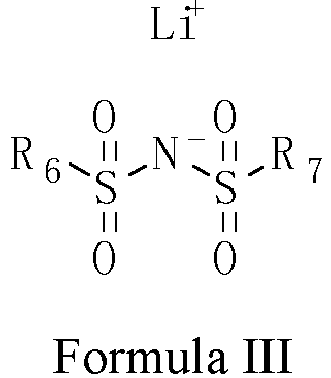
- The electrolyte solution according to claim 7, wherein the compound of formula III comprises at least one selected from lithium bisfluorosulfonimide and lithium bis(trifluoromethanesulfonyl)imide.
- The electrolyte solution according to any one of claims 1 to 8, wherein the solvent further comprises a carbonate, and a mass percentage of the carbonate in the solvent is 30% or more, optionally 35%-65%.
- The electrolyte solution according to any one of claims 1 to 8, wherein the solvent further comprises ethylene carbonate, and a mass percentage of the ethylene carbonate in the solvent is 30% or more.
- The electrolyte solution according to any one of claims 1 to 10, wherein the additive further comprises at least one selected from vinylene carbonate (VC), fluoroethylene carbonate (FEC), vinyl sulfate (DTD), 1,3-propane sultone (PS), lithium difluorobisoxalate phosphate (LiDFOP), lithium difluoro(oxalato)borate (LiDFOB), and lithium bis(oxalato)borate (LiBOB).
- A secondary battery, comprising the electrolyte solution according to any one of claims 1 to 11.
- The secondary battery according to claim 12, wherein the secondary battery comprises a positive electrode sheet, the positive electrode sheet comprises a positive electrode film layer, the positive electrode film layer comprises a positive active material, and the positive active material comprises an olivine-structured lithium-containing phosphate.
- The secondary battery according to claim 13, wherein the secondary battery makes true 1 g/1000m2≤L≤5 g/1000m2, optionally makes true 1.5 g/1000m2≤L≤4 g/1000m2,
 M1 is mass of the compound of formula II with a unit of g,M2 is mass of the positive active material with a unit of g,B is a specific surface area of the positive active material with a unit of m2/g,a is a mass percentage of the compound of formula I in the solvent, andc is a molar percentage of the compound of formula III in the electrolyte salt.
 - The secondary battery according to claim 14, wherein 8 m2/g≤B≤16 m2/g, optionally 10 m2/g≤B≤14 m2/g.
- The secondary battery according to any one of claims 14-15, wherein a thickness of the single-faced positive electrode film layer is 0.08 mm or more, optionally 0.09 mm-0.3 mm.
- A power consumption apparatus comprising the secondary battery according to any one of claims 12 to 16.
Applications Claiming Priority (1)
| Application Number | Priority Date | Filing Date | Title |
|---|---|---|---|
| PCT/CN2021/124097 WO2023060554A1 (en) | 2021-10-15 | 2021-10-15 | Electrolyte, secondary battery, and power device |
Publications (2)
| Publication Number | Publication Date |
|---|---|
| EP4383397A1 true EP4383397A1 (en) | 2024-06-12 |
| EP4383397A4 EP4383397A4 (en) | 2024-11-27 |
Family
ID=85982558
Family Applications (1)
| Application Number | Title | Priority Date | Filing Date |
|---|---|---|---|
| EP21942141.9A Pending EP4383397A4 (en) | 2021-10-15 | 2021-10-15 | ELECTROLYTE, SECONDARY BATTERY AND POWER SUPPLY DEVICE |
Country Status (6)
| Country | Link |
|---|---|
| US (1) | US12500273B2 (en) |
| EP (1) | EP4383397A4 (en) |
| JP (2) | JP2023550220A (en) |
| KR (1) | KR20230056000A (en) |
| CN (1) | CN116918126A (en) |
| WO (1) | WO2023060554A1 (en) |
Families Citing this family (5)
| Publication number | Priority date | Publication date | Assignee | Title |
|---|---|---|---|---|
| CN116759646B (en) * | 2023-06-30 | 2024-09-27 | 宁德时代新能源科技股份有限公司 | Secondary batteries and electrical devices |
| CN120033334A (en) * | 2023-11-23 | 2025-05-23 | 宁德时代新能源科技股份有限公司 | Lithium secondary battery and power-consuming device |
| CN118472395A (en) * | 2024-04-30 | 2024-08-09 | 宁德时代新能源科技股份有限公司 | Cylindrical battery cell, battery and electricity utilization device |
| CN121748536A (en) * | 2024-09-27 | 2026-03-27 | 宁德时代新能源科技股份有限公司 | Secondary batteries and electrical appliances |
| CN119504341B (en) * | 2025-01-21 | 2025-05-30 | 浙江永太科技股份有限公司 | A method for co-producing fluorobenzene compounds and lithium hexafluorophosphate |
Family Cites Families (33)
| Publication number | Priority date | Publication date | Assignee | Title |
|---|---|---|---|---|
| JP3380501B2 (en) * | 1999-10-26 | 2003-02-24 | ジ−エス・メルコテック株式会社 | Non-aqueous electrolyte secondary battery |
| JP3456650B2 (en) * | 2002-07-08 | 2003-10-14 | 日立マクセル株式会社 | Organic electrolytes Organic electrolytes for secondary batteries |
| JP2008198409A (en) * | 2007-02-09 | 2008-08-28 | Sony Corp | Non-aqueous electrolyte and non-aqueous electrolyte battery using the same |
| CN101682084A (en) * | 2007-06-07 | 2010-03-24 | 株式会社Lg化学 | Non-aqueous electrolyte solution for lithium ion secondary battery and lithium ion secondary battery having the same |
| JP5235405B2 (en) | 2007-12-28 | 2013-07-10 | 三洋電機株式会社 | Nonaqueous electrolyte secondary battery |
| CN101442143A (en) * | 2008-12-17 | 2009-05-27 | 东莞市杉杉电池材料有限公司 | Lithium ion battery electrolyte and lithium ion battery |
| JP5699465B2 (en) * | 2009-08-31 | 2015-04-08 | 三菱化学株式会社 | Non-aqueous electrolyte and lithium secondary battery using the same |
| CN101931096A (en) * | 2010-08-27 | 2010-12-29 | 上海奥威科技开发有限公司 | Propylene carbonate based low-temperature organic electrolyte and application thereof |
| JP2013171758A (en) * | 2012-02-22 | 2013-09-02 | Sanyo Electric Co Ltd | Nonaqueous electrolyte secondary battery |
| US20160211548A1 (en) * | 2013-09-12 | 2016-07-21 | Basf Corporation | Gel Electrolyte and Lithium Ion Battery Employing the Gel Electrolyte |
| EP3051618B1 (en) * | 2013-09-26 | 2018-11-14 | Mitsubishi Chemical Corporation | Nonaqueous electrolyte solution and nonaqueous electrolyte battery using same |
| JP6604014B2 (en) | 2015-03-25 | 2019-11-13 | 三菱ケミカル株式会社 | Non-aqueous electrolyte and non-aqueous electrolyte secondary battery |
| KR101992124B1 (en) * | 2015-09-30 | 2019-06-25 | 주식회사 엘지화학 | Non-aqueous electrolyte solution and lithium secondary battery comprising the same |
| JP2017117684A (en) * | 2015-12-25 | 2017-06-29 | セントラル硝子株式会社 | Electrolytic solution for nonaqueous electrolyte battery, and nonaqueous electrolyte battery using the same |
| CN105680088A (en) * | 2016-02-03 | 2016-06-15 | 东莞市凯欣电池材料有限公司 | Non-aqueous electrolyte solution for high-voltage lithium ion secondary battery and high-voltage lithium ion secondary battery |
| KR20180118657A (en) * | 2016-03-07 | 2018-10-31 | 맥셀 홀딩스 가부시키가이샤 | Non-aqueous electrolyte cell |
| US10199677B2 (en) * | 2016-04-07 | 2019-02-05 | StoreDot Ltd. | Electrolytes for lithium ion batteries |
| US20180048020A1 (en) * | 2016-08-12 | 2018-02-15 | Lenovo (Beijing) Co., Ltd. | Lithium-ion polymer battery and electronic device |
| KR102069213B1 (en) * | 2017-01-23 | 2020-01-22 | 주식회사 엘지화학 | Method for preparing lithium secondary battery having high-temperature storage properties |
| CN107086287A (en) * | 2017-03-27 | 2017-08-22 | 湖北猛狮新能源科技有限公司 | A kind of preparation method of high multiplying power lithium ion battery |
| KR102383073B1 (en) * | 2017-07-21 | 2022-04-04 | 삼성에스디아이 주식회사 | Electrolyte of rechargeable lithium battery and rechargeable lithium battery including same |
| KR102400325B1 (en) * | 2017-08-07 | 2022-05-20 | 다이킨 고교 가부시키가이샤 | Electrolytes, electrochemical devices, lithium ion secondary batteries and modules |
| WO2019126360A1 (en) * | 2017-12-21 | 2019-06-27 | Pellion Technologies Inc. | Electrochemical cell and electrolyte for same |
| CN111557061B (en) * | 2018-01-30 | 2024-01-05 | 大金工业株式会社 | Electrolytes, electrochemical devices, lithium-ion secondary batteries and components |
| CN108511802A (en) | 2018-06-04 | 2018-09-07 | 东莞市杉杉电池材料有限公司 | A kind of lithium-ion-power cell Overcharge prevention electrolyte and lithium-ion-power cell |
| CN108878980A (en) * | 2018-08-03 | 2018-11-23 | 浙江长兴中俄新能源材料技术研究院有限公司 | Long-life lithium-ion-power cell function type eletrolysis solution and preparation method thereof |
| CN110034333A (en) * | 2019-04-16 | 2019-07-19 | 山东海容电源材料股份有限公司 | A kind of high temperature resistant nonaqueous electrolytic solution |
| JP7427175B2 (en) | 2019-06-13 | 2024-02-05 | 時空化学株式会社 | Additives for electrolytes, electrolytes for lithium secondary batteries, and lithium secondary batteries |
| JP7243508B2 (en) * | 2019-07-25 | 2023-03-22 | トヨタ自動車株式会社 | Fluoride ion battery and non-aqueous electrolyte |
| WO2021038922A1 (en) | 2019-08-23 | 2021-03-04 | 日本碍子株式会社 | Lithium ion secondary battery |
| EP4265568A3 (en) * | 2020-03-27 | 2024-01-03 | Contemporary Amperex Technology Co., Limited | Process for preparing a secondary battery |
| CN112510259B (en) * | 2020-11-25 | 2022-04-22 | 张家港市国泰华荣化工新材料有限公司 | A kind of non-aqueous electrolyte and lithium battery |
| CN113140793B (en) * | 2021-03-30 | 2022-07-12 | 山东海容电源材料有限公司 | High-voltage lithium ion electrolyte and application thereof |
-
2021
- 2021-10-15 CN CN202180094960.7A patent/CN116918126A/en active Pending
- 2021-10-15 JP JP2022552955A patent/JP2023550220A/en active Pending
- 2021-10-15 EP EP21942141.9A patent/EP4383397A4/en active Pending
- 2021-10-15 WO PCT/CN2021/124097 patent/WO2023060554A1/en not_active Ceased
- 2021-10-15 KR KR1020227030701A patent/KR20230056000A/en not_active Ceased
-
2022
- 2022-12-01 US US18/072,720 patent/US12500273B2/en active Active
-
2024
- 2024-11-01 JP JP2024193048A patent/JP2025023987A/en active Pending
Also Published As
| Publication number | Publication date |
|---|---|
| US12500273B2 (en) | 2025-12-16 |
| JP2025023987A (en) | 2025-02-19 |
| US20230117520A1 (en) | 2023-04-20 |
| EP4383397A4 (en) | 2024-11-27 |
| CN116918126A (en) | 2023-10-20 |
| WO2023060554A1 (en) | 2023-04-20 |
| KR20230056000A (en) | 2023-04-26 |
| JP2023550220A (en) | 2023-12-01 |
Similar Documents
| Publication | Publication Date | Title |
|---|---|---|
| KR102502618B1 (en) | Secondary battery, battery module including secondary battery, battery pack and device | |
| US12199274B2 (en) | Secondary battery and power consumption apparatus including the same preliminary class | |
| US12500273B2 (en) | Electrolytic solution, secondary battery, and power consumption apparatus | |
| JP7829671B2 (en) | Lithium-ion batteries, battery units, battery packs, and electrical devices | |
| EP4734209A1 (en) | Lithium secondary battery and electric device | |
| CN116207351B (en) | Electrolyte, lithium secondary battery and electrical device | |
| CN116868411B (en) | Electrolyte, secondary battery and electric device | |
| WO2023040355A1 (en) | Negative electrode plate and preparation method therefor, secondary battery, battery module, battery pack and power-consuming apparatus | |
| EP4611102A1 (en) | Secondary battery and electric device | |
| EP4485602A1 (en) | Electrochemical device and electric appliance comprising same | |
| JP2024504217A (en) | Secondary batteries, battery modules, battery packs and power consumption devices | |
| KR102911589B1 (en) | Secondary batteries and battery modules, battery packs and electrical devices containing the same | |
| CN118231775A (en) | Secondary batteries and electrical devices | |
| KR102797793B1 (en) | Electrolyte, secondary battery, battery module, battery pack and electrical device | |
| JP2024527948A (en) | Nonaqueous electrolyte, secondary battery including the same, battery module, battery pack, and power consumption device | |
| US11996515B2 (en) | Lithium-ion secondary battery, battery module, battery pack, and power consumption apparatus | |
| EP4715896A1 (en) | Battery cell, battery comprising same, and electric apparatus | |
| JP7801438B2 (en) | Secondary battery, method for manufacturing secondary battery, battery module, battery pack, and power consumption device | |
| WO2023082866A1 (en) | Secondary battery, method for preparing secondary battery, battery module, battery pack, and electrical apparatus | |
| KR20230015879A (en) | Electrolytes, lithium ion batteries and electrical devices | |
| EP4510265A1 (en) | Electrolyte solution, secondary battery, battery module, battery pack, and electric device | |
| EP4404299A1 (en) | Negative electrode sheet, secondary battery and preparation method therefor, battery module, battery pack, and electrical device | |
| EP4178001A1 (en) | Lithium ion battery, battery module, battery pack, and electric device | |
| WO2025107733A1 (en) | Lithium secondary battery and electrical apparatus | |
| EP4654294A1 (en) | Silicon composite material and preparation method therefor, negative electrode sheet, secondary battery, and electric device |
Legal Events
| Date | Code | Title | Description |
|---|---|---|---|
| STAA | Information on the status of an ep patent application or granted ep patent |
Free format text: STATUS: UNKNOWN |
|
| STAA | Information on the status of an ep patent application or granted ep patent |
Free format text: STATUS: THE INTERNATIONAL PUBLICATION HAS BEEN MADE |
|
| PUAI | Public reference made under article 153(3) epc to a published international application that has entered the european phase |
Free format text: ORIGINAL CODE: 0009012 |
|
| STAA | Information on the status of an ep patent application or granted ep patent |
Free format text: STATUS: REQUEST FOR EXAMINATION WAS MADE |
|
| 17P | Request for examination filed |
Effective date: 20221201 |
|
| AK | Designated contracting states |
Kind code of ref document: A1 Designated state(s): AL AT BE BG CH CY CZ DE DK EE ES FI FR GB GR HR HU IE IS IT LI LT LU LV MC MK MT NL NO PL PT RO RS SE SI SK SM TR |
|
| RAP1 | Party data changed (applicant data changed or rights of an application transferred) |
Owner name: CONTEMPORARY AMPEREX TECHNOLOGY(HONG KONG) LIMITED |
|
| A4 | Supplementary search report drawn up and despatched |
Effective date: 20241028 |
|
| RIC1 | Information provided on ipc code assigned before grant |
Ipc: H01M 4/58 20100101ALN20241022BHEP Ipc: H01M 10/0568 20100101ALN20241022BHEP Ipc: H01M 10/42 20060101ALI20241022BHEP Ipc: H01M 10/052 20100101ALI20241022BHEP Ipc: H01M 10/0567 20100101ALI20241022BHEP Ipc: H01M 10/0569 20100101AFI20241022BHEP |
|
| DAV | Request for validation of the european patent (deleted) | ||
| DAX | Request for extension of the european patent (deleted) |