EP4383293A2 - Mehrschichtiges keramisches elektronisches bauteil - Google Patents
Mehrschichtiges keramisches elektronisches bauteil Download PDFInfo
- Publication number
- EP4383293A2 EP4383293A2 EP23196331.5A EP23196331A EP4383293A2 EP 4383293 A2 EP4383293 A2 EP 4383293A2 EP 23196331 A EP23196331 A EP 23196331A EP 4383293 A2 EP4383293 A2 EP 4383293A2
- Authority
- EP
- European Patent Office
- Prior art keywords
- corner
- disposed
- electrode layer
- layer
- electronic component
- Prior art date
- Legal status (The legal status is an assumption and is not a legal conclusion. Google has not performed a legal analysis and makes no representation as to the accuracy of the status listed.)
- Pending
Links
Images



Classifications
-
- H—ELECTRICITY
- H01—ELECTRIC ELEMENTS
- H01G—CAPACITORS; CAPACITORS, RECTIFIERS, DETECTORS, SWITCHING DEVICES, LIGHT-SENSITIVE OR TEMPERATURE-SENSITIVE DEVICES OF THE ELECTROLYTIC TYPE
- H01G4/00—Fixed capacitors; Processes of their manufacture
- H01G4/002—Details
- H01G4/018—Dielectrics
- H01G4/06—Solid dielectrics
- H01G4/08—Inorganic dielectrics
- H01G4/12—Ceramic dielectrics
- H01G4/1209—Ceramic dielectrics characterised by the ceramic dielectric material
- H01G4/1218—Ceramic dielectrics characterised by the ceramic dielectric material based on titanium oxides or titanates
- H01G4/1227—Ceramic dielectrics characterised by the ceramic dielectric material based on titanium oxides or titanates based on alkaline earth titanates
-
- H—ELECTRICITY
- H01—ELECTRIC ELEMENTS
- H01G—CAPACITORS; CAPACITORS, RECTIFIERS, DETECTORS, SWITCHING DEVICES, LIGHT-SENSITIVE OR TEMPERATURE-SENSITIVE DEVICES OF THE ELECTROLYTIC TYPE
- H01G4/00—Fixed capacitors; Processes of their manufacture
- H01G4/30—Stacked capacitors
-
- H—ELECTRICITY
- H01—ELECTRIC ELEMENTS
- H01G—CAPACITORS; CAPACITORS, RECTIFIERS, DETECTORS, SWITCHING DEVICES, LIGHT-SENSITIVE OR TEMPERATURE-SENSITIVE DEVICES OF THE ELECTROLYTIC TYPE
- H01G4/00—Fixed capacitors; Processes of their manufacture
- H01G4/002—Details
-
- H—ELECTRICITY
- H01—ELECTRIC ELEMENTS
- H01G—CAPACITORS; CAPACITORS, RECTIFIERS, DETECTORS, SWITCHING DEVICES, LIGHT-SENSITIVE OR TEMPERATURE-SENSITIVE DEVICES OF THE ELECTROLYTIC TYPE
- H01G4/00—Fixed capacitors; Processes of their manufacture
- H01G4/002—Details
- H01G4/005—Electrodes
-
- H—ELECTRICITY
- H01—ELECTRIC ELEMENTS
- H01G—CAPACITORS; CAPACITORS, RECTIFIERS, DETECTORS, SWITCHING DEVICES, LIGHT-SENSITIVE OR TEMPERATURE-SENSITIVE DEVICES OF THE ELECTROLYTIC TYPE
- H01G4/00—Fixed capacitors; Processes of their manufacture
- H01G4/002—Details
- H01G4/005—Electrodes
- H01G4/012—Form of non-self-supporting electrodes
-
- H—ELECTRICITY
- H01—ELECTRIC ELEMENTS
- H01G—CAPACITORS; CAPACITORS, RECTIFIERS, DETECTORS, SWITCHING DEVICES, LIGHT-SENSITIVE OR TEMPERATURE-SENSITIVE DEVICES OF THE ELECTROLYTIC TYPE
- H01G4/00—Fixed capacitors; Processes of their manufacture
- H01G4/002—Details
- H01G4/228—Terminals
- H01G4/232—Terminals electrically connecting two or more layers of a stacked or rolled capacitor
-
- H—ELECTRICITY
- H01—ELECTRIC ELEMENTS
- H01G—CAPACITORS; CAPACITORS, RECTIFIERS, DETECTORS, SWITCHING DEVICES, LIGHT-SENSITIVE OR TEMPERATURE-SENSITIVE DEVICES OF THE ELECTROLYTIC TYPE
- H01G4/00—Fixed capacitors; Processes of their manufacture
- H01G4/002—Details
- H01G4/018—Dielectrics
- H01G4/06—Solid dielectrics
- H01G4/08—Inorganic dielectrics
- H01G4/12—Ceramic dielectrics
-
- H—ELECTRICITY
- H01—ELECTRIC ELEMENTS
- H01G—CAPACITORS; CAPACITORS, RECTIFIERS, DETECTORS, SWITCHING DEVICES, LIGHT-SENSITIVE OR TEMPERATURE-SENSITIVE DEVICES OF THE ELECTROLYTIC TYPE
- H01G4/00—Fixed capacitors; Processes of their manufacture
- H01G4/002—Details
- H01G4/228—Terminals
- H01G4/232—Terminals electrically connecting two or more layers of a stacked or rolled capacitor
- H01G4/2325—Terminals electrically connecting two or more layers of a stacked or rolled capacitor characterised by the material of the terminals
Definitions
- the present disclosure relates to a multilayer electronic component.
- a multilayer ceramic capacitor which is a multilayer electronic component, is a chip-type capacitor mounted on the printed circuit boards of various types of electronic products such as imaging devices including liquid crystal displays (LCDs) and plasma display panels (PDPs), computers, smartphones, cell phones, and the like, to allow electricity to be charged therein and discharged therefrom.
- imaging devices including liquid crystal displays (LCDs) and plasma display panels (PDPs), computers, smartphones, cell phones, and the like, to allow electricity to be charged therein and discharged therefrom.
- LCDs liquid crystal displays
- PDPs plasma display panels
- Such an MLCC may be used as a component of various electronic devices due to advantages thereof such as compactness, guaranteed high capacitance, and ease of mounting.
- advantages thereof such as compactness, guaranteed high capacitance, and ease of mounting.
- various electronic devices such as computers and mobile devices have been reduced in size and increased in power, and demand for miniaturization and high capacitance of multilayer ceramic capacitors have been increased.
- An aspect of the present disclosure may provide a multilayer electronic component having improved reliability.
- An aspect of the present disclosure may also provide a multilayer electronic component having improved high-temperature reliability and moisture resistance reliability.
- An aspect of the present disclosure may also provide a multilayer electronic component in which a plating solution and/or moisture are prevented from penetrating into a body, while securing capacitance per unit volume.
- a multilayer electronic component may include: a body including a dielectric layer and first and second internal electrodes alternately disposed in a first direction with the dielectric layer interposed therebetween, including first and second surfaces facing in the first direction, third and fourth surfaces connected to the first and second surfaces and facing in a second direction, and fifth and sixth surfaces connected to the first to fourth surfaces and facing in a third direction, and including a first corner connecting the third surface to each of the first, second, fifth, and sixth surfaces and a second corner connecting the fourth surface to each of the first, second, fifth, and sixth surfaces, a first external electrode including a first base electrode layer disposed on the third surface and extending to and disposed on at least a portion of the first, second, fifth, and sixth surfaces, a first corner electrode layer disposed at the first corner and disposed on the first base electrode layer, and a first plating layer disposed on the first corner electrode layer and disposed to contact at least a portion of the first base electrode layer on the third surface and a second external electrode
- a multilayer electronic component may include: a body including a dielectric layer and first and second internal electrodes alternately disposed in a first direction with the dielectric layer interposed therebetween, including first and second surfaces facing in the first direction, third and fourth surfaces connected to the first and second surfaces and facing in a second direction, and fifth and sixth surfaces connected to the first to fourth surfaces and facing in a third direction, and including a first corner connecting the third surface to each of the first, second, fifth, and sixth surfaces and a second corner connecting the fourth surface to each of the first, second, fifth, and sixth surfaces, a first external electrode including a first base electrode layer disposed on the third surface and extending to and disposed on at least a portion of the first, second, fifth, and sixth surfaces, a first corner electrode layer disposed at the first corner and disposed on the first base electrode layer, a conductive resin layer disposed on the first corner electrode layer and disposed to contact at least a portion of the first base electrode layer on the third surface, and a first plating
- a multilayer electronic component may include: a body including a dielectric layer and first and second internal electrodes alternately disposed in a first direction with the dielectric layer interposed therebetween, including first and second surfaces facing in the first direction, third and fourth surfaces connected to the first and second surfaces and facing in a second direction, and fifth and sixth surfaces connected to the first to fourth surfaces and facing in a third direction, and including a first corner connecting the third surface to each of the first, second, fifth, and sixth surfaces and a second corner connecting the fourth surface to each of the first, second, fifth, and sixth surfaces; a first external electrode including a first base electrode layer disposed on the third surface and extending to and disposed on at least a portion of the first, second, fifth, and sixth surfaces, a first corner electrode layer disposed at the first corner and disposed on the first base electrode layer, a first conductive resin layer includes one or more first openings disposed on the first corner electrode layer and disposed to contact at least a portion of the first base electrode layer on the third
- a first direction may be defined as a thickness (T) direction
- a second direction may be defined as a length (L) direction
- a third direction may be defined as a width (W) direction.
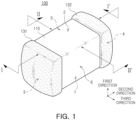
- FIG. 1 is a perspective view schematically illustrating a multilayer electronic component according to an exemplary embodiment in the present disclosure.
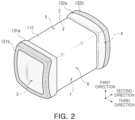
- FIG. 2 is a perspective view schematically illustrating a structure of FIG. 1 excluding a plating layer of an external electrode.
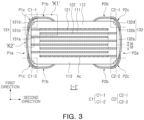
- FIG. 3 is a cross-sectional view taken along line I-I' of FIG. 1 .
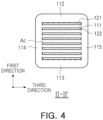
- FIG. 4 is a cross-sectional view taken along line II-II' of FIG. 1 .
- FIG. 5 is an exploded perspective view schematically illustrating a body of a multilayer electronic component according to an exemplary embodiment in the present disclosure.
- FIG. 6 is an enlarged view of region K1 of FIG. 3 .
- FIG. 7 is an enlarged view of region K2 of FIG. 3 .
- a multilayer electronic component 100 may include a body 110 including a dielectric layer 111 and first and second internal electrodes 121 and 122 alternately disposed in a first direction with the dielectric layer interposed therebetween, including first and second surfaces 1 and 2 facing in the first direction, third and fourth surfaces 3 and 4 connected to the first and second surfaces and facing in a second direction, and fifth and sixth surfaces 5 and 6 connected to the first to fourth surfaces and facing in a third direction, and including a first corner C1 connecting the third surface to each of the first, second, fifth, and sixth surfaces and a second corner C2 connecting the fourth surface to each of the first, second, fifth, and sixth surfaces.
- a first external electrode 131 includes a first base electrode layer 131a disposed on the third surface and extending to and disposed on at least a portion of the first, second, fifth, and sixth surfaces, a first corner electrode layer 131b disposed at the first corner and disposed on the first base electrode layer, and a first plating layer 131d disposed on the first corner electrode layer and disposed to contact at least a portion of the first base electrode layer on the third surface.
- a second external electrode 132 includes a second base electrode layer 132a disposed on the fourth surface and extending to and disposed on at least a portion of the first, second, fifth, and sixth surfaces, a second corner electrode layer 132b disposed at the second corner and disposed on the second base electrode layer, and a second plating layer 132d disposed on the second corner electrode layer and disposed to contact at least a portion of the second base electrode layer on the fourth surface.
- an area ratio occupied by metal is 90% or more.
- the external electrodes of the multilayer ceramic capacitor When forming the external electrodes of the multilayer ceramic capacitor, a method of dipping surfaces of the body to which the internal electrodes of the body are exposed to a conductive paste including a conductive metal is mainly used. However, since the external electrode formed by the dipping method is thinly formed at the corner portion of the body, a plating solution and/or moisture may easily penetrate into the body through the corner portion of the body. In order to prevent this, if the external electrode is formed to be thick, a capacitance per unit volume may be lowered.
- the corner electrode layers 131b and 132b having an area ratio occupied by metal of 90% or more are disposed at the corners C1 and C2 of the body and disposed on the base electrode layers 131a and 132a, thereby preventing penetration of the plating solution and/or external moisture through the corner of the body, while securing the capacitance per unit volume.
- the area ratio represents a ratio between area occupied by metal in the corner electrode layer (e. g., the corner electrode layer 131b, the corner electrode layer 132 b) and entire area of the corner electrode layer.
- the body 110 may have a hexahedral shape or a shape similar thereto as illustrated. Due to the shrinkage of ceramic powder included in the body 110 or polishing of the corner portions during a sintering process, the body 110 may not have a perfectly straight hexahedral shape but may have a substantially hexahedral shape.
- the body 110 may have the first and second surfaces 1 and 2 facing each other in the first direction, the third and fourth surfaces 3 and 4 connected to the first and second surfaces 1 and 2 and facing each other in the second direction, and fifth and sixth surfaces 5 and 6 connected to the first to fourth surfaces 1, 2, 3, and 4 and facing each other in the third direction.
- the body 110 may include a first corner C1 connecting the third surface to each of the first surface, the second surface, the fifth surface, and the sixth surface and a second corner C2 connecting the fourth surface to each of the first surface, second surface, the fifth surface, and the sixth surface.
- the first corner C1 may include a 1-1 corner C1-1 connecting the third surface to the first surface and a 1-2 corner C1-2 connecting the third surface to the second surface.
- the second corner C2 may include a 2-3 corner C2-1 connecting the fourth surface to the first surface, and a 2-2 corner C2-2 connecting the fourth surface to the second surface.
- the first corner C1 may include a 1-5 corner connecting the third surface to the fifth surface and a 1-6 corner connecting the third surface to the sixth surface
- the second corner C2 may include a 2-5 corner connecting the fourth surface to the fifth surface and a 2-6 corner connecting the fourth surface to the sixth surface.
- the corner may have a round shape by rounding the corner connecting each side of the body 110 by performing a separate process.
- the first to sixth surfaces of the body 110 may be generally flat surfaces, and non-flat regions may be considered as corners.
- dielectric layers 111 and the internal electrodes 121 and 122 may be alternately stacked.
- the plurality of dielectric layer 111 included in the body 110 are in a fired state, and adjacent dielectric layers 111 may be integrated such that boundaries therebetween may not be readily apparent without using a scanning electron microscope (SEM).
- SEM scanning electron microscope
- the dielectric layer 111 may be formed by preparing a ceramic slurry including ceramic powder, an organic solvent and a binder, applying the slurry to a carrier film, drying the carrier film to prepare a green sheet, and then firing the ceramic green sheet.
- the ceramic powder is not particularly limited as long as sufficient capacitance may be obtained, but, for example, barium titanate-based (BaTiO 3 )-based powder may be used.
- An average thickness td of the dielectric layer 111 is not particularly limited, but may be, for example, 10 um or less.
- the average thickness td of the dielectric layer 111 may be arbitrarily set according to desired characteristics or purposes. For example, in the case of electronic components for high-voltage electric devices, the average thickness td of the dielectric layer 111 may be less than 2.8 um, and in the case of electronic components for small IT devices, the average thickness td of the dielectric layer 111 may be 0.4 pm or less to achieve miniaturization and high capacitance, but the present disclosure is not limited thereto.
- the thickness of the dielectric layer 111 is reduced, cracks are likely to occur in the body 110 due to bending stress occurring when voltage is applied, and the body may be vulnerable to penetration of a plating solution and/or external moisture through the corner of the body.
- the corner electrode layers 131b and 132b in which an area ratio of metal is 90% or more are disposed at the corners C1 and C2 of the body and disposed on the base electrode layers 131a and 132a, the reliability of the multilayer electronic component may be improved even when the average thickness td of the dielectric layer 111 is less than 2.8 um or less than 0.4 ⁇ m.
- the average thickness td of the dielectric layer 111 refers to the size of the dielectric layer 111 disposed between the internal electrodes 121 and 122 in the first direction.
- the average thickness of the dielectric layer 111 may be measured by scanning cross-sections of the body 110 in the first and second directions with a scanning electron microscope (SEM) with magnification of 10,000. More specifically, thicknesses at a plurality of points of one dielectric layer 111, for example, at 30 points equally spaced in the second direction, may be measured and an average value thereof may be measured. The 30 equally spaced points may be designated in a capacitance forming portion Ac to be described later.
- the average thickness of the dielectric layer 111 may be further generalized.
- the internal electrodes 121 and 122 may be alternately disposed with the dielectric layer 111.
- the first internal electrode 121 and the second internal electrode 122 which are a pair of electrodes having different polarities, may be disposed to face each other with the dielectric layer 111 interposed therebetween.
- the plurality of first internal electrodes 121 and the plurality of second internal electrodes 122 may be electrically separated from each other by the dielectric layer 111 disposed therebetween.
- the plurality of first internal electrodes 121 may be spaced apart from the fourth surface 4 and connected to the third surface 3.
- the plurality of second internal electrodes 122 may be spaced apart from the third surface 3 and connected to the fourth surface 4.
- the conductive metals included in the internal electrodes 121 and 122 may include at least one of nickel (Ni), copper (Cu), palladium (Pd), silver (Ag), gold (Au), platinum (Pt), tin (Sn), and tungsten (W), titanium (Ti), and alloys thereof, but the present disclosure is not limited thereto.
- the internal electrodes 121 and 122 may be formed by applying a conductive paste for internal electrodes including a conductive metal to a predetermined thickness on a ceramic green sheet and firing the paste.
- a conductive paste for internal electrodes including a conductive metal to a predetermined thickness on a ceramic green sheet and firing the paste.
- a method of printing the conductive paste for internal electrodes a screen printing method or a gravure printing method may be used, but the present disclosure is not limited thereto.
- An average thickness te of the internal electrodes 121 and 122 is not particularly limited, but may be, for example, 3 um or less.
- the average thickness te of the internal electrodes 121 and 122 may be arbitrarily set according to desired characteristics or purposes. For example, in the case of electronic components for high voltage electric devices, the average thickness te of the internal electrodes 121 and 122 may be less than 1 um, and in the case of electronic components for small IT devices, the average thickness te of the internal electrodes 121 and 122 may be 0.4 pm or less, but the present disclosure is not limited thereto.
- the reliability of the multilayer electronic component may be improved even when the average thickness te of at least one of the plurality of internal electrodes 121 and 122 is less than 1 um or less than 0.4 ⁇ m.
- the thickness of the internal electrodes 121 and 122 refers to a size of the internal electrodes 121 and 122 in the first direction.
- the average thickness of the internal electrodes 121 and 122 may be measured by scanning cross-sections of the body 110 in the first and second directions with a scanning electron microscope (SEM) at a magnification of 10,000. More specifically, thicknesses at a plurality of points of one internal electrode 121 or 122, for example, at 30 points equally spaced in the second direction, may be measured and an average value thereof may be measured. The 30 equally spaced points may be designated in a capacitance forming portion Ac to be described later.
- the average thickness of the internal electrodes 121 and 122 may be further generalized.
- the body 110 may include the capacitance forming portion Ac disposed inside the body 110 and forming capacitance by including the first and second internal electrodes 121 and 122 alternately disposed with the dielectric layer 111 interposed therebetween and a first cover portion 112 and a second cover portion 113 respectively disposed on both surfaces of the capacitance forming portion Ac facing each other in the first direction.
- the cover portions 112 and 113 may basically serve to prevent damage to the internal electrodes due to physical or chemical stress.
- the cover portions 112 and 113 may have the same structure as that of the dielectric layer 111 except that the cover portions 112 and 113 do not include internal electrodes.
- the body 110 may include margin portions 114 and 115 disposed on both surfaces of the capacitance forming portion Ac facing each other in the third direction. That is, the margin portions 114 and 115 may refer to regions between both ends of the internal electrodes 121 and 122 and a boundary surface of the body 110 in cross-sections of the body 110 cut in the first and third directions. At this time, the margin portions 114 and 115 may include a first margin portion 114 connected to the fifth surface 5 of the body 110 and a second margin portion 115 connected to the sixth surface 6 of the body 110.
- the margin portions 114 and 115 may include the same material as that of the dielectric layer 111 except that the internal electrodes 121 and 122 are not included.
- the margin portions 114 and 115 may basically serve to prevent damage to the internal electrodes 121 and 122 due to physical or chemical stress.
- the margin portions 114 and 115 may be formed by applying and firing a conductive paste for internal electrodes on a ceramic green sheet, except where the margin portion is to be formed.
- the internal electrodes 121 and 122 may be cut to be connected to the fifth and sixth surfaces 5 and 6 of the body, and then, a single dielectric layer or two or more dielectric layers may be stacked on both sides of the capacitance forming portion Ac facing each other in the third direction to form the margin portions 114 and 115.
- the external electrodes 131 and 132 may be disposed on the third and fourth surfaces 3 and 4 of the body 110, and may extend to portions of the first, second, fifth, and sixth surfaces.
- the external electrodes 131 and 132 may include a first external electrode 131 connected to the plurality of first internal electrodes 121 and a second external electrode 132 connected to the plurality of second internal electrodes 122.
- a region of the first external electrode 131 disposed on the third surface may be defined as a first connection portion P1a
- a region disposed on the first and second surfaces may be defined as a first band portion P1b
- a region between the first connection portion and the first band portion at the first corner C1 may be defined as a first corner portion P1c
- a region of the second external electrode 132 disposed on the fourth surface may be defined as a second connection portion P2a
- a region disposed on the first surface and the second surface may be defined as a second band portion P2b
- a region between the second connection portion and the second band portion at the second corner C2 may be defined as a second corner portion P2c.
- the first external electrode 131 may include a first base electrode layer 131a disposed on the third surface and extending to at least a portion of the first, second, fifth, and sixth surfaces, a first corner electrode layer 131b disposed at the first corner and disposed on the first base electrode layer, and a first plating layer 131d disposed on the first corner electrode layer and disposed to be in contact with at least a portion of the first base electrode layer on the third surface
- the second external electrode 132 may include a second base electrode layer 132a disposed on the fourth surface and extending to at least a portion of the first, second, fifth, and sixth surfaces, a second corner electrode layer 132b disposed at the second corner and disposed on the second base electrode layer, and a second plating layer 132d disposed on the second corner electrode layer and disposed to be in contact with at least a portion of the second base electrode layer on the fourth surface.
- the first base electrode layer 131a may serve to connect the first internal electrode 121 to the first external electrode 131, and the second base electrode layer 132a may connect the second internal electrode 122 to the second external electrodes 132.
- the conductive metal included in the first and second base electrode layers 131a and 132a may not be particularly limited, but for example, the first and second base electrode layers 131a and 132a may include one or more of Ni, Cu, Cr, Sn, Pd, and alloys thereof.
- the first base electrode layer 131a may be disposed on the third surface and extend to at least a portion of the first, second, fifth, and sixth surfaces.
- the regions disposed on the first, second, fifth, and sixth surfaces may be referred to as band portions of the first base electrode layer
- the region disposed on the third surface may be referred to as a connection portion of the first base electrode layer
- the region disposed at the corner C1 may be referred to as a corner portion of the first base electrode layer.
- the second base electrode layer 132a may be disposed on the fourth surface and extend to at least a portion of the first, second, fifth, and sixth surfaces.
- the regions disposed on the first, second, fifth, and sixth surfaces may be referred to as band portions of the second base electrode layer
- the region disposed on the fourth surface may be referred to as a connection portion of the second base electrode layer
- the region disposed at the second corner C2 may be referred to as a corner portion of the second base electrode layer.
- the first and second base electrode layers 131a and 132a may include glass . Accordingly, the first and second base electrode layers 131a and 132a may have excellent bonding strength with the body 110. In this case, the base electrode layers 131a and 132a may be formed by dipping the body into a paste including a conductive metal and glass and then sintering the body.
- the corner electrode layers 131b and 132b are basically disposed at the corners C1 and C2 of the body 110.
- the thickness of the connection portion is the thickest and the thickness of the corner portion becomes thin.
- erosion may occur, and when the glass is eroded, a region in which the corner of the body is directly exposed may occur, which may become a path for moisture penetration.
- the corner electrode layers 131b and 132b having a metal area ratio of 90% or more are disposed at the corners C1 and C2 of the body and on the base electrode layers 131a and 132a, thereby improving moisture resistance reliability, without excessively increasing the thickness of the central region of the external electrodes 131 and 132 in the first direction, and preventing penetration of a plating solution and/or external moisture into the corners C1 and C2 of the body 110, while securing capacitance per unit volume of the multilayer electronic component.
- an area ratio occupied by metal may be 90% or more.
- the area ratio represents a ratio of area occupied by metal in the corner electrode layer (e.g., the corner electrode layer 131b, the corner electrode layer 132 b) to entire area of the corner electrode layer (100%) .
- bonding force with the body is not required.
- the area ratio occupied by metal in the corner electrode layers 131b and 132b may be 95% or more, and even more preferably, 98% or more. That is, it is most preferable that the corner electrode layers 131b and 132b be formed of metal except for unavoidable impurities.
- pores, glass, etc. may be disposed in regions of the corner electrode layers 131b and 132b excluding metal, and it may be more preferable that glass is not included in the regions of the corner electrode layers 131b and 132b except for metal.
- the first and second corner electrode layers 131b and 132b may substantially consist of metal.
- the first and second corner electrode layers 131b and 132b substantially consisting of metal may mean that an area ratio occupied by metal in the corner electrode layers 131b and 132b is 98% or more.
- the corner electrode layers 131b and 132b may partially include elements diffused from the base electrode layer and oxygen atoms resulting from oxidation during firing, but excluding these elements, the first and second corner electrode layers 131b and 132b may substantially consist of metal. Accordingly, the effect of improving moisture resistance reliability according to the present disclosure may be more remarkable.
- the area ratio occupied by metal in the corner electrode layers 131b and 132b may be calculated from an image scanned using a scanning electron microscope (SEM). Specifically, the area ratio of metal may be measured by polishing the multilayer electronic component to a central position in the width direction (third direction) to expose the cross-section (L-T cross-section) in the length direction and thickness direction and then analyzing an image of the corner electrode layer portion scanned with magnification of 2000 using the SEM. At this time, the area may be measured using an image analysis program, and the image analysis program is not particularly limited. In the image scanned by the SEM, metal, pores, glass, etc. may be distinguished from each other by the difference in shade, and since metal appears as the brightest color, glass appears as dark gray, and pores appears black, they may be easily distinguished from each other with the naked eyes.
- SEM scanning electron microscope
- the first and second corner electrode layers 131b and 132b may not include glass. Since the corner electrode layers 131b and 132b do not include glass, it is possible to fundamentally prevent the glass from being eroded by a plating solution and/or external moisture, so that the effect of improving moisture resistance reliability according to the present disclosure may be more remarkable.
- the metal included in the first and second corner electrode layers 131b and 132b may not be particularly limited.
- the metal included in the first and second corner electrode layers 131b and 132b may be at least one selected from Cu, Ni, Cr, Sn, Pd, and alloys thereof.
- the metal included in the first and second corner electrode layers 131b and 132b may be different from the metal included in the first and second base electrode layers 131a and 132a.
- the present disclosure is not limited thereto, and the metal included in the first and second corner electrode layers 131b and 132b and the metal included in the first and second base electrode layers 131a and 132a may be the same and may include any one of the metal elements included in the base electrode layers 131a and 132a.
- the metal included in the first and second corner electrode layers 131b and 132b may be different from the metal element of the first and second plating layers 131d and 132d.
- the present disclosure is not limited thereto, and the metal included in the first and second corner electrode layers 131b and 132b may be the same as the metal element constituting the first and second plating layers 131d and 132d and may include any one of the metal elements constituting the first and second plating layers 131d and 132d.
- the method of forming the corner electrode layers 131b and 132b may not be particularly limited.
- the corner electrode layers 131b and 132b may be formed by applying a conductive paste including a conductive metal on the corners C1 and C2 of the body 110 and firing the conductive paste.
- the corner electrode layers 131b and 132b may be formed by applying a conductive paste including conductive metal but not glass on the corners C1 and C2 of the body 110 and firing the conductive paste.
- one end portion of the first corner electrode layer 131b may be disposed on the first connection portion P1a, and one end portion of the second corner electrode layer 132b may be disposed on the second connection portion P2a. Accordingly, penetration of the plating solution and/or external moisture into the corners C1 and C2 of the body 110 may be more reliably suppressed.
- the other end portion of the first corner electrode layer 131b may be disposed on the first band portion P1b, and the other end portion of the second corner electrode layer 132b may be disposed on the second band portion P2b. That is, the first corner electrode layer 131b may be disposed to entirely cover the first corner C1, and the second corner electrode layer 132b may be disposed to entirely cover the second corner C2. Accordingly, penetration of the plating solution and/or external moisture into the corners C1 and C2 of the body 110 may be more reliably suppressed.
- corner electrode layers 131b and 132b may be disposed to cover the outermost internal electrode in the first direction. Accordingly, penetration of the plating solution and/or external moisture into the body through the outermost internal electrode may be suppressed.
- the plating layers 131d and 132d may improve mounting characteristics.
- the type of the plating layers 131d and 132d is not particularly limited and may be a plating layer including Ni, Sn, Pd, and/or alloys thereof, and may be formed of a plurality of layers.
- the plating layers 131d and 132d may be, for example, a Ni plating layer or a Sn plating layer or may have a form in which a Ni plating layer and a Sn plating layer are sequentially formed.
- the plating layers 131d and 132d may include a plurality of Ni plating layers and/or a plurality of Sn plating layers.
- the first plating layer 131d may be disposed to contact at least a portion of the first base electrode layer 131a on the third surface, and the second plating layer 132d may be disposed to contact at least a portion of the second base electrode layer 132a on the fourth surface. Accordingly, capacitance per unit volume may be improved by minimizing the thickness of the external electrodes 131 and 132.
- the first plating layer 131d may be disposed to contact at least a portion of the first base electrode layer 131a on the first, second, fifth, and sixth surfaces, and the second plating layer 132d may be disposed to contact at least a portion of the second base electrode layer 132a on the second, fifth, and sixth surfaces. That is, the first plating layer 131d may be disposed to entirely cover the first corner electrode layer 131b, and the second plating layer 132d may be disposed to entirely cover the second corner electrode layer 132b.
- first base electrode layer 131a, the first corner electrode layer 131b, and the first plating layer 131d will be described, but since the second external electrode 132 may be symmetrical with the first external electrode 131 in the second direction, and thus, descriptions of the first base electrode layer 131a, the first corner electrode layer 131b, and the first plating layer 131d may also be equally applied to the second base electrode layer 132a, the second corner electrode layer 132b, and the second plating layer 132d.
- tb when a minimum value of the sum of the thicknesses of the first base electrode layer 131a and the first corner electrode layer 131b at the first corner C1 is tb, tb may be 2 um or more. When tb is 2 um or more, penetration of the plating solution and/or external moisture through the first corner C1 of the body 110 may be more effectively prevented.
- tb may be the minimum value of the sum of the thicknesses of the first base electrode layer 131a and the first corner electrode layer 131b measured in a direction perpendicular to a surface of a 1-1 corner C1-1 or 1-2 corner C1-2.
- tb may be measured by observing the cross-sections of the multilayer electronic component cut in the first and second directions at the center in the third direction using a scanning electron microscope (SEM) with magnification of 3000 fold or greater.
- SEM scanning electron microscope
- L1>L2 a distance in the second direction from the third surface to the end of the first base electrode layer disposed on the first or second surface
- L1>L2 a distance in the second direction from the third surface to the end of the first corner electrode layer 131b disposed on the first surface or the second surface
- L1 and L2 may be measured by observing cross-sections of the multilayer electronic component cut in the first and second directions in the center in the third direction using a scanning electron microscope (SEM) with magnification of 2000 fold or greater.
- SEM scanning electron microscope
- ta' /ta when a size of the first base electrode layer 131a in the second direction measured at the center of the body 110 in the first direction is ta and a size of the first base electrode layer 131a in the second direction measured in the outermost internal electrode of the body 110 in the first direction is ta' , ta' /ta may be less than 1.
- ta'/ta when the first base electrode layer 131a is formed by a dipping method, it may be difficult for ta'/ta to have a value greater than 0.7, so ta' /ta may be 0.7 or less.
- ta'/ta When the first base electrode layer 131a is formed by a dipping method, ta'/ta may generally have a value of 0.4 or less.
- the corner electrode layers 131b and 132b in which the area ratio occupied by metal is 90% or more are disposed at the corners C1 and C2 of the body and disposed on the base electrode layers 131a and 132a, and thus, moisture resistance reliability may be secured.
- a lower limit of ta'/ta may not be particularly limited, and for example, ta'/ta may be 0.05 or greater.
- a size of the first base electrode layer 131a in the second direction measured at the center of the body 110 in the first direction is ta
- a thickness of the first base electrode layer 131a measured in the outermost internal electrode of the body in the first direction is ta'
- a size of the first corner electrode layer 131b in the second direction measured in the outermost internal electrode of the body in the first direction is tb'
- ta'+tb' ⁇ ta may be satisfied.
- an increase in the size of the external electrode in the second direction due to the formation of the first corner electrode layer 131b may be suppressed, thereby improving the capacitance per unit volume, while securing moisture resistance reliability.
- ta, ta', and tb' may be measured by observing cross-sections of the multilayer electronic component in the first and second directions at the center in the third direction using a scanning electron microscope (SEM) with magnification of 3000 fold or greater.
- SEM scanning electron microscope
- the multilayer electronic component according to another exemplary embodiment in the present disclosure may have the same configuration as that of the multilayer electronic component according to an exemplary embodiment in the present disclosure described above. Therefore, descriptions that are the same as those of the exemplary embodiment in the present disclosure will be omitted.
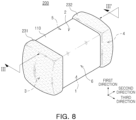
- external electrodes 231 and 232 further include conductive resin layer 231c and 232c.
- FIG. 8 is a perspective view schematically illustrating a multilayer electronic component according to another exemplary embodiment in the present disclosure.
- FIG. 9 is a perspective view schematically illustrating a structure of FIG. 8 excluding a plating layer of an external electrode.
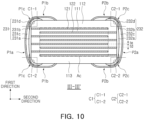
- FIG. 10 is a cross-sectional view taken along line III-III' of FIG. 8 .
- the multilayer electronic component 200 may include a body 110 including a dielectric layer 111 and first and second internal electrodes 121 and 122 alternately disposed in a first direction with the dielectric layer interposed therebetween, including first and second surfaces 1 and 2 facing in the first direction, third and fourth surfaces 3 and 4 connected to the first and second surfaces and facing in a second direction, and fifth and sixth surfaces 5 and 6 connected to the first to fourth surfaces and facing in a third direction, and including a first corner C1 connecting the third surface to each of the first, second, fifth, and sixth surfaces and a second corner C2 connecting the fourth surface to each of the first, second, fifth, and sixth surfaces, a first external electrode 231 including a first base electrode layer 231a disposed on the third surface and extending to and disposed on at least a portion of the first, second, fifth, and sixth surfaces, a first corner electrode layer 231b disposed at the first corner and disposed on the first base electrode layer,
- the conductive resin layers 231c and 232c may include conductive metal and resin.
- the conductive metal included in the conductive resin layers 231c and 232c may serve to electrically connect the base electrode layers 231a and 232a to the corner electrode layers 231b and 232b.
- the conductive metal included in the conductive resin layers 231c and 232c is not particularly limited, but may include, for example, one or more of Cu, Ni, Ag, Sn, Cr, and alloys thereof.
- the shape of the conductive metal included in the conductive resin layers 231c and 232c may not be particularly limited, but may include, for example, one or more of spherical particles and flake particles.
- the spherical particle may include a shape that is not perfectly spherical, and may include a shape in which, for example, a length ratio (major axis/minor axis) between a major axis and a minor axis is 1.45 or less.
- the flake particles refer to particles having a flat and elongated shape, and are not particularly limited, but, for example, a length ratio between a major axis and a minor axis (major axis/minor axis) may be 1.95 or more.
- the lengths of the major and minor axes of the spherical particles and the flake particles may be measured from an image obtained by scanning cross-sections of the multilayer electronic component in the first and second directions at the center in the third direction of the multilayer electronic component with a scanning electron microscope (SEM).
- SEM scanning electron microscope
- the resin included in the conductive resin layers 231c and 232c may secure bonding and absorb shock. Accordingly, the conductive resin layers 231c and 232c may have relatively high flexibility. Accordingly, the multilayer electronic component may be protected from external physical shock or bending shock, and cracks in the multilayer electronic component may be prevented by absorbing stress or tensile stress applied during mounting on a board.
- the resin included in the conductive resin layers 231c and 232c is not particularly limited, but an insulating resin may be used, and for example, one or more of epoxy resin, acrylic resin, and ethyl cellulose may be included.
- the first plating layer 231d at the first corner C1 contacts at least a portion of the first corner electrode layer 231b
- the second plating layer 232d at the second corner C2 may contact at least a portion of the second corner electrode layer 232b.
- at least a portion of the first corner electrode layer 231b may contact the first plating layer 231d at the first corner portion P1c
- at least a portion of the second corner electrode layer 232b may contact the second plating layer 232d the second corner portion P2c.
- ESR equivalent serial resistance
- the corner electrode layers 231b and 232b are in contact with the plating layers 231d and 232d at the corners C1 and C2 of the body 110, an increase in ESR may be prevented, while cracks due to mounting may be prevented through the conductive resin layers 231c and 232c.
- corner electrode layers 231b and 232b is in contact with the plating layers 231d and 232d at the corners C1 and C2 of the body 110 spaced apart from the internal electrodes 121 and 122, thereby effectively reducing ESR, without affecting the reliability of the multilayer electronic component.
- a contact point between the corner electrode layers 231b and 232b and the plating layers 231d and 232d may be on the corners C1 and C2 of the body 110 and may not be particularly limited.
- at least a portion of the corner electrode layer 231b and 232b may contact the plating layers 231d and 232d on the corners C1 and C2 of the body 110.
- the method of bringing the corner electrode layers 231b and 232b into contact with the plating layers 231d and 232d may not be particularly limited.
- the first conductive resin layer 231c may include a first opening H disposed at the first corner C1 and the first corner electrode layer 231b and the first plating layer 231d may be in contact with each other through the first opening
- the second conductive resin layer 232c may include a second opening disposed at the second corner C2 and the second corner electrode layer 232b and the second plating layer 232d may be in contact with each other through the second opening. That is, the conductive resin layers 231c and 232c may include openings disposed at the corner portions P1c and P2c, and the corner electrode layers 231b and 232b may contact the plating layers 231d and 232d through the opening.
- the conductive resin layers 231c and 232c may include one or more openings disposed at the corners C1 and C2 of the body 110, and the openings may have any form as long as the corner electrode layers 231b and 232b and the plating layers 231d and 232d may be in contact with each other therethrough.
- the method of forming the openings of the conductive resin layers 231c and 232c is not particularly limited, but, for example, the openings may be formed by applying a conductive resin composition forming the conductive resin layers 231c and 232c on the corner electrode layers 231b and 232b and then removing at least a portion of the conductive resin composition applied to the corners C1 and C2 of the body 110 before the conductive resin composition is cured.
- the conductive resin layers 231c and 232c may be disposed on the corner electrode layers 231b and 232b, and at least a portion of the first and second conductive resin layers 231c and 232c may extend onto the first and second surfaces. In addition, at least a portion of the first and second conductive resin layers 231c and 232c may extend onto the fifth and sixth surfaces.
- a distance from the third surface to the end of the first conductive resin layer 231c or 232c disposed on the first or second surface in the second direction may be greater than a distance from the third surface to the end of the first base electrode layers 231a and 232a disposed on the first surface or the second surface. Accordingly, the bending strength characteristics may be further improved.
- Inventive Example 1 having the structure of a multilayer electronic component according to an exemplary embodiment in the present disclosure shown in FIGS. 1 through 7 was manufactured. Unlike Inventive Example 1, Comparative Example 1 was manufactured except for a corner electrode layer.
- a body including a dielectric layer and internal electrodes After preparing a body including a dielectric layer and internal electrodes, the body was dipped into a paste including a conductive metal and glass and then sintered to form a base electrode layer. Thereafter, in Inventive Example 1, a conductive paste including a conductive metal but not glass was applied on the corner of the body on which the base electrode layer was formed and then fired to form a corner electrode layer, and in Comparative Example 1, a corner electrode layer was not formed. Thereafter, a plating layer was formed to prepare a sample chip.
- Inventive example 2 having the structure of a multilayer electronic component according to another exemplary embodiment in the present disclosure shown in FIGS. 8 through 10 was manufactured. Comparative Example 2, was manufactured except for the corner electrode layer, unlike Inventive Example 2.
- a body including a dielectric layer and internal electrodes After preparing a body including a dielectric layer and internal electrodes, the body was dipped into a paste including a conductive metal and glass and then sintered to form a base electrode layer. Thereafter, in Inventive Example 1, a conductive paste including a conductive metal was applied on the corner of the body on which the base electrode layer was formed and then fired to form a corner electrode layer, and in Comparative Example 1, a corner electrode layer was not formed. Thereafter, after a conductive resin composition was applied, a portion of the conductive resin composition applied to a central region of the corner of the body in the third direction was removed to expose an intermediate electrode layer. Thereafter, curing heat treatment was performed to form a conductive resin layer, and a plating layer was formed on the conductive resin layer to prepare a sample chip.
- ESR was measured using a measuring instrument, and an average value, minimum value, and maximum value at 1 MHz were measured and listed in Table 2 below.
- Table 2 Classification High-temperat ure reliability defect Moisture resistance reliabilit y defect ESR (m ⁇ ) Average value Minimum value Maximum value Comparative Example 2 2/400 5/400 4.87 3.24 10.68 Inventive Example 2 0/400 0/400 4.21 3.16 5.34
- reliability of the multilayer electronic component may be improved by including the corner electrode layer disposed at the corner of the body and disposed on the base electrode layer.
- an increase in ESR may be prevented, while preventing cracks due to mounting.
Landscapes
- Engineering & Computer Science (AREA)
- Power Engineering (AREA)
- Manufacturing & Machinery (AREA)
- Microelectronics & Electronic Packaging (AREA)
- Ceramic Engineering (AREA)
- Chemical & Material Sciences (AREA)
- Inorganic Chemistry (AREA)
- Fixed Capacitors And Capacitor Manufacturing Machines (AREA)
- Ceramic Capacitors (AREA)
Applications Claiming Priority (1)
| Application Number | Priority Date | Filing Date | Title |
|---|---|---|---|
| KR1020220168650A KR20240084148A (ko) | 2022-12-06 | 2022-12-06 | 적층형 전자 부품 |
Publications (2)
| Publication Number | Publication Date |
|---|---|
| EP4383293A2 true EP4383293A2 (de) | 2024-06-12 |
| EP4383293A3 EP4383293A3 (de) | 2024-07-17 |
Family
ID=88016178
Family Applications (1)
| Application Number | Title | Priority Date | Filing Date |
|---|---|---|---|
| EP23196331.5A Pending EP4383293A3 (de) | 2022-12-06 | 2023-09-08 | Mehrschichtiges keramisches elektronisches bauteil |
Country Status (5)
| Country | Link |
|---|---|
| US (1) | US12469643B2 (de) |
| EP (1) | EP4383293A3 (de) |
| JP (1) | JP2024081591A (de) |
| KR (1) | KR20240084148A (de) |
| CN (1) | CN118156034A (de) |
Family Cites Families (9)
| Publication number | Priority date | Publication date | Assignee | Title |
|---|---|---|---|---|
| JP2010118499A (ja) | 2008-11-13 | 2010-05-27 | Murata Mfg Co Ltd | 積層セラミック電子部品 |
| KR101751079B1 (ko) * | 2012-06-28 | 2017-06-26 | 삼성전기주식회사 | 적층 세라믹 전자부품 및 이의 제조방법 |
| KR102004776B1 (ko) * | 2013-12-05 | 2019-07-29 | 삼성전기주식회사 | 적층 세라믹 전자부품 및 그 실장 기판 |
| KR101548859B1 (ko) * | 2014-02-26 | 2015-08-31 | 삼성전기주식회사 | 적층 세라믹 전자부품 및 그 실장 기판 |
| KR102150558B1 (ko) * | 2015-05-29 | 2020-09-01 | 삼성전기주식회사 | 적층 세라믹 전자 부품 및 그 제조 방법 |
| JP2018088451A (ja) * | 2016-11-28 | 2018-06-07 | 株式会社村田製作所 | 積層セラミックコンデンサ |
| JP2018101724A (ja) * | 2016-12-21 | 2018-06-28 | 株式会社村田製作所 | 積層セラミックコンデンサ |
| KR102762882B1 (ko) * | 2019-09-02 | 2025-02-07 | 삼성전기주식회사 | 적층 세라믹 전자부품 |
| JP2021052129A (ja) * | 2019-09-26 | 2021-04-01 | 株式会社村田製作所 | 積層セラミック電子部品 |
-
2022
- 2022-12-06 KR KR1020220168650A patent/KR20240084148A/ko active Pending
-
2023
- 2023-09-08 EP EP23196331.5A patent/EP4383293A3/de active Pending
- 2023-09-19 US US18/370,201 patent/US12469643B2/en active Active
- 2023-09-20 JP JP2023152246A patent/JP2024081591A/ja active Pending
- 2023-11-23 CN CN202311575570.9A patent/CN118156034A/zh active Pending
Also Published As
| Publication number | Publication date |
|---|---|
| CN118156034A (zh) | 2024-06-07 |
| US20240186069A1 (en) | 2024-06-06 |
| KR20240084148A (ko) | 2024-06-13 |
| JP2024081591A (ja) | 2024-06-18 |
| EP4383293A3 (de) | 2024-07-17 |
| US12469643B2 (en) | 2025-11-11 |
Similar Documents
| Publication | Publication Date | Title |
|---|---|---|
| US11164700B2 (en) | Multilayer capacitor | |
| US11735374B2 (en) | Multi-layered ceramic electronic component | |
| US11049661B2 (en) | Multilayer electronic component | |
| CN111354572A (zh) | 电容器组件 | |
| EP4333003A2 (de) | Mehrschichtiges elektronisches bauteil | |
| CN114551098A (zh) | 多层电子组件 | |
| US12033804B2 (en) | Multilayer electronic component | |
| EP4394825B1 (de) | GRENZFLÄCHENELEKTRODE ZWISCHEN INNEREN UND ÄUSSEREN ELEKTRODEN IN KERAMISCHEN MEHRSCHICHTKOMPONENTEN, BEI DENEN DREI ODER MEHR DER NICKELKÖRNER EINE KÖRNUNGSGRÖSSE VON 4 µM ODER GRÖSSER HABEN | |
| US12482606B2 (en) | Multilayered ceramic capacitor | |
| EP4379762A1 (de) | Mehrschichtiges elektronisches bauelement (mlcc) verbesserte schnittstelle mit externen elektroden | |
| CN111009415B (zh) | 陶瓷电子组件 | |
| EP4383293A2 (de) | Mehrschichtiges keramisches elektronisches bauteil | |
| CN116417256A (zh) | 多层电子组件 | |
| US12444538B2 (en) | Multilayer electronic component having external electrode which includes resin layer and conductive resin layer | |
| EP4216246A1 (de) | Mehrschichtiges elektronisches bauteil | |
| EP4557330A1 (de) | Vielschichtkondensator mit erhöhter dicke der innenelektroden an der schnittstelle zu den aussenelektroden | |
| EP4553870A1 (de) | Aussenelektroden für einen mehrschichtigen keramischen kondensator mit einer ersten kupferbasierten elektrode, gefolgt von einer schwach porösen zwischenschicht aus einer silber-kupfer-basierenden legierung mit einer silberbasierten zwischenelektrode | |
| EP4435811A2 (de) | Mehrschichtiges elektronisches bauteil | |
| EP4386792A1 (de) | Mehrschichtiges elektronisches bauteil | |
| CN116417243A (zh) | 多层陶瓷电子组件 | |
| CN118522559A (zh) | 多层电容器 | |
| KR20200138117A (ko) | 적층형 커패시터 |
Legal Events
| Date | Code | Title | Description |
|---|---|---|---|
| PUAI | Public reference made under article 153(3) epc to a published international application that has entered the european phase |
Free format text: ORIGINAL CODE: 0009012 |
|
| STAA | Information on the status of an ep patent application or granted ep patent |
Free format text: STATUS: THE APPLICATION HAS BEEN PUBLISHED |
|
| AK | Designated contracting states |
Kind code of ref document: A2 Designated state(s): AL AT BE BG CH CY CZ DE DK EE ES FI FR GB GR HR HU IE IS IT LI LT LU LV MC ME MK MT NL NO PL PT RO RS SE SI SK SM TR |
|
| PUAL | Search report despatched |
Free format text: ORIGINAL CODE: 0009013 |
|
| AK | Designated contracting states |
Kind code of ref document: A3 Designated state(s): AL AT BE BG CH CY CZ DE DK EE ES FI FR GB GR HR HU IE IS IT LI LT LU LV MC ME MK MT NL NO PL PT RO RS SE SI SK SM TR |
|
| RIC1 | Information provided on ipc code assigned before grant |
Ipc: H01G 4/30 20060101ALI20240607BHEP Ipc: H01G 4/12 20060101ALI20240607BHEP Ipc: H01G 4/232 20060101AFI20240607BHEP |
|
| STAA | Information on the status of an ep patent application or granted ep patent |
Free format text: STATUS: REQUEST FOR EXAMINATION WAS MADE |
|
| 17P | Request for examination filed |
Effective date: 20250107 |