EP4382553A1 - Method for returning crosslinked site of crosslinked elastomer to uncrosslinked state - Google Patents
Method for returning crosslinked site of crosslinked elastomer to uncrosslinked state Download PDFInfo
- Publication number
- EP4382553A1 EP4382553A1 EP22852760.2A EP22852760A EP4382553A1 EP 4382553 A1 EP4382553 A1 EP 4382553A1 EP 22852760 A EP22852760 A EP 22852760A EP 4382553 A1 EP4382553 A1 EP 4382553A1
- Authority
- EP
- European Patent Office
- Prior art keywords
- elastomer
- crosslinked
- crosslinked elastomer
- acid ester
- skeleton unit
- Prior art date
- Legal status (The legal status is an assumption and is not a legal conclusion. Google has not performed a legal analysis and makes no representation as to the accuracy of the status listed.)
- Granted
Links
Classifications
-
- C—CHEMISTRY; METALLURGY
- C08—ORGANIC MACROMOLECULAR COMPOUNDS; THEIR PREPARATION OR CHEMICAL WORKING-UP; COMPOSITIONS BASED THEREON
- C08J—WORKING-UP; GENERAL PROCESSES OF COMPOUNDING; AFTER-TREATMENT NOT COVERED BY SUBCLASSES C08B, C08C, C08F, C08G or C08H
- C08J11/00—Recovery or working-up of waste materials
- C08J11/04—Recovery or working-up of waste materials of polymers
- C08J11/10—Recovery or working-up of waste materials of polymers by chemically breaking down the molecular chains of polymers or breaking of crosslinks, e.g. devulcanisation
-
- C—CHEMISTRY; METALLURGY
- C08—ORGANIC MACROMOLECULAR COMPOUNDS; THEIR PREPARATION OR CHEMICAL WORKING-UP; COMPOSITIONS BASED THEREON
- C08C—TREATMENT OR CHEMICAL MODIFICATION OF RUBBERS
- C08C19/00—Chemical modification of rubber
- C08C19/08—Depolymerisation
-
- C—CHEMISTRY; METALLURGY
- C08—ORGANIC MACROMOLECULAR COMPOUNDS; THEIR PREPARATION OR CHEMICAL WORKING-UP; COMPOSITIONS BASED THEREON
- C08J—WORKING-UP; GENERAL PROCESSES OF COMPOUNDING; AFTER-TREATMENT NOT COVERED BY SUBCLASSES C08B, C08C, C08F, C08G or C08H
- C08J3/00—Processes of treating or compounding macromolecular substances
-
- C—CHEMISTRY; METALLURGY
- C08—ORGANIC MACROMOLECULAR COMPOUNDS; THEIR PREPARATION OR CHEMICAL WORKING-UP; COMPOSITIONS BASED THEREON
- C08J—WORKING-UP; GENERAL PROCESSES OF COMPOUNDING; AFTER-TREATMENT NOT COVERED BY SUBCLASSES C08B, C08C, C08F, C08G or C08H
- C08J2309/00—Characterised by the use of homopolymers or copolymers of conjugated diene hydrocarbons
- C08J2309/06—Copolymers with styrene
-
- C—CHEMISTRY; METALLURGY
- C08—ORGANIC MACROMOLECULAR COMPOUNDS; THEIR PREPARATION OR CHEMICAL WORKING-UP; COMPOSITIONS BASED THEREON
- C08J—WORKING-UP; GENERAL PROCESSES OF COMPOUNDING; AFTER-TREATMENT NOT COVERED BY SUBCLASSES C08B, C08C, C08F, C08G or C08H
- C08J2319/00—Characterised by the use of rubbers not provided for in groups C08J2307/00 - C08J2317/00
-
- Y—GENERAL TAGGING OF NEW TECHNOLOGICAL DEVELOPMENTS; GENERAL TAGGING OF CROSS-SECTIONAL TECHNOLOGIES SPANNING OVER SEVERAL SECTIONS OF THE IPC; TECHNICAL SUBJECTS COVERED BY FORMER USPC CROSS-REFERENCE ART COLLECTIONS [XRACs] AND DIGESTS
- Y02—TECHNOLOGIES OR APPLICATIONS FOR MITIGATION OR ADAPTATION AGAINST CLIMATE CHANGE
- Y02W—CLIMATE CHANGE MITIGATION TECHNOLOGIES RELATED TO WASTEWATER TREATMENT OR WASTE MANAGEMENT
- Y02W30/00—Technologies for solid waste management
- Y02W30/50—Reuse, recycling or recovery technologies
- Y02W30/62—Plastics recycling; Rubber recycling
Definitions
- the present disclosure relates to a method of returning a crosslinking site of a crosslinked elastomer to a non-crosslinked state.
- Patent Literature (PTL) 1 discloses a decomposition and recovery method for vulcanized rubber in which vulcanized rubber is caused to decompose through a lipid peroxidation reaction, and then lipid is removed in alcohol having an alkali added thereto so as to recover rubber content.
- PTL 1 discloses that this method has a low decomposition reaction temperature, excellent energy efficiency, and a fast decomposition rate and yields a decomposition product that is easy to recycle and recover.
- PTL 1 broadly takes vulcanized rubbers as decomposition subjects without giving any consideration to rubbers (crosslinked elastomers) crosslinked by methods other than vulcanization (sulfur crosslinking).
- crosslinked elastomers themselves so as to develop a crosslinked elastomer that can easily be decrosslinked and that can also be recrosslinked (i.e., a crosslinked elastomer having "reversible crosslinkability").
- the present disclosure addresses a problem of providing a method by which a crosslinking site of a crosslinked elastomer can easily be returned to a non-crosslinked state.
- a method according to the present disclosure is a method of returning a crosslinking site of a crosslinked elastomer to a non-crosslinked state, comprising a step of causing contact of a crosslinked elastomer including, at a crosslinking site, a diboronic acid ester skeleton unit represented by general formula (1), shown below, where, in general formula (1), X 1 is a single bond or any divalent group, with a monoboronic acid compound represented by general formula (3), shown below, where, in general formula (3), X 2 is hydrogen or any monovalent group, in the presence of an organic solvent having an SP value (solubility parameter) of not less than 7 (cal/cm 3 ) 1/2 and not more than 10 (cal/cm 3 ) 1/2 , wherein a molar abundance ratio of the monoboronic acid compound relative to the diboronic acid ester skeleton unit, in terms of monoboronic acid compound/diboronic acid ester skeleton unit, is set as more than 2 and not more than 5
- a method of returning a crosslinking site of a crosslinked elastomer to a non-crosslinked state is a method of returning, to a non-crosslinked state, a crosslinking site of a crosslinked elastomer including a diboronic acid ester skeleton unit represented by general formula (1), shown below, where, in general formula (1), X 1 is a single bond or any divalent group, at the crosslinked site and includes a step of causing contact of the crosslinked elastomer with a monoboronic acid compound represented by general formula (3), shown below, where, in general formula (3), X 2 is hydrogen or any monovalent group, in the presence of an organic solvent having an SP value (solubility parameter) of not less than 7 (cal/cm 3 ) 1/2 and not more than 10 (cal/cm 3 ) 1/2 , wherein a molar abundance ratio of the monoboronic acid compound relative to the di
- Crosslinking via the diboronic acid ester skeleton unit in the crosslinked elastomer described above is not bonding through sulfur as in typical vulcanized rubber. Moreover, by causing contact of the crosslinked elastomer described above with a monoboronic acid compound in the presence of a specific organic solvent, an exchange reaction occurs at the crosslinking site of the crosslinked elastomer, thereby resulting in crosslinking via the diboronic acid ester skeleton unit being replaced by bonding of the monoboronic acid compound. Since the monoboronic acid compound only includes one boronic acid that functions as a bonding site with the elastomer, linking of the elastomer is undone. Accordingly, the method of the present embodiment makes it easy to return the crosslinking site of the crosslinked elastomer to a non-crosslinked state (i.e., to cause decrosslinking).
- an elastomer that has been treated by the method of the present embodiment i.e., a decrosslinked elastomer
- a decrosslinked elastomer can be further recrosslinked
- versatile use of the elastomer for various rubber articles can be expected.
- the crosslinked elastomer that is used in the method of the present embodiment includes a diboronic acid ester skeleton unit represented by the following general formula (1) at a crosslinking site.
- X 1 is a single bond or any divalent group.
- This diboronic acid ester skeleton unit is typically derived from a structure of a crosslinking agent that is used in production of the crosslinked elastomer.
- the divalent group that can constitute X 1 in general formula (1) may be a hydrocarbon group, for example, specific examples of which include linear and branched aliphatic groups (alkylene groups, alkenylene groups, and alkynylene groups) having a carbon number of 1 to 10; and aromatic-containing groups having a carbon number of 6 to 20 (1,2-phenylene group, 1,3-phenylene group, 1,4-phenylene group, 1,4-naphthylene group, 1,5-naphthylene group, 2,6-naphthylene group, 4,4'-biphenylene group, etc.).
- R 2 represents a hydrogen atom or an alkyl group having a carbon number of 1 to 6.
- the proportion constituted by the diboronic acid ester skeleton unit described above in the crosslinked elastomer that is used in the method of the present embodiment is preferably 17 mass% or less. In this case, adequate elastomer properties of the crosslinked elastomer can be retained. From the same viewpoint, the proportion constituted by the diboronic acid ester skeleton unit in the crosslinked elastomer is more preferably 14 mass% or less, and even more preferably 10 mass% or less.
- the proportion constituted by the diboronic acid ester skeleton unit in the crosslinked elastomer is more than 0 mass%
- the proportion is preferably 1 mass% or more, and more preferably 2 mass% or more from a viewpoint of increasing strength to a similar degree as with sulfur crosslinking.
- the proportion constituted by the diboronic acid ester skeleton unit in the crosslinked elastomer can be calculated based on the amounts of an elastomer and a diboronic acid ester compound that are used in production of the crosslinked elastomer.
- the crosslinked elastomer that is used in the method of the present embodiment is preferably obtained through crosslinking of a diene elastomer.
- the crosslinked elastomer of the present embodiment is preferably a crosslinked product of a diene elastomer.
- the diene elastomer is an elastomer that includes at least diene units and may be natural rubber (NR), butadiene rubber (BR), styrene-butadiene rubber (SBR), isoprene rubber (IR), chloroprene rubber (CR), or the like, for example.
- the diene elastomer may be one type of diene elastomer used individually or may be two or more types of diene elastomers used in combination.
- BR butadiene rubber
- SBR styrene-butadiene rubber
- the diene elastomer preferably has a vinyl bond content of 30 mass% or less and a weight-average molecular weight (Mw) of 1,000 or more.
- Mw weight-average molecular weight
- the crosslinked elastomer that is used in the method of the present embodiment is preferably obtained through crosslinking of a diene elastomer having a vinyl bond content of 30 mass% or less and a weight-average molecular weight of 1,000 or more.
- the vinyl bond content of the diene elastomer is 30 mass% or less, the occurrence of gelation during heating and forming of the crosslinked elastomer can be effectively suppressed.
- the weight-average molecular weight (Mw) of the diene elastomer is 1,000 or more, sufficient entanglement arises in the crosslinked elastomer, and adequate mechanical strength can be displayed upon use in a rubber article such as a tire.
- the vinyl bond content of the diene elastomer is preferably 28 mass% or less, and more preferably 26 mass% or less.
- the lower limit for the vinyl bond content of the diene elastomer is preferably 3 mass% or more, more preferably 5 mass% or more, even more preferably 8 mass% or more, and particularly preferably 10 mass% or more.
- the vinyl bond content of the diene elastomer referred to in the present specification is the mass proportion of units that are diene units and that are vinyl bonded among the overall diene elastomer.
- the vinyl bond content of the diene elastomer is not the proportion constituted by vinyl bonded units among diene units.
- weight-average molecular weight can be determined by gel permeation chromatography (GPC) with polystyrene as a standard substance.
- the diboronic acid ester skeleton unit in the crosslinked elastomer is preferably bonded to a carbon that is a constituent of a vinyl group remaining in a vinyl bonded diene unit in the diene elastomer.
- bonding of the diboronic acid ester skeleton unit and the diene elastomer described above may be direct bonding or may be bonding via any group (for example, an alkylene group having a carbon number of 1 to 3).
- a filler such as carbon black may be dispersed in the crosslinked elastomer that is used in the method of the present embodiment as a result of being compounded during production of the crosslinked elastomer.
- the amount of this filler relative to 100 parts by mass of the crosslinked elastomer can be set as 10 parts by mass or more, and can be set as 100 parts by mass or less.
- the crosslinked elastomer that is used in the method of the present embodiment can be produced by, for example, crosslinking the diene elastomer in the presence of a radical initiator using a diboronic acid ester compound represented by the following general formula (2).
- a radical reaction is used to form crosslinks among the diene elastomer via a specific skeleton, thereby enabling easy production of the above-described crosslinked elastomer.
- X 1 in general formula (2) corresponds to X 1 in general formula (1).
- the crosslinked elastomer can be obtained, more specifically, by compounding the radical initiator and the diboronic acid ester compound with the previously described diene elastomer, performing mixing thereof using a mixer or the like, and then heating the mixture.
- the heating temperature and time are preferably adjusted as appropriate in consideration of the vinyl bond content of the used diene elastomer, the type of used radical initiator, the amounts thereof that are used, and so forth.
- the radical initiator, and the diboronic acid ester compound may be further compounded in the production method described above.
- other components include fillers such as carbon black.
- the organic solvent that is used in the method of the present embodiment is required to have an SP value (solubility parameter) of not less than 7 (cal/cm 3 ) 1/2 and not more than 10 (cal/cm 3 ) 1/2 .
- SP value solubility parameter
- the SP value of the organic solvent is preferably 8 (cal/cm 3 ) 1/2 or more, and is preferably 9.5 (cal/cm 3 ) 1/2 or less from a viewpoint of more reliably instigating the exchange reaction.
- the SP value can be calculated in accordance with the Hansen method.
- the organic solvent may be a single solvent or may be a mixed solvent.
- the monoboronic acid compound that is used in the method of the present embodiment is represented by the following general formula (3).
- X 2 is hydrogen or any monovalent group.
- the monoboronic acid compound includes one boronic acid.
- the monovalent group that can constitute X 2 in general formula (3) may be a hydrocarbon group, for example, specific examples of which include linear and branched aliphatic groups (alkyl groups, alkenyl groups, and alkynyl groups) having a carbon number of 1 to 10; aromatic-containing groups having a carbon number of 6 to 20 (phenyl group, naphthyl group, biphenyl group, etc.); and heteroaromatic groups (2-furyl group, etc.).
- R 2 represents a hydrogen atom or an alkyl group having a carbon number of 1 to 6.
- the monovalent group that can constitute X 2 in general formula (3) is preferably equivalent to a group having hydrogen bonded at one of the bonding sites of the divalent group that can constitute X 1 in the previously described general formula (1).
- a crosslinked elastomer for which X 1 in general formula (1) is a phenylene group it is preferable to use a monoboronic acid compound for which X 2 in general formula (3) is a phenyl group. In this case, the exchange reaction can more effectively be instigated.
- the crosslinked elastomer is brought into contact with the monoboronic acid compound in the presence of the specific organic solvent described above.
- This contacting causes an exchange reaction to occur at the crosslinking site of the elastomer.
- two elastomer crosslinking sites that are linked typically each become capped by a functional group represented by the following general formula (4): and thus return to a non-crosslinked state.
- the ratio in which the diboronic acid ester skeleton unit included in the crosslinked elastomer and the monoboronic acid compound are present is crucial. Specifically, a molar abundance ratio of the monoboronic acid compound relative to the diboronic acid ester skeleton unit (monoboronic acid compound/diboronic acid ester skeleton unit) is required to be more than 2 and not more than 5. In a situation in which this molar abundance ratio is 2 or less, the number of chemical equivalents of boronic acid may be insufficient for undoing links among the elastomer. Moreover, in a situation in which this molar abundance ratio is more than 5, this increases the residual amount of the monoboronic acid compound, which then acts as an impediment in a situation in which further recrosslinking is performed after decrosslinking.
- a preferred range for the molar abundance ratio of the monoboronic acid compound relative to the diboronic acid ester skeleton unit differs depending on whether or not a filler such as carbon black is dispersed in the crosslinked elastomer.
- this molar abundance ratio is preferably 4 or more.
- this molar abundance ratio is preferably 2.5 or more. In these cases, it is possible to cause more sufficient and effective decrosslinking.
- the concentration of the crosslinked elastomer (mass proportion of crosslinked elastomer among total of crosslinked elastomer and organic solvent) is preferably not less than 5 mass% and not more than 65 mass%.
- the concentration of the crosslinked elastomer is within the range set forth above, it is possible to cause more sufficient and effective decrosslinking.
- the concentration of the crosslinked elastomer is more preferably 10 mass% or more.
- the concentration of the crosslinked elastomer is preferably 20 mass% or more.
- the crosslinked elastomer is finely milled in advance in order to increase the frequency of contact with the monoboronic acid compound.
- solid-liquid separation treatment may be performed by a known method after the monoboronic acid contacting step.
- Elastomer compositions were produced according to formulations shown in Table 1. Next, each elastomer composition was heated under conditions shown in Table 1 and the storage modulus G' thereof was measured using a rubber process analyzer (produced by Alpha Technologies). The results are shown in Table 1. In each of the examples, the storage modulus G' was of roughly the desired value. Therefore, crosslinking was judged to have occurred.
- Reference Example 1 is an example of sulfur crosslinking (vulcanization) in which carbon black is not used as a filler
- Examples 1-1 to 1-4 are examples in which conditions are appropriately adjusted so as to obtain a storage modulus G' close to that in Reference Example 1 without using carbon black
- Reference Example 2 is an example of sulfur crosslinking (vulcanization) in which carbon black is used as a filler
- Example 1-5 is an example in which conditions are appropriately adjusted so as to obtain a storage modulus G' close to that in Reference Example 2 using carbon black.
- Example 1-1 Example 1-2
- Example 1-3 Example 1-4 Reference Example 2
- Example 1-5 Diene elastomer *1 Parts by mass 100 100 100 100 100 100 100 100 100 100 100 100 100 100 100 100 100 BDB *2 0 3 5 10 5 0 5 CB *3 0 0 0 0 0 50 50 Radical initiator *4 0 0.1 0.1 0.1 0.3 0 0.5 Vulcanization accelerator DPG *5 0.6 0 0 0 0 0.6 0 Vulcanization accelerator MBTS *6 0.6 0 0 0 0 0.6 0 Vulcanization accelerator TBBS *7 0.6 0 0 0 0 0.6 0 Sulfur 1 0 0 0 0 1 0 Proportion of BDB skeleton unit Mass% 0 2.9 4.8 9.1 4.8 0.0 4.8 Heating temperature °C 160 160 160 160 120 160 120 Heating time min 20 180 180 180 20 20 60 Storage modulus G' of crosslinked elastomer kPa 570
- crosslinked elastomers obtained in Examples 1-1 to 1-5 were confirmed to include a diboronic acid ester skeleton unit represented by the following formula (6): through appropriate use of solvent NMR. Moreover, in these crosslinked elastomers, a crosslink was formed through direct bonding of the above-described diboronic acid ester skeleton unit to a carbon that was a constituent of a vinyl group remaining in a vinyl bonded butadiene unit in the diene elastomer.
- the crosslinked elastomer obtained in Example 1-4 was selected as a crosslinked elastomer in which carbon black was not mixed and the crosslinked elastomer obtained in Example 1-5 was selected as a crosslinked elastomer in which carbon black was mixed.
- the concentration of the crosslinked elastomer (mass proportion of crosslinked elastomer among total of crosslinked elastomer and organic solvent) and the molar abundance ratio of the monoboronic acid compound relative to the diboronic acid ester skeleton unit in the crosslinked elastomer (BA/BDB skeleton unit) were set as shown in Table 2. After settling, casting was performed and solvent was evaporated to yield a treated elastomer.
- the treated elastomer that was obtained was used to perform a roll forming operation.
- a case in which roll forming could be performed was evaluated as a case in which softness had been imparted as a result of decrosslinking (crosslinking sites returning to a non-crosslinked state).
- the results are shown in Table 2.
- Example 2-1 Example 2-2 Example 2-3
- Example 2-4 Example 2-5
- Example 2-6 Example 2-7
- Crosslinked elastomer (Example No.) 1-4 (CB not used) 1-5 (CB used) Crosslinked elastomer concentration (mass%) 10 10 10 13 50 50 50 50 BA/BDB skeleton unit (molar abundance ratio) 3 3.5 4 2.5 2.5 3 3.5
- Evaluation of roll formability (decrosslinking) O O O O O O O O Remarks relating to formed article of treated elastomer Shrinkage Shrinkage Similar to initial Fairly rough surface Similar to initial Similar to initial Similar to initial *Similar to initial: Similar quality to diene elastomer before crosslinking
- crosslinked elastomers obtained in Examples 1-1 to 1-3 also include the diboronic acid ester skeleton unit described above. Therefore, these crosslinked elastomers are thought to be easy to decrosslink through the same treatment as described above.
- the decrosslinked elastomer (treated elastomer) obtained in Example 2-2 or Example 2-3 was selected as a decrosslinked elastomer in which carbon black was not mixed and the decrosslinked elastomer (treated elastomer) obtained in Example 2-5 was selected as a decrosslinked elastomer in which carbon black was mixed.
- each of these decrosslinked elastomers was loaded into a solvent shown in Table 3 together with the diboronic acid compound produced during decrosslinking treatment.
- a radical initiator was further added according to a formulation shown in Table 3, and these were left to settle over night at room temperature (approximately 25°C).
- the concentration of the decrosslinked elastomer (mass proportion of decrosslinked elastomer among total of decrosslinked elastomer and solvent) was set as shown in Table 3. After settling, casting was performed and solvent was evaporated to yield a treated elastomer.
- the obtained treated elastomer was heated at 120°C for 10 minutes to 30 minutes (until the value of the storage modulus G' stabilized) and the storage modulus G' thereof was measured using a rubber process analyzer (produced by Alpha Technologies).
- the measured storage modulus G' was at least 20% compared to the storage modulus G' of the crosslinked elastomer prior to addition of the monoboronic acid compound described above. Therefore, crosslinking was judged to have occurred in each of the examples.
- Example 3-1 Example 3-2
- Example 3-3 Example 3-4
- Example 3-5 Example 3-7
- Decrosslinked elastomer (Example No.) 2-2 (CB not used) 2-3 (CB not used) 2-5 (CB used) Decrosslinked elastomer Parts by mass 100 100 100 100 100 100 100 100 100 100 100 100 100 100 100 100 100 100 100 100 100 100 100 100 100 100 100 100 100 100 100 100 100 100 100 100 100 100 100 Radical initiator *4 Parts by mass 0.5 0.5 0.3 0.3 1 1 0.5
- Decrosslinked elastomer concentration Mass% 10 10 10 10 50 50 50 50 Evaluation of croslinking (recrosslinking) ⁇ O O O ⁇ O O
- the treated elastomers (recrosslinked elastomers) obtained in Examples 3-1 to 3-7 were confirmed to include a diboronic acid ester skeleton unit represented by the following formula (6): through appropriate use of solvent NMR.
- the treated elastomers (recrosslinked elastomers) obtained in Examples 3-1 to 3-7 had substantially the same structure as the crosslinked elastomers obtained in Examples 1-1 to 1-5.
Landscapes
- Chemical & Material Sciences (AREA)
- Health & Medical Sciences (AREA)
- Chemical Kinetics & Catalysis (AREA)
- Medicinal Chemistry (AREA)
- Polymers & Plastics (AREA)
- Organic Chemistry (AREA)
- General Chemical & Material Sciences (AREA)
- Life Sciences & Earth Sciences (AREA)
- Sustainable Development (AREA)
- Addition Polymer Or Copolymer, Post-Treatments, Or Chemical Modifications (AREA)
Abstract
Description
- The present disclosure relates to a method of returning a crosslinking site of a crosslinked elastomer to a non-crosslinked state.
- Recycling of vulcanized rubber (crosslinked rubber) in tires, etc. after use has been promoted in recent times in consideration of environmental issues and resource conservation. Although the devulcanization of vulcanized rubber is commonly known as a recycling technique for vulcanized rubber, this technique has a drawback of poor energy efficiency due to the extremely high temperature required in a devulcanization reaction.
- Therefore, techniques for causing decomposition of vulcanized rubber by methods other than devulcanization are being studied. For example, Patent Literature (PTL) 1 discloses a decomposition and recovery method for vulcanized rubber in which vulcanized rubber is caused to decompose through a lipid peroxidation reaction, and then lipid is removed in alcohol having an alkali added thereto so as to recover rubber content. PTL 1 discloses that this method has a low decomposition reaction temperature, excellent energy efficiency, and a fast decomposition rate and yields a decomposition product that is easy to recycle and recover.
- PTL 1:
JP2011-153272A - However, the technique described in PTL 1 broadly takes vulcanized rubbers as decomposition subjects without giving any consideration to rubbers (crosslinked elastomers) crosslinked by methods other than vulcanization (sulfur crosslinking).
- Moreover, from viewpoints of versatility and more effective utilization of materials, it would be extremely useful to focus on crosslinked elastomers themselves so as to develop a crosslinked elastomer that can easily be decrosslinked and that can also be recrosslinked (i.e., a crosslinked elastomer having "reversible crosslinkability").
- Accordingly, the present disclosure addresses a problem of providing a method by which a crosslinking site of a crosslinked elastomer can easily be returned to a non-crosslinked state.
- As a result of diligent studies conducted with the aim of resolving the problem set forth above, the inventors discovered that in the case of a crosslinked elastomer including a specific skeleton unit at a crosslinking site, it is easy to return the crosslinking site to a non-crosslinked state under specific conditions, thereby leading to completion of the present disclosure. Specifically, primary features of the present disclosure for resolving the problem set forth above are as follows.
- A method according to the present disclosure is a method of returning a crosslinking site of a crosslinked elastomer to a non-crosslinked state, comprising a step of causing contact of a crosslinked elastomer including, at a crosslinking site, a diboronic acid ester skeleton unit represented by general formula (1), shown below,


a molar abundance ratio of the monoboronic acid compound relative to the diboronic acid ester skeleton unit, in terms of monoboronic acid compound/diboronic acid ester skeleton unit, is set as more than 2 and not more than 5 in the step. - According to the present disclosure, it is possible to provide a method by which a crosslinking site of a crosslinked elastomer can easily be returned to a non-crosslinked state.
- The following describes embodiments of the present disclosure. However, the following description is intended for illustrative purposes only and is not intended to limit the scope of the present disclosure in any way.
- A method of returning a crosslinking site of a crosslinked elastomer to a non-crosslinked state according to one embodiment of the present disclosure (hereinafter, also referred to as "the method of the present embodiment") is a method of returning, to a non-crosslinked state, a crosslinking site of a crosslinked elastomer including a diboronic acid ester skeleton unit represented by general formula (1), shown below,


a molar abundance ratio of the monoboronic acid compound relative to the diboronic acid ester skeleton unit (monoboronic acid compound/diboronic acid ester skeleton unit) is set as more than 2 and not more than 5 in the step. - Crosslinking via the diboronic acid ester skeleton unit in the crosslinked elastomer described above is not bonding through sulfur as in typical vulcanized rubber. Moreover, by causing contact of the crosslinked elastomer described above with a monoboronic acid compound in the presence of a specific organic solvent, an exchange reaction occurs at the crosslinking site of the crosslinked elastomer, thereby resulting in crosslinking via the diboronic acid ester skeleton unit being replaced by bonding of the monoboronic acid compound. Since the monoboronic acid compound only includes one boronic acid that functions as a bonding site with the elastomer, linking of the elastomer is undone. Accordingly, the method of the present embodiment makes it easy to return the crosslinking site of the crosslinked elastomer to a non-crosslinked state (i.e., to cause decrosslinking).
- Furthermore, since an elastomer that has been treated by the method of the present embodiment (i.e., a decrosslinked elastomer) can be further recrosslinked, versatile use of the elastomer for various rubber articles can be expected.
- The crosslinked elastomer that is used in the method of the present embodiment includes a diboronic acid ester skeleton unit represented by the following general formula (1) at a crosslinking site.

- The divalent group that can constitute X1 in general formula (1) may be a hydrocarbon group, for example, specific examples of which include linear and branched aliphatic groups (alkylene groups, alkenylene groups, and alkynylene groups) having a carbon number of 1 to 10; and aromatic-containing groups having a carbon number of 6 to 20 (1,2-phenylene group, 1,3-phenylene group, 1,4-phenylene group, 1,4-naphthylene group, 1,5-naphthylene group, 2,6-naphthylene group, 4,4'-biphenylene group, etc.). Moreover, -O-, -S-, -O-C(=O)-, -C(=O)-O-, -O-C(=O)-O-, -NR2-C(=O)-, -C(=O)-NR2-, -NR2-, or -C(=O)- may be interposed in the aforementioned aliphatic groups and aromatic-containing groups. Note that R2 represents a hydrogen atom or an alkyl group having a carbon number of 1 to 6.
- The proportion constituted by the diboronic acid ester skeleton unit described above in the crosslinked elastomer that is used in the method of the present embodiment is preferably 17 mass% or less. In this case, adequate elastomer properties of the crosslinked elastomer can be retained. From the same viewpoint, the proportion constituted by the diboronic acid ester skeleton unit in the crosslinked elastomer is more preferably 14 mass% or less, and even more preferably 10 mass% or less. On the other hand, although no specific limitations are placed on the lower limit for the proportion constituted by the diboronic acid ester skeleton unit in the crosslinked elastomer so long as this proportion is more than 0 mass%, the proportion is preferably 1 mass% or more, and more preferably 2 mass% or more from a viewpoint of increasing strength to a similar degree as with sulfur crosslinking.
- Note that the proportion constituted by the diboronic acid ester skeleton unit in the crosslinked elastomer can be calculated based on the amounts of an elastomer and a diboronic acid ester compound that are used in production of the crosslinked elastomer.
- The crosslinked elastomer that is used in the method of the present embodiment is preferably obtained through crosslinking of a diene elastomer. In other words, the crosslinked elastomer of the present embodiment is preferably a crosslinked product of a diene elastomer. The diene elastomer is an elastomer that includes at least diene units and may be natural rubber (NR), butadiene rubber (BR), styrene-butadiene rubber (SBR), isoprene rubber (IR), chloroprene rubber (CR), or the like, for example. The diene elastomer may be one type of diene elastomer used individually or may be two or more types of diene elastomers used in combination. Of these examples, butadiene rubber (BR) and styrene-butadiene rubber (SBR) are preferable as the diene elastomer from a viewpoint of sufficiently ensuring mechanical strength of a rubber article such as a tire.
- Moreover, the diene elastomer preferably has a vinyl bond content of 30 mass% or less and a weight-average molecular weight (Mw) of 1,000 or more. In other words, the crosslinked elastomer that is used in the method of the present embodiment is preferably obtained through crosslinking of a diene elastomer having a vinyl bond content of 30 mass% or less and a weight-average molecular weight of 1,000 or more. When the vinyl bond content of the diene elastomer is 30 mass% or less, the occurrence of gelation during heating and forming of the crosslinked elastomer can be effectively suppressed. Moreover, when the weight-average molecular weight (Mw) of the diene elastomer is 1,000 or more, sufficient entanglement arises in the crosslinked elastomer, and adequate mechanical strength can be displayed upon use in a rubber article such as a tire. From the same viewpoint, the vinyl bond content of the diene elastomer is preferably 28 mass% or less, and more preferably 26 mass% or less. On the other hand, the lower limit for the vinyl bond content of the diene elastomer is preferably 3 mass% or more, more preferably 5 mass% or more, even more preferably 8 mass% or more, and particularly preferably 10 mass% or more.
- Note that the vinyl bond content of the diene elastomer referred to in the present specification is the mass proportion of units that are diene units and that are vinyl bonded among the overall diene elastomer. In other words, the vinyl bond content of the diene elastomer is not the proportion constituted by vinyl bonded units among diene units.
- Also note that the weight-average molecular weight (Mw) can be determined by gel permeation chromatography (GPC) with polystyrene as a standard substance.
- In a case in which the crosslinked elastomer is obtained through crosslinking of a diene elastomer, the diboronic acid ester skeleton unit in the crosslinked elastomer is preferably bonded to a carbon that is a constituent of a vinyl group remaining in a vinyl bonded diene unit in the diene elastomer. Moreover, bonding of the diboronic acid ester skeleton unit and the diene elastomer described above may be direct bonding or may be bonding via any group (for example, an alkylene group having a carbon number of 1 to 3).
- A filler such as carbon black may be dispersed in the crosslinked elastomer that is used in the method of the present embodiment as a result of being compounded during production of the crosslinked elastomer. In a case in which a filler is dispersed in the crosslinked elastomer, the amount of this filler relative to 100 parts by mass of the crosslinked elastomer can be set as 10 parts by mass or more, and can be set as 100 parts by mass or less.
- The crosslinked elastomer that is used in the method of the present embodiment can be produced by, for example, crosslinking the diene elastomer in the presence of a radical initiator using a diboronic acid ester compound represented by the following general formula (2).

- In the production method described above, the crosslinked elastomer can be obtained, more specifically, by compounding the radical initiator and the diboronic acid ester compound with the previously described diene elastomer, performing mixing thereof using a mixer or the like, and then heating the mixture. The heating temperature and time are preferably adjusted as appropriate in consideration of the vinyl bond content of the used diene elastomer, the type of used radical initiator, the amounts thereof that are used, and so forth.
- Moreover, in addition to the diene elastomer, the radical initiator, and the diboronic acid ester compound, appropriate amounts of other components may be further compounded in the production method described above. Examples of other components include fillers such as carbon black.
- The organic solvent that is used in the method of the present embodiment is required to have an SP value (solubility parameter) of not less than 7 (cal/cm3)1/2 and not more than 10 (cal/cm3)1/2. In a situation in which the SP value of the organic solvent deviates from the range set forth above, compatibility with the crosslinked elastomer decreases, and the exchange reaction with the monoboronic acid compound at the crosslinking site may not sufficiently occur. The SP value of the organic solvent is preferably 8 (cal/cm3)1/2 or more, and is preferably 9.5 (cal/cm3)1/2 or less from a viewpoint of more reliably instigating the exchange reaction.
- Note that the SP value can be calculated in accordance with the Hansen method. Also note that the organic solvent may be a single solvent or may be a mixed solvent.
- The monoboronic acid compound that is used in the method of the present embodiment is represented by the following general formula (3).

- The monovalent group that can constitute X2 in general formula (3) is preferably equivalent to a group having hydrogen bonded at one of the bonding sites of the divalent group that can constitute X1 in the previously described general formula (1). As one example, in a case in which a crosslinked elastomer for which X1 in general formula (1) is a phenylene group is used, it is preferable to use a monoboronic acid compound for which X2 in general formula (3) is a phenyl group. In this case, the exchange reaction can more effectively be instigated.
- In the monoboronic acid contacting step, the crosslinked elastomer is brought into contact with the monoboronic acid compound in the presence of the specific organic solvent described above. This contacting causes an exchange reaction to occur at the crosslinking site of the elastomer. During the above, two elastomer crosslinking sites that are linked typically each become capped by a functional group represented by the following general formula (4):


- Note that in the monoboronic acid contacting step, the ratio in which the diboronic acid ester skeleton unit included in the crosslinked elastomer and the monoboronic acid compound are present is crucial. Specifically, a molar abundance ratio of the monoboronic acid compound relative to the diboronic acid ester skeleton unit (monoboronic acid compound/diboronic acid ester skeleton unit) is required to be more than 2 and not more than 5. In a situation in which this molar abundance ratio is 2 or less, the number of chemical equivalents of boronic acid may be insufficient for undoing links among the elastomer. Moreover, in a situation in which this molar abundance ratio is more than 5, this increases the residual amount of the monoboronic acid compound, which then acts as an impediment in a situation in which further recrosslinking is performed after decrosslinking.
- A preferred range for the molar abundance ratio of the monoboronic acid compound relative to the diboronic acid ester skeleton unit (monoboronic acid compound/diboronic acid ester skeleton unit) differs depending on whether or not a filler such as carbon black is dispersed in the crosslinked elastomer. In a case in which a filler is not dispersed in the crosslinked elastomer, this molar abundance ratio is preferably 4 or more. Moreover, in a case in which a filler is dispersed in the crosslinked elastomer, this molar abundance ratio is preferably 2.5 or more. In these cases, it is possible to cause more sufficient and effective decrosslinking.
- In the monoboronic acid contacting step, the concentration of the crosslinked elastomer (mass proportion of crosslinked elastomer among total of crosslinked elastomer and organic solvent) is preferably not less than 5 mass% and not more than 65 mass%. When the concentration of the crosslinked elastomer is within the range set forth above, it is possible to cause more sufficient and effective decrosslinking. From the same viewpoint, the concentration of the crosslinked elastomer is more preferably 10 mass% or more. Particularly in a case in which a filler is dispersed in the crosslinked elastomer, the concentration of the crosslinked elastomer is preferably 20 mass% or more.
- Note that a lower concentration of the crosslinked elastomer results in the crosslinked elastomer being in an immersed state in the organic solvent, whereas a higher concentration of the crosslinked elastomer results in the crosslinked elastomer being in a swollen state with the organic solvent.
- No specific limitations are placed on specific conditions (temperature, time, etc.) in the monoboronic acid contacting step. However, it is preferable that the crosslinked elastomer is finely milled in advance in order to increase the frequency of contact with the monoboronic acid compound. Moreover, solid-liquid separation treatment may be performed by a known method after the monoboronic acid contacting step.
- The following describes the present disclosure in more detail through Examples. However, these Examples are for illustrative purposes and are not intended to limit the scope of the present disclosure in any way.
- Note that the following provides not only examples of the method of returning a crosslinking site of a crosslinked elastomer to a non-crosslinked state (i.e., decrosslinking) according to the present disclosure, but also of producing the crosslinked elastomer and recrosslinking after decrosslinking as a single series.
- Elastomer compositions were produced according to formulations shown in Table 1. Next, each elastomer composition was heated under conditions shown in Table 1 and the storage modulus G' thereof was measured using a rubber process analyzer (produced by Alpha Technologies). The results are shown in Table 1. In each of the examples, the storage modulus G' was of roughly the desired value. Therefore, crosslinking was judged to have occurred.
- Note that Reference Example 1 is an example of sulfur crosslinking (vulcanization) in which carbon black is not used as a filler, whereas Examples 1-1 to 1-4 are examples in which conditions are appropriately adjusted so as to obtain a storage modulus G' close to that in Reference Example 1 without using carbon black. Likewise, Reference Example 2 is an example of sulfur crosslinking (vulcanization) in which carbon black is used as a filler, whereas Example 1-5 is an example in which conditions are appropriately adjusted so as to obtain a storage modulus G' close to that in Reference Example 2 using carbon black.
-
Table 1 Reference Example 1 Example 1-1 Example 1-2 Example 1-3 Example 1-4 Reference Example 2 Example 1-5 Diene elastomer *1 Parts by mass 100 100 100 100 100 100 100 BDB *2 0 3 5 10 5 0 5 CB *3 0 0 0 0 0 50 50 Radical initiator *4 0 0.1 0.1 0.1 0.3 0 0.5 Vulcanization accelerator DPG *5 0.6 0 0 0 0 0.6 0 Vulcanization accelerator MBTS *6 0.6 0 0 0 0 0.6 0 Vulcanization accelerator TBBS *7 0.6 0 0 0 0 0.6 0 Sulfur 1 0 0 0 0 1 0 Proportion of BDB skeleton unit Mass% 0 2.9 4.8 9.1 4.8 0.0 4.8 Heating temperature °C 160 160 160 160 120 160 120 Heating time min 20 180 180 180 20 20 60 Storage modulus G' of crosslinked elastomer kPa 570 300 350 410 420 800 800 *1 Diene elastomer: TUFDENE® 2000R (TUFDENE is a registered trademark in Japan, other countries, or both) produced by Asahi Kasei Corporation, styrene-butadiene rubber, vinyl bond content 10 mass% to 26 mass%, weight-average molecular weight 373,000 (to 3 significant figures)
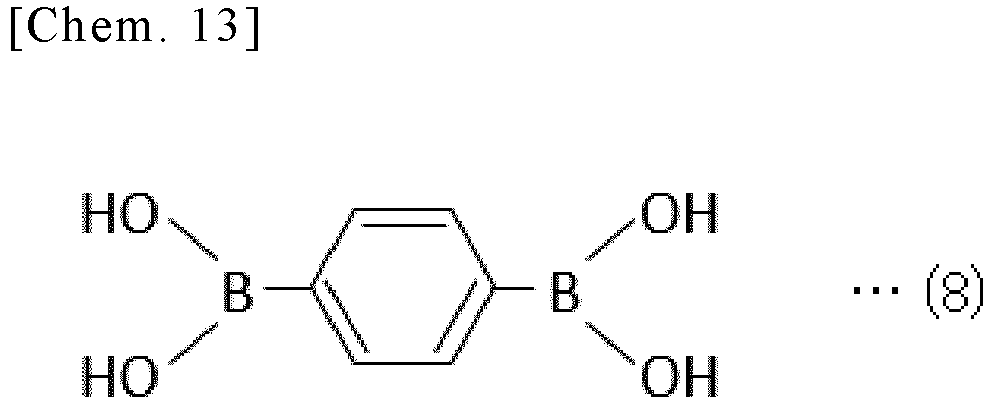
*2 BDB: Diboronic acid ester compound represented by following formula (5) (synthetic product)
*3 CB: HAF grade carbon black
*4 Radical initiator: Azobisisobutyronitrile (AIBN)
*5 Vulcanization accelerator DPG: 1,3-Diphenylguanidine
*6 Vulcanization accelerator MBTS: Di-2-benzothiazolyl disulfide
*7 Vulcanization accelerator TBBS: N-(tert-Butyl)-2-benzothiazolesulfenamide - Note that crosslinked elastomers obtained in Examples 1-1 to 1-5 were confirmed to include a diboronic acid ester skeleton unit represented by the following formula (6):

- The crosslinked elastomer obtained in Example 1-4 was selected as a crosslinked elastomer in which carbon black was not mixed and the crosslinked elastomer obtained in Example 1-5 was selected as a crosslinked elastomer in which carbon black was mixed.
- Each of these crosslinked elastomers was finely milled and was then loaded into tetrahydrofuran (THF; SP value: 8.95 (cal/cm3)1/2) as an organic solvent. Phenylboronic acid (PhB(OH)2) was further added as a monoboronic acid compound (BA), was thoroughly mixed therewith, and then the mixture was left to settle at room temperature (approximately 25°C) for 1 day. In the above, the concentration of the crosslinked elastomer (mass proportion of crosslinked elastomer among total of crosslinked elastomer and organic solvent) and the molar abundance ratio of the monoboronic acid compound relative to the diboronic acid ester skeleton unit in the crosslinked elastomer (BA/BDB skeleton unit) were set as shown in Table 2. After settling, casting was performed and solvent was evaporated to yield a treated elastomer.
- The treated elastomer that was obtained was used to perform a roll forming operation. A case in which roll forming could be performed was evaluated as a case in which softness had been imparted as a result of decrosslinking (crosslinking sites returning to a non-crosslinked state). The results are shown in Table 2.
-
Table 2 Example 2-1 Example 2-2 Example 2-3 Example 2-4 Example 2-5 Example 2-6 Example 2-7 Crosslinked elastomer (Example No.) 1-4 (CB not used) 1-5 (CB used) Crosslinked elastomer concentration (mass%) 10 10 10 13 50 50 50 BA/BDB skeleton unit (molar abundance ratio) 3 3.5 4 2.5 2.5 3 3.5 Evaluation of roll formability (decrosslinking) O O O O O O O Remarks relating to formed article of treated elastomer Shrinkage Shrinkage Similar to initial Fairly rough surface Similar to initial Similar to initial Similar to initial *Similar to initial: Similar quality to diene elastomer before crosslinking - It can be seen from Table 2 that an evaluation result of "O" was given for decrosslinking in all of Examples 2-1 to 2-7. In other words, the crosslinked elastomers obtained in Examples 1-4 and 1-5 could easily be decrosslinked by causing contact of the crosslinked elastomer with a monoboronic acid compound in the presence of a specific organic solvent.
- Also note that for the treated elastomers (decrosslinked elastomers) obtained in Examples 2-1 to 2-7, it was confirmed through appropriate use of solution NMR that a site where the skeleton represented by formula (6) was bonded in the crosslinked elastomer prior to treatment had been capped by a functional group represented by the following formula (7):

- The crosslinked elastomers obtained in Examples 1-1 to 1-3 also include the diboronic acid ester skeleton unit described above. Therefore, these crosslinked elastomers are thought to be easy to decrosslink through the same treatment as described above.
- The decrosslinked elastomer (treated elastomer) obtained in Example 2-2 or Example 2-3 was selected as a decrosslinked elastomer in which carbon black was not mixed and the decrosslinked elastomer (treated elastomer) obtained in Example 2-5 was selected as a decrosslinked elastomer in which carbon black was mixed.
- Each of these decrosslinked elastomers was loaded into a solvent shown in Table 3 together with the diboronic acid compound produced during decrosslinking treatment. A radical initiator was further added according to a formulation shown in Table 3, and these were left to settle over night at room temperature (approximately 25°C). In the above, the concentration of the decrosslinked elastomer (mass proportion of decrosslinked elastomer among total of decrosslinked elastomer and solvent) was set as shown in Table 3. After settling, casting was performed and solvent was evaporated to yield a treated elastomer.
- The obtained treated elastomer was heated at 120°C for 10 minutes to 30 minutes (until the value of the storage modulus G' stabilized) and the storage modulus G' thereof was measured using a rubber process analyzer (produced by Alpha Technologies). In each of the examples, the measured storage modulus G' was at least 20% compared to the storage modulus G' of the crosslinked elastomer prior to addition of the monoboronic acid compound described above. Therefore, crosslinking was judged to have occurred in each of the examples. More specifically, crosslinking was judged to have occurred to a more sufficient degree and an evaluation of "O" was given in a case in which the measured storage modulus G' was 50% or more compared to the storage modulus G' of the crosslinked elastomer prior to addition of phenylboronic acid described above, whereas an evaluation of "Δ" was given in a case in which the measured storage modulus G' was less than 50% compared thereto. The results are shown in Table 3.
-
Table 3 Example 3-1 Example 3-2 Example 3-3 Example 3-4 Example 3-5 Example 3-6 Example 3-7 Decrosslinked elastomer (Example No.) 2-2 (CB not used) 2-3 (CB not used) 2-5 (CB used) Decrosslinked elastomer Parts by mass 100 100 100 100 100 100 100 Radical initiator *4 Parts by mass 0.5 0.5 0.3 0.3 1 1 0.5 Type of solvent iPrOH MeOH:THF 1:1 MeOH:THF 1:1 MeOH:THF 2:1 MeOH:THF 1:1 MeOH:THF 2:1 MeOHTHF 4:1 SP value of solvent (mixed solvent) (cal/cm3)1/2 10.41 10.43 10.43 11.36 10.43 11.36 12.38 Decrosslinked elastomer concentration Mass% 10 10 10 10 50 50 50 Evaluation of croslinking (recrosslinking) Δ O O O Δ O O * iPrOH: Isopropanol (SP value: 10.41), MeOH: Methanol, THF: Tetrahydrofuran (SP value: 8.95) - It can be seen from Table 3 that the decrosslinked elastomers obtained in Examples 2-2, 2-3, and 2-5 could easily be crosslinked (recrosslinked) by causing contact of the decrosslinked elastomer with a diboronic acid compound in the presence of a specific solvent.
- Note that the treated elastomers (recrosslinked elastomers) obtained in Examples 3-1 to 3-7 were confirmed to include a diboronic acid ester skeleton unit represented by the following formula (6):

- According to the present disclosure, it is possible to provide a method by which a crosslinking site of a crosslinked elastomer can easily be returned to a non-crosslinked state.
Claims (3)
- A method of returning a crosslinking site of a crosslinked elastomer to a non-crosslinked state, comprising a step of causing contact of a crosslinked elastomer including, at a crosslinking site, a diboronic acid ester skeleton unit represented by general formula (1), shown below,


a molar abundance ratio of the monoboronic acid compound relative to the diboronic acid ester skeleton unit, in terms of monoboronic acid compound/diboronic acid ester skeleton unit, is set as more than 2 and not more than 5 in the step. - The method according to claim 1, wherein a proportion constituted by the diboronic acid ester skeleton unit in the crosslinked elastomer is 17 mass% or less.
- The method according to claim 1 or 2, wherein the crosslinked elastomer is obtained through crosslinking of a diene elastomer having a vinyl bond content of 30 mass% or less and a weight-average molecular weight of 1,000 or more.
Applications Claiming Priority (2)
| Application Number | Priority Date | Filing Date | Title |
|---|---|---|---|
| JP2021129377A JP7761419B2 (en) | 2021-08-05 | 2021-08-05 | A method for returning crosslinked sites of crosslinked elastomers to an uncrosslinked state |
| PCT/JP2022/026428 WO2023013334A1 (en) | 2021-08-05 | 2022-06-30 | Method for returning crosslinked site of crosslinked elastomer to uncrosslinked state |
Publications (3)
| Publication Number | Publication Date |
|---|---|
| EP4382553A1 true EP4382553A1 (en) | 2024-06-12 |
| EP4382553A4 EP4382553A4 (en) | 2025-07-23 |
| EP4382553B1 EP4382553B1 (en) | 2026-03-18 |
Family
ID=85155789
Family Applications (1)
| Application Number | Title | Priority Date | Filing Date |
|---|---|---|---|
| EP22852760.2A Active EP4382553B1 (en) | 2021-08-05 | 2022-06-30 | Method of returning crosslinking site of crosslinked elastomer to non-crosslinked state |
Country Status (5)
| Country | Link |
|---|---|
| US (1) | US20240301096A1 (en) |
| EP (1) | EP4382553B1 (en) |
| JP (1) | JP7761419B2 (en) |
| CN (1) | CN117651731A (en) |
| WO (1) | WO2023013334A1 (en) |
Cited By (1)
| Publication number | Priority date | Publication date | Assignee | Title |
|---|---|---|---|---|
| EP4671283A1 (en) * | 2024-06-26 | 2025-12-31 | Sumitomo Rubber Industries, Ltd. | TIRES |
Families Citing this family (1)
| Publication number | Priority date | Publication date | Assignee | Title |
|---|---|---|---|---|
| EP4755928A1 (en) * | 2023-08-04 | 2026-06-10 | Bridgestone Corporation | Liquid polymer, mixture of liquid polymer and recycled carbon black, and method for recovering diene-based monomer |
Family Cites Families (5)
| Publication number | Priority date | Publication date | Assignee | Title |
|---|---|---|---|---|
| JPS5529520A (en) * | 1978-08-22 | 1980-03-01 | Yokohama Rubber Co Ltd:The | Rubber composition |
| FR3040172B1 (en) | 2015-08-20 | 2020-01-24 | Ecole Superieure De Physique Et De Chimie Industrielles De La Ville De Paris | POLYMER COMPOSITIONS COMPRISING CROSSLINKED POLYMERS COMPRISING BORONIC ESTER FUNCTIONS, ALLOWING EXCHANGE REACTIONS, METHOD OF PREPARATION AND USE |
| CN108341958A (en) * | 2017-01-25 | 2018-07-31 | 翁秋梅 | A kind of energy-absorbing method based on hydridization dynamic aggregation object |
| WO2019023837A1 (en) * | 2017-07-31 | 2019-02-07 | Dow Silicones Corporation | Handling additive for silicone elastomers |
| CN112812331B (en) * | 2021-01-12 | 2021-11-16 | 华南理工大学 | Heterogeneous cross-linked rubber, preparation method and recovery method |
-
2021
- 2021-08-05 JP JP2021129377A patent/JP7761419B2/en active Active
-
2022
- 2022-06-30 US US18/578,595 patent/US20240301096A1/en active Pending
- 2022-06-30 WO PCT/JP2022/026428 patent/WO2023013334A1/en not_active Ceased
- 2022-06-30 EP EP22852760.2A patent/EP4382553B1/en active Active
- 2022-06-30 CN CN202280050118.8A patent/CN117651731A/en active Pending
Cited By (1)
| Publication number | Priority date | Publication date | Assignee | Title |
|---|---|---|---|---|
| EP4671283A1 (en) * | 2024-06-26 | 2025-12-31 | Sumitomo Rubber Industries, Ltd. | TIRES |
Also Published As
| Publication number | Publication date |
|---|---|
| WO2023013334A1 (en) | 2023-02-09 |
| CN117651731A (en) | 2024-03-05 |
| EP4382553A4 (en) | 2025-07-23 |
| JP2023023661A (en) | 2023-02-16 |
| EP4382553B1 (en) | 2026-03-18 |
| US20240301096A1 (en) | 2024-09-12 |
| JP7761419B2 (en) | 2025-10-28 |
Similar Documents
| Publication | Publication Date | Title |
|---|---|---|
| EP4382552A1 (en) | Crosslinked elastomer and method for producing same | |
| Phadke et al. | Studies of vulcanization of reclaimed rubber | |
| Qi et al. | Second natural rubber with self-reinforcing effect based on strain-induced crystallization | |
| Boden et al. | Understanding the effects of cross-linking density on the self-healing performance of epoxidized natural rubber and natural rubber | |
| EP4382553B1 (en) | Method of returning crosslinking site of crosslinked elastomer to non-crosslinked state | |
| JP4511095B2 (en) | Modifier for desulfurization of vulcanized elastomer, mainly vulcanized rubber, and desulfurization method using this modifier | |
| EP4382556B1 (en) | Method of crosslinking elastomer | |
| US9175155B2 (en) | Methods of functionalizing reclaimed elastomer material and compositions comprising the same | |
| JPH03139550A (en) | Elastomer composition | |
| WO2019160088A1 (en) | Rubber composition production method | |
| EP0397949B1 (en) | Water based precure paint for rubber articles | |
| JP2008260863A (en) | Adhesive composition and method for adhering organic fiber and rubber using the same | |
| US2395493A (en) | Vulcanization of chloroprene polymers | |
| US2605241A (en) | Reclaiming rubber with bis (trialkyl phenol) sulfides | |
| Martin | 1, 2-Polybutadiene resin co-agents for peroxide cure of rubber compounds | |
| CN113388119B (en) | Preparation method of polyhydroxysilane modified butadiene rubber and ozone aging resistant rubber | |
| EP3615607A1 (en) | A vulcanization mix, and implementations thereof | |
| JP2001226519A (en) | Unvulcanized rubber composite and method for separating unvulcanized rubber composition | |
| KR0151128B1 (en) | Vinyl high content polybutadiene rubber with improved curing properties | |
| JPH032895B2 (en) | ||
| CN116640370A (en) | A kind of graft modified natural rubber, preparation method and rubber composition comprising graft modified natural rubber | |
| JP2013043955A (en) | Rubber composition for breaker cushion and pneumatic tire | |
| JPS608017B2 (en) | Polyisoprene rubber composition | |
| JP2021091830A (en) | Rubber composition, method for producing the same and tire | |
| Saiwari et al. | Pathway for high-quality reclaim by thermal treatment of sulfur-vulcanized SBR |
Legal Events
| Date | Code | Title | Description |
|---|---|---|---|
| STAA | Information on the status of an ep patent application or granted ep patent |
Free format text: STATUS: THE INTERNATIONAL PUBLICATION HAS BEEN MADE |
|
| PUAI | Public reference made under article 153(3) epc to a published international application that has entered the european phase |
Free format text: ORIGINAL CODE: 0009012 |
|
| STAA | Information on the status of an ep patent application or granted ep patent |
Free format text: STATUS: REQUEST FOR EXAMINATION WAS MADE |
|
| 17P | Request for examination filed |
Effective date: 20231219 |
|
| AK | Designated contracting states |
Kind code of ref document: A1 Designated state(s): AL AT BE BG CH CY CZ DE DK EE ES FI FR GB GR HR HU IE IS IT LI LT LU LV MC MK MT NL NO PL PT RO RS SE SI SK SM TR |
|
| DAV | Request for validation of the european patent (deleted) | ||
| DAX | Request for extension of the european patent (deleted) | ||
| REG | Reference to a national code |
Ref country code: DE Free format text: PREVIOUS MAIN CLASS: C08J0003000000 Ipc: C08J0003240000 Ref country code: DE Ref legal event code: R079 Ref document number: 602022032723 Country of ref document: DE Free format text: PREVIOUS MAIN CLASS: C08J0003000000 Ipc: C08J0003240000 |
|
| A4 | Supplementary search report drawn up and despatched |
Effective date: 20250623 |
|
| RIC1 | Information provided on ipc code assigned before grant |
Ipc: C08J 3/24 20060101AFI20250616BHEP |
|
| GRAJ | Information related to disapproval of communication of intention to grant by the applicant or resumption of examination proceedings by the epo deleted |
Free format text: ORIGINAL CODE: EPIDOSDIGR1 |
|
| GRAP | Despatch of communication of intention to grant a patent |
Free format text: ORIGINAL CODE: EPIDOSNIGR1 |
|
| GRAP | Despatch of communication of intention to grant a patent |
Free format text: ORIGINAL CODE: EPIDOSNIGR1 |
|
| STAA | Information on the status of an ep patent application or granted ep patent |
Free format text: STATUS: GRANT OF PATENT IS INTENDED |
|
| INTG | Intention to grant announced |
Effective date: 20251017 |
|
| GRAS | Grant fee paid |
Free format text: ORIGINAL CODE: EPIDOSNIGR3 |
|
| P01 | Opt-out of the competence of the unified patent court (upc) registered |
Free format text: CASE NUMBER: UPC_APP_0000371_4382553/2026 Effective date: 20260106 |
|
| GRAA | (expected) grant |
Free format text: ORIGINAL CODE: 0009210 |
|
| STAA | Information on the status of an ep patent application or granted ep patent |
Free format text: STATUS: THE PATENT HAS BEEN GRANTED |
|
| AK | Designated contracting states |
Kind code of ref document: B1 Designated state(s): AL AT BE BG CH CY CZ DE DK EE ES FI FR GB GR HR HU IE IS IT LI LT LU LV MC MK MT NL NO PL PT RO RS SE SI SK SM TR |
|
| REG | Reference to a national code |
Ref country code: CH Ref legal event code: F10 Free format text: ST27 STATUS EVENT CODE: U-0-0-F10-F00 (AS PROVIDED BY THE NATIONAL OFFICE) Effective date: 20260318 Ref country code: GB Ref legal event code: FG4D |
|
| REG | Reference to a national code |
Ref country code: DE Ref legal event code: R096 Ref document number: 602022032723 Country of ref document: DE |
|
| REG | Reference to a national code |
Ref country code: IE Ref legal event code: FG4D |
|
| PG25 | Lapsed in a contracting state [announced via postgrant information from national office to epo] |
Ref country code: RS Free format text: LAPSE BECAUSE OF FAILURE TO SUBMIT A TRANSLATION OF THE DESCRIPTION OR TO PAY THE FEE WITHIN THE PRESCRIBED TIME-LIMIT Effective date: 20260618 |
|
| PG25 | Lapsed in a contracting state [announced via postgrant information from national office to epo] |
Ref country code: GR Free format text: LAPSE BECAUSE OF FAILURE TO SUBMIT A TRANSLATION OF THE DESCRIPTION OR TO PAY THE FEE WITHIN THE PRESCRIBED TIME-LIMIT Effective date: 20260619 |
|
| REG | Reference to a national code |
Ref country code: LT Ref legal event code: MG9D |
|
| PG25 | Lapsed in a contracting state [announced via postgrant information from national office to epo] |
Ref country code: LT Free format text: LAPSE BECAUSE OF FAILURE TO SUBMIT A TRANSLATION OF THE DESCRIPTION OR TO PAY THE FEE WITHIN THE PRESCRIBED TIME-LIMIT Effective date: 20260318 |
|
| PGFP | Annual fee paid to national office [announced via postgrant information from national office to epo] |
Ref country code: DE Payment date: 20260622 Year of fee payment: 5 |
|
| PG25 | Lapsed in a contracting state [announced via postgrant information from national office to epo] |
Ref country code: NO Free format text: LAPSE BECAUSE OF FAILURE TO SUBMIT A TRANSLATION OF THE DESCRIPTION OR TO PAY THE FEE WITHIN THE PRESCRIBED TIME-LIMIT Effective date: 20260618 |
|
| PG25 | Lapsed in a contracting state [announced via postgrant information from national office to epo] |
Ref country code: SE Free format text: LAPSE BECAUSE OF FAILURE TO SUBMIT A TRANSLATION OF THE DESCRIPTION OR TO PAY THE FEE WITHIN THE PRESCRIBED TIME-LIMIT Effective date: 20260318 Ref country code: FI Free format text: LAPSE BECAUSE OF FAILURE TO SUBMIT A TRANSLATION OF THE DESCRIPTION OR TO PAY THE FEE WITHIN THE PRESCRIBED TIME-LIMIT Effective date: 20260318 |
|
| PG25 | Lapsed in a contracting state [announced via postgrant information from national office to epo] |
Ref country code: HR Free format text: LAPSE BECAUSE OF FAILURE TO SUBMIT A TRANSLATION OF THE DESCRIPTION OR TO PAY THE FEE WITHIN THE PRESCRIBED TIME-LIMIT Effective date: 20260318 |
|
| REG | Reference to a national code |
Ref country code: NL Ref legal event code: MP Effective date: 20260318 |
|
| PGFP | Annual fee paid to national office [announced via postgrant information from national office to epo] |
Ref country code: FR Payment date: 20260626 Year of fee payment: 5 |
|
| PG25 | Lapsed in a contracting state [announced via postgrant information from national office to epo] |
Ref country code: LV Free format text: LAPSE BECAUSE OF FAILURE TO SUBMIT A TRANSLATION OF THE DESCRIPTION OR TO PAY THE FEE WITHIN THE PRESCRIBED TIME-LIMIT Effective date: 20260318 |
|
| PG25 | Lapsed in a contracting state [announced via postgrant information from national office to epo] |
Ref country code: BG Free format text: LAPSE BECAUSE OF FAILURE TO SUBMIT A TRANSLATION OF THE DESCRIPTION OR TO PAY THE FEE WITHIN THE PRESCRIBED TIME-LIMIT Effective date: 20260318 |