EP4381285B1 - Elektrochemischer biofilmsensor - Google Patents
Elektrochemischer biofilmsensor Download PDFInfo
- Publication number
- EP4381285B1 EP4381285B1 EP22758016.4A EP22758016A EP4381285B1 EP 4381285 B1 EP4381285 B1 EP 4381285B1 EP 22758016 A EP22758016 A EP 22758016A EP 4381285 B1 EP4381285 B1 EP 4381285B1
- Authority
- EP
- European Patent Office
- Prior art keywords
- electrode
- sensor
- counter
- electrodes
- current
- Prior art date
- Legal status (The legal status is an assumption and is not a legal conclusion. Google has not performed a legal analysis and makes no representation as to the accuracy of the status listed.)
- Active
Links
Images

Classifications
-
- G—PHYSICS
- G01—MEASURING; TESTING
- G01N—INVESTIGATING OR ANALYSING MATERIALS BY DETERMINING THEIR CHEMICAL OR PHYSICAL PROPERTIES
- G01N27/00—Investigating or analysing materials by the use of electric, electrochemical, or magnetic means
- G01N27/26—Investigating or analysing materials by the use of electric, electrochemical, or magnetic means by investigating electrochemical variables; by using electrolysis or electrophoresis
- G01N27/28—Electrolytic cell components
- G01N27/30—Electrodes, e.g. test electrodes; Half-cells
- G01N27/327—Biochemical electrodes, e.g. electrical or mechanical details for in vitro measurements
-
- G—PHYSICS
- G01—MEASURING; TESTING
- G01N—INVESTIGATING OR ANALYSING MATERIALS BY DETERMINING THEIR CHEMICAL OR PHYSICAL PROPERTIES
- G01N33/00—Investigating or analysing materials by specific methods not covered by groups G01N1/00 - G01N31/00
- G01N33/18—Water
- G01N33/186—Water using one or more living organisms, e.g. a fish
- G01N33/1866—Water using one or more living organisms, e.g. a fish using microorganisms
-
- G—PHYSICS
- G01—MEASURING; TESTING
- G01N—INVESTIGATING OR ANALYSING MATERIALS BY DETERMINING THEIR CHEMICAL OR PHYSICAL PROPERTIES
- G01N27/00—Investigating or analysing materials by the use of electric, electrochemical, or magnetic means
- G01N27/02—Investigating or analysing materials by the use of electric, electrochemical, or magnetic means by investigating impedance
- G01N27/028—Circuits therefor
-
- G—PHYSICS
- G01—MEASURING; TESTING
- G01N—INVESTIGATING OR ANALYSING MATERIALS BY DETERMINING THEIR CHEMICAL OR PHYSICAL PROPERTIES
- G01N27/00—Investigating or analysing materials by the use of electric, electrochemical, or magnetic means
- G01N27/26—Investigating or analysing materials by the use of electric, electrochemical, or magnetic means by investigating electrochemical variables; by using electrolysis or electrophoresis
- G01N27/28—Electrolytic cell components
- G01N27/30—Electrodes, e.g. test electrodes; Half-cells
- G01N27/301—Reference electrodes
-
- G—PHYSICS
- G01—MEASURING; TESTING
- G01N—INVESTIGATING OR ANALYSING MATERIALS BY DETERMINING THEIR CHEMICAL OR PHYSICAL PROPERTIES
- G01N27/00—Investigating or analysing materials by the use of electric, electrochemical, or magnetic means
- G01N27/26—Investigating or analysing materials by the use of electric, electrochemical, or magnetic means by investigating electrochemical variables; by using electrolysis or electrophoresis
- G01N27/28—Electrolytic cell components
- G01N27/30—Electrodes, e.g. test electrodes; Half-cells
- G01N27/38—Cleaning of electrodes
-
- H—ELECTRICITY
- H01—ELECTRIC ELEMENTS
- H01G—CAPACITORS; CAPACITORS, RECTIFIERS, DETECTORS, SWITCHING DEVICES, LIGHT-SENSITIVE OR TEMPERATURE-SENSITIVE DEVICES OF THE ELECTROLYTIC TYPE
- H01G11/00—Hybrid capacitors, i.e. capacitors having different positive and negative electrodes; Electric double-layer [EDL] capacitors; Processes for the manufacture thereof or of parts thereof
- H01G11/04—Hybrid capacitors
-
- H—ELECTRICITY
- H01—ELECTRIC ELEMENTS
- H01G—CAPACITORS; CAPACITORS, RECTIFIERS, DETECTORS, SWITCHING DEVICES, LIGHT-SENSITIVE OR TEMPERATURE-SENSITIVE DEVICES OF THE ELECTROLYTIC TYPE
- H01G9/00—Electrolytic capacitors, rectifiers, detectors, switching devices, light-sensitive or temperature-sensitive devices; Processes of their manufacture
- H01G9/004—Details
- H01G9/04—Electrodes or formation of dielectric layers thereon
- H01G9/048—Electrodes or formation of dielectric layers thereon characterised by their structure
-
- H—ELECTRICITY
- H01—ELECTRIC ELEMENTS
- H01G—CAPACITORS; CAPACITORS, RECTIFIERS, DETECTORS, SWITCHING DEVICES, LIGHT-SENSITIVE OR TEMPERATURE-SENSITIVE DEVICES OF THE ELECTROLYTIC TYPE
- H01G9/00—Electrolytic capacitors, rectifiers, detectors, switching devices, light-sensitive or temperature-sensitive devices; Processes of their manufacture
- H01G9/004—Details
- H01G9/07—Dielectric layers
-
- H—ELECTRICITY
- H01—ELECTRIC ELEMENTS
- H01G—CAPACITORS; CAPACITORS, RECTIFIERS, DETECTORS, SWITCHING DEVICES, LIGHT-SENSITIVE OR TEMPERATURE-SENSITIVE DEVICES OF THE ELECTROLYTIC TYPE
- H01G9/00—Electrolytic capacitors, rectifiers, detectors, switching devices, light-sensitive or temperature-sensitive devices; Processes of their manufacture
- H01G9/22—Devices using combined reduction and oxidation, e.g. redox arrangement or solion
-
- H—ELECTRICITY
- H01—ELECTRIC ELEMENTS
- H01G—CAPACITORS; CAPACITORS, RECTIFIERS, DETECTORS, SWITCHING DEVICES, LIGHT-SENSITIVE OR TEMPERATURE-SENSITIVE DEVICES OF THE ELECTROLYTIC TYPE
- H01G9/00—Electrolytic capacitors, rectifiers, detectors, switching devices, light-sensitive or temperature-sensitive devices; Processes of their manufacture
- H01G9/28—Structural combinations of electrolytic capacitors, rectifiers, detectors, switching devices with other electric components not covered by this subclass
-
- G—PHYSICS
- G01—MEASURING; TESTING
- G01R—MEASURING ELECTRIC VARIABLES; MEASURING MAGNETIC VARIABLES
- G01R27/00—Arrangements for measuring resistance, reactance, impedance, or electric characteristics derived therefrom
- G01R27/02—Measuring real or complex resistance, reactance, impedance, or other two-pole characteristics derived therefrom, e.g. time constant
- G01R27/26—Measuring inductance or capacitance; Measuring quality factor, e.g. by using the resonance method; Measuring loss factor; Measuring dielectric constants ; Measuring impedance or related variables
- G01R27/2617—Measuring dielectric properties, e.g. constants
-
- H—ELECTRICITY
- H01—ELECTRIC ELEMENTS
- H01G—CAPACITORS; CAPACITORS, RECTIFIERS, DETECTORS, SWITCHING DEVICES, LIGHT-SENSITIVE OR TEMPERATURE-SENSITIVE DEVICES OF THE ELECTROLYTIC TYPE
- H01G11/00—Hybrid capacitors, i.e. capacitors having different positive and negative electrodes; Electric double-layer [EDL] capacitors; Processes for the manufacture thereof or of parts thereof
- H01G11/02—Hybrid capacitors, i.e. capacitors having different positive and negative electrodes; Electric double-layer [EDL] capacitors; Processes for the manufacture thereof or of parts thereof using combined reduction-oxidation reactions, e.g. redox arrangement or solion
-
- H—ELECTRICITY
- H01—ELECTRIC ELEMENTS
- H01G—CAPACITORS; CAPACITORS, RECTIFIERS, DETECTORS, SWITCHING DEVICES, LIGHT-SENSITIVE OR TEMPERATURE-SENSITIVE DEVICES OF THE ELECTROLYTIC TYPE
- H01G11/00—Hybrid capacitors, i.e. capacitors having different positive and negative electrodes; Electric double-layer [EDL] capacitors; Processes for the manufacture thereof or of parts thereof
- H01G11/08—Structural combinations, e.g. assembly or connection, of hybrid or EDL capacitors with other electric components, at least one hybrid or EDL capacitor being the main component
Definitions
- These devices are basically three-electrode cells, i.e. working electrode, reference electrode and counter-electrode.
- the working electrode whereon biofilm growth is monitored, is usually made of a "passive" alloy (e.g. stainless steel or titanium), while the other two auxiliary electrodes are often combined into a single electrode, which performs at the same time the role of counter-electrode and pseudo-reference electrode, normally made up of materials of the "sacrificial anode” type, such as zinc.
- the described coatings can allow the temporary application of suitable and high electric currents, aimed at eliminating (both as a direct consequence of the applied current, and due to oxidizing products generated by electrochemical reactions on the electrode surface) a pre-existing biofilm, thus allowing to carry out an "on-site self-cleaning" of the working electrode and/or of the reference electrode and/or of the counter-electrode, without damaging the electrode being treated.
- This treatment can be carried out with or without the aid of a service electrode, designed to support the supply of the necessary currents.
- the possibility of self-cleaning one or more electrodes represents a significant advantage, reducing or even completely eliminating the need for further cleaning.
- the invention also relates to a device according to claim 5 to measure the growth of a biofilm on the working electrode of a sensor according to one or more of the envisaged embodiments and such a device comprises a potentiostatic circuit equipped with a terminal for the input of a polarization voltage, a feedback circuit to maintain said polarization voltage between the working electrode and the reference/counter-electrode when the working electrode and the reference/counter-electrode of the sensor are connected to the device, a circuit to detect the current flowing between the working electrode and the counter-electrode or alternatively a circuit to detect the voltage present between the working electrode and the reference electrode/counter-electrode, a generator circuit that can be connected manually or by means of switches between pairs of sensor electrodes to temporarily supply a current to clean the electrodes.
- the invention refers to a process according to claim 11 to apply a coating to the electrodes of a sensor according to one or more of the previous embodiments, such a method comprising the steps of initially immersing the electrode in a solution that includes salts of one or more noble metals such as, for instance, iridium, ruthenium, platinum, niobium, rhodium, tantalum and subsequently subjecting the electrode to high temperature to allow the transformation of the salts into ceramic oxides.
- a noble metals such as, for instance, iridium, ruthenium, platinum, niobium, rhodium, tantalum
- the assessment of the rate of oxygen reduction can, therefore, provide a measure of the greater corrosivity induced by the biofilm formation.
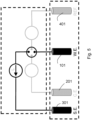
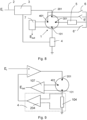
- FIG. 5 shows an example wherein the service electrode is connected to the working electrode.
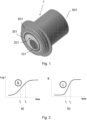
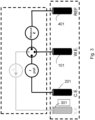
- the reference electrode and the counter-electrode can also advantageously form a single electrode having the function of counter-electrode and pseudo reference electrode thus realizing a simpler and more manageable sensor like that of the embodiment shown in Fig. 1 .
- the ability to self-clean one or more electrodes is a significant advantage that reduces or even completely eliminates the need for maintenance.
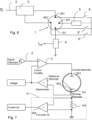
- the voltage input 2 is used to set a polarization current of the sensor through a feedback circuit 3 to maintain said polarization current between the working electrode 101 and the counter-electrode 201.
- the current can be detected with a resistor in series 104 and amplifier 204 as indicated in the previous example.
- the device is completed by a circuit 7, for instance with amplifier 107, to detect the voltage present between the working electrode 101 and the reference electrode 401, in the case of a configuration with separate counter-electrode and reference electrode, or between the working electrode 101 and the counter-electrode 201, when this also assumes the function of pseudo-reference, and a generator circuit 5 which can be connected manually or by means of switches between pairs of electrodes of the sensor to temporarily supply a current to clean the electrodes.
Landscapes
- Chemical & Material Sciences (AREA)
- Life Sciences & Earth Sciences (AREA)
- Engineering & Computer Science (AREA)
- Health & Medical Sciences (AREA)
- Power Engineering (AREA)
- Pathology (AREA)
- Physics & Mathematics (AREA)
- Analytical Chemistry (AREA)
- Biochemistry (AREA)
- General Health & Medical Sciences (AREA)
- General Physics & Mathematics (AREA)
- Immunology (AREA)
- Electrochemistry (AREA)
- Chemical Kinetics & Catalysis (AREA)
- Microelectronics & Electronic Packaging (AREA)
- Molecular Biology (AREA)
- Microbiology (AREA)
- Food Science & Technology (AREA)
- Medicinal Chemistry (AREA)
- Investigating Or Analyzing Materials By The Use Of Electric Means (AREA)
- Measurement Of The Respiration, Hearing Ability, Form, And Blood Characteristics Of Living Organisms (AREA)
- Measurement And Recording Of Electrical Phenomena And Electrical Characteristics Of The Living Body (AREA)
Claims (11)
- Elektrochemischer Biofilmsensor umfassend eine erste (101), eine zweite (401) und eine dritte Elektrode (201), wobei die erste Elektrode (101) eine Arbeitselektrode ist, auf deren Oberfläche das Biofilmwachstum zu messen ist, und die zweite Elektrode (401) eine Referenzelektrode ist, die die Funktion hat, ein stabiles Referenzpotential für die Polarisation der Arbeitselektrode bereitzustellen, die dritte Elektrode (201) eine Gegenelektrode ist, die mit der ersten Elektrode (101) über einen Stromkreis derart verbunden werden kann, dass sie bei einem festen Potential den Stromkreislauf von der ersten Elektrode (101) zur dritten Elektrode (201) oder umgekehrt ermöglicht, in Abhängigkeit von der durch den Biofilm induzierten Veränderung der Kinetik der sich auf der Oberfläche der ersten Elektrode (101) vollziehenden Reaktionen zu ermöglichen, oder um bei einem festen Strom die Messung des Potentials der ersten Elektrode (101) in Bezug auf die zweite Elektrode (401) zu ermöglichen, wobei der Sensor dadurch gekennzeichnet ist, dass die erste Elektrode (101) und/oder die zweite Elektrode (401) und/oder die dritte Elektrode (201) mit einer Beschichtung auf Basis von gemischten Oxiden von verschiedenen Edelmetallen beschichtet sind, die aus Iridium, Ruthenium, Platin, Rhodium, Tantal oder Niob ausgewählt sind, und wobei eine oder mehrere Elektroden aus Titan oder Tantal hergestellt sind, und wobei die Dicke der Beschichtung zwischen 0,1 und 50 Mikrometer, vorzugsweise 2,5 Mikrometer ± 10 % beträgt.
- Sensor nach Anspruch 1, wobei die Referenzelektrode (401) und die Gegenelektrode (201) eine einzige Elektrode bilden, die gleichzeitig die Funktion von Gegenelektrode und Pseudoreferenz hat.
- Sensor nach Anspruch 1 oder 2, wobei eine weitere Betriebselektrode (301) vorhanden ist, die einzeln oder in Gruppen mit jeder Elektrode des Sensors mittels einer elektrischen Schaltung (5) anschließbar ist und in der Lage ist, einen Strom zur lokalen Selbstreinigung der Sensorelektrode(n) bereitzustellen.
- Sensor nach Anspruch 3, wobei die Betriebselektrode (301) mit einer Beschichtung auf Basis von gemischten Metalloxiden beschichtet ist.
- Vorrichtung zur Messung des Wachstums eines Biofilms auf der Arbeitselektrode (101) eines Sensors nach einem oder mehreren der Ansprüche 1 bis 4, umfassend eine potentiostatische Schaltung, die mit einem Anschluss (2) zur Eingabe einer Polarisationsspannung ausgestattet ist, eine Rückkopplungsschaltung (3) zur Aufrechterhaltung der Polarisationsspannung zwischen der Arbeitselektrode (101) und der Referenz-/Gegenelektrode (401, 201), wenn die Arbeitselektrode (101) und die Referenz-/Gegenelektrode des Sensors (401, 201) mit der Vorrichtung verbunden sind, eine Schaltung (4) zur Erfassung des zwischen der Arbeitselektrode (101) und der Gegenelektrode (201) fließenden Stroms oder alternativ eine Schaltung (7) zur Erfassung der Spannung zwischen der Arbeitselektrode (101) und der Referenzelektrode/Gegenelektrode (401, 201), eine Generatorschaltung (5), die manuell oder über Schalter (6, 6', 6") zwischen Elektrodenpaaren (101, 201, 401) des Sensors angeschlossen werden kann, um vorübergehend einen Strom zur Reinigung der Elektroden zu liefern.
- Vorrichtung nach Anspruch 5, wobei die Generatorschaltung (5) dazu vorgesehen ist, zwischen der Betriebselektrode (301) und einer oder mehreren der übrigen Elektroden (101, 201, 401) des Sensors angeschlossen zu werden, um diese Elektroden zu reinigen.
- Vorrichtung nach Anspruch 5 oder 6, wobei der Generator (5) für die vorübergehende Bereitstellung eines elektrischen Stroms derart konfiguriert ist, dass er auf der Oberfläche der der Reinigungsbehandlung unterzogenen Elektrode eine entsprechende Stromdichte im Bereich von 1 ÷ 100 mA/cm2 induziert.
- System zur Überwachung des Wachstums von Biofilm auf einem Sensor nach einem oder mehreren der Ansprüche 1 bis 4, umfassend eine Vorrichtung nach einem oder mehreren der Ansprüche 5 bis 7, die mit den Elektroden eines Sensors nach einem oder mehreren der Ansprüche 1 bis 4 verbunden ist, wobei das System eine amperometrische (4) und/oder potentiometrische (7) Schaltung umfasst, die von einer Steuereinheit gesteuert wird, welche dazu konfiguriert ist, den zwischen der Arbeitselektrode (101) und der Gegenelektrode (201) fließenden Strom und/oder die Spannung zwischen der Arbeitselektrode (101) und der Referenz-/Gegenelektrode (401, 201) mit einem polarisierten Sensor über die Zeit zu messen.
- System nach Anspruch 8, wobei die Steuereinheit derart eingerichtet ist, dass sie auf den Generator (5) des Messgeräts zur gesteuerten Abgabe eines Reinigungsstroms zwischen Sensorelektrodenpaaren einwirkt.
- System nach Anspruch 9, wobei Schalter (6, 6', 6") vorgesehen sind, die von der Steuereinheit gesteuert werden können, um den Generator mit der Betriebselektrode (301) und mit der Arbeitselektrode (101) oder mit der Gegenelektrode (201) oder mit der Referenzelektrode (401) zu verbinden, um einen Stromfluss zwischen der Betriebselektrode (301) und der zu reinigenden Elektrode oder umgekehrt zu erzeugen.
- Verfahren zum Auftragen einer Beschichtung auf die Elektroden eines Sensors nach einem oder mehreren der vorhergehenden Ansprüche 1 bis 4, dadurch gekennzeichnet, dass die Elektrode zunächst in eine Lösung getaucht wird, die Salze von einem oder mehreren Edelmetallen, ausgewählt aus Iridium, Ruthenium, Platin, Niob, Rhodium und Tantal, enthält, und dass die Elektrode anschließend einer hohen Temperatur ausgesetzt wird, um die Umwandlung der Salze in keramische Oxide zu ermöglichen.
Applications Claiming Priority (2)
| Application Number | Priority Date | Filing Date | Title |
|---|---|---|---|
| IT102021000021248A IT202100021248A1 (it) | 2021-08-05 | 2021-08-05 | Sensore elettrochimico di biofilm |
| PCT/IB2022/056876 WO2023012581A1 (en) | 2021-08-05 | 2022-07-26 | Electrochemical biofilm sensor |
Publications (3)
| Publication Number | Publication Date |
|---|---|
| EP4381285A1 EP4381285A1 (de) | 2024-06-12 |
| EP4381285B1 true EP4381285B1 (de) | 2025-04-09 |
| EP4381285C0 EP4381285C0 (de) | 2025-04-09 |
Family
ID=78649645
Family Applications (1)
| Application Number | Title | Priority Date | Filing Date |
|---|---|---|---|
| EP22758016.4A Active EP4381285B1 (de) | 2021-08-05 | 2022-07-26 | Elektrochemischer biofilmsensor |
Country Status (5)
| Country | Link |
|---|---|
| US (1) | US20240210349A1 (de) |
| EP (1) | EP4381285B1 (de) |
| ES (1) | ES3032332T3 (de) |
| IT (1) | IT202100021248A1 (de) |
| WO (1) | WO2023012581A1 (de) |
Families Citing this family (1)
| Publication number | Priority date | Publication date | Assignee | Title |
|---|---|---|---|---|
| GB2634255A (en) * | 2023-10-03 | 2025-04-09 | Univ Durham | An electrochemical system for detecting bacterial growth in a duct |
Family Cites Families (9)
| Publication number | Priority date | Publication date | Assignee | Title |
|---|---|---|---|---|
| US5246560A (en) * | 1991-10-04 | 1993-09-21 | Electric Power Research Institute, Inc. | Apparatus for monitoring biofilm activity |
| EP1715334A1 (de) * | 2005-04-22 | 2006-10-25 | Adamant Technologies SA | Verfahren unter Verwendung eines Elektrochemischen Sensors und Elektroden, die diesen Sensor bilden |
| ITTO20080274A1 (it) * | 2008-04-09 | 2009-10-10 | Emilio Capparelli | Dispositivo sensore elettrochimico di condizioni ambientali basato su biofilm e procedimento di rivelazione di condizioni ambientali facente uso di tale dispositivo |
| US9616142B2 (en) * | 2009-08-03 | 2017-04-11 | The Research Foundation For The State University Of New York | Electrochemical eradication of microbes on surfaces of objects |
| US20140048424A1 (en) * | 2011-04-27 | 2014-02-20 | Ohio University | Methods and devices for the detection of biofilms |
| US10444180B1 (en) * | 2011-07-22 | 2019-10-15 | United States Of America As Represented By The Administrator Of National Aeronautics And Space Administration | Polymer electrolyte-based sensors |
| US11933758B2 (en) * | 2015-08-14 | 2024-03-19 | Scott R. Burge | Methods and systems for monitoring microbial activity and communication in an environment |
| WO2021028054A1 (en) * | 2019-08-15 | 2021-02-18 | Robert Bosch Gmbh | Electrochemical sensor designed for biofilm detection |
| US20210087082A1 (en) * | 2019-09-23 | 2021-03-25 | Northeastern University | Electrogeneration of reactive oxygen species without external oxygen supply |
-
2021
- 2021-08-05 IT IT102021000021248A patent/IT202100021248A1/it unknown
-
2022
- 2022-07-26 US US18/293,762 patent/US20240210349A1/en active Pending
- 2022-07-26 EP EP22758016.4A patent/EP4381285B1/de active Active
- 2022-07-26 ES ES22758016T patent/ES3032332T3/es active Active
- 2022-07-26 WO PCT/IB2022/056876 patent/WO2023012581A1/en not_active Ceased
Also Published As
| Publication number | Publication date |
|---|---|
| IT202100021248A1 (it) | 2023-02-05 |
| ES3032332T3 (en) | 2025-07-17 |
| WO2023012581A1 (en) | 2023-02-09 |
| EP4381285C0 (de) | 2025-04-09 |
| US20240210349A1 (en) | 2024-06-27 |
| EP4381285A1 (de) | 2024-06-12 |
Similar Documents
| Publication | Publication Date | Title |
|---|---|---|
| US8111078B1 (en) | Oxidizing power sensor for corrosion monitoring | |
| US9291590B2 (en) | Reference electrode | |
| Dexter et al. | Use and limitations of electrochemical techniques for investigating microbiological corrosion | |
| US5356521A (en) | Process for monitoring biofilm activity | |
| Ismail et al. | Effect of oxygen concentration on corrosion rate of carbon steel in seawater | |
| Worsley et al. | Mechanistic changes in cut-edge corrosion induced by variation of organic coating porosity | |
| CZ20031118A3 (cs) | Betonová konstrukce s dvojitě chráněnými výztužnými prvky | |
| US20160053398A1 (en) | Graphene Anti-Corrosion Coating and Method of Application Thereof | |
| EP4381285B1 (de) | Elektrochemischer biofilmsensor | |
| Bastos et al. | Localised measurements of pH and dissolved oxygen as complements to SVET in the investigation of corrosion at defects in coated aluminum alloy | |
| WO2004097906A2 (en) | Semi-permanent reference electrode | |
| Iannucci et al. | A novel approach for microbial corrosion assessment | |
| EP2221601B1 (de) | Lochkorrosionsdiagnoseverfahren und -vorrichtung für Edelstahl und für eine Meerwasserpumpe, die Edelstahl als Bauelement einsetzt | |
| US5275704A (en) | Method and apparatus for measuring underdeposit localized corrosion rate or metal corrosion rate under tubercles in cooling water systems | |
| Ferraris et al. | Measuring system for enhanced cathodic corrosion protection | |
| Msallamová et al. | The differential aeration cell and the corrosion paradox | |
| Klassen et al. | A novel approach to characterizing localized corrosion within a crevice | |
| JP6276124B2 (ja) | 電気防食方法、及び電気防食システム | |
| Dubey et al. | A review of electrochemical techniques applied to microbiologically influenced corrosion in recent studies | |
| JPH06100570B2 (ja) | 被覆金属の寿命予測方法 | |
| Gac et al. | A comparison of thick-film chemical sensor characteristics in laboratory andon-line industrial process applications | |
| Tribollet | Electrochemical sensors for biofilm and biocorrosion | |
| Salvago et al. | Probability of Localized Corrosion of | |
| CA2372920A1 (en) | Method of providing electrochemical prevention of corrosion in changing conditions | |
| Hasan et al. | Cathodic Protection of Carbon Steel in 0.1 N NaCl Solution under Flow Conditions Using Rotating Cylinder Electrode |
Legal Events
| Date | Code | Title | Description |
|---|---|---|---|
| STAA | Information on the status of an ep patent application or granted ep patent |
Free format text: STATUS: UNKNOWN |
|
| STAA | Information on the status of an ep patent application or granted ep patent |
Free format text: STATUS: THE INTERNATIONAL PUBLICATION HAS BEEN MADE |
|
| PUAI | Public reference made under article 153(3) epc to a published international application that has entered the european phase |
Free format text: ORIGINAL CODE: 0009012 |
|
| STAA | Information on the status of an ep patent application or granted ep patent |
Free format text: STATUS: REQUEST FOR EXAMINATION WAS MADE |
|
| 17P | Request for examination filed |
Effective date: 20240202 |
|
| AK | Designated contracting states |
Kind code of ref document: A1 Designated state(s): AL AT BE BG CH CY CZ DE DK EE ES FI FR GB GR HR HU IE IS IT LI LT LU LV MC MK MT NL NO PL PT RO RS SE SI SK SM TR |
|
| DAV | Request for validation of the european patent (deleted) | ||
| DAX | Request for extension of the european patent (deleted) | ||
| REG | Reference to a national code |
Ref country code: DE Ref legal event code: R079 Free format text: PREVIOUS MAIN CLASS: G01N0027220000 Ipc: H01G0009048000 Ref document number: 602022013016 Country of ref document: DE |
|
| GRAP | Despatch of communication of intention to grant a patent |
Free format text: ORIGINAL CODE: EPIDOSNIGR1 |
|
| STAA | Information on the status of an ep patent application or granted ep patent |
Free format text: STATUS: GRANT OF PATENT IS INTENDED |
|
| GRAS | Grant fee paid |
Free format text: ORIGINAL CODE: EPIDOSNIGR3 |
|
| GRAA | (expected) grant |
Free format text: ORIGINAL CODE: 0009210 |
|
| STAA | Information on the status of an ep patent application or granted ep patent |
Free format text: STATUS: THE PATENT HAS BEEN GRANTED |
|
| INTG | Intention to grant announced |
Effective date: 20250210 |
|
| RIC1 | Information provided on ipc code assigned before grant |
Ipc: H01G 11/08 20130101ALN20250131BHEP Ipc: H01G 11/02 20130101ALN20250131BHEP Ipc: G01R 27/26 20060101ALN20250131BHEP Ipc: H01G 9/28 20060101ALI20250131BHEP Ipc: H01G 9/22 20130101ALI20250131BHEP Ipc: H01G 11/04 20130101ALI20250131BHEP Ipc: G01N 33/18 20060101ALI20250131BHEP Ipc: G01N 27/22 20060101ALI20250131BHEP Ipc: G01N 27/38 20060101ALI20250131BHEP Ipc: H01G 9/07 20060101ALI20250131BHEP Ipc: H01G 9/048 20060101AFI20250131BHEP |
|
| AK | Designated contracting states |
Kind code of ref document: B1 Designated state(s): AL AT BE BG CH CY CZ DE DK EE ES FI FR GB GR HR HU IE IS IT LI LT LU LV MC MK MT NL NO PL PT RO RS SE SI SK SM TR |
|
| REG | Reference to a national code |
Ref country code: GB Ref legal event code: FG4D |
|
| REG | Reference to a national code |
Ref country code: CH Ref legal event code: EP |
|
| REG | Reference to a national code |
Ref country code: DE Ref legal event code: R096 Ref document number: 602022013016 Country of ref document: DE |
|
| REG | Reference to a national code |
Ref country code: IE Ref legal event code: FG4D |
|
| U01 | Request for unitary effect filed |
Effective date: 20250507 |
|
| U07 | Unitary effect registered |
Designated state(s): AT BE BG DE DK EE FI FR IT LT LU LV MT NL PT RO SE SI Effective date: 20250514 |
|
| REG | Reference to a national code |
Ref country code: ES Ref legal event code: FG2A Ref document number: 3032332 Country of ref document: ES Kind code of ref document: T3 Effective date: 20250717 |
|
| U20 | Renewal fee for the european patent with unitary effect paid |
Year of fee payment: 4 Effective date: 20250616 |
|
| PGFP | Annual fee paid to national office [announced via postgrant information from national office to epo] |
Ref country code: ES Payment date: 20250812 Year of fee payment: 4 |
|
| PG25 | Lapsed in a contracting state [announced via postgrant information from national office to epo] |
Ref country code: GR Free format text: LAPSE BECAUSE OF FAILURE TO SUBMIT A TRANSLATION OF THE DESCRIPTION OR TO PAY THE FEE WITHIN THE PRESCRIBED TIME-LIMIT Effective date: 20250710 Ref country code: NO Free format text: LAPSE BECAUSE OF FAILURE TO SUBMIT A TRANSLATION OF THE DESCRIPTION OR TO PAY THE FEE WITHIN THE PRESCRIBED TIME-LIMIT Effective date: 20250709 |
|
| PG25 | Lapsed in a contracting state [announced via postgrant information from national office to epo] |
Ref country code: PL Free format text: LAPSE BECAUSE OF FAILURE TO SUBMIT A TRANSLATION OF THE DESCRIPTION OR TO PAY THE FEE WITHIN THE PRESCRIBED TIME-LIMIT Effective date: 20250409 |
|
| PG25 | Lapsed in a contracting state [announced via postgrant information from national office to epo] |
Ref country code: HR Free format text: LAPSE BECAUSE OF FAILURE TO SUBMIT A TRANSLATION OF THE DESCRIPTION OR TO PAY THE FEE WITHIN THE PRESCRIBED TIME-LIMIT Effective date: 20250409 |
|
| PG25 | Lapsed in a contracting state [announced via postgrant information from national office to epo] |
Ref country code: RS Free format text: LAPSE BECAUSE OF FAILURE TO SUBMIT A TRANSLATION OF THE DESCRIPTION OR TO PAY THE FEE WITHIN THE PRESCRIBED TIME-LIMIT Effective date: 20250709 |
|
| PG25 | Lapsed in a contracting state [announced via postgrant information from national office to epo] |
Ref country code: IS Free format text: LAPSE BECAUSE OF FAILURE TO SUBMIT A TRANSLATION OF THE DESCRIPTION OR TO PAY THE FEE WITHIN THE PRESCRIBED TIME-LIMIT Effective date: 20250809 |