EP4381009B1 - Polyolefinformulierung mit einer kombination aus spannungsstabilisatorverbindungen - Google Patents
Polyolefinformulierung mit einer kombination aus spannungsstabilisatorverbindungen Download PDFInfo
- Publication number
- EP4381009B1 EP4381009B1 EP22783593.1A EP22783593A EP4381009B1 EP 4381009 B1 EP4381009 B1 EP 4381009B1 EP 22783593 A EP22783593 A EP 22783593A EP 4381009 B1 EP4381009 B1 EP 4381009B1
- Authority
- EP
- European Patent Office
- Prior art keywords
- polyolefin
- formulation
- compound
- polymer
- ethylene
- Prior art date
- Legal status (The legal status is an assumption and is not a legal conclusion. Google has not performed a legal analysis and makes no representation as to the accuracy of the status listed.)
- Active
Links
Images
Classifications
-
- C—CHEMISTRY; METALLURGY
- C08—ORGANIC MACROMOLECULAR COMPOUNDS; THEIR PREPARATION OR CHEMICAL WORKING-UP; COMPOSITIONS BASED THEREON
- C08J—WORKING-UP; GENERAL PROCESSES OF COMPOUNDING; AFTER-TREATMENT NOT COVERED BY SUBCLASSES C08B, C08C, C08F, C08G or C08H
- C08J3/00—Processes of treating or compounding macromolecular substances
- C08J3/20—Compounding polymers with additives, e.g. colouring
- C08J3/203—Solid polymers with solid and/or liquid additives
-
- C—CHEMISTRY; METALLURGY
- C08—ORGANIC MACROMOLECULAR COMPOUNDS; THEIR PREPARATION OR CHEMICAL WORKING-UP; COMPOSITIONS BASED THEREON
- C08J—WORKING-UP; GENERAL PROCESSES OF COMPOUNDING; AFTER-TREATMENT NOT COVERED BY SUBCLASSES C08B, C08C, C08F, C08G or C08H
- C08J3/00—Processes of treating or compounding macromolecular substances
- C08J3/24—Crosslinking, e.g. vulcanising, of macromolecules
-
- C—CHEMISTRY; METALLURGY
- C08—ORGANIC MACROMOLECULAR COMPOUNDS; THEIR PREPARATION OR CHEMICAL WORKING-UP; COMPOSITIONS BASED THEREON
- C08K—Use of inorganic or non-macromolecular organic substances as compounding ingredients
- C08K5/00—Use of organic ingredients
- C08K5/0008—Organic ingredients according to more than one of the "one dot" groups of C08K5/01 - C08K5/59
- C08K5/005—Stabilisers against oxidation, heat, light, ozone
-
- C—CHEMISTRY; METALLURGY
- C08—ORGANIC MACROMOLECULAR COMPOUNDS; THEIR PREPARATION OR CHEMICAL WORKING-UP; COMPOSITIONS BASED THEREON
- C08K—Use of inorganic or non-macromolecular organic substances as compounding ingredients
- C08K5/00—Use of organic ingredients
- C08K5/04—Oxygen-containing compounds
- C08K5/07—Aldehydes; Ketones
-
- C—CHEMISTRY; METALLURGY
- C08—ORGANIC MACROMOLECULAR COMPOUNDS; THEIR PREPARATION OR CHEMICAL WORKING-UP; COMPOSITIONS BASED THEREON
- C08K—Use of inorganic or non-macromolecular organic substances as compounding ingredients
- C08K5/00—Use of organic ingredients
- C08K5/04—Oxygen-containing compounds
- C08K5/13—Phenols; Phenolates
-
- C—CHEMISTRY; METALLURGY
- C08—ORGANIC MACROMOLECULAR COMPOUNDS; THEIR PREPARATION OR CHEMICAL WORKING-UP; COMPOSITIONS BASED THEREON
- C08K—Use of inorganic or non-macromolecular organic substances as compounding ingredients
- C08K5/00—Use of organic ingredients
- C08K5/04—Oxygen-containing compounds
- C08K5/13—Phenols; Phenolates
- C08K5/132—Phenols containing keto groups, e.g. benzophenones
-
- C—CHEMISTRY; METALLURGY
- C08—ORGANIC MACROMOLECULAR COMPOUNDS; THEIR PREPARATION OR CHEMICAL WORKING-UP; COMPOSITIONS BASED THEREON
- C08L—COMPOSITIONS OF MACROMOLECULAR COMPOUNDS
- C08L23/00—Compositions of homopolymers or copolymers of unsaturated aliphatic hydrocarbons having only one carbon-to-carbon double bond; Compositions of derivatives of such polymers
- C08L23/02—Compositions of homopolymers or copolymers of unsaturated aliphatic hydrocarbons having only one carbon-to-carbon double bond; Compositions of derivatives of such polymers not modified by chemical after-treatment
- C08L23/04—Homopolymers or copolymers of ethene
- C08L23/06—Polyethylene
-
- H—ELECTRICITY
- H01—ELECTRIC ELEMENTS
- H01B—CABLES; CONDUCTORS; INSULATORS; SELECTION OF MATERIALS FOR THEIR CONDUCTIVE, INSULATING OR DIELECTRIC PROPERTIES
- H01B3/00—Insulators or insulating bodies characterised by the insulating materials; Selection of materials for their insulating or dielectric properties
- H01B3/18—Insulators or insulating bodies characterised by the insulating materials; Selection of materials for their insulating or dielectric properties mainly consisting of organic substances
- H01B3/30—Insulators or insulating bodies characterised by the insulating materials; Selection of materials for their insulating or dielectric properties mainly consisting of organic substances plastics; resins; waxes
- H01B3/44—Insulators or insulating bodies characterised by the insulating materials; Selection of materials for their insulating or dielectric properties mainly consisting of organic substances plastics; resins; waxes vinyl resins; acrylic resins
- H01B3/441—Insulators or insulating bodies characterised by the insulating materials; Selection of materials for their insulating or dielectric properties mainly consisting of organic substances plastics; resins; waxes vinyl resins; acrylic resins from alkenes
-
- C—CHEMISTRY; METALLURGY
- C08—ORGANIC MACROMOLECULAR COMPOUNDS; THEIR PREPARATION OR CHEMICAL WORKING-UP; COMPOSITIONS BASED THEREON
- C08J—WORKING-UP; GENERAL PROCESSES OF COMPOUNDING; AFTER-TREATMENT NOT COVERED BY SUBCLASSES C08B, C08C, C08F, C08G or C08H
- C08J2323/00—Characterised by the use of homopolymers or copolymers of unsaturated aliphatic hydrocarbons having only one carbon-to-carbon double bond; Derivatives of such polymers
- C08J2323/02—Characterised by the use of homopolymers or copolymers of unsaturated aliphatic hydrocarbons having only one carbon-to-carbon double bond; Derivatives of such polymers not modified by chemical after treatment
- C08J2323/04—Homopolymers or copolymers of ethene
- C08J2323/06—Polyethene
-
- C—CHEMISTRY; METALLURGY
- C08—ORGANIC MACROMOLECULAR COMPOUNDS; THEIR PREPARATION OR CHEMICAL WORKING-UP; COMPOSITIONS BASED THEREON
- C08K—Use of inorganic or non-macromolecular organic substances as compounding ingredients
- C08K2201/00—Specific properties of additives
- C08K2201/014—Additives containing two or more different additives of the same subgroup in C08K
-
- C—CHEMISTRY; METALLURGY
- C08—ORGANIC MACROMOLECULAR COMPOUNDS; THEIR PREPARATION OR CHEMICAL WORKING-UP; COMPOSITIONS BASED THEREON
- C08L—COMPOSITIONS OF MACROMOLECULAR COMPOUNDS
- C08L2207/00—Properties characterising the ingredient of the composition
- C08L2207/06—Properties of polyethylene
- C08L2207/066—LDPE (radical process)
Definitions
- the technical field includes polyolefin formulations for wires and cables.
- Patents in the field include US3413263 , US6696154B2 , US8680399B2 , US9133320B2 , and US9343198B2 .
- Patent application publications in the field include EP0111043A1 , EP2886595 , GB1461331A , US20160304699A1 , US20160312007A1 , WO2010028721A1 , WO2012044521 , WO2014209661A1 , and WO2014172107A1 .
- Publications include About The Significance Of Peroxide Decomposition Products In XLPE Cable Insulations, by H. Wagner and J. Wartusch, IEEE Trans. Electr. Insul, vol. EI-12, no. 6, December 1977 .
- Insulated electrical conductors typically comprise a conductive core covered by an insulation layer.
- the conductive core may be solid or stranded (e.g., a bundle of wires).
- Some insulated electrical conductors may also contain one or more additional elements such as semiconducting layer(s) and/or a protective jacket (e.g., wound wire, tape, or sheath).
- additional elements such as semiconducting layer(s) and/or a protective jacket (e.g., wound wire, tape, or sheath).
- Examples are coated metal wires and electrical power cables, including those for use in low voltage ("LV", > 0 to ⁇ 5 kilovolts (kV)), medium voltage (“MV”, 5 to ⁇ 69 kV), high voltage (“HV", 69 to 230 kV) and extra-high voltage (“EHV", > 230 kV) power cables and their electricity-transmitting/distributing applications. Evaluations of power cables may use AEIC/ICEA specifications and standards and/or I
- a majority of high and extra-high voltage power cables contain an insulation layer composed of an insulation material that comprises a host polymer and one or more additives.
- the additive(s) may include antioxidants, a colorant, and/or a hindered amine stabilizer.
- Electrical breakdown strength (also known as dielectric strength) of the insulation material determines how thick the insulation layer needs to be to satisfy industry specifications for performance of power cables at a particular voltage.
- an insulation material having a higher electrical breakdown strength allows for a thinner insulation layer with the same electrical breakdown strength as a comparative thicker layer.
- the thinner insulation layer means a thinner cable.
- the thinner cable beneficially allows using a lesser amount of cable mass per unit cable length for achieving a given electrical breakdown strength. In turn this helpfully increases the length of cable that can be wound onto a standard-size cable roll. The longer cables in turn decrease the number of joints or splices needed to connect two or more thinner cables together.
- the insulation material having a higher electrical breakdown strength allows for an insulation layer with the same thickness, and thus a cable of same thickness, but greater electrical breakdown strength.
- the same thickness cable having higher electrical breakdown strength advantageously allows higher voltage to be carried in that cable geometry. Transmitting electrical power at higher voltage reduces energy loss.
- a voltage stabilizer additive combination comprising an acetoarenone compound and a benzophenone compound with beneficial voltage stabilizing efficacy.
- the efficacy is believed to be synergistic as described later.
- the resulting polyolefin formulation has increased electrical breakdown strength versus that of host polyolefin without the (B) acetoarenone compound and the (C) benzophenone compound.
- the electrical breakdown strength of the inventive formulation is advantageously greater than that of a comparative formulation containing benzil and/or a benzil derivative.
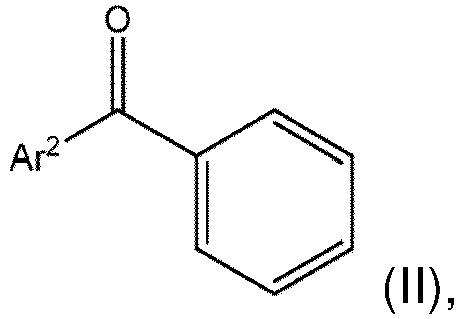
- a polyolefin formulation comprising (A) a polyolefin polymer; at least one and at most two different (B) an acetoarenone compound of formula (I): wherein Ar 1 is a naphthyl or an anthracenyl; and (C) a benzophenone compound of formula (II): wherein Ar 2 is phenyl or an alkylphenyl.
- a method of making the polyolefin formulation comprising contacting the (A) polyolefin polymer with the (B) acetoarenone compound and the (C) benzophenone compound in such a way so as to make the formulation.
- a method of making a crosslinked polyolefin product comprising subjecting the formulation to a curing condition in such a way so as to crosslink the (A) polyolefin polymer, thereby making the crosslinked polyolefin product.
- a crosslinked polyolefin product made by the above method made by the above method.
- An article comprising the polyolefin formulation and/or the crosslinked polymer product.
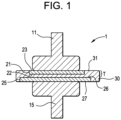
- FIG. 1 is a drawing of a geometry of a test sample for measuring electrical breakdown strength.
- a polyolefin formulation comprising (A) a polyolefin polymer; at least one and at most two different (B) an acetoarenone compound of formula (I): wherein Ar 1 is a naphthyl or an anthracenyl; and (C) a benzophenone compound of formula (II): wherein Ar 2 is phenyl or an alkylphenyl.
- Ar 1 is a naphthyl or an anthracenyl
- C a benzophenone compound of formula (II): wherein Ar 2 is phenyl or an alkylphenyl.
- the two different (B) acetoarenone compounds of formula (I) consist of one compound of formula (I) wherein Ar 1 is naphthyl and one compound of formula (I) wherein Ar 1 is anthracenyl.
- the polyolefin formulation has increased electrical breakdown strength versus that of a (A) polyolefin polymer that is free of one or both of the constituents (B) and (C).
- Aspect 2 The polyolefin formulation of aspect 1 wherein the Ar 2 is phenyl; and Ar 1 is selected from the group consisting of: (i) 1-naphthyl; (ii) 2-naphthyl; (iii) 2-anthracenyl; and (iv) 9-anthracenyl; or wherein the Ar 2 is an alkylphenyl; and Ar 1 is selected from the group consisting of: (i) 1-naphthyl; (ii) 2-naphthyl; (iii) 2-anthracenyl; and (iv) 9-anthracenyl.
- the Ar 2 is phenyl; and Ar 1 is 2-naphthyl.
- the Ar 2 is phenyl; and Ar 1 is 9-anthracenyl.
- the Ar 2 is phenyl and there are two and only two different compounds (B) in the formulation, wherein in one compound (B) Ar 1 is 2-naphthyl and in the other compound (B) the Ar 1 is 9-anthracenyl.
- Aspect 3 The polyolefin formulation of any one of aspects 1 to 2 wherein the Ar 1 is 2-naphthyl or 9-anthracenyl and the Ar 2 is phenyl.
- Aspect 4 The polyolefin formulation of any one of aspects 1 to 3 wherein the (A) polyolefin polymer is selected from the group consisting of: a low-density polyethylene polymer, an ethylene/(C 4 -C 20 )alpha-olefin copolymer, an ethylene/(unsaturated carboxylic ester) copolymer, an ethylene/(monocyclic organosiloxane) copolymer, an ethylene/propylene copolymer, an ethylene/propylene/(diene monomer) terpolymer, and a propylene homopolymer.
- the (A) polyolefin polymer is a low-density polyethylene (LDPE) polymer, alternatively a LDPE homopolymer
- Aspect 5 The polyolefin formulation of any one of aspects 1 to 4 comprising from 50.0 to 99.7 weight percent (wt%) of the (A) polyolefin polymer; from 0.1 to 5.0 wt% of the at least one and at most two different (B) acetoarenone compound; from 0.1 to 2.0 wt% of the (C) benzophenone compound; and a total of from 0.1 to 43 wt% of at least one additive, wherein each of the at least one additive is different than constituents (A), (B), and (C) and is independently selected from the group consisting of: (D) an organic peroxide; (E) an anti-scorch agent; (F) an antioxidant; (G) a filler; (H) a flame retardant; (I) a hindered amine stabilizer; (J) a tree retardant; (K) a methyl radical scavenger; (L) a crosslinking coagent; (M) a processing aid; (N)
- the polyolefin formulation of aspect 5 comprising from 85 to 99.5 weight percent (wt%) of the (A) polyolefin polymer, which is a low-density polyethylene polymer; from 0.20 to 0.54 wt% of the at least one and at most two different (B) acetoarenone compound that is a compound of formula (I) wherein Ar 1 is 2-naphthyl or 9-anthracenyl; from 0.35 to 0.8 wt% of the (C) benzophenone compound of formula (II) wherein Ar 2 is phenyl; and from 0.1 to 1.5 wt% of at least one (F) antioxidant.
- the made formulation may be a non-uniform or uniform blend of constituents (A), (B), and (C).
- the contacting step comprises bringing constituents (A), (B), and (C) into contact with each other (from before they were previously not in contact).
- the contacting step may further comprise mixing the contacted (A), (B), and (C) together to form the uniform mixture thereof.
- the method further comprises mixing at least one of the optional additives (D) to (N) with (A) and (B).
- the mixing may comprise melt blending constituents (B), (C), and optionally one or more of additives (D) to (N) into a melt of constituent (A).
- the melt blending may be performed in an extruder configured for melting mixing polyolefins and additives.
- the resulting melt blend may be extruded through a die in to form a strand that is then pelletized to give the polyolefin formulation in the form of pellets.
- the melt blend may be extruded through a die designed to form the manufactured article comprising the polyolefin formulation.
- a method of making a crosslinked polyolefin product comprising subjecting the polyolefin formulation of any one of aspects 1 to 6 to a curing condition in such a way so as to crosslink the (A) polyolefin polymer, thereby making the crosslinked polyolefin product.
- the curing condition may comprise exposing the formulation to ultraviolet light or heating the formulation with the (D) organic peroxide and, optionally, the (L) crosslinking coagent.
- Embodiments of the method may comprise heating an embodiment of the polyolefin formulation of any one of aspects 1 to 7 that comprises the (D) organic peroxide and, optionally, the (L) crosslinking coagent, in such a way so as to crosslink the (A) polyolefin polymer, thereby making a crosslinked polyolefin product.
- the crosslinking comprises generating covalent carbon-carbon bonds between molecules of the (A) polyolefin polymer.
- the crosslinking comprises generating covalent carbon-carbon bonds between molecules of the (A) polyolefin polymer and generating covalent carbon-carbon bonds between molecules of the (L) crosslinking coagent and molecules of the (A) polyolefin polymer.
- the crosslinked polyolefin product has increased electrical breakdown strength versus that of a crosslinked (A) polyolefin polymer that is free of one or both of the constituents (B) and (C).
- the crosslinked polyolefin product may comprise (A') a crosslinked (networked) polyethylene polymer made by crosslinking the (A) polyolefin polymer or a combination of the (A) polyolefin polymer and the (L) crosslinking coagent; and the constituents (B) and (C).
- the crosslinked polyolefin product may further comprise at least one additive selected from (F) an antioxidant; (G) a filler; (H) a flame retardant; (I) a hindered amine stabilizer; (J) a tree retardant; (K) a methyl radical scavenger; (M) a nucleating agent; and (N) a colorant (e.g., carbon black or titanium dioxide).
- the crosslinked polyolefin product has increased electrical breakdown strength versus that of a crosslinked (A) polyolefin polymer that is free of the constituents (B) and (C).
- Aspect 10 An article comprising the polyolefin formulation of any one of aspects 1 to 6 or the crosslinked polyolefin product of aspect 9.
- the article has increased electrical breakdown strength versus that of an article containing the (A) polyolefin polymer that is free of one or both of the constituents (B) and (C).
- the manufactured article is selected from: a coating, a film, a sheet, an extruded article (not pellets), and an injection molded article.
- coated conductors, insulation layers of wire and cables for transmitting electric power or telecommunications, agricultural film, automobile part, container, food packaging, garment bags, grocery bags, heavy-duty sacks, industrial sheeting, pallet and shrink wraps, bags, buckets, freezer containers, lids, toys.
- the manufactured article has increased electrical breakdown strength versus that of a crosslinked host polyolefin without the (B) acetoarenone compound and the (C) benzophenone compound.
- a coated conductor comprising a conductive core and an insulation layer at least partially covering the conductive core, wherein at least a portion of the insulation layer comprises the crosslinked polyolefin product of aspect 9.
- the coated conductor and its insulation layer have increased electrical breakdown strength versus that of a coated conductor or insulation layer containing the (A) polyolefin polymer that is free of one or both of the constituents (B) and (C).
- the coated conductor and its insulation layer have increased electrical breakdown strength.
- the conductive core may be a wire having proximal and distal ends, at least one end of which may be free of the insulation layer.
- a method of transmitting electricity comprising applying a voltage across the conductive core of the coated conductor of aspect 10 so as to generate a flow of electricity through the conductive core. Also contemplated is a method of transmitting data using the inventive coated conductor that comprises the insulated electrical conductor.
- Aspect 13 The invention of any one of aspects 1 to 12 wherein the polyolefin formulation has an improvement (increase) in electrical breakdown strength value eta, ⁇ , of at least +39 percent (%) relative to that of a comparative formulation that is free of both the (B) acetoarenone compound and the (C) benzophenone compound; wherein the electrical breakdown strength values eta, ⁇ , are determined for a failure probability value of 63.2% using Weibull statistics according to the Electrical Breakdown Strength Test Method and Weibull Statistics Method described in the description.
- the inventive improvement in electrical breakdown strength value eta, ⁇ , (for a failure probability value of 63.2%) relative to that of the (A) polyolefin polymer that is free of a voltage stabilizer (e.g., relative to that of Comparative Example 0 (CE0) described later in the Examples) is at least +45%, alternatively at least +49%.
- the inventive improvement in electrical breakdown strength value eta, ⁇ , (for a failure probability value of 63.2%) relative to that of the (A) polyolefin polymer that is free of a voltage stabilizer (e.g., relative to that of CE0) is further characterized as being at most 75%, alternatively at most +65%, alternatively at most +59%, alternatively at most 53%.
- the inventive improvement in electrical breakdown strength value eta, ⁇ , (for a failure probability value of 63.2%) relative to that of the (A) polyolefin polymer that is free of a voltage stabilizer is from +45% to +54%.
- the inventive improvement in electrical breakdown strength value eta, ⁇ , (for a failure probability value of 63.2%) relative to that of the (A) polyolefin polymer that is free of a voltage stabilizer (e.g., relative to that of CE0) is +50% ⁇ 5%.
- the crosslinked polyolefin product made from the polyolefin formulation has any one of the aforementioned inventive improvement in electrical breakdown strength value eta, ⁇ , (for a failure probability value of 63.2%). All of the foregoing electrical breakdown strength improvement percentage values eta, ⁇ , (for a failure probability value of 63.2%) are determined according to the Electrical Breakdown Strength Test Method described later.
- the values eta, ⁇ , (for a failure probability value of 63.2%) are further characterized by a 90% confidence level beta, ⁇ , determined according to the Electrical Breakdown Strength Test Method and Weibull Statistics Method described later.
- Aspect 14 The invention of any one of aspects 1 to 13 wherein the polyolefin formulation has an improvement (increase) in electrical breakdown strength value eta, ⁇ , that is greater than the sum of eta of a first comparative formulation comprising (A) polyolefin polymer and benzophenone only plus eta of a second comparative formulation comprising (A) polyolefin polymer, 2-acetonaphthone, and 9-acetylanthracene, wherein the weight percent (wt%) of the benzophenone in the first comparative formulation is the same as the wt% of the (C) benzophenone compound in the polyolefin formulation; wherein the wt% of the 2-acetonaphthone in the second comparative formulation is the same as the wt% of the (B) acetoarenone compound in the polyolefin formulation; and wherein the wt% of the 9-acetylanthracene in the second comparative formulation
- the coated conductor may be a power cable having proximal and distal ends, and the electricity may flow through the conductive core from the proximal end to the distal end, or vice versa.
- the conductive core may be a wire.
- the power cable may be a medium-voltage (MV), high-voltage (HV), or extra-high-voltage (EHV) power cable. The power cables are useful in electricity transmitting applications.
- the (A) polyolefin polymer Composed of polyethylene macromolecules that independently comprise at least 5, alternatively from 10 to 200,000 constituent units derived from polymerizing ethylene and zero, one or more other olefin-functional monomers.
- the (A) polyolefin polymer may have a density of from 0.870 to 0.975 gram per cubic centimeter (g/cm 3 ), alternatively from 0.890 to 0.930 g/cm 3 (e.g., LDPE or LLDPE), alternatively from 0.910 to 0.930 g/cm 3 (e.g., LDPE or LLDPE), alternatively from 0.931 to 0.945 g/cm 3 (e.g., MDPE), alternatively from 0.945 to 0.970 g/cm 3 (e.g., HDPE), all measured according to ASTM D792-13, Method B.
- the polyethylene may be a homopolymer or a copolymer.
- the homopolymer is made by polymerizing only ethylene.
- the copolymer is made by polymerizing at least two different olefin monomers, one of which is ethylene.
- the copolymer may be a bipolymer made by polymerizing ethylene and one different olefin monomer, a terpolymer made by polymerizing ethylene and two different olefin monomers, or a tetrapolymer made by polymerizing ethylene and three different olefin monomers.
- the polyolefin that is a copolymer may be a block copolymer or a random copolymer.
- Examples of the olefin-functional monomers used to make the (A) polyolefin polymer are ethylene, propene, (C 4 -C 20 )alpha-olefins, cyclic alkenes (e.g., norbornene), dienes (e.g., 1,3-butadiene), unsaturated carboxylic esters, and olefin-functional hydrolyzable silanes.
- Examples of the (C 4 -C 20 )alpha-olefin are a (C 4 -C 8 )alpha-olefin such as 1-butene, 1-hexene, or 1-octene; and a (C 10 - C 20 )alpha-olefin.
- Example of the diene is 1,3-butadiene.
- Examples of the unsaturated carboxylic esters are alkyl acrylates, alkyl methacrylates, and vinyl carboxylates (e.g., vinyl acetate).
- Examples of the olefin-functional hydrolyzable silanes are vinyltrialkoxysilanes, vinyltris(dialkylamino)silanes, and vinyl(trioximo)silanes.
- the (A) polyolefin polymer is an ethylene-based polymer.
- An ethylene-based polymer comprises from 51 to 100 wt% of ethylenic units derived from polymerizing ethylene and from 49 to 0 wt% of comonomeric units derived from polymerizing one, alternatively two olefin-functional monomer (comonomer).
- the comonomer may be selected from propylene, a (C 4 -C 20 )alpha-olefin, and 1,3-butadiene.
- the (C 4 -C 20 )alpha-olefin may be a (C 4 -C 8 )alpha-olefin such as 1-butene, 1-hexene, or 1-octene.
- ethylene-based polymers examples include polyethylene homopolymers, ethylene/(C 4 -C 20 )alpha-olefin copolymers, ethylene/propylene copolymers, ethylene/propylene/diene monomer (EPDM) copolymers such as an ethylene/propylene/1,3-butadiene terpolymer, and ethylene/1-butene/styrene copolymers.
- suitable ethylene/(C 4 -C 20 )alpha-olefin copolymers examples include ethylene/1-butene copolymers, ethylene/1-hexene copolymers, and ethylene/1-octene copolymers.
- the ethylene-based polymers may be an ultra-low-density polyethylene (ULDPE), very low-density polyethylene (VLDPE), a linear low-density polyethylene (LLDPE), a low-density polyethylene (LDPE), a medium-density polyethylene (MDPE), a high-density polyethylene (HDPE), or an ultra-high-density polyethylene (UHDPE).
- ULDPE ultra-low-density polyethylene
- VLDPE very low-density polyethylene
- LLDPE linear low-density polyethylene
- LDPE low-density polyethylene
- MDPE medium-density polyethylene
- HDPE high-density polyethylene
- UHDPE ultra-high-density polyethylene
- Many of the ethylene-based polymers are sold by The Dow Chemical Company under trade names like AFFINITY, ATTANE, DOWLEX, ENGAGE, FLEXOMER, or INFUSE.
- LDPE is made in a high pressure polymerization reactor in the presence of a free radical initiator (a peroxide or O 2 ) without an olefin polymerization catalyst
- LLDPE is made in a standard pressure polymerization reactor in the presence of an olefin polymerization catalyst and in the absence of a free radical initiator.
- the (A) polyolefin polymer is a polyethylene homopolymer, e.g., the low-density polyethylene (LDPE). All of the constituent units thereof are ethylenic repeat units.
- LDPE can be made by polymerizing ethylene in a high pressure reactor in the absence of a metal-based polymerization catalyst and in the presence of a small amount (e.g., 0.3 to 0.4 wt%) of a free radical initiator (e.g., a peroxide or mixture of peroxides or O 2 ) and 1 wt% of a chain transfer agent that is propylene.
- a free radical initiator e.g., a peroxide or mixture of peroxides or O 2
- the (A) polyolefin polymer consist of polymer of only one ethylene-based polymer (e.g., only LLDPE, or only LDPE, or only MDPE, or only HDPE). In some embodiments the (A) polyolefin polymer consists of an LDPE. When the (A) polyolefin polymer consists of an LDPE, in some such embodiments the polyolefin formulation may be free of any organic polymer other than the LDPE.
- the (A) polyolefin polymer may be the ethylene/alpha-olefin copolymer.
- the ethylene/alpha-olefin copolymer may be an ethylene/1-butene copolymer, an ethylene/1-hexene copolymer, an ethylene/1-octene copolymer, or a combination of any two thereof.
- the constituent units of the ethylene/(C 4 -C 20 )alpha-olefin copolymer consist of from 51 to 99.9 wt% ethylene-derived constituent units and from 49 to 0.1 wt% alpha-olefin-derived constituent units.
- the (A) polyolefin polymer may be the ethylene/propylene copolymer.
- the constituent units of the ethylene/propylene copolymer consist of ethylenic monomeric units, propylenic comonomeric units, and, optionally, diene comonomeric units.
- the (A) polyolefin polymer may be the ethylene/(unsaturated carboxylic ester) copolymer.
- the unsaturated carboxylic ester is vinyl acetate, an alkyl acrylate, or an alkyl methacrylate.
- the (A) polyolefin polymer may be the ethylene/(monocyclic organosiloxane) copolymer.
- the (A) polyolefin polymer may comprise a blend two or more different ethylene-based polymers.
- the two or more different ethylene-based polymers of the blend includes a least one LDPE.
- the (A) polyolefin polymer consists of a low-density polyethylene (LDPE) polymer.
- the LDPE polymer is made by polymerizing ethylene in a high pressure reactor in the absence of a metal-based polymerization catalyst and in the presence of a small amount of a free radical initiator (e.g., a peroxide or O 2 ) and a chain transfer agent (CTA).
- the CTA may be propylene, which may be used at 1 wt% relative to the total weight of ethylene and propylene in the high pressure reactor.
- the LDPE polymer may have a density of from 0.910 to 0.930 g/cm 3 and a melt index (I 2 ) of from 1.0 to 5 g/10 min.
- the LDPE polymer may be LDPE-1 described in the Examples.
- the polyolefin formulation may comprise from 60.0 to 99.9 wt% of the (A) polyolefin polymer; alternatively from 70.0 to 99.9 wt% of the (A) polyolefin polymer; alternatively from 85.0 to 99.9 wt% of the (A) polyolefin polymer; alternatively from 90.0 to 99.9 wt% of the (A) polyolefin polymer; all based on total weight of the polyolefin formulation.
- Ar 1 is 1-naphthyl, 2-naphthyl, 2-anthracenyl, or 9-anthracenyl; alternatively 2-naphthyl or 9-anthracenyl; alternatively 2-naphthyl, alternatively 9-anthracenyl.
- the (B) acetoarenone compound of formula (I) may be 1-acetonaphthone ( CAS 941-98-0 ), 2-acetonaphthone ( CAS No. 93-08-3 ), 2-acetylanthracene ( CAS 10210-32-9 ), or 9-acetylanthracene (CAS No. 784-04-3).
- the Ar 2 group in formula (II) may be the alkylphenyl.
- Alkylphenyl is a phenyl group independently substituted with from 1 to 5 (C 1 -C 20 )alkyl groups. Without being bound by theory it is believed that the alkyl substituent(s) on the phenyl aid in the solubility of the (C) benzophenone compound having same in the (A) polyolefin polymer.
- the alkylphenyl may be a (C 1 )alkylphenyl (i.e., a methylphenyl), a (C 2 -C 20 )alkylphenyl, or a combination thereof.
- Examples of (C 1 )alkylphenyl (i.e., a methylphenyl) include 4-methylphenyl; 2,4-dimethyphenyl; 2,5-dimethylphenyl; 2,4,5-trimethylphenyl; and 2,3,4,t-tetramethylphenyl.
- Examples of (C 2 -C 20 )alkylphenyl include 4-ethylphenyl; 4-hexylphenyl; 4-decylphenyl; 4-nonadecylphenyl. Examples of the combination include 2-methyl-4-hexylphenyl.
- Ar 2 is phenyl or a methyl-substituted phenyl; alternatively phenyl.
- the Ar 2 may be phenyl and the (C) benzophenone compound of formula (II) may be benzophenone per se (CAS 119-61-9).
- the Ar 2 may be 4-methylphenyl, 2,4-dimethylphenyl, 3,4-dimethylphenyl, or 4-(1,1-dimethylethyl)phenyl and the (C) benzophenone compound of formula (II) may be 4-methylbenzophenone (CAS 134-84-9), 2,4,-dimethylbenzophenone ( CAS 1140-14-3 ), 3,4,-dimethylbenzophenone ( CAS 2571-39-3 ), or 4-tert-butylbenzophenone ( CAS 22679-54-5 ).
- the polyolefin formulation and crosslinked polyolefin product made therefrom may be free of any voltage stabilizer compound except the at least one and at most two different (B) acetoarenone compound and the (C) benzophenone compound.
- the polyolefin formulation and crosslinked polyolefin product made therefrom may contain a third voltage stabilizer compound, which is different than the (B) acetoarenone compound and the (C) benzophenone compound.
- the polyolefin formulation and crosslinked polyolefin product made therefrom may independently contain from 0.1 to 5.0 wt%, alternatively 0.15 to 3.0 wt%, alternatively from 0.15 to 2.0 wt% of the (B) acetoarenone compound and the (C) benzophenone compound.
- the amount of the (B) acetoarenone compound is from 0.10 to 2.0 wt%, alternatively from 0.15 to 1.40 wt%, alternatively from 0.20 to 0.54 wt%, alternatively from 0.20 to 0.30 wt%, alternatively from 0.35 to 0.54 wt%.
- the amount of the (C) benzophenone compound is from 0.25 to 1.40 wt%, alternatively from 0.30 to 0.90 wt%, alternatively from 0.35 to 0.75 wt%, alternatively from 0.35 to 0.54 wt%, alternatively from 0.45 to 0.75 wt%. All wt% are based on total weight of the polyolefin formulation or total weight of the crosslinked polyolefin product, respectively.
- the constituent (D) organic peroxide a molecule containing carbon atoms, hydrogen atoms, and two or more oxygen atoms, and having at least one -O-O- group, with the proviso that when there are more than one -O-O- group, each -O-O- group is bonded indirectly to another -O-O- group via one or more carbon atoms, or collection of such molecules.
- the (D) organic peroxide may be added to the polyolefin formulation for curing comprising heating the polyolefin formulation comprising constituents (A), (B), and (D) to a temperature at or above the (D) organic peroxide's decomposition temperature.
- the (D) organic peroxide may be a monoperoxide of formula R O -O-O-R O , wherein each R O independently is a (C 1 -C 20 )alkyl group or (C 6 -C 20 )aryl group. Each (C 1 -C 20 )alkyl group independently is unsubstituted or substituted with 1 or 2 (C 6 -C 12 )aryl groups. Each (C 6 -C 20 )aryl group is unsubstituted or substituted with 1 to 4 (C 1 -C 10 )alkyl groups.
- the (D) may be a diperoxide of formula R O -O-O-R-O-O-R O , wherein R is a divalent hydrocarbon group such as a (C 2 -C 10 )alkylene, (C 3 -C 10 )cycloalkylene, or phenylene, and each R O is as defined above.
- the (D) organic peroxide may be bis(1,1-dimethylethyl) peroxide; bis(1,1-dimethylpropyl) peroxide; 2,5-dimethyl-2,5-bis(1,1-dimethylethylperoxy) hexane; 2,5-dimethyl-2,5-bis(1,1-dimethylethylperoxy) hexyne; 4,4-bis(1,1-dimethylethylperoxy) valeric acid; butyl ester; 1,1-bis(1,1-dimethylethylperoxy)-3,3,5-trimethylcyclohexane; benzoyl peroxide; tert-butyl peroxybenzoate; di-tert-amyl peroxide ("DTAP”); bis(alpha-t-butyl-peroxyisopropyl) benzene (“BIPB”); isopropylcumyl t-butyl peroxide; t-but
- the (D) organic peroxide may be dicumyl peroxide.
- a blend of two or more (D) organic peroxides is used, e.g., a 20:80 (wt/wt) blend of t-butyl cumyl peroxide and bis(t-butyl peroxy isopropyl)benzene (e.g., LUPEROX D446B, which is commercially available from Arkema).
- at least one, alternatively each (D) organic peroxide contains one -O-O- group.
- the (D) organic peroxide may be 0.29 to 0.44 wt%, alternatively 0.30 to 39 wt%, alternatively 0.30 to 0.37 wt% of the carrier mixture, alternatively of the polyolefin formulation.
- the optional constituent (E) scorch retardant a molecule that inhibits premature curing, or a collection of such molecules.
- a scorch retardant are hindered phenols; semi-hindered phenols; TEMPO; TEMPO derivatives; 1,1-diphenylethylene; 2,4-diphenyl-4-methyl-1-pentene (also known as alpha-methyl styrene dimer or AMSD); and allyl-containing compounds described in US 6277925B1 , column 2, line 62, to column 3, line 46.
- the polyolefin formulation and crosslinked polyolefin product is free of (E).
- the (E) scorch retardant may be from 0.01 to 1.5 wt%, alternatively 0.05 to 1.2 wt%, alternatively 0.1 to 1.0 wt% of the polyolefin formulation.
- the optional constituent (F) antioxidant an organic molecule that inhibits oxidation, or a collection of such molecules.
- the (F) antioxidant functions to provide antioxidizing properties to the polyolefin formulation and/or crosslinked polyolefin product.
- suitable (F) are bis(4-(1-methyl-1-phenylethyl)phenyl)amine (e.g., NAUGARD 445); 2,2'-methylene-bis(4-methyl-6-t-butylphenol) (e.g., VANOX MBPC); 2,2'-thiobis(2-t-butyl-5-methylphenol ( CAS No.
- 4,4'-thiobus(2-t-butyl-5-methylphenol) also known as 4,4'-thiobis(6-tert-butyl-m-cresol), CAS No. 96-69-5 , commercially LOWINOX TBM-6
- 2,2'-thiobis(6-t-butyl-4-methylphenol CAS No.
- IRGANOX 1520 2',3-bis[[3-[3,5-di-tert-butyl-4-hydroxyphenyl]propionyl]] propionohydrazide
- IRGANOX 1024 2',3-bis[[3-[3,5-di-tert-butyl-4-hydroxyphenyl]propionyl]] propionohydrazide
- F is4,4 thiobis(2-t-butyl-5-methylphenol) (also known as 4,4'-thiobis(6-tert-butyl-m-cresol); 2,2'-thiobis(6-t-butyl-4-methylphenol; tris[(4-tert-butyl-3-hydroxy-2,6-dimethylphenyl)methyl]-1,3,5-triazine-2,4,6-trione; distearyl thiodipropionate; or dilauryl thiodipropionate; or a combination of any two or more thereof.
- the combination may be tris[(4-tert-butyl-3-hydroxy-2,6-dimethylphenyl)methyl]-1,3,5-triazine-2,4,6-trione and distearyl thiodipropionate.
- the polyolefin formulation and crosslinked polyolefin product is free of (F).
- the (F) antioxidant may be from 0.01 to 1.5 wt%, alternatively 0.05 to 1.2 wt%, alternatively 0.1 to 1.0 wt% of the polyolefin formulation.
- the optional constituent (H) flame retardant a molecule or substance that inhibits combustion, or a collection of such molecules.
- the (H) may be a halogenated or halogen-free compound.
- Examples of (H) halogenated (H) flame retardants are organochlorides and organobromides, Examples of the organochlorides are chlorendic acid derivatives and chlorinated paraffins.
- organobromides examples include decabromodiphenyl ether, decabromodiphenyl ethane, polymeric brominated compounds such as brominated polystyrenes, brominated carbonate oligomers, brominated epoxy oligomers, tetrabromophthalic anhydride, tetrabromobisphenol A and hexabromocyclododecane .
- the halogenated (H) flame retardants are used in conjunction with a synergist to enhance their efficiency.
- the synergist may be antimony trioxide.
- the halogen-free (H) flame retardant examples include inorganic minerals, organic nitrogen intumescent compounds, and phosphorus based intumescent compounds.
- Examples of the inorganic minerals are aluminum hydroxide and magnesium hydroxide.
- Examples of the phosphorous-based intumescent compounds are organic phosphonic acids, phosphonates, phosphinates, phosphonites, phosphinites, phosphine oxides, phosphines, phosphites, phosphates, phosphonitrilic chloride, phosphorus ester amides, phosphoric acid amides, phosphonic acid amides, phosphinic acid amides, melamine and melamine derivatives thereof, including melamine polyphosphate, melamine pyrophosphate and melamine cyanurate, and mixtures of two or more of these materials.
- Examples include phenylbisdodecyl phosphate, phenylbisneopentyl phosphate, phenyl ethylene hydrogen phosphate, phenyl-bis-3,5,5' trimethylhexyl phosphate), ethyldiphenyl phosphate, 2 ethylhexyl di(p-tolyl) phosphate, diphenyl hydrogen phosphate, bis(2-ethyl-hexyl) para-tolylphosphate, tritolyl phosphate, bis(2-ethylhexyl)-phenyl phosphate, tri(nonylphenyl) phosphate, phenylmethyl hydrogen phosphate, di(dodecyl) p-tolyl phosphate, tricresyl phosphate, triphenyl phosphate, triphenyl phosphate, dibutylphenyl phosphate, 2-chloroethyldiphenyl phosphate,
- Phosphoric acid esters of the type described in U.S. Patent No. 6,404,971 are examples of phosphorus-based flame retardants. Additional examples include liquid phosphates such as bisphenol A diphosphate (BAPP) (Adeka Palmarole) and/or resorcinol bis(diphenyl phosphate) (Fyroflex RDP) (Supresta, ICI), solid phosphorus such as ammonium polyphosphate (APP), piperazine pyrophosphate and piperazine polyphosphate. Ammonium polyphosphate is often used with flame retardant co-additives, such as melamine derivatives.
- BAPP bisphenol A diphosphate
- Fyroflex RDP resorcinol bis(diphenyl phosphate)
- Solid phosphorus such as ammonium polyphosphate (APP), piperazine pyrophosphate and piperazine polyphosphate.
- Ammonium polyphosphate is often used with flame retardant co-additives, such as melamine
- the polyolefin formulation and crosslinked polyolefin product is free of (H).
- the (H) may be in a concentration of from 0.01 to 70 wt%, alternatively 0.05 to 40 wt%, alternatively 1 to 20 wt% of the polyolefin formulation.
- the optional constituent (I) hindered amine stabilizer a molecule that contains a basic nitrogen atom that is bonded to at least one sterically bulky organo group and functions as an inhibitor of degradation or decomposition, or a collection of such molecules.
- the (I) is a compound that has a sterically hindered amino functional group and inhibits oxidative degradation and can also increase the shelf lives of embodiments of the polyolefin formulation that contain (D) organic peroxide.
- suitable (I) are butanedioic acid dimethyl ester, polymer with 4-hydroxy-2,2,6,6-tetramethyl-1-piperidine-ethanol ( CAS No.
- polyolefin formulation and crosslinked polyolefin product is free of (I).
- the (I) hindered amine stabilizer may be from 0.001 to 1.5 wt%, alternatively 0.002 to 1.2 wt%, alternatively 0.002 to 1.0 wt%, alternatively 0.005 to 0.5 wt%, alternatively 0.01 to 0.2 wt%, alternatively 0.05 to 0.1 wt% of the polyolefin formulation.
- the optional constituent (J) tree retardant a molecule that inhibits water and/or electrical treeing, or a collection of such molecules.
- the tree retardant may be a water tree retardant or electrical tree retardant.
- the water tree retardant is a compound that inhibits water treeing, which is a process by which polyolefins degrade when exposed to the combined effects of an electric field and humidity or moisture.
- the electrical tree retardant also called a voltage stabilizer, is a compound that inhibits electrical treeing, which is an electrical pre-breakdown process in solid electrical insulation due to partial electrical discharges. Electrical treeing can occur in the absence of water. Water treeing and electrical treeing are problems for electrical cables that contain a coated conductor wherein the coating contains a polyolefin.
- the (J) may be a poly(ethylene glycol) (PEG).
- the polyolefin formulation and crosslinked polyolefin product is free of (J).
- the (J) tree retardant may be from 0.01 to 1.5 wt%, alternatively 0.05 to 1.2 wt%, alternatively 0.1 to 1.0 wt% of the polyolefin formulation.
- the optional constituent (K) methyl radical scavenger a molecule that is reactive with methyl radicals, or a collection of such molecules.
- the (K) react with methyl radicals in the polyolefin formulation or crosslinked polyolefin product.
- the (K) may be a "TEMPO" derivative of 2,2,6,6-tetramethyl-1-piperidinyl-N-oxyl or a 1,1-diarylethylene. Examples of TEMPO derivatives are 4-acryloxy-2,2,6,6-tetramethyl-1-piperidinyl-N-oxyl ( CAS No.
- acrylate TEMPO 4-allyloxy-2,2,6,6-tetramethyl-1-piperidinyl-N-oxyl ( CAS No. 217496-13-4 , “allyl TEMPO”); bis(2,2,6,6-tetramethyl-1-piperidinyl-N-oxyl) sebacate ( CAS No. 2516-92-9 , “bis TEMPO”)); N,N-bis(acryloyl-4-amino)-2,2,6,6-tetramethyl-1-piperidinyl-N-oxyl ( CAS No.
- the polyolefin formulation and crosslinked polyolefin product is free of (K).
- the (K) methyl radical scavenger may be from 0.01 to 1.5 wt%, alternatively 0.05 to 1.2 wt%, alternatively 0.1 to 1.0 wt% of the polyolefin formulation.
- the optional constituent (L) crosslinking coagent a molecule that contains a backbone or ring substructure and one, alternatively two or more propenyl, acrylate, and/or vinyl groups bonded thereto, wherein the substructure is composed of carbon atoms and optionally nitrogen atoms, or a collection of such molecules.
- the (L) crosslinking coagent is free of silicon atoms.
- the (L) crosslinking coagent may be a propenyl-functional crosslinking coagent as described by any one of limitations (i) to (v):
- (i) (L) is 2-allylphenyl allyl ether; 4-isopropenyl-2,6-dimethylphenyl allyl ether; 2,6-dimethyl-4-allylphenyl allyl ether; 2-methoxy-4-allylphenyl allyl ether; 2,2'-diallyl bisphenol A; O,O'-diallyl bisphenol A; or tetramethyl diallylbisphenol A;
- (ii) (L) is 2,4-diphenyl-4-methyl-1-pentene or 1,3-diisopropenylbenzene;
- (iii) (L) is triallyl isocyanurate ("TAIC”); triallyl cyanurate (“TAC”); triallyl trimellitate ("TATM”); N,N,N',N'
- the (L) may be an acrylate-functional crosslinking coagent selected from trimethylolpropane triacrylate (“TMPTA”), trimethylolpropane trimethylacrylate (“TMPTMA”), ethoxylated bisphenol A dimethacrylate, 1,6-hexanediol diacrylate, pentaerythritol tetraacrylate, dipentaerythritol pentaacrylate, tris(2-hydroxyethyl) isocyanurate triacrylate, and propoxylated glyceryl triacrylate.
- TMPTA trimethylolpropane triacrylate
- TMPTMA trimethylolpropane trimethylacrylate
- ethoxylated bisphenol A dimethacrylate 1,6-hexanediol diacrylate
- pentaerythritol tetraacrylate pentaerythritol tetraacrylate
- the (L) may be a vinyl-functional crosslinking coagent selected from polybutadiene having at least 50 wt% 1,2-vinyl content and trivinyl cyclohexane ("TVCH").
- the (L) may be a crosslinking coagent described in US 5,346,961 or US 4,018,852 .
- the (L) may be a combination or any two or more of the foregoing crosslinking coagents.
- the polyolefin formulation and crosslinked polyolefin product is free of (L).
- the (L) crosslinking coagent may be 0.01 to 4.5 wt%, alternatively 0.05 to 2 wt%, alternatively 0.1 to 1 wt%, alternatively 0.2 to 0.5 wt% of the polyolefin formulation.
- the optional constituent (M) processing aid an organic or organosiloxane additive that enhances flowability of a melt of the (A) polyolefin polymer during extrusion thereof.
- (M) are poly(fluoroethylene) polymers and polydimethylsiloxanes.
- the polyolefin formulation and crosslinked polyolefin product is free of (M).
- the (M) may be in a concentration of from 0.01 to 1.5 wt%, alternatively 0.05 to 1.2 wt%, alternatively 0.1 to 1.0 wt% of the polyolefin formulation.
- the optional constituent (N) colorant e.g., carbon black or TiO 2 .
- Carbon black a finely-divided form of paracrystalline carbon having a high surface area-to-volume ratio, but lower than that of activated carbon. Examples of carbon black are furnace carbon black, acetylene carbon black, conductive carbons (e.g., carbon fibers, carbon nanotubes, graphene, graphite, and expanded graphite platelets).
- the polyolefin formulation and crosslinked polyolefin product is free of (N).
- the (N) may be in a concentration of from 0.01 to 40 wt%, alternatively 0.05 to 35 wt%, alternatively 0.1 to 20 wt%, alternatively 0.5 to 10 wt%, alternatively 1 to 5 wt%, of the polyolefin formulation.
- polyolefin formulation may independently further comprise one or more other optional additives selected from a carrier resin, lubricant, slip agent, plasticizer, surfactant, extender oil, acid scavenger, and metal deactivator.
- a carrier resin lubricant, slip agent, plasticizer, surfactant, extender oil, acid scavenger, and metal deactivator.
- the crosslinked polyolefin product may also contain by-products of curing such as alcohol and ketone by-products of the reaction of the (D) organic peroxide.
- the polyolefin formulation further contains one or more of any optional additives or constituents such as (F) antioxidant
- the crosslinked polyolefin product may also contain the any one or more of the optional additives or constituents such as (F), or one or more reaction products formed therefrom during the curing of the polyolefin formulation.
- the crosslinked polyolefin product may be in a divided solid form or in continuous form.
- the divided solid form may comprise granules, pellets, powder, or a combination of any two or more thereof.
- the continuous form may be an article of manufacture such as molded part (e.g., injection molded part) or an extruded part (e.g., a coated conductor or a cable).
- the coated conductor may be an insulated electrical conductor.
- the insulated electrical conductor may be a coated metal wire or an electrical cable, including a power cable for use in low voltage ("LV", > 0 to ⁇ 5 kilovolts (kV)), medium voltage ("MV", 5 to ⁇ 69 kV), high voltage (“HV", 69 to 230 kV) or extra-high voltage (“EHV", > 230 kV) data transmitting and electricity-transmitting/distributing applications.
- a "wire” means a single strand or filament of conductive material, e.g., conductive metal such as copper or aluminum.
- a “cable” and “power cable” are synonymous and mean an insulated electrical conductor comprising at least one wire disposed within a covering that may be referred to as a sheath, jacket (protective outer jacket), or coating.
- the insulated electrical conductor may be designed and constructed for use in medium, high, or extra-high voltage applications. Examples of suitable cable designs are shown in US 5,246,783 ; US 6,496,629 ; and US 6,714,707 .
- the insulated electrical conductor may contain a conductor/transmitter core and an outer single layer covering or an outer multilayer covering disposed therearound so as to protect and insulate the conductor/transmitter core from external environments.
- the conductor/transmitter core may be composed of one or more metal wires. When the conductor/transmitter core contains two or more metal wires, the metal wires may be sub-divided into discrete wire bundles. Each wire in the conductor/transmitter core, whether bundled or not, may be individually coated with an insulation layer and/or the discrete bundles may be coated with an insulation layer.
- the single layer covering or multilayer covering primarily functions to protect or insulate the conductor/transmitter core from external environments such as sunlight, water, heat, oxygen, other conductive materials (e.g., to prevent short-circuiting), and/or other corrosive materials (e.g., chemical fumes).
- the single layer or multilayer covering from one insulated electrical conductor to the next may be configured differently depending upon their respective intended uses.
- the multilayer covering of the insulated electrical conductor may be configured sequentially from its innermost layer to its outermost layer with the following components: an inner semiconducting layer, a crosslinked polyolefin insulation layer comprising the crosslinked polyolefin product (inventive crosslinked product), an outer semiconducting layer, a metal shield, and a protective sheath.
- the layers and sheath are circumferentially and coaxially (longitudinally) continuous.
- the metal shield (ground) is coaxially continuous, and circumferentially either continuous (a layer) or discontinuous (tape or wire).
- the multilayer covering for the insulated optical fiber may omit the semiconducting layers and/or the metal shield.
- the outer semiconducting layer when present, may be composed of a peroxide-crosslinked semiconducting product that is either bonded or strippable from the crosslinked polyolefin layer.
- a method of making the coated conductor comprising extruding a coating comprising a layer of the polyolefin formulation onto a conductor/transmitter core to give a coated core, and passing coated core through a continuous vulcanization (CV) apparatus configured with suitable CV conditions for curing the polyolefin formulation to give the coated conductor.
- CV conditions include temperature, atmosphere (e.g., nitrogen gas), and line speed or passage time period through the CV apparatus.
- Suitable CV conditions may give a coated conductor exiting the CV apparatus, wherein the coated conductor contains a crosslinked polyolefin layer formed by curing the layer of the crosslinked polyolefin layer.
- Electrical breakdown strength the maximum electric field (voltage applied divided by electrode separation distance) that an electrically insulative material can withstand without experiencing an electrical breakdown event, i.e., without becoming electrically conductive. Expressed in volts using a standard electrode separation distance.
- Any compound, composition, formulation, material, mixture, or reaction product herein may be free of any one of the chemical elements selected from the group consisting of: H, Li, Be, B, C, N, O, F, Na, Mg, Al, Si, P, S, Cl, K, Ca, Sc, Ti, V, Cr, Mn, Fe, Co, Ni, Cu, Zn, Ga, Ge, As, Se, Br, Rb, Sr, Y, Zr, Nb, Mo, Tc, Ru, Rh, Pd, Ag, Cd, In, Sn, Sb, Te, I, Cs, Ba, Hf, Ta, W, Re, Os, Ir, Pt, Au, Hg, Tl, Pb, Bi, lanthanoids, and actinoids; with the proviso that chemical elements that are inherently required by the compound, composition, formulation, material, mixture, or reaction product (e.g., C and H required by a polyethylene, or C, H, and O required by an alcohol) are not omitted.
- ANSI is the American National Standards Institute organization headquartered in Washington, D.C., USA.
- ASME is the American Society of Mechanical Engineers, headquartered in New York City, New York, USA.
- ASTM is the standards organization, ASTM International, West Conshohocken, Pennsylvania, USA. Any comparative example is used for illustration purposes only and shall not be prior art. Free of or lacks means a complete absence of; alternatively not detectable.
- IEC is International Electrotechnical Commission, 3 rue de Varemb, Case postale 131, CH-1211, Geneva 20, Switzerland, http://www.iec.ch.
- IUPAC International Union of Pure and Applied Chemistry (IUPAC Secretariat, Research Triangle Park, North Carolina, USA).
- Periodic Table of the Elements is the IUPAC version of May 1, 2018. May confers a permitted choice, not an imperative.
- Operative means functionally capable or effective.
- Optional(ly) means is absent (or excluded), alternatively is present (or included). Properties may be measured using standard test methods and conditions. Ranges include endpoints, subranges, and whole and/or fractional values subsumed therein, except a range of integers does not include fractional values.
- any one of the terms “comprising” or “comprises” may be replaced by the phrase “consisting essentially of” or “consists essentially of”.
- the phrases “consisting essentially of” and “consists essentially of” are partially-closed ended and mean that the polyolefin formulation and the crosslinked polyolefin product made therefrom are free of the excluded materials.
- the excluded materials may comprise any voltage stabilizer that is not the one and only compound (B) acetoarenone compound and the (C) benzophenone compound.
- ranges from any lower limit may be combined with any upper limit to recite a range not explicitly recited.
- ranges from any lower limit may be combined with any other lower limit to recite a range not explicitly recited; and in the same way, ranges from any upper limit may be combined with any other upper limit to recite a range not explicitly recited.
- Density Test Method measured according to ASTM D792-13, Standard Test Methods for Density and Specific Gravity (Relative Density) of Plastics by Displacement, Method B (for testing solid plastics in liquids other than water, e.g., in liquid 2-propanol). Report results in units of grams per cubic centimeter (g/cm 3 ).
- the inventive embodiments may be tested according to the following Electrical Breakdown Strength Test Method.
- the description of the method is separated for clarity into sections 1 to 3.
- Section 1 deals with the materials used to prepare a test assembly.
- Section 2 deals with the procedure for preparing a test plaque representing an insulation layer and preparing the test assembly.
- the test assembly comprises a sandwich of the test plaque representing an insulation layer and two conductor disks, wherein the test plaque (insulation layer) is disposed between the conductor disks.
- Section 3 deals with a procedure for applying an increasing test voltage to the test assembly, and detecting an electrical breakdown event in the insulation layer.
- Section 1 Electrical Breakdown Strength Test Method (materials): conductors are a plurality of 40 millimeter (mm) diameter aluminum disks and a plurality of 29 mm diameter aluminum disks; wherein each disk 75 microns thick. Sandwich test insulation layer between the conductors so that the total thickness of the sandwich is 350 to 500 microns. After breakdown, remove Al disks and measure thickness of the insulation layer at the location of breakdown.
- Section 2 Electrical Breakdown Strength Test Method (procedure for assembling electrodes and test plaques into test assemblies).
- step 1 Weigh polymer pellets. Place the weighed pellets in a compression mold (8-inch by 8-inch square compression molding frame, of from about 150 to about 900 microns thickness). Pre-warm the polymer pellets under about 7 pounds per square inch (psi) to 140° C. for 3 minutes. Under the same temperature, switch to high pressure of about 382 psi, and hold for 3 minutes. Under the same pressure, cool down the resulting polymer plaque to room temperature within about 15 minutes.
- psi pounds per square inch
- Step 2 Cut a plurality of conductive aluminum (Al) disks of 29 mm and 40 mm diameter out from aluminum sheets of 75 microns thick. Place the conductive Al disks on top and bottom of the plaque (prepared in step 1), with the 29 mm diameter disks on one side and 40-mm diameter disks on the opposite side. The two conductive Al disks are opposing each other and positioned approximately concentric with each other. Position 3-by-3 array of 9 such conductive Al disk pairs, spaced apart on each side of the 8 inch x 8 inch polymer plaque. Thermally compress the resulting assembly in the same compression mold and under the same protocol as in step 1. Then place the assembly between two brass electrodes to give the test assembly. Each test assembly has nine pairs of upper and lower brass electrodes, nine pairs of upper and lower conductive Al disks, and a single plaque sandwiched between the nine pairs of upper and lower conductive Al disks.
- Al conductive aluminum
- a portion 1 of the test assembly is shown in Fig. 1 .
- Each test assembly has nine portions 1.
- Portion 1 of the test assembly includes one of the nine pairs of upper and lower brass electrodes 11 and 15, respectively; one of the nine pairs of upper and lower conductive Al disks 21 and 25, respectively; and a portion of the single plaque 30 ( Fig. 1 ).
- Each pair of brass electrodes 11 and 15 is in electrical communication with a device (not shown) configured for supplying electrical current, detecting electrical breakdown, and measuring voltage thereat.
- Brass electrodes 11 and 15 are used to apply the electrical current to its pair of conductive Al disks 21 and 25 respectively.
- Upper conductive Al disk 21 independently has lower surface 22 and upper surface 23 and its disk thickness is the distance therebetween (i.e., distance from 22 to 23).
- Lower conductive Al disk 25 independently has lower surface 27 and upper surface 26 and its disk thickness is the distance therebetween (i.e., distance from 26 to 27).
- the thickness of the plaque 30 between the conductive Al disks 21 and 25 is the distance between the lower surface 22 of upper conductive Al disk 21 and the upper surface 26 of lower conductive Al disk 25.
- Each portion of plaque 30 independently has upper surface 31.
- the thickness T of the portion of plaque 30 used in the determination of the electrical breakdown strength in Section 3 below is the distance between the upper surface 26 of lower conductive Al disk 25 and the upper surface 31 of plaque 30. This thickness T is indicated by the " ⁇ T" in Fig. 1 and is measured at location of a channel created by the electrical breakdown event referenced in Section 3.
- Section 3 Electrical Breakdown Strength Test Method: procedure for applying an alternating electrical current (AC) with increasing test voltage to the test assembly and detecting an electrical breakdown event. Submerge the assembly prepared above in insulation oil and contact same at top and bottom by brass electrodes. Apply voltage. Gradually increase the voltage at a rate of 500 V/S (volts per second, 50Hz) until a breakdown event takes place, resulting in a channel being created that penetrates through the polymer. A breakdown event is detected as a sudden increase in electrical current. The applied kilovoltage (V) at which this jump in electrical current event occurs is recorded. Such a breakdown event results from a channel being created by the applied voltage in the insulation layer.
- AC alternating electrical current
- E act is normalized to 1.016 millimeter (mm, equal to 40 mils) thickness and reported as normalized breakdown strength E in kV/mm.
- T is the measured thickness of the insulation layer (plaque, at the location of breakdown)
- T 0 is thickness of 1.016 mm (equivalent to 40 mils) such that T/T 0 normalizes the breakdown strength value to 1.016 mm thickness. Record the voltage at which electrical breakdown event occurs. Evaluate efficacy of voltage stabilizer by comparing breakdown field strength of the same polymer with and without additive.
- the voltage at which the electrical breakdown event occurs will vary depending upon thickness of the insulation layer.
- the electrical breakdown strength value used to determine improvement or diminishment relative to a baseline value for CE0 is the value eta, ⁇ , that is a predicted for a failure probability value of 63.2% and is determined from the normalized field strength E values using the Weibull statistics described above. Also reported is the 90% confidence levels (upper and lower) beta, ⁇ , value, b, obtained using the Weibull statistics described above. All other things being equal, the higher the ⁇ value, the narrower the range of filed strength within which the test samples N fail, and therefore the narrower is the range of E at the 90% confidence level.
- Polyethylene polymer (A)-1 a low-density polyethylene (LDPE-1).
- LDPE-1 has a density 0.920 g/cm 3 and a melt index of 2.0 g/10 min. Available from The Dow Chemical Company as DFDK-7423NT.
- Inventive acetoarenone compound (B)-1 2-acetonaphthone, which is a compound of formula (I) wherein Ar 1 is 2-napthyl.
- Inventive acetoarenone compound (B)-2 9-acetylanthracene, which is a compound of formula (I) wherein Ar 1 is 9-anthracenyl.
- Inventive benzophenone compound (C)-1 benzophenone, which is a compound of formula (II) wherein Ar 2 is phenyl.
- test compounds including the (B) acetoarenone compound by itself (comparative), the (C) benzophenone compound by itself (comparative), and blends thereof (inventive), for effects on electrical breakdown strength of polyolefin formulations.
- Tested embodiments of the inventive polyolefin formulations comprise a test compound that is the (B) acetoarenone compound , a test compound that is the (C) benzophenone compound of formula (II), and the polyethylene polymer (A)-1.
- a first comparative polyolefin formulation comprises a test compound that is the (B) acetoarenone compound and the polyethylene polymer (A)-1 but not containing the (C) benzophenone compound of formula (II).
- a second comparative polyolefin formulation comprises a test compound that is the (C) benzophenone compound of formula (II) and the polyethylene polymer (A)-1 but not containing the (B) acetoarenone compound .
- a third comparative formulation comprises the polyethylene polymer (A)-1 but not containing compounds (B) or (C).
- Prepare the formulations for testing by melt-compounding a known quantity of test compound into the polyethylene polymer (A)-1 such that the concentration of the test compound in the test formulation is from 0.1 to 10.0 wt%, based on total weight of the formulation. Concentrations of 0.5 wt% and 1.0 wt% of test compound are convenient amounts to use for testing purposes, but higher concentrations may be used if desired.
- Comparative Example 0 (CE0). Prepare a single batch of a stabilizer-free comparative formulation consisting of 100.00 wt% of polyethylene polymer (A)-1. The batch of stabilizer-free comparative formulation is free of a voltage stabilizer or any additive. In separate experiments, melt compound different samples of the stabilizer-free comparative formulation into 17 test plaques. Measure electrical breakdown strength of each test plaque using a 3-by-3 array of nine electrode pairs to obtain 153 actual electrical breakdown strength values. Normalize the electrical breakdown strength values to a plaque thickness of 40 mm according to Eq. 1 described earlier.
- Normalized electrical breakdown strength value for CE0 is eta, ⁇ , value (for a failure probability value of 63.2%) of 18.49 kV/mm with a 90% confidence level, beta, of 18.18 to 18.81 kV/mm (lower limit to higher limit). Compare all comparative and inventive eta, ⁇ , values for percent improvement for a failure probability value of 63.2% against the 18.5 kV/mm as the baseline (unimproved or undiminished) normalized electrical breakdown strength value for a failure probability value of 63.2%.
- the procedure used to run the experiments of the comparative examples and inventive examples described below comprises the following steps: (1) a Brabender mixer is turned on an allowed to heat up while the bowl is empty until the temperature recorded is about 140°C. (2) The Brabender bowl is charged with about 260 grams of (A) polyethylene polymer resin and allowed to mix until it is melted at 40 rpms for up to 10 minutes. (3) The mixing speed (rpm) is reduced, the rotation of the twin screws is reversed allowing for some sample is taken out for further testing. (4) Additional amount of (A) polyethylene polymer and compounds (B) and (C) are added such that the bowl capacity is refilled to 260 g at target additive loading and the rpms raised back to 40 rpm.
- Step 4-6 are repeated to create a series of additive concentrations in the polyethylene up to 2 wt%/. Typically compounding is carried out at 0.5wt%, 1wt% and 2wt%. (8) Mixing speed (rpm) is reduced, the rotation of the twin screws is reversed allowing for some sample is taken out for further testing. (9) Step 9 is the end of the experiment. (10) Samples are pressed into think plaques approximately 15 mils thick.
- Blend mixture is prepared by adding equal weight proportions of the two additives onto the weighing bowl and then mixing with a spatula.
- Comparative Examples 1 to 7 In separate runs melt compound polyethylene polymer (A)-1 with either (CE1) a first known amount of 2-acetonaphthone; (CE2) a second known amount of 2-acetonaphthone; (CE3) a first known amount of 9-acetylanthracene; (CE4) a second known amount of 9-acetylanthracene; (CE5) a first known amount of benzophenone (C)-1; (CE6) a second known amount of benzophenone (C)-1; or (CE7) a combination of 2-acetonaphthone (B)-1 and 9-acetylanthracene (B)-2, as shown in Table 1 below to give comparative polyolefin formulations CE1 to CE7.
- N/r is not reported.
- 0.5 wt% of benzophenone enhances voltage breakdown strength by 25% (CE5) but 1.0 wt% benzophenone enhances voltage breakdown strength by 30.5% (CE6).
- CE5 0.5 wt% of 2-acetonaphthone enhances voltage breakdown strength by 31% (CE1) and 1.0 wt% of 2-acetonaphthone by 51% (CE2).
- the 1 wt% of a 50/50 combination of 2-acetonaphthone and 9-acetylanthracene i.e., a combination of 0.5 wt% of 2-acetonaphthone and 0.5 wt% of 9-acetylanthracene, enhances voltage breakdown strength by 26% (CE7).
- Inventive Examples 1 to 3 (IE1 to IE3): In separate runs, melt compound polyethylene polymer (A)-1 with known amounts of the 2-acetonaphthone (B)-1 and benzophenone (C)-1 or melt compound polyethylene polymer (A)-1 with known amounts of the 9-acetylanthracene (B)-2 and benzophenone (C)-1 according to Table 3 below to give inventive polyolefin formulations of IE1 to IE3. Test the formulations according to the Electrical Breakdown Strength Test Method. The test results are shown in Table 4.
- Inventive Example 4 In a separate run, melt compound polyethylene polymer (A)-1 with known amounts of the 2-acetonaphthone (B)-1, 9-acetylanthracene (B)-2, and benzophenone (C)-1 according to Table 3 below to give inventive polyolefin formulation of IE4. Test the formulation according to the Electrical Breakdown Strength Test Method. The results are reported in Table 4. Table 3: compositions of formulations CE0, IE1 to IE4.
- Table 3 indicates that the polyolefin formulations of IE1 to IE4 are examples of the inventive polyolefin formulation.
- Table 4 electrical breakdown strength test results of formulations CE0, IE1 to IE4. Electrical Breakdown Strength CE0 IE1 IE2 IE3 IE4 voltage stabilizer/destabilizer None (B)-1 + (C)-1 (B)-1 + (C)-1 (B)-2 + (C)-1 (B)-1 + (B)-2 + (C)-1 Total Concentration of comparative voltage stabilizer/destabilizer (wt%) 0 1.0 1.0 1.0 1.0 Percentage increase in voltage (improvement, +%) or percentage decrease in voltage (degradation, -%) relative to voltage of CE0 0% +52% +50% 39% 39% 39% 39% 39% 39% 39% 39% 39% 39% 39% 39% 39% 39%
- inventive polyolefin formulation comprising the (A) polyolefin polymer; the (B) acetoarenone compound of formula (I) wherein Ar 1 is 2-acetonaphthone; and the (C) benzophenone compound of formula (II) can be beneficially achieve high voltage stabilizing improvement of 39% or higher, alternatively 45% or higher, alternatively 49% or higher without needing to load any one additive greater than 0.5 wt%.
- This achievement is especially advantageous for improving voltage breakdown strength of polyolefin polymers that cannot solubilize a 1.0 wt% concentration of 2-acetonaphthone, e.g., in aspects wherein some of the 2-acetonaphthone at such a 1.0 wt% loading would migrate to the surface of such polyolefin polymers, thereby harming any voltage stabilizing effect of the higher loading.
- IE3 shows that the wt% loading of the (B) acetoarenone compound and the (C) benzophenone compound do not have to be equal amounts in order to achieve significant improvement in voltage breakdown strength.
- IE4 shows that a combination of two different (B) acetoarenone compounds with the (C) benzophenone compound also achieves significant improvement in voltage breakdown strength.
- the combination of 0.5 wt% of 9-acetylanthracene and 0.5 wt% of benzophenone enhances voltage breakdown strength by 50% (IE2), which is greater than the sum of 38.5% of the enhancement achieved individually by these compounds alone (13.5% of CE3 + 25% of CE5).
- IE2 voltage breakdown strength
- the voltage stabilizing improvement of the inventive polyolefin formulation comprising the (A) polyolefin polymer; the (B) acetoarenone compound of formula (I) wherein Ar 1 is anthracenyl; and the (C) benzophenone compound of formula (II) can be said to be synergistic.
- Inventive Examples 5a to 5c, 6a to 6c, 7a to 7c, and 8a to 8c (IE5a to IE5c, IE6a to IE6c, IE7a to IE7c, and IE8a to IE8c, all prophetic): in separate runs replicate Inventive Example IE1 except replace the polyethylene polymer (A)-1 with a high-density polyethylene polymer (HDPE, IE5a to IE5c), an ethylene/vinyl acetate copolymer (EVA, IE6a to IE6c), an ethylene/methyl acrylate copolymer (EMA, IE7a to IE7c), or an ethylene/(monocyclic tetravinyl-tetramethyl-tetrasiloxane) copolymer) (IE8a to IE8c) to give a first inventive polyolefin formulation IE5a, IE6a, IE7a, or IE8a,
- Inventive Example 9 making a coated conductor.
- the inventive polyolefin formulation of any one of the foregoing inventive examples is introduced into a wire coating extrusion line to make a coated wire of having a coating consisting essentially of the formulation as wire constructions on 14 AWG solid copper wire.
- the wire coating extrusion line consists of a BRABENDER 1.9 cm extruder with variable speed drive, a 25:1 standard PE screw, a BRABENDER cross-head wire die, lab water cooling trough with air wipe, a laser micrometer and a variable speed wire puller.
- the sample is extruded at 40 rpm screw speed with 0.76 millimeter (mm, 30 mils) wall thickness.
- a wire is made using a set temperature profile of 160°/170°C/180°C/190° C. across zone 1/zone 2/zone 3/and head/die, respectively, at a take-up speed of 3.1 meters per minute (10 feet per minute).
- the coating on the wire consists essentially of one of the inventive polyolefin formulations.
- the wire may be passed through a vulcanization tube set at a cure temperature of 220° C. to fully cure the formulation to give a wire having a coating thereon wherein the coating consists essentially of an inventive crosslinked product thereof.
- Inventive Example 10 conducting electricity. Strip end portions of the coating from each end of the coated wire made above to expose the wire. Apply a voltage across the wire (e.g., conductive core) of the coated wire (coated conductor), thereby generating a flow of electricity through the wire.
- the applied voltage may be sourced from a battery, an electrical power grid, or an inverter-containing solar panel.
Landscapes
- Chemical & Material Sciences (AREA)
- Health & Medical Sciences (AREA)
- Chemical Kinetics & Catalysis (AREA)
- Medicinal Chemistry (AREA)
- Polymers & Plastics (AREA)
- Organic Chemistry (AREA)
- Physics & Mathematics (AREA)
- Spectroscopy & Molecular Physics (AREA)
- Compositions Of Macromolecular Compounds (AREA)
- Insulated Conductors (AREA)
Claims (12)
- Polyolefinformulierung, umfassend (A) ein Polyolefinpolymer; mindestens eine und höchstens zwei verschiedene (B) Acetoarenonverbindungen der Formel (I) :

- Polyolefinformulierung nach Anspruch 1, wobei das Ar2 Phenyl ist; und Ar1 aus der Gruppe ausgewählt ist, bestehend aus: (i) 1-Naphthyl; (ii) 2-Naphthyl; (iii) 2-Anthracenyl; und (iv) 9-Anthracenyl; oder wobei das Ar2 ein Alkylphenyl ist; wobei Ar1 aus der Gruppe ausgewählt ist, bestehend aus: (i) 1-Naphthyl; (ii) 2-Naphthyl; (iii) 2-Anthracenyl; und (iv) 9-Anthracenyl.
- Polyolefinformulierung nach einem der Ansprüche 1 bis 2, wobei das Ar1 2-Naphthyl oder 9-Anthracenyl und das Ar2 Phenyl ist.
- Polyolefinformulierung nach einem der Ansprüche 1 bis 3, wobei das Polyolefinpolymer (A) aus der Gruppe ausgewählt ist, bestehend aus: einem Polyethylenpolymer niedriger Dichte, einem Ethylen/(C4-C20)-Alpha-Olefin-Copolymer, einem Ethylen/(ungesättigter Carbonsäureester)-Copolymer, einem Ethylen/(monozyklisches Organosiloxan)-Copolymer, einem Ethylen/Propylen-Copolymer, einem Ethylen/Propylen/(Dienmonomer)-Terpolymer und einem Propylenhomopolymer.
- Polyolefinformulierung nach einem der Ansprüche 1 bis 4, umfassend zu 50,0 bis 99,7 Gewichtsprozent (Gew.-%) das (A) Polyolefinpolymer; insgesamt zu 0,1 bis 5,0 Gew.-% die mindestens eine und die höchstens zwei verschiedenen (B) Acetoarenonverbindungen; zu 0,1 bis 2,0 Gew.-% die (C) Benzophenonverbindung; und zu insgesamt 0,1 bis 43 Gew.-% mindestens ein Additiv, wobei jedes des mindestens einen Additivs von den Bestandteilen (A), (B) und (C) verschieden ist und unabhängig aus der Gruppe ausgewählt ist, bestehend aus: (D) einem organischen Peroxid; (E) einem Mittel gegen Anbrennen; (F) einem Antioxidationsmittel; (G) einem Füllstoff; (H) einem Flammschutzmittel; (I) einem gehinderten Aminstabilisator; (J) einem Bäumchenverzögerer; (K) einem Methylradikalfänger; (L) einem Vernetzungskoagens; (M) einer Verarbeitungshilfe; (N) einem Farbstoff; und einer Kombination von beliebigen zwei oder mehr Additiven (D) bis (N).
- Polyolefinformulierung nach Anspruch 5, umfassend zu 85 bis 99,5 Gewichtsprozent (Gew.-%) das (A) Polyolefinpolymer, das ein Polyethylenpolymer niedriger Dichte ist; zu 0,20 bis 0,54 Gew.-% die mindestens eine und die höchstens zwei verschiedenen (B) Acetoarenonverbindungen, die eine Verbindung der Formel (I) sind, wobei Ar1 2-Naphthyl oder 9-Anthracenyl ist; zu 0,35 bis 0,8 Gew.-% die (C) Benzophenonverbindung der Formel (II), wobei Ar2 Phenyl ist; und zu 0,1 bis 1,5 Gew.-% das mindestens eine (F) Antioxidationsmittel.
- Verfahren zum Herstellen der Polyolefinformulierung nach einem der Ansprüche 1 bis 6, das Verfahren umfassend ein Mischen des (A) Polyolefinpolymers mit der mindestens einen und den höchstens zwei verschiedenen (B) Acetoarenonverbindungen und der (C) Benzophenonverbindung und, wahlweise, mindestens einem Additiv derart, um die Formulierung herzustellen.
- Verfahren zum Herstellen eines vernetzten Polyolefinprodukts, das Verfahren umfassend ein Unterziehen der Polyolefinformulierung nach einem der Ansprüche 1 bis 6 einer Härtungsbedingung, um das Polyolefinpolymer (A) derart zu vernetzen und dadurch das vernetzte Polyolefinprodukt herzustellen.
- Vernetztes Polyolefinprodukt, hergestellt durch das Verfahren nach Anspruch 8.
- Erzeugnis, umfassend die Polyolefinformulierung nach einem der Ansprüche 1 bis 6, das vernetzte Polyolefinprodukt nach Anspruch 9 oder eine Kombination davon.
- Beschichteter Leiter, umfassend einen leitfähigen Kern und eine Isolierschicht, die den leitfähigen Kern mindestens teilweise abdeckt, wobei die Isolierschicht das vernetzte Polyolefinprodukt nach Anspruch 9 umfasst.
- Verfahren zum Übertragen von Elektrizität, das Verfahren umfassend ein Anlegen einer Spannung an den leitfähigen Kern des beschichteten Leiters nach Anspruch 11, um eine Strömung von Elektrizität durch den leitfähigen Kern zu erzeugen.
Applications Claiming Priority (2)
| Application Number | Priority Date | Filing Date | Title |
|---|---|---|---|
| US202163229323P | 2021-08-04 | 2021-08-04 | |
| PCT/US2022/039002 WO2023014630A1 (en) | 2021-08-04 | 2022-08-01 | Polyolefin formulation containing combination of voltage stabilizer compounds |
Publications (2)
| Publication Number | Publication Date |
|---|---|
| EP4381009A1 EP4381009A1 (de) | 2024-06-12 |
| EP4381009B1 true EP4381009B1 (de) | 2025-06-25 |
Family
ID=83558076
Family Applications (1)
| Application Number | Title | Priority Date | Filing Date |
|---|---|---|---|
| EP22783593.1A Active EP4381009B1 (de) | 2021-08-04 | 2022-08-01 | Polyolefinformulierung mit einer kombination aus spannungsstabilisatorverbindungen |
Country Status (9)
| Country | Link |
|---|---|
| US (1) | US20240270936A1 (de) |
| EP (1) | EP4381009B1 (de) |
| JP (1) | JP2024530129A (de) |
| KR (1) | KR20240041976A (de) |
| CN (1) | CN117677659A (de) |
| CA (1) | CA3226773A1 (de) |
| MX (1) | MX2024001049A (de) |
| TW (1) | TW202309109A (de) |
| WO (1) | WO2023014630A1 (de) |
Families Citing this family (1)
| Publication number | Priority date | Publication date | Assignee | Title |
|---|---|---|---|---|
| CN119314723A (zh) * | 2024-12-16 | 2025-01-14 | 北京怀柔实验室 | 交联聚乙烯绝缘料及其制备方法和应用 |
Family Cites Families (26)
| Publication number | Priority date | Publication date | Assignee | Title |
|---|---|---|---|---|
| US3413263A (en) | 1965-06-01 | 1968-11-26 | Gaf Corp | Alkylphenone stabilizers, stabilized compositions and methods for making same |
| JPS5014348B1 (de) * | 1970-09-14 | 1975-05-27 | ||
| US3830764A (en) * | 1972-07-06 | 1974-08-20 | Princeton Polymer Lab | Degradable hydrocarbon polymers |
| JPS5112058B2 (de) | 1973-07-03 | 1976-04-15 | ||
| US4018852A (en) | 1974-11-27 | 1977-04-19 | Union Carbide Corporation | Composition with triallyl compounds and process for avoiding scorching of ethylene polymer composition |
| DE3244704C2 (de) | 1982-12-03 | 1985-01-31 | Licentia Patent-Verwaltungs-Gmbh, 6000 Frankfurt | Elektrische Isolierung mit Stabilisator |
| US5246783A (en) | 1991-08-15 | 1993-09-21 | Exxon Chemical Patents Inc. | Electrical devices comprising polymeric insulating or semiconducting members |
| US5346961A (en) | 1993-04-07 | 1994-09-13 | Union Carbide Chemicals & Plastics Technology Corporation | Process for crosslinking |
| US6277925B1 (en) | 1999-03-18 | 2001-08-21 | Hercules Incorporated | Allyl compounds, compositions containing allyl compounds and processes for forming and curing polymer compositions |
| US6496629B2 (en) | 1999-05-28 | 2002-12-17 | Tycom (Us) Inc. | Undersea telecommunications cable |
| US6696154B2 (en) | 1999-07-27 | 2004-02-24 | Pirelli Cavi E Sistemi S.P.A. | Cable, in particular for transport or distribution of electrical energy and insulating composition |
| EP1208571B1 (de) * | 1999-07-27 | 2003-10-01 | PIRELLI S.p.A. | Kabel, insbesondere für transport und verteilung von elektrischer energie und isolierungszusammensetzung |
| US6455620B1 (en) * | 1999-08-10 | 2002-09-24 | Eastman Chemical Company | Polyether containing polymers for oxygen scavenging |
| ES2209780T3 (es) | 2000-06-14 | 2004-07-01 | Nexans | Mezcla para las envolturas de cables opticos o electricos. |
| US6714707B2 (en) | 2002-01-24 | 2004-03-30 | Alcatel | Optical cable housing an optical unit surrounded by a plurality of gel layers |
| ES2621851T3 (es) * | 2006-11-15 | 2017-07-05 | Prysmian S.P.A. | Cable de energía |
| MX2009009859A (es) | 2007-03-15 | 2009-12-02 | Union Carbide Chem Plastic | Aislamiento de cable con proliferacion reducida de caminos conductores electricos. |
| DE602007008925D1 (de) | 2007-12-21 | 2010-10-14 | Borealis Tech Oy | Polyolefinzusammensetzung für Mitte-/Hoch-/Höchstspannungskabel mit verbesserter elektrischer Durchbruchfestigkeit |
| PL2163576T3 (pl) | 2008-09-09 | 2012-04-30 | Borealis Ag | Kompozycja poliolefinowa do średnio-/wysoko-/ekstra- wysokonapięciowych kabli zawierająca benzofenonowy stabilizator napięcia |
| US9133320B2 (en) | 2010-03-08 | 2015-09-15 | Borealis Ag | Polyolefin composition for medium/high/extra high voltage cables comprising benzil-type voltage stabiliser |
| WO2012044521A1 (en) | 2010-09-30 | 2012-04-05 | Union Carbide Chemicals & Plastics Technology Llc | Polymeric compositions with voltage stabilizer additive |
| CA2816568C (en) * | 2010-11-25 | 2017-06-27 | Prysmian S.P.A. | Energy cable having a voltage stabilized thermoplastic electrically insulating layer |
| BR112015021505A2 (pt) | 2013-04-18 | 2017-07-18 | Dow Global Technologies Llc | condutor revestido |
| KR102236518B1 (ko) | 2013-06-26 | 2021-04-07 | 다우 글로벌 테크놀로지스 엘엘씨 | 전압-안정화된 폴리머 조성물 |
| EP2886595B1 (de) | 2013-12-20 | 2016-04-20 | Borealis AG | Polyolefin-Zusammensetzung für Mittel-/Hoch-/Extrahoch-Spannungskabel mit Benzil-Spannungsstabilisator |
| WO2015090604A1 (en) | 2013-12-20 | 2015-06-25 | Borealis Ag | Polyolefin composition for medium/high/extra high voltage cables |
-
2022
- 2022-08-01 EP EP22783593.1A patent/EP4381009B1/de active Active
- 2022-08-01 TW TW111128744A patent/TW202309109A/zh unknown
- 2022-08-01 CA CA3226773A patent/CA3226773A1/en active Pending
- 2022-08-01 US US18/560,962 patent/US20240270936A1/en active Pending
- 2022-08-01 WO PCT/US2022/039002 patent/WO2023014630A1/en not_active Ceased
- 2022-08-01 KR KR1020247006564A patent/KR20240041976A/ko active Pending
- 2022-08-01 MX MX2024001049A patent/MX2024001049A/es unknown
- 2022-08-01 CN CN202280051445.5A patent/CN117677659A/zh active Pending
- 2022-08-01 JP JP2024503906A patent/JP2024530129A/ja active Pending
Also Published As
| Publication number | Publication date |
|---|---|
| TW202309109A (zh) | 2023-03-01 |
| EP4381009A1 (de) | 2024-06-12 |
| KR20240041976A (ko) | 2024-04-01 |
| MX2024001049A (es) | 2024-02-27 |
| JP2024530129A (ja) | 2024-08-16 |
| CN117677659A (zh) | 2024-03-08 |
| US20240270936A1 (en) | 2024-08-15 |
| WO2023014630A1 (en) | 2023-02-09 |
| CA3226773A1 (en) | 2023-02-09 |
Similar Documents
| Publication | Publication Date | Title |
|---|---|---|
| KR102454140B1 (ko) | 폴리올레핀 조성물 | |
| EP4077496B1 (de) | Polyolefinzusammensetzung | |
| JP7296876B2 (ja) | 散逸係数と添加剤受容性をバランスさせた組成物 | |
| EP4381009B1 (de) | Polyolefinformulierung mit einer kombination aus spannungsstabilisatorverbindungen | |
| EP4381010B1 (de) | Polyolefinformulierung mit einer kombination aus spannungsstabilisatorverbindungen | |
| KR102730260B1 (ko) | 폴리올레핀 첨가제 제형 | |
| US12441868B2 (en) | Polyolefin formulation | |
| US20240270935A1 (en) | Polyolefin formulation containing crotophenone compound | |
| KR102726312B1 (ko) | 극성 유기 공중합체 및 초저 습윤성 카본 블랙의 복합체 |
Legal Events
| Date | Code | Title | Description |
|---|---|---|---|
| STAA | Information on the status of an ep patent application or granted ep patent |
Free format text: STATUS: UNKNOWN |
|
| STAA | Information on the status of an ep patent application or granted ep patent |
Free format text: STATUS: THE INTERNATIONAL PUBLICATION HAS BEEN MADE |
|
| PUAI | Public reference made under article 153(3) epc to a published international application that has entered the european phase |
Free format text: ORIGINAL CODE: 0009012 |
|
| STAA | Information on the status of an ep patent application or granted ep patent |
Free format text: STATUS: REQUEST FOR EXAMINATION WAS MADE |
|
| 17P | Request for examination filed |
Effective date: 20240208 |
|
| AK | Designated contracting states |
Kind code of ref document: A1 Designated state(s): AL AT BE BG CH CY CZ DE DK EE ES FI FR GB GR HR HU IE IS IT LI LT LU LV MC MK MT NL NO PL PT RO RS SE SI SK SM TR |
|
| DAV | Request for validation of the european patent (deleted) | ||
| DAX | Request for extension of the european patent (deleted) | ||
| GRAP | Despatch of communication of intention to grant a patent |
Free format text: ORIGINAL CODE: EPIDOSNIGR1 |
|
| STAA | Information on the status of an ep patent application or granted ep patent |
Free format text: STATUS: GRANT OF PATENT IS INTENDED |
|
| RIC1 | Information provided on ipc code assigned before grant |
Ipc: H01B 3/44 20060101ALI20250203BHEP Ipc: C08K 5/132 20060101ALI20250203BHEP Ipc: C08K 5/07 20060101ALI20250203BHEP Ipc: C08K 5/00 20060101AFI20250203BHEP |
|
| INTG | Intention to grant announced |
Effective date: 20250219 |
|
| GRAS | Grant fee paid |
Free format text: ORIGINAL CODE: EPIDOSNIGR3 |
|
| GRAA | (expected) grant |
Free format text: ORIGINAL CODE: 0009210 |
|
| STAA | Information on the status of an ep patent application or granted ep patent |
Free format text: STATUS: THE PATENT HAS BEEN GRANTED |
|
| AK | Designated contracting states |
Kind code of ref document: B1 Designated state(s): AL AT BE BG CH CY CZ DE DK EE ES FI FR GB GR HR HU IE IS IT LI LT LU LV MC MK MT NL NO PL PT RO RS SE SI SK SM TR |
|
| REG | Reference to a national code |
Ref country code: GB Ref legal event code: FG4D |
|
| REG | Reference to a national code |
Ref country code: CH Ref legal event code: EP |
|
| REG | Reference to a national code |
Ref country code: CH Ref legal event code: EP |
|
| REG | Reference to a national code |
Ref country code: IE Ref legal event code: FG4D |
|
| REG | Reference to a national code |
Ref country code: DE Ref legal event code: R096 Ref document number: 602022016568 Country of ref document: DE |
|
| REG | Reference to a national code |
Ref country code: SE Ref legal event code: TRGR |
|
| P01 | Opt-out of the competence of the unified patent court (upc) registered |
Free format text: CASE NUMBER: UPC_APP_1762_4381009/2025 Effective date: 20250731 |
|
| PG25 | Lapsed in a contracting state [announced via postgrant information from national office to epo] |
Ref country code: FI Free format text: LAPSE BECAUSE OF FAILURE TO SUBMIT A TRANSLATION OF THE DESCRIPTION OR TO PAY THE FEE WITHIN THE PRESCRIBED TIME-LIMIT Effective date: 20250625 |
|
| PGFP | Annual fee paid to national office [announced via postgrant information from national office to epo] |
Ref country code: DE Payment date: 20250702 Year of fee payment: 4 |
|
| REG | Reference to a national code |
Ref country code: LT Ref legal event code: MG9D |
|
| PG25 | Lapsed in a contracting state [announced via postgrant information from national office to epo] |
Ref country code: NO Free format text: LAPSE BECAUSE OF FAILURE TO SUBMIT A TRANSLATION OF THE DESCRIPTION OR TO PAY THE FEE WITHIN THE PRESCRIBED TIME-LIMIT Effective date: 20250925 Ref country code: GR Free format text: LAPSE BECAUSE OF FAILURE TO SUBMIT A TRANSLATION OF THE DESCRIPTION OR TO PAY THE FEE WITHIN THE PRESCRIBED TIME-LIMIT Effective date: 20250926 |
|
| PGFP | Annual fee paid to national office [announced via postgrant information from national office to epo] |
Ref country code: IT Payment date: 20250901 Year of fee payment: 4 |
|
| PG25 | Lapsed in a contracting state [announced via postgrant information from national office to epo] |
Ref country code: BG Free format text: LAPSE BECAUSE OF FAILURE TO SUBMIT A TRANSLATION OF THE DESCRIPTION OR TO PAY THE FEE WITHIN THE PRESCRIBED TIME-LIMIT Effective date: 20250625 |
|
| PG25 | Lapsed in a contracting state [announced via postgrant information from national office to epo] |
Ref country code: HR Free format text: LAPSE BECAUSE OF FAILURE TO SUBMIT A TRANSLATION OF THE DESCRIPTION OR TO PAY THE FEE WITHIN THE PRESCRIBED TIME-LIMIT Effective date: 20250625 |
|
| PGFP | Annual fee paid to national office [announced via postgrant information from national office to epo] |
Ref country code: FR Payment date: 20250703 Year of fee payment: 4 Ref country code: AT Payment date: 20251020 Year of fee payment: 4 |
|
| PGFP | Annual fee paid to national office [announced via postgrant information from national office to epo] |
Ref country code: SE Payment date: 20250702 Year of fee payment: 4 |
|
| PG25 | Lapsed in a contracting state [announced via postgrant information from national office to epo] |
Ref country code: RS Free format text: LAPSE BECAUSE OF FAILURE TO SUBMIT A TRANSLATION OF THE DESCRIPTION OR TO PAY THE FEE WITHIN THE PRESCRIBED TIME-LIMIT Effective date: 20250925 |
|
| PG25 | Lapsed in a contracting state [announced via postgrant information from national office to epo] |
Ref country code: LV Free format text: LAPSE BECAUSE OF FAILURE TO SUBMIT A TRANSLATION OF THE DESCRIPTION OR TO PAY THE FEE WITHIN THE PRESCRIBED TIME-LIMIT Effective date: 20250625 |
|
| REG | Reference to a national code |
Ref country code: NL Ref legal event code: MP Effective date: 20250625 |
|
| PG25 | Lapsed in a contracting state [announced via postgrant information from national office to epo] |
Ref country code: NL Free format text: LAPSE BECAUSE OF FAILURE TO SUBMIT A TRANSLATION OF THE DESCRIPTION OR TO PAY THE FEE WITHIN THE PRESCRIBED TIME-LIMIT Effective date: 20250625 |
|
| PG25 | Lapsed in a contracting state [announced via postgrant information from national office to epo] |
Ref country code: PT Free format text: LAPSE BECAUSE OF FAILURE TO SUBMIT A TRANSLATION OF THE DESCRIPTION OR TO PAY THE FEE WITHIN THE PRESCRIBED TIME-LIMIT Effective date: 20251027 |
|
| REG | Reference to a national code |
Ref country code: AT Ref legal event code: MK05 Ref document number: 1806413 Country of ref document: AT Kind code of ref document: T Effective date: 20250625 |
|
| PG25 | Lapsed in a contracting state [announced via postgrant information from national office to epo] |
Ref country code: IS Free format text: LAPSE BECAUSE OF FAILURE TO SUBMIT A TRANSLATION OF THE DESCRIPTION OR TO PAY THE FEE WITHIN THE PRESCRIBED TIME-LIMIT Effective date: 20251025 |
|
| PG25 | Lapsed in a contracting state [announced via postgrant information from national office to epo] |
Ref country code: AT Free format text: LAPSE BECAUSE OF FAILURE TO SUBMIT A TRANSLATION OF THE DESCRIPTION OR TO PAY THE FEE WITHIN THE PRESCRIBED TIME-LIMIT Effective date: 20250625 Ref country code: SM Free format text: LAPSE BECAUSE OF FAILURE TO SUBMIT A TRANSLATION OF THE DESCRIPTION OR TO PAY THE FEE WITHIN THE PRESCRIBED TIME-LIMIT Effective date: 20250625 |
|
| PG25 | Lapsed in a contracting state [announced via postgrant information from national office to epo] |
Ref country code: CZ Free format text: LAPSE BECAUSE OF FAILURE TO SUBMIT A TRANSLATION OF THE DESCRIPTION OR TO PAY THE FEE WITHIN THE PRESCRIBED TIME-LIMIT Effective date: 20250625 |
|
| PG25 | Lapsed in a contracting state [announced via postgrant information from national office to epo] |
Ref country code: PL Free format text: LAPSE BECAUSE OF FAILURE TO SUBMIT A TRANSLATION OF THE DESCRIPTION OR TO PAY THE FEE WITHIN THE PRESCRIBED TIME-LIMIT Effective date: 20250625 |
|
| PG25 | Lapsed in a contracting state [announced via postgrant information from national office to epo] |
Ref country code: EE Free format text: LAPSE BECAUSE OF FAILURE TO SUBMIT A TRANSLATION OF THE DESCRIPTION OR TO PAY THE FEE WITHIN THE PRESCRIBED TIME-LIMIT Effective date: 20250625 |
|
| PG25 | Lapsed in a contracting state [announced via postgrant information from national office to epo] |
Ref country code: SK Free format text: LAPSE BECAUSE OF FAILURE TO SUBMIT A TRANSLATION OF THE DESCRIPTION OR TO PAY THE FEE WITHIN THE PRESCRIBED TIME-LIMIT Effective date: 20250625 |
|
| PG25 | Lapsed in a contracting state [announced via postgrant information from national office to epo] |
Ref country code: ES Free format text: LAPSE BECAUSE OF FAILURE TO SUBMIT A TRANSLATION OF THE DESCRIPTION OR TO PAY THE FEE WITHIN THE PRESCRIBED TIME-LIMIT Effective date: 20250625 |
|
| PG25 | Lapsed in a contracting state [announced via postgrant information from national office to epo] |
Ref country code: RO Free format text: LAPSE BECAUSE OF FAILURE TO SUBMIT A TRANSLATION OF THE DESCRIPTION OR TO PAY THE FEE WITHIN THE PRESCRIBED TIME-LIMIT Effective date: 20250625 |
|
| REG | Reference to a national code |
Ref country code: CH Ref legal event code: H13 Free format text: ST27 STATUS EVENT CODE: U-0-0-H10-H13 (AS PROVIDED BY THE NATIONAL OFFICE) Effective date: 20260324 |