EP4380201A1 - Fahrzeuginterne steuerung der drahtlosverbindungsdichte - Google Patents
Fahrzeuginterne steuerung der drahtlosverbindungsdichte Download PDFInfo
- Publication number
- EP4380201A1 EP4380201A1 EP23212988.2A EP23212988A EP4380201A1 EP 4380201 A1 EP4380201 A1 EP 4380201A1 EP 23212988 A EP23212988 A EP 23212988A EP 4380201 A1 EP4380201 A1 EP 4380201A1
- Authority
- EP
- European Patent Office
- Prior art keywords
- connection
- vehicle
- token
- seatback
- wireless
- Prior art date
- Legal status (The legal status is an assumption and is not a legal conclusion. Google has not performed a legal analysis and makes no representation as to the accuracy of the status listed.)
- Pending
Links
- 238000000034 method Methods 0.000 claims abstract description 55
- 230000015654 memory Effects 0.000 claims description 19
- 238000004891 communication Methods 0.000 description 20
- 230000004044 response Effects 0.000 description 16
- 238000012545 processing Methods 0.000 description 7
- 238000010586 diagram Methods 0.000 description 5
- 238000011156 evaluation Methods 0.000 description 5
- 230000002452 interceptive effect Effects 0.000 description 5
- 230000008569 process Effects 0.000 description 5
- 238000005516 engineering process Methods 0.000 description 4
- 238000012986 modification Methods 0.000 description 4
- 230000004048 modification Effects 0.000 description 4
- 230000010267 cellular communication Effects 0.000 description 3
- 230000001413 cellular effect Effects 0.000 description 3
- 230000001186 cumulative effect Effects 0.000 description 3
- 238000009434 installation Methods 0.000 description 3
- 238000010801 machine learning Methods 0.000 description 3
- 238000012360 testing method Methods 0.000 description 2
- 230000005540 biological transmission Effects 0.000 description 1
- 238000004590 computer program Methods 0.000 description 1
- 238000013480 data collection Methods 0.000 description 1
- 230000003247 decreasing effect Effects 0.000 description 1
- 238000012217 deletion Methods 0.000 description 1
- 230000037430 deletion Effects 0.000 description 1
- 230000006870 function Effects 0.000 description 1
- 239000004973 liquid crystal related substance Substances 0.000 description 1
- 238000013507 mapping Methods 0.000 description 1
- 238000005259 measurement Methods 0.000 description 1
- 230000003287 optical effect Effects 0.000 description 1
- 230000005236 sound signal Effects 0.000 description 1
- 238000012800 visualization Methods 0.000 description 1
Images



Classifications
-
- H—ELECTRICITY
- H04—ELECTRIC COMMUNICATION TECHNIQUE
- H04W—WIRELESS COMMUNICATION NETWORKS
- H04W76/00—Connection management
- H04W76/30—Connection release
- H04W76/32—Release of transport tunnels
-
- H—ELECTRICITY
- H04—ELECTRIC COMMUNICATION TECHNIQUE
- H04W—WIRELESS COMMUNICATION NETWORKS
- H04W4/00—Services specially adapted for wireless communication networks; Facilities therefor
- H04W4/30—Services specially adapted for particular environments, situations or purposes
- H04W4/40—Services specially adapted for particular environments, situations or purposes for vehicles, e.g. vehicle-to-pedestrians [V2P]
- H04W4/48—Services specially adapted for particular environments, situations or purposes for vehicles, e.g. vehicle-to-pedestrians [V2P] for in-vehicle communication
-
- H—ELECTRICITY
- H04—ELECTRIC COMMUNICATION TECHNIQUE
- H04W—WIRELESS COMMUNICATION NETWORKS
- H04W4/00—Services specially adapted for wireless communication networks; Facilities therefor
- H04W4/02—Services making use of location information
- H04W4/021—Services related to particular areas, e.g. point of interest [POI] services, venue services or geofences
-
- H—ELECTRICITY
- H04—ELECTRIC COMMUNICATION TECHNIQUE
- H04W—WIRELESS COMMUNICATION NETWORKS
- H04W76/00—Connection management
- H04W76/10—Connection setup
-
- H—ELECTRICITY
- H04—ELECTRIC COMMUNICATION TECHNIQUE
- H04W—WIRELESS COMMUNICATION NETWORKS
- H04W4/00—Services specially adapted for wireless communication networks; Facilities therefor
- H04W4/80—Services using short range communication, e.g. near-field communication [NFC], radio-frequency identification [RFID] or low energy communication
Definitions
- the present document provides various techniques for managing wireless connections between user devices (also referred to herein as passenger devices) and an in-vehicle system that provides content and information to passengers in a vehicle.
- user devices also referred to herein as passenger devices
- in-vehicle system that provides content and information to passengers in a vehicle.
- various techniques and embodiments described herein enable high-resolution and dynamic management of wireless connection density throughout a vehicle, thereby preventing cross-interference and improving reliability of passenger device usage within a vehicle.
- embodiments disclosed in the present document address technical challenges related to signal interference that arises when multiple densely-arranged passengers within a vehicle wirelessly connect their user devices with in-vehicle systems and monitors.
- various embodiments involve the use of tokens or data objects that represent existing wireless connections between user devices and monitors or stations at mapped locations (e.g., within the vehicle).
- a connection management system for a vehicle uses such tokens to determine whether to grant or deny a new connection request from a user device at a given location. In this determination, the connection management system defines a density zone or area around the given location and determines whether the connections indicated by the tokens within the density zone exceeds a capacity or threshold.
- the connection management system is able to assess a current landscape and spatial density of wireless connections and perform connection management operations thereby.
- a method in one example aspect, includes detecting a connection request from a first passenger device requesting a wireless connection with a first seatback device at a first in-vehicle location within a vehicle having a plurality of seatback devices located at a plurality of in-vehicle locations.
- the method further includes defining a first density zone that includes one or more other in-vehicle locations surrounding the first in-vehicle location according to zone configuration data that indicates a zone size for the first density zone.
- the zone configuration data further indicates a maximum number of wireless connections allowed for the first density zone.
- a token server stores connection tokens that each describe an existing wireless connection
- the method further includes determining, via the token server, a number of particular connection tokens that describe existing connections at the one or more other in-vehicle locations within the first density zone.
- the method further includes selectively denying the wireless connection between the first passenger device and the first seatback device by comparing the number of particular connection tokens with the maximum number of wireless connections allowed for the first density zone.
- an in-vehicle system within a vehicle includes a device interface via which the in-vehicle system communicates with a plurality of seatback devices located at a plurality of in-vehicle locations throughout the vehicle to (i) detect a connection request by a passenger device with a seatback device, and (ii) cause a wireless connection between the passenger device and the seatback device to be permitted or denied.
- the in-vehicle system includes a token server that stores connections tokens that describe existing wireless connections and indicate in-vehicle locations of respective seatback devices of the existing wireless connections.
- the in-vehicle system includes a connection management module that references the token server to selectively determine whether to permit or to deny the wireless connection between the passenger device and the seatback device based on a number of particular connection tokens that indicate particular in-vehicle locations within a density zone that includes an in-vehicle location of the seatback device.
- connection management system includes a processor and a memory storing instructions that, when executed by the processor, cause the connection management system to detect a connection request from a first passenger device requesting a wireless connection with a first seatback device at a first in-vehicle location within a vehicle.
- the instructions further cause the connection management system to define a first density zone that includes one or more other in-vehicle locations surrounding the first in-vehicle location according to zone configuration data that indicates a zone size for the first density zone.
- the zone configuration data further indicates a maximum number of wireless connections for the first density zone.
- the instructions further cause the connection management system to determine, via a token server that stores connection tokens that each describe an existing wireless connection, a number of particular connection tokens that describe existing wireless connections at the one or more other in-vehicle locations within the first density zone.
- the instructions further cause the connection management system to transmit, to the first seatback device, one of a first instruction to disconnect the wireless connection or a second instruction that permits the wireless connection.
- the first instruction is transmitted based on the number of particular connection tokens being less than the maximum number of wireless connections
- the second instruction is transmitted based on the number of particular connection tokens being at least the maximum number of wireless connections.
- a computer readable medium stores processor-executable program code that, upon execution by one or more processors, causes implementation of one or more methods described in the present document.
- Air travel typically involves journeys over extended distances that at the very least take several hours to complete, so airlines provide onboard in-flight entertainment (IFE) and communications (IFEC) systems that offer a wide variety of multimedia content for passenger consumption.
- IFE in-flight entertainment
- IFEC communications
- IFEC systems may offer recently released movies and television shows such as news programs, situation and stand-up comedies, documentaries, and so on for passenger viewing.
- IFEC systems may offer audio-only programming, video-only content, video games, or the like.
- the multimedia content provided to passengers includes flight maps, passenger account information, flight itinerary information, flight tracking information, and/or other useful and/or passenger-specific information.
- Vehicles includes installations, monitors, stations, and/or the like within the vehicle that presents such content to passengers.
- each passenger seat is equipped with a seatback device that includes a display device, an audio output modality, an input modality, and a terminal unit (although the specific installation may vary depending on service class, in specific embodiments).
- the terminal unit may generate video and audio signals, receive inputs from the input modality, and execute pre-programmed instructions in response thereto.
- the display device may be a liquid crystal display (LCD) screen that is installed on the seatback of the row in front of the passenger, though in some cases it may be mounted to a bulkhead or retractable arm, or the like, that is in turn mounted to the passenger's seat.
- LCD liquid crystal display
- the audio output modality is a headphone jack, to which a headphone, either supplied by the airline or by the passenger, may be connected.
- the audio output modality enables wireless connection with passenger devices, such as personal audio playback devices (e.g., headphones, earphones, earbuds, speakers, etc.).
- passenger devices such as personal audio playback devices (e.g., headphones, earphones, earbuds, speakers, etc.).
- Inputs to the terminal unit may be provided via a separate multi-function remote controller or by via a combination touch display.
- the terminal unit and display device were separate components in earlier IFEC implementations, more recently, these components and more may be integrated into a single smart monitor or seatback device.
- the vehicle is integrated with a plurality of monitors that present content to passengers.
- Passengers of a vehicle commonly own and use personal electronic devices (also referred to herein as user devices and passenger devices) that are used by the passengers to consume content and information, whether within the vehicle travel context or otherwise. For example, passengers bring aboard personal devices, such as laptops, mobile phones, and tablets, for use during travel. According to advancements in vehicle technology, personal electronic devices of passengers are leveraged when presenting content and information to passengers within a vehicle. Individual seatback devices are configured with wireless connection capabilities for wirelessly connecting with personal electronic devices of passengers, such that the content and information is relayed to and presented at the personal electronic devices.
- connection tokens are dynamically created and managed to represent current wireless connections throughout an area, with each connection token corresponds to a wireless connection at a particular location. Then, when determining whether to grant or deny a given wireless connection at a given location, the connection tokens are referenced to easily determine whether too many wireless connections already exist nearby. Based on the connection tokens, the given wireless connection is granted or denied.
- Embodiments disclosed herein provide density zones that precisely define the nearby and relevant locations for a given wireless connection.
- a density zone is defined around a location for the given wireless connection, and the density zone represents a spatial unit or area within which a given number of other wireless connections may negatively affect the given wireless connection.
- a density zone includes a number of rows and a number of columns of seats that surround a particular seat at which a connection is being requested.
- a density zone is defined as a cabin or section of the vehicle in which a connection is being requested.
- the given number of other wireless connections for a density zone is defined as a capacity or threshold (e.g., defined as a token capacity, a connection capacity, a cumulative connection power threshold, and/or the like), and a number of tokens corresponding to locations within the density zone is compared against this capacity or threshold to determine whether the density zone can handle additional more wireless connections.
- a capacity or threshold e.g., defined as a token capacity, a connection capacity, a cumulative connection power threshold, and/or the like
- embodiments disclosed herein provide efficient and accurate techniques for managing wireless connections based on nearby existing wireless connections represented by connection tokens.
- Technical improvements result from the disclosed embodiments, as a quality and a reliability of individual wireless connections is improved without excess amounts of interfering or disruptive connections located nearby.
- tokens that represent current wireless connections and density zones that define relevant locations intelligent decisions on whether to grant or deny a given wireless connection are made, and by doing so, occurrences of poor device connections and negative passenger experiences are reduced.
- FIG. 1 shows an exemplary overview of an IFE system installed in an airplane 102, and example embodiments for managing a density of wireless connections are implemented for the IFE system and the airplane 102.
- the IFE system includes a plurality of seatback devices 104, and the seatback devices 104 are located at locations within the vehicle.
- the seatback devices 104 are located at each seat of the airplane 102, which are laid out in a fixed grid or layout of seat rows and seat columns.
- the seatback devices 104 include an in-device terminal or computing unit.
- the seatback devices 104 are communicably coupled to computing units (e.g., computers) that may be located in a seat below one or more seatback devices 104.
- computing units e.g., computers
- one or more seatback devices 104 located in a row in the airplane 102 may be communicable coupled to one computing unit located below a seat in the row.
- each seatback device 104 may be communicably coupled to a respective computing unit that is located in the seat where the seatback device 104 is located.
- each of the plurality of seatback devices 104 is configured such that a passenger device 110 can directly connect with a seatback device 104 (or a computing unit to which the seatback device 104 is coupled).
- each seatback device 104 is configured for Bluetooth or Bluetooth Low Energy (BLE) communication with passenger devices 110.
- BLE Bluetooth Low Energy
- a seatback device 104 is configured to detect nearby candidate passenger devices, receive connection requests from passenger devices 110, establish a direct connection or pairing with a passenger device 110, and transmit/receive data via the direct connection or pairing with the passenger device 110.
- a seatback device 104 is configured for direct communication with passenger devices 110 via other means, such as a near-field communication (NFC) device via which a passenger device 110 directly communicates with the seatback device 104.
- NFC near-field communication
- the in-vehicle location of the seatback device 104 approximately represents a location of the wireless connection.
- Each of the plurality of seatback devices 104 may include an ethernet connector which allows the plurality of seatback devices 104 to be communicably coupled to a server 106 via, for example, an Ethernet switch.
- a seatback device 104 reports connection requests from passenger devices, connection and disconnection events, device information, and/or the like to the server 106.
- the server 106 includes one or more processing units configured to implement example operations disclosed herein to determine whether to grant or deny a wireless connection between a seatback device 104 and a passenger device based on nearby tokens.
- the server 106 implements a connection management system and is configured to transmit instructions or commands to individual seatback devices that cause the individual seatback devices to continue or disconnect respective wireless connections.
- the server 106 includes or communicates with a token server at which connection tokens are dynamically created and managed, such that the server 106 is able to reference the connection tokens to ascertain a density of wireless connections in a given area.
- passenger devices 110 directly connect to seatback devices 104 via Bluetooth.
- the server 106 instructs and grants permission to seatback devices 104 to accept or deny Bluetooth connection requests.
- the server 106 is communicably coupled (e.g., via Ethernet switch) to one or more wireless access points 108, and passenger devices 110 can connect to the server 106 and/or seatback devices via the wireless access points 108 (e.g., via Wi-Fi connections). That is, in one example embodiment, a passenger device 110 can connect to a seatback device 104 indirectly via a wireless access point 108.
- the airplane 102 includes a plurality of wireless access points 108 in in-vehicle locations, and a number of passenger devices 110 connected to a wireless access point 108 is controlled in accordance with embodiments described herein.
- FIG. 1 illustrates an example of an aircraft
- embodiments disclosed herein for controlling wireless connections throughout various locations are applicable to other vehicles.
- embodiments disclosed herein enable a system to be implemented on a train to control wireless connections between passenger devices and individual stations (e.g., seatback devices, tablets, kiosks) on the train.
- embodiments disclosed herein are applicable to systems at travel hubs.
- embodiments disclosed herein enable a system implemented at an airport lounge to determine whether to grant or deny wireless connections with a lounge device or system (e.g., a mounted screen, a television, a tablet, individual seat devices) by passenger or user devices.
- a lounge device or system e.g., a mounted screen, a television, a tablet, individual seat devices
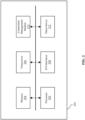
- FIG. 2 provides a diagram illustrating an example computing entity 200 that implements various embodiments described herein.
- the computing entity 200 is located within a vehicle.
- the computing entity 200 is configured to perform operations that relate to granting or denying wireless connections based on referencing dynamically stored and managed connection tokens.
- the computing entity 200 is embodied by an entertainment system (IFEC system), an in-vehicle server (e.g., server 106), a connection management system, and/or the like.
- IFEC system entertainment system
- in-vehicle server e.g., server 106
- connection management system e.g., and/or the like.
- the computing entity 200 includes at least one processor 202 and a memory 204 having instructions stored thereupon.
- the memory 204 may store instructions to be executed by the processor 202. In other embodiments, additional, fewer, and/or different elements may be used to configure the computing entity 200.
- the memory 204 is an electronic holding place or storage for information or instructions so that the information or instructions can be accessed by the processor 202.
- the memory 204 can include, but is not limited to, any type of random access memory (RAM), any type of read only memory (ROM), any type of flash memory, etc.
- Such as magnetic storage devices e.g., hard disk, floppy disk, magnetic strips, etc.
- optical disks e.g., compact disk (CD), digital versatile discs (DVD), etc.
- smart cards flash memory devices, etc.
- the instructions upon execution by the processor 202 configure the computing entity 200 to perform the example operations described in this patent document.
- the instructions executed by the processor 202 may be carried out by a special purpose computer, logic circuits, or hardware circuits.
- the processor 202 may be implemented in hardware, firmware, software, or any combination thereof.
- execution is, for example, the process of running an application or the carrying out of the operation called for by an instruction.
- the instructions may be written using one or more programming language, scripting language, assembly language, etc. By executing the instruction, the processor 202 can perform the operations called for by that instruction.
- the processor 202 operably couples with the memory 204 and transceiver 206 to receive, to send, and to process information and to control the operations of the computing entity 200.
- the processor 202 may retrieve a set of instructions from a permanent memory device such as a ROM device and copy the instructions in an executable form to a temporary memory device that is generally some form of RAM.
- a permanent memory device such as a ROM device
- the computing entity 200 can include a plurality of processors that use the same or a different processing technology.
- the transceiver 206 transmits and receives information or data to another device (e.g., a seatback device 104, a passenger device 110, a ground server, other servers, satellites, or the like). In some examples, the transceiver 206 transmits instructions that grant a wireless connection or instructions that deny a wireless connection to a seatback device 104. In some examples, the transceiver 206 is configured to relay event information (e.g., describing a number of connection grants or denials, describing a number of wireless connections, describing analytics related to wireless connections) to a ground server that is used to refine and improve information used to define density zones.
- event information e.g., describing a number of connection grants or denials, describing a number of wireless connections, describing analytics related to wireless connections
- the transceiver 206 is configured to receive zone configuration data from a ground server, from other aircraft, from satellites, and/or the like that includes parameters for density zones defined by the computing entity 200.
- the transceiver 206 may be comprised of a transmitter and a receiver; in some embodiments, the computing entity 200 comprises a transmitter and a receiver that are separate from another but functionally form a transceiver.
- the computing entity 200 includes input/output (I/O) interfaces 208.
- the I/O interfaces 208 enable data to be provided to the computing entity 200 as input and enable the computing entity 200 to provide data as output.
- the computing entity 200 provides a visualization of a defined density zone surrounding a given in-vehicle location via the I/O interfaces 208.
- the computing entity 200 provides a control display for a user to manually grant or deny a new wireless connection based on a display of existing wireless connections nearby.
- the I/O interfaces 208 may enable user input to be obtained and received by the computing entity 200 (e.g., via a touch-screen display, via buttons or switches) and may enable the computing entity 200 to display information.
- devices including touch-screen displays, buttons, controllers, audio speakers, or the like are connected to the computing entity 200 via I/O interfaces 208.
- the I/O interfaces 208 include a device interface via which the computing entity 200 communicates with seatback devices 104. The device interface enables the computing entity 200 to receive information from seatback devices 104 and to transmit instructions to specific seatback devices 104.
- the computing entity 200 further includes a connection management module 210.
- the connection management module 210 is embodied by a combination of at least a portion of the processor 202 and the memory 204.
- the connection management module 210 includes a dedicated processor and a dedicated memory.
- the connection management module 210 is a computing device that is included in or connected to the computing entity 200.
- the connection management module 210 is configured to perform example operations disclosed herein for controlling or managing a density of wireless connections, for example, within a vehicle.
- connection management module 210 is configured to dynamically manage connection tokens and to determine whether to grant or deny wireless connection using the connection tokens.
- the connection management module 210 is configured to perform token management operations
- the connection management module 210 is configured to perform zone definition and evaluation operations, in some embodiments.
- the computing entity 200 includes a token server 212 at which the connection tokens managed by the connection management module 210 are stored.
- the token server 212 is a portion of the memory 204.
- the token server 212 is an individual memory device integrated or coupled with the computing entity 200.
- the connection management module 210 implements the token server 212 at which the connection management module 210 is configured to dynamically create, modify, and release connection tokens that describe and represent wireless connections within a vehicle.
- the connection management module 210 is configured to dynamically create connection tokens for new and/or granted wireless connections, modify connection tokens to renew the tokens and respective connections, and release connection tokens that are "stale" or whose respective wireless connections no longer exist.
- connection management module 210 is configured to generate connection tokens that include a token identifier, a location identifier (e.g., a seat number), and/or other information describing the respective wireless connection.
- the token identifier enables the connection management module 210 to reference specific connection tokens when parsing a seat status table or seat map. For example, a list of seats includes a token identifier column or parameter that indicates, if any, a token corresponding to or assigned to a given seat according to the token identifier
- the connection management module 210 is configured to include passenger and/or passenger device information in a token when creating the token.
- the connection management module 210 is configured to store or access profile data for the passenger that indicates one or more demographic categories (e.g., account status, travel experience, age) that is included in a token.
- the tokens provide multi-dimensional information that enable more dynamic control over wireless connection across passengers. For example, a number of allowed wireless connections can be differentially configured by account status of passengers based on including passenger account status in the tokens.
- the connection management module 210 is configured to obtain a device type, device address, and/or the like of the passenger device of a wireless connection, and include such device parameters in a connection token. Then, for example, wireless connections for laptops can be controlled separately for wireless connections for mobile phones.
- the connection management module 210 is configured to include parameters relating to the wireless connection itself in the token. For example, a token indicates a signal or connection quality of the respective wireless connection, transmit powers, and/or other parameters.
- connection management module 210 is configured to perform various operations with the token server 212 to dynamically manage connection tokens, and in some embodiments, these operations include creating a token, modifying a token, and releasing a token.
- the connection management module 210 creates, generates, acquires, activates, and/or the like a connection token in response to a seatback device connecting with a user device.
- the connection management module 210 creates a connection token for a Bluetooth connection but not for a Bluetooth pairing.
- the connection between the seatback device and the user device is initiated by any one of the seatback device or the user device and can occur after a reboot of either device or Bluetooth functionality being toggled on at either device.
- connection management module 210 is configured to modify tokens to renew tokens.
- Connection tokens are associated with an expiration time, such that the tokens dynamically represent current wireless connections in real-time.
- the connection management module 210 Upon reaching the expiration time, the connection management module 210 is configured to renew the token with a new expiration time based on the respective wireless connection still existing, being active, or being in use.
- the connection management module 210 is configured to release tokens such that the absence of a wireless connection is accurately reflected by the tokens. Release of tokens is caused by the expiration times of each token and/or by a reboot or fault at the seatback device that is detected by the connection management module 210.
- the connection management module 210 is configured to implement an application programming interface (API) via which the seatback devices interface with the connection management module 210 to cause the token management operations to be performed.
- API application programming interface
- a seatback device transmits an API request to the connection management module 210 for a new token in response to a connection request occurring at the seatback device.
- the connection management module 210 updates the token server 212 with a new token or by marking an existing token as active or in use based on the connection management module 210 granting the connection request, and the new token or marked token is assigned with an expiration time.
- the connection management module 210 then provides an API response that indicates a token identifier of the new or marked token as well as the expiration time.
- the seatback device transmits an API request to the connection management module 210 to renew the token for the seatback device.
- the seatback device transmits this API request based on the seatback device remaining in wireless connection with the user device at the expiration time.
- the seatback devices individually and locally monitor the expiration time and provide indications to the connection management module 210 of whether to renew the token.
- the connection management module 210 updates the expiration time for the token and provides an API response with the same token identifier and the updated expiration time.
- the seatback device transmits an API request to the connection management module 210 to release the token based on the wireless connection no longer existing.
- connection management module 210 accordingly releases (e.g., deletes) the token or marks the token as inactive/unused, and provides an API response that acknowledges the request.
- the seatback device transmits an API request or message to the connection management module 210 that indicates that a reboot of the seatback device.
- the connection management module 210 releases the token or marks the token as inactive/unused.
- the connection management module 210 and/or the token server 212 implement a seat status table that includes mappings between token identifiers and seat or location identifiers.
- the seat status table includes a list of locations (e.g., seats) where seatback devices are located, and each location corresponds to a token is that is either marked as active/used or inactive/unused by the connection management module 210.
- the seat status table includes a list of locations, and each location is assigned with a token based on the dynamic token operations performed by the connection management module 210.
- connection management module 210 is configured to define density zones for connection requests to determine whether to grant or deny the connection requests. By defining density zones, the connection management module 210 localizes a connection request and is able to determine whether too many wireless connections already exist in the local area within the vehicle.
- the connection management module 210 is configured to obtain zone configuration data that includes parameters for how to define density zones.
- zone configuration data includes a size (e.g., with respect to distance measurements, with respect to a number of seats or locations) of a density zone, a centering of a density zone (e.g., centered on a connection request, skewed around the connection request), and/or the like.
- the zone configuration data includes different zone parameters for density zones in different sections of the vehicle. For example, given an aircraft with a first class cabin and a business class cabin, the zone configuration data includes different sizes for density zones per cabin.
- the connection management module 210 obtains the zone configuration data from a ground server and/or from other vehicles, and the zone configuration data is generated based on connection testing.
- the zone configuration data is generated based on experimental testing that determines relative distances between different wireless connections that interfere or disrupt one another.
- the connection management module 210 is configured to define a density zone surrounding a connection request and use the locations within the density zone to reference the token server 212.
- the density zone includes a plurality of locations, and in various examples, the locations includes particular locations being indicated by connection tokens stored in the token server 212.
- the connection management module 210 is configured to, given the density zone, reference the token server 212 to identify tokens that correspond to locations within the density zone.
- the connection management module 210 compares the identified tokens that correspond to locations within the density zone to a capacity for the density zone.
- the capacity defines one or more thresholds for the density zone by which a new wireless connections are granted or denied.
- the capacity includes a threshold or maximum number of connections (or tokens) that are allowed to be present in the density zone, or that are allocated for the density zone.
- the capacity includes a threshold for cumulative transmit power of wireless connections within the density zone.
- the capacity includes a maximum number of tokens allocated for passengers of a particular demographic category.
- the capacity includes thresholds defined with respect to information included to the tokens.
- connection management module 210 is further configured to record or generate event data relating to wireless connections between passenger devices and in-vehicle devices (e.g., seatback devices 104).
- the connection management module 210 is configured to generate an event data for a token creation event, a token renewal event, and a token release event.
- the event data indicates a number of times that wireless connections are granted (e.g., token creation events), an average length of time that wireless connections are active (e.g., based on a number of token renewal events per token), and other insights obtained from token management.
- the connection management module 210 is configured to generate event data that includes a list of unique tokens created during a flight or trip of the vehicle.
- the event data further indicates a location identifier (e.g., a seat number) associated with each wireless connection or token that is described, in some embodiments.
- the connection management module 210 is configured to generate event data that includes, for a given wireless connection (e.g., indicated by a given connection token), at least one of: a passenger device type, a passenger device ID (e.g., a MAC address), services or Bluetooth profiles used, timestamp(s) when the connection was established (e.g., when token was created) and renewed, a location of the given wireless connection (e.g., a seat number), a length of time that the given wireless connection was active, a number of times the connection was renewed, content identifiers for content provided via the given wireless connection (e.g., song identifiers, movie identifiers, content identifiers), and/or the like.
- a given wireless connection e.g., indicated by a given connection token
- a passenger device ID e.g., a
- connection management module 210 is configured to store the event data in memory 204 while the vehicle is in flight, and the connection management module 210 is configured to cause the event data to be transmitted to a ground server (e.g., via transceiver 206) after the flight of the vehicle. In some embodiments, the connection management module 210 is configured to cause the event data to be transmitted to other vehicles during the flight of the vehicle.
- improvements with respect to token management include modifying renewal time periods for tokens based on a number of times connections are renewed, based on a number of connection denial events, and/or the like. In doing so, a number of dynamic token management operations that are performed is reduced, without significantly affecting the accuracy of representing existing wireless connections by the connection tokens.
- improvements with respect to zone management and evaluation include modifying zone configuration data. For example, given that event data indicates an excess number of connection denial events, zone configuration data may be modified to increase a threshold of density zones, modify a size of density zones, and/or the like. As another example, given that event data indicates a disproportional number of connection requests in a first section of a vehicle compared to a second zone, density zone size and/or capacity for the second zone can be increased.
- the computing entity 200, one or more ground servers, and/or the connection management module 210 are configured to implement a machine learning model for modifying parameters for token management and zone definition and evaluation.
- the machine learning model is trained to receive the event data as input and output a predicted and/or optimized density zone size, density zone capacity, a token renewal time, and/or the like. Accordingly, in an example, the connection management module 210 obtains zone configuration data to use for a first flight to define and evaluate density zones, provides event data for the first flight to ground servers, and receives improved zone configuration data to use for a second flight.
- FIG. 3 shows an exemplary system for data gathering, processing, and usage.
- FIG. 3 shows a communication network in which information obtained from and used for managing wireless connections in a vehicle is communicated to, from, and among vehicles and other systems.
- a communication management system located on-board an airplane obtains zone configuration data that provides parameters for density zones defined by the communication management system for managing a given wireless connection.
- the zone configuration data may be obtained at one airplane from other airplanes and/or from a ground server 304.
- the communication management system generates event data that describes connection denials, connection grants, connection renewals, and/or the like, and the event data is shared with other airplanes and/or the ground server 304.
- an airplane obtains seat map or location information from the ground server 304 that is specific to a type or class of airplanes.
- a ground server 304 is configured to communicate with vehicles 302a, 302b, ... 302n via a direct communication link or through a satellite connection using satellites 308a, 308b, 308c, ... 308n, in some embodiments.
- databases 306a, 306b, ... 306n may include databases that store the zone configuration data, databases that store event data, databases that store device location maps, and/or the like.
- the ground server 304 communicates with each of the databases 306a, 306b, ... 306n to provide one or more of the zone configuration data, event data, or seat map data to the vehicles 302a, 302b, ..., 302n.
- the data gathering, processing and usage network depicted in FIG. 3 may include equipment that provides wireless communication connectivity between the airplane equipment and ground based server via equipment such as a Wi-Fi access points at an airport gate, or via a cellular communication equipment such as a cell phone tower that may be available to the airplane at the airport or near gate area.
- the Wi-Fi and cellular connectivity may also be available to some airplanes during flight; for example, some airplanes may maintain connectivity with the ground server 304 (e.g., via satellites 308) while in flight such that data is obtained from the ground server 304 at any time while the airplanes are in flight.
- FIG. 4 shows another configuration of a system in which a ground server 402 may use information from multiple airlines (Airline 1, Airline 2... Airline N) to provide connection management information to an aircraft 428.
- the ground server 402 communicates with multiple airlines to aggregate, analyze, and learn from event data collected by airlines to generate improved zone configuration data.
- improved zone configuration data is generated and stored at the ground server 402, possibly via communication through the internet 410, in some embodiments.
- the ground server 402 may communicate the information via a satellite dish 416 with one or more satellites 418, 420, 422, and the information is in turn received in the aircraft 428 via antenna 424 by an onboard server 406, or edge server.
- the onboard server 406 may implement various embodiments described herein, to manage wireless connections between user devices and seatback devices 408 onboard the aircraft 428.
- the ground server 402 may communicate the information to the onboard server 406 through a terrestrial connection such as through cellular communication via a cellular network to an antenna 426 onboard the airplane that is configured for cellular reception.
- the connectivity between the ground server 402 and airplane equipment may be based on a local area wireless network (e.g., a Wi-Fi access point) or a cellular communication network (e.g., cell tower 404) which may be available to the aircraft 428 for communication while during a flight or when parked at an airport terminal, near the gate area.
- a local area wireless network e.g., a Wi-Fi access point
- a cellular communication network e.g., cell tower 404
- the onboard server 406 may be in communication with one or more seatback devices 408.
- the onboard server 406 may communicate instructions to establish a wireless connection with a user device, maintain a wireless connection with a user device, or disconnect a wireless connection with a user device. To determine such instructions, the onboard server 406 receives reports from seatback devices 408 that indicate connection requests from user devices.
- the onboard server 412 may be connected with the seatback devices 414 via wireless connection or via wired connections.
- the onboard server 406 may be implemented in the form of one or more hardware platforms that include one or more processors, one or more computer memories and network interface for digital data communications.
- the onboard server may embody the computing entity 200.
- the onboard server may be configured to provide various instructions and content to the seatback devices 408.
- the onboard server may also be configured to communicate with a ground server or another server across the internet or a computing cloud for exchanging information related to account data for passengers, unique identifiers for passenger devices, and so on.
- the onboard server may perform such communication in real-time (e.g., using the example satellite communication paths depicted in FIGs. 3 and 4 ) or offline such as communicating with the ground sever at the beginning and/or end of a travel segment.
- the ground server is understood to be a standalone computer system, or multiple standalone computer systems with general purpose data processors, memory, secondary storage, and/or a network interface device for connecting to each other.
- the computer systems may have an operating system installed thereon, along with the server applications that implement the various components of the system for sensor data collection and processing according to the embodiments disclosed herein.
- the ground server may access zone configuration data from one or more databases and transmit the zone configuration data to vehicles.
- the ground server implements machine learning models to improve, optimize and predict zone configuration data using event data received from vehicles.
- the ground server and the onboard server synchronize zone configuration data and event data after the airplane lands and establishes a connection with the ground server.
- FIG. 5 provides a diagram that demonstrates dynamic and flexible use of density zones and connection tokens to manage spatial density of wireless connections between user devices (e.g., passenger personal electronic devices) and seatback devices 104 (e.g., fixed devices within a vehicle or other spatially dense area).
- user devices e.g., passenger personal electronic devices
- seatback devices 104 e.g., fixed devices within a vehicle or other spatially dense area.
- a plurality of mapped locations 502 are shown.
- the mapped locations 502 are in-vehicle locations, for example, locations at which seatback devices 104 are located within a vehicle.
- the mapped locations 502 generally represent locations at which wireless connections can be established.
- a token server stores connection tokens that describe and represent existing wireless connections.
- a connection token indicates a particular mapped location at which a wireless connection is active or exists.
- tokens 504 are visually represented to indicate particular ones of the mapped locations 502 at which wireless connections exist. Specifically, within the thirty mapped locations shown in FIG. 5 , there are six wireless connections indicated by connection tokens stored in a token server.
- a seatback device at one of the mapped locations 502 receives a connection request 506 from a user device.
- the wireless connection is initially or provisionally established based on an allowance received by the seatback device from the connection management system, after which the connection management system performs operations with connection tokens to determine whether the provisional wireless connection should continue.
- the seatback device reports the connection request 506 and/or the connection to the connection management system, which then performs a determination to grant or deny the connection based on a presence of nearby wireless connections.
- the connection management system defines a density zone 508 surrounding the seatback device in response to the connection request 506.
- the density zone 508 includes other mapped locations 502 nearby the mapped location 502 at which the connection request 506 occurred.
- the size of the density zone 508-or how many and which other mapped locations are considered "nearby"- is defined in zone configuration data obtained by the connection management system, in some examples.
- the density zone 508 is defined as a 3X3 grid of mapped locations 502 surrounding the mapped location 502 at which the connection request 506 occurred.
- the connection management system defines the density zone 508 as a list or set of mapped locations 502 based on a seat map or information that describes a spatial layout of the mapped locations 502.
- the density zone 508 identifies locations considered to be near and potentially interfering or disruptive to a wireless connection for the connection request 506.
- the connection management system determines a number of tokens 504 that correspond to mapped locations 502 within the density zone 508. In the illustrated example, three tokens correspond to mapped locations 502 within the density zone 508, thereby indicating that there are three wireless connections already existing nearby the location of the connection request 506.
- the connection management system compares the determined number (e.g., three in the illustrated example) to a capacity or threshold associated with the density zone 508.
- the zone configuration data that defines parameters for the density zone 508 further associates a capacity or threshold with the density zone 508.
- a uniform capacity or threshold is applied for all density zones.
- the capacity or threshold is a threshold number of tokens for the density zone 508.
- the capacity or threshold is based on token parameters, such as passenger demographics. For example, the capacity indicates a threshold number of tokens issued for passengers of a first demographic type, and other tokens issued for passengers of other demographic types are not considered.
- the capacity or threshold is a threshold connection or signal power cumulative across wireless connections in the density zone 508, and each token indicates a power for the respective wireless connection.
- the connection management system determines whether to grant or deny the connection request 506. For the sake of the illustrated example, consider a capacity of five tokens, or five wireless connections, for the density zone 508. Because the total number of wireless connections (according to the tokens) including the provisional or prospective connection for the connection request 506 would be less than five, then the connection request 506 is granted. When granting the connection request 506, the connection management system creates a new token for the connection request 506, such that the new connection is considered for subsequent connection requests.
- connection management system then denies the connection request 506.
- the provisional wireless connection for the connection request 506 is disconnected.
- the seatback device presents an interface or alert that restricts connection requests.
- the seatback device indicates a predicted time at which a wireless connection would be granted (based on expiration and release of other wireless connections and their tokens).
- the determination of whether to grant or deny a connection request 506 is spatially centric to the connection request 506 and is dynamically performed using tokens 504 that describe and represent existing wireless connections. Therefore, technical benefits are provided by controlling a density of wireless connections in a spatial area and minimizing cross-interference of multiple wireless connections.
- FIG. 6 shows a flowchart of an example method 600 relating to managing or controlling a density of wireless connections within a vehicle.
- the method 600 is performed by a connection management system, for example, a system embodied by the server 106 of FIG. 1 , the computing entity 200 of FIG. 2 , and/or the onboard server 406 or edge server 406.
- the system detects a connection request from a passenger device with a seatback device at an in-vehicle location.
- the seatback device reports to the system that the seatback device received a connection request.
- the connection request is a Bluetooth connection request, a Bluetooth Low Energy connection request, and/or the like.
- the system detects the connection request via a device interface, the system communicating with a plurality of seatback devices via the device interface.
- the system obtains information related to the passenger device and/or the passenger associated with the passenger device. For example, the system access profile data associated with the passenger to determine passenger demographics.
- the system defines a density zone surrounding the in-vehicle location according to zone configuration data.
- the density zone defines nearby locations at which wireless communications may be disruptive or interfering with a connection for the connection request.
- a size of the density zone is indicated by the zone configuration data.
- the system determines a number of in-vehicle locations belonging to the density zone based on respective distances between seatback devices from seat map information.
- the size of the density zone is indicated by the zone configuration data with respect to seatback devices.
- the system obtains the zone configuration data from a ground server, another vehicle, and/or the like.
- the system obtains the zone configuration data based on a type or class of the vehicle, and the zone configuration data is applicable to vehicles of the same type or class.
- the system determines, via a token server storing connection tokens, a number of connection tokens corresponding to other in-vehicle locations within the density zone.
- the connection tokens describe and represent existing wireless connections, and therefore, the system determines a number of existing wireless connections within the density zone.
- the connection tokens include further information relating to the passenger device or passenger involved in the wireless connection. For example, a connection token includes one or more demographic categories for the passenger, a device type of the device, and/or the like.
- the token server is located or resides within the vehicle, and the system is coupled with the token server.
- the token server parses a list of connection tokens to determine the number of connections tokens corresponding to locations within the density zone. In some embodiments, the token server determines whether each of the locations within the density zone is indicated by a connection token.
- the system determines whether the number of tokens satisfies a capacity for the density zone.
- the capacity includes a threshold number of tokens, a threshold connection power cumulatively indicated by the tokens, a threshold number of certain tokens (e.g., tokens that include a certain demographic category of a passenger, tokens that include a certain device type), and/or the like.
- the capacity is associated with the density zone in the zone configuration data. In some embodiments, the capacity is uniformly applied to density zones within the vehicle.
- the system grants a wireless connection between the passenger device and the seatback device at an operation 610.
- the number of tokens for locations within the density zone is less than a threshold number of tokens defined by the capacity for the density zone.
- the system transmits an instruction to the seatback device to establish and/or continue the wireless connection with the passenger device in response to the connection request.
- the system dynamically creates a new token to represent the wireless connection and stores the new token in the token server, in some embodiments.
- each seatback device is associated with either an active token or an inactive token, and the system modifies the inactive token for the seatback device to an active token to reflect the wireless connection being granted and established.
- the system denies the wireless connection between the passenger device and the seatback device at an operation 612. For example, the number of tokens for locations within the density zone is at or greater than the threshold number of tokens defined by the capacity for the density zone.
- the system transmits an instruction to the seatback device to deny or disconnect the wireless connection being requested. In some embodiments, further operations are performed in connection with the wireless connection being denied. In an example, the system transmits an instruction to the seatback device that causes the seatback device to block subsequent connection requests for a predetermined amount of time.
- the system predicts a subsequent point in time at which a wireless connection would be granted (e.g., the number of tokens is predicted to be less than the threshold at the subsequent point in time) and causes requests to be blocked until the subsequent point in time.
- the system causes the seatback device to indicate (e.g., display) the subsequent point in time to the passenger to suggest that the passenger re-attempt the connection request then.
- the system triggers a token expiration and/or release operation in response o the denial of the wireless connection. In doing so, the system releases tokens whose respective wireless connections have been disconnected, and the system reevaluates whether the capacity is satisfied with the tokens being released.
- the system presents an override interface for a crew member of the vehicle that enables the crew member to grant the wireless connection manually.
- the method describes example operations for managing one given wireless connection between a passenger device and a seatback device, and the example operations may be performed for each connection request occurring within the vehicle.
- the method includes further operations.
- the method further includes determining that the number of tokens corresponding to locations within the zone has decreased, and permitting a second connection request to occur at the seatback device.
- the method includes dynamically managing the tokens stored in the token server, in some embodiments. For example, the method further includes renewing or release connection tokens at respective expiration times based on whether the respective wireless connections still exist and/or are still active. In some examples, renewing a connection token includes determining a new expiration time. In some embodiments, the method includes detecting a reboot of a particular seatback device indicated by a connection token and releasing the connection token in response to the reboot.
- this patent document describes various technical solutions involving the management of wireless connections in a spatially-dense setting (e.g., a commercial vehicle).
- Various technical solutions are provided based on dynamic management of tokens that represent and describe wireless connections and based on defining and evaluating density zones for connection requests.
- a computer-readable medium may include removable and non-removable storage devices including, but not limited to, Read Only Memory (ROM), Random Access Memory (RAM), compact discs (CDs), digital versatile discs (DVD), etc. Therefore, the computer-readable media can include a non-transitory storage media.
- program modules may include routines, programs, objects, components, data structures, etc. that perform particular tasks or implement particular abstract data types.
- Computer- or processor-executable instructions, associated data structures, and program modules represent examples of program code for executing steps of the methods disclosed herein. The particular sequence of such executable instructions or associated data structures represents examples of corresponding acts for implementing the functions described in such steps or processes.
- a hardware circuit implementation can include discrete analog and/or digital components that are, for example, integrated as part of a printed circuit board.
- the disclosed components or modules can be implemented as an Application Specific Integrated Circuit (ASIC) and/or as a Field Programmable Gate Array (FPGA) device.
- ASIC Application Specific Integrated Circuit
- FPGA Field Programmable Gate Array
- DSP digital signal processor
- the various components or sub-components within each module may be implemented in software, hardware or firmware.
- the connectivity between the modules and/or components within the modules may be provided using any one of the connectivity methods and media that is known in the art, including, but not limited to, communications over the Internet, wired, or wireless networks using the appropriate protocols.
- programmable circuitry e.g., one or more microprocessors, programmed with software and/or firmware
- special-purpose hardwired circuitry e.g., non-programmable circuitry
- special-purpose hardwired circuitry may be in the form of, for example, one or more application-specific integrated circuits (ASICs), programmable logic devices (PLDs), field-programmable gate array (FPGAs), etc.
- ASICs application-specific integrated circuits
- PLDs programmable logic devices
- FPGAs field-programmable gate array
- the methods may be stored in the form of computer-executable instructions that are stored on a computer-readable medium.
- cloud-based computing resources may be used for implementing the embodiments.
- terms such as “processing,” “computing,” “calculating,” “determining,” “displaying,” “generating,” or the like refer to actions and processes of a computer or similar electronic computing device that manipulates and transforms data represented as physical (electronic) quantities within the computer's memory or registers into other data similarly represented as physical quantities within the computer's memory, registers, or other such storage medium, transmission, or display devices.
- references herein to "one embodiment” or “an embodiment” means that a particular feature, structure, or characteristic described in connection with the embodiment is included in at least one embodiment of the disclosure.
- the appearances of the phrase “in one embodiment” in various places in the specification are not necessarily all referring to the same embodiment, nor are separate or alternative embodiments mutually exclusive of other embodiments.
- various features are described which may be exhibited by some embodiments and not by others.
- various requirements are described which may be requirements for some embodiments but not for other embodiments.
Landscapes
- Engineering & Computer Science (AREA)
- Computer Networks & Wireless Communication (AREA)
- Signal Processing (AREA)
- Mobile Radio Communication Systems (AREA)
Applications Claiming Priority (1)
| Application Number | Priority Date | Filing Date | Title |
|---|---|---|---|
| US18/060,879 US20240188182A1 (en) | 2022-12-01 | 2022-12-01 | In-vehicle control of wireless connection density |
Publications (1)
| Publication Number | Publication Date |
|---|---|
| EP4380201A1 true EP4380201A1 (de) | 2024-06-05 |
Family
ID=89029649
Family Applications (1)
| Application Number | Title | Priority Date | Filing Date |
|---|---|---|---|
| EP23212988.2A Pending EP4380201A1 (de) | 2022-12-01 | 2023-11-29 | Fahrzeuginterne steuerung der drahtlosverbindungsdichte |
Country Status (2)
| Country | Link |
|---|---|
| US (1) | US20240188182A1 (de) |
| EP (1) | EP4380201A1 (de) |
Families Citing this family (2)
| Publication number | Priority date | Publication date | Assignee | Title |
|---|---|---|---|---|
| US12490111B2 (en) | 2022-02-18 | 2025-12-02 | Panasonic Avionics Corporation | Antenna system of in-flight entertainment and communication system |
| US12267546B2 (en) * | 2023-02-14 | 2025-04-01 | Panasonic Avionics Corporation | Creating localized wireless network zones for passengers on commercial passenger vehicles |
Citations (2)
| Publication number | Priority date | Publication date | Assignee | Title |
|---|---|---|---|---|
| US20190261225A1 (en) * | 2017-02-23 | 2019-08-22 | John Mezzallngua Associates, LLC | System and method for adaptively tracking and allocating capacity in a broadly-dispersed wireless network |
| US20200120733A1 (en) * | 2018-10-12 | 2020-04-16 | Systems And Software Enterprises, Llc | Systems And Methods For Managing A Plurality Of Short-Range Wireless Connections Within A Vehicle |
Family Cites Families (5)
| Publication number | Priority date | Publication date | Assignee | Title |
|---|---|---|---|---|
| US20110313826A1 (en) * | 2010-06-22 | 2011-12-22 | Livetv Llc | Personal electronic device (ped) operating as a commerce device onboard an aircraft and associated methods |
| US20130005336A1 (en) * | 2011-06-28 | 2013-01-03 | Loren Thomas Ayotte | Passenger mobile station registration with a vehicle communications system using passenger information |
| US10412173B2 (en) * | 2015-04-22 | 2019-09-10 | Panasonic Avionics Corporation | Passenger seat pairing system |
| US10362609B2 (en) * | 2016-08-10 | 2019-07-23 | Panasonic Avionics Corporation | Methods and systems for automatically pairing a personal electronic device on a transportation vehicle |
| CA3073340C (en) * | 2017-09-18 | 2023-07-18 | Arris Enterprises Llc | A method of controlling hotspot access on multi-band access point |
-
2022
- 2022-12-01 US US18/060,879 patent/US20240188182A1/en active Pending
-
2023
- 2023-11-29 EP EP23212988.2A patent/EP4380201A1/de active Pending
Patent Citations (2)
| Publication number | Priority date | Publication date | Assignee | Title |
|---|---|---|---|---|
| US20190261225A1 (en) * | 2017-02-23 | 2019-08-22 | John Mezzallngua Associates, LLC | System and method for adaptively tracking and allocating capacity in a broadly-dispersed wireless network |
| US20200120733A1 (en) * | 2018-10-12 | 2020-04-16 | Systems And Software Enterprises, Llc | Systems And Methods For Managing A Plurality Of Short-Range Wireless Connections Within A Vehicle |
Also Published As
| Publication number | Publication date |
|---|---|
| US20240188182A1 (en) | 2024-06-06 |
Similar Documents
| Publication | Publication Date | Title |
|---|---|---|
| US11138310B2 (en) | Communication system and method for nodes associated with a vehicle | |
| EP4380201A1 (de) | Fahrzeuginterne steuerung der drahtlosverbindungsdichte | |
| US9313773B2 (en) | Aircraft communications switching system | |
| EP2542000A1 (de) | Registrierung einer Mobilstation eines Passagieres mit einem Fahrzeug-Kommunikationssystem unter Verwendung einer Passagier-Information | |
| CN108737424A (zh) | 智能家居的权限共享方法、服务器、系统及可读存储介质 | |
| US10171556B2 (en) | Systems and methods for distributing recorded messages to a vehicle public announcement system | |
| GB2525750A (en) | Crowd enhanced connectivity map for data transfer intermittency mitigation | |
| EP3290949A1 (de) | Lokale positionierung mit kommunikationsetiketten | |
| EP4155206B1 (de) | Verwaltung der paarung drahtloser flugzeuglautsprecher mit mehreren paarungssendern | |
| EP2770787B1 (de) | Registrierung der Mobilstation eines Passagiers mit einem Passagierkommunikationssystem mit Nahfeldkommunikation | |
| US20240276051A1 (en) | Creating localized wireless network zones for passengers on commercial passenger vehicles | |
| CN110937116A (zh) | 用于交通工具的方法、系统和座椅装置 | |
| KR20220145356A (ko) | 네트워크 슬라이스와 관련된 통신 | |
| US11521503B2 (en) | Methods and systems for authenticating an automatic dependent surveillance-broadcast (ADS-B) signal | |
| EP2848527A1 (de) | Flugzeugsystemsteuerung und Meldung über eine mobile Vorrichtung | |
| CN106063312A (zh) | 用于无线数据传输的保护带使用 | |
| CN114996692B (zh) | 车载软件控制方法及系统 | |
| US9031716B2 (en) | Information handling for aircraft flight decks | |
| US11210592B2 (en) | Crowd sourced maintenance systems and methods for transportation vehicles | |
| US10667099B2 (en) | WAIC interface device | |
| KR101495965B1 (ko) | 버스-사용자 단말 인터렉션 방법 및 장치 | |
| EP4332799A1 (de) | Sicherer zugang zu und darstellung passagierspezifischer informationen | |
| HK40014407A (en) | Communication system and method for nodes associated with a vehicle |
Legal Events
| Date | Code | Title | Description |
|---|---|---|---|
| PUAI | Public reference made under article 153(3) epc to a published international application that has entered the european phase |
Free format text: ORIGINAL CODE: 0009012 |
|
| STAA | Information on the status of an ep patent application or granted ep patent |
Free format text: STATUS: THE APPLICATION HAS BEEN PUBLISHED |
|
| AK | Designated contracting states |
Kind code of ref document: A1 Designated state(s): AL AT BE BG CH CY CZ DE DK EE ES FI FR GB GR HR HU IE IS IT LI LT LU LV MC ME MK MT NL NO PL PT RO RS SE SI SK SM TR |
|
| STAA | Information on the status of an ep patent application or granted ep patent |
Free format text: STATUS: REQUEST FOR EXAMINATION WAS MADE |
|
| 17P | Request for examination filed |
Effective date: 20241204 |
|
| RBV | Designated contracting states (corrected) |
Designated state(s): AL AT BE BG CH CY CZ DE DK EE ES FI FR GB GR HR HU IE IS IT LI LT LU LV MC ME MK MT NL NO PL PT RO RS SE SI SK SM TR |