EP4378372A1 - Method and system for self-checking of an endoscope reprocessing device - Google Patents
Method and system for self-checking of an endoscope reprocessing device Download PDFInfo
- Publication number
- EP4378372A1 EP4378372A1 EP23179037.9A EP23179037A EP4378372A1 EP 4378372 A1 EP4378372 A1 EP 4378372A1 EP 23179037 A EP23179037 A EP 23179037A EP 4378372 A1 EP4378372 A1 EP 4378372A1
- Authority
- EP
- European Patent Office
- Prior art keywords
- reprocessing
- endoscope
- channels
- supply channel
- fluid
- Prior art date
- Legal status (The legal status is an assumption and is not a legal conclusion. Google has not performed a legal analysis and makes no representation as to the accuracy of the status listed.)
- Pending
Links
Images

Classifications
-
- A—HUMAN NECESSITIES
- A61—MEDICAL OR VETERINARY SCIENCE; HYGIENE
- A61B—DIAGNOSIS; SURGERY; IDENTIFICATION
- A61B1/00—Instruments for performing medical examinations of the interior of cavities or tubes of the body by visual or photographical inspection, e.g. endoscopes; Illuminating arrangements therefor
- A61B1/00002—Operational features of endoscopes
- A61B1/00057—Operational features of endoscopes provided with means for testing or calibration
-
- A—HUMAN NECESSITIES
- A61—MEDICAL OR VETERINARY SCIENCE; HYGIENE
- A61B—DIAGNOSIS; SURGERY; IDENTIFICATION
- A61B1/00—Instruments for performing medical examinations of the interior of cavities or tubes of the body by visual or photographical inspection, e.g. endoscopes; Illuminating arrangements therefor
- A61B1/012—Instruments for performing medical examinations of the interior of cavities or tubes of the body by visual or photographical inspection, e.g. endoscopes; Illuminating arrangements therefor characterised by internal passages or accessories therefor
- A61B1/015—Control of fluid supply or evacuation
-
- A—HUMAN NECESSITIES
- A61—MEDICAL OR VETERINARY SCIENCE; HYGIENE
- A61B—DIAGNOSIS; SURGERY; IDENTIFICATION
- A61B1/00—Instruments for performing medical examinations of the interior of cavities or tubes of the body by visual or photographical inspection, e.g. endoscopes; Illuminating arrangements therefor
- A61B1/12—Instruments for performing medical examinations of the interior of cavities or tubes of the body by visual or photographical inspection, e.g. endoscopes; Illuminating arrangements therefor with cooling or rinsing arrangements
- A61B1/121—Instruments for performing medical examinations of the interior of cavities or tubes of the body by visual or photographical inspection, e.g. endoscopes; Illuminating arrangements therefor with cooling or rinsing arrangements provided with means for cleaning post-use
- A61B1/125—Instruments for performing medical examinations of the interior of cavities or tubes of the body by visual or photographical inspection, e.g. endoscopes; Illuminating arrangements therefor with cooling or rinsing arrangements provided with means for cleaning post-use using fluid circuits
-
- A—HUMAN NECESSITIES
- A61—MEDICAL OR VETERINARY SCIENCE; HYGIENE
- A61B—DIAGNOSIS; SURGERY; IDENTIFICATION
- A61B1/00—Instruments for performing medical examinations of the interior of cavities or tubes of the body by visual or photographical inspection, e.g. endoscopes; Illuminating arrangements therefor
- A61B1/12—Instruments for performing medical examinations of the interior of cavities or tubes of the body by visual or photographical inspection, e.g. endoscopes; Illuminating arrangements therefor with cooling or rinsing arrangements
-
- A—HUMAN NECESSITIES
- A61—MEDICAL OR VETERINARY SCIENCE; HYGIENE
- A61B—DIAGNOSIS; SURGERY; IDENTIFICATION
- A61B1/00—Instruments for performing medical examinations of the interior of cavities or tubes of the body by visual or photographical inspection, e.g. endoscopes; Illuminating arrangements therefor
- A61B1/12—Instruments for performing medical examinations of the interior of cavities or tubes of the body by visual or photographical inspection, e.g. endoscopes; Illuminating arrangements therefor with cooling or rinsing arrangements
- A61B1/121—Instruments for performing medical examinations of the interior of cavities or tubes of the body by visual or photographical inspection, e.g. endoscopes; Illuminating arrangements therefor with cooling or rinsing arrangements provided with means for cleaning post-use
- A61B1/123—Instruments for performing medical examinations of the interior of cavities or tubes of the body by visual or photographical inspection, e.g. endoscopes; Illuminating arrangements therefor with cooling or rinsing arrangements provided with means for cleaning post-use using washing machines
Definitions
- the present invention refers to a method and a system for self-checking of an endoscope reprocessing device having a source for reprocessing fluid, a source for pressurized air, a plurality of supply channels for supplying reprocessing fluid and/or pressurized air from the sources to individual channels of endoscopes connected with the supply channels of the reprocessing device for reprocessing, and a control unit for controlling the reprocessing of endoscopes, each supply channel having a dedicated switchable valve for alternatively blocking and opening the supply channel in response to control signals issued by the control unit.
- Endoscope reprocessing devices such as the applicant's ETD series devices generally have a washing cabinet with, e.g., baskets for receiving endoscopes to be reprocessed and adapters with which to connect endoscope channels to supply channels of the endoscope reprocessing device.
- the endoscope reprocessing device circulates reprocessing fluid through the various endoscope channels and after completion switches over to drying air which is supplied out of a pressurized air source.
- a flow control unit of the endoscope reprocessing device is situated at the interface between the water and pressurized air supplies and the washing cabinet.
- the flow control receives the reprocessing fluid and pressurized air from the respective source and distributes it into one or a plurality of dedicated supply channels that each are equipped with an electronically controllable valve for individually reprocessing the different endoscope channels.
- the endoscope reprocessing device and in particular the flow control unit, is equipped with diagnostic equipment, in particular pressure sensors that are connected to the one or more individual supply channels downstream of the respective valve as well as one or more pressure sensors connected to the common channel from which the supply channels branch off.
- diagnostic equipment in particular pressure sensors that are connected to the one or more individual supply channels downstream of the respective valve as well as one or more pressure sensors connected to the common channel from which the supply channels branch off.
- This sensor suite measures the pressure as supplied by the pressurized air source as well as the pressures inside the supply channels, which reflect the pressure inside the individual endoscope channels. These measurements are used for flow tests through the individual endoscope channels prior to, during and/or after reprocessing that can reveal blockages, obstructions or leakages of individual endoscope channels.
- Such flow tests are usually done for each endoscope channel individually, one at a time. They may involve two stages, the first being opening the valve of the supply channel to which the endoscope channel to be tested is connected, feeding pressurized air into the endoscope channel. After a brief period of the system reaching an equilibrium, the difference is measured between the pressure of the pressurized air provided by the pressurized air source and as measured in the common channel of the flow control unit and the pressure in the supply channel measured with the pressure sensor connected to the supply channel downstream of the respective valve. If this first pressure difference lies between a pre-set maximum pressure difference and a pre-set minimum pressure difference, the first stage of the flow test is completed successfully.
- the pre-set maximum and minimum pressure differences may vary for different types of endoscopes, and per endoscope channel, e.g., depending on its diameter.
- the valve in the supply channel is closed. This results in the pressure in the endoscope channel, as measured by the pressure sensor downstream of the now closed valve, drops off with a rate typical for the respective type of endoscope and/or endoscope channel.
- the difference in pressure between the supply channel pressure as measured in the first stage and the progression of the decreasing supply channel pressure is measured and again analyzed with respect to lying within an allowed range between a minimum and a maximum pressure difference, which may again be pre-set according to endoscope type specifications.
- Irregular flow test results i.e., results that are not in line with specifications, in the first and/or second stage of the flow test, will be reported such that an endoscope may be sent for further cleaning, repair or discarding, as the case may be.
- the reprocessing and flow test analysis rely on all components of the endoscope reprocessing device being in working order and being calibrated within specifications. To ensure the continuing serviceability of the endoscope reprocessing device, it is prompted to perform self-checks in regular service intervals, at which occasion the calibration of the pressure sensors is checked and, if necessary, updated. These self-checks are performed using standardized test plates that are inserted into the washing cabinet and connected to the supply channels leading out of the flow control unit. The test plates have orifices of well-known dimensions in order to provide a standardized environment for reproducible flow test results without the uncertainty of real endoscope channels that might deviate from their design specifications. Following a self-check, the endoscope reprocessing device may have to be serviced or repaired, until its functioning according to design specifications is restored.
- an endoscope reprocessing device having at least one source for a fluid, in particular a source for a reprocessing fluid and/or a source for pressurized air, one or more supply channels for supplying a fluid from the at least one source to one or more individual channels of one or more endoscopes connected with the one or more supply channels of the reprocessing device for reprocessing, and a control unit for controlling the reprocessing of endoscopes, each of the one or more supply channel having a dedicated switchable valve designed to let through the fluid and to block the supply channel in response to control signals issued by the control unit, the method comprising reprocessing of one or more endoscopes that are connected to the reprocessing device for reprocessing, the reprocessing of the one or more endoscopes comprising a flow test during which pressures or pressure differences are checked in a sequence of application and blocking of the fluid in the one or more channels of the one or more endoscopes connected to
- This method provides functionality for self-checking of endoscope reprocessing devices that does not rely on dedicated self-checks, but are carried out in the course of normal endoscope reprocessing operations.
- the method does not require any additional hardware. It can be implemented as an update to the control or diagnostics software and runs on at least one of the control unit of the reprocessing device, the control unit within the flow control unit of the reprocessing device and the external computer system that is connected with the reprocessing device via datalink, for example internet or intranet.
- the underlying measurements of fluidic pressure can be the measurement of a reprocessing fluid pressure or of a pressure of pressurized air, or both, as the case may be.
- the running self-check is done for the one or more individual supply channels of the endoscope reprocessing device. Problems can occur and be identified in one, several or all of the supply channels.
- the keeping and updating of the history of flow test results may be realized by keeping a history of individual flow tests including all the measurement data taken during the flow tests and the flow test result, or, in an abbreviated form, including only test results, such as error flags raised during test results, or simply a running count of errors.
- a flow test result anomaly is a blockage of an endoscope channel connected with said particular supply channel or a problem with the attachment of an endoscope channel to said particular supply channel.
- the blockage of the channel may indicate a problem with the supply channel since, in the case of a single measurement, it is not possible to distinguish between a real blockage of the endoscope channel, a sensor malfunction and a malfunction of the valve. The same holds true for cases, where the endoscope channel has disconnected itself from the supply channel, for example fallen off.
- one of the one or more predefined criteria is met for said particular supply channel when flow test result anomalies identified during flow testing of endoscope channels connected with said particular supply channel have occurred at least a first predefined number N 1 of times within a second predefined number N 2 of the most recent flow tests, with N 2 being greater than N 1 .
- This criterion is based on the fact, that flow test results anomalies usually have a certain low probability of occurring. This probability may be known from experience or from prior testing of such scenarios.
- the predefined numbers N 1 and N 2 may be chosen such that they indicate a statistically significant clustered occurrence of flow test result anomalies.
- N 2 may be chosen such that the problem occurring in the reprocessing device is caught shortly after its first occurrence in order to facilitate a quick response and remedy to the problem with the reprocessing device, for example by scheduling an out-of-turn maintenance or repair.
- one of the one or more predefined criteria is met for said particular supply channel when flow test result anomalies identified during flow testing of endoscope channels connected with said particular supply channel have occurred a third predefined number of times N 3 in succession.
- This criterion is stricter than the previously described criteria, since it requires flow test results anomalies in the same supply channel in uninterrupted succession. Since usually reprocessing operations are done with different endoscopes, it is highly unlikely that flow test result anomalies occur at the same supply channel several times in a row, so that a sufficient statistical significance is reached very quickly.
- the number of times N 3 may therefore be chosen smaller than N 2 , the latter of which allows for only sporadic occurrences of flow test results anomalies.
- a counter counting the number of times in which flow test result anomalies have been identified in successive flow tests of endoscope channels connected with said particular supply channel may be reset when a new flow test of an endoscope channel connected with said particular supply channel does not turn up a flow test result anomaly.
- Such counters may be defined for each of the supply channels.
- counters for the number of identifications of test flow anomalies are reset after a dedicated self-check of the reprocessing device, in particular using a test plate connected to the supply channels.
- the flow tests of endoscope channels connected with one or more of the supply channels are performed sequentially one after another at least one of before, during and after reprocessing of an endoscope.
- a message reporting a finding is generated and displayed or transmitted to a user or to a service provider in the event that a problem with a particular supply channel or valve associated with said supply channel is identified.
- an endoscope reprocessing device comprising a washing cabinet designed for receiving one or more endoscopes to be reprocessed, a main control unit designed and configured for controlling the reprocessing of endoscopes, at least one source for a fluid controlled by the main control unit, in particular a source for reprocessing fluid and/or a source for pressurized air, and one or more supply channels connected to the at least one source for fluid leading to the washing cabinet, each of the one or more supply channels having an electronically controlled valve for opening and closing the respective supply channel and a pressure sensor connected to the supply channel downstream of the valve, wherein the device is configured for carrying out a running self-check of the reprocessing device, the running self-check comprising keeping a history of flow test results, updating the history with the latest flow test results and carrying out an analysis of the history of flow test results for each of the one or more supply channels of the reprocessing device, wherein a problem with a particular supply channel or a valve associated with said
- the endoscope reprocessing device embodies the same advantages, features and characteristics as the above described inventive method.
- the at least one source for fluid in particular the sources for reprocessing fluid and for pressurized air, is or are connected via a switchable valve to a common bus channel from which the supply channels branch off, wherein in particular the switchable valve has two positions for alternatively letting through reprocessing fluid and pressurized air, and in particular a third position for closing off both reprocessing fluid and pressurized air.
- the sources for reprocessing fluid and for pressurized air are connected directly to the one or more supply channels, wherein the switchable valves have three positions, a first position for letting through processing fluid, a second position for letting through pressurized air and a third position for closing off the supply channel.
- a flow control unit in communication with the main controller is designed to control the operation of the electronically controlled valves of the one or more supply channels.
- At least one of the main control unit and the flow control unit is or are configured for carrying out embodiments of the above-described inventive method.
- Embodiments according to the invention can fulfill individual characteristics or a combination of several characteristics.
- Fig. 1 shows a schematic representation of an endoscope reprocessing device 10, which includes a flow control unit 20 and a washing cabinet 30.
- the flow control unit 20 may be an integral part of the reprocessing device 10, the latter having the sole control unit in the form of main controller 140, or it may have its own control unit in communication with the main controller 140.
- the endoscope reprocessing device 10 features a reprocessing fluid supply 110 and a pressurized air supply unit 120, which supply a reprocessing fluid and pressurized drying air, respectively, to endoscopes (not shown) that have been put into washing baskets inside the washing cabinet 30 and connected to adapters that are ultimately collected to reprocessing fluid supply 110 and the pressurized air supply unit 120.
- the reprocessing fluid supply 110 has a pump 112, e.g., a circulation pump, receiving reprocessing fluid back from the washing cabinet 30 by way of a return duct 180.
- Pump 112 may pump the reprocessing fluid through other parts, such as a filter or a secondary pump 116 tasked with providing the required flow rate and pressure of the reprocessing fluid to the endoscopes to be reprocessed.
- the pressurized gas supplies unit 120 may have a pump as a pressurized air source 122, which supplies pressurized air for drying and for conducting flow tests to the endoscopes.
- the regulation of the flow rate and pressure of the pressurized air flow into the endoscopes my be aided by means of an adjustment valve 124.
- An electronically controlled switchable valve 170 that may actuated pneumatically, hydraulically or electrically is used to switch back and forth between supply of processing fluid and pressurized air.
- the control of the valve 170 as well as other controllable parts of the endoscope reprocessing device 10 and the flow control unit 20 is carried out by the main controller 140 having control over reprocessing operation as well as other functionality, such as self-checking of the device.
- Another component of the endoscope reprocessing device 10 is a power supply 130.
- An endoscope type list having reprocessing and testing parameters for all the types of endoscopes that the endoscope reprocessing device 10 is cleared to reprocess may be stored in a memory unit of the main controller 140.
- the flow control unit 20 has a common channel 220 connected to the outlet of switching valve 170 and thus alternately receives reprocessing fluid and pressurized air from their respective supplies, depending on the switch status of valve 170.
- a pressure sensor 225 is connected to the common channel 220, providing sensor readings for the fluid or air pressure inside the common channel 220 as supplied by supplies 110 and 120.
- the common channel 220 branches off into a plurality of supply channels 230 that lead to an adapter or adapters at the interface to the washing cabinet 30, to which the channels of an endoscope to be reprocessed will be connected.
- Fig. 1 shows a device having four supply channels 230, only one of which is provided with reference numbers for clarity's sake.
- the other supply channels are outfitted in similar fashion and may vary in diameter or other parameters depending on the type of endoscope channels for which they are usually used, but usually not in overall functionality. In place of the four supply channels depicted here, fewer or more supply channels may be foreseen, as the case may be. In the case of an elevator channel with an APC (Albarran Pressure Control), there may be only one supply channel present, with in some cases more supply channels in a parallel unit.
- APC Albarran Pressure Control
- all of the supply channels 230 each have an electronically controllable switchable valve 232 for opening or closing off the respective supply channel 230, as well as a pressure sensor 235 connected to the respective supply channel 230 downstream of the respective valve 232. In this way, it is possible to measure the pressure present in each supply channel 230 individually both when the valve 232 is open or closed, respectively, and independently of the pressure inside the common channel 220.
- the flow control unit 20 may have the dedicated mainboard 210 locally controlling operations of components of the flow control unit 20.
- the dedicated mainboard 210 may be in data communication with the main controller 140 and receive commands to be carried out by the flow control unit 20.
- the washing cabinet 30 has a coupling to an endoscope channel 330 constituting a constriction to the flow of reprocessing fluid and pressurized air.
- a further constriction 310 represents, e.g., an adapter and an endoscope connected to the supply channel 230.
- Further identical sorts of couplings 340 are symbolized as "" in Fig. 1 .
- the flow control unit 20 may be equipped with its own control unit in communication with main controller 130.
- switchable valve 170 or switchable valves 232 may be connected directly to the two fluid supplies 110, 120 and have three positions, namely open for pressurized air, open for reprocessing fluid and closed. In the latter case, there maybe two common channels 220, one for pressurized air and one for the reprocessing fluid.
- the reprocessing device 10 including the flow control unit 20 and the washing cabinet 30 is equipped to reprocess endoscopes, conduct flow tests and a running self-check.
- Fig. 2 shows an annotated representation of flow test curves, pressure and time being the vertical and horizontal axes of the graph, respectively.
- the fluid pressure during a flow test of an endoscope channel connected to a single supply channel 230 is depicted over time for two scenarios.
- the fluid may be a reprocessing fluid or pressurized air, for example.
- a typical flow test of an endoscope channel may have two stages. The first stage involves opening the valve 232 of a supply channel 230, allowing the fluid to run through an endoscope channel connected to the supply channel 230. There is a brief period of build-up of fluid pressure as the valve 232 opens until an equilibrium is reached. After a predetermined time, the second stage is started by closing the valve 232 again. The drop off of the supply channel pressure is then measured for a certain time.
- a simple case (not shown) is present if an endoscope channel is fully blocked.
- the fluid pressure will go up quickly and stay at a high level, at or slightly under the pressure the pressurized fluid is supplied with.
- the pressurized fluid cannot escape through the blocked endoscope channel and remains high throughout the flow test.
- a "channel blocked" flag or some other indication of the blockage will be recorded and displayed. This case is not shown in Fig. 2 .
- the supply channel 230 may be open, for example because of a connection failure, possibly with the adapter having fallen off.
- This is presented by the curve annotated with "Channel pressure (open)".
- the pressure as measured rises to a constant, but low value.
- valve 232 is closed, the pressure drops off very fast since the pressurized fluid escapes rapidly and unrestrictedly from the open end of the supply channel 230.
- This curve is typical for the condition "not connected", which may also be recorded and displayed.
- the second case displayed in Fig. 2 is one in which no fault is found.
- the pressurized air has to make its way through the endoscope channel that is attached to the supply channel, which constitutes a further restriction to the flow of pressurized fluid.
- the pressure in the supply channel 230 rises quickly to a constant equilibrium value within boundaries that may be preset according to pre-known endoscope type specifications, either as absolute values or as pressure differences towards the supplied fluid pressure.
- the equilibrium pressure, as well as the boundary values are furthermore lower than the pressure in case of a blocked channel and higher than the pressure observed when the end of the supply channel 230 is not connected.
- the pressurized fluid has to escape through the endoscope channel, and therefore much more slowly than in the case of the unconnected, i.e., open ended supply channel 230.
- the curve showing the decreasing pressure in the supply channel 230 runs through a window (not shown) of allowed values between a maximum and a minimum pressure or pressure difference, e.g., between the measured supply channel pressure before the valve 232 was opened and the presently measured decreasing supply channel pressure. If, at a predetermined time or at predetermined times after closing valve 232, the measured supply channel pressure lies within these boundaries, the endoscope channel will have passed the second stage of the flow test.
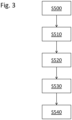
- Fig. 3 is a flow diagram of an iteration of a running self-check according to the present invention.
- an endoscope is reprocessed in the endoscope reprocessing device 10.
- the endoscope channels are subjected to a flow test in step S510, as described in the context of Fig. 2 .
- the endoscope may pass the flow test, or an irregularity may be found, such as a blocked channel or an adapter having fallen off.
- a minimum content of the update to the flow test result history is the result of the flow test for each channel, but may also may include a time stamp, information about the type of endoscope tested or other information that may be deemed relevant for subsequent analysis.
- step S530 the flow test result history, having been updated with the most recent results, is analyzed for anomalies, such as a statistically significant clustering of anomalous or irregular test results in one or several of the channels, or the occurrence of several consecutive irregular test results in one of the channels. If such a clustering or consecutive occurrence is found, the problem may be reported in step S540, in order to alert a user that the endoscope reprocessing device is in need of servicing or repair.
- anomalies such as a statistically significant clustering of anomalous or irregular test results in one or several of the channels, or the occurrence of several consecutive irregular test results in one of the channels.
Landscapes
- Health & Medical Sciences (AREA)
- Life Sciences & Earth Sciences (AREA)
- Surgery (AREA)
- Nuclear Medicine, Radiotherapy & Molecular Imaging (AREA)
- Biomedical Technology (AREA)
- Optics & Photonics (AREA)
- Pathology (AREA)
- Radiology & Medical Imaging (AREA)
- Biophysics (AREA)
- Engineering & Computer Science (AREA)
- Physics & Mathematics (AREA)
- Heart & Thoracic Surgery (AREA)
- Medical Informatics (AREA)
- Molecular Biology (AREA)
- Animal Behavior & Ethology (AREA)
- General Health & Medical Sciences (AREA)
- Public Health (AREA)
- Veterinary Medicine (AREA)
- Endoscopes (AREA)
Abstract
Description
- The present invention refers to a method and a system for self-checking of an endoscope reprocessing device having a source for reprocessing fluid, a source for pressurized air, a plurality of supply channels for supplying reprocessing fluid and/or pressurized air from the sources to individual channels of endoscopes connected with the supply channels of the reprocessing device for reprocessing, and a control unit for controlling the reprocessing of endoscopes, each supply channel having a dedicated switchable valve for alternatively blocking and opening the supply channel in response to control signals issued by the control unit.
- Endoscope reprocessing devices such as the applicant's ETD series devices generally have a washing cabinet with, e.g., baskets for receiving endoscopes to be reprocessed and adapters with which to connect endoscope channels to supply channels of the endoscope reprocessing device. During reprocessing, the endoscope reprocessing device circulates reprocessing fluid through the various endoscope channels and after completion switches over to drying air which is supplied out of a pressurized air source.
- A flow control unit of the endoscope reprocessing device is situated at the interface between the water and pressurized air supplies and the washing cabinet. The flow control receives the reprocessing fluid and pressurized air from the respective source and distributes it into one or a plurality of dedicated supply channels that each are equipped with an electronically controllable valve for individually reprocessing the different endoscope channels.
- The endoscope reprocessing device, and in particular the flow control unit, is equipped with diagnostic equipment, in particular pressure sensors that are connected to the one or more individual supply channels downstream of the respective valve as well as one or more pressure sensors connected to the common channel from which the supply channels branch off. This sensor suite measures the pressure as supplied by the pressurized air source as well as the pressures inside the supply channels, which reflect the pressure inside the individual endoscope channels. These measurements are used for flow tests through the individual endoscope channels prior to, during and/or after reprocessing that can reveal blockages, obstructions or leakages of individual endoscope channels.
- Such flow tests are usually done for each endoscope channel individually, one at a time. They may involve two stages, the first being opening the valve of the supply channel to which the endoscope channel to be tested is connected, feeding pressurized air into the endoscope channel. After a brief period of the system reaching an equilibrium, the difference is measured between the pressure of the pressurized air provided by the pressurized air source and as measured in the common channel of the flow control unit and the pressure in the supply channel measured with the pressure sensor connected to the supply channel downstream of the respective valve. If this first pressure difference lies between a pre-set maximum pressure difference and a pre-set minimum pressure difference, the first stage of the flow test is completed successfully. The pre-set maximum and minimum pressure differences may vary for different types of endoscopes, and per endoscope channel, e.g., depending on its diameter.
- For the second stage of the flow test, the valve in the supply channel is closed. This results in the pressure in the endoscope channel, as measured by the pressure sensor downstream of the now closed valve, drops off with a rate typical for the respective type of endoscope and/or endoscope channel. In this second stage, the difference in pressure between the supply channel pressure as measured in the first stage and the progression of the decreasing supply channel pressure is measured and again analyzed with respect to lying within an allowed range between a minimum and a maximum pressure difference, which may again be pre-set according to endoscope type specifications.
- Irregular flow test results, i.e., results that are not in line with specifications, in the first and/or second stage of the flow test, will be reported such that an endoscope may be sent for further cleaning, repair or discarding, as the case may be.
- The reprocessing and flow test analysis rely on all components of the endoscope reprocessing device being in working order and being calibrated within specifications. To ensure the continuing serviceability of the endoscope reprocessing device, it is prompted to perform self-checks in regular service intervals, at which occasion the calibration of the pressure sensors is checked and, if necessary, updated. These self-checks are performed using standardized test plates that are inserted into the washing cabinet and connected to the supply channels leading out of the flow control unit. The test plates have orifices of well-known dimensions in order to provide a standardized environment for reproducible flow test results without the uncertainty of real endoscope channels that might deviate from their design specifications. Following a self-check, the endoscope reprocessing device may have to be serviced or repaired, until its functioning according to design specifications is restored.
- In the daily routine of reprocessing of endoscopes, irregular flow test results therefore usually indicate problems with the endoscope being reprocessed and tested. However, in some cases, a problem may also have occurred in the endoscope reprocessing device, in particular in one or more of its supply channels. Also, there may be a problem with an adapter that might not have been properly connected to its designated endoscope channel and might have fallen off or failed to properly seal with it.
- In both cases, the flow test results will show irregularities. Since the endoscope reprocessing device is assumed to function properly, these irregularities will then be attributed to a problem with the respective endoscope channel. This erroneous attribution of the cause of the problem leads to a false negative result for this specific endoscope channel that in reality does not have a problem. The problem residing in the reprocessing device, on the other, remains undetected.
- It is an object of the present invention to provide a system and method that alleviate the afore-described drawbacks of the known endoscope reprocessing devices.
- This object is solved by a method for self-checking of an endoscope reprocessing device having at least one source for a fluid, in particular a source for a reprocessing fluid and/or a source for pressurized air, one or more supply channels for supplying a fluid from the at least one source to one or more individual channels of one or more endoscopes connected with the one or more supply channels of the reprocessing device for reprocessing, and a control unit for controlling the reprocessing of endoscopes, each of the one or more supply channel having a dedicated switchable valve designed to let through the fluid and to block the supply channel in response to control signals issued by the control unit, the method comprising reprocessing of one or more endoscopes that are connected to the reprocessing device for reprocessing, the reprocessing of the one or more endoscopes comprising a flow test during which pressures or pressure differences are checked in a sequence of application and blocking of the fluid in the one or more channels of the one or more endoscopes connected to the reprocessing device for identification of anomalies occurring at the one or more individual endoscope channels, characterized in that a running self-check of the reprocessing device is carried out, the running self-check comprising keeping a history of flow test results, updating the history with the latest flow test results and carrying out an analysis of the history of flow test results for each of the one or more supply channels of the reprocessing device, wherein a problem with a particular supply channel or a valve associated with said particular supply channel is indicated if the history of flow test results contains flow test result anomalies in said particular supply channel that meet at least one out of one or more predefined criteria.
- This method provides functionality for self-checking of endoscope reprocessing devices that does not rely on dedicated self-checks, but are carried out in the course of normal endoscope reprocessing operations. The method does not require any additional hardware. It can be implemented as an update to the control or diagnostics software and runs on at least one of the control unit of the reprocessing device, the control unit within the flow control unit of the reprocessing device and the external computer system that is connected with the reprocessing device via datalink, for example internet or intranet.
- The underlying measurements of fluidic pressure can be the measurement of a reprocessing fluid pressure or of a pressure of pressurized air, or both, as the case may be.
- The feature of keeping a history of flow test results, updating the history with the latest flow test results and carrying out an analysis of the history of flow test results makes it possible to analyze the history of flow test results for irregularities that can be traced back to problems with the reprocessing device itself, in particular the supply channel or channels thereof. Since this method identifies problems of the reprocessing device, it provides a self-check functionality for the reprocessing device. Since this analysis is done in the context of every single endoscope reprocessing operation, this self-check functionality constitutes a running self-check for the reprocessing device. The running self-check complements the dedicated self-checks that are carried out during routine servicing of the reprocessing device.
- The running self-check is done for the one or more individual supply channels of the endoscope reprocessing device. Problems can occur and be identified in one, several or all of the supply channels.
- The keeping and updating of the history of flow test results may be realized by keeping a history of individual flow tests including all the measurement data taken during the flow tests and the flow test result, or, in an abbreviated form, including only test results, such as error flags raised during test results, or simply a running count of errors.
- In an embodiment of the method, a flow test result anomaly is a blockage of an endoscope channel connected with said particular supply channel or a problem with the attachment of an endoscope channel to said particular supply channel. The blockage of the channel may indicate a problem with the supply channel since, in the case of a single measurement, it is not possible to distinguish between a real blockage of the endoscope channel, a sensor malfunction and a malfunction of the valve. The same holds true for cases, where the endoscope channel has disconnected itself from the supply channel, for example fallen off.
- In embodiments, one of the one or more predefined criteria is met for said particular supply channel when flow test result anomalies identified during flow testing of endoscope channels connected with said particular supply channel have occurred at least a first predefined number N1 of times within a second predefined number N2 of the most recent flow tests, with N2 being greater than N1. This criterion is based on the fact, that flow test results anomalies usually have a certain low probability of occurring. This probability may be known from experience or from prior testing of such scenarios. The predefined numbers N1 and N2 may be chosen such that they indicate a statistically significant clustered occurrence of flow test result anomalies. In particular, N2 may be chosen such that the problem occurring in the reprocessing device is caught shortly after its first occurrence in order to facilitate a quick response and remedy to the problem with the reprocessing device, for example by scheduling an out-of-turn maintenance or repair.
- In embodiments, one of the one or more predefined criteria is met for said particular supply channel when flow test result anomalies identified during flow testing of endoscope channels connected with said particular supply channel have occurred a third predefined number of times N3 in succession. This criterion is stricter than the previously described criteria, since it requires flow test results anomalies in the same supply channel in uninterrupted succession. Since usually reprocessing operations are done with different endoscopes, it is highly unlikely that flow test result anomalies occur at the same supply channel several times in a row, so that a sufficient statistical significance is reached very quickly. The number of times N3 may therefore be chosen smaller than N2, the latter of which allows for only sporadic occurrences of flow test results anomalies.
- In the case of successive flow test results anomalies associated with a single supply channel, a counter counting the number of times in which flow test result anomalies have been identified in successive flow tests of endoscope channels connected with said particular supply channel may be reset when a new flow test of an endoscope channel connected with said particular supply channel does not turn up a flow test result anomaly. Such counters may be defined for each of the supply channels.
- In embodiments of the method, counters for the number of identifications of test flow anomalies are reset after a dedicated self-check of the reprocessing device, in particular using a test plate connected to the supply channels.
- In embodiments of the method, the flow tests of endoscope channels connected with one or more of the supply channels are performed sequentially one after another at least one of before, during and after reprocessing of an endoscope.
- In further embodiments, a message reporting a finding is generated and displayed or transmitted to a user or to a service provider in the event that a problem with a particular supply channel or valve associated with said supply channel is identified.
- The object underlying the present invention is also solved by an endoscope reprocessing device comprising a washing cabinet designed for receiving one or more endoscopes to be reprocessed, a main control unit designed and configured for controlling the reprocessing of endoscopes, at least one source for a fluid controlled by the main control unit, in particular a source for reprocessing fluid and/or a source for pressurized air, and one or more supply channels connected to the at least one source for fluid leading to the washing cabinet, each of the one or more supply channels having an electronically controlled valve for opening and closing the respective supply channel and a pressure sensor connected to the supply channel downstream of the valve, wherein the device is configured for carrying out a running self-check of the reprocessing device, the running self-check comprising keeping a history of flow test results, updating the history with the latest flow test results and carrying out an analysis of the history of flow test results for each of the one or more supply channels of the reprocessing device, wherein a problem with a particular supply channel or a valve associated with said particular supply channel is indicated if the history of flow test results contains flow test result anomalies in said particular supply channel that meet at least one out of one or more predefined criteria.
- The endoscope reprocessing device according to the invention embodies the same advantages, features and characteristics as the above described inventive method.
- In embodiments, the at least one source for fluid, in particular the sources for reprocessing fluid and for pressurized air, is or are connected via a switchable valve to a common bus channel from which the supply channels branch off, wherein in particular the switchable valve has two positions for alternatively letting through reprocessing fluid and pressurized air, and in particular a third position for closing off both reprocessing fluid and pressurized air.
- In alternative embodiments, the sources for reprocessing fluid and for pressurized air are connected directly to the one or more supply channels, wherein the switchable valves have three positions, a first position for letting through processing fluid, a second position for letting through pressurized air and a third position for closing off the supply channel.
- In some embodiments, a flow control unit in communication with the main controller is designed to control the operation of the electronically controlled valves of the one or more supply channels.
- In embodiments, at least one of the main control unit and the flow control unit is or are configured for carrying out embodiments of the above-described inventive method.
- Further characteristics of the invention will become apparent from the description of the embodiments according to the invention together with the claims and the included drawings. Embodiments according to the invention can fulfill individual characteristics or a combination of several characteristics.
- The invention is described below, without restricting the general intent of the invention, based on exemplary embodiments, wherein reference is made expressly to the drawings with regard to the disclosure of all details according to the invention that are not explained in greater detail in the text. The drawings show in:
- Fig. 1
- a schematic representation of an endoscope reprocessing device,
- Fig. 2
- an annotated representation of flow test curves and
- Fig. 3
- a flow diagram of a running self-check.
- In the drawings, the same or similar types of elements or respectively corresponding parts are provided with the same reference numbers in order to prevent the item from needing to be reintroduced.
-
Fig. 1 shows a schematic representation of anendoscope reprocessing device 10, which includes aflow control unit 20 and awashing cabinet 30. Theflow control unit 20 may be an integral part of thereprocessing device 10, the latter having the sole control unit in the form ofmain controller 140, or it may have its own control unit in communication with themain controller 140. Theendoscope reprocessing device 10 features a reprocessingfluid supply 110 and a pressurizedair supply unit 120, which supply a reprocessing fluid and pressurized drying air, respectively, to endoscopes (not shown) that have been put into washing baskets inside thewashing cabinet 30 and connected to adapters that are ultimately collected to reprocessingfluid supply 110 and the pressurizedair supply unit 120. - The reprocessing
fluid supply 110 has apump 112, e.g., a circulation pump, receiving reprocessing fluid back from thewashing cabinet 30 by way of areturn duct 180. Pump 112 may pump the reprocessing fluid through other parts, such as a filter or a secondary pump 116 tasked with providing the required flow rate and pressure of the reprocessing fluid to the endoscopes to be reprocessed. - The pressurized
gas supplies unit 120 may have a pump as apressurized air source 122, which supplies pressurized air for drying and for conducting flow tests to the endoscopes. The regulation of the flow rate and pressure of the pressurized air flow into the endoscopes my be aided by means of anadjustment valve 124. - An electronically controlled
switchable valve 170 that may actuated pneumatically, hydraulically or electrically is used to switch back and forth between supply of processing fluid and pressurized air. The control of thevalve 170 as well as other controllable parts of theendoscope reprocessing device 10 and theflow control unit 20 is carried out by themain controller 140 having control over reprocessing operation as well as other functionality, such as self-checking of the device. - Another component of the
endoscope reprocessing device 10 is apower supply 130. An endoscope type list having reprocessing and testing parameters for all the types of endoscopes that theendoscope reprocessing device 10 is cleared to reprocess may be stored in a memory unit of themain controller 140. - The
flow control unit 20 has acommon channel 220 connected to the outlet of switchingvalve 170 and thus alternately receives reprocessing fluid and pressurized air from their respective supplies, depending on the switch status ofvalve 170. Apressure sensor 225 is connected to thecommon channel 220, providing sensor readings for the fluid or air pressure inside thecommon channel 220 as supplied bysupplies common channel 220 branches off into a plurality ofsupply channels 230 that lead to an adapter or adapters at the interface to thewashing cabinet 30, to which the channels of an endoscope to be reprocessed will be connected.Fig. 1 shows a device having foursupply channels 230, only one of which is provided with reference numbers for clarity's sake. The other supply channels are outfitted in similar fashion and may vary in diameter or other parameters depending on the type of endoscope channels for which they are usually used, but usually not in overall functionality. In place of the four supply channels depicted here, fewer or more supply channels may be foreseen, as the case may be. In the case of an elevator channel with an APC (Albarran Pressure Control), there may be only one supply channel present, with in some cases more supply channels in a parallel unit. - In the embodiment depicted in
Fig. 1 , all of thesupply channels 230 each have an electronically controllableswitchable valve 232 for opening or closing off therespective supply channel 230, as well as apressure sensor 235 connected to therespective supply channel 230 downstream of therespective valve 232. In this way, it is possible to measure the pressure present in eachsupply channel 230 individually both when thevalve 232 is open or closed, respectively, and independently of the pressure inside thecommon channel 220. - The
flow control unit 20 may have the dedicated mainboard 210 locally controlling operations of components of theflow control unit 20. The dedicated mainboard 210 may be in data communication with themain controller 140 and receive commands to be carried out by theflow control unit 20. - For each of the
supply channels 230 of theflow control unit 20, thewashing cabinet 30 has a coupling to an endoscope channel 330 constituting a constriction to the flow of reprocessing fluid and pressurized air. Afurther constriction 310 represents, e.g., an adapter and an endoscope connected to thesupply channel 230. Further identical sorts ofcouplings 340 are symbolized as "..." inFig. 1 . - In alternative versions of the reprocessing device, the
flow control unit 20 may be equipped with its own control unit in communication withmain controller 130. Furthermore, eitherswitchable valve 170 orswitchable valves 232 may be connected directly to the twofluid supplies common channels 220, one for pressurized air and one for the reprocessing fluid. - The
reprocessing device 10 including theflow control unit 20 and thewashing cabinet 30 is equipped to reprocess endoscopes, conduct flow tests and a running self-check. -
Fig. 2 shows an annotated representation of flow test curves, pressure and time being the vertical and horizontal axes of the graph, respectively. The fluid pressure during a flow test of an endoscope channel connected to asingle supply channel 230 is depicted over time for two scenarios. The fluid may be a reprocessing fluid or pressurized air, for example. - A typical flow test of an endoscope channel may have two stages. The first stage involves opening the
valve 232 of asupply channel 230, allowing the fluid to run through an endoscope channel connected to thesupply channel 230. There is a brief period of build-up of fluid pressure as thevalve 232 opens until an equilibrium is reached. After a predetermined time, the second stage is started by closing thevalve 232 again. The drop off of the supply channel pressure is then measured for a certain time. - A simple case (not shown) is present if an endoscope channel is fully blocked. In that case, the fluid pressure will go up quickly and stay at a high level, at or slightly under the pressure the pressurized fluid is supplied with. In that case, the pressurized fluid cannot escape through the blocked endoscope channel and remains high throughout the flow test. In this case, a "channel blocked" flag or some other indication of the blockage will be recorded and displayed. This case is not shown in
Fig. 2 . - At the other extreme, the
supply channel 230 may be open, for example because of a connection failure, possibly with the adapter having fallen off. This is presented by the curve annotated with "Channel pressure (open)". In that case, after the application of pressurized fluid by opening thevalve 232 of thesupply channel 230, the pressure as measured rises to a constant, but low value. Whenvalve 232 is closed, the pressure drops off very fast since the pressurized fluid escapes rapidly and unrestrictedly from the open end of thesupply channel 230. This curve is typical for the condition "not connected", which may also be recorded and displayed. - The second case displayed in
Fig. 2 is one in which no fault is found. In the curve annotated with "Channel pressure (OK)", the pressurized air has to make its way through the endoscope channel that is attached to the supply channel, which constitutes a further restriction to the flow of pressurized fluid. For this reason, the pressure in thesupply channel 230 rises quickly to a constant equilibrium value within boundaries that may be preset according to pre-known endoscope type specifications, either as absolute values or as pressure differences towards the supplied fluid pressure. The equilibrium pressure, as well as the boundary values, are furthermore lower than the pressure in case of a blocked channel and higher than the pressure observed when the end of thesupply channel 230 is not connected. - Likewise, after closing
valve 232, the pressurized fluid has to escape through the endoscope channel, and therefore much more slowly than in the case of the unconnected, i.e., open endedsupply channel 230. The curve showing the decreasing pressure in thesupply channel 230 runs through a window (not shown) of allowed values between a maximum and a minimum pressure or pressure difference, e.g., between the measured supply channel pressure before thevalve 232 was opened and the presently measured decreasing supply channel pressure. If, at a predetermined time or at predetermined times after closingvalve 232, the measured supply channel pressure lies within these boundaries, the endoscope channel will have passed the second stage of the flow test. -
Fig. 3 is a flow diagram of an iteration of a running self-check according to the present invention. In step S500, an endoscope is reprocessed in theendoscope reprocessing device 10. Before, during and/or after the reprocessing itself, the endoscope channels are subjected to a flow test in step S510, as described in the context ofFig. 2 . The endoscope may pass the flow test, or an irregularity may be found, such as a blocked channel or an adapter having fallen off. - The results of the flow test of the present reprocessing operation are then used to update a flow test result history in step S520. A minimum content of the update to the flow test result history is the result of the flow test for each channel, but may also may include a time stamp, information about the type of endoscope tested or other information that may be deemed relevant for subsequent analysis.
- In step S530 the flow test result history, having been updated with the most recent results, is analyzed for anomalies, such as a statistically significant clustering of anomalous or irregular test results in one or several of the channels, or the occurrence of several consecutive irregular test results in one of the channels. If such a clustering or consecutive occurrence is found, the problem may be reported in step S540, in order to alert a user that the endoscope reprocessing device is in need of servicing or repair.
- All named characteristics, including those taken from the drawings alone, and individual characteristics, which are disclosed in combination with other characteristics, are considered alone and in combination as important to the invention. Embodiments according to the invention can be fulfilled through individual characteristics or a combination of several characteristics. Features which are combined with the wording "in particular" or "especially" are to be treated as preferred embodiments.
-
- 10
- reprocessing device
- 20
- flow control unit
- 30
- washing cabinet
- 110
- reprocessing fluid supply
- 112
- pump
- 120
- pressurized air supply unit
- 122
- pressurized air source
- 124
- adjustment valve
- 130
- power supply
- 140
- main controller
- 170
- switchable valve
- 180
- return duct
- 220
- common channel
- 225
- pressure sensor
- 230
- supply channel
- 232
- switchable valve
- 235
- pressure sensor
- 310
- constriction
- 340
- further couplings
- S500
- reprocessing of endoscope
- S510
- flow test
- S520
- update history of flow test results
- S530
- analyze history of flow test results
- S540
- identify/report problem
Claims (13)
- A method for self-checking of an endoscope reprocessing device having at least one source for a fluid, in particular a source for a reprocessing fluid and/or a source for pressurized air, one or more supply channels for supplying a fluid from the at least one source to one or more individual channels of one or more endoscopes connected with the one or more supply channels of the reprocessing device for reprocessing, and a control unit for controlling the reprocessing of endoscopes, each of the one or more supply channel having a dedicated switchable valve designed to let through the fluid and to block the supply channel in response to control signals issued by the control unit, the method comprising reprocessing of one or more endoscopes that are connected to the reprocessing device for reprocessing, the reprocessing of the one or more endoscopes comprising a flow test during which pressures or pressure differences are checked in a sequence of application and blocking of the fluid in the one or more channels of the one or more endoscopes connected to the reprocessing device for identification of anomalies occurring at the one or more individual endoscope channels, characterized in that a running self-check of the reprocessing device is carried out, the running self-check comprising keeping a history of flow test results, updating the history with the latest flow test results and carrying out an analysis of the history of flow test results for each of the one or more supply channels of the reprocessing device, wherein a problem with a particular supply channel or a valve associated with said particular supply channel is indicated if the history of flow test results contains flow test result anomalies in said particular supply channel that meet at least one out of one or more predefined criteria.
- The method according to claim 1, characterized in that a flow test result anomaly is a blockage of an endoscope channel connected with said particular supply channel or a problem with the attachment of an endoscope channel to said particular supply channel.
- The method according to claim 1 or 2, characterized in that one of the one or more predefined criteria is met for said particular supply channel when flow test result anomalies identified during flow testing of endoscope channels connected with said particular supply channel have occurred at least a first predefined number N1 of times within a second predefined number N2 of the most recent flow tests, with N2 being greater than N1.
- The method according to one of claims 1 to 3, characterized in that one of the one or more predefined criteria is met for said particular supply channel when flow test result anomalies identified during flow testing of endoscope channels connected with said particular supply channel have occurred a third predefined number of times N3 in succession.
- The method according to claim 4, characterized in that a counter counting the number of times in which flow test result anomalies have been identified in successive flow tests of endoscope channels connected with said particular supply channel is reset when a new flow test of an endoscope channel connected with said particular supply channel does not turn up a flow test result anomaly.
- The method according to one of claims 1 to 5, characterized in that counters for the number of identifications of test flow anomalies are reset after a dedicated self-check of the reprocessing device, in particular using a test plate connected to the supply channels.
- The method according to one of claims 1 to 6, characterized in that the flow tests of endoscope channels connected with the one or more supply channels are performed sequentially one after another or in several or all of the supply channels in parallel at least one of before, during and after reprocessing of an endoscope.
- The method according to one of claims 1 to 7, characterized in that a message reporting a finding is generated and displayed or transmitted to a user or to a service provider in the event that a problem with a particular supply channel or valve associated with said supply channel is identified.
- An endoscope reprocessing device comprising a washing cabinet designed for receiving one or more endoscopes to be reprocessed, a main control unit designed and configured for controlling the reprocessing of endoscopes, at least one source for a fluid controlled by the main control unit, in particular a source for reprocessing fluid and/or a source for pressurized air, and one or more supply channels connected to the at least one source for fluid leading to the washing cabinet, each of the one or more supply channels having an electronically controlled valve for opening and closing the respective supply channel and a pressure sensor connected to the supply channel downstream of the valve, wherein the device is configured for carrying out a running self-check of the reprocessing device, the running self-check comprising keeping a history of flow test results, updating the history with the latest flow test results and carrying out an analysis of the history of flow test results for each of the one or more supply channels of the reprocessing device, wherein a problem with a particular supply channel or a valve associated with said particular supply channel is indicated if the history of flow test results contains flow test result anomalies in said particular supply channel that meet at least one out of one or more predefined criteria.
- The endoscope reprocessing device according to claim 9, characterized in that the at least one source for fluid, in particular the sources for reprocessing fluid and for pressurized air, is or are connected via a switchable valve to a common bus channel from which the supply channels branch off, wherein in particular the switchable valve has two positions for alternatively letting through reprocessing fluid and pressurized air, and in particular a third position for closing off both reprocessing fluid and pressurized air.
- The endoscope reprocessing device according to claim 9, characterized in that the source for reprocessing fluid and for pressurized air are connected directly to the one or more supply channels, wherein the switchable valves have three positions, a first position for letting through processing fluid, a second position for letting through pressurized air and a third position for closing off the supply channel.
- The endoscope reprocessing device according to one of claims 9 to 11, characterized in that a flow control unit in communication with the main controller is designed to control the operation of the electronically controlled valves of the one or more supply channels.
- The endoscope reprocessing device according to one of claims 9 to 12, characterized in that at least one of the main control unit and the flow control unit is or are configured for carrying out the method according to one of claims 1 to 8.
Applications Claiming Priority (1)
| Application Number | Priority Date | Filing Date | Title |
|---|---|---|---|
| US202263428493P | 2022-11-29 | 2022-11-29 |
Publications (1)
| Publication Number | Publication Date |
|---|---|
| EP4378372A1 true EP4378372A1 (en) | 2024-06-05 |
Family
ID=86776544
Family Applications (1)
| Application Number | Title | Priority Date | Filing Date |
|---|---|---|---|
| EP23179037.9A Pending EP4378372A1 (en) | 2022-11-29 | 2023-06-13 | Method and system for self-checking of an endoscope reprocessing device |
Country Status (5)
| Country | Link |
|---|---|
| US (1) | US20240172921A1 (en) |
| EP (1) | EP4378372A1 (en) |
| JP (1) | JP2024078434A (en) |
| CN (1) | CN118105021A (en) |
| DE (1) | DE102022131781A1 (en) |
Citations (2)
| Publication number | Priority date | Publication date | Assignee | Title |
|---|---|---|---|---|
| US20070169799A1 (en) * | 2005-11-15 | 2007-07-26 | Olympus Medical Systems Corporation | Apparatus for washing and disinfecting medical instruments and method of supplying gas to medical instruments for water leakage examination |
| US20110126868A1 (en) * | 2008-06-03 | 2011-06-02 | Olympus Winter & Ibe Gmbh | Method for testing the patency of an endoscopic channel and an endoscope washing machine for same |
Family Cites Families (9)
| Publication number | Priority date | Publication date | Assignee | Title |
|---|---|---|---|---|
| US6884392B2 (en) * | 2002-11-12 | 2005-04-26 | Minntech Corporation | Apparatus and method for steam reprocessing flexible endoscopes |
| US8920574B2 (en) * | 2011-10-21 | 2014-12-30 | Ethicon, Inc. | Instrument reprocessor and instrument reprocessing methods |
| CN108498811B (en) * | 2013-03-13 | 2021-05-11 | 史赛克公司 | Sterilization container capable of providing an indication of whether or not a sterilized surgical instrument in the container has been properly sterilized |
| US20150161678A1 (en) * | 2013-12-05 | 2015-06-11 | Turn Inc. | Dynamic ordering of online advertisement software steps |
| DE102015206267A1 (en) * | 2015-04-08 | 2016-10-13 | Olympus Winter & Ibe Gmbh | Monitoring the connection of fluid lines with surgical instruments |
| JP6033515B1 (en) * | 2015-08-11 | 2016-11-30 | オリンパス株式会社 | Endoscope reprocessor and failure detection method |
| US11134833B2 (en) * | 2017-09-14 | 2021-10-05 | Asp Global Manufacturing Gmbh | Apparatus and method to asynchronously fill and purge channels of endoscope simultaneously |
| WO2020079777A1 (en) * | 2018-10-17 | 2020-04-23 | オリンパス株式会社 | Cleaning assistance system, processing device and cleaning assistance method |
| CN110190584B (en) * | 2019-05-10 | 2020-04-24 | 浙江大学 | Self-checking chip of leakage protector |
-
2022
- 2022-11-30 DE DE102022131781.1A patent/DE102022131781A1/en active Pending
-
2023
- 2023-06-13 EP EP23179037.9A patent/EP4378372A1/en active Pending
- 2023-09-21 US US18/371,190 patent/US20240172921A1/en active Pending
- 2023-11-23 CN CN202311572523.9A patent/CN118105021A/en active Pending
- 2023-11-24 JP JP2023199289A patent/JP2024078434A/en active Pending
Patent Citations (2)
| Publication number | Priority date | Publication date | Assignee | Title |
|---|---|---|---|---|
| US20070169799A1 (en) * | 2005-11-15 | 2007-07-26 | Olympus Medical Systems Corporation | Apparatus for washing and disinfecting medical instruments and method of supplying gas to medical instruments for water leakage examination |
| US20110126868A1 (en) * | 2008-06-03 | 2011-06-02 | Olympus Winter & Ibe Gmbh | Method for testing the patency of an endoscopic channel and an endoscope washing machine for same |
Also Published As
| Publication number | Publication date |
|---|---|
| US20240172921A1 (en) | 2024-05-30 |
| DE102022131781A1 (en) | 2024-05-29 |
| JP2024078434A (en) | 2024-06-10 |
| CN118105021A (en) | 2024-05-31 |
Similar Documents
| Publication | Publication Date | Title |
|---|---|---|
| US9678845B2 (en) | Abnormality diagnostic system and industrial machinery | |
| US8676553B2 (en) | Apparatus abnormality diagnosis method and system | |
| EP2193413B1 (en) | System for preserving and displaying process control data associated with an abnormal situation | |
| US6295478B1 (en) | Manufacturing process change control apparatus and manufacturing process change control method | |
| US7117119B2 (en) | System and method for continuous online safety and reliability monitoring | |
| EP2202600A2 (en) | Performance monitoring and prognostics for aircraft pneumatic control valves | |
| US20070043539A1 (en) | Abnormality monitoring system and abnormality monitoring method | |
| EP3850452B1 (en) | Method and system for monitoring condition of a sample handling system of a gas analyser | |
| CN100465916C (en) | Failure diagnosis method, device and system for PCI system | |
| JP6509001B2 (en) | Failure diagnosis system | |
| CN110582626A (en) | Systems and methods for monitoring turbines with anomaly detection corrected by wear factor | |
| KR20210127223A (en) | Abnormality determination apparatus of a blast furnace, abnormality determination method of a blast furnace, and operation method of a blast furnace | |
| CN112484922A (en) | Process chamber leakage rate detection method and semiconductor process equipment | |
| JP7026012B2 (en) | Equipment status monitoring system and equipment status monitoring method | |
| JP5411498B2 (en) | Electronic diagnostic system and method for process vacuum environment | |
| US20240172921A1 (en) | Method and system for self-checking of an endoscope reprocessing device | |
| CN119394675B (en) | Air suspension fault diagnosis method, device, equipment and readable storage medium | |
| WO2009046199A1 (en) | System and method for recognizing and compensating for invalid regression model applied to abnormal situation prevention | |
| US10275511B2 (en) | Method for analyzing and/or evaluating at least one event | |
| KR102797798B1 (en) | Diagnostic device and diagnostic method and plasma processing device and semiconductor device manufacturing system | |
| KR101089835B1 (en) | Self Logic Testing Apparatus and Method of Digital Reactor Protection System | |
| KR101620850B1 (en) | Method and system for measuring sensor performance evaluation using virtual iso-sensor technology | |
| CN112114242A (en) | On-line monitoring and analyzing method for automatic IC test | |
| CN117012423A (en) | Nuclear power plant reactor protection system channel test optimization method and control equipment | |
| KR20240171641A (en) | Method for predictive method through automatic detection of pump failure |
Legal Events
| Date | Code | Title | Description |
|---|---|---|---|
| PUAI | Public reference made under article 153(3) epc to a published international application that has entered the european phase |
Free format text: ORIGINAL CODE: 0009012 |
|
| STAA | Information on the status of an ep patent application or granted ep patent |
Free format text: STATUS: THE APPLICATION HAS BEEN PUBLISHED |
|
| AK | Designated contracting states |
Kind code of ref document: A1 Designated state(s): AL AT BE BG CH CY CZ DE DK EE ES FI FR GB GR HR HU IE IS IT LI LT LU LV MC ME MK MT NL NO PL PT RO RS SE SI SK SM TR |
|
| STAA | Information on the status of an ep patent application or granted ep patent |
Free format text: STATUS: REQUEST FOR EXAMINATION WAS MADE |
|
| 17P | Request for examination filed |
Effective date: 20240924 |
|
| RBV | Designated contracting states (corrected) |
Designated state(s): AL AT BE BG CH CY CZ DE DK EE ES FI FR GB GR HR HU IE IS IT LI LT LU LV MC ME MK MT NL NO PL PT RO RS SE SI SK SM TR |