EP4375127A1 - Method of controlling battery replacement and battery replacement control system - Google Patents
Method of controlling battery replacement and battery replacement control system Download PDFInfo
- Publication number
- EP4375127A1 EP4375127A1 EP23208403.8A EP23208403A EP4375127A1 EP 4375127 A1 EP4375127 A1 EP 4375127A1 EP 23208403 A EP23208403 A EP 23208403A EP 4375127 A1 EP4375127 A1 EP 4375127A1
- Authority
- EP
- European Patent Office
- Prior art keywords
- battery
- station
- electrically powered
- battery replacement
- user
- Prior art date
- Legal status (The legal status is an assumption and is not a legal conclusion. Google has not performed a legal analysis and makes no representation as to the accuracy of the status listed.)
- Pending
Links
Images


Classifications
-
- B—PERFORMING OPERATIONS; TRANSPORTING
- B60—VEHICLES IN GENERAL
- B60L—PROPULSION OF ELECTRICALLY-PROPELLED VEHICLES; SUPPLYING ELECTRIC POWER FOR AUXILIARY EQUIPMENT OF ELECTRICALLY-PROPELLED VEHICLES; ELECTRODYNAMIC BRAKE SYSTEMS FOR VEHICLES IN GENERAL; MAGNETIC SUSPENSION OR LEVITATION FOR VEHICLES; MONITORING OPERATING VARIABLES OF ELECTRICALLY-PROPELLED VEHICLES; ELECTRIC SAFETY DEVICES FOR ELECTRICALLY-PROPELLED VEHICLES
- B60L53/00—Methods of charging batteries, specially adapted for electric vehicles; Charging stations or on-board charging equipment therefor; Exchange of energy storage elements in electric vehicles
- B60L53/60—Monitoring or controlling charging stations
- B60L53/66—Data transfer between charging stations and vehicles
-
- B—PERFORMING OPERATIONS; TRANSPORTING
- B60—VEHICLES IN GENERAL
- B60L—PROPULSION OF ELECTRICALLY-PROPELLED VEHICLES; SUPPLYING ELECTRIC POWER FOR AUXILIARY EQUIPMENT OF ELECTRICALLY-PROPELLED VEHICLES; ELECTRODYNAMIC BRAKE SYSTEMS FOR VEHICLES IN GENERAL; MAGNETIC SUSPENSION OR LEVITATION FOR VEHICLES; MONITORING OPERATING VARIABLES OF ELECTRICALLY-PROPELLED VEHICLES; ELECTRIC SAFETY DEVICES FOR ELECTRICALLY-PROPELLED VEHICLES
- B60L53/00—Methods of charging batteries, specially adapted for electric vehicles; Charging stations or on-board charging equipment therefor; Exchange of energy storage elements in electric vehicles
- B60L53/60—Monitoring or controlling charging stations
- B60L53/65—Monitoring or controlling charging stations involving identification of vehicles or their battery types
-
- B—PERFORMING OPERATIONS; TRANSPORTING
- B60—VEHICLES IN GENERAL
- B60L—PROPULSION OF ELECTRICALLY-PROPELLED VEHICLES; SUPPLYING ELECTRIC POWER FOR AUXILIARY EQUIPMENT OF ELECTRICALLY-PROPELLED VEHICLES; ELECTRODYNAMIC BRAKE SYSTEMS FOR VEHICLES IN GENERAL; MAGNETIC SUSPENSION OR LEVITATION FOR VEHICLES; MONITORING OPERATING VARIABLES OF ELECTRICALLY-PROPELLED VEHICLES; ELECTRIC SAFETY DEVICES FOR ELECTRICALLY-PROPELLED VEHICLES
- B60L53/00—Methods of charging batteries, specially adapted for electric vehicles; Charging stations or on-board charging equipment therefor; Exchange of energy storage elements in electric vehicles
- B60L53/60—Monitoring or controlling charging stations
- B60L53/66—Data transfer between charging stations and vehicles
- B60L53/665—Methods related to measuring, billing or payment
-
- B—PERFORMING OPERATIONS; TRANSPORTING
- B60—VEHICLES IN GENERAL
- B60L—PROPULSION OF ELECTRICALLY-PROPELLED VEHICLES; SUPPLYING ELECTRIC POWER FOR AUXILIARY EQUIPMENT OF ELECTRICALLY-PROPELLED VEHICLES; ELECTRODYNAMIC BRAKE SYSTEMS FOR VEHICLES IN GENERAL; MAGNETIC SUSPENSION OR LEVITATION FOR VEHICLES; MONITORING OPERATING VARIABLES OF ELECTRICALLY-PROPELLED VEHICLES; ELECTRIC SAFETY DEVICES FOR ELECTRICALLY-PROPELLED VEHICLES
- B60L53/00—Methods of charging batteries, specially adapted for electric vehicles; Charging stations or on-board charging equipment therefor; Exchange of energy storage elements in electric vehicles
- B60L53/60—Monitoring or controlling charging stations
- B60L53/67—Controlling two or more charging stations
-
- B—PERFORMING OPERATIONS; TRANSPORTING
- B60—VEHICLES IN GENERAL
- B60L—PROPULSION OF ELECTRICALLY-PROPELLED VEHICLES; SUPPLYING ELECTRIC POWER FOR AUXILIARY EQUIPMENT OF ELECTRICALLY-PROPELLED VEHICLES; ELECTRODYNAMIC BRAKE SYSTEMS FOR VEHICLES IN GENERAL; MAGNETIC SUSPENSION OR LEVITATION FOR VEHICLES; MONITORING OPERATING VARIABLES OF ELECTRICALLY-PROPELLED VEHICLES; ELECTRIC SAFETY DEVICES FOR ELECTRICALLY-PROPELLED VEHICLES
- B60L53/00—Methods of charging batteries, specially adapted for electric vehicles; Charging stations or on-board charging equipment therefor; Exchange of energy storage elements in electric vehicles
- B60L53/60—Monitoring or controlling charging stations
- B60L53/68—Off-site monitoring or control, e.g. remote control
-
- B—PERFORMING OPERATIONS; TRANSPORTING
- B60—VEHICLES IN GENERAL
- B60L—PROPULSION OF ELECTRICALLY-PROPELLED VEHICLES; SUPPLYING ELECTRIC POWER FOR AUXILIARY EQUIPMENT OF ELECTRICALLY-PROPELLED VEHICLES; ELECTRODYNAMIC BRAKE SYSTEMS FOR VEHICLES IN GENERAL; MAGNETIC SUSPENSION OR LEVITATION FOR VEHICLES; MONITORING OPERATING VARIABLES OF ELECTRICALLY-PROPELLED VEHICLES; ELECTRIC SAFETY DEVICES FOR ELECTRICALLY-PROPELLED VEHICLES
- B60L53/00—Methods of charging batteries, specially adapted for electric vehicles; Charging stations or on-board charging equipment therefor; Exchange of energy storage elements in electric vehicles
- B60L53/80—Exchanging energy storage elements, e.g. removable batteries
-
- B—PERFORMING OPERATIONS; TRANSPORTING
- B60—VEHICLES IN GENERAL
- B60L—PROPULSION OF ELECTRICALLY-PROPELLED VEHICLES; SUPPLYING ELECTRIC POWER FOR AUXILIARY EQUIPMENT OF ELECTRICALLY-PROPELLED VEHICLES; ELECTRODYNAMIC BRAKE SYSTEMS FOR VEHICLES IN GENERAL; MAGNETIC SUSPENSION OR LEVITATION FOR VEHICLES; MONITORING OPERATING VARIABLES OF ELECTRICALLY-PROPELLED VEHICLES; ELECTRIC SAFETY DEVICES FOR ELECTRICALLY-PROPELLED VEHICLES
- B60L58/00—Methods or circuit arrangements for monitoring or controlling batteries or fuel cells, specially adapted for electric vehicles
- B60L58/10—Methods or circuit arrangements for monitoring or controlling batteries or fuel cells, specially adapted for electric vehicles for monitoring or controlling batteries
- B60L58/16—Methods or circuit arrangements for monitoring or controlling batteries or fuel cells, specially adapted for electric vehicles for monitoring or controlling batteries responding to battery ageing, e.g. to the number of charging cycles or the state of health [SoH]
-
- G—PHYSICS
- G06—COMPUTING OR CALCULATING; COUNTING
- G06Q—INFORMATION AND COMMUNICATION TECHNOLOGY [ICT] SPECIALLY ADAPTED FOR ADMINISTRATIVE, COMMERCIAL, FINANCIAL, MANAGERIAL OR SUPERVISORY PURPOSES; SYSTEMS OR METHODS SPECIALLY ADAPTED FOR ADMINISTRATIVE, COMMERCIAL, FINANCIAL, MANAGERIAL OR SUPERVISORY PURPOSES, NOT OTHERWISE PROVIDED FOR
- G06Q10/00—Administration; Management
- G06Q10/02—Reservations, e.g. for tickets, services or events
-
- G—PHYSICS
- G06—COMPUTING OR CALCULATING; COUNTING
- G06Q—INFORMATION AND COMMUNICATION TECHNOLOGY [ICT] SPECIALLY ADAPTED FOR ADMINISTRATIVE, COMMERCIAL, FINANCIAL, MANAGERIAL OR SUPERVISORY PURPOSES; SYSTEMS OR METHODS SPECIALLY ADAPTED FOR ADMINISTRATIVE, COMMERCIAL, FINANCIAL, MANAGERIAL OR SUPERVISORY PURPOSES, NOT OTHERWISE PROVIDED FOR
- G06Q10/00—Administration; Management
- G06Q10/20—Administration of product repair or maintenance
-
- G—PHYSICS
- G06—COMPUTING OR CALCULATING; COUNTING
- G06Q—INFORMATION AND COMMUNICATION TECHNOLOGY [ICT] SPECIALLY ADAPTED FOR ADMINISTRATIVE, COMMERCIAL, FINANCIAL, MANAGERIAL OR SUPERVISORY PURPOSES; SYSTEMS OR METHODS SPECIALLY ADAPTED FOR ADMINISTRATIVE, COMMERCIAL, FINANCIAL, MANAGERIAL OR SUPERVISORY PURPOSES, NOT OTHERWISE PROVIDED FOR
- G06Q30/00—Commerce
- G06Q30/02—Marketing; Price estimation or determination; Fundraising
- G06Q30/0207—Discounts or incentives, e.g. coupons or rebates
- G06Q30/0208—Trade or exchange of goods or services in exchange for incentives or rewards
-
- G—PHYSICS
- G06—COMPUTING OR CALCULATING; COUNTING
- G06Q—INFORMATION AND COMMUNICATION TECHNOLOGY [ICT] SPECIALLY ADAPTED FOR ADMINISTRATIVE, COMMERCIAL, FINANCIAL, MANAGERIAL OR SUPERVISORY PURPOSES; SYSTEMS OR METHODS SPECIALLY ADAPTED FOR ADMINISTRATIVE, COMMERCIAL, FINANCIAL, MANAGERIAL OR SUPERVISORY PURPOSES, NOT OTHERWISE PROVIDED FOR
- G06Q30/00—Commerce
- G06Q30/02—Marketing; Price estimation or determination; Fundraising
- G06Q30/0207—Discounts or incentives, e.g. coupons or rebates
- G06Q30/0236—Incentive or reward received by requiring registration or ID from user
-
- G—PHYSICS
- G06—COMPUTING OR CALCULATING; COUNTING
- G06Q—INFORMATION AND COMMUNICATION TECHNOLOGY [ICT] SPECIALLY ADAPTED FOR ADMINISTRATIVE, COMMERCIAL, FINANCIAL, MANAGERIAL OR SUPERVISORY PURPOSES; SYSTEMS OR METHODS SPECIALLY ADAPTED FOR ADMINISTRATIVE, COMMERCIAL, FINANCIAL, MANAGERIAL OR SUPERVISORY PURPOSES, NOT OTHERWISE PROVIDED FOR
- G06Q50/00—Information and communication technology [ICT] specially adapted for implementation of business processes of specific business sectors, e.g. utilities or tourism
- G06Q50/40—Business processes related to the transportation industry
-
- B—PERFORMING OPERATIONS; TRANSPORTING
- B60—VEHICLES IN GENERAL
- B60L—PROPULSION OF ELECTRICALLY-PROPELLED VEHICLES; SUPPLYING ELECTRIC POWER FOR AUXILIARY EQUIPMENT OF ELECTRICALLY-PROPELLED VEHICLES; ELECTRODYNAMIC BRAKE SYSTEMS FOR VEHICLES IN GENERAL; MAGNETIC SUSPENSION OR LEVITATION FOR VEHICLES; MONITORING OPERATING VARIABLES OF ELECTRICALLY-PROPELLED VEHICLES; ELECTRIC SAFETY DEVICES FOR ELECTRICALLY-PROPELLED VEHICLES
- B60L2250/00—Driver interactions
- B60L2250/12—Driver interactions by confirmation, e.g. of the input
-
- G—PHYSICS
- G06—COMPUTING OR CALCULATING; COUNTING
- G06Q—INFORMATION AND COMMUNICATION TECHNOLOGY [ICT] SPECIALLY ADAPTED FOR ADMINISTRATIVE, COMMERCIAL, FINANCIAL, MANAGERIAL OR SUPERVISORY PURPOSES; SYSTEMS OR METHODS SPECIALLY ADAPTED FOR ADMINISTRATIVE, COMMERCIAL, FINANCIAL, MANAGERIAL OR SUPERVISORY PURPOSES, NOT OTHERWISE PROVIDED FOR
- G06Q10/00—Administration; Management
- G06Q10/06—Resources, workflows, human or project management; Enterprise or organisation planning; Enterprise or organisation modelling
- G06Q10/063—Operations research, analysis or management
- G06Q10/0631—Resource planning, allocation, distributing or scheduling for enterprises or organisations
-
- G—PHYSICS
- G06—COMPUTING OR CALCULATING; COUNTING
- G06Q—INFORMATION AND COMMUNICATION TECHNOLOGY [ICT] SPECIALLY ADAPTED FOR ADMINISTRATIVE, COMMERCIAL, FINANCIAL, MANAGERIAL OR SUPERVISORY PURPOSES; SYSTEMS OR METHODS SPECIALLY ADAPTED FOR ADMINISTRATIVE, COMMERCIAL, FINANCIAL, MANAGERIAL OR SUPERVISORY PURPOSES, NOT OTHERWISE PROVIDED FOR
- G06Q50/00—Information and communication technology [ICT] specially adapted for implementation of business processes of specific business sectors, e.g. utilities or tourism
- G06Q50/06—Energy or water supply
-
- Y—GENERAL TAGGING OF NEW TECHNOLOGICAL DEVELOPMENTS; GENERAL TAGGING OF CROSS-SECTIONAL TECHNOLOGIES SPANNING OVER SEVERAL SECTIONS OF THE IPC; TECHNICAL SUBJECTS COVERED BY FORMER USPC CROSS-REFERENCE ART COLLECTIONS [XRACs] AND DIGESTS
- Y02—TECHNOLOGIES OR APPLICATIONS FOR MITIGATION OR ADAPTATION AGAINST CLIMATE CHANGE
- Y02T—CLIMATE CHANGE MITIGATION TECHNOLOGIES RELATED TO TRANSPORTATION
- Y02T10/00—Road transport of goods or passengers
- Y02T10/60—Other road transportation technologies with climate change mitigation effect
- Y02T10/70—Energy storage systems for electromobility, e.g. batteries
-
- Y—GENERAL TAGGING OF NEW TECHNOLOGICAL DEVELOPMENTS; GENERAL TAGGING OF CROSS-SECTIONAL TECHNOLOGIES SPANNING OVER SEVERAL SECTIONS OF THE IPC; TECHNICAL SUBJECTS COVERED BY FORMER USPC CROSS-REFERENCE ART COLLECTIONS [XRACs] AND DIGESTS
- Y02—TECHNOLOGIES OR APPLICATIONS FOR MITIGATION OR ADAPTATION AGAINST CLIMATE CHANGE
- Y02T—CLIMATE CHANGE MITIGATION TECHNOLOGIES RELATED TO TRANSPORTATION
- Y02T10/00—Road transport of goods or passengers
- Y02T10/60—Other road transportation technologies with climate change mitigation effect
- Y02T10/7072—Electromobility specific charging systems or methods for batteries, ultracapacitors, supercapacitors or double-layer capacitors
-
- Y—GENERAL TAGGING OF NEW TECHNOLOGICAL DEVELOPMENTS; GENERAL TAGGING OF CROSS-SECTIONAL TECHNOLOGIES SPANNING OVER SEVERAL SECTIONS OF THE IPC; TECHNICAL SUBJECTS COVERED BY FORMER USPC CROSS-REFERENCE ART COLLECTIONS [XRACs] AND DIGESTS
- Y02—TECHNOLOGIES OR APPLICATIONS FOR MITIGATION OR ADAPTATION AGAINST CLIMATE CHANGE
- Y02T—CLIMATE CHANGE MITIGATION TECHNOLOGIES RELATED TO TRANSPORTATION
- Y02T90/00—Enabling technologies or technologies with a potential or indirect contribution to GHG emissions mitigation
- Y02T90/10—Technologies relating to charging of electric vehicles
- Y02T90/12—Electric charging stations
-
- Y—GENERAL TAGGING OF NEW TECHNOLOGICAL DEVELOPMENTS; GENERAL TAGGING OF CROSS-SECTIONAL TECHNOLOGIES SPANNING OVER SEVERAL SECTIONS OF THE IPC; TECHNICAL SUBJECTS COVERED BY FORMER USPC CROSS-REFERENCE ART COLLECTIONS [XRACs] AND DIGESTS
- Y02—TECHNOLOGIES OR APPLICATIONS FOR MITIGATION OR ADAPTATION AGAINST CLIMATE CHANGE
- Y02T—CLIMATE CHANGE MITIGATION TECHNOLOGIES RELATED TO TRANSPORTATION
- Y02T90/00—Enabling technologies or technologies with a potential or indirect contribution to GHG emissions mitigation
- Y02T90/10—Technologies relating to charging of electric vehicles
- Y02T90/16—Information or communication technologies improving the operation of electric vehicles
Definitions
- the present disclosure relates to a method of controlling battery replacement and a battery replacement control system.
- Chinese Patent Publication No. 109670661A discloses a system that makes a plan for charging of a battery within a battery station based on scheduled time of arrival of an electrically powered vehicle at the battery station.
- the present disclosure was made to solve the problem above, and an object thereof is to provide a method of controlling battery replacement and a battery replacement control system that can facilitate prediction of a battery replacement station that an electrically powered vehicle is going to use.
- a method of controlling battery replacement according to a first aspect of the present disclosure is a method of controlling battery replacement at a plurality of battery replacement stations each equipped with a battery that replaces a battery mounted on at least one electrically powered vehicle.
- the battery equipped at each of the plurality of battery replacement stations is a first battery.
- the battery mounted on the at least one electrically powered vehicle is a second battery.
- the method includes receiving from a user of the electrically powered vehicle, a request for registration as a home station, of a specific battery replacement station among the plurality of battery replacement stations and determining a first incentive to be granted to the user when the user uses the home station for battery replacement of the electrically powered vehicle.
- the determining a first incentive includes setting the first incentive to be greater than a second incentive to be granted to the user when the user uses a battery replacement station other than the home station for battery replacement of the electrically powered vehicle.
- the first incentive is set to be greater than the second incentive as set forth above.
- the user of the electrically powered vehicle thus tends to mainly use the home station where the user can obtain the relatively great first incentive. Consequently, the battery replacement station that the electrically powered vehicle is going to use can readily be predicted.
- the determining a first incentive includes setting the first incentive to be granted to be greater for a battery replacement station registered as the home station in fewer electrically powered vehicles.
- a battery replacement station registered as the home station in few electrically powered vehicles can readily be registered in a larger number of electrically powered vehicles (the number of such electrically powered vehicles can readily be increased; such electrically powered vehicles being referred to as registration vehicles). Consequently, variation in number of registration vehicles among the plurality of battery replacement stations can be suppressed. Congestion of a specific battery replacement station can thus be suppressed.
- the method of controlling battery replacement according to the first aspect preferably further includes rejecting the request when the request is received, the request being directed to a battery replacement station registered as the home station in other electrically powered vehicles, the number of other electrically powered vehicles being larger than a prescribed first number threshold value.
- rejecting the request when the request is received the request being directed to a battery replacement station registered as the home station in other electrically powered vehicles, the number of other electrically powered vehicles being larger than a prescribed first number threshold value.
- the method of controlling battery replacement according to the first aspect preferably further includes giving the user a notification that encourages registration as the home station, of a battery replacement station a frequency of use of which by the user is higher than a prescribed frequency threshold value.
- the method of controlling battery replacement according to the first aspect preferably further includes giving the user a notification when a battery replacement station registered as the home station in other electrically powered vehicles, the number of other electrically powered vehicles being smaller than a prescribed second number threshold value, is used or booked, the notification being a notification that encourages registration of the used or booked battery replacement station as the home station.
- a battery replacement station registered as the home station in other electrically powered vehicles, the number of other electrically powered vehicles being smaller than the prescribed second number threshold value can readily be registered in a larger number of electrically powered vehicles (the number of such electrically powered vehicles can readily be increased; such electrically powered vehicles being referred to as registration vehicles). Consequently, variation in number of registration vehicles among the plurality of battery replacement stations can further be suppressed.
- a battery replacement control system includes a first processing apparatus that performs processing for replacing a first battery mounted on at least one electrically powered vehicle and a second battery stored at each of a plurality of battery replacement stations with each other and a second processing apparatus that receives from a user of the electrically powered vehicle, a request for registration as a home station, of a specific battery replacement station among the plurality of battery replacement stations and determines a first incentive to be granted to the user when the first processing apparatus causes replacement of the second battery at the home station and the first battery with each other.
- the second processing apparatus sets the first incentive to be greater than a second incentive to be granted to the user when the first processing apparatus causes replacement of the second battery at a battery replacement station other than the home station and the first battery with each other.
- the first incentive is set to be greater than the second incentive as set forth above.
- a battery replacement control system capable of readily predicting a battery replacement station to be used by an electrically powered vehicle can thus be provided.
- the second processing apparatus controls the first processing apparatus such that a degree of deterioration of the second battery that replaces the first battery of the electrically powered vehicle based on the first incentive is lower than a degree of deterioration of the second battery that replaces the first battery of the electrically powered vehicle based on the second incentive.
- a frequency of use of the home station by a user of the electrically powered vehicle in which the battery has deteriorated can readily be set to be higher than a frequency of use by the user of a battery replacement station other than the home station.
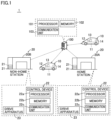
- Fig. 1 is a diagram showing a configuration of a battery replacement control system 1 according to the present embodiment.
- Control system 1 includes a server 100, a plurality of electrically powered vehicles 10, and a plurality of battery stations 20.
- Control system 1 and battery station 20 are an exemplary "battery replacement control system” and an exemplary "battery replacement station” in the present disclosure, respectively.
- Server 100 is an exemplary "second processing apparatus" in the present disclosure.
- Electrically powered vehicle 10 includes a battery 11, a navigation system 12, an electronic control unit (ECU) 13, and a communication instrument 14.
- the plurality of electrically powered vehicles 10 may be identical in configuration to each other.
- Battery 11 represents an exemplary "first battery” in the present disclosure.
- Battery 11 supplies electric power to various electrical components such as a not-shown motor for travel of electrically powered vehicle 10.
- ECU 13 controls various electrical components of electrically powered vehicle 10 including navigation system 12 and communication instrument 14.
- Communication instrument 14 and server 100 can communicate with each other.
- Server 100 may communicate with a not-shown portable terminal or the like owned by a user of electrically powered vehicle 10.
- Battery station 20 includes a plurality of batteries 21 that replace battery 11 of electrically powered vehicle 10. Battery station 20 is provided at a position different from server 100. Battery 21 represents an exemplary "second battery" in the present disclosure.
- the plurality of battery stations 20 include a battery station 20A and a battery station 20B.
- Battery station 20A and battery station 20B are identical to each other in configuration. Contents in a part of the description below referring simply to "battery station 20" are contents common to battery station 20A and battery station 20B.
- a user of electrically powered vehicle 10 can register one of the plurality of battery stations 20 as the home station.
- battery station 20A is registered as the home station and battery station 20B is not registered as the home station.
- the home station means battery station 20 mainly used by the user for battery replacement.
- Battery station 20 includes a control device 22 and a drive apparatus 23.
- Control device 22 represents an exemplary "first processing apparatus" in the present disclosure.
- Control device 22 includes a processor 22a, a memory 22b, and a communication unit 22c. Not only a program to be executed by processor 22a but also information (for example, a map, a mathematical expression, and various parameters) to be used in the program are stored in memory 22b. Processor 22a controls drive apparatus 23.
- Communication unit 22c includes various communication I/Fs. Processor 22a controls communication unit 22c. Communication unit 22c communicates with server 100.
- Control device 22 processes battery replacement at battery station 20 by controlling drive apparatus 23 (to drive).
- drive apparatus 23 includes a movement mechanism that finely adjusts a position of electrically powered vehicle 10 to a battery replacement position, a lifting mechanism that moves up and down electrically powered vehicle 10, a mechanism that replaces batteries, and the like. Detailed description and illustration of each mechanism will not be given herein.
- Server 100 is a server that manages (controls) battery replacement of electrically powered vehicle 10 at each of the plurality of battery stations 20.
- Server 100 includes a processor 101, a memory 102, and a communication unit 103.
- Server 100 receives from a user of electrically powered vehicle 10, a request for registration as the home station, of specific battery station 20 among the plurality of battery stations 20.
- processor 101 determines a first incentive to be granted to the user when control device 22 of the home station performs processing for replacing battery 21 at the home station and battery 11 with each other (that is, when battery station 20A is used).
- processor 101 controls communication unit 103.
- Communication unit 103 includes various communication I/Fs.
- server 100 sets the first incentive corresponding to use of the home station to be greater than a second incentive to be granted to the user when control device 22 of battery station 20 other than the home station causes replacement of battery 21 at battery station 20B and battery 11 with each other (that is, when battery station 20B is used).
- sequence control in control system 1 in the present embodiment will now be described with reference to Figs. 2 to 4 .
- the sequence control in Figs. 2 to 4 is sequence control between a specific user (electrically powered vehicle 10), and server 100 and battery station 20.
- each of the plurality of battery stations 20 transmits through communication unit 22c to server 100, information on a frequency of use of that battery station by specific electrically powered vehicle 10 (user).
- Server 100 (processor 101) thus obtains the information on the frequency of use of each of the plurality of battery stations 20 by the user.
- Server 100 may periodically (continually) obtain the information on the frequency of use.
- server 100 may obtain the information on the frequency of use through the Internet, without receiving the information from battery station 20.
- the information on the frequency of use may be stored in memory 102 of server 100.
- step S2 server 100 (processor 101) determines whether or not the frequency of use corresponding to each of the plurality of battery stations 20 is higher than a prescribed threshold value A (for example, three times in one past week).
- a prescribed threshold value A for example, three times in one past week.
- the process proceeds to step S3.
- Threshold value A may be set to a frequency other than three times in one past week as above.
- Threshold value A represents an exemplary "prescribed frequency threshold value" in the present disclosure.
- step S3 server 100 (processor 101) gives through communication unit 103 to the user, a notification that encourages registration as the home station, of battery station 20 the frequency of use of which is higher than threshold value A.
- processor 101 recommends as the home station to the user, battery station 20 the frequency of use of which is higher than threshold value A.
- Server 100 (processor 101) does not give the user a notification that encourages registration as the home station, of battery station 20 the frequency of use of which is equal to or lower than threshold value A.
- the notification is shown on navigation system 12 of electrically powered vehicle 10 or a not-shown portable terminal or the like of the user.
- a plurality of battery stations 20 the frequency of use of which is higher than threshold value A may be recommended as the home stations.
- only battery station 20 more readily available to the user may be recommended as the home station based on an address of the user of electrically powered vehicle 10, a history of a travel route of electrically powered vehicle 10, or the like.
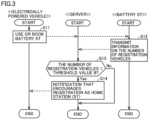
- Fig. 3 will now be described. It is assumed that a specific user (electrically powered vehicle 10) used or booked battery station 20 in step S11. Information on booking of the battery station may be given through server 100 to battery station 20.
- step S12 battery station 20 (processor 22a) used or booked by the user in step S11 transmits through communication unit 22c to server 100, information on the number of electrically powered vehicles 10 (other electrically powered vehicles 10) where (that battery station 20) is registered as the home station.
- Server 100 (processor 101) thus obtains information on the number of registration vehicles corresponding to battery station 20.
- Server 100 may periodically (continually) obtain the information on the number of registration vehicles from each of the plurality of battery stations 20, without being triggered by the processing in step S11.
- server 100 may obtain the information on the number of registration vehicles through the Internet, without receiving the information from battery station 20.
- the information on the number of registration vehicles may be stored in memory 102 of server 100.
- step S13 server 100 (processor 101) determines whether or not the number of electrically powered vehicles 10 (other electrically powered vehicles 10) where battery station 20 used or booked by the user in step S11 is registered as the home station is smaller than a prescribed threshold value B (for example, five). When the number is smaller than threshold value B, the process proceeds to step S14. When the number is equal to or larger than threshold value B, the process ends.
- Threshold value B represents an exemplary "second number threshold value" in the present disclosure.
- step S14 server 100 (processor 101) gives through communication unit 103 to the user, a notification that encourages registration of used or booked battery station 20 as the home station.
- processor 101 recommends used or booked battery station 20 as the home station to the user.
- step S21 the user of electrically powered vehicle 10 transmits to server 100, for example, information (a signal) indicating a request for registration of battery station 20A as the home station.
- step S22 server 100 (communication unit 103) receives the information (signal) transmitted in step S21.
- Server 100 (communication unit 103) thus receives the request corresponding to step S21 from the user.
- server 100 obtains information on the number (the number of registration vehicles) of electrically powered vehicles 10 (other electrically powered vehicles 10) where battery station 20A is registered as the home station.
- server 100 may obtain through communication unit 103, the information on the number of registration vehicles from battery station 20A.
- server 100 may obtain the information on the number of registration vehicles through the Internet.
- the information on the number of registration vehicles may be stored in memory 102 of server 100.
- step S24 server 100 (processor 101) determines whether or not the number (the number of registration vehicles) obtained in step S23 is larger than a prescribed threshold value C (for example, five).
- a prescribed threshold value C for example, five.
- the process proceeds to step S25.
- the number (the number of registration vehicles) is equal to or smaller than threshold value C (in the case of No in step S24)
- the process proceeds to step S26.
- Threshold value C represents an exemplary "first number threshold value" in the present disclosure.
- step S25 server 100 (processor 101) rejects the request received in step S22. Thereafter, the process ends.
- step S26 server (processor 101) approves the request received in step S22. Thereafter, the process proceeds to step S27.
- step S27 server 100 (processor 101) determines the first incentive to be granted to the user when the user uses the home station (20A) for battery replacement of electrically powered vehicle 10.
- processor 101 sets the first incentive to be greater than the second incentive to be granted to the user when the user uses battery station 20 (20B) other than the home station for battery replacement of electrically powered vehicle 10.
- processor 101 sets states of health (SOH) of battery 21 that replaces battery 11 in use of the home station to be higher than the SOH (for example, 50% on average) of battery 21 that replaces battery 11 in use of battery station 20 other than the home station.
- SOH states of health
- processor 101 controls control device 22 of each battery station 20 (20A and 20B) such that battery 11 is replaced with battery 21 lower in degree of deterioration in use of the home station than in use of battery station 20 other than the home station.
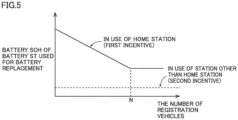
- Processor 101 sets the first incentive (the SOH of battery 21) to be granted to be greater for a battery replacement station registered as the home station in fewer electrically powered vehicles.
- the SOH linearly lowers with increase in number of registration vehicles within a range where the number of registration vehicles is equal to or smaller than N (for example, twenty). In the range where the number of registration vehicles is equal to or smaller than N (for example, twenty), the SOH may lower exponentially or stepwise (in steps) with increase in number of registration vehicles.
- the SOH has a constant value in a range where the number of registration vehicles is larger than N.
- the constant value (a minimum value of the SOH) is larger than the SOH (see a horizontally drawn dashed line in Fig. 5 ) corresponding to the second incentive.
- the SOH may vary (lower) with increase in number of registration vehicles.
- the SOH above is merely a reference value.
- Battery 21 having the SOH closest to the SOH corresponding to the first incentive determined by processor 101 among the plurality of batteries 21 replaces battery 11 of electrically powered vehicle 10.
- the first incentive to be granted to the user when the user uses the home station is set to be greater than the second incentive to be granted to the user when the user uses battery station 20 other than the home station.
- the frequency of use by the user of battery station 20 other than the home station among the plurality of battery stations 20 can thus be lowered. Consequently, battery station 20 that electrically powered vehicle 10 is going to use can readily be predicted.
- the granted first incentive is greater for battery station 20 registered as the home station in fewer electrically powered vehicles 10
- the present disclosure is not limited as such.
- the granted first incentive may be constant.
- the present disclosure is not limited as such.
- the request may be approved also in the case above. Specifically, processing in steps S23 to S25 (S26) shown in Fig. 4 does not have to be performed.
- magnitude of the incentive is defined by magnitude of the SOH of battery 21
- the present disclosure is not limited as such.
- the magnitude of the incentive may be defined by magnitude of an amount of discount of a fee required for battery replacement or magnitude of a point given to the user.
Landscapes
- Engineering & Computer Science (AREA)
- Business, Economics & Management (AREA)
- Power Engineering (AREA)
- Transportation (AREA)
- Mechanical Engineering (AREA)
- Strategic Management (AREA)
- Physics & Mathematics (AREA)
- Theoretical Computer Science (AREA)
- Economics (AREA)
- General Physics & Mathematics (AREA)
- General Business, Economics & Management (AREA)
- Marketing (AREA)
- Human Resources & Organizations (AREA)
- Tourism & Hospitality (AREA)
- Development Economics (AREA)
- Accounting & Taxation (AREA)
- Finance (AREA)
- Entrepreneurship & Innovation (AREA)
- General Health & Medical Sciences (AREA)
- Primary Health Care (AREA)
- Health & Medical Sciences (AREA)
- Operations Research (AREA)
- Quality & Reliability (AREA)
- Game Theory and Decision Science (AREA)
- Sustainable Energy (AREA)
- Life Sciences & Earth Sciences (AREA)
- Sustainable Development (AREA)
- Management, Administration, Business Operations System, And Electronic Commerce (AREA)
- Secondary Cells (AREA)
- Electric Propulsion And Braking For Vehicles (AREA)
- Charge And Discharge Circuits For Batteries Or The Like (AREA)
Abstract
A method of controlling battery replacement includes receiving from a user of an electrically powered vehicle (10), a request for registration as a home station, of a specific battery replacement station among a plurality of battery stations (20) (battery replacement stations) and determining a first incentive to be granted to the user when the user uses the home station for battery replacement of the electrically powered vehicle (10). The determining the first incentive includes setting the first incentive to be greater than a second incentive to be granted to the user when the user uses a battery station (20) other than the home station for battery replacement of the electrically powered vehicle (10).
Description
- This nonprovisional application is based on
Japanese Patent Application No. 2022-186792 filed with the Japan Patent Office on November 22, 2022 - The present disclosure relates to a method of controlling battery replacement and a battery replacement control system.
-
Chinese Patent Publication No. 109670661A discloses a system that makes a plan for charging of a battery within a battery station based on scheduled time of arrival of an electrically powered vehicle at the battery station. - When the electrically powered vehicle has not booked the battery station in the system as disclosed in
Chinese Patent Publication No. 109670661A , it is difficult to determine which battery station the electrically powered vehicle is going to use. For example, even when batteries have been charged at a battery station, the electrically powered vehicle may not use this battery station. A system and a method that can facilitate prediction of a battery station (battery replacement station) that an electrically powered vehicle is going to use have been demanded. - The present disclosure was made to solve the problem above, and an object thereof is to provide a method of controlling battery replacement and a battery replacement control system that can facilitate prediction of a battery replacement station that an electrically powered vehicle is going to use.
- A method of controlling battery replacement according to a first aspect of the present disclosure is a method of controlling battery replacement at a plurality of battery replacement stations each equipped with a battery that replaces a battery mounted on at least one electrically powered vehicle. The battery equipped at each of the plurality of battery replacement stations is a first battery. The battery mounted on the at least one electrically powered vehicle is a second battery. The method includes receiving from a user of the electrically powered vehicle, a request for registration as a home station, of a specific battery replacement station among the plurality of battery replacement stations and determining a first incentive to be granted to the user when the user uses the home station for battery replacement of the electrically powered vehicle. The determining a first incentive includes setting the first incentive to be greater than a second incentive to be granted to the user when the user uses a battery replacement station other than the home station for battery replacement of the electrically powered vehicle.
- In the method of controlling battery replacement according to the first aspect of the present disclosure, the first incentive is set to be greater than the second incentive as set forth above. The user of the electrically powered vehicle thus tends to mainly use the home station where the user can obtain the relatively great first incentive. Consequently, the battery replacement station that the electrically powered vehicle is going to use can readily be predicted.
- In the method of controlling battery replacement according to the first aspect, preferably, the determining a first incentive includes setting the first incentive to be granted to be greater for a battery replacement station registered as the home station in fewer electrically powered vehicles. According to such a configuration, a battery replacement station registered as the home station in few electrically powered vehicles can readily be registered in a larger number of electrically powered vehicles (the number of such electrically powered vehicles can readily be increased; such electrically powered vehicles being referred to as registration vehicles). Consequently, variation in number of registration vehicles among the plurality of battery replacement stations can be suppressed. Congestion of a specific battery replacement station can thus be suppressed.
- The method of controlling battery replacement according to the first aspect preferably further includes rejecting the request when the request is received, the request being directed to a battery replacement station registered as the home station in other electrically powered vehicles, the number of other electrically powered vehicles being larger than a prescribed first number threshold value. According to such a configuration, further increase in number of registration vehicles of the battery replacement station registered as the home station in other electrically powered vehicles, the number of other electrically powered vehicles being larger than the prescribed first number threshold value, can be suppressed. Consequently, congestion of the specific battery replacement station can further be suppressed.
- The method of controlling battery replacement according to the first aspect preferably further includes giving the user a notification that encourages registration as the home station, of a battery replacement station a frequency of use of which by the user is higher than a prescribed frequency threshold value. According to such a configuration, the number of users who register the battery replacement station relatively low in frequency of use as the home station can be increased. Consequently, the frequency of use of the battery replacement station relatively low in frequency of use due to increase in number of registration vehicles can be increased. Variation in frequency of use among the battery replacement stations can thus be lessened.
- The method of controlling battery replacement according to the first aspect preferably further includes giving the user a notification when a battery replacement station registered as the home station in other electrically powered vehicles, the number of other electrically powered vehicles being smaller than a prescribed second number threshold value, is used or booked, the notification being a notification that encourages registration of the used or booked battery replacement station as the home station. According to such a configuration, a battery replacement station registered as the home station in other electrically powered vehicles, the number of other electrically powered vehicles being smaller than the prescribed second number threshold value, can readily be registered in a larger number of electrically powered vehicles (the number of such electrically powered vehicles can readily be increased; such electrically powered vehicles being referred to as registration vehicles). Consequently, variation in number of registration vehicles among the plurality of battery replacement stations can further be suppressed.
- A battery replacement control system according to a second aspect of the present disclosure includes a first processing apparatus that performs processing for replacing a first battery mounted on at least one electrically powered vehicle and a second battery stored at each of a plurality of battery replacement stations with each other and a second processing apparatus that receives from a user of the electrically powered vehicle, a request for registration as a home station, of a specific battery replacement station among the plurality of battery replacement stations and determines a first incentive to be granted to the user when the first processing apparatus causes replacement of the second battery at the home station and the first battery with each other. The second processing apparatus sets the first incentive to be greater than a second incentive to be granted to the user when the first processing apparatus causes replacement of the second battery at a battery replacement station other than the home station and the first battery with each other.
- In the battery replacement control system according to the second aspect of the present disclosure, the first incentive is set to be greater than the second incentive as set forth above. A battery replacement control system capable of readily predicting a battery replacement station to be used by an electrically powered vehicle can thus be provided.
- In the battery replacement control system according to the second aspect, preferably, the second processing apparatus controls the first processing apparatus such that a degree of deterioration of the second battery that replaces the first battery of the electrically powered vehicle based on the first incentive is lower than a degree of deterioration of the second battery that replaces the first battery of the electrically powered vehicle based on the second incentive. According to such a configuration, a frequency of use of the home station by a user of the electrically powered vehicle in which the battery has deteriorated can readily be set to be higher than a frequency of use by the user of a battery replacement station other than the home station.
- The foregoing and other objects, features, aspects and advantages of the present disclosure will become more apparent from the following detailed description of the present disclosure when taken in conjunction with the accompanying drawings.
-
-
Fig. 1 is a diagram showing a configuration of a control system according to one embodiment. -
Fig. 2 is a first diagram showing sequence control in the control system according to one embodiment. -
Fig. 3 is a second diagram showing sequence control in the control system according to one embodiment. -
Fig. 4 is a third diagram showing sequence control in the control system according to one embodiment. -
Fig. 5 is a diagram showing relation between a first incentive and a second incentive. - An embodiment of the present disclosure will be described in detail below with reference to the drawings. The same or corresponding elements in the drawings have the same reference characters allotted and description thereof will not be repeated.
-
Fig. 1 is a diagram showing a configuration of a batteryreplacement control system 1 according to the present embodiment.Control system 1 includes aserver 100, a plurality of electrically poweredvehicles 10, and a plurality ofbattery stations 20.Control system 1 andbattery station 20 are an exemplary "battery replacement control system" and an exemplary "battery replacement station" in the present disclosure, respectively.Server 100 is an exemplary "second processing apparatus" in the present disclosure. - Electrically powered
vehicle 10 includes abattery 11, anavigation system 12, an electronic control unit (ECU) 13, and acommunication instrument 14. The plurality of electrically poweredvehicles 10 may be identical in configuration to each other.Battery 11 represents an exemplary "first battery" in the present disclosure. -
Battery 11 supplies electric power to various electrical components such as a not-shown motor for travel of electrically poweredvehicle 10. ECU 13 controls various electrical components of electrically poweredvehicle 10 includingnavigation system 12 andcommunication instrument 14.Communication instrument 14 andserver 100 can communicate with each other.Server 100 may communicate with a not-shown portable terminal or the like owned by a user of electrically poweredvehicle 10. -
Battery station 20 includes a plurality ofbatteries 21 that replacebattery 11 of electrically poweredvehicle 10.Battery station 20 is provided at a position different fromserver 100.Battery 21 represents an exemplary "second battery" in the present disclosure. - The plurality of
battery stations 20 include abattery station 20A and abattery station 20B.Battery station 20A andbattery station 20B are identical to each other in configuration. Contents in a part of the description below referring simply to "battery station 20" are contents common tobattery station 20A andbattery station 20B. - A user of electrically powered
vehicle 10 can register one of the plurality ofbattery stations 20 as the home station. In the present embodiment, it is assumed thatbattery station 20A is registered as the home station andbattery station 20B is not registered as the home station. The home station meansbattery station 20 mainly used by the user for battery replacement. -
Battery station 20 includes acontrol device 22 and adrive apparatus 23.Control device 22 represents an exemplary "first processing apparatus" in the present disclosure. -
Control device 22 includes aprocessor 22a, amemory 22b, and acommunication unit 22c. Not only a program to be executed byprocessor 22a but also information (for example, a map, a mathematical expression, and various parameters) to be used in the program are stored inmemory 22b.Processor 22a controls driveapparatus 23. -
Communication unit 22c includes various communication I/Fs.Processor 22a controlscommunication unit 22c.Communication unit 22c communicates withserver 100. -
Control device 22 processes battery replacement atbattery station 20 by controlling drive apparatus 23 (to drive). Specifically,drive apparatus 23 includes a movement mechanism that finely adjusts a position of electrically poweredvehicle 10 to a battery replacement position, a lifting mechanism that moves up and down electrically poweredvehicle 10, a mechanism that replaces batteries, and the like. Detailed description and illustration of each mechanism will not be given herein. -
Server 100 is a server that manages (controls) battery replacement of electrically poweredvehicle 10 at each of the plurality ofbattery stations 20.Server 100 includes aprocessor 101, amemory 102, and acommunication unit 103. - Server 100 (processor 101) receives from a user of electrically powered
vehicle 10, a request for registration as the home station, ofspecific battery station 20 among the plurality ofbattery stations 20. In addition,processor 101 determines a first incentive to be granted to the user whencontrol device 22 of the home station performs processing for replacingbattery 21 at the home station andbattery 11 with each other (that is, whenbattery station 20A is used). - Not only a program to be executed by
processor 101 but also information (for example, a map, a mathematical expression, and various parameters) to be used in the program are stored inmemory 102. Position information ofbattery station 20 is stored inmemory 102.Processor 101 controlscommunication unit 103.Communication unit 103 includes various communication I/Fs. - In the conventional control system, when an electrically powered vehicle has not booked a battery station, it is difficult to determine which battery station the electrically powered vehicle is going to use. For example, even when batteries have been charged at a battery station, the electrically powered vehicle may not use this battery station. A system and a method that can facilitate prediction of a battery station that an electrically powered vehicle is going to use have been demanded.
- In the present embodiment, server 100 (processor 101) sets the first incentive corresponding to use of the home station to be greater than a second incentive to be granted to the user when
control device 22 ofbattery station 20 other than the home station causes replacement ofbattery 21 atbattery station 20B andbattery 11 with each other (that is, whenbattery station 20B is used). - Exemplary sequence control in
control system 1 in the present embodiment will now be described with reference toFigs. 2 to 4 . The sequence control inFigs. 2 to 4 is sequence control between a specific user (electrically powered vehicle 10), andserver 100 andbattery station 20. - In step S1, each of the plurality of battery stations 20 (
processors 22a) transmits throughcommunication unit 22c toserver 100, information on a frequency of use of that battery station by specific electrically powered vehicle 10 (user). Server 100 (processor 101) thus obtains the information on the frequency of use of each of the plurality ofbattery stations 20 by the user.Server 100 may periodically (continually) obtain the information on the frequency of use. Alternatively,server 100 may obtain the information on the frequency of use through the Internet, without receiving the information frombattery station 20. The information on the frequency of use may be stored inmemory 102 ofserver 100. - In step S2, server 100 (processor 101) determines whether or not the frequency of use corresponding to each of the plurality of
battery stations 20 is higher than a prescribed threshold value A (for example, three times in one past week). When there isbattery station 20 the frequency of use of which is higher than threshold value A (in the case of Yes in S2), the process proceeds to step S3. When there is nobattery station 20 the frequency of use of which is higher than threshold value A (in the case of No in S2), the process ends. Threshold value A may be set to a frequency other than three times in one past week as above. Threshold value A represents an exemplary "prescribed frequency threshold value" in the present disclosure. - In this case, in step S3, server 100 (processor 101) gives through
communication unit 103 to the user, a notification that encourages registration as the home station, ofbattery station 20 the frequency of use of which is higher than threshold value A. In other words,processor 101 recommends as the home station to the user,battery station 20 the frequency of use of which is higher than threshold value A. Server 100 (processor 101), on the other hand, does not give the user a notification that encourages registration as the home station, ofbattery station 20 the frequency of use of which is equal to or lower than threshold value A. The notification is shown onnavigation system 12 of electrically poweredvehicle 10 or a not-shown portable terminal or the like of the user. - When the frequency of use corresponding to each of the plurality of
battery stations 20 is higher than threshold value A, a plurality ofbattery stations 20 the frequency of use of which is higher than threshold value A may be recommended as the home stations. In this case, onlybattery station 20 more readily available to the user may be recommended as the home station based on an address of the user of electrically poweredvehicle 10, a history of a travel route of electrically poweredvehicle 10, or the like. -
Fig. 3 will now be described. It is assumed that a specific user (electrically powered vehicle 10) used or bookedbattery station 20 in step S11. Information on booking of the battery station may be given throughserver 100 tobattery station 20. - In step S12, battery station 20 (
processor 22a) used or booked by the user in step S11 transmits throughcommunication unit 22c toserver 100, information on the number of electrically powered vehicles 10 (other electrically powered vehicles 10) where (that battery station 20) is registered as the home station. Server 100 (processor 101) thus obtains information on the number of registration vehicles corresponding tobattery station 20.Server 100 may periodically (continually) obtain the information on the number of registration vehicles from each of the plurality ofbattery stations 20, without being triggered by the processing in step S11. Alternatively,server 100 may obtain the information on the number of registration vehicles through the Internet, without receiving the information frombattery station 20. The information on the number of registration vehicles may be stored inmemory 102 ofserver 100. - In step S13, server 100 (processor 101) determines whether or not the number of electrically powered vehicles 10 (other electrically powered vehicles 10) where
battery station 20 used or booked by the user in step S11 is registered as the home station is smaller than a prescribed threshold value B (for example, five). When the number is smaller than threshold value B, the process proceeds to step S14. When the number is equal to or larger than threshold value B, the process ends. Threshold value B represents an exemplary "second number threshold value" in the present disclosure. - In step S14, server 100 (processor 101) gives through
communication unit 103 to the user, a notification that encourages registration of used or bookedbattery station 20 as the home station. In other words,processor 101 recommends used or bookedbattery station 20 as the home station to the user. -
Fig. 4 will now be described. In step S21, the user of electrically poweredvehicle 10 transmits toserver 100, for example, information (a signal) indicating a request for registration ofbattery station 20A as the home station. - In step S22, server 100 (communication unit 103) receives the information (signal) transmitted in step S21. Server 100 (communication unit 103) thus receives the request corresponding to step S21 from the user.
- In step S23,
server 100 obtains information on the number (the number of registration vehicles) of electrically powered vehicles 10 (other electrically powered vehicles 10) wherebattery station 20A is registered as the home station. For example,server 100 may obtain throughcommunication unit 103, the information on the number of registration vehicles frombattery station 20A. Alternatively,server 100 may obtain the information on the number of registration vehicles through the Internet. The information on the number of registration vehicles may be stored inmemory 102 ofserver 100. - In step S24, server 100 (processor 101) determines whether or not the number (the number of registration vehicles) obtained in step S23 is larger than a prescribed threshold value C (for example, five). When the number (the number of registration vehicles) is larger than threshold value C (in the case of Yes in step S24), the process proceeds to step S25. When the number (the number of registration vehicles) is equal to or smaller than threshold value C (in the case of No in step S24), the process proceeds to step S26. Threshold value C represents an exemplary "first number threshold value" in the present disclosure.
- In step S25, server 100 (processor 101) rejects the request received in step S22. Thereafter, the process ends.
- In step S26, server (processor 101) approves the request received in step S22. Thereafter, the process proceeds to step S27.
- In step S27, server 100 (processor 101) determines the first incentive to be granted to the user when the user uses the home station (20A) for battery replacement of electrically powered
vehicle 10. - Specifically, as shown in
Fig. 5 ,processor 101 sets the first incentive to be greater than the second incentive to be granted to the user when the user uses battery station 20 (20B) other than the home station for battery replacement of electrically poweredvehicle 10. - Specifically,
processor 101 sets states of health (SOH) ofbattery 21 that replacesbattery 11 in use of the home station to be higher than the SOH (for example, 50% on average) ofbattery 21 that replacesbattery 11 in use ofbattery station 20 other than the home station. In other words,processor 101 controls controldevice 22 of each battery station 20 (20A and 20B) such thatbattery 11 is replaced withbattery 21 lower in degree of deterioration in use of the home station than in use ofbattery station 20 other than the home station. -
Processor 101 sets the first incentive (the SOH of battery 21) to be granted to be greater for a battery replacement station registered as the home station in fewer electrically powered vehicles. Specifically, the SOH linearly lowers with increase in number of registration vehicles within a range where the number of registration vehicles is equal to or smaller than N (for example, twenty). In the range where the number of registration vehicles is equal to or smaller than N (for example, twenty), the SOH may lower exponentially or stepwise (in steps) with increase in number of registration vehicles. - The SOH has a constant value in a range where the number of registration vehicles is larger than N. The constant value (a minimum value of the SOH) is larger than the SOH (see a horizontally drawn dashed line in
Fig. 5 ) corresponding to the second incentive. In the range where the number of registration vehicles is larger than N, the SOH may vary (lower) with increase in number of registration vehicles. - The SOH above is merely a reference value.
Battery 21 having the SOH closest to the SOH corresponding to the first incentive determined byprocessor 101 among the plurality ofbatteries 21 replacesbattery 11 of electrically poweredvehicle 10. - As set forth above, the first incentive to be granted to the user when the user uses the home station is set to be greater than the second incentive to be granted to the user when the user uses
battery station 20 other than the home station. The frequency of use by the user ofbattery station 20 other than the home station among the plurality ofbattery stations 20 can thus be lowered. Consequently,battery station 20 that electricallypowered vehicle 10 is going to use can readily be predicted. - Though an example in which the granted first incentive is greater for
battery station 20 registered as the home station in fewer electricallypowered vehicles 10 is shown in the embodiment, the present disclosure is not limited as such. For example, regardless of the number of electricallypowered vehicles 10 where the battery station is registered as the home station, the granted first incentive may be constant. - Though an example in which the request is rejected when the request is received, the request being directed to
battery station 20 registered as the home station in other electrically powered vehicles, the number of which is larger than threshold value C, is shown in the embodiment, the present disclosure is not limited as such. The request may be approved also in the case above. Specifically, processing in steps S23 to S25 (S26) shown inFig. 4 does not have to be performed. - Though an example in which magnitude of the incentive is defined by magnitude of the SOH of
battery 21 is shown in the embodiment, the present disclosure is not limited as such. For example, the magnitude of the incentive may be defined by magnitude of an amount of discount of a fee required for battery replacement or magnitude of a point given to the user. - Though an embodiment of the present disclosure has been described, it should be understood that the embodiment disclosed herein is illustrative and non-restrictive in every respect. The scope of the present disclosure is defined by the terms of the claims and is intended to include any modifications within the scope and meaning equivalent to the terms of the claims.
Claims (7)
- A method of controlling battery replacement at a plurality of battery replacement stations (20) each equipped with a battery (21) for replacing a battery (11) mounted on at least one electrically powered vehicle (10), the battery (11) mounted on the at least one electrically powered vehicle being a first battery (11), the battery (21) equipped at each of the plurality of battery replacement stations (20) being a second battery (21), the method comprising:receiving from a user of the electrically powered vehicle (10), a request for registration as a home station, of a specific battery replacement station (20) among the plurality of battery replacement stations (20); anddetermining a first incentive to be granted to the user when the user uses the home station for battery replacement of the electrically powered vehicle (10), whereinthe determining a first incentive includes setting the first incentive to be greater than a second incentive to be granted to the user when the user uses a battery replacement station (20) other than the home station for battery replacement of the electrically powered vehicle (10).
- The method of controlling battery replacement according to claim 1, wherein
the determining a first incentive includes setting the first incentive to be granted to be greater for a battery replacement station (20) registered as the home station in fewer electrically powered vehicles (10). - The method of controlling battery replacement according to claim 1 or 2, further comprising rejecting the request when the request is received, the request being directed to a battery replacement station (20) registered as the home station in other electrically powered vehicles (10), the number of other electrically powered vehicles (10) being larger than a prescribed first number threshold value (C).
- The method of controlling battery replacement according to claim 1 or 2, further comprising giving the user a notification that encourages registration as the home station, of a battery replacement station (20) a frequency of use of which by the user is higher than a prescribed frequency threshold value (A).
- The method of controlling battery replacement according to claim 1 or 2, further comprising giving the user a notification when the user uses or books a battery replacement station (20) registered as the home station in other electrically powered vehicles (10), the number of other electrically powered vehicles (10) being smaller than a prescribed second number threshold value (B), the notification being a notification that encourages registration of the used or booked battery replacement station (20) as the home station.
- A battery replacement control system (1) comprising:a first processing apparatus (22) configured to perform processing for replacing a first battery (11) mounted on at least one electrically powered vehicle (10) and a second battery (21) stored at each of a plurality of battery replacement stations (20) with each other; anda second processing apparatus (100) configured to (i) receive from a user of the electrically powered vehicle (10), a request for registration as a home station, of a specific battery replacement station (20) among the plurality of battery replacement stations (20) and (ii) determine a first incentive to be granted to the user when the first processing apparatus (22) causes replacement of the second battery (21) at the home station and the first battery (11) with each other, whereinthe second processing apparatus (100) is configured to set the first incentive to be greater than a second incentive to be granted to the user when the first processing apparatus (22) causes replacement of the second battery (21) at a battery replacement station (20) other than the home station and the first battery (11) with each other.
- The battery replacement control system (1) according to claim 6, wherein
the second processing apparatus (100) is configured to control the first processing apparatus (22) such that a degree of deterioration of the second battery (21) that replaces the first battery (11) of the electrically powered vehicle (10) based on the first incentive is lower than a degree of deterioration of the second battery (21) that replaces the first battery (11) of the electrically powered vehicle (10) based on the second incentive.
Applications Claiming Priority (1)
| Application Number | Priority Date | Filing Date | Title |
|---|---|---|---|
| JP2022186792A JP7845152B2 (en) | 2022-11-22 | 2022-11-22 | Battery replacement control method and battery replacement control system |
Publications (1)
| Publication Number | Publication Date |
|---|---|
| EP4375127A1 true EP4375127A1 (en) | 2024-05-29 |
Family
ID=88745827
Family Applications (1)
| Application Number | Title | Priority Date | Filing Date |
|---|---|---|---|
| EP23208403.8A Pending EP4375127A1 (en) | 2022-11-22 | 2023-11-07 | Method of controlling battery replacement and battery replacement control system |
Country Status (5)
| Country | Link |
|---|---|
| US (1) | US20240166080A1 (en) |
| EP (1) | EP4375127A1 (en) |
| JP (1) | JP7845152B2 (en) |
| KR (1) | KR20240076697A (en) |
| CN (1) | CN118061846A (en) |
Families Citing this family (1)
| Publication number | Priority date | Publication date | Assignee | Title |
|---|---|---|---|---|
| CN119773578B (en) * | 2024-12-31 | 2026-04-03 | 浙江吉利控股集团有限公司 | A battery swapping dispatching method, battery swapping station and vehicle |
Citations (4)
| Publication number | Priority date | Publication date | Assignee | Title |
|---|---|---|---|---|
| CN109670661A (en) | 2017-10-17 | 2019-04-23 | 蔚来汽车有限公司 | Method and apparatus for determining the charging strategy of the deficient electric battery in electrical changing station |
| US20200402075A1 (en) * | 2018-02-23 | 2020-12-24 | Panasonic Intellectual Property Management Co., Ltd. | Battery station management system and battery station management method |
| JP2021034126A (en) * | 2019-08-14 | 2021-03-01 | 本田技研工業株式会社 | Determination device, determination method, and program |
| US20220276688A1 (en) * | 2019-11-19 | 2022-09-01 | Honda Motor Co.,Ltd. | Information processing device, computer-readable storage medium, and information processing method |
Family Cites Families (6)
| Publication number | Priority date | Publication date | Assignee | Title |
|---|---|---|---|---|
| JP4051197B2 (en) | 2001-11-14 | 2008-02-20 | 株式会社ジェーシービー | Point management system and method |
| JP6678384B2 (en) * | 2014-10-23 | 2020-04-08 | 日産自動車株式会社 | Shared vehicle management device and shared vehicle management method |
| JP7053253B2 (en) | 2017-12-27 | 2022-04-12 | トヨタ自動車株式会社 | Battery module lending system, lending method and lending program |
| CN111670451A (en) | 2018-03-20 | 2020-09-15 | 本田技研工业株式会社 | Server, management device and management system |
| CN112163720A (en) | 2020-10-22 | 2021-01-01 | 哈尔滨工程大学 | A battery swap scheduling method for multi-agent unmanned electric vehicles based on the Internet of Vehicles |
| JP7451459B2 (en) | 2021-03-30 | 2024-03-18 | Eneos株式会社 | information processing system |
-
2022
- 2022-11-22 JP JP2022186792A patent/JP7845152B2/en active Active
-
2023
- 2023-10-23 US US18/382,771 patent/US20240166080A1/en active Pending
- 2023-11-07 EP EP23208403.8A patent/EP4375127A1/en active Pending
- 2023-11-08 KR KR1020230153637A patent/KR20240076697A/en not_active Ceased
- 2023-11-15 CN CN202311519111.9A patent/CN118061846A/en active Pending
Patent Citations (4)
| Publication number | Priority date | Publication date | Assignee | Title |
|---|---|---|---|---|
| CN109670661A (en) | 2017-10-17 | 2019-04-23 | 蔚来汽车有限公司 | Method and apparatus for determining the charging strategy of the deficient electric battery in electrical changing station |
| US20200402075A1 (en) * | 2018-02-23 | 2020-12-24 | Panasonic Intellectual Property Management Co., Ltd. | Battery station management system and battery station management method |
| JP2021034126A (en) * | 2019-08-14 | 2021-03-01 | 本田技研工業株式会社 | Determination device, determination method, and program |
| US20220276688A1 (en) * | 2019-11-19 | 2022-09-01 | Honda Motor Co.,Ltd. | Information processing device, computer-readable storage medium, and information processing method |
Also Published As
| Publication number | Publication date |
|---|---|
| CN118061846A (en) | 2024-05-24 |
| JP2024075382A (en) | 2024-06-03 |
| KR20240076697A (en) | 2024-05-30 |
| US20240166080A1 (en) | 2024-05-23 |
| JP7845152B2 (en) | 2026-04-14 |
Similar Documents
| Publication | Publication Date | Title |
|---|---|---|
| EP2584313A1 (en) | Information providing device and information providing method | |
| WO2022128175A1 (en) | Intelligent preconditioning for high voltage electric vehicle batteries | |
| CN109765895B (en) | Unmanned vehicle control method, unmanned vehicle control device, unmanned vehicle and storage medium | |
| CN111861081B (en) | Order distribution method, device, electronic device and storage medium | |
| EP4375127A1 (en) | Method of controlling battery replacement and battery replacement control system | |
| CN109785611B (en) | Unmanned vehicle control method, device, server and storage medium | |
| CN115503534B (en) | Charging pile recommendation method, device, equipment and computer readable storage medium | |
| EP3862764A1 (en) | Battery deterioration judging system, battery deterioration judging method, and battery deterioration judging program | |
| CN115577173B (en) | Information pushing method, device, equipment and storage medium | |
| CN113240477A (en) | Order distribution method, order distribution device and readable storage medium | |
| CN111882912B (en) | Riding information processing method, device and system | |
| CN106530790A (en) | Road side unit based bus arrival prompting method and apparatus | |
| CN118014289A (en) | Method, device, vehicle and storage medium for recommending charging station | |
| CN112669116B (en) | Order processing method and device, electronic equipment and readable storage medium | |
| CN111629926B (en) | Control device, control method, and storage medium | |
| KR102522516B1 (en) | System and method for managing and charging battery of electric bus efficiently | |
| CN120986263A (en) | Intelligent charging reminder method for vehicles | |
| CA3202138A1 (en) | Network system for controlling communications based on user context | |
| US12304343B2 (en) | Method of controlling battery replacement, battery replacement control device, and battery replacement control system | |
| US12254776B2 (en) | Control system of vehicle | |
| CN110286968A (en) | Notification system and notification method | |
| JP6976379B2 (en) | Vehicle dispatch system | |
| WO2023087108A1 (en) | Systems, methods, and devices for determining optimal electric car charging stations | |
| CN111814074B (en) | Method, device, electronic device and storage medium for providing predicted itinerary | |
| CN117874372B (en) | Public transport voice broadcasting method, device, equipment and medium |
Legal Events
| Date | Code | Title | Description |
|---|---|---|---|
| PUAI | Public reference made under article 153(3) epc to a published international application that has entered the european phase |
Free format text: ORIGINAL CODE: 0009012 |
|
| STAA | Information on the status of an ep patent application or granted ep patent |
Free format text: STATUS: REQUEST FOR EXAMINATION WAS MADE |
|
| 17P | Request for examination filed |
Effective date: 20231107 |
|
| AK | Designated contracting states |
Kind code of ref document: A1 Designated state(s): AL AT BE BG CH CY CZ DE DK EE ES FI FR GB GR HR HU IE IS IT LI LT LU LV MC ME MK MT NL NO PL PT RO RS SE SI SK SM TR |