EP4373701B1 - Charging station for an electric scooter and electric scooter - Google Patents
Charging station for an electric scooter and electric scooter Download PDFInfo
- Publication number
- EP4373701B1 EP4373701B1 EP21748834.5A EP21748834A EP4373701B1 EP 4373701 B1 EP4373701 B1 EP 4373701B1 EP 21748834 A EP21748834 A EP 21748834A EP 4373701 B1 EP4373701 B1 EP 4373701B1
- Authority
- EP
- European Patent Office
- Prior art keywords
- charging
- electric vehicle
- light electric
- adapter
- headtube
- Prior art date
- Legal status (The legal status is an assumption and is not a legal conclusion. Google has not performed a legal analysis and makes no representation as to the accuracy of the status listed.)
- Active
Links
Images

Classifications
-
- B—PERFORMING OPERATIONS; TRANSPORTING
- B60—VEHICLES IN GENERAL
- B60L—PROPULSION OF ELECTRICALLY-PROPELLED VEHICLES; SUPPLYING ELECTRIC POWER FOR AUXILIARY EQUIPMENT OF ELECTRICALLY-PROPELLED VEHICLES; ELECTRODYNAMIC BRAKE SYSTEMS FOR VEHICLES IN GENERAL; MAGNETIC SUSPENSION OR LEVITATION FOR VEHICLES; MONITORING OPERATING VARIABLES OF ELECTRICALLY-PROPELLED VEHICLES; ELECTRIC SAFETY DEVICES FOR ELECTRICALLY-PROPELLED VEHICLES
- B60L53/00—Methods of charging batteries, specially adapted for electric vehicles; Charging stations or on-board charging equipment therefor; Exchange of energy storage elements in electric vehicles
- B60L53/10—Methods of charging batteries, specially adapted for electric vehicles; Charging stations or on-board charging equipment therefor; Exchange of energy storage elements in electric vehicles characterised by the energy transfer between the charging station and the vehicle
- B60L53/14—Conductive energy transfer
- B60L53/16—Connectors, e.g. plugs or sockets, specially adapted for charging electric vehicles
-
- B—PERFORMING OPERATIONS; TRANSPORTING
- B60—VEHICLES IN GENERAL
- B60L—PROPULSION OF ELECTRICALLY-PROPELLED VEHICLES; SUPPLYING ELECTRIC POWER FOR AUXILIARY EQUIPMENT OF ELECTRICALLY-PROPELLED VEHICLES; ELECTRODYNAMIC BRAKE SYSTEMS FOR VEHICLES IN GENERAL; MAGNETIC SUSPENSION OR LEVITATION FOR VEHICLES; MONITORING OPERATING VARIABLES OF ELECTRICALLY-PROPELLED VEHICLES; ELECTRIC SAFETY DEVICES FOR ELECTRICALLY-PROPELLED VEHICLES
- B60L53/00—Methods of charging batteries, specially adapted for electric vehicles; Charging stations or on-board charging equipment therefor; Exchange of energy storage elements in electric vehicles
- B60L53/30—Constructional details of charging stations
- B60L53/31—Charging columns specially adapted for electric vehicles
-
- B—PERFORMING OPERATIONS; TRANSPORTING
- B60—VEHICLES IN GENERAL
- B60L—PROPULSION OF ELECTRICALLY-PROPELLED VEHICLES; SUPPLYING ELECTRIC POWER FOR AUXILIARY EQUIPMENT OF ELECTRICALLY-PROPELLED VEHICLES; ELECTRODYNAMIC BRAKE SYSTEMS FOR VEHICLES IN GENERAL; MAGNETIC SUSPENSION OR LEVITATION FOR VEHICLES; MONITORING OPERATING VARIABLES OF ELECTRICALLY-PROPELLED VEHICLES; ELECTRIC SAFETY DEVICES FOR ELECTRICALLY-PROPELLED VEHICLES
- B60L53/00—Methods of charging batteries, specially adapted for electric vehicles; Charging stations or on-board charging equipment therefor; Exchange of energy storage elements in electric vehicles
- B60L53/60—Monitoring or controlling charging stations
- B60L53/65—Monitoring or controlling charging stations involving identification of vehicles or their battery types
-
- B—PERFORMING OPERATIONS; TRANSPORTING
- B60—VEHICLES IN GENERAL
- B60L—PROPULSION OF ELECTRICALLY-PROPELLED VEHICLES; SUPPLYING ELECTRIC POWER FOR AUXILIARY EQUIPMENT OF ELECTRICALLY-PROPELLED VEHICLES; ELECTRODYNAMIC BRAKE SYSTEMS FOR VEHICLES IN GENERAL; MAGNETIC SUSPENSION OR LEVITATION FOR VEHICLES; MONITORING OPERATING VARIABLES OF ELECTRICALLY-PROPELLED VEHICLES; ELECTRIC SAFETY DEVICES FOR ELECTRICALLY-PROPELLED VEHICLES
- B60L2200/00—Type of vehicles
- B60L2200/12—Bikes
-
- B—PERFORMING OPERATIONS; TRANSPORTING
- B60—VEHICLES IN GENERAL
- B60L—PROPULSION OF ELECTRICALLY-PROPELLED VEHICLES; SUPPLYING ELECTRIC POWER FOR AUXILIARY EQUIPMENT OF ELECTRICALLY-PROPELLED VEHICLES; ELECTRODYNAMIC BRAKE SYSTEMS FOR VEHICLES IN GENERAL; MAGNETIC SUSPENSION OR LEVITATION FOR VEHICLES; MONITORING OPERATING VARIABLES OF ELECTRICALLY-PROPELLED VEHICLES; ELECTRIC SAFETY DEVICES FOR ELECTRICALLY-PROPELLED VEHICLES
- B60L2200/00—Type of vehicles
- B60L2200/20—Vehicles specially adapted for children, e.g. toy vehicles
-
- B—PERFORMING OPERATIONS; TRANSPORTING
- B62—LAND VEHICLES FOR TRAVELLING OTHERWISE THAN ON RAILS
- B62H—CYCLE STANDS; SUPPORTS OR HOLDERS FOR PARKING OR STORING CYCLES; APPLIANCES PREVENTING OR INDICATING UNAUTHORIZED USE OR THEFT OF CYCLES; LOCKS INTEGRAL WITH CYCLES; DEVICES FOR LEARNING TO RIDE CYCLES
- B62H3/00—Separate supports or holders for parking or storing cycles
- B62H2003/005—Supports or holders associated with means for bike rental
-
- B—PERFORMING OPERATIONS; TRANSPORTING
- B62—LAND VEHICLES FOR TRAVELLING OTHERWISE THAN ON RAILS
- B62J—CYCLE SADDLES OR SEATS; AUXILIARY DEVICES OR ACCESSORIES SPECIALLY ADAPTED TO CYCLES AND NOT OTHERWISE PROVIDED FOR, e.g. ARTICLE CARRIERS OR CYCLE PROTECTORS
- B62J50/00—Arrangements specially adapted for use on cycles not provided for in main groups B62J1/00 - B62J45/00
- B62J50/20—Information-providing devices
-
- B—PERFORMING OPERATIONS; TRANSPORTING
- B62—LAND VEHICLES FOR TRAVELLING OTHERWISE THAN ON RAILS
- B62K—CYCLES; CYCLE FRAMES; CYCLE STEERING DEVICES; RIDER-OPERATED TERMINAL CONTROLS SPECIALLY ADAPTED FOR CYCLES; CYCLE AXLE SUSPENSIONS; CYCLE SIDECARS, FORECARS, OR THE LIKE
- B62K3/00—Bicycles
- B62K3/002—Bicycles without a seat, i.e. the rider operating the vehicle in a standing position, e.g. non-motorized scooters; non-motorized scooters with skis or runners
-
- Y—GENERAL TAGGING OF NEW TECHNOLOGICAL DEVELOPMENTS; GENERAL TAGGING OF CROSS-SECTIONAL TECHNOLOGIES SPANNING OVER SEVERAL SECTIONS OF THE IPC; TECHNICAL SUBJECTS COVERED BY FORMER USPC CROSS-REFERENCE ART COLLECTIONS [XRACs] AND DIGESTS
- Y02—TECHNOLOGIES OR APPLICATIONS FOR MITIGATION OR ADAPTATION AGAINST CLIMATE CHANGE
- Y02T—CLIMATE CHANGE MITIGATION TECHNOLOGIES RELATED TO TRANSPORTATION
- Y02T10/00—Road transport of goods or passengers
- Y02T10/60—Other road transportation technologies with climate change mitigation effect
- Y02T10/70—Energy storage systems for electromobility, e.g. batteries
-
- Y—GENERAL TAGGING OF NEW TECHNOLOGICAL DEVELOPMENTS; GENERAL TAGGING OF CROSS-SECTIONAL TECHNOLOGIES SPANNING OVER SEVERAL SECTIONS OF THE IPC; TECHNICAL SUBJECTS COVERED BY FORMER USPC CROSS-REFERENCE ART COLLECTIONS [XRACs] AND DIGESTS
- Y02—TECHNOLOGIES OR APPLICATIONS FOR MITIGATION OR ADAPTATION AGAINST CLIMATE CHANGE
- Y02T—CLIMATE CHANGE MITIGATION TECHNOLOGIES RELATED TO TRANSPORTATION
- Y02T10/00—Road transport of goods or passengers
- Y02T10/60—Other road transportation technologies with climate change mitigation effect
- Y02T10/7072—Electromobility specific charging systems or methods for batteries, ultracapacitors, supercapacitors or double-layer capacitors
-
- Y—GENERAL TAGGING OF NEW TECHNOLOGICAL DEVELOPMENTS; GENERAL TAGGING OF CROSS-SECTIONAL TECHNOLOGIES SPANNING OVER SEVERAL SECTIONS OF THE IPC; TECHNICAL SUBJECTS COVERED BY FORMER USPC CROSS-REFERENCE ART COLLECTIONS [XRACs] AND DIGESTS
- Y02—TECHNOLOGIES OR APPLICATIONS FOR MITIGATION OR ADAPTATION AGAINST CLIMATE CHANGE
- Y02T—CLIMATE CHANGE MITIGATION TECHNOLOGIES RELATED TO TRANSPORTATION
- Y02T90/00—Enabling technologies or technologies with a potential or indirect contribution to GHG emissions mitigation
- Y02T90/10—Technologies relating to charging of electric vehicles
- Y02T90/12—Electric charging stations
-
- Y—GENERAL TAGGING OF NEW TECHNOLOGICAL DEVELOPMENTS; GENERAL TAGGING OF CROSS-SECTIONAL TECHNOLOGIES SPANNING OVER SEVERAL SECTIONS OF THE IPC; TECHNICAL SUBJECTS COVERED BY FORMER USPC CROSS-REFERENCE ART COLLECTIONS [XRACs] AND DIGESTS
- Y02—TECHNOLOGIES OR APPLICATIONS FOR MITIGATION OR ADAPTATION AGAINST CLIMATE CHANGE
- Y02T—CLIMATE CHANGE MITIGATION TECHNOLOGIES RELATED TO TRANSPORTATION
- Y02T90/00—Enabling technologies or technologies with a potential or indirect contribution to GHG emissions mitigation
- Y02T90/10—Technologies relating to charging of electric vehicles
- Y02T90/14—Plug-in electric vehicles
Definitions
- the present invention relates in general to charging of light electrical vehicles such as electric scooters and similar two or three-wheel electric vehicles.
- the present invention concerns a charging station of light electrical vehicles, a charging interface socket, a charging adapter and a light electrical vehicle comprising the charging adapter.
- scooters also referred to as electric motorized scooters and e-scooters
- bikes are commonly used especially in city environments.
- Light electrical vehicles being fast, convenient, eco-friendly way of transport in a city and free-floating rental model, for example, a scooter-sharing system is comfortable and quick solution for scooter riders.
- the scooter-sharing system can be described by being a service in which electric scooters are made available to use for short-term rental. Similar services are also known for electric bikes.
- scooter-sharing systems There however exist several accompanying problems with scooter-sharing systems, one of them being scooter clutter on the streets in the city. As people have a freedom to leave the scooters however they like, it is common that a scooter ends up being parked so that they block the paths of pedestrians, cyclists, and other scooter users.
- Electric scooters are operated by utilizing electrical power stored into a battery thereof and batteries need to be changed or charged regularly.
- Battery-related operations are one of the biggest costs for scooter operators. Either scooters need to be taken to warehouses for battery charging or batteries being swapped on the street, the battery-related operations are workforce heavy.
- US 2020361328 discloses a charging system including a charging adapter configured to be mounted on a light electric vehicle (LEV), a charging station, and a processor configured to control charging of the LEV.
- the charging adapter has electrical contacts for docking with a charging station and a charging interface for supplying power from the charging station to a battery of the LEV.
- a charging adapter configured to be mounted on a headtube of a light electric vehicle, the charging adapter comprises an RFID tag and two electrical contacts for receiving electric power from an electric scooter charging station. Those two electrical contacts are arranged on sides of the headtube and both sides of the RFID tag, which is configured to face the travelling direction of the light electric vehicle, when the charging adapter is mounted on the headtube.
- the RFID tag and two electrical contacts are arranged at outer surface of the charging adapter.
- the inner surface of the charging adapter is configured to be mounted against the headtube.
- the charging adapter has a shape corresponding a letter U in the horizontal plane.
- the RFID tag is arranged to the tip of the letter u-shaped charging adapter.
- the charging adapter has a shape of a cross-section of the headtube.
- the light electric vehicle is an electric scooter. According to an example embodiment, the light electric vehicle further comprise a GPS tracker chip.
- a charging interface socket for a charging station.
- the charging interface socket comprises a notch for receiving a headtube of a light electric vehicle, and an RFID reader for an RFID tag of the light electric vehicle, a fixing mechanism for holding the light electric vehicle in place in the notch, and two electrical contacts for supplying electrical power to a battery of the light electric vehicle on the inner surface of the notch.
- the RFID reader is arranged at the end of notch of the socket, the fixing mechanism is arranged at or in the vicinity of the mouth of the notch, and the electric contacts are arranged between the RFID reader and the fixing mechanism.
- the fixing mechanism comprises two spring-tensioned contact rollers arranged on both sides at or in the vicinity of the mouth of the notch of the charging interface socket.
- the electrical contacts are spring-loaded contacts.
- a charging station for charging a light electric vehicle wherein the charging station (300) comprises at least one charger (302) and at least one charging interface socket (200) according to the third aspect and any one of its example embodiment.
- a plurality of may refer to any positive integer starting from two (2), that is, being at least two.
- An “electric scooter” is used herein only as an example of a light electric vehicle (LEV). Instead of electric scooters, the present invention is also suitable for electric bikes etc.
- the idea of the present invention is to provide a safe, low-cost, user-friendly, and low-maintenance light electric vehicle (LEV) charging system requiring minimal or no input from the user so that riders find it easy to bring LEVs for charging .
- LEVs When LEVs end up to the charging stations it means that LEVs could be charged for the next users and less LEVs end up cluttering the streets in the city.
- a rider when finishing a LEV ride, for example an electric scooter ride and being close to a charging station can just push the LEV into the charging station, which charging interface socket is configured to receive a charging adapter mounted on a headtube of the LEV, for example, of the electric scooter.
- the outer surface of the charging adapter configured to face the charging interface socket comprises an RFID tag for identification of the LEV and two electrical contacts for receiving electric power for a battery of the LEV.
- the outer surface of the charging adapter is opposite to the inner surface of the adapter configured to be positioned against the headtube.
- the charging adapter may, for example, have a shape substantially corresponding the letter U or horizontal cross-section of the headtube.
- the charging adapter has such a size and shape that it is suitable to be mounted on or around a headtube of a LEV. It is however possible that the charging adapter is an additional separate piece having, for example, a rectangular or circular shape or any other suitable shape for a charging adapter, which charging adapter is arranged to be mounted i.e. fixed to the front part of a headtube of a LEV by a fixing element.
- the fixing element may be, for example, a cable tie, a metal cable tie, or any other fixing means suitable for fixing a charging adapter around a headtube of a LEV.
- mounting of an adapter on a headtube covers situations when the adapter is arranged partially or completely around the headtube or on the headtube.
- the RFID tag is embedded inside the adapter i.e. it is not on the outer surface of the adapter, or it is on the outer surface of the adapter.
- the adapter may, for example, be made of plastic or other suitable material.
- a charging interface socket of a charging station may comprise a notch or corresponding into which a headtube of a LEV is configured to be inserted.
- the form of the charging interface socket may, for example, substantially correspond the letter U in the horizontal plane.
- the charging interface socket comprises on its inner surface i.e. in the notch a RFID reader for reading an RFID tag of a charging adapter of a LEV and a fixing mechanism for the LEV, and two electrical contacts for supplying electrical power to a battery of the LEV.
- the fixing mechanism may comprise, for example, two spring-tensioned contact rollers arranged on the inner surface of ends of the U-shaped socket i.e. at or near i.e. in the vicinity the mouth of the notch.
- the decision to initiate charging or not may further require that a GPS location of a LEV corresponds a location of a charging station in question.
- the decision of this correspondence may be made, for example, in an external computing device, for example, in a server or cloud, which receives the information from the charging station and GPS tracking software tracking the LEV.
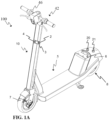
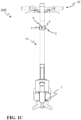
- FIGS 1A-1C illustrate schematically an electric scooter 100 with a charging adapter 2 according to an example embodiment from different viewing angles.
- Fig. 1A illustrates a perspective view of the electric scooter 100
- Fig. 1B illustrates the electric scooter 100 from a side
- Fig. 1C from the front.
- the electric scooter 100 comprises a frame 5, a front wheel support portion 7 for supporting at least one front wheel, and a rear wheel support portion 8 for supporting at least one rear wheel, wherein the front wheel support portion 7 and the rear wheel support portion 8 are coupled to the frame 5, an electric motor (not shown in Figs. 1A-1C ), and a controlling unit 21.
- the controlling unit is, preferably, configured to control the operation of the electric scooter 100, especially at least of the electric motor thereof.
- the controlling unit may comprise one or more processing units, such as processor(s), and memory, such as non-transitory or non-volatile memory storage medium, for storing instructions executable by the processing unit(s) for operating the scooter 100.
- controlling unit may comprise electrical power converter for converting and/or controlling the current being injected to the electric motor.
- the controlling unit 21 may be substantially a single unit or being distributed in more than one positions. In overall, the position of the controlling unit is not limited to any specific position, but it may reside basically anywhere in the scooter 100.
- the electric motor(s) may be arranged for rotating at least a front wheel coupled a front wheel support portion 7 and/or at least a rear wheel coupled to the rear wheel support portion 8.
- the electric motor may be a hub motor in the front and/or rear wheel.
- the electric scooter 100 comprises a chargeable battery 6 and a charging adapter 2 mounted on a headtube 10 of the electric scooter 100.
- the charging adapter 2 comprises two electrical contacts 3 (only one electrical contact is shown in Figs. 1A-1B ) on the sides of the charging adapter 2 and on the sides of the headtube, and an RFID tag 4 in front of the charging adapter 2 facing the riding direction of the scooter 100.
- the mounting height of the charging adapter 2 depends on the height of a charging interface socket of a charging station, wherein the scooter 100 is configured to be charged.
- the charging adapter 2 may be mounted on the headtube 10, for example, by glue, by fixing means, for example, by screws, or by a collar or corresponding (not shown).
- the electric scooter 100 further comprises required electronics and circuitry (not shown) needed for charging the battery 6 through the charging adapter 2.
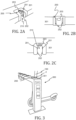
- FIGS 2A-2C illustrate schematically a charging interface socket 200 of a charging station 300 according to an example embodiment from different viewing angles.
- Fig. 2A illustrates a perspective view of the charging interface socket 200
- Fig. 2B illustrates the charging interface socket 200 from the front i.e. a direction wherefrom a light electric vehicle, for example, a scooter is configured to be pushed to the charging station
- Fig. 2C from above.
- the charging interface socket 200 is arranged in connection with the charging station, for example, to a horizontal support plate of the charging station 301 or some other suitable part of the charging station.
- the charging interface socket 200 comprises a notch 210 for receiving a headtube of a light electric vehicle and a charging adapter mounted on the headtube. It may say that the charging interface socket 200 could, for example, have a shape that substantially corresponds the letter U.
- the charging interface socket 200 further comprises, on the inner surface of the notch 210, an RFID reader 203 for a RFID tag of the light electric vehicle, a fixing mechanism 202 for holding the light electric vehicle in place in the notch 210 and in the charging station 300, and two electrical contacts 201 to be connected with electric contacts of the adapter.
- the fixing mechanism 202 comprises, in this example embodiment, two spring-tensioned contact rollers arranged at or near the mouth of the notch 210 of the socket 200.
- the electrical contacts 201 are in this example embodiment spring contacts so that the contact with the contacts of the charging adapter is easier, more reliable, and ensures electric contact in a wide range of tolerances.
- the socket 200 may comprise inside it a rubber cushion for making the insertion of the LEV to the socket 200 smoother.
- the charging interface socket 200 maybe made of plastic.
- a charging station 300 for charging light electric vehicles 100 for example, electric scooters 100 comprising a charging adapter 2 shown in FIGs 1A-1C .
- the charging station 300 comprises two chargers 302 and a plurality of charging interface sockets 200 for receiving a light electric vehicle.
Landscapes
- Engineering & Computer Science (AREA)
- Power Engineering (AREA)
- Transportation (AREA)
- Mechanical Engineering (AREA)
- Charge And Discharge Circuits For Batteries Or The Like (AREA)
- Electric Propulsion And Braking For Vehicles (AREA)
Description
- The present invention relates in general to charging of light electrical vehicles such as electric scooters and similar two or three-wheel electric vehicles. In particular, however, not exclusively, the present invention concerns a charging station of light electrical vehicles, a charging interface socket, a charging adapter and a light electrical vehicle comprising the charging adapter.
- Nowadays light electrical vehicles such as electric scooters (also referred to as electric motorized scooters and e-scooters) and bikes are commonly used especially in city environments. Light electrical vehicles being fast, convenient, eco-friendly way of transport in a city and free-floating rental model, for example, a scooter-sharing system is comfortable and quick solution for scooter riders. The scooter-sharing system can be described by being a service in which electric scooters are made available to use for short-term rental. Similar services are also known for electric bikes.
- There however exist several accompanying problems with scooter-sharing systems, one of them being scooter clutter on the streets in the city. As people have a freedom to leave the scooters however they like, it is common that a scooter ends up being parked so that they block the paths of pedestrians, cyclists, and other scooter users.
- Furthermore, electric scooters are operated by utilizing electrical power stored into a battery thereof and batteries need to be changed or charged regularly. Battery-related operations are one of the biggest costs for scooter operators. Either scooters need to be taken to warehouses for battery charging or batteries being swapped on the street, the battery-related operations are workforce heavy. There also exist stationary charging stations provided by scooter operators into which electric scooters can be brought and connected for charging. These stations are convenient and practical way to take care of charging. In such charging stations, it is crucial that the scooter can be easily brought and connected for charging and that the charging arrangement is such that the charging is successful and safe, and that the scooter stays on place in the charging station.
-
WO 2021080525 discloses a charging station and a LEV with an attachment unit on a headtube of the LEV. The attachment unit has an actuation loop in its front part for engaging the LEV to a docking station and two electrical terminal modules in front of the LEV on both sides of the loop. The attachment unit also comprises a RFID tag, which place is not specified. -
US 2020361328 discloses a charging system including a charging adapter configured to be mounted on a light electric vehicle (LEV), a charging station, and a processor configured to control charging of the LEV. The charging adapter has electrical contacts for docking with a charging station and a charging interface for supplying power from the charging station to a battery of the LEV. - An objective of the present invention is to provide a charging station for light electric vehicles and a charging interface socket for charging stations. Another objective of the present invention is to provide a charging adapter for a light electric vehicle, a light electric vehicle comprising a charging adapter.
- The objectives of the invention are reached by a charging station for an electric scooter, and an electric scooter as defined by the respective independent claims.
- According to a first aspect, there is provided a charging adapter. The charging adapter is configured to be mounted on a headtube of a light electric vehicle, the charging adapter comprises an RFID tag and two electrical contacts for receiving electric power from an electric scooter charging station. Those two electrical contacts are arranged on sides of the headtube and both sides of the RFID tag, which is configured to face the travelling direction of the light electric vehicle, when the charging adapter is mounted on the headtube.
- According to an example embodiment, the RFID tag and two electrical contacts are arranged at outer surface of the charging adapter. According to an embodiment, the inner surface of the charging adapter is configured to be mounted against the headtube. According to an embodiment, the charging adapter has a shape corresponding a letter U in the horizontal plane. According to an embodiment, the RFID tag is arranged to the tip of the letter u-shaped charging adapter. According to an embodiment, the charging adapter has a shape of a cross-section of the headtube. According to a second aspect, there is provided a light electric vehicle. The light electric vehicle comprises a charging adapter according to the first aspect and any one of its example embodiment.
- According to an example embodiment, the light electric vehicle is an electric scooter. According to an example embodiment, the light electric vehicle further comprise a GPS tracker chip.
- According to a third aspect, there is provided a charging interface socket for a charging station. The charging interface socket comprises a notch for receiving a headtube of a light electric vehicle, and an RFID reader for an RFID tag of the light electric vehicle, a fixing mechanism for holding the light electric vehicle in place in the notch, and two electrical contacts for supplying electrical power to a battery of the light electric vehicle on the inner surface of the notch. The RFID reader is arranged at the end of notch of the socket, the fixing mechanism is arranged at or in the vicinity of the mouth of the notch, and the electric contacts are arranged between the RFID reader and the fixing mechanism.
- According to an example embodiment, the fixing mechanism comprises two spring-tensioned contact rollers arranged on both sides at or in the vicinity of the mouth of the notch of the charging interface socket. According to an example embodiment, the electrical contacts are spring-loaded contacts.
- According to a fourth aspect, there is provided a charging station for charging a light electric vehicle, wherein the charging station (300) comprises at least one charger (302) and at least one charging interface socket (200) according to the third aspect and any one of its example embodiment.
- Various other advantages will become clear to a skilled person based on the following detailed description.
- The expression "a plurality of" may refer to any positive integer starting from two (2), that is, being at least two.
- The terms "first", "second", etc. are herein used to distinguish one element from other element, and not to specially prioritize or place them in order, if not otherwise explicitly stated.
- An "electric scooter" is used herein only as an example of a light electric vehicle (LEV). Instead of electric scooters, the present invention is also suitable for electric bikes etc.
- The exemplary embodiments of the present invention presented herein are not to be interpreted to pose limitations to the applicability of the appended claims. The verb "to comprise" is used herein as an open limitation that does not exclude the existence of also unrecited features. The features recited in dependent claims are mutually freely combinable unless otherwise explicitly stated.
- The novel features which are considered as characteristic of the present invention are set forth in particular in the appended claims. The present invention itself, however, together with additional objectives and advantages thereof, will be best understood from the following description of specific embodiments when read in connection with the accompanying drawings.
- Some embodiments of the invention are illustrated by way of example, and not by way of limitation, in the figures of the accompanying drawings.
-
Figures 1A-1C illustrate schematically an electric scooter with a charging adapter according to an example embodiment from different viewing angles. -
Figures 2A-2C illustrate schematically a charging interface socket of a charging station according to an example embodiment from different viewing angles. -
Figure 3 illustrates schematically a charging station according to an example embodiment. - The idea of the present invention is to provide a safe, low-cost, user-friendly, and low-maintenance light electric vehicle (LEV) charging system requiring minimal or no input from the user so that riders find it easy to bring LEVs for charging . When LEVs end up to the charging stations it means that LEVs could be charged for the next users and less LEVs end up cluttering the streets in the city.
- A rider, when finishing a LEV ride, for example an electric scooter ride and being close to a charging station can just push the LEV into the charging station, which charging interface socket is configured to receive a charging adapter mounted on a headtube of the LEV, for example, of the electric scooter. The outer surface of the charging adapter configured to face the charging interface socket comprises an RFID tag for identification of the LEV and two electrical contacts for receiving electric power for a battery of the LEV. The outer surface of the charging adapter is opposite to the inner surface of the adapter configured to be positioned against the headtube. When the charging adapter is mounted on a headtube of a LEV the RFID tag of the adapter is facing the front i.e. to the riding direction, and electrical contacts are arranged on the sides of the adapter and the headtube, one on each side. The charging adapter may, for example, have a shape substantially corresponding the letter U or horizontal cross-section of the headtube. The charging adapter has such a size and shape that it is suitable to be mounted on or around a headtube of a LEV. It is however possible that the charging adapter is an additional separate piece having, for example, a rectangular or circular shape or any other suitable shape for a charging adapter, which charging adapter is arranged to be mounted i.e. fixed to the front part of a headtube of a LEV by a fixing element. The fixing element may be, for example, a cable tie, a metal cable tie, or any other fixing means suitable for fixing a charging adapter around a headtube of a LEV. In this context, mounting of an adapter on a headtube covers situations when the adapter is arranged partially or completely around the headtube or on the headtube. It is possible, that the RFID tag is embedded inside the adapter i.e. it is not on the outer surface of the adapter, or it is on the outer surface of the adapter. The adapter may, for example, be made of plastic or other suitable material.
- A charging interface socket of a charging station may comprise a notch or corresponding into which a headtube of a LEV is configured to be inserted. The form of the charging interface socket may, for example, substantially correspond the letter U in the horizontal plane. The charging interface socket comprises on its inner surface i.e. in the notch a RFID reader for reading an RFID tag of a charging adapter of a LEV and a fixing mechanism for the LEV, and two electrical contacts for supplying electrical power to a battery of the LEV. The fixing mechanism may comprise, for example, two spring-tensioned contact rollers arranged on the inner surface of ends of the U-shaped socket i.e. at or near i.e. in the vicinity the mouth of the notch. The spring-tensioned rollers are configured to physically fix the scooter pushed into the socket in place to the charging station for charging and in a case of fully charged battery for storing and supporting the LEV. The spring-tensioned rollers are configured to press both sides of the headtube of the LEV and/or both sides of the charging adapter arranged on the headtube so that the LEV, headtube and its charging adapter are fix in their place to the charging station. It is also possible that the spring-tensioned rollers are configured to press the back side of the headtube instead of the sides of the headtube and/or sides of the charging adapter. The RFID reader is arranged at the end of the notch of the socket, and it is configured to be positioned against or in the vicinity of an RFID tag of the LEV pushed into the charging interface socket of the charging station for charging. The fourth side, between the ends of the U-shaped charging interface socket, or a side opposite the end of the notch, is open because the LEV is configured to be pushed through it into the charging interface socket of the charging station. The electric contacts are arranged between the RFID reader and a spring-tensioned roller. The charging interface socket may further comprise on its inner surface a locking mechanism for locking the LEV to the charging station.
- A LEV comprises a chargeable battery, a charging adapter mounted according to the present invention on a headtube of the LEV, and required electronics and circuitry needed for charging the battery. The LEV may further comprise a GPS tracker chip, which enables a real-time GPS location tracking of the LEV using any suitable existing method.
- A charging station may comprise one or more chargers as a power source wherefrom the power is configured to be transmitted to a battery of a LEV. A physical electrical connection for transmitting power from the charging station and the LEV is configured to be established between electrical contacts of the socket, for example, electrical spring contacts, and the electrical contacts of the adapter of the LEV. Charging may be initiated when an RFID tag of a LEV arranged to a socket of a charging station is read and recognized by an RFID reader of the station as an RFID tag registered for the charging station i.e. determined as the registered RFID tag. The charging station may be configured to charge only those LEVs, which comprise registered RFID tags. The station may not need to determine the type of the battery of the LEV, the power type of the power source, nor control the power based on the type of the battery and the type of the power source. This is because when the LEV comprises a registered RFID tag, a battery of that LEV is such that power received from the charging station is determined to be suitable for it. In other words, the station reads and recognizes the RFID tag of the LEV by its RFID tag reader and computing unit as a registered RFID tag before it starts the charging. However, it is also possible a charging station is compatible with two or more different charging voltages and the voltage to be used for charging is decided based on the read RFID tag and information relating to it in the server.
- However, the decision to initiate charging or not may further require that a GPS location of a LEV corresponds a location of a charging station in question. The decision of this correspondence may be made, for example, in an external computing device, for example, in a server or cloud, which receives the information from the charging station and GPS tracking software tracking the LEV.
- There may be several reasons why to position electric connectors on the sides of a charging adapter and a charging interface socket according to examples of the present invention instead of to the front of a LEV or to the end of the notch of the socket, a few of them are the following ones. Firstly, it may be possible to get more up-down tolerance for the connections between the electrical contacts of the charging adapter and the electrical contacts of the charging interface. Secondly, contacts on different sides further increase safety compared to a situation wherein contacts are next to each other, as the distance between positive and negative contact terminals is larger and thus a risk of a short circuit is lower. Thirdly, contacts on the sides are less prone to damages. And fourthly, because contacts are arranged on the sides, it is possible to position an RFID tag in front of the adapter. If the contacts would be in the front and the RFID tag would be on the side, there may not be enough room for an RFID reader antenna on the side of a socket of a charging station due to a fixing mechanism, for example, spring-tensioned rollers.
-
Figures 1A-1C illustrate schematically anelectric scooter 100 with a chargingadapter 2 according to an example embodiment from different viewing angles.Fig. 1A illustrates a perspective view of theelectric scooter 100,Fig. 1B illustrates theelectric scooter 100 from a side, andFig. 1C from the front. - In various example embodiments, the
electric scooter 100 comprises aframe 5, a frontwheel support portion 7 for supporting at least one front wheel, and a rearwheel support portion 8 for supporting at least one rear wheel, wherein the frontwheel support portion 7 and the rearwheel support portion 8 are coupled to theframe 5, an electric motor (not shown inFigs. 1A-1C ), and a controllingunit 21. The controlling unit is, preferably, configured to control the operation of theelectric scooter 100, especially at least of the electric motor thereof. In various embodiments, the controlling unit may comprise one or more processing units, such as processor(s), and memory, such as non-transitory or non-volatile memory storage medium, for storing instructions executable by the processing unit(s) for operating thescooter 100. Furthermore, the controlling unit may comprise electrical power converter for converting and/or controlling the current being injected to the electric motor. The controllingunit 21 may be substantially a single unit or being distributed in more than one positions. In overall, the position of the controlling unit is not limited to any specific position, but it may reside basically anywhere in thescooter 100. - In various embodiments, the electric motor(s) may be arranged for rotating at least a front wheel coupled a front
wheel support portion 7 and/or at least a rear wheel coupled to the rearwheel support portion 8. The electric motor may be a hub motor in the front and/or rear wheel. - In
Figs. 1A-1C , theelectric scooter 100 comprises achargeable battery 6 and a chargingadapter 2 mounted on aheadtube 10 of theelectric scooter 100. The chargingadapter 2 comprises two electrical contacts 3 (only one electrical contact is shown inFigs. 1A-1B ) on the sides of the chargingadapter 2 and on the sides of the headtube, and anRFID tag 4 in front of the chargingadapter 2 facing the riding direction of thescooter 100. The mounting height of the chargingadapter 2 depends on the height of a charging interface socket of a charging station, wherein thescooter 100 is configured to be charged. The chargingadapter 2 may be mounted on theheadtube 10, for example, by glue, by fixing means, for example, by screws, or by a collar or corresponding (not shown). Theelectric scooter 100 further comprises required electronics and circuitry (not shown) needed for charging thebattery 6 through the chargingadapter 2. - Furthermore, as shown in
Figs. 1A-1C , thebattery 6 may be coupled to theframe 5 and arranged in a battery case (not shown). In various embodiments, theelectric scooter 100 may comprise a lock device (not shown) for locking thebattery 6 inside the battery case. Still further, as shown inFigs. 1A-1C , theheadtube 6 is configured to act as a steering column comprising ahandle bar 42, wherein speed adjusting means 46 are coupled to thehandle bar 42, and wherein the speed adjusting means 46 are at least in communication connection with the controllingunit 21. -
Figures 2A-2C illustrate schematically a charginginterface socket 200 of a chargingstation 300 according to an example embodiment from different viewing angles.Fig. 2A illustrates a perspective view of the charginginterface socket 200,Fig. 2B illustrates the charginginterface socket 200 from the front i.e. a direction wherefrom a light electric vehicle, for example, a scooter is configured to be pushed to the charging station, andFig. 2C from above. The charginginterface socket 200 is arranged in connection with the charging station, for example, to a horizontal support plate of the chargingstation 301 or some other suitable part of the charging station. - In various example embodiments, the charging
interface socket 200 comprises anotch 210 for receiving a headtube of a light electric vehicle and a charging adapter mounted on the headtube. It may say that the charginginterface socket 200 could, for example, have a shape that substantially corresponds the letter U. The charginginterface socket 200 further comprises, on the inner surface of thenotch 210, anRFID reader 203 for a RFID tag of the light electric vehicle, afixing mechanism 202 for holding the light electric vehicle in place in thenotch 210 and in the chargingstation 300, and twoelectrical contacts 201 to be connected with electric contacts of the adapter. Thefixing mechanism 202 comprises, in this example embodiment, two spring-tensioned contact rollers arranged at or near the mouth of thenotch 210 of thesocket 200. Theelectrical contacts 201 are in this example embodiment spring contacts so that the contact with the contacts of the charging adapter is easier, more reliable, and ensures electric contact in a wide range of tolerances. The socket 200may comprise inside it a rubber cushion for making the insertion of the LEV to thesocket 200 smoother. The charginginterface socket 200 maybe made of plastic. - In
Figure 3 , is shown a chargingstation 300 for charging lightelectric vehicles 100, for example,electric scooters 100 comprising a chargingadapter 2 shown inFIGs 1A-1C . The chargingstation 300 comprises twochargers 302 and a plurality of charginginterface sockets 200 for receiving a light electric vehicle. - However, it is possible that there is one
charger 302 per oneinterface socket 200. But it is also possible to have two ormore chargers 302 per onesocket 300. Having two ormore chargers 302 may give flexibility in terms of battery voltage. The charginginterface sockets 200 are arranged, in this example embodiment, to asupport plate 301 of the chargingstation 300, for example, to ahorizontal support plate 301. But it is also possible that they are arranged some other way in connection with the chargingstation 300 for receiving light electric vehicles. The number of charginginterface sockets 200 of the chargingstation 300 is not limited to the shown number, but it may vary and depend for example on a need, size or charging capacity of the chargingstation 300. - The charging
station 300 further comprises a controlling unit 311. The controlling unit is, preferably, configured to control the operation of the chargingstation 300, especially at least charging of LEVs. In various embodiments, the controlling unit may comprise means for receiving information of read RFID tags of light electric vehicles, such as a receiver or transceiver, one or more processing units, such as processor(s), and memory, such as non-transitory or non-volatile memory storage medium, for storing registered RFID tags and instructions executable by the processing unit(s) for, for example, comparing the read RFID tags to registered RFID tags in order to determine whether to start charging or not. The controlling unit 311 may further comprise receiving means, such as a receiver or transceiver, for receiving information, for example, from an external unit or cloud storage, indicating whether or not a location of a LEV comprising a registered RFID correspond to the location of the chargingstation 300. However, it is also possible that the controlling unit 311 of the chargingstation 300 performs this analysis by itself. This location correspondence information may further to be used for determining whether to charge a light electric vehicle or not. In other words, if locations corresponds, the charging could be started. - Furthermore, the controlling unit may comprise electrical power converter for converting and/or controlling the current being transmitted to a battery of a light electric vehicle. The controlling unit may be substantially a single unit or being distributed in more than one positions. In overall, the position of the controlling unit is not limited to any specific position, but it may reside basically anywhere in the charging
station 300. - In the description specific terminology is employed for the sake of clarity. The invention, however, it is not intended to be limited to the specific terminology so selected. Thus, it is to be understood that each specific element includes all technical equivalents that operate in the same or similar manner to accomplish the same or similar functions.
Claims (13)
- A charging adapter, wherein the charging adapter (2) is mountable on a headtube (10) of a light electric vehicle (100), the charging adapter (2) comprises an RFID tag (4) readable and recognizable by an RFID reader of an electric scooter charging station of the light electric vehicle (100), and two electrical contacts (3) for receiving electric power from the electric scooter charging station, characterised in that said two electrical contacts (3) are arranged on sides of the headtube (10) and the RFID tag (4), which RFID tag (4) is configured to face the travelling direction of the light electric vehicle (100), when the charging adapter (2) is mounted on the headtube (10).
- A charging adapter according to claim 1, wherein the RFID tag (4) and two electrical contacts (3) are arranged at outer surface of the charging adapter (2).
- A charging adapter according to claim 1 or 2, wherein the inner surface of the charging adapter (2) is configured to be mounted against the headtube (10).
- A charging adapter according to any of claims 1 to 3, wherein the charging adapter (2) has a shape corresponding a letter U in the horizontal plane.
- A charging adapter according to claim 4, wherein the RFID tag (4) is arranged to the tip of the letter u-shaped charging adapter (2).
- A charging adapter according to any of claims 1 to 3, wherein the charging adapter (2) has a shape of a cross-section of the headtube (10).
- A light electric vehicle (100), characterised in that the light electric vehicle (100) comprises a charging adapter (2) according to any one of claims 1-6.
- A light electric vehicle (100) according to claim 7, wherein the light electric vehicle (100) is an electric scooter.
- A light electric vehicle (100) according to claim 7 or 8, wherein the light electric vehicle (100) further comprise a GPS tracker chip (21).
- A charging interface socket for a charging station, wherein the charging interface socket (200) comprises a notch (210) for receiving a headtube of a light electric vehicle, and an RFID reader (203) configured to read and recognize an RFID tag of the light electric vehicle, a fixing mechanism (202) for holding the light electric vehicle in place in the notch (210), and two electrical contacts (201) for supplying electrical power to a battery of the light electric vehicle on the inner surface of the notch (210), characterized in that the RFID reader (203) is arranged at the end of notch (210) of the socket (200), the fixing mechanism (202) is arranged at or in the vicinity of the mouth of the notch (210) and the electric contacts are arranged between the RFID reader (203) and the fixing mechanism (202).
- A charging interface socket according to claim 10, wherein the fixing mechanism (202) comprises two spring-tensioned contact rollers arranged on both sides at or in the vicinity of the mouth of the notch (210) of the charging interface socket (200).
- A charging interface socket according to claim 10 or 11, wherein the electrical contacts (201) are spring-loaded contacts.
- A charging station for charging a light electric vehicle, wherein the charging station (300) comprises at least one charger (302) and at least one charging interface socket (200) according to claim 10 to 12 for a light electric vehicle.
Priority Applications (1)
| Application Number | Priority Date | Filing Date | Title |
|---|---|---|---|
| PL21748834.5T PL4373701T3 (en) | 2021-07-22 | 2021-07-22 | Charging station for an electric scooter and electric scooter |
Applications Claiming Priority (1)
| Application Number | Priority Date | Filing Date | Title |
|---|---|---|---|
| PCT/EP2021/070496 WO2023001376A1 (en) | 2021-07-22 | 2021-07-22 | Charging station for an electric scooter and electric scooter |
Publications (3)
| Publication Number | Publication Date |
|---|---|
| EP4373701A1 EP4373701A1 (en) | 2024-05-29 |
| EP4373701C0 EP4373701C0 (en) | 2025-07-02 |
| EP4373701B1 true EP4373701B1 (en) | 2025-07-02 |
Family
ID=77155761
Family Applications (1)
| Application Number | Title | Priority Date | Filing Date |
|---|---|---|---|
| EP21748834.5A Active EP4373701B1 (en) | 2021-07-22 | 2021-07-22 | Charging station for an electric scooter and electric scooter |
Country Status (6)
| Country | Link |
|---|---|
| US (1) | US20250001881A1 (en) |
| EP (1) | EP4373701B1 (en) |
| CN (1) | CN118043220A (en) |
| ES (1) | ES3037381T3 (en) |
| PL (1) | PL4373701T3 (en) |
| WO (1) | WO2023001376A1 (en) |
Families Citing this family (4)
| Publication number | Priority date | Publication date | Assignee | Title |
|---|---|---|---|---|
| US11279250B2 (en) * | 2019-08-16 | 2022-03-22 | Neptune Scooters | Electric scooter docking stations |
| US20230278443A1 (en) * | 2021-12-23 | 2023-09-07 | Kuhmute Inc. | System for use in docking and charging micro-mobility electric vehicles |
| SE2351158A1 (en) * | 2023-10-09 | 2025-02-18 | Standab Ab | Light electric vehicle parking and charging system |
| USD1114680S1 (en) * | 2023-10-25 | 2026-02-24 | Shanghai Magic Wheels Sporting Goods Co., Ltd. | Battery part for scooter |
Family Cites Families (3)
| Publication number | Priority date | Publication date | Assignee | Title |
|---|---|---|---|---|
| WO2017217929A1 (en) * | 2016-06-16 | 2017-12-21 | Neuron Mobility Pte Ltd. | Docking station for motorised vehicles |
| US10919405B2 (en) * | 2018-07-26 | 2021-02-16 | Swiftmile, Inc. | Light electric vehicle parking and charging stations and smart charging systems for the vehicle batteries |
| US12508926B2 (en) * | 2019-10-23 | 2025-12-30 | Acton, Inc. | Docking and recharging system for battery powered personal mobility vehicles |
-
2021
- 2021-07-22 WO PCT/EP2021/070496 patent/WO2023001376A1/en not_active Ceased
- 2021-07-22 PL PL21748834.5T patent/PL4373701T3/en unknown
- 2021-07-22 CN CN202180102195.9A patent/CN118043220A/en active Pending
- 2021-07-22 US US18/580,369 patent/US20250001881A1/en active Pending
- 2021-07-22 EP EP21748834.5A patent/EP4373701B1/en active Active
- 2021-07-22 ES ES21748834T patent/ES3037381T3/en active Active
Also Published As
| Publication number | Publication date |
|---|---|
| EP4373701A1 (en) | 2024-05-29 |
| WO2023001376A1 (en) | 2023-01-26 |
| US20250001881A1 (en) | 2025-01-02 |
| ES3037381T3 (en) | 2025-10-01 |
| PL4373701T3 (en) | 2026-03-09 |
| CN118043220A (en) | 2024-05-14 |
| EP4373701C0 (en) | 2025-07-02 |
Similar Documents
| Publication | Publication Date | Title |
|---|---|---|
| EP4373701B1 (en) | Charging station for an electric scooter and electric scooter | |
| JP3786392B2 (en) | Electric vehicle charging device | |
| US11198373B2 (en) | Method for operating a charging device | |
| EP3489867A1 (en) | System, server, and method for dispatching an autonomous vehicle | |
| EP3793060B1 (en) | Wireless power supply system and wireless power transmission device | |
| KR20210155039A (en) | System and method for operating in-driving electic vehicle charging and computer program for the same | |
| US11139674B2 (en) | Method for operating a motor vehicle and managing the charging state of a battery | |
| US11413977B2 (en) | Charging assembly for electric vehicle | |
| AU2014201675B2 (en) | Automatic Cycle Storage System and Battery for Such System | |
| CA2907317A1 (en) | Electrically powered cycles and automatic storage system for such cycles | |
| KR102006327B1 (en) | Electric bicycle charging system | |
| US20230256838A1 (en) | Method for performing an electrical charging process | |
| KR20190108753A (en) | Method of swapping battery of electric vehicle and the electric vehicle | |
| CN113904065A (en) | Stackable battery assembly and method of use | |
| US11828609B2 (en) | Control device of vehicle and vehicle control system | |
| KR102569286B1 (en) | Charging Connector for electric car and Charging system including the same | |
| EP3305580A1 (en) | Primary vehicle comprising a traction battery and method for controlling a charging process of a traction battery of a secondary vehicle | |
| KR20220026731A (en) | Apparatus for in-driving charging of electic vehicle and method for connecting the same | |
| EP4170858A1 (en) | Interface device for transferring electrical charge | |
| US20240308607A1 (en) | Modular Vehicle With Detachable Modules That Exchange Information And Power Wirelessly | |
| NL2030621B1 (en) | Charging system for electrically powered vehicles | |
| US20220379983A1 (en) | Connection System for Connecting a Small Vehicle to a Base Station | |
| US10960780B2 (en) | Charging device for supplying electrical charging energy | |
| US20210155106A1 (en) | Method for recharging an electrical energy storage device storing electrical energy of a plurality of vehicles | |
| KR102663806B1 (en) | Parking system for personal mobile device |
Legal Events
| Date | Code | Title | Description |
|---|---|---|---|
| STAA | Information on the status of an ep patent application or granted ep patent |
Free format text: STATUS: UNKNOWN |
|
| STAA | Information on the status of an ep patent application or granted ep patent |
Free format text: STATUS: THE INTERNATIONAL PUBLICATION HAS BEEN MADE |
|
| PUAI | Public reference made under article 153(3) epc to a published international application that has entered the european phase |
Free format text: ORIGINAL CODE: 0009012 |
|
| STAA | Information on the status of an ep patent application or granted ep patent |
Free format text: STATUS: REQUEST FOR EXAMINATION WAS MADE |
|
| 17P | Request for examination filed |
Effective date: 20240205 |
|
| AK | Designated contracting states |
Kind code of ref document: A1 Designated state(s): AL AT BE BG CH CY CZ DE DK EE ES FI FR GB GR HR HU IE IS IT LI LT LU LV MC MK MT NL NO PL PT RO RS SE SI SK SM TR |
|
| DAV | Request for validation of the european patent (deleted) | ||
| DAX | Request for extension of the european patent (deleted) | ||
| GRAP | Despatch of communication of intention to grant a patent |
Free format text: ORIGINAL CODE: EPIDOSNIGR1 |
|
| STAA | Information on the status of an ep patent application or granted ep patent |
Free format text: STATUS: GRANT OF PATENT IS INTENDED |
|
| RIC1 | Information provided on ipc code assigned before grant |
Ipc: B62K 3/00 20060101ALI20250204BHEP Ipc: B60L 53/31 20190101ALI20250204BHEP Ipc: B60L 53/65 20190101ALI20250204BHEP Ipc: B60L 53/16 20190101AFI20250204BHEP Ipc: B62H 3/00 20060101ALI20250204BHEP |
|
| INTG | Intention to grant announced |
Effective date: 20250217 |
|
| GRAS | Grant fee paid |
Free format text: ORIGINAL CODE: EPIDOSNIGR3 |
|
| GRAA | (expected) grant |
Free format text: ORIGINAL CODE: 0009210 |
|
| STAA | Information on the status of an ep patent application or granted ep patent |
Free format text: STATUS: THE PATENT HAS BEEN GRANTED |
|
| AK | Designated contracting states |
Kind code of ref document: B1 Designated state(s): AL AT BE BG CH CY CZ DE DK EE ES FI FR GB GR HR HU IE IS IT LI LT LU LV MC MK MT NL NO PL PT RO RS SE SI SK SM TR |
|
| REG | Reference to a national code |
Ref country code: GB Ref legal event code: FG4D |
|
| REG | Reference to a national code |
Ref country code: CH Ref legal event code: EP |
|
| REG | Reference to a national code |
Ref country code: DE Ref legal event code: R096 Ref document number: 602021033400 Country of ref document: DE |
|
| REG | Reference to a national code |
Ref country code: IE Ref legal event code: FG4D |
|
| U01 | Request for unitary effect filed |
Effective date: 20250730 |
|
| U07 | Unitary effect registered |
Designated state(s): AT BE BG DE DK EE FI FR IT LT LU LV MT NL PT RO SE SI Effective date: 20250807 |
|
| REG | Reference to a national code |
Ref country code: ES Ref legal event code: FG2A Ref document number: 3037381 Country of ref document: ES Kind code of ref document: T3 Effective date: 20251001 |
|
| U20 | Renewal fee for the european patent with unitary effect paid |
Year of fee payment: 5 Effective date: 20250904 |
|
| REG | Reference to a national code |
Ref country code: CH Ref legal event code: U11 Free format text: ST27 STATUS EVENT CODE: U-0-0-U10-U11 (AS PROVIDED BY THE NATIONAL OFFICE) Effective date: 20251021 |
|
| PG25 | Lapsed in a contracting state [announced via postgrant information from national office to epo] |
Ref country code: IS Free format text: LAPSE BECAUSE OF FAILURE TO SUBMIT A TRANSLATION OF THE DESCRIPTION OR TO PAY THE FEE WITHIN THE PRESCRIBED TIME-LIMIT Effective date: 20251102 |
|
| PGFP | Annual fee paid to national office [announced via postgrant information from national office to epo] |
Ref country code: GB Payment date: 20251020 Year of fee payment: 5 |
|
| PGFP | Annual fee paid to national office [announced via postgrant information from national office to epo] |
Ref country code: NO Payment date: 20250922 Year of fee payment: 5 |
|
| PG25 | Lapsed in a contracting state [announced via postgrant information from national office to epo] |
Ref country code: HR Free format text: LAPSE BECAUSE OF FAILURE TO SUBMIT A TRANSLATION OF THE DESCRIPTION OR TO PAY THE FEE WITHIN THE PRESCRIBED TIME-LIMIT Effective date: 20250702 |
|
| PG25 | Lapsed in a contracting state [announced via postgrant information from national office to epo] |
Ref country code: GR Free format text: LAPSE BECAUSE OF FAILURE TO SUBMIT A TRANSLATION OF THE DESCRIPTION OR TO PAY THE FEE WITHIN THE PRESCRIBED TIME-LIMIT Effective date: 20251003 |
|
| PGFP | Annual fee paid to national office [announced via postgrant information from national office to epo] |
Ref country code: CH Payment date: 20251021 Year of fee payment: 5 |
|
| PG25 | Lapsed in a contracting state [announced via postgrant information from national office to epo] |
Ref country code: CZ Free format text: LAPSE BECAUSE OF FAILURE TO SUBMIT A TRANSLATION OF THE DESCRIPTION OR TO PAY THE FEE WITHIN THE PRESCRIBED TIME-LIMIT Effective date: 20250702 |
|
| PG25 | Lapsed in a contracting state [announced via postgrant information from national office to epo] |
Ref country code: RS Free format text: LAPSE BECAUSE OF FAILURE TO SUBMIT A TRANSLATION OF THE DESCRIPTION OR TO PAY THE FEE WITHIN THE PRESCRIBED TIME-LIMIT Effective date: 20251002 |
|
| PGFP | Annual fee paid to national office [announced via postgrant information from national office to epo] |
Ref country code: ES Payment date: 20251028 Year of fee payment: 5 |
|
| PG25 | Lapsed in a contracting state [announced via postgrant information from national office to epo] |
Ref country code: SM Free format text: LAPSE BECAUSE OF FAILURE TO SUBMIT A TRANSLATION OF THE DESCRIPTION OR TO PAY THE FEE WITHIN THE PRESCRIBED TIME-LIMIT Effective date: 20250702 |
|
| PGFP | Annual fee paid to national office [announced via postgrant information from national office to epo] |
Ref country code: PL Payment date: 20250901 Year of fee payment: 5 |
|
| PG25 | Lapsed in a contracting state [announced via postgrant information from national office to epo] |
Ref country code: SK Free format text: LAPSE BECAUSE OF FAILURE TO SUBMIT A TRANSLATION OF THE DESCRIPTION OR TO PAY THE FEE WITHIN THE PRESCRIBED TIME-LIMIT Effective date: 20250702 |