EP4373313B1 - Aerosol-generating article comprising a wrapper with a metal layer - Google Patents
Aerosol-generating article comprising a wrapper with a metal layer Download PDFInfo
- Publication number
- EP4373313B1 EP4373313B1 EP22741325.9A EP22741325A EP4373313B1 EP 4373313 B1 EP4373313 B1 EP 4373313B1 EP 22741325 A EP22741325 A EP 22741325A EP 4373313 B1 EP4373313 B1 EP 4373313B1
- Authority
- EP
- European Patent Office
- Prior art keywords
- aerosol
- forming substrate
- percent
- weight
- generating article
- Prior art date
- Legal status (The legal status is an assumption and is not a legal conclusion. Google has not performed a legal analysis and makes no representation as to the accuracy of the status listed.)
- Active
Links
Images


Classifications
-
- A—HUMAN NECESSITIES
- A24—TOBACCO; CIGARS; CIGARETTES; SIMULATED SMOKING DEVICES; SMOKERS' REQUISITES
- A24D—CIGARS; CIGARETTES; TOBACCO SMOKE FILTERS; MOUTHPIECES OF CIGARS OR CIGARETTES; MANUFACTURE OF TOBACCO SMOKE FILTERS OR MOUTHPIECES
- A24D1/00—Cigars; Cigarettes
- A24D1/02—Cigars; Cigarettes with special covers
- A24D1/025—Cigars; Cigarettes with special covers the covers having material applied to defined areas, e.g. bands for reducing the ignition propensity
-
- A—HUMAN NECESSITIES
- A24—TOBACCO; CIGARS; CIGARETTES; SIMULATED SMOKING DEVICES; SMOKERS' REQUISITES
- A24B—MANUFACTURE OR PREPARATION OF TOBACCO FOR SMOKING OR CHEWING; TOBACCO; SNUFF
- A24B15/00—Chemical features or treatment of tobacco; Tobacco substitutes, e.g. in liquid form
- A24B15/18—Treatment of tobacco products or tobacco substitutes
- A24B15/28—Treatment of tobacco products or tobacco substitutes by chemical substances
- A24B15/30—Treatment of tobacco products or tobacco substitutes by chemical substances by organic substances
- A24B15/32—Treatment of tobacco products or tobacco substitutes by chemical substances by organic substances by acyclic compounds
-
- A—HUMAN NECESSITIES
- A24—TOBACCO; CIGARS; CIGARETTES; SIMULATED SMOKING DEVICES; SMOKERS' REQUISITES
- A24D—CIGARS; CIGARETTES; TOBACCO SMOKE FILTERS; MOUTHPIECES OF CIGARS OR CIGARETTES; MANUFACTURE OF TOBACCO SMOKE FILTERS OR MOUTHPIECES
- A24D1/00—Cigars; Cigarettes
- A24D1/02—Cigars; Cigarettes with special covers
-
- A—HUMAN NECESSITIES
- A24—TOBACCO; CIGARS; CIGARETTES; SIMULATED SMOKING DEVICES; SMOKERS' REQUISITES
- A24D—CIGARS; CIGARETTES; TOBACCO SMOKE FILTERS; MOUTHPIECES OF CIGARS OR CIGARETTES; MANUFACTURE OF TOBACCO SMOKE FILTERS OR MOUTHPIECES
- A24D1/00—Cigars; Cigarettes
- A24D1/20—Cigarettes specially adapted for simulated smoking devices
-
- A—HUMAN NECESSITIES
- A24—TOBACCO; CIGARS; CIGARETTES; SIMULATED SMOKING DEVICES; SMOKERS' REQUISITES
- A24F—SMOKERS' REQUISITES; MATCH BOXES; SIMULATED SMOKING DEVICES
- A24F40/00—Electrically operated smoking devices; Component parts thereof; Manufacture thereof; Maintenance or testing thereof; Charging means specially adapted therefor
- A24F40/40—Constructional details, e.g. connection of cartridges and battery parts
-
- A—HUMAN NECESSITIES
- A24—TOBACCO; CIGARS; CIGARETTES; SIMULATED SMOKING DEVICES; SMOKERS' REQUISITES
- A24F—SMOKERS' REQUISITES; MATCH BOXES; SIMULATED SMOKING DEVICES
- A24F40/00—Electrically operated smoking devices; Component parts thereof; Manufacture thereof; Maintenance or testing thereof; Charging means specially adapted therefor
- A24F40/40—Constructional details, e.g. connection of cartridges and battery parts
- A24F40/46—Shape or structure of electric heating means
- A24F40/465—Shape or structure of electric heating means specially adapted for induction heating
Definitions
- the present invention relates to an aerosol-generating article comprising a wrapper with a metal layer.
- Aerosol-generating systems for delivering an aerosol to a user typically comprise an aerosol-generating article and an atomiser.
- the aerosol-generating article includes an aerosol-forming substrate.
- the atomiser is configured to generate an inhalable aerosol from an aerosol-forming substrate.
- Some known aerosol-generating systems comprise a thermal atomiser such as an electric heater or an inductive heating device.
- the thermal atomiser is configured to heat and vaporise the aerosol-forming substrate to generate an aerosol, which can be inhaled by a user.
- Typical aerosol-forming substrates for use in aerosol-generating systems are nicotine formulations, which may be liquid nicotine formulations comprising an aerosol former such as glycerine.
- WO 2020/025723 A1 describes a laminate aerosol generating material, wherein the material comprises an aerosol-forming layer attached to a carrier layer, wherein the aerosol-forming layer comprises an amorphous solid and wherein the carrier comprises wood and/or cardboard.
- an aerosol-generating article comprising: an aerosol-forming substrate comprising one or more aerosol formers; and a wrapper, wherein the wrapper is wrapped around the aerosol-forming substrate, wherein the wrapper comprises a metal layer, wherein the aerosol-forming substrate has an aerosol former content of greater than or equal to 40 percent by weight, wherein the metal layer has a thickness of greater than or equal to 2 nanometres, and wherein the metal layer has a thickness of less than 2000 nanometres.
- an aerosol-generating system comprising aerosol-generating article, the aerosol-generating article comprising: an aerosol-forming substrate comprising one or more aerosol formers; and a wrapper, wherein the wrapper is wrapped around the aerosol-forming substrate, wherein the wrapper comprises a metal layer, and wherein the aerosol-forming substrate has an aerosol former content of greater than or equal to 40 percent by weight, wherein the metal layer has a thickness of greater than or equal to 2 nanometres, and wherein the metal layer has a thickness of less than 2000 nanometres.
- a wrapper wrapped around the aerosol-forming substrate provides better nicotine delivery when the aerosol-forming substrate comprises a high amount of aerosol former.
- the increase in the amount of nicotine delivered from the aerosol-forming substrate may be caused by the barrier reducing the migration of one or more components of the aerosol-forming substrate out of the aerosol-forming substrate.
- an aerosol-generating article refers to an article for producing an aerosol.
- An aerosol-generating article typically comprises an aerosol-forming substrate that is suitable and intended to be heated or combusted in order to release volatile compounds that can form an aerosol.
- a conventional cigarette is lit when a user applies a flame to one end of the cigarette and draws air through the other end. The localised heat provided by the flame and the oxygen in the air drawn through the cigarette causes the end of the cigarette to ignite, and the resulting combustion generates an inhalable smoke.
- heated aerosol-generating articles include, for example, electrically heated aerosol-generating articles.
- aerosol-forming substrate refers to a substrate that is capable of producing upon heating volatile compounds, which can form an aerosol.
- the aerosol generated from aerosol-forming substrate may be visible to the human eye or invisible and may include vapours (for example, fine particles of substances, which are in a gaseous state, that are ordinarily liquid or solid at room temperature) as well as gases and liquid droplets of condensed vapours.
- the term "susceptor element” refers to a material that can convert electromagnetic energy into heat. When located within a fluctuating electromagnetic field, eddy currents induced in the susceptor element cause heating of the susceptor element. As the susceptor element is located in thermal contact with the aerosol-forming substrate, the aerosol-forming substrate is heated by the susceptor element.
- the paper layer may have a thickness of between 10 micrometres and 120 micrometres.
- the paper layer may have a thickness of between 10 micrometres and 100 micrometres.
- the paper layer may have a thickness of between 10 micrometres and 80 micrometres.
- the paper layer may have a thickness of between 20 micrometres and 120 micrometres.
- the paper layer may have a thickness of between 20 micrometres and about 100 micrometres.
- the paper layer may have a thickness of between 20 micrometres and 80 micrometres.
- the paper layer may have a thickness of between 40 micrometres and 120 micrometres.
- the paper layer may have a thickness of between 40 micrometres and 100 micrometres.
- the paper layer may have a thickness of between 40 micrometres and 80 micrometres.
- the aerosol-generating article may comprise an upstream element located upstream of the aerosol-forming substrate.
- the upstream element may be located adjacent to the aerosol-forming substrate.
- provision of an upstream element in combination with the metal layer of the wrapper may result in reduced migration of one or more components of the aerosol-forming substrate to other parts of the aerosol-generating article.
- the upstream element may comprise a porous element.
- the porous element may not significantly alter the resistance to draw of the aerosol-generating article.
- the upstream element may comprise an annular element.
- the wrapper may be wrapped around at least a portion of the upstream element.
- the wrapper may be wrapped around at least 5 percent of the length of the upstream element.
- the wrapper may be wrapped around at least 10 percent of the length of the upstream element.
- the wrapper may be wrapped around at least 20 percent of the length of the upstream element.
- the wrapper may be wrapped around at least 30 percent of the length of the upstream element.
- the wrapper may be wrapped around at least 40 percent of the length of the upstream element.
- the wrapper may be wrapped around at least 50 percent of the length of the upstream element.
- the wrapper may be wrapped around the entire length of the upstream element.
- providing the wrapper over at least a portion of the upstream element may reduce migration of components of the aerosol-forming substrate through the join between the aerosol-forming substrate and the upstream element.
- the upstream element may be made of any material suitable for use in an aerosol-generating article.
- the upstream element may be made of a same material as used for one of the other components of the aerosol-generating article. Suitable materials for forming the upstream element include filter materials, ceramic, polymer material, cellulose acetate, cardboard, zeolite or aerosol-generating substrate.
- the upstream element may be formed from a plug of cellulose acetate.
- the upstream element may be formed of a heat resistant material.
- the upstream element may be formed of a material that resists temperatures of up to 350 degrees Celsius. This may ensure that the upstream element is not adversely affected by the heating means for heating the aerosol-generating substrate.
- the upstream element may have a diameter that is approximately equal to the diameter of the aerosol-generating article.
- the upstream element may have a length of between 1 millimetre and 10 millimetres.
- the upstream element may have a length of between 3 millimetres and 8 millimetres.
- the upstream element may have a length of between 4 millimetres and 6 millimetres.
- the upstream element may have a length of 5 millimetres.
- the aerosol-generating article may comprise a downstream element located downstream of the aerosol-forming substrate.
- the downstream element may be located adjacent to the aerosol-forming substrate.
- provision of an downstream element in combination with the metal layer of the wrapper may result in reduced migration of one or more components of the aerosol-forming substrate to other parts of the aerosol-generating article.
- the wrapper may be wrapped around at least a portion of the downstream element.
- the wrapper may be wrapped around at least 5 percent of the length of the downstream element.
- the wrapper may be wrapped around at least 10 percent of the length of the downstream element.
- the wrapper may be wrapped around at least 20 percent of the length of the downstream element.
- the wrapper may be wrapped around at least 30 percent of the length of the downstream element.
- the wrapper may be wrapped around at least 40 percent of the length of the downstream element.
- the wrapper may be wrapped around at least 50 percent of the length of the downstream element.
- the wrapper may be wrapped around the entire length of the downstream element.
- the downstream element may be made of any material suitable for use in an aerosol-generating article.
- the downstream element may be made of a same material as used for one of the other components of the aerosol-generating article. Suitable materials for forming the downstream element include filter materials, ceramic, polymer material, cellulose acetate, cardboard, zeolite or aerosol-generating substrate.
- the downstream element may be formed from a plug of cellulose acetate.
- the downstream element may be formed of a heat resistant material.
- the upstream element may be formed of a material that resists temperatures of up to 350 degrees Celsius. This may ensure that the downstream element is not adversely affected by the heating means for heating the aerosol-generating substrate.
- the downstream element may comprise a hollow tubular segment.
- the hollow tubular segment may also be located adjacent to the aerosol-forming substrate.
- the hollow tubular segment may comprise a cellulose acetate tube.
- the hollow tubular segment may comprise two cellulose acetate tubes.
- providing the wrapper over at least a portion of the hollow tubular segment may reduce migration of components of the aerosol-forming substrate through the join between the aerosol-forming substrate and the hollow tubular segment.
- the downstream element may be located adjacent to the aerosol-forming substrate.
- the downstream element may comprise a hollow tubular segment.
- the downstream element may comprise a second hollow tubular segment.
- the second hollow tubular segment may be located adjacent to the hollow tubular segment.
- the wrapper may be wrapped around at least a portion of the second hollow tubular segment.
- the wrapper may be wrapped around at least 5 percent of the length of the second hollow tubular segment.
- the wrapper may be wrapped around at least 10 percent of the length of the second hollow tubular segment.
- the wrapper may be wrapped around at least 20 percent of the length of the second hollow tubular segment.
- the wrapper may be wrapped around at least 30 percent of the length of the second hollow tubular segment.
- the wrapper may be wrapped around at least 40 percent of the length of the second hollow tubular segment.
- the wrapper may be wrapped around at least 50 percent of the length of the second hollow tubular segment.
- the wrapper may be wrapped around the entire length of the second hollow tubular segment.
- an upstream element, an aerosol-forming substrate, a hollow tubular segment, a second hollow tubular segment and a mouthpiece element may be referred to as elements of the aerosol-generating article.
- the wrapper may be wrapped around at least one element of the aerosol-generating article.
- the wrapper may be wrapped around at least two elements of the aerosol-generating article.
- the wrapper may be wrapped around at least three elements of the aerosol-generating article.
- the wrapper may be wrapped around at least four elements of the aerosol-generating article.
- the wrapper may be wrapped around at least five elements of the aerosol-generating article.
- the wrapper may be wrapped around all elements of the aerosol-generating article. For example, in an aerosol-generating article comprising an upstream element, an aerosol-forming substrate, a hollow tubular segment, a second hollow tubular segment and a mouthpiece element, wrapper may be wrapped around all of these elements.
- the wrapper may be wrapped around at least 25 percent of the length of the aerosol-generating article.
- the wrapper may be wrapped around at least 30 percent of the length of the aerosol-generating article.
- the wrapper may be wrapped around at least 35 percent of the length of the aerosol-generating article.
- the wrapper may be wrapped around at least 40 percent of the length of the aerosol-generating article.
- the wrapper may be wrapped around at least 45 percent of the length of the aerosol-generating article.
- the wrapper may be wrapped around at least 50 percent of the length of the aerosol-generating article.
- the wrapper may be wrapped around at least 55 percent of the length of the aerosol-generating article.
- the wrapper may be wrapped around at least 60 percent of the length of the aerosol-generating article.
- the wrapper may be wrapped around at least 65 percent of the length of the aerosol-generating article.
- the wrapper may be wrapped around at least 70 percent of the length of the aerosol-generating article.
- the wrapper may be wrapped around at least 75 percent of the length of the aerosol-generating article.
- the wrapper may be wrapped around at least 80 percent of the length of the aerosol-generating article.
- the wrapper may be wrapped around at least 85 percent of the length of the aerosol-generating article.
- the wrapper may be wrapped around at least 90 percent of the length of the aerosol-generating article.
- the wrapper may be wrapped around at least 95 percent of the length of the aerosol-generating article.
- the wrapper may be wrapped around 100 percent of the length of the aerosol-generating article.
- the wrapper may be wrapped around substantially the whole of the length of the aerosol-generating article.
- the wrapper may be wrapped around the whole of the length of the aerosol-generating article.
- One or more elements of the aerosol-generating article may comprise an element wrapper wrapped around substantially the whole length of the element.
- One or more elements of the aerosol-generating article may comprise an element wrapper wrapped around the whole length of the element.
- the aerosol-forming substrate may comprise an element wrapper wrapped around the length of the rod of the aerosol-forming substrate.
- the upstream element may comprise an element wrapper wrapped around the length of the upstream element.
- the hollow tubular segment may comprise an element wrapper wrapped around the length of the hollow tubular segment.
- the second hollow tubular segment may comprise an element wrapper wrapped around the length of the second hollow tubular segment.
- the mouthpiece element may comprise an element wrapper wrapped around the length of the mouthpiece element.
- one or more of the elements comprises an element wrapper.
- the element wrapper may comprise a paper layer.
- the wrapper may be wrapped around and over the one or more element wrappers.
- the aerosol-forming substrate may comprise a gel.
- the aerosol-forming substrate may comprise a film.
- the aerosol-forming substrate may comprise crimped tobacco.
- the aerosol-forming substrate may comprise cut tobacco filler.
- the aerosol-forming substrate may comprise a colloid.
- the colloid may have discontinuous solid particles dispersed in a continuous liquid.
- the colloid may have discontinuous liquid particles dispersed in a continuous liquid.
- the colloid may have discontinuous liquid particles dispersed in a continuous solid.
- the aerosol-forming substrate may be a solid.
- the aerosol-forming substrate may be a film.
- percent by weight refers to dry weight
- the aerosol-forming substrate may have an aerosol former content of greater than 5 percent by weight.
- the aerosol-forming substrate may have an aerosol former content of greater than 10 percent by weight.
- the aerosol-forming substrate may have an aerosol former content of greater than 15 percent by weight.
- the aerosol-forming substrate may have an aerosol former content of greater than 20 percent by weight.
- the aerosol-forming substrate may have an aerosol former content of greater than 25 percent by weight.
- the aerosol-forming substrate may have an aerosol former content of greater than 30 percent by weight.
- the aerosol-forming substrate may have an aerosol former content of greater than 35 percent by weight.
- the aerosol-forming substrate may have an aerosol former content of greater than 40 percent by weight.
- the aerosol-forming substrate may have an aerosol former content of greater than 45 percent by weight.
- the aerosol-forming substrate may have an aerosol former content of greater than 50 percent by weight.
- the aerosol-forming substrate may have an aerosol former content of greater than or equal to 60 percent by weight.
- the aerosol-forming substrate may have an aerosol former content of greater than or equal to 70 percent by weight.
- the aerosol-forming substrate may have an aerosol former content of greater than or equal to 80 percent by weight.
- the aerosol-forming substrate may have an aerosol former content of greater than or equal to 90 percent by weight.
- the aerosol-forming substrate may have an aerosol former content of greater than or equal to 95 percent by weight.
- the aerosol-forming substrate may have an aerosol former content of greater than or equal to 97 percent by weight.
- the aerosol-forming substrate may have an aerosol former content of greater than or equal to 99 percent by weight.
- the aerosol-forming substrate may have an aerosol former content of greater than or equal to 99 percent by weight.
- the aerosol-forming substrate may have an aerosol former content of greater than or equal to 97 percent by weight.
- the aerosol-forming substrate may have an aerosol former content of greater than or equal to 95 percent by weight.
- the aerosol-forming substrate may have an aerosol former content of less than 90 percent by weight.
- the aerosol-forming substrate may have an aerosol former content of less than 80 percent by weight.
- the aerosol-forming substrate may have an aerosol former content of less than 70 percent by weight.
- the aerosol-forming substrate may have an aerosol former content of less than 60 percent by weight.
- the aerosol-forming substrate may have an aerosol former content of between 40 percent by weight and 90 percent by weight.
- the aerosol-forming substrate may have an aerosol former content of between 40 percent by weight and 80 percent by weight.
- the aerosol-forming substrate may have an aerosol former content of between 40 percent by weight and 70 percent by weight.
- the aerosol-forming substrate may have an aerosol former content of between 40 percent by weight and 60 percent by weight.
- the aerosol-forming substrate may have an aerosol former content of between 40 percent by weight and 50 percent by weight.
- the aerosol-forming substrate may have an aerosol former content of between 40 percent by weight and 90 percent by weight.
- the aerosol-forming substrate may have an aerosol former content of between 50 percent by weight and 90 percent by weight.
- the aerosol-forming substrate may have an aerosol former content of between 60 percent by weight and 90 percent by weight.
- the aerosol-forming substrate may have an aerosol former content of between 70 percent by weight and 90 percent by weight.
- the aerosol-forming substrate may have an aerosol former content of between 80 percent by weight and 90 percent by weight.
- the aerosol-forming substrate may have an aerosol former content of between 50 percent by weight and 90 percent by weight.
- the aerosol-forming substrate may have an aerosol former content of between 50 percent by weight and 80 percent by weight.
- the aerosol-forming substrate may have an aerosol former content of between 60 percent by weight and 80 percent by weight.
- the aerosol-forming substrate may have an aerosol former content of between 60 percent by weight and 70 percent by weight.
- the aerosol-forming substrate may have an aerosol former content of greater than or equal to 100 milligrams.
- the aerosol-forming substrate may have an aerosol former content of greater than or equal to 200 milligrams.
- the aerosol-forming substrate may have an aerosol former content of greater than or equal to 250 milligrams.
- the aerosol-forming substrate may have an aerosol former content of less than 500 milligrams.
- the aerosol-forming substrate may have an aerosol former content of less than 400 milligrams.
- the aerosol-forming substrate may have an aerosol former content of less than 300 milligrams.
- the aerosol-forming substrate may have an aerosol former content of between 100 milligrams and 500 milligrams.
- the aerosol-forming substrate may have an aerosol former content of between 100 milligrams and 400 milligrams.
- the aerosol-forming substrate may have an aerosol former content of between 200 milligrams and 400 milligrams.
- the aerosol-forming substrate may have an aerosol former content of between 200 milligrams and 300 milligrams.
- the aerosol-forming substrate may have an aerosol former content of greater than or equal to 0.05 grams per cubic centimetre.
- the aerosol-forming substrate may an aerosol former content of greater than or equal to 0.1 grams per cubic centimetre.
- the aerosol-forming substrate may have an aerosol former content of less than 0.3 grams per cubic centimetre.
- the aerosol-forming substrate may have an aerosol former content of less than 0.25 grams per cubic centimetre.
- the moisture content is measured as according to the method defined in the description below.
- the aerosol-generating article may have a length of between 38 millimetres and 60 millimetres.
- the aerosol-generating article may have a length of between 40 millimetres and 60 millimetres.
- the aerosol-generating article may have a length of between 38 millimetres and 50 millimetres.
- the aerosol-generating article may have a length of between 42 millimetres and 50 millimetres.
- the aerosol-generating article may have a length of 45 millimetres.
- the aerosol-generating article may have an external diameter of less than 15 millimetres.
- the aerosol-generating article may have an external diameter of less than 12 millimetres.
- the aerosol-generating article may have an external diameter of less than 10 millimetres.
- the aerosol-generating article may have an external diameter of less than 8 millimetres.
- the aerosol-generating article may have an external diameter of greater than or equal to 5 millimetres.
- the aerosol-generating article may have an external diameter of greater than or equal to 6 millimetres.
- the aerosol-generating article may have an external diameter of greater than or equal to 7 millimetres.
- the aerosol-generating article may have an external diameter of between 5 millimetres and 12 millimetres.
- the aerosol-generating article may have an external diameter of between 6 millimetres and 12 millimetres.
- the aerosol-generating article may have an external diameter of between 7 millimetres and 12 millimetres.
- the aerosol-generating article may have an external diameter of between 5 millimetres and 10 millimetres.
- the aerosol-generating article may have an external diameter of between 6 millimetres and 10 millimetres.
- the aerosol-generating article may have an external diameter of between 7 millimetres and 10 millimetres.
- the aerosol-generating article may have an external diameter of between 5 millimetres and 8 millimetres.
- the aerosol-generating article may have an external diameter of between 6 millimetres and 8 millimetres.
- the aerosol-generating article may have an external diameter of between 7 millimetres and 8 millimetres.
- the aerosol-generating article may comprise an outermost wrapper wrapped around at least the aerosol-forming substrate and the wrapper.
- the outermost wrapper may be formed from paper.
- the aerosol-generating article may comprise a susceptor element.
- the aerosol-generating article may comprise a plurality of susceptor elements.
- the susceptor element may be an elongate susceptor element.
- the susceptor element may be rod-shaped.
- the susceptor element may be flat.
- the susceptor element has a length of 12 mm.
- the susceptor element has a width of 5 mm.
- the susceptor element has a thickness of 60 ⁇ m.
- the term "elongate" means that the susceptor element has a length dimension that is greater than its width dimension or its thickness dimension.
- the length dimension may be greater than twice the width dimension or the thickness dimension.
- the susceptor element may be arranged substantially longitudinally within the aerosol-generating article. This means that the length dimension of the susceptor element is arranged to be approximately parallel to the longitudinal direction of the aerosol-generating article. For example, the susceptor element may be arranged to be within plus or minus 10 degrees of parallel to the longitudinal direction of the aerosol-generating article. The susceptor element may be positioned in a radially central position within the aerosol-generating article. The susceptor element may extend along the longitudinal axis of the rod.
- the susceptor element may be a plurality of susceptor particles which may be deposited on or embedded within the aerosol-forming substrate.
- the susceptor particles may be immobilized by the aerosol-forming substrate and remain at an initial position.
- the susceptor particles may be homogeneously distributed in the aerosol- forming substrate. Due to the particulate nature of the susceptor, heat may be produced according to the distribution of the particles in the aerosol-forming substrate.
- the susceptor element may be in the form of one or more sheets, strips, shreds or rods that may be placed next to or embedded in the aerosol-forming substrate.
- the aerosol-forming substrate may comprise one or more susceptor strips.
- the term "thickness” refers to the distance through the susceptor, from one external face to another external face.
- the susceptor element may have a thickness of between 1 millimetre and 5 millimetres.
- the susceptor element may have a thickness of between 0.01 millimetres and 2 millimetres.
- the susceptor element may have a thickness of between 0.5 millimetres and 2 millimetres.
- the susceptor element may have a thickness of between 10 micrometres and 500 micrometres.
- the susceptor element may have a thickness of between 10 micrometres and 100 micrometres.
- the susceptor may have a constant cross- section.
- the susceptor element may have a circular cross-section. If the susceptor element has a circular cross-section, the susceptor element may have a diameter of between 1 millimetre and 5 millimetres. The diameter of a susceptor with a non-circular cross-section, such as a flat susceptor, may be equivalent to the thickness of the flat susceptor.
- the susceptor element may have a diameter of less than 5 millimetres.
- the susceptor element may have a diameter of less than 4 millimetres.
- the susceptor element may have a diameter of less than 3 millimetres.
- the susceptor element may have a diameter of less than 2 millimetres.
- the susceptor element may have a diameter of greater than or equal to 1 millimetre.
- the susceptor element may have a diameter of greater than or equal to 2 millimetres.
- the susceptor element may have a diameter of greater than or equal to 3 millimetres.
- the susceptor element may have a diameter of greater than or equal to 4 millimetres.
- the width of the susceptor element may be the same as the diameter of the susceptor element.
- a ratio of the thickness of the susceptor element to the thickness of the metal layer may be less than 3000.
- a ratio of the thickness of the susceptor element to the thickness of the metal layer may be less than 2750.
- a ratio of the thickness of the susceptor element to the thickness of the metal layer may be less than 2500.
- a ratio of the thickness of the susceptor element to the thickness of the metal layer may be less than 2250.
- a ratio of the thickness of the susceptor element to the thickness of the metal layer may be less than 2000.
- a ratio of the thickness of the susceptor element to the thickness of the metal layer may be less than 1750.
- a ratio of the thickness of the susceptor element to the thickness of the metal layer may be less than 1500.
- a ratio of the thickness of the susceptor element to the thickness of the metal layer may be less than 1250.
- a ratio of the thickness of the susceptor element to the thickness of the metal layer may be less than 1000.
- a ratio of the thickness of the susceptor element to the thickness of the metal layer may be greater than or equal to 1000.
- a ratio of the thickness of the susceptor element to the thickness of the metal layer may be greater than or equal to 1250.
- a ratio of the thickness of the susceptor element to the thickness of the metal layer may be greater than or equal to 1500.
- a ratio of the thickness of the susceptor element to the thickness of the metal layer may be greater than or equal to 1750.
- a ratio of the thickness of the susceptor element to the thickness of the metal layer may be greater than or equal to 2000.
- a ratio of the thickness of the susceptor element to the thickness of the metal layer may be greater than or equal to 2250.
- a ratio of the thickness of the susceptor element to the thickness of the metal layer may be greater than or equal to 2500.
- a ratio of the thickness of the susceptor element to the thickness of the metal layer may be greater than or equal to 2750.
- a ratio of the thickness of the susceptor element to the thickness of the metal layer may be greater than or equal to 3000.
- a ratio of the thickness of the susceptor element to the thickness of the metal layer may be between 1000 and 3000.
- a ratio of the thickness of the susceptor element to the thickness of the metal layer may be between 1250 and 3000.
- a ratio of the thickness of the susceptor element to the thickness of the metal layer may be between 1250 and 2750.
- a ratio of the thickness of the susceptor element to the thickness of the metal layer may be between 1500 and 2750.
- Mitigating migration of components away from an aerosol-forming substrate may be particularly important when the bulk density is high because the aerosol-forming substrate has move contact with the wrapper.
- the aerosol-generating device may comprise a battery and control electronics.
- any features described herein in relation to one embodiment of an aerosol-forming substrate, an aerosol-generating article, an aerosol-generating device, or an aerosol-generating system may also be applicable to other embodiments of aerosol-forming substrates, an aerosol-generating articles, an aerosol-generating devices, or aerosol-generating systems according to this disclosure.
- a feature described in relation to one embodiment may be equally applicable to another embodiment in accordance with this disclosure.
- an aerosol generator according to this disclosure may be provided in an aerosol-generating device without a cartridge. Accordingly, any of the features described herein with relation to a cartridge may be equally applicable to an aerosol-generating device.
- Aerosol-generating systems for delivering an aerosol to a user typically comprise an aerosol-generating article and an atomiser.
- the aerosol-generating article includes an aerosol-forming substrate.
- the atomiser is configured to generate an inhalable aerosol from an aerosol-forming substrate.
- Some known aerosol-generating systems comprise a thermal atomiser such as an electric heater or an inductive heating device.
- the thermal atomiser is configured to heat and vaporise the aerosol-forming substrate to generate an aerosol, which can be inhaled by a user.
- Typical aerosol-forming substrates for use in aerosol-generating systems are nicotine formulations, which may be liquid nicotine formulations comprising an aerosol former such as glycerine.
- the aerosol-forming substrate is typically held within a plug of a porous material. It has been found that, in some cases, a quantity of one or more components of the aerosol-forming substrate, such as glycerine or nicotine, may leak out of the plug and migrate to other parts of the aerosol-generating article. Migration of the aerosol-forming substrate away from the plug may reduce the amount of aerosol-forming substrate that can be vaporised and then inhaled by a user.
- One known solution is to wrap the aerosol-generating article in hydrophobic paper.
- the present inventors have found that when using hydrophobic paper, some of the aerosol former in the aerosol-forming substrate may migrate into the paper during the process of manufacturing the aerosol-generating article. This can dampen or soften the hydrophobic paper, which may make the aerosol-generating article difficult to handle, or may result in the aerosol-generating becoming jammed in a machine used for manufacturing the aerosol-generating article.
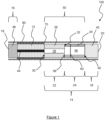
- Figure 1 shows an example of an aerosol-generating article 10.
- the aerosol-generating article 100 includes a rod 12 of aerosol-forming substrate.
- the rod 12 of aerosol-forming substrate is formed by crimping a portion of a sheet of cast leaf tobacco.
- the aerosol-generating article 100 also includes a downstream section 14 and an upstream section 16.
- the downstream section 14 is at a location downstream of the rod 12 of aerosol-forming substrate.
- the upstream section 16 is at a location upstream of the rod 12 of aerosol-forming substrate.
- the aerosol-generating article 100 extends from an upstream end (or distal end) 18 to a downstream end (or mouth end) 20.
- the aerosol-generating article 100 has an overall length of about 45 millimetres.
- the downstream section 14 includes a support element 22 located immediately downstream of the rod 12 of aerosol-forming substrate.
- the support element 22 is in longitudinal alignment with the rod 12 of aerosol-forming substrate.
- the downstream section 14 includes an aerosol-cooling element 24.
- the aerosol-cooling element 24 is located immediately downstream of the support element 22.
- the aerosol-cooling element 24 is in longitudinal alignment with the rod 12 of aerosol-forming substrate and the support element 22. In the example shown in Figure 1 , an upstream end of the aerosol-cooling element 24 abuts a downstream end of the support element 22.
- the first hollow tubular segment 26 has a length of about 8 millimetres, an external diameter of about 7.25 millimetres, and an internal diameter of about 1.9 millimetres.
- a thickness of a peripheral wall of the first hollow tubular segment 26 is about 2.67 millimetres.
- the aerosol-cooling element 24 includes a second hollow tubular segment 34.
- the second hollow tubular segment 34 is provided in the form of a hollow cylindrical tube made of cellulose acetate.
- the second hollow tubular segment 34 defines an internal cavity 36 that extends all the way from an upstream end 38 of the second hollow tubular segment to a downstream end 40 of the second hollow tubular segment 34.
- the internal cavity 36 is substantially empty, and so substantially unrestricted airflow is enabled along the internal cavity 36.
- the second hollow tubular segment 34 has a length of about 8 millimetres, an external diameter of about 7.25 millimetres, and an internal diameter of about 3.25 millimetres.
- a thickness of a peripheral wall of the second hollow tubular segment 34 is about 2 millimetres.
- a ratio between the internal diameter of the first hollow tubular segment 26 and the internal diameter of the second hollow tubular segment 34 is about 0.75.
- the aerosol-generating article 100 has a ventilation zone 60 provided at a location along the second hollow tubular segment 34.
- the ventilation zone 60 is provided at about 2 millimetres from the upstream end of the second hollow tubular segment 34.
- a ventilation level of the aerosol-generating article 100 is about 25 percent.
- the downstream section 14 includes a mouthpiece element 42 at a location downstream of the intermediate hollow section 50.
- the mouthpiece element 42 is positioned immediately downstream of the aerosol-cooling element 24. As shown in the drawing of Figure 1 , an upstream end of the mouthpiece element 42 abuts the downstream end 40 of the aerosol-cooling element 18.
- the mouthpiece element 42 is provided in the form of a cylindrical plug of low-density cellulose acetate.
- the mouthpiece element 42 has a length of about 12 millimetres and an external diameter of about 7.25 millimetres.
- the rod 12 of aerosol-forming substrate has an external diameter of about 7.25 millimetres and a length of about 12 millimetres.
- the aerosol-generating article 100 includes an elongate susceptor element 44 within the rod 12 of aerosol-forming substrate.
- the susceptor element 44 is arranged substantially longitudinally within the aerosol-generating substrate, such as to be approximately parallel to the longitudinal direction of the rod 12 of aerosol-forming substrate.
- the susceptor element 44 is positioned in a radially central position within the rod 12 and extends effectively along the longitudinal axis of the rod 12.
- the susceptor element 44 extends all the way from an upstream end to a downstream end of the rod 12 of aerosol-forming substrate. In effect, the susceptor element 44 has substantially the same length as the rod 12 of aerosol-forming substrate.
- the susceptor element 44 is provided in the form of a strip and has a length of about 12 millimetres, a thickness of about 60 micrometres, and a width of about 4 millimetres.
- the upstream section 16 includes an upstream element 46.
- the upstream element 46 is located immediately upstream of the rod 12 of aerosol-forming substrate.
- the upstream element 46 is in longitudinal alignment with the rod 12.
- the downstream end of the upstream element 46 abuts the upstream end of the rod 12 of aerosol-forming substrate.
- this may prevent the susceptor element 44 from being dislodged. Further, this may ensure that the user cannot accidentally contact the heated susceptor element 44 after use.
- the upstream element 46 is provided in the form of a cylindrical plug of cellulose acetate.
- the upstream element 46 has a length of about 5 millimetres.
- the aerosol-generating article 100 includes a wrapper 70.
- the wrapper 70 is wrapped around the rod 12 of aerosol-forming substrate.
- the wrapper 70 includes a metal layer.
- the metal is aluminium.
- the wrapper 70 also includes a paper layer.
- the metal layer is deposited on the paper layer.
- the metal layer may be deposited on the paper layer by use of vapour deposition.
- the metal layer is fixed to the paper layer.
- the metal layer and the paper layer may be bonded together to form a laminate.
- the metal layer has a thickness of 40 nanometres
- the paper layer has a thickness of 60 micrometres.
- the wrapper 70 is wrapped around the entire of the circumferential surface area of the rod 12 of aerosol-forming substrate.
- the wrapper 70 is provided to act as a physical barrier between the rod 12 of aerosol-forming substrate and other components of the aerosol-generating article 10.
- the aerosol-generating article 100 includes an outermost wrapper 80.
- the outermost wrapper 80 is wrapped around all of the components of the aerosol-generating article 10.
- the outermost wrapper 80 is also wrapper around the wrapper 70.
- Figures 2 , 3 , 4 , 5 and 6 show alternative examples to the example shown in Figure 1 .
- the aerosol-generating article 200 of Figure 2 , the aerosol-generating article 300 of Figure 3 , the aerosol-generating article 400 of Figure 4 , the aerosol-generating article 500 of Figure 5 , and the aerosol-generating article 600 of Figure 6 are the same as the aerosol-generating article 100 of Figure 1 except for the following differences.
- the wrapper 70 is wrapped around both the rod 12 of aerosol-forming substrate and the upstream element 46. In contrast, in the example shown in Figure 1 , the wrapper 70 is only wrapped around the rod 12 of aerosol-forming substrate.
- the wrapper 70 is wrapped around the entire length of the upstream element 46. However, in some examples, the wrapper 70 may only be wrapped around part of the length of the upstream element 46.
- the upstream element 46 is pre-wrapped with a paper element wrapper (not shown), which is positioned underneath the wrapper 70.
- the wrapper 70 is wrapped around both the rod 12 of aerosol-forming substrate and the first hollow tubular segment 26. In contrast, in the example shown in Figure 1 , the wrapper 70 is only wrapped around the rod 12 of aerosol-forming substrate.
- the wrapper 70 is wrapped around the entire length of the first hollow tubular segment 26. However, in some examples, the wrapper 70 may only be wrapped around part of the length of the first hollow tubular segment 26.
- the wrapper 70 is wrapped around the entire length of the first hollow tubular segment 26. However, in some examples, the wrapper 70 may only be wrapped around part of the length of the first hollow tubular segment 26.
- the wrapper 70 is wrapped around the entire length of the upstream element 46, the rod 12 of aerosol-forming substrate, the first hollow tubular segment 26 and the second hollow tubular segment 34. In contrast, in the example shown in Figure 1 , the wrapper 70 is only wrapped around the rod 12 of aerosol-forming substrate.
- the wrapper 70 is wrapped around the entire length of the first hollow tubular segment 26 and the entire length of the second hollow tubular segment 34.
- the wrapper 70 may only be wrapped around part of the length of the first hollow tubular segment 26 and/or part of the length of the second hollow tubular segment 34.
- the wrapper 70 is wrapped around the entire length of all elements of the aerosol-generating article 600.
- the wrapper 70 is wrapped around the upstream element 46, the rod 12 of aerosol-forming substrate, the first hollow tubular segment 26, the second hollow tubular segment 34, and the mouthpiece element 42.
- the wrapper 70 is only wrapped around the rod 12 of aerosol-forming substrate.
- the rod 12 is a porous medium loaded with an amount of aerosol-forming substrate.
- An example formulation of a suitable aerosol-forming substrate is shown in Table 1.
- Table 1 Example A B C Glycerine (% by weight) 74.4 72.7 50 Water (% by weight) 20 20 0 Nicotine (% by weight) 1.5 2 0 Sodium Carboxymethyl Cellulose (% by weight) 2.4 0 6.25 Lactic Acid (% by weight) 1.7 0 0 Low Acyl Gellan (% by weight) 0 3 0 Calcium (% by weight) 0 1 0 Levulnic Acid (% by weight) 0 1.3 0 Hydroxypropylmethyl Cellulose (% by weight) 0 0 12.5 Cellulose Fibres (% by weight) 0 0 31.25
- Example A The moisture content of Example A is 20 percent by weight.
- the moisture content includes all the glycerine content and the water content of the formulation.
- the moisture content of an aerosol-forming substrate is measured according to the following method:
- Example 1 (Aerosol-Generating Article without a Wrapper Comprising a Metal Layer)
- Example 2 (Aerosol-Generating Article with a Wrapper Comprising a Metal Layer) Nicotine Yield (micrograms) 278 461
- a wrapper 70 that is wrapped around the rod 12 of aerosol-forming substrate, and includes a metal layer, may help to contain one or more of the components of the aerosol-forming substrate within the rod 12.
- the wrapper 70 may help to reduce migration of one or more components of an aerosol-forming substrate away from the rod 12 and into other parts of the aerosol-generating article 100.
- Table 2 shows the nicotine yield from a rod 12 of the aerosol-forming substrate of Example A within the aerosol-generating articles of Example 1 and Example 2.
- the aerosol-generating article of Example 1 is a typical aerosol-generating article that does not include a wrapper with a metal layer wrapped around the aerosol-forming substrate. Instead, the wrapper in the aerosol-generating article of Example 1 is a simple paper wrapper.
- the aerosol-generating article of Example 2 is the aerosol-generating article 100 as described above and as shown in Figure 1 .
- the nicotine yield from the plug 12 of aerosol-forming substrate is 278 micrograms when the aerosol-generating article 100 does not include the wrapper 70. However, when the aerosol-generating article 100 does include the wrapper 70, the nicotine yield from the rod 12 of aerosol-forming substrate increases by 66% to 461 micrograms.
- a wrapper 70 that is wrapped around the rod 12 of aerosol-forming substrate, and includes a metal layer, increases the nicotine yield from the rod 12 of aerosol-forming substrate.
- the increase in nicotine yield is because the metal layer of the wrapper may prevent or at least reduce the migration of components of the aerosol-forming substrate, such as the aerosol-former, out of the rod 12 and into other parts of the aerosol-generating article 100. It follows that if more of the aerosol-forming substrate is retained within in the rod 12 then it is possible to yield more nicotine from the aerosol-forming substrate.
- An increase in nicotine yield from the rod 12 of aerosol-forming substrate may lead to an improvement in the user experience.
Landscapes
- Health & Medical Sciences (AREA)
- General Health & Medical Sciences (AREA)
- Toxicology (AREA)
- Chemical & Material Sciences (AREA)
- Chemical Kinetics & Catalysis (AREA)
- General Chemical & Material Sciences (AREA)
- Medicinal Preparation (AREA)
- Cigarettes, Filters, And Manufacturing Of Filters (AREA)
- Containers And Packaging Bodies Having A Special Means To Remove Contents (AREA)
- Wrappers (AREA)
Priority Applications (1)
| Application Number | Priority Date | Filing Date | Title |
|---|---|---|---|
| EP25179659.5A EP4602932A3 (en) | 2021-07-20 | 2022-07-20 | Aerosol-generating article comprising a wrapper with a metal layer |
Applications Claiming Priority (2)
| Application Number | Priority Date | Filing Date | Title |
|---|---|---|---|
| EP21186806 | 2021-07-20 | ||
| PCT/EP2022/070424 WO2023001929A1 (en) | 2021-07-20 | 2022-07-20 | Aerosol-generating article comprising a wrapper with a metal layer |
Related Child Applications (2)
| Application Number | Title | Priority Date | Filing Date |
|---|---|---|---|
| EP25179659.5A Division EP4602932A3 (en) | 2021-07-20 | 2022-07-20 | Aerosol-generating article comprising a wrapper with a metal layer |
| EP25179659.5A Division-Into EP4602932A3 (en) | 2021-07-20 | 2022-07-20 | Aerosol-generating article comprising a wrapper with a metal layer |
Publications (3)
| Publication Number | Publication Date |
|---|---|
| EP4373313A1 EP4373313A1 (en) | 2024-05-29 |
| EP4373313C0 EP4373313C0 (en) | 2025-07-09 |
| EP4373313B1 true EP4373313B1 (en) | 2025-07-09 |
Family
ID=76999770
Family Applications (2)
| Application Number | Title | Priority Date | Filing Date |
|---|---|---|---|
| EP22741325.9A Active EP4373313B1 (en) | 2021-07-20 | 2022-07-20 | Aerosol-generating article comprising a wrapper with a metal layer |
| EP25179659.5A Pending EP4602932A3 (en) | 2021-07-20 | 2022-07-20 | Aerosol-generating article comprising a wrapper with a metal layer |
Family Applications After (1)
| Application Number | Title | Priority Date | Filing Date |
|---|---|---|---|
| EP25179659.5A Pending EP4602932A3 (en) | 2021-07-20 | 2022-07-20 | Aerosol-generating article comprising a wrapper with a metal layer |
Country Status (6)
| Country | Link |
|---|---|
| US (1) | US20240365849A1 (https=) |
| EP (2) | EP4373313B1 (https=) |
| JP (1) | JP2024525737A (https=) |
| KR (1) | KR20240034231A (https=) |
| CN (1) | CN117642086A (https=) |
| WO (1) | WO2023001929A1 (https=) |
Families Citing this family (1)
| Publication number | Priority date | Publication date | Assignee | Title |
|---|---|---|---|---|
| WO2024201062A1 (en) * | 2023-03-29 | 2024-10-03 | Nicoventures Trading Limited | Aerosol generating article |
Family Cites Families (9)
| Publication number | Priority date | Publication date | Assignee | Title |
|---|---|---|---|---|
| US5613505A (en) | 1992-09-11 | 1997-03-25 | Philip Morris Incorporated | Inductive heating systems for smoking articles |
| TWI692274B (zh) | 2014-05-21 | 2020-04-21 | 瑞士商菲利浦莫里斯製品股份有限公司 | 用於加熱氣溶膠形成基材之感應加熱裝置及操作感應加熱系統之方法 |
| CN110545680B (zh) * | 2017-06-15 | 2022-04-01 | 菲利普莫里斯生产公司 | 用于制造可感应加热的气溶胶形成杆的方法和设备 |
| CN111902055B (zh) * | 2018-04-10 | 2022-11-22 | 菲利普莫里斯生产公司 | 包括可加热元件的气溶胶生成制品 |
| GB201812489D0 (en) * | 2018-07-31 | 2018-09-12 | Nicoventures Trading Ltd | Consumable |
| GB201812501D0 (en) * | 2018-07-31 | 2018-09-12 | Nicoventures Trading Ltd | Aerosol generation |
| GB201812500D0 (en) * | 2018-07-31 | 2018-09-12 | Nicoventures Holdings Ltd | Aerosol generation |
| CN114340414B (zh) * | 2019-09-19 | 2024-11-01 | 菲利普莫里斯生产公司 | 具有管状基质层的中空气溶胶生成制品 |
| CN110973694A (zh) * | 2019-12-17 | 2020-04-10 | 云南中烟工业有限责任公司 | 一种防止发烟介质中物质外渗和扩散的卷烟及其制备方法 |
-
2022
- 2022-07-20 EP EP22741325.9A patent/EP4373313B1/en active Active
- 2022-07-20 CN CN202280049381.5A patent/CN117642086A/zh active Pending
- 2022-07-20 KR KR1020247004934A patent/KR20240034231A/ko active Pending
- 2022-07-20 US US18/580,068 patent/US20240365849A1/en active Pending
- 2022-07-20 WO PCT/EP2022/070424 patent/WO2023001929A1/en not_active Ceased
- 2022-07-20 JP JP2024501786A patent/JP2024525737A/ja active Pending
- 2022-07-20 EP EP25179659.5A patent/EP4602932A3/en active Pending
Also Published As
| Publication number | Publication date |
|---|---|
| WO2023001929A1 (en) | 2023-01-26 |
| CN117642086A (zh) | 2024-03-01 |
| US20240365849A1 (en) | 2024-11-07 |
| EP4373313C0 (en) | 2025-07-09 |
| JP2024525737A (ja) | 2024-07-12 |
| EP4602932A3 (en) | 2025-11-05 |
| EP4602932A2 (en) | 2025-08-20 |
| EP4373313A1 (en) | 2024-05-29 |
| KR20240034231A (ko) | 2024-03-13 |
Similar Documents
| Publication | Publication Date | Title |
|---|---|---|
| EP4427604B1 (en) | An aerosol-forming substrate | |
| CN113853126A (zh) | 包含气溶胶生成膜的气溶胶生成基材 | |
| KR20230080479A (ko) | 저밀도 기재를 갖는 에어로졸 발생 물품 | |
| CN113795157A (zh) | 包括气溶胶生成膜的气溶胶生成制品 | |
| CN114729511B (zh) | 具有双重纸包装物的气溶胶生成基质元件 | |
| CN114745972A (zh) | 具有含氮亲核化合物的气溶胶形成基质 | |
| KR20230082645A (ko) | 낮은 흡인 저항 및 개선된 향미 전달을 갖는 에어로졸 발생 시스템 | |
| US20240237702A1 (en) | Aerosol-generating article comprising a susceptor element and a wrapper with a metal layer | |
| CN115175577A (zh) | 气溶胶生成制品及其制造方法 | |
| EP4373313B1 (en) | Aerosol-generating article comprising a wrapper with a metal layer | |
| EP4547049B1 (en) | Aerosol-generating article having two aerosol-generating segments | |
| RU2859759C2 (ru) | Изделие, генерирующее аэрозоль, содержащее обертку с металлическим слоем | |
| EP4557978B1 (en) | Aerosol-generating article with thick wrapper | |
| EP4064866B1 (en) | Aerosol-generating material comprising an amorphous solid comprising methol and calcium-crosslinked alginate | |
| US20250176615A1 (en) | Aerosol-generating article with susceptor and thick wrapper | |
| WO2025114156A2 (en) | Inhaler article with support element | |
| EP4712798A1 (en) | Aerosol-generating system with increased aerosol-forming substrate length | |
| WO2024003112A1 (en) | Aerosol-generating system with plurality of aerosol-generating segments | |
| WO2026008733A1 (en) | Aerosol-generating article with mouth end recess | |
| WO2026008728A2 (en) | Aerosol-generating article with distal end recess | |
| HK40062015A (en) | Aerosol-generating substrate comprising an aerosol-generating film | |
| HK40062015B (en) | Aerosol-generating substrate comprising an aerosol-generating film | |
| BR112020003680A2 (pt) | artigo gerador de aerossol com invólucro mais externo melhorado |
Legal Events
| Date | Code | Title | Description |
|---|---|---|---|
| STAA | Information on the status of an ep patent application or granted ep patent |
Free format text: STATUS: UNKNOWN |
|
| STAA | Information on the status of an ep patent application or granted ep patent |
Free format text: STATUS: THE INTERNATIONAL PUBLICATION HAS BEEN MADE |
|
| PUAI | Public reference made under article 153(3) epc to a published international application that has entered the european phase |
Free format text: ORIGINAL CODE: 0009012 |
|
| STAA | Information on the status of an ep patent application or granted ep patent |
Free format text: STATUS: REQUEST FOR EXAMINATION WAS MADE |
|
| 17P | Request for examination filed |
Effective date: 20240112 |
|
| AK | Designated contracting states |
Kind code of ref document: A1 Designated state(s): AL AT BE BG CH CY CZ DE DK EE ES FI FR GB GR HR HU IE IS IT LI LT LU LV MC MK MT NL NO PL PT RO RS SE SI SK SM TR |
|
| DAV | Request for validation of the european patent (deleted) | ||
| DAX | Request for extension of the european patent (deleted) | ||
| RIC1 | Information provided on ipc code assigned before grant |
Ipc: A24D 1/02 20060101ALI20241216BHEP Ipc: A24D 1/20 20200101AFI20241216BHEP |
|
| GRAP | Despatch of communication of intention to grant a patent |
Free format text: ORIGINAL CODE: EPIDOSNIGR1 |
|
| STAA | Information on the status of an ep patent application or granted ep patent |
Free format text: STATUS: GRANT OF PATENT IS INTENDED |
|
| INTG | Intention to grant announced |
Effective date: 20250129 |
|
| GRAS | Grant fee paid |
Free format text: ORIGINAL CODE: EPIDOSNIGR3 |
|
| GRAA | (expected) grant |
Free format text: ORIGINAL CODE: 0009210 |
|
| STAA | Information on the status of an ep patent application or granted ep patent |
Free format text: STATUS: THE PATENT HAS BEEN GRANTED |
|
| AK | Designated contracting states |
Kind code of ref document: B1 Designated state(s): AL AT BE BG CH CY CZ DE DK EE ES FI FR GB GR HR HU IE IS IT LI LT LU LV MC MK MT NL NO PL PT RO RS SE SI SK SM TR |
|
| REG | Reference to a national code |
Ref country code: GB Ref legal event code: FG4D |
|
| REG | Reference to a national code |
Ref country code: CH Ref legal event code: EP |
|
| REG | Reference to a national code |
Ref country code: IE Ref legal event code: FG4D |
|
| U01 | Request for unitary effect filed |
Effective date: 20250709 |
|
| U07 | Unitary effect registered |
Designated state(s): AT BE BG DE DK EE FI FR IT LT LU LV MT NL PT RO SE SI Effective date: 20250715 |
|
| PGFP | Annual fee paid to national office [announced via postgrant information from national office to epo] |
Ref country code: CH Payment date: 20250801 Year of fee payment: 4 |
|
| U20 | Renewal fee for the european patent with unitary effect paid |
Year of fee payment: 4 Effective date: 20250924 |
|
| PG25 | Lapsed in a contracting state [announced via postgrant information from national office to epo] |
Ref country code: IS Free format text: LAPSE BECAUSE OF FAILURE TO SUBMIT A TRANSLATION OF THE DESCRIPTION OR TO PAY THE FEE WITHIN THE PRESCRIBED TIME-LIMIT Effective date: 20251109 |
|
| PG25 | Lapsed in a contracting state [announced via postgrant information from national office to epo] |
Ref country code: NO Free format text: LAPSE BECAUSE OF FAILURE TO SUBMIT A TRANSLATION OF THE DESCRIPTION OR TO PAY THE FEE WITHIN THE PRESCRIBED TIME-LIMIT Effective date: 20251009 |
|
| PG25 | Lapsed in a contracting state [announced via postgrant information from national office to epo] |
Ref country code: HR Free format text: LAPSE BECAUSE OF FAILURE TO SUBMIT A TRANSLATION OF THE DESCRIPTION OR TO PAY THE FEE WITHIN THE PRESCRIBED TIME-LIMIT Effective date: 20250709 |
|
| PG25 | Lapsed in a contracting state [announced via postgrant information from national office to epo] |
Ref country code: GR Free format text: LAPSE BECAUSE OF FAILURE TO SUBMIT A TRANSLATION OF THE DESCRIPTION OR TO PAY THE FEE WITHIN THE PRESCRIBED TIME-LIMIT Effective date: 20251010 |
|
| PG25 | Lapsed in a contracting state [announced via postgrant information from national office to epo] |
Ref country code: PL Free format text: LAPSE BECAUSE OF FAILURE TO SUBMIT A TRANSLATION OF THE DESCRIPTION OR TO PAY THE FEE WITHIN THE PRESCRIBED TIME-LIMIT Effective date: 20250709 |
|
| PG25 | Lapsed in a contracting state [announced via postgrant information from national office to epo] |
Ref country code: RS Free format text: LAPSE BECAUSE OF FAILURE TO SUBMIT A TRANSLATION OF THE DESCRIPTION OR TO PAY THE FEE WITHIN THE PRESCRIBED TIME-LIMIT Effective date: 20251009 |
|
| PG25 | Lapsed in a contracting state [announced via postgrant information from national office to epo] |
Ref country code: ES Free format text: LAPSE BECAUSE OF FAILURE TO SUBMIT A TRANSLATION OF THE DESCRIPTION OR TO PAY THE FEE WITHIN THE PRESCRIBED TIME-LIMIT Effective date: 20250709 |
|
| PG25 | Lapsed in a contracting state [announced via postgrant information from national office to epo] |
Ref country code: SM Free format text: LAPSE BECAUSE OF FAILURE TO SUBMIT A TRANSLATION OF THE DESCRIPTION OR TO PAY THE FEE WITHIN THE PRESCRIBED TIME-LIMIT Effective date: 20250709 |
|
| PG25 | Lapsed in a contracting state [announced via postgrant information from national office to epo] |
Ref country code: CZ Free format text: LAPSE BECAUSE OF FAILURE TO SUBMIT A TRANSLATION OF THE DESCRIPTION OR TO PAY THE FEE WITHIN THE PRESCRIBED TIME-LIMIT Effective date: 20250709 |
|
| PG25 | Lapsed in a contracting state [announced via postgrant information from national office to epo] |
Ref country code: SK Free format text: LAPSE BECAUSE OF FAILURE TO SUBMIT A TRANSLATION OF THE DESCRIPTION OR TO PAY THE FEE WITHIN THE PRESCRIBED TIME-LIMIT Effective date: 20250709 |