EP4369325A1 - Driving assistance apparatus - Google Patents
Driving assistance apparatus Download PDFInfo
- Publication number
- EP4369325A1 EP4369325A1 EP23204563.3A EP23204563A EP4369325A1 EP 4369325 A1 EP4369325 A1 EP 4369325A1 EP 23204563 A EP23204563 A EP 23204563A EP 4369325 A1 EP4369325 A1 EP 4369325A1
- Authority
- EP
- European Patent Office
- Prior art keywords
- alarm
- vehicle
- stop
- unit
- generation unit
- Prior art date
- Legal status (The legal status is an assumption and is not a legal conclusion. Google has not performed a legal analysis and makes no representation as to the accuracy of the status listed.)
- Pending
Links
- 230000006870 function Effects 0.000 description 36
- 238000000034 method Methods 0.000 description 14
- 238000010586 diagram Methods 0.000 description 6
- 238000004891 communication Methods 0.000 description 3
- 238000007689 inspection Methods 0.000 description 2
- 238000012986 modification Methods 0.000 description 2
- 230000004048 modification Effects 0.000 description 2
- 230000000694 effects Effects 0.000 description 1
Images
Classifications
-
- G—PHYSICS
- G08—SIGNALLING
- G08G—TRAFFIC CONTROL SYSTEMS
- G08G1/00—Traffic control systems for road vehicles
- G08G1/16—Anti-collision systems
- G08G1/166—Anti-collision systems for active traffic, e.g. moving vehicles, pedestrians, bikes
-
- B—PERFORMING OPERATIONS; TRANSPORTING
- B60—VEHICLES IN GENERAL
- B60W—CONJOINT CONTROL OF VEHICLE SUB-UNITS OF DIFFERENT TYPE OR DIFFERENT FUNCTION; CONTROL SYSTEMS SPECIALLY ADAPTED FOR HYBRID VEHICLES; ROAD VEHICLE DRIVE CONTROL SYSTEMS FOR PURPOSES NOT RELATED TO THE CONTROL OF A PARTICULAR SUB-UNIT
- B60W50/00—Details of control systems for road vehicle drive control not related to the control of a particular sub-unit, e.g. process diagnostic or vehicle driver interfaces
- B60W50/08—Interaction between the driver and the control system
- B60W50/14—Means for informing the driver, warning the driver or prompting a driver intervention
-
- G—PHYSICS
- G08—SIGNALLING
- G08G—TRAFFIC CONTROL SYSTEMS
- G08G1/00—Traffic control systems for road vehicles
- G08G1/01—Detecting movement of traffic to be counted or controlled
- G08G1/017—Detecting movement of traffic to be counted or controlled identifying vehicles
-
- G—PHYSICS
- G08—SIGNALLING
- G08G—TRAFFIC CONTROL SYSTEMS
- G08G1/00—Traffic control systems for road vehicles
- G08G1/01—Detecting movement of traffic to be counted or controlled
- G08G1/017—Detecting movement of traffic to be counted or controlled identifying vehicles
- G08G1/0175—Detecting movement of traffic to be counted or controlled identifying vehicles by photographing vehicles, e.g. when violating traffic rules
-
- G—PHYSICS
- G08—SIGNALLING
- G08G—TRAFFIC CONTROL SYSTEMS
- G08G1/00—Traffic control systems for road vehicles
- G08G1/09—Arrangements for giving variable traffic instructions
- G08G1/0962—Arrangements for giving variable traffic instructions having an indicator mounted inside the vehicle, e.g. giving voice messages
- G08G1/09626—Arrangements for giving variable traffic instructions having an indicator mounted inside the vehicle, e.g. giving voice messages where the origin of the information is within the own vehicle, e.g. a local storage device, digital map
-
- G—PHYSICS
- G08—SIGNALLING
- G08G—TRAFFIC CONTROL SYSTEMS
- G08G1/00—Traffic control systems for road vehicles
- G08G1/09—Arrangements for giving variable traffic instructions
- G08G1/0962—Arrangements for giving variable traffic instructions having an indicator mounted inside the vehicle, e.g. giving voice messages
- G08G1/0967—Systems involving transmission of highway information, e.g. weather, speed limits
- G08G1/096708—Systems involving transmission of highway information, e.g. weather, speed limits where the received information might be used to generate an automatic action on the vehicle control
- G08G1/096716—Systems involving transmission of highway information, e.g. weather, speed limits where the received information might be used to generate an automatic action on the vehicle control where the received information does not generate an automatic action on the vehicle control
-
- G—PHYSICS
- G08—SIGNALLING
- G08G—TRAFFIC CONTROL SYSTEMS
- G08G1/00—Traffic control systems for road vehicles
- G08G1/09—Arrangements for giving variable traffic instructions
- G08G1/0962—Arrangements for giving variable traffic instructions having an indicator mounted inside the vehicle, e.g. giving voice messages
- G08G1/0967—Systems involving transmission of highway information, e.g. weather, speed limits
- G08G1/096733—Systems involving transmission of highway information, e.g. weather, speed limits where a selection of the information might take place
- G08G1/096758—Systems involving transmission of highway information, e.g. weather, speed limits where a selection of the information might take place where no selection takes place on the transmitted or the received information
-
- G—PHYSICS
- G08—SIGNALLING
- G08G—TRAFFIC CONTROL SYSTEMS
- G08G1/00—Traffic control systems for road vehicles
- G08G1/09—Arrangements for giving variable traffic instructions
- G08G1/0962—Arrangements for giving variable traffic instructions having an indicator mounted inside the vehicle, e.g. giving voice messages
- G08G1/0967—Systems involving transmission of highway information, e.g. weather, speed limits
- G08G1/096766—Systems involving transmission of highway information, e.g. weather, speed limits where the system is characterised by the origin of the information transmission
- G08G1/096791—Systems involving transmission of highway information, e.g. weather, speed limits where the system is characterised by the origin of the information transmission where the origin of the information is another vehicle
-
- G—PHYSICS
- G08—SIGNALLING
- G08G—TRAFFIC CONTROL SYSTEMS
- G08G1/00—Traffic control systems for road vehicles
- G08G1/16—Anti-collision systems
- G08G1/161—Decentralised systems, e.g. inter-vehicle communication
- G08G1/163—Decentralised systems, e.g. inter-vehicle communication involving continuous checking
-
- G—PHYSICS
- G08—SIGNALLING
- G08G—TRAFFIC CONTROL SYSTEMS
- G08G1/00—Traffic control systems for road vehicles
- G08G1/20—Monitoring the location of vehicles belonging to a group, e.g. fleet of vehicles, countable or determined number of vehicles
- G08G1/207—Monitoring the location of vehicles belonging to a group, e.g. fleet of vehicles, countable or determined number of vehicles with respect to certain areas, e.g. forbidden or allowed areas with possible alerting when inside or outside boundaries
-
- B—PERFORMING OPERATIONS; TRANSPORTING
- B60—VEHICLES IN GENERAL
- B60W—CONJOINT CONTROL OF VEHICLE SUB-UNITS OF DIFFERENT TYPE OR DIFFERENT FUNCTION; CONTROL SYSTEMS SPECIALLY ADAPTED FOR HYBRID VEHICLES; ROAD VEHICLE DRIVE CONTROL SYSTEMS FOR PURPOSES NOT RELATED TO THE CONTROL OF A PARTICULAR SUB-UNIT
- B60W2554/00—Input parameters relating to objects
- B60W2554/40—Dynamic objects, e.g. animals, windblown objects
- B60W2554/404—Characteristics
- B60W2554/4041—Position
-
- B—PERFORMING OPERATIONS; TRANSPORTING
- B60—VEHICLES IN GENERAL
- B60W—CONJOINT CONTROL OF VEHICLE SUB-UNITS OF DIFFERENT TYPE OR DIFFERENT FUNCTION; CONTROL SYSTEMS SPECIALLY ADAPTED FOR HYBRID VEHICLES; ROAD VEHICLE DRIVE CONTROL SYSTEMS FOR PURPOSES NOT RELATED TO THE CONTROL OF A PARTICULAR SUB-UNIT
- B60W2554/00—Input parameters relating to objects
- B60W2554/40—Dynamic objects, e.g. animals, windblown objects
- B60W2554/404—Characteristics
- B60W2554/4046—Behavior, e.g. aggressive or erratic
-
- B—PERFORMING OPERATIONS; TRANSPORTING
- B60—VEHICLES IN GENERAL
- B60W—CONJOINT CONTROL OF VEHICLE SUB-UNITS OF DIFFERENT TYPE OR DIFFERENT FUNCTION; CONTROL SYSTEMS SPECIALLY ADAPTED FOR HYBRID VEHICLES; ROAD VEHICLE DRIVE CONTROL SYSTEMS FOR PURPOSES NOT RELATED TO THE CONTROL OF A PARTICULAR SUB-UNIT
- B60W2554/00—Input parameters relating to objects
- B60W2554/80—Spatial relation or speed relative to objects
- B60W2554/802—Longitudinal distance
Definitions
- the present invention relates to a driving assistance apparatus.
- Patent Literature 1 discloses a driving assistance apparatus that sets a vehicle-to-vehicle distance with another vehicle traveling around an own vehicle to a safe distance based on a familiarity degree of a driver of the other vehicle. Specifically, in the driving assistance apparatus in Patent Literature 1, the braking of the vehicle is controlled such that a target vehicle-to-vehicle distance with the other vehicle is set longer as the familiarity degree indicating the degree to which the driver of the other vehicle is accustomed to driving on a surrounding road is lower.
- Patent Literature 1 JP2018-180737A
- the present invention has been made in view of the above-described problems, and an object of the present invention is to prevent an alarm from frequently occurring when driving in a location where a large number of drivers are unfamiliar with a current location.
- a driving assistance apparatus includes: an alarm generation unit configured to generate an alarm in order to alert a driver of an own vehicle when a current location of the own vehicle and a location where another vehicle is mainly used are separated by a predetermined distance or more; and an alarm stop unit configured to stop the alarm from the alarm generation unit when it is predicted that the alarm from the alarm generation unit frequently occurs.
- a driving assistance apparatus 30 includes: an alarm generation unit 31 configured to generate an alarm in order to alert a driver of an own vehicle when a current location of the own vehicle and a location where another vehicle is mainly used are separated by a predetermined distance or more; and an alarm stop unit 32 configured to stop the alarm from the alarm generation unit 31 when it is predicted that the alarm from the alarm generation unit 31 frequently occurs.
- an alarm generation unit 31 configured to generate an alarm in order to alert a driver of an own vehicle when a current location of the own vehicle and a location where another vehicle is mainly used are separated by a predetermined distance or more
- an alarm stop unit 32 configured to stop the alarm from the alarm generation unit 31 when it is predicted that the alarm from the alarm generation unit 31 frequently occurs.
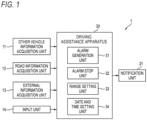
- FIG. 1 is a diagram showing a configuration of a part of a vehicle 1 which is an own vehicle including a driving assistance apparatus 30.
- the vehicle 1 includes an other vehicle information acquisition unit 11, a road information acquisition unit 12, an external information acquisition unit 13, an input unit 14, a notification unit 21, and the driving assistance apparatus 30.
- the vehicle 1 also includes a device that is generally provided in a vehicle, and the illustration and description of the device are omitted.
- the other vehicle information acquisition unit 11 acquires information on another vehicle present around the vehicle 1 (the own vehicle). Specifically, the other vehicle information acquisition unit 11 acquires position information of a location where the other vehicle present around the vehicle 1 is mainly used.
- the other vehicle information acquisition unit 11 reads home base information (a place name) displayed on a license plate (an automobile registration number mark and a vehicle number mark) from image information of the other vehicle captured by the camera.
- the other vehicle information acquisition unit 11 acquires the read home base information as the position information of the location where the other vehicle is mainly used.
- the other vehicle information acquisition unit 11 acquires information on an automobile inspection certificate included in the information on the other vehicle acquired by the vehicle-to-vehicle communication device.
- the other vehicle information acquisition unit 11 acquires information on an address of an owner or an address of a user from the information on the automobile inspection certificate as the position information of the location where another person is mainly used.
- the road information acquisition unit 12 acquires position information of the own vehicle or acquires road information. Specifically, the road information acquisition unit 12 acquires the position information of the own vehicle by calculating latitude and longitude based on a radio wave received from a GPS satellite or acquiring information on the latitude and longitude from a base station. The road information acquisition unit 12 acquires the road information by reading the stored information. When the vehicle 1 is provided with a car navigation system, the road information acquisition unit 12 may acquire the position information and the road information of the own vehicle from the car navigation system.
- the external information acquisition unit 13 acquires information from the outside via a communication device. Specifically, the external information acquisition unit 13 acquires from, an external server, position information and date and time information of a location where a large number of distant vehicles are predicted to travel.
- the location where a large number of distant vehicles are predicted to travel is, for example, a location of a tourist spot or a location where an event such as a festival is held.
- the date and time at which a large number of distant vehicles are predicted to travel is a period and time in which an event is held.
- the input unit 14 receives input from the driver of the vehicle 1 and transmits received information to the driving assistance apparatus 30. Specifically, the driver of the vehicle 1 inputs, using the input unit 14, the location and date and time at which a large number of distant vehicles are predicted to travel.
- the input unit 14 may be, for example, a touch panel or a microphone implemented integrally with a display provided in the vehicle 1.
- the notification unit 21 gives a notification by displaying an alarm from the alarm generation unit 31, which will be described later, of the driving assistance apparatus 30 with characters or symbols, or sounding an alarm with a sound (including a voice).
- a display unit such as a display or a meter panel or a speaker provided in the vehicle 1 may be used as the notification unit 21.
- a display or a speaker of the car navigation system can be used as the notification unit 21.
- the driving assistance apparatus 30 assists driving of the vehicle 1 by the driver.
- an electronic control unit (ECU) that controls the entire vehicle 1 is used as the driving assistance apparatus 30.
- the ECU includes at least one CPU and at least one memory, and functions as a so-called computer.
- the number of ECUs is not limited to one.
- a plurality of ECUs may be in cooperation with each other, or the ECU may be different from the ECU that controls the entire vehicle 1.
- the CPU of the ECU achieves functional components of the driving assistance apparatus 30 by executing a program stored in the memory.
- the driving assistance apparatus 30 includes, as functional components, the alarm generation unit 31, the alarm stop unit 32, a range setting unit 33, and a date and time setting unit 34.
- the alarm generation unit 31 generates an alarm via the notification unit 21 in order to alert the driver of the own vehicle when driving in a location where a large number of drivers are unfamiliar with a current location. Specifically, when the current location of the own vehicle and a location where another vehicle is mainly used are separated by a predetermined distance or more, the alarm generation unit 31 generates an alarm via the notification unit 21 in order to alert the driver of the own vehicle.
- the alarm generation unit 31 receives position information of the current location of the own vehicle from the road information acquisition unit 12, and receives position information of the location where the other vehicle is mainly used from the other vehicle information acquisition unit 11.
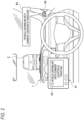
- FIG. 2 is a diagram showing an example of an alarm from the alarm generation unit 31.
- the vehicle 1 includes a display 41 and a speaker 42 as the notification unit 21.
- the alarm generation unit 31 receives the position information of the own vehicle from the road information acquisition unit 12, and receives the position information of the location where the other vehicle is mainly used from the other vehicle information acquisition unit 11.
- the alarm generation unit 31 determines whether the position information of the own vehicle and the position information of the location where the other vehicle is mainly used are separated by a predetermined distance or more. Here, it is determined that the positions are separated by the predetermined distance or more.
- the alarm generation unit 31 generates an alarm via the notification unit 21 according to a determination result in order to alert the driver of the own vehicle. Specifically, the alarm generation unit 31 displays a message 43 that "a vehicle unfamiliar with the current location is traveling" via the display 41. The alarm generation unit 31 emits a voice 44 that "a vehicle unfamiliar with the current location is traveling" via the speaker 42.
- the alarm generation unit 31 is not limited to a case of emitting a voice, and may emit a predetermined alarm sound.
- the alarm generation unit 31 generates an alarm in this way, so that the driver of the own vehicle can recognize that an unfamiliar vehicle is traveling in a surrounding region. Therefore, the driver of the own vehicle can drive while paying attention to the unfamiliar vehicle.
- the alarm generation unit 31 similarly determines other vehicles present around the own vehicle, and generates an alarm for each of the other vehicles according to a determination result. As will be described later, the alarm function (the alert function) executed by the alarm generation unit 31 via the notification unit 21 is switched between ON and OFF.
- the alarm stop unit 32 stops the alarm from the alarm generation unit 31.
- a location where a large number of distant vehicles travel such as a tourist spot
- the alarm from the alarm generation unit 31 is predicted to frequently occur, and the driver of the own vehicle may feel the alarm annoying.
- the alarm stop unit 32 stops the alarm by turning off the alarm function of the alarm generation unit 31 from on.
- the range setting unit 33 sets a stop range for stopping the alarm. Specifically, the range setting unit 33 sets, as the stop range, a range indicating a location where a large number of distant vehicles are predicted to travel, such as a location of a tourist spot or a location where an event such as a festival is held.
- a method for setting the stop range by the range setting unit 33 will be described.
- the range setting unit 33 sets a range indicating a location input by the driver of the own vehicle via the input unit 14 as the stop range.
- the driver or the like inputs in advance a location of a tourist spot or a location where an event such as a festival is held.
- the stop range is set according to an input of the driver or the like.
- the range setting unit 33 sets, as the stop range, a range indicating a location of a tourist spot or a location where an event such as a festival is held.
- the stop range is set as a default.
- the range setting unit 33 sets the stop range based on the information acquired by the external information acquisition unit 13.
- the external information acquisition unit 13 acquires, from an external server, information on a location of a tourist spot or a location where an event such as a festival is held.
- the stop range is automatically set regardless of the input of the driver, and the stop range is automatically updated and set.
- the date and time setting unit 34 sets the date and time at which the alarm is stopped. Specifically, the date and time setting unit 34 usually sets a date and time at which a large number of distant vehicles are predicted to travel on a specific date and time such as an event such as a large-scale festival, although the distant vehicles usually do not travel.
- a method for setting a date and time by the date and time setting unit 34 will be described.
- the date and time setting unit 34 sets the date and time input by the driver of the own vehicle via the input unit 14. The driver inputs in advance, via the input unit 14, the date and time at which an event such as a festival is held. In the first method, the date and time is set according to the input of the driver.
- the date and time setting unit 34 sets the date and time at which an event such as a festival is held when the driving assistance apparatus 30 is manufactured. In the second method, the date and time is set as a default.
- the date and time setting unit 34 sets the date and time based on the information acquired by the external information acquisition unit 13. The external information acquisition unit 13 acquires, from an external server, information on the date and time at which an event such as a festival is held. In the third method, the date and time is automatically set regardless of the input of the driver, and the date and time is automatically updated and set.
- the date and time setting unit 34 sets the date and time
- the date and time and the stop range are associated with each other by the range setting unit 33 setting the stop range before and after the setting of the date and time. Therefore, for example, the date and time of an event and a venue of the event are set in association with each other.
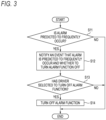
- the flowchart in FIG. 3 is implemented by the CPU of the ECU used as the driving assistance apparatus 30 executing the program stored in the memory.
- the flowchart in FIG. 3 is started when a power of the driving assistance apparatus 30 is turned on, and the alarm function by the alarm generation unit 31 is on at the start.
- the alarm stop unit 32 determines whether the alarm from the alarm generation unit 31 is predicted to frequently occur. When it is predicted that the alarm frequently occurs, the processing proceeds to S12, and otherwise, the processing in the flowchart ends. Specifically, the alarm stop unit 32 determines whether the current location of the own vehicle is within the stop range set by the range setting unit 33.
- the range setting unit 33 sets, as the stop range, a range indicating a location where a large number of distant vehicles are predicted to travel, such as a tourist spot. Therefore, when the current location of the own vehicle is within the stop range, the alarm from the alarm generation unit 31 is predicted to frequently occur.
- the alarm stop unit 32 determines whether the current time is the date and time set by the date and time setting unit 34 and the current location of the own vehicle is within the stop range set by the range setting unit 33.
- the date and time setting unit 34 sets a date and time at which a large number of distant vehicles are predicted to travel, such as a date and time when an event such as a festival is held.
- the alarm from the alarm generation unit 31 is predicted to frequently occur.
- the alarm stop unit 32 notifies the driver of the own vehicle of an event determined to be predicted that an alarm from the alarm generation unit 31 frequently occurs and whether to stop the alarm from the alarm generation unit 31.
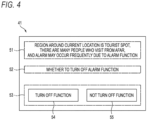
- FIG. 4 is a diagram showing an example of the notification from the alarm stop unit 32.
- the display 41 has a first display column 51, a second display column 52, and a third display column 53.
- the first display column 51 displays an event determined to be predicted that an alarm frequently occurs.
- the first display column 51 in FIG. 4 displays a message that "a region around the current location is one of tourist spots, there are many people who visit from afar, and an alarm may occur frequently due to the alarm function".
- This message is an example displayed when the date and time set by the date and time setting unit 34 is not associated with the stop range set by the range setting unit 33 and only the stop range is set by the range setting unit 33.
- the first display column 51 may display, for example, a message that "there is a festival today in a region around the current location, there are many people who visit from afar, and an alarm may occur frequently due to the alarm function".
- This message is displayed when the date and time set by the date and time setting unit 34 is associated with the stop range set by the range setting unit 33. In this way, by notifying the event determined to be predicted that an alarm frequently occurs, the driver can easily grasp a situation of the current location.
- the present invention is not limited to the notification of the event determined to be predicted that an alarm frequently occurs, and the alarm function may be automatically turned off without any notification.
- the second display column 52 displays a content for checking the intention of the driver.
- the second display column 52 in FIG. 4 displays a message "whether to turn off the alarm function".
- the third display column 53 displays selection items for the driver to select the intention.
- the third display column 53 in FIG. 4 displays a selection item 54 "turn off the function” and a selection item 55 "not turn off the function”.
- the driver touches a region of either of the selection items, so that the intention of the driver can be input.
- the third display column 53 may be omitted, and the second display column 52 may display a message "turn off the alarm function".
- the first display column 51 and the third display column 53 may be omitted, and the second display column 52 may display a message "turn off the alarm function”.
- all of the first display column 51, the second display column 52, and the third display column 53 may be omitted, that is, the processing in S12 and S13 to be described later may be omitted.
- the alarm stop unit 32 determines whether the driver has selected to turn off the alarm function. Specifically, the alarm stop unit 32 determines that the driver has selected to turn off the alarm function by detecting the touch of the selection item 54 "turn off the function" of the selection items 54 and 55 displayed on the display 41, and determines that the driver has selected to turn on the alarm function by detecting the touch of the selection item 55 "not turn off the function".
- the processing proceeds to S14, and otherwise, the processing in the flowchart ends.
- the alarm stop unit 32 turns off the alarm function to stop the alarm from the alarm generation unit 31, thereby completing the processing.
- the processing from S11 is repeatedly performed at regular intervals.
- the alarm stop unit 32 stops the alarm from the alarm generation unit 31, so that the alarm from the alarm generation unit 31 can be prevented from frequently occurring. Therefore, it is possible to prevent the driver from feeling annoyed due to frequent alarms.
- the driver when it is predicted that an alarm frequently occurs to alert the presence of other vehicles unfamiliar with the current location, the driver is notified that the alarm stop unit 32 automatically stops the alarm from the alarm generation unit 31. Therefore, the driver can recognize that the alarm is automatically stopped.
- the alarm stop unit 32 when it is predicted that an alarm frequently occurs to alert the presence of other vehicles unfamiliar with the current location, the alarm stop unit 32 notifies the driver whether to stop the alarm from the alarm generation unit 31, and causes the driver to select whether to stop the alarm. Therefore, the alarm can be stopped according to the intention of the driver.
- the alarm stop unit 32 when it is predicted that an alarm frequently occurs to alert the presence of other vehicles unfamiliar with the current location, the alarm stop unit 32 notifies the event determined to be predicted that an alarm frequently occurs and that the alarm from the alarm generation unit 31 is to be stopped. Therefore, the driver can recognize a reason why the alarm is automatically stopped.
- the alarm stop unit 32 when it is predicted that an alarm frequently occurs to alert the presence of other vehicles unfamiliar with the current location, the alarm stop unit 32 notifies the event determined to be predicted that an alarm frequently occurs, and causes the driver to select whether to stop the alarm. Therefore, the driver can select whether to stop the alarm after considering the notified event.
- the range setting unit 33 when the current location of the own vehicle is within the stop range set by the range setting unit 33, it is predicted that the alarm from the alarm generation unit 31 frequently occurs. Therefore, in a location where a large number of distant vehicles are predicted to travel, such as a tourist spot, it is possible to prevent the alarm from the alarm generation unit 31 from frequently occurring by setting the location in advance.
- the present embodiment when the current location of the own vehicle is within the stop range set by the range setting unit 33 at the date and time set by the date and time setting unit 34, it is predicted that the alarm from the alarm generation unit 31 frequently occurs. Therefore, in a location where a large number of distant vehicles are predicted to travel on a specific date and time such as an event such as a large-scale festival, it is possible to prevent the alarm from the alarm generation unit 31 from frequently occurring by setting the specific date and time and the location in advance.
- the range setting unit 33 sets the stop range based on information on a location visited by distant vehicles.
- the information is acquired from the outside of the own vehicle. Therefore, in a location where a large number of distant vehicles are predicted to travel, such as a tourist spot, the input of the driver can be reduced by automatically setting the location.
- the date and time setting unit 34 sets information on the date and time at which distant vehicles visit the location.
- the information is acquired from the outside of the own vehicle. Therefore, in a location where a large number of distant vehicles are predicted to travel on a specific date and time such as an event such as a large-scale festival, the input of the driver can be reduced by automatically setting the specific date and time and the location.
- the alarm stop unit 32 prevents the alarm from the alarm generation unit 31 from frequently occurring when the number of distant vehicles increases by chance and it is predicted that a large number of distant vehicles travel due to continuing of this situation.
- the processing performed by the driving assistance apparatus 30 according to the present embodiment is different from that of the first embodiment in the processing in S11 and S14 in the flowchart in FIG. 3 . Therefore, the processing in S11 and S14 will be described below, and the description of the other processing will be omitted as appropriate.
- the alarm stop unit 32 determines whether the alarm from the alarm generation unit 31 is predicted to frequently occur. Specifically, the alarm stop unit 32 determines whether the alarm is predicted to frequently occur, by determining whether, to the number of other vehicles for which information has been acquired by the other vehicle information acquisition unit 11, a ratio of the number of other vehicles to be a target of the alarm is larger than a predetermined ratio.
- the alarm stop unit 32 may freely set at least one of the number (a parameter) of other vehicles for which information has been acquired by the other vehicle information acquisition unit 11 and the predetermined ratio by the input of the driver via the input unit 14, or may be set the at least one of the number and the predetermined ratio as a default.
- the alarm stop unit 32 may reset the number (the parameter) of other vehicles at predetermined time intervals, or may reset the number when the power of the driving assistance apparatus 30 is turned off.
- the predetermined ratio is 20%
- the number (the parameter) of other vehicles is 50
- the predetermined reset time interval is 1 hour.
- the alarm generation unit 31 generates an alarm for, among 50 other vehicles for which information has been acquired within 1 hour, every 10 other vehicles up to the 10th other vehicle to be a target of the alarm.
- the alarm stop unit 32 counts other vehicles to be a target of the alarm, and predicts that the alarm frequently occurs when the 11th vehicle is present as the other vehicle to be a target of the alarm.
- the processing proceeds to S12.
- the ratio of other vehicles to be a target of the alarm is equal to or less than the predetermined ratio, the alarm is predicted not to frequently occur, and the processing is ended.
- the alarm stop unit 32 turns off the alarm function, stops the alarm from the alarm generation unit 31, and ends the processing.
- the alarm stop unit 32 counts other vehicles to be a target of the alarm, and stops the alarm from the alarm generation unit 31 when the 11th vehicle is present and the driver selects to turn off the alarm function. Therefore, the alarm for the 11th and subsequent other vehicles to be a target of the alarm is stopped.
- the alarm stop unit 32 resets the number (the parameter) of other vehicles and the count of other vehicles to be a target of the alarm, and turns on the alarm function.
- the alarm stop unit 32 stops the alarm from the alarm generation unit 31, so that it is possible to prevent the alarm from the alarm generation unit 31 from frequently occurring. Therefore, it is possible to prevent the driver from feeling annoyed due to frequent alarms.
- the alarm stop unit 32 may turn the alarm function back on when a predetermined condition is satisfied. For example, after turning off the alarm function, the alarm stop unit 32 determines whether the current location of the own vehicle is outside the stop range set by the range setting unit 33. When the current location is outside the stop range, the alarm stop unit 32 turns the alarm function back on, and when the current location is within the stop range, the alarm stop unit 32 keeps the alarm function off.
- the alarm stop unit 32 determines whether the current time is outside the date and time set by the date and time setting unit 34. When the current time is outside the date and time, the alarm stop unit 32 turns the alarm function back on, and when the current time is within the date and time, the alarm stop unit 32 keeps the alarm function off. In this way, by turning the alarm function back on when the predetermined condition is satisfied after turning off the alarm function, it is possible to prevent a situation in which no alarm occurs to alert the driver of the own vehicle even though the current location where the own vehicle travels is a location where the alarm does not frequently occur and unfamiliar vehicles drive around the own vehicle.
Landscapes
- Physics & Mathematics (AREA)
- General Physics & Mathematics (AREA)
- Engineering & Computer Science (AREA)
- Life Sciences & Earth Sciences (AREA)
- Atmospheric Sciences (AREA)
- Automation & Control Theory (AREA)
- Human Computer Interaction (AREA)
- Transportation (AREA)
- Mechanical Engineering (AREA)
- Traffic Control Systems (AREA)
Abstract
An object of the present invention is to prevent an alarm from frequently occurring when driving in a location where a large number of drivers are unfamiliar with a current location. A driving assistance apparatus 30 according to the present invention includes: an alarm generation unit 31 configured to generate an alarm in order to alert a driver of an own vehicle when a current location of the own vehicle and a location where another vehicle is mainly used are separated by a predetermined distance or more; and an alarm stop unit 32 configured to stop the alarm from the alarm generation unit 31 when it is predicted that the alarm from the alarm generation unit 31 frequently occurs. The alarm stop unit 32 stops the alarm from the alarm generation unit 31, so that it is possible to prevent the alarm from the alarm generation unit 31 from frequently occurring.
Description
- The present invention relates to a driving assistance apparatus.
- In the related art, a driving assistance apparatus that assists driving of a driver has been known. Patent Literature 1 discloses a driving assistance apparatus that sets a vehicle-to-vehicle distance with another vehicle traveling around an own vehicle to a safe distance based on a familiarity degree of a driver of the other vehicle. Specifically, in the driving assistance apparatus in Patent Literature 1, the braking of the vehicle is controlled such that a target vehicle-to-vehicle distance with the other vehicle is set longer as the familiarity degree indicating the degree to which the driver of the other vehicle is accustomed to driving on a surrounding road is lower.
- Patent Literature 1:
JP2018-180737A - However, in the driving assistance apparatus in Patent Literature 1, when driving in a location where a large number of distant vehicles travel, such as a tourist spot, it is assumed that the percentage of the drivers having a low familiarity degree increases, and the control may be frequently performed. In such a case, the driver of the own vehicle may feel frequent control annoying.
- The present invention has been made in view of the above-described problems, and an object of the present invention is to prevent an alarm from frequently occurring when driving in a location where a large number of drivers are unfamiliar with a current location.
- A driving assistance apparatus according to the present invention includes: an alarm generation unit configured to generate an alarm in order to alert a driver of an own vehicle when a current location of the own vehicle and a location where another vehicle is mainly used are separated by a predetermined distance or more; and an alarm stop unit configured to stop the alarm from the alarm generation unit when it is predicted that the alarm from the alarm generation unit frequently occurs.
- According to the present invention, it is possible to prevent an alarm from frequently occurring when driving in a location where a large number of drivers are unfamiliar with a current location.
-
- [
FIG. 1] FIG. 1 is a diagram showing a configuration of a part of a vehicle including a driving assistance apparatus. - [
FIG. 2] FIG. 2 is a diagram showing an example of an alarm. - [
FIG. 3] FIG. 3 is a flowchart showing processing performed by the driving assistance apparatus. - [
FIG. 4] FIG. 4 is a diagram showing an example of a notification from an alarm stop unit. - A
driving assistance apparatus 30 according to an embodiment of the present invention includes: analarm generation unit 31 configured to generate an alarm in order to alert a driver of an own vehicle when a current location of the own vehicle and a location where another vehicle is mainly used are separated by a predetermined distance or more; and analarm stop unit 32 configured to stop the alarm from thealarm generation unit 31 when it is predicted that the alarm from thealarm generation unit 31 frequently occurs. When driving in a location where a large number of drivers are unfamiliar with a current location, it is predicted that the alarm frequently occurs in order to alert the driver of the own vehicle. In such a case, the driver of the own vehicle can eliminate the annoyance due to frequent alarms by preventing the alarm from frequently occurring. - Hereinafter, the
driving assistance apparatus 30 according to the present invention will be described with reference to the drawings.FIG. 1 is a diagram showing a configuration of a part of a vehicle 1 which is an own vehicle including adriving assistance apparatus 30. - The vehicle 1 includes an other vehicle
information acquisition unit 11, a roadinformation acquisition unit 12, an externalinformation acquisition unit 13, aninput unit 14, anotification unit 21, and thedriving assistance apparatus 30. The vehicle 1 also includes a device that is generally provided in a vehicle, and the illustration and description of the device are omitted. - The other vehicle
information acquisition unit 11 acquires information on another vehicle present around the vehicle 1 (the own vehicle). Specifically, the other vehicleinformation acquisition unit 11 acquires position information of a location where the other vehicle present around the vehicle 1 is mainly used. When the vehicle 1 is provided with a camera, the other vehicleinformation acquisition unit 11 reads home base information (a place name) displayed on a license plate (an automobile registration number mark and a vehicle number mark) from image information of the other vehicle captured by the camera. The other vehicleinformation acquisition unit 11 acquires the read home base information as the position information of the location where the other vehicle is mainly used. When a vehicle-to-vehicle communication device is provided in the vehicle 1, the other vehicleinformation acquisition unit 11 acquires information on an automobile inspection certificate included in the information on the other vehicle acquired by the vehicle-to-vehicle communication device. The other vehicleinformation acquisition unit 11 acquires information on an address of an owner or an address of a user from the information on the automobile inspection certificate as the position information of the location where another person is mainly used. - The road
information acquisition unit 12 acquires position information of the own vehicle or acquires road information. Specifically, the roadinformation acquisition unit 12 acquires the position information of the own vehicle by calculating latitude and longitude based on a radio wave received from a GPS satellite or acquiring information on the latitude and longitude from a base station. The roadinformation acquisition unit 12 acquires the road information by reading the stored information. When the vehicle 1 is provided with a car navigation system, the roadinformation acquisition unit 12 may acquire the position information and the road information of the own vehicle from the car navigation system. - The external
information acquisition unit 13 acquires information from the outside via a communication device. Specifically, the externalinformation acquisition unit 13 acquires from, an external server, position information and date and time information of a location where a large number of distant vehicles are predicted to travel. Here, the location where a large number of distant vehicles are predicted to travel is, for example, a location of a tourist spot or a location where an event such as a festival is held. The date and time at which a large number of distant vehicles are predicted to travel is a period and time in which an event is held. - The
input unit 14 receives input from the driver of the vehicle 1 and transmits received information to thedriving assistance apparatus 30. Specifically, the driver of the vehicle 1 inputs, using theinput unit 14, the location and date and time at which a large number of distant vehicles are predicted to travel. Theinput unit 14 may be, for example, a touch panel or a microphone implemented integrally with a display provided in the vehicle 1. - The
notification unit 21 gives a notification by displaying an alarm from thealarm generation unit 31, which will be described later, of thedriving assistance apparatus 30 with characters or symbols, or sounding an alarm with a sound (including a voice). For example, a display unit such as a display or a meter panel or a speaker provided in the vehicle 1 may be used as thenotification unit 21. When the vehicle 1 is provided with a car navigation system, a display or a speaker of the car navigation system can be used as thenotification unit 21. - The
driving assistance apparatus 30 assists driving of the vehicle 1 by the driver. For example, an electronic control unit (ECU) that controls the entire vehicle 1 is used as thedriving assistance apparatus 30. The ECU includes at least one CPU and at least one memory, and functions as a so-called computer. The number of ECUs is not limited to one. A plurality of ECUs may be in cooperation with each other, or the ECU may be different from the ECU that controls the entire vehicle 1. The CPU of the ECU achieves functional components of thedriving assistance apparatus 30 by executing a program stored in the memory. - The
driving assistance apparatus 30 includes, as functional components, thealarm generation unit 31, thealarm stop unit 32, arange setting unit 33, and a date andtime setting unit 34. Thealarm generation unit 31 generates an alarm via thenotification unit 21 in order to alert the driver of the own vehicle when driving in a location where a large number of drivers are unfamiliar with a current location. Specifically, when the current location of the own vehicle and a location where another vehicle is mainly used are separated by a predetermined distance or more, thealarm generation unit 31 generates an alarm via thenotification unit 21 in order to alert the driver of the own vehicle. Thealarm generation unit 31 receives position information of the current location of the own vehicle from the roadinformation acquisition unit 12, and receives position information of the location where the other vehicle is mainly used from the other vehicleinformation acquisition unit 11. -
FIG. 2 is a diagram showing an example of an alarm from thealarm generation unit 31. Here, in terms of anothervehicle 2 traveling ahead, it is assumed that the current location and the location where theother vehicle 2 is mainly used are separated by a predetermined distance or more. The vehicle 1 includes adisplay 41 and aspeaker 42 as thenotification unit 21. First, thealarm generation unit 31 receives the position information of the own vehicle from the roadinformation acquisition unit 12, and receives the position information of the location where the other vehicle is mainly used from the other vehicleinformation acquisition unit 11. Next, thealarm generation unit 31 determines whether the position information of the own vehicle and the position information of the location where the other vehicle is mainly used are separated by a predetermined distance or more. Here, it is determined that the positions are separated by the predetermined distance or more. - The
alarm generation unit 31 generates an alarm via thenotification unit 21 according to a determination result in order to alert the driver of the own vehicle. Specifically, thealarm generation unit 31 displays amessage 43 that "a vehicle unfamiliar with the current location is traveling" via thedisplay 41. Thealarm generation unit 31 emits avoice 44 that "a vehicle unfamiliar with the current location is traveling" via thespeaker 42. Thealarm generation unit 31 is not limited to a case of emitting a voice, and may emit a predetermined alarm sound. - The
alarm generation unit 31 generates an alarm in this way, so that the driver of the own vehicle can recognize that an unfamiliar vehicle is traveling in a surrounding region. Therefore, the driver of the own vehicle can drive while paying attention to the unfamiliar vehicle. Thealarm generation unit 31 similarly determines other vehicles present around the own vehicle, and generates an alarm for each of the other vehicles according to a determination result. As will be described later, the alarm function (the alert function) executed by thealarm generation unit 31 via thenotification unit 21 is switched between ON and OFF. - The
alarm stop unit 32 stops the alarm from thealarm generation unit 31. When driving in a location where a large number of distant vehicles travel, such as a tourist spot, it is assumed that there are a large number of other vehicles in which the position information of the own vehicle and the position information of the location where the other vehicles are mainly used are separated by a predetermined distance or more. In such a case, the alarm from thealarm generation unit 31 is predicted to frequently occur, and the driver of the own vehicle may feel the alarm annoying. When it is predicted that the alarm from thealarm generation unit 31 frequently occurs, thealarm stop unit 32 stops the alarm by turning off the alarm function of thealarm generation unit 31 from on. - The
range setting unit 33 sets a stop range for stopping the alarm. Specifically, therange setting unit 33 sets, as the stop range, a range indicating a location where a large number of distant vehicles are predicted to travel, such as a location of a tourist spot or a location where an event such as a festival is held. Here, a method for setting the stop range by therange setting unit 33 will be described. As a first method, therange setting unit 33 sets a range indicating a location input by the driver of the own vehicle via theinput unit 14 as the stop range. The driver or the like inputs in advance a location of a tourist spot or a location where an event such as a festival is held. In the first method, the stop range is set according to an input of the driver or the like. As a second method, when the drivingassistance apparatus 30 is manufactured, therange setting unit 33 sets, as the stop range, a range indicating a location of a tourist spot or a location where an event such as a festival is held. In the second method, the stop range is set as a default. As a third method, therange setting unit 33 sets the stop range based on the information acquired by the externalinformation acquisition unit 13. The externalinformation acquisition unit 13 acquires, from an external server, information on a location of a tourist spot or a location where an event such as a festival is held. In the third method, the stop range is automatically set regardless of the input of the driver, and the stop range is automatically updated and set. - The date and
time setting unit 34 sets the date and time at which the alarm is stopped. Specifically, the date andtime setting unit 34 usually sets a date and time at which a large number of distant vehicles are predicted to travel on a specific date and time such as an event such as a large-scale festival, although the distant vehicles usually do not travel. Here, a method for setting a date and time by the date andtime setting unit 34 will be described. As a first method, the date andtime setting unit 34 sets the date and time input by the driver of the own vehicle via theinput unit 14. The driver inputs in advance, via theinput unit 14, the date and time at which an event such as a festival is held. In the first method, the date and time is set according to the input of the driver. As a second method, the date andtime setting unit 34 sets the date and time at which an event such as a festival is held when the drivingassistance apparatus 30 is manufactured. In the second method, the date and time is set as a default. As a third method, the date andtime setting unit 34 sets the date and time based on the information acquired by the externalinformation acquisition unit 13. The externalinformation acquisition unit 13 acquires, from an external server, information on the date and time at which an event such as a festival is held. In the third method, the date and time is automatically set regardless of the input of the driver, and the date and time is automatically updated and set. When the date andtime setting unit 34 sets the date and time, the date and time and the stop range are associated with each other by therange setting unit 33 setting the stop range before and after the setting of the date and time. Therefore, for example, the date and time of an event and a venue of the event are set in association with each other. - Next, processing according to the driving
assistance apparatus 30 in the present embodiment will be described with reference to a flowchart inFIG. 3 . The flowchart inFIG. 3 is implemented by the CPU of the ECU used as the drivingassistance apparatus 30 executing the program stored in the memory. The flowchart inFIG. 3 is started when a power of the drivingassistance apparatus 30 is turned on, and the alarm function by thealarm generation unit 31 is on at the start. - In S11, the
alarm stop unit 32 determines whether the alarm from thealarm generation unit 31 is predicted to frequently occur. When it is predicted that the alarm frequently occurs, the processing proceeds to S12, and otherwise, the processing in the flowchart ends. Specifically, thealarm stop unit 32 determines whether the current location of the own vehicle is within the stop range set by therange setting unit 33. Here, therange setting unit 33 sets, as the stop range, a range indicating a location where a large number of distant vehicles are predicted to travel, such as a tourist spot. Therefore, when the current location of the own vehicle is within the stop range, the alarm from thealarm generation unit 31 is predicted to frequently occur. When the date and time is set in the date andtime setting unit 34, thealarm stop unit 32 determines whether the current time is the date and time set by the date andtime setting unit 34 and the current location of the own vehicle is within the stop range set by therange setting unit 33. Here, the date andtime setting unit 34 sets a date and time at which a large number of distant vehicles are predicted to travel, such as a date and time when an event such as a festival is held. When the current time is the set date and time and the current location of the own vehicle is within the stop range, the alarm from thealarm generation unit 31 is predicted to frequently occur. - In S12, the
alarm stop unit 32 notifies the driver of the own vehicle of an event determined to be predicted that an alarm from thealarm generation unit 31 frequently occurs and whether to stop the alarm from thealarm generation unit 31.FIG. 4 is a diagram showing an example of the notification from thealarm stop unit 32. Here, thedisplay 41 has afirst display column 51, asecond display column 52, and athird display column 53. - The
first display column 51 displays an event determined to be predicted that an alarm frequently occurs. Thefirst display column 51 inFIG. 4 displays a message that "a region around the current location is one of tourist spots, there are many people who visit from afar, and an alarm may occur frequently due to the alarm function". This message is an example displayed when the date and time set by the date andtime setting unit 34 is not associated with the stop range set by therange setting unit 33 and only the stop range is set by therange setting unit 33. Thefirst display column 51 may display, for example, a message that "there is a festival today in a region around the current location, there are many people who visit from afar, and an alarm may occur frequently due to the alarm function". This message is displayed when the date and time set by the date andtime setting unit 34 is associated with the stop range set by therange setting unit 33. In this way, by notifying the event determined to be predicted that an alarm frequently occurs, the driver can easily grasp a situation of the current location. The present invention is not limited to the notification of the event determined to be predicted that an alarm frequently occurs, and the alarm function may be automatically turned off without any notification. - The
second display column 52 displays a content for checking the intention of the driver. Thesecond display column 52 inFIG. 4 displays a message "whether to turn off the alarm function". Thethird display column 53 displays selection items for the driver to select the intention. Thethird display column 53 inFIG. 4 displays aselection item 54 "turn off the function" and aselection item 55 "not turn off the function". The driver touches a region of either of the selection items, so that the intention of the driver can be input. - When the alarm function is automatically turned off without checking the intention of the driver, the
third display column 53 may be omitted, and thesecond display column 52 may display a message "turn off the alarm function". When the alarm function is automatically turned off without checking the intention of the driver, thefirst display column 51 and thethird display column 53 may be omitted, and thesecond display column 52 may display a message "turn off the alarm function". When the alarm function is automatically turned off without checking the intention of the driver, all of thefirst display column 51, thesecond display column 52, and thethird display column 53 may be omitted, that is, the processing in S12 and S13 to be described later may be omitted. - Returning to the flowchart in
FIG. 3 , the description will be given. InS 13, thealarm stop unit 32 determines whether the driver has selected to turn off the alarm function. Specifically, thealarm stop unit 32 determines that the driver has selected to turn off the alarm function by detecting the touch of theselection item 54 "turn off the function" of theselection items display 41, and determines that the driver has selected to turn on the alarm function by detecting the touch of theselection item 55 "not turn off the function". When the driver has selected to turn off the alarm function, the processing proceeds to S14, and otherwise, the processing in the flowchart ends. - In S14, the
alarm stop unit 32 turns off the alarm function to stop the alarm from thealarm generation unit 31, thereby completing the processing. On the other hand, when the processing proceeds to the end without passing through S14, the processing from S11 is repeatedly performed at regular intervals. - In this way, according to the present embodiment, when it is predicted that an alarm frequently occurs to alert the presence of other vehicles unfamiliar with the current location, the
alarm stop unit 32 stops the alarm from thealarm generation unit 31, so that the alarm from thealarm generation unit 31 can be prevented from frequently occurring. Therefore, it is possible to prevent the driver from feeling annoyed due to frequent alarms. - According to the present embodiment, when it is predicted that an alarm frequently occurs to alert the presence of other vehicles unfamiliar with the current location, the driver is notified that the
alarm stop unit 32 automatically stops the alarm from thealarm generation unit 31. Therefore, the driver can recognize that the alarm is automatically stopped. - According to the present embodiment, when it is predicted that an alarm frequently occurs to alert the presence of other vehicles unfamiliar with the current location, the
alarm stop unit 32 notifies the driver whether to stop the alarm from thealarm generation unit 31, and causes the driver to select whether to stop the alarm. Therefore, the alarm can be stopped according to the intention of the driver. - According to the present embodiment, when it is predicted that an alarm frequently occurs to alert the presence of other vehicles unfamiliar with the current location, the
alarm stop unit 32 notifies the event determined to be predicted that an alarm frequently occurs and that the alarm from thealarm generation unit 31 is to be stopped. Therefore, the driver can recognize a reason why the alarm is automatically stopped. - According to the present embodiment, when it is predicted that an alarm frequently occurs to alert the presence of other vehicles unfamiliar with the current location, the
alarm stop unit 32 notifies the event determined to be predicted that an alarm frequently occurs, and causes the driver to select whether to stop the alarm. Therefore, the driver can select whether to stop the alarm after considering the notified event. - According to the present embodiment, when the current location of the own vehicle is within the stop range set by the
range setting unit 33, it is predicted that the alarm from thealarm generation unit 31 frequently occurs. Therefore, in a location where a large number of distant vehicles are predicted to travel, such as a tourist spot, it is possible to prevent the alarm from thealarm generation unit 31 from frequently occurring by setting the location in advance. - According to the present embodiment, when the current location of the own vehicle is within the stop range set by the
range setting unit 33 at the date and time set by the date andtime setting unit 34, it is predicted that the alarm from thealarm generation unit 31 frequently occurs. Therefore, in a location where a large number of distant vehicles are predicted to travel on a specific date and time such as an event such as a large-scale festival, it is possible to prevent the alarm from thealarm generation unit 31 from frequently occurring by setting the specific date and time and the location in advance. - According to the present embodiment, the
range setting unit 33 sets the stop range based on information on a location visited by distant vehicles. The information is acquired from the outside of the own vehicle. Therefore, in a location where a large number of distant vehicles are predicted to travel, such as a tourist spot, the input of the driver can be reduced by automatically setting the location. - According to the present embodiment, the date and
time setting unit 34 sets information on the date and time at which distant vehicles visit the location. The information is acquired from the outside of the own vehicle. Therefore, in a location where a large number of distant vehicles are predicted to travel on a specific date and time such as an event such as a large-scale festival, the input of the driver can be reduced by automatically setting the specific date and time and the location. - In the first embodiment, the description has been given of a case in which the alarm from the
alarm generation unit 31 is prevented from frequently occurring at a location where a large number of distant vehicles are predicted to travel, such as a location of a tourist spot or a location where an event such as a festival is held. In the present embodiment, thealarm stop unit 32 prevents the alarm from thealarm generation unit 31 from frequently occurring when the number of distant vehicles increases by chance and it is predicted that a large number of distant vehicles travel due to continuing of this situation. - The processing performed by the driving
assistance apparatus 30 according to the present embodiment is different from that of the first embodiment in the processing in S11 and S14 in the flowchart inFIG. 3 . Therefore, the processing in S11 and S14 will be described below, and the description of the other processing will be omitted as appropriate. - In
S 11, thealarm stop unit 32 determines whether the alarm from thealarm generation unit 31 is predicted to frequently occur. Specifically, thealarm stop unit 32 determines whether the alarm is predicted to frequently occur, by determining whether, to the number of other vehicles for which information has been acquired by the other vehicleinformation acquisition unit 11, a ratio of the number of other vehicles to be a target of the alarm is larger than a predetermined ratio. - The
alarm stop unit 32 may freely set at least one of the number (a parameter) of other vehicles for which information has been acquired by the other vehicleinformation acquisition unit 11 and the predetermined ratio by the input of the driver via theinput unit 14, or may be set the at least one of the number and the predetermined ratio as a default. Thealarm stop unit 32 may reset the number (the parameter) of other vehicles at predetermined time intervals, or may reset the number when the power of the drivingassistance apparatus 30 is turned off. Here, as an example, the predetermined ratio is 20%, the number (the parameter) of other vehicles is 50, and the predetermined reset time interval is 1 hour. Thealarm generation unit 31 generates an alarm for, among 50 other vehicles for which information has been acquired within 1 hour, every 10 other vehicles up to the 10th other vehicle to be a target of the alarm. Thealarm stop unit 32 counts other vehicles to be a target of the alarm, and predicts that the alarm frequently occurs when the 11th vehicle is present as the other vehicle to be a target of the alarm. - When the ratio of other vehicles to be a target of the alarm is larger than the predetermined ratio, it is determined that the alarm is predicted to frequently occur, and the processing proceeds to S12. On the other hand, when the ratio of other vehicles to be a target of the alarm is equal to or less than the predetermined ratio, the alarm is predicted not to frequently occur, and the processing is ended.
- The processing in S12 and S13 is the same as that of the first embodiment. In S14, the
alarm stop unit 32 turns off the alarm function, stops the alarm from thealarm generation unit 31, and ends the processing. To give the description using an example described above, thealarm stop unit 32 counts other vehicles to be a target of the alarm, and stops the alarm from thealarm generation unit 31 when the 11th vehicle is present and the driver selects to turn off the alarm function. Therefore, the alarm for the 11th and subsequent other vehicles to be a target of the alarm is stopped. When 1 hour has elapsed as the predetermined time interval, thealarm stop unit 32 resets the number (the parameter) of other vehicles and the count of other vehicles to be a target of the alarm, and turns on the alarm function. - In this way, according to the present embodiment, even if it is unpredictable in advance and is accidental, when a large number of distant vehicles are predicted to travel according to a situation from the past to the current time, the
alarm stop unit 32 stops the alarm from thealarm generation unit 31, so that it is possible to prevent the alarm from thealarm generation unit 31 from frequently occurring. Therefore, it is possible to prevent the driver from feeling annoyed due to frequent alarms. - Although the embodiments according to the present invention have been described above, the present invention is not limited to the embodiments described above. Modifications and the like can be made within the scope of the present invention, and a part of the embodiments and a part of the modifications may be combined with other embodiments.
- In the first embodiment described above, the case has been described in which the alarm function is turned off in S14 in the flowchart in
FIG. 3 . Alternatively, after turning off the alarm function, thealarm stop unit 32 may turn the alarm function back on when a predetermined condition is satisfied. For example, after turning off the alarm function, thealarm stop unit 32 determines whether the current location of the own vehicle is outside the stop range set by therange setting unit 33. When the current location is outside the stop range, thealarm stop unit 32 turns the alarm function back on, and when the current location is within the stop range, thealarm stop unit 32 keeps the alarm function off. For example, when the date and time is set in the date andtime setting unit 34, thealarm stop unit 32 determines whether the current time is outside the date and time set by the date andtime setting unit 34. When the current time is outside the date and time, thealarm stop unit 32 turns the alarm function back on, and when the current time is within the date and time, thealarm stop unit 32 keeps the alarm function off. In this way, by turning the alarm function back on when the predetermined condition is satisfied after turning off the alarm function, it is possible to prevent a situation in which no alarm occurs to alert the driver of the own vehicle even though the current location where the own vehicle travels is a location where the alarm does not frequently occur and unfamiliar vehicles drive around the own vehicle. -
- 1: vehicle (own vehicle)
- 2: other vehicles
- 11: other vehicle information acquisition unit
- 12: road information acquisition unit
- 13: external information acquisition unit
- 14: input unit
- 21: notification unit
- 30: driving assistance apparatus
- 31: alarm generation unit
- 32: alarm stop unit
- 33: range setting unit
- 34: date and time setting unit
- 41: display
- 42: speaker
- 43: message
- 44: voice
Claims (10)
- A driving assistance apparatus (30) comprising:an alarm generation unit (31) configured to generate an alarm in order to alert a driver of an own vehicle (1) when a current location of the own vehicle (1) and a location where another vehicle (2) is mainly used are separated by a predetermined distance or more; andan alarm stop unit (32) configured to stop the alarm from the alarm generation unit (31) when it is predicted that the alarm from the alarm generation unit (31) frequently occurs.
- The driving assistance apparatus according to claim 1,
wherein, when the alarm from the alarm generation unit is predicted to frequently occur, the alarm stop unit notifies the driver of the own vehicle to stop the alarm from the alarm generation unit, and stops the alarm from the alarm generation unit. - The driving assistance apparatus according to claim 1,
wherein, when the alarm from the alarm generation unit is predicted to frequently occur, the alarm stop unit notifies the driver of the own vehicle whether to stop the alarm from the alarm generation unit, and stops the alarm from the alarm generation unit when the driver selects to stop the alarm. - The driving assistance apparatus according to claim 1,
wherein, when the alarm from the alarm generation unit is predicted to frequently occur, the alarm stop unit notifies the driver of the own vehicle of an event determined to be predicted that the alarm frequently occurs and that the alarm from the alarm generation unit is to be stopped, and stops the alarm from the alarm generation unit. - The driving assistance apparatus according to claim 1,
wherein, when the alarm from the alarm generation unit is predicted to frequently occur, the alarm stop unit notifies the driver of the own vehicle of an event determined to be predicted that the alarm frequently occurs and whether to stop the alarm from the alarm generation unit, and stops the alarm from the alarm generation unit when the driver selects to stop the alarm. - The driving assistance apparatus according to any one of claims 1 to 5, further comprisinga range setting unit configured to set a stop range,wherein, when the current location of the own vehicle is within the stop range set by the range setting unit, the alarm stop unit predicts that the alarm from the alarm generation unit frequently occurs.
- The driving assistance apparatus according to claim 6, further comprisinga date and time setting unit configured to set a date and time,wherein, when the current location of the own vehicle is within the stop range set by the range setting unit at the date and time set by the date and time setting unit, the alarm stop unit predicts that the alarm from the alarm generation unit frequently occurs.
- The driving assistance apparatus according to any one of claims 1 to 5, further comprisinga range setting unit configured to set a stop range based on information on a location visited by a distant vehicle, the information being acquired from an outside of the own vehicle,wherein, when the current location of the own vehicle is within the stop range set by the range setting unit, the alarm stop unit predicts that the alarm from the alarm generation unit frequently occurs.
- The driving assistance apparatus according to claim 8, further comprisinga date and time setting unit configured to set information on a date and time at which a distant vehicle visits the location, the information being acquired from the outside of the own vehicle,wherein, when the current location of the own vehicle is within the stop range set by the range setting unit at the date and time set by the date and time setting unit, the alarm stop unit predicts that the alarm from the alarm generation unit frequently occurs.
- The driving assistance apparatus according to any one of claims 1 to 5,
wherein, when a ratio of other vehicles to be a target of the alarm to a plurality of other vehicles is larger than a predetermined ratio, the alarm stop unit predicts that the alarm from the alarm generation unit frequently occurs.
Applications Claiming Priority (1)
| Application Number | Priority Date | Filing Date | Title |
|---|---|---|---|
| JP2022181937A JP2024071144A (en) | 2022-11-14 | 2022-11-14 | Driving Support Devices |
Publications (1)
| Publication Number | Publication Date |
|---|---|
| EP4369325A1 true EP4369325A1 (en) | 2024-05-15 |
Family
ID=88505413
Family Applications (1)
| Application Number | Title | Priority Date | Filing Date |
|---|---|---|---|
| EP23204563.3A Pending EP4369325A1 (en) | 2022-11-14 | 2023-10-19 | Driving assistance apparatus |
Country Status (2)
| Country | Link |
|---|---|
| EP (1) | EP4369325A1 (en) |
| JP (1) | JP2024071144A (en) |
Citations (3)
| Publication number | Priority date | Publication date | Assignee | Title |
|---|---|---|---|---|
| US20170206788A1 (en) * | 2016-01-18 | 2017-07-20 | Denso Corporation | Driving assistance apparatus |
| US20180156624A1 (en) * | 2016-03-17 | 2018-06-07 | Honda Motor Co., Ltd. | Vehicular communications network and methods of use and manufacture thereof |
| JP2018180737A (en) | 2017-04-06 | 2018-11-15 | トヨタ自動車株式会社 | Driving support device |
Family Cites Families (2)
| Publication number | Priority date | Publication date | Assignee | Title |
|---|---|---|---|---|
| JP2010282522A (en) * | 2009-06-08 | 2010-12-16 | Sanyo Electric Co Ltd | On-vehicle communication equipment |
| JP2014106786A (en) * | 2012-11-28 | 2014-06-09 | Toyota Motor Corp | In-vehicle alarm system |
-
2022
- 2022-11-14 JP JP2022181937A patent/JP2024071144A/en active Pending
-
2023
- 2023-10-19 EP EP23204563.3A patent/EP4369325A1/en active Pending
Patent Citations (3)
| Publication number | Priority date | Publication date | Assignee | Title |
|---|---|---|---|---|
| US20170206788A1 (en) * | 2016-01-18 | 2017-07-20 | Denso Corporation | Driving assistance apparatus |
| US20180156624A1 (en) * | 2016-03-17 | 2018-06-07 | Honda Motor Co., Ltd. | Vehicular communications network and methods of use and manufacture thereof |
| JP2018180737A (en) | 2017-04-06 | 2018-11-15 | トヨタ自動車株式会社 | Driving support device |
Also Published As
| Publication number | Publication date |
|---|---|
| JP2024071144A (en) | 2024-05-24 |
Similar Documents
| Publication | Publication Date | Title |
|---|---|---|
| JP4760794B2 (en) | Parking lot departure management system | |
| JP2011145173A (en) | Navigation system for vehicle equipped with support function for safety driving | |
| JP2017068711A (en) | Vehicular drive support apparatus | |
| JP2005199875A (en) | Vehicle information providing device | |
| JP2007286706A (en) | Driving support device | |
| JP2010197349A (en) | Navigation system | |
| JP2018124932A (en) | Driving support apparatus, driving support system, and driving support method | |
| US11267466B2 (en) | Driving support device | |
| US20230027246A1 (en) | Device for Displaying the Arrival Time of a Vehicle | |
| JP2000242887A (en) | Network-type signage system and recording medium for recording programs for in-vehicle information devices | |
| JP2018139031A (en) | Information provision device, information provision method, and computer program | |
| EP4369325A1 (en) | Driving assistance apparatus | |
| JP2004355055A (en) | On-vehicle electronic device and navigation method | |
| KR102261664B1 (en) | Parking helper system through smart devices | |
| US20250225868A1 (en) | Informing a Driver of a Motor Vehicle | |
| JP2005345293A (en) | In-vehicle alarm system | |
| JP2005250666A (en) | Communication apparatus and program | |
| US12403923B2 (en) | Driving support system for vehicle to assist a driver via notifications | |
| JP6465131B2 (en) | Driver monitoring device, driver monitoring method, and program for driver monitoring | |
| CN117288218A (en) | Navigation prompt method, device and vehicle | |
| JP2007115079A (en) | Driving support apparatus | |
| JP7417891B2 (en) | Notification control device, notification device, notification control method, notification control program, and vehicle information transmitting device | |
| JP2007122142A (en) | Driving support device | |
| JP5501003B2 (en) | Vehicle navigation device having a safe driving support function | |
| JP2011187016A (en) | On-vehicle electronic equipment and program |
Legal Events
| Date | Code | Title | Description |
|---|---|---|---|
| PUAI | Public reference made under article 153(3) epc to a published international application that has entered the european phase |
Free format text: ORIGINAL CODE: 0009012 |
|
| STAA | Information on the status of an ep patent application or granted ep patent |
Free format text: STATUS: REQUEST FOR EXAMINATION WAS MADE |
|
| 17P | Request for examination filed |
Effective date: 20231117 |
|
| AK | Designated contracting states |
Kind code of ref document: A1 Designated state(s): AL AT BE BG CH CY CZ DE DK EE ES FI FR GB GR HR HU IE IS IT LI LT LU LV MC ME MK MT NL NO PL PT RO RS SE SI SK SM TR |