EP4366454A2 - Funkrufnachricht für mobile terminierende kleine datenübertragung - Google Patents
Funkrufnachricht für mobile terminierende kleine datenübertragung Download PDFInfo
- Publication number
- EP4366454A2 EP4366454A2 EP23207562.2A EP23207562A EP4366454A2 EP 4366454 A2 EP4366454 A2 EP 4366454A2 EP 23207562 A EP23207562 A EP 23207562A EP 4366454 A2 EP4366454 A2 EP 4366454A2
- Authority
- EP
- European Patent Office
- Prior art keywords
- sdt
- rrc
- base station
- small data
- message
- Prior art date
- Legal status (The legal status is an assumption and is not a legal conclusion. Google has not performed a legal analysis and makes no representation as to the accuracy of the status listed.)
- Pending
Links
Images



Classifications
-
- H—ELECTRICITY
- H04—ELECTRIC COMMUNICATION TECHNIQUE
- H04W—WIRELESS COMMUNICATION NETWORKS
- H04W76/00—Connection management
- H04W76/20—Manipulation of established connections
- H04W76/27—Transitions between radio resource control [RRC] states
-
- H—ELECTRICITY
- H04—ELECTRIC COMMUNICATION TECHNIQUE
- H04W—WIRELESS COMMUNICATION NETWORKS
- H04W68/00—User notification, e.g. alerting and paging, for incoming communication, change of service or the like
- H04W68/005—Transmission of information for alerting of incoming communication
-
- H—ELECTRICITY
- H04—ELECTRIC COMMUNICATION TECHNIQUE
- H04W—WIRELESS COMMUNICATION NETWORKS
- H04W76/00—Connection management
- H04W76/30—Connection release
Definitions
- a user equipment can wirelessly connect to one or more base stations in order to engage in voice calls, video calls, data transfers, or other types of communications.
- a mobile device such as a smart phone, can wirelessly connect to one or more gNBs or other base stations of a radio access network (RAN) to access the telecommunication network.
- RAN radio access network
- the UE When a UE initiates a communication session or a transfer of data via the telecommunication network, the UE can be considered a Mobile Originating (MO) device. However, when another device, server, or other element initiates such a communication session or transfer of data directed to the UE, the UE can be considered a Mobile Terminating (MT) device.
- MO Mobile Originating
- MT Mobile Terminating
- a UE can wirelessly connect to a base station of a telecommunication network, such as a gNB of a fifth generation (5G) New Radio (NR) radio access network.
- a base station of a telecommunication network such as a gNB of a fifth generation (5G) New Radio (NR) radio access network.
- the UE When connected to the base station, the UE can send uplink data to the base station and receive downlink data from the base station.
- 5G fifth generation
- NR New Radio
- the UE can establish a Radio Resource Control (RRC) connection with the base station.
- the UE can use one or more bearers, such as data radio bearers (DRBs), associated with the established RRC connection to send and/or receive data while the UE is in an RRC Connected state.
- DRBs data radio bearers
- the RRC connection can be released when the RRC connection is no longer being used, and the UE can enter an RRC Idle state.
- the RRC Idle state may reduce power consumption of the UE relative to the RRC Connected state.
- the UE can exchange messages with a base station to establish a new RRC connection, and can switch from the low-power RRC Idle state back to the RRC Connected state.
- the UE may intermittently send and/or receive small data payloads, such as data payloads that have sizes of 50 bytes, 100 bytes, or any other threshold size.
- small data payloads may be associated with instant messages, push notifications, heartbeat messages, transfers of sensor data, transfers of location data, or other small amounts of data.
- the UE could switch between the RRC Idle state and the RRC Connected state for transfers of such small data payloads, for example by establishing a new RRC connection with a base station each time the UE is to send or receive a small data payload, and then releasing the RRC connection after the small data payload has been transferred.
- establishing a new RRC connection can be a relatively lengthy process and involve the exchange of multiple signaling messages between the UE and the base station
- establishing a new RRC connection only for a short period of time for the transfer of each small data payload can be inefficient. For instance, establishing a new RRC connection for each small data payload can be associated relatively high volumes of signaling between the UE and base stations, relatively high latencies associated with RRC connection establishment procedures, and relatively high power consumption levels of the UE.
- the UE can enter an RRC Inactive state instead of the RRC Idle state.
- RRC Inactive state an established RRC connection can be suspended instead of released, such that the suspended RRC connection can be reactivated and/or used more quickly and with less latency and signaling than establishing a new RRC connection.
- the RRC Inactive state can reduce power consumption of the UE relative to the RRC Connected state.
- the UE can use Small Data Transmission (SDT) procedures to resume and/or use one or more DRBs associated with the established RRC connection to send and/or receive small data payloads.
- SDT Small Data Transmission
- the UE can remain in the low-power RRC Inactive state, and avoid switching to the RRC Connected state.
- SDT procedures that allow the UE to remain in the RRC Inactive state can also be used more quickly, and/or with less signaling volume, than changing between the RRC Inactive state and the RRC Connected state.
- SDT procedures are designed for Mobile Originating (MO) UEs, where an MO UE initiates an uplink transfer of a small data payload while remaining in the RRC Inactive state. Some SDT procedures may also allow a Mobile Terminating (MT) UE to receive a small data payload while remaining in the RRC Inactive state.
- MT Mobile Terminating
- such an MT UE may not be able to determine when a small data payload is available for the MT UE, and thus not be able to determine when to stay in the RRC Inactive state and to use SDT procedures instead of switching from the RRC Inactive state to the RRC Connected state.
- a base station may send a paging message to the MT UE.
- a paging message may not indicate that a small data payload is available for the MT UE.
- the MT UE may be configured to respond to such a paging message by moving from the low-power RRC Inactive state to the high-power RRC Connected state, for example as the MT UE may do when responding to a paging message associated with an incoming voice call directed to the MT UE.
- such a paging message may prompt an MT UE to enter the high-power RRC Connected state to resume a suspended RRC connection in order to receive a small data payload, instead of using SDT procedures to receive the small data payload while the MT UE remains in the low-power RRC Inactive state.
- the systems and methods described herein allow a base station to directly indicate, within a paging message sent to an MT UE that is in the RRC Inactive state, that a small data payload is available for the MT UE. Accordingly, because the paging message directly indicates that the small data payload is available for the MT UE, the MT UE can determine to respond to the paging message by using SDT procedures that allow the MT UE to receive the small data payload via one or more resumed DRBs while the MT UE remains in the RRC Inactive state. The MT UE can therefore avoid switching from the RRC Inactive state to the RRC Connected state in order to respond to the paging message.
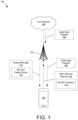
- FIG. 1 shows an example 100 of a network environment in which a UE 102 can connect to a telecommunication network via at least one base station 104.
- the UE 102 can engage in communication sessions for voice calls, video calls, messaging, data transfers, and/or any other type of communication via the telecommunication network.
- the UE 102 can be any device that can wirelessly connect to the base station 104.
- the UE 102 can be a mobile phone, such as a smart phone or other cellular phone.
- the UE 102 can be a personal digital assistant (PDA), a media player, a tablet computer, a gaming device, a smart watch, a hotspot, an Internet of Things (IoT) device, a personal computer (PC) such as a laptop, desktop, or workstation, or any other type of computing or communication device.
- PDA personal digital assistant
- IoT Internet of Things
- PC personal computer
- the base station 104 can be part of an access network of the telecommunication network, such as a radio access network (RAN).
- the telecommunication network can also have a core network 106 linked to the access network.
- the UE 102 can wirelessly connect to the base station 104 of the access network, and in turn be connected to the core network 106 via the base station 104.
- the core network 106 can also link the UE 102 to an Internet Protocol (IP) Multimedia Subsystem (IMS), the Internet, and/or other networks.
- IP Internet Protocol
- IMS Internet Multimedia Subsystem
- the UE 102 and elements of the telecommunication network can be compatible with one or more radio access technologies, wireless access technologies, protocols, and/or standards.
- the UE 102, the base station 104, and/or the core network 106 can support 5G NR technology, Long-Term Evolution (LTE) / LTE Advanced technology, other fourth generation (4G) technology, High-Speed Data Packet Access (HSDPA)/Evolved High-Speed Packet Access (HSPA+) technology, Universal Mobile Telecommunications System (UMTS) technology, Code Division Multiple Access (CDMA) technology, Global System for Mobile Communications (GSM) technology, WiMax ® technology, WiFi ® technology, and/or any other previous or future generation of radio access technology.
- LTE Long-Term Evolution
- LTE Advanced technology Long-Term Evolution (LTE) / LTE Advanced technology
- 4G fourth generation
- UMTS Universal Mobile Telecommunications System
- CDMA Code
- the base station 104 can be a gNB of a 5G access network.
- the access network can be an LTE access network, known as an Evolved UMTS Terrestrial Radio Access Network (E-UTRAN), and the base station 104 can be an evolved Node B (eNB) of the LTE access network.
- the core network 106 can also be based on LTE or 5G.
- the core network 106 can be a 5G core network or an LTE packet core network known as an Evolved Packet Core (EPC).
- EPC Evolved Packet Core
- the base station 104 and the core network 106 may be based on the same radio access technology, or different radio access technologies.
- the base station 104 can be a 5G gNB that is linked to an LTE core network and/or a 5G core network.
- the UE 102 can transmit data to, and/or receive data from, the base station 104.
- the UE 102 can receive downlink transmissions from the base station 104, for instance to download data, receive voice and/or video data during calls, and/or receive any other type of data.
- the UE 102 can send uplink transmissions to the base station 104 to upload data, submit requests for services, transmit voice and/or video data during calls, and/or to transmit any other type of data from the UE 102 to the base station 104, the core network 106, an IMS, the Internet, and/or other networks.
- the UE 102 can establish a Radio Resource Control (RRC) connection with the base station 104, such that the UE 102 and the base station 104 can use the RRC connection for downlink and/or uplink transmissions.
- RRC Radio Resource Control
- the UE 102 can be configured to transition between different RRC states.
- RRC states can include an RRC Idle state (RRC_IDLE) in which the UE 102 does not have an RRC connection with a base station, an RRC Connected state (RRC_CONNECTED) in which the UE 102 does have an active RRC connection with a base station, and an RRC Inactive state (RRC_INACTIVE) in which an established RRC connection between the UE 102 and a base station is suspended.
- RRC_IDLE RRC Idle state
- RRC_CONNECTED RRC Connected state
- RRC_INACTIVE RRC Inactive state
- Different RRC states can be associated with different power consumption levels, as discussed further below.
- the UE 102 can be in the RRC Idle state when no RRC connection is established between the UE 102 and a base station.
- the UE 102 can be in the RRC Idle state when the UE 102 initially powers on and has not yet established an RRC connection with a base station.
- the UE 102 can move from the RRC Connected state to the RRC Idle state.
- UE 102 can consume less power in the RRC Idle state relative to when the UE 102 is in the RRC Connected state.
- the UE 102 can enter the RRC Connected state when an RRC connection is established between the UE 102 and a base station.
- the UE 102 can send an RRC connection request message to the base station 104.
- the base station 104 can respond with an RRC connection setup message, and the UE 102 can in turn respond with an RRC connection setup complete message and move to the RRC Connected state.
- the base station 104 can also configure the RRC connection, for instance by setting up radio bearers, such as default and/or dedicated bearers.
- Bearers associated with the RRC connection can include one or more signaling radio bearers (SRBs) used to transmit RRC messages and/or other signaling messages, and/or one or more data radio bearers (DRBs) used to transmit data.
- SRBs signaling radio bearers
- DRBs data radio bearers
- the base station 104 can send information about such bearers, and/or other configuration information, to the UE 102 in an RRC reconfiguration message, and the UE 102 can respond with an RRC reconfiguration complete message.
- the UE 102 can be in the RRC Connected state and can send and/or receive data via one or more DRBs associated with the RRC connection with the base station 104. Because the UE 102 has an established RRC connection with a base station when the UE 102 is in the RRC Connected state and may use the established RRC connection to send and/or receive data, the UE 102 can consume more power while in the RRC Connected state relative to when the UE 102 is in the RRC Idle state.
- the UE 102 can switch between the RRC Idle state and the RRC Connected state, switching from the RRC idle state to the RRC connected state can take time and can also involve the exchange of numerous signaling messages between the UE 102 and a base station to establish a new RRC connection as discussed above.
- the UE 102 can also use more power in the RRC connected state relative to the RRC idle state, as discussed above.
- the UE can enter the RRC Inactive state instead of the RRC Idle state.
- an established RRC connection associated with the UE 102 can be suspended and made inactive.
- the UE 102 and the base station associated with an established RRC connection can both store Access Stratum (AS) context information associated with the established RRC connection, such as bearer configuration information and other information associated with the established RRC connection.
- AS Access Stratum
- a connection between the base station and the core network 106, associated with the established RRC connection can also continue to exist while the UE 102 is in the RRC Inactive state. Similar to the RRC Idle state, the UE 102 can consume less power while in the RRC Inactive state than in the RRC Connected state, because the RRC connection is suspended.
- the existing suspended RRC connection can be reactivated and used more quickly, and with less signaling, relative to the time and signaling volume that would be used to establish a new RRC connection during a change from the RRC Idle state to the RRC Connected state.
- the suspended RRC connection can be reactivated and/or used more quickly than setting up a new RRC connection. Accordingly, in some situations, the UE 102 can move from the RRC Inactive state to the RRC Connected state to reactivate a suspended RRC connection, as described above.
- the UE 102 can use Small Data Transmission (SDT) procedures to send and/or receive small data payloads, such as the small data payload 108 shown in FIG. 1 , via one or more DRBs associated with an RRC connection without the UE 102 changing from the RRC Inactive state to the RRC Connected state.
- SDT Small Data Transmission
- the RRC connection may have been suspended when the UE 102 entered the RRC Inactive state, one or more DRBs associated with the RRC connection can be resumed and used at least temporarily during SDT procedures to transmit data while the UE 102 remains in the RRC Inactive state.
- the UE 102 can use SDT procedures to send and/or receive small data payloads while the UE 102 remains in the RRC Inactive state.
- SDT procedures that allow the UE 102 to remain in the RRC Inactive state can be associated with lower latencies, lower signaling volumes between the base station and the UE 102, and/or lower power consumption levels of the UE 102.
- SDT procedures can be used when the UE 102 is a Mobile Originating (MO) device or a Mobile Terminating (MO) device.
- MO Mobile Originating
- MO Mobile Terminating
- the UE 102 can use SDT procedures to send the small data payload to a base station via one or more DRBs associated with an RRC connection while the UE 102 remains in the RRC Inactive state.
- the UE 102 can use SDT procedures to receive the small data payload from a base station via one or more DRBs associated with an RRC connection while the UE 102 remains in the RRC Inactive state.
- Network elements may periodically or intermittently send small data payloads, such as the small data payload 108 shown in FIG. 1 , to the UE 102 when the UE 102 is a MT device.
- the small data payloads can be associated with relatively small amounts of data, such as amounts of data that are equal to or under a threshold size.
- the threshold size for the small data payloads can, for example, be configured to be 50 bytes, 100 bytes, or any other size.
- the small data payload 108 can be a small amount of data associated with an instant message that is to be delivered to an instant messaging client executing on the UE 102.
- the small data payload 108 can be a small amount of data associated with a push notification for an application executing on the UE 102, a heartbeat message configured to keep an application on the UE 102 active, a small amount of sensor data or other information that is to be delivered to the UE 102, and/or any type of data payload with a size that is equal to or less than the threshold size.
- the UE 102 may receive such small data payloads from one or more sources, such as application servers or other network elements, on a periodic or intermittent basis.
- an application server may send a series of heartbeat messages associated with a particular application to the UE 102 on a regular or irregular basis.
- Each of those heartbeat messages may be small data payloads, such as data payloads of one byte, two bytes, four bytes, or any other size that is equal to or less than the threshold size.
- one or more elements of the core network 106 can notify the base station 104 that the small data payload 108 is available for the UE 102, and/or provide the small data payload 108 to the base station 104.
- the base station 104 can send a paging message 110 addressed to the UE 102.
- the base station 104 can broadcast the paging message 110, but include an identifier of the UE 102 within the paging message 110 to indicate that at least a portion of the paging message 110 is associated with the UE 102.
- the identifier of the UE 102 in the paging message 110 may be an Inactive Radio Network Temporary Identifier (I-RNTI) associated with the UE 102.
- I-RNTI Inactive Radio Network Temporary Identifier
- the portion of the paging message 110 associated with the UE 102 can include an MT-SDT paging cause 112.
- the MT-SDT paging cause 112 can notify the UE 102 that there is a pending small data payload available for the UE 102, which the UE 102 can obtain via SDT procedures.
- a paging message sent by a base station can include a "PagingCause" field that can hold one of a set of possible values indicating why the UE 102 is being paged by the base station. For example, if a base station is paging the UE 102 due to an incoming voice call addressed to the UE 102, the "PagingCause" field of a paging message may have a "voice" value that prompts the UE 102 to move to the RRC Connected state to answer the incoming voice call.
- the MT-SDT paging cause 112 in the paging message 110 can be a particular value for the "PagingCause" field, such as "mt-SDT," that signifies to the UE 102 that there is a small data payload available for the UE 102. Accordingly, based on the MT-SDT paging cause 112 in the paging message 110, the UE 102 can determine to use SDT procedures to receive the small data payload while the UE 102 remains in the RRC Inactive state, instead of responding to the paging message 110 by moving to the RRC Connected state.
- different base stations such as a group of base stations in a tracking area where the UE 102 last connected to a base station, may be notified about the small data payload 108 and/or receive the small data payload 108. Accordingly, in these examples, different base stations can attempt to send the paging message 110 that includes the MT-SDT paging cause 112 to the UE 102.
- the base station 104 and/or other base stations that receive or are notified about the small data payload 108 for the UE 102 can broadcast the paging message 110, including the MT-SDT paging cause 112, in association with one or more cells of the base stations.
- the paging message 110 for the UE 102 may include one or more identifiers of the UE 102, such as an I-RNTI.
- the UE 102 while in the RRC Inactive state, can receive data broadcast by one or more base stations.
- the UE 102 can determine whether the broadcast data includes a paging message addressed to the UE 102, such as the paging message 110 that includes the MT-SDT paging cause 112.
- the UE 102 may nevertheless periodically wake to receive data being broadcast from one or more base stations.
- the UE 102 can analyze the received broadcast data to determine if the data includes a paging message addressed the UE 102, such as the paging message 110.
- the UE 102 can determine that the portion of the paging message 110 associated with the UE 102 includes the MT-SDT paging cause 112 instead of a different paging cause. For example, the UE 102 can review the "PagingCause" field of the portion of the paging message addressed to the UE 102, and determine that the value of the "PagingCause" field is the MT-SDT paging cause 112 instead of a "voice" paging cause or any other type of paging cause.
- the UE 102 can determine that the UE 102 should respond to the paging message 110 using SDT procedures and while remaining in the RRC Inactive state, instead of responding to the paging message by switching from the RRC Inactive state to the RRC Connected state.
- the UE 102 can send an RRC resume request 114 to the base station 104.
- the UE 102 can send the RRC resume request 114 to the base station 104 while the UE 102 remains in the RRC Inactive state.
- the RRC resume request 114 can include an MT-SDT indicator 116.
- the MT-SDT indicator 116 can indicate to the base station 104 that the UE 102 is requesting to use SDT procedures to resume a previously-established RRC connection to receive the small data payload 108 while the UE 102 remains in the RRC Inactive state.
- the presence of the MT-SDT indicator 116 can, for example, indicate to the base station 104 that the UE 102 is not requesting a resumption of the RRC connection as part of a change by the UE 102 from the RRC Inactive state to the RRC Connected state.
- the MT-SDT indicator 116 can be a particular value of a "ResumeCause" field of the RRC resume request 114, such as "mt-Access-SDT," that signifies to the base station 104 that the UE 102 is requesting to use SDT procedures to receive a small data payload while the UE 102 remains in the RRC Inactive state.
- a value of the "ResumeCause” field associated with the MT-SDT indicator 116 such as "mt-Access-SDT”
- a possible value of the "ResumeCause” field may be "mt-Access,” but the "mt-Access” value of the "ResumeCause” field may be associated with an answer to a paging message for general types of data and/or communications sessions, and therefore may not indicate that the UE 102 is an MT device that is requesting to use SDT procedures to receive a small data payload while the UE 102 remains in the RRC Inactive state.
- the MT-SDT indicator 116 can be a particular value of an uplink payload portion of the RRC resume request 114 that signifies to the base station 104 that the UE 102 is requesting to use SDT procedures to receive a small data payload while the UE 102 remains in the RRC Inactive state.
- the MT-SDT indicator 116 may be a value of "0" or "-1" of the uplink payload portion of the RRC resume request 114.
- MO-SDT procedures in which a UE is an MO device that is resuming an RRC connection to send a small data payload uplink via the RRC connection, the UE can indicate a positive value in the uplink payload portion of the RRC resume request 114.
- the positive value of the uplink small data payload in the uplink payload portion of the RRC resume request 114 can signify to the base station 104 that the UE is requesting to use SDT procedures to send a small data payload while the UE 102 remains in the RRC Inactive state.
- the UE 102 when the UE 102 is an MT device and is responding to the paging message 110 that includes the MT-SDT paging cause 112, the UE 102 can set the uplink payload portion of the RRC resume request 114 to a different non-positive value, such as "0" or "-1," to indicate that the UE is an MT device that is responding to a paging message and is requesting to use SDT procedures to receive a small data payload while the UE 102 remains in the RRC Inactive state.
- a different non-positive value such as "0" or "-1”
- the base station 104 can use SDT procedures to send the small data payload 108 to the UE 102 via the established RRC connection while the UE 102 is in the RRC Inactive state. For example, in response to the RRC resume request 114, the base station 104 may return an RRC resume message to the UE 102 that identifies one or more bearers, such as one or more DRBs, associated with the established RRC connection that are being resumed to transmit the small data payload 108 to the UE 102. The base station 104 can accordingly transfer the small data payload 108 to the UE 102 via the one or more resumed DRBs, identified in the RRC resume message, while the UE 102 remains in the RRC Inactive state.
- the base station 104 may also send the UE 102 an RRC release message that includes a suspend indication.
- the suspend indication in the RRC release message can indicate that the RRC connection is suspended and is not being fully released, and thus cause the UE 102 to remain in the RRC Inactive state instead of moving to the RRC Idle state. Accordingly, because the UE 102 can continue to be in the RRC Inactive state, the UE 102 can be prepared to use SDT procedures again, for instance if another small data payload is later transmitted to the UE 102 and the UE 102 receives another paging message with the MT-SDT paging cause 112.
- the base station that receives the RRC resume request 114 from the UE 102 can be the last base station that served the UE 102. Accordingly, the base station can use stored AS context information associated with the suspended RRC connection to transmit the small data payload 108 to the UE 102.
- the base station that receives the RRC resume request 114 from the UE 102 may not be the last base station that served the UE 102. Accordingly, in these examples, the base station can retrieve stored AS context information associated with the suspended RRC connection from the base station that last served the UE 102, and use the retrieved AS context information associated with the suspended RRC connection to transmit the small data payload 108 to the UE 102.
- the last serving base station (the current anchor base station for the UE 102) may determine to relocate AS context information associated with the UE 102 to the base station that received the RRC resume request 114 via "SDT with UE context relocation" operations, such that the base station that received the RRC resume request 114 becomes the new anchor base station for the UE 102. In other examples, the last serving base station may determine to continue to be the anchor base station for the UE 102 by keeping the AS context information associated with the UE 102 via "SDT without UE context relocation" operations.
- the SDT procedures initiated by the UE 102 in response to the paging message 110 that includes the MT-SDT paging cause 112 can be performed via a Random Access Channel (RACH) procedure.
- RACH Random Access Channel
- the SDT procedures can be 4-step or 2-step Random Access Small Data Transmission (RA-SDT) procedures, as discussed further below with respect to FIG. 3 and FIG. 4 .
- RA-SDT procedures can be performed with UE context relocation or without UE context relocation, as described above.
- the SDT procedures can be Configured Grant Small Data Transmission (CG-SDT) procedures, as discussed further below with respect to FIG. 5 .
- CG-SDT Configured Grant Small Data Transmission
- the UE 102 may determine to use 4-step RA-SDT procedures, 2-step RA-SDT procedures, or CG-SDT procedures in response to the paging message 110 that includes the MT-SDT paging cause 112 based on a configuration of the UE 102 and/or how a previously-established RRC connection with the base station 104 was suspended.
- the base station 104 can include the MT-SDT paging cause 112 in the paging message 110 to indicate to the UE 102 that the small data payload 108 is available for the UE 102 and can be obtained via SDT procedures.
- the UE 102 can determine to respond to the paging message 110 by using SDT procedures to obtain the small data payload 108 while remaining in the RRC Inactive state and without moving to the RRC Connected state.
- FIG. 2 shows a first sequence diagram 200 of a general example sequence of messages that can be used to page the UE 102 and prompt the UE 102 to use SDT procedures to obtain the small data payload 108 while remaining in the RRC Inactive state.
- a network element 202 such as an application server, element of the core network 106, or other network element can provide the small data payload 108 for the UE 102 to the base station 104 and/or notify the base station 104 that the small data payload 108 is being sent to the UE 102.
- the UE 102 can be in the RRC Inactive state, for instance because a previously-established RRC connection has been suspended.
- the base station 104 can send the paging message 110 to the UE 102.
- the base station 104 can include an identifier of the UE 102, such as an I-RNTI, in the paging message 110, and can broadcast the paging message 110.
- the base station 104 can also include the MT-SDT paging cause 112 in the paging message 110, for example in a portion of the paging message 110 that is addressed to the UE 102.
- the MT-SDT paging cause 112 can be a particular value of a "PagingCause" field, such as "mt-SDT.”
- the MT-SDT paging cause 112 in the paging message 110 can signify, to the UE 102, that the UE 102 is being paged because a small data payload is available for the UE 102, and that the UE 102 can obtain the small data payload via SDT procedures while the UE 102 remains in the RRC Inactive state.
- the UE 102 can determine based on MT-SDT paging cause 112 that the small data payload 108 is available for the UE 102, and that the UE 102 can obtain the small data payload via SDT procedures. Accordingly, the UE 102 can send the RRC resume request 114 to the base station 104 in response to the paging message 110.
- the RRC resume request 114 can include the MT-SDT indicator 116, such as a particular value of a "ResumeCause" field or an uplink payload portion of the RRC resume request 114, which indicates a request to use MT-SDT procedures.
- the base station 104 can send the small data payload 108 to the UE 102 via the previously-suspended RRC connection. For example, after receiving the RRC resume request 114, the base station 104 can send an RRC resume message to the UE 102 that identifies one or more DRBs associated with the RRC connection that are being resumed, and can send the small data payload 108 to the UE 102 via the one or more resumed DRBs. At this point, the UE 102 can still be in the RRC Inactive state. The base station 104 can also send the UE 102 an RRC release message 204 that includes a suspend indication.
- the suspend indication in the RRC release message 204 can indicate that the RRC connection is suspended and is not being fully released, and thus cause the UE 102 to remain in the RRC Inactive state instead of moving to the RRC Idle state.
- the base station 104 can send the RRC resume message, the small data payload 108, and/or the RRC release message as separate messages.
- the base station 104 can send the small data payload 108 along with, or inside, the RRC resume message.
- the base station 104 can package the RRC resume message, the small data payload 108, and the RRC release message 204 together.
- FIG. 2 shows a general example sequence of messages that can be associated with SDT procedures initiated by the paging message 110 that includes the MT-SDT paging cause 112
- FIGS. 3-5 show examples of message sequences associated with different types of SDT procedures.
- FIG. 3 shows an example message sequence associated with 4-step RA-SDT procedures
- FIG. 4 shows an example message sequence associated with 2-step RA-SDT procedures
- FIG. 5 shows an example message sequence associated with CG-SDT procedures.
- FIG. 3 shows a second sequence diagram 300 of an example message sequence, associated with 4-step RA-SDT procedures, that can be initiated by the paging message 110 that includes the MT-SDT paging cause 112.
- the 4-step RA-SDT procedures can be performed with UE context relocation or without UE context relocation, as described above.
- the network element 202 can provide the small data payload 108 for the UE 102 to the base station 104, and/or notify the base station 104 that the small data payload 108 is being sent to the UE 102.
- the UE 102 can be in the RRC Inactive state, for instance because a previously-established RRC connection has been suspended.
- the base station 104 can send the paging message 110 that includes the MT-SDT paging cause 112 to the UE 102.
- the MT-SDT paging cause 112 can be a particular value of a "PagingCause" field, such as "mt-SDT.”
- the UE 102 can determine based on MT-SDT paging cause 112 that a small data payload is available for the UE 102.
- the UE 102 can determine to use 4-step RA-SDT procedures to obtain the small data payload.
- the UE 102 may be pre-configured to use 4-step RA-SDT procedures instead of the 2-step RA-SDT procedures discussed below with respect to FIG. 4 , and/or may determine that CG-SDT procedures discussed below with respect to FIG. 5 are not available.
- the UE 102 can transmit a first message 302 (known as "Msg1" in the 4-step RA-SDT procedure) to the base station 104 in response to the paging message 110 that includes the MT-SDT paging cause 112.
- the first message 302 (Msg1) can include a Physical Random Access Channel (PRACH) preamble.
- the base station 104 can return a second message 304 (known as "Msg2" in the 4-step RA-SDT procedure) to the UE 102.
- the second message 304 (Msg2) can include a Random Access Response from the base station 104.
- the UE 102 can respond to the second message 304 (Msg2) by sending a third message 306 (known as "Msg3" in the 4-step RA-SDT procedure) to the base station 104.
- the third message 306 (Msg3) can include Physical Uplink Shared Channel (PUSCH) information.
- PUSCH Physical Uplink Shared Channel
- the UE 102 can send the RRC resume request 114, including the MT-SDT indicator 116, via the third message 306 (Msg3), for example in or along with the PUSCH information.
- the MT-SDT indicator 116 may be a particular value of a "ResumeCause" field or an uplink payload portion of the RRC resume request 114, which indicates a request to use MT-SDT procedures.
- the RRC resume request 114, including the MT-SDT indicator 116, in the third message 306 (Msg3) can therefore indicate to the base station 104 that the UE 102 is requesting to use SDT procedures to obtain the small data payload 108 while the UE 102 remains in the RRC Inactive state.
- the base station 104 can respond to the third message 306 (Msg3) by sending the small data payload 108 to the UE 102.
- Msg3 the third message 306
- the base station 104 can use SDT procedures to send the small data payload 108 to the UE 102.
- the base station 104 can send an RRC resume message to the UE 102 that identifies one or more DRBs associated with the RRC connection that are being resumed, and can send the small data payload 108 to the UE 102 via the one or more resumed DRBs while the UE 102 is in the RRC Inactive state.
- the base station 104 can also send a fourth message 308 (known as "Msg4" in the 4-step RA-SDT procedure) to the UE 102.
- the base station 104 can also include an RRC release message, with a suspend indication, in the fourth message 308 (Msg4) sent to the UE 102.
- the suspend indication, in the RRC release message sent via the fourth message 308 (Msg4) can indicate that the RRC connection is suspended and is not being fully released, and thus cause the UE 102 to remain in the RRC Inactive state instead of moving to the RRC Idle state.
- the base station 104 can send the small data payload 108 to the UE 102 in a separate message prior to sending the fourth message 308 (Msg4), for instance after or along with an RRC resume message that identifies one or more DRBs that are being resumed to send the small data payload 108 to the UE 102 as shown in FIG. 3 .
- the base station 104 can include the small data payload 108 in the fourth message 308 (Msg4) sent to the UE 102.
- FIG. 4 shows a third sequence diagram 400 of an example message sequence, associated with 2-step RA-SDT procedures, that can be initiated by the paging message 110 that includes the MT-SDT paging cause 112.
- the 2-step RA-SDT procedures can be performed with UE context relocation or without UE context relocation, as described above.
- the network element 202 can provide the small data payload 108 for the UE 102 to the base station 104, and/or notify the base station 104 that the small data payload 108 is being sent to the UE 102.
- the UE 102 can be in the RRC Inactive state, for instance because a previously-established RRC connection has been suspended.
- the base station 104 can send the paging message 110 that includes the MT-SDT paging cause 112 to the UE 102.
- the MT-SDT paging cause 112 can be a particular value of a "PagingCause" field, such as "mt-SDT.”
- the UE 102 can determine based on MT-SDT paging cause 112 that a small data payload is available for the UE 102.
- the UE 102 can determine to use 2-step RA-SDT procedures to obtain the small data payload.
- the UE 102 may be pre-configured to use 2-step RA-SDT procedures instead of the 4-step RA-SDT procedures discussed above with respect to FIG. 3 , and/or may determine that CG-SDT procedures discussed below with respect to FIG. 5 are not available.
- the UE 102 can transmit a first message 402 (known as "MsgA" in the 2-step RA-SDT procedure) to the base station 104 in response to the paging message 110 that includes the MT-SDT paging cause 112.
- the first message 402 (MsgA) can include a PRACH preamble and PUSCH information.
- the RRC resume request 114 with the MT-SDT indicator 116 can be included by the UE 102 in the first message 402 (MsgA) in the 2-step RA-SDT procedure, for instance in or along with the PUSCH information.
- the MT-SDT indicator 116 may be a particular value of a "ResumeCause" field or an uplink payload portion of the RRC resume request 114, which indicates a request to use MT-SDT procedures.
- the RRC resume request 114, including the MT-SDT indicator 116, in the first message 402 (MsgA) of the 2-step RA-SDT procedure can therefore indicate to the base station 104 that the UE 102 is requesting to use SDT procedures to obtain the small data payload 108 while the UE 102 remains in the RRC Inactive state.
- the base station 104 can send the small data payload 108 to the UE 102.
- the base station 104 can use SDT procedures to send the small data payload 108 to the UE 102.
- the base station 104 can send an RRC resume message to the UE 102 that identifies one or more DRBs associated with the RRC connection that are being resumed, and can send the small data payload 108 to the UE 102 via the one or more resumed DRBs while the UE 102 is in the RRC Inactive state.
- the base station 104 can also send a second message 404 (known as "MsgB" in the 2-step RA-SDT procedure) to the UE 102.
- the second message 404 (MsgB) can include an RRC release message with a suspend indication.
- the suspend indication in the RRC release message sent via the second message 404 (MsgB), can indicate that the RRC connection is suspended and is not being fully released, and thus cause the UE 102 to remain in the RRC Inactive state instead of moving to the RRC Idle state.
- the base station 104 can send the small data payload 108 to the UE 102 in a separate message prior to sending the second message 404 (MsgB), for instance after or along with an RRC resume message that identifies one or more DRBs that are being resumed to send the small data payload 108 to the UE 102 as shown in FIG. 4 .
- the base station 104 can include the small data payload 108 in the second message 404 (MsgB) sent to the UE 102.
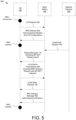
- FIG. 5 shows a fourth sequence diagram 500 of an example message sequence, associated with CG-SDT procedures, that can be initiated by the paging message 110 that includes the MT-SDT paging cause 112.
- the CG-SDT procedures can be available if a configured grant (CG) configuration was requested from the base station 104 by the UE 102 while the UE 102 was in the RRC connected state.
- the CG configuration can be associated with reserved or pre-configured PUSCH resources, and may thus be associated with lower latencies, lower signaling volume, and/or lower power consumption of the UE 102 relative to 4-step RA-SDT procedures or 2-step RA-SDT procedures.
- the UE 102 can send a CG request 502 to the base station 104.
- the CG request 502 can be a request for a CG configuration.
- the base station 104 can return an RRC release message 504 to the UE 102.
- the RRC release message 504 can include a suspend indicator, which indicates that the RRC connection is suspended and is not being fully released, and thus causes the UE 102 to change from the RRC Connected state to the RRC Inactive state as shown in FIG. 5 .
- the RRC release message 504 can also include the CG configuration requested by the UE 102 via the CG request 502.
- the CG configuration sent in the RRC release message 504 can be specific to the UE 102, and can include allocated PUSCH resources and other elements.
- the network element 202 can provide the small data payload 108 for the UE 102 to the base station 104, and/or notify the base station 104 that the small data payload 108 is being sent to the UE 102.
- the UE 102 can be in the RRC Inactive state due to the RRC release message 504.
- the base station 104 can send the paging message 110 that includes the MT-SDT paging cause 112 to the UE 102.
- the MT-SDT paging cause 112 can be a particular value of a "PagingCause" field, such as "mt-SDT.”
- the UE 102 can determine based on MT-SDT paging cause 112 that a small data payload is available for the UE 102.
- the UE 102 can determine that CG-SDT procedures are available. The UE 102 may therefore determine to use the CG-SDT procedures to obtain the small data payload, instead of the 4-step RA-SDT procedures or 2-step RA-SDT procedures discussed above with respect to FIG. 3 and FIG. 4 .
- the UE 102 can send a CG PUSCH transmission 506 to the base station 104 in response to the paging message 110 that includes the MT-SDT paging cause 112.
- the RRC resume request 114 with the MT-SDT indicator 116 can be included by the UE 102 in the CG PUSCH transmission 506 in the CG-SDT procedure.
- the MT-SDT indicator 116 may be a particular value of a "ResumeCause" field or an uplink payload portion of the RRC resume request 114, which indicates a request to use MT-SDT procedures.
- the RRC resume request 114 including the MT-SDT indicator 116, in the CG PUSCH transmission 506 of the CG-SDT procedure can therefore indicate to the base station 104 that the UE 102 is requesting to use SDT procedures to obtain the small data payload 108 while the UE 102 remains in the RRC Inactive state.
- the base station 104 can send the small data payload 108 to the UE 102.
- the base station 104 can use SDT procedures to send the small data payload 108 to the UE 102.
- the base station 104 can send an RRC resume message to the UE 102 that identifies one or more DRBs associated with the RRC connection that are being resumed, and can send the small data payload 108 to the UE 102 via the one or more resumed DRBs while the UE 102 is in the RRC Inactive state.
- the base station 104 can also send an RRC release message 508, including a suspend indication, to the UE 102.
- the suspend indication in the RRC release message 508 sent to the UE 102, can indicate that the RRC connection is suspended and is not being fully released, and thus cause the UE 102 to remain in the RRC Inactive state instead of moving to the RRC Idle state.
- the base station 104 can send the small data payload 108 to the UE 102 in a separate message prior to sending the RRC release message 508, for instance after or along with an RRC resume message that identifies one or more DRBs that are being resumed to send the small data payload 108 to the UE 102 as shown in FIG. 5 .
- the base station 104 can include the small data payload 108 in the RRC release message 508 sent to the UE 102.
- the UE 102 can receive the paging message 110 with the MT-SDT paging cause 112 while the UE 102 is in the RRC Inactive state.
- the paging message 110 including the MT-SDT paging cause 112, can be sent by the base station 104 when the small data payload 108 is available for the UE 102.
- the UE 102 can respond to the paging message 110 that includes the MT-SDT paging cause 112 by initiating an SDT procedure with the RRC resume request 114 that includes the MT-SDT indicator 116.
- the base station 104 can send the small data payload 108 to the UE 102, and can also use a suspend indication in an RRC release message to cause the UE 102 to remain in the RRC Inactive state. Accordingly, when the small data payload 108 is available for the UE 102, the paging message 110 with the MT-SDT paging cause 112 can cause the UE 102 can obtain the small data payload 108 without the UE 102 changing from the RRC Inactive state to the RRC Connected state.
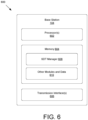
- FIG. 6 shows an example 600 of a system architecture for the base station 104, in accordance with various examples.
- the base station 104 can be a 5G gNB, an LTE eNB, or other type of base station as described above.
- the base station 104 can include processor(s) 602, memory 604, and transmission interfaces 606.
- the processor(s) 602 may be a central processing unit (CPU), or any other type of processing unit. Each of the one or more processor(s) 602 may have numerous arithmetic logic units (ALUs) that perform arithmetic and logical operations, as well as one or more control units (CUs) that extract instructions and stored content from processor cache memory, and then executes these instructions by calling on the ALUs, as necessary, during program execution.
- ALUs arithmetic logic units
- CUs control units
- the processor(s) 602 may also be responsible for executing all computer-executable instructions and/or computer applications stored in the memory 604.
- the memory 604 can include system memory, which may be volatile (such as RAM), non-volatile (such as ROM, flash memory, etc.) or some combination of the two.
- the memory 604 can also include additional data storage devices (removable and/or non-removable) such as, for example, magnetic disks, optical disks, or tape.
- Memory 604 can further include non-transitory computer-readable media, such as volatile and nonvolatile, removable and non-removable media implemented in any method or technology for storage of information, such as computer readable instructions, data structures, program modules, or other data.
- System memory, removable storage, and non-removable storage are all examples of non-transitory computer-readable media.
- non-transitory computer-readable media include, but are not limited to, RAM, ROM, EEPROM, flash memory or other memory technology, CD-ROM, DVD, or other optical storage, magnetic cassettes, magnetic tape, magnetic disk storage or other magnetic storage devices, or any other non-transitory medium which can be used to store the desired information and which can be accessed by the base station 104. Any such non-transitory computer-readable media may be part of the base station 104.
- the memory 604 can store computer-readable instructions and/or other data associated with operations of the base station 104.
- the memory 604 can store computer-readable instructions and/or other data associated with an SDT manager 608.
- the SDT manager 608 can be configured to generate and send the paging message 110 that includes, in at least a portion of the paging message 110 addressed to and/or associated with the UE 102, the MT-SDT paging cause 112.
- the SDT manager 608 can be configured to transmit the small data payload 108 to the UE 102, and may also be configured to send an RRC release message with a suspend indicator that causes the UE 102 to remain in an RRC Inactive state.
- the memory 604 can also store other modules and data 610.
- the other modules and data 610 can be utilized by the base station 104 to perform or enable performing any action taken by the base station 104.
- the other modules and data 610 can include a platform, operating system, firmware, and/or applications, and data utilized by the platform, operating system, firmware, and/or applications.
- the transmission interfaces 606 can include one or more modems, receivers, transmitters, antennas, error correction units, symbol coders and decoders, processors, chips, application specific integrated circuits (ASICs), programmable circuit (e.g., field programmable gate arrays), firmware components, and/or other components that can establish connections with the UE 102, other base stations or RAN elements, elements of the core network 106, and/or other network elements, and can transmit data over such connections.
- ASICs application specific integrated circuits
- programmable circuit e.g., field programmable gate arrays
- firmware components e.g., firmware components
- the transmission interfaces 606 can establish a connection with the UE 102 over an air interface.
- the transmission interfaces 606 can also support transmissions using one or more radio access technologies, such as 5GNR.
- the transmission interfaces 606 can also be used by the base station 104 to establish and/or suspend an RRC connection with the UE 102, send the paging message 110 that includes the MT-SDT paging cause 112, receive the RRC resume request 114 that includes the MT-SDT indicator, send the small data payload 108 to the UE 102, send an RRC release message that includes a suspend indicator, and/or to send or receive any other data.
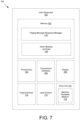
- FIG. 7 shows an example 700 of system architecture for the UE 102, in accordance with various examples.
- the UE 102 can have at least one memory 702, processor(s) 704, transmission interfaces 706, a display 708, output devices 710, input devices 712, and/or a drive unit 714 including a machine readable medium 716.
- the memory 702 can include system memory, which may be volatile (such as RAM), non-volatile (such as ROM, flash memory, etc.) or some combination of the two.
- the memory 702 can further include non-transitory computer-readable media, such as volatile and nonvolatile, removable and non-removable media implemented in any method or technology for storage of information, such as computer readable instructions, data structures, program modules, or other data.
- System memory, removable storage, and non-removable storage are all examples of non-transitory computer-readable media.
- non-transitory computer-readable media examples include, but are not limited to, RAM, ROM, EEPROM, flash memory or other memory technology, CD-ROM, digital versatile discs (DVD) or other optical storage, magnetic cassettes, magnetic tape, magnetic disk storage or other magnetic storage devices, or any other non-transitory medium which can be used to store the desired information and which can be accessed by the UE 102. Any such non-transitory computer-readable media may be part of the UE 102.
- the memory 702 can include one or more software or firmware elements, such as data and/or computer-readable instructions that are executable by the one or more processors 704.
- the memory 702 can store computer-executable instructions and data associated with a paging message response manager 718.
- the paging message response manager 718 can be configured to evaluate a paging message addressed to the UE 102, and determine how the UE 102 is to respond to the paging message. For example, if the paging message has a "voice" paging cause due to an incoming voice call directed to the UE 102, the paging message response manager 718 may cause the UE 102 to switch to the RRC Connected state to respond to the paging message and answer the voice call.
- the paging message response manager 718 can cause the UE 102 to use SDT procedures to respond to the paging message and to obtain a pending small data payload for the UE 102 without switching from the RRC Inactive state to the RRC Connected state. For instance, if the paging message includes the MT-SDT paging cause 112, the paging message response manager 718 can cause the UE 102 to send the RRC resume request 114 that includes the MT-SDT indicator 116 as described above.
- the memory 702 can also store other modules and data 720, which can be utilized by the UE 102 to perform or enable performing any action taken by the UE 102.
- the other modules and data 720 can include a platform, operating system, firmware, and/or applications, and data utilized by the platform, operating system, firmware, and/or applications.
- the processor(s) 704 can be a CPU, a graphics processing unit (GPU), or both CPU and GPU, or any other type of processing unit.
- Each of the one or more processor(s) 704 may have numerous ALUs that perform arithmetic and logical operations, as well as one or more CUs that extract instructions and stored content from processor cache memory, and then executes these instructions by calling on the ALUs, as necessary, during program execution.
- the processor(s) 704 may also be responsible for executing all computer applications stored in the memory 702, which can be associated with types of volatile (RAM) and/or nonvolatile (ROM) memory.
- the transmission interfaces 706 can include transceivers, modems, interfaces, antennas, and/or other components that perform or assist in exchanging radio frequency (RF) communications with base stations of the access network, a Wi-Fi access point, or otherwise implement connections with one or more networks.
- the transmission interfaces 706 can be compatible with one or more radio access technologies, such as 5G NR radio access technologies and/or LTE radio access technologies.
- the transmission interfaces 706 can be used by the UE 102 to receive the paging message 110 that includes the MT-SDT paging cause 112, send the RRC resume request 114 that includes the MT-SDT indicator, receive the small data payload 108 from the base station 104, receive an RRC release message that includes a suspend indicator, and/or to send or receive any other data.
- the display 708 can be a liquid crystal display or any other type of display commonly used in UEs.
- the display 708 may be a touch-sensitive display screen, and can thus also act as an input device or keypad, such as for providing a soft-key keyboard, navigation buttons, or any other type of input.
- the output devices 710 can include any sort of output devices known in the art, such as the display 708, speakers, a vibrating mechanism, and/or a tactile feedback mechanism. Output devices 710 can also include ports for one or more peripheral devices, such as headphones, peripheral speakers, and/or a peripheral display.
- the input devices 712 can include any sort of input devices known in the art.
- input devices 712 can include a microphone, a keyboard/keypad, and/or a touch-sensitive display, such as the touch-sensitive display screen described above.
- a keyboard/keypad can be a push button numeric dialing pad, a multi-key keyboard, or one or more other types of keys or buttons, and can also include a joystick-like controller, designated navigation buttons, or any other type of input mechanism.
- the machine readable medium 716 can store one or more sets of instructions, such as software or firmware, that embodies any one or more of the methodologies or functions described herein.
- the instructions can also reside, completely or at least partially, within the memory 702, processor(s) 704, and/or transmission interface(s) 706 during execution thereof by the UE 102.
- the memory 702 and the processor(s) 704 also can constitute machine readable media 716.
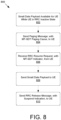
- FIG. 8 shows a flowchart of an example method 800 in which the base station 104 can use the paging message 110, including the MT-SDT paging cause 112, to notify an MT UE about a small data payload that the UE 102 can obtain via SDT procedures.
- the base station 104 can determine that the small data payload 108 is available for the UE 102 while the UE 102 is in the RRC Inactive state.
- one or more network elements such as an AMF and/or UPF in the core network 106, can notify the base station 104 about the small data payload 108 and/or provide the small data payload 108 to the base station 104.
- the UE 102 may be in the RRC Inactive state due to a suspension of a previously-established RRC connection, for instance based on an RRC release message with a suspend indication sent by the base station 104 or a different base station.
- the base station 104 can send the paging message 110 with the MT-SDT paging cause 112 to the UE 102.
- the base station 104 can generate the paging message 110 by addressing at least a portion of the paging message 110 with an I-RNTI or other identifier of the UE 102, and including the MT-SDT paging cause 112 in the portion of the paging message 110 associated with the UE 102.
- the MT-SDT paging cause 112 can be a particular value of a "PagingCause" field, such as "mt-SDT.”
- the base station 104 can broadcast the paging message 110, including the MT-SDT paging cause 112, such that the UE 102 can receive the paging message 110 if the UE 102 is within range of the base station 104.
- the base station 104 can receive the RRC resume request 114, including the MT-SDT indicator 116, from the UE 102 in response to the paging message 110.
- the MT-SDT indicator 116 can be a particular value of a "ResumeCause" field of the RRC resume request 114 that is associated with MT-SDT procedures.
- the MT-SDT indicator 116 can be a particular value of an uplink payload portion of the RRC resume request 114, such as "0" or "-1,” that indicates a request for MT-SDT procedures.
- the base station 104 can use SDT procedures to send the small data payload 108 to the UE 102 while the UE 102 remains in the RRC Inactive state. For example, after receiving the RRC resume request 114 at block 806, the base station 104 can send an RRC resume message to the UE 102 that identifies one or more DRBs associated with an RRC connection that are being resumed, and can send the small data payload 108 to the UE 102 via the one or more resumed DRBs while the UE 102 is in the RRC Inactive state.
- the base station 104 can also, at block 810, send an RRC release message that includes a suspend indication to the UE 102.
- the suspend indication in the RRC release message can indicate that the RRC connection is suspended and is not being fully released, and thus cause the UE 102 to remain in the RRC Inactive state instead of moving to the RRC Idle state.
- the base station 104 can send the small data payload at block 808 and send the RRC release message at block 810 as separate messages.
- the base station 104 can send the small data payload at block 808 and send the RRC release message at block 810 as part of the same message sent to the UE 102.
- multiple base stations may perform the operations of block 802 and block 804, while one of the base stations that receives the RRC resume request 114 from the base station 104 can perform the operations of blocks 806-810.
- one or more network elements may notify multiple base stations, such as multiple base stations in a tracking area where the UE 102 was last connected to the telecommunication network, about the small data payload 108 at block 802.
- the multiple base stations can accordingly broadcast paging messages with portions addressed to the UE 102 that include the MT-SDT paging cause 112 at block 804.
- the UE 102 can respond by sending the RRC resume request 114, including the MT-SDT indicator 116, to that particular base station. Accordingly, that particular base station can receive the RRC resume request 114 from the UE 102 at block 806, send the small data payload 108 to the UE 102 at block 808, and send the RRC release message with the suspend indication to the UE 102 at block 810.
- the particular base station may nevertheless receive the RRC resume request 114 from the UE 102, send the small data payload 108 to the UE 102, and send the RRC release message with the suspend indication to the UE 102, for instance via RA-SDT procedures with UE context relocation or without UE context relocation.
- FIG. 9 shows a flowchart of an example method 900 in which the UE 102 can respond to a paging message from the base station 104 while the UE 102 is in the RRC Inactive state.
- the UE 102 can receive the paging message while the UE 102 is in the RRC Inactive state.
- At least a portion of the paging message can be addressed to, or be associated with the UE 102, for instance via an I-RNTI or other identifier associated with the UE 102.
- the UE 102 can be in the RRC Inactive state, the UE 102 can periodically check to determine whether paging messages sent by one or more base stations, received by the UE 102 while in the RRC Inactive state, have portions that are addressed to an I-RNTI or other identifier associated with the UE 102.
- the UE 102 may be in the RRC Inactive state due to a suspension of a previously-established RRC connection, for instance based on an RRC release message with a suspend indication sent by the base station 104 or a different base station.
- the UE 102 can determine whether a portion of the paging message, associated with the UE 102, includes the MT-SDT paging cause 112.
- the MT-SDT paging cause 112 can be a particular value of a "PagingCause" field, such as "mt-SDT.”
- the UE 102 determines at block 904 that the paging message does not include the MT-SDT paging cause 112 in association with the UE 102 (Block 904 - No), for instance because the paging message include a "voice" paging cause, any other paging cause different from the MT-SDT paging cause 112, or no specific paging cause, the UE 102 can determine to move from the RRC Inactive state to the RRC Connected state to respond to the paging message. Accordingly, at block 906 the UE 102 can send an RRC resume request without the MT-SDT indicator 116 to the base station, and at block 908 can receive data from the base station while in the RRC connected state.
- the UE 102 may later change back from the RRC Connected state to the RRC Idle state, such that the UE 102 can use the method 900 shown in FIG. 9 to respond to a subsequent paging message received while the UE 102 is in the RRC Idle state.
- the UE 102 can determine based on the MT-SDT paging cause 112 that the UE 102 is being paged because a small data payload is available for the UE, and that the small data payload can be obtained via SDT procedures.
- the UE 102 can accordingly determine to use SDT procedures to obtain the small data payload in response to the paging message that includes the MT-SDT paging cause 112.
- the UE 102 can therefore respond to the paging message by sending an RRC resume request that includes the MT-SDT indicator 116 to the base station.
- the MT-SDT indicator 116 can be a particular value of a "ResumeCause" field of the RRC resume request 114 that is associated with MT-SDT procedures. In other examples, the MT-SDT indicator 116 can be a particular value of an uplink payload portion of the RRC resume request 114, such as "0" or "-1,” that indicates a request for MT-SDT procedures.
- the UE 102 can receive the small data payload from the base station via SDT procedures while the UE 102 remains in the RRC Inactive state.
- the UE 102 can receive an RRC resume message from the base station 104 that identifies one or more DRBs associated with an RRC connection that are being resumed, and the UE 102 can receive the small data payload 108 from the base station 104 via the one or more resumed DRBs while the UE 102 is still in the RRC Inactive state.
- the UE 102 can also receive an RRC release message from the base station 104 that includes a suspend indication, separately or along with the small data payload.
- the suspend indication in the RRC release message can indicate that the RRC connection is suspended and is not being fully released, and thus cause the UE 102 to remain in the RRC Inactive state instead of moving to the RRC Idle state. Accordingly, the UE 102 can use the method 900 shown in FIG. 9 to respond to a subsequent paging message received while the UE 102 is in the RRC Idle state, such as a subsequent paging message associated with another small data payload.
Landscapes
- Engineering & Computer Science (AREA)
- Computer Networks & Wireless Communication (AREA)
- Signal Processing (AREA)
- Mobile Radio Communication Systems (AREA)
Applications Claiming Priority (1)
| Application Number | Priority Date | Filing Date | Title |
|---|---|---|---|
| US17/980,362 US12495392B2 (en) | 2022-11-03 | 2022-11-03 | Paging message for mobile terminating small data transmission |
Publications (2)
| Publication Number | Publication Date |
|---|---|
| EP4366454A2 true EP4366454A2 (de) | 2024-05-08 |
| EP4366454A3 EP4366454A3 (de) | 2024-05-29 |
Family
ID=88689984
Family Applications (1)
| Application Number | Title | Priority Date | Filing Date |
|---|---|---|---|
| EP23207562.2A Pending EP4366454A3 (de) | 2022-11-03 | 2023-11-02 | Funkrufnachricht für mobile terminierende kleine datenübertragung |
Country Status (2)
| Country | Link |
|---|---|
| US (2) | US12495392B2 (de) |
| EP (1) | EP4366454A3 (de) |
Families Citing this family (2)
| Publication number | Priority date | Publication date | Assignee | Title |
|---|---|---|---|---|
| US20240188038A1 (en) * | 2023-02-16 | 2024-06-06 | Intel Corporation | Support for mobile terminated small data transmission in fifth generation systems |
| KR20250149776A (ko) * | 2023-02-17 | 2025-10-16 | 노키아 테크놀로지스 오와이 | 모바일 착신 소용량 데이터 송신 베어러 핸들링 |
Citations (2)
| Publication number | Priority date | Publication date | Assignee | Title |
|---|---|---|---|---|
| WO2020254960A1 (en) * | 2019-06-17 | 2020-12-24 | Telefonaktiebolaget Lm Ericsson (Publ) | Systems and methods for mobile terminating early data transmission |
| WO2021015655A1 (en) * | 2019-07-19 | 2021-01-28 | Telefonaktiebolaget Lm Ericsson (Publ) | Release, suspend and reconfiguration in paging |
Family Cites Families (23)
| Publication number | Priority date | Publication date | Assignee | Title |
|---|---|---|---|---|
| WO2013006193A1 (en) | 2011-07-01 | 2013-01-10 | Intel Corporation | Layer shifting in open loop multiple-input, multiple-output communications |
| WO2017134939A1 (ja) * | 2016-02-04 | 2017-08-10 | 日本電気株式会社 | 無線端末、無線局、及びこれらの方法 |
| WO2017196360A1 (en) * | 2016-05-13 | 2017-11-16 | Nokia Solutions And Networks Oy | Optimized small data transmission over uplink |
| US11985525B2 (en) * | 2019-03-07 | 2024-05-14 | Telefonaktiebolaget Lm Ericsson (Publ) | Early measurement configuration handling in 2-steps resume request-release |
| WO2021136474A1 (en) * | 2019-12-31 | 2021-07-08 | FG Innovation Company Limited | Method of small data transmission and related device |
| US20230209463A1 (en) * | 2020-05-26 | 2023-06-29 | FG Innovation Company Limited | Method of performing a power saving operation and related device |
| KR20230058478A (ko) * | 2020-09-08 | 2023-05-03 | 에프쥐 이노베이션 컴퍼니 리미티드 | 무선 통신 시스템에서의 액세스 제어를 위한 방법 및 사용자 장비 |
| CN116349391A (zh) * | 2020-10-22 | 2023-06-27 | 苹果公司 | 非活动状态中的基于rrc的用户数据传输 |
| US12587984B2 (en) * | 2020-12-23 | 2026-03-24 | Purplevine Innovation Company Limi | Method for small data transmission in RRC inactive state and related devices |
| US11570736B2 (en) | 2021-01-14 | 2023-01-31 | Nokia Technologies Oy | Method for delay spread based TA validation |
| US20220377800A1 (en) * | 2021-05-04 | 2022-11-24 | FG Innovation Company Limited | User equipment and method for small data transmission |
| WO2023274617A1 (en) * | 2021-06-29 | 2023-01-05 | Nokia Technologies Oy | Small data transmission |
| WO2023000279A1 (en) * | 2021-07-22 | 2023-01-26 | Nokia Shanghai Bell Co., Ltd. | Acknowledgement feedback for positioning in radio resource control inactive state |
| EP4132206A1 (de) * | 2021-08-06 | 2023-02-08 | Apple Inc. | Datenübertragung in einem inaktiven zustand |
| US20240406900A1 (en) * | 2021-09-30 | 2024-12-05 | Lenovo (Singapore) Pte. Ltd. | Timing alignment in rrc_inactive |
| US11910397B2 (en) * | 2021-11-17 | 2024-02-20 | Lenovo (Singapore) Pte. Ltd. | Notification for configured grant-small data transmission action |
| CN118451774A (zh) * | 2021-12-28 | 2024-08-06 | 三星电子株式会社 | 用于无线通信系统中的小数据传输的方法和装置 |
| KR20230105304A (ko) * | 2022-01-03 | 2023-07-11 | 엘지전자 주식회사 | Cu-du 분리를 고려한 mt-sdt 지원 |
| CN120603069A (zh) * | 2022-03-25 | 2025-09-05 | 华硕电脑股份有限公司 | 无线通信系统中用于移动终止的小数据传送的方法和设备 |
| CN117135746A (zh) * | 2022-05-19 | 2023-11-28 | 上海朗帛通信技术有限公司 | 一种被用于无线通信的方法和装置 |
| EP4393256A4 (de) * | 2022-07-12 | 2025-04-23 | ZTE Corporation | Verfahren, vorrichtung und computerprogrammprodukt zur drahtlosen kommunikation |
| CN118715838A (zh) * | 2022-07-12 | 2024-09-27 | 中兴通讯股份有限公司 | 用于无线通信的方法、设备和计算机程序产品 |
| JP2025516350A (ja) * | 2022-09-19 | 2025-05-27 | 楽天モバイル株式会社 | モバイル終端小データ転送のためのrrc非アクティブモード改良ページングを提供するためのシステムおよび方法 |
-
2022
- 2022-11-03 US US17/980,362 patent/US12495392B2/en active Active
-
2023
- 2023-11-02 EP EP23207562.2A patent/EP4366454A3/de active Pending
-
2025
- 2025-11-07 US US19/383,222 patent/US20260067861A1/en active Pending
Patent Citations (2)
| Publication number | Priority date | Publication date | Assignee | Title |
|---|---|---|---|---|
| WO2020254960A1 (en) * | 2019-06-17 | 2020-12-24 | Telefonaktiebolaget Lm Ericsson (Publ) | Systems and methods for mobile terminating early data transmission |
| WO2021015655A1 (en) * | 2019-07-19 | 2021-01-28 | Telefonaktiebolaget Lm Ericsson (Publ) | Release, suspend and reconfiguration in paging |
Non-Patent Citations (1)
| Title |
|---|
| "3rd Generation Partnership Project; Technical Specification Group Radio Access Network; NR; Radio Resource Control (RRC) protocol specification (Release 17)", vol. RAN WG2, no. V17.2.0, 2 October 2022 (2022-10-02), pages 1 - 1298, XP052211372, Retrieved from the Internet <URL:https://ftp.3gpp.org/Specs/archive/38_series/38.331/38331-h20.zip 38331-h20.docx> [retrieved on 20221002] * |
Also Published As
| Publication number | Publication date |
|---|---|
| EP4366454A3 (de) | 2024-05-29 |
| US20260067861A1 (en) | 2026-03-05 |
| US12495392B2 (en) | 2025-12-09 |
| US20240155556A1 (en) | 2024-05-09 |
Similar Documents
| Publication | Publication Date | Title |
|---|---|---|
| US12133281B2 (en) | Communication method and wireless communications apparatus | |
| US20260067861A1 (en) | Paging message for mobile terminating small data transmission | |
| US20120322515A1 (en) | Apparatus and Method to Indicate Power Saving Mode of a Network Element | |
| US20210274393A1 (en) | Data transmission method and device in rrc inactive state, terminal and network side device | |
| US9781767B2 (en) | Method for achieving fast dormancy of user equipment (UE) in Cell—PCH or URA—PCH state in UMTS | |
| EP3829261B1 (de) | 5g-vermeidung während echtzeitkommunikation auf lte-basis | |
| US20240373497A1 (en) | Methods and apparatuses for data and signaling transmission | |
| US12425935B2 (en) | Method and apparatus for data transmission | |
| CN114830813B (zh) | 用于高效rrc状态变化的早期状态处置辅助 | |
| JP7828975B2 (ja) | 非sdtデータを取り扱うための方法、装置、および媒体 | |
| US20240373494A1 (en) | Communication method and system | |
| US10070370B1 (en) | Apparatus, systems and methods for initiating a cell selection | |
| JP6450461B2 (ja) | 無線装置、ネットワークノード、および、それらにおける方法 | |
| US11523455B2 (en) | Wireless communication system, base station, mobile station, and method of wireless communication | |
| JP2025510316A (ja) | リソース制御方法、装置、端末及びネットワーク側機器 | |
| CN114175727B (zh) | 接入网络切片的方法和装置 | |
| US20240365423A1 (en) | Method and apparatus for small data transmission | |
| WO2022077286A1 (en) | Base station, user equipment and method for small data transmission based on random access | |
| EP3001738B1 (de) | Verfahren zum wechseln des mobilitätszustands einer benutzervorrichtung basierend auf hintergrundverkehr | |
| US20250393101A1 (en) | Regulating the use of paging during emergency sessions in a telecommunications network | |
| EP4561207A1 (de) | Funkrufantwortverfahren und -vorrichtung | |
| EP4583590A1 (de) | Datenübertragungsverfahren und -vorrichtung | |
| US20240214873A1 (en) | Service type indicator in user assistance information messaging | |
| JP2025133998A (ja) | 無線通信装置、無線通信システム及び無線通信方法 |
Legal Events
| Date | Code | Title | Description |
|---|---|---|---|
| PUAI | Public reference made under article 153(3) epc to a published international application that has entered the european phase |
Free format text: ORIGINAL CODE: 0009012 |
|
| STAA | Information on the status of an ep patent application or granted ep patent |
Free format text: STATUS: THE APPLICATION HAS BEEN PUBLISHED |
|
| PUAL | Search report despatched |
Free format text: ORIGINAL CODE: 0009013 |
|
| AK | Designated contracting states |
Kind code of ref document: A2 Designated state(s): AL AT BE BG CH CY CZ DE DK EE ES FI FR GB GR HR HU IE IS IT LI LT LU LV MC ME MK MT NL NO PL PT RO RS SE SI SK SM TR |
|
| AK | Designated contracting states |
Kind code of ref document: A3 Designated state(s): AL AT BE BG CH CY CZ DE DK EE ES FI FR GB GR HR HU IE IS IT LI LT LU LV MC ME MK MT NL NO PL PT RO RS SE SI SK SM TR |
|
| RIC1 | Information provided on ipc code assigned before grant |
Ipc: H04W 68/00 20090101ALN20240423BHEP Ipc: H04W 68/02 20090101ALI20240423BHEP Ipc: H04W 76/27 20180101AFI20240423BHEP |
|
| STAA | Information on the status of an ep patent application or granted ep patent |
Free format text: STATUS: REQUEST FOR EXAMINATION WAS MADE |
|
| 17P | Request for examination filed |
Effective date: 20241129 |
|
| RBV | Designated contracting states (corrected) |
Designated state(s): AL AT BE BG CH CY CZ DE DK EE ES FI FR GB GR HR HU IE IS IT LI LT LU LV MC ME MK MT NL NO PL PT RO RS SE SI SK SM TR |
|
| STAA | Information on the status of an ep patent application or granted ep patent |
Free format text: STATUS: EXAMINATION IS IN PROGRESS |
|
| 17Q | First examination report despatched |
Effective date: 20250711 |